

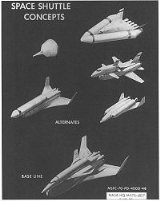
Spaceplane

Encyclopedia
A spaceplane is a vehicle that operates as an aircraft
in Earth's atmosphere, as well as a spacecraft
when it is in space
. It combines features of an aircraft and a spacecraft, which can be thought of as an aircraft that can endure and maneuver in the vacuum of space or likewise a spacecraft that can fly like an airplane. Typically, it takes the form of a spacecraft equipped with wing
s, although lifting bodies
have been designed and tested. The propulsion to reach space may be purely rocket based or may use the assistance of air-breathing engines.
To date, only pure rocket spaceplanes
have succeeded in reaching space, although several have been carried up to an altitude of several tens of thousands of feet by a purely atmospheric aircraft mothership before release. All spaceplanes have been vertical takeoff horizontal landing (VTHL) vehicles that use only rocket lift for the ascent phase in reaching space (excluding mothership first stage) and only used atmospheric lift for the reentry and landing phase.
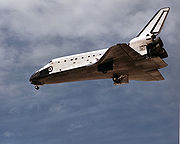 A spaceplane features some differences from rocket launch systems.
s in order to generate lift. For spaceplanes different shaped wings can be used, delta wings are common, but straight wings, lifting bodies
and even rotorcraft
have been proposed. Typically the force of lift generated by these surfaces is many times that of the drag
that they induce. The ratio of these forces (the Lift-to-drag ratio
or L/D) varies between different aircraft designs.
It can be as high as 60 in high performance gliders, but is usually closer to 7 or less for typical supersonic aircraft configurations, but may be significantly lower for hypersonic aerospace planes.
In practice a lift to drag ratio of 7 means that a thrust force equal to 1/7 of the weight of the aircraft is sufficient to support it in flight. This low thrust requirement significantly reduces the amount of fuel required to carry the weight of an aerospace plane in comparison to rocket launch systems which must provide thrust greater than the weight of the vehicle.
A partially off-setting difference between these systems is that the aerospace plane would typically experience powered flight for much longer periods of time than a rocket. In addition winged vehicles need extra dry mass for the wings, and this penalizes vehicles towards the end of the flight.
Rockets are also able to use their high thrust at an angle which gives reasonable lifting efficiency when burning for orbit. However, spaceplanes typically undergo what is called a "zoom maneuver" when transitioning from air-breathing flight to pure rocket propulsion to reach space, in which they change their attitude and climb rate significantly, translating some forward velocity into vertical velocity in order to get above the remaining atmosphere so the rocket engine can operate most efficiently.
s are designed for trajectories that do not reach orbital speed
, they do not need the kinds of thermal protection orbital spacecraft required during the hypersonic
phase of atmospheric reentry
. The Space Shuttle thermal protection system
, for example, protects the orbiter from surface temperatures that could otherwise reach as high as 3000 °F (1,648.9 °C), well above the melting point of steel.
s with chemical fuels. Due to the orbital insertion burn necessarily being done in space, orbital spaceplanes require rocket engines for at least that portion of the flight.
. Since the mass of the oxidizer is, at takeoff, the single largest mass of most rocket designs (the Space Shuttle
's liquid oxygen tank weighs 629,340 kg, more than one of its solid rocket booster
s), this provides a huge potential weight savings benefit. However, air breathing engines are usually very much heavier than rocket engines and the empty weight of the oxidiser tank, and since, unlike oxidiser, this extra weight must be carried into space it greatly offsets the overall system performance.
Types of air breathing engines proposed for spaceplanes include scramjet
, liquid air cycle engine
s, precooled jet engines, pulse detonation engine
and ramjet
s. Some engine designs combine several types of engines features into a combined cycle. For instance, the Rocket-based combined cycle
(RBCC) engine uses a rocket engine inside a ramscoop so that at low speed, the rockets thrust is boosted by ejector augmented thrust. It then transitions to ramjet propulsion at near-supersonic speeds, then to supersonic combustion or scramjet propulsion, above Mach 6, then back to pure rocket propulsion above Mach 10.
surfaces of the aerospace plane. These loads typically require special advanced materials, active cooling, or both for the structures to survive the environment.
However, even rocket-powered spaceplanes can face a significant thermal environment if they are burning for orbit, but this is nevertheless far less severe than air-breathing spaceplanes.
Suborbital space planes designed to briefly reach space do not require significant thermal protection, as they experience peak heating for only a short time during re-entry. Intercontinental suborbital trajectories require much higher speeds and thermal protection more similar to orbital spacecraft reentry.
can be active perhaps with some fins to aid stability. For a winged vehicle the centre of lift moves during the atmospheric flight as well as the centre of mass; and the vehicle spends longer in the atmosphere as well. Historically, the X-33 and HOTOL
spaceplanes were rear engined and had relatively heavy engines. This puts a heavy mass at the rear of the aircraft with wings that had to hold up the vehicle. As the wet mass reduces, the centre of mass tends to move rearward behind the centre of lift, which tends to be around the centre of the wings. This can cause severe instability that is usually solved by extra fins which add weight and decrease performance.
of Scaled Composites
recently patented a method of gluing the fuel tank directly to the vehicle skin, saving the weight of fasteners while also stiffening both parts.
Proponents of scramjet technology often cite such a vehicle as being a possible application of that type of engine, however pure rocket and subsonic combustion jet designs have also been proposed and may be easier to design and build. The main problem with SSTO operation is overall weight.
al spaceplanes successfully flown to date utilize a VTHL (vertical takeoff, horizontal landing) design. They include the piloted United States
Space Shuttle
and three unmanned spaceplanes: the early-1980s BOR-4
(subscale test vehicle for the Spiral spaceplane that was subsequently cancelled), the late-1980s Soviet
Buran
, and the early-2010s Boeing X-37
.
These vehicles have used wings
to provide aerobraking
to return from orbit and to provide lift
, allowing them to land on a runway
like conventional aircraft. These vehicles are still designed to ascend to orbit vertically under rocket
power like conventional expendable launch vehicles
. One drawback of spaceplanes is that they have a significantly smaller payload fraction
than a ballistic design with the same takeoff weight. This is in part due to the weight of the wings — around 9-12% of the weight of the atmospheric flight weight of the vehicle. This significantly reduces the payload size, but the reusability is intended to offset this disadvantage.
While all spaceplanes have used atmospheric lift for the reentry phase, none to date have succeeded in a design that relies on aerodynamic lift for the ascent phase in reaching space (excluding mothership first stage). Efforts such as the Sanger and X-30/X-33 have all failed to materialize into a vehicle capable of successfully reaching space. The Pegasus winged booster has had many successful flights to deploy orbital payloads, but since its aerodynamic vehicle component operates only as a booster, and not operate in space as a spacecraft, it is not typically considered to be a spaceplane.
On the other hand, OREX
is a test vehicle of HOPE-X
and launched into 450 km LEO using H-II
in 1994. OREX succeeded to reenter, but it was only hemispherical head of HOPE-X, that is, not plane-shaped.
, requiring far less energy for propulsion, and can use the vehicle's wings to provide lift for the ascent to space in addition to the rocket. As of 2010, the only such craft to reach space have been the X-15
and SpaceShipOne. Neither of these craft was capable of entering orbit. The X-15 and SpaceShipOne both began their independent flight only after being lifted to high altitude by a carrier aircraft.
Scaled Composites
and Virgin Galactic
unveiled on December 7, 2009, the SpaceShipTwo space plane, the VSS Enterprise, and its WhiteKnightTwo mothership, "Eve". SpaceShipTwo is designed to carry two pilots and six passengers on suborbital flights, with flight testing scheduled to be completed in the 2012 time frame.
XCOR Aerospace
signed a $30 million contract with Yecheon Astro Space Center to build and lease its Lynx Mark II
spaceplane, which would be designed to take off from a runway under its own rocket power, and to reach the same altitude and speed range as SpaceShipOne and SpaceShipTwo, due to the fact that Lynx is propelled by higher specific impulse fuels. Lynx is designed to only carry a pilot and one passenger, although tickets are expected to be around half those quoted for Virgin Galactic services.
Hyflex
is a miniaturized suborbital demonstrator of HOPE-X launched in 1996. Hyflex flew 110 km altitude and succeeded to reenter, though it was failed to recover.
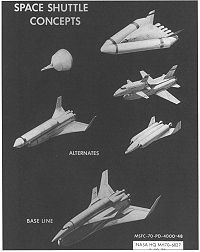 Various types of spaceplanes have been suggested since the early twentieth century. Notable early designs include Friedrich Zander
's spaceplane equipped with wings made of combustible alloys that it would burn during its ascent, and Eugen Sänger
's Silbervogel bomber design. Also in Nazi Germany
and then in the USA, winged versions of the V2 rocket were considered during and after World War II
, and when public interest in space exploration was high in the 1950s and '60s, winged rocket designs by Wernher von Braun
and Willy Ley
served to inspire science fiction
artists and filmmakers.
efforts of the late 1950s, but later ended these when they decided to use a modified version of Sänger's design. The result, Boeing X-20 Dyna-Soar, was to have been the first orbital spaceplane, but was canceled in the early 1960s in lieu of NASA
's Project Gemini
and the U.S. Air Force's Manned Orbiting Laboratory
program. The Rockwell X-30
National Aero-Space Plane (NASP), begun in the 1980s, was an attempt to build a scramjet vehicle capable of operating like an aircraft and achieving orbit like the shuttle. It was canceled due to increasing technical challenges, growing budgets, and the loss of public interest. In 1994 Mitchell Burnside Clapp proposed a single stage to orbit peroxide/kerosene spaceplane called "Black Horse
". This was notable in that it was to take off almost empty and undergo mid-air refueling
before accelerating to orbit.
The Lockheed Martin X-33
was a prototype made as part of an attempt by NASA to build a SSTO hydrogen-fuelled spaceplane VentureStar
that failed when the hydrogen tank design proved to be unconstructable in the planned way. The March 5, 2006 edition of Aviation Week & Space Technology
published a story purporting to be "outing" a highly classified U.S. military two-stage-to-orbit spaceplane system with the code name Blackstar
, SR-3/XOV among other nicknames. The alleged system, using an XB-70-like first-stage mother ship, capable of Mach 3, is said to launch an upper-stage "waverider
" spaceplane capable of carrying small payloads and crews near to or into orbit or on skip-diving flights, ostensibly for reconnaissance and other missions, achieving surprise that cannot be attained by satellite. There has been considerable controversy over this story and its claims.
In 1999 NASA started the Boeing X-37
project, an unmanned, remote controlled spaceplane. The project was transferred to the U.S. Department of Defense in 2004. It had its first flight as a drop test on 7 April 2006, at Edwards Air Force Base
. The spaceplane's first orbital mission, USA-212 was launched on 22 April 2010 using an Atlas V rocket, and the heat shield and hypersonic aerodynamic handling was tested. A second X-37B test flight was launched on 5 March 2011.
Boeing has proposed that a larger variant of the X-37B, the X-37C could be built to carry up to six passengers up to LEO. The spaceplane would also be usable for carrying cargo, with both upmass and downmass (return to Earth) cargo capacity. The ideal size for the proposed derivative "is approximately 165 to 180 percent of the current X-37B."
In December 2010, Orbital Sciences made a commercial proposal to NASA to develop the Prometheus
, a lifting-body
spaceplane vehicle about one-quarter the size of the Space Shuttle
, in response to NASA's Commercial Crew Development
(CCDev) solicitation. The vehicle would be launched on a human-rated (upgraded) Atlas V
rocket but would land on a runway.
For the same solicitation, Sierra Nevada Corporation
proposed extensions of its Dream Chaser spaceplane technology, partially developed under the first phase of NASA's CCDev program. Both the Orbital Sciences proposal and the Dream Chaser are lifting body
designs. Sierra Nevada will utilize Virgin Galactic
to market Dream Chaser commercial services and may use "Virgin’s WhiteKnightTwo carrier aircraft as a platform for drop trials of the Dream Chaser atmospheric test vehicle"
NASA expects to make approximately $200 million of phase 2 awards by March 2011, for technology development projects that could last up to 14 months.
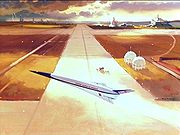 President Ronald Reagan
described NASP in his 1986 State of the Union
address as "...a new Orient Express that could, by the end of the next decade, take off from Dulles Airport and accelerate up to twenty-five times the speed of sound, attaining low earth orbit or flying to Tokyo within two hours..."
There were six identifiable technologies which were considered critical to the success of the NASP project. Three of these "enabling" technologies were related to the propulsion system, which would consist of a hydrogen-fueled scramjet. The NASP program became the Hypersonic Systems Technology Program (HySTP) in late 1994.
HySTP was designed to transfer the accomplishments made in hypersonic technologies by the National Aero-Space Plane (NASP) program into a technology development program. On January 27, 1995 the Air Force terminated participation in (HySTP).
firstly considered a preliminary design of rocket-launch small spaceplane Lapotok in early 1960s. Then the Spiral airspace system with small orbital spaceplane and rocket as second stage was widely developed in the 1960s-1980s. Although test flights of prototypes of spaceplane were fulfilled in air (MiG-105) and space (BOR-4
), program was canceled in 1987, a year before the first Buran
flight. Project of Tupolev
Design Bureau of military suborbital spaceplane-bomber Tu-136/139 Zvezda was canceled in early stage. Another project of Uragan spaceplane, a smaller sibling to Buran, launched by Proton and Zenit rockets, never been confirmed by Soviet or Russian authorities as really conducted, although an existence of similar project of Chelomei's LKS (Kosmolyot) spaceplane was confirmed.
: космоплан) capable of transporting passengers has been proposed by Russia's Institute of Applied Mechanics. According to researchers, it could take about 20 minutes to fly from Moscow
to Paris
, using hydrogen and oxygen fueled engines.
joint European program of ESA of Hermes manned spaceplane launched by Ariane rocket continued a few years before it was canceled in early 1990s. Earlier France Dassault-Avion company proposed Astrobus spaceplane and now develops ARES spaceplane as prototype for FLPP. Hopper
was proposed as European spaceplane by EADS
which also develops ARES spaceplane as prototype for ESA FLPP/FLTP program and commercial suborbital spaceplane
for space tourism
.
was a Japan
ese experimental spaceplane project designed by a partnership between NASDA
and NAL (both now part of JAXA
), started in the 1980s. It was positioned for most of its lifetime as one of the main Japanese contributions to the International Space Station
, the other being the Japanese Experiment Module
. The project was eventually cancelled in 2003, by which point test flights of a sub-scale testbed had flown successfully.
Sänger-Bredt RaBo and Silbervogel of the 1930s and 1940s, Eugen Sänger
worked for time on various space plane projects, coming up with several designs for Messerschmitt-Bölkow-Blohm
such as the MBB Raumtransporter-8. In the 1980s, West Germany funded design work on the MBB Sänger II with the Hypersonic Technology Program. Development continued on MBB/Deutsche Aerospace Sänger II/HORUS until the last 1980s, when it was canceled. Germany went on to participate in the Ariane rocket, Columbus space station and Hermes spaceplane of ESA, Spacelab
of ESA-NASA and Deutschland missions (non-U.S. funded Space Shuttle flights with Spacelab). The Sänger II had predicted cost savings of up to 30 percent over expendable rockets. The Daimler-Chrysler Aerospace RLV was a much later small reusable spaceplane prototype for ESA FLPP/FLTP program.
(MUSTARD) was a concept explored by the British
Aircraft Corporation (BAC) around 1964-1965 for launching payloads weighing as much as 5,000 lb into orbit. It was never constructed. The British Government also began development of a SSTO-spaceplane, called HOTOL
, but the project was canceled due to technical and financial issues.
The lead engineer from the HOTOL project has since set up a private company dedicated to creating a similar plane called Skylon with a different combined cycle rocket/turbine precooled jet engine called SABRE. This vehicle is intended to be capable of a single stage to orbit launch also and, if successful, would be far in advance of anything currently in operation.
, being developed by India's Defense Research and Development Organization along with Indian Space Research Organization and other research institutions; it could be used for cheaper military and civilian satellite
launches.
Aircraft
An aircraft is a vehicle that is able to fly by gaining support from the air, or, in general, the atmosphere of a planet. An aircraft counters the force of gravity by using either static lift or by using the dynamic lift of an airfoil, or in a few cases the downward thrust from jet engines.Although...
in Earth's atmosphere, as well as a spacecraft
Spacecraft
A spacecraft or spaceship is a craft or machine designed for spaceflight. Spacecraft are used for a variety of purposes, including communications, earth observation, meteorology, navigation, planetary exploration and transportation of humans and cargo....
when it is in space
Karman line
The Kármán line lies at an altitude of above the Earth's sea level, and is commonly used to define the boundary between the Earth's atmosphere and outer space...
. It combines features of an aircraft and a spacecraft, which can be thought of as an aircraft that can endure and maneuver in the vacuum of space or likewise a spacecraft that can fly like an airplane. Typically, it takes the form of a spacecraft equipped with wing
Wing
A wing is an appendage with a surface that produces lift for flight or propulsion through the atmosphere, or through another gaseous or liquid fluid...
s, although lifting bodies
Lifting body
A lifting body is a fixed-wing aircraft configuration in which the body itself produces lift. In contrast to a flying wing, which is a wing with minimal or no conventional fuselage, a lifting body can be thought of as a fuselage with little or no conventional wing...
have been designed and tested. The propulsion to reach space may be purely rocket based or may use the assistance of air-breathing engines.
To date, only pure rocket spaceplanes
Rocket-powered aircraft
A rocket-powered aircraft or rocket plane is an aircraft that uses a rocket for propulsion, sometimes in addition to airbreathing jet engines. Rocket planes can achieve much higher speeds than similarly sized jet aircraft, but typically for at most a few minutes of powered operation, followed by a...
have succeeded in reaching space, although several have been carried up to an altitude of several tens of thousands of feet by a purely atmospheric aircraft mothership before release. All spaceplanes have been vertical takeoff horizontal landing (VTHL) vehicles that use only rocket lift for the ascent phase in reaching space (excluding mothership first stage) and only used atmospheric lift for the reentry and landing phase.
Description
Aerodynamic lift
All aircraft utilize aerodynamic surfaceWing
A wing is an appendage with a surface that produces lift for flight or propulsion through the atmosphere, or through another gaseous or liquid fluid...
s in order to generate lift. For spaceplanes different shaped wings can be used, delta wings are common, but straight wings, lifting bodies
Lifting body
A lifting body is a fixed-wing aircraft configuration in which the body itself produces lift. In contrast to a flying wing, which is a wing with minimal or no conventional fuselage, a lifting body can be thought of as a fuselage with little or no conventional wing...
and even rotorcraft
Rotorcraft
A rotorcraft or rotary wing aircraft is a heavier-than-air flying machine that uses lift generated by wings, called rotor blades, that revolve around a mast. Several rotor blades mounted to a single mast are referred to as a rotor. The International Civil Aviation Organization defines a rotorcraft...
have been proposed. Typically the force of lift generated by these surfaces is many times that of the drag
Drag (physics)
In fluid dynamics, drag refers to forces which act on a solid object in the direction of the relative fluid flow velocity...
that they induce. The ratio of these forces (the Lift-to-drag ratio
Lift-to-drag ratio
In aerodynamics, the lift-to-drag ratio, or L/D ratio, is the amount of lift generated by a wing or vehicle, divided by the drag it creates by moving through the air...
or L/D) varies between different aircraft designs.
It can be as high as 60 in high performance gliders, but is usually closer to 7 or less for typical supersonic aircraft configurations, but may be significantly lower for hypersonic aerospace planes.
In practice a lift to drag ratio of 7 means that a thrust force equal to 1/7 of the weight of the aircraft is sufficient to support it in flight. This low thrust requirement significantly reduces the amount of fuel required to carry the weight of an aerospace plane in comparison to rocket launch systems which must provide thrust greater than the weight of the vehicle.
A partially off-setting difference between these systems is that the aerospace plane would typically experience powered flight for much longer periods of time than a rocket. In addition winged vehicles need extra dry mass for the wings, and this penalizes vehicles towards the end of the flight.
Rockets are also able to use their high thrust at an angle which gives reasonable lifting efficiency when burning for orbit. However, spaceplanes typically undergo what is called a "zoom maneuver" when transitioning from air-breathing flight to pure rocket propulsion to reach space, in which they change their attitude and climb rate significantly, translating some forward velocity into vertical velocity in order to get above the remaining atmosphere so the rocket engine can operate most efficiently.
Atmospheric reentry
Because suborbital spaceplaneSuborbital spaceplane
A suborbital spaceplane is a spaceplane designed specifically for sub-orbital spaceflight. A few projects of civil and military suborbital spaceplanes were in past in Nazi Germany, United States, Soviet Union etc. From the beginning of 21st century, it is expected that this type of spacecraft, as...
s are designed for trajectories that do not reach orbital speed
Orbital speed
The orbital speed of a body, generally a planet, a natural satellite, an artificial satellite, or a multiple star, is the speed at which it orbits around the barycenter of a system, usually around a more massive body...
, they do not need the kinds of thermal protection orbital spacecraft required during the hypersonic
Hypersonic
In aerodynamics, a hypersonic speed is one that is highly supersonic. Since the 1970s, the term has generally been assumed to refer to speeds of Mach 5 and above...
phase of atmospheric reentry
Atmospheric reentry
Atmospheric entry is the movement of human-made or natural objects as they enter the atmosphere of a celestial body from outer space—in the case of Earth from an altitude above the Kármán Line,...
. The Space Shuttle thermal protection system
Space Shuttle thermal protection system
The Space Shuttle thermal protection system is the barrier that protects the Space Shuttle Orbiter during the searing heat of atmospheric reentry...
, for example, protects the orbiter from surface temperatures that could otherwise reach as high as 3000 °F (1,648.9 °C), well above the melting point of steel.
Propulsion
Rocket engines
All spaceplanes to date have used rocket engineRocket engine
A rocket engine, or simply "rocket", is a jet engineRocket Propulsion Elements; 7th edition- chapter 1 that uses only propellant mass for forming its high speed propulsive jet. Rocket engines are reaction engines and obtain thrust in accordance with Newton's third law...
s with chemical fuels. Due to the orbital insertion burn necessarily being done in space, orbital spaceplanes require rocket engines for at least that portion of the flight.
Air breathing engines
A difference between rocket based and air-breathing aerospace plane launch systems is that aerospace plane designs typically include minimal oxidizer storage for propulsion. Air-breathing aerospace plane designs include engine inlets so they can use atmospheric oxygen for combustionCombustion
Combustion or burning is the sequence of exothermic chemical reactions between a fuel and an oxidant accompanied by the production of heat and conversion of chemical species. The release of heat can result in the production of light in the form of either glowing or a flame...
. Since the mass of the oxidizer is, at takeoff, the single largest mass of most rocket designs (the Space Shuttle
Space Shuttle
The Space Shuttle was a manned orbital rocket and spacecraft system operated by NASA on 135 missions from 1981 to 2011. The system combined rocket launch, orbital spacecraft, and re-entry spaceplane with modular add-ons...
's liquid oxygen tank weighs 629,340 kg, more than one of its solid rocket booster
Space Shuttle Solid Rocket Booster
The Space Shuttle Solid Rocket Boosters were the pair of large solid rockets used by the United States' NASA Space Shuttle during the first two minutes of powered flight. Together they provided about 83% of liftoff thrust for the Space Shuttle. They were located on either side of the rusty or...
s), this provides a huge potential weight savings benefit. However, air breathing engines are usually very much heavier than rocket engines and the empty weight of the oxidiser tank, and since, unlike oxidiser, this extra weight must be carried into space it greatly offsets the overall system performance.
Types of air breathing engines proposed for spaceplanes include scramjet
Scramjet
A scramjet is a variant of a ramjet airbreathing jet engine in which combustion takes place in supersonic airflow...
, liquid air cycle engine
Liquid air cycle engine
A Liquid Air Cycle Engine is a type of spacecraft propulsion engine that attempts to increase its efficiency by gathering part of its oxidizer from the atmosphere...
s, precooled jet engines, pulse detonation engine
Pulse detonation engine
A pulse detonation engine, or "PDE", is a type of propulsion system that uses detonation waves to combust the fuel and oxidizer mixture. The engine is pulsed because the mixture must be renewed in the combustion chamber between each detonation wave initiated by an ignition source. Theoretically, a...
and ramjet
Ramjet
A ramjet, sometimes referred to as a stovepipe jet, or an athodyd, is a form of airbreathing jet engine using the engine's forward motion to compress incoming air, without a rotary compressor. Ramjets cannot produce thrust at zero airspeed and thus cannot move an aircraft from a standstill...
s. Some engine designs combine several types of engines features into a combined cycle. For instance, the Rocket-based combined cycle
Rocket-based combined cycle
The RBCC, or Rocket-Based Combined Cycle, is one of the two types of propulsion systems that may be used in the Boeing X-43 experimental aircraft....
(RBCC) engine uses a rocket engine inside a ramscoop so that at low speed, the rockets thrust is boosted by ejector augmented thrust. It then transitions to ramjet propulsion at near-supersonic speeds, then to supersonic combustion or scramjet propulsion, above Mach 6, then back to pure rocket propulsion above Mach 10.
Harsh flight environment
The flight trajectory required of air-breathing aerospace vehicles to reach orbit is to fly what is known as a 'depressed trajectory' which places the aerospace plane in the high-altitude hypersonic flight regime of the atmosphere. This environment induces high dynamic pressure, high temperature, and high heat flow loads particularly upon the leading edgeLeading edge
The leading edge is the part of the wing that first contacts the air; alternatively it is the foremost edge of an airfoil section. The first is an aerodynamic definition, the second a structural one....
surfaces of the aerospace plane. These loads typically require special advanced materials, active cooling, or both for the structures to survive the environment.
However, even rocket-powered spaceplanes can face a significant thermal environment if they are burning for orbit, but this is nevertheless far less severe than air-breathing spaceplanes.
Suborbital space planes designed to briefly reach space do not require significant thermal protection, as they experience peak heating for only a short time during re-entry. Intercontinental suborbital trajectories require much higher speeds and thermal protection more similar to orbital spacecraft reentry.
Center of mass issues
A wingless launch vehicle has lower aerodynamic forces affecting the vehicle, and attitude controlFlight dynamics
Flight dynamics is the science of air vehicle orientation and control in three dimensions. The three critical flight dynamics parameters are the angles of rotation in three dimensions about the vehicle's center of mass, known as pitch, roll and yaw .Aerospace engineers develop control systems for...
can be active perhaps with some fins to aid stability. For a winged vehicle the centre of lift moves during the atmospheric flight as well as the centre of mass; and the vehicle spends longer in the atmosphere as well. Historically, the X-33 and HOTOL
HOTOL
HOTOL, for Horizontal Take-Off and Landing, was a British air-breathing space shuttle effort by Rolls Royce and British Aerospace.Designed as a single-stage-to-orbit reusable winged launch vehicle, it was to be fitted with a unique air-breathing engine, the RB545 called the Swallow, to be...
spaceplanes were rear engined and had relatively heavy engines. This puts a heavy mass at the rear of the aircraft with wings that had to hold up the vehicle. As the wet mass reduces, the centre of mass tends to move rearward behind the centre of lift, which tends to be around the centre of the wings. This can cause severe instability that is usually solved by extra fins which add weight and decrease performance.
Overall weight
A vertically launched rocket forms the shape of a cylinder stood on end. This structure can be made very light and strong. A horizontally launched spaceplane approximates a cylinder on its side. This structure experiences greater bending forces, so must be strengthened. This makes it heavier, requiring advanced materials and design techniques to reduce weight. For example Burt RutanBurt Rutan
Elbert Leander "Burt" Rutan is an American aerospace engineer noted for his originality in designing light, strong, unusual-looking, energy-efficient aircraft...
of Scaled Composites
Scaled Composites
Scaled Composites is an aerospace company founded by Burt Rutan and currently owned by Northrop Grumman that is located at the Mojave Spaceport, Mojave, California, United States...
recently patented a method of gluing the fuel tank directly to the vehicle skin, saving the weight of fasteners while also stiffening both parts.
Single stage to orbit
Future orbital spaceplanes may take off, ascend, descend, and land like conventional aircraft, providing true single stage to orbit (SSTO) capability.Proponents of scramjet technology often cite such a vehicle as being a possible application of that type of engine, however pure rocket and subsonic combustion jet designs have also been proposed and may be easier to design and build. The main problem with SSTO operation is overall weight.
Orbital spaceplanes
All four of the orbitOrbit
In physics, an orbit is the gravitationally curved path of an object around a point in space, for example the orbit of a planet around the center of a star system, such as the Solar System...
al spaceplanes successfully flown to date utilize a VTHL (vertical takeoff, horizontal landing) design. They include the piloted United States
United States
The United States of America is a federal constitutional republic comprising fifty states and a federal district...
Space Shuttle
Space Shuttle
The Space Shuttle was a manned orbital rocket and spacecraft system operated by NASA on 135 missions from 1981 to 2011. The system combined rocket launch, orbital spacecraft, and re-entry spaceplane with modular add-ons...
and three unmanned spaceplanes: the early-1980s BOR-4
BOR-4
The BOR-4 flight vehicle is a scaled prototype of the Soviet Spiral VTHL spaceplane. An unmanned, subscale craft, its purpose was to test the heatshield tiles and reinforced carbon-carbon for the Buran space shuttle, then under development...
(subscale test vehicle for the Spiral spaceplane that was subsequently cancelled), the late-1980s Soviet
Soviet Union
The Soviet Union , officially the Union of Soviet Socialist Republics , was a constitutionally socialist state that existed in Eurasia between 1922 and 1991....
Buran
Shuttle Buran
The Buran spacecraft , GRAU index 11F35 K1 was a Russian orbital vehicle analogous in function and design to the US Space Shuttle and developed by Chief Designer Gleb Lozino-Lozinskiy of Energia rocket corporation...
, and the early-2010s Boeing X-37
Boeing X-37
The Boeing X-37 is an American unmanned vertical-takeoff, horizontal-landing spaceplane. The X-37 is operated by the United States Air Force for orbital spaceflight missions intended to demonstrate reusable space technologies...
.
These vehicles have used wings
Airfoil
An airfoil or aerofoil is the shape of a wing or blade or sail as seen in cross-section....
to provide aerobraking
Aerobraking
Aerobraking is a spaceflight maneuver that reduces the high point of an elliptical orbit by flying the vehicle through the atmosphere at the low point of the orbit . The resulting drag slows the spacecraft...
to return from orbit and to provide lift
Lift (force)
A fluid flowing past the surface of a body exerts a surface force on it. Lift is the component of this force that is perpendicular to the oncoming flow direction. It contrasts with the drag force, which is the component of the surface force parallel to the flow direction...
, allowing them to land on a runway
Runway
According to ICAO a runway is a "defined rectangular area on a land aerodrome prepared for the landing and take-off of aircraft." Runways may be a man-made surface or a natural surface .- Orientation and dimensions :Runways are named by a number between 01 and 36, which is generally one tenth...
like conventional aircraft. These vehicles are still designed to ascend to orbit vertically under rocket
Rocket
A rocket is a missile, spacecraft, aircraft or other vehicle which obtains thrust from a rocket engine. In all rockets, the exhaust is formed entirely from propellants carried within the rocket before use. Rocket engines work by action and reaction...
power like conventional expendable launch vehicles
Expendable launch system
An expendable launch system is a launch system that uses an expendable launch vehicle to carry a payload into space. The vehicles used in expendable launch systems are designed to be used only once , and their components are not recovered for re-use after launch...
. One drawback of spaceplanes is that they have a significantly smaller payload fraction
Payload fraction
In aerospace engineering, payload fraction is a common term used to characterize the efficiency of a particular design. Payload fraction is calculated by dividing the weight of the payload by the weight of the otherwise empty aircraft when fully fueled...
than a ballistic design with the same takeoff weight. This is in part due to the weight of the wings — around 9-12% of the weight of the atmospheric flight weight of the vehicle. This significantly reduces the payload size, but the reusability is intended to offset this disadvantage.
While all spaceplanes have used atmospheric lift for the reentry phase, none to date have succeeded in a design that relies on aerodynamic lift for the ascent phase in reaching space (excluding mothership first stage). Efforts such as the Sanger and X-30/X-33 have all failed to materialize into a vehicle capable of successfully reaching space. The Pegasus winged booster has had many successful flights to deploy orbital payloads, but since its aerodynamic vehicle component operates only as a booster, and not operate in space as a spacecraft, it is not typically considered to be a spaceplane.
On the other hand, OREX
OREX
OREX was a NASDA reentry demonstrator prototype which was launched in 1994 on the H-II launcher. It was a precursor for the Japanese space Shuttle Hope....
is a test vehicle of HOPE-X
HOPE-X
HOPE was a Japanese experimental spaceplane project designed by a partnership between NASDA and NAL , started in the 1980s. It was positioned for most of its lifetime as one of the main Japanese contributions to the International Space Station, the other being the Japanese Experiment Module...
and launched into 450 km LEO using H-II
H-II
The H-II rocket was a Japanese satellite launch system, which flew seven times between 1994 and 1999, with five successes. It was developed by NASDA in order to give Japan a capability to launch larger satellites in the 1990s. It was the first two-stage liquid-fuelled rocket Japan made using only...
in 1994. OREX succeeded to reenter, but it was only hemispherical head of HOPE-X, that is, not plane-shaped.
Suborbital spaceplanes
Other spaceplane designs are suborbitalSuborbital spaceplane
A suborbital spaceplane is a spaceplane designed specifically for sub-orbital spaceflight. A few projects of civil and military suborbital spaceplanes were in past in Nazi Germany, United States, Soviet Union etc. From the beginning of 21st century, it is expected that this type of spacecraft, as...
, requiring far less energy for propulsion, and can use the vehicle's wings to provide lift for the ascent to space in addition to the rocket. As of 2010, the only such craft to reach space have been the X-15
North American X-15
The North American X-15 rocket-powered aircraft/spaceplane was part of the X-series of experimental aircraft, initiated with the Bell X-1, that were made for the USAAF/USAF, NACA/NASA, and the USN. The X-15 set speed and altitude records in the early 1960s, reaching the edge of outer space and...
and SpaceShipOne. Neither of these craft was capable of entering orbit. The X-15 and SpaceShipOne both began their independent flight only after being lifted to high altitude by a carrier aircraft.
Scaled Composites
Scaled Composites
Scaled Composites is an aerospace company founded by Burt Rutan and currently owned by Northrop Grumman that is located at the Mojave Spaceport, Mojave, California, United States...
and Virgin Galactic
Virgin Galactic
Virgin Galactic is a company within Richard Branson's Virgin Group which plans to provide sub-orbital spaceflights to the paying public, along with suborbital space science missions and orbital launches of small satellites...
unveiled on December 7, 2009, the SpaceShipTwo space plane, the VSS Enterprise, and its WhiteKnightTwo mothership, "Eve". SpaceShipTwo is designed to carry two pilots and six passengers on suborbital flights, with flight testing scheduled to be completed in the 2012 time frame.
XCOR Aerospace
XCOR Aerospace
XCOR Aerospace is an American private rocket engine and spaceflight development company based at the Mojave Spaceport in Mojave, California. XCOR was formed by former members of the Rotary Rocket rocket engine development team in September, 1999...
signed a $30 million contract with Yecheon Astro Space Center to build and lease its Lynx Mark II
Lynx rocketplane
The Lynx rocketplane is a suborbital horizontal-takeoff, horizontal-landing ,rocket-powered spaceplane being developed by the California-based company XCOR to compete in the emerging suborbital space flight market. The Lynx is projected to carry one pilot, a ticketed passenger, and/or a payload or...
spaceplane, which would be designed to take off from a runway under its own rocket power, and to reach the same altitude and speed range as SpaceShipOne and SpaceShipTwo, due to the fact that Lynx is propelled by higher specific impulse fuels. Lynx is designed to only carry a pilot and one passenger, although tickets are expected to be around half those quoted for Virgin Galactic services.
Hyflex
Hyflex
Hyflex was a NASDA reentry demonstrator prototype which was launched in 1996 on the only flight of the J-I launcher...
is a miniaturized suborbital demonstrator of HOPE-X launched in 1996. Hyflex flew 110 km altitude and succeeded to reenter, though it was failed to recover.
Other projects
Friedrich Zander
Friedrich Zander , often transliterated Fridrikh Arturovich Tsander, was a pioneer of rocketry and spaceflight in the Russian Empire and the Soviet Union...
's spaceplane equipped with wings made of combustible alloys that it would burn during its ascent, and Eugen Sänger
Eugen Sänger
Eugen Sänger was an Austrian-German aerospace engineer best known for his contributions to lifting body and ramjet technology.-Early career:...
's Silbervogel bomber design. Also in Nazi Germany
Nazi Germany
Nazi Germany , also known as the Third Reich , but officially called German Reich from 1933 to 1943 and Greater German Reich from 26 June 1943 onward, is the name commonly used to refer to the state of Germany from 1933 to 1945, when it was a totalitarian dictatorship ruled by...
and then in the USA, winged versions of the V2 rocket were considered during and after World War II
World War II
World War II, or the Second World War , was a global conflict lasting from 1939 to 1945, involving most of the world's nations—including all of the great powers—eventually forming two opposing military alliances: the Allies and the Axis...
, and when public interest in space exploration was high in the 1950s and '60s, winged rocket designs by Wernher von Braun
Wernher von Braun
Wernher Magnus Maximilian, Freiherr von Braun was a German rocket scientist, aerospace engineer, space architect, and one of the leading figures in the development of rocket technology in Nazi Germany during World War II and in the United States after that.A former member of the Nazi party,...
and Willy Ley
Willy Ley
Willy Ley was a German-American science writer and space advocate who helped popularize rocketry and spaceflight in both Germany and the United States. The crater Ley on the far side of the Moon is named in his honor.-Life:...
served to inspire science fiction
Science fiction
Science fiction is a genre of fiction dealing with imaginary but more or less plausible content such as future settings, futuristic science and technology, space travel, aliens, and paranormal abilities...
artists and filmmakers.
United States
The U.S. Air Force invested some effort in a paper study of a variety of spaceplane projects under their AerospaceplaneAerospaceplane
The US Air Force's aerospaceplane project encompassed a variety of projects from 1958 until 1963 to study a fully reusable spaceplane. A variety of designs were studied during the lifetime of the project, including most of the early efforts on liquid air cycle engines and even a nuclear-powered...
efforts of the late 1950s, but later ended these when they decided to use a modified version of Sänger's design. The result, Boeing X-20 Dyna-Soar, was to have been the first orbital spaceplane, but was canceled in the early 1960s in lieu of NASA
NASA
The National Aeronautics and Space Administration is the agency of the United States government that is responsible for the nation's civilian space program and for aeronautics and aerospace research...
's Project Gemini
Project Gemini
Project Gemini was the second human spaceflight program of NASA, the civilian space agency of the United States government. Project Gemini was conducted between projects Mercury and Apollo, with ten manned flights occurring in 1965 and 1966....
and the U.S. Air Force's Manned Orbiting Laboratory
Manned Orbiting Laboratory
The Manned Orbiting Laboratory , originally referred to as the Manned Orbital Laboratory, was part of the United States Air Force's manned spaceflight program, a successor to the cancelled Boeing X-20 Dyna-Soar military reconnaissance space plane project...
program. The Rockwell X-30
Rockwell X-30
-See also:-References: 2. -External links:*...
National Aero-Space Plane (NASP), begun in the 1980s, was an attempt to build a scramjet vehicle capable of operating like an aircraft and achieving orbit like the shuttle. It was canceled due to increasing technical challenges, growing budgets, and the loss of public interest. In 1994 Mitchell Burnside Clapp proposed a single stage to orbit peroxide/kerosene spaceplane called "Black Horse
Black Horse (spaceplane)
The Black Horse was a study for a proposed winged, single stage to orbit launch vehicle using aerial refueling and lower performance, non-cryogenic propellants.- External links :* * * -...
". This was notable in that it was to take off almost empty and undergo mid-air refueling
Aerial refueling
Aerial refueling, also called air refueling, in-flight refueling , air-to-air refueling or tanking, is the process of transferring fuel from one aircraft to another during flight....
before accelerating to orbit.
The Lockheed Martin X-33
Lockheed Martin X-33
The Lockheed Martin X-33 was an unmanned, sub-scale technology demonstrator suborbital spaceplane developed in the 1990s under the U.S. government-funded Space Launch Initiative program. The X-33 was a technology demonstrator for the VentureStar orbital spaceplane, which was planned to be a...
was a prototype made as part of an attempt by NASA to build a SSTO hydrogen-fuelled spaceplane VentureStar
VentureStar
VentureStar was a proposed spaceplane design for a single-stage-to-orbit reusable launch system by Lockheed Martin. The program's primary goal as a United States federally funded program was to develop a reusable unmanned spaceplane for launching satellites into orbit at a fraction of the cost of...
that failed when the hydrogen tank design proved to be unconstructable in the planned way. The March 5, 2006 edition of Aviation Week & Space Technology
Aviation Week & Space Technology
Aviation Week & Space Technology, often abbreviated Aviation Week or AW&ST, is a weekly magazine owned and published by McGraw-Hill...
published a story purporting to be "outing" a highly classified U.S. military two-stage-to-orbit spaceplane system with the code name Blackstar
Blackstar (spaceplane)
Blackstar is the reported codename of a secret United States orbital spaceplane system. The possible existence of the Blackstar program was reported in March 2006 by Aviation Week & Space Technology magazine; the magazine reported that the program had been underway since at least the early 1990s,...
, SR-3/XOV among other nicknames. The alleged system, using an XB-70-like first-stage mother ship, capable of Mach 3, is said to launch an upper-stage "waverider
Waverider
A waverider is a hypersonic aircraft design that improves its supersonic lift-to-drag ratio by using the shock waves being generated by its own flight as a lifting surface. To date the only aircraft to use the technique is the Mach 3 supersonic XB-70 Valkyrie, which was waverider-like with its...
" spaceplane capable of carrying small payloads and crews near to or into orbit or on skip-diving flights, ostensibly for reconnaissance and other missions, achieving surprise that cannot be attained by satellite. There has been considerable controversy over this story and its claims.
In 1999 NASA started the Boeing X-37
Boeing X-37
The Boeing X-37 is an American unmanned vertical-takeoff, horizontal-landing spaceplane. The X-37 is operated by the United States Air Force for orbital spaceflight missions intended to demonstrate reusable space technologies...
project, an unmanned, remote controlled spaceplane. The project was transferred to the U.S. Department of Defense in 2004. It had its first flight as a drop test on 7 April 2006, at Edwards Air Force Base
Edwards Air Force Base
Edwards Air Force Base is a United States Air Force base located on the border of Kern County, Los Angeles County, and San Bernardino County, California, in the Antelope Valley. It is southwest of the central business district of North Edwards, California and due east of Rosamond.It is named in...
. The spaceplane's first orbital mission, USA-212 was launched on 22 April 2010 using an Atlas V rocket, and the heat shield and hypersonic aerodynamic handling was tested. A second X-37B test flight was launched on 5 March 2011.
Boeing has proposed that a larger variant of the X-37B, the X-37C could be built to carry up to six passengers up to LEO. The spaceplane would also be usable for carrying cargo, with both upmass and downmass (return to Earth) cargo capacity. The ideal size for the proposed derivative "is approximately 165 to 180 percent of the current X-37B."
In December 2010, Orbital Sciences made a commercial proposal to NASA to develop the Prometheus
Prometheus (spacecraft)
Prometheus was a proposed manned vertical-takeoff, horizontal-landing spaceplane concept put forward by Orbital Sciences Corporation in late 2010 as part of the second phase of NASA's Commercial Crew Development program.-Design:...
, a lifting-body
Lifting body
A lifting body is a fixed-wing aircraft configuration in which the body itself produces lift. In contrast to a flying wing, which is a wing with minimal or no conventional fuselage, a lifting body can be thought of as a fuselage with little or no conventional wing...
spaceplane vehicle about one-quarter the size of the Space Shuttle
Space Shuttle
The Space Shuttle was a manned orbital rocket and spacecraft system operated by NASA on 135 missions from 1981 to 2011. The system combined rocket launch, orbital spacecraft, and re-entry spaceplane with modular add-ons...
, in response to NASA's Commercial Crew Development
Commercial Crew Development
Commercial Crew Development is a multiphase space technology development program, funded by the U.S. government, and administered by NASA. The program is intended to stimulate development of privately operated crew vehicles to low Earth orbit. It is run by the Commercial Crew and Cargo Program...
(CCDev) solicitation. The vehicle would be launched on a human-rated (upgraded) Atlas V
Atlas V
Atlas V is an active expendable launch system in the Atlas rocket family. Atlas V was formerly operated by Lockheed Martin, and is now operated by the Lockheed Martin-Boeing joint venture United Launch Alliance...
rocket but would land on a runway.
For the same solicitation, Sierra Nevada Corporation
Sierra Nevada Corporation
Sierra Nevada Corporation is an electronic systems provider and systems integrator specializing in microsatellites, energy, telemedicine, nanotechnology, and commercial orbital transportation services. The company contracts with the US military, NASA and private spaceflight companies. The company...
proposed extensions of its Dream Chaser spaceplane technology, partially developed under the first phase of NASA's CCDev program. Both the Orbital Sciences proposal and the Dream Chaser are lifting body
Lifting body
A lifting body is a fixed-wing aircraft configuration in which the body itself produces lift. In contrast to a flying wing, which is a wing with minimal or no conventional fuselage, a lifting body can be thought of as a fuselage with little or no conventional wing...
designs. Sierra Nevada will utilize Virgin Galactic
Virgin Galactic
Virgin Galactic is a company within Richard Branson's Virgin Group which plans to provide sub-orbital spaceflights to the paying public, along with suborbital space science missions and orbital launches of small satellites...
to market Dream Chaser commercial services and may use "Virgin’s WhiteKnightTwo carrier aircraft as a platform for drop trials of the Dream Chaser atmospheric test vehicle"
NASA expects to make approximately $200 million of phase 2 awards by March 2011, for technology development projects that could last up to 14 months.
National Aerospace Plane
Ronald Reagan
Ronald Wilson Reagan was the 40th President of the United States , the 33rd Governor of California and, prior to that, a radio, film and television actor....
described NASP in his 1986 State of the Union
State Of The Union
"State Of The Union" is the debut single from British singer-songwriter David Ford. It had previously been featured as a demo on his official website, before appearing as a track on a CD entitled "Apology Demos EP," only on sale at live shows....
address as "...a new Orient Express that could, by the end of the next decade, take off from Dulles Airport and accelerate up to twenty-five times the speed of sound, attaining low earth orbit or flying to Tokyo within two hours..."
There were six identifiable technologies which were considered critical to the success of the NASP project. Three of these "enabling" technologies were related to the propulsion system, which would consist of a hydrogen-fueled scramjet. The NASP program became the Hypersonic Systems Technology Program (HySTP) in late 1994.
HySTP was designed to transfer the accomplishments made in hypersonic technologies by the National Aero-Space Plane (NASP) program into a technology development program. On January 27, 1995 the Air Force terminated participation in (HySTP).
Soviet Union and Russia
The Soviet UnionSoviet Union
The Soviet Union , officially the Union of Soviet Socialist Republics , was a constitutionally socialist state that existed in Eurasia between 1922 and 1991....
firstly considered a preliminary design of rocket-launch small spaceplane Lapotok in early 1960s. Then the Spiral airspace system with small orbital spaceplane and rocket as second stage was widely developed in the 1960s-1980s. Although test flights of prototypes of spaceplane were fulfilled in air (MiG-105) and space (BOR-4
BOR-4
The BOR-4 flight vehicle is a scaled prototype of the Soviet Spiral VTHL spaceplane. An unmanned, subscale craft, its purpose was to test the heatshield tiles and reinforced carbon-carbon for the Buran space shuttle, then under development...
), program was canceled in 1987, a year before the first Buran
Buran
Buran may refer to:* Buran , a Soviet space shuttle** Buran program, which developed the spacecraft* Buran eavesdropping device, invented by Léon Theremin, used by soviet intelligence* Buran cruise missile, a Soviet cruise missile...
flight. Project of Tupolev
Tupolev
Tupolev is a Russian aerospace and defence company, headquartered in Basmanny District, Central Administrative Okrug, Moscow. Known officially as Public Stock Company Tupolev, it is the successor of the Tupolev OKB or Tupolev Design Bureau headed by the Soviet aerospace engineer A.N. Tupolev...
Design Bureau of military suborbital spaceplane-bomber Tu-136/139 Zvezda was canceled in early stage. Another project of Uragan spaceplane, a smaller sibling to Buran, launched by Proton and Zenit rockets, never been confirmed by Soviet or Russian authorities as really conducted, although an existence of similar project of Chelomei's LKS (Kosmolyot) spaceplane was confirmed.
Cosmoplane
In recent times, an orbital spaceplane, called cosmoplane (RussianRussian language
Russian is a Slavic language used primarily in Russia, Belarus, Uzbekistan, Kazakhstan, Tajikistan and Kyrgyzstan. It is an unofficial but widely spoken language in Ukraine, Moldova, Latvia, Turkmenistan and Estonia and, to a lesser extent, the other countries that were once constituent republics...
: космоплан) capable of transporting passengers has been proposed by Russia's Institute of Applied Mechanics. According to researchers, it could take about 20 minutes to fly from Moscow
Moscow
Moscow is the capital, the most populous city, and the most populous federal subject of Russia. The city is a major political, economic, cultural, scientific, religious, financial, educational, and transportation centre of Russia and the continent...
to Paris
Paris
Paris is the capital and largest city in France, situated on the river Seine, in northern France, at the heart of the Île-de-France region...
, using hydrogen and oxygen fueled engines.
France
Initiated by FranceFrance
The French Republic , The French Republic , The French Republic , (commonly known as France , is a unitary semi-presidential republic in Western Europe with several overseas territories and islands located on other continents and in the Indian, Pacific, and Atlantic oceans. Metropolitan France...
joint European program of ESA of Hermes manned spaceplane launched by Ariane rocket continued a few years before it was canceled in early 1990s. Earlier France Dassault-Avion company proposed Astrobus spaceplane and now develops ARES spaceplane as prototype for FLPP. Hopper
Hopper (spacecraft)
Hopper was a proposed European Space Agency orbital and reusable launch vehicle. The shuttle prototype spaceplane was one of several proposals for a European reusable launch vehicle planned to cheaply ferry satellites into orbit by 2015...
was proposed as European spaceplane by EADS
EADS
The European Aeronautic Defence and Space Company N.V. is a global pan-European aerospace and defence corporation and a leading defence and military contractor worldwide...
which also develops ARES spaceplane as prototype for ESA FLPP/FLTP program and commercial suborbital spaceplane
EADS Astrium Space Tourism Project
The EADS Astrium Space Tourism Project, also called EADS Astrium TBN according to some sources, is a suborbital spaceplane concept for carrying space tourists, proposed by EADS Astrium, the space subsidiary of the European consortium EADS. A mockup was officially unveiled in Paris on June 13,...
for space tourism
Space tourism
Space Tourism is space travel for recreational, leisure or business purposes. A number of startup companies have sprung up in recent years, hoping to create a space tourism industry...
.
Japan
HOPEHOPE-X
HOPE was a Japanese experimental spaceplane project designed by a partnership between NASDA and NAL , started in the 1980s. It was positioned for most of its lifetime as one of the main Japanese contributions to the International Space Station, the other being the Japanese Experiment Module...
was a Japan
Japan
Japan is an island nation in East Asia. Located in the Pacific Ocean, it lies to the east of the Sea of Japan, China, North Korea, South Korea and Russia, stretching from the Sea of Okhotsk in the north to the East China Sea and Taiwan in the south...
ese experimental spaceplane project designed by a partnership between NASDA
National Space Development Agency of Japan
of Japan, or NASDA, was a Japanese national space agency established on October 1, 1969 under the National Space Development Agency Law only for peaceful purposes...
and NAL (both now part of JAXA
Japan Aerospace Exploration Agency
The , or JAXA, is Japan's national aerospace agency. Through the merger of three previously independent organizations, JAXA was formed on October 1, 2003, as an Independent Administrative Institution administered by the Ministry of Education, Culture, Sports, Science and Technology and the...
), started in the 1980s. It was positioned for most of its lifetime as one of the main Japanese contributions to the International Space Station
International Space Station
The International Space Station is a habitable, artificial satellite in low Earth orbit. The ISS follows the Salyut, Almaz, Cosmos, Skylab, and Mir space stations, as the 11th space station launched, not including the Genesis I and II prototypes...
, the other being the Japanese Experiment Module
Japanese Experiment Module
The Japanese Experiment Module , also known with the nickname , is a Japanese science module for the International Space Station developed by JAXA. It is the largest single ISS module. The first two pieces of the module were launched on space shuttle missions STS-123 and STS-124...
. The project was eventually cancelled in 2003, by which point test flights of a sub-scale testbed had flown successfully.
Germany
After the GermanGermany
Germany , officially the Federal Republic of Germany , is a federal parliamentary republic in Europe. The country consists of 16 states while the capital and largest city is Berlin. Germany covers an area of 357,021 km2 and has a largely temperate seasonal climate...
Sänger-Bredt RaBo and Silbervogel of the 1930s and 1940s, Eugen Sänger
Eugen Sänger
Eugen Sänger was an Austrian-German aerospace engineer best known for his contributions to lifting body and ramjet technology.-Early career:...
worked for time on various space plane projects, coming up with several designs for Messerschmitt-Bölkow-Blohm
Messerschmitt-Bölkow-Blohm
Messerschmitt-Bölkow-Blohm was a German aerospace company formed as the result of several mergers in the late 1960s. Among its best-known products was the MBB Bo 105 light twin helicopter...
such as the MBB Raumtransporter-8. In the 1980s, West Germany funded design work on the MBB Sänger II with the Hypersonic Technology Program. Development continued on MBB/Deutsche Aerospace Sänger II/HORUS until the last 1980s, when it was canceled. Germany went on to participate in the Ariane rocket, Columbus space station and Hermes spaceplane of ESA, Spacelab
Spacelab
Spacelab was a reusable laboratory used on certain spaceflights flown by the Space Shuttle. The laboratory consisted of multiple components, including a pressurized module, an unpressurized carrier and other related hardware housed in the Shuttle's cargo bay...
of ESA-NASA and Deutschland missions (non-U.S. funded Space Shuttle flights with Spacelab). The Sänger II had predicted cost savings of up to 30 percent over expendable rockets. The Daimler-Chrysler Aerospace RLV was a much later small reusable spaceplane prototype for ESA FLPP/FLTP program.
United Kingdom
The Multi-Unit Space Transport And Recovery DeviceMUSTARD
The Multi-Unit Space Transport And Recovery Device or MUSTARD was a concept explored by the British Aircraft Corporation around 1968 for launching payloads weighing as much as 5,000 lb. into orbit...
(MUSTARD) was a concept explored by the British
United Kingdom
The United Kingdom of Great Britain and Northern IrelandIn the United Kingdom and Dependencies, other languages have been officially recognised as legitimate autochthonous languages under the European Charter for Regional or Minority Languages...
Aircraft Corporation (BAC) around 1964-1965 for launching payloads weighing as much as 5,000 lb into orbit. It was never constructed. The British Government also began development of a SSTO-spaceplane, called HOTOL
HOTOL
HOTOL, for Horizontal Take-Off and Landing, was a British air-breathing space shuttle effort by Rolls Royce and British Aerospace.Designed as a single-stage-to-orbit reusable winged launch vehicle, it was to be fitted with a unique air-breathing engine, the RB545 called the Swallow, to be...
, but the project was canceled due to technical and financial issues.
The lead engineer from the HOTOL project has since set up a private company dedicated to creating a similar plane called Skylon with a different combined cycle rocket/turbine precooled jet engine called SABRE. This vehicle is intended to be capable of a single stage to orbit launch also and, if successful, would be far in advance of anything currently in operation.
India
AVATAR (from "Aerobic Vehicle for Hypersonic Aerospace TrAnspoRtation") is a single-stage reusable spaceplane capable of horizontal takeoff and landingCTOL
CTOL is an acronym for conventional take-off and landing, and is the process whereby conventional aircraft take off and land, involving the use of runways. The aircraft will taxi along the runway until its rotation speed is reached, then climb into the air...
, being developed by India's Defense Research and Development Organization along with Indian Space Research Organization and other research institutions; it could be used for cheaper military and civilian satellite
Satellite
In the context of spaceflight, a satellite is an object which has been placed into orbit by human endeavour. Such objects are sometimes called artificial satellites to distinguish them from natural satellites such as the Moon....
launches.
See also
- Ansari X PrizeAnsari X PrizeThe Ansari X Prize was a space competition in which the X Prize Foundation offered a US$10,000,000 prize for the first non-government organization to launch a reusable manned spacecraft into space twice within two weeks...
- List of manned spacecraft
- List of private spaceflight companies#Crew and cargo transport vehicles
- SpaceflightSpaceflightSpaceflight is the act of travelling into or through outer space. Spaceflight can occur with spacecraft which may, or may not, have humans on board. Examples of human spaceflight include the Russian Soyuz program, the U.S. Space shuttle program, as well as the ongoing International Space Station...
External links
- Encyclopedia Astronautica article on Uragan / Zenit
- Russianspacweb: Russian Reusable Spacecraft
- Popular Science article: Space Shuttle proposals written by Wernher von Braun - July 1970
- Popular Science article: VentureStar, X-34, MAKS, Burlak and other - October 1996
- Popular Science article: Space Access' Space Plane - January 1998
- Popular Science article: Space planes - May 1999
- Popular Science article: Space plane replacement of Space Shuttle and info on past designs including NASP and Clipper - May 2003