
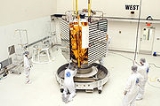
The MErcury Surface, Space ENvironment, GEochemistry and Ranging (MESSENGER)
space probeA robotic spacecraft is a spacecraft with no humans on board, that is usually under telerobotic control. A robotic spacecraft designed to make scientific research measurements is often called a space probe. Many space missions are more suited to telerobotic rather than crewed operation, due to...
is a
roboticA robotic spacecraft is a spacecraft with no humans on board, that is usually under telerobotic control. A robotic spacecraft designed to make scientific research measurements is often called a space probe. Many space missions are more suited to telerobotic rather than crewed operation, due to...
NASAThe National Aeronautics and Space Administration is the agency of the United States government that is responsible for the nation's civilian space program and for aeronautics and aerospace research...
spacecraft in orbit around the planet
MercuryMercury is the innermost and smallest planet in the Solar System, orbiting the Sun once every 87.969 Earth days. The orbit of Mercury has the highest eccentricity of all the Solar System planets, and it has the smallest axial tilt. It completes three rotations about its axis for every two orbits...
. The 485 kilograms (1,069.2 lb) spacecraft was launched aboard a
Delta IIDelta II was an American space launch system, originally designed and built by McDonnell Douglas. Delta II is part of the Delta rocket family and was in service from 1989 until November 1, 2011...
rocket in August 2004 to study the chemical composition,
geologyThe surface of Mercury is dominated by impact craters, and lava plains similar in some respects to the lunar maria. Other notable features include scarps and mineral deposits inside craters at the poles. Currently, the surface is presumed to be geologically inactive...
, and magnetic field of Mercury. It became the second mission after 1975's
Mariner 10Mariner 10 was an American robotic space probe launched by NASA on November 3, 1973, to fly by the planets Mercury and Venus. It was launched approximately two years after Mariner 9 and was the last spacecraft in the Mariner program...
to reach Mercury successfully when it made a flyby in January 2008, followed by a second flyby in October 2008, and a third flyby in September 2009. MESSENGER is furthermore the first spacecraft ever to orbit Mercury.
The instruments carried by MESSENGER were tested on a complex series of flybys – the spacecraft flew by Earth once, Venus twice, and Mercury itself three times, allowing it to decelerate relative to Mercury with minimal fuel. MESSENGER successfully entered Mercury's orbit on 18 March 2011, and reactivated its science instruments on 24 March, returning the first photo from Mercury orbit on 29 March. MESSENGERs formal science data collection mission began on 4 April 2011.
Previous missions
In 1973,
Mariner 10Mariner 10 was an American robotic space probe launched by NASA on November 3, 1973, to fly by the planets Mercury and Venus. It was launched approximately two years after Mariner 9 and was the last spacecraft in the Mariner program...
was launched to make multiple flyby encounters of Venus and
MercuryMercury is the innermost and smallest planet in the Solar System, orbiting the Sun once every 87.969 Earth days. The orbit of Mercury has the highest eccentricity of all the Solar System planets, and it has the smallest axial tilt. It completes three rotations about its axis for every two orbits...
. Mariner 10 provided the first detailed data of Mercury, mapping 40-45% of the surface. The final flyby of Mercury by Mariner 10 occurred on March 16, 1975, ending close-range observations of the planet for over thirty years.
Proposals for the mission
In 1998, a study detailed a proposed mission to send an orbiting spacecraft to Mercury, as the planet was at that point the least-explored of the inner planets. In the years following the Mariner 10 mission, subsequent mission proposals to revisit Mercury had appeared too costly, requiring large quantities of propellant and a
heavy lift launch vehicleA Heavy Lift Launch Vehicle, or HLLV, is a launch vehicle capable of lifting more mass into Low Earth Orbit than Medium Lift or Mid-Heavy Lift Launch Vehicles.There is no universally accepted capability requirements for heavy-lift launch vehicles....
. Moreover, inserting a spacecraft into orbit around Mercury is difficult, because a probe approaching on a direct path from Earth would be accelerated by the Sun's gravity and pass Mercury far too quickly to orbit it. However, using a trajectory designed by Chen-wan Yen in 1985, the study showed it was possible to seek a
Discovery-classNASA's Discovery Program is a series of lower-cost, highly-focused American scientific space missions that are exploring the Solar System. It was founded in 1992 to implement then-NASA Administrator Daniel S. Goldin's vision of "faster, better, cheaper" planetary missions...
mission by using multiple, consecutive gravity assist, 'swingby' maneuvers around Venus and Mercury, in combination with minor propulsive trajectory corrections, to gradually slow the spacecraft and thereby minimize propellant needs.
Mission objectives
The primary science objectives of the mission include:
- determining accurately the surface composition of Mercury
- characterizing the geological history of the planet
- determining the precise strength of the magnetic field and its variation with position and altitude
- investigating the presence of a liquid outer core by measuring Mercury's libration
In astronomy, libration is an oscillating motion of orbiting bodies relative to each other, notably including the motion of the Moon relative to Earth, or of Trojan asteroids relative to planets.-Lunar libration:...
- determining the nature of the radar reflective materials at Mercury’s poles
- investigating the important volatile species and their sources and sinks on and near Mercury.
The spacecraft was designed and built at the
Johns Hopkins UniversityThe Johns Hopkins University, commonly referred to as Johns Hopkins, JHU, or simply Hopkins, is a private research university based in Baltimore, Maryland, United States...
Applied Physics LaboratoryThe Johns Hopkins University Applied Physics Laboratory , located in Howard County, Maryland near Laurel and Columbia, is a not-for-profit, university-affiliated research center employing 4,500 people. APL is primarily a defense contractor. It serves as a technical resource for the Department of...
. Science operations, managed by Dr. Sean Solomon as principal investigator, and mission operations are also conducted at JHU/APL. The contrived acronym MESSENGER was chosen because
MercuryMercury was a messenger who wore winged sandals, and a god of trade, the son of Maia Maiestas and Jupiter in Roman mythology. His name is related to the Latin word merx , mercari , and merces...
was the messenger of the gods according to
Roman mythologyRoman mythology is the body of traditional stories pertaining to ancient Rome's legendary origins and religious system, as represented in the literature and visual arts of the Romans...
.
Spacecraft design
The MESSENGER bus measures 1.85 metres (72.8 in) tall, 1.42 m (55.9 in) wide and 1.27 m (50 in) deep. The bus is primarily constructed with four graphite fiber /
cyanate esterCyanate esters are chemical substances generally based on a bisphenol or novolac derivative, in which the hydrogen atom of the phenolic OH group is substituted by a cyanide group...
composite panels which support the propellant tanks, the "LVA" (large velocity adjust) thruster, attitude monitors and correction thrusters, antennas, the instrument pallet, and a large ceramic-cloth sunshade, measuring 2.5 m (8.2 ft) tall and 2 m (6.6 ft) wide, for passive thermal control.
Attitude control and propulsion
Main propulsion is via the 645 N, 317 sec.
IspSpecific impulse is a way to describe the efficiency of rocket and jet engines. It represents the derivative of the impulse with respect to amount of propellant used, i.e., the thrust divided by the amount of propellant used per unit time. If the "amount" of propellant is given in terms of mass ,...
bipropellant (
hydrazineHydrazine is an inorganic compound with the formula N2H4. It is a colourless flammable liquid with an ammonia-like odor. Hydrazine is highly toxic and dangerously unstable unless handled in solution. Approximately 260,000 tons are manufactured annually...
and nitrogen tetroxide) LVA thruster. The spacecraft is designed to carry 607.8 kilograms (1,340 lb) of propellant and pressurizer (
heliumHelium is the chemical element with atomic number 2 and an atomic weight of 4.002602, which is represented by the symbol He. It is a colorless, odorless, tasteless, non-toxic, inert, monatomic gas that heads the noble gas group in the periodic table...
).
Four 22 N
monopropellantA monopropellant rocket is a rocket that uses a single chemical as its propellant.-Chemical-reaction monopropellant rockets:...
thrusters provide spacecraft steering during main thruster burns, and ten 4 N monopropellant thrusters are used for attitude control. For precision attitude control, a reaction wheel
attitude control systemIn spaceflight, the attitude control system or attitude determination and control system of a spacecraft consists of equipment to measure, report and change the orientation of the vehicle.- Components :...
was also included.
Information for attitude control is provided by star trackers, an inertial measurement unit, and six sun sensors.
Communications
The probe includes two
small deep space transponderThe Small Deep Space Transponder is a transponder designed by JPL specifically for deep space probes. It unifies a number of communication functions -...
s for communications with the
Deep Space NetworkThe Deep Space Network, or DSN, is a world-wide network of large antennas and communication facilities that supports interplanetary spacecraft missions. It also performs radio and radar astronomy observations for the exploration of the solar system and the universe, and supports selected...
and three kinds of antennas: a high gain phased array whose main beam can be electronically steered in one plane, a medium-gain “fan-beam” antenna and a low gain horn with a broad pattern. The high gain antenna is used as transmit-only at 8.4 GHz, the medium-gain and low gain antennas transmit at 8.4 GHz and receive at 7.2 GHz, and all three antennas operate with right-hand circularly polarized (RHCP) radiation. One of each of these antennas is mounted on the front of the probe facing the sun, and one of each is mounted to the back of the probe facing away from the sun.
Power
The space probe is powered by a two-panel, gallium arsenide/
germaniumGermanium is a chemical element with the symbol Ge and atomic number 32. It is a lustrous, hard, grayish-white metalloid in the carbon group, chemically similar to its group neighbors tin and silicon. The isolated element is a semiconductor, with an appearance most similar to elemental silicon....
(GaAs/Ge) solar array providing an average of 450
wattThe watt is a derived unit of power in the International System of Units , named after the Scottish engineer James Watt . The unit, defined as one joule per second, measures the rate of energy conversion.-Definition:...
s at Mercury. Each panel is rotatable and includes optical solar reflectors to balance the temperature of the array. Power is stored in a common-pressure-vessel, 23-
ampereThe ampere , often shortened to amp, is the SI unit of electric current and is one of the seven SI base units. It is named after André-Marie Ampère , French mathematician and physicist, considered the father of electrodynamics...
-hour
nickel hydrogen batteryA nickel–hydrogen battery is a rechargeable electrochemical power source based on nickel and hydrogen. It differs from a nickel–metal hydride battery by the use of hydrogen in a pressurized cell at up to 1200 psi pressure.The cathode is made up of a dry sintered porous nickel plaque, which...
, with 11 vessels and two cells per vessel.
Computer and software
The computer system is based on the Integrated Electronics Module (IEM), a device which combines core
avionicsAvionics are electronic systems used on aircraft, artificial satellites and spacecraft.Avionic systems include communications, navigation, the display and management of multiple systems and the hundreds of systems that are fitted to aircraft to meet individual roles...
into a single box. The computer features two
radiation-hardenedRadiation hardening is a method of designing and testing electronic components and systems to make them resistant to damage or malfunctions caused by ionizing radiation , such as would be encountered in outer space, high-altitude flight, around nuclear reactors, particle accelerators, or during...
IBM RAD6000, a 25 megahertz main processor and 10 MHz fault protection processor. For redundancy, the spacecraft carries a pair of identical IEM computers. For
data storagethumb|200px|right|A reel-to-reel tape recorder .The magnetic tape is a data storage medium. The recorder is data storage equipment using a portable medium to store the data....
, the spacecraft carries two
solid-stateA solid-state drive , sometimes called a solid-state disk or electronic disk, is a data storage device that uses solid-state memory to store persistent data with the intention of providing access in the same manner of a traditional block i/o hard disk drive...
recorders able to store up to one
gigabyteThe gigabyte is a multiple of the unit byte for digital information storage. The prefix giga means 109 in the International System of Units , therefore 1 gigabyte is...
each. The IBM RAD6000 main processor collects,
compressesIn computer science and information theory, data compression, source coding or bit-rate reduction is the process of encoding information using fewer bits than the original representation would use....
, and stores data from MESSENGER
's instruments for later playback to Earth.
MESSENGER uses a software suite called SciBox to simulate its orbit and instruments, in order to "choreograph the complicated process of maximizing the scientific return from the mission and minimizing conflicts between instrument observations, while at the same time meeting all spacecraft constraints on pointing, data downlink rates, and onboard data storage capacity."
Scientific instruments
| Mercury Dual Imaging System (MDIS) |
| |
Includes two CCD A charge-coupled device is a device for the movement of electrical charge, usually from within the device to an area where the charge can be manipulated, for example conversion into a digital value. This is achieved by "shifting" the signals between stages within the device one at a time... cameras, a narrow-angle camera (NAC) and a wide-angle camera (WAC) mounted to a pivoting platform. The camera system will provide a complete map of the surface of Mercury at a resolution of 250 meters/pixel with 20–50 meters/pixel images of regions of geologic interest. Color imaging is possible only with the narrow-band filter wheel attached to the wide-angle camera.
| Objectives |
Flyby Phase
- Acquisition of near-global coverage at ≈500-meters/pixel
In digital imaging, a pixel, or pel, is a single point in a raster image, or the smallest addressable screen element in a display device; it is the smallest unit of picture that can be represented or controlled.... .
- Multispectral mapping at ≈2-kilometers/pixel.
|
Orbital Phase
A nadirThe nadir is the direction pointing directly below a particular location; that is, it is one of two vertical directions at a specified location, orthogonal to a horizontal flat surface there. Since the concept of being below is itself somewhat vague, scientists define the nadir in more rigorous... -looking monochromeMonochrome describes paintings, drawings, design, or photographs in one color or shades of one color. A monochromatic object or image has colors in shades of limited colors or hues. Images using only shades of grey are called grayscale or black-and-white... global photomosaic at moderate solar incidence angles (55°–75°) and 250-meters/pixel or better sampling resolution.
A 25°-off-nadir mosaic to complement the nadir-looking mosaic for global stereo mappingStereo imaging is an audio jargon term used for the aspect of sound recording and reproduction concerning spatial locations of the sound source, both laterally and in depth. An image is 'good' if the performers can be effortlessly located; 'bad' if there is no hope of doing so... .
Completion of the multispectral mapping begun during the flybys.
High-resolution (20–50-meters/pixel) image strips across features representative of major geologic units and structures. |
| Filters |
EWLINE
| Wide Angle Camera Filters |
| Name (pos) |
Wavelength |
Sensitivity |
| Clear (2) |
400–1000 nm |
|
| Violet (6) |
420–440 nm |
|
| Blue (3) |
465–485 nm |
|
| Green (4) |
555–565 nm |
|
| Far Red (1) |
695–705 nm |
|
| N-IR (7) |
745–755 nm |
|
| N-IR (12) |
825–835 nm |
N/A |
| N-IR (10) |
895–905 nm |
N/A |
| N-IR (8) |
945–950 nm |
N/A |
| N-IR (9) |
980–1010 nm |
N/A |
| N-IR (11) |
975–1045 nm |
N/A |
|
Principal investigator: Scott Murchie / Johns Hopkins University
Data: PDS/MODE narrow-angle catalog, PDS/MODE wide-angle catalog, PDS/PIN data catalog |
| Gamma-Ray Spectrometer (GRS) |
| |
Measures gamma-ray emissions from the surface of Mercury to determine the composition by detecting certain elements (oxygenOxygen is the element with atomic number 8 and represented by the symbol O. Its name derives from the Greek roots ὀξύς and -γενής , because at the time of naming, it was mistakenly thought that all acids required oxygen in their composition... , siliconSilicon is a chemical element with the symbol Si and atomic number 14. A tetravalent metalloid, it is less reactive than its chemical analog carbon, the nonmetal directly above it in the periodic table, but more reactive than germanium, the metalloid directly below it in the table... , sulphur, ironIron is a chemical element with the symbol Fe and atomic number 26. It is a metal in the first transition series. It is the most common element forming the planet Earth as a whole, forming much of Earth's outer and inner core. It is the fourth most common element in the Earth's crust... , hydrogenHydrogen is the chemical element with atomic number 1. It is represented by the symbol H. With an average atomic weight of , hydrogen is the lightest and most abundant chemical element, constituting roughly 75% of the Universe's chemical elemental mass. Stars in the main sequence are mainly... , potassiumPotassium is the chemical element with the symbol K and atomic number 19. Elemental potassium is a soft silvery-white alkali metal that oxidizes rapidly in air and is very reactive with water, generating sufficient heat to ignite the hydrogen emitted in the reaction.Potassium and sodium are... , thoriumThorium is a natural radioactive chemical element with the symbol Th and atomic number 90. It was discovered in 1828 and named after Thor, the Norse god of thunder.... , uraniumUranium is a silvery-white metallic chemical element in the actinide series of the periodic table, with atomic number 92. It is assigned the chemical symbol U. A uranium atom has 92 protons and 92 electrons, of which 6 are valence electrons... ) to a depth of 10 cm.
| Objectives |
|
Provide surface abundances of major elements.
Provide surface abundances of Fe, Si, and K, infer alkali depletion from K abundances, and provide abundance limits on H (water ice) and S (if present) at the poles.
Map surface element abundances where possible, and otherwise provide surface-averaged abundances or establish upper limits. |
Principal investigator: William Boynton / University of Arizona
Data: PDS/GSN data catalog, PDS/MODE GRS data catalog |
| Neutron Spectrometer (NS) |
| |
Determines the hydrogen mineral composition to a depth of 40 cm by detecting low-energy neutrons that result from the collision of cosmic rays and the minerals.
| Objectives |
|
Establish and map the abundance of hydrogen over most of the northern hemisphere of Mercury.
Investigate the possible presence of water ice within and near permanently shaded craters near the north pole.
Provide secondary evidence to aid in interpreting GRS measured gamma-ray line strengths in terms of elemental abundances.
Outline surface domains at the base of both northern and southern cusps of the magnetosphere where the solar wind can implant hydrogen in surface material. |
Principal investigator: William Boynton / University of Arizona
Data: PDS/GSN data catalog, PDS/MODE NS data catalog |
| X-Ray Spectrometer X-ray spectroscopy is a gathering name for several spectroscopic techniques for characterization of materials by using x-ray excitation.-Characteristic X-ray Spectroscopy:... (XRS) |
| |
Maps mineral composition within the top millimeter of the surface on Mercury by detecting X-rayX-radiation is a form of electromagnetic radiation. X-rays have a wavelength in the range of 0.01 to 10 nanometers, corresponding to frequencies in the range 30 petahertz to 30 exahertz and energies in the range 120 eV to 120 keV. They are shorter in wavelength than UV rays and longer than gamma... spectral lineA spectral line is a dark or bright line in an otherwise uniform and continuous spectrum, resulting from a deficiency or excess of photons in a narrow frequency range, compared with the nearby frequencies.- Types of line spectra :... s from magnesiumMagnesium is a chemical element with the symbol Mg, atomic number 12, and common oxidation number +2. It is an alkaline earth metal and the eighth most abundant element in the Earth's crust and ninth in the known universe as a whole... , aluminum, sulphur, calciumCalcium is the chemical element with the symbol Ca and atomic number 20. It has an atomic mass of 40.078 amu. Calcium is a soft gray alkaline earth metal, and is the fifth-most-abundant element by mass in the Earth's crust... , titaniumTitanium is a chemical element with the symbol Ti and atomic number 22. It has a low density and is a strong, lustrous, corrosion-resistant transition metal with a silver color.... , and iron, in the 1-10 keVIn physics, the electron volt is a unit of energy equal to approximately joule . By definition, it is equal to the amount of kinetic energy gained by a single unbound electron when it accelerates through an electric potential difference of one volt... range.
| Objectives |
|
Determine the history of the formation of Mercury
Characterize the composition of surface elements by measuring the X-ray emissions induced by the incident solar flux. |
Principal investigator: George Ho / APL
Data: PDS/GSN data catalog, PDS/MODE data catalog |
| Magnetometer A magnetometer is a measuring instrument used to measure the strength or direction of a magnetic field either produced in the laboratory or existing in nature... (MAG) |
| |
Measures the magnetic field around Mercury in detail to determine the strength and average position of the field.
| Objectives |
Investigate the structure of Mercury’s magnetic field and its interaction with the solar windThe solar wind is a stream of charged particles ejected from the upper atmosphere of the Sun. It mostly consists of electrons and protons with energies usually between 1.5 and 10 keV. The stream of particles varies in temperature and speed over time... .
Characterize the geometry and time variability of the magnetospheric field.
Detect wave-particle interactions with the magnetosphere.
Observe magnetotail dynamics, including phenomena possibly analogous to substorms in the Earth’s magnetosphere.
Characterize the magnetopause structure and dynamics.
Characterize field-aligned currents that link the planet with the magnetosphere. |
Principal investigator: Mario Acuna / NASA Goddard Space Flight Center
Data: PDS/PPI data catalog |
| Mercury Laser Altimeter (MLA) |
| |
Provides detailed information regarding the height of landforms on the surface of Mercury by detecting the light of an infrared laser as the light bounces off the surface.
| Objectives |
|
Provide a high-precision topographic map of the high northern latitude regions.
Measure the long-wavelength topographic features at mid-to-low northern latitudes.
Determine topographic profiles across major geologic features in the northern hemisphere.
Detect and quantify the planet’s forced physical librations by tracking the motion of large-scale topographic features as a function of time.
Measure the surface reflectivity of Mercury at the MLA operating wavelength of 1,064 nanometers. |
Principal investigator: David Smith / GSFC
Data: PDS/GSN data catalog, PDS/MODE data catalog |
| Mercury Atmospheric and Surface Composition Spectrometer (MASCS) |
| |
Determines the characteristics of the tenuous atmosphere surrounding Mercury by measuring ultraviolet light emissions and the prevalence of iron and titanium minerals on the surface by measuring the reflectance of infrared light.
| Objectives |
|
Characterize the composition, structure, and temporal behavior of the exosphere.
Investigate the processes that generate and maintain the exosphere.
Determine the relationship between exospheric and surface composition.
Search for polar deposits of volatile material, and determine how are the accumulation of these deposits are related to exospheric processes. |
Principal investigator: William McClintock / University of Colorado (http://lasp.colorado.edu/messenger/)
Data: PDS/GSN data catalog, PDS/MODE data catalog |
| Energetic Particle and Plasma Spectrometer (EPPS) |
| |
Measures the charged particles in the magnetosphere A magnetosphere is formed when a stream of charged particles, such as the solar wind, interacts with and is deflected by the intrinsic magnetic field of a planet or similar body. Earth is surrounded by a magnetosphere, as are the other planets with intrinsic magnetic fields: Mercury, Jupiter,... around Mercury using an Energetic Particle Spectrometer (EPS) and the charged particles that come from the surface using a Fast Imaging Plasma Spectrometer (FIPS).
| Objectives |
|
Determine the structure of the planet's magnetic field.
Characterize exosphere neutrals and accelerated magnetospheric ions.
Determine the composition of the radar-reflective materials at Mercury's poles.
Determine the electrical properties of the crust/atmosphere/environment interface.
Determine characteristics of the dynamics of Mercury's magnetosphere and their relationships to external drivers and their internal conditions.
Measure interplanetary plasma properties in cruise and in Mercury vicinity. |
Principal investigator: Barry Mauk / APL
Data: PDS/PPI data catalog |
| Radio Science (RS) |
|
Measures the gravity of Mercury and the state of the planetary core by utilizing the spacecraft positioning data.
| Objectives |
Determine the position of the spacecraft during both the cruise and orbital phases of the mission.
Observe gravitational perturbations from Mercury to investigate the spatial variations of density within the planet’s interior, and a time-varying component in Mercury’s gravity to quantify the amplitude of Mercury’s librationIn astronomy, libration is an oscillating motion of orbiting bodies relative to each other, notably including the motion of the Moon relative to Earth, or of Trojan asteroids relative to planets.-Lunar libration:... .
Provide precise measurements of the range of the MESSENGER spacecraft to the surface of Mercury for determining proper altitude mapping with the MLA. |
Principal investigator: David Smith / NASA Goddard Space Flight Center
Data: PDS/GSN data catalog, PDS/MODE data catalog |
Mission profile
| Timeline of observations |
EWLINE
---- |
| Date |
Event |
---- |
| |
Spacecraft launched at 06:15:56 UTC |
| |
|
| |
| |
| |
Mercury orbital insertion |
Launch and trajectory
The MESSENGER probe was launched on August 3, 2004 at 06:15:56 UTC by NASA from Space Launch Complex 17B at the
Cape Canaveral Air Force StationCape Canaveral Air Force Station is an installation of the United States Air Force Space Command's 45th Space Wing, headquartered at nearby Patrick Air Force Base. Located on Cape Canaveral in the state of Florida, CCAFS is the primary launch head of America's Eastern Range with four launch pads...
in Florida, aboard a
Delta II 7925Delta II was an American space launch system, originally designed and built by McDonnell Douglas. Delta II is part of the Delta rocket family and was in service from 1989 until November 1, 2011...
launch vehicle. The complete burn sequence lasted 57 minutes bringing the spacecraft into a heliocentric orbit, with a final velocity of 10.68 km/s (6.64 miles/s) and sending the probe into a 7.9 billion-kilometer trajectory that took 6 years, 7 months and 16 days before its orbital insertion on March 18, 2011.
Traveling to Mercury requires an extremely large velocity change (see
delta-vIn astrodynamics a Δv or delta-v is a scalar which takes units of speed. It is a measure of the amount of "effort" that is needed to change from one trajectory to another by making an orbital maneuver....
) because Mercury's orbit is deep in the Sun's
gravity wellA gravity well or gravitational well is a conceptual model of the gravitational field surrounding a body in space. The more massive the body the deeper and more extensive the gravity well associated with it. The Sun has a far-reaching and deep gravity well. Asteroids and small moons have much...
. If on a direct course from Earth to Mercury, a spacecraft is constantly accelerated as it falls toward the Sun, and arrives at Mercury with a velocity too high to achieve orbit without excessive use of fuel. For planets with an atmosphere, such as
VenusVenus is the second planet from the Sun, orbiting it every 224.7 Earth days. The planet is named after Venus, the Roman goddess of love and beauty. After the Moon, it is the brightest natural object in the night sky, reaching an apparent magnitude of −4.6, bright enough to cast shadows...
and
MarsMars is the fourth planet from the Sun in the Solar System. The planet is named after the Roman god of war, Mars. It is often described as the "Red Planet", as the iron oxide prevalent on its surface gives it a reddish appearance...
, spacecraft can minimize their fuel consumption upon arrival by using friction with the atmosphere to enter orbit (
aerocaptureAerocapture is a technique used to reduce velocity of a spacecraft, arriving at a celestial body with a hyperbolic trajectory, in order to bring it in an orbit with an eccentricity of less than 1. It uses the drag created by the atmosphere of the celestial body to decelerate. Only one pass in the...
), or can briefly fire their rocket engines to enter into orbit followed by a reduction of the orbit by
aerobrakingAerobraking is a spaceflight maneuver that reduces the high point of an elliptical orbit by flying the vehicle through the atmosphere at the low point of the orbit . The resulting drag slows the spacecraft...
. However, the tenuous
atmosphere of Mercury is far too thin for these maneuvers. Instead, MESSENGER extensively used gravity assist maneuvers at Earth, Venus, and Mercury to reduce the speed relative to Mercury, then used its large rocket engine to enter into an elliptical orbit around the planet. The multi-flyby process greatly reduced the amount of propellant necessary to slow the spacecraft, but at the cost of prolonging the trip by many years and to a total distance of 4.9 billion miles. To further minimize the amount of necessary propellant, the spacecraft orbital insertion targeted a highly elliptical orbit around Mercury.
The elongated orbit has two other benefits: It allows the spacecraft time to cool after the times it is sandwiched between the hot surface and the sun, and it allows the spacecraft to measure the effects of solar wind and the magnetic fields of the planet at various distances, while still allowing close-up measurements and photographs of the surface and exosphere.
Encounter with Earth
MESSENGER performed a successful Earth flyby a year after launch, on August 2, 2005, with the closest approach at 19:13
UTCCoordinated Universal Time is the primary time standard by which the world regulates clocks and time. It is one of several closely related successors to Greenwich Mean Time. Computer servers, online services and other entities that rely on having a universally accepted time use UTC for that purpose...
at an altitude of 2,347 kilometers (1,458 statute miles) over central
MongoliaMongolia is a landlocked country in East and Central Asia. It is bordered by Russia to the north and China to the south, east and west. Although Mongolia does not share a border with Kazakhstan, its western-most point is only from Kazakhstan's eastern tip. Ulan Bator, the capital and largest...
. On December 12, 2005, a 524 second-long burn (Deep-Space Maneuver or DSM-1) of the large thruster adjusted the trajectory for the upcoming Venus flyby.
During the Earth flyby, the MESSENGER team imaged the Earth and Moon using MDIS and checked the status of several other instruments observing the atmospheric and surface compositions and testing the magnetosphere and determining that all instruments tested were working as expected. This calibration period will be useful for ensuring accurate interpretation of data as the spacecraft orbits Mercury.
Encounter with Venus
On October 24, 2006 at 08:34 UTC, MESSENGER encountered Venus at an altitude of 2992 kilometres (1,859.1 mi). During the encounter, MESSENGER passed behind Venus and entered superior conjunction, a period when Earth was on the exact opposite side of the Solar System, with the Sun inhibiting radio contact. For this reason, no scientific observations were conducted during the flyby. Communication with the spacecraft was reestablished in late November and performed a deep space maneuver on December 12, to correct the trajectory to encounter Venus in a second flyby.
On June 5, 2007, at 23:08 UTC, MESSENGER performed a second encounter of Venus at an altitude of 338 km (210 mi), for the greatest velocity reduction of the mission. During the encounter, all instruments were used to observe Venus and prepare for the following Mercury encounters. The encounter provided visible and
near-infraredInfrared light is electromagnetic radiation with a wavelength longer than that of visible light, measured from the nominal edge of visible red light at 0.74 micrometres , and extending conventionally to 300 µm...
imaging data of the upper
atmosphere of VenusThe atmosphere of Venus is much denser and hotter than that of Earth. The temperature at the surface is 740 K , while the pressure is 93 bar. The Venusian atmosphere supports opaque clouds made of sulfuric acid, making optical Earth-based and orbital observation of the surface impossible...
.
UltravioletUltraviolet light is electromagnetic radiation with a wavelength shorter than that of visible light, but longer than X-rays, in the range 10 nm to 400 nm, and energies from 3 eV to 124 eV...
and X-ray
spectrometryA spectrometer is an instrument used to measure properties of light over a specific portion of the electromagnetic spectrum, typically used in spectroscopic analysis to identify materials. The variable measured is most often the light's intensity but could also, for instance, be the polarization...
of the upper atmosphere were also recorded, to characterize the composition. The ESA's
Venus ExpressVenus Express is the first Venus exploration mission of the European Space Agency. Launched in November 2005, it arrived at Venus in April 2006 and has been continuously sending back science data from its polar orbit around Venus. Equipped with seven science instruments, the main objective of the...
was also orbiting during the encounter, providing the first opportunity for simultaneous measurement of particle-and-field characteristics of the planet.
Encounter with Mercury
MESSENGER made a flyby of Mercury on January 14, 2008 (closest approach 200 km above surface of Mercury at 19:04:39
UTCCoordinated Universal Time is the primary time standard by which the world regulates clocks and time. It is one of several closely related successors to Greenwich Mean Time. Computer servers, online services and other entities that rely on having a universally accepted time use UTC for that purpose...
), followed by a second flyby on October 6, 2008. MESSENGER executed a final flyby on September 29, 2009, that further slowed down the spacecraft. Sometime during the closest approach of the last flyby, the spacecraft entered
safe modeSafe mode is an operating mode of a modern spacecraft during which all non-essential systems are shut down and only essential functions such as thermal management, radio reception and attitude control are active.-Triggering events:...
. Although this had no effect on the trajectory necessary for later orbit insertion, it resulted in the loss of science data and images that were planned for the outbound leg of the fly-by. The spacecraft had fully recovered by about 7 hours later. One last deep space maneuver, DSM-5 was executed on November 24, 2009 at 22:45 UTC to provide the required velocity change for the scheduled Mercury orbit insertion on March 18, 2011, marking the beginning of a year-long orbital mission.
Initial discoveries
On July 3, 2008, MESSENGER team member Thomas Zurbuchen announced that the probe had discovered large amounts of water present in Mercury's
exosphereThe exosphere is the uppermost layer of Earth's atmosphere. In the exosphere, an upward travelling molecule moving fast enough to attain escape velocity can escape to space with a low chance of collisions; if it is moving below escape velocity it will be prevented from escaping from the celestial...
, which was an unexpected finding. MESSENGER also provided visual evidence of past volcanic activity on the surface of Mercury, as well as evidence for a liquid
planetary coreThe planetary core consists of the innermost layer of a planet.The core may be composed of solid and liquid layers, while the cores of Mars and Venus are thought to be completely solid as they lack an internally generated magnetic field. In our solar system, core size can range from about 20% to...
.
Orbital insertion
The thruster maneuver to insert the craft into Mercury's orbit began at 12:45 AM (00:45 hours) UTC on March 18, 2011. It lasted about 15 minutes, with confirmation that the craft was in Mercury orbit received at 1:10 AM on March 18 (UTC – 9:10 PM, March 17 EDT). Mission lead engineer Eric Finnegan indicated that the spacecraft achieved a near-perfect orbit.
MESSENGERs orbit is highly elliptical, taking it within 200 kilometre of Mercury's surface and then 15000 kilometre away from it every twelve hours. This orbit was chosen to shield the probe from the heat radiated by Mercury's hot surface. Only a small portion of each orbit is at a low altitude, where the spacecraft is subjected to heating from the hot side of the planet.
Primary science
After MESSSENGERs orbital insertion, an eighteen-day commissioning phase took place. The supervising personnel switched on and tested the craft's science instruments to ensure they had completed the journey without damage. The commissioning phase "demonstrated that the spacecraft and payload [were] all operating nominally, notwithstanding Mercury’s challenging environment.”
The primary mission began as planned April 4, with MESSENGER orbiting Mercury once every twelve hours for an intended duration of twelve Earth months, the equivalent of two solar days on Mercury. Principal Investigator Sean Solomon, of the Carnegie Institution of Washington, said: “With the beginning today of the primary science phase of the mission, we will be making nearly continuous observations that will allow us to gain the first global perspective on the innermost planet. Moreover, as solar activity steadily increases, we will have a front-row seat on the most dynamic magnetosphere–atmosphere system in the Solar System.”
On October 5, 2011, the scientific results obtained by MESSENGER during its first six terrestrial months in Mercury's orbit were presented in a series of papers at the European Planetary Science Congress in
NantesNantes is a city in western France, located on the Loire River, from the Atlantic coast. The city is the 6th largest in France, while its metropolitan area ranks 8th with over 800,000 inhabitants....
,
FranceThe French Republic , The French Republic , The French Republic , (commonly known as France , is a unitary semi-presidential republic in Western Europe with several overseas territories and islands located on other continents and in the Indian, Pacific, and Atlantic oceans. Metropolitan France...
. Among the discoveries presented were the unexpectedly high concentrations of
magnesiumMagnesium is a chemical element with the symbol Mg, atomic number 12, and common oxidation number +2. It is an alkaline earth metal and the eighth most abundant element in the Earth's crust and ninth in the known universe as a whole...
and
calciumCalcium is the chemical element with the symbol Ca and atomic number 20. It has an atomic mass of 40.078 amu. Calcium is a soft gray alkaline earth metal, and is the fifth-most-abundant element by mass in the Earth's crust...
found on Mercury's nightside, and the fact that Mercury's
magnetic fieldA magnetic field is a mathematical description of the magnetic influence of electric currents and magnetic materials. The magnetic field at any given point is specified by both a direction and a magnitude ; as such it is a vector field.Technically, a magnetic field is a pseudo vector;...
is offset far to the north of the planet's center.
Extended mission
In November 2011, NASA announced that the MESSENGER mission would be extended by one year, allowing the spacecraft to observe the 2012
solar maximumSolar maximum or solar max is the period of greatest solar activity in the solar cycle of the sun. During solar maximum, sunspots appear....
.
MESSENGER family portrait
On February 18, 2011, a portrait of the
Solar SystemThe Solar System consists of the Sun and the astronomical objects gravitationally bound in orbit around it, all of which formed from the collapse of a giant molecular cloud approximately 4.6 billion years ago. The vast majority of the system's mass is in the Sun...
was published on the MESSENGER website. The mosaic contained 34 images, acquired by the MDIS instrument during November 2010. All the planets were visible with the exception of Uranus and Neptune, due to their vast distances from the Sun. The MESSENGER "family portrait" was intended to be complementary to the "
Voyager family portraitThe Family Portrait, or sometimes Portrait of the Planets, is an image of the Solar System acquired by Voyager 1 on February 14, 1990 from a distance of approximately 6 billion kilometers....
", which was acquired from outside the solar system on February 14, 1990.
See also
- List of active Solar System probes
- Stamatios Krimigis
Stamatios M. Krimigis is a Greek-American scientist in space exploration. He has contributed to the majority of the United States' unmanned space exploration programs of the Solar system and beyond. He has contributed to exploration missions to almost every planet of our solar system...
, a key contributor to the mission
External links