
|
|
|
|
Christa McAuliffe
|
| |
|
| |
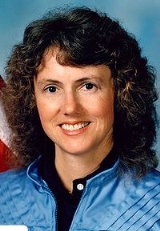
Sharon Christa Corrigan McAuliffe (September 2, 1948 – January 28, 1986), better known simply as Christa McAuliffe née Sharon Christa Corrigan, was an American teacher from Concord, New Hampshire. McAuliffe was born in Boston, Massachusetts and received her bachelor's degree in education and history from Framingham State College in 1970 and a Master of Arts from Bowie State University in 1978. She took a teaching post as a social studies teacher at Concord High School in New Hampshire in 1982.
In 1985, McAuliffe was selected from more than 11,000 applicants to participate in the NASA Teacher in Space Project and she was scheduled to become the first teacher in space.

Discussion
Ask a question about 'Christa McAuliffe'
Start a new discussion about 'Christa McAuliffe'
Answer questions from other users
|
Encyclopedia
Sharon Christa Corrigan McAuliffe (September 2, 1948 – January 28, 1986), better known simply as Christa McAuliffe née Sharon Christa Corrigan, was an American teacher from Concord, New Hampshire. McAuliffe was born in Boston, Massachusetts and received her bachelor's degree in education and history from Framingham State College in 1970 and a Master of Arts from Bowie State University in 1978. She took a teaching post as a social studies teacher at Concord High School in New Hampshire in 1982.
In 1985, McAuliffe was selected from more than 11,000 applicants to participate in the NASA Teacher in Space Project and she was scheduled to become the first teacher in space. As a member of mission STS-51-L, she was planning to conduct experiments and teach two lessons from Space Shuttle Challenger. On January 28, 1986, her spacecraft disintegrated 73 seconds after launch and she was one of seven crew members killed in the Space Shuttle Challenger disaster. After her death, schools and scholarships were named in her honor and in 2004 she was awarded the Congressional Space Medal of Honor.
Early life
Born Sharon Christa Corrigan on September 2, 1948 in Boston, Massachusetts, McAuliffe was the oldest of five children of Edward Christopher Corrigan (1922-1990), an accountant, and Grace Mary (George) Corrigan, a substitute teacher. She was part Irish, Lebanese, German, English, and Native American. McAuliffe's mother is of part Maronite Lebanese origin through her father (McAuliffe's grandfather) and is a niece of historian Philip Hitti.
The year McAuliffe was born, her father was completing his sophomore year at Boston College. Not long thereafter, he took a job as an assistant comptroller in a Boston department store and the family moved to Framingham, Massachusetts, where she attended and graduated from Marian High School in 1966. As a youth, she was inspired by Project Mercury and the Apollo moon landing program, writing years later on her NASA application form: "I watched the Space Age being born, and I would like to participate."
Career as an educator
McAuliffe attended Framingham State College in her hometown, graduating in 1970 with a Bachelor of Arts in education and history. A few weeks later, she married her longstanding boyfriend Steven J. McAuliffe, whom she had met at Marian High, and they moved closer to Washington, DC so Steven could attend the Georgetown University Law Center. They had two children: Scott and Caroline, who were nine and six respectively when she died.
in New Hampshire]]
McAuliffe obtained her first teaching position in 1970 as an American history teacher at Benjamin Foulois Junior High School in Morningside, Maryland. From 1971 to 1978, she taught history and civics at Thomas Johnson Middle School in Lanham, Maryland. In addition to teaching, she completed a Master of Arts in education supervision and administration from Bowie State University in Maryland. In 1978, she moved to Concord, New Hampshire when Steven accepted a job as an assistant to the New Hampshire Attorney General. McAuliffe took a teaching post at Concord High School in 1982. She was a social studies teacher and taught several courses including American history, law, economics, and a self-designed course: "The American Woman." An important part of her teaching techniques were field trips or bringing in speakers. According to The New York Times, she "emphasized the impact of ordinary people on history, saying they were as important to the historical record as kings, politicians or generals."
In 1984, President Ronald Reagan announced the Teacher in Space Project and she learned about NASA's efforts to find the first civilian, an educator, to fly into space. NASA wanted to find an "ordinary person," a gifted teacher who could communicate with students while in orbit. McAuliffe became one out of more than 11,000 applicants, writing:
Teacher in Space Project and disaster NASA selected McAuliffe for this position on July 19, 1985 (another teacher, Barbara Morgan, served as her backup). In the autumn of that year, both she and Morgan took a year-long leave of absence from teaching (NASA paid their salaries) to train for an early 1986 space shuttle mission. While not a member of the NASA Astronaut Corps, she would be part of the STS-51-L crew and would conduct experiments and teach lessons from space. Her planned duties included basic science experiments in the fields of chromatography, hydroponics, magnetism, and Newton's laws. McAuliffe was also planning to conduct two 15-minute classes from space including a tour of the spacecraft called "The Ultimate Field Trip" and a lesson about the benefits of space travel called "Where We've Been, Where We're Going, Why." The lessons were to be broadcast to millions of schoolchildren via closed-circuit TV.
After being chosen to be the first teacher in space, McAuliffe was a guest on several television programs, including Good Morning America, the CBS Morning News, the Today Show, and the Tonight Show Starring Johnny Carson. She had an immediate rapport with the media, and the Teacher in Space Project received tremendously popular attention as a result.
]]
On January 28, 1986, McAuliffe boarded Space Shuttle Challenger with the other six crewmembers of STS-51-L. Challenger broke apart 73 seconds into its flight, leading to the deaths of all seven crew members. According to NASA, it is in part because of the excitement over McAuliffe's presence on Challenger that the accident had such a significant effect on the nation. Many schoolchildren were viewing the launch live, and media coverage of the accident was extensive.
Barbara Morgan, McAuliffe's backup, became a professional astronaut in January 1998. Morgan flew on the space shuttle mission STS-118 aboard Endeavour (the orbiter that replaced Challenger) to the International Space Station on August 8, 2007. She became the first teacher to successfully reach space, 21 years after the Challenger disaster.
Legacy
McAuliffe's remains were buried in Blossum Hill Cemetery in Concord, NH. She was honored at many events, including the Daytona 500 auto race in 1986. The Christa McAuliffe Planetarium in Concord and the Christa Corrigan McAuliffe Center for Education and Teaching Excellence at Framingham State College are named in her memory, as are asteroid 3352 McAuliffe, the crater McAuliffe on the Moon, and a crater on the planet Venus that was named McAuliffe by the Soviet Union. Approximately 40 schools around the world have been named after her, including the Christa McAuliffe Space Education Center in Pleasant Grove, Utah.
]]
Scholarships and other events have also been established in her memory. The has been held every year in Nashua, New Hampshire since 1986, and is devoted to the use of technology in all aspects of education. The Nebraska McAuliffe Prize honors a Nebraska teacher each year for courage and excellence in education. Grants in her name honoring innovative teachers are provided by the American Association of State Colleges and Universities and the National Council for the Social Studies.
In 1990, McAuliffe was portrayed by Karen Allen in the TV movie Challenger. The spaceship on the 1996–1997 children's science-fiction series Space Cases, about a group of students lost in space, was called "Christa". In 2006, a documentary film about McAuliffe and Morgan called Christa McAuliffe: Reach for the Stars aired on CNN. The film, produced by Renee Sotile and Mary Jo Godges, commemorated the 20th anniversary of McAuliffe's death. The 75-minute feature version was narrated by Susan Sarandon and included an original song by Carly Simon.
McAuliffe's parents worked with Framingham State College to establish the McAuliffe Center for Education. Her husband Steven remarried and became a federal judge in 1992, serving with the United States District Court for the District of New Hampshire in Concord. McAuliffe's son Scott completed graduate studies in marine biology and her daughter Caroline went on to pursue the same career as her mother: teaching. On July 23, 2004, McAuliffe was posthumously awarded the Congressional Space Medal of Honor by President George W. Bush.
Quotes
I touch the future. I teach.No teacher has ever been better prepared to teach a lesson.I have a vision of the world as a global village, a world without boundaries. Imagine a history teacher making history!Reach for it, you know. Go push yourself as far as you can.What are we doing here? We're reaching for the stars.May your future be limited only by your dreams!
See also
Further reading
External links
|
| |
|
|