

Cassini-Huygens

Encyclopedia
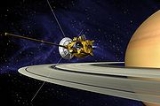
Cassini–Huygens is a joint NASA
/ESA
/ASI
spacecraft
mission studying the planet Saturn
and its many natural satellites
since 2004. Launched in 1997 after nearly two decades of gestation, it includes a Saturn orbiter and an atmospheric probe/lander for the moon Titan
, although it has also returned data on a wide variety of other things including the Heliosphere
, Jupiter
, and relativity tests
. The Titan probe, Huygens, entered and landed on Titan in 2005. The current end of mission plan is a 2017 Saturn impact.
The complete Cassini–Huygens space probe was launched on October 15, 1997 by a Titan IVB/Centaur, and after a long interplanetary voyage it entered into orbit around Saturn on July 1, 2004. On December 25, 2004, the Huygens probe was separated from the orbiter at approximately 02:00 UTC
. It reached Saturn's moon Titan
on January 14, 2005, when it descended into Titan's atmosphere, and downward to the surface, radioing scientific information back to the Earth by telemetry
. This was the first landing
ever accomplished in the outer Solar System. On April 18, 2008, NASA announced a two-year extension of the funding for ground operations of this mission, at which point it was renamed to Cassini Equinox Mission. This was again extended in February 2010 with the Cassini Solstice Mission continuing until 2017. Cassini is the fourth space probe to visit Saturn and the first to enter orbit.
Sixteen European countries and the United States make up the team responsible for designing, building, flying and collecting data from the Cassini orbiter and Huygens probe. The mission is managed by NASA’s Jet Propulsion Laboratory
in the United States, where the orbiter was designed and assembled. Development of the Huygens Titan probe was managed by the European Space Research and Technology Centre
, whose prime contractor for the probe was the Alcatel
company in France. Equipment and instruments for the probe were supplied from many countries. The Italian Space Agency
(ASI) provided the Cassini probe's high-gain radio antenna
, and a compact and lightweight radar, which acts in multipurpose as a synthetic aperture radar
, a radar altimeter
, and a radiometer
.
Cassini is powered by 32.7 kg of Plutonium-238
the heat from the material's radioactive decay is turned into electricity. Huygens was supported by Cassini during cruise, but used chemical batteries when independent.
, (also known later as Jean-Dominique Cassini when he became a citizen of France), and the ESA-developed Huygens probe
, named for the Dutch astronomer, mathematician and physicist Christiaan Huygens. It was commonly called Saturn Orbiter Titan Probe (SOTP) during gestation, both as a Mariner Mark II
mission and generically. Mr. Huygens discovered Titan, and Mr. Cassini discovered a few more of Saturn's moons.
The Cassini–Huygens spacecraft was launched on October 15, 1997, from Cape Canaveral Air Force Station
's Space Launch Complex 40 using a U.S. Air Force Titan IV
B/Centaur rocket. The complete launcher was made up of a two-stage Titan IV
booster rocket
, two strap-on solid rocket motors, the Centaur upper stage, and a payload enclosure, or fairing.
The total cost of this scientific exploration mission is about US$
3.26 billion
, including $1.4 billion for pre-launch development, $704 million
for mission operations, $54 million for tracking and $422 million for the launch vehicle. The United States contributed $2.6 billion (80%), the ESA $500 million (15%), and the ASI $160 million (5%).
The primary mission for Cassini ended on July 30, 2008. However, given the excellent condition of the orbiter, the mission was extended to the end of June 2010 (Cassini Equinox Mission). This studied the Saturn system in detail during Equinox, which happened in August 2009. On February 3, 2010, NASA announced another extension for Cassini, this one for 6½ years until 2017, the time of Summer Solstice in Saturn's Northern Hemisphere (Cassini Solstice Mission). The extension enables another 155 revolutions around the planet, 54 flybys of Titan and 11 flybys of Enceladus. In 2017, an encounter with Titan will change its orbit in such a way that, at closest approach to Saturn, it will be only 3,000 km above the planet's cloudtops, below the inner edge of the D ring. This sequence of "proximal orbits" will end when another encounter with Titan sends the probe into Saturn's atmosphere.
 Cassini–Huygenss origins date to 1982, when the European Science Foundation
and the American National Academy of Sciences
formed a working group
to investigate future cooperative missions. Two European scientists suggested a paired Saturn Orbiter and Titan Probe as a possible joint mission. In 1983, NASA's Solar System Exploration Committee recommended the same Orbiter and Probe pair as a core NASA project. NASA and the European Space Agency
(ESA) performed a joint study of the potential mission from 1984 to 1985. ESA continued with its own study in 1986, while the American astronaut Sally Ride
, in her influential 1987 report "NASA Leadership and America's Future in Space
", also examined and approved of the Cassini mission.
While Ride's report described the Saturn orbiter and probe as a NASA solo mission, in 1988 the Associate Administrator for Space Science and Applications of NASA Len Fisk returned to the idea of a joint NASA and ESA mission. He wrote to his counterpart at the ESA, Roger Bonnet, strongly suggesting that the ESA choose the Cassini mission from the three candidates at hand and promising that NASA would commit to the mission as soon as the ESA did.
At the time, NASA was becoming more sensitive to the strain that had developed between the American and European space programs as a result of European perceptions that NASA had not treated it like an equal during previous collaborations. NASA officials and advisers involved in promoting and planning Cassini–Huygens attempted to correct this trend by stressing their desire to evenly share any scientific and technology benefits resulting from the mission. In part, this newfound spirit of cooperation with Europe was driven by a sense of competition with the Soviet Union
, which had begun to cooperate more closely with Europe as the ESA drew further away from NASA.
The collaboration not only improved relations between the two space programs but also helped Cassini–Huygens survive congressional budget cuts in the United States. Cassini–Huygens came under fire politically in both 1992 and 1994, but NASA successfully persuaded the U.S. Congress that it would be unwise to halt the project after the ESA had already poured funds into development because frustration on broken space exploration promises might spill over into other areas of foreign relations. The project proceeded politically smoothly after 1994, although citizens' groups concerned about its potential environmental impact attempted to derail it through protests and lawsuits until and past its 1997 launch.
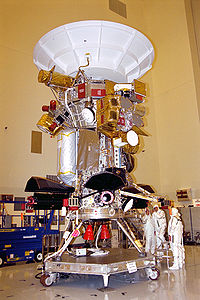 The spacecraft was originally planned to be the second three-axis stabilized, RTG
-powered Mariner Mark II
, a class of spacecraft developed for missions beyond the orbit of Mars
.
Cassini was developed simultaneously with the Comet Rendezvous Asteroid Flyby
(CRAF) spacecraft, but various budget cuts and rescopings of the project forced NASA to terminate CRAF development in order to save Cassini. As a result, the Cassini spacecraft became a more specialized design, canceling the implementation of the Mariner Mark II series.
The spacecraft, including the orbiter and the probe, is the largest and most complex interplanetary spacecraft built to date. The orbiter has a mass of 2150 kg (4,739.9 lb), the probe 350 kg (771.6 lb). With the launch vehicle adapter and 3132 kg (6,904.9 lb) of propellants at launch, the spacecraft had a mass of about 5600 kg (12,345.9 lb). Only the two Phobos
spacecraft sent to Mars
by the Soviet Union
were heavier.
The Cassini spacecraft is more than 6.8 metres (22.3 ft) high and more than 4 metres (13.1 ft) wide. The complexity of the spacecraft is necessitated both by its trajectory
(flight path) to Saturn, and by the ambitious program of scientific observations once the spacecraft reaches its destination. Cassini has at least 1,630 interconnected electronic components, 22,000 wire connections, and over 14 kilometres (8.7 mi) of cabling. The core control computer CPU was a redundant MIL-STD-1750A control system.
Now that the Cassini probe is orbiting Saturn, it is between 8.2 and 10.2 astronomical unit
s from the Earth
. Because of this, it takes between 68 to 84 minutes for radio signals to travel
from Earth to the spacecraft, and vice-versa. Thus, ground controllers cannot give "real-time" instructions to the spacecraft, either for day-to-day operations, or in cases of unexpected events. Even if they responded immediately after becoming aware of a problem, nearly three hours will have passed between the occurrence of the problem itself and the reception of the engineers' response by the satellite.
mapper, a charge-coupled device
imaging system, a visible/infrared
mapping spectrometer
, a composite infrared spectrometer, a cosmic dust
analyzer, a radio
and plasma
wave experiment, a plasma spectrometer, an ultraviolet
imaging spectrograph, a magnetospheric
imaging instrument, a magnetometer
and an ion
/neutral mass spectrometer. Telemetry from the communications antenna and other special transmitters (an S-band
transmitter and a dual-frequency Ka-band
system) will also be used to make observations of the atmospheres of Titan and Saturn and to measure the gravity fields of the planet and its satellites.
Cassini Plasma Spectrometer (CAPS): The CAPS is a direct sensing instrument that measures the energy and electrical charge of particles that the instrument encounters, (the number of electrons and protons in the particle). CAPS will measure the molecules originating from Saturn's ionosphere and also determine the configuration of Saturn's magnetic field. CAPS will also investigate plasma
in these areas as well as the solar wind within Saturn's magnetosphere.
Cosmic Dust Analyzer (CDA): The CDA is a direct sensing instrument that measures the size, speed, and direction of tiny dust grains near Saturn. Some of these particles are orbiting Saturn, while others may come from other star systems. The CDA on the orbiter is designed to learn more about these mysterious particles, the materials in other celestial bodies and potentially about the origins of the universe.
Composite Infrared Spectrometer (CIRS): The CIRS is a remote sensing instrument that measures the infrared waves
coming from objects to learn about their temperatures, thermal properties, and compositions. Throughout the Cassini–Huygens mission, the CIRS will measure infrared emissions from atmospheres, rings and surfaces in the vast Saturn system. It will map the atmosphere of Saturn in three dimensions to determine temperature and pressure profiles with altitude, gas composition, and the distribution of aerosols and clouds. It will also measure thermal characteristics and the composition of satellite surfaces and rings.
Ion and Neutral Mass Spectrometer (INMS): The INMS is a direct sensing instrument that analyzes charged particles (like protons and heavier ions) and neutral particles (like atoms) near Titan and Saturn to learn more about their atmospheres. INMS is intended also to measure the positive ion and neutral environments of Saturn's icy satellites and rings.
Imaging Science Subsystem (ISS): The ISS is a remote sensing instrument that captures most images in visible light, and also some infrared images and ultraviolet
images. The ISS has taken hundreds of thousands of images of Saturn, its rings, and its moons, for return to the Earth by radio telemetry
. The ISS has a wide-angle camera
(WAC) that takes pictures of large areas, and a narrow-angle camera (NAC) that takes pictures of small areas in fine detail. Each of these cameras uses a sensitive charge-coupled device (CCD) as its electromagnetic wave
detector. Each CCD has a 1,024 square array of pixels, 12 μm
on a side. Both cameras allow for many data collection modes, including on-chip data compression. Both cameras are fitted with spectral filters that rotate on a wheel—to view different bands within the electromagnetic spectrum ranging from 0.2 to 1.1 μm.
Dual Technique Magnetometer (MAG): The MAG is a direct sensing instrument that measures the strength and direction of the magnetic field around Saturn. The magnetic fields are generated partly by the intensely hot molten core at Saturn's center. Measuring the magnetic field is one of the ways to probe the core, even though it is far too hot and deep to visit. MAG aims to develop a three-dimensional model of Saturn's magnetosphere, and determine the magnetic state of Titan and its atmosphere, and the icy satellites and their role in the magnetosphere of Saturn.
Magnetospheric Imaging Instrument (MIMI): The MIMI is both a direct and remote sensing instrument that produces images and other data about the particles trapped in Saturn's huge magnetic field, or magnetosphere. This information will be used to study the overall configuration and dynamics of the magnetosphere and its interactions with the solar wind, Saturn's atmosphere, Titan, rings, and icy satellites. MIMI includes the Ion and Neutral Camera (INCA), which captures and measures Energetic Neutral Atoms (ENAs).
Radar: The onboard radar is a remote active and remote passive sensing instrument that will produce maps of Titan's surface. It measures the height of surface objects (like mountains and canyons) by sending radio signals that bounce off Titan's surface and timing their return. Radio waves can penetrate the thick veil of haze surrounding Titan. The radar will listen for radio waves that Saturn or its moons may be producing.
Radio and Plasma Wave Science instrument (RPWS): The RPWS is a direct and remote sensing instrument that receives and measures radio signals coming from Saturn, including the radio waves given off by the interaction of the solar wind with Saturn and Titan. RPWS is to measure the electric and magnetic wave fields in the interplanetary medium and planetary magnetospheres. It will also determine the electron density and temperature near Titan and in some regions of Saturn's magnetosphere. RPWS studies the configuration of Saturn's magnetic field and its relationship to Saturn Kilometric Radiation (SKR), as well as monitoring and mapping Saturn's ionosphere, plasma, and lightning from Saturn's (and possibly Titan's) atmosphere.
Radio Science Subsystem
(RSS): The RSS is a remote sensing instrument that uses radio antennas on Earth to observe the way radio signals from the spacecraft change as they are sent through objects, such as Titan's atmosphere or Saturn's rings, or even behind the Sun
. The RSS also studies the compositions, pressures and temperatures of atmospheres and ionospheres, radial structure and particle size distribution within rings, body and system masses and gravitational waves. The instrument uses the spacecraft X-band communication link as well as S-band downlink and Ka-band uplink and downlink.
Ultraviolet Imaging Spectrograph (UVIS): The UVIS is a remote sensing instrument that captures images of the ultraviolet light reflected off an object, such as the clouds of Saturn and/or its rings, to learn more about their structure and composition. Designed to measure ultraviolet light over wavelengths from 55.8 to 190 nm, this instrument is also a valuable tool to help determine the composition, distribution, aerosol particle content and temperatures of their atmospheres. Unlike other types of spectrometer, this sensitive instrument can take both spectral and spatial readings. It is particularly adept at determining the composition of gases. Spatial observations take a wide-by-narrow view, only one pixel
tall and 64 pixels across. The spectral dimension is 1,024 pixels per spatial pixel. Also, it can take many images that create movies of the ways in which this material is moved around by other forces.
Visible and Infrared Mapping Spectrometer (VIMS): The VIMS is a remote sensing instrument that captures images using visible and infrared light to learn more about the composition of moon surfaces, the rings, and the atmospheres of Saturn and Titan. It is made up of two cameras in one: one used to measure visible light, the other infrared. VIMS measures reflected and emitted radiation from atmospheres, rings and surfaces over wavelengths from 350 to 5100 nm, to help determine their compositions, temperatures and structures. It also observes the sunlight and starlight that passes through the rings to learn more about their structure. Scientists plan to use VIMS for long-term studies of cloud movement and morphology in the Saturn system, to determine Saturn's weather patterns.
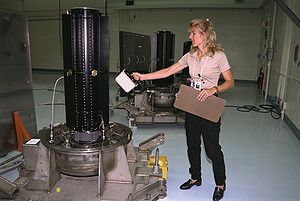 Because of Saturn's distance from the Sun, solar arrays
were not feasible as power sources for this space probe. To generate enough power, such arrays would have been too large and too heavy. Instead, the Cassini orbiter is powered by three radioisotope thermoelectric generator
s (RTGs), which use heat from the natural decay of about 33 kilograms (72 pounds) of plutonium
-238 (in the form of plutonium dioxide) to generate direct current electricity via thermocouple
s. The RTGs on the Cassini mission have the same design as those used on the New Horizons
, Galileo and Ulysses space probes, and they were designed to have very long operational lifetimes. At the end of the nominal 11-year Cassini mission, they will still be able to produce 600 to 700 watt
s of electrical power. (One of the spare RTGs for the Cassini mission was used to power the New Horizons
mission to Pluto
and the Kuiper belt
, which was designed and launched later on.)
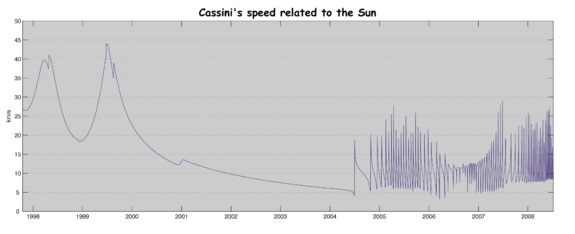
To gain interplanetary momentum
while already in flight, the trajectory of the Cassini mission included several gravitational slingshot maneuvers: two fly-by passes of Venus
, one more of the Earth, and then one of the planet Jupiter
. The terrestrial fly-by was the final instance when the Cassini space probe posed any conceivable danger to human beings. This occurred successfully, with hundreds of miles to spare (the space probe passing 500 km above the Earth), on August 18, 1999. Had there been any malfunction that caused the Cassini space probe to collide with the Earth, NASA's complete environmental impact study estimated that, in the worst case (with an acute angle of entry in which Cassini would gradually burn up), a significant fraction of the 32.7 kg of plutonium-238 inside the RTGs would have been dispersed into the Earth's atmosphere so that up to five billion people (i.e. the entire terrestrial population) could have been exposed, causing up to an estimated 5,000 additional cancer deaths (0.0005 per cent, i.e. a fraction 0.000005, of 1 billion cancer deaths expected anyway from other causes; the product is incorrectly calculated elsewhere as 500,000 deaths), but the odds against that happening were more than 1 million to one.
(ESA) and named after the 17th century Dutch astronomer who first discovered Titan, Christiaan Huygens, scrutinized the clouds, atmosphere, and surface of Saturn's moon Titan in its descent on January 15, 2005. It was designed to enter and brake in Titan's atmosphere and parachute a fully instrumented robotic laboratory down to the surface.
The probe system consisted of the probe itself which descended to Titan, and the probe support equipment (PSE) which remained attached to the orbiting spacecraft. The PSE includes electronics that track the probe, recover the data gathered during its descent, and process and deliver the data to the orbiter that transmits it to Earth. The core control computer CPU was a redundant MIL-STD-1750A control system.
The data was transmitted by a radio link between Huygens and Cassini provided by Probe Data Relay Subsystem (PDRS). As the probe's mission could not be telecommanded from Earth because of the great distance, it was automatically managed by the Command Data Management Subsystem (CDMS). The PDRS and CDMS were provided by the Italian Space Agency
(ASI).
 The Cassini space probe performed two gravitational-assist fly-bys of Venus
on April 26, 1998, and June 24, 1999. These fly-bys provided the space probe with enough momentum to travel all the way out to the asteroid belt
. At that point, the Sun's gravity pulled the space probe back into the inner Solar System, where it made a gravitational-assist fly-by of the Earth.
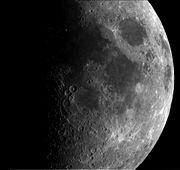
On August 18, 1999, at 03:28 UTC, the Cassini craft made a gravitational-assist flyby of the Earth. One hour and 20 minutes before closest approach, Cassini made the closest approach to the Earth's Moon at 377,000 kilometers, and it took a series of calibration photos.
On Jan. 23, 2000, the Cassini space probe performed a fly-by of the asteroid
2685 Masursky
at around 10:00 UTC. The Cassini craft took photos in the period five to seven hours before the fly-by at a distance of 1.6 million kilometers, and a diameter of 15 to 20 km was estimated for the asteroid.
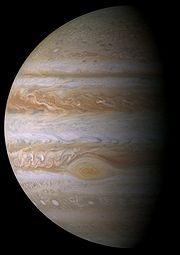 Cassini made its closest approach to Jupiter on December 30, 2000, and made many scientific measurements. About 26,000 images of Jupiter were taken during the months-long flyby. It produced the most detailed global color portrait of Jupiter yet (see image at right), in which the smallest visible features are approximately 60 km (37.3 mi) across.
The New Horizons mission to Pluto
captured more recent images of Jupiter, with a closest approach on February 28, 2007.
A major finding of the flyby, announced on March 6, 2003, was of Jupiter's atmospheric circulation. Dark "belts" alternate with light "zones" in the atmosphere, and scientists had long considered the zones, with their pale clouds, to be areas of upwelling air, partly because many clouds on Earth form where air is rising. But analysis of Cassini imagery showed that individual storm cells of upwelling bright-white clouds, too small to see from Earth, pop up almost without exception in the dark belts. According to Anthony Del Genio of NASA's Goddard Institute for Space Studies
, "the belts must be the areas of net-rising atmospheric motion on Jupiter, [so] the net motion in the zones has to be sinking."
Other atmospheric observations included a swirling dark oval of high atmospheric-haze, about the size of the Great Red Spot, near Jupiter's north pole. Infrared imagery revealed aspects of circulation near the poles, with bands of globe-encircling winds, with adjacent bands moving in opposite directions.
The same announcement also discussed the nature of Jupiter's rings
. Light scattering by particles in the rings showed the particles were irregularly shaped (rather than spherical) and likely originate as ejecta from micrometeorite impacts on Jupiter's moons, probably Metis
and Adrastea
.
Theory of General Relativity, which were done by using radio wave
s that were transmitted from the Cassini space probe.
The radio scientists measured a frequency
shift in the radio waves to and from the spacecraft, while those signals traveled close to the Sun. According to the Theory of General Relativity, a massive object like the Sun causes space-time to curve, and a beam of radio waves (or light, or any form of electromagnetic radiation
) that passes by the Sun has to travel farther because of the curvature.
The extra distance that the radio waves traveled from the Cassini craft, past the Sun, to the Earth delays their arrival. The amount of this time delay provides a sensitive test of the calculated predictions of Einstein's Relativity Theory.
Although some measurable deviations from the values that are calculated using the General Theory of Relativity are predicted by some unusual cosmological models, none of these deviations were found by this experiment. Previous tests using radio waves that were transmitted by the Viking and Voyager space probes were in agreement with the calculated values from General Relativity to within an accuracy of one part in one thousand. The more refined measurements from the Cassini space probe experiment improved this accuracy to about one part in 51,000, with the measured data firmly supporting Einstein's General Theory of Relativity.
 Using images taken by Cassini, three new moons of Saturn were discovered in 2004. They are very small and were given the provisional names S/2004 S 1, S/2004 S 2 and S/2004 S 5 before being named Methone
, Pallene
and Polydeuces
at the beginning of 2005.
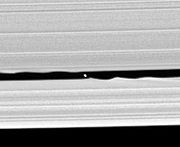
On May 1, 2005, a new moon was discovered by Cassini in the Keeler gap. It was given the designation S/2005 S 1 before being named Daphnis
. The only other known moon inside Saturn's ring system is Pan
.
A fifth new moon was discovered by Cassini on May 30, 2007, and was provisionally labelled S/2007 S 4. It is now known as Anthe
.
A press release on February 3, 2009 showed a sixth new moon found the Cassini. The moon is approximately 1/3 of a mile in diameter within the G-ring of the ring system of Saturn, and is now named Aegaeon (formerly S/2008 S 1).
A press release on November 2, 2009 mentions the seventh new moon found by Cassini on July 26, 2009. It is presently labeled S/2009 S 1
and is approximately 300 m (984 ft.) in diameter in the B-ring system.
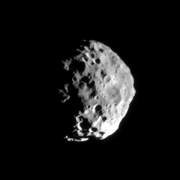 On June 11, 2004, Cassini flew by the moon Phoebe
. This was the first opportunity for close-up studies of this moon since the Voyager 2
flyby. It also was Cassinis only possible flyby for Phoebe due to the mechanics of the available orbits around Saturn.
First close-up images were received on June 12, 2004, and mission scientists immediately realized that the surface of Phoebe looks different from asteroids visited by spacecraft. Parts of the heavily cratered surfaces look very bright in those pictures, and it is currently believed that a large amount of water ice exists under its immediate surface.
, and that it is now 6 minutes longer. This does not indicate a change in the overall spin of the planet, but is thought to be due to movement of the source of the radio emissions to a different latitude, at which the rotation rate is different.
and achieved orbit
, after a seven year voyage. It is the first spacecraft to ever orbit Saturn.
The Saturn Orbital Insertion (SOI) maneuver performed by Cassini was complex, requiring the craft to orient its High-Gain Antenna away from Earth and along its flight path, to shield its instruments from particles in Saturn's rings. Once the craft crossed the ring plane, it had to rotate again to point its engine along its flight path, and then the engine fired to decelerate the craft by 622 meters per second to allow Saturn to capture it. Cassini was captured by Saturn's gravity at around 8:54 p.m. Pacific Daylight Time on June 30, 2004. During the maneuver Cassini passed within 20000 km (12,427.5 mi) of Saturn's cloud tops.
Although it is in Saturn orbit, departure from the Saturn system was evaluated in 2008 during end of mission planning.
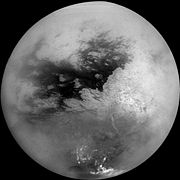 Cassini had its first distant flyby of Saturn's largest moon, Titan, on July 2, 2004, only a day after orbit insertion, when it approached to within 339000 km (210,645.4 mi) of Titan and provided the best look at the moon's surface to date. Images taken through special filters (able to see through the moon's global haze) showed south polar clouds thought to be composed of methane
and surface features with widely differing brightness. On October 27, 2004, the spacecraft executed the first of the 45 planned close flybys of Titan when it flew a mere 1,200 kilometers above the moon. Almost four gigabit
s of data were collected and transmitted to Earth, including the first radar images of the moon's haze-enshrouded surface. It revealed the surface of Titan (at least the area covered by radar) to be relatively level, with topography reaching no more than about 50 meters in altitude. The flyby provided a remarkable increase in imaging resolution over previous coverage. Images with up to 100 times better "resolution" were taken and are typical of resolutions planned for subsequent Titan flybys. (Note that "resolution" refers to the clarity and precision of pictures, and that it has nothing to do with the overall size of the pictures in square centimeters, as is very commonly erroneously stated.)
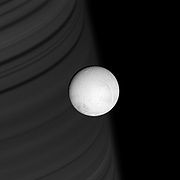 During the first two close flybys of the moon Enceladus
in 2005, Cassini discovered a "deflection" in the local magnetic field that is characteristic for the existence of a thin but significant atmosphere. Other measurements obtained at that time point to ionized water vapor as being its main constituent. Cassini also observed water ice geysers erupting from the south pole of Enceladus, which gives more credibility to the idea that Enceladus is supplying the particles of Saturn's E ring. Mission scientists hypothesize that there may be pockets of liquid water near the surface of the moon that fuel the eruptions, making Enceladus one of the few bodies in the Solar System to contain liquid water.
On March 12, 2008, Cassini made a close fly-by of Enceladus, getting within 50 km of the moon's surface. The spacecraft passed through the plumes extending from its southern geysers, detecting water, carbon dioxide and various hydrocarbons with its mass spectrometer, while also mapping surface features that are at much higher temperature than their surroundings with the infrared spectrometer. Cassini was unable to collect data with its cosmic dust analyzer due to an unknown software malfunction.
On November 21 Cassini again made a fly by of Enceladus, this time with a very different geometry, approaching within 1600 kilometres (994.2 mi) of the surface. The Composit Infrared Spectrograph (CIRS) instrument will make a map of thermal emissions from the tiger stripe Baghdad Sulcus. This is the eighth flyby of Enceladus and is also sometimes referred to as “E-8.” The data and images returned will help to create the most-detailed-yet mosaic image of the southern part of the moon's Saturn-facing hemisphere and a contiguous thermal map of one of the intriguing "tiger stripe" features, with the highest resolution to date.
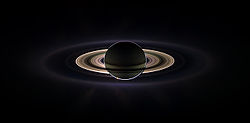 In May 2005, Cassini began a series of occultation
experiments, to measure the size-distribution of particles in Saturn's rings
, and measure the atmosphere of Saturn itself. For over 4 months, Cassini completed orbits designed for this purpose. During these experiments, Cassini flew behind the ring plane of Saturn, as seen from Earth, and transmitted radio waves through the particles. The radio signals were received on Earth, where the frequency, phase, and power of the signal was analyzed to help determine the structure of the rings.
space probes in the early 1980s.
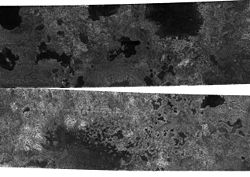 Radar images obtained on July 21, 2006 appear to show lakes of liquid hydrocarbon (such as methane
and ethane
) in Titan's northern latitudes. This is the first discovery of currently-existing lakes anywhere besides Earth. The lakes range in size from one to one-hundred kilometers across.
 On March 13, 2007, the Jet Propulsion Laboratory
announced that it found strong evidence of seas of methane and ethane in the northern hemisphere of Titan. At least one of these is larger than any of the Great Lakes
in North America.
. This is characteristic of a hurricane
on Earth and had never been seen on another planet before. Unlike a terran hurricane, the storm appears to be stationary at the pole. The storm is 8000 kilometres (4,971 mi) across, and 70 kilometres (43.5 mi) high, with winds blowing at 560 kilometres per hour (348 mph).
. Images were taken from 1000 miles (1,609.3 km) above the surface. As it was sending the images back to Earth, it was hit by a cosmic ray
which forced it to temporarily enter safe mode
. All of the data from the flyby was recovered.
, with 21 more close Titan flybys, seven of Enceladus, six of Mimas, eight of Tethys, and one targeted flyby each of Dione
, Rhea
, and Helene
. The extended mission began on July 1, 2008, and was renamed the Cassini Equinox Mission as the mission coincided with Saturn's equinox
.
A proposal was submitted to NASA for a second mission extension, provisionally named the extended-extended mission or XXM. This was subsequently approved and renamed the Cassini Solstice Mission. It will see Cassini orbiting Saturn 155 more times, conducting 54 additional flybys of Titan
and 11 more of Enceladus. The chosen mission ending is a series of close Saturn passes then a fiery plunge into the Saturn atmosphere, around its 2017 northern summer solstice.
On November 2, 2010, Cassini was triggered into a protective standby mode, or "safe mode", after a bit flip caused it to miss an important instruction. NASA announced the interruption in scientific processes on November 8. However, by November 8 some of the craft's functionality had already been partly restored. Nominal scientific instrument sequencing events were successfully started on November 10.
Cassini was reactivated as scheduled on November 24 and has returned to perfect working order, in time for two scheduled close fly-bys with Enceladus
. At this point there has been no public disclosure as to the data loss impact of the November 11 (T-73) flyby. However, no images were acquired at the 11 November polar flyby.
During planning for its extended missions, various future plans for Cassini were evaluated especially on the basis of science return, cost, and time. Some of the options examined include collision with Saturn atmosphere, icy satellite, or rings; another is departure from Saturn
orbit to Jupiter
, Uranus
, Neptune
, or a Centaur. Other options include leaving it in certain stable orbits around Saturn, or departure to a heliocentric orbit. Each plan requires certain amounts of time and changes in velocity. Another possibility was aerobraking
into orbit around Titan.
This table is based on page 19 of Cassini Extend Missions (NASA), from 2008.
The choice was XXM (Cassini Solstice Mission), starting in 2010, several years of flybys culminating in proximal orbits and Saturn impact in 2017. See Planetary Science Decadal Survey
for other Solar System mission concepts.
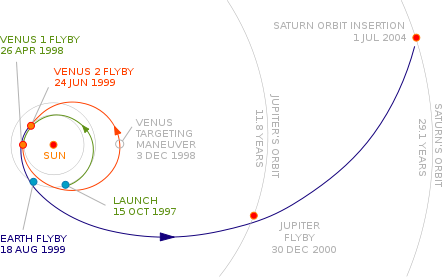 The initial gravitational-assist trajectory of Cassini–Huygens is the process whereby an insignificant mass approaches a significant mass "from behind" and "steals" some of its orbital momentum. The significant mass, usually a planet, loses a very small proportion of its orbital momentum to the insignificant mass, the space probe in this case. However, due to the space probe's small mass, this momentum transfer gives it a relatively large velocity increase in proportion to its initial velocity, speeding up its travel through outer space.
The Cassini–Huygens space probe performed two gravitational assist fly-bys at Venus, one more fly-by at the Earth, and a final fly-by at Jupiter.
.jpg)
Telecommunications & imaging
Scientific press coverage
Other
NASA
The National Aeronautics and Space Administration is the agency of the United States government that is responsible for the nation's civilian space program and for aeronautics and aerospace research...
/ESA
European Space Agency
The European Space Agency , established in 1975, is an intergovernmental organisation dedicated to the exploration of space, currently with 18 member states...
/ASI
Italian Space Agency
The Italian Space Agency is a government agency established in 1988 to fund, regulate and coordinate space exploration activities in Italy...
spacecraft
Spacecraft
A spacecraft or spaceship is a craft or machine designed for spaceflight. Spacecraft are used for a variety of purposes, including communications, earth observation, meteorology, navigation, planetary exploration and transportation of humans and cargo....
mission studying the planet Saturn
Saturn
Saturn is the sixth planet from the Sun and the second largest planet in the Solar System, after Jupiter. Saturn is named after the Roman god Saturn, equated to the Greek Cronus , the Babylonian Ninurta and the Hindu Shani. Saturn's astronomical symbol represents the Roman god's sickle.Saturn,...
and its many natural satellites
Saturn's natural satellites
The moons of Saturn are numerous and diverse, ranging from tiny moonlets less than 1 kilometre across, to the enormous Titan, which is larger than the planet Mercury. Saturn has 62 moons with confirmed orbits, fifty-three of which have names, and only thirteen of which have diameters larger than 50...
since 2004. Launched in 1997 after nearly two decades of gestation, it includes a Saturn orbiter and an atmospheric probe/lander for the moon Titan
Titan (moon)
Titan , or Saturn VI, is the largest moon of Saturn, the only natural satellite known to have a dense atmosphere, and the only object other than Earth for which clear evidence of stable bodies of surface liquid has been found....
, although it has also returned data on a wide variety of other things including the Heliosphere
Heliosphere
The heliosphere is a bubble in space "blown" into the interstellar medium by the solar wind. Although electrically neutral atoms from interstellar volume can penetrate this bubble, virtually all of the material in the heliosphere emanates from the Sun itself...
, Jupiter
Jupiter
Jupiter is the fifth planet from the Sun and the largest planet within the Solar System. It is a gas giant with mass one-thousandth that of the Sun but is two and a half times the mass of all the other planets in our Solar System combined. Jupiter is classified as a gas giant along with Saturn,...
, and relativity tests
Theory of relativity
The theory of relativity, or simply relativity, encompasses two theories of Albert Einstein: special relativity and general relativity. However, the word relativity is sometimes used in reference to Galilean invariance....
. The Titan probe, Huygens, entered and landed on Titan in 2005. The current end of mission plan is a 2017 Saturn impact.
The complete Cassini–Huygens space probe was launched on October 15, 1997 by a Titan IVB/Centaur, and after a long interplanetary voyage it entered into orbit around Saturn on July 1, 2004. On December 25, 2004, the Huygens probe was separated from the orbiter at approximately 02:00 UTC
Coordinated Universal Time
Coordinated Universal Time is the primary time standard by which the world regulates clocks and time. It is one of several closely related successors to Greenwich Mean Time. Computer servers, online services and other entities that rely on having a universally accepted time use UTC for that purpose...
. It reached Saturn's moon Titan
Titan (moon)
Titan , or Saturn VI, is the largest moon of Saturn, the only natural satellite known to have a dense atmosphere, and the only object other than Earth for which clear evidence of stable bodies of surface liquid has been found....
on January 14, 2005, when it descended into Titan's atmosphere, and downward to the surface, radioing scientific information back to the Earth by telemetry
Telemetry
Telemetry is a technology that allows measurements to be made at a distance, usually via radio wave transmission and reception of the information. The word is derived from Greek roots: tele = remote, and metron = measure...
. This was the first landing
Landing
thumb|A [[Mute Swan]] alighting. Note the ruffled feathers on top of the wings indicate that the swan is flying at the [[Stall |stall]]ing speed...
ever accomplished in the outer Solar System. On April 18, 2008, NASA announced a two-year extension of the funding for ground operations of this mission, at which point it was renamed to Cassini Equinox Mission. This was again extended in February 2010 with the Cassini Solstice Mission continuing until 2017. Cassini is the fourth space probe to visit Saturn and the first to enter orbit.
Sixteen European countries and the United States make up the team responsible for designing, building, flying and collecting data from the Cassini orbiter and Huygens probe. The mission is managed by NASA’s Jet Propulsion Laboratory
Jet Propulsion Laboratory
Jet Propulsion Laboratory is a federally funded research and development center and NASA field center located in the San Gabriel Valley area of Los Angeles County, California, United States. The facility is headquartered in the city of Pasadena on the border of La Cañada Flintridge and Pasadena...
in the United States, where the orbiter was designed and assembled. Development of the Huygens Titan probe was managed by the European Space Research and Technology Centre
European Space Research and Technology Centre
The European Space Research and Technology Centre is the European Space Agency's main technology development and test centre for spacecraft and space technology. It is situated in Noordwijk, South Holland, in the western Netherlands....
, whose prime contractor for the probe was the Alcatel
Alcatel
Alcatel Mobile Phones is a brand of mobile handsets. It was established in 2004 as a joint venture between Alcatel-Lucent of France and TCL Communication of China....
company in France. Equipment and instruments for the probe were supplied from many countries. The Italian Space Agency
Italian Space Agency
The Italian Space Agency is a government agency established in 1988 to fund, regulate and coordinate space exploration activities in Italy...
(ASI) provided the Cassini probe's high-gain radio antenna
Antenna (radio)
An antenna is an electrical device which converts electric currents into radio waves, and vice versa. It is usually used with a radio transmitter or radio receiver...
, and a compact and lightweight radar, which acts in multipurpose as a synthetic aperture radar
Synthetic aperture radar
Synthetic-aperture radar is a form of radar whose defining characteristic is its use of relative motion between an antenna and its target region to provide distinctive long-term coherent-signal variations that are exploited to obtain finer spatial resolution than is possible with conventional...
, a radar altimeter
Radar altimeter
A radar altimeter, radio altimeter, low range radio altimeter or simply RA measures altitude above the terrain presently beneath an aircraft or spacecraft...
, and a radiometer
Radiometer
A radiometer is a device for measuring the radiant flux of electromagnetic radiation. Generally, the term radiometer denotes an infrared radiation detector, yet it also includes detectors operating on any electromagnetic wavelength....
.
Cassini is powered by 32.7 kg of Plutonium-238
Plutonium-238
-External links:**...
the heat from the material's radioactive decay is turned into electricity. Huygens was supported by Cassini during cruise, but used chemical batteries when independent.
Naming
The spacecraft consists of two main elements: the ASI/NASA Cassini orbiter, named for the Italian-French astronomer Giovanni Domenico CassiniGiovanni Domenico Cassini
This article is about the Italian-born astronomer. For his French-born great-grandson, see Jean-Dominique Cassini.Giovanni Domenico Cassini was an Italian/French mathematician, astronomer, engineer, and astrologer...
, (also known later as Jean-Dominique Cassini when he became a citizen of France), and the ESA-developed Huygens probe
Huygens probe
The Huygens probe was an atmospheric entry probe carried to Saturn's moon Titan as part of the Cassini–Huygens mission. The probe was supplied by the European Space Agency and named after the Dutch 17th century astronomer Christiaan Huygens....
, named for the Dutch astronomer, mathematician and physicist Christiaan Huygens. It was commonly called Saturn Orbiter Titan Probe (SOTP) during gestation, both as a Mariner Mark II
Mariner Mark II
Mariner Mark II was NASA's planned family of unmanned spacecraft for the exploration of the outer solar system that were to be developed and operated by JPL between 1990 through the year 2010....
mission and generically. Mr. Huygens discovered Titan, and Mr. Cassini discovered a few more of Saturn's moons.
Objectives
Cassini has seven primary objectives:- Determine the three-dimensional structure and dynamic behavior of the ringsPlanetary ringA planetary ring is a ring of cosmic dust and other small particles orbiting around a planet in a flat disc-shaped region.The most notable planetary rings known in Earth's solar system are those around Saturn, but the other three gas giants of the solar system possess ring systems of their...
of Saturn - Determine the composition of the satelliteSatelliteIn the context of spaceflight, a satellite is an object which has been placed into orbit by human endeavour. Such objects are sometimes called artificial satellites to distinguish them from natural satellites such as the Moon....
surfaces and the geological history of each object - Determine the nature and origin of the dark material on Iapetus'sIapetus (moon)Iapetus ), occasionally Japetus , is the third-largest moon of Saturn, and eleventh in the Solar System. It was discovered by Giovanni Domenico Cassini in 1671...
leading hemisphere - Measure the three-dimensional structure and dynamic behavior of the magnetosphereMagnetosphereA magnetosphere is formed when a stream of charged particles, such as the solar wind, interacts with and is deflected by the intrinsic magnetic field of a planet or similar body. Earth is surrounded by a magnetosphere, as are the other planets with intrinsic magnetic fields: Mercury, Jupiter,...
- Study the dynamic behavior of Saturn's atmosphere at cloudCloudA cloud is a visible mass of liquid droplets or frozen crystals made of water and/or various chemicals suspended in the atmosphere above the surface of a planetary body. They are also known as aerosols. Clouds in Earth's atmosphere are studied in the cloud physics branch of meteorology...
level - Study the time variability of Titan's clouds and hazeHazeHaze is traditionally an atmospheric phenomenon where dust, smoke and other dry particles obscure the clarity of the sky. The World Meteorological Organization manual of codes includes a classification of horizontal obscuration into categories of fog, ice fog, steam fog, mist, haze, smoke, volcanic...
s - Characterize Titan's surface on a regional scale
The Cassini–Huygens spacecraft was launched on October 15, 1997, from Cape Canaveral Air Force Station
Cape Canaveral Air Force Station
Cape Canaveral Air Force Station is an installation of the United States Air Force Space Command's 45th Space Wing, headquartered at nearby Patrick Air Force Base. Located on Cape Canaveral in the state of Florida, CCAFS is the primary launch head of America's Eastern Range with four launch pads...
's Space Launch Complex 40 using a U.S. Air Force Titan IV
Titan IV
The Titan IV family of space boosters were used by the U.S. Air Force. They were launched from Cape Canaveral Air Force Station, Florida, and Vandenberg Air Force Base, California. At the time of its introduction, the Titan IV was the "largest unmanned space booster used by the Air Force."The...
B/Centaur rocket. The complete launcher was made up of a two-stage Titan IV
Titan IV
The Titan IV family of space boosters were used by the U.S. Air Force. They were launched from Cape Canaveral Air Force Station, Florida, and Vandenberg Air Force Base, California. At the time of its introduction, the Titan IV was the "largest unmanned space booster used by the Air Force."The...
booster rocket
Booster rocket
A booster rocket is either the first stage of a multi-stage launch vehicle, or else a strap-on rocket used to augment the core launch vehicle's takeoff thrust and payload capability. Boosters are generally necessary to launch spacecraft into Earth orbit or beyond...
, two strap-on solid rocket motors, the Centaur upper stage, and a payload enclosure, or fairing.
The total cost of this scientific exploration mission is about US$
United States dollar
The United States dollar , also referred to as the American dollar, is the official currency of the United States of America. It is divided into 100 smaller units called cents or pennies....
3.26 billion
1000000000 (number)
1,000,000,000 is the natural number following 999,999,999 and preceding 1,000,000,001.In scientific notation, it is written as 109....
, including $1.4 billion for pre-launch development, $704 million
Million
One million or one thousand thousand, is the natural number following 999,999 and preceding 1,000,001. The word is derived from the early Italian millione , from mille, "thousand", plus the augmentative suffix -one.In scientific notation, it is written as or just 106...
for mission operations, $54 million for tracking and $422 million for the launch vehicle. The United States contributed $2.6 billion (80%), the ESA $500 million (15%), and the ASI $160 million (5%).
The primary mission for Cassini ended on July 30, 2008. However, given the excellent condition of the orbiter, the mission was extended to the end of June 2010 (Cassini Equinox Mission). This studied the Saturn system in detail during Equinox, which happened in August 2009. On February 3, 2010, NASA announced another extension for Cassini, this one for 6½ years until 2017, the time of Summer Solstice in Saturn's Northern Hemisphere (Cassini Solstice Mission). The extension enables another 155 revolutions around the planet, 54 flybys of Titan and 11 flybys of Enceladus. In 2017, an encounter with Titan will change its orbit in such a way that, at closest approach to Saturn, it will be only 3,000 km above the planet's cloudtops, below the inner edge of the D ring. This sequence of "proximal orbits" will end when another encounter with Titan sends the probe into Saturn's atmosphere.
History
European Science Foundation
The European Science Foundation is an association of 78 member organisations devoted to scientific research in 30 European countries. It is an independent, non-governmental, non-profit organisation that facilitates cooperation and collaboration in European research and development, European...
and the American National Academy of Sciences
United States National Academy of Sciences
The National Academy of Sciences is a corporation in the United States whose members serve pro bono as "advisers to the nation on science, engineering, and medicine." As a national academy, new members of the organization are elected annually by current members, based on their distinguished and...
formed a working group
Working group
A working group is an interdisciplinary collaboration of researchers working on new research activities that would be difficult to develop under traditional funding mechanisms . The lifespan of the WG can last anywhere between a few months and several years...
to investigate future cooperative missions. Two European scientists suggested a paired Saturn Orbiter and Titan Probe as a possible joint mission. In 1983, NASA's Solar System Exploration Committee recommended the same Orbiter and Probe pair as a core NASA project. NASA and the European Space Agency
European Space Agency
The European Space Agency , established in 1975, is an intergovernmental organisation dedicated to the exploration of space, currently with 18 member states...
(ESA) performed a joint study of the potential mission from 1984 to 1985. ESA continued with its own study in 1986, while the American astronaut Sally Ride
Sally Ride
Sally Kristen Ride is an American physicist and a former NASA astronaut. Ride joined NASA in 1978, and in 1983 became the first American woman—and then-youngest American, at 32—to enter space...
, in her influential 1987 report "NASA Leadership and America's Future in Space
The Ride Report
The Ride Report is the informal name of the report titled NASA Leadership and America's Future in Space: A Report to the Administrator. In 1986, a task force under the leadership of Sally Ride was asked to formulate a new strategy for NASA. The report was issued in 1987.The Ride Report proposed...
", also examined and approved of the Cassini mission.
While Ride's report described the Saturn orbiter and probe as a NASA solo mission, in 1988 the Associate Administrator for Space Science and Applications of NASA Len Fisk returned to the idea of a joint NASA and ESA mission. He wrote to his counterpart at the ESA, Roger Bonnet, strongly suggesting that the ESA choose the Cassini mission from the three candidates at hand and promising that NASA would commit to the mission as soon as the ESA did.
At the time, NASA was becoming more sensitive to the strain that had developed between the American and European space programs as a result of European perceptions that NASA had not treated it like an equal during previous collaborations. NASA officials and advisers involved in promoting and planning Cassini–Huygens attempted to correct this trend by stressing their desire to evenly share any scientific and technology benefits resulting from the mission. In part, this newfound spirit of cooperation with Europe was driven by a sense of competition with the Soviet Union
Soviet Union
The Soviet Union , officially the Union of Soviet Socialist Republics , was a constitutionally socialist state that existed in Eurasia between 1922 and 1991....
, which had begun to cooperate more closely with Europe as the ESA drew further away from NASA.
The collaboration not only improved relations between the two space programs but also helped Cassini–Huygens survive congressional budget cuts in the United States. Cassini–Huygens came under fire politically in both 1992 and 1994, but NASA successfully persuaded the U.S. Congress that it would be unwise to halt the project after the ESA had already poured funds into development because frustration on broken space exploration promises might spill over into other areas of foreign relations. The project proceeded politically smoothly after 1994, although citizens' groups concerned about its potential environmental impact attempted to derail it through protests and lawsuits until and past its 1997 launch.
Spacecraft design
Radioisotope thermoelectric generator
A radioisotope thermoelectric generator is an electrical generator that obtains its power from radioactive decay. In such a device, the heat released by the decay of a suitable radioactive material is converted into electricity by the Seebeck effect using an array of thermocouples.RTGs can be...
-powered Mariner Mark II
Mariner Mark II
Mariner Mark II was NASA's planned family of unmanned spacecraft for the exploration of the outer solar system that were to be developed and operated by JPL between 1990 through the year 2010....
, a class of spacecraft developed for missions beyond the orbit of Mars
Mars
Mars is the fourth planet from the Sun in the Solar System. The planet is named after the Roman god of war, Mars. It is often described as the "Red Planet", as the iron oxide prevalent on its surface gives it a reddish appearance...
.
Cassini was developed simultaneously with the Comet Rendezvous Asteroid Flyby
Comet Rendezvous Asteroid Flyby
The Comet Rendezvous Asteroid Flyby was a cancelled plan for a NASA led exploratory mission designed by the Jet Propulsion Laboratory during the mid-to-late 1980s and early 1990s, that planned to send a spacecraft to encounter an asteroid, and then to rendezvous with a comet and fly alongside it...
(CRAF) spacecraft, but various budget cuts and rescopings of the project forced NASA to terminate CRAF development in order to save Cassini. As a result, the Cassini spacecraft became a more specialized design, canceling the implementation of the Mariner Mark II series.
The spacecraft, including the orbiter and the probe, is the largest and most complex interplanetary spacecraft built to date. The orbiter has a mass of 2150 kg (4,739.9 lb), the probe 350 kg (771.6 lb). With the launch vehicle adapter and 3132 kg (6,904.9 lb) of propellants at launch, the spacecraft had a mass of about 5600 kg (12,345.9 lb). Only the two Phobos
Phobos program
The Phobos program was an unmanned space mission consisting of two probes launched by the Soviet Union to study Mars and its moons Phobos and Deimos. Phobos 2 became a Mars orbiter and returned 38 images with a resolution of up to 40 meters...
spacecraft sent to Mars
Mars
Mars is the fourth planet from the Sun in the Solar System. The planet is named after the Roman god of war, Mars. It is often described as the "Red Planet", as the iron oxide prevalent on its surface gives it a reddish appearance...
by the Soviet Union
Soviet Union
The Soviet Union , officially the Union of Soviet Socialist Republics , was a constitutionally socialist state that existed in Eurasia between 1922 and 1991....
were heavier.
The Cassini spacecraft is more than 6.8 metres (22.3 ft) high and more than 4 metres (13.1 ft) wide. The complexity of the spacecraft is necessitated both by its trajectory
Trajectory
A trajectory is the path that a moving object follows through space as a function of time. The object might be a projectile or a satellite, for example. It thus includes the meaning of orbit—the path of a planet, an asteroid or a comet as it travels around a central mass...
(flight path) to Saturn, and by the ambitious program of scientific observations once the spacecraft reaches its destination. Cassini has at least 1,630 interconnected electronic components, 22,000 wire connections, and over 14 kilometres (8.7 mi) of cabling. The core control computer CPU was a redundant MIL-STD-1750A control system.
Now that the Cassini probe is orbiting Saturn, it is between 8.2 and 10.2 astronomical unit
Astronomical unit
An astronomical unit is a unit of length equal to about or approximately the mean Earth–Sun distance....
s from the Earth
Earth
Earth is the third planet from the Sun, and the densest and fifth-largest of the eight planets in the Solar System. It is also the largest of the Solar System's four terrestrial planets...
. Because of this, it takes between 68 to 84 minutes for radio signals to travel
Travel time
Travel time may refer to* Travel, movement of people between locations* Travel journal, record made by a voyager* Propagation speed, term in physics to measure things such as the speed of light or radio waves...
from Earth to the spacecraft, and vice-versa. Thus, ground controllers cannot give "real-time" instructions to the spacecraft, either for day-to-day operations, or in cases of unexpected events. Even if they responded immediately after becoming aware of a problem, nearly three hours will have passed between the occurrence of the problem itself and the reception of the engineers' response by the satellite.
Instruments
Cassinis instrumentation consists of: a synthetic aperture radarRadar
Radar is an object-detection system which uses radio waves to determine the range, altitude, direction, or speed of objects. It can be used to detect aircraft, ships, spacecraft, guided missiles, motor vehicles, weather formations, and terrain. The radar dish or antenna transmits pulses of radio...
mapper, a charge-coupled device
Charge-coupled device
A charge-coupled device is a device for the movement of electrical charge, usually from within the device to an area where the charge can be manipulated, for example conversion into a digital value. This is achieved by "shifting" the signals between stages within the device one at a time...
imaging system, a visible/infrared
Infrared
Infrared light is electromagnetic radiation with a wavelength longer than that of visible light, measured from the nominal edge of visible red light at 0.74 micrometres , and extending conventionally to 300 µm...
mapping spectrometer
Spectrometer
A spectrometer is an instrument used to measure properties of light over a specific portion of the electromagnetic spectrum, typically used in spectroscopic analysis to identify materials. The variable measured is most often the light's intensity but could also, for instance, be the polarization...
, a composite infrared spectrometer, a cosmic dust
Cosmic dust
Cosmic dust is a type of dust composed of particles in space which are a few molecules to 0.1 µm in size. Cosmic dust can be further distinguished by its astronomical location; for example: intergalactic dust, interstellar dust, interplanetary dust and circumplanetary dust .In our own Solar...
analyzer, a radio
Radio
Radio is the transmission of signals through free space by modulation of electromagnetic waves with frequencies below those of visible light. Electromagnetic radiation travels by means of oscillating electromagnetic fields that pass through the air and the vacuum of space...
and plasma
Plasma (physics)
In physics and chemistry, plasma is a state of matter similar to gas in which a certain portion of the particles are ionized. Heating a gas may ionize its molecules or atoms , thus turning it into a plasma, which contains charged particles: positive ions and negative electrons or ions...
wave experiment, a plasma spectrometer, an ultraviolet
Ultraviolet
Ultraviolet light is electromagnetic radiation with a wavelength shorter than that of visible light, but longer than X-rays, in the range 10 nm to 400 nm, and energies from 3 eV to 124 eV...
imaging spectrograph, a magnetospheric
Magnetosphere
A magnetosphere is formed when a stream of charged particles, such as the solar wind, interacts with and is deflected by the intrinsic magnetic field of a planet or similar body. Earth is surrounded by a magnetosphere, as are the other planets with intrinsic magnetic fields: Mercury, Jupiter,...
imaging instrument, a magnetometer
Magnetometer
A magnetometer is a measuring instrument used to measure the strength or direction of a magnetic field either produced in the laboratory or existing in nature...
and an ion
Ion
An ion is an atom or molecule in which the total number of electrons is not equal to the total number of protons, giving it a net positive or negative electrical charge. The name was given by physicist Michael Faraday for the substances that allow a current to pass between electrodes in a...
/neutral mass spectrometer. Telemetry from the communications antenna and other special transmitters (an S-band
S band
The S band is defined by an IEEE standard for radio waves with frequencies that range from 2 to 4 GHz, crossing the conventional boundary between UHF and SHF at 3.0 GHz. It is part of the microwave band of the electromagnetic spectrum...
transmitter and a dual-frequency Ka-band
Ka band
The Ka band covers the frequencies of 26.5–40 GHz. The Ka band is part of the K band of the microwave band of the electromagnetic spectrum. This symbol refers to "K-above" — in other words, the band directly above the K-band...
system) will also be used to make observations of the atmospheres of Titan and Saturn and to measure the gravity fields of the planet and its satellites.
Cassini Plasma Spectrometer (CAPS): The CAPS is a direct sensing instrument that measures the energy and electrical charge of particles that the instrument encounters, (the number of electrons and protons in the particle). CAPS will measure the molecules originating from Saturn's ionosphere and also determine the configuration of Saturn's magnetic field. CAPS will also investigate plasma
Plasma (physics)
In physics and chemistry, plasma is a state of matter similar to gas in which a certain portion of the particles are ionized. Heating a gas may ionize its molecules or atoms , thus turning it into a plasma, which contains charged particles: positive ions and negative electrons or ions...
in these areas as well as the solar wind within Saturn's magnetosphere.
Cosmic Dust Analyzer (CDA): The CDA is a direct sensing instrument that measures the size, speed, and direction of tiny dust grains near Saturn. Some of these particles are orbiting Saturn, while others may come from other star systems. The CDA on the orbiter is designed to learn more about these mysterious particles, the materials in other celestial bodies and potentially about the origins of the universe.
Composite Infrared Spectrometer (CIRS): The CIRS is a remote sensing instrument that measures the infrared waves
Infrared
Infrared light is electromagnetic radiation with a wavelength longer than that of visible light, measured from the nominal edge of visible red light at 0.74 micrometres , and extending conventionally to 300 µm...
coming from objects to learn about their temperatures, thermal properties, and compositions. Throughout the Cassini–Huygens mission, the CIRS will measure infrared emissions from atmospheres, rings and surfaces in the vast Saturn system. It will map the atmosphere of Saturn in three dimensions to determine temperature and pressure profiles with altitude, gas composition, and the distribution of aerosols and clouds. It will also measure thermal characteristics and the composition of satellite surfaces and rings.
Ion and Neutral Mass Spectrometer (INMS): The INMS is a direct sensing instrument that analyzes charged particles (like protons and heavier ions) and neutral particles (like atoms) near Titan and Saturn to learn more about their atmospheres. INMS is intended also to measure the positive ion and neutral environments of Saturn's icy satellites and rings.
Imaging Science Subsystem (ISS): The ISS is a remote sensing instrument that captures most images in visible light, and also some infrared images and ultraviolet
Ultraviolet
Ultraviolet light is electromagnetic radiation with a wavelength shorter than that of visible light, but longer than X-rays, in the range 10 nm to 400 nm, and energies from 3 eV to 124 eV...
images. The ISS has taken hundreds of thousands of images of Saturn, its rings, and its moons, for return to the Earth by radio telemetry
Telemetry
Telemetry is a technology that allows measurements to be made at a distance, usually via radio wave transmission and reception of the information. The word is derived from Greek roots: tele = remote, and metron = measure...
. The ISS has a wide-angle camera
Camera
A camera is a device that records and stores images. These images may be still photographs or moving images such as videos or movies. The term camera comes from the camera obscura , an early mechanism for projecting images...
(WAC) that takes pictures of large areas, and a narrow-angle camera (NAC) that takes pictures of small areas in fine detail. Each of these cameras uses a sensitive charge-coupled device (CCD) as its electromagnetic wave
Electromagnetism
Electromagnetism is one of the four fundamental interactions in nature. The other three are the strong interaction, the weak interaction and gravitation...
detector. Each CCD has a 1,024 square array of pixels, 12 μm
Micrometre
A micrometer , is by definition 1×10⁻⁶ of a meter .In plain English, it means one-millionth of a meter . Its unit symbol in the International System of Units is μm...
on a side. Both cameras allow for many data collection modes, including on-chip data compression. Both cameras are fitted with spectral filters that rotate on a wheel—to view different bands within the electromagnetic spectrum ranging from 0.2 to 1.1 μm.
Dual Technique Magnetometer (MAG): The MAG is a direct sensing instrument that measures the strength and direction of the magnetic field around Saturn. The magnetic fields are generated partly by the intensely hot molten core at Saturn's center. Measuring the magnetic field is one of the ways to probe the core, even though it is far too hot and deep to visit. MAG aims to develop a three-dimensional model of Saturn's magnetosphere, and determine the magnetic state of Titan and its atmosphere, and the icy satellites and their role in the magnetosphere of Saturn.
Magnetospheric Imaging Instrument (MIMI): The MIMI is both a direct and remote sensing instrument that produces images and other data about the particles trapped in Saturn's huge magnetic field, or magnetosphere. This information will be used to study the overall configuration and dynamics of the magnetosphere and its interactions with the solar wind, Saturn's atmosphere, Titan, rings, and icy satellites. MIMI includes the Ion and Neutral Camera (INCA), which captures and measures Energetic Neutral Atoms (ENAs).
Radar: The onboard radar is a remote active and remote passive sensing instrument that will produce maps of Titan's surface. It measures the height of surface objects (like mountains and canyons) by sending radio signals that bounce off Titan's surface and timing their return. Radio waves can penetrate the thick veil of haze surrounding Titan. The radar will listen for radio waves that Saturn or its moons may be producing.
Radio and Plasma Wave Science instrument (RPWS): The RPWS is a direct and remote sensing instrument that receives and measures radio signals coming from Saturn, including the radio waves given off by the interaction of the solar wind with Saturn and Titan. RPWS is to measure the electric and magnetic wave fields in the interplanetary medium and planetary magnetospheres. It will also determine the electron density and temperature near Titan and in some regions of Saturn's magnetosphere. RPWS studies the configuration of Saturn's magnetic field and its relationship to Saturn Kilometric Radiation (SKR), as well as monitoring and mapping Saturn's ionosphere, plasma, and lightning from Saturn's (and possibly Titan's) atmosphere.
Radio Science Subsystem
Radio Science Subsystem
The Radio Science Subsystem on a scientific spacecraft uses radio signals to probe a medium such as a planetary atmosphere. The spacecraft transmits a highly stable signal to ground stations, receives such a signal from ground stations, or both...
(RSS): The RSS is a remote sensing instrument that uses radio antennas on Earth to observe the way radio signals from the spacecraft change as they are sent through objects, such as Titan's atmosphere or Saturn's rings, or even behind the Sun
Sun
The Sun is the star at the center of the Solar System. It is almost perfectly spherical and consists of hot plasma interwoven with magnetic fields...
. The RSS also studies the compositions, pressures and temperatures of atmospheres and ionospheres, radial structure and particle size distribution within rings, body and system masses and gravitational waves. The instrument uses the spacecraft X-band communication link as well as S-band downlink and Ka-band uplink and downlink.
Ultraviolet Imaging Spectrograph (UVIS): The UVIS is a remote sensing instrument that captures images of the ultraviolet light reflected off an object, such as the clouds of Saturn and/or its rings, to learn more about their structure and composition. Designed to measure ultraviolet light over wavelengths from 55.8 to 190 nm, this instrument is also a valuable tool to help determine the composition, distribution, aerosol particle content and temperatures of their atmospheres. Unlike other types of spectrometer, this sensitive instrument can take both spectral and spatial readings. It is particularly adept at determining the composition of gases. Spatial observations take a wide-by-narrow view, only one pixel
Pixel
In digital imaging, a pixel, or pel, is a single point in a raster image, or the smallest addressable screen element in a display device; it is the smallest unit of picture that can be represented or controlled....
tall and 64 pixels across. The spectral dimension is 1,024 pixels per spatial pixel. Also, it can take many images that create movies of the ways in which this material is moved around by other forces.
Visible and Infrared Mapping Spectrometer (VIMS): The VIMS is a remote sensing instrument that captures images using visible and infrared light to learn more about the composition of moon surfaces, the rings, and the atmospheres of Saturn and Titan. It is made up of two cameras in one: one used to measure visible light, the other infrared. VIMS measures reflected and emitted radiation from atmospheres, rings and surfaces over wavelengths from 350 to 5100 nm, to help determine their compositions, temperatures and structures. It also observes the sunlight and starlight that passes through the rings to learn more about their structure. Scientists plan to use VIMS for long-term studies of cloud movement and morphology in the Saturn system, to determine Saturn's weather patterns.
Plutonium power source
Solar cell
A solar cell is a solid state electrical device that converts the energy of light directly into electricity by the photovoltaic effect....
were not feasible as power sources for this space probe. To generate enough power, such arrays would have been too large and too heavy. Instead, the Cassini orbiter is powered by three radioisotope thermoelectric generator
Radioisotope thermoelectric generator
A radioisotope thermoelectric generator is an electrical generator that obtains its power from radioactive decay. In such a device, the heat released by the decay of a suitable radioactive material is converted into electricity by the Seebeck effect using an array of thermocouples.RTGs can be...
s (RTGs), which use heat from the natural decay of about 33 kilograms (72 pounds) of plutonium
Plutonium
Plutonium is a transuranic radioactive chemical element with the chemical symbol Pu and atomic number 94. It is an actinide metal of silvery-gray appearance that tarnishes when exposed to air, forming a dull coating when oxidized. The element normally exhibits six allotropes and four oxidation...
-238 (in the form of plutonium dioxide) to generate direct current electricity via thermocouple
Thermocouple
A thermocouple is a device consisting of two different conductors that produce a voltage proportional to a temperature difference between either end of the pair of conductors. Thermocouples are a widely used type of temperature sensor for measurement and control and can also be used to convert a...
s. The RTGs on the Cassini mission have the same design as those used on the New Horizons
New Horizons
New Horizons is a NASA robotic spacecraft mission currently en route to the dwarf planet Pluto. It is expected to be the first spacecraft to fly by and study Pluto and its moons, Charon, Nix, Hydra and S/2011 P 1. Its estimated arrival date at the Pluto-Charon system is July 14th, 2015...
, Galileo and Ulysses space probes, and they were designed to have very long operational lifetimes. At the end of the nominal 11-year Cassini mission, they will still be able to produce 600 to 700 watt
Watt
The watt is a derived unit of power in the International System of Units , named after the Scottish engineer James Watt . The unit, defined as one joule per second, measures the rate of energy conversion.-Definition:...
s of electrical power. (One of the spare RTGs for the Cassini mission was used to power the New Horizons
New Horizons
New Horizons is a NASA robotic spacecraft mission currently en route to the dwarf planet Pluto. It is expected to be the first spacecraft to fly by and study Pluto and its moons, Charon, Nix, Hydra and S/2011 P 1. Its estimated arrival date at the Pluto-Charon system is July 14th, 2015...
mission to Pluto
Pluto
Pluto, formal designation 134340 Pluto, is the second-most-massive known dwarf planet in the Solar System and the tenth-most-massive body observed directly orbiting the Sun...
and the Kuiper belt
Kuiper belt
The Kuiper belt , sometimes called the Edgeworth–Kuiper belt, is a region of the Solar System beyond the planets extending from the orbit of Neptune to approximately 50 AU from the Sun. It is similar to the asteroid belt, although it is far larger—20 times as wide and 20 to 200 times as massive...
, which was designed and launched later on.)
To gain interplanetary momentum
Momentum
In classical mechanics, linear momentum or translational momentum is the product of the mass and velocity of an object...
while already in flight, the trajectory of the Cassini mission included several gravitational slingshot maneuvers: two fly-by passes of Venus
Venus
Venus is the second planet from the Sun, orbiting it every 224.7 Earth days. The planet is named after Venus, the Roman goddess of love and beauty. After the Moon, it is the brightest natural object in the night sky, reaching an apparent magnitude of −4.6, bright enough to cast shadows...
, one more of the Earth, and then one of the planet Jupiter
Jupiter
Jupiter is the fifth planet from the Sun and the largest planet within the Solar System. It is a gas giant with mass one-thousandth that of the Sun but is two and a half times the mass of all the other planets in our Solar System combined. Jupiter is classified as a gas giant along with Saturn,...
. The terrestrial fly-by was the final instance when the Cassini space probe posed any conceivable danger to human beings. This occurred successfully, with hundreds of miles to spare (the space probe passing 500 km above the Earth), on August 18, 1999. Had there been any malfunction that caused the Cassini space probe to collide with the Earth, NASA's complete environmental impact study estimated that, in the worst case (with an acute angle of entry in which Cassini would gradually burn up), a significant fraction of the 32.7 kg of plutonium-238 inside the RTGs would have been dispersed into the Earth's atmosphere so that up to five billion people (i.e. the entire terrestrial population) could have been exposed, causing up to an estimated 5,000 additional cancer deaths (0.0005 per cent, i.e. a fraction 0.000005, of 1 billion cancer deaths expected anyway from other causes; the product is incorrectly calculated elsewhere as 500,000 deaths), but the odds against that happening were more than 1 million to one.
Huygens probe
The Huygens probe, supplied by the European Space AgencyEuropean Space Agency
The European Space Agency , established in 1975, is an intergovernmental organisation dedicated to the exploration of space, currently with 18 member states...
(ESA) and named after the 17th century Dutch astronomer who first discovered Titan, Christiaan Huygens, scrutinized the clouds, atmosphere, and surface of Saturn's moon Titan in its descent on January 15, 2005. It was designed to enter and brake in Titan's atmosphere and parachute a fully instrumented robotic laboratory down to the surface.
The probe system consisted of the probe itself which descended to Titan, and the probe support equipment (PSE) which remained attached to the orbiting spacecraft. The PSE includes electronics that track the probe, recover the data gathered during its descent, and process and deliver the data to the orbiter that transmits it to Earth. The core control computer CPU was a redundant MIL-STD-1750A control system.
The data was transmitted by a radio link between Huygens and Cassini provided by Probe Data Relay Subsystem (PDRS). As the probe's mission could not be telecommanded from Earth because of the great distance, it was automatically managed by the Command Data Management Subsystem (CDMS). The PDRS and CDMS were provided by the Italian Space Agency
Italian Space Agency
The Italian Space Agency is a government agency established in 1988 to fund, regulate and coordinate space exploration activities in Italy...
(ASI).
Venus and Earth fly-bys and the cruise to Jupiter
Venus
Venus is the second planet from the Sun, orbiting it every 224.7 Earth days. The planet is named after Venus, the Roman goddess of love and beauty. After the Moon, it is the brightest natural object in the night sky, reaching an apparent magnitude of −4.6, bright enough to cast shadows...
on April 26, 1998, and June 24, 1999. These fly-bys provided the space probe with enough momentum to travel all the way out to the asteroid belt
Asteroid belt
The asteroid belt is the region of the Solar System located roughly between the orbits of the planets Mars and Jupiter. It is occupied by numerous irregularly shaped bodies called asteroids or minor planets...
. At that point, the Sun's gravity pulled the space probe back into the inner Solar System, where it made a gravitational-assist fly-by of the Earth.
On August 18, 1999, at 03:28 UTC, the Cassini craft made a gravitational-assist flyby of the Earth. One hour and 20 minutes before closest approach, Cassini made the closest approach to the Earth's Moon at 377,000 kilometers, and it took a series of calibration photos.
On Jan. 23, 2000, the Cassini space probe performed a fly-by of the asteroid
Asteroid
Asteroids are a class of small Solar System bodies in orbit around the Sun. They have also been called planetoids, especially the larger ones...
2685 Masursky
2685 Masursky
The asteroid 2685 Masursky is a main-belt asteroid. It was discovered by Edward Bowell in 1981. It was named after Harold Masursky , a planetary geologist at the U.S. Geological Survey, Flagstaff, who worked on numerous space missions....
at around 10:00 UTC. The Cassini craft took photos in the period five to seven hours before the fly-by at a distance of 1.6 million kilometers, and a diameter of 15 to 20 km was estimated for the asteroid.
Jupiter flyby
The New Horizons mission to Pluto
New Horizons
New Horizons is a NASA robotic spacecraft mission currently en route to the dwarf planet Pluto. It is expected to be the first spacecraft to fly by and study Pluto and its moons, Charon, Nix, Hydra and S/2011 P 1. Its estimated arrival date at the Pluto-Charon system is July 14th, 2015...
captured more recent images of Jupiter, with a closest approach on February 28, 2007.
A major finding of the flyby, announced on March 6, 2003, was of Jupiter's atmospheric circulation. Dark "belts" alternate with light "zones" in the atmosphere, and scientists had long considered the zones, with their pale clouds, to be areas of upwelling air, partly because many clouds on Earth form where air is rising. But analysis of Cassini imagery showed that individual storm cells of upwelling bright-white clouds, too small to see from Earth, pop up almost without exception in the dark belts. According to Anthony Del Genio of NASA's Goddard Institute for Space Studies
Goddard Institute for Space Studies
The NASA Goddard Institute for Space Studies , at Columbia University in New York City, is a component laboratory of NASA's Goddard Space Flight Center Earth-Sun Exploration Division and a unit of The Earth Institute at Columbia University...
, "the belts must be the areas of net-rising atmospheric motion on Jupiter, [so] the net motion in the zones has to be sinking."
Other atmospheric observations included a swirling dark oval of high atmospheric-haze, about the size of the Great Red Spot, near Jupiter's north pole. Infrared imagery revealed aspects of circulation near the poles, with bands of globe-encircling winds, with adjacent bands moving in opposite directions.
The same announcement also discussed the nature of Jupiter's rings
Planetary ring
A planetary ring is a ring of cosmic dust and other small particles orbiting around a planet in a flat disc-shaped region.The most notable planetary rings known in Earth's solar system are those around Saturn, but the other three gas giants of the solar system possess ring systems of their...
. Light scattering by particles in the rings showed the particles were irregularly shaped (rather than spherical) and likely originate as ejecta from micrometeorite impacts on Jupiter's moons, probably Metis
Metis (moon)
Metis , also known as ', is the innermost moon of Jupiter. It was discovered in 1979 in images taken by Voyager 1, and was named in 1983 after the first wife of Zeus, Metis...
and Adrastea
Adrastea (moon)
Adrastea , also known as ', is the second by distance, and the smallest of the four inner moons of Jupiter. It was discovered in Voyager 2 probe photographs taken in 1979, making it the first natural satellite to be discovered from images taken by an interplanetary spacecraft, rather than...
.
Tests of Einstein's Theory of General Relativity
On October 10, 2003, the Cassini science team announced the results of tests of Einstein'sAlbert Einstein
Albert Einstein was a German-born theoretical physicist who developed the theory of general relativity, effecting a revolution in physics. For this achievement, Einstein is often regarded as the father of modern physics and one of the most prolific intellects in human history...
Theory of General Relativity, which were done by using radio wave
Radio Wave
Radio Wave may refer to:*Radio frequency*Radio Wave 96.5, a radio station in Blackpool, UK...
s that were transmitted from the Cassini space probe.
The radio scientists measured a frequency
Frequency
Frequency is the number of occurrences of a repeating event per unit time. It is also referred to as temporal frequency.The period is the duration of one cycle in a repeating event, so the period is the reciprocal of the frequency...
shift in the radio waves to and from the spacecraft, while those signals traveled close to the Sun. According to the Theory of General Relativity, a massive object like the Sun causes space-time to curve, and a beam of radio waves (or light, or any form of electromagnetic radiation
Electromagnetic radiation
Electromagnetic radiation is a form of energy that exhibits wave-like behavior as it travels through space...
) that passes by the Sun has to travel farther because of the curvature.
The extra distance that the radio waves traveled from the Cassini craft, past the Sun, to the Earth delays their arrival. The amount of this time delay provides a sensitive test of the calculated predictions of Einstein's Relativity Theory.
Although some measurable deviations from the values that are calculated using the General Theory of Relativity are predicted by some unusual cosmological models, none of these deviations were found by this experiment. Previous tests using radio waves that were transmitted by the Viking and Voyager space probes were in agreement with the calculated values from General Relativity to within an accuracy of one part in one thousand. The more refined measurements from the Cassini space probe experiment improved this accuracy to about one part in 51,000, with the measured data firmly supporting Einstein's General Theory of Relativity.
New moons of Saturn
Methone (moon)
Methone is a very small natural satellite of Saturn lying between the orbits of Mimas and Enceladus.It was first seen by the Cassini Imaging Team and given the temporary designation '. Methone is also named '....
, Pallene
Pallene (moon)
Pallene is a very small natural satellite of Saturn. It is one of three small moons known as the Alkyonides that lie between the orbits of the larger Mimas and Enceladus. It is also designated as '.-Discovery:...
and Polydeuces
Polydeuces (moon)
Polydeuces is a very small natural satellite of Saturn that is co-orbital with Dione and librates around the trailing Lagrangian point . Its diameter is estimated to be about 3.5 km....
at the beginning of 2005.
On May 1, 2005, a new moon was discovered by Cassini in the Keeler gap. It was given the designation S/2005 S 1 before being named Daphnis
Daphnis (moon)
Daphnis is an inner satellite of Saturn. It is also known as '; its provisional designation was '. Daphnis is about 8 kilometres in diameter, and orbits the planet in the Keeler Gap within the A ring.- Naming :...
. The only other known moon inside Saturn's ring system is Pan
Pan (moon)
Pan is the innermost moon of Saturn. It is a walnut-shaped small moon about 35 kilometres across and 23 km high that orbits within the Encke Gap in Saturn's A Ring. Pan acts as a ring shepherd and is responsible for keeping the Encke Gap free of ring particles.It was discovered by Mark R...
.
A fifth new moon was discovered by Cassini on May 30, 2007, and was provisionally labelled S/2007 S 4. It is now known as Anthe
Anthe (moon)
Anthe is a very small natural satellite of Saturn lying between the orbits of Mimas and Enceladus. It is also known as Saturn XLIX; its provisional designation was S/2007 S 4. It is named after one of the Alkyonides; the name means flowery. It is the sixtieth confirmed moon of Saturn.It was...
.
A press release on February 3, 2009 showed a sixth new moon found the Cassini. The moon is approximately 1/3 of a mile in diameter within the G-ring of the ring system of Saturn, and is now named Aegaeon (formerly S/2008 S 1).
A press release on November 2, 2009 mentions the seventh new moon found by Cassini on July 26, 2009. It is presently labeled S/2009 S 1
S/2009 S 1
S/2009 S 1 is a 'propeller moonlet' of Saturn orbiting at a distance of about , in the outer part of Saturn's B Ring, and with an approximate diameter of . It was discovered by the Cassini Imaging Team on July 26, 2009. The moon was noticed during the 2009 equinox event by an approximately long...
and is approximately 300 m (984 ft.) in diameter in the B-ring system.
Phoebe flyby
Phoebe (moon)
Phoebe is an irregular satellite of Saturn. It was discovered by William Henry Pickering on 17 March 1899 from photographic plates that had been taken starting on 16 August 1898 at the Boyden Observatory near Arequipa, Peru, by DeLisle Stewart...
. This was the first opportunity for close-up studies of this moon since the Voyager 2
Voyager 2
The Voyager 2 spacecraft is a 722-kilogram space probe launched by NASA on August 20, 1977 to study the outer Solar System and eventually interstellar space...
flyby. It also was Cassinis only possible flyby for Phoebe due to the mechanics of the available orbits around Saturn.
First close-up images were received on June 12, 2004, and mission scientists immediately realized that the surface of Phoebe looks different from asteroids visited by spacecraft. Parts of the heavily cratered surfaces look very bright in those pictures, and it is currently believed that a large amount of water ice exists under its immediate surface.
Saturn rotation
In an announcement on June 28, 2004, Cassini program scientists described the measurement of the rotational period of Saturn. Since there are no fixed features on the surface that can be used to obtain this period, the repetition of radio emissions was used. These new data agree with the latest values measured from Earth, and constitute a puzzle to the scientists. It turns out that the radio rotational period has changed since it was first measured in 1980 by VoyagerVoyager program
The Voyager program is a U.S program that launched two unmanned space missions, scientific probes Voyager 1 and Voyager 2. They were launched in 1977 to take advantage of a favorable planetary alignment of the late 1970s...
, and that it is now 6 minutes longer. This does not indicate a change in the overall spin of the planet, but is thought to be due to movement of the source of the radio emissions to a different latitude, at which the rotation rate is different.
Orbiting Saturn
On July 1, 2004, the spacecraft flew through the gap between the F and G ringsRings of Saturn
The rings of Saturn are the most extensive planetary ring system of any planet in the Solar System. They consist of countless small particles, ranging in size from micrometres to metres, that form clumps that in turn orbit about Saturn...
and achieved orbit
Orbit
In physics, an orbit is the gravitationally curved path of an object around a point in space, for example the orbit of a planet around the center of a star system, such as the Solar System...
, after a seven year voyage. It is the first spacecraft to ever orbit Saturn.
The Saturn Orbital Insertion (SOI) maneuver performed by Cassini was complex, requiring the craft to orient its High-Gain Antenna away from Earth and along its flight path, to shield its instruments from particles in Saturn's rings. Once the craft crossed the ring plane, it had to rotate again to point its engine along its flight path, and then the engine fired to decelerate the craft by 622 meters per second to allow Saturn to capture it. Cassini was captured by Saturn's gravity at around 8:54 p.m. Pacific Daylight Time on June 30, 2004. During the maneuver Cassini passed within 20000 km (12,427.5 mi) of Saturn's cloud tops.
Although it is in Saturn orbit, departure from the Saturn system was evaluated in 2008 during end of mission planning.
Titan flybys
Methane
Methane is a chemical compound with the chemical formula . It is the simplest alkane, the principal component of natural gas, and probably the most abundant organic compound on earth. The relative abundance of methane makes it an attractive fuel...
and surface features with widely differing brightness. On October 27, 2004, the spacecraft executed the first of the 45 planned close flybys of Titan when it flew a mere 1,200 kilometers above the moon. Almost four gigabit
Gigabit
The gigabit is a multiple of the unit bit for digital information or computer storage. The prefix giga is defined in the International System of Units as a multiplier of 109 , and therefore...
s of data were collected and transmitted to Earth, including the first radar images of the moon's haze-enshrouded surface. It revealed the surface of Titan (at least the area covered by radar) to be relatively level, with topography reaching no more than about 50 meters in altitude. The flyby provided a remarkable increase in imaging resolution over previous coverage. Images with up to 100 times better "resolution" were taken and are typical of resolutions planned for subsequent Titan flybys. (Note that "resolution" refers to the clarity and precision of pictures, and that it has nothing to do with the overall size of the pictures in square centimeters, as is very commonly erroneously stated.)
Huygens lands on Titan
Cassini released the Huygens probe on December 25, 2004, by means of a spring and spiral rails intended to rotate the probe for greater stability. It entered the atmosphere of Titan on January 14, 2005, and after a two-and-a-half-hour descent landed on solid ground. Although Cassini successfully relayed 350 of the pictures that it received from Huygens of its descent and landing site, a software error failed to turn on one of the Cassini receivers and caused the loss of the other 350 pictures.Enceladus flybys
Enceladus (moon)
Enceladus is the sixth-largest of the moons of Saturn. It was discovered in 1789 by William Herschel. Until the two Voyager spacecraft passed near it in the early 1980s very little was known about this small moon besides the identification of water ice on its surface...
in 2005, Cassini discovered a "deflection" in the local magnetic field that is characteristic for the existence of a thin but significant atmosphere. Other measurements obtained at that time point to ionized water vapor as being its main constituent. Cassini also observed water ice geysers erupting from the south pole of Enceladus, which gives more credibility to the idea that Enceladus is supplying the particles of Saturn's E ring. Mission scientists hypothesize that there may be pockets of liquid water near the surface of the moon that fuel the eruptions, making Enceladus one of the few bodies in the Solar System to contain liquid water.
On March 12, 2008, Cassini made a close fly-by of Enceladus, getting within 50 km of the moon's surface. The spacecraft passed through the plumes extending from its southern geysers, detecting water, carbon dioxide and various hydrocarbons with its mass spectrometer, while also mapping surface features that are at much higher temperature than their surroundings with the infrared spectrometer. Cassini was unable to collect data with its cosmic dust analyzer due to an unknown software malfunction.
On November 21 Cassini again made a fly by of Enceladus, this time with a very different geometry, approaching within 1600 kilometres (994.2 mi) of the surface. The Composit Infrared Spectrograph (CIRS) instrument will make a map of thermal emissions from the tiger stripe Baghdad Sulcus. This is the eighth flyby of Enceladus and is also sometimes referred to as “E-8.” The data and images returned will help to create the most-detailed-yet mosaic image of the southern part of the moon's Saturn-facing hemisphere and a contiguous thermal map of one of the intriguing "tiger stripe" features, with the highest resolution to date.
Radio occultations of Saturn's rings
Occultation
An occultation is an event that occurs when one object is hidden by another object that passes between it and the observer. The word is used in astronomy . It can also refer to any situation wherein an object in the foreground blocks from view an object in the background...
experiments, to measure the size-distribution of particles in Saturn's rings
Rings of Saturn
The rings of Saturn are the most extensive planetary ring system of any planet in the Solar System. They consist of countless small particles, ranging in size from micrometres to metres, that form clumps that in turn orbit about Saturn...
, and measure the atmosphere of Saturn itself. For over 4 months, Cassini completed orbits designed for this purpose. During these experiments, Cassini flew behind the ring plane of Saturn, as seen from Earth, and transmitted radio waves through the particles. The radio signals were received on Earth, where the frequency, phase, and power of the signal was analyzed to help determine the structure of the rings.
Spoke phenomenon verified
In images captured September 5, 2005, Cassini detected spokes in Saturn's rings, previously seen only by the visual observer Stephen James O'Meara in 1977 and then confirmed by the VoyagerVoyager program
The Voyager program is a U.S program that launched two unmanned space missions, scientific probes Voyager 1 and Voyager 2. They were launched in 1977 to take advantage of a favorable planetary alignment of the late 1970s...
space probes in the early 1980s.
Lakes of Titan
Methane
Methane is a chemical compound with the chemical formula . It is the simplest alkane, the principal component of natural gas, and probably the most abundant organic compound on earth. The relative abundance of methane makes it an attractive fuel...
and ethane
Ethane
Ethane is a chemical compound with chemical formula C2H6. It is the only two-carbon alkane that is an aliphatic hydrocarbon. At standard temperature and pressure, ethane is a colorless, odorless gas....
) in Titan's northern latitudes. This is the first discovery of currently-existing lakes anywhere besides Earth. The lakes range in size from one to one-hundred kilometers across.
Jet Propulsion Laboratory
Jet Propulsion Laboratory is a federally funded research and development center and NASA field center located in the San Gabriel Valley area of Los Angeles County, California, United States. The facility is headquartered in the city of Pasadena on the border of La Cañada Flintridge and Pasadena...
announced that it found strong evidence of seas of methane and ethane in the northern hemisphere of Titan. At least one of these is larger than any of the Great Lakes
Great Lakes
The Great Lakes are a collection of freshwater lakes located in northeastern North America, on the Canada – United States border. Consisting of Lakes Superior, Michigan, Huron, Erie, and Ontario, they form the largest group of freshwater lakes on Earth by total surface, coming in second by volume...
in North America.
Saturn hurricane
In November 2006, scientists discovered a storm at the south pole of Saturn with a distinct eyewallEye (cyclone)
The eye is a region of mostly calm weather found at the center of strong tropical cyclones. The eye of a storm is a roughly circular area and typically 30–65 km in diameter. It is surrounded by the eyewall, a ring of towering thunderstorms where the second most severe weather of a cyclone...
. This is characteristic of a hurricane
Tropical cyclone
A tropical cyclone is a storm system characterized by a large low-pressure center and numerous thunderstorms that produce strong winds and heavy rain. Tropical cyclones strengthen when water evaporated from the ocean is released as the saturated air rises, resulting in condensation of water vapor...
on Earth and had never been seen on another planet before. Unlike a terran hurricane, the storm appears to be stationary at the pole. The storm is 8000 kilometres (4,971 mi) across, and 70 kilometres (43.5 mi) high, with winds blowing at 560 kilometres per hour (348 mph).
Iapetus flyby
On September 10, 2007, Cassini completed its flyby of the strange, two-toned, walnut-shaped moon, IapetusIapetus (moon)
Iapetus ), occasionally Japetus , is the third-largest moon of Saturn, and eleventh in the Solar System. It was discovered by Giovanni Domenico Cassini in 1671...
. Images were taken from 1000 miles (1,609.3 km) above the surface. As it was sending the images back to Earth, it was hit by a cosmic ray
Cosmic ray
Cosmic rays are energetic charged subatomic particles, originating from outer space. They may produce secondary particles that penetrate the Earth's atmosphere and surface. The term ray is historical as cosmic rays were thought to be electromagnetic radiation...
which forced it to temporarily enter safe mode
Safe mode (spacecraft)
Safe mode is an operating mode of a modern spacecraft during which all non-essential systems are shut down and only essential functions such as thermal management, radio reception and attitude control are active.-Triggering events:...
. All of the data from the flyby was recovered.
Mission extension
On April 15, 2008, Cassini received funding for a two-year extended mission. It consisted of 60 more orbits of SaturnSaturn
Saturn is the sixth planet from the Sun and the second largest planet in the Solar System, after Jupiter. Saturn is named after the Roman god Saturn, equated to the Greek Cronus , the Babylonian Ninurta and the Hindu Shani. Saturn's astronomical symbol represents the Roman god's sickle.Saturn,...
, with 21 more close Titan flybys, seven of Enceladus, six of Mimas, eight of Tethys, and one targeted flyby each of Dione
Dione (moon)
Dione is a moon of Saturn discovered by Cassini in 1684. It is named after the titan Dione of Greek mythology. It is also designated Saturn IV.- Name :...
, Rhea
Rhea (moon)
Rhea is the second-largest moon of Saturn and the ninth largest moon in the Solar System. It was discovered in 1672 by Giovanni Domenico Cassini.-Name:Rhea is named after the Titan Rhea of Greek mythology, "mother of the gods"...
, and Helene
Helene (moon)
Helene is a moon of Saturn. It was discovered by Pierre Laques and Jean Lecacheux in 1980 from ground-based observations at Pic du Midi Observatory, and was designated . In 1988 it was officially named after Helen of Troy, who was the granddaughter of Cronus in Greek mythology...
. The extended mission began on July 1, 2008, and was renamed the Cassini Equinox Mission as the mission coincided with Saturn's equinox
Equinox
An equinox occurs twice a year, when the tilt of the Earth's axis is inclined neither away from nor towards the Sun, the center of the Sun being in the same plane as the Earth's equator...
.
A proposal was submitted to NASA for a second mission extension, provisionally named the extended-extended mission or XXM. This was subsequently approved and renamed the Cassini Solstice Mission. It will see Cassini orbiting Saturn 155 more times, conducting 54 additional flybys of Titan
Titan (moon)
Titan , or Saturn VI, is the largest moon of Saturn, the only natural satellite known to have a dense atmosphere, and the only object other than Earth for which clear evidence of stable bodies of surface liquid has been found....
and 11 more of Enceladus. The chosen mission ending is a series of close Saturn passes then a fiery plunge into the Saturn atmosphere, around its 2017 northern summer solstice.
On November 2, 2010, Cassini was triggered into a protective standby mode, or "safe mode", after a bit flip caused it to miss an important instruction. NASA announced the interruption in scientific processes on November 8. However, by November 8 some of the craft's functionality had already been partly restored. Nominal scientific instrument sequencing events were successfully started on November 10.
Cassini was reactivated as scheduled on November 24 and has returned to perfect working order, in time for two scheduled close fly-bys with Enceladus
Enceladus (moon)
Enceladus is the sixth-largest of the moons of Saturn. It was discovered in 1789 by William Herschel. Until the two Voyager spacecraft passed near it in the early 1980s very little was known about this small moon besides the identification of water ice on its surface...
. At this point there has been no public disclosure as to the data loss impact of the November 11 (T-73) flyby. However, no images were acquired at the 11 November polar flyby.
End of missions planning
| Colour | Meaning |
|---|---|
| Red | Poor |
| Yellow | Fair |
| Light Green | Good |
| Green | Excellent |
During planning for its extended missions, various future plans for Cassini were evaluated especially on the basis of science return, cost, and time. Some of the options examined include collision with Saturn atmosphere, icy satellite, or rings; another is departure from Saturn
Saturn
Saturn is the sixth planet from the Sun and the second largest planet in the Solar System, after Jupiter. Saturn is named after the Roman god Saturn, equated to the Greek Cronus , the Babylonian Ninurta and the Hindu Shani. Saturn's astronomical symbol represents the Roman god's sickle.Saturn,...
orbit to Jupiter
Jupiter
Jupiter is the fifth planet from the Sun and the largest planet within the Solar System. It is a gas giant with mass one-thousandth that of the Sun but is two and a half times the mass of all the other planets in our Solar System combined. Jupiter is classified as a gas giant along with Saturn,...
, Uranus
Uranus
Uranus is the seventh planet from the Sun. It has the third-largest planetary radius and fourth-largest planetary mass in the Solar System. It is named after the ancient Greek deity of the sky Uranus , the father of Cronus and grandfather of Zeus...
, Neptune
Neptune
Neptune is the eighth and farthest planet from the Sun in the Solar System. Named for the Roman god of the sea, it is the fourth-largest planet by diameter and the third largest by mass. Neptune is 17 times the mass of Earth and is slightly more massive than its near-twin Uranus, which is 15 times...
, or a Centaur. Other options include leaving it in certain stable orbits around Saturn, or departure to a heliocentric orbit. Each plan requires certain amounts of time and changes in velocity. Another possibility was aerobraking
Aerobraking
Aerobraking is a spaceflight maneuver that reduces the high point of an elliptical orbit by flying the vehicle through the atmosphere at the low point of the orbit . The resulting drag slows the spacecraft...
into orbit around Titan.
This table is based on page 19 of Cassini Extend Missions (NASA), from 2008.
| Option | Set Up Requirements | Execution Time | Operability + Assurance of EOL |
Velocity change (Delta-V) required |
Science Evaluation circa 2008 |
|---|---|---|---|---|---|
| Saturn Impact – Short Period Orbits | High inclination achievable via any XXM design | 2–10 months total | Short time between last encounter and impact | 5–30 m/s | D-ring option satisfies unachieved AO goals; cheap and easily achievable |
| Saturn Impact – Long Period Orbits | Specific orientation and inclination required | 4–22 months to set up long period orbit + 3 years for final orbit | 3 years between last encounter and impact | 5–35 m/s | Operations costs required for 3 years with no science could be applied elsewhere |
| Impact Icy Satellite | Can be implemented from any geometry | 0.5–3 months total | Short time between last encounter and impact | 5–15 m/s | Cheap and achievable anywhere/time |
| Impact Main Rings Rings of Saturn The rings of Saturn are the most extensive planetary ring system of any planet in the Solar System. They consist of countless small particles, ranging in size from micrometres to metres, that form clumps that in turn orbit about Saturn... |
Can be implemented from any geometry | 0.5–3 months total | Short time between last encounter and impact but difficult to prove spacecraft destruction | 5–15 m/s | Cheap and achievable anywhere/time; close-in science before impact |
| Escape to Gas Giant Gas giant A gas giant is a large planet that is not primarily composed of rock or other solid matter. There are four gas giants in the Solar System: Jupiter, Saturn, Uranus, and Neptune... |
Specific orbit period, orientation and inclination required + specific departure dates | 1.4-2.4 years to escape + long transfer time (Jupiter Jupiter Jupiter is the fifth planet from the Sun and the largest planet within the Solar System. It is a gas giant with mass one-thousandth that of the Sun but is two and a half times the mass of all the other planets in our Solar System combined. Jupiter is classified as a gas giant along with Saturn,... 12 years, Uranus Uranus Uranus is the seventh planet from the Sun. It has the third-largest planetary radius and fourth-largest planetary mass in the Solar System. It is named after the ancient Greek deity of the sky Uranus , the father of Cronus and grandfather of Zeus... 20 years, Neptune Neptune Neptune is the eighth and farthest planet from the Sun in the Solar System. Named for the Roman god of the sea, it is the fourth-largest planet by diameter and the third largest by mass. Neptune is 17 times the mass of Earth and is slightly more massive than its near-twin Uranus, which is 15 times... 40 years) |
Planetary impact can only be guaranteed shortly after escape for Jupiter | 5–35 m/s | Gas giant science unlikely |
| Escape to Heliocentric orbit Heliocentric orbit A heliocentric orbit is an orbit around the Sun. All planets, comets, and asteroids in our Solar System are in such orbits, as are many artificial probes and pieces of debris. The moons of planets in the Solar System, by contrast, are not in heliocentric orbits as they orbit their respective planet... |
Can be implemented from any geometry | 9–18 months to escape, open-ended Solar orbit | Last encounter goes to escape | 5–30 m/s | Solar wind data only |
| Escape to Centaur | Large target set offers wide range of departures | 1–2 years to escape + 3+ year transfer | Last encounter goes to escape; must maintain teams for 3+ years for Centaur science | 5–30 m/s | Multi-year lifetime and funding seems better spent in target-rich Saturnian environment |
| Stable Orbit Outside Titan | Specific orientation and orbit period required | 13–24 months + open-ended time in stable orbit | 200 days between last encounter and final orbit | 50 m/s | Limited Saturn / magnetospheric science, but for long period of time |
| Stable Orbit Outside Phoebe Phoebe (moon) Phoebe is an irregular satellite of Saturn. It was discovered by William Henry Pickering on 17 March 1899 from photographic plates that had been taken starting on 16 August 1898 at the Boyden Observatory near Arequipa, Peru, by DeLisle Stewart... |
Specific orientation and orbit period required | 8+ years + open-ended time in stable orbit | Many months between last encounter and final orbit |
120 m/s | Solar wind Solar wind The solar wind is a stream of charged particles ejected from the upper atmosphere of the Sun. It mostly consists of electrons and protons with energies usually between 1.5 and 10 keV. The stream of particles varies in temperature and speed over time... data; very rare passages through magnetotail |
The choice was XXM (Cassini Solstice Mission), starting in 2010, several years of flybys culminating in proximal orbits and Saturn impact in 2017. See Planetary Science Decadal Survey
Planetary Science Decadal Survey
The Planetary Science Decadal Survey is a publication of the United States National Research Council produced for NASA and other United States Government Agencies such as the National Science Foundation. The document identifies key questions facing planetary science and outlines plans for space...
for other Solar System mission concepts.
Trajectory
The Cassini–Huygens space probe performed two gravitational assist fly-bys at Venus, one more fly-by at the Earth, and a final fly-by at Jupiter.
External links
Official websites- Cassini-Huygens main page at NASANASAThe National Aeronautics and Space Administration is the agency of the United States government that is responsible for the nation's civilian space program and for aeronautics and aerospace research...
- Cassini Mission Homepage by the Jet Propulsion LaboratoryJet Propulsion LaboratoryJet Propulsion Laboratory is a federally funded research and development center and NASA field center located in the San Gabriel Valley area of Los Angeles County, California, United States. The facility is headquartered in the city of Pasadena on the border of La Cañada Flintridge and Pasadena...
- Cassini-Huygens Mission Profile by NASA's Solar System Exploration
Telecommunications & imaging
- Cassini Imaging Homepage
- DESCANSO DSN Telecom information
- CASSIE interactive web-browser-based mission explorer/simulator
- Cassini information by the National Space Science Data CenterNational Space Science Data CenterThe National Space Science Data Center serves as the permanent archive for NASA space science mission data. "Space science" pertains to astronomy and astrophysics, solar and space plasma physics, and planetary and lunar science...
(NSSDC). - Photo Gallery - full coverage
- Outside In - film animated from hundreds of thousands of still Cassini photographs
Scientific press coverage
- Cassini's Tour de Saturn part A, B, C, D, E, F – descriptions of the 4-year tour of Saturn by Bruce Moomaw
- SpaceflightNow news coverage of the mission
- Countdown to Cancel the Cassini Space Probe by the Baltimore Peace Network in 1997 due to concerns over the use of plutonium
Other
- Spacecraft Cassini is Visiting Saturn!—children's stories explaining the Cassini mission
- Yahoo group for the Cassini Huygens mission