

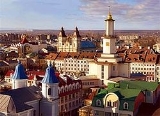
Ivano-Frankivsk

Encyclopedia
Ivano-Frankivsk is a historic city located in the western Ukraine. It is the administrative centre
of the Ivano-Frankivsk Oblast
(province
), and is designated as its own separate raion
(district) within the oblast
, municipality.
Built in the mid 17th century as a private fortress of the Potocki family, with the partition of Poland in 1772 was passed to the Habsburg Empire, after which it became a property of the State authorities of the Austrian Empire
. It was during that time when the fortress was transformed into one of the most prominent cities at the foothills of the Carpathian Mountains
. After the World War I
for a short stint it served a temporary capital of the West Ukrainian People's Republic, after fall of which Stanislawow became part of the Second Polish Republic
. At the dawn of the World War II
the city was "liberated" by the Soviet forces that were soon overran by the Nazi Germany
. With the liberation of Ukraine in 1944, in the city for the next 45 years was established the Soviet regime. Few years before the fall of the Soviet Union in the city was raised the blue-yellow flag as the symbol of the independent Ukraine.
A city visitor may find elements of various cultures intertwined within Ivano-Frankivsk, the Polish Rathaus, the Austrian city's business center, the Soviet panel multi-stories residential apartment buildings
at the city's urban-rural fringe, and others. The city is the third in population amongst other cities in the Carpathian Euroregion
, yielding only to Lviv
and Košice
.
Stanisław "Rewera" Potocki, although other sources claim it is named after his grandson (see History of Ivano-Frankivsk
). In 1772 its name was transliterated into German as Stanislau when it became part of the Austrian Empire
and later Austria-Hungary
; however, after the revolution of 1868 the city carried three different linguistic renderings of its name: German, Polish, and Ruthenian
. Other spellings used in the local press-media included: and . After World War II
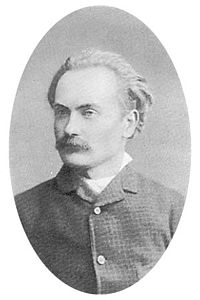
it was changed by the Soviet authorities into the simplified version Stanislav . In 1962, on the city's 300th anniversary, it was renamed to honour the Ukrainian writer Ivan Franko
. Due to the city's over-sized name, unofficially it is sometimes called simply Franyk by its residents. Even though Ivano-Frankivsk is the officially accepted name, the city's original name was never fully abandoned and/or forgotten and can be found throughout the city in all kinds of variations.
Name change
• 1662–1772: Stanisławów, Polish-Lithuanian Commonwealth (within the Kingdom of Poland),
• 1772–1809: Stanislau, Austrian Monarchy
(within the Kingdom of Galicia and Lodomeria
),
• 1809–1815: Stanislav, Russian Empire
,
• 1815–1918: Stanislau, Austrian Empire
, then Austria–Hungary,
• November 1918 – May 1919: Stanyslaviv, West Ukrainian National Republic,
• May 1919 – September 1939: Stanisławów, Poland, seat of the Stanisławów Voivodship,
• October 1939 – June 1941: Stanyslaviv, Ukrainian Soviet Socialist Republic,
• July 1941 – August 1944: Stanislau, seat of the Stanislau Kreis, Distrikt Galizien, Generalgouvernement
,
• August 1944–1991: Stanislav, (renamed in 1962: Ivano-Frankivsk), oblast seat, Ukrainian SSR,
• Post–1991: Ivano-Frankivsk, independent Ukraine
.
with warm summers, and fairly cold winters. The following climate date provided for the past 19 years. The average number of days with precipitation is 187 spread almost equally throughout a year. Most of precipitation takes place during the winter months and least - early fall. Thunderstorms occur mostly in summer months averaging around 25 annually. Ivano-Frankivsk averages about 296 days of fog or misty days with about 24 per month.
The city is situated in the Carpathian
region north east of the mountain range, sitting approximately 120 metres (393.7 ft) above mean sea level
. One of the several main geographical features is the Vovchynets Hill also known as the Vovchynets Mountains. The hill reaches 300-350 metres (1,148.3 ft) above the sea level and is part of the Pokuttya Highland (Upland
). Around the hill Bystrytsia River
branches into Bystrytsia of Nadvirna, Bystrytsia of Solotvyn, and Vorona. The last two rivers serve a natural border between the Pokuttya Highland and Stanislav Basin. The Vovchynets Hill is located just outside and north-east of Ivano-Frankivsk. South-east from the Stanislav basin in the direction of the Prut
Valley is located the Khorosnen (Prut-Bystrytsia) Highland. The highest point of that highland is the mount Hostra 425 metres (1,394.4 ft).
The closest neighboring city is Tysmenytsia
that lies less than 10 kilometres (6.2 mi) to the east. Another cities that lay in the radius of 25–30 km (less than 20 mi) are Tlumach
(east), Nadvirna
(south), Kalush
(west), and Halych
(north).
The city of Ivano-Frankivsk has an extensive network of public transport including buses, trolleybus
es, and taxis
(marshrutka
). There are nine trolleybus routes and about 52 for regular buses. Some of the routes run beyond the city into nearby villages.
Railway transportation
There is one railway terminal locally known as Vokzal. There are also smaller rail stations in adjacent villages, including Uhryniv and Khryplyn
. All of them are part of Lviv Railways
.
Bus transportation
Until 2008 the railway terminal also housed a bus terminal which provided several inter-city bus routes, including some to international destinations. In 2000 construction work began on a new bus terminal next to the railway terminus on Zaliznychna Street. Inauguration of the new bus terminal took place on May 22, 2010. At the opening ceremony the mayor of the city, Viktor Anushkevichus, noted that the new bus terminal was only partially completed, and for a period it would be necessary to offload passengers at the Pryvokzalna Square, which is already saturated with traffic. He also emphasised the need for another bus station on the outskirts of the city.
Airways transportation
The city is served by the Ivano-Frankivsk International Airport, which was granted international status in 1992. The airport shares its facilities with the 114 Brigade of the Ukrainian Air Force
. Since 2002 the airport has been leased to the private enterprise company Yavson, and from 2005 the Public limited company
Naftokhimik Prykarpattia, a (subsidiary
of Ukrnafta
). The contract with Naftokhimik Prykarpattia expires in 2013.
Lodging
There area many lodging options in Ivano-Frankivsk. Ivano-Frankivsk has one four-star hotel ("Park Hotel") and three three-star hotels ("Nadia", "Auscoprut", "Pid Templem").
All street names reflecting the city's Soviet or Russian past have been returned to their former names, or given new names of national historic importance, or other non-contriversial name. For example, Gagarin Street (connecting the city with its suburbs) became Vovchynets Street, Suvorov Street is now Harbar Street, and Soviet Street is Nezalezhnist (Independence) Street.
Around 100 other streets were renamed.
Important transportation arteries
.jpg) The city has seven main city squares four of them located in the "old town" part of the city.
The city has seven main city squares four of them located in the "old town" part of the city.
and the former Soviet Union
, Ivano-Frankivsk is also notorious for its rural-urban fringe panel building
residential districts.
locally known as Bily Dim or Bily Budynok. In front of the building is a big open space bordered by Shpytalna Street on the north-east, Hrushevsky Street on the south-east, and Melnychuk Street on the south-west. Next to the building is located a memorial to the Unification of the Western Ukraine with the rest of Ukraine. The main feature of the memorial is a tall marble stele
, on the both sides of which are located statues: kamenyar
(west) and kobzar
(east).
of the V convocation by political bloks was elected as such: Our Ukraine 22 (Our Ukraine 9, Rukh
8, United Centre
1, Industrialists and Entrepreneurs
2, no affiliation 2), BYuT 17 (Batkivschyna 14, USDP
2, no affiliation 1), Ukrainian People's Party 14 (UPP
3, CUN
1, United Centre
3, Sobor
1, no affiliation 6), Party of Regions 4 (Party of Regions
3, no affiliation 1), PORA 3 (PORA 2, no affiliation 1).
There also numerous sports school
s: Fitness Sport Association "Ukraine" - 5 schools, MVK - 3 schools, Fitness Sport Association "Spartak" - 2 schools, Fitness Sport Association "Kolos" - 1 school, others.
, and the Ivano-Frankivsk Institute of Management and Economics "Halytska Akademia". All of those universities are state funded.
Former
(Prykarpattya) that participated on the national level since 1950s. Since 2007 the club only fields its youth team Spartak-93 and competes at the Children-Youth Football League of Ukraine. The former president of Spartak Anatoliy Revutskiy reorganized the local university (University of Nafty i Hazu
) team in 2007 into the new "FSK Prykarpattia" with support of the city mayor Anushkevichus making it the main football club in the region and replacing Spartak. Previously during the interbellum period the city was home to another football club that was based on the local Polish garrison and was called Rewera Stanisławów (1908). That club competed at a regional level that has evolved at that period. With the start of the World War II
that club was disbanded. During the Soviet period among several others there was another club "Elektron" that successfully participated at a regional level around 1970s.
The city also is the home to a futsal team, PFC Uragan Ivano-Frankivsk
, that competes in the Ukrainian Futsal Championship. They are the current the Ukrainian champions having won the 2010/11 season playoffs and therefore took part in the 2011–12 UEFA Futsal Cup
for the first time.
The city had a Ice hockey team, HC Vatra Ivano-Frankivsk, which previously played in the Ukrainian Hockey Championship.
Ivano-Frankivsk is also the hometown of Ukrainian gymnasts one of them Dariya Zgoba who won gold on the Uneven Bars in the 2007 European Championships as well as a finalist on the Beijing Olympics and another - Yana Demyanchuk
, who won gold on the balance beam at the 2009 European Championships.
Other clubs include:
Main Stadiums and Sport Complexes
Radio
Television
Local orientation
Regional orientation
Capital City
Capital City was a television show produced by Euston Films which focused on the lives of investment bankers in London living and working on the corporate trading floor for the fictional international bank Shane-Longman....
of the Ivano-Frankivsk Oblast
Ivano-Frankivsk Oblast
Ivano-Frankivsk Oblast is an oblast in western Ukraine. Its administrative center is the city of Ivano-Frankivsk. As is the case with most other oblasts of Ukraine this region has the same name as its administrative center – which was renamed by the Soviets after the Ukrainian writer, nationalist...
(province
Oblast
Oblast is a type of administrative division in Slavic countries, including some countries of the former Soviet Union. The word "oblast" is a loanword in English, but it is nevertheless often translated as "area", "zone", "province", or "region"...
), and is designated as its own separate raion
Raion
A raion is a type of administrative unit of several post-Soviet countries. The term, which is from French rayon 'honeycomb, department,' describes both a type of a subnational entity and a division of a city, and is commonly translated in English as "district"...
(district) within the oblast
Oblast
Oblast is a type of administrative division in Slavic countries, including some countries of the former Soviet Union. The word "oblast" is a loanword in English, but it is nevertheless often translated as "area", "zone", "province", or "region"...
, municipality.
Built in the mid 17th century as a private fortress of the Potocki family, with the partition of Poland in 1772 was passed to the Habsburg Empire, after which it became a property of the State authorities of the Austrian Empire
Austrian Empire
The Austrian Empire was a modern era successor empire, which was centered on what is today's Austria and which officially lasted from 1804 to 1867. It was followed by the Empire of Austria-Hungary, whose proclamation was a diplomatic move that elevated Hungary's status within the Austrian Empire...
. It was during that time when the fortress was transformed into one of the most prominent cities at the foothills of the Carpathian Mountains
Carpathian Mountains
The Carpathian Mountains or Carpathians are a range of mountains forming an arc roughly long across Central and Eastern Europe, making them the second-longest mountain range in Europe...
. After the World War I
World War I
World War I , which was predominantly called the World War or the Great War from its occurrence until 1939, and the First World War or World War I thereafter, was a major war centred in Europe that began on 28 July 1914 and lasted until 11 November 1918...
for a short stint it served a temporary capital of the West Ukrainian People's Republic, after fall of which Stanislawow became part of the Second Polish Republic
Second Polish Republic
The Second Polish Republic, Second Commonwealth of Poland or interwar Poland refers to Poland between the two world wars; a period in Polish history in which Poland was restored as an independent state. Officially known as the Republic of Poland or the Commonwealth of Poland , the Polish state was...
. At the dawn of the World War II
World War II
World War II, or the Second World War , was a global conflict lasting from 1939 to 1945, involving most of the world's nations—including all of the great powers—eventually forming two opposing military alliances: the Allies and the Axis...
the city was "liberated" by the Soviet forces that were soon overran by the Nazi Germany
Nazi Germany
Nazi Germany , also known as the Third Reich , but officially called German Reich from 1933 to 1943 and Greater German Reich from 26 June 1943 onward, is the name commonly used to refer to the state of Germany from 1933 to 1945, when it was a totalitarian dictatorship ruled by...
. With the liberation of Ukraine in 1944, in the city for the next 45 years was established the Soviet regime. Few years before the fall of the Soviet Union in the city was raised the blue-yellow flag as the symbol of the independent Ukraine.
A city visitor may find elements of various cultures intertwined within Ivano-Frankivsk, the Polish Rathaus, the Austrian city's business center, the Soviet panel multi-stories residential apartment buildings
Panelák
is a colloquial term in Czech and Slovak for a panel building constructed of pre-fabricated, pre-stressed concrete, such as those extant in Czech Republic and elsewhere in the former Soviet bloc...
at the city's urban-rural fringe, and others. The city is the third in population amongst other cities in the Carpathian Euroregion
Carpathian Euroregion
The Carpathian Euroregion is an international association formed on February 14, 1993 by the Ministers of Foreign Affairs of Poland, Ukraine, and Hungary in the city of Debrecen....
, yielding only to Lviv
Lviv
Lviv is a city in western Ukraine. The city is regarded as one of the main cultural centres of today's Ukraine and historically has also been a major Polish and Jewish cultural center, as Poles and Jews were the two main ethnicities of the city until the outbreak of World War II and the following...
and Košice
Košice
Košice is a city in eastern Slovakia. It is situated on the river Hornád at the eastern reaches of the Slovak Ore Mountains, near the border with Hungary...
.
Name
Stanisławów was founded as a fortress in 1650 and was named after the Polish hetmanHetman
Hetman was the title of the second-highest military commander in 15th- to 18th-century Poland and the Grand Duchy of Lithuania, which together, from 1569 to 1795, comprised the Polish-Lithuanian Commonwealth, or Rzeczpospolita....
Stanisław "Rewera" Potocki, although other sources claim it is named after his grandson (see History of Ivano-Frankivsk
History of Ivano-Frankivsk
Ivano-Frankivsk is one of administrative centers in western Ukraine with almost 350 years of history as a city settlement. For the most part of its history the city was known for its Polish name of Stanisławów until 1962 . In the Soviet times it was decided to change the name of the city during...
). In 1772 its name was transliterated into German as Stanislau when it became part of the Austrian Empire
Austrian Empire
The Austrian Empire was a modern era successor empire, which was centered on what is today's Austria and which officially lasted from 1804 to 1867. It was followed by the Empire of Austria-Hungary, whose proclamation was a diplomatic move that elevated Hungary's status within the Austrian Empire...
and later Austria-Hungary
Austria-Hungary
Austria-Hungary , more formally known as the Kingdoms and Lands Represented in the Imperial Council and the Lands of the Holy Hungarian Crown of Saint Stephen, was a constitutional monarchic union between the crowns of the Austrian Empire and the Kingdom of Hungary in...
; however, after the revolution of 1868 the city carried three different linguistic renderings of its name: German, Polish, and Ruthenian
Ruthenian language
Ruthenian, or Old Ruthenian , is a term used for the varieties of Eastern Slavonic spoken in the Grand Duchy of Lithuania and later in the East Slavic territories of the Polish–Lithuanian Commonwealth....
. Other spellings used in the local press-media included: and . After World War II
World War II
World War II, or the Second World War , was a global conflict lasting from 1939 to 1945, involving most of the world's nations—including all of the great powers—eventually forming two opposing military alliances: the Allies and the Axis...
it was changed by the Soviet authorities into the simplified version Stanislav . In 1962, on the city's 300th anniversary, it was renamed to honour the Ukrainian writer Ivan Franko
Ivan Franko
Ivan Yakovych Franko was a Ukrainian poet, writer, social and literary critic, journalist, interpreter, economist, political activist, doctor of philosophy, the author of the first detective novels and modern poetry in the Ukrainian language....
. Due to the city's over-sized name, unofficially it is sometimes called simply Franyk by its residents. Even though Ivano-Frankivsk is the officially accepted name, the city's original name was never fully abandoned and/or forgotten and can be found throughout the city in all kinds of variations.
Name change
- 1662 founded as Stanisławów
- 1772 transliteration change to Stanislau
- 1919 transliteration change to Stanislaviv
- 1919 transliteration change to Stanisławów
- 1939 transliteration change to Stanislav
- 1941 transliteration change to Stanislau
- 1944 transliteration change to Stanislav
- November 9, 1962 name change to Ivano-Frankivsk (for honour to Ivan Franko)
History
Timeline
• 1650–1662: establishing a private fortress of Potocki and seeking the Magdeburg rightsMagdeburg rights
Magdeburg Rights or Magdeburg Law were a set of German town laws regulating the degree of internal autonomy within cities and villages granted by a local ruler. Modelled and named after the laws of the German city of Magdeburg and developed during many centuries of the Holy Roman Empire, it was...
• 1662–1772: Stanisławów, Polish-Lithuanian Commonwealth (within the Kingdom of Poland),
• 1772–1809: Stanislau, Austrian Monarchy
Habsburg Monarchy
The Habsburg Monarchy covered the territories ruled by the junior Austrian branch of the House of Habsburg , and then by the successor House of Habsburg-Lorraine , between 1526 and 1867/1918. The Imperial capital was Vienna, except from 1583 to 1611, when it was moved to Prague...
(within the Kingdom of Galicia and Lodomeria
Kingdom of Galicia and Lodomeria
The Kingdom of Galicia and Lodomeria was a crownland of the Habsburg Monarchy, the Austrian Empire, and Austria–Hungary from 1772 to 1918 .This historical region in eastern Central Europe is currently divided between Poland and Ukraine...
),
• 1809–1815: Stanislav, Russian Empire
Russian Empire
The Russian Empire was a state that existed from 1721 until the Russian Revolution of 1917. It was the successor to the Tsardom of Russia and the predecessor of the Soviet Union...
,
• 1815–1918: Stanislau, Austrian Empire
Austrian Empire
The Austrian Empire was a modern era successor empire, which was centered on what is today's Austria and which officially lasted from 1804 to 1867. It was followed by the Empire of Austria-Hungary, whose proclamation was a diplomatic move that elevated Hungary's status within the Austrian Empire...
, then Austria–Hungary,
• November 1918 – May 1919: Stanyslaviv, West Ukrainian National Republic,
• May 1919 – September 1939: Stanisławów, Poland, seat of the Stanisławów Voivodship,
• October 1939 – June 1941: Stanyslaviv, Ukrainian Soviet Socialist Republic,
• July 1941 – August 1944: Stanislau, seat of the Stanislau Kreis, Distrikt Galizien, Generalgouvernement
Guberniya
A guberniya was a major administrative subdivision of the Russian Empire usually translated as government, governorate, or province. Such administrative division was preserved for sometime upon the collapse of the empire in 1917. A guberniya was ruled by a governor , a word borrowed from Latin ,...
,
• August 1944–1991: Stanislav, (renamed in 1962: Ivano-Frankivsk), oblast seat, Ukrainian SSR,
• Post–1991: Ivano-Frankivsk, independent Ukraine
Ukraine
Ukraine is a country in Eastern Europe. It has an area of 603,628 km², making it the second largest contiguous country on the European continent, after Russia...
.
Climate and Geography
As is the case with most of Ukraine, the climate is moderate continentalContinental climate
Continental climate is a climate characterized by important annual variation in temperature due to the lack of significant bodies of water nearby...
with warm summers, and fairly cold winters. The following climate date provided for the past 19 years. The average number of days with precipitation is 187 spread almost equally throughout a year. Most of precipitation takes place during the winter months and least - early fall. Thunderstorms occur mostly in summer months averaging around 25 annually. Ivano-Frankivsk averages about 296 days of fog or misty days with about 24 per month.
The city is situated in the Carpathian
Carpathian Mountains
The Carpathian Mountains or Carpathians are a range of mountains forming an arc roughly long across Central and Eastern Europe, making them the second-longest mountain range in Europe...
region north east of the mountain range, sitting approximately 120 metres (393.7 ft) above mean sea level
Above mean sea level
The term above mean sea level refers to the elevation or altitude of any object, relative to the average sea level datum. AMSL is used extensively in radio by engineers to determine the coverage area a station will be able to reach...
. One of the several main geographical features is the Vovchynets Hill also known as the Vovchynets Mountains. The hill reaches 300-350 metres (1,148.3 ft) above the sea level and is part of the Pokuttya Highland (Upland
Highland (geography)
The term highland or upland is used to denote any mountainous region or elevated mountainous plateau. Generally speaking, the term upland tends to be used for ranges of hills, typically up to 500-600m, and highland for ranges of low mountains.The Scottish Highlands refers to the mountainous...
). Around the hill Bystrytsia River
Bystrytsia River
The Bystrytsia is a river, a right tributary of the Dniester which flows through Ukraine. The upper half of the Bystrytsia river is divided into two parts: Bystrytsia-Solotvynska and Bystrytsia-Nadvirnyanska...
branches into Bystrytsia of Nadvirna, Bystrytsia of Solotvyn, and Vorona. The last two rivers serve a natural border between the Pokuttya Highland and Stanislav Basin. The Vovchynets Hill is located just outside and north-east of Ivano-Frankivsk. South-east from the Stanislav basin in the direction of the Prut
Prut
The Prut is a long river in Eastern Europe. In part of its course it forms the border between Romania and Moldova.-Overview:...
Valley is located the Khorosnen (Prut-Bystrytsia) Highland. The highest point of that highland is the mount Hostra 425 metres (1,394.4 ft).
The closest neighboring city is Tysmenytsia
Tysmenytsia
Tysmenytsia is a city, the administrative center of the Tysmenytsia Raion in the Ivano-Frankivsk Oblast of western Ukraine. In 1900 as part of the Kingdom of Galicia and Lodomeria, Tysmenytsia was in Tłumacz powiat.-Overview:...
that lies less than 10 kilometres (6.2 mi) to the east. Another cities that lay in the radius of 25–30 km (less than 20 mi) are Tlumach
Tlumach
Tlumach is a small city located in the Ivano-Frankivsk Oblast, in western Ukraine. It is the administrative center of the Tlumach Raion .The current estimated population is around 8,800 .-History:...
(east), Nadvirna
Nadvirna
Nadvirna is a city located in the Ivano-Frankivsk Oblast in western Ukraine. It is the administrative centre of Nadvirna Raion.Until World War I, Nadvirna was integrated into the Austro-Hungarian Empire, in the province of Galicia. In the inter-war years, the borders changed and it was annexed...
(south), Kalush
Kalush, Ukraine
-Notable residents:*Stepan Bandera*August Aleksander Czartoryski*Jakub Sobieski*Jan "Sobiepan" Zamoyski*Tomasz Zamoyski*Fedir Danylak-Twin towns — sister cities:Kalush, Ukraine is twinned with:- Location :Local orientationRegional orientation...
(west), and Halych
Halych
Halych is a historic city on the Dniester River in western Ukraine. The town gave its name to the historic province and kingdom of Kingdom of Galicia–Volhynia, of which it was the capital until the early 14th century, when the seat of the local princes was moved to Lviv...
(north).
Population and demographics
Note: Historical population record is taken out of Ivano-Frankivsk portal , more recent - the Regional Directorate of Statistics . There is also other information on a population growth such as the Jewishgen.org. With asterisk there are identified years of approximate data. In the 18th century differentiation among Poles and Ukrainians was conducted on the religious backgrounds rather than on ethnic (Catholics vs. Orthodox).1732 Population
|
1792 Population
|
1869 Population
|
1880 Population
|
|
1900 Population
|
1910 Population
|
1921 Population
|
Infrastructure
Public trasportationThe city of Ivano-Frankivsk has an extensive network of public transport including buses, trolleybus
Trolleybus
A trolleybus is an electric bus that draws its electricity from overhead wires using spring-loaded trolley poles. Two wires and poles are required to complete the electrical circuit...
es, and taxis
Taxicab
A taxicab, also taxi or cab, is a type of vehicle for hire with a driver, used by a single passenger or small group of passengers, often for a non-shared ride. A taxicab conveys passengers between locations of their choice...
(marshrutka
Marshrutka
Marshrutka , from marshrutnoye taksi is a share taxi in the CIS countries, the Baltic states, and Bulgaria. Marshrutnoye taksi literally means routed taxicab...
). There are nine trolleybus routes and about 52 for regular buses. Some of the routes run beyond the city into nearby villages.
Railway transportation
There is one railway terminal locally known as Vokzal. There are also smaller rail stations in adjacent villages, including Uhryniv and Khryplyn
Khryplyn
Khryplyn is the smallest village of the Ivano-Frankivsk municipality located in the Ivano-Frankivsk Oblast, Ukraine. It was first mentioned in 1436....
. All of them are part of Lviv Railways
Lviv Railways
Lviv Railways is a territorial branch company of Ukrzaliznytsia headquartered in Lviv.-General description:Lviv Railways administers all railroads of Lviv Oblast, Zakarpattia Oblast, Ivano-Frankivsk Oblast, Chernivtsi Oblast, Ternopil Oblast, Volyn Oblast and most of Rivne Oblast...
.
Bus transportation
Until 2008 the railway terminal also housed a bus terminal which provided several inter-city bus routes, including some to international destinations. In 2000 construction work began on a new bus terminal next to the railway terminus on Zaliznychna Street. Inauguration of the new bus terminal took place on May 22, 2010. At the opening ceremony the mayor of the city, Viktor Anushkevichus, noted that the new bus terminal was only partially completed, and for a period it would be necessary to offload passengers at the Pryvokzalna Square, which is already saturated with traffic. He also emphasised the need for another bus station on the outskirts of the city.
Airways transportation
The city is served by the Ivano-Frankivsk International Airport, which was granted international status in 1992. The airport shares its facilities with the 114 Brigade of the Ukrainian Air Force
Ukrainian Air Force
The Ukrainian Air Force is a part of the Armed Forces of Ukraine. Ukrainian Air Force Command and headquarters are located in the city of Vinnytsia....
. Since 2002 the airport has been leased to the private enterprise company Yavson, and from 2005 the Public limited company
Public limited company
A public limited company is a limited liability company that sells shares to the public in United Kingdom company law, in the Republic of Ireland and Commonwealth jurisdictions....
Naftokhimik Prykarpattia, a (subsidiary
Subsidiary
A subsidiary company, subsidiary, or daughter company is a company that is completely or partly owned and wholly controlled by another company that owns more than half of the subsidiary's stock. The subsidiary can be a company, corporation, or limited liability company. In some cases it is a...
of Ukrnafta
Ukrnafta
Ukrnafta is a Ukrainian oil and natural gas extracting company, the largest producer of oil and gas in the country.The company produces around 3 million tonnes of oil and 4 billion m3 of natural gas per year, having oil proven reserves of nearly 180 million tonnes. Ukrnafta also ownes three natural...
). The contract with Naftokhimik Prykarpattia expires in 2013.
Lodging
There area many lodging options in Ivano-Frankivsk. Ivano-Frankivsk has one four-star hotel ("Park Hotel") and three three-star hotels ("Nadia", "Auscoprut", "Pid Templem").
Streets
Full list of renamed streetsAll street names reflecting the city's Soviet or Russian past have been returned to their former names, or given new names of national historic importance, or other non-contriversial name. For example, Gagarin Street (connecting the city with its suburbs) became Vovchynets Street, Suvorov Street is now Harbar Street, and Soviet Street is Nezalezhnist (Independence) Street.
Around 100 other streets were renamed.
Important transportation arteries
- Independence StreetIndependence Street (Ivano-Frankivsk)Independence Street is considered the central street of Ivano-Frankivsk. It runs from west to east and passes the original city's center 250-300 meters south from it...
(vulytsya Nezalezhnosti) / Tysmenytsya Road (doroha Tysmenetska) - Halych Road (vulytsya Halytska)
- Hetman Mazepa Street (vulytsya Hetmana Mazepy) / Krykhivtsi Road (doroha Krykhivetska)
- Yevhen Konovalets Road (vulytsya Yevhena Konovaltsya)
- Vovchynets Street (vulytsya Vovchynetska)
- Vasyl Stefanyk Shore Drive (naberezhna Vasylya Stefanyka)
Routes
The city of Ivano-Frankivsk is located on the intersection of three major national (Ukraine) routes: , , and . There also is one important regional route T09-06. All the H-routes eventually connect to .City Squares
- Viche MaidanViche Maidan (Ivano-Frankivsk)Viche Maidan is a city square located in the center of Ivano-Frankivsk.- Composition :The square stretches from Halych Street to Vitovsky Street. Through Vitovsky street a city wanderer may travel from the Viche Maidan to another city square the Mickiewicz Square...
- Market SquareMarket Square (Ivano-Frankivsk)Market Square in Ivano-Frankivsk is called Ploshcha Rynok and is historically the central square of the city. It is the oldest square and traces its history to the city's establishment...
- Sheptytsky Square
- Pryvokzalna Square
- Mickiewicz Square (Mickiewicz Park)
- Liberation Square
- European Square
Rural-urban fringe districts
As a lot of regional centers in UkraineUkraine
Ukraine is a country in Eastern Europe. It has an area of 603,628 km², making it the second largest contiguous country on the European continent, after Russia...
and the former Soviet Union
Soviet Union
The Soviet Union , officially the Union of Soviet Socialist Republics , was a constitutionally socialist state that existed in Eurasia between 1922 and 1991....
, Ivano-Frankivsk is also notorious for its rural-urban fringe panel building
Panel building
Panel building may refer to buildings of one of the following types:*Built of structural insulated panels*Built of pre-fabricated concrete blocks, named differently in various countries....
residential districts.
- BAM
- Kaskad
- Positron
- Budivelnykiv
Administration
Both city and oblast administrations as well as the regional council are all located in a massive white building on the Hrushevsky StreetHrushevsky Street (Ivano-Frankivsk)
Mykhailo Hrushevsky Street is one of the most important streets located in the Ivano-Frankivsk. It runs along several government institutions such as regional and city administration Bily Dim as well as the city's branch of the National Bank of Ukraine....
locally known as Bily Dim or Bily Budynok. In front of the building is a big open space bordered by Shpytalna Street on the north-east, Hrushevsky Street on the south-east, and Melnychuk Street on the south-west. Next to the building is located a memorial to the Unification of the Western Ukraine with the rest of Ukraine. The main feature of the memorial is a tall marble stele
Stele
A stele , also stela , is a stone or wooden slab, generally taller than it is wide, erected for funerals or commemorative purposes, most usually decorated with the names and titles of the deceased or living — inscribed, carved in relief , or painted onto the slab...
, on the both sides of which are located statues: kamenyar
Ivan Franko
Ivan Yakovych Franko was a Ukrainian poet, writer, social and literary critic, journalist, interpreter, economist, political activist, doctor of philosophy, the author of the first detective novels and modern poetry in the Ukrainian language....
(west) and kobzar
Kobzar
A Kobzar was an itinerant Ukrainian bard who sang to his own accompaniment.-Tradition:Kobzars were often blind, and became predominantly so by the 1800s...
(east).
City's Council
The city's council currently consists of 60 deputies. The political representationRepresentation (politics)
In politics, representation describes how some individuals stand in for others or a group of others, for a certain time period. Representation usually refers to representative democracies, where elected officials nominally speak for their constituents in the legislature...
of the V convocation by political bloks was elected as such: Our Ukraine 22 (Our Ukraine 9, Rukh
People's Movement of Ukraine
The People's Movement of Ukraine is a Ukrainian center-right political party...
8, United Centre
United Centre
United Centre is a Ukrainian political party. It is an offspring of Our Ukraine. It will participate in the next Ukrainian parliamentary election independently. Legally United Centre is the successor of the Party of Private Property , registered with the Ministry of Justice on September 24, 1999....
1, Industrialists and Entrepreneurs
Party of Industrialists and Entrepreneurs of Ukraine
The Party of Industrialists and Entrepreneurs of Ukraine is a political party in Ukraine registered in April 2000. Former Ukrainian Prime Minister Anatoliy Kinakh is one of its most noticeable members.-History:...
2, no affiliation 2), BYuT 17 (Batkivschyna 14, USDP
Ukrainian Social Democratic Party
-History:The party was founded in 1998 when the Social Democratic Party of Ukraine and Party of Human Rights were united. The first leader of the party was Vasyl Onopenko who in the Presidential elections in 1999 got 0,47% of the votes. Since November 2006 Yevhen Korniychuk is the chairman of the...
2, no affiliation 1), Ukrainian People's Party 14 (UPP
Ukrainian People's Party
The Ukrainian People's Party is a political party in Ukraine, led by Yury Kostenko, registered on Old Year's Day 1999 as Ukrainian National Movement .-History:...
3, CUN
Congress of Ukrainian Nationalists
The Congress of Ukrainian Nationalists is a right-wing political party in Ukraine. It was founded on October 18, 1992 and registered with the Ministry of Justice on January 26, 1993. The party leader from its formation and until her death in 2003 was Yaroslava Stetsko .-History:During the 1998...
1, United Centre
United Centre
United Centre is a Ukrainian political party. It is an offspring of Our Ukraine. It will participate in the next Ukrainian parliamentary election independently. Legally United Centre is the successor of the Party of Private Property , registered with the Ministry of Justice on September 24, 1999....
3, Sobor
Ukrainian Republican Party Assembly
The Ukrainian Republican Party "Sobor" is a political party in Ukraine. The current party was created in 2002 after the merger of the Ukrainian Republican Party and the Ukrainian People's Party "Assembly" .-May 1999:...
1, no affiliation 6), Party of Regions 4 (Party of Regions
Party of Regions
The Party of Regions is an Ukrainian political party created on October 26, 1997 just prior to the 1998 Ukrainian parliamentary elections under the name of Party of Regional Revival of Ukraine. It was reformed later in 2001 when the party united with several others...
3, no affiliation 1), PORA 3 (PORA 2, no affiliation 1).
Recent city mayors
- Bohdan Borovych (OUN) July 1994 – June 1998
- Zinoviy Shkutiak (Our Ukraine) March 1998 – March 26, 2006
- Viktor Anushkevychus (UPPUkrainian People's PartyThe Ukrainian People's Party is a political party in Ukraine, led by Yury Kostenko, registered on Old Year's Day 1999 as Ukrainian National Movement .-History:...
) March 26, 2006 – present (reelected in 2010)
Education
The city has over 25 public schools of general education for grades 1 through 11. Aside of them there are some privately owned schools and lyceums. The city also has several professional public institutes.There also numerous sports school
Sports School
Sports School may refer to:* Sports school* Singapore Sports School, a specialized independent school in Singapore* National Sport School , a public high school in Calgary, Alberta...
s: Fitness Sport Association "Ukraine" - 5 schools, MVK - 3 schools, Fitness Sport Association "Spartak" - 2 schools, Fitness Sport Association "Kolos" - 1 school, others.
Universities
The city has six universities, the Ivano-Frankivsk Institute of Management that is a local campus of the Ternopil National Economic UniversityTernopil National Economic University
Ternopil National Economic University, TNEU founded in 1971. It is located in the city of Ternopil, Ternopil Oblast.Viktor Yushchenko, the president of Ukraine , is an alumnus of TNEU.-Academic Departments by Faculty:****...
, and the Ivano-Frankivsk Institute of Management and Economics "Halytska Akademia". All of those universities are state funded.
- Prykarpattia National University of Vasyl StefanykVasyl StefanykVasyl' Semenovych Stefanyk was a classical Ukrainian prose writer and political activist. He was a member of the Austrian parliament 1908-1918....
- Ivano-Frankivsk National Technical University of Oil and GasIvano-Frankivsk National Technical University of Oil and GasIvano-Frankivsk National Technical University of Oil and Gas is an institution of higher education in Ivano-Frankivsk, Ukraine. Since its establishment in 1967, the university's focus remains on preparing qualified and experienced specialists for the oil and gas industries...
(University of Oil and Gas) - Ivano-Frankivsk State Medical University
- Ivano-Frankivsk University of Law of the King Danylo Halytsky
- Ivano-Frankivsk Theological Academy of Greek-Catholic Church
- West-Ukrainian University of Economics and Law
National Landmarks
- the Church of the Holy Resurrection (Greek Catholic CathedralUkrainian Greek Catholic ChurchThe Ukrainian Greek Catholic Church , Ukrainska Hreko-Katolytska Tserkva), is the largest Eastern Rite Catholic sui juris particular church in full communion with the Holy See, and is directly subject to the Pope...
), - the Church of Virgin Mary (at the moment used as museum of Sacred Art of Galicia)
- Latin Collegiate
- the Armenian church (presently used by one of the Ukrainian Orthodox ChurchesHistory of Christianity in UkraineThe History of Christianity in Ukraine dates back to the earliest centuries of the apostolic church. It has remained the dominant religion in the country since its acceptance in 988 by Vladimir the Great , who instated it as the state religion of Kievan Rus', a medieval East Slavic state.Although...
). - City Brewery
Other attractions
- Market SquareMarket Square (Ivano-Frankivsk)Market Square in Ivano-Frankivsk is called Ploshcha Rynok and is historically the central square of the city. It is the oldest square and traces its history to the city's establishment...
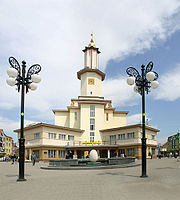
with the city's old town hall, today hosting an ethno-cultural museum.
- Shevchenko Park – a big park that consists of an amusement parkAmusement parkthumb|Cinderella Castle in [[Magic Kingdom]], [[Disney World]]Amusement and theme parks are terms for a group of entertainment attractions and rides and other events in a location for the enjoyment of large numbers of people...
, a big lake with swans, couple of full-size football fields, and many others interesting places worth of seeing.
- Bily Budynok – a big white building in the middle of the city and next to the Market place. It is the main administration building of Ivano-Frankivsk and the Ivano-Frankivsk oblastIvano-Frankivsk OblastIvano-Frankivsk Oblast is an oblast in western Ukraine. Its administrative center is the city of Ivano-Frankivsk. As is the case with most other oblasts of Ukraine this region has the same name as its administrative center – which was renamed by the Soviets after the Ukrainian writer, nationalist...
. In front of the building there are two full-size sculptural monuments of Franko and Shevchenko.
- Bazaar – a huge area that covers the old market and the new market with couple of supermarket stores locally known as the universal stores.
- 100 m (328.08 ft) stretch (stometrivka) – unofficial local name for part of Independence StreetIndependence Street (Ivano-Frankivsk)Independence Street is considered the central street of Ivano-Frankivsk. It runs from west to east and passes the original city's center 250-300 meters south from it...
that consists of series of shopettes and restricted to pedestrian traffic only.
Architecture
- Stanislav fortress compound and Potocki palace
- Cathedral of the Holy Resurrection, locally known as Katedra (Greek-Catholic Cathedral)
- Jesuit Kostel – the second building of Jesuits after they were forced to surrender Katedra
- FaraArt Museum (Ivano-Frankivsk)Art Museum is the contemporary name for the oldest former church of the city, the Collegiate Church of Virgin Mary. Together with the city rathaus the building is the oldest in Ivano-Frankivsk.-History:The exact date of the church's founding is not known...
– also known as the Collegiate ChurchCollegiate churchIn Christianity, a collegiate church is a church where the daily office of worship is maintained by a college of canons; a non-monastic, or "secular" community of clergy, organised as a self-governing corporate body, which may be presided over by a dean or provost...
of Virgin Mary and Saint Stanislaus (today - the Regional Art Museum) - Ratusha – former city hall
- Battle of Grunwald monumentBattle of GrunwaldThe Battle of Grunwald or 1st Battle of Tannenberg was fought on 15 July 1410, during the Polish–Lithuanian–Teutonic War. The alliance of the Kingdom of Poland and the Grand Duchy of Lithuania, led respectively by King Jogaila and Grand Duke Vytautas , decisively defeated the Teutonic Knights, led...
– commemorating the defeat of the Teutonic OrderTeutonic KnightsThe Order of Brothers of the German House of Saint Mary in Jerusalem , commonly the Teutonic Order , is a German medieval military order, in modern times a purely religious Catholic order...
in 1410 - Monument to Adam MickiewiczAdam MickiewiczAdam Bernard Mickiewicz ) was a Polish poet, publisher and political writer of the Romantic period. One of the primary representatives of the Polish Romanticism era, a national poet of Poland, he is seen as one of Poland's Three Bards and the greatest poet in all of Polish literature...
(1930), it was reconstructed in 1989, located on Adam Mickewicz Square next to a regional concert (philharmony) hall. It is the oldest surviving monument in the city and was built on November 20, 1898 (sculptor Tadeusz Błotnicki). - Monument to Stepan Bandera and Museum of the Insurgent Army at the European Square was awarded the best architectural project of 2007 designed by a local architecture company "Atelie Arkhitektury"
Theaters
- Academic Regional Music-Drama Theater of Franko
- Academic Regional Puppet Theater of Pidhiryanka
- Regional Concert Philharmony
- Cinema theater "Lumier" (previously of Franko)
- Cinema theater "Cosmos"
Former
- Cinema theater "Patriot"
- Cinema theater of Shevchenko (previously "Pioneer")
- "Videotech"
- Cinema theater of Gorky
- Cinema theater "Komsomolets"
- Cinema theater of Shevchenko (original)
- Summer cinema theater "Trembita"
City Parks
- Shevchenko Park
- Park of Warriors-Internationalists
- Park "Valy"
- Pryvokzalny park
- Memorial Park, near the regional Ivan Franko Academic Music-Drama Theater
Night Life
-
- Relax - Hip-hop, R&B
- Vavilon - Techno
- Edison - House
- Kilimanjaro - Mix pop, Rap, R&B
Sports
Ivano-Frankivsk is home to a number of sports teams. Most notably it was home to the football club FC Spartak Ivano-FrankivskFC Spartak Ivano-Frankivsk
FC Spartak Ivano-Frankivsk was a Ukrainian football team based in Ivano-Frankivsk, Ivano-Frankivsk Oblast, Ukraine, the unofficial capital of the Prykarpattia region. The club was founded in 1940 and was to play in the Druha Liha under the guidance of Mykola Prystay. The club has previously gone...
(Prykarpattya) that participated on the national level since 1950s. Since 2007 the club only fields its youth team Spartak-93 and competes at the Children-Youth Football League of Ukraine. The former president of Spartak Anatoliy Revutskiy reorganized the local university (University of Nafty i Hazu
Ivano-Frankivsk National Technical University of Oil and Gas
Ivano-Frankivsk National Technical University of Oil and Gas is an institution of higher education in Ivano-Frankivsk, Ukraine. Since its establishment in 1967, the university's focus remains on preparing qualified and experienced specialists for the oil and gas industries...
) team in 2007 into the new "FSK Prykarpattia" with support of the city mayor Anushkevichus making it the main football club in the region and replacing Spartak. Previously during the interbellum period the city was home to another football club that was based on the local Polish garrison and was called Rewera Stanisławów (1908). That club competed at a regional level that has evolved at that period. With the start of the World War II
World War II
World War II, or the Second World War , was a global conflict lasting from 1939 to 1945, involving most of the world's nations—including all of the great powers—eventually forming two opposing military alliances: the Allies and the Axis...
that club was disbanded. During the Soviet period among several others there was another club "Elektron" that successfully participated at a regional level around 1970s.
The city also is the home to a futsal team, PFC Uragan Ivano-Frankivsk
Urahan Ivano-Frankivsk
Uragan Ivano-Frankivsk , is a futsal team from Ivano-Frankivsk, Ukraine.The team was founded in 2002, and after two years was promoted from the second league to the first.-Domestic:...
, that competes in the Ukrainian Futsal Championship. They are the current the Ukrainian champions having won the 2010/11 season playoffs and therefore took part in the 2011–12 UEFA Futsal Cup
2011–12 UEFA Futsal Cup
The 2011–12 UEFA Futsal Cup is the twenty-sixth edition of Europe's premier club futsal tournament and the eleventh edition under the current UEFA Futsal Cup format.-Teams:TH Title Holder-Preliminary round:...
for the first time.
The city had a Ice hockey team, HC Vatra Ivano-Frankivsk, which previously played in the Ukrainian Hockey Championship.
Ivano-Frankivsk is also the hometown of Ukrainian gymnasts one of them Dariya Zgoba who won gold on the Uneven Bars in the 2007 European Championships as well as a finalist on the Beijing Olympics and another - Yana Demyanchuk
Yana Demyanchuk
Yana Demyanchuk is a Ukrainian Artistic Gymnast who won gold on Beam at the 2009 European Artistic Gymnastics Championships. This was Yana's first major international competition and her immediate impact has revitalised the Ukrainian team ahead of the 2009 World Championships...
, who won gold on the balance beam at the 2009 European Championships.
Other clubs include:
- Hoverla Ivano-Frankivsk (basketball)
- Roland Ivano-Frankivsk (rugby)
Main Stadiums and Sport Complexes
- MCS RukhMCS RukhMunicipal Central Stadium "Rukh" is the multi-purpose central stadium of the Ivano-Frankivsk Oblast. The stadium is located at 128 Vyacheslav Chernovol Street, the city of Ivano-Frankivsk 750447. It currently holds 15,000 spectators and 6,500 individual plastic seats...
, a sport complex consisting of the major arena and two auxiliary fields next to it - Yunist Stadium (Youth)
- Hirka Stadium, property of the Ivano-Frankivsk Locomotive Maintenance Plant
- Nauka Stadium (Science), belongs to Prykarpattia National University of Stefanyk
- Stadium of Oil and Gaz University
- Sport-Recreational Center "Tsunami", contains an ice arena for the city hockey events and an aquapark
City's radio, television, press media
Press- "Reporter" - Ivano-Frankivsk weekly (www.report.if.ua)
- "Halytsky Korrespondent" - a social-political weekly (gk-press.if.ua)
- "Halychyna" - regional newspaper (www.galychyna.if.ua)
Radio
- "Zakhidny Polyus (104.3 FM)" - city's radio (1043.com.ua)
- "Vezha (107 FM)" - city's radio (www.vezha.org)
Television
- "Ivano-Frankivsk ODTRK" - regional State Tele and Radio Company (odtrk.if.ua)
- "3-Studia" - regional Tele and Radio Company (www.studio3.com.ua)
- "Halychyna" - regional television (www.galtv.if.ua)
Twin towns – Sister cities
Ivano-Frankivsk is twinned with 22 cities and one county:| Arlington Arlington County, Virginia Arlington County is a county in the Commonwealth of Virginia. The land that became Arlington was originally donated by Virginia to the United States government to form part of the new federal capital district. On February 27, 1801, the United States Congress organized the area as a subdivision of... in USA Veliky Novgorod Veliky Novgorod Veliky Novgorod is one of Russia's most historic cities and the administrative center of Novgorod Oblast. It is situated on the M10 federal highway connecting Moscow and St. Petersburg. The city lies along the Volkhov River just below its outflow from Lake Ilmen... in Russia Russia Russia or , officially known as both Russia and the Russian Federation , is a country in northern Eurasia. It is a federal semi-presidential republic, comprising 83 federal subjects... Baia Mare Baia Mare Baia Mare is a municipality in northwestern Romania and the capital of Maramureş County. The city is situated about 600 kilometres from Bucharest, the capital of Romania, 70 kilometres from the border with Hungary and 50 kilometres from the border with Ukraine... in Romania Romania Romania is a country located at the crossroads of Central and Southeastern Europe, on the Lower Danube, within and outside the Carpathian arch, bordering on the Black Sea... Rzeszów Rzeszów Rzeszów is a city in southeastern Poland with a population of 179,455 in 2010. It is located on both sides of the Wisłok River, in the heartland of the Sandomierska Valley... in Poland Poland Poland , officially the Republic of Poland , is a country in Central Europe bordered by Germany to the west; the Czech Republic and Slovakia to the south; Ukraine, Belarus and Lithuania to the east; and the Baltic Sea and Kaliningrad Oblast, a Russian exclave, to the north... Chrzanów Chrzanów Chrzanów is a town in south Poland with 39,704 inhabitants . It is situated in the Lesser Poland Voivodeship and is the capital of Chrzanów County.- To 1809:... in Poland Zielona Góra Zielona Góra Zielona Góra is a city in Lubusz Voivodeship, in western Poland, with 117,557 inhabitants within the city limits and 294,000 inhabitants within the metropolitan area, including three neighbouring counties .... in Poland Serpukhov Serpukhov Serpukhov is a city in Moscow Oblast, Russia, which is situated at the confluence of the Oka and the Nara Rivers. It is located south from Moscow on the Moscow—Simferopol highway. The Moscow—Tula railway passes through the town. Population: -History:... in Russia Rybnik Rybnik Rybnik is a city in southern Poland, in the Silesian Voivodeship. Rybnik is located close to the border with the Czech Republic and just outside the southern border of the largest urban area in Poland, the Upper Silesian Metropolitan Union... in Poland (since 12.10.2001) |
Surgut Surgut Surgut is a city in Khanty-Mansi Autonomous Okrug, Russia, located on the Ob River near its junction with the Irtysh River, the largest in the autonomous okrug and the second largest in Tyumen Oblast. Population:... in Russia Tomaszów Mazowiecki Tomaszów Mazowiecki Tomaszów Mazowiecki is a town in central Poland with 67,159 inhabitants . Situated in the Łódź Voivodeship , it was previously part of Piotrków Trybunalski Voivodeship... in Poland Brest Brest, Belarus Brest , formerly also Brest-on-the-Bug and Brest-Litovsk , is a city in Belarus at the border with Poland opposite the city of Terespol, where the Bug River and Mukhavets rivers meet... in Belarus Belarus Belarus , officially the Republic of Belarus, is a landlocked country in Eastern Europe, bordered clockwise by Russia to the northeast, Ukraine to the south, Poland to the west, and Lithuania and Latvia to the northwest. Its capital is Minsk; other major cities include Brest, Grodno , Gomel ,... Nyíregyháza Nyíregyháza - Tourist sights :Nyíregyháza also has several museums and exhibitions, showing the city's rich cultural heritage.* Collection of the International Medallion Art and Small Sculpture Creative Community of Nyíregyháza-Sóstó – periodic exhibitions of works of contemporary artists-Twin towns — Sister... in Hungary Hungary Hungary , officially the Republic of Hungary , is a landlocked country in Central Europe. It is situated in the Carpathian Basin and is bordered by Slovakia to the north, Ukraine and Romania to the east, Serbia and Croatia to the south, Slovenia to the southwest and Austria to the west. The... Opole Opole Opole is a city in southern Poland on the Oder River . It has a population of 125,992 and is the capital of the Upper Silesia, Opole Voivodeship and, also the seat of Opole County... in Poland Targoviste Târgoviste Târgoviște is a city in the Dâmbovița county of Romania. It is situated on the right bank of the Ialomiţa River. , it had an estimated population of 89,000. One village, Priseaca, is administered by the city.-Name:... in Romania Ochota Ochota Ochota is a district of Warsaw, Poland, located in the central part of the Polish capital city's urban agglomeration.The biggest housing estates of Ochota are:* Kolonia Lubeckiego* Kolonia Staszica* Filtry* Rakowiec* Szosa Krakowska* Szczęśliwice... , Warsaw Warsaw Warsaw is the capital and largest city of Poland. It is located on the Vistula River, roughly from the Baltic Sea and from the Carpathian Mountains. Its population in 2010 was estimated at 1,716,855 residents with a greater metropolitan area of 2,631,902 residents, making Warsaw the 10th most... in Poland Oradea Oradea Oradea is the capital city of Bihor County, in the Crișana region of north-western Romania. The city has a population of 204,477, according to the 2009 estimates. The wider Oradea metropolitan area has a total population of 245,832.-Geography:... in Romania |
Trakai Trakai Trakai is a historic city and lake resort in Lithuania. It lies 28 km west of Vilnius, the capital of Lithuania. Because of its proximity to Vilnius, Trakai is a popular tourist destination. Trakai is the administrative centre of Trakai district municipality. The town covers 11.52 km2 of... in Lithuania Lithuania Lithuania , officially the Republic of Lithuania is a country in Northern Europe, the biggest of the three Baltic states. It is situated along the southeastern shore of the Baltic Sea, whereby to the west lie Sweden and Denmark... Jelgava Jelgava -Sports:The city's main football team, FK Jelgava, plays in the Latvian Higher League and won the 2009/2010 Latvian Football Cup.- Notable people :*August Johann Gottfried Bielenstein - linguist, folklorist, ethnographer... in Latvia Latvia Latvia , officially the Republic of Latvia , is a country in the Baltic region of Northern Europe. It is bordered to the north by Estonia , to the south by Lithuania , to the east by the Russian Federation , to the southeast by Belarus and shares maritime borders to the west with Sweden... Świdnica Swidnica Świdnica is a city in south-western Poland in the region of Silesia. It has a population of 60,317 according to 2006 figures. It lies in Lower Silesian Voivodeship, being the seventh largest town in that voivodeship. From 1975–98 it was in the former Wałbrzych Voivodeship... in Poland Lublin Lublin Lublin is the ninth largest city in Poland. It is the capital of Lublin Voivodeship with a population of 350,392 . Lublin is also the largest Polish city east of the Vistula river... in Poland Koszalin Koszalin Koszalin ; is the largest city of Middle Pomerania in north-western Poland. It is located 12 km south of the Baltic Sea coast. Koszalin is also a county-status city and capital of Koszalin County of West Pomeranian Voivodeship since 1999... in Poland Nowa Sól County Nowa Sól County Nowa Sól County is a unit of territorial administration and local government in Lubusz Voivodeship, western Poland. It came into being on January 1, 1999, as a result of the Polish local government reforms passed in 1998. Its administrative seat and largest town is Nowa Sól, which lies ... in Poland Přerov Prerov Přerov is a town in the Olomouc Region of the Czech Republic where the Bečva river flows through. Přerov is a statute town . It has population of about 47,373 to January 2, 2008. Přerov is about 22 km south west of Olomouc. In the past it was a major crossroad in the heart of Moravia in the... in Czech Republic Czech Republic The Czech Republic is a landlocked country in Central Europe. The country is bordered by Poland to the northeast, Slovakia to the east, Austria to the south, and Germany to the west and northwest.... |
Local orientation
Regional orientation