

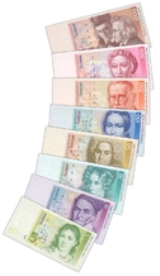
German mark

Encyclopedia
The Deutsche Mark (ˈdɔʏtʃə ˈmaʁk, German mark
, abbreviated "DM") was the official currency
of West Germany
(1948–1990) and Germany
(1990–2002) until the adoption of the euro
in 2002. It is commonly called the "Deutschmark" in English but not in German. Germans often say "Mark" or "D-Mark". It was first issued under Allied occupation
in 1948 replacing the Reichsmark
, and served as the Federal Republic of Germany
's official currency from its founding the following year until 1999, when the mark was replaced by the euro
; its coin
s and banknote
s remained in circulation, defined in terms of euros, until the introduction of euro notes and coins in early 2002. The Deutsche Mark ceased to be legal tender
immediately upon the introduction of the euro—in contrast to the other Eurozone
nations, where the euro and legacy currency circulated side by side for up to two months. Mark coins and banknotes continued to be accepted as valid forms of payment in Germany until 28 February 2002.
The Deutsche Bundesbank
has guaranteed that all German mark in cash form may be changed into euros indefinitely, and one may do so at any branch of the Bundesbank in Germany. Banknotes can even be sent to the bank by mail.
On 31 December 1998, the European Central Bank
(ECB) fixed the irrevocable exchange rate, effective 1 January 1999, for German mark to euro
s as DM 1.95583 = €1.
One Deutsche Mark was divided into 100 pfennig
s.
in 1871. Before that time, the different German states issued a variety of different currencies, though most were linked to the Vereinsthaler
, a silver coin containing 16 2/3 gram
s of pure silver. Although the mark was based on gold rather than silver, a fixed exchange rate between the Vereinsthaler and the mark of 3 marks = 1 Vereinsthaler was used for the conversion.
, was introduced in 1873. With the outbreak of World War I
, the mark was taken off the gold standard. The currency thus became known as the Papiermark
, especially as high inflation
, then hyperinflation occurred and the currency became exclusively made up of paper money. The Papiermark was replaced by the Rentenmark
(RM) since 1923, November 15, and the Reichsmark
(RM) in 1924.
. The old Reichsmark and Rentenmark were exchanged for the new currency at a rate of DM 1 = RM 1 for the essential currency such as wages, payment of rents etc., and DM 1 = RM 10 for the remainder in private non-bank credit balance, with half frozen. Large amounts were exchanged for RM 10 to 65 pfennigs. In addition, each person received a per capita allowance of DM 60 in two parts, the first being DM 40 and the second DM 20.
A few weeks later Erhard, acting against orders, issued an edict abolishing many economic controls which had been originally implemented by the Nazis, and which the Allies had not removed. He did this, as he often confessed, on Sunday because the offices of the American, British, and French occupation authorities were closed that day. He was sure that if he had done it when they were open, they would have countermanded the order.
The introduction of the new currency was intended to protect western Germany from a second wave of hyperinflation
and to stop the rampant barter and black market trade (where American cigarettes acted as currency). Although the new currency was initially only distributed in the three western occupation zones outside Berlin, the move angered the Soviet authorities, who regarded it as a threat. The Soviets promptly cut off all road, rail and canal links between the three western zones and West Berlin, starting the Berlin Blockade
. In response, the U.S. and Britain launched an airlift of food and coal and distributed the new currency in West Berlin
as well.
money coming in from the United States, which primarily was used for investment. In addition, the Marshall plan forced German companies, as well as those in all of Western Europe, to modernize their business practices, and take account of the wider market. Marshall plan funding overcame bottlenecks in the surging economy caused by remaining controls (which were removed in 1949), and opened up a greatly expanded market for German exports. Overnight, consumer goods appeared in the stores, because they could be sold for realistic prices, emphasizing to Germans that their economy had turned a corner.
), the East German mark
(also named "Deutsche Mark" from 1948–1964 and colloquially referred to as the Ostmark) was introduced a few days afterwards in the form of Reichsmark and Rentenmark notes with adhesive stamps to stop the flooding in of Reichsmark and Rentenmark notes from the West. In July 1948, a completely new series of East German mark banknotes were issued.
assumed responsibility, followed in 1957 by the Deutsche Bundesbank
. The Deutsche Mark earned a reputation as a strong store of value
at times when other national currencies succumbed to periods of inflation
. It became a source of national pride and an anchor for the country's economic prosperity, particularly during the years of the Wirtschaftswunder
in the 1950s. In the 1990s, opinion polls showed a majority of Germans opposed to the adoption of the euro; polls today show a significant number would prefer to return to the mark.
rejected in a referendum the proposal to turn it into a "European territory". Despite French pre-referendum claims that a "no" vote would mean that the Saar would remain a French protectorate
it in fact resulted in the incorporation of the Saar into the Federal Republic of Germany
on January 1, 1957. The new German member state
of the Saarland
maintained its currency, the Saar franc
, which was in a currency union at par with the French franc
. On July 9, 1959 the Deutsche Mark replaced the Saar franc at a ratio of 100 Francs = DM 0.8507.
in July 1990, replacing the East German Mark (Mark der DDR), in preparation for unification on 3 October 1990. East German marks were exchanged for German marks at a rate of 1:1 for the first 4000 Marks and 2:1 for larger amounts. Before reunification, each citizen of East Germany coming to West Germany was given Begrüßungsgeld, greeting money, a per capita allowance of DM 100 in cash. The government of Germany, and the Bundesbank were in major disagreement over the exchange rate between the East German Mark and the German mark.
France and the United Kingdom were opposed to German reunification, and attempted to influence the Soviet Union
to stop it. However, in late 1989 France extracted German commitment to the Monetary Union
in return for support for German reunification.
's present policy towards the euro. The German mark's stability was greatly apparent in 1993, when speculation on the French franc and other European currencies caused a change in the European Exchange Rate Mechanism
. However, it should be remembered that "hard" is relative only if it is compared to other currencies, as in its 53 year history, the purchasing power of the German mark was reduced by over 70%.
in 1948 and 1949. From 1950, the inscription Bundesrepublik Deutschland (Federal Republic of Germany) appeared on the coins.
The masses and dimensions of the coins can be found in an FAQ of the Bundesbank.
Unlike other countries (such as Australia) there was no attempt (or proposal suggested) for the withdrawal of the one and two pfennig coins. Both coins were still in circulation in 2001 and supermarkets in particular still marked prices to the pfennig. This penchant for accuracy continues with the Euro (whilst Finland or the Netherlands for example, price to the nearest 5 cents) with the cent still encountered in Germany.
There were a considerable number of commemorative silver DM 5 and DM 10 coins
, which actually had the status of legal tender
but were rarely seen outside of collectors' circles.
.jpg) On 27 December 2000, the German government enacted a law authorizing the Bundesbank to issue, in 2001, a special .999 pure gold 1 Deutsche Mark coin commemorating the end of the German mark. The coin had the exact design and dimensions of the circulating cupro-nickel DM 1 coin, with the exception of the inscription on the reverse, which read "Deutsche Bundesbank" (instead of "Bundesrepublik Deutschland"), as the Bundesbank was the issuing authority in this case. A total of one million gold German mark coins were minted (200,000 at each of the five mints) and were sold beginning in mid-2001 through German coin dealers on behalf of the Bundesbank. The issue price varied by dealer but averaged approximately 165 United States dollar
On 27 December 2000, the German government enacted a law authorizing the Bundesbank to issue, in 2001, a special .999 pure gold 1 Deutsche Mark coin commemorating the end of the German mark. The coin had the exact design and dimensions of the circulating cupro-nickel DM 1 coin, with the exception of the inscription on the reverse, which read "Deutsche Bundesbank" (instead of "Bundesrepublik Deutschland"), as the Bundesbank was the issuing authority in this case. A total of one million gold German mark coins were minted (200,000 at each of the five mints) and were sold beginning in mid-2001 through German coin dealers on behalf of the Bundesbank. The issue price varied by dealer but averaged approximately 165 United States dollar
s.
German coins bear a mint mark, indicating where the coin was minted. D indicates Munich, F Stuttgart, G Karlsruhe and J Hamburg. Coins minted during the Second World War
include the mint marks A (Berlin) and B (Vienna). The mint mark A was also used for German mark coins minted in Berlin beginning in 1990 following the reunification of Germany. These mint marks have been continued on the German euro
coins.
Between July 1, 1990 (Currency union with East Germany) and July 1, 1991 East German coins of denominations up to 50 pfennigs continued to circulate as Deutsche Mark coins at their face value, owing to a temporary shortage of small coins. These coins were legal tender only in the territory of the former East Germany.
(cf. groat). Likewise, sechser (sixer) could refer to a coin of 5 pfennigs. Both colloquialisms refer to several pre-1871 currencies of the previously independent Länder
(notably Prussia
), where a groschen was subdivided into 12 pfennigs, hence half a Groschen into 6. After 1871, 12 pfennigs of old currency would be converted into 10 pfennig of the mark, hence 10 pfennig coins inherited the "groschen" name and 5 pfennig coins inherited the "sechser" name. Both usages are only regional and may not be understood in areas where a groschen coin did not exist before 1871. In particular, the usage of "sechser" is less widespread. In northern Germany the 5-Mark coin used to be also called "Heiermann" (etymology is unclear).
The notes with a value greater than 200 marks were rarely seen.
The new security features were: a windowed security-thread (with the notes' denominations in microprinting), watermark, micro-printing, intaglio-printing
(viewing-angle dependent visibility as well as a Braille
representation of the notes denomination), colour-shifting ink (on the DM 500 and 1000 denominations), a see-through register and ultraviolet-visible security features.
First to be issued were the DM 100 and 200 denominations on 1 October 1990 (although the banknote shows "Frankfurt am Main
, 2. Januar 1989"). The next denomination was DM 10 on 16 April 1991, followed by DM 50 in autumn the same year. Next was the DM 20 note on 20 March 1992 (printed on 2 August 1991). The reason for this gradual introduction was, that public should become familiar with one single denomination, before introducing a new one. The change was finished with the introduction of the 5, 500, and 1000 mark denominations on 27 October 1992. The last three denominations were rarely seen in circulation and were introduced in one step. With the advance of forgery technology, the Bundesbank decided to introduce additional security features on the most important denominations (50, 100, and 200 marks) as of 1996. These were a hologram foil in the center of the note's obverse, a matted printing on the note's right obverse, showing its denomination (like on the reverse of the new €5, €10, and €20 banknotes
), and the EURion constellation
on the note's reverse. Furthermore, the colors were changed a bit to pastel to hamper counterfeiting.
, ˈdɔʏtʃə ˈmaʁk); its plural form in standard German
is the same as the singular. In German, the adjective "deutsche" (adjective for "German" in feminine
singular
nominative form) is capitalized because it is part of a proper name, while the noun "Mark", like all German nouns, is always capitalized. The English loanword
"Deutschmark" had a slightly different spelling (possibly due to the frequency of silent e
in English) and a plural form in -s. In Germany, the currency's name was often abbreviated as D-Mark (fem.
, ˈdeːmaʁk) or simply Mark (fem.
) with the latter term also often used in English. Like Deutsche Mark, D-Mark and Mark have no plural form, the singular being used to refer to any amount of money (e.g. eine (one) Mark and dreißig (thirty) Mark). Sometimes, a plural form of Mark, Märker ˈmɛʁkɐ was used as either as diminutive
form or to refer to a (physically present or small) number of D-Mark coins or bills (e.g. Gib mir mal ein paar Märker (Just give me a few Mark (-bills or -coins)) and Die lieben Märker wieder (The lovely money again (with an ironic
undertone)).
The subdivision unit is spelled Pfennig (masc.
; ˈpfɛnɪç), which unlike Mark does have a commonly used plural form: Pfennige ([ˈpfɛnɪɡə]), but the singular could also be used instead with no difference in meaning. (e.g.: ein (one) Pfennig, dreißig (thirty) Pfennige or dreißig (thirty) Pfennig). The official form is singular.
Mark (money)
Mark was a measure of weight mainly for gold and silver, commonly used throughout western Europe and often equivalent to 8 ounces. Considerable variations, however, occurred throughout the Middle Ages Mark (from a merging of three Teutonic/Germanic languages words, Latinized in 9th century...
, abbreviated "DM") was the official currency
Currency
In economics, currency refers to a generally accepted medium of exchange. These are usually the coins and banknotes of a particular government, which comprise the physical aspects of a nation's money supply...
of West Germany
West Germany
West Germany is the common English, but not official, name for the Federal Republic of Germany or FRG in the period between its creation in May 1949 to German reunification on 3 October 1990....
(1948–1990) and Germany
Germany
Germany , officially the Federal Republic of Germany , is a federal parliamentary republic in Europe. The country consists of 16 states while the capital and largest city is Berlin. Germany covers an area of 357,021 km2 and has a largely temperate seasonal climate...
(1990–2002) until the adoption of the euro
Euro
The euro is the official currency of the eurozone: 17 of the 27 member states of the European Union. It is also the currency used by the Institutions of the European Union. The eurozone consists of Austria, Belgium, Cyprus, Estonia, Finland, France, Germany, Greece, Ireland, Italy, Luxembourg,...
in 2002. It is commonly called the "Deutschmark" in English but not in German. Germans often say "Mark" or "D-Mark". It was first issued under Allied occupation
Bizone
The Bizone, or Bizonia was the combination of the American and the British occupation zones in 1947 during the occupation of Germany after World War II. With the addition of the French occupation zone in March 1948, the entity became the Trizone...
in 1948 replacing the Reichsmark
German reichsmark
The Reichsmark was the currency in Germany from 1924 until June 20, 1948. The Reichsmark was subdivided into 100 Reichspfennig.-History:...
, and served as the Federal Republic of Germany
Germany
Germany , officially the Federal Republic of Germany , is a federal parliamentary republic in Europe. The country consists of 16 states while the capital and largest city is Berlin. Germany covers an area of 357,021 km2 and has a largely temperate seasonal climate...
's official currency from its founding the following year until 1999, when the mark was replaced by the euro
Euro
The euro is the official currency of the eurozone: 17 of the 27 member states of the European Union. It is also the currency used by the Institutions of the European Union. The eurozone consists of Austria, Belgium, Cyprus, Estonia, Finland, France, Germany, Greece, Ireland, Italy, Luxembourg,...
; its coin
Coin
A coin is a piece of hard material that is standardized in weight, is produced in large quantities in order to facilitate trade, and primarily can be used as a legal tender token for commerce in the designated country, region, or territory....
s and banknote
Banknote
A banknote is a kind of negotiable instrument, a promissory note made by a bank payable to the bearer on demand, used as money, and in many jurisdictions is legal tender. In addition to coins, banknotes make up the cash or bearer forms of all modern fiat money...
s remained in circulation, defined in terms of euros, until the introduction of euro notes and coins in early 2002. The Deutsche Mark ceased to be legal tender
Legal tender
Legal tender is a medium of payment allowed by law or recognized by a legal system to be valid for meeting a financial obligation. Paper currency is a common form of legal tender in many countries....
immediately upon the introduction of the euro—in contrast to the other Eurozone
Eurozone
The eurozone , officially called the euro area, is an economic and monetary union of seventeen European Union member states that have adopted the euro as their common currency and sole legal tender...
nations, where the euro and legacy currency circulated side by side for up to two months. Mark coins and banknotes continued to be accepted as valid forms of payment in Germany until 28 February 2002.
The Deutsche Bundesbank
Deutsche Bundesbank
The Deutsche Bundesbank is the central bank of the Federal Republic of Germany and as such part of the European System of Central Banks . Due to its strength and former size, the Bundesbank is the most influential member of the ESCB. Both the Deutsche Bundesbank and the European Central Bank are...
has guaranteed that all German mark in cash form may be changed into euros indefinitely, and one may do so at any branch of the Bundesbank in Germany. Banknotes can even be sent to the bank by mail.
On 31 December 1998, the European Central Bank
European Central Bank
The European Central Bank is the institution of the European Union that administers the monetary policy of the 17 EU Eurozone member states. It is thus one of the world's most important central banks. The bank was established by the Treaty of Amsterdam in 1998, and is headquartered in Frankfurt,...
(ECB) fixed the irrevocable exchange rate, effective 1 January 1999, for German mark to euro
Euro
The euro is the official currency of the eurozone: 17 of the 27 member states of the European Union. It is also the currency used by the Institutions of the European Union. The eurozone consists of Austria, Belgium, Cyprus, Estonia, Finland, France, Germany, Greece, Ireland, Italy, Luxembourg,...
s as DM 1.95583 = €1.
One Deutsche Mark was divided into 100 pfennig
Pfennig
The Pfennig , plural Pfennige, is an old German coin or note, which existed from the 9th century until the introduction of the euro in 2002....
s.
Before 1871
A mark had been the currency of Germany since its original unificationUnification of Germany
The formal unification of Germany into a politically and administratively integrated nation state officially occurred on 18 January 1871 at the Versailles Palace's Hall of Mirrors in France. Princes of the German states gathered there to proclaim Wilhelm of Prussia as Emperor Wilhelm of the German...
in 1871. Before that time, the different German states issued a variety of different currencies, though most were linked to the Vereinsthaler
Vereinsthaler
The Vereinsthaler was a standard silver coin used in most German states and the Austrian Empire in the years prior to German unification.- Introduction :...
, a silver coin containing 16 2/3 gram
Gram
The gram is a metric system unit of mass....
s of pure silver. Although the mark was based on gold rather than silver, a fixed exchange rate between the Vereinsthaler and the mark of 3 marks = 1 Vereinsthaler was used for the conversion.
1873–1948
The first mark, known as the GoldmarkGerman gold mark
The Goldmark was the currency used in the German Empire from 1873 to 1914.-History:Before unification, the different German states issued a variety of different currencies, though most were linked to the Vereinsthaler, a silver coin containing 16⅔ grams of pure silver...
, was introduced in 1873. With the outbreak of World War I
World War I
World War I , which was predominantly called the World War or the Great War from its occurrence until 1939, and the First World War or World War I thereafter, was a major war centred in Europe that began on 28 July 1914 and lasted until 11 November 1918...
, the mark was taken off the gold standard. The currency thus became known as the Papiermark
German papiermark
The name Papiermark is applied to the German currency from the 4th August 1914 when the link between the Mark and gold was abandoned, due to the outbreak of World War I...
, especially as high inflation
Inflation
In economics, inflation is a rise in the general level of prices of goods and services in an economy over a period of time.When the general price level rises, each unit of currency buys fewer goods and services. Consequently, inflation also reflects an erosion in the purchasing power of money – a...
, then hyperinflation occurred and the currency became exclusively made up of paper money. The Papiermark was replaced by the Rentenmark
German rentenmark
The Rentenmark was a currency issued on 15 November 1923 to stop the hyperinflation of 1922 and 1923 in Germany. It was subdivided into 100 Rentenpfennig.-History:...
(RM) since 1923, November 15, and the Reichsmark
German reichsmark
The Reichsmark was the currency in Germany from 1924 until June 20, 1948. The Reichsmark was subdivided into 100 Reichspfennig.-History:...
(RM) in 1924.
Early military occupation 1945–1947
During the first 2 years of occupation the occupying powers France, United Kingdom, United States, and the Soviet Union, were not able to successfully negotiate a possible currency reform in Germany. Due to the strains between the Allies each zone was governed independently as regards monetary matters. The US occupation policy was governed by the directive JCS 1067 (in effect until July 1947), which forbade the US military governor "to take any steps to strengthen German financial structure". As a consequence a separate monetary reform in the U.S. zone was not possible. Each of the Allies printed its own occupation currency.Currency reform of June 1948
The Deutsche Mark was introduced on Sunday, June 20, 1948 by Ludwig ErhardLudwig Erhard
Ludwig Wilhelm Erhard was a German politician affiliated with the CDU and Chancellor of West Germany from 1963 until 1966. He is notable for his leading role in German postwar economic reform and economic recovery , particularly in his role as Minister of Economics under Chancellor Konrad Adenauer...
. The old Reichsmark and Rentenmark were exchanged for the new currency at a rate of DM 1 = RM 1 for the essential currency such as wages, payment of rents etc., and DM 1 = RM 10 for the remainder in private non-bank credit balance, with half frozen. Large amounts were exchanged for RM 10 to 65 pfennigs. In addition, each person received a per capita allowance of DM 60 in two parts, the first being DM 40 and the second DM 20.
A few weeks later Erhard, acting against orders, issued an edict abolishing many economic controls which had been originally implemented by the Nazis, and which the Allies had not removed. He did this, as he often confessed, on Sunday because the offices of the American, British, and French occupation authorities were closed that day. He was sure that if he had done it when they were open, they would have countermanded the order.
The introduction of the new currency was intended to protect western Germany from a second wave of hyperinflation
Hyperinflation
In economics, hyperinflation is inflation that is very high or out of control. While the real values of the specific economic items generally stay the same in terms of relatively stable foreign currencies, in hyperinflationary conditions the general price level within a specific economy increases...
and to stop the rampant barter and black market trade (where American cigarettes acted as currency). Although the new currency was initially only distributed in the three western occupation zones outside Berlin, the move angered the Soviet authorities, who regarded it as a threat. The Soviets promptly cut off all road, rail and canal links between the three western zones and West Berlin, starting the Berlin Blockade
Berlin Blockade
The Berlin Blockade was one of the first major international crises of the Cold War and the first resulting in casualties. During the multinational occupation of post-World War II Germany, the Soviet Union blocked the Western Allies' railway and road access to the sectors of Berlin under Allied...
. In response, the U.S. and Britain launched an airlift of food and coal and distributed the new currency in West Berlin
West Berlin
West Berlin was a political exclave that existed between 1949 and 1990. It comprised the western regions of Berlin, which were bordered by East Berlin and parts of East Germany. West Berlin consisted of the American, British, and French occupation sectors, which had been established in 1945...
as well.
Economics of 1948 currency reform
Since the 1930s, prices and wages had been controlled, but money had been plentiful. That meant that people had accumulated large paper assets, and that official prices and wages did not reflect reality, as the black market dominated the economy and more than half of all transactions were taking place unofficially. The reform replaced the old money with the new Deutsche Mark at the rate of one new per ten old. This wiped out 90% of government and private debt, as well as private savings. Prices were decontrolled, and labor unions agreed to accept a 15% wage increase, despite the 25% rise in prices. The result was the prices of German export products held steady, while profits and earnings from exports soared, and were poured back into the economy. The currency reforms were simultaneous with the $1.4 billion in Marshall PlanMarshall Plan
The Marshall Plan was the large-scale American program to aid Europe where the United States gave monetary support to help rebuild European economies after the end of World War II in order to combat the spread of Soviet communism. The plan was in operation for four years beginning in April 1948...
money coming in from the United States, which primarily was used for investment. In addition, the Marshall plan forced German companies, as well as those in all of Western Europe, to modernize their business practices, and take account of the wider market. Marshall plan funding overcame bottlenecks in the surging economy caused by remaining controls (which were removed in 1949), and opened up a greatly expanded market for German exports. Overnight, consumer goods appeared in the stores, because they could be sold for realistic prices, emphasizing to Germans that their economy had turned a corner.
Currency reform in the Soviet occupation zone
In the Soviet occupation zone of Germany (later the German Democratic RepublicGerman Democratic Republic
The German Democratic Republic , informally called East Germany by West Germany and other countries, was a socialist state established in 1949 in the Soviet zone of occupied Germany, including East Berlin of the Allied-occupied capital city...
), the East German mark
East German mark
The East German mark commonly called the eastern mark , in East Germany only Mark, was the currency of the German Democratic Republic . Its ISO 4217 currency code was DDM...
(also named "Deutsche Mark" from 1948–1964 and colloquially referred to as the Ostmark) was introduced a few days afterwards in the form of Reichsmark and Rentenmark notes with adhesive stamps to stop the flooding in of Reichsmark and Rentenmark notes from the West. In July 1948, a completely new series of East German mark banknotes were issued.
Bank deutscher Länder and the Deutsche Bundesbank
Later in 1948, the Bank deutscher LänderBank deutscher Länder
The Bank deutscher Länder , abbreviation BdL, was the forerunner of the Deutsche Bundesbank. It was founded on 1 March 1948....
assumed responsibility, followed in 1957 by the Deutsche Bundesbank
Deutsche Bundesbank
The Deutsche Bundesbank is the central bank of the Federal Republic of Germany and as such part of the European System of Central Banks . Due to its strength and former size, the Bundesbank is the most influential member of the ESCB. Both the Deutsche Bundesbank and the European Central Bank are...
. The Deutsche Mark earned a reputation as a strong store of value
Store of value
A recognized form of exchange can be a form of money or currency, a commodity like gold, or financial capital. To act as a store of value, these forms must be able to be saved and retrieved at a later time, and be predictably useful when retrieved....
at times when other national currencies succumbed to periods of inflation
Inflation
In economics, inflation is a rise in the general level of prices of goods and services in an economy over a period of time.When the general price level rises, each unit of currency buys fewer goods and services. Consequently, inflation also reflects an erosion in the purchasing power of money – a...
. It became a source of national pride and an anchor for the country's economic prosperity, particularly during the years of the Wirtschaftswunder
Wirtschaftswunder
The term describes the rapid reconstruction and development of the economies of West Germany and Austria after World War II . The expression was used by The Times in 1950...
in the 1950s. In the 1990s, opinion polls showed a majority of Germans opposed to the adoption of the euro; polls today show a significant number would prefer to return to the mark.
Currency Union with the Saarland
The population in the Saar ProtectorateSaar (protectorate)
The Saar Protectorate was a German borderland territory twice temporarily made a protectorate state. Since rejoining Germany the second time in 1957, it is the smallest Federal German Area State , the Saarland, not counting the city-states Berlin, Hamburg and Bremen...
rejected in a referendum the proposal to turn it into a "European territory". Despite French pre-referendum claims that a "no" vote would mean that the Saar would remain a French protectorate
Protectorate
In history, the term protectorate has two different meanings. In its earliest inception, which has been adopted by modern international law, it is an autonomous territory that is protected diplomatically or militarily against third parties by a stronger state or entity...
it in fact resulted in the incorporation of the Saar into the Federal Republic of Germany
West Germany
West Germany is the common English, but not official, name for the Federal Republic of Germany or FRG in the period between its creation in May 1949 to German reunification on 3 October 1990....
on January 1, 1957. The new German member state
States of Germany
Germany is made up of sixteen which are partly sovereign constituent states of the Federal Republic of Germany. Land literally translates as "country", and constitutionally speaking, they are constituent countries...
of the Saarland
Saarland
Saarland is one of the sixteen states of Germany. The capital is Saarbrücken. It has an area of 2570 km² and 1,045,000 inhabitants. In both area and population, it is the smallest state in Germany other than the city-states...
maintained its currency, the Saar franc
Saar franc
The franc was the currency of the Saar Protectorate and, later, the state of Saarland in West Germany between 20 November 1947 and 6 July 1959...
, which was in a currency union at par with the French franc
French franc
The franc was a currency of France. Along with the Spanish peseta, it was also a de facto currency used in Andorra . Between 1360 and 1641, it was the name of coins worth 1 livre tournois and it remained in common parlance as a term for this amount of money...
. On July 9, 1959 the Deutsche Mark replaced the Saar franc at a ratio of 100 Francs = DM 0.8507.
The German mark's role in German reunification
The Deutsche Mark played an important role in the reunification of Germany. It was introduced as the official currency of East GermanyGerman Democratic Republic
The German Democratic Republic , informally called East Germany by West Germany and other countries, was a socialist state established in 1949 in the Soviet zone of occupied Germany, including East Berlin of the Allied-occupied capital city...
in July 1990, replacing the East German Mark (Mark der DDR), in preparation for unification on 3 October 1990. East German marks were exchanged for German marks at a rate of 1:1 for the first 4000 Marks and 2:1 for larger amounts. Before reunification, each citizen of East Germany coming to West Germany was given Begrüßungsgeld, greeting money, a per capita allowance of DM 100 in cash. The government of Germany, and the Bundesbank were in major disagreement over the exchange rate between the East German Mark and the German mark.
France and the United Kingdom were opposed to German reunification, and attempted to influence the Soviet Union
Soviet Union
The Soviet Union , officially the Union of Soviet Socialist Republics , was a constitutionally socialist state that existed in Eurasia between 1922 and 1991....
to stop it. However, in late 1989 France extracted German commitment to the Monetary Union
Economic and Monetary Union of the European Union
The Economic and Monetary Union is an umbrella term for the group of policies aimed at converging the economies of members of the European Union in three stages so as to allow them to adopt a single currency, the euro. As such, it is largely synonymous with the eurozone.All member states of the...
in return for support for German reunification.
Stability of the German mark
The German mark had a reputation as one of the world's most stable currencies; this was based on the monetary policy of the Bundesbank. The policy was "hard" in relation to the policies of certain other central banks in Europe. The "hard" and "soft" was in respect to the aims of inflation and political interference. This policy was the foundation of the European Central BankEuropean Central Bank
The European Central Bank is the institution of the European Union that administers the monetary policy of the 17 EU Eurozone member states. It is thus one of the world's most important central banks. The bank was established by the Treaty of Amsterdam in 1998, and is headquartered in Frankfurt,...
's present policy towards the euro. The German mark's stability was greatly apparent in 1993, when speculation on the French franc and other European currencies caused a change in the European Exchange Rate Mechanism
European Exchange Rate Mechanism
The European Exchange Rate Mechanism, ERM, was a system introduced by the European Community in March 1979, as part of the European Monetary System , to reduce exchange rate variability and achieve monetary stability in Europe, in preparation for Economic and Monetary Union and the introduction of...
. However, it should be remembered that "hard" is relative only if it is compared to other currencies, as in its 53 year history, the purchasing power of the German mark was reduced by over 70%.
Coins
The first German mark coins were issued by the Bank deutscher LänderBank deutscher Länder
The Bank deutscher Länder , abbreviation BdL, was the forerunner of the Deutsche Bundesbank. It was founded on 1 March 1948....
in 1948 and 1949. From 1950, the inscription Bundesrepublik Deutschland (Federal Republic of Germany) appeared on the coins.
| Denomination | Dates issued | Composition | Obverse | Reverse | |
|---|---|---|---|---|---|
| 1 pfennig | 1948–2001 | 1948–1949: Bronzeplated steel 1950–2001: Copperplated steel |
Denomination between rye stalks | Oak sprig | |
| 2 pfennigs | 1950–2001 | 1950–1968: Bronze 1968–2001: Bronzeplated steel |
Denomination between rye stalks | Oak sprig | |
| 5 pfennigs | 1949–2001 | Brassplated steel | Denomination between rye stalks | Oak sprig | |
| 10 pfennigs | 1949–2001 | Brassplated steel | Denomination between rye stalks | Oak sprig | |
| 50 pfennigs | 1949–2001 | Cupro-nickel | Denomination | Woman planting an oak seedling | |
 |
DM 1 | 1950–2001 | Cupro-nickel | Denomination between oak leaves | German eagle |
| DM 2 | 1951, 1957–2001 | Cupro-nickel | 1951: Denomination between rye stalks and grapes 1957–1971: Max Planck Max Planck Max Karl Ernst Ludwig Planck, ForMemRS, was a German physicist who actualized the quantum physics, initiating a revolution in natural science and philosophy. He is regarded as the founder of the quantum theory, for which he received the Nobel Prize in Physics in 1918.-Life and career:Planck came... 1969–1987: Konrad Adenauer Konrad Adenauer Konrad Hermann Joseph Adenauer was a German statesman. He was the chancellor of the West Germany from 1949 to 1963. He is widely recognised as a person who led his country from the ruins of World War II to a powerful and prosperous nation that had forged close relations with old enemies France,... 1970–1987: Theodor Heuss Theodor Heuss Theodor Heuss was a liberal German politician who served as the first President of the Federal Republic of Germany after World War II from 1949 to 1959... 1979–2001: Kurt Schumacher Kurt Schumacher Dr. Kurt Schumacher , was chairman of the Social Democratic Party of Germany from 1946 and first Leader of the Opposition in the West German Bundestag parliament from 1949 until his death... 1988–2001: Ludwig Erhard Ludwig Erhard Ludwig Wilhelm Erhard was a German politician affiliated with the CDU and Chancellor of West Germany from 1963 until 1966. He is notable for his leading role in German postwar economic reform and economic recovery , particularly in his role as Minister of Economics under Chancellor Konrad Adenauer... 1990–1994: Franz Josef Strauß Franz Josef Strauß Franz Josef Strauss was a German politician. He was the leader of the Christian Social Union, member of the federal cabinet in different positions and long-time minister-president of the state of Bavaria.... 1994–2001: Willy Brandt Willy Brandt Willy Brandt, born Herbert Ernst Karl Frahm , was a German politician, Mayor of West Berlin 1957–1966, Chancellor of West Germany 1969–1974, and leader of the Social Democratic Party of Germany 1964–1987.... |
German eagle | |
| DM 5 | 1951–2001 | 1951–1974: Silver 1975–2001: Cupro-nickel |
Denomination | German eagle | |
| DM 10 | 1987–2001 | 1987–2001: Silver | Varies | German eagle, different designs |
The masses and dimensions of the coins can be found in an FAQ of the Bundesbank.
Unlike other countries (such as Australia) there was no attempt (or proposal suggested) for the withdrawal of the one and two pfennig coins. Both coins were still in circulation in 2001 and supermarkets in particular still marked prices to the pfennig. This penchant for accuracy continues with the Euro (whilst Finland or the Netherlands for example, price to the nearest 5 cents) with the cent still encountered in Germany.
There were a considerable number of commemorative silver DM 5 and DM 10 coins
Coinage of the Federal Republic of Germany
This is a list of commemorative coins issued by the Federal Republic of Germany. For regular coins, see Deutsche Mark and German euro coins. Those prior to 2002 were denominated in Deutsche Marks; subsequent ones have been denominated in euros....
, which actually had the status of legal tender
Legal tender
Legal tender is a medium of payment allowed by law or recognized by a legal system to be valid for meeting a financial obligation. Paper currency is a common form of legal tender in many countries....
but were rarely seen outside of collectors' circles.
United States dollar
The United States dollar , also referred to as the American dollar, is the official currency of the United States of America. It is divided into 100 smaller units called cents or pennies....
s.
German coins bear a mint mark, indicating where the coin was minted. D indicates Munich, F Stuttgart, G Karlsruhe and J Hamburg. Coins minted during the Second World War
World War II
World War II, or the Second World War , was a global conflict lasting from 1939 to 1945, involving most of the world's nations—including all of the great powers—eventually forming two opposing military alliances: the Allies and the Axis...
include the mint marks A (Berlin) and B (Vienna). The mint mark A was also used for German mark coins minted in Berlin beginning in 1990 following the reunification of Germany. These mint marks have been continued on the German euro
Euro
The euro is the official currency of the eurozone: 17 of the 27 member states of the European Union. It is also the currency used by the Institutions of the European Union. The eurozone consists of Austria, Belgium, Cyprus, Estonia, Finland, France, Germany, Greece, Ireland, Italy, Luxembourg,...
coins.
Between July 1, 1990 (Currency union with East Germany) and July 1, 1991 East German coins of denominations up to 50 pfennigs continued to circulate as Deutsche Mark coins at their face value, owing to a temporary shortage of small coins. These coins were legal tender only in the territory of the former East Germany.
Colloquial expression
In colloquial German the 10 pfennig coin was sometimes called a groschenGroschen
Groschen was the name for a coin used in various German-speaking states as well as some non-German-speaking countries of Central Europe , the Danubian principalities...
(cf. groat). Likewise, sechser (sixer) could refer to a coin of 5 pfennigs. Both colloquialisms refer to several pre-1871 currencies of the previously independent Länder
States of Germany
Germany is made up of sixteen which are partly sovereign constituent states of the Federal Republic of Germany. Land literally translates as "country", and constitutionally speaking, they are constituent countries...
(notably Prussia
Prussia
Prussia was a German kingdom and historic state originating out of the Duchy of Prussia and the Margraviate of Brandenburg. For centuries, the House of Hohenzollern ruled Prussia, successfully expanding its size by way of an unusually well-organized and effective army. Prussia shaped the history...
), where a groschen was subdivided into 12 pfennigs, hence half a Groschen into 6. After 1871, 12 pfennigs of old currency would be converted into 10 pfennig of the mark, hence 10 pfennig coins inherited the "groschen" name and 5 pfennig coins inherited the "sechser" name. Both usages are only regional and may not be understood in areas where a groschen coin did not exist before 1871. In particular, the usage of "sechser" is less widespread. In northern Germany the 5-Mark coin used to be also called "Heiermann" (etymology is unclear).
Banknotes
There were four series of German mark banknotes:- The first was issued in 1948 by the Allied military. There were denominations of ½, 1, 2, 5, 10, 20, 50 and 100 marks, with two designs of 20 and 50 marks notes.
- The second series was introduced in 1948 by the Bank deutscher Länder, an institution of the western occupation government. The designs were similar to the US Dollar and French francFrench francThe franc was a currency of France. Along with the Spanish peseta, it was also a de facto currency used in Andorra . Between 1360 and 1641, it was the name of coins worth 1 livre tournois and it remained in common parlance as a term for this amount of money...
, as the job of designing and printing the different denominations was shared between the Bank of France and the American Bank Note Company. There were denominations of 5 and 10 pfennigs, 5, 10, 20, 50 and 100 marks. - The third series was introduced in 1960 by the Bundesbank, depicting neutral symbols, paintings by the German painter Albrecht DürerAlbrecht DürerAlbrecht Dürer was a German painter, printmaker, engraver, mathematician, and theorist from Nuremberg. His prints established his reputation across Europe when he was still in his twenties, and he has been conventionally regarded as the greatest artist of the Northern Renaissance ever since...
, and buildings. There were 5, 10, 20, 50, 100, 500 and 1000 mark denominations. - The fourth was introduced in 1990 by the Bundesbank to counter advances in forgeryForgeryForgery is the process of making, adapting, or imitating objects, statistics, or documents with the intent to deceive. Copies, studio replicas, and reproductions are not considered forgeries, though they may later become forgeries through knowing and willful misrepresentations. Forging money or...
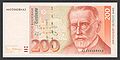
technology. The notes depicted German artists and scientists together with symbols and tools of their trade. This series added a 200 mark denomination, to decrease the use of 100 mark banknotes, which made up 54% of all circulating banknotes, and to fill the gap between the DM 100 and DM 500 denomination.
The notes with a value greater than 200 marks were rarely seen.
Banknotes of the fourth series (1990–2002)
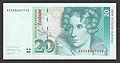
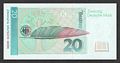
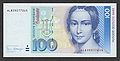
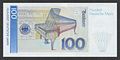
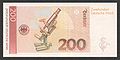
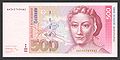
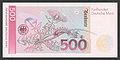
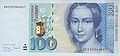
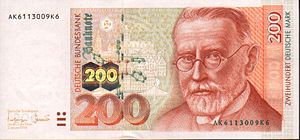
The design of German banknotes remained unchanged during the 1960s, 1970s and 1980s. During this period, forgery technology made significant advances so, in the late 1980s, the Bundesbank decided to issue a new series of Deutsche Mark banknotes. The colours for each denomination remained unchanged from the previous series but the designs underwent significant changes and a DM 200 denomination was introduced. Famous national artists and scientists were chosen to be portrayed on the new banknotes. Male and female artists were chosen in equal numbers. The buildings in the background of the notes' obverses had a close relationship to the person displayed (e.g., place of birth, place of death, place of work), as well as the second background picture (Lyra and the musician Schumann). The reverses of the notes refer to the work of the person on the obverse.The new security features were: a windowed security-thread (with the notes' denominations in microprinting), watermark, micro-printing, intaglio-printing
Intaglio (printmaking)
Intaglio is a family of printmaking techniques in which the image is incised into a surface, known as the matrix or plate, and the incised line or area holds the ink. Normally, copper or zinc plates are used as a surface, and the incisions are created by etching, engraving, drypoint, aquatint or...
(viewing-angle dependent visibility as well as a Braille
Braille
The Braille system is a method that is widely used by blind people to read and write, and was the first digital form of writing.Braille was devised in 1825 by Louis Braille, a blind Frenchman. Each Braille character, or cell, is made up of six dot positions, arranged in a rectangle containing two...
representation of the notes denomination), colour-shifting ink (on the DM 500 and 1000 denominations), a see-through register and ultraviolet-visible security features.
First to be issued were the DM 100 and 200 denominations on 1 October 1990 (although the banknote shows "Frankfurt am Main
Frankfurt
Frankfurt am Main , commonly known simply as Frankfurt, is the largest city in the German state of Hesse and the fifth-largest city in Germany, with a 2010 population of 688,249. The urban area had an estimated population of 2,300,000 in 2010...
, 2. Januar 1989"). The next denomination was DM 10 on 16 April 1991, followed by DM 50 in autumn the same year. Next was the DM 20 note on 20 March 1992 (printed on 2 August 1991). The reason for this gradual introduction was, that public should become familiar with one single denomination, before introducing a new one. The change was finished with the introduction of the 5, 500, and 1000 mark denominations on 27 October 1992. The last three denominations were rarely seen in circulation and were introduced in one step. With the advance of forgery technology, the Bundesbank decided to introduce additional security features on the most important denominations (50, 100, and 200 marks) as of 1996. These were a hologram foil in the center of the note's obverse, a matted printing on the note's right obverse, showing its denomination (like on the reverse of the new €5, €10, and €20 banknotes
Euro banknotes
Euro banknotes are the banknotes of the euro, the currency of the eurozone and have been in circulation since 2002. They are issued by the national central banks of the euro area or the European Central Bank...
), and the EURion constellation
EURion constellation
The EURion constellation is a pattern of symbols found on a number of banknote designs worldwide since about 1996. It is added to help software detect the presence of a banknote in a digital image. Such software can then block the user from reproducing banknotes to prevent counterfeiting using...
on the note's reverse. Furthermore, the colors were changed a bit to pastel to hamper counterfeiting.
| 1989 Series http://www.bundesbank.de/bargeld/bargeld_faq_dmbanknotenabbildungen.php | ||||||||||||
|---|---|---|---|---|---|---|---|---|---|---|---|---|
| Image | Value | € equiv. | Dimensions | Main Colour | Description | Date of | ||||||
| Obverse | Reverse | Obverse | Reverse | Watermark | first printing | issue | withdrawal | lapse | ||||
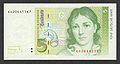 |
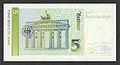 |
DM 5 | 2.56 | 122 × 62 mm | Yellowish-green | Bettina von Arnim Bettina von Arnim Bettina von Arnim , born Elisabeth Catharina Ludovica Magdalena Brentano, was a German writer and novelist.... , Wiepersdorf estate and buildings of historic Berlin, Horn (symbolizing Des Knaben Wunderhorn) |
Brandenburg Gate Brandenburg Gate The Brandenburg Gate is a former city gate and one of the most well-known landmarks of Berlin and Germany. It is located west of the city centre at the junction of Unter den Linden and Ebertstraße, immediately west of the Pariser Platz. It is the only remaining gate of a series through which... , Script from Bettina von Arnim's correspondence with Goethe ("Briefwechsel mit einem Kinde") |
As portrait | 1 August 1991 | 27 October 1992 | 31 December 2001 | Indefinite |
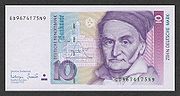 |
 |
DM 10 | 5.11 | 130 × 65 mm | Blue-violet | Carl Friedrich Gauss Carl Friedrich Gauss Johann Carl Friedrich Gauss was a German mathematician and scientist who contributed significantly to many fields, including number theory, statistics, analysis, differential geometry, geodesy, geophysics, electrostatics, astronomy and optics.Sometimes referred to as the Princeps mathematicorum... , Gaussian distribution, historic buildings of Göttingen Göttingen Göttingen is a university town in Lower Saxony, Germany. It is the capital of the district of Göttingen. The Leine river runs through the town. In 2006 the population was 129,686.-General information:... |
Sextant Sextant A sextant is an instrument used to measure the angle between any two visible objects. Its primary use is to determine the angle between a celestial object and the horizon which is known as the altitude. Making this measurement is known as sighting the object, shooting the object, or taking a sight... , a small map showing the triangulation Triangulation In trigonometry and geometry, triangulation is the process of determining the location of a point by measuring angles to it from known points at either end of a fixed baseline, rather than measuring distances to the point directly... of the Kingdom of Hanover Kingdom of Hanover The Kingdom of Hanover was established in October 1814 by the Congress of Vienna, with the restoration of George III to his Hanoverian territories after the Napoleonic era. It succeeded the former Electorate of Brunswick-Lüneburg , and joined with 38 other sovereign states in the German... performed by Gauss |
2 January 1989 | 16 April 1991 | |||
 |
 |
DM 20 | 10.23 | 138 × 68 mm | Bluish-green | Annette von Droste-Hülshoff Annette von Droste-Hülshoff Anna Elisabeth von Droste-Hülshoff, known as Annette von Droste-Hülshoff , was a 19th century German author, and one of the most important German poets.-Biography:... , buildings of the city of Meersburg Meersburg Meersburg is a town of Baden-Württemberg in the southwest of Germany at Lake Constance.It is famous for its charming medieval city. The lower town and upper town are reserved for pedestrians only and connected by two stairways and a steep street .-History:The name of the town means "Burg on the... |
A quill Quill A quill pen is a writing implement made from a flight feather of a large bird. Quills were used for writing with ink before the invention of the dip pen, metal-nibbed pens, the fountain pen, and, eventually, the ballpoint pen... pen and a beech-tree, referring to her work Die Judenbuche Die Judenbuche Die Judenbuche is a novella written by Annette von Droste-Hülshoff and first published in 1842. The beech tree becomes a significant symbol in the story.... (the Jews' Beech) |
1 August 1991 | 20 March 1992 | |||
 |
 |
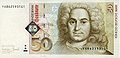
DM 50 | 25.56 | 146 × 71 mm | Yellowish-brown | Balthasar Neumann Balthasar Neumann Johann Balthasar Neumann , also known as Balthasar Neumann, was a [German] military artillery engineer and architect who developed a refined brand of Baroque architecture, fusing Austrian, Bohemian, Italian, and French elements to design some of the most impressive buildings of the period,... , buildings of Old Würzburg Würzburg Würzburg is a city in the region of Franconia which lies in the northern tip of Bavaria, Germany. Located at the Main River, it is the capital of the Regierungsbezirk Lower Franconia. The regional dialect is Franconian.... , an architect's ruler |
Partial view of the stairway in the Würzburg Residence Würzburg Residence The Würzburg Residence is a palace in Würzburg, southern Germany. Johann Lukas von Hildebrandt and Maximilian von Welsch, representants of the Austrian/South German Baroque were involved in the construction, as well as Robert de Cotte and Germain Boffrand, who were followers of the French Style... , the ground plan of a famous chapel, Kreuzkapelle, in Kitzingen Kitzingen Kitzingen is a town in the German state of Bavaria, capital of the district Kitzingen. It is part of Franconia geographical region and has around 21,000 inhabitants.Surrounded by vineyards, Kitzingen County is the largest wine producer in Bavaria... |
2 January 1989 | 30 September 1991 | |||
 |
 |
DM 100 | 51.13 | 154 × 74 mm | Dark blue | Clara Schumann Clara Schumann Clara Schumann was a German musician and composer, considered one of the most distinguished pianists of the Romantic era... from a lithograph by Andreas Staub, buildings of historic Leipzig Leipzig Leipzig Leipzig has always been a trade city, situated during the time of the Holy Roman Empire at the intersection of the Via Regia and Via Imperii, two important trade routes. At one time, Leipzig was one of the major European centres of learning and culture in fields such as music and publishing... and a lyre Lyre The lyre is a stringed musical instrument known for its use in Greek classical antiquity and later. The word comes from the Greek "λύρα" and the earliest reference to the word is the Mycenaean Greek ru-ra-ta-e, meaning "lyrists", written in Linear B syllabic script... |
Grand piano, Background: the pre-war building of the Hoch Conservatory Hoch Conservatory Dr. Hoch’s Konservatorium - Musikakademie was founded in Frankfurt am Main on September 22, 1878. Through the generosity of Frankfurter Joseph Hoch, who bequeathed the Conservatory one million German gold marks in his testament, a school for music and the arts was established for all age groups. ... in Frankfurt am Main |
1 October 1990 | ||||
 |
 |
DM 200 | 102.26 | 162 × 77 mm | Orange | Paul Ehrlich Paul Ehrlich Paul Ehrlich was a German scientist in the fields of hematology, immunology, and chemotherapy, and Nobel laureate. He is noted for curing syphilis and for his research in autoimmunity, calling it "horror autotoxicus"... , buildings of historic Frankfurt Frankfurt Frankfurt am Main , commonly known simply as Frankfurt, is the largest city in the German state of Hesse and the fifth-largest city in Germany, with a 2010 population of 688,249. The urban area had an estimated population of 2,300,000 in 2010... , the formula of Arsphenamine Arsphenamine Arsphenamine, also known as Salvarsan and 606, is a drug that was used beginning in the 1910s to treat syphilis and trypanosomiasis... |
Microscope Microscope A microscope is an instrument used to see objects that are too small for the naked eye. The science of investigating small objects using such an instrument is called microscopy... , the Rod of Asclepius Rod of Asclepius The rod of Asclepius , also known as the asklepian, is an ancient symbol associated with astrology, the Greek god Asclepius, and with medicine and healing. It consists of a serpent entwined around a staff. The name of the symbol derives from its early and widespread association with Asclepius, the... surrounded by simplified cell structures |
|||||
 |
 |
DM 500 | 255.65 | 170 × 80 mm | Red-violet | Anna Maria Sibylla Merian, an insect, buildings of ancient Nuremberg Nuremberg Nuremberg[p] is a city in the German state of Bavaria, in the administrative region of Middle Franconia. Situated on the Pegnitz river and the Rhine–Main–Danube Canal, it is located about north of Munich and is Franconia's largest city. The population is 505,664... |
Dandelion, inchworm Geometer moth The geometer moths or Geometridae are a family of the order Lepidoptera... , butterfly Butterfly A butterfly is a mainly day-flying insect of the order Lepidoptera, which includes the butterflies and moths. Like other holometabolous insects, the butterfly's life cycle consists of four parts: egg, larva, pupa and adult. Most species are diurnal. Butterflies have large, often brightly coloured... |
1 August 1991 | 27 October 1992 | |||
 |
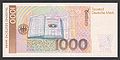 |
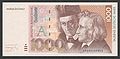
DM 1000 | 511.29 | 178 × 83 mm | Dark-brown | Wilhelm Wilhelm Grimm Wilhelm Carl Grimm was a German author, the younger of the Brothers Grimm.-Life and work:... and Jakob Grimm Brothers Grimm The Brothers Grimm , Jacob Grimm and Wilhelm Grimm , were German academics, linguists, cultural researchers, and authors who collected folklore and published several collections of it as Grimm's Fairy Tales, which became very popular... , buildings of historic Kassel Kassel Kassel is a town located on the Fulda River in northern Hesse, Germany. It is the administrative seat of the Kassel Regierungsbezirk and the Kreis of the same name and has approximately 195,000 inhabitants.- History :... |
The 'German dictionary' (Deutsches Wörterbuch), the Royal library in Berlin | |||||
| Hologram variant | ||||||||||||
 |
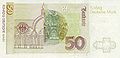 |
DM 50 | 25.56 | As previous | 2 January 1996 | 2 February 1998 | 31 December 2001 | Indefinite | ||||
 |
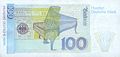 |
DM 100 | 51.13 | 1 August 1997 | ||||||||
 |
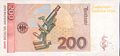 |
DM 200 | 102.26 | |||||||||
Spelling and pronunciation
The German name of the currency is Deutsche Mark (fem.Grammatical gender
Grammatical gender is defined linguistically as a system of classes of nouns which trigger specific types of inflections in associated words, such as adjectives, verbs and others. For a system of noun classes to be a gender system, every noun must belong to one of the classes and there should be...
, ˈdɔʏtʃə ˈmaʁk); its plural form in standard German
Standard German
Standard German is the standard variety of the German language used as a written language, in formal contexts, and for communication between different dialect areas...
is the same as the singular. In German, the adjective "deutsche" (adjective for "German" in feminine
Grammatical gender
Grammatical gender is defined linguistically as a system of classes of nouns which trigger specific types of inflections in associated words, such as adjectives, verbs and others. For a system of noun classes to be a gender system, every noun must belong to one of the classes and there should be...
singular
Grammatical number
In linguistics, grammatical number is a grammatical category of nouns, pronouns, and adjective and verb agreement that expresses count distinctions ....
nominative form) is capitalized because it is part of a proper name, while the noun "Mark", like all German nouns, is always capitalized. The English loanword
Loanword
A loanword is a word borrowed from a donor language and incorporated into a recipient language. By contrast, a calque or loan translation is a related concept where the meaning or idiom is borrowed rather than the lexical item itself. The word loanword is itself a calque of the German Lehnwort,...
"Deutschmark" had a slightly different spelling (possibly due to the frequency of silent e
Silent E
Silent e is a writing convention in English spelling. A silent letter e at the end of a word often signals a specific pronunciation of the preceding vowel letter, as in the difference between "rid" and "ride" . This orthographic pattern followed the phonological changes of the Great Vowel Shift...
in English) and a plural form in -s. In Germany, the currency's name was often abbreviated as D-Mark (fem.
Grammatical gender
Grammatical gender is defined linguistically as a system of classes of nouns which trigger specific types of inflections in associated words, such as adjectives, verbs and others. For a system of noun classes to be a gender system, every noun must belong to one of the classes and there should be...
, ˈdeːmaʁk) or simply Mark (fem.
Grammatical gender
Grammatical gender is defined linguistically as a system of classes of nouns which trigger specific types of inflections in associated words, such as adjectives, verbs and others. For a system of noun classes to be a gender system, every noun must belong to one of the classes and there should be...
) with the latter term also often used in English. Like Deutsche Mark, D-Mark and Mark have no plural form, the singular being used to refer to any amount of money (e.g. eine (one) Mark and dreißig (thirty) Mark). Sometimes, a plural form of Mark, Märker ˈmɛʁkɐ was used as either as diminutive
Diminutive
In language structure, a diminutive, or diminutive form , is a formation of a word used to convey a slight degree of the root meaning, smallness of the object or quality named, encapsulation, intimacy, or endearment...
form or to refer to a (physically present or small) number of D-Mark coins or bills (e.g. Gib mir mal ein paar Märker (Just give me a few Mark (-bills or -coins)) and Die lieben Märker wieder (The lovely money again (with an ironic
Irony
Irony is a rhetorical device, literary technique, or situation in which there is a sharp incongruity or discordance that goes beyond the simple and evident intention of words or actions...
undertone)).
The subdivision unit is spelled Pfennig (masc.
Grammatical gender
Grammatical gender is defined linguistically as a system of classes of nouns which trigger specific types of inflections in associated words, such as adjectives, verbs and others. For a system of noun classes to be a gender system, every noun must belong to one of the classes and there should be...
; ˈpfɛnɪç), which unlike Mark does have a commonly used plural form: Pfennige ([ˈpfɛnɪɡə]), but the singular could also be used instead with no difference in meaning. (e.g.: ein (one) Pfennig, dreißig (thirty) Pfennige or dreißig (thirty) Pfennig). The official form is singular.
As a reserve currency
Before the switch to the euro, the mark was considered a major international reserve currency, second only to the United States dollar.See also
- German euro coinsGerman euro coinsGerman euro coins have three separate designs for the three series of coins. The 1, 2 and 5 cent coins were designed by Rolf Lederbogen, the design for the 10, 20 and 50 cent coins is by Reinhard Heinsdorff and the 1 and 2 euro coins were done by Heinz Hoyer and Sneschana Russewa-Hoyer...
- List of commemorative coins of the Federal Republic of Germany
- German PapiermarkGerman papiermarkThe name Papiermark is applied to the German currency from the 4th August 1914 when the link between the Mark and gold was abandoned, due to the outbreak of World War I...
and NotgeldNotgeldNotgeld is the name of money issued by an institution not authorized for money emission. This occurs usually when money is not available from the central bank. The most well know emergency money emissions occurred in Germany and Austria-Hungary around the end of the first World War, that's why the... - German ReichsmarkGerman reichsmarkThe Reichsmark was the currency in Germany from 1924 until June 20, 1948. The Reichsmark was subdivided into 100 Reichspfennig.-History:...
- Economy of GermanyEconomy of GermanyGermany is the largest national economy in Europe, the fourth-largest by nominal GDP in the world, and fifth by GDP in 2008. Since the age of industrialisation, the country has been a driver, innovator, and beneficiary of an ever more globalised economy...