

United States Secretary of State

Encyclopedia
The United States Secretary of State is the head of the United States Department of State
, concerned with foreign affairs
. The Secretary is a member of the Cabinet
and the highest-ranking cabinet secretary both in line of succession
and order of precedence
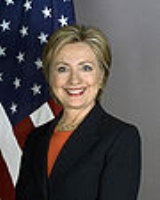
. The current Secretary of State is Hillary Rodham Clinton
, the 67th person, and third woman to hold the post.
The specific duties of the Secretary of State include:
The original duties of the Secretary of State include some domestic duties, such as:
Most of the domestic functions of the Department of State have been transferred to other agencies. Those that remain include storage and use of the Great Seal of the United States, performance of protocol
functions for the White House
, and the drafting of certain proclamations. The Secretary also negotiates with the individual States over the extradition of fugitives to foreign countries. President Nixon's resignation, a domestic issue, was also addressed to the Secretary of State.
As the highest-ranking member of the cabinet, the Secretary of State is the third-highest official of the executive branch of the Federal Government of the United States, after the President and Vice President and is fourth in line to succeed the Presidency
, coming after the Vice President
, the Speaker of the House of Representatives
, and the President pro tempore of the Senate
. Six Secretaries of State have gone on to be elected President.
As the head of the United States Foreign Service
, the Secretary of State is responsible for management of the diplomatic service of the United States. The foreign service employs about 12,000 people domestically and internationally, and supports 265 United States diplomatic missions around the world, including ambassadors to various nations.
Federal law provides that a presidential or vice-presidential resignation or refusal to accept office must be accomplished by written communication from the President to the office of the Secretary of State.
When there is a vacancy in the office of Secretary of State, the duties are exercised either by another member of the cabinet, or, in more recent times, by a high-ranking official of the State Department until the President appoints, and the United States Senate
confirms, a new Secretary.
United States Department of State
The United States Department of State , is the United States federal executive department responsible for international relations of the United States, equivalent to the foreign ministries of other countries...
, concerned with foreign affairs
Foreign Affairs
Foreign Affairs is an American magazine and website on international relations and U.S. foreign policy published since 1922 by the Council on Foreign Relations six times annually...
. The Secretary is a member of the Cabinet
United States Cabinet
The Cabinet of the United States is composed of the most senior appointed officers of the executive branch of the federal government of the United States, which are generally the heads of the federal executive departments...
and the highest-ranking cabinet secretary both in line of succession
United States presidential line of succession
The United States presidential line of succession defines who may become or act as President of the United States upon the incapacity, death, resignation, or removal from office of a sitting president or a president-elect.- Current order :This is a list of the current presidential line of...
and order of precedence
United States order of precedence
The United States order of precedence lists the ceremonial order for domestic and foreign government officials, military and civic leaders at diplomatic, ceremonial, and social events within the United States and abroad. Former Presidents, Vice Presidents, First Ladies, Secretaries of State and...
. The current Secretary of State is Hillary Rodham Clinton
Hillary Rodham Clinton
Hillary Diane Rodham Clinton is the 67th United States Secretary of State, serving in the administration of President Barack Obama. She was a United States Senator for New York from 2001 to 2009. As the wife of the 42nd President of the United States, Bill Clinton, she was the First Lady of the...
, the 67th person, and third woman to hold the post.
The specific duties of the Secretary of State include:
- Organizes and supervises the entire United States Department of StateUnited States Department of StateThe United States Department of State , is the United States federal executive department responsible for international relations of the United States, equivalent to the foreign ministries of other countries...
and the United States Foreign ServiceUnited States Foreign ServiceThe United States Foreign Service is a component of the United States federal government under the aegis of the United States Department of State. It consists of approximately 11,500 professionals carrying out the foreign policy of the United States and aiding U.S...
. - Advises the President on matters relating to U.S. foreign policy, including the appointment of diplomatic representatives to other nations, and on the acceptance or dismissal of representatives from other nations.
- Participates in high-level negotiations with other countries, either bilaterally or as part of an international conference or organization, or appoints representatives to do so. This includes the negotiation of international treaties and other agreements.
- Responsible for overall direction, coordination, and supervision of interdepartmental activities of the U.S. Government overseas.
- Providing information and services to U.S. citizens living or traveling abroad, including providing credentials in the form of passportPassportA passport is a document, issued by a national government, which certifies, for the purpose of international travel, the identity and nationality of its holder. The elements of identity are name, date of birth, sex, and place of birth....
s and visaVisa (document)A visa is a document showing that a person is authorized to enter the territory for which it was issued, subject to permission of an immigration official at the time of actual entry. The authorization may be a document, but more commonly it is a stamp endorsed in the applicant's passport...
s. - Supervises the United States immigration policyImmigration to the United StatesImmigration to the United States has been a major source of population growth and cultural change throughout much of the history of the United States. The economic, social, and political aspects of immigration have caused controversy regarding ethnicity, economic benefits, jobs for non-immigrants,...
abroad. - Communicates issues relating the United States foreign policy to Congress and to U.S. citizens.
The original duties of the Secretary of State include some domestic duties, such as:
- Receipt, publication, distribution, and preservation of the laws of the United States
- Preparation, sealing, and recording of the commissions of Presidential appointees
- Preparation and authentication of copies of records and authentication of copies under the Department's seal
- Custody of the Great Seal of the United StatesGreat Seal of the United StatesThe Great Seal of the United States is used to authenticate certain documents issued by the United States federal government. The phrase is used both for the physical seal itself , and more generally for the design impressed upon it...
- Custody of the records of the former Secretary of the Continental CongressContinental CongressThe Continental Congress was a convention of delegates called together from the Thirteen Colonies that became the governing body of the United States during the American Revolution....
, except for those of the Treasury and War Departments
Most of the domestic functions of the Department of State have been transferred to other agencies. Those that remain include storage and use of the Great Seal of the United States, performance of protocol
Protocol (diplomacy)
In international politics, protocol is the etiquette of diplomacy and affairs of state.A protocol is a rule which guides how an activity should be performed, especially in the field of diplomacy. In diplomatic services and governmental fields of endeavor protocols are often unwritten guidelines...
functions for the White House
White House
The White House is the official residence and principal workplace of the president of the United States. Located at 1600 Pennsylvania Avenue NW in Washington, D.C., the house was designed by Irish-born James Hoban, and built between 1792 and 1800 of white-painted Aquia sandstone in the Neoclassical...
, and the drafting of certain proclamations. The Secretary also negotiates with the individual States over the extradition of fugitives to foreign countries. President Nixon's resignation, a domestic issue, was also addressed to the Secretary of State.
As the highest-ranking member of the cabinet, the Secretary of State is the third-highest official of the executive branch of the Federal Government of the United States, after the President and Vice President and is fourth in line to succeed the Presidency
United States presidential line of succession
The United States presidential line of succession defines who may become or act as President of the United States upon the incapacity, death, resignation, or removal from office of a sitting president or a president-elect.- Current order :This is a list of the current presidential line of...
, coming after the Vice President
Vice President of the United States
The Vice President of the United States is the holder of a public office created by the United States Constitution. The Vice President, together with the President of the United States, is indirectly elected by the people, through the Electoral College, to a four-year term...
, the Speaker of the House of Representatives
Speaker of the United States House of Representatives
The Speaker of the United States House of Representatives, or Speaker of the House, is the presiding officer of the United States House of Representatives...
, and the President pro tempore of the Senate
President pro tempore of the United States Senate
The President pro tempore is the second-highest-ranking official of the United States Senate. The United States Constitution states that the Vice President of the United States is the President of the Senate and the highest-ranking official of the Senate despite not being a member of the body...
. Six Secretaries of State have gone on to be elected President.
As the head of the United States Foreign Service
United States Foreign Service
The United States Foreign Service is a component of the United States federal government under the aegis of the United States Department of State. It consists of approximately 11,500 professionals carrying out the foreign policy of the United States and aiding U.S...
, the Secretary of State is responsible for management of the diplomatic service of the United States. The foreign service employs about 12,000 people domestically and internationally, and supports 265 United States diplomatic missions around the world, including ambassadors to various nations.
Federal law provides that a presidential or vice-presidential resignation or refusal to accept office must be accomplished by written communication from the President to the office of the Secretary of State.
When there is a vacancy in the office of Secretary of State, the duties are exercised either by another member of the cabinet, or, in more recent times, by a high-ranking official of the State Department until the President appoints, and the United States Senate
United States Senate
The United States Senate is the upper house of the bicameral legislature of the United States, and together with the United States House of Representatives comprises the United States Congress. The composition and powers of the Senate are established in Article One of the U.S. Constitution. Each...
confirms, a new Secretary.