


Khedive

Encyclopedia
English language
English is a West Germanic language that arose in the Anglo-Saxon kingdoms of England and spread into what was to become south-east Scotland under the influence of the Anglian medieval kingdom of Northumbria...
word viceroy
Viceroy
A viceroy is a royal official who runs a country, colony, or province in the name of and as representative of the monarch. The term derives from the Latin prefix vice-, meaning "in the place of" and the French word roi, meaning king. A viceroy's province or larger territory is called a viceroyalty...
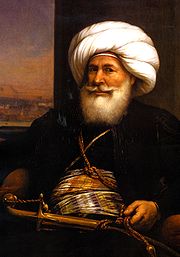
. It was first used, without official recognition, by Muhammad Ali Pasha
Muhammad Ali of Egypt
Muhammad Ali Pasha al-Mas'ud ibn Agha was a commander in the Ottoman army, who became Wāli, and self-declared Khedive of Egypt and Sudan...
, the Wāli
Wali
Walī , is an Arabic word meaning "custodian", "protector", "sponsor", or authority as denoted by its definition "crown". "Wali" is someone who has "Walayah" over somebody else. For example, in Fiqh the father is wali of his children. In Islam, the phrase ولي الله walīyu 'llāh...
(Governor) of Egypt
Egypt Eyalet
Egypt was conquered by the Ottoman Empire in 1517, following the Ottoman–Mamluk War and the loss of Syria to the Ottomans in 1516. Egypt was administrated as an eyalet of the Ottoman Empire from 1517 until 1867, with an interruption during the French occupation of 1798 to 1801.Egypt was always a...
and Sudan, and vassal of the Ottoman Empire
Ottoman Empire
The Ottoman EmpireIt was usually referred to as the "Ottoman Empire", the "Turkish Empire", the "Ottoman Caliphate" or more commonly "Turkey" by its contemporaries...
. The initially self-declared title was officially recognized by the Ottoman government in 1867, and used subsequently by Ismail Pasha
Isma'il Pasha
Isma'il Pasha , known as Ismail the Magnificent , was the Khedive of Egypt and Sudan from 1863 to 1879, when he was removed at the behest of the United Kingdom...
, and his dynastic successors until 1914.
Etymology
This title, known for its use by the Muhammad Ali DynastyMuhammad Ali Dynasty
The Muhammad Ali Dynasty was the ruling dynasty of Egypt and Sudan, from the 19th to the mid-20th Century. It is named after its progenitor, Muhammad Ali Pasha, regarded as the founder of modern Egypt. It was also more formally known as the Alawiyya Dynasty...
of Egypt and Sudan, is recorded in English since 1867, derived via the French khédive; based on the Turkish hıdiv which itself derived from the Persian khidiv (prince), a derivative of khoda "master, prince" from Old Persian khvadata- "lord," from the compound khvat-data-, literally "created from oneself," from khvat- (from the Proto-Indo-European
Indo-European
Indo-European may refer to:* Indo-European languages** Aryan race, a 19th century and early 20th century term for those peoples who are the native speakers of Indo-European languages...
root swe-tos "from oneself," ablative of base s(w)e-; see idiom) + data- "created."
Wāliyah/unrecognized Khedivate (1805–1867)
Following the French invasion of Egypt in 1798 and Napoleon's defeat of Egyptian forces, which consisted largely of the ruling MamlukMamluk
A Mamluk was a soldier of slave origin, who were predominantly Cumans/Kipchaks The "mamluk phenomenon", as David Ayalon dubbed the creation of the specific warrior...
military caste, the Ottoman Empire
Ottoman Empire
The Ottoman EmpireIt was usually referred to as the "Ottoman Empire", the "Turkish Empire", the "Ottoman Caliphate" or more commonly "Turkey" by its contemporaries...
dispatched troops from Rumelia
Rumelia
Rumelia was an historical region comprising the territories of the Ottoman Empire in Europe...
(the Balkan provinces of the Ottoman Empire) under the command of Muhammad Ali Pasha to restore the Empire's authority in what had hitherto been an Ottoman province. However, upon the French defeat and departure, Muhammad Ali seized control
Muhammad Ali's seizure of power
The process of Muhammad Ali's seizure of power in Egypt was a long three way civil war between the Ottoman Turks, Egyptian Mamluks, and Albanian mercenaries. It ended in victory for the Albanians led by Muhammad Ali of Egypt ....
of the country, and declared himself ruler of Egypt, quickly consolidating an independent local powerbase. After repeated failed attempts to remove and kill him, in 1805, the Porte officially recognized Muhammad Ali as Pasha
Pasha
Pasha or pascha, formerly bashaw, was a high rank in the Ottoman Empire political system, typically granted to governors, generals and dignitaries. As an honorary title, Pasha, in one of its various ranks, is equivalent to the British title of Lord, and was also one of the highest titles in...
and Wāli
Wali
Walī , is an Arabic word meaning "custodian", "protector", "sponsor", or authority as denoted by its definition "crown". "Wali" is someone who has "Walayah" over somebody else. For example, in Fiqh the father is wali of his children. In Islam, the phrase ولي الله walīyu 'llāh...
(Governor) of Egypt. However, demonstrating his grander ambitions, he claimed for himself the higher title of Khedive (Viceroy), as did his successors, Ibrahim Pasha
Ibrahim Pasha of Egypt
Ibrahim Pasha was the eldest son of Muhammad Ali, the Wāli and unrecognised Khedive of Egypt and Sudan. He served as a general in the Egyptian army that his father established during his reign, taking his first command of Egyptian forces was when he was merely a teenager...
, Abbas I
Abbas I of Egypt
Abbas I , , also known as Abbas Hilmi I Pasha Wāli of Egypt and Sudan, was a son of Tusun Pasha and grandson of Muhammad Ali, founder of the reigning dynasty of Egypt and Sudan at the time...
, and Sa'id I
Sa'id of Egypt
Muhammad Sa'id Pasha was the Wāli self-declared Khedive of Egypt and Sudan from 1854 until 1863, officially owing fealty to the Ottoman Sultan but in practice exercising virtual independence. He was the fourth son of Muhammad Ali Pasha. Sa'id was a Francophone, educated in Paris.Under Sa'id's rule...
.
Khedivate (1867–1914)

The Muhammad Ali Dynasty
Muhammad Ali Dynasty
The Muhammad Ali Dynasty was the ruling dynasty of Egypt and Sudan, from the 19th to the mid-20th Century. It is named after its progenitor, Muhammad Ali Pasha, regarded as the founder of modern Egypt. It was also more formally known as the Alawiyya Dynasty...
’s use of the title Khedive was not sanctioned by the Ottoman Empire until 1867 when Sultan Abdülaziz officially recognized it as the title of Ismail Pasha. Moreover, the Porte accepted Ismail's alteration of the royal line of succession to go from father to son, rather than brother to brother, as was the tradition in the Ottoman Empire, and Arab dynasties. In May 1879, the British Empire
British Empire
The British Empire comprised the dominions, colonies, protectorates, mandates and other territories ruled or administered by the United Kingdom. It originated with the overseas colonies and trading posts established by England in the late 16th and early 17th centuries. At its height, it was the...
, and France
France
The French Republic , The French Republic , The French Republic , (commonly known as France , is a unitary semi-presidential republic in Western Europe with several overseas territories and islands located on other continents and in the Indian, Pacific, and Atlantic oceans. Metropolitan France...
began pressuring the Ottoman
Ottoman Empire
The Ottoman EmpireIt was usually referred to as the "Ottoman Empire", the "Turkish Empire", the "Ottoman Caliphate" or more commonly "Turkey" by its contemporaries...
Sultan Abdülhamid II to depose Ismail Pasha, and this was done on June 26, 1879. The more pliable Tewfik Pasha
Tewfik Pasha
HH Muhammed Tewfik Pasha ' was Khedive of Egypt and Sudan between 1879 and 1892, and the sixth ruler from the Muhammad Ali Dynasty.-Early life:...
, Ismail's son, was made his successor as the new Khedive. Ismail Pasha left Egypt and initially went into exile to Naples
Naples
Naples is a city in Southern Italy, situated on the country's west coast by the Gulf of Naples. Lying between two notable volcanic regions, Mount Vesuvius and the Phlegraean Fields, it is the capital of the region of Campania and of the province of Naples...
, but was eventually permitted by Sultan Abdülhamid II to retire to his Palace of Emirgan on the Bosporus
Bosporus
The Bosphorus or Bosporus , also known as the Istanbul Strait , is a strait that forms part of the boundary between Europe and Asia. It is one of the Turkish Straits, along with the Dardanelles...
in Constantinople
Constantinople
Constantinople was the capital of the Roman, Eastern Roman, Byzantine, Latin, and Ottoman Empires. Throughout most of the Middle Ages, Constantinople was Europe's largest and wealthiest city.-Names:...
. There he remained, more or less a state prisoner, until his death. He was later buried in Cairo
Cairo
Cairo , is the capital of Egypt and the largest city in the Arab world and Africa, and the 16th largest metropolitan area in the world. Nicknamed "The City of a Thousand Minarets" for its preponderance of Islamic architecture, Cairo has long been a centre of the region's political and cultural life...
.
After the nationalist Urabi Revolt
Urabi Revolt
The Urabi Revolt or Orabi Revolt , also known as the Orabi Revolution, was an uprising in Egypt in 1879-82 against the Khedive and European influence in the country...
of 1882, Britain
United Kingdom
The United Kingdom of Great Britain and Northern IrelandIn the United Kingdom and Dependencies, other languages have been officially recognised as legitimate autochthonous languages under the European Charter for Regional or Minority Languages...
invaded Egypt in support of Tewfik Pasha, and would continue to occupy and dominate the country for decades. During this period, the Muhammad Ali Dynasty under Tewfik Pasha and his son Abbas Hilmi Pasha continued to rule Egypt and Sudan using the title Khedive, whilst still under nominal (de jure
De jure
De jure is an expression that means "concerning law", as contrasted with de facto, which means "concerning fact".De jure = 'Legally', De facto = 'In fact'....
) Ottoman sovereignty until 1914.
Sultanate (1914–1922)
With the outbreak of the First World War, Abbas Hilmi PashaAbbas II of Egypt
HH Abbas II Hilmi Bey was the last Khedive of Egypt and Sudan .-Early life:...
sided with the Ottoman Empire, which had joined the war on the side of the Central Powers
Central Powers
The Central Powers were one of the two warring factions in World War I , composed of the German Empire, the Austro-Hungarian Empire, the Ottoman Empire, and the Kingdom of Bulgaria...
, and was subsequently deposed by the British, who declared Egypt a protectorate
Protectorate
In history, the term protectorate has two different meanings. In its earliest inception, which has been adopted by modern international law, it is an autonomous territory that is protected diplomatically or militarily against third parties by a stronger state or entity...
, which means formally adding a territory to British sovereignty under a subordinate ruler, while he was on a visit to Vienna
Vienna
Vienna is the capital and largest city of the Republic of Austria and one of the nine states of Austria. Vienna is Austria's primary city, with a population of about 1.723 million , and is by far the largest city in Austria, as well as its cultural, economic, and political centre...
. His uncle Hussein Kamel was declared Sultan
Sultan
Sultan is a title with several historical meanings. Originally, it was an Arabic language abstract noun meaning "strength", "authority", "rulership", and "dictatorship", derived from the masdar سلطة , meaning "authority" or "power". Later, it came to be used as the title of certain rulers who...
of Egypt by the British, who declared severance of the nominal ties of Egypt and Sudan to the Ottoman Empire (at least arguably invalid under international law, which did/does not allow acquisition of title to territory unless the existing sovereign, i.e., the Ottoman Empire, cedes it), and brought an end to the use of the title of Khedive. Hussein Kamel and later Fuad I
Fuad I of Egypt
Fuad I was the Sultan and later King of Egypt and Sudan, Sovereign of Nubia, Kordofan, and Darfur. The ninth ruler of Egypt and Sudan from the Muhammad Ali Dynasty, he became Sultan of Egypt and Sudan in 1917, succeeding his elder brother Sultan Hussein Kamel...
issued a series of restrictive orders to strip Abbas Hilmi Pasha, their nephew, of property in Egypt and Sudan, and forbade contributions to him. These also barred Abbas Hilmi Pasha from entering Egyptian territory and stripped him of the right to sue in Egyptian courts. Abbas Hilmi Pasha finally accepted the new order of things and formally abdicated on May 12, 1931. He retired to Switzerland
Switzerland
Switzerland name of one of the Swiss cantons. ; ; ; or ), in its full name the Swiss Confederation , is a federal republic consisting of 26 cantons, with Bern as the seat of the federal authorities. The country is situated in Western Europe,Or Central Europe depending on the definition....
, where he died in Geneva
Geneva
Geneva In the national languages of Switzerland the city is known as Genf , Ginevra and Genevra is the second-most-populous city in Switzerland and is the most populous city of Romandie, the French-speaking part of Switzerland...
on December 19, 1944.
With "Article 17" of the Treaty of Lausanne
Treaty of Lausanne
The Treaty of Lausanne was a peace treaty signed in Lausanne, Switzerland on 24 July 1923, that settled the Anatolian and East Thracian parts of the partitioning of the Ottoman Empire. The treaty of Lausanne was ratified by the Greek government on 11 February 1924, by the Turkish government on 31...
in 1923, Turkey
Turkey
Turkey , known officially as the Republic of Turkey , is a Eurasian country located in Western Asia and in East Thrace in Southeastern Europe...
formally ceded--retroactive to 1914--all remaining claims and rights in Egypt
Egypt
Egypt , officially the Arab Republic of Egypt, Arabic: , is a country mainly in North Africa, with the Sinai Peninsula forming a land bridge in Southwest Asia. Egypt is thus a transcontinental country, and a major power in Africa, the Mediterranean Basin, the Middle East and the Muslim world...
and Sudan
Sudan
Sudan , officially the Republic of the Sudan , is a country in North Africa, sometimes considered part of the Middle East politically. It is bordered by Egypt to the north, the Red Sea to the northeast, Eritrea and Ethiopia to the east, South Sudan to the south, the Central African Republic to the...
.
See also
- Khedivate of EgyptKhedivate of EgyptThe Khedivate of Egypt was an autonomous tributary state of the Ottoman Empire.- Rise of Muhammad Ali :The Egypt Eyalet was an eyalet of the Ottoman Empire. The eyalet was ruled locally by the Mamluk military caste and their various beys , who started to fight amongst themselves for control of...
- Khedive PalaceKhedive PalaceThe Khedive Palace or Çubuklu Palace, Çubuklu Summer Palace, ; Hidiv Mansion; located on the Asian side of the Bosporus in Istanbul, Turkey, was a former residence of Khedive Abbas II of Egypt and Sudan...
- Muhammad Ali DynastyMuhammad Ali DynastyThe Muhammad Ali Dynasty was the ruling dynasty of Egypt and Sudan, from the 19th to the mid-20th Century. It is named after its progenitor, Muhammad Ali Pasha, regarded as the founder of modern Egypt. It was also more formally known as the Alawiyya Dynasty...
- List of monarchs of the Muhammad Ali Dynasty
- Egypt under Muhammad Ali and his successorsEgypt under Muhammad Ali and his successorsThe history of Egypt under the Muhammad Ali Pasha dynasty spanned the later period of Ottoman Egypt, the Khedivate of Egypt under British patronage, and the nominally independent Sultanate of Egypt and Kingdom of Egypt, ending with the Revolution of 1952 and the formation of the Republic of...