
All Topics  
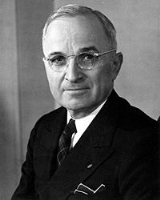
Harry S. Truman

 
Harry S. Truman

   Email Print
   Bookmark   Link


Harry S. Truman


Harry S. Truman (May 8, 1884 – December 26, 1972) was the 33rd
List of Presidents of the United States

File:WhiteHouseSouthFacade.JPGThe President of the United States is the head of state and the head of government of the United States. As chief of the executive branch and head of the Federal government of the United States as a whole, the presidency is the highest political office in the United States by influence and recognition....
 President of the United States
President of the United States

The President of the United States is the head of state and head of government of the United States and is the highest political official in the United States by influence and recognition....
 (1945–1953). As the 34th
List of Vice Presidents of the United States

This List of Vice Presidents of the United States from John Adams to Joe Biden. It includes the home state of each Vice President of the United States as well as when he took office, left office and the political party to which he belonged....
 vice president
Vice President of the United States

The Vice President of the United States is the holder of a public office in the United States of America created by the Constitution of the United States....
, he succeeded Franklin D. Roosevelt
Franklin D. Roosevelt

Franklin Delano Roosevelt , often referred to by his initials FDR, was the List of Presidents of the United States President of the United States....
, who died less than three months after he began his fourth term.

During World War I
World War I

World War I, or the First World War , was a global military conflict which involved the Great powers, organized into two opposing military alliances: the Allies of World War I and the Central Powers....
 Truman served as an artillery
United States Army Field Artillery Corps

The Field Artillery branch was founded on November 17, 1775 by the Continental Congress, which unanimously elected Henry Knox "Colonel of the Regiment of Artillery"....
 officer. After the war he became part of the political machine
Political machine

A political machine is a disciplined political organization in which an authoritative boss or small group commands the support of a corps of supporters , who receive rewards for their efforts....
 of Tom Pendergast
Tom Pendergast

Thomas Joseph Pendergast controlled Kansas City, Missouri and Jackson County, Missouri as a political boss. "Boss Tom" Pendergast gave workers jobs and helped elect politicians during the Great Depression, becoming wealthy in the process....
 and was elected a county commissioner in Missouri
Missouri

Missouri is a U.S. state in the Midwestern United States of the United States bordered by Iowa, Illinois, Kentucky, Tennessee, Arkansas, Oklahoma, Kansas and Nebraska....
 and eventually a United States Senator
United States Senate

The United States Senate is the upper house of the Bicameralism United States Congress, the lower house being the United States House of Representatives....
. After he gained national prominence as head of the wartime Truman Committee, Truman replaced vice president Henry A. Wallace
Henry A. Wallace

Henry Agard Wallace was the List of Vice Presidents of the United States Vice President of the United States , the 11th United States Secretary of Agriculture , and the tenth United States Secretary of Commerce ....
 as Roosevelt's running mate
Running mate

A running mate is a person running together with another person on a joint Ticket during an election. The term is most often used in reference to the person in the subordinate position but can also properly be used when referring to both candidates, such as "Michael Dukakis and Lloyd Bentsen were running mates in 1988"....
 in 1944.

Truman faced challenge after challenge in domestic affairs.


Discussion
Ask a question about 'Harry S. Truman'
Start a new discussion about 'Harry S. Truman'
Answer questions from other users
Full Discussion Forum


Recent Posts


Timeline

1884   Born

1945   United States President Franklin Delano Roosevelt (1933-1945) dies suddenly at Warm Springs, Georgia; Vice President Harry S. Truman (1945-1953) takes the Oath of Offi

1945   In Atlantic, ships can finally keep their lights lit. Leo Szilard begs Harry S. Truman not to use the bomb.

1945   World War II: Harry S. Truman informed that Japan will talk peace if she can keep the Emperor.

1945   World War II: Harry S. Truman approves order for atomic bombs to be used.

1945   Harry S. Truman, Clement Attlee, and Mackenzie King call for a UN Atomic Energy Commission.

1947   Cold War: In an effort to fight the spread of Communism, President Harry S. Truman signs an act implementing the Truman Doctrine. The act granted $400 million in military and economic aid to Turkey and Greece.

1947   The United States Senate follows the United States House of Representatives in overriding U.S. President Harry S. Truman's veto of the Taft-Hartley Act.

1947   President Harry S. Truman signs the Presidential Succession Act into law which places the Speaker of the House and the Senate President Pro Tempore next in the line of succession after the United States Vice President.

1947   Cold War: U.S. President Harry S. Truman signs the National Security Act into United States law creating the Central Intelligence Agency, Department of Defense, Joint Chiefs of Staff, and the National Security Council.


Quotations


I believe that it must be the policy of the United States to support free peoples who are resisting attempted subjugation by armed minorities or by outside pressures.

Excerpt from The Truman Doctrine (1947)

It isn't important who is ahead at one time or another in either an election or horse race. It's the horse that comes in first at the finish line that counts.

Reprinted in Wayne Slater, James Moore (2003). Bush's Brain: How Karl Rove Made George W. Bush Presidential. USA: Wiley, 173.

...but this is a great nation with a high purpose, and we shall come to our senses and resume our course.

This was the response of a letter written by Charles Kennedy about the problems during the Vietnam War. He wrote the note on March 18, 1970.


Encyclopedia


Harry S. Truman (May 8, 1884 – December 26, 1972) was the 33rd
List of Presidents of the United States

File:WhiteHouseSouthFacade.JPGThe President of the United States is the head of state and the head of government of the United States. As chief of the executive branch and head of the Federal government of the United States as a whole, the presidency is the highest political office in the United States by influence and recognition....
 President of the United States
President of the United States

The President of the United States is the head of state and head of government of the United States and is the highest political official in the United States by influence and recognition....
 (1945–1953). As the 34th
List of Vice Presidents of the United States

This List of Vice Presidents of the United States from John Adams to Joe Biden. It includes the home state of each Vice President of the United States as well as when he took office, left office and the political party to which he belonged....
 vice president
Vice President of the United States

The Vice President of the United States is the holder of a public office in the United States of America created by the Constitution of the United States....
, he succeeded Franklin D. Roosevelt
Franklin D. Roosevelt

Franklin Delano Roosevelt , often referred to by his initials FDR, was the List of Presidents of the United States President of the United States....
, who died less than three months after he began his fourth term.

During World War I
World War I

World War I, or the First World War , was a global military conflict which involved the Great powers, organized into two opposing military alliances: the Allies of World War I and the Central Powers....
 Truman served as an artillery
United States Army Field Artillery Corps

The Field Artillery branch was founded on November 17, 1775 by the Continental Congress, which unanimously elected Henry Knox "Colonel of the Regiment of Artillery"....
 officer. After the war he became part of the political machine
Political machine

A political machine is a disciplined political organization in which an authoritative boss or small group commands the support of a corps of supporters , who receive rewards for their efforts....
 of Tom Pendergast
Tom Pendergast

Thomas Joseph Pendergast controlled Kansas City, Missouri and Jackson County, Missouri as a political boss. "Boss Tom" Pendergast gave workers jobs and helped elect politicians during the Great Depression, becoming wealthy in the process....
 and was elected a county commissioner in Missouri
Missouri

Missouri is a U.S. state in the Midwestern United States of the United States bordered by Iowa, Illinois, Kentucky, Tennessee, Arkansas, Oklahoma, Kansas and Nebraska....
 and eventually a United States Senator
United States Senate

The United States Senate is the upper house of the Bicameralism United States Congress, the lower house being the United States House of Representatives....
. After he gained national prominence as head of the wartime Truman Committee, Truman replaced vice president Henry A. Wallace
Henry A. Wallace

Henry Agard Wallace was the List of Vice Presidents of the United States Vice President of the United States , the 11th United States Secretary of Agriculture , and the tenth United States Secretary of Commerce ....
 as Roosevelt's running mate
Running mate

A running mate is a person running together with another person on a joint Ticket during an election. The term is most often used in reference to the person in the subordinate position but can also properly be used when referring to both candidates, such as "Michael Dukakis and Lloyd Bentsen were running mates in 1988"....
 in 1944.

Truman faced challenge after challenge in domestic affairs. The disorderly reconversion of the economy of the United States
Economy of the United States

The economy of the United States is the List of countries by GDP in the world. Its gross domestic product was estimated as $14.2 trillion in 2008....
 was marked by severe shortages, numerous strikes, and the passage of the Taft-Hartley Act
Taft-Hartley Act

The Labor?Management Relations Act, informally the Taft?Hartley Act, is a Law of the United States greatly restricting the activities and power of trade unions....
 over his veto
Veto

A veto, Latin for "I forbid", is used to denote that a certain party has the right to stop unilaterally a piece of legislation. In practice, the veto can be absolute or limited ...
. He confounded all predictions to win re-election in 1948
United States presidential election, 1948

The United States presidential election of 1948 is considered by most historians as the greatest election upset in History of the United States....
, helped by his famous Whistle Stop Tour
Whistle stop train tour

A whistlestop or whistlestop tour is a style of political campaigning where the politician makes a series of brief appearances or speeches at a number of small towns over a short period of time....
 of rural America. After his re-election he was able to pass only one of the proposals in his Fair Deal
Fair Deal

In United States history, the Fair Deal was President of the United States Harry S. Truman's catchphrase for a series of social and economic reforms , outlined in his 1949 State of the Union Address to Congress on January 5, 1949....
 program. He used executive orders to begin desegregation
Desegregation

'Desegregation' is the process of ending racial segregation, most commonly used in reference to the United States. Desegregation was long a focus of the African-American Civil Rights Movement , both before and after the Supreme Court of the United States decision in Brown v....
 of the U.S. armed forces
Military of the United States

The United States Armed Forces are the overall unified armed forces of the United States. The United States military was first formed by the second Second Continental Congress to defend the new nation against the British Empire in the American Revolutionary War....
 and to launch a system of loyalty checks to remove thousands of communist
Communism

Communism is a socioeconomic structure and political ideology that promotes the establishment of an egalitarianism, classlessness, stateless society based on common ownership and control of the means of production and property in general....
 sympathizers from government office, even though he strongly opposed mandatory loyalty oath
Loyalty oath

A loyalty oath is an oath of loyalty to an organization, institution, or state of which an individual is a member.In this context, a loyalty oath is not a pledge or oath of allegiance....
s for governmental employees, a stance that led to charges that his administration was soft on communism. Truman's presidency was also eventful in foreign affairs, with the end of World War II
World War II

World War II, or the Second World War , was a global military conflict which involved a Participants in World War II, including all of the great powers, organised into two opposing military alliances: the Allies of World War II and the Axis powers....
 and his decision to use nuclear weapons against Japan, the founding of the United Nations
United Nations

The United Nations is an international organization whose stated aims are to facilitate cooperation in international law, international security, economic development, Social change, human rights and achieving world peace....
, the Marshall Plan
Marshall Plan

The Marshall Plan was the primary plan of the United States for rebuilding and creating a stronger foundation for the countries of Western Europe, and repelling communism after World War II....
 to rebuild Europe
Europe

Europe is, conventionally, one of the world's seven continents. Comprising the westernmost peninsula of Eurasia, Europe is generally divided from Asia to its east by the water divide of the Ural Mountains, the Ural , the Caspian Sea, and by the Caucasus Mountains to the southeast....
, the Truman Doctrine
Truman Doctrine

The Truman Doctrine is a set of principles of U.S. foreign policy declared by List of Presidents of the United States Harry S. Truman in a 1947 address to Congress to request $400 million in aid to Greece and Turkey, as well as authorization to send American economic and military advisers to the two countries....
 to contain communism, the beginning of the Cold War
Cold War

The Cold War was the continuing state of conflict, tension and competition that existed between a number of world powers, including the United States, the Soviet Union, People's Republic of China, France, United Kingdom and those countries' respective allies from the mid-1940s to the early 1990s....
, the creation of the North Atlantic Treaty Organization
NATO

The North Atlantic Treaty Organization , also called the Atlantic Alliance, is a military alliance established by the signing of the North Atlantic Treaty on 4 April 1949....
, and the Korean War
Korean War

The Korean War refers to a period of military conflict between North Korea and South Korea regimes, with major hostilities lasting from June 25, 1950 until the armistice signed on July 27, 1953....
. Corruption in Truman's administration reached the cabinet
United States Cabinet

The United States Cabinet is composed of the most senior appointed officers of the executive branch of the federal government of the United States, and its existence dates back to the first United States of America President of the United States, George Washington, who appointed a Cabinet of four people to advise and assist him in his dutie...
 and senior White House
White House

The White House is the official residence and principal workplace of the President of the United States. Located at 1600 Pennsylvania Avenue in Washington, D.C., it was built between 1792 and 1800 of white-painted Aquia sandstone in the late Georgian architecture and has been the executive residence of every U.S....
 staff. Republicans
Republican Party (United States)

The Republican Party is one of the two major party contemporary political parties in the United States, along with the Democratic Party . It is often called the Grand Old Party or the GOP....
 made corruption a central issue in the 1952 campaign
United States presidential election, 1952

The United States presidential election of 1952 took place in an era when Cold War tension between the United States and the Soviet Union was escalating rapidly....
.

Truman, whose demeanor was very different from that of the patrician Roosevelt, was a folksy, unassuming president. He popularized such phrases as "The buck stops here" and "If you can't stand the heat, you better get out of the kitchen." He overcame the low expectations of many political observers who compared him unfavorably with his highly regarded predecessor. At different points in his presidency, Truman earned both the highest and the lowest public approval ratings that had ever been recorded. Despite negative public opinion during his term in office, popular and scholarly assessments of his presidency became more positive after his retirement from politics and the publication of Truman's memoirs. Truman's legendary upset victory in 1948
United States presidential election, 1948

The United States presidential election of 1948 is considered by most historians as the greatest election upset in History of the United States....
 over Thomas E. Dewey is routinely invoked by underdog presidential candidates. Truman has been consistently ranked by scholars as one of the greatest U.S. Presidents
Historical rankings of United States Presidents

In political science, historical rankings of United States Presidents are surveys conducted in order to construct rankings of the success of individuals who have served as President of the United States....
.

Personal life


Truman was born on May 8, 1884 in Lamar
Lamar, Missouri

Lamar is a city in Barton County, Missouri, Missouri, United States. The population was 4,425 at the 2000 census. It is the county seat of Barton County, Missouri....
, Missouri
Missouri

Missouri is a U.S. state in the Midwestern United States of the United States bordered by Iowa, Illinois, Kentucky, Tennessee, Arkansas, Oklahoma, Kansas and Nebraska....
, the oldest child of John Anderson Truman (1851-1914) and Martha Ellen Young Truman (1852-1947). His parents chose the name Harry after his mother's brother, Harrison Young (1846-1916), Harry's uncle. His parents chose "S" as his middle name, in attempt to please both of Harry's grandfathers, Anderson Shippe Truman and Solomon Young; the initial did not actually stand for anything, as was a common practice among Scots-Irish. A brother, John Vivian (1886–1965), soon followed, along with sister Mary Jane Truman (1889–1978).

John Truman was a farmer and livestock dealer. The family lived in Lamar until Harry was ten months old. They then moved to a farm near Harrisonville
Harrisonville, Missouri

Harrisonville is a city in Cass County, Missouri, Missouri, United States. The population was 8,946 at the 2000 census. It is the county seat of Cass County, Missouri....
, then to Belton
Belton, Missouri

Belton is a city in Cass County, Missouri, near Kansas City, Missouri. As of the 2000 census, the city had a population of 21,730....
, and in 1887 to his grandparents' 600 acre (240 ha) farm in Grandview
Grandview, Missouri

Grandview is a city in Jackson County, Missouri, Missouri, United States. The population was 24,881 at the 2000 census....
. When Truman was six, his parents moved the family to Independence
Independence, Missouri

Independence is a city in Clay County, Missouri and Jackson County, Missouri counties in the U.S. state of Missouri, and the fourth largest city in the state....
, so he could attend the Presbyterian Church Sunday School. Truman did not attend a traditional school until he was eight.

As a young boy, Truman had three main interests: music, reading, and history, all encouraged by his mother. He was very close to his mother for as long as she lived, and as president solicited political as well as personal advice from her. He got up at five every morning to practice the piano
Piano

The piano is a musical instrument played by means of a keyboard instrument. Widely used in Western music for solo performance, ensemble use, chamber music, and accompaniment, the piano is also very popular as an aid to musical composition and rehearsal....
, and went to a local music teacher twice a week until he was fifteen. Truman also read a great deal of popular history. He was a page at the 1900 Democratic National Convention
1900 Democratic National Convention

The 1900 Democratic National Convention was a U.S. presidential nominating convention that took place the week of July 4, 1900 at Convention Hall in Kansas City, Missouri, Missouri....
 at Convention Hall
Convention Hall

Convention Hall was a convention center in Kansas City, Missouri that hosted the 1900 Democratic National Convention and 1928 Republican National Convention....
 in Kansas City
Kansas City, Missouri

Kansas City is the largest city in the U.S. state of Missouri. It encompasses in parts of Jackson County, Missouri, Clay County, Missouri, Cass County, Missouri, and Platte County, Missouri counties....
.

After graduating from Independence High School (now William Chrisman High School
William Chrisman High School

William Chrisman High School is a High School located in Independence, Missouri as part of the Independence Public School District. The school was founded in 1888 and was originally known as Independence High School....
) in 1901, Truman worked as a timekeeper on the Santa Fe Railroad
Atchison, Topeka and Santa Fe Railway

The Atchison, Topeka and Santa Fe Railway , often abbreviated as Santa Fe, was one of the larger List of United States railroads. The company was first chartered in February 1859....
, sleeping in "hobo
Hobo

Hobo is a term that refers to migrants, particularly those who make a habit of freighthopping. The iconic image of a hobo is that of an itinerant beggar, one that was solidified in American culture during the Great Depression....
 camps" near the rail lines; he then worked at a series of clerical jobs. He returned to the Grandview farm in 1906 and stayed there until 1917 when he went into military service.

The physically demanding work he put in on the Grandview farm was a formative experience. During this period he courted Bess Wallace
Bess Truman

Elizabeth Virginia Wallace Truman , widely known as Bess Truman, was the wife of Harry S. Truman and First Lady of the United States from 1945 to 1953....
 and even proposed to her in 1911. She turned him down, and Truman said he wanted to make more money than a farmer before he proposed again. He did propose again in 1918, after coming back as a Captain from World War I, and she accepted.

Truman was the only president who served after 1897 not to earn a college degree: poor eyesight prevented him from applying to West Point
United States Military Academy

The United States Military Academy at West Point is a four-year coeducational United States Service academies located at West Point, New York, New York....
 (his childhood dream) and financial constraints prevented him from securing a degree elsewhere. He did, however, study for two years toward a law degree at the Kansas City Law School (now the University of Missouri-Kansas City School of Law) in the early 1920s. Later in his life, at age 60, Truman was issued an invitation to become a member of Missouri-Kansas City's Lambda Chi Alpha
Lambda Chi Alpha

For a list of prominent members of Lambda Chi Alpha fraternity, see: List of notable members of Lambda Chi AlphaLambda Chi Alpha , headquartered in Indianapolis, Indiana, is a member of the North-American Interfraternity Conference and one of the largest men's general Fraternities and sororities in North America, by its own count...
 fraternity, which he accepted.

World War I

Truman enlisted in the Missouri Army National Guard
United States National Guard

The National Guard of the United States is a Military reserve force composed of U.S. state National Guard militia members or units under federally recognized active or inactive Military of the United States service for the United States ....
 in 1905, and served in it until 1911. With the onset of American participation in World War I, he rejoined the Guard. At his physical in 1905, his eyesight had been an unacceptable 20/50
Visual acuity

Visual acuity is acuteness or clearness of visual perception, especially form vision, which is dependent on the sharpness of the retinal focus within the eye and the sensitivity of the interpretative faculty of the brain....
 in the right eye and 20/40 in the left. Reportedly, he passed by secretly memorizing the eye chart.

Before going to France, he was sent to Camp Doniphan
Camp Doniphan, Oklahoma

Camp Doniphan was a military base adjacent to Fort Sill, just outside of Lawton, Oklahoma, in Comanche County, Oklahoma, Oklahoma, that was activated for use in World War I for artillery training....
, adjacent to Fort Sill
Fort Sill

Fort Sill is a United States Army post near Lawton, Oklahoma, Oklahoma, about 85 miles southwest of Oklahoma City.Today, Fort Sill remains the only active Army installation of all the forts on the South Plains built during the Indian Wars....
, near Lawton, Oklahoma
Lawton, Oklahoma

Lawton is a city in and the county seat of Comanche County, Oklahoma, Oklahoma, United States. It is the principal city of the Lawton, Oklahoma Metropolitan Statistical Area....
 for training. He ran the camp canteen with Edward Jacobson
Edward Jacobson

Edward Jacobson was an history of Jews in the United Statesish businessman. He was also a U.S. Army associate, business partner, and close friend of President Harry S....
, who had experience in a Kansas City clothing store as a clerk. At Ft. Sill he also met Lieutenant James M. Pendergast, the nephew of Thomas Joseph (T.J.) Pendergast
Tom Pendergast

Thomas Joseph Pendergast controlled Kansas City, Missouri and Jackson County, Missouri as a political boss. "Boss Tom" Pendergast gave workers jobs and helped elect politicians during the Great Depression, becoming wealthy in the process....
, a Kansas City politician. Both men would have profound influences on later events in Truman's life.

Truman was chosen to be an officer, and then battery
Artillery battery

In military organizations, an artillery battery is a unit of guns, mortar s, or rockets, so grouped in order to facilitate better battlefield communication and command and control, as well as to provide dispersion for its constituent gunnery crews and their systems....
 commander in an artillery regiment in France. His unit was Battery D, 129th Field Artillery, 60th Brigade, 35th Infantry Division, known for its discipline problems. During a sudden attack by the Germans
German Empire

The German Empire is the name commonly used in English to describe Germany from the unification of Germany and proclamation of William I, German Emperor as German Emperor on 18 January 1871, to 1918, when it became Weimar republic after defeat in World War I and the abdication of William II, German Emperor ....
 in the Vosges Mountains
Vosges mountains

For the department of France of the same name, see Vosges.The Vosges are a range of low mountains in eastern France, near its border with Germany....
, the battery started to disperse; Truman ordered them back into position using profanities that he had "learned while working on the Santa Fe railroad." Shocked by the outburst, his men reassembled and followed him to safety. Under Captain Truman's command in France, the battery did not lose a single man. On November 11, 1918 his artillery unit fired some of the last shots of World War I
World War I

World War I, or the First World War , was a global military conflict which involved the Great powers, organized into two opposing military alliances: the Allies of World War I and the Central Powers....
 into German positions. The war was a transformative experience that brought out Truman's leadership qualities; he later rose to the rank of Colonel in the Army Reserves , and his war record made possible his later political career in Missouri.

Early business career

Trumanwedding
At the war's conclusion, Truman returned to Independence and married his longtime love interest, Bess Wallace
Bess Truman

Elizabeth Virginia Wallace Truman , widely known as Bess Truman, was the wife of Harry S. Truman and First Lady of the United States from 1945 to 1953....
, on June 28, 1919. The couple had one child, Mary Margaret (February 17, 1924 - January 29, 2008).

A month before the wedding, banking on their success at Fort Sill and overseas, Truman and Jacobson opened a haberdashery of the same name at 104 West 12th Street in downtown Kansas City. After a few successful years, the store went bankrupt during the recession of 1921
Post-WWI recession

The post-World War I recession was an economic recession that hit much of the world after World War I.The decade before the war had seen some of the fastest economic growth in history....
, which greatly affected the farm economy. Truman blamed the fall in farm prices on the policies of the Republicans; he worked to pay off the debts until 1934, just as he was going into the U.S. Senate, when banker William T. Kemper retrieved the note during the sale of a bankrupt bank and allowed Truman to pay it off for $1,000. (At the same time Kemper made a $1,000 contribution to Truman's campaign.)

Former comrades in arms and former business partners, Jacobson and Truman remained close friends for life. Decades later, Jacobson's advice to Truman on Zionism
Zionism

Zionism is the international Jewish political movement that originally supported the reestablishment of a homeland for the Jewish People in Palestine....
 would play a critical role in the US government's decision to recognize Israel
Israel

Israel officially the State of Israel , is a country in the Middle East located on the eastern shore of the Mediterranean Sea. It borders Lebanon in the north, Syria in the northeast, Jordan in the east, and Egypt on the southwest, and contains geographically diverse features within its relatively small area....
.

Politics


Jackson County judge

In 1922, with the help of the Kansas City Democratic
Democratic Party (United States)

The Democratic Party is one of two major party contemporary political parties in the United States, along with the Republican Party . It is the oldest political party in continuous operation in the United States and it is one of the oldest parties in the world....
 machine
Political machine

A political machine is a disciplined political organization in which an authoritative boss or small group commands the support of a corps of supporters , who receive rewards for their efforts....
 led by boss
Political boss

A boss, in political science, is a person who wields de facto power over a particular political region or constituency. Bosses may dictate voting patterns, control appointments, and wield considerable influence in other political processes....
 Tom Pendergast
Tom Pendergast

Thomas Joseph Pendergast controlled Kansas City, Missouri and Jackson County, Missouri as a political boss. "Boss Tom" Pendergast gave workers jobs and helped elect politicians during the Great Depression, becoming wealthy in the process....
, Truman was elected as a judge of the County Court of the eastern district of Jackson County
Jackson County, Missouri

Jackson County is a county located in the U.S. state of Missouri. As of 2000, the population was 654,880. The 2005 Census estimates put the population of Jackson County at 662,959....
—an administrative, not judicial, position similar to county commissioners elsewhere.

In 1922, Truman gave a friend $10 for an initiation fee for the Ku Klux Klan
Ku Klux Klan

Ku Klux Klan is the name of several past and present secret domestic militant organizations in the United States, originating in the southern states and eventually having national scope, that are best known for advocating white supremacy and acting as terrorists while hidden behind conical hats, masks and white robes....
 but later asked to get his money back; he was never initiated, never attended a meeting, and never claimed membership. Though Truman at times expressed anger towards Jews in his diaries, his business partner and close friend Edward Jacobson
Edward Jacobson

Edward Jacobson was an history of Jews in the United Statesish businessman. He was also a U.S. Army associate, business partner, and close friend of President Harry S....
 was Jewish. Truman's attitudes toward blacks
Black people

Black people is a term usually referring to a Race of humans with a dark skin color, but the term has also been used to categorise a number of diverse populations into one common group....
 were typical of white Missourians of his era, and were expressed in his casual use of terms like "nigger
Nigger

Nigger is a noun in the English language, most notable as a pejorative term and common ethnic slur for black people, and also as an informal slang term, among other contexts....
". Years later, another measure of his racial attitudes would come to the forefront: tales of the abuse, violence, and persecution suffered by many African American veterans upon their return from World War II
World War II

World War II, or the Second World War , was a global military conflict which involved a Participants in World War II, including all of the great powers, organised into two opposing military alliances: the Allies of World War II and the Axis powers....
 infuriated Truman, and were a major factor in his decision to issue Executive Order 9981
Executive Order 9981

Executive Order 9981 is an Executive order issued on July 26, 1948 by President of the United States Harry S. Truman. It expanded on Executive Order 8802 by establishing equality of treatment and opportunity in the Military of the United States for people of all Race , religions, or national origins....
, in July 1948, to back civil rights initiatives
American Civil Rights Movement (1896-1954)

The Civil Rights Movement in the United States has been a long, primarily nonviolent struggle to bring full civil rights and equality under the law to all Americans....
 and desegregate the armed forces.

He was not reelected in 1924, but in 1926 was elected the presiding judge for the court, and was reelected in 1930.

In 1930 Truman coordinated the "Ten Year Plan", which transformed Jackson County and the Kansas City skyline with new public works projects, including an extensive series of roads, construction of a new Wight and Wight
Wight and Wight

Wight and Wight was an architecture firm in Kansas City, Missouri consisting of the brothers Thomas Wight and William Wight who designed several landmark buildings in Missouri and Kansas....
-designed County Court building, and the dedication of a series of 12 Madonna of the Trail
Madonna of the Trail

Sorry, no overview for this topic
 monuments honoring pioneer women. Much of the building was done with Pendergast Ready Mixed concrete.

In 1933 Truman was named Missouri's director for the Federal Re-Employment program (part of the Civil Works Administration
Civil Works Administration

The Civil Works Administration was established by the New Deal during the Great Depression to create jobs for millions of unemployed. The jobs were merely temporary, for the duration of the hard winter....
) at the request of Postmaster General James Farley
James Farley

James Aloysius "Jim" Farley was an United States politician, business executive, and dignitary who served as head of the Democratic National Committee and as United States Postmaster General....
 as payback to Pendergast for delivering the Kansas City vote to Franklin D. Roosevelt in the 1932 presidential election
United States presidential election, 1932

The United States presidential election of 1932 took place as the effects of the 1929 Stock Market Crash and the Great Depression were being felt intensely across the country....
. The appointment confirmed Pendergast's control over federal patronage
Patronage

Patronage is the support, encouragement, privilege and often financial aid that an organization or individual bestows to another. In the history of art, arts patronage refers to the support that kings or popes have provided to musicians, painters, and sculptors....
 jobs in Missouri and marked the zenith of his power. It was also to create a relationship between Truman and Harry Hopkins
Harry Hopkins

Harry Lloyd Hopkins was one of Franklin Delano Roosevelt's closest advisers. He was one of the architects of the New Deal, especially the relief programs of the Works Progress Administration , which he directed and built into the largest employer in the country....
 and assure avid Truman support for the New Deal.

U.S. Senator


First term
Senator Harry Truman
After serving as judge, Truman wanted to run for Governor or Congress, but Pendergast rejected these ideas. In 1934, Pendergast's aides suggested Harry Truman as a candidate for Senator; after three other men turned him down, Pendergast reluctantly backed Truman as the candidate for the 1934 U.S. Senate election for Missouri. During the Democratic primary
Primary election

A primary election , also referred to simply as a primary, is an election in which voters in a jurisdiction select candidates for a subsequent election....
, Truman defeated John J. Cochran
John J. Cochran

John Joseph Cochran was a United States House of Representatives from Missouri.Cochran was born in Webster Groves, Missouri, and he attended the public schools there....
 and Tuck Milligan, the brother of federal prosecutor Maurice M. Milligan
Maurice M. Milligan

Maurice Morton Milligan , a U.S. Attorney for the Western District of Missouri, is most famous for the successful 1939 prosecution of Kansas City, Missouri boss Tom Pendergast....
. Truman then defeated the incumbent Republican, Roscoe C. Patterson
Roscoe C. Patterson

Roscoe Conkling Patterson was a United States Representative and United States Senate from Missouri. Born in Springfield, Missouri, he attended public and private schools, Drury College, and the University of Missouri?Columbia at Columbia, Missouri....
, by nearly 20 percent.

On election day, four people were killed at the polls, prompting various investigations into Kansas City election practices. Truman assumed office under a cloud as "the senator from Pendergast." He gave patronage decisions to Pendergast but always maintained he voted his conscience. Truman always defended the patronage by saying that by offering a little, he saved a lot.

In his first term as a U.S. Senator, Truman spoke out bluntly against corporate greed, and warned about the dangers of Wall Street
Wall Street

Wall Street is a street in lower Manhattan, New York City, New York, United States. It runs east from Broadway to South Street on the East River, through the historical center of the Financial District, Manhattan....
 speculators and other moneyed special interests attaining too much influence in national affairs. He was, however, largely ignored by President Roosevelt, who appeared not to have taken him seriously at this stage. Truman reportedly had difficulty getting White House secretaries to return his calls.

The 1936 election of Pendergast-backed Governor Lloyd C. Stark
Lloyd C. Stark

Lloyd Crow Stark was a List of Governors of Missouri of the U.S. state of Missouri. He was a United States Democratic Party.Stark was born near Louisiana, Missouri....
 revealed even bigger voter irregularities in Missouri than had been uncovered in 1934. Milligan prosecuted 278 defendants in vote fraud cases; he convicted 259. Stark turned on Pendergast, urged prosecution, and was able to wrest federal patronage from the Pendergast machine.

Ultimately Milligan discovered that Pendergast had not paid federal taxes between 1927 and 1937 and had conducted a fraudulent insurance scam. In 1939, Pendergast pled guilty and received a $10,000 fine and a 15-month sentence at Leavenworth Federal Prison. No charges were filed against Truman.

1940 election
Truman's prospects for re-election to the Senate looked bleak. In 1940, both Stark and Maurice Milligan challenged him in the Democratic primary for the Senate. Robert E. Hannegan
Robert E. Hannegan

Robert Emmet Hannegan was a St. Louis, Missouri politician who served as Commissioner of Internal Revenue from October 1943 to January 1944. He also served as chairman of the Democratic National Committee from 1944 to 1947 and United States Postmaster General from 1945 to 1947....
, who controlled St. Louis
St. Louis, Missouri

St. Louis is an independent city in the U.S. state of Missouri, located near the confluence of the Mississippi River and the Missouri River. St....
 Democratic politics, threw his support in the election behind Truman. (Hannegan would go on to broker the 1944 deal that put Truman on the vice presidential ticket for Roosevelt.) Truman campaigned tirelessly and combatively. In the end, Stark and Milligan split the anti-Pendergast vote in the Democratic primary, with Stark and Milligan having more combined votes than Truman.

In September 1940, during the general election campaign, Truman was elected Grand Master
Grand Master (Masonic)

In Freemasonry the Grand Master is the supreme ruler of the Craft within a given jurisdiction. He presides over his Grand Lodge and has certain rights in each private Masonic lodge within his jurisdiction....
 of the Missouri Grand Lodge
Grand Lodge

A Grand Lodge, or "Grand Orient", is the usual governing body of "Craft", or "Blue Lodge", Freemasonry in a particular Regular Masonic jurisdictions....
 of Freemasonry
Freemasonry

Freemasonry is a fraternal and service organizations that arose from obscure origins in the late 16th to early 17th century. Freemasonry now exists in various forms all over the world, with a membership estimated at around 5 million ....
. In November of that year, he defeated Kansas City State Senator Manvel H. Davis
Manvel H. Davis

Manvel Humphrey Davis was a member of the Missouri House of Representatives and Missouri State Senate. Davis, a Republican, challenged Harry S....
 by over 40,000 votes and retained his Senate seat. Truman said later that the Masonic election assured his victory in the general election over State Senator Davis.

The successful 1940 Senate campaign is regarded by many biographers as a personal triumph and vindication for Truman and as a precursor to the much more celebrated 1948 drive for the White House, another contest where he was underestimated. It was the turning point of his political career.

Defense policy statements
On June 23, 1941, the day after Nazi Germany
Nazi Germany

Nazi Germany and the Third Reich are the colloquial English names for Germany under the regime of Adolf Hitler and the Nazi Party , which established a Totalitarianism dictatorship that existed from 1933 to 1945....
 attacked
Operation Barbarossa

Operation Barbarossa was the code name for Nazi Germany's invasion of the Soviet Union during World War II that commenced on 22 June 1941. Over 4.5 million troops of the Axis powers invaded the USSR along a 2,900 kilometer front ....
 the Soviet Union
Soviet Union

The Union of Soviet Socialist Republics was a Constitution of the Soviet Union socialist state that existed in Eurasia from 1922 to 1991.The name is a translation of the , romanization of Russian Soyuz Sovetskikh Sotsialisticheskikh Respublik, abbreviated ????, SSSR....
, Senator Truman declared: "If we see that Germany is winning we ought to help Russia and if Russia is winning we ought to help Germany, and that way let them kill as many as possible, although I don't want to see Hitler victorious under any circumstances. Neither of them thinks anything of their pledged word." Although the sentiment was in line with what many Americans felt at the time, it was regarded by later biographers as both inappropriate and cynical. The remark was the first in a long series of prominently inopportune off-the-cuff statements by Truman to members of the national press corps.

Truman Committee
Truman gained fame and respect when his preparedness committee (popularly known as the "Truman Committee") investigated the scandal of military wastefulness by exposing fraud and mismanagement. The Roosevelt administration had initially feared the Committee would hurt war morale, and Undersecretary of War
United States Department of War

The United States Department of War, sometimes also called the War Office, was the department of the United States Federal government of the United States's Federal government of the United States#Executive branch responsible for the operation and maintenance of land Military of the United States from 1789 until September 18, 1947,...
 Robert P. Patterson
Robert P. Patterson

Robert Porter Patterson was the United States Under Secretary of War under President Franklin Roosevelt and the United States Secretary of War under President of the United States Harry S....
 wrote to the president declaring it was "in the public interest" to suspend the committee. Truman wrote a letter to the president saying that the committee was "100 percent behind the administration" and that it had no intention of criticizing the military conduct of the war. The committee was considered a success and is reported to have saved at least $15 billion. Truman's advocacy of common-sense cost-saving measures for the military attracted much attention. In 1943, his work as chairman earned Truman his first appearance on the cover of Time
Time (magazine)

Time is a weekly United States newsmagazine, similar to Newsweek and U.S. News & World Report. A European edition is published from London....
. He would eventually appear on nine Time covers and be named the magazine's Man of the Year
Person of the Year

Person of the Year is an annual issue of the United States newsmagazine Time that features and profiles a man, woman, couple, group, idea, place, or machine that "for better or for worse, ...has done the most to influence the events of the year."...
 for 1945 and 1948. After years as a marginal figure in the Senate, Truman was cast into the national spotlight after the success of the Truman Committee.

Vice Presidency

Following months of uncertainty over the president's preference for a running mate, Truman was selected as Franklin Roosevelt's vice presidential candidate in 1944
United States presidential election, 1944

The United States presidential election of 1944 took place while the United States was preoccupied with fighting World War II. President Franklin D....
 as the result of a deal worked out by Hannegan, who was Democratic National Chairman that year.

Although his public image remained that of a robust, engaged world leader, Roosevelt's physical condition was in fact rapidly deteriorating in mid-1944. A handful of key FDR advisers, including outgoing Democratic National Committee Chairman Frank C. Walker, incoming Chairman Robert Hannegan, party treasurer Edwin W. Pauley
Edwin W. Pauley

Edwin Wendell Pauley Sr. was an United States oilman and political appointee....
, strategist Ed Flynn, and lobbyist George E. Allen closed ranks in the summer of 1944 to "keep Henry Wallace
Henry A. Wallace

Henry Agard Wallace was the List of Vice Presidents of the United States Vice President of the United States , the 11th United States Secretary of Agriculture , and the tenth United States Secretary of Commerce ....
 off the ticket." They considered Wallace, the incumbent vice president, too liberal, and had grave concerns about the possibility of his ascension to the presidency. Allen would later recall that each of these men "realized that the man nominated to run with Roosevelt would in all probability be the next President. . ."

After meeting personally with the party leaders, FDR agreed to replace Wallace as vice president; however, Roosevelt chose to leave the final selection of a running mate unresolved until the later stages of the Democratic National Convention in Chicago
Chicago

Chicago is the largest city in the U.S. state of Illinois and the Midwestern United States, as well as the List of United States cities by population city in the United States with more than 2.8 million residents....
. James F. Byrnes
James F. Byrnes

James Francis Byrnes was an United States statesman from the state of South Carolina. During his career, Byrnes served as a member of the United States House of Representatives , as a United States Senate , as Justice of the Supreme Court of the United States , as United States Secretary of State , and as Governor of South Carolina ....
 of South Carolina
South Carolina

South Carolina is a U.S. state in the Southern United States of the United States. It borders Georgia to the south and North Carolina to the north....
 was initially favored, but labor leaders opposed him. Roosevelt also opposed Byrnes, but was reluctant to disappoint any candidate and did not want to tell Byrnes of his opposition directly; thus the president told Hannegan to "clear it [Byrnes' nomination] with Sidney", meaning labor leader and Byrnes opponent Sidney Hillman
Sidney Hillman

Sidney Hillman was an United States labor leader. Head of the Amalgamated Clothing Workers of America, he was a key figure in the founding of the Congress of Industrial Organizations and in marshaling labor's support for Franklin Delano Roosevelt and the United States Democratic Party....
, a few days before the convention. In addition, Byrnes' status as a segregationist
Racial segregation

File:Segregated cinema entrance3.jpgRacial segregation is the separation of different Race s in daily life, such as eating in a restaurant, drinking from a drinking fountain, using a rest room, attending school, going to the movies, or in the rental or purchase of a home....
 gave him problems with Northern liberals, and he was also considered vulnerable because of his conversion from Catholicism
Roman Catholic Church

The Roman Catholic Church, officially known as the Catholic Church is the world's largest Christianity Ecclesia , representing over half of all Christians and one-sixth of the world population....
. Reportedly, Roosevelt offered the position to Governor Henry F. Schricker
Henry F. Schricker

Henry Frederick Schricker was Democratic Party Governor#United States of the United States state of Indiana from 1941 to 1945 and from 1949 to 1953....
 of Indiana
Indiana

The State of Indiana was the 19th U.S. state admitted into the union. It is located in the Midwestern United States of the United States of America....
, but he declined. Before the convention began, Roosevelt wrote a note saying he would accept either Truman or Supreme Court
Supreme Court of the United States

The Supreme Court of the United States is the highest judicial body in the United States, and leads the federal United States federal courts. It consists of the Chief Justice of the United States and eight Associate Justice of the Supreme Court of the United States, who are nominated by the President of the United States and confirmed with th...
 Justice William O. Douglas
William O. Douglas

William Orville Douglas was a United States Supreme Court Associate Justice. With a term lasting 36 years and 209 days, he is the longest-serving justice in the history of the Supreme Court....
; state and city party leaders preferred Truman. Truman himself did not campaign directly or indirectly that summer for the number two spot on the ticket, and always maintained that he had not wanted the job of vice president. As a result, Roosevelt had to put a great deal of pressure on Truman to accept the vice presidency. On July 19, the party bosses summoned Truman to a suite in the Blackstone Hotel
Blackstone Hotel

The Blackstone Hotel is located on the corner of Michigan Avenue and Balbo Street in the Historic Michigan Boulevard District in the Chicago Loop Community areas of Chicago of ....
 to listen in on a phone call that, unknown to the Senator, they had rehearsed in advance with the President. During the conversation, FDR asked the party bosses whether Truman would accept the position. When they said no, FDR angrily accused Truman of disrupting the unity of the Democratic party then hung up. Feeling as if he had no choice, Truman reluctantly agreed to become Roosevelt's running mate.

Truman's candidacy was humorously dubbed the second "Missouri Compromise
Missouri Compromise

The Missouri Compromise was an agreement passed in 1820 between the slave state and free state factions in the United States Congress, involving primarily the regulation of slavery in the Historic regions of the United States....
" at the 1944 Democratic National Convention
1944 Democratic National Convention

The 1944 Democratic National Convention was held at the Chicago Stadium in Chicago, Illinois from July 19 - July 21, 1944. The convention resulted in the re-nomination of U.S....
 in Chicago, as his appeal to the party center contrasted with the liberal Wallace and the conservative Byrnes. The nomination was well received, and the Roosevelt-Truman team went on to score a 432–99 electoral-vote
United States Electoral College

The Electoral College consists of the popularly elected representatives who formally elect the President of the United States and Vice President of the United States....
 victory in the 1944 presidential election
United States presidential election, 1944

The United States presidential election of 1944 took place while the United States was preoccupied with fighting World War II. President Franklin D....
, defeating Governor Thomas E. Dewey of New York
New York

The State of New York is a U.S. state in the Mid-Atlantic States and Northeastern United States regions of the United States and is the nation's List of U.S....
 and Governor John Bricker of Ohio
Ohio

Ohio is a Midwestern United States U.S. state of the United States. As part of the Great Lakes region , Ohio has long been a cultural and geographical crossroads in North America....
. Truman was sworn in as vice president on January 20, 1945, and served less than three months.

Truman's brief vice-presidency was relatively uneventful, and Roosevelt rarely contacted him, even to inform him of major decisions. Truman shocked many when he attended his disgraced patron Pendergast's funeral a few days after being sworn in. Truman was reportedly the only elected official who attended the funeral. Truman brushed aside the criticism, saying simply, "He was always my friend and I have always been his."

On April 12, 1945, Truman was urgently called to the White House, where Eleanor Roosevelt
Eleanor Roosevelt

Anna Eleanor Roosevelt was First Lady of the United States from 1933 to 1945. She supported the New Deal policies of her husband, President Franklin D....
 informed him that the president had died after suffering a massive cerebral hemorrhage. Truman's first concern was for Mrs. Roosevelt. He asked if there was anything he could do for her, to which she replied, "Is there anything we can do for you? For you are the one in trouble now."

Presidency 1945–1953


First term (1945–1949)


Assuming office
Harrytruman
Truman had been vice president for only 82 days when President Roosevelt died, April 12, 1945. He had had very little meaningful communication with Roosevelt about world affairs or domestic politics after being sworn in as vice president, and was completely uninformed about major initiatives relating to the successful prosecution of the war—notably the top secret Manhattan Project
Manhattan Project

The Manhattan Project was the project to develop the first atomic weapon during World War II; involving the United States, the United Kingdom, and Canada....
, which was about to test the world's first atomic bomb.

Shortly after taking the oath of office, Truman said to reporters:
"Boys, if you ever pray, pray for me now. I don't know if you fellas ever had a load of hay fall on you, but when they told me what happened yesterday, I felt like the moon, the stars, and all the planets had fallen on me."


A few days after his swearing in, he wrote to his wife, Bess: "It won't be long until I can sit back and study the whole picture and. . . there'll be no more to this job than there was to running Jackson County and not anymore worry." However, the simplicity he had predicted would prove elusive.

Upon assuming the presidency, Truman asked all the members of FDR's cabinet to remain in place, told them that he was open to their advice, and laid down a central principle of his administration: he would be the one making decisions, and they were to support him. Just a few weeks after he assumed office, on his 61st birthday, the Allies
Allies of World War II

The Allies of World War II were the countries officially opposed to the Axis powers of World War II during the World War II. Within the ranks of the Allies powers, the British Empire, the Soviet Union, and the United States of America were known as "The Big Three"....
 achieved victory
Victory in Europe Day

Victory in Europe Day was May 7 and May 8, 1945, the dates when the World War II Allies of World War II formally accepted the unconditional surrender of the armed forces of Nazi Germany and the end of Adolf Hitler's Nazi Germany....
 in Europe.

Truman was much more difficult for the Secret Service to protect than the wheel chair–bound Roosevelt was. The Secret Service
United States Secret Service

The United States Secret Service is a United States Federal government of the United States law enforcement agency that falls under the United States Department of Homeland Security....
 had been protecting Roosevelt for over 12 years. Because he was wheel chair–bound, most of the time, if he needed to go anywhere, his Secret Service agents would push him at their own speed. Truman had no such restrictions and was an avid walker, regularly taking walks around Washington D.C.

Atomic bomb use
Truman was quickly briefed on the Manhattan Project
Manhattan Project

The Manhattan Project was the project to develop the first atomic weapon during World War II; involving the United States, the United Kingdom, and Canada....
 and authorized use of atomic weapons against the Japanese
Empire of Japan

The Empire of Japan was a Japanese political entity that existed during the period from the Meiji Restoration in 1868 until its defeat in World War II in 1945....
 in August 1945, after Japan did not accept the Potsdam Declaration
Potsdam Declaration

The Potsdam Declaration or the Proclamation Defining Terms for Japanese Surrender was a statement issued on July 26 for the surrender of Japanese forces, 1945, by United States President of the United States Harry S....
. The atomic bombings that followed were the first, and so far the only, instance of nuclear warfare
Nuclear warfare

Nuclear warfare, or atomic warfare refers to the strategy for fighting or deterring military conflicts and terrorism when nuclear weapons are present....
.

On the morning of August 6, 1945, at 8:15, the B-29 bomber Enola Gay
Enola Gay

The Enola Gay is the B-29 Superfortress bomber that dropped the first Nuclear weapon, code-named "Little Boy", to be used in war, by the United States Army Air Forces in the attack on Hiroshima, Japan on 6 August 1945, just before the end of World War II....
 dropped an atomic bomb on Hiroshima
Hiroshima

The Japanese city of is the capital of Hiroshima Prefecture, and the largest city in the Chugoku region of western Honshu, the largest of Japan's islands....
. Two days later, having heard nothing from the Japanese government, the U.S. military proceeded with its plans to drop a second atomic bomb. On August 9, Nagasaki was also devastated. Truman received news of the bombing while aboard the heavy cruiser USS Augusta on his way back to the U.S. after the Potsdam Conference
Potsdam Conference

The Potsdam Conference was held at Cecilienhof, the home of William, German Crown Prince, in Potsdam, Germany, from July 16 to August 2, 1945....
. The Japanese agreed to surrender
Surrender of Japan

The surrender of Japan in August 1945 brought World War II to a close. On August 10, 1945, after the Soviet Union Soviet invasion of Manchuria and the United States atomic bombings of Hiroshima and Nagasaki, Japan's leaders at the Supreme War Council decided, in principle, to accept the terms the Allies of World War II had set down...
 on August 14.

At the Potsdam Conference, Truman indicated cryptically to Joseph Stalin
Joseph Stalin

Joseph Stalin was the General Secretary of the Communist Party of the Soviet Union's Central Committee of the Communist Party of the Soviet Union from 1922 until his death in 1953....
 the U.S. was about to use a new kind of weapon against the Japanese. Though this was the first time the Soviets had been officially given information about the atomic bomb, Stalin (through his spies in the U.S.) was already well aware of the bomb project, in fact learning about it long before Truman himself did.

In the years since the bombings, however, questions about Truman's choice have become more pointed. Supporters of Truman's decision to use the bomb argue that it saved hundreds of thousands of lives that would have been lost in an invasion
Operation Downfall

Operation Downfall was the overall Allies of World War II plan for the invasion of Japan near the end of World War II. The operation was cancelled when Surrender of Japan following the atomic bombings of Hiroshima and Nagasaki of Hiroshima and Nagasaki, Nagasaki, and the Soviet Union's declaration of war against Japan....
 of mainland Japan. Eleanor Roosevelt
Eleanor Roosevelt

Anna Eleanor Roosevelt was First Lady of the United States from 1933 to 1945. She supported the New Deal policies of her husband, President Franklin D....
 spoke in support of this view in 1954, saying that Truman had "made the only decision he could," and that the bomb's use was necessary "to avoid tremendous sacrifice of American lives." Others, including historian Gar Alperovitz
Gar Alperovitz

Gar Alperovitz is Lionel R. Bauman Professor of Political Economy at the University of Maryland, College Park Department of Government and Politics....
, have argued that the use of nuclear weapons was unnecessary and inherently immoral. Truman himself wrote later in life that, "I knew what I was doing when I stopped the war... I have no regrets and, under the same circumstances, I would do it again."

Strikes and economic upheaval
The end of World War II was followed in the United States by uneasy and contentious conversion back to a peacetime economy. The president was faced with a sudden renewal of labor-management conflicts that had lain dormant during the war years, severe shortages in housing and consumer products, and widespread dissatisfaction with inflation
Inflation

In economics, inflation is a rise in the general price level of goods and services in an economy over a period of time. The term "inflation" once referred to increases in the money supply ; however, economic debates about the relationship between money supply and price levels have led to its primary use today in describing price inflatio...
, which at one point hit six percent in a single month. In this polarized environment, there was a wave of destabilizing strikes in major industries, and Truman's response to them was generally seen as ineffective. In the spring of 1946, a national railway
Rail transport in the United States

Today, most rail transport in the United States is based in freight train shipments. Changing U.S. economic needs and the rise of automobile, bus, and air transport led to repeated convulsions in the U.S....
 strike, unprecedented in the nation's history, brought virtually all passenger and freight lines to a standstill for over a month. When the railway workers turned down a proposed settlement, Truman seized control of the railways and threatened to draft striking workers into the armed forces. While delivering a speech before Congress
United States Congress

The United States Congress is the Bicameralism legislature of the Federal government of the United States of the United States of America, consisting of two houses, the United States Senate and the United States House of Representatives....
 requesting authority for this plan, Truman received word that the strike had been settled on his terms. He announced this development to Congress on the spot and received a tumultuous ovation that was replayed for weeks on newsreels. Although the resolution of the crippling railway strike made for stirring political theater, it actually cost Truman politically: his proposed solution was seen by many as high-handed; and labor voters, already wary of Truman's handling of workers' issues, were deeply alienated.

United Nations, Marshall Plan and the Cold War
As a Wilsonian
Wilsonian

Wilsonianism or Wilsonian are words used to describe a certain type of Ideology perspectives on foreign policy. The term comes from the ideology of United States President of the United States Woodrow Wilson and his famous Fourteen Points that he believed would help create world peace if implemented....
 internationalist, Truman strongly supported the creation of the United Nations, and included former First Lady
First Lady of the United States

First Lady of the United States is the unofficial title of the hostess of the White House. Because this position is traditionally filled by the wife of the President of the United States, the title is sometimes taken to apply only to the wife of a sitting President....
 Eleanor Roosevelt
Eleanor Roosevelt

Anna Eleanor Roosevelt was First Lady of the United States from 1933 to 1945. She supported the New Deal policies of her husband, President Franklin D....
 on the delegation to the U.N.'s first General Assembly in order to meet the public desire for peace after the carnage of World War II. Faced with Communist abandonment of commitments to democracy made at the Potsdam Conference
Potsdam Conference

The Potsdam Conference was held at Cecilienhof, the home of William, German Crown Prince, in Potsdam, Germany, from July 16 to August 2, 1945....
, and with Communist advances in Greece
Greece

Greece , officially the Hellenic Republic , is a country in southeastern Europe, situated on the southern end of the Balkans. It has borders with Albania, Bulgaria and the former Yugoslav Republic of Macedonia to the north, and Turkey to the east....
 (leading to the Greek Civil War
Greek Civil War

The Greek Civil War , fought from 1946 to 1949 by the Governmental forces, receiving logistical support by the United Kingdom at first and later by the United States, and the Democratic Army of Greece , the military branch of the Communist Party of Greece , was the result of a highly polarized struggle between leftists and rightists which sta...
) and in Turkey
Turkey

Turkey , known officially as the Republic of Turkey , is a Eurasian country that stretches across the Anatolian peninsula in southwest Asia and Thrace in the Balkans region of Southern Europe....
 that suggested a hunger for global domination, Truman and his foreign policy advisors concluded that the interests of the Soviet Union
Soviet Union

The Union of Soviet Socialist Republics was a Constitution of the Soviet Union socialist state that existed in Eurasia from 1922 to 1991.The name is a translation of the , romanization of Russian Soyuz Sovetskikh Sotsialisticheskikh Respublik, abbreviated ????, SSSR....
 were quickly becoming incompatible with those of the United States
United States

The United States of America is a Federal government constitutional republic comprising U.S. state and a federal district. The country is situated mostly in central North America, where its Contiguous United States and Washington, D.C., the Capital districts and territories, lie between the Pacific Ocean and Atlantic Oceans, Borders of the U...
. The Truman administration articulated an increasingly hard line against the Soviets.

Although he claimed no personal expertise on foreign matters, and although the opposition Republicans controlled the United States Congress
United States Congress

The United States Congress is the Bicameralism legislature of the Federal government of the United States of the United States of America, consisting of two houses, the United States Senate and the United States House of Representatives....
, Truman was able to win bipartisan support for both the Truman Doctrine
Truman Doctrine

The Truman Doctrine is a set of principles of U.S. foreign policy declared by List of Presidents of the United States Harry S. Truman in a 1947 address to Congress to request $400 million in aid to Greece and Turkey, as well as authorization to send American economic and military advisers to the two countries....
, which formalised a policy of containment
Containment

Containment was a United States government policy uniting military, economic, and diplomatic strategies to contain any further spread of Communism in the world after World War II, with the goal of thereby enhancing America?s security and influence abroad by preventing a "domino effect"....
, and the Marshall Plan
Marshall Plan

The Marshall Plan was the primary plan of the United States for rebuilding and creating a stronger foundation for the countries of Western Europe, and repelling communism after World War II....
, which aimed to help rebuild postwar Europe. To get Congress to spend the vast sums necessary to restart the moribund European economy, Truman used an ideological argument, arguing forcefully that Communism flourishes in economically deprived areas. His goal was to "scare the hell out of Congress." As part of the U.S. Cold War
Cold War

The Cold War was the continuing state of conflict, tension and competition that existed between a number of world powers, including the United States, the Soviet Union, People's Republic of China, France, United Kingdom and those countries' respective allies from the mid-1940s to the early 1990s....
 strategy, Truman signed the National Security Act of 1947
National Security Act of 1947

The National Security Act of 1947 was signed by United States President of the United States Harry S. Truman on July 26, 1947, and realigned and reorganized the United States Armed Forces, Foreign policy of the United States, and United States Intelligence Community apparatus in the aftermath of World War II....
 and reorganized military forces by merging the Department of War
United States Department of War

The United States Department of War, sometimes also called the War Office, was the department of the United States Federal government of the United States's Federal government of the United States#Executive branch responsible for the operation and maintenance of land Military of the United States from 1789 until September 18, 1947,...
 and the Department of the Navy
United States Department of the Navy

The United States Department of the Navy was established by an Act of Congress on April 30, 1798, to provide administrative and technical support, and civilian leadership to the United States Navy and the United States Marine Corps ....
 into the National Military Establishment (later the Department of Defense
United States Department of Defense

The United States Department of Defense is the federal department charged with coordinating and supervising all agencies and functions of the government relating directly to national security and the Military of the United States....
) and creating the U.S. Air Force
United States Air Force

The United States Air Force is the aerial warfare branch of the Military of the United States and one of the uniformed services of the United States....
. The act also created the CIA
Central Intelligence Agency

The Central Intelligence Agency is a civilian intelligence agency of the Federal government of the United States. It is the successor of the Office of Strategic Services formed during World War II to coordinate espionage activities between the branches of the US military services....
 and the National Security Council
United States National Security Council

The White House National Security Council in the United States is the principal forum used by the President of the United States for considering national security and Foreign relations of the United States matters with his senior National Security Advisor s and United States Cabinet officials and is part of the Executive Office of the Presid...
.

Fair Deal
After many years of Democratic majorities in Congress and two Democratic presidents, voter fatigue
Voter fatigue

In politics, voter fatigue is the apathy that the electorate can experience when they are required to vote too often.It is often used as a criticism of the direct democracy system, in which voters are constantly asked to decide on policy via referendums....
 with the Democrats delivered a new Republican majority in the 1946 midterm elections, with the Republicans picking up 55 seats in the House of Representatives
United States House of Representatives

The United States House of Representatives, commonly referred to as "the House", is one of the bicameralism of the United States Congress; the other is the United States Senate....
 and several seats in the Senate. Although Truman cooperated closely with the Republican leaders on foreign policy, he fought them bitterly on domestic issues. He failed to prevent tax cuts or the removal of price controls. The power of the labor unions was significantly curtailed by the Taft-Hartley Act
Taft-Hartley Act

The Labor?Management Relations Act, informally the Taft?Hartley Act, is a Law of the United States greatly restricting the activities and power of trade unions....
, which was enacted by overriding Truman's veto.

As he readied for the approaching 1948 election, Truman made clear his identity as a Democrat in the New Deal
New Deal

The New Deal was the name that United States President of the United States Franklin D. Roosevelt gave to a sequence of central economic planning and economic stimulus programs he initiated between 1933 and 1938 with the goal of giving aid to the unemployed, reform of business and financial practices, and recovery of the Economy of the Unite...
 tradition, advocating national health insurance
National health insurance

National health insurance is health insurance that insures a national population for the costs of health care and usually is instituted as a program of healthcare reform....
, the repeal of the anti-union Taft-Hartley Act, and an aggressive civil rights program. Taken together, it all constituted a broad legislative agenda that came to be called the "Fair Deal
Fair Deal

In United States history, the Fair Deal was President of the United States Harry S. Truman's catchphrase for a series of social and economic reforms , outlined in his 1949 State of the Union Address to Congress on January 5, 1949....
".

Truman's proposals made for potent campaign rhetoric, but were not well received by Congress, even after Democratic gains in the 1948 election. Only one of the major Fair Deal bills, the Housing Act of 1949
Housing Act of 1949

The American Housing Act of 1949 was a landmark, sweeping expansion of the federal role in mortgage insurance and issuance and the construction of public housing....
, was ever enacted.

Recognition of Israel
Truman was a key figure in the establishment of the Jewish state
Jewish state

The terms "Jewish state" and "homeland of the Jewish people" are used to describe the Zionism and the Israel and refer to its status as a nation-state for Jews....
 in the Palestine Mandate. In shaping his policy toward Palestine, Truman experienced continuous pressures, especially from the Jewish community, virtually from the moment he took office as president. Truman writes, "Top Jewish leaders in the United States were putting all sorts of pressure on me to commit American power and forces on behalf of the Jewish aspirations in Palestine." In 1946, an Anglo-American Committee of Inquiry
Anglo-American Committee of Inquiry

The Anglo-American Committee of Inquiry was a joint United Kingdom and United States attempt in 1946 to agree upon a policy as regards the admission of Jews to Palestine ....
 recommended the gradual establishment of two states in Palestine, with neither Jews nor Arab
Arab

An Arab is a person who Identity as such on linguistic or cultural grounds. The plural form, Arabs , refers to the Ethnocultural group at large....
s dominating. However, there was little Zionist support for the two-state proposal. Britain's
United Kingdom

The United Kingdom of Great Britain and Northern Ireland, commonly known as the United Kingdom , the UK or Britain,is a sovereign state located off the northwestern coast of continental Europe....
 empire
British Empire

The British Empire comprised the dominions, Crown colony, protectorates, League of Nations mandate, and other Dependent territory ruled or administered by the United Kingdom , that had originated with the overseas colonies and trading posts established by England in the late 16th and early 17th centuries....
 was in rapid decline, and under pressure to withdraw from Palestine quickly because of attacks on British forces by armed Zionist groups.

At the urging of the British, a special U.N. committee, UNSCOP, recommended the immediate partitioning of Palestine into two states, and with Truman's support, this initiative was approved by the General Assembly on November 29, 1947. According to Truman, "The facts were that not only were there pressure movements around the United Nations unlike anything that had been seen there before, but that the White House, too, was subjected to a constant barrage. I do not think I ever had as much pressure and propaganda aimed at the White House as I had in this instance. The persistence of a few of the extreme Zionist leaders — actuated by a political motive and engaging in political threats — disturbed and annoyed me." The president noted in a letter to Eleanor Roosevelt
Eleanor Roosevelt

Anna Eleanor Roosevelt was First Lady of the United States from 1933 to 1945. She supported the New Deal policies of her husband, President Franklin D....
, "I regret this situation very much because my sympathy has always been on their [Zionist] side."

The British announced on November 30, 1947 that they would leave Palestine by May 15, 1948. A civil war
1948 Palestine war

The 1948 Palestine war refers to the events that happened in Palestine between the vote on the United Nations Partition Plan for Palestine of Palestine on November 30, 1947, to the end of the first Arab-Israeli war on July 20, 1949....
 broke out in Palestine and the Arab League
Arab League

The Arab League , officially called the League of Arab States , is a regional organization of Arab states in Southwest Asia, and North Africa and Horn of Africa....
 Council nations began moving troops to Palestine's borders. The Zionist idea of a Jewish state in the Middle East was popular in the U.S., particularly among urban Jewish voters, one of Truman's key constituencies. Truman additionally viewed a viable Jewish state as the best way to resettle the some 250,000 Jewish Holocaust refugees living in displaced person camps
Displaced persons camp

A displaced persons camp is in principle any temporary facility for displaced persons. In recent times Displaced Persons Camps have existed in many parts of the world for many kinds of people, including for people in the Darfur region of the Sudan, for Palestinians in Lebanon and Jordan, and for Afghan refugees in Pakistan....
.

The State Department
United States Department of State

The United States Department of State, often referred to as the State Department, is the United States Cabinet-level foreign affairs agency of the United States Federal government of the United States, similar to foreign ministries, foreign offices, ministries of external relations, etc....
, however, disagreed with the decision. Secretary of State George Marshall
George Marshall

George Catlett Marshall was an United States Military of the United States leader, Chief of Staff of the United States Army, United States Secretary of State, and the third United States Secretary of Defense....
 and most of the foreign service experts strongly opposed the creation of a Jewish state in Palestine. Thus, when Truman agreed to meet with Chaim Weizmann
Chaim Weizmann

Chaim Azriel Weizmann, , was a Zionism leader, President of the World Zionist Organization, and the first President of the State of Israel. He was Israeli presidential election, 1949 on 1 February 1949, and served until his death in 1952....
, at the request of Edward Jacobson
Edward Jacobson

Edward Jacobson was an history of Jews in the United Statesish businessman. He was also a U.S. Army associate, business partner, and close friend of President Harry S....
 he found himself overruling his own Secretary of State. In the end, Marshall did not publicly dispute the president's decision, as Truman feared he might. Secretary of Defense James Forrestal
James Forrestal

James Vincent Forrestal was a United States Secretary of the Navy and the first United States United States Secretary of Defense.Forrestal was a supporter of naval carrier battle group centered on aircraft carriers....
, was perhaps most vocal on the issue of Palestine and spoke repeatedly about the perils of arousing Arab hostility, which might result in denial of access to petroleum resources in the area and about "the impact of this question on the security of the United States." Truman recognized the State of Israel
Israel

Israel officially the State of Israel , is a country in the Middle East located on the eastern shore of the Mediterranean Sea. It borders Lebanon in the north, Syria in the northeast, Jordan in the east, and Egypt on the southwest, and contains geographically diverse features within its relatively small area....
 on May 14, 1948, eleven minutes after it declared itself a nation.

Lenczowski writes:
Whatever misgivings Truman might have had about the Zionist program, he eventually not only embraced it but added impetus to it by ordering the US delegation at the United Nations to vote for partition. It is not easy to give an evaluation of his motives in choosing this option. Initially, he was merely interested in relieving human misery by urging admission of displaced Jews to British-ruled Palestine. In that early stage, he appeared to be quite firm in rejecting "a political structure imposed on the Middle East that would result in conflict." He was also aware, as we have seen, of the gains likely to accrue to the Soviets if Arabs were to be antagonized. Yet he ultimately chose a policy that did lead to conflict and opened the gates to Soviet penetration in the Arab world, as the examples of Nasser's, Egypt, Syria, Iraq, and other states showed. Was this policy based on his genuine conversion to the idea that the thus generated conflict in the Middle East was of secondary importance and that the Soviet factor could be safely disregarded? This alternative does not quite square with his determination to stop Soviet advances in the northern tier of Iran, Turkey, and Greece. Furthermore, as his arms embargo indicated, he did not identify US interest with Israel's victory and never went on record claiming that Israel was America’s ally or strategic asset. This leaves us with the other possible alternative — that despite his resentment of the political pressures at home he chose to give them priority over other considerations. Certain observers who stood close to the decision-making process of that era were convinced that domestic politics constituted a major motivation in Truman's behavior. In the often quoted statement addressed to four American envoys from the middle east who, at a meeting in the White House on November 10, 1945, warned him of adverse effects of a pro-Zionist policy, he declared: "I am sorry, gentlemen, but I have to answer to hundreds of thousands who are anxious for the success of Zionism: I do not have hundreds of thousands of Arabs among my constituents."


Berlin Airlift
On June 24, 1948, the Soviet Union blocked access to the three Western-held sectors
History of Berlin

Berlin is the capital city of reunited Germany. Berlin is a young city by European standards, founded in the 13th century.Early history...
 of Berlin
Berlin

Berlin is the Capital of Germany city and one of sixteen States of Germany of Germany. With a population of 3.4 million within its city limits, Berlin is the country's largest city....
. The Allies had never negotiated a deal to guarantee supply of the sectors deep within the Soviet-occupied zone. The commander of the American occupation zone in Germany, General Lucius D. Clay
Lucius D. Clay

General Lucius Dubignon Clay was an USA general and military governor best known for his administration of Germany immediately after World War II....
, proposed sending a large armored column driving peacefully, as a moral right, down the autobahn
Autobahn

is the German language word for a major high-speed road restricted to motor vehicles capable of driving at least and having full control of access, similar to a motorway or freeway in English-speaking countries....
 across the Soviet zone to West Berlin
West Berlin

West Berlin was the name given to the western part of Berlin between 1949 and 1990. It consisted of the American, British, and French occupation sectors established in 1945....
, with instructions to defend itself if it were stopped or attacked. Truman, however, following the consensus in Washington, believed this would entail an unacceptable risk of war. He approved a plan to supply the blockaded city by air. On June 25, the Allies initiated the Berlin Airlift, a campaign that delivered food and other supplies, such as coal, using military airplanes on a massive scale. Nothing remotely like it had ever been attempted before, and no other nation had the capability, either logistically or materially, to have accomplished it. The airlift worked; ground access was again granted on May 11, 1949. The airlift continued for several months after that. The Berlin Airlift was one of Truman's great foreign policy successes as president; it significantly aided his election campaign in 1948.

Defense cutbacks
Truman, Congress, and the Pentagon
The Pentagon

The Pentagon is the headquarters of the United States Department of Defense, located in Arlington County, Virginia, Virginia. As a symbol of the Military of the United States, "the Pentagon" is often used Metonymy to refer to the Department of Defense rather than the building itself....
 followed a strategy of rapid demobilization after World War II, mothballing ships and sending the veterans home. The reasons for this strategy, which persisted through Truman's first term and well into his second, were largely financial. In order to fund domestic spending requirements, Truman had advocated a policy of defense program cuts for the U.S. armed forces at the end of the war. The Republican majority in Congress, anxious to enact numerous tax cuts, approved of Truman's plan to "hold the line" on defense spending. In addition, Truman's experience in the Senate left him with lingering suspicions that large sums were being wasted in the Pentagon. In 1949, Truman appointed Louis A. Johnson
Louis A. Johnson

Louis Arthur Johnson was the second United States United States Secretary of Defense, serving in the cabinet of President Harry S. Truman from March 28, 1949 to September 19, 1950....
 as Secretary of Defense. Impressed by U.S. advances in atomic bomb development, Truman and Johnson initially believed that the atomic bomb rendered conventional forces largely irrelevant to the modern battlefield. This assumption eventually had to be revisited, however, as the Soviet Union exploded its first atomic weapon in the same year.

Nevertheless, reductions continued, adversely affecting U.S. conventional defense readiness. Both Truman and Johnson had a particular antipathy to Navy
United States Navy

The United States Navy is the navy of the United States Armed Forces. It is one of the seven uniformed services of the United States. The U.S. Navy currently has approximately 331,682 personnel on active duty as of 31 December 2008 and 124,000 in the United States Navy Reserve....
 and Marine Corps
United States Marine Corps

The United States Marine Corps is a branch of the United States Armed Forces responsible for providing Military power projection from the sea, using the mobility of the United States Navy to rapidly deliver Marine Air-Ground Task Force....
 budget requests. Truman had a well-known dislike of the Marines dating back to his service in World War I, and famously said, "The Marine Corps is the Navy's police force, and as long as I am President that is what it will remain. They have a propaganda machine that is almost equal to Stalin's." Indeed, Truman had proposed disbanding the Marine Corps entirely as part of the 1948 defense reorganization plan, a plan that was abandoned only after a letter-writing campaign and the intervention of influential congressmen who were Marine veterans.

Under Truman defense budgets through Fiscal Year 1950, many Navy ships were mothballed, sold to other countries, or scrapped. The U.S. Army
United States Army

The United States Army is the branch of the United States Armed Forces responsible for Army operations. It is the largest and oldest established branch of the U.S....
, faced with high turnover of experienced personnel, cut back on training exercises, and eased recruitment standards. Usable equipment was scrapped or sold off instead of stored, and even ammunition stockpiles were cut. The Marine Corps, its budgets slashed, was reduced to hoarding surplus inventories of World War II-era weapons and equipment. It was only after the invasion of South Korea
South Korea

South Korea, officially the Republic of Korea , ), often referred to as Korea and the "names of Korea#Revival of the names", is a Semi-presidential system republic in East Asia, located in the southern half of the Korean Peninsula....
 by the North Koreans in 1950 that Truman sent significantly larger defense requests to Congress—and initiated what might be considered the modern period of defense spending in the United States.

Civil rights
A 1947 report by the Truman administration titled
To Secure These Rights presented a detailed ten-point agenda of civil rights reforms. In February 1948, the president submitted a civil rights agenda to Congress that proposed creating several federal offices devoted to issues such as voting rights and fair employment
Employment discrimination

Employment discrimination refers to discriminatory employment practices such as discrimination in hiring, promotion, job assignment, termination, and compensation, and various types of harassment....
 practices. This provoked a storm of criticism from Southern Democrats in the run up to the national nominating convention, but Truman refused to compromise, saying: "My forebears were Confederates
Confederate States of America

The Confederate States of America formed as the government set up from 1861 to 1865 by eleven Southern United States U.S. state of the United States of America that had declared their secession from the U.S....
. . . . But my very stomach turned over when I had learned that Negro soldiers, just back from overseas, were being dumped out of Army trucks in Mississippi
Mississippi

Mississippi is a U.S. state located in the Deep South of the United States. Jackson, Mississippi is the state capital and largest city. The state's name comes from the Mississippi River, which flows along its western boundary, and takes its name from the Anishinaabe language word misi-ziibi ....
 and beaten." In retirement however, Truman was less progressive on the issue. He described the 1965 Selma to Montgomery marches as silly, stating that the marches would not "accomplish a darned thing".

Election of 1948

Deweytruman12
The 1948 presidential election
United States presidential election, 1948

The United States presidential election of 1948 is considered by most historians as the greatest election upset in History of the United States....
 is best remembered for Truman's stunning come-from-behind victory. In the spring of 1948, Truman's public approval rating stood at 36 percent, and the president was nearly universally regarded as incapable of winning the general election. The "New Deal" operatives within the party—including FDR's son James
James Roosevelt

James Roosevelt was the oldest son of President Franklin D. Roosevelt and Eleanor Roosevelt. He was born in New York City at 125 East 36th Street and attended Harvard University 1926-1930....
—tried to swing the Democratic nomination to General Dwight D. Eisenhower
Dwight D. Eisenhower

Dwight David ?Ike? Eisenhower was the List of Presidents of the United States President of the United States from 1953 until 1961 and a General of the Army in the United States Army....
, a wildly popular figure whose political views—and party affiliation—were totally unknown. Eisenhower emphatically refused to accept, and Truman outflanked opponents to his nomination.

At the 1948 Democratic National Convention
1948 Democratic National Convention

The 1948 Democratic National Convention was held at Philadelphia Civic Center in Philadelphia, Pennsylvania, Pennsylvania, from July 12 to July 14, and resulted in the nominations of incumbent Harry S....
, Truman attempted to calm turbulent domestic political waters by placing a tepid civil rights plank in the party platform; the aim was to assuage the internal conflicts between the northern and southern wings of his party. Events overtook the president's efforts at compromise, however. A sharp address given by Mayor Hubert Humphrey
Hubert Humphrey

Hubert Horatio Humphrey, Jr. was the List of Vice Presidents of the United States Vice President of the United States, serving under President Lyndon B....
 of Minneapolis
Minneapolis, Minnesota

Minneapolis is the largest city in the U.S. state of Minnesota and is the county seat of Hennepin County, Minnesota. The city lies on both banks of the Mississippi River, just north of the river's confluence with the Minnesota River, and adjoins Saint Paul, Minnesota, the state's Capital ....
—as well as the local political interests of a number of urban bosses—convinced the Convention to adopt a stronger civil rights plank, which Truman approved wholeheartedly. All of Alabama
Alabama

Alabama is a state located in the Southern United States of the United States of America. It is bordered by Tennessee to the north, Georgia to the east, Florida and the Gulf of Mexico to the south, and Mississippi to the west....
's delegates, and a portion of Mississippi's, walked out of the convention in protest. Unfazed, Truman delivered an aggressive acceptance speech attacking the 80th Congress and promising to win the election and "make these Republicans like it."

Within two weeks, Truman issued Executive Order 9981
Executive Order 9981

Executive Order 9981 is an Executive order issued on July 26, 1948 by President of the United States Harry S. Truman. It expanded on Executive Order 8802 by establishing equality of treatment and opportunity in the Military of the United States for people of all Race , religions, or national origins....
, racially integrating
Racial integration

Racial integration, or simply integration includes desegregation . In addition to desegregation, integration includes goals such as leveling barriers to association, creating equal opportunity regardless of Race , and the development of a culture that draws on diverse traditions, rather than merely bringing a racial minority into the m...
 the U.S. Armed Services. Truman took considerable political risk in backing civil rights, and many seasoned Democrats were concerned that the loss of Dixiecrat
Dixiecrat

The States' Rights Democratic Party was a Racial segregation, social conservatism political party in the United States. The term Dixiecrat is a portmanteau of Dixie, referring to the Southern United States, and Democrat, referring to the United States Democratic Party....
 support might destroy the Democratic Party. The fear seemed well justified—Strom Thurmond
Strom Thurmond

James Strom Thurmond was an American politician who served as governor of South Carolina and as a United States Senate. He also ran for the President of the United States in United States presidential election, 1948 as the segregationist Dixiecrat candidate, receiving 2.4% of the popular vote and 39 Electoral College ....
 declared his candidacy for the presidency and led a full-scale revolt of Southern "states' rights
States' rights

States' rights refers to the idea, in politics of the United States and United States constitutional law, that U.S. states possess certain rights and political powers in relation to the federal government of the United States....
" proponents. This revolt on the right was matched by a revolt on the left, led by former Vice President Henry A. Wallace
Henry A. Wallace

Henry Agard Wallace was the List of Vice Presidents of the United States Vice President of the United States , the 11th United States Secretary of Agriculture , and the tenth United States Secretary of Commerce ....
 on the Progressive Party
Progressive Party (United States, 1948)

The United States Progressive Party of 1948 was a political party that ran former Vice President Henry A. Wallace of Iowa for president and U.S....
 ticket. Immediately after its first post-FDR convention, the Democratic Party found itself disintegrating. Victory in November seemed a remote possibility indeed, with the party not simply split but divided three ways.

There followed a remarkable presidential odyssey, an unprecedented personal appeal to the nation. Truman and his staff crisscrossed the United States in the presidential train; his "whistlestop
Whistle stop train tour

A whistlestop or whistlestop tour is a style of political campaigning where the politician makes a series of brief appearances or speeches at a number of small towns over a short period of time....
" tactic of giving brief speeches from the rear platform of the observation car
Observation car

An observation car/carriage/coach is a type of railroad Passenger car , generally operated in a passenger train consist as the last carriage....
 
Ferdinand Magellan
Ferdinand Magellan Railcar

The Ferdinand Magellan is a former Pullman Company observation car which served as President of the United States Rail Car, U.S. Number 1 from 1943 until 1958....
came to represent the entire campaign. His combative appearances, such as those at the town square of Harrisburg, Illinois
Harrisburg, Illinois

Harrisburg is a city in Saline County, Illinois, Illinois, United States. The population was 9,860 at the 2000 census, with a township population of 11,658....
, captured the popular imagination and drew huge crowds. Six stops in Michigan
Michigan

Michigan is a Midwestern United States U.S. state of the United States of America. It was named after Lake Michigan, whose name is a French adaptation of the Anishinaabe language term mishigama, meaning "large water" or "large lake"....
 drew a combined total of half a million people; a full million turned out for a New York City
New York City

The City of New York is the List of United States cities by population in the United States, while the New York metropolitan area ranks among the List of urban areas by population....
 ticker-tape parade.

The large, mostly spontaneous gatherings at Truman's depot events were an important sign of a critical change in momentum in the campaign—but this shift went virtually unnoticed by the national press corps, which continued reporting Republican Thomas Dewey
Thomas Dewey

Thomas Edmund Dewey was the List of Governors of New York and the unsuccessful Republican Party candidate for the President of the United States in United States presidential election, 1944 and United States presidential election, 1948....
's apparent impending victory as a certainty. One reason for the press' inaccurate projection was polls conducted primarily by telephone in a time when many people, including much of Truman's populist base, did not own a telephone. This skewed the data to indicate a stronger support base for Dewey than existed, resulting in an unintended and undetected projection error that may well have contributed to the perception of Truman's bleak chances. The three major polling organizations also stopped polling well before the November 2 election date—Roper in September, and Crossley and Gallup in October—thus failing to measure the very period when Truman appears to have surged past Dewey.

In the end, Truman held his midwestern base of progressives, won most of the Southern states despite his civil rights plank, and squeaked through with narrow victories in a few critical "battleground" states, notably Ohio
Ohio

Ohio is a Midwestern United States U.S. state of the United States. As part of the Great Lakes region , Ohio has long been a cultural and geographical crossroads in North America....
, California
California

California is a U.S. state on the West Coast of the United States of the United States, along the Pacific Ocean. It is bordered by Oregon to the north, Nevada to the east, Arizona to the southeast, and to the south the Mexico state of Baja California....
, and Illinois
Illinois

The State of Illinois is a U.S. state of the United States, the 21st to be admitted to the United States. Illinois is the most populous and demographically diverse Midwestern United States state and the fifth most populous state in the nation....
. The final tally showed that the president had secured 303 electoral votes, Dewey 189, and Thurmond only 39. Henry Wallace got none. The defining image of the campaign came after Election Day, when Truman held aloft the erroneous front page of the
Chicago Tribune
Chicago Tribune

"The Trib" redirects here. For other newspapers with similar names, see Tribune The Chicago Tribune is a major daily newspaper based in Chicago, Illinois, United States, and the flagship publication of the Tribune Company....
with a huge headline proclaiming "Dewey Defeats Truman
Dewey Defeats Truman

"Dewey Defeats Truman" was a famously incorrect banner headline on the front page of the Chicago Tribune on November 3, 1948, the day after incumbent United States President of the United States Harry S....
."

Truman's no-holds-barred style of campaigning in the face of seemingly impossible odds became a campaign tactic that would be repeated by, and appealed to by, many presidential candidates in years to come, notably George H. W. Bush
George H. W. Bush

George Herbert Walker Bush served as the List of Presidents of the United States President of the United States from 1989 to 1993. Bush held a variety of political positions prior to his presidency, including Vice President of the United States in the administration of Ronald Reagan and Director of Central Intelligence under Gerald R....
 in 1992
United States presidential election, 1992

The United States presidential elections of 1992 featured a battle between incumbent President of the United States United States Republican Party George H....
, another trailing incumbent who fought constantly with Congress.

Truman did not have a vice president in his first term. His running mate, and eventual vice president for the term that began January 20, 1949, was Alben W. Barkley
Alben W. Barkley

Alben William Barkley was a Democratic Party member of the United States House of Representatives and the United States Senate from Paducah, Kentucky, majority leader of the Senate, and the List of Vice Presidents of the United States Vice President of the United States....
.

Second term (1949–1953)

Truman's inauguration was the first ever televised nationally.

His second term was grueling, in large measure because of foreign policy challenges connected directly or indirectly to his policy of containment. For instance, he quickly had to come to terms with the end of the American nuclear monopoly. With information provided by its espionage networks in the United States, the Soviet Union's atomic bomb project
Soviet atomic bomb project

The Soviet project to develop an atomic bomb began during World War II in the Soviet Union. The USSR tested its first nuclear weapon in 1949....
 progressed much faster than had been expected and they exploded their first bomb on August 29, 1949. On January 7, 1953, Truman announced the detonation of the first U.S. hydrogen bomb
Teller-Ulam design

The Teller?Ulam design is a nuclear weapon design which is used in megaton-range thermonuclear weapons, and is more colloquially referred to as "the secret of the hydrogen bomb"....
.

NATO
Truman was a strong supporter of the North Atlantic Treaty Organization (NATO
NATO

The North Atlantic Treaty Organization , also called the Atlantic Alliance, is a military alliance established by the signing of the North Atlantic Treaty on 4 April 1949....
), which established a formal peacetime military alliance with Canada
Canada

Canada is a country occupying most of northern North America, extending from the Atlantic Ocean in the east to the Pacific Ocean in the west and northward into the Arctic Ocean....
 and many of the democratic European nations that had not fallen under Soviet control following World War II. Truman successfully guided the treaty through the Senate in 1949. NATO's stated goals were to check Soviet expansion in Europe and to send a clear message to communist leaders that the world's democracies were willing and able to build new security structures in support of democratic ideals. The United States, United Kingdom
United Kingdom

The United Kingdom of Great Britain and Northern Ireland, commonly known as the United Kingdom , the UK or Britain,is a sovereign state located off the northwestern coast of continental Europe....
, France
France

France , officially the French Republic , is a country whose Metropolitan France is located in Western Europe and that also comprises various Overseas departments and territories of France....
, Italy
Italy

Italy , officially the Italian Republic , is a country located on the Italian Peninsula in Southern Europe and on the two largest islands in the Mediterranean Sea, Sicily and Sardinia....
, the Netherlands
Netherlands

The Netherlands is a country that is part of the Kingdom of the Netherlands. It is a parliamentary democratic constitutional monarchy. The Netherlands is located in North-West Europe, and bordered by the North Sea to the north and west, Belgium to the south, and Germany to the east....
, Belgium
Belgium

* A small German-speaking Community of Belgium exists in eastern Wallonia. Belgium's linguistic diversity and related political and cultural conflicts are reflected in the history of Belgium and a complex Communities and regions of Belgium....
, Luxembourg
Luxembourg

Luxembourg , officially the Grand Duchy of Luxembourg , is a small landlocked country in western Europe, bordered by Belgium, France, and Germany....
, Norway
Norway

Norway , officially the Kingdom of Norway, is a constitutional monarchy in Northern Europe that occupies the western portion of the Scandinavian Peninsula....
, Denmark
Denmark

Denmark is a Scandinavian country in northern Europe and the senior member of the Kingdom of Denmark. It is the southernmost of the Nordic countries....
, Portugal
Portugal

Portugal , officially the Portuguese Republic , is a country on the Iberian Peninsula. Located in southwestern Europe, Portugal is the westernmost country of mainland Europe and is bordered by the Atlantic Ocean to the west and south and by Spain to the north and east....
, Iceland
Iceland

Iceland, officially the Republic of Iceland , is an island country located in the North Atlantic Ocean between mainland Europe and Greenland....
, and Canada were the original treaty signatories; Greece
Greece

Greece , officially the Hellenic Republic , is a country in southeastern Europe, situated on the southern end of the Balkans. It has borders with Albania, Bulgaria and the former Yugoslav Republic of Macedonia to the north, and Turkey to the east....
 and Turkey
Turkey

Turkey , known officially as the Republic of Turkey , is a Eurasian country that stretches across the Anatolian peninsula in southwest Asia and Thrace in the Balkans region of Southern Europe....
 joined in 1952.

People's Republic of China
On December 21, 1949, Chiang Kai-shek
Chiang Kai-shek

Chiang Kai-shek , Order of the Bath , served as Generalissimo of the Nationalist Government of the Republic of China from 1928 to 1948. He was sometimes referred to simply as "the Generalissimo"....
 (Jiang Jieshi) and his National Revolutionary Army
National Revolutionary Army

The National Revolutionary Army was the National Army of the Kuomintang from 1925 until 1947, as well as the National Army of the Republic of China during the KMT's period of Single-party state beginning in 1928....
 left mainland China
Mainland China

Mainland China, Continental China, the Chinese mainland or simply the mainland, is a geopolitical term refers to the area under the jurisdiction of the People's Republic of China , excluding Hong Kong and Macau, which run on One Country, Two Systems....
, fleeing to Taiwan
Taiwan

Taiwan is an island in East Asia. "Taiwan" is also commonly used to refer to the country governed by the Republic of China and to the ROC itself, which governs the island of Taiwan, Orchid Island and Green Island, Taiwan in the Pacific Ocean off the Taiwan coast, the Penghu islands in the Taiwan Strait, and Kinmen and the Matsu Islands...
 in the face of successful attacks by Mao Zedong
Mao Zedong

Mao Zedong was a China military and politics dictator. Mao led the Communist Party of China to victory against the Kuomintang in the Chinese Civil War, and was the leader of the People?s Republic of China from its establishment in 1949 until his death in 1976....
's communist army during the Chinese Civil War
Chinese Civil War

The Chinese Civil War or , which lasted from April 1927 to May 1950, was a civil war in China between the Kuomintang and the Chinese Communist Party ....
. In June 1950, Truman ordered the U.S. Navy's Seventh Fleet into the Taiwan Strait
Taiwan Strait

The Taiwan Strait or Formosa Strait is a 180-km-wide strait between mainland China and Taiwan. The strait is part of the South China Sea and connects to East China Sea to the northeast....
 to prevent further conflict between the communist government at the China mainland and the Republic of China
Republic of China

The Republic of China , also known as Nationalist China is a country in East Asia that has evolved from a single-party state with full global recognition into a multi-party democratic state with Political status of Taiwan....
 at Taiwan. Truman also called for Taiwan not to make any further attack on the mainland.

Soviet espionage and McCarthyism
Throughout his presidency, Truman had to deal with accusations that the federal government was harboring Soviet spies at the highest level. Testimony in Congress on this issue garnered national attention, and thousands of people were fired as security risks. An optimistic, patriotic man, Truman was dubious about reports of potential Communist or Soviet penetration of the U.S. government, and his oft-quoted response was to dismiss the allegations as a "red herring."

In August 1948, Whittaker Chambers
Whittaker Chambers

Whittaker Chambers , born Jay Vivian Chambers and also known as David Whittaker, was an American writer and editor. A Communist party member and Soviet Union spy, he renounced communism and became an outspoken opponent....
, a former spy for the Soviets and a senior editor at
Time
Time (magazine)

Time is a weekly United States newsmagazine, similar to Newsweek and U.S. News & World Report. A European edition is published from London....
 magazine, testified before the House Un-American Activities Committee
House Un-American Activities Committee

The House Committee on Un-American Activities was an investigative United States Congressional committee of the United States House of Representatives....
 (HUAC) and presented a list of what he said were members of an underground communist network working within the United States government in the 1930s. One was Alger Hiss
Alger Hiss

Alger Hiss was a United States Department of State official involved in the establishment of the United Nations. He was accused of being a Soviet Union spy in 1948 and convicted of perjury in connection with this charge in 1950....
, a senior State Department official. Hiss denied the accusations.

Chambers' revelations led to a crisis in American political culture, as Hiss was convicted of perjury, in a controversial trial. On February 9, 1950, Republican Senator Joseph McCarthy
Joseph McCarthy

Joseph Raymond McCarthy was an United States politician who served as a Republican Party United States Senate from the state of Wisconsin from 1947 until his death in 1957....
 accused the State Department of having communists on the payroll, and specifically claimed that Secretary of State Dean Acheson
Dean Acheson

Dean Gooderham Acheson was an American statesman and lawyer; as United States Secretary of State in the administration of President Harry S. Truman during 1949?1953, he played a central role in defining American foreign policy during the Cold War....
 knew of, and was protecting, 205 communists within the State Department. At issue was whether Truman had discovered all the subversive agents that had entered the government during the Roosevelt years. Many on the right, such as McCarthy and Congressman Richard Nixon
Richard Nixon

Richard Milhous Nixon was the List of Presidents of the United States President of the United States and the only president to resign the office....
, insisted that he had not.

By spotlighting this issue and attacking Truman's administration, McCarthy quickly established himself as a national figure, and his explosive allegations dominated the headlines. His claims were short on confirmable details, but they nevertheless transfixed a nation struggling to come to grips with frightening new realities: the Soviet Union's nuclear explosion, the loss of U.S. atom bomb secrets, the fall of China to communism, and new revelations of Soviet intelligence penetration of other U.S. agencies, including the Treasury Department
United States Department of the Treasury

The Department of the Treasury is an United States federal executive departments and the treasury of the United States Federal government of the United States....
. Truman, a pragmatic man who had made allowances for the likes of Tom Pendergast and Stalin, quickly developed an unshakable loathing of Joseph McCarthy. He counterattacked, saying that "Americanism" itself was under attack by elements "who are loudly proclaiming that they are its chief defenders. ... They are trying to create fear and suspicion among us by the use of slander, unproved accusations and just plain lies. ... They are trying to get us to believe that our Government is riddled with communism and corruption. ... These slandermongers are trying to get us so hysterical that no one will stand up to them for fear of being called a communist. Now this is an old communist trick in reverse. ... That is not fair play. That is not Americanism." Nevertheless Truman was never able to shake his image among the public of being unable to purge his government of subversive influences.

Pakistan
President Truman recognised the newly created state of Pakistan in 1947 and the United States was one of the first countries in the world to do so. President Truman personally invited Pakistan's first Prime Minister Liaquat Ali Khan
Liaquat Ali Khan

For other people with the same or similar name, see Liaqat Ali Nawabzada Liaquat Ali Khan was a Pakistani politician who became the first Prime Minister of Pakistan and Defence Minister....
 and his wife Begum Ra'ana to the United States for talks. Liaquat Ali Khan accepted the invitation and arrived in Washington in May 1950. Liaquat toured the United States and gave various speeches to the US Senate. At the time of the visit Pakistan was non-aligned between the US-led Western Bloc and the Soviet-led Eastern Bloc and it had recognised the Communist-led People's Republic of China, ignoring Washington's opposition to Peking. Despite the success of his US tour, Liaquat Ali's Government did not make any drastic change in its foreign policy of semi-non-alignment in the Cold War rivalry. In the UN Security Council, it did oppose North Korea's aggression against pro-American South Korea but refused to send Pakistani combat troops to join the UN force in the Korean Peninsula. This was mainly because Pakistan was recently recovering from its war with India over the disputed Kashmir
Kashmir

Kashmir is the northwestern region of the Indian subcontinent. Until the mid-19th century, the term "Kashmir" referred only to the valley lying between the Great Himalayas and the Pir Panjal range; since then, it has been used for a larger area that today includes the Indian administerd state of Jammu and Kashmir consisting of the Kashmir...
 in 1948.

Korean War
Truman Initiating Korean Involvement
On June 25, 1950, the North Korean People's Army under the command of Kim Il-sung
Kim Il-sung

Kim Il-sung was the president and absolute ruler of North Korea from its founding in early 1948 until his death, when he was succeeded by his son Kim Jong-il....
 invaded South Korea, precipitating the outbreak of the Korean War
Korean War

The Korean War refers to a period of military conflict between North Korea and South Korea regimes, with major hostilities lasting from June 25, 1950 until the armistice signed on July 27, 1953....
. Poorly trained and equipped, without tanks or air support, the South Korean Army was rapidly pushed backwards, quickly losing the capital, Seoul
Seoul

Seoul is the Capital and largest city of South Korea. With a population of over 10 million, It is one of the world's List of cities proper by population.The Seoul National Capital Area - which includes the major port city of Incheon and satellite towns in Gyeonggi-do, has 24.5 million inhabitants and is the world's second largest List of me...
.

Stunned, Truman called for a naval blockade of Korea, which went into effect; while the U.S. Navy no longer possessed sufficient surface ships with which to enforce such a measure, no ships tried to challenge it. Truman promptly urged the United Nations to intervene; it did, authorizing armed defense for the first time in its history. The Soviet Union, which was boycotting the United Nations at the time, was not present at the vote that approved the measure. However, Truman decided not to consult with Congress, an error that greatly weakened his position later in the conflict.

In the first four weeks of the conflict, the American infantry forces hastily deployed to Korea proved too few and were under-equipped. The Eighth Army in Japan
Japan

Japan is an island country in East Asia. Located in the Pacific Ocean, it lies to the east of the Sea of Japan, People's Republic of China, North Korea, South Korea and Russia, stretching from the Sea of Okhotsk in the north to the East China Sea and Taiwan in the south....
 was forced to recondition World War II Sherman tanks
M4 Sherman

The M4 Sherman, formally Medium Tank, M4, was the primary tank used by the United States during World War II. It was also distributed to the Allies via lend lease....
 from depots and monuments for use in Korea.

Responding to criticism over readiness, Truman fired his Secretary of Defense, Louis A. Johnson
Louis A. Johnson

Louis Arthur Johnson was the second United States United States Secretary of Defense, serving in the cabinet of President Harry S. Truman from March 28, 1949 to September 19, 1950....
, replacing him with retired General George Marshall
George Marshall

George Catlett Marshall was an United States Military of the United States leader, Chief of Staff of the United States Army, United States Secretary of State, and the third United States Secretary of Defense....
. Truman (with UN approval) decided on a roll-back policy—that is, conquest of North Korea. UN forces led by General Douglas MacArthur
Douglas MacArthur

General of the Army Douglas MacArthur, Order of the Bath was an United States General officer, United Nations general and Field Marshal of the Philippine Army....
 led the counterattack, scoring a stunning surprise victory with an amphibious landing at the Battle of Inchon
Battle of Inchon

The Battle of Incheon was an Amphibious warfare and battle of the Korean War that resulted in a decisive victory and strategic reversal in favor of the United Nations ....
 that nearly trapped the invaders. UN forces then marched north, toward the Yalu River
Yalu River

The Yalu River or the Amnok River is a river on the border between China and North Korea. The Chinese language name comes from a Manchu language word meaning "the boundary between two countries"....
 boundary with China, with the goal of reuniting Korea under UN auspices.

China surprised the UN forces with a large-scale invasion in November. The UN forces were forced back to below the 38th parallel
38th parallel north

The 38th parallel north is a circle of latitude that is 38 degree true north of the Earth equator. The 38th parallel north has been especially important in the recent history of Korea....
, then recovered; by early 1951 the war became a fierce stalemate at about the 38th parallel where it had begun. UN and U.S. casualties were heavy. Truman rejected MacArthur's request to attack Chinese supply bases north of the Yalu, but MacArthur nevertheless promoted his plan to Republican House leader Joseph Martin
Joseph William Martin, Jr.

Joseph William Martin, Jr. was a Republican Party Congressman and Speaker of the House from North Attleborough, Massachusetts....
, who leaked it to the press. Truman was gravely concerned that further escalation of the war might draw the Soviet Union further into the conflict: it was already supplying weapons and providing warplanes (with Korean markings and Soviet fliers). On April 11, 1951, Truman fired MacArthur from all his commands in Korea and Japan.

Relieving MacArthur of his command was among the least politically popular decisions in presidential history. Truman's approval ratings plummeted, and he faced calls for his impeachment
Impeachment

Impeachment is the first of two stages in a specific process for a legislative body to consider whether or not to forcibly remove a government official from office....
 from, among others, Senator Robert Taft
Robert Taft

Robert Alphonso Taft , of the Taft family of Cincinnati, was a Republican Party United States Senate and a prominent American conservatism spokesman....
. The
Chicago Tribune called for immediate impeachment proceedings against Truman:

President Truman must be impeached and convicted. His hasty and vindictive removal of Gen. MacArthur is the culmination of series of acts which have shown that he is unfit, morally and mentally, for his high office. . . . The American nation has never been in greater danger. It is led by a fool who is surrounded by knaves. . . .


Fierce criticism from virtually all quarters accused Truman of refusing to shoulder the blame for a war gone sour and blaming his generals instead. Many prominent citizens and officials, including Eleanor Roosevelt
Eleanor Roosevelt

Anna Eleanor Roosevelt was First Lady of the United States from 1933 to 1945. She supported the New Deal policies of her husband, President Franklin D....
 however supported and applauded Truman's decision. MacArthur meanwhile, returned to the United States to a hero's welcome, and, after his famous address before Congress—which Truman was reported to have said was a bunch of "damn bullshit". MacArthur was even rumored as a candidate for the presidency.

The war remained a frustrating stalemate for two years, with over 30,000 Americans killed, until a peace agreement restored borders and ended the conflict. In the interim, the difficulties in Korea and the popular outcry against Truman's sacking of MacArthur helped to make the president so unpopular that Democrats started turning to other candidates. In the New Hampshire primary
New Hampshire primary

The New Hampshire primary is the first in a series of nationwide political party primary elections held in the United States every four years, as part of the process of choosing the United States Democratic Party and United States Republican Party nominees for the United States presidential election to be held the subsequent November....
 on March 11, 1952, Truman lost to Estes Kefauver
Estes Kefauver

Carey Estes Kefauver was an United States politician from Tennessee who opposed the concentration of economic and political power under the control of a wealthy, exclusive elite and favored racial equality....
, who won the preference poll 19,800 to 15,927 and all eight delegates. Truman was forced to cancel his reelection campaign. In February 1952, Truman's approval mark stood at 22 percent according to Gallup poll
Gallup poll

The Gallup Poll is the division of The Gallup Organization that regularly conducts public opinion polls in the United States and more than 140 countries around the world....
s, which was, until 2008, the all-time lowest approval mark for an active American president. However it didn't last beyond March.

Indochina
United States' involvement in Indochina
Indochina

Indochina, or the Indochinese Peninsula, is a subregion in Southeast Asia. It lies roughly east of India, south of China.The word has French origins, Indochine, and was adopted when French colonizers in Vietnam began expanding their territory to bordering countries....
 widened during the Truman administration. On V-J Day 1945, Vietnam
Vietnam

Vietnam , officially the Socialist Republic of Vietnam , is the easternmost country on the Indochina Peninsula in Southeast Asia. It is bordered by People's Republic of China to the north, Laos to the northwest, Cambodia to the southwest, and the South China Sea to the east....
ese Communist
Communism

Communism is a socioeconomic structure and political ideology that promotes the establishment of an egalitarianism, classlessness, stateless society based on common ownership and control of the means of production and property in general....
 leader Ho Chi Minh
Ho Chi Minh

H? Ch? Minh was a Vietnamese communism revolutionary and statesman who was Prime Minister and President of the Democratic Republic of Vietnam ....
 declared independence from France
France

France , officially the French Republic , is a country whose Metropolitan France is located in Western Europe and that also comprises various Overseas departments and territories of France....
, but the U.S. announced its support of restoring French power
French Indochina

French Indochina was the part of the French colonial empire in Indochina in southeast Asia. A federation of the three Vietnamese regions, Tonkin, Annam, and Cochinchina, as well as Cambodia, was formed in 1887....
. In 1950, Ho again declared Vietnamese independence, which was recognized by Communist China and the Soviet Union. Ho controlled a remote territory along the Chinese border, while France controlled the remainder. Truman's "containment policy" called for opposition to Communist expansion, and led the U.S. to continue to recognize French rule, support the French client government, and increase aid to Vietnam. However, a basic dispute emerged: the Americans wanted a strong and independent Vietnam, while the French cared little about containing China but instead wanted to suppress local nationalism and integrate Indochina into the French Union
French Union

The French Union was a political entity created by the French Fourth Republic to replace the old French colonial system, the "French colonial empire" and to abolish its "indigenous" status....
.

White House renovations
White House 1950 Interior Shell
In 1948 Truman ordered a controversial addition to the exterior of the White House
White House

The White House is the official residence and principal workplace of the President of the United States. Located at 1600 Pennsylvania Avenue in Washington, D.C., it was built between 1792 and 1800 of white-painted Aquia sandstone in the late Georgian architecture and has been the executive residence of every U.S....
: a second-floor balcony in the south portico that came to be known as the "Truman Balcony
Truman Balcony

The Truman Balcony is the second-floor balcony of the Executive Residence of the White House, which overlooks the South Lawn . It was completed in March 1948, during the presidency of Harry S....
." The addition was unpopular.

Not long afterwards, engineering experts concluded that the building, much of it over 130 years old, was in a dangerously dilapidated condition. That August, a section of floor collapsed and Truman's own bedroom and bathroom were closed as unsafe. No public announcement about the serious structural problems of the White House was made until after the 1948 election had been won, by which time Truman had been informed that his new balcony was the only part of the building that was sound. The Truman family moved into nearby Blair House
Blair House

Blair House is the official state guest house for the President of the United States. It is located at 1651-1653 Pennsylvania Avenue NW in Washington, D.C., opposite the Old Executive Office Building of the White House, off the corner of President's Park#Lafayette Park....
; as the newer West Wing
West Wing

The West Wing is the building housing the official offices of the President of the United States. It is the part of the White House Complex in which the Oval Office, the Cabinet Room, the White House Situation Room, and also the famous Roosevelt Room are located....
, including the Oval Office
Oval Office

| File:Barack Obama and Hillary Clinton in the Oval Office.jpg|-| |-| |-| |-| |-| |-| |-| |-| |}The Oval Office is the official office of the President of the United States....
, remained open, Truman found himself walking to work across the street each morning and afternoon. In due course the decision was made to demolish and rebuild the whole interior of the main White House, as well as excavating new basement levels and underpinning the foundations. The famous exterior of the structure, however, was buttressed and retained while the renovations proceeded inside. The work lasted from December 1949 until March 1952.

Assassination attempt
On November 1, 1950, Puerto Rican
Puerto Rico

Puerto Rico , officially the Commonwealth of Puerto Rico , is a Autonomy Territories of the United States of the United States located in the northeastern Caribbean, east of the Dominican Republic and west of the Virgin Islands....
 nationalists Griselio Torresola
Griselio Torresola

Griselio Torresola born in Jayuya, Puerto Rico, was one of two Puerto Rico Nationalists who attempted to assassinate United States President of the United States Harry Truman....
 and Oscar Collazo
Oscar Collazo

Oscar Collazo , was one of two Puerto Ricans who attempted to assassinate U.S. President Harry S. Truman....
 attempted to assassinate Truman at Blair House. On the street outside the residence, Torresola mortally wounded a White House policeman, Leslie Coffelt
Leslie Coffelt

Leslie William Coffelt was an officer of the White House Police, now known as the United States Secret Service Uniformed Division, who was killed in the line of duty....
, who shot Torresola dead before expiring himself. Collazo, as a co-conspirator in a felony that turned into a homicide, was found guilty of murder and was sentenced to death in 1952. Truman later commuted his sentence to life in prison.

Acknowledging the importance of the question of Puerto Rican independence, Truman allowed for a plebiscite in Puerto Rico to determine the status of its relationship to the United States.

The attack, which could easily have taken the president's life, drew new attention to security concerns surrounding his residence at Blair House. He had jumped up from his nap, and was watching the gunfight from his open bedroom window until a passerby shouted at him to take cover.

Steel and coal strikes
In response to a labor/management impasse arising from bitter disagreements over wage and price controls, Truman instructed his Secretary of Commerce
United States Secretary of Commerce

The United States Secretary of Commerce is the head of the United States Department of Commerce concerned with business and industry; the Department states its mission to be "to foster, promote, and develop the foreign and domestic commerce." Until 1913 there was one United States Secretary of Commerce and Labor, uniting this department with...
, Charles W. Sawyer
Charles W. Sawyer

Charles W. Sawyer was United States Secretary of Commerce from May 6, 1948 to January 20, 1953 in the administration of Harry Truman.Sawyer was born in Cincinnati, Ohio....
, to take control of a number of the nation's steel mills in April 1952. Truman cited his authority as Commander in Chief and the need to maintain an uninterrupted supply of steel for munitions to be used in the war in Korea. The Supreme Court
Supreme Court of the United States

The Supreme Court of the United States is the highest judicial body in the United States, and leads the federal United States federal courts. It consists of the Chief Justice of the United States and eight Associate Justice of the Supreme Court of the United States, who are nominated by the President of the United States and confirmed with th...
 found Truman's actions unconstitutional, however, and reversed the order in a major separation-of-powers
Separation of powers

Separation of powers, a term ascribed to France Age of Enlightenment political philosopher Charles de Secondat, baron de Montesquieu, is a model for the governance of democracy states, having its origins in an ancient idea of mixed government....
 decision,
Youngstown Sheet & Tube Co. v. Sawyer

Youngstown Sheet & Tube Co. v. Sawyer, Case citation , was a United States Supreme Court decision that limited the power of the President of the United States to seize private property in the absence of either specifically enumerated authority under Article Two of the United States Constitution or statutory authority conferred on him by...
. The 6–3 decision, which held that Truman's assertion of authority was too vague and was not rooted in any legislative action by Congress, was delivered by a Court composed entirely of Justices appointed by either Truman or Roosevelt. The high court's reversal of Truman's order was one of the notable defeats of his presidency.

After coal miners went on strike in the spring of 1946, Truman threatened to draft the miners into the Army if they didn't return to work, or use members of the Army to replace the workers.

Scandals and controversies

In 1950, the Senate, led by Estes Kefauver
Estes Kefauver

Carey Estes Kefauver was an United States politician from Tennessee who opposed the concentration of economic and political power under the control of a wealthy, exclusive elite and favored racial equality....
, investigated numerous charges of corruption among senior Administration officials, some of whom received fur coats and deep freezers
Refrigerator

A refrigerator is a cooling appliance comprising a thermal insulation compartment and a heat pump - a mechanism to transfer heat from it to the external environment, cooling the contents to a temperature below ambient....
 for favors. The Internal Revenue Service
Internal Revenue Service

The Internal Revenue Service is the Federal government of the United States agency that collects taxes and enforces the tax law. It is an agency within the U.S....
 (IRS) was involved. In 1950, 166 IRS employees either resigned or were fired, and many were facing indictments from the Department of Justice
United States Department of Justice

The United States Department of Justice is a United States Cabinet department in the United States government of the United States designed to enforce the law and defend the interests of the United States according to the law and to ensure fair and impartial administration of justice for all Americans ....
 on a variety of tax-fixing and bribery charges, including the assistant attorney general in charge of the Tax Division. When Attorney General Howard McGrath fired the special prosecutor for being too zealous, Truman fired McGrath. Historians agree that Truman himself was innocent and unaware—with one exception. In 1945, Mrs. Truman received a new, expensive, hard-to-get deep freezer. The businessman who provided the gift was the president of a perfume company and, thanks to Truman's aide and confidante General Harry Vaughan, received priority to fly to Europe days after the war ended, where he bought new perfumes. On the way back he "bumped" a wounded veteran from a flight that would have taken him back to the US. Disclosure of the episode in 1949 humiliated Truman. The President responded by vigorously defending Vaughan, an old friend with an office in the White House itself. Vaughan was eventually connected to multiple influence-peddling scandals.

Charges that Soviet agents had infiltrated the government bedeviled the Truman Administration and became a major campaign issue for Eisenhower in 1952. In 1947, Truman issued Executive Order 9835
Executive Order 9835

United States Executive Order 9835, sometimes known as The Loyalty Order, was signed March 21 1947 by President of the United States Harry S....
 to set up loyalty boards to investigate espionage among federal employees. Between 1947 and 1952, "about 20,000 government employees were investigated, some 2500 resigned 'voluntarily,' and 400 were fired." He did, however, strongly oppose mandatory loyalty oaths for governmental employees, a stance that led to charges that his Administration was soft on Communism.

In 1953, Senator Joseph McCarthy
Joseph McCarthy

Joseph Raymond McCarthy was an United States politician who served as a Republican Party United States Senate from the state of Wisconsin from 1947 until his death in 1957....
 and Attorney General Herbert Brownell, Jr.
Herbert Brownell, Jr.

Herbert Brownell, Jr. was the United States Attorney General of the United States in President Dwight D. Eisenhower United States Cabinet from 1953 to 1957....
 claimed that Truman had known Harry Dexter White
Harry Dexter White

Harry Dexter White was an United States economist and senior U.S. Department of Treasury official. He was a primary mover behind the Bretton Woods conference and the formation of the International Monetary Fund and the World Bank....
 was a Soviet spy when Truman appointed him to the International Monetary Fund
International Monetary Fund

The International Monetary Fund is an international organization that oversees the global financial system by following the macroeconomic policies of its member countries, in particular those with an impact on exchange rates and the balance of payments....
.

Administration and Cabinet

All of the cabinet members when Truman became president in 1945 had been previously serving under Franklin D. Roosevelt.

Judicial appointments


Supreme Court
Truman appointed the following Justices to the Supreme Court of the United States
Supreme Court of the United States

The Supreme Court of the United States is the highest judicial body in the United States, and leads the federal United States federal courts. It consists of the Chief Justice of the United States and eight Associate Justice of the Supreme Court of the United States, who are nominated by the President of the United States and confirmed with th...
:

  • Harold Hitz Burton
    Harold Hitz Burton

    Harold Hitz Burton served as the 45th List of Mayors of Cleveland, Ohio Cleveland, Ohio, Ohio, a member of the United States Senate and later Associate Justice of the Supreme Court of the United States of the Supreme Court of the United States....
    —1945
  • Fred M. Vinson
    Fred M. Vinson

    Frederick Moore Vinson served the United States in all three branches of government. In the legislative branch, he was an elected member of the United States House of Representatives from Louisa, Kentucky, for twelve years....
     (Chief Justice
    Chief Justice of the United States

    The Chief Justice of the United States is the head of the United States federal courts and the chief judge of the Supreme Court of the United States....
    )—1946
  • Tom C. Clark
    Tom C. Clark

    Thomas Elizabeth Clark was United States Attorney General from 1945 to 1949 and an Associate Justice of the Supreme Court of the United States ....
    —1949
  • Sherman Minton
    Sherman Minton

    Sherman Minton, was a United States Democratic Party United States Senate from Indiana and an associate Justice of the Supreme Court of the United States....
    —1949


Truman's judicial appointments have been called by critics "inexcusable." A former Truman aide confided that it was the weakest aspect of Truman's presidency. The
New York Times condemned the appointments of Tom C. Clark
Tom C. Clark

Thomas Elizabeth Clark was United States Attorney General from 1945 to 1949 and an Associate Justice of the Supreme Court of the United States ....
 and Sherman Minton
Sherman Minton

Sherman Minton, was a United States Democratic Party United States Senate from Indiana and an associate Justice of the Supreme Court of the United States....
 in particular as examples of cronyism and favoritism for unqualified candidates.

The four justices appointed by Truman joined with Justices Felix Frankfurter
Felix Frankfurter

Felix Frankfurter was an Associate Justice of the Supreme Court of the United States....
, Robert H. Jackson
Robert H. Jackson

Robert Houghwout Jackson was United States Attorney General and an Associate Justice of the Supreme Court of the United States of the Supreme Court of the United States ....
, and Stanley Reed to create a substantial seven-member conservative bloc on the Supreme Court. This returned the court for a time to the conservatism of the Taft era.

Other courts
In addition to his four Supreme Court appointments, Truman appointed 27 judges to the United States Courts of Appeals, and 101 judges to the United States district courts.

1952 election

In 1951, the U.S. ratified the 22nd Amendment
Twenty-second Amendment to the United States Constitution

The Twenty-second Amendment of the United States Constitution sets a term limit for the President of the United States. The United States Congress passed the amendment on March 21, 1947....
, making a president ineligible to be elected for a third time, or to be elected for a second time after having served more than two years of a previous president's term. The latter clause would have applied to Truman in 1952, except that a grandfather clause
Grandfather clause

A grandfather clause is an exception that allows an old rule to continue to apply to some existing situations, when a new rule will apply to all future situations....
 in the amendment explicitly excluded the current president from this provision. However, Truman decided not to run for reelection.

At the time of the 1952 New Hampshire primary, no candidate had won Truman's backing. His first choice, Chief Justice Fred M. Vinson
Fred M. Vinson

Frederick Moore Vinson served the United States in all three branches of government. In the legislative branch, he was an elected member of the United States House of Representatives from Louisa, Kentucky, for twelve years....
, had declined to run; Illinois Governor Adlai Stevenson
Adlai Stevenson

Adlai Ewing Stevenson II was an United States, noted for his intellectual demeanor, eloquent oratory, and promotion of liberal causes in the History of the United States Democrat Party....
 had also turned Truman down; Vice President Barkley was considered too old; and Truman distrusted and disliked Senator Estes Kefauver
Estes Kefauver

Carey Estes Kefauver was an United States politician from Tennessee who opposed the concentration of economic and political power under the control of a wealthy, exclusive elite and favored racial equality....
, whom he privately called "Cowfever."

Truman's name was on the New Hampshire primary ballot but Kefauver won. On March 29 Truman announced his decision not to run for re-election. Stevenson, having reconsidered his presidential ambitions, received Truman's backing and won the Democratic nomination.

Dwight D. Eisenhower

Dwight David ?Ike? Eisenhower was the List of Presidents of the United States President of the United States from 1953 until 1961 and a General of the Army in the United States Army....
, now a Republican and the nominee of his party, campaigned against what he denounced as Truman's failures regarding "Korea, Communism and Corruption" and the "mess in Washington," and promised to "go to Korea." Eisenhower defeated Stevenson decisively in the general election
United States presidential election, 1952

The United States presidential election of 1952 took place in an era when Cold War tension between the United States and the Soviet Union was escalating rapidly....
, ending 20 years of Democratic rule. While Truman and Eisenhower had previously been good friends, Truman felt betrayed that Eisenhower did not denounce Joseph McCarthy during the campaign.

Post-presidency


Truman Library, Memoirs, and life as a private citizen

Truman returned to Independence, Missouri to live at the Wallace home he and Bess had shared for years with her mother. His predecessor, Franklin D. Roosevelt
Franklin D. Roosevelt

Franklin Delano Roosevelt , often referred to by his initials FDR, was the List of Presidents of the United States President of the United States....
, had organized his own presidential library
Presidential library

In the United States, the Presidential library system is a nationwide network of 13 libraries administered by the Office of Presidential Libraries, which is part of the National Archives and Records Administration ....
, but legislation to enable future presidents to do something similar still remained to be enacted. Truman worked to garner private donations to build a presidential library, which he then donated to the federal government to maintain and operate—a practice adopted by all of his successors.

Once out of office, Truman quickly decided that he did not wish to be on any corporate payroll, believing that taking advantage of such financial opportunities would diminish the integrity of the nation's highest office. He also turned down numerous offers for commercial endorsements. Since his earlier business ventures had proved unremunerative, he had no personal savings. As a result, he faced financial challenges. Once Truman left the White House, his only income was his old army pension: $112.56 per month. Former members of Congress and the federal courts received a federal retirement package; President Truman himself had ensured that former servants of the executive branch of government would receive similar support. In 1953, however, there was no such benefit package for former presidents.

He took out a personal loan from a Missouri bank shortly after leaving office, and then set about establishing another precedent for future former chief executives: a book deal for his memoirs of his time in office. Ulysses S. Grant
Ulysses S. Grant

Ulysses S. Grant, born Hiram Ulysses Grant , was an United States general and the List of Presidents of the United States President of the United States ....
 had overcome similar financial issues with his own memoirs, but the book had been published posthumously, and he had declined to write about life in the White House in any detail. For the memoirs Truman received only a flat payment of $670,000, and had to pay two-thirds of that in tax; he calculated he got $37,000 after he paid his assistants.

Truman's memoirs were a commercial and critical success; they were published in two volumes in 1955 and 1956 by Doubleday (Garden City, N.Y) and Hodder & Stoughton (London):
Memoirs by Harry S. Truman: Year of Decisions and Memoirs by Harry S. Truman: Years of Trial and Hope.

Truman was quoted in 1957 as saying to then-House Majority Leader John McCormack
John William McCormack

John William McCormack was an United States politician from Boston, Massachusetts.McCormack served as a member of United States House of Representatives from 1928 until he retired from political life in 1971....
, "Had it not been for the fact that I was able to sell some property that my brother, sister, and I inherited from our mother, I would practically be on relief, but with the sale of that property I am not financially embarrassed."

In 1958, Congress passed the Former Presidents Act, offering a $25,000 yearly pension to each former president, and it is likely that Truman's financial status played a role in the law's enactment. The one other living former president at the time, Herbert Hoover
Herbert Hoover

Herbert Clark Hoover was the List of Presidents of the United States President of the United States . Besides his political career, Hoover was a professional mining engineer and author....
, also took the pension, even though he did not need the money; reportedly, he did so to avoid embarrassing Truman. Hoover may have been remembering an old favor: Shortly after becoming President, Truman had invited Hoover to the White House for an informal chat about conditions in Europe. This was Hoover's first visit to the White House since leaving office, as the Roosevelt administration had shunned Hoover. The two remained good friends for the remainder of their lives.

Later life and death

In 1956, Truman took a trip to Europe with his wife, and was a sensation. In Britain he received an honorary degree in Civic Law from Oxford University, an event that moved him to tears. He met with his friend Winston Churchill
Winston Churchill

Sir Winston Leonard Spencer-Churchill, Order of the Garter, Order of Merit, Order of the Companions of Honour, Territorial Decoration, Fellow of the Royal Society, Her Majesty's Most Honourable Privy Council, Queen's Privy Council for Canada was a Politics of the United Kingdom known chiefly for his leadership of the United King...
 for the last time, and on returning to the U.S., he gave his full support to Adlai Stevenson's second bid for the White House, although he had initially favored Democratic Governor W. Averell Harriman
W. Averell Harriman

William Averell Harriman was an United States United States Democratic Party politician, businessman and diplomat. He was the son of railroad baron E....
 of New York for the nomination.

Upon turning 80, Truman was feted in Washington and asked to address the United States Senate, as part of a new rule that allowed former presidents to be granted privilege of the floor
Floor privileges of the United States Senate

The privilege of the floor determines who is allowed on the floor of the United States Senate. The privilege of the floor is outlined in Rule XXIII of the Standing Rules of the United States Senate....
. Truman was so emotionally overcome by the honor and by his reception that he was barely able to deliver his speech. He also campaigned for senatorial candidates. A bad fall in the bathroom of his home in late 1964 severely limited his physical capabilities, and he was unable to maintain his daily presence at his presidential library.

In 1965, President Lyndon B. Johnson
Lyndon B. Johnson

Lyndon Baines Johnson , often referred to as LBJ, was the List of Presidents of the United States President of the United States and List of Vice Presidents of the United States Vice President of the United States ....
 signed the Medicare
Medicare (United States)

Medicare is a social insurance program administered by the United States government, providing health insurance coverage to people who are aged 65 and over, or who meet other special criteria....
 bill at the Truman Library and gave the first two Medicare cards to Truman and his wife Bess to honor his fight for government health care as president.

On December 5, 1972, he was admitted to Kansas City
Kansas City, Missouri

Kansas City is the largest city in the U.S. state of Missouri. It encompasses in parts of Jackson County, Missouri, Clay County, Missouri, Cass County, Missouri, and Platte County, Missouri counties....
's Research Hospital and Medical Center with lung congestion from pneumonia
Pneumonia

Pneumonia is an Inflammation illness of the lung. Frequently, it is described as lung parenchyma/alveolus inflammation and abnormal alveolar filling with fluid ....
. He subsequently developed multiple organ failure and died at 7:50 a.m. on December 26 at the age of 88. Bess Truman died nearly ten years later, on October 18, 1982. He and Bess are buried at the Truman Library in Independence, Missouri
Independence, Missouri

Independence is a city in Clay County, Missouri and Jackson County, Missouri counties in the U.S. state of Missouri, and the fourth largest city in the state....
. Truman decided against lying in state in the Capitol rotunda and a state funeral in Washington, opting instead for a simple service at the library.

Legacy

When he left office in 1953, Truman was one of the most unpopular chief executives in history. His job approval rating of 22 percent in the Gallup Poll as of February 1952 was actually lower than Richard Nixon
Richard Nixon

Richard Milhous Nixon was the List of Presidents of the United States President of the United States and the only president to resign the office....
's was in August 1974 at 24 percent, the month that Nixon resigned. Public feeling toward Truman grew steadily warmer with the passing years, however, and the period shortly after his death consolidated a partial rehabilitation among both historians and members of the general public. Since leaving office, Truman has fared well in polls ranking the presidents
Historical rankings of United States Presidents

In political science, historical rankings of United States Presidents are surveys conducted in order to construct rankings of the success of individuals who have served as President of the United States....
. He has never been listed lower than ninth, and most recently was seventh in a
Wall Street Journal poll in 2005. He has also had his critics. After a review of information available to Truman on the presence of espionage activities in the U.S. government, Democratic Senator Daniel Patrick Moynihan
Daniel Patrick Moynihan

For the U.S. Representative from Illinois, see P. H. MoynihanDaniel Patrick ?Pat? Moynihan was an United States politician and sociologist....
 concluded that Truman was "almost willfully obtuse" concerning the danger of American communism.

Truman died during a time when the nation was consumed with crises in Vietnam
Vietnam War

The Vietnam War, also known as the Second Indochina Wars, the Vietnam Conflict, or often in Vietnam the American War occurred in Vietnam, Laos and Cambodia from 1959 to April 30, 1975....
 and Watergate
Watergate scandal

The Watergate scandals were a series of United States political scandals during the President of the United States of Richard Nixon that resulted in the indictment of several of Nixon's closest advisors, and ultimately his resignation on August 9, 1974....
, and his death brought a new wave of attention to his political career. In the early and mid-1970s, Truman captured the popular imagination much as he had in 1948, this time emerging as a kind of political folk hero, a president who was thought to exemplify an integrity and accountability many observers felt was lacking in the Nixon White House. Truman has been portrayed on screen many times, several in performances that have won wide acclaim, and the pop band Chicago
Chicago (band)

Chicago is an American pop rock band formed in 1967 in Chicago, Illinois. The band began as a politically charged, sometimes experimental, rock band and later moved to a predominantly softer sound, becoming famous for producing a number of hit ballads....
 recorded a nostalgic song, "Harry Truman
Harry Truman (song)

"Harry Truman" is a song written by Robert Lamm for the group Chicago and recorded for their album Chicago VIII , with lead vocals by Lamm....
" (1975).

Due to Truman's critical role in the US government's decision to recognize Israel, the Israeli village of Beit Harel was renamed Kfar Truman
Kfar Truman

Kfar Truman is a moshav in central Israel. Located in the Shephelah around three kilometres east of Ben Gurion International Airport, it falls under the jurisdiction of Hevel Modi'in Regional Council....
.

The Truman Scholarship
Truman Scholarship

The Harry S. Truman Scholarship is a federal scholarship granted to U.S. college juniors for demonstrated leadership potential and a commitment to public service....
, a federal program that seeks to honor U.S. college students who exemplified dedication to public service and leadership in public policy, was created in 1975.

The President Harry S. Truman Fellowship in National Security Science and Engineering, a distinguished postdoctoral three-year appointment at Sandia National Laboratories
Sandia National Laboratories

Sandia National Laboratories, which is managed and operated by the Sandia Corporation , is a major United States Department of Energy research and development United States Department of Energy National Labs with two locations, one in Albuquerque, New Mexico, New Mexico and the other in Livermore, California, California....
 was created in 2004.

In 1951 President Truman established the Science Advisory Committee as part of the Office of Defence Mobilization. Renamed the President's Science Advisory Committee
President's Science Advisory Committee

In 1951 President of the United States Harry S. Truman established the Science Advisory Committee as part of the Office of Defense Mobilization ....
 (PSAC) by President Dwight D. Eisenhower
Dwight D. Eisenhower

Dwight David ?Ike? Eisenhower was the List of Presidents of the United States President of the United States from 1953 until 1961 and a General of the Army in the United States Army....
, it lasted until President Nixon disbanded it. It was reinstated by the first Bush administration under the name PCAST
PCAST

File:US-PCAST-Seal.svgPCAST is the United States President's Council of Advisers on Science and Technology. The council follows a tradition of presidential advisory panels focused on science and technology that dates back to the administration of President Harry Truman, named President's Science Advisory Committee by Dwight Eisenhowe...
.

The USS
Harry S. Truman
USS Harry S. Truman (CVN-75)

USS Harry S. Truman is the eighth Nimitz class aircraft carrier supercarrier of the United States Navy, named after the 33rd President of the United States, Harry S....
 was named on September 7, 1996. The ship, sometimes known as the 'HST', was authorized as USS
United States, but her name was changed before the keel laying.

The University of Missouri
University of Missouri

The University of Missouri System is a state university system providing centralized administration for four universities, a health care system, an extension program, five research and technology parks, and a publishing press....
 established the Harry S. Truman School of Public Affairs to advance the study and practice of governance. The university's Missouri Tigers
Missouri Tigers

The Missouri Tigers athletics programs include the extramural and intramural sports teams of the University of Missouri, located in Columbia, Missouri....
 athletics programs have an official mascot named Truman the Tiger
Truman the Tiger

Truman the Tiger is the official mascot of the athletic teams of the University of Missouri Missouri Tigers. Truman is named after United States President Harry S....
.

To mark its transformation from a regional state teachers' college to a selective liberal arts university and to honor the only Missourian to become president, Northeast Missouri State University became Truman State University
Truman State University

Truman State University is a highly selective public university liberal arts college and sciences university in Missouri and a member of the Council of Public Liberal Arts Colleges....
 on July 1, 1996. A member institution of the City Colleges of Chicago
City Colleges of Chicago

The City Colleges of Chicago is a system of seven community colleges which provide learning opportunities for Chicago residents at the schools or online, and also members of the US military through the Navy Campus to enhance their knowledge and skills....
, Harry S Truman College
Harry S Truman College

Harry S Truman College, popularly called Truman College and formerly called Mayfair College, is a community college of Chicago, Illinois, Illinois in the United States....
 in Chicago, Illinois is named in honor of the president for his dedication to public colleges and universities. The headquarters for the State Department, built in the 1930s but never officially named, was dedicated as the Harry S Truman Building
Harry S Truman Building

The Harry S Truman Building is the headquarters of the United States Department of State. It is located in the national capital of Washington D.C....
 in 2000.

In 1991, Truman was inducted into the Hall of Famous Missourians
Hall of Famous Missourians

The Hall of Famous Missourians is located in Jefferson City, Missouri, in the third-floor rotunda of the Missouri State Capitol. The group of bronze busts depicts prominent Missourians honored for their achievements and contributions to the state....
, and a bronze bust depicting him is on permanent display in the rotunda of the Missouri State Capitol
Missouri State Capitol

The Missouri State Capitol is the state capitol building of the U.S. state of Missouri. Housing the Missouri General Assembly, it is located in the state capital of Jefferson City, Missouri at 201 West Capitol Avenue....
.

Thom Daniel, grandson of the Trumans accepted a star on the Missouri Walk of Fame in 2006 to honor his late grandfather. John Truman, Truman's nephew, would accept a star for Bess Truman in 2007. The Walk of Fame is in Marshfield, Missouri
Marshfield, Missouri

Marshfield is a city in Webster County, Missouri, Missouri, United States. The population was 5,720 at the 2000 census. It is the county seat and part of the Springfield, Missouri Springfield, Missouri Metropolitan Area....
, a city Truman visited in 1948.

Historic sites

  • Harry S. Truman National Historic Site
    Harry S. Truman National Historic Site

    The Harry S. Truman National Historic Site preserves both the family farm and the longtime home of Harry S. Truman , 33rd President of the United States....
     includes the Wallace House at 219 Delaware in Independence and the family farmhouse at Grandview, Missouri
    Grandview, Missouri

    Grandview is a city in Jackson County, Missouri, Missouri, United States. The population was 24,881 at the 2000 census....
     (Truman sold most of the farm for Kansas City suburban development including the Truman Corners Shopping Center).
  • Harry S. Truman Birthplace State Historic Site is the house where Truman was born and spent 11 months in Lamar, Missouri.
  • Harry S. Truman Presidential Library and Museum
    Harry S. Truman Presidential Library and Museum

    The Harry S. Truman Library and Museum is a library and museum dedicated to preserving papers, books, and other historical materials relating to former President of the United States Harry S....
    —The Presidential Library
    Presidential library

    In the United States, the Presidential library system is a nationwide network of 13 libraries administered by the Office of Presidential Libraries, which is part of the National Archives and Records Administration ....
     in Independence
  • Harry S. Truman Little White House
    Harry S. Truman Little White House

    The Harry S. Truman Little White House in Key West, Florida was the winter White House for President Harry S. Truman for 175 days during 11 visits....
    —Truman's winter getaway at Key West, Florida
    Key West, Florida

    Key West is a city in Monroe County, Florida, United States.The city encompasses Key West, the namesake island, the part of Stock Island, Florida north of U.S....


Truman's middle initial

Harry S
Truman did not have a middle name
Middle name

Many people's names include one or more middle names, placed between the first given name and the surname. In the Western world, a middle name is effectively a second given name....
, only a middle initial. In his autobiography, Truman stated, "I was named for . . . Harrison Young. I was given the diminutive Harry and, so that I could have two initials in my given name, the letter S was added. My Grandfather Truman's name was Anderson Shippe [sometimes also spelled 'Shipp'] Truman and my Grandfather Young's name was Solomon Young, so I received the S for both of them." He once joked that the S was a name, not an initial, and it should not have a period, but official documents and his presidential library all use a period. The Harry S. Truman Library
Harry S. Truman Presidential Library and Museum

The Harry S. Truman Library and Museum is a library and museum dedicated to preserving papers, books, and other historical materials relating to former President of the United States Harry S....
 has numerous examples of the signature written at various times throughout Truman's lifetime where his own use of a period after the S is conspicuous. The Associated Press
Associated Press

The Associated Press is an Media of the United States news agency. The AP is a cooperative owned by its contributing newspapers, Radio station and Television station stations in the United States, which both contribute stories to the AP and use material written by its staffers....
 Stylebook has called for a period after the S since the early 1960s, when Truman indicated he had no preference. However, the use of a period after his middle initial is not universal. Prior to 2008, his official White House biography did not use it. All official US Navy listings of the USS
Harry S. Truman
USS Harry S. Truman (CVN-75)

USS Harry S. Truman is the eighth Nimitz class aircraft carrier supercarrier of the United States Navy, named after the 33rd President of the United States, Harry S....
 (CVN-75) include the period after the S.

Truman's bare initial caused an unusual slip when he first became president and took the oath of office
President of the United States oath of office

File:Barack Obama - ITN.jpgThe oath of office of the President of the United States is an oath or Affirmation in law required by the United States Constitution before the President begins the execution of the office....
. At a meeting in the Cabinet Room, Chief Justice
Chief Justice of the United States

The Chief Justice of the United States is the head of the United States federal courts and the chief judge of the Supreme Court of the United States....
 Harlan Stone
Harlan Fiske Stone

Harlan Fiske Stone was an United States lawyer and judge. A native of New Hampshire he served as the dean of Columbia Law School, his alma mater in the early 20th century....
 began reading the oath by saying "I, Harry Shipp Truman, . . ." Truman responded: "I, Harry S. Truman, . . ."

See also

  • Electoral history of Harry S. Truman
    Electoral history of Harry S. Truman

    Electoral history of Harry S. Truman, 33rd President of the United States, 34th Vice President of the United States and United States Senator from Missouri...
  • National Mental Health Act
    National Mental Health Act

    On July 3 1946, Harry Truman signed the National Mental Health Act, which called for the establishment of a National Institute of Mental Health....


External links

  • *
  • , lecture by Professor Vernon Bogdanor at Gresham College
    Gresham College

    File:Gresham College, 1740.jpgGresham College is an unusual institution of higher learning off Holborn in central London. It enrolls no students and grants no academic degrees....
    , 29 January 2008 [available for free audio, video and text download]