

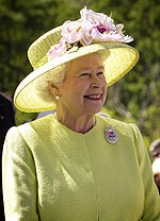
Monarchy in Canada

Encyclopedia
The monarchy of Canada is the core of both Canada
's federalism
and its Westminster-style
parliamentary
democracy
, being the foundation of the executive
, legislative
, and judicial
branches of the Canadian government
and each provincial government. The monarchy has been headed since 6 February 1952 by Queen Elizabeth II, who as sovereign is shared
equally with fifteen other countries
within the Commonwealth of Nations
, all being independent and the monarchy of each legally distinct. For Canada, the monarch is officially titled Queen of Canada , and she, her consort, and other members of the Canadian Royal Family undertake various public and private functions across the country and on its behalf abroad. However, the Queen is the only member of the Royal Family with any constitution
al role. While several powers are the sovereign's alone, because she lives predominantly in the United Kingdom, most of the royal governmental and ceremonial duties in Canada are carried out by the Queen's representative, the governor general
. In each of Canada's provinces
, the monarch is represented by a lieutenant governor
, while the territories are not sovereign and thus do not have a viceroy
.
Per the Canadian constitution
, the responsibilities of the sovereign and/or governor general include summoning and dismissing parliament, calling elections, and appointing governments. Further, Royal Assent
and the royal sign-manual
are required to enact laws, letters patent
, and orders in council. But the authority for these acts stems from the Canadian populace and, within the conventional stipulations of constitutional monarchy
, the sovereign's direct participation in any of these areas of governance is limited, with most related powers entrusted for exercise by the elected and appointed parliamentarians
, the ministers of the Crown
generally drawn from amongst them, and the judges
and justices of the peace. The Crown today primarily functions as a guarantor of continuous and stable governance and a nonpartisan
safeguard against the abuse of power, the sovereign acting as a custodian of the Crown's democratic powers and a representation of the "power of the people above government and political parties."
The historical roots of the Canadian monarchy date back to approximately the turn of the 16th century, when European kingdoms made the first claims to what is now Canadian territory. Monarchical governance thenceforth evolved under a continuous succession of French and British sovereigns, and eventually the legally distinct Canadian monarchy, which is sometimes colloquially
referred to as the Maple
Crown.
Canada shares equally the same sovereign
with fifteen other monarchies in the fifty-four-member Commonwealth of Nations
, a grouping known informally as the Commonwealth realm
s, with the monarch residing predominantly in the oldest and most populous realm, the United Kingdom, and viceroy
s acting as the sovereign's representatives in Canada. The emergence of this arrangement paralleled the fruition of Canadian nationalism
following the end of the First World War
and culminated in the passage of the Statute of Westminster
in 1931. Since then, the pan-national Crown has had both a shared and separate character and the sovereign's role as monarch of Canada has been distinct to his or her position as monarch of any other realm, including the United Kingdom. Only Canadian federal ministers of the Crown
may advise the sovereign on all matters of the Canadian state, of which the sovereign, when not in Canada, is kept abreast by weekly communications with the federal viceroy. The monarchy thus ceased to be an exclusively British institution and in Canada became a Canadian, or "domesticated", establishment, though it is still often denoted as "British" in both legal and common language, for reasons historical, political, and of convenience.
This division is illustrated in a number of ways: The sovereign, for example, holds a unique Canadian title and, when she and other members of the Royal Family are acting in public specifically as representatives of Canada, they will use, where possible, Canadian symbols, including the country's national flag
, unique royal symbols, armed forces uniforms
, and the like, as well as Canadian Forces aircraft or other Canadian-owned vehicles for travel. Once in Canadian airspace, or arrived at a Canadian event taking place abroad, the Canadian Secretary to the Queen
, officers of the Royal Canadian Mounted Police
, and other Canadian officials will take over from whichever of their other realms' counterparts were previously escorting the Queen or other member of the Royal Family.
The sovereign similarly only draws from Canadian coffers for support in the performance of her duties when in Canada or acting as Queen of Canada abroad; Canadians do not pay any money to the Queen or any other member of the Royal Family, either towards personal income or to support royal residences outside of Canada. Normally, tax dollars pay only for the costs associated with the governor general and ten lieutenant governors as instruments of the Queen's authority, including travel, security, residences, offices, ceremonies, and the like. In the absence of official reports on the full cost of the monarchy, the Monarchist League of Canada
regularly issues a survey based on various federal and provincial budgets, expenditures, and estimates; the 2009 edition found that the institution cost Canadians roughly $50 million in 2008.
governed by both the Act of Settlement, 1701
, and Bill of Rights, 1689
, legislation that limits the succession to the natural (i.e. non-adopted
), legitimate descendants of Sophia, Electress of Hanover
and stipulates that the monarch cannot be a Roman Catholic, nor married to one, and must be in communion with the Church of England
upon ascending the throne; these particular clauses have prompted legal challenge
. Though, via adopting the Statute of Westminster, these constitutional laws as they apply to Canada now lie within the full control of the Canadian parliament
, Canada also agreed not to change its rules of succession without the unanimous consent of, and a parallel change of succession in, the other realms, unless explicitly leaving the shared monarchy relationship; a situation that applies symmetrically
in all the other realms and has been likened to a treaty
amongst these countries. Thus, Canada's line of succession remains identical to that of the United Kingdom
. However, there is no provision in Canadian law requiring that the king or queen of Canada must be the same person as the king or queen of the United Kingdom; if the UK were to breach the convention set out in the preamble to the Statute of Westminster and unilaterally change the line of succession to the British throne, the alteration would have no effect on the reigning sovereign of Canada or his or her heirs and successors. As such, the rules for succession are not fixed, but may be changed by a constitutional amendment. In 2011, the Prime Minister of Canada, along with the prime ministers of the other Commonwealth realms, gave support to a proposed change of primogeniture governing the line of succession from agnatic to absolute cognatic.
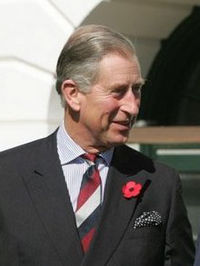 Upon a demise of the Crown
(the death or abdication of a sovereign), the late sovereign's heir immediately and automatically succeeds, without any need for confirmation or further ceremony hence arises the phrase "The King is dead. Long live the King!
". It is customary, though, for the accession of the new monarch to be publicly proclaimed
by the governor general on behalf of the Queen's Privy Council for Canada
, which meets at Rideau Hall
after the accession. Following an appropriate period of mourning
, the monarch is also crowned
in the United Kingdom in an ancient ritual, but one not necessary for a sovereign to reign. By the Interpretation Act of 2005, no incumbent appointee of the Crown is affected by the death of the monarch, nor are they required to take the Oath of Allegiance
again, and all references in legislation to previous monarchs, whether in the masculine (e.g. His Majesty) or feminine (e.g. the Queen), continue to mean the reigning sovereign of Canada, regardless of his or her gender. After an individual ascends the throne, he or she typically continues to reign until death, being unable to unilaterally abdicate per the tenets of constitutional monarchy.
Canada has no laws allowing for a regency
, should the sovereign be a minor
or debilitated; none have been passed by the Canadian parliament and it was made clear by successive Cabinets since 1937 that the United Kingdom's Regency Act
had no applicability to Canada, as the Canadian Cabinet had not requested otherwise when the act was passed that year and again in 1943 and 1953. As the 1947 Letters Patent issued by King George VI permit the Governor General of Canada
to exercise almost all of the monarch's powers in respect of Canada, the viceroy is expected to continue to act as the personal representative of the monarch, and not any regent, even if the monarch is a child or incapacitated. It is unclear, however, how those duties that are the sole domain of the monarch would be carried out at such a time.
as a bulwark against any potential fracturing of the Canadian federation
, the Canadian monarchy is a federal one in which the Crown is unitary throughout all jurisdictions in the country, the sovereignty of the different administrations being passed on through the overreaching Crown itself as a part of the executive, legislative, and judicial operations in each of the federal and provincial spheres and the headship of state
being a part of all equally. However, though the singular Crown links the various governments into a federal state, it is also "divided" into eleven legal jurisdictions, or eleven "crowns" one federal and ten provincial with the monarch taking on a distinct legal persona in each. As such, the constitution instructs that any change to the position of the monarch or his or her representatives in Canada requires the consent of the Senate
, the House of Commons, and the legislative assemblies of all the provinces.
The monarch is personally represented in each area by a viceroy who carries out the majority of the Queen's duties on her behalf: that in the federal sphere being titled Governor General of Canada
and appointed by the Queen on the advice of her federal prime minister
, and those in the provincial spheres being called Lieutenant Governor
and appointed by the governor general on the advice of the federal prime minister, with input from the relevant provincial premier. The commissioner
s of Canada's territories are appointed by the federal Governor-in-Council, at the recommendation of the Minister of Indian Affairs and Northern Development
; but, as the territories are not sovereign entities, the commissioners are not personal representatives of the sovereign.
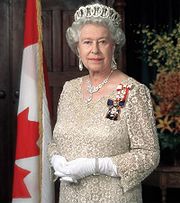
As the living embodiment of the Crown
, the sovereign is regarded as the personification of the Canadian state
, the body of the reigning sovereign thus holding two distinct personas in constant coexistence: that of a natural-born human being and that of the state as accorded to him or her through law; even in private, the monarch is always "on duty". The state is therefore referred to as Her Majesty The Queen in Right of Canada , or The Crown
in Right of Canada, and the monarch's legal personality
is sometimes referred to simply as Canada.
As such, the king or queen of Canada is the employer of all government staff (including the viceroys, judges, members of the Canadian Forces
, police
officers, and parliamentarians
), the guardian of foster children (Crown ward
s), as well as the owner of all state lands (Crown land
), buildings and equipment (Crown held property), state owned companies (Crown corporations
), and the copyright
for all government publications (Crown copyright
). This is all in his or her position as sovereign, and not as an individual; all such property is held by the Crown in perpetuity and cannot be sold by the sovereign without the proper advice and consent of his or her ministers.
As the embodiment of the state, the monarch tops the Canadian order of precedence
, and is also the locus of oaths of allegiance
, required of many employees of the Crown, as well as by new citizens
, as per the Oath of Citizenship
laid out in the Citizenship Act
. This is done in reciprocation
to the sovereign's Coronation
Oath, wherein he or she promises "to govern the Peoples of... Canada... according to their respective laws and customs."
is a republican one inapplicable in a constitutional monarchy such as Canada, where the monarch is the embodiment of the state and thus cannot be head of it, the sovereign is regarded by official government sources, judges, constitutional scholars, and pollsters as the head of state, while the governor general and lieutenant governors are all only representatives of, and thus equally subordinate to, that figure. Some governors general, their staff, government publications, and constitutional scholars like Edward McWhinney
and C. E. S. Franks have, however, referred to the position of governor general as that of Canada's head of state, though sometimes qualilfying the assertion with de facto
or effective; Franks has hence recommended that the governor general be named officially as the head of state. Since 1927, governors general have been received on state visit
s abroad as though they were heads of state.
Officials at Rideau Hall have pointed to the Letters Patent of 1947 as justification for describing the governor general as head of state, but others countered that the document makes no such distinction, either literally or implicitly, nor does it effect an abdication of the sovereign's powers in favour of the viceroy. Michael D. Jackson, former protocol officer for Saskatchewan, pointed out that Rideau Hall had been attempting to "recast" the governor general as head of state since the 1970s and that doing so preempted both the Queen and all of the lieutenant governors, the latter causing not only "precedence wars" at provincial events (where the governor general usurped the lieutenant governor's proper spot as most senior official in attendance), but also constitutional issues by "unbalancing[...] the federalist symmetry." This has been regarded as both a natural evolution and as a dishonest effort to alter the constitution without public scrutiny. Still others view the role of head of state as being shared by both the sovereign and her viceroys.
In a poll conducted by Ipsos-Reid
following the first prorogation of the 40th parliament on 4 December 2008, it was found that 42% of the sample group thought the prime minister was head of state, while 33% felt it was the governor general. Only 24% named the Queen as head of state, a number up from 2002, when the results of an EKOS Research Associates
survey showed only 5% of those polled knew the Queen was head of state (69% answered that it was the prime minister).
is based on the Westminster parliamentary model
, wherein the role of the Queen is both legal and practical, but not political. The sovereign is vested with all the powers of state, collectively known as the Royal Prerogative
, which stems from the people, who are thus considered subjects of the Crown. However, as the monarch is a constitutional one
, he or she does not rule alone, as in an absolute monarchy
. Instead, the Crown is regarded as a corporation
, with the monarch being the centre of a construct in which the power of the whole is shared by multiple institutions of government the executive
, legislative
, and judicial
acting under the sovereign's authority, which is entrusted for exercise by the politicians (the elected and appointed parliamentarians
and the ministers of the Crown
generally drawn from amongst them) and the judges
and justices of the peace. The monarchy has thus been described as the underlying principle of Canada's institutional unity and the monarch as a "guardian of constitutional freedoms" whose "job is to ensure that the political process remains intact and is allowed to function."
The Crown also sits at the pinnacle of the Canadian Forces
, with the constitution placing the monarch in the position of commander-in-chief of the entire force, though the governor general carries out the duties attached to the position and also bears the title of Commander-in-Chief in and over Canada. Further, included in Canada's constitution are the various treaties between the Crown and Canadian First Nations
, Inuit
, and Métis
peoples, who view these documents as agreements directly and only between themselves and the reigning monarch, illustrating the relationship between sovereign and aboriginals
.
formally termed Her Majesty's Government
is defined by the constitution as the Queen acting on the advice
of her Privy Council
; what is technically known as the Queen-in-Council, or sometimes the Governor-in-Council, referring to the governor general as the Queen's stand-in. One of the main duties of the Crown is to "ensure that a democratically elected government is always in place," which means appointing a prime minister
to thereafter head the Cabinet
a committee of the Privy Council charged with advising
the Crown on the exercise of the Royal Prerogative. The Queen is informed by her viceroy of the swearing-in and resignation of prime ministers and other members of the ministry, remains fully briefed through regular communications from her Canadian ministers, and holds audience with them whenever possible.
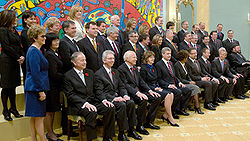 In the construct of constitutional monarchy and responsible government
, the ministerial advice tendered is typically binding, meaning the monarch reigns but does not rule, the Cabinet ruling "in trust" for the monarch. This has been the case in Canada since the Treaty of Paris
ended the reign of the territory's last absolute monarch
, King Louis XV
. However, the Royal Prerogative belongs to the Crown and not to any of the ministers, and the royal and viceroyal figures may unilaterally use these powers in exceptional constitutional crisis
situations, thereby allowing the monarch to make sure "that the government conducts itself in compliance with the constitution." There are also a few duties which must be specifically performed by, or bills that require assent by, the Queen; these include applying the royal sign-manual
and Great Seal of Canada
to the appointment papers of governors general, the issuance of Letters Patent, the confirmation of awards of Canadian honours, the approval of any change in her Canadian title, and the creation of new senate seats.
The Royal Prerogative also extends to foreign affairs: the sovereign or governor general negotiates and ratifies treaties, alliances, and international agreements, all on the advice of the Cabinet, and the governor general, on behalf of the Queen, both accredits Canadian high commissioners and ambassadors and receives similar diplomats from foreign states. These tasks were solely in the domain of the monarch until the 1970s, when Queen Elizabeth II, on the advice of Prime Minister Pierre Trudeau
, allowed the governor general to perform these duties on her behalf. In 2005, the letters of credence and recall
were altered so as to run in the name of the incumbent governor general, instead of following the usual international process of the letters being from one head of state to another. In addition, the issuance of passports falls under the Royal Prerogative and, as such, all Canadian passport
s are issued in the monarch's name and remain her property.
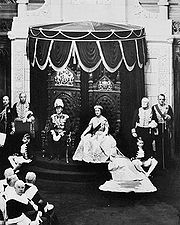 All laws in Canada are the monarch's and the sovereign is one of the three components of parliament
formally called the Queen-in-Parliament
but the monarch and viceroy do not participate in the legislative process save for the granting of Royal Assent
, which is necessary for a bill to be enacted as law. Either figure or a delegate may perform this task, and the viceroy has the option of deferring assent to the sovereign, as per the constitution. The governor general is further responsible for summoning the House of Commons, while either the viceroy or monarch can prorogue
and dissolve
the legislature, after which the governor general usually calls for a general election
. The new parliamentary session is marked by either the monarch, governor general, or some other representative reading the Speech from the Throne
; as the sovereign is traditionally barred from the House of Commons, this ceremony, as well as the bestowing of Royal Assent, takes place in the Senate chamber. Despite this exclusion, members of the commons must still express their loyalty to the monarch and defer to her authority, as the Oath of Allegiance must be recited by all new parliamentarians before they may take their seat, and the official opposition
is traditionally dubbed as Her Majesty's Loyal Opposition
.
The monarch does not have the prerogative to impose and collect new taxes without the authorization of an Act of Parliament
. The consent of the Crown must, however, be obtained before either of the houses of parliament may even debate a bill affecting the sovereign's prerogatives or interests, and no act of parliament binds the Queen or her rights unless the act states that it does.
formally dubbed the Queen on the Bench. Though the monarch does not personally rule in judicial cases, this function of the Royal Prerogative instead performed in trust and in the Queen's name by officers of Her Majesty's court, common law holds the notion that the sovereign "can do no wrong"; the monarch cannot be prosecuted in her own courts, judged by herself, for criminal offences. Civil lawsuits against the Crown in its public capacity (that is, lawsuits against the Queen-in-Council) are permitted, but lawsuits against the monarch personally are not cognizable. In international cases, as a sovereign and under established principles of international law
, the Queen of Canada is not subject to suit in foreign courts without her express consent. The monarch, and by extension the governor general, also grants immunity from prosecution, exercises the Royal Prerogative of Mercy and may pardon offences against the Crown, either before, during, or after a trial.
An image of the Queen and/or the Arms of Her Majesty in Right of Canada is always displayed in Canadian federal courtrooms. Itinerant
judges will display an image of the Queen and the Canadian flag
when holding a session away from established courtrooms; such situations occur in parts of Canada where the stakeholders in a given court case are too isolated geographically to be able to travel for regular proceedings.
. A prominent feature of the latter are numerous royal walkabouts, the tradition of which was initiated in 1939 by Queen Elizabeth
when she was in Ottawa and broke from the royal party to speak directly to gathered veterans. Usually important milestones, anniversaries, or celebrations of Canadian culture
will warrant the presence of the monarch, while other royals will be asked to participate in lesser occasions. A household to assist and tend to the monarch forms part of the royal party.
Official duties involve the sovereign representing the Canadian state at home or abroad, or her relations as members of the Royal Family participating in government organized ceremonies either in Canada or elsewhere. The advice of the Canadian Cabinet is the impetus for royal participation in any Canadian event, though, at present, the Chief of Protocol and his staff in the Department of Canadian Heritage
are, as part of the State Ceremonial and Canadian Symbols Program, responsible for orchestrating any official events in or for Canada that involve the Royal Family. Conversely, unofficial duties are performed by Royal Family members on behalf of Canadian organizations of which they may be patrons
, through their attendance at charity events, visiting with members of the Canadian Forces as colonel-in-chief, or marking certain key anniversaries. The invitation and expenses associated with these undertakings are usually borne by the associated organization. In 2005 members of the Royal Family were present at a total of 76 Canadian engagements, as well as several more through 2006 and 2007.
Apart from Canada, the Queen and other members of the Royal Family regularly perform public duties in the other fifteen nations of the Commonwealth in which the Queen is head of state. This situation, however, can mean the monarch and/or members of the Royal Family will be promoting one nation and not another; a situation that has been met with criticism.
 The main symbol of the monarchy is the sovereign herself, described as "the personal expression of the Crown in Canada," and her image is thus used to signify Canadian sovereignty and government authority her effigy
, for instance, appearing on currency
, and her portrait in government buildings. The sovereign is further both mentioned in and the subject of songs, loyal toast
s, and salutes. A royal cypher
, appearing on buildings and official seals
, or a crown, seen on provincial and national coats of arms
, as well as police
force and Canadian Forces
regimental and maritime badges and rank insignia, is also used to illustrate the monarchy as the locus of authority, the latter without referring to any specific monarch.
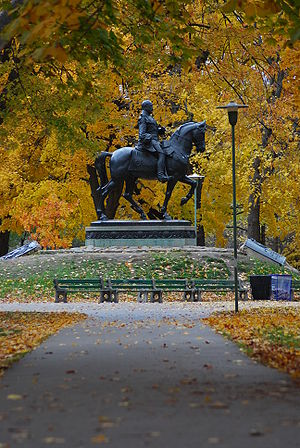 Since the days of King Louis XIV
, the monarch is the fount
of all honours in Canada and new orders, decorations, and medals, which form "an integral element of the Crown," may only be created with the approval of the sovereign through letters patent. Hence, the insignia and medallions for these awards bear a crown, cypher, and/or effigy of the monarch. Similarly, the country's heraldic authority
was created by the Queen and, operating under the authority of the governor general, grants new coats of arms
, flag
s, and badges
in Canada. Use of the royal crown in such symbols is a gift from the monarch showing royal support and/or association, and requires her approval before being added.
Members of the Royal Family also act as ceremonial Colonels-in-Chief
of various military regiments, reflecting the Crown's relationship with the armed forces
through participation in events both at home and abroad. The monarch also serves as the Honorary Commissioner of the Royal Canadian Mounted Police
.
A number of Canadian civilian organizations have association with the monarchy, either through their being founded via a royal charter, having been granted the right to use the prefix royal before their name, or because at least one member of the Royal Family serves as a patron
. Some charities and volunteer organizations have also been founded as gifts to, or in honour of, some of Canada's monarchs or members of the Royal Family, such as the Victorian Order of Nurses
(a gift to Queen Victoria for her Diamond Jubilee in 1897), the Canadian Cancer Fund (set up in honour of King George V's Silver Jubilee in 1935), and the Queen Elizabeth II Fund to Aid in Research on the Diseases of Children. A number of awards in Canada are likewise issued in the name of previous or present members of the Royal Family. Further, organizations will give commemorative gifts to members of the Royal Family to mark a visit or other important occasion.
maintains a list of immediate members and the Department of National Defence
stipulates that those in the direct line of succession who bear the style
of Royal Highness (Altesse Royale) are subjects of, and owe their allegiance to, the reigning sovereign specifically as king or queen of Canada. This entitles them to Canadian consular assistance
and to the protection of the Queen's armed forces of Canada
when they are outside of the Commonwealth realms and in need of protection or aid.
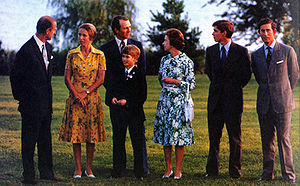 Given the shared nature of the Canadian monarch, most members of the Canadian Royal Family are also members of the British Royal Family
, and thus the House of Windsor
. As such, they are the distant relations of the Belgian, Danish
, Greek
, Norwegian
, Spanish
, and Swedish Royal Families
, and bear lineage from, amongst others, Arab, Armenian
, Cuman
, French
, German
, Hungarian, Italian, Mongolian
, Norwegian, Portuguese
, Serbian
, and Swedish ethnicities, as well as, according to Moroccan and Chinese officials, respectively, being directly descended from the Prophet Muhammad
and Tang Dynasty
Chinese Emperors
. However, because Canada and the UK are independent of one another, it is incorrect to refer in the Canadian context to the family of the monarch as the "British Royal Family" as is frequently done by Canadian and other media and there exist some differences between the official lists of each: for instance, while he never held the style His Royal Highness, Angus Ogilvy
was included in the Department of Canadian Heritage's royal family list, but was not considered a member of the British Royal Family. Additionally, unlike in the United Kingdom, the monarch is the only member of the Royal Family in Canada with a title established through law; it would be possible for others to be granted distinctly Canadian titles (as is the case for the Duke of Rothesay
in Scotland
), but they have always been, and continue to only be, accorded the use of a courtesy title
, which is that they have been granted via letters patent
in the United Kingdom, though they are also in Canada translated to French.
Though the group is predominantly based in the United Kingdom, the sovereign and those amongst her relations who do not meet the requirements of Canadian citizenship law are still considered Canadian; as early as 1959, it was recognized that the Queen was "equally at home in all her realms." Rather, as legal subjects of the country's monarch, the Royal Family holds a unique position reflected in the confusion that sometimes arises around the awarding of honours to them. There are three Canadian citizens within the Canadian Royal Family: Two married into it: In 1988, Sylvana Jones
(née Tomaselli in Placentia, Newfoundland
) wed the Earl of St. Andrews
, a great-grandson of King George V
, and, on 18 May 2008, Autumn Kelly
, originally from Montreal
, married Queen Elizabeth II's eldest grandson, Peter Phillips
. In December 2010, Autumn Phillips gave birth to a daughter who held dual Canadian and British citizenship and was, at the time, 12th in line to the throne. Beyond legalities, members of the Royal Family have also, on occasion, declared themselves to be Canadian, and some past members have lived in Canada for extended periods as viceroy or for other reasons. Still, the existence of a Canadian Royal Family is contested, mostly by individuals in Canada's republican movement
, but also by former Lieutenant Governor of British Columbia
Iona Campagnolo
. Poet George Elliott Clarke
publicly mused about a fully First Nations
royal family for Canada.
According to the Canadian Royal Heritage Trust, Prince Edward Augustus, Duke of Kent and Strathearn
due to his having lived in Canada between 1791 and 1800, and fathering Queen Victoria is the "ancestor of the modern Canadian Royal Family." Nonetheless, the concept of the Canadian Royal Family did not emerge until after the passage of the Statute of Westminster in 1931, when Canadian officials only began to overtly consider putting the principles of Canada's new status as an independent kingdom
into effect. At first, the monarch was the only member of the Royal Family to carry out public ceremonial duties solely on the advice of Canadian ministers; King Edward VIII
became the first to do so when in July 1936 he dedicated the Canadian National Vimy Memorial
in France one of his few obligations performed during his short reign. Over the decades, however, the monarch's children, grandchildren, cousins, and their respective spouses began to also perform functions at the direction of the Canadian Crown-in-Council, representing the monarch within Canada or abroad. By the 1960s, loyal societies in Canada recognized the Queen's cousin, Princess Alexandra, The Honourable Lady Ogilvy
, as a "Canadian princess"; but, it was not until October 2002 when the term Canadian Royal Family was first used publicly and officially by one of its members: in a speech to the Nunavut legislature
at its opening, Queen Elizabeth II stated: "I am proud to be the first member of the Canadian Royal Family to be greeted in Canada's newest territory." At the time of the 2011 royal tour of Prince William, Duke of Cambridge, and Catherine, Duchess of Cambridge, both Michael Valpy
, writing for the CBC
, and The Globe and Mail
referred to William as "a prince of Canada" and both Canadian and British media were referring to "Canada's royal family" or the "Canadian royal family".
The press frequently follows the movements of the Royal Family, and can, at times, affect the group's popularity, which has fluctuated over the years. Mirroring the mood in the United Kingdom, the family's lowest approval was during the mid-1980s to 1990s, when the children of the monarch were enduring their divorces and were the targets of negative tabloid reporting.
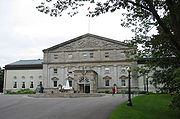 A number of buildings across Canada are reserved by the Crown for the use of the monarch and her viceroys. The sovereign's principal official residence, as well as that primarily used by the governor general, is Rideau Hall
, located in Ottawa
, Ontario
, and another residence of the governor general is the Citadelle
, in Quebec City
. Each of these royal seats holds pieces from the Crown Collection
. Further, though neither was ever used for their intended purpose, Hatley Castle
in British Columbia was purchased in 1940 by King George VI in Right of Canada to use as his home during the course of World War II, and the Emergency Government Headquarters, built in 1959 at CFS Carp
and decommissioned in 1994, included a residential apartment for the sovereign or governor general in the case of a nuclear attack
on Ottawa.
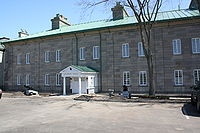 Monarchs and members of their family have also owned in a private capacity homes and land in Canada: King Edward VIII
owned Bedingfield Ranch, near Pekisko, Alberta
; The Marquess of Lorne
and Princess Louise
owned a cottage on the Cascapédia River
in Quebec
; and Princess Margaret
owned Portland Island between its gifting to her by the Crown in Right of British Columbia in 1958 and her death in 2002, though she offered it back to the Crown on permanent loan in 1966 and the island and surrounding waters eventually became Princess Margaret Marine Park.
To assist the Queen in carrying out her official duties on behalf of Canada, she appoints various people to her Canadian household. Along with the Canadian Secretary to the Queen
, the monarch's entourage includes two ladies-in-waiting
, the Canadian Equerry-in-Waiting to the Queen, the Queen's Police Officer, the Duke of Edinburgh's Police Officer, the Queen's Honorary Physician, the Queen's Honorary Dental Surgeon, and the Queen's Honorary Nursing Officer the latter three being drawn from the Canadian Forces. There are also three household regiments
specifically attached to the Royal Household (the Governor General's Foot Guards
, the Governor General's Horse Guards
, and the Canadian Grenadier Guards
), as well as two chapels royal
in Ontario.
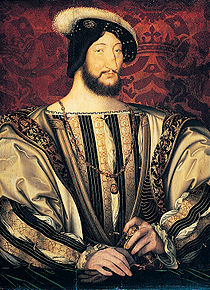 The Canadian monarchy can trace its ancestral lineage back to the kings of the Angles and the early Scottish kings
, through centuries since parts of the territories that today comprise Canada were claimed by King Henry VII
in 1497 and others by King Francis I
in 1534; both being blood relatives of the current Canadian monarch. Prime Minister Stephen Harper
said of the Crown that it "links us all together with the majestic past that takes us back to the Tudors, the Plantagenets, the Magna Carta
, habeas corpus
, petition of rights, and English common law
." Though the first French and British colonizers of Canada interpreted the hereditary nature of some indigenous North American chieftainships as a form of monarchy, it is generally accepted that Canada has been a territory of a monarch or a monarchy in its own right only since the establishment of New France
in the early 17th century; according to historian Jacques Monet, the Canadian Crown is one of the few that have survived through uninterrupted succession since before its inception.
After the Canadian colonies of France were, via war and treaties, ceded to the British Crown, and the population was greatly expanded by those loyal to George III
fleeing north from persecution during and following the American Revolution
, British North America
was in 1867 confederated by Queen Victoria
to form Canada as a kingdom
in its own right. By the end of the First World War, the increased fortitude of Canadian nationalism
inspired the country's leaders to push for greater independence from the King in his British Council, resulting in the creation of the uniquely Canadian monarchy through the Statute of Westminster
, which was granted Royal Assent in 1931. Only five years later, Canada had three successive kings in the space of one year, with the death of George V
, the accession and abdication
of Edward VIII, and his replacement by George VI.
The latter became in 1939 the first reigning monarch of Canada to tour the country (though previous kings had done so before their accession). As the ease of travel increased, visits by the sovereign and other Royal Family members became more frequent and involved, seeing Queen Elizabeth II officiate at various moments of importance in the nation's history, one being when she proclaimed the country to be fully independent, via constitutional patriation
, in 1982. That act is said to have entrenched the monarchy in Canada, due to the stringent requirements, as laid out in the amending formula, that must be met in order to alter the monarchy in any way.
Through the 1960s and 1970s, the rise of Quebec nationalism
and changes in Canadian identity
created an atmosphere where the purpose and role of the monarchy came into question
. Some references to the monarch and the monarchy were removed from the public eye and moves were made by the federal government to constitutionally alter the Crown's place and role in Canada, first by explicit legal amendments and later by subtle attrition impelled by elements of the public service, the Cabinet, and governors general and their staff alike. But, provincial and federal ministers, along with loyal national citizen's organizations
, ensured that the system remained the same in essence. By 2002, the royal tour and associated fête
s for the Queen's Golden Jubilee proved popular with Canadians across the country, though Canada's first republican organization since the 1830s was also founded that year. Planning began in 2010 for the celebrations to mark Queen Elizabeth II's Diamond Jubilee
in 2012, the first such event in Canada since 1897, when Victoria marked her 60th year on the throne.
, a subject of which most Canadians are generally unaware. Out of Canada's three most prominent political parties, neither the Liberal Party
nor the Conservative Party
is officially in favour of abolishing the monarchy (though the latter makes support for constitutional monarchy a founding principle in its policy declaration) and the New Democratic Party
(NDP) has no official position on the role of the Crown. Only some Members of Parliament belonging to these parties and the leaders of the Bloc Québécois
have made any statements suggesting abolition of the monarchy. Canada has two special-interest groups representing the debate, who frequently argue the issue in the media: the Monarchist League of Canada
and Citizens for a Canadian Republic
. There are also other organizations that support and advocate for the monarchy, such as the United Empire Loyalists' Association of Canada, the Canadian Royal Heritage Trust, the Orange Order in Canada
, and the Friends of the Canadian Crown.
The idea of a uniquely Canadian monarch has been proffered as an alternative, either one descended from the present queen or coming from a First Nations
royal house
; however, there has been no popular or official support for such a change.
Canada
Canada is a North American country consisting of ten provinces and three territories. Located in the northern part of the continent, it extends from the Atlantic Ocean in the east to the Pacific Ocean in the west, and northward into the Arctic Ocean...
's federalism
Canadian federalism
Canada is a federation with two distinct jurisdictions of political authority: the country-wide federal government and the ten regionally-based provincial governments. It also has three territorial governments in the far north, though these are subject to the federal government...
and its Westminster-style
Westminster System
The Westminster system is a democratic parliamentary system of government modelled after the politics of the United Kingdom. This term comes from the Palace of Westminster, the seat of the Parliament of the United Kingdom....
parliamentary
Parliamentary system
A parliamentary system is a system of government in which the ministers of the executive branch get their democratic legitimacy from the legislature and are accountable to that body, such that the executive and legislative branches are intertwined....
democracy
Democracy
Democracy is generally defined as a form of government in which all adult citizens have an equal say in the decisions that affect their lives. Ideally, this includes equal participation in the proposal, development and passage of legislation into law...
, being the foundation of the executive
Executive (government)
Executive branch of Government is the part of government that has sole authority and responsibility for the daily administration of the state bureaucracy. The division of power into separate branches of government is central to the idea of the separation of powers.In many countries, the term...
, legislative
Legislature
A legislature is a kind of deliberative assembly with the power to pass, amend, and repeal laws. The law created by a legislature is called legislation or statutory law. In addition to enacting laws, legislatures usually have exclusive authority to raise or lower taxes and adopt the budget and...
, and judicial
Judiciary
The judiciary is the system of courts that interprets and applies the law in the name of the state. The judiciary also provides a mechanism for the resolution of disputes...
branches of the Canadian government
Government of Canada
The Government of Canada, formally Her Majesty's Government, is the system whereby the federation of Canada is administered by a common authority; in Canadian English, the term can mean either the collective set of institutions or specifically the Queen-in-Council...
and each provincial government. The monarchy has been headed since 6 February 1952 by Queen Elizabeth II, who as sovereign is shared
Personal union
A personal union is the combination by which two or more different states have the same monarch while their boundaries, their laws and their interests remain distinct. It should not be confused with a federation which is internationally considered a single state...
equally with fifteen other countries
Commonwealth Realm
A Commonwealth realm is a sovereign state within the Commonwealth of Nations that has Elizabeth II as its monarch and head of state. The sixteen current realms have a combined land area of 18.8 million km² , and a population of 134 million, of which all, except about two million, live in the six...
within the Commonwealth of Nations
Commonwealth of Nations
The Commonwealth of Nations, normally referred to as the Commonwealth and formerly known as the British Commonwealth, is an intergovernmental organisation of fifty-four independent member states...
, all being independent and the monarchy of each legally distinct. For Canada, the monarch is officially titled Queen of Canada , and she, her consort, and other members of the Canadian Royal Family undertake various public and private functions across the country and on its behalf abroad. However, the Queen is the only member of the Royal Family with any constitution
Constitution
A constitution is a set of fundamental principles or established precedents according to which a state or other organization is governed. These rules together make up, i.e. constitute, what the entity is...
al role. While several powers are the sovereign's alone, because she lives predominantly in the United Kingdom, most of the royal governmental and ceremonial duties in Canada are carried out by the Queen's representative, the governor general
Governor General of Canada
The Governor General of Canada is the federal viceregal representative of the Canadian monarch, Queen Elizabeth II...
. In each of Canada's provinces
Provinces and territories of Canada
The provinces and territories of Canada combine to make up the world's second-largest country by area. There are ten provinces and three territories...
, the monarch is represented by a lieutenant governor
Lieutenant Governor (Canada)
In Canada, a lieutenant governor is the viceregal representative in a provincial jurisdiction of the Canadian monarch and head of state, Queen Elizabeth II, who resides predominantly in her oldest realm, the United Kingdom...
, while the territories are not sovereign and thus do not have a viceroy
Viceroy
A viceroy is a royal official who runs a country, colony, or province in the name of and as representative of the monarch. The term derives from the Latin prefix vice-, meaning "in the place of" and the French word roi, meaning king. A viceroy's province or larger territory is called a viceroyalty...
.
Per the Canadian constitution
Constitution of Canada
The Constitution of Canada is the supreme law in Canada; the country's constitution is an amalgamation of codified acts and uncodified traditions and conventions. It outlines Canada's system of government, as well as the civil rights of all Canadian citizens and those in Canada...
, the responsibilities of the sovereign and/or governor general include summoning and dismissing parliament, calling elections, and appointing governments. Further, Royal Assent
Royal Assent
The granting of royal assent refers to the method by which any constitutional monarch formally approves and promulgates an act of his or her nation's parliament, thus making it a law...
and the royal sign-manual
Royal sign-manual
The royal sign manual is the formal name given in the Commonwealth realms to the autograph signature of the sovereign, by the affixing of which the monarch expresses his or her pleasure either by order, commission, or warrant. A sign-manual warrant may be either an executive actfor example, an...
are required to enact laws, letters patent
Letters patent
Letters patent are a type of legal instrument in the form of a published written order issued by a monarch or president, generally granting an office, right, monopoly, title, or status to a person or corporation...
, and orders in council. But the authority for these acts stems from the Canadian populace and, within the conventional stipulations of constitutional monarchy
Constitutional monarchy
Constitutional monarchy is a form of government in which a monarch acts as head of state within the parameters of a constitution, whether it be a written, uncodified or blended constitution...
, the sovereign's direct participation in any of these areas of governance is limited, with most related powers entrusted for exercise by the elected and appointed parliamentarians
Parliament of Canada
The Parliament of Canada is the federal legislative branch of Canada, seated at Parliament Hill in the national capital, Ottawa. Formally, the body consists of the Canadian monarch—represented by her governor general—the Senate, and the House of Commons, each element having its own officers and...
, the ministers of the Crown
Minister of the Crown
Minister of the Crown is the formal constitutional term used in the Commonwealth realms to describe a minister to the reigning sovereign. The term indicates that the minister serves at His/Her Majesty's pleasure, and advises the monarch, or viceroy, on how to exercise the Crown prerogatives...
generally drawn from amongst them, and the judges
Court system of Canada
The court system of Canada is made up of many courts differing in levels of legal superiority and separated by jurisdiction. Some of the courts are federal in nature while others are provincial or territorial....
and justices of the peace. The Crown today primarily functions as a guarantor of continuous and stable governance and a nonpartisan
Nonpartisan
In political science, nonpartisan denotes an election, event, organization or person in which there is no formally declared association with a political party affiliation....
safeguard against the abuse of power, the sovereign acting as a custodian of the Crown's democratic powers and a representation of the "power of the people above government and political parties."
The historical roots of the Canadian monarchy date back to approximately the turn of the 16th century, when European kingdoms made the first claims to what is now Canadian territory. Monarchical governance thenceforth evolved under a continuous succession of French and British sovereigns, and eventually the legally distinct Canadian monarchy, which is sometimes colloquially
Colloquialism
A colloquialism is a word or phrase that is common in everyday, unconstrained conversation rather than in formal speech, academic writing, or paralinguistics. Dictionaries often display colloquial words and phrases with the abbreviation colloq. as an identifier...
referred to as the Maple
Maple leaf
The maple leaf is the characteristic leaf of the maple tree, and is the most widely recognized national symbol of Canada.-Use in Canada:At the beginning of the eighteenth century, the settlements of New France had attained a population of about 18,000...
Crown.
International and domestic aspects
- Further information: Commonwealth realm > Relationship of the realms
Canada shares equally the same sovereign
Personal union
A personal union is the combination by which two or more different states have the same monarch while their boundaries, their laws and their interests remain distinct. It should not be confused with a federation which is internationally considered a single state...
with fifteen other monarchies in the fifty-four-member Commonwealth of Nations
Commonwealth of Nations
The Commonwealth of Nations, normally referred to as the Commonwealth and formerly known as the British Commonwealth, is an intergovernmental organisation of fifty-four independent member states...
, a grouping known informally as the Commonwealth realm
Commonwealth Realm
A Commonwealth realm is a sovereign state within the Commonwealth of Nations that has Elizabeth II as its monarch and head of state. The sixteen current realms have a combined land area of 18.8 million km² , and a population of 134 million, of which all, except about two million, live in the six...
s, with the monarch residing predominantly in the oldest and most populous realm, the United Kingdom, and viceroy
Viceroy
A viceroy is a royal official who runs a country, colony, or province in the name of and as representative of the monarch. The term derives from the Latin prefix vice-, meaning "in the place of" and the French word roi, meaning king. A viceroy's province or larger territory is called a viceroyalty...
s acting as the sovereign's representatives in Canada. The emergence of this arrangement paralleled the fruition of Canadian nationalism
Canadian nationalism
Canadian nationalism is a term which has been applied to ideologies of several different types which highlight and promote specifically Canadian interests over those of other countries, notably the United States...
following the end of the First World War
World War I
World War I , which was predominantly called the World War or the Great War from its occurrence until 1939, and the First World War or World War I thereafter, was a major war centred in Europe that began on 28 July 1914 and lasted until 11 November 1918...
and culminated in the passage of the Statute of Westminster
Statute of Westminster 1931
The Statute of Westminster 1931 is an Act of the Parliament of the United Kingdom. Passed on 11 December 1931, the Act established legislative equality for the self-governing dominions of the British Empire with the United Kingdom...
in 1931. Since then, the pan-national Crown has had both a shared and separate character and the sovereign's role as monarch of Canada has been distinct to his or her position as monarch of any other realm, including the United Kingdom. Only Canadian federal ministers of the Crown
Minister of the Crown
Minister of the Crown is the formal constitutional term used in the Commonwealth realms to describe a minister to the reigning sovereign. The term indicates that the minister serves at His/Her Majesty's pleasure, and advises the monarch, or viceroy, on how to exercise the Crown prerogatives...
may advise the sovereign on all matters of the Canadian state, of which the sovereign, when not in Canada, is kept abreast by weekly communications with the federal viceroy. The monarchy thus ceased to be an exclusively British institution and in Canada became a Canadian, or "domesticated", establishment, though it is still often denoted as "British" in both legal and common language, for reasons historical, political, and of convenience.
This division is illustrated in a number of ways: The sovereign, for example, holds a unique Canadian title and, when she and other members of the Royal Family are acting in public specifically as representatives of Canada, they will use, where possible, Canadian symbols, including the country's national flag
Flag of Canada
The national flag of Canada, also known as the Maple Leaf, and , is a red flag with a white square in its centre, featuring a stylized 11-pointed red maple leaf. Its adoption in 1965 marked the first time a national flag had been officially adopted in Canada to replace the Union Flag...
, unique royal symbols, armed forces uniforms
Uniforms of the Canadian Forces
The Uniforms of the Canadian Forces are the official dress worn by members of Canada's military while on duty.Prior to unification in 1968, the uniforms of the Canadian Army, Royal Canadian Navy and Royal Canadian Air Force were similar to their counterparts in the forces of the United Kingdom...
, and the like, as well as Canadian Forces aircraft or other Canadian-owned vehicles for travel. Once in Canadian airspace, or arrived at a Canadian event taking place abroad, the Canadian Secretary to the Queen
Canadian Secretary to the Queen
The Canadian Secretary to the Queen is the senior operational member of the Royal Household of the sovereign of Canada. The secretary is the principal channel of communication between the Queen and her Canadian government, provincial governments, and the governments of the fifteen other...
, officers of the Royal Canadian Mounted Police
Royal Canadian Mounted Police
The Royal Canadian Mounted Police , literally ‘Royal Gendarmerie of Canada’; colloquially known as The Mounties, and internally as ‘The Force’) is the national police force of Canada, and one of the most recognized of its kind in the world. It is unique in the world as a national, federal,...
, and other Canadian officials will take over from whichever of their other realms' counterparts were previously escorting the Queen or other member of the Royal Family.
The sovereign similarly only draws from Canadian coffers for support in the performance of her duties when in Canada or acting as Queen of Canada abroad; Canadians do not pay any money to the Queen or any other member of the Royal Family, either towards personal income or to support royal residences outside of Canada. Normally, tax dollars pay only for the costs associated with the governor general and ten lieutenant governors as instruments of the Queen's authority, including travel, security, residences, offices, ceremonies, and the like. In the absence of official reports on the full cost of the monarchy, the Monarchist League of Canada
Monarchist League of Canada
The Monarchist League of Canada is a national, non-partisan, non-profit organization whose mission is "to promote the full expression and a better understanding of the history and real benefits of a uniquely Canadian constitutional monarchy"....
regularly issues a survey based on various federal and provincial budgets, expenditures, and estimates; the 2009 edition found that the institution cost Canadians roughly $50 million in 2008.
Succession and regency
Succession is by male-preference primogeniturePrimogeniture
Primogeniture is the right, by law or custom, of the firstborn to inherit the entire estate, to the exclusion of younger siblings . Historically, the term implied male primogeniture, to the exclusion of females...
governed by both the Act of Settlement, 1701
Act of Settlement 1701
The Act of Settlement is an act of the Parliament of England that was passed in 1701 to settle the succession to the English throne on the Electress Sophia of Hanover and her Protestant heirs. The act was later extended to Scotland, as a result of the Treaty of Union , enacted in the Acts of Union...
, and Bill of Rights, 1689
Bill of Rights 1689
The Bill of Rights or the Bill of Rights 1688 is an Act of the Parliament of England.The Bill of Rights was passed by Parliament on 16 December 1689. It was a re-statement in statutory form of the Declaration of Right presented by the Convention Parliament to William and Mary in March 1689 ,...
, legislation that limits the succession to the natural (i.e. non-adopted
Adoption
Adoption is a process whereby a person assumes the parenting for another and, in so doing, permanently transfers all rights and responsibilities from the original parent or parents...
), legitimate descendants of Sophia, Electress of Hanover
Sophia of Hanover
Sophia of the Palatinate was an heiress to the crowns of England and Ireland and later the crown of Great Britain. She was declared heiress presumptive by the Act of Settlement 1701...
and stipulates that the monarch cannot be a Roman Catholic, nor married to one, and must be in communion with the Church of England
Church of England
The Church of England is the officially established Christian church in England and the Mother Church of the worldwide Anglican Communion. The church considers itself within the tradition of Western Christianity and dates its formal establishment principally to the mission to England by St...
upon ascending the throne; these particular clauses have prompted legal challenge
O'Donohue v. Canada
O'Donohue v. Canada was a legal challenge to the exclusion of Roman Catholics from the throne of Canada. The applicant sought a declaratory judgment that certain provisions of the Act of Settlement 1701 violate the equality-rights section of the Canadian Charter of Rights and Freedoms...
. Though, via adopting the Statute of Westminster, these constitutional laws as they apply to Canada now lie within the full control of the Canadian parliament
Parliament of Canada
The Parliament of Canada is the federal legislative branch of Canada, seated at Parliament Hill in the national capital, Ottawa. Formally, the body consists of the Canadian monarch—represented by her governor general—the Senate, and the House of Commons, each element having its own officers and...
, Canada also agreed not to change its rules of succession without the unanimous consent of, and a parallel change of succession in, the other realms, unless explicitly leaving the shared monarchy relationship; a situation that applies symmetrically
Symmetry
Symmetry generally conveys two primary meanings. The first is an imprecise sense of harmonious or aesthetically pleasing proportionality and balance; such that it reflects beauty or perfection...
in all the other realms and has been likened to a treaty
Treaty
A treaty is an express agreement under international law entered into by actors in international law, namely sovereign states and international organizations. A treaty may also be known as an agreement, protocol, covenant, convention or exchange of letters, among other terms...
amongst these countries. Thus, Canada's line of succession remains identical to that of the United Kingdom
Succession to the British Throne
Succession to the British throne is governed both by common law and statute. Under common law the crown is currently passed on by male-preference primogeniture. In other words, succession passes first to an individual's sons, in order of birth, and subsequently to daughters, again in order of birth....
. However, there is no provision in Canadian law requiring that the king or queen of Canada must be the same person as the king or queen of the United Kingdom; if the UK were to breach the convention set out in the preamble to the Statute of Westminster and unilaterally change the line of succession to the British throne, the alteration would have no effect on the reigning sovereign of Canada or his or her heirs and successors. As such, the rules for succession are not fixed, but may be changed by a constitutional amendment. In 2011, the Prime Minister of Canada, along with the prime ministers of the other Commonwealth realms, gave support to a proposed change of primogeniture governing the line of succession from agnatic to absolute cognatic.
Demise of the Crown
In relation to the shared monarchy of the Commonwealth realms and other monarchies, the demise of the Crown is the legal term for the end of a reign by a king, queen, or emperor, whether by death or abdication....
(the death or abdication of a sovereign), the late sovereign's heir immediately and automatically succeeds, without any need for confirmation or further ceremony hence arises the phrase "The King is dead. Long live the King!
The King is dead. Long live the King!
The King is dead. Long live the King. is a traditional proclamation made following the accession of a new monarch in various countries, such as the United Kingdom....
". It is customary, though, for the accession of the new monarch to be publicly proclaimed
Proclamation
A proclamation is an official declaration.-England and Wales:In English law, a proclamation is a formal announcement , made under the great seal, of some matter which the King in Council or Queen in Council desires to make known to his or her subjects: e.g., the declaration of war, or state of...
by the governor general on behalf of the Queen's Privy Council for Canada
Queen's Privy Council for Canada
The Queen's Privy Council for Canada ), sometimes called Her Majesty's Privy Council for Canada or simply the Privy Council, is the full group of personal consultants to the monarch of Canada on state and constitutional affairs, though responsible government requires the sovereign or her viceroy,...
, which meets at Rideau Hall
Rideau Hall
Rideau Hall is, since 1867, the official residence in Ottawa of both the Canadian monarch and the Governor General of Canada. It stands in Canada's capital on a 0.36 km2 estate at 1 Sussex Drive, with the main building consisting of 170 rooms across 9,500 m2 , and 24 outbuildings around the...
after the accession. Following an appropriate period of mourning
Mourning
Mourning is, in the simplest sense, synonymous with grief over the death of someone. The word is also used to describe a cultural complex of behaviours in which the bereaved participate or are expected to participate...
, the monarch is also crowned
Coronation of the British monarch
The coronation of the British monarch is a ceremony in which the monarch of the United Kingdom is formally crowned and invested with regalia...
in the United Kingdom in an ancient ritual, but one not necessary for a sovereign to reign. By the Interpretation Act of 2005, no incumbent appointee of the Crown is affected by the death of the monarch, nor are they required to take the Oath of Allegiance
Oath of Allegiance (Canada)
The Canadian Oath of Allegiance is a promise or declaration of fealty to the Canadian monarch, taken, along with other specific oaths of office, by new occupants of various government positions, including federal and provincial viceroys, appointees to the Queen's Privy Council, Supreme Court...
again, and all references in legislation to previous monarchs, whether in the masculine (e.g. His Majesty) or feminine (e.g. the Queen), continue to mean the reigning sovereign of Canada, regardless of his or her gender. After an individual ascends the throne, he or she typically continues to reign until death, being unable to unilaterally abdicate per the tenets of constitutional monarchy.
Canada has no laws allowing for a regency
Regent
A regent, from the Latin regens "one who reigns", is a person selected to act as head of state because the ruler is a minor, not present, or debilitated. Currently there are only two ruling Regencies in the world, sovereign Liechtenstein and the Malaysian constitutive state of Terengganu...
, should the sovereign be a minor
Minor (law)
In law, a minor is a person under a certain age — the age of majority — which legally demarcates childhood from adulthood; the age depends upon jurisdiction and application, but is typically 18...
or debilitated; none have been passed by the Canadian parliament and it was made clear by successive Cabinets since 1937 that the United Kingdom's Regency Act
Regency Acts
The Regency Acts are Acts of the Parliament of the United Kingdom passed at various times, to provide a regent if the reigning monarch were to be incapacitated or a minor . Prior to 1937, Regency Acts were passed only when necessary to deal with a specific situation...
had no applicability to Canada, as the Canadian Cabinet had not requested otherwise when the act was passed that year and again in 1943 and 1953. As the 1947 Letters Patent issued by King George VI permit the Governor General of Canada
Governor General of Canada
The Governor General of Canada is the federal viceregal representative of the Canadian monarch, Queen Elizabeth II...
to exercise almost all of the monarch's powers in respect of Canada, the viceroy is expected to continue to act as the personal representative of the monarch, and not any regent, even if the monarch is a child or incapacitated. It is unclear, however, how those duties that are the sole domain of the monarch would be carried out at such a time.
Federal and provincial aspects
Conceived by the Fathers of ConfederationFathers of Confederation
The Fathers of Confederation are the people who attended the Charlottetown and Quebec Conferences in 1864 and the London Conference of 1866 in England, preceding Canadian Confederation. The following lists the participants in the Charlottetown, Quebec, and London Conferences and their attendance at...
as a bulwark against any potential fracturing of the Canadian federation
Canadian Confederation
Canadian Confederation was the process by which the federal Dominion of Canada was formed on July 1, 1867. On that day, three British colonies were formed into four Canadian provinces...
, the Canadian monarchy is a federal one in which the Crown is unitary throughout all jurisdictions in the country, the sovereignty of the different administrations being passed on through the overreaching Crown itself as a part of the executive, legislative, and judicial operations in each of the federal and provincial spheres and the headship of state
Head of State
A head of state is the individual that serves as the chief public representative of a monarchy, republic, federation, commonwealth or other kind of state. His or her role generally includes legitimizing the state and exercising the political powers, functions, and duties granted to the head of...
being a part of all equally. However, though the singular Crown links the various governments into a federal state, it is also "divided" into eleven legal jurisdictions, or eleven "crowns" one federal and ten provincial with the monarch taking on a distinct legal persona in each. As such, the constitution instructs that any change to the position of the monarch or his or her representatives in Canada requires the consent of the Senate
Canadian Senate
The Senate of Canada is a component of the Parliament of Canada, along with the House of Commons, and the monarch . The Senate consists of 105 members appointed by the governor general on the advice of the prime minister...
, the House of Commons, and the legislative assemblies of all the provinces.
The monarch is personally represented in each area by a viceroy who carries out the majority of the Queen's duties on her behalf: that in the federal sphere being titled Governor General of Canada
Governor General of Canada
The Governor General of Canada is the federal viceregal representative of the Canadian monarch, Queen Elizabeth II...
and appointed by the Queen on the advice of her federal prime minister
Prime Minister of Canada
The Prime Minister of Canada is the primary minister of the Crown, chairman of the Cabinet, and thus head of government for Canada, charged with advising the Canadian monarch or viceroy on the exercise of the executive powers vested in them by the constitution...
, and those in the provincial spheres being called Lieutenant Governor
Lieutenant Governor (Canada)
In Canada, a lieutenant governor is the viceregal representative in a provincial jurisdiction of the Canadian monarch and head of state, Queen Elizabeth II, who resides predominantly in her oldest realm, the United Kingdom...
and appointed by the governor general on the advice of the federal prime minister, with input from the relevant provincial premier. The commissioner
Commissioner
Commissioner is in principle the title given to a member of a commission or to an individual who has been given a commission ....
s of Canada's territories are appointed by the federal Governor-in-Council, at the recommendation of the Minister of Indian Affairs and Northern Development
Minister of Indian Affairs and Northern Development (Canada)
The Minister of Aboriginal Affairs and Northern Development is the Minister of the Crown in the Canadian Cabinet who heads two different departments...
; but, as the territories are not sovereign entities, the commissioners are not personal representatives of the sovereign.
Personification of the Canadian state
As the living embodiment of the Crown
The Crown
The Crown is a corporation sole that in the Commonwealth realms and any provincial or state sub-divisions thereof represents the legal embodiment of governance, whether executive, legislative, or judicial...
, the sovereign is regarded as the personification of the Canadian state
State (polity)
A state is an organized political community, living under a government. States may be sovereign and may enjoy a monopoly on the legal initiation of force and are not dependent on, or subject to any other power or state. Many states are federated states which participate in a federal union...
, the body of the reigning sovereign thus holding two distinct personas in constant coexistence: that of a natural-born human being and that of the state as accorded to him or her through law; even in private, the monarch is always "on duty". The state is therefore referred to as Her Majesty The Queen in Right of Canada , or The Crown
The Crown
The Crown is a corporation sole that in the Commonwealth realms and any provincial or state sub-divisions thereof represents the legal embodiment of governance, whether executive, legislative, or judicial...
in Right of Canada, and the monarch's legal personality
Legal personality
Legal personality is the characteristic of a non-human entity regarded by law to have the status of a person....
is sometimes referred to simply as Canada.
As such, the king or queen of Canada is the employer of all government staff (including the viceroys, judges, members of the Canadian Forces
Canadian Forces
The Canadian Forces , officially the Canadian Armed Forces , are the unified armed forces of Canada, as constituted by the National Defence Act, which states: "The Canadian Forces are the armed forces of Her Majesty raised by Canada and consist of one Service called the Canadian Armed Forces."...
, police
Police
The police is a personification of the state designated to put in practice the enforced law, protect property and reduce civil disorder in civilian matters. Their powers include the legitimized use of force...
officers, and parliamentarians
Parliament of Canada
The Parliament of Canada is the federal legislative branch of Canada, seated at Parliament Hill in the national capital, Ottawa. Formally, the body consists of the Canadian monarch—represented by her governor general—the Senate, and the House of Commons, each element having its own officers and...
), the guardian of foster children (Crown ward
Crown ward
A ward of the state, also known as a Crown ward is a term used in Canada to describe a foster child who has been made the legal responsibility of the government. The Children's Aid Society or a court can make a child a Crown ward if the child cannot be reunited with his/her natural family...
s), as well as the owner of all state lands (Crown land
Crown land
In Commonwealth realms, Crown land is an area belonging to the monarch , the equivalent of an entailed estate that passed with the monarchy and could not be alienated from it....
), buildings and equipment (Crown held property), state owned companies (Crown corporations
Crown corporations of Canada
Canadian Crown corporations are enterprises owned by the federal government of Canada , one of Canada's provincial governments or one of the territorial governments. Crown corporations have a long standing presence in the country and have been instrumental in the formation of the state...
), and the copyright
Copyright
Copyright is a legal concept, enacted by most governments, giving the creator of an original work exclusive rights to it, usually for a limited time...
for all government publications (Crown copyright
Crown copyright
Crown copyright is a form of copyright claim used by the governments of a number of Commonwealth realms. It provides special copyright rules for the Crown .- Australia :...
). This is all in his or her position as sovereign, and not as an individual; all such property is held by the Crown in perpetuity and cannot be sold by the sovereign without the proper advice and consent of his or her ministers.
As the embodiment of the state, the monarch tops the Canadian order of precedence
Canadian order of precedence
The Canadian order of precedence is a nominal and symbolic hierarchy of important positions within the Government of Canada. It has no legal standing but is used to dictate ceremonial protocol....
, and is also the locus of oaths of allegiance
Oath of Allegiance (Canada)
The Canadian Oath of Allegiance is a promise or declaration of fealty to the Canadian monarch, taken, along with other specific oaths of office, by new occupants of various government positions, including federal and provincial viceroys, appointees to the Queen's Privy Council, Supreme Court...
, required of many employees of the Crown, as well as by new citizens
Citizenship
Citizenship is the state of being a citizen of a particular social, political, national, or human resource community. Citizenship status, under social contract theory, carries with it both rights and responsibilities...
, as per the Oath of Citizenship
Oath of citizenship (Canada)
The Oath of Citizenship, or Citizenship Oath , is a statement recited and signed by candidates who wish to become citizens of Canada...
laid out in the Citizenship Act
Canadian nationality law
Canadian citizenship is typically obtained by birth in Canada, birth abroad when at least one parent is a Canadian citizen and was born or naturalized in Canada, or by adoption abroad by at least one Canadian citizen. It can also be granted to a permanent resident who lives in Canada for three out...
. This is done in reciprocation
Reciprocal (grammar)
A reciprocal is a linguistic structure that marks a particular kind of relationship between two noun phrases. In a reciprocal construction, each of the participants occupies both the role of agent and patient with respect to each other...
to the sovereign's Coronation
Coronation
A coronation is a ceremony marking the formal investiture of a monarch and/or their consort with regal power, usually involving the placement of a crown upon their head and the presentation of other items of regalia...
Oath, wherein he or she promises "to govern the Peoples of... Canada... according to their respective laws and customs."
Head of state
Though it has been argued that the term head of stateHead of State
A head of state is the individual that serves as the chief public representative of a monarchy, republic, federation, commonwealth or other kind of state. His or her role generally includes legitimizing the state and exercising the political powers, functions, and duties granted to the head of...
is a republican one inapplicable in a constitutional monarchy such as Canada, where the monarch is the embodiment of the state and thus cannot be head of it, the sovereign is regarded by official government sources, judges, constitutional scholars, and pollsters as the head of state, while the governor general and lieutenant governors are all only representatives of, and thus equally subordinate to, that figure. Some governors general, their staff, government publications, and constitutional scholars like Edward McWhinney
Ted McWhinney
Edward Watson "Ted" McWhinney, QC is a Canadian lawyer and academic specializing in constitutional and international law. He was a Liberal Party Member of Parliament from 1993 to 2000 for the electoral district of Vancouver Quadra....
and C. E. S. Franks have, however, referred to the position of governor general as that of Canada's head of state, though sometimes qualilfying the assertion with de facto
De facto
De facto is a Latin expression that means "concerning fact." In law, it often means "in practice but not necessarily ordained by law" or "in practice or actuality, but not officially established." It is commonly used in contrast to de jure when referring to matters of law, governance, or...
or effective; Franks has hence recommended that the governor general be named officially as the head of state. Since 1927, governors general have been received on state visit
State visit
A state visit is a formal visit by a foreign head of state to another nation, at the invitation of that nation's head of state. State visits are the highest form of diplomatic contact between two nations, and are marked by ceremonial pomp and diplomatic protocol. In parliamentary democracies, heads...
s abroad as though they were heads of state.
Officials at Rideau Hall have pointed to the Letters Patent of 1947 as justification for describing the governor general as head of state, but others countered that the document makes no such distinction, either literally or implicitly, nor does it effect an abdication of the sovereign's powers in favour of the viceroy. Michael D. Jackson, former protocol officer for Saskatchewan, pointed out that Rideau Hall had been attempting to "recast" the governor general as head of state since the 1970s and that doing so preempted both the Queen and all of the lieutenant governors, the latter causing not only "precedence wars" at provincial events (where the governor general usurped the lieutenant governor's proper spot as most senior official in attendance), but also constitutional issues by "unbalancing[...] the federalist symmetry." This has been regarded as both a natural evolution and as a dishonest effort to alter the constitution without public scrutiny. Still others view the role of head of state as being shared by both the sovereign and her viceroys.
In a poll conducted by Ipsos-Reid
Ipsos-Reid
Ipsos Reid is a research company based in Canada and is the Canadian arm of the global Ipsos Group. Founded in Winnipeg in 1979, the company expanded across the country and became part of the Ipsos Group in 2000....
following the first prorogation of the 40th parliament on 4 December 2008, it was found that 42% of the sample group thought the prime minister was head of state, while 33% felt it was the governor general. Only 24% named the Queen as head of state, a number up from 2002, when the results of an EKOS Research Associates
EKOS Research Associates
EKOS Research Associates Inc. is a Canadian social and economic research company founded by Carleton University graduate Frank Graves. They specialize in market research, public opinion research, strategic communications advice, program evaluation and performance measurement, and human resources...
survey showed only 5% of those polled knew the Queen was head of state (69% answered that it was the prime minister).
Federal constitutional role
Canada's constitutionConstitution of Canada
The Constitution of Canada is the supreme law in Canada; the country's constitution is an amalgamation of codified acts and uncodified traditions and conventions. It outlines Canada's system of government, as well as the civil rights of all Canadian citizens and those in Canada...
is based on the Westminster parliamentary model
Westminster System
The Westminster system is a democratic parliamentary system of government modelled after the politics of the United Kingdom. This term comes from the Palace of Westminster, the seat of the Parliament of the United Kingdom....
, wherein the role of the Queen is both legal and practical, but not political. The sovereign is vested with all the powers of state, collectively known as the Royal Prerogative
Royal Prerogative
The royal prerogative is a body of customary authority, privilege, and immunity, recognized in common law and, sometimes, in civil law jurisdictions possessing a monarchy as belonging to the sovereign alone. It is the means by which some of the executive powers of government, possessed by and...
, which stems from the people, who are thus considered subjects of the Crown. However, as the monarch is a constitutional one
Constitutional monarchy
Constitutional monarchy is a form of government in which a monarch acts as head of state within the parameters of a constitution, whether it be a written, uncodified or blended constitution...
, he or she does not rule alone, as in an absolute monarchy
Absolute monarchy
Absolute monarchy is a monarchical form of government in which the monarch exercises ultimate governing authority as head of state and head of government, his or her power not being limited by a constitution or by the law. An absolute monarch thus wields unrestricted political power over the...
. Instead, the Crown is regarded as a corporation
Corporation
A corporation is created under the laws of a state as a separate legal entity that has privileges and liabilities that are distinct from those of its members. There are many different forms of corporations, most of which are used to conduct business. Early corporations were established by charter...
, with the monarch being the centre of a construct in which the power of the whole is shared by multiple institutions of government the executive
Executive (government)
Executive branch of Government is the part of government that has sole authority and responsibility for the daily administration of the state bureaucracy. The division of power into separate branches of government is central to the idea of the separation of powers.In many countries, the term...
, legislative
Legislature
A legislature is a kind of deliberative assembly with the power to pass, amend, and repeal laws. The law created by a legislature is called legislation or statutory law. In addition to enacting laws, legislatures usually have exclusive authority to raise or lower taxes and adopt the budget and...
, and judicial
Judiciary
The judiciary is the system of courts that interprets and applies the law in the name of the state. The judiciary also provides a mechanism for the resolution of disputes...
acting under the sovereign's authority, which is entrusted for exercise by the politicians (the elected and appointed parliamentarians
Parliament of Canada
The Parliament of Canada is the federal legislative branch of Canada, seated at Parliament Hill in the national capital, Ottawa. Formally, the body consists of the Canadian monarch—represented by her governor general—the Senate, and the House of Commons, each element having its own officers and...
and the ministers of the Crown
Minister of the Crown
Minister of the Crown is the formal constitutional term used in the Commonwealth realms to describe a minister to the reigning sovereign. The term indicates that the minister serves at His/Her Majesty's pleasure, and advises the monarch, or viceroy, on how to exercise the Crown prerogatives...
generally drawn from amongst them) and the judges
Court system of Canada
The court system of Canada is made up of many courts differing in levels of legal superiority and separated by jurisdiction. Some of the courts are federal in nature while others are provincial or territorial....
and justices of the peace. The monarchy has thus been described as the underlying principle of Canada's institutional unity and the monarch as a "guardian of constitutional freedoms" whose "job is to ensure that the political process remains intact and is allowed to function."
The Crown also sits at the pinnacle of the Canadian Forces
Canadian Forces
The Canadian Forces , officially the Canadian Armed Forces , are the unified armed forces of Canada, as constituted by the National Defence Act, which states: "The Canadian Forces are the armed forces of Her Majesty raised by Canada and consist of one Service called the Canadian Armed Forces."...
, with the constitution placing the monarch in the position of commander-in-chief of the entire force, though the governor general carries out the duties attached to the position and also bears the title of Commander-in-Chief in and over Canada. Further, included in Canada's constitution are the various treaties between the Crown and Canadian First Nations
First Nations
First Nations is a term that collectively refers to various Aboriginal peoples in Canada who are neither Inuit nor Métis. There are currently over 630 recognised First Nations governments or bands spread across Canada, roughly half of which are in the provinces of Ontario and British Columbia. The...
, Inuit
Inuit
The Inuit are a group of culturally similar indigenous peoples inhabiting the Arctic regions of Canada , Denmark , Russia and the United States . Inuit means “the people” in the Inuktitut language...
, and Métis
Métis people (Canada)
The Métis are one of the Aboriginal peoples in Canada who trace their descent to mixed First Nations parentage. The term was historically a catch-all describing the offspring of any such union, but within generations the culture syncretised into what is today a distinct aboriginal group, with...
peoples, who view these documents as agreements directly and only between themselves and the reigning monarch, illustrating the relationship between sovereign and aboriginals
The Canadian Crown and First Nations, Inuit and Métis
The association between the Canadian Crown and Aboriginal peoples of Canada stretches back to the first interactions between North American indigenous peoples and European colonialists and, over centuries of interface, treaties were established concerning the monarch and aboriginal tribes...
.
Executive (Queen-in-Council)
The government of CanadaGovernment of Canada
The Government of Canada, formally Her Majesty's Government, is the system whereby the federation of Canada is administered by a common authority; in Canadian English, the term can mean either the collective set of institutions or specifically the Queen-in-Council...
formally termed Her Majesty's Government
Her Majesty's Government (term)
The phrase Her Majesty's Government is a formal term referring to the governments of various jurisdictions within the Commonwealth realms...
is defined by the constitution as the Queen acting on the advice
Advice (constitutional)
Advice, in constitutional law, is formal, usually binding, instruction given by one constitutional officer of state to another. Especially in parliamentary systems of government, Heads of state often act on the basis of advice issued by prime ministers or other government ministers...
of her Privy Council
Queen's Privy Council for Canada
The Queen's Privy Council for Canada ), sometimes called Her Majesty's Privy Council for Canada or simply the Privy Council, is the full group of personal consultants to the monarch of Canada on state and constitutional affairs, though responsible government requires the sovereign or her viceroy,...
; what is technically known as the Queen-in-Council, or sometimes the Governor-in-Council, referring to the governor general as the Queen's stand-in. One of the main duties of the Crown is to "ensure that a democratically elected government is always in place," which means appointing a prime minister
Prime minister
A prime minister is the most senior minister of cabinet in the executive branch of government in a parliamentary system. In many systems, the prime minister selects and may dismiss other members of the cabinet, and allocates posts to members within the government. In most systems, the prime...
to thereafter head the Cabinet
Cabinet of Canada
The Cabinet of Canada is a body of ministers of the Crown that, along with the Canadian monarch, and within the tenets of the Westminster system, forms the government of Canada...
a committee of the Privy Council charged with advising
Advice (constitutional)
Advice, in constitutional law, is formal, usually binding, instruction given by one constitutional officer of state to another. Especially in parliamentary systems of government, Heads of state often act on the basis of advice issued by prime ministers or other government ministers...
the Crown on the exercise of the Royal Prerogative. The Queen is informed by her viceroy of the swearing-in and resignation of prime ministers and other members of the ministry, remains fully briefed through regular communications from her Canadian ministers, and holds audience with them whenever possible.
Responsible government
Responsible government is a conception of a system of government that embodies the principle of parliamentary accountability which is the foundation of the Westminster system of parliamentary democracy...
, the ministerial advice tendered is typically binding, meaning the monarch reigns but does not rule, the Cabinet ruling "in trust" for the monarch. This has been the case in Canada since the Treaty of Paris
Treaty of Paris (1763)
The Treaty of Paris, often called the Peace of Paris, or the Treaty of 1763, was signed on 10 February 1763, by the kingdoms of Great Britain, France and Spain, with Portugal in agreement. It ended the French and Indian War/Seven Years' War...
ended the reign of the territory's last absolute monarch
Absolute monarchy
Absolute monarchy is a monarchical form of government in which the monarch exercises ultimate governing authority as head of state and head of government, his or her power not being limited by a constitution or by the law. An absolute monarch thus wields unrestricted political power over the...
, King Louis XV
Louis XV of France
Louis XV was a Bourbon monarch who ruled as King of France and of Navarre from 1 September 1715 until his death. He succeeded his great-grandfather at the age of five, his first cousin Philippe II, Duke of Orléans, served as Regent of the kingdom until Louis's majority in 1723...
. However, the Royal Prerogative belongs to the Crown and not to any of the ministers, and the royal and viceroyal figures may unilaterally use these powers in exceptional constitutional crisis
Constitutional crisis
A constitutional crisis is a situation that the legal system's constitution or other basic principles of operation appear unable to resolve; it often results in a breakdown in the orderly operation of government...
situations, thereby allowing the monarch to make sure "that the government conducts itself in compliance with the constitution." There are also a few duties which must be specifically performed by, or bills that require assent by, the Queen; these include applying the royal sign-manual
Royal sign-manual
The royal sign manual is the formal name given in the Commonwealth realms to the autograph signature of the sovereign, by the affixing of which the monarch expresses his or her pleasure either by order, commission, or warrant. A sign-manual warrant may be either an executive actfor example, an...
and Great Seal of Canada
Great Seal of Canada
The Great Seal of Canada is a seal used for official purposes of state in Canada such as the certification of Acts of Parliament that have been granted Royal Assent....
to the appointment papers of governors general, the issuance of Letters Patent, the confirmation of awards of Canadian honours, the approval of any change in her Canadian title, and the creation of new senate seats.
The Royal Prerogative also extends to foreign affairs: the sovereign or governor general negotiates and ratifies treaties, alliances, and international agreements, all on the advice of the Cabinet, and the governor general, on behalf of the Queen, both accredits Canadian high commissioners and ambassadors and receives similar diplomats from foreign states. These tasks were solely in the domain of the monarch until the 1970s, when Queen Elizabeth II, on the advice of Prime Minister Pierre Trudeau
Pierre Trudeau
Joseph Philippe Pierre Yves Elliott Trudeau, , usually known as Pierre Trudeau or Pierre Elliott Trudeau, was the 15th Prime Minister of Canada from April 20, 1968 to June 4, 1979, and again from March 3, 1980 to June 30, 1984.Trudeau began his political career campaigning for socialist ideals,...
, allowed the governor general to perform these duties on her behalf. In 2005, the letters of credence and recall
Letter of Credence
A letter of credence is a formal letter usually sent by one head of state to another that formally grants diplomatic accreditation to a named individual to be their ambassador in the country of the head of state receiving the letter...
were altered so as to run in the name of the incumbent governor general, instead of following the usual international process of the letters being from one head of state to another. In addition, the issuance of passports falls under the Royal Prerogative and, as such, all Canadian passport
Canadian passport
A Canadian passport is a passport issued to citizens of Canada for the purpose of international travel; allowing the bearer to travel in foreign countries in accordance with visa requirements; facilitating the process of securing assistance from Canadian consular officials abroad, if necessary; and...
s are issued in the monarch's name and remain her property.
Parliament (Queen-in-Parliament)
Parliament of Canada
The Parliament of Canada is the federal legislative branch of Canada, seated at Parliament Hill in the national capital, Ottawa. Formally, the body consists of the Canadian monarch—represented by her governor general—the Senate, and the House of Commons, each element having its own officers and...
formally called the Queen-in-Parliament
Queen-in-Parliament
The Queen-in-Parliament , sometimes referred to as the Crown-in-Parliament or, more fully, as the King in Parliament under God, is a technical term of constitutional law in the Commonwealth realms that refers to the Crown in its legislative role, acting with the advice and consent of the lower...
but the monarch and viceroy do not participate in the legislative process save for the granting of Royal Assent
Royal Assent
The granting of royal assent refers to the method by which any constitutional monarch formally approves and promulgates an act of his or her nation's parliament, thus making it a law...
, which is necessary for a bill to be enacted as law. Either figure or a delegate may perform this task, and the viceroy has the option of deferring assent to the sovereign, as per the constitution. The governor general is further responsible for summoning the House of Commons, while either the viceroy or monarch can prorogue
Prorogation in Canada
Prorogation is the end of a parliamentary session in the Parliament of Canada and the parliaments of its provinces and territories. It differs from a recess or adjournment, which do not end a session, and from a complete dissolution of parliament, which ends both the session and the entire...
and dissolve
Dissolution of parliament
In parliamentary systems, a dissolution of parliament is the dispersal of a legislature at the call of an election.Usually there is a maximum length of a legislature, and a dissolution must happen before the maximum time...
the legislature, after which the governor general usually calls for a general election
Writ of election
A writ of election is a writ issued by the government ordering the holding of a special election for a political office.In the United Kingdom and in Canada, this is the only way of holding an election for the House of Commons...
. The new parliamentary session is marked by either the monarch, governor general, or some other representative reading the Speech from the Throne
Speech from the Throne
A speech from the throne is an event in certain monarchies in which the reigning sovereign reads a prepared speech to a complete session of parliament, outlining the government's agenda for the coming session...
; as the sovereign is traditionally barred from the House of Commons, this ceremony, as well as the bestowing of Royal Assent, takes place in the Senate chamber. Despite this exclusion, members of the commons must still express their loyalty to the monarch and defer to her authority, as the Oath of Allegiance must be recited by all new parliamentarians before they may take their seat, and the official opposition
Official Opposition (Canada)
In Canada, Her Majesty's Loyal Opposition , commonly known as the Official Opposition, is usually the largest parliamentary opposition party in the House of Commons or a provincial legislative assembly that is not in government, either on its own or as part of a governing coalition...
is traditionally dubbed as Her Majesty's Loyal Opposition
Loyal opposition
In parliamentary systems of government, the term loyal opposition is applied to the opposition parties in the legislature to indicate that the non-governing parties may oppose the actions of the sitting cabinet typically comprising parliamentarians from the party with the most seats in the elected...
.
The monarch does not have the prerogative to impose and collect new taxes without the authorization of an Act of Parliament
Act of Parliament
An Act of Parliament is a statute enacted as primary legislation by a national or sub-national parliament. In the Republic of Ireland the term Act of the Oireachtas is used, and in the United States the term Act of Congress is used.In Commonwealth countries, the term is used both in a narrow...
. The consent of the Crown must, however, be obtained before either of the houses of parliament may even debate a bill affecting the sovereign's prerogatives or interests, and no act of parliament binds the Queen or her rights unless the act states that it does.
Courts (Queen-on-the-Bench)
The sovereign is responsible for rendering justice for all her subjects, and is thus traditionally deemed the fount of justice, her position in the Canadian courtsCourt system of Canada
The court system of Canada is made up of many courts differing in levels of legal superiority and separated by jurisdiction. Some of the courts are federal in nature while others are provincial or territorial....
formally dubbed the Queen on the Bench. Though the monarch does not personally rule in judicial cases, this function of the Royal Prerogative instead performed in trust and in the Queen's name by officers of Her Majesty's court, common law holds the notion that the sovereign "can do no wrong"; the monarch cannot be prosecuted in her own courts, judged by herself, for criminal offences. Civil lawsuits against the Crown in its public capacity (that is, lawsuits against the Queen-in-Council) are permitted, but lawsuits against the monarch personally are not cognizable. In international cases, as a sovereign and under established principles of international law
International law
Public international law concerns the structure and conduct of sovereign states; analogous entities, such as the Holy See; and intergovernmental organizations. To a lesser degree, international law also may affect multinational corporations and individuals, an impact increasingly evolving beyond...
, the Queen of Canada is not subject to suit in foreign courts without her express consent. The monarch, and by extension the governor general, also grants immunity from prosecution, exercises the Royal Prerogative of Mercy and may pardon offences against the Crown, either before, during, or after a trial.
An image of the Queen and/or the Arms of Her Majesty in Right of Canada is always displayed in Canadian federal courtrooms. Itinerant
Itinerant
An itinerant is a person who travels from place to place with no fixed home. The term comes from the late 16th century: from late Latin itinerant , from the verb itinerari, from Latin iter, itiner ....
judges will display an image of the Queen and the Canadian flag
Flag of Canada
The national flag of Canada, also known as the Maple Leaf, and , is a red flag with a white square in its centre, featuring a stylized 11-pointed red maple leaf. Its adoption in 1965 marked the first time a national flag had been officially adopted in Canada to replace the Union Flag...
when holding a session away from established courtrooms; such situations occur in parts of Canada where the stakeholders in a given court case are too isolated geographically to be able to travel for regular proceedings.
Royal presence and duties
Members of the Royal Family have been present in Canada since the late 18th century, their reasons including participating in military manoeuvres, serving as the federal viceroy, or undertaking official royal toursRoyal tours of Canada
Canadian royal tours have been taking place since 1786, and continue into the 21st century, either as an official tour, a working tour, a vacation, or a period of military service by a member of the Canadian Royal Family...
. A prominent feature of the latter are numerous royal walkabouts, the tradition of which was initiated in 1939 by Queen Elizabeth
Elizabeth Bowes-Lyon
Elizabeth Angela Marguerite Bowes-Lyon was the queen consort of King George VI from 1936 until her husband's death in 1952, after which she was known as Queen Elizabeth The Queen Mother, to avoid confusion with her daughter, Queen Elizabeth II...
when she was in Ottawa and broke from the royal party to speak directly to gathered veterans. Usually important milestones, anniversaries, or celebrations of Canadian culture
Culture of Canada
Canadian culture is a term that explains the artistic, musical, literary, culinary, political and social elements that are representative of Canada and Canadians, not only to its own population, but people all over the world. Canada's culture has historically been influenced by European culture and...
will warrant the presence of the monarch, while other royals will be asked to participate in lesser occasions. A household to assist and tend to the monarch forms part of the royal party.
Official duties involve the sovereign representing the Canadian state at home or abroad, or her relations as members of the Royal Family participating in government organized ceremonies either in Canada or elsewhere. The advice of the Canadian Cabinet is the impetus for royal participation in any Canadian event, though, at present, the Chief of Protocol and his staff in the Department of Canadian Heritage
Department of Canadian Heritage
The Department of Canadian Heritage, or simply Canadian Heritage |department]] of the Government of Canada with responsibility for policies and programs regarding the arts, culture, media, communications networks, official languages , status of women, sports , and multiculturalism...
are, as part of the State Ceremonial and Canadian Symbols Program, responsible for orchestrating any official events in or for Canada that involve the Royal Family. Conversely, unofficial duties are performed by Royal Family members on behalf of Canadian organizations of which they may be patrons
Patronage
Patronage is the support, encouragement, privilege, or financial aid that an organization or individual bestows to another. In the history of art, arts patronage refers to the support that kings or popes have provided to musicians, painters, and sculptors...
, through their attendance at charity events, visiting with members of the Canadian Forces as colonel-in-chief, or marking certain key anniversaries. The invitation and expenses associated with these undertakings are usually borne by the associated organization. In 2005 members of the Royal Family were present at a total of 76 Canadian engagements, as well as several more through 2006 and 2007.
Apart from Canada, the Queen and other members of the Royal Family regularly perform public duties in the other fifteen nations of the Commonwealth in which the Queen is head of state. This situation, however, can mean the monarch and/or members of the Royal Family will be promoting one nation and not another; a situation that has been met with criticism.
Symbols, associations, and awards
Effigy
An effigy is a representation of a person, especially in the form of sculpture or some other three-dimensional form.The term is usually associated with full-length figures of a deceased person depicted in stone or wood on church monuments. These most often lie supine with hands together in prayer,...
, for instance, appearing on currency
Canadian dollar
The Canadian dollar is the currency of Canada. As of 2007, the Canadian dollar is the 7th most traded currency in the world. It is abbreviated with the dollar sign $, or C$ to distinguish it from other dollar-denominated currencies...
, and her portrait in government buildings. The sovereign is further both mentioned in and the subject of songs, loyal toast
Loyal toast
A loyal toast is a salute given to the head of state of the country in which a formal gathering is being given, or by expatriates of that country, whether or not the particular head of state is present. It is usually a matter of protocol at state and military occasions, and a display of patriotic...
s, and salutes. A royal cypher
Royal Cypher
In modern heraldry, a royal cypher is a monogram-like device of a country's reigning sovereign, typically consisting of the initials of the monarch's name and title, sometimes interwoven and often surmounted by a crown. In the case where such a cypher is used by an emperor or empress, it is called...
, appearing on buildings and official seals
Seal (device)
A seal can be a figure impressed in wax, clay, or some other medium, or embossed on paper, with the purpose of authenticating a document ; but the term can also mean the device for making such impressions, being essentially a mould with the mirror image of the design carved in sunken- relief or...
, or a crown, seen on provincial and national coats of arms
Coat of arms of Canada
The Arms of Canada is, since 1921, the official coat of arms of the Canadian monarch, and thus also of Canada...
, as well as police
Police
The police is a personification of the state designated to put in practice the enforced law, protect property and reduce civil disorder in civilian matters. Their powers include the legitimized use of force...
force and Canadian Forces
Canadian Forces
The Canadian Forces , officially the Canadian Armed Forces , are the unified armed forces of Canada, as constituted by the National Defence Act, which states: "The Canadian Forces are the armed forces of Her Majesty raised by Canada and consist of one Service called the Canadian Armed Forces."...
regimental and maritime badges and rank insignia, is also used to illustrate the monarchy as the locus of authority, the latter without referring to any specific monarch.
Louis XIV of France
Louis XIV , known as Louis the Great or the Sun King , was a Bourbon monarch who ruled as King of France and Navarre. His reign, from 1643 to his death in 1715, began at the age of four and lasted seventy-two years, three months, and eighteen days...
, the monarch is the fount
Fount of honour
The fount of honour refers to a nation's head of state, who, by virtue of his or her official position, has the exclusive right of conferring legitimate titles of nobility and orders of chivalry to other persons.- Origin :...
of all honours in Canada and new orders, decorations, and medals, which form "an integral element of the Crown," may only be created with the approval of the sovereign through letters patent. Hence, the insignia and medallions for these awards bear a crown, cypher, and/or effigy of the monarch. Similarly, the country's heraldic authority
Canadian Heraldic Authority
The Canadian Heraldic Authority is part of the Canadian honours system under the Queen of Canada, whose authority is exercised by the Governor General. The Authority is responsible for the creation and granting of new coats of arms , flags and badges for Canadian citizens, permanent residents and...
was created by the Queen and, operating under the authority of the governor general, grants new coats of arms
Coat of arms
A coat of arms is a unique heraldic design on a shield or escutcheon or on a surcoat or tabard used to cover and protect armour and to identify the wearer. Thus the term is often stated as "coat-armour", because it was anciently displayed on the front of a coat of cloth...
, flag
Flag
A flag is a piece of fabric with a distinctive design that is usually rectangular and used as a symbol, as a signaling device, or decoration. The term flag is also used to refer to the graphic design employed by a flag, or to its depiction in another medium.The first flags were used to assist...
s, and badges
Heraldic badge
A heraldic badge is an emblem or personal device worn as a badge to indicate allegiance to or the property of an individual or family. Medieval forms are usually called a livery badge, and also a cognizance...
in Canada. Use of the royal crown in such symbols is a gift from the monarch showing royal support and/or association, and requires her approval before being added.
Members of the Royal Family also act as ceremonial Colonels-in-Chief
Colonel-in-Chief
In the various Commonwealth armies, the Colonel-in-Chief of a regiment is its patron. This position is distinct from that of Colonel of the Regiment. They do not have an operational role. They are however kept informed of all important activities of the regiment, and pay occasional visits to its...
of various military regiments, reflecting the Crown's relationship with the armed forces
The Canadian Crown and the Canadian Forces
The place of the Canadian Crown in relation to the Canadian Armed Forces is both constitutional and ceremonial, the sovereign of Canada being the supreme commander of the forces, while he or she and the rest of the Canadian Royal Family hold honorary positions in various branches and regiments,...
through participation in events both at home and abroad. The monarch also serves as the Honorary Commissioner of the Royal Canadian Mounted Police
Royal Canadian Mounted Police
The Royal Canadian Mounted Police , literally ‘Royal Gendarmerie of Canada’; colloquially known as The Mounties, and internally as ‘The Force’) is the national police force of Canada, and one of the most recognized of its kind in the world. It is unique in the world as a national, federal,...
.
A number of Canadian civilian organizations have association with the monarchy, either through their being founded via a royal charter, having been granted the right to use the prefix royal before their name, or because at least one member of the Royal Family serves as a patron
Patronage
Patronage is the support, encouragement, privilege, or financial aid that an organization or individual bestows to another. In the history of art, arts patronage refers to the support that kings or popes have provided to musicians, painters, and sculptors...
. Some charities and volunteer organizations have also been founded as gifts to, or in honour of, some of Canada's monarchs or members of the Royal Family, such as the Victorian Order of Nurses
Victorian Order of Nurses
The Victorian Order of Nurses is a non-profit charitable organization founded in Ottawa, Ontario, Canada on January 29, 1897 created as a gift for Queen Victoria for the purposes of home care and social services. It is registered as a charity the Canada Revenue Agency, charity number...
(a gift to Queen Victoria for her Diamond Jubilee in 1897), the Canadian Cancer Fund (set up in honour of King George V's Silver Jubilee in 1935), and the Queen Elizabeth II Fund to Aid in Research on the Diseases of Children. A number of awards in Canada are likewise issued in the name of previous or present members of the Royal Family. Further, organizations will give commemorative gifts to members of the Royal Family to mark a visit or other important occasion.
Canadian Royal Family
The Canadian Royal Family is a group of people related to the monarch of Canada. There is no strict legal or formal definition of who is or is not a member of the group, though the Department of Canadian HeritageDepartment of Canadian Heritage
The Department of Canadian Heritage, or simply Canadian Heritage |department]] of the Government of Canada with responsibility for policies and programs regarding the arts, culture, media, communications networks, official languages , status of women, sports , and multiculturalism...
maintains a list of immediate members and the Department of National Defence
Department of National Defence (Canada)
The Department of National Defence , frequently referred to by its acronym DND, is the department within the government of Canada with responsibility for all matters concerning the defence of Canada...
stipulates that those in the direct line of succession who bear the style
Style (manner of address)
A style of office, or honorific, is a legal, official, or recognized title. A style, by tradition or law, precedes a reference to a person who holds a post or political office, and is sometimes used to refer to the office itself. An honorific can also be awarded to an individual in a personal...
of Royal Highness (Altesse Royale) are subjects of, and owe their allegiance to, the reigning sovereign specifically as king or queen of Canada. This entitles them to Canadian consular assistance
Diplomatic missions of Canada
This is a list of diplomatic missions of Canada. Canada has an extensive diplomatic network, maintained by Foreign Affairs and International Trade Canada. As a Commonwealth nation, Canada's diplomatic missions in the capitals of other commonwealth nations are referred to as High Commissions...
and to the protection of the Queen's armed forces of Canada
Canadian Forces
The Canadian Forces , officially the Canadian Armed Forces , are the unified armed forces of Canada, as constituted by the National Defence Act, which states: "The Canadian Forces are the armed forces of Her Majesty raised by Canada and consist of one Service called the Canadian Armed Forces."...
when they are outside of the Commonwealth realms and in need of protection or aid.
British Royal Family
The British Royal Family is the group of close relatives of the monarch of the United Kingdom. The term is also commonly applied to the same group of people as the relations of the monarch in her or his role as sovereign of any of the other Commonwealth realms, thus sometimes at variance with...
, and thus the House of Windsor
House of Windsor
The House of Windsor is the royal house of the Commonwealth realms. It was founded by King George V by royal proclamation on the 17 July 1917, when he changed the name of his family from the German Saxe-Coburg and Gotha to the English Windsor, due to the anti-German sentiment in the United Kingdom...
. As such, they are the distant relations of the Belgian, Danish
Danish Royal Family
The Danish Royal Family includes the Queen of Denmark and her family. All members except the Queen hold the title of Prince/Princess of Denmark with the style of His/Her Royal Highness or His/Her Highness. The Queen is styled Her Majesty. The Queen and her siblings belong to the House of...
, Greek
Greek Royal Family
The Greek Royal Family was a branch of the House of Glücksburg that reigned in Greece from 1863 to 1924 and again from 1935 to 1973. Its first monarch was George I. He and his successors styled themselves "Kings of the Hellenes"...
, Norwegian
Norwegian Royal Family
The Royal Family of Norway is the family of King Harald V of Norway. In Norway there is a distinction between the Royal House and the Royal Family. The Royal House includes only the King and his spouse, the Queen, the King's eldest son with spouse, being the Crown Prince and Crown Princess, and the...
, Spanish
Spanish Royal Family
The Royal Family of the Kingdom of Spain consists of the current king, Juan Carlos, his spouse, Queen Sofia of Spain and their direct descendants. The Spanish royal family belongs to the House of Borbón...
, and Swedish Royal Families
Swedish Royal Family
The Swedish Royal Family since 1818 consists of a number of persons in the Swedish Royal House of Bernadotte, closely related to the King of Sweden. They are entitled to royal titles and style , and some perform official engagements and ceremonial duties of state...
, and bear lineage from, amongst others, Arab, Armenian
Armenians
Armenian people or Armenians are a nation and ethnic group native to the Armenian Highland.The largest concentration is in Armenia having a nearly-homogeneous population with 97.9% or 3,145,354 being ethnic Armenian....
, Cuman
Cumans
The Cumans were Turkic nomadic people comprising the western branch of the Cuman-Kipchak confederation. After Mongol invasion , they decided to seek asylum in Hungary, and subsequently to Bulgaria...
, French
French people
The French are a nation that share a common French culture and speak the French language as a mother tongue. Historically, the French population are descended from peoples of Celtic, Latin and Germanic origin, and are today a mixture of several ethnic groups...
, German
Germans
The Germans are a Germanic ethnic group native to Central Europe. The English term Germans has referred to the German-speaking population of the Holy Roman Empire since the Late Middle Ages....
, Hungarian, Italian, Mongolian
Mongols
Mongols ) are a Central-East Asian ethnic group that lives mainly in the countries of Mongolia, China, and Russia. In China, ethnic Mongols can be found mainly in the central north region of China such as Inner Mongolia...
, Norwegian, Portuguese
Portuguese people
The Portuguese are a nation and ethnic group native to the country of Portugal, in the west of the Iberian peninsula of south-west Europe. Their language is Portuguese, and Roman Catholicism is the predominant religion....
, Serbian
Serbs
The Serbs are a South Slavic ethnic group of the Balkans and southern Central Europe. Serbs are located mainly in Serbia, Montenegro and Bosnia and Herzegovina, and form a sizable minority in Croatia, the Republic of Macedonia and Slovenia. Likewise, Serbs are an officially recognized minority in...
, and Swedish ethnicities, as well as, according to Moroccan and Chinese officials, respectively, being directly descended from the Prophet Muhammad
Muhammad
Muhammad |ligature]] at U+FDF4 ;Arabic pronunciation varies regionally; the first vowel ranges from ~~; the second and the last vowel: ~~~. There are dialects which have no stress. In Egypt, it is pronounced not in religious contexts...
and Tang Dynasty
Tang Dynasty
The Tang Dynasty was an imperial dynasty of China preceded by the Sui Dynasty and followed by the Five Dynasties and Ten Kingdoms Period. It was founded by the Li family, who seized power during the decline and collapse of the Sui Empire...
Chinese Emperors
Emperor of China
The Emperor of China refers to any sovereign of Imperial China reigning between the founding of Qin Dynasty of China, united by the King of Qin in 221 BCE, and the fall of Yuan Shikai's Empire of China in 1916. When referred to as the Son of Heaven , a title that predates the Qin unification, the...
. However, because Canada and the UK are independent of one another, it is incorrect to refer in the Canadian context to the family of the monarch as the "British Royal Family" as is frequently done by Canadian and other media and there exist some differences between the official lists of each: for instance, while he never held the style His Royal Highness, Angus Ogilvy
Angus Ogilvy
Sir Angus James Bruce Ogilvy, was a British businessman best known as the husband of Princess Alexandra of Kent, a first cousin of Queen Elizabeth II....
was included in the Department of Canadian Heritage's royal family list, but was not considered a member of the British Royal Family. Additionally, unlike in the United Kingdom, the monarch is the only member of the Royal Family in Canada with a title established through law; it would be possible for others to be granted distinctly Canadian titles (as is the case for the Duke of Rothesay
Duke of Rothesay
Duke of Rothesay was a title of the heir apparent to the throne of the Kingdom of Scotland before 1707, of the Kingdom of Great Britain from 1707 to 1801, and now of the United Kingdom of Great Britain and Northern Ireland....
in Scotland
Scotland
Scotland is a country that is part of the United Kingdom. Occupying the northern third of the island of Great Britain, it shares a border with England to the south and is bounded by the North Sea to the east, the Atlantic Ocean to the north and west, and the North Channel and Irish Sea to the...
), but they have always been, and continue to only be, accorded the use of a courtesy title
Courtesy title
A courtesy title is a form of address in systems of nobility used for children, former wives and other close relatives of a peer. These styles are used 'by courtesy' in the sense that the relatives do not themselves hold substantive titles...
, which is that they have been granted via letters patent
Letters patent
Letters patent are a type of legal instrument in the form of a published written order issued by a monarch or president, generally granting an office, right, monopoly, title, or status to a person or corporation...
in the United Kingdom, though they are also in Canada translated to French.
Though the group is predominantly based in the United Kingdom, the sovereign and those amongst her relations who do not meet the requirements of Canadian citizenship law are still considered Canadian; as early as 1959, it was recognized that the Queen was "equally at home in all her realms." Rather, as legal subjects of the country's monarch, the Royal Family holds a unique position reflected in the confusion that sometimes arises around the awarding of honours to them. There are three Canadian citizens within the Canadian Royal Family: Two married into it: In 1988, Sylvana Jones
Sylvana Windsor, Countess of St Andrews
Sylvana Palma Windsor, Countess of St Andrews , is the wife of George Windsor, Earl of St Andrews, the eldest son and heir of Prince Edward, Duke of Kent. Lady St Andrews was born in Placentia, Newfoundland and Labrador, the daughter of Maximilian Karl Tomaselli, formerly of Salzburg, and Josiane...
(née Tomaselli in Placentia, Newfoundland
Placentia, Newfoundland and Labrador
Placentia is a town on the Avalon Peninsula, Newfoundland and Labrador, consisting of the amalgamated communities of Jerseyside, Townside, Freshwater, Dunville and Argentia...
) wed the Earl of St. Andrews
George Windsor, Earl of St Andrews
George Windsor, Earl of St Andrews is the son of Prince Edward, Duke of Kent and his wife, Katharine, Duchess of Kent...
, a great-grandson of King George V
George V of the United Kingdom
George V was King of the United Kingdom and the British Dominions, and Emperor of India, from 6 May 1910 through the First World War until his death in 1936....
, and, on 18 May 2008, Autumn Kelly
Autumn Phillips
Autumn Patricia Phillips is the wife of Peter Phillips, who is the son of Anne, Princess Royal and Captain Mark Phillips, and the oldest grandchild of Elizabeth II and Prince Philip, Duke of Edinburgh....
, originally from Montreal
Montreal
Montreal is a city in Canada. It is the largest city in the province of Quebec, the second-largest city in Canada and the seventh largest in North America...
, married Queen Elizabeth II's eldest grandson, Peter Phillips
Peter Phillips
Peter Phillips is the son of Anne, Princess Royal of the United Kingdom.Peter Phillips or Philips may also refer to:* Peter Philips Peter Phillips (born 1977) is the son of Anne, Princess Royal of the United Kingdom.Peter Phillips or Philips may also refer to:* Peter Philips Peter Phillips (born...
. In December 2010, Autumn Phillips gave birth to a daughter who held dual Canadian and British citizenship and was, at the time, 12th in line to the throne. Beyond legalities, members of the Royal Family have also, on occasion, declared themselves to be Canadian, and some past members have lived in Canada for extended periods as viceroy or for other reasons. Still, the existence of a Canadian Royal Family is contested, mostly by individuals in Canada's republican movement
Republicanism in Canada
Canadian republicanism is the appreciation amongst Canadians for the replacement of the Canadian system of constitutional monarchy with a republican form of government in the sense of the state headed by a president. These beliefs are expressed either individually generally in academic circles or...
, but also by former Lieutenant Governor of British Columbia
Lieutenant Governor of British Columbia
The Lieutenant Governor of British Columbia is the viceregal representative in British Columbia of the Canadian monarch, Queen Elizabeth II, who operates distinctly within the province but is also shared with equally the ten other jurisdictions of Canada and resides predominantly in her oldest...
Iona Campagnolo
Iona Campagnolo
Iona Campagnolo, is a Canadian politician, and was the first woman and 27th Lieutenant Governor of British Columbia. Prior to becoming Lieutenant Governor she was a Canadian politician and cabinet member in the Liberal government of Prime Minister Pierre Trudeau.-Career:Born Iona Victoria Hardy...
. Poet George Elliott Clarke
George Elliott Clarke
George Elliott Clarke, OC is a Canadian poet and playwright. His work largely explores and chronicles the experience and history of the Black Canadian community of Nova Scotia and New Brunswick, creating a cultural geography that Clarke refers to as "Africadia".-Life:Born to William and Geraldine...
publicly mused about a fully First Nations
First Nations
First Nations is a term that collectively refers to various Aboriginal peoples in Canada who are neither Inuit nor Métis. There are currently over 630 recognised First Nations governments or bands spread across Canada, roughly half of which are in the provinces of Ontario and British Columbia. The...
royal family for Canada.
According to the Canadian Royal Heritage Trust, Prince Edward Augustus, Duke of Kent and Strathearn
Prince Edward Augustus, Duke of Kent and Strathearn
The Prince Edward, Duke of Kent and Strathearn was a member of the British Royal Family, the fourth son of King George III and the father of Queen Victoria...
due to his having lived in Canada between 1791 and 1800, and fathering Queen Victoria is the "ancestor of the modern Canadian Royal Family." Nonetheless, the concept of the Canadian Royal Family did not emerge until after the passage of the Statute of Westminster in 1931, when Canadian officials only began to overtly consider putting the principles of Canada's new status as an independent kingdom
Monarchy
A monarchy is a form of government in which the office of head of state is usually held until death or abdication and is often hereditary and includes a royal house. In some cases, the monarch is elected...
into effect. At first, the monarch was the only member of the Royal Family to carry out public ceremonial duties solely on the advice of Canadian ministers; King Edward VIII
Edward VIII of the United Kingdom
Edward VIII was King of the United Kingdom and the Dominions of the British Commonwealth, and Emperor of India, from 20 January to 11 December 1936.Before his accession to the throne, Edward was Prince of Wales and Duke of Cornwall and Rothesay...
became the first to do so when in July 1936 he dedicated the Canadian National Vimy Memorial
Canadian National Vimy Memorial
The Canadian National Vimy Memorial is a memorial site in France dedicated to the memory of Canadian Expeditionary Force members killed during the First World War. It also serves as the place of commemoration for First World War Canadian soldiers killed or presumed dead in France who have no known...
in France one of his few obligations performed during his short reign. Over the decades, however, the monarch's children, grandchildren, cousins, and their respective spouses began to also perform functions at the direction of the Canadian Crown-in-Council, representing the monarch within Canada or abroad. By the 1960s, loyal societies in Canada recognized the Queen's cousin, Princess Alexandra, The Honourable Lady Ogilvy
Princess Alexandra, The Honourable Lady Ogilvy
Princess Alexandra, The Honourable Lady Ogilvy is the youngest granddaughter of King George V of the United Kingdom and Mary of Teck. She is the widow of Sir Angus Ogilvy...
, as a "Canadian princess"; but, it was not until October 2002 when the term Canadian Royal Family was first used publicly and officially by one of its members: in a speech to the Nunavut legislature
Legislative Assembly of Nunavut
The Legislative Assembly of Nunavut, Canada, is located in Iqaluit, and is the territory's parliament.The Legislative Assembly of Nunavut was opened by Queen Elizabeth II, as Queen of Canada, on 7 October 2002, during her Golden Jubilee tour of Canada...
at its opening, Queen Elizabeth II stated: "I am proud to be the first member of the Canadian Royal Family to be greeted in Canada's newest territory." At the time of the 2011 royal tour of Prince William, Duke of Cambridge, and Catherine, Duchess of Cambridge, both Michael Valpy
Michael Valpy
Michael Granville Valpy is an award-winning Canadian journalist and author. He writes for the Globe and Mail newspaper where he made his reputation on both political and human interest stories...
, writing for the CBC
Canadian Broadcasting Corporation
The Canadian Broadcasting Corporation, commonly known as CBC and officially as CBC/Radio-Canada, is a Canadian crown corporation that serves as the national public radio and television broadcaster...
, and The Globe and Mail
The Globe and Mail
The Globe and Mail is a nationally distributed Canadian newspaper, based in Toronto and printed in six cities across the country. With a weekly readership of approximately 1 million, it is Canada's largest-circulation national newspaper and second-largest daily newspaper after the Toronto Star...
referred to William as "a prince of Canada" and both Canadian and British media were referring to "Canada's royal family" or the "Canadian royal family".
The press frequently follows the movements of the Royal Family, and can, at times, affect the group's popularity, which has fluctuated over the years. Mirroring the mood in the United Kingdom, the family's lowest approval was during the mid-1980s to 1990s, when the children of the monarch were enduring their divorces and were the targets of negative tabloid reporting.
Federal residences and royal household
Rideau Hall
Rideau Hall is, since 1867, the official residence in Ottawa of both the Canadian monarch and the Governor General of Canada. It stands in Canada's capital on a 0.36 km2 estate at 1 Sussex Drive, with the main building consisting of 170 rooms across 9,500 m2 , and 24 outbuildings around the...
, located in Ottawa
Ottawa
Ottawa is the capital of Canada, the second largest city in the Province of Ontario, and the fourth largest city in the country. The city is located on the south bank of the Ottawa River in the eastern portion of Southern Ontario...
, Ontario
Ontario
Ontario is a province of Canada, located in east-central Canada. It is Canada's most populous province and second largest in total area. It is home to the nation's most populous city, Toronto, and the nation's capital, Ottawa....
, and another residence of the governor general is the Citadelle
Citadelle of Quebec
The Citadelle — the French name is used both in English and French — is a military installation and official residence located atop Cap Diamant, adjoining the Plains of Abraham in Quebec City, Quebec, Canada...
, in Quebec City
Quebec City
Quebec , also Québec, Quebec City or Québec City is the capital of the Canadian province of Quebec and is located within the Capitale-Nationale region. It is the second most populous city in Quebec after Montreal, which is about to the southwest...
. Each of these royal seats holds pieces from the Crown Collection
Crown Collection
The Crown Collection is the assemblage of more than 7,000 objects, including contemporary and antique art and furnishings, books, and rugs, owned by the sovereign in right of Canada, many of which are used to furnish the country's official residences....
. Further, though neither was ever used for their intended purpose, Hatley Castle
Hatley Park National Historic Site
Hatley Park National Historic Site is located in Colwood, British Columbia in Greater Victoria. It is the site of Hatley Castle, a Classified Federal Heritage Building. Since 1995, the mansion and estate have been used for the public Royal Roads University...
in British Columbia was purchased in 1940 by King George VI in Right of Canada to use as his home during the course of World War II, and the Emergency Government Headquarters, built in 1959 at CFS Carp
CFS Carp
Canadian Forces Station Carp is a former Canadian military facility located in the rural farming community of Carp, Ontario, approximately 30 km west of Ottawa....
and decommissioned in 1994, included a residential apartment for the sovereign or governor general in the case of a nuclear attack
Nuclear warfare
Nuclear warfare, or atomic warfare, is a military conflict or political strategy in which nuclear weaponry is detonated on an opponent. Compared to conventional warfare, nuclear warfare can be vastly more destructive in range and extent of damage...
on Ottawa.
Edward VIII of the United Kingdom
Edward VIII was King of the United Kingdom and the Dominions of the British Commonwealth, and Emperor of India, from 20 January to 11 December 1936.Before his accession to the throne, Edward was Prince of Wales and Duke of Cornwall and Rothesay...
owned Bedingfield Ranch, near Pekisko, Alberta
Pekisko, Alberta
Pekisko is an unincorporated community in southern Alberta, Canada. It is located in the municipal district of Foothills, west of the junction of Cowboy Trail and Highway 540, south of High River and south of Longview....
; The Marquess of Lorne
John Campbell, 9th Duke of Argyll
John George Edward Henry Douglas Sutherland Campbell, 9th Duke of Argyll KG, KT, GCMG, GCVO, VD, PC , usually better known by the courtesy title Marquess of Lorne, by which he was known between 1847 and 1900, was a British nobleman and was the fourth Governor General of Canada from 1878 to 1883...
and Princess Louise
Princess Louise, Duchess of Argyll
The Princess Louise was a member of the British Royal Family, the sixth child and fourth daughter of Queen Victoria and her husband, Albert, Prince Consort.Louise's early life was spent moving between the various royal residences in the...
owned a cottage on the Cascapédia River
Cascapédia River
The Cascapédia River is a river in the Gaspé Peninsula of Quebec which rises in the Chic-Choc Mountains and empties into Baie de la Cascapédia, a small bay on Baie des Chaleurs. The river is about 120 km in length.It is known for its Atlantic Salmon fishing...
in Quebec
Quebec
Quebec or is a province in east-central Canada. It is the only Canadian province with a predominantly French-speaking population and the only one whose sole official language is French at the provincial level....
; and Princess Margaret
Princess Margaret, Countess of Snowdon
Princess Margaret, Countess of Snowdon was the younger sister of Queen Elizabeth II and the younger daughter of King George VI....
owned Portland Island between its gifting to her by the Crown in Right of British Columbia in 1958 and her death in 2002, though she offered it back to the Crown on permanent loan in 1966 and the island and surrounding waters eventually became Princess Margaret Marine Park.
To assist the Queen in carrying out her official duties on behalf of Canada, she appoints various people to her Canadian household. Along with the Canadian Secretary to the Queen
Canadian Secretary to the Queen
The Canadian Secretary to the Queen is the senior operational member of the Royal Household of the sovereign of Canada. The secretary is the principal channel of communication between the Queen and her Canadian government, provincial governments, and the governments of the fifteen other...
, the monarch's entourage includes two ladies-in-waiting
Lady-in-waiting
A lady-in-waiting is a female personal assistant at a royal court, attending on a queen, a princess, or a high-ranking noblewoman. Historically, in Europe a lady-in-waiting was often a noblewoman from a family highly thought of in good society, but was of lower rank than the woman on whom she...
, the Canadian Equerry-in-Waiting to the Queen, the Queen's Police Officer, the Duke of Edinburgh's Police Officer, the Queen's Honorary Physician, the Queen's Honorary Dental Surgeon, and the Queen's Honorary Nursing Officer the latter three being drawn from the Canadian Forces. There are also three household regiments
Household Division
Household Division is a term used principally in the Commonwealth of Nations to describe a country’s most elite or historically senior military units, or those military units that provide ceremonial or protective functions associated directly with the head of state.-Historical Development:In...
specifically attached to the Royal Household (the Governor General's Foot Guards
Governor General's Foot Guards
The Governor General's Foot Guards is one of three Household regiments in the Primary Reserve of the Canadian Army, along with The Governor General's Horse Guards and the Canadian Grenadier Guards. The GGFG is the most senior militia infantry regiment in Canada."Civitas et Princeps Cura Nostra" is...
, the Governor General's Horse Guards
The Governor General's Horse Guards
The Governor General's Horse Guards is an armoured reconnaissance regiment in the Primary Reserve of the Canadian Army, part of Land Force Central Area's 32 Canadian Brigade Group. Based in Toronto, it is the most senior reserve regiment in Canada, and the only Household Cavalry regiment of...
, and the Canadian Grenadier Guards
The Canadian Grenadier Guards
The Canadian Grenadier Guards is the second most senior and oldest infantry regiment in the Reserve Force of the Canadian Forces. Located in Montreal, its primary role is the provision of combat-ready troops in support of Canadian regular infantry...
), as well as two chapels royal
Chapel Royal
A Chapel Royal is a body of priests and singers who serve the spiritual needs of their sovereign wherever they are called upon to do so.-Austria:...
in Ontario.
History
Kingdom of Scotland
The Kingdom of Scotland was a Sovereign state in North-West Europe that existed from 843 until 1707. It occupied the northern third of the island of Great Britain and shared a land border to the south with the Kingdom of England...
, through centuries since parts of the territories that today comprise Canada were claimed by King Henry VII
Henry VII of England
Henry VII was King of England and Lord of Ireland from his seizing the crown on 22 August 1485 until his death on 21 April 1509, as the first monarch of the House of Tudor....
in 1497 and others by King Francis I
Francis I of France
Francis I was King of France from 1515 until his death. During his reign, huge cultural changes took place in France and he has been called France's original Renaissance monarch...
in 1534; both being blood relatives of the current Canadian monarch. Prime Minister Stephen Harper
Stephen Harper
Stephen Joseph Harper is the 22nd and current Prime Minister of Canada and leader of the Conservative Party. Harper became prime minister when his party formed a minority government after the 2006 federal election...
said of the Crown that it "links us all together with the majestic past that takes us back to the Tudors, the Plantagenets, the Magna Carta
Magna Carta
Magna Carta is an English charter, originally issued in the year 1215 and reissued later in the 13th century in modified versions, which included the most direct challenges to the monarch's authority to date. The charter first passed into law in 1225...
, habeas corpus
Habeas corpus
is a writ, or legal action, through which a prisoner can be released from unlawful detention. The remedy can be sought by the prisoner or by another person coming to his aid. Habeas corpus originated in the English legal system, but it is now available in many nations...
, petition of rights, and English common law
Common law
Common law is law developed by judges through decisions of courts and similar tribunals rather than through legislative statutes or executive branch action...
." Though the first French and British colonizers of Canada interpreted the hereditary nature of some indigenous North American chieftainships as a form of monarchy, it is generally accepted that Canada has been a territory of a monarch or a monarchy in its own right only since the establishment of New France
New France
New France was the area colonized by France in North America during a period beginning with the exploration of the Saint Lawrence River by Jacques Cartier in 1534 and ending with the cession of New France to Spain and Great Britain in 1763...
in the early 17th century; according to historian Jacques Monet, the Canadian Crown is one of the few that have survived through uninterrupted succession since before its inception.
After the Canadian colonies of France were, via war and treaties, ceded to the British Crown, and the population was greatly expanded by those loyal to George III
United Empire Loyalists
The name United Empire Loyalists is an honorific given after the fact to those American Loyalists who resettled in British North America and other British Colonies as an act of fealty to King George III after the British defeat in the American Revolutionary War and prior to the Treaty of Paris...
fleeing north from persecution during and following the American Revolution
American Revolution
The American Revolution was the political upheaval during the last half of the 18th century in which thirteen colonies in North America joined together to break free from the British Empire, combining to become the United States of America...
, British North America
British North America
British North America is a historical term. It consisted of the colonies and territories of the British Empire in continental North America after the end of the American Revolutionary War and the recognition of American independence in 1783.At the start of the Revolutionary War in 1775 the British...
was in 1867 confederated by Queen Victoria
Victoria of the United Kingdom
Victoria was the monarch of the United Kingdom of Great Britain and Ireland from 20 June 1837 until her death. From 1 May 1876, she used the additional title of Empress of India....
to form Canada as a kingdom
Monarchy
A monarchy is a form of government in which the office of head of state is usually held until death or abdication and is often hereditary and includes a royal house. In some cases, the monarch is elected...
in its own right. By the end of the First World War, the increased fortitude of Canadian nationalism
Canadian nationalism
Canadian nationalism is a term which has been applied to ideologies of several different types which highlight and promote specifically Canadian interests over those of other countries, notably the United States...
inspired the country's leaders to push for greater independence from the King in his British Council, resulting in the creation of the uniquely Canadian monarchy through the Statute of Westminster
Statute of Westminster 1931
The Statute of Westminster 1931 is an Act of the Parliament of the United Kingdom. Passed on 11 December 1931, the Act established legislative equality for the self-governing dominions of the British Empire with the United Kingdom...
, which was granted Royal Assent in 1931. Only five years later, Canada had three successive kings in the space of one year, with the death of George V
George V
George V was king of the United Kingdom and its dominions from 1910 to 1936.George V or similar terms may also refer to:-People:* George V of Georgia * George V of Imereti * George V of Hanover...
, the accession and abdication
Edward VIII abdication crisis
In 1936, a constitutional crisis in the British Empire was caused by King-Emperor Edward VIII's proposal to marry Wallis Simpson, a twice-divorced American socialite....
of Edward VIII, and his replacement by George VI.
The latter became in 1939 the first reigning monarch of Canada to tour the country (though previous kings had done so before their accession). As the ease of travel increased, visits by the sovereign and other Royal Family members became more frequent and involved, seeing Queen Elizabeth II officiate at various moments of importance in the nation's history, one being when she proclaimed the country to be fully independent, via constitutional patriation
Constitution Act, 1982
The Constitution Act, 1982 is a part of the Constitution of Canada. The Act was introduced as part of Canada's process of "patriating" the constitution, introducing several amendments to the British North America Act, 1867, and changing the latter's name in Canada to the Constitution Act, 1867...
, in 1982. That act is said to have entrenched the monarchy in Canada, due to the stringent requirements, as laid out in the amending formula, that must be met in order to alter the monarchy in any way.
Through the 1960s and 1970s, the rise of Quebec nationalism
Quebec nationalism
Quebec nationalism is a nationalist movement in the Canadian province of Quebec .-1534–1774:Canada was first a french colony. Jacques Cartier claimed it for France in 1534, and permanent French settlement began in 1608. It was part of New France, which constituted all French colonies in North America...
and changes in Canadian identity
Canadian identity
Canadian identity refers to the set of characteristics and symbols that many Canadians regard as expressing their unique place and role in the world....
created an atmosphere where the purpose and role of the monarchy came into question
Debate on the monarchy in Canada
Debate between monarchists and republicans in Canada has been taking place since before the country's Confederation in 1867, though it has rarely been of significance since the rebellions of 1837. Open support for republicanism only came from the Patriotes in the early 19th century, the Red River...
. Some references to the monarch and the monarchy were removed from the public eye and moves were made by the federal government to constitutionally alter the Crown's place and role in Canada, first by explicit legal amendments and later by subtle attrition impelled by elements of the public service, the Cabinet, and governors general and their staff alike. But, provincial and federal ministers, along with loyal national citizen's organizations
Monarchism in Canada
Canadian monarchism is the appreciation amongst Canadians for, and thus also advocacy for the retention of, their distinct system of constitutional monarchy, countering anti-monarchical reform as being generally revisionist, idealistic, and ultimately impracticable...
, ensured that the system remained the same in essence. By 2002, the royal tour and associated fête
Fête
Fête is a French word meaning festival, celebration or party, which has passed into English as a label that may be given to certain events.-Description:It is widely used in England and Australia in the context of a village fête,...
s for the Queen's Golden Jubilee proved popular with Canadians across the country, though Canada's first republican organization since the 1830s was also founded that year. Planning began in 2010 for the celebrations to mark Queen Elizabeth II's Diamond Jubilee
Diamond Jubilee of Elizabeth II
The Diamond Jubilee of Queen Elizabeth II is the forthcoming international celebration in 2012 marking the 60th anniversary of the accession of Queen Elizabeth II to the thrones of seven countries, upon the death of her father, King George VI, on 6 February 1952...
in 2012, the first such event in Canada since 1897, when Victoria marked her 60th year on the throne.
Debate
To date, outside of academic circles, there has been little national debate on the Canadian monarchyDebate on the monarchy in Canada
Debate between monarchists and republicans in Canada has been taking place since before the country's Confederation in 1867, though it has rarely been of significance since the rebellions of 1837. Open support for republicanism only came from the Patriotes in the early 19th century, the Red River...
, a subject of which most Canadians are generally unaware. Out of Canada's three most prominent political parties, neither the Liberal Party
Liberal Party of Canada
The Liberal Party of Canada , colloquially known as the Grits, is the oldest federally registered party in Canada. In the conventional political spectrum, the party sits between the centre and the centre-left. Historically the Liberal Party has positioned itself to the left of the Conservative...
nor the Conservative Party
Conservative Party of Canada
The Conservative Party of Canada , is a political party in Canada which was formed by the merger of the Canadian Alliance and the Progressive Conservative Party of Canada in 2003. It is positioned on the right of the Canadian political spectrum...
is officially in favour of abolishing the monarchy (though the latter makes support for constitutional monarchy a founding principle in its policy declaration) and the New Democratic Party
New Democratic Party
The New Democratic Party , commonly referred to as the NDP, is a federal social-democratic political party in Canada. The interim leader of the NDP is Nycole Turmel who was appointed to the position due to the illness of Jack Layton, who died on August 22, 2011. The provincial wings of the NDP in...
(NDP) has no official position on the role of the Crown. Only some Members of Parliament belonging to these parties and the leaders of the Bloc Québécois
Bloc Québécois
The Bloc Québécois is a federal political party in Canada devoted to the protection of Quebec's interests in the House of Commons of Canada, and the promotion of Quebec sovereignty. The Bloc was originally a party made of Quebec nationalists who defected from the federal Progressive Conservative...
have made any statements suggesting abolition of the monarchy. Canada has two special-interest groups representing the debate, who frequently argue the issue in the media: the Monarchist League of Canada
Monarchist League of Canada
The Monarchist League of Canada is a national, non-partisan, non-profit organization whose mission is "to promote the full expression and a better understanding of the history and real benefits of a uniquely Canadian constitutional monarchy"....
and Citizens for a Canadian Republic
Citizens for a Canadian Republic
Citizens for a Canadian Republic is a not-for-profit Canadian organization founded in 2002 that advocates the replacement of the Canadian monarchy with a head of state who would either be chosen through a general election or elected by parliament...
. There are also other organizations that support and advocate for the monarchy, such as the United Empire Loyalists' Association of Canada, the Canadian Royal Heritage Trust, the Orange Order in Canada
Orange Order in Canada
The Orange Order is a Protestant fraternal organisation based predominantly in Northern Ireland and Scotland, and has lodges in Canada, Australia, New Zealand, Ghana, Togo, the U.S.A, etc..-History:...
, and the Friends of the Canadian Crown.
The idea of a uniquely Canadian monarch has been proffered as an alternative, either one descended from the present queen or coming from a First Nations
First Nations
First Nations is a term that collectively refers to various Aboriginal peoples in Canada who are neither Inuit nor Métis. There are currently over 630 recognised First Nations governments or bands spread across Canada, roughly half of which are in the provinces of Ontario and British Columbia. The...
royal house
Royal House
A royal house or royal dynasty consists of at least one, but usually more monarchs who are related to one another, as well as their non-reigning descendants and spouses. Monarchs of the same realm who are not related to one another are usually deemed to belong to different houses, and each house is...
; however, there has been no popular or official support for such a change.
See also
- List of Canadian monarchs
- Current Commonwealth realms
- States headed by Elizabeth IIStates headed by Elizabeth IIThe number of states headed by Queen Elizabeth II has varied during her years on the throne, altogether seeing her as head of state of a total of thirty-two independent countries during this period...
- Monarchies in the AmericasMonarchies in the AmericasThere are currently 13 monarchies in the Americas; that is: self-governing states and territories in North and South America where supreme power resides with an individual, who is recognised as the head of state...
- List of monarchies
External links
- Canadian government website for the Canadian Monarchy
- Canada: A Constitutional Monarchy from the Government of Canada
- Buckingham Palace website for the Canadian Monarchy
- Maple Leaf Web: The Monarchy in Canada
- Learning About the Canadian Crown Website
- The Canadian Crown
- Film footage of Queen Elizabeth II in Canada
- CBC Digital Archives: Expodition: The royal treatment
- The Royal Collection: Film footage of the Duke and Duchess of Edinburgh in Canada, 1951
- CBC Digital Archives: Their Majesties in Canada
- Film footage of King George VI and Queen Elizabeth in Canada, 1939
- National Film Board of Canada films on the Canadian monarchy