
|
|
|
|
Adoption
|
| |
|
| |
Adoption is the act of legally placing a child with a parent or parents other than those to whom they were born. An adoption order has the effect of severing parental responsibilities and rights of the original parent(s) and transferring those responsibilities and rights to the adoptive parent(s).
tion for the well-born
Adoption has been called the quintessential American institution, embodying faith in social engineering and mobility.

Discussion
Ask a question about 'Adoption'
Start a new discussion about 'Adoption'
Answer questions from other users
|
Recent Posts

Encyclopedia
Adoption is the act of legally placing a child with a parent or parents other than those to whom they were born. An adoption order has the effect of severing parental responsibilities and rights of the original parent(s) and transferring those responsibilities and rights to the adoptive parent(s).
History of adoption
Antiquity
Adoption for the well-born
Adoption has been called the quintessential American institution, embodying faith in social engineering and mobility. While it is true that the modern form emerged in the United States, civilization has a long history of the practice of adoption. The Code of Hammurabi, for example, details the rights of adopters and the responsibilities of adopted individuals at length while the practice of adoption in ancient Rome is well documented in the Codex Justinianus.
Ancient adoption practices were markedly different from those in the modern period. Foremost, they were legal tools that strengthened political ties between wealthy families and provided male heirs to manage the estates of other notables. Adoption was inherently an act that fostered the interests of adults, putting less emphasis on the interests of those adopted. The use of adoption along these lines by the aristocracy is well documented; many of Rome's emperors were adopted sons.
Moreover, evidence suggests that although legal, infant adoption for the purpose of building a family was rare. The abandoned were often picked up for slavery rather than adoption. In fact, abandoned children are thought to have composed a significant percentage of the Empire’s slave supply. Evidence of trafficking abandoned children also comes from the Church Fathers. Both Clement of Alexandria and Justin Martyr attest that foundlings of both genders made up a substantial portion of those in brothels.
Nevertheless, Roman legal records indicate that some foundlings were taken in by families and raised as one of their own. Such children, however, were not normally adopted. Called alumni, they were more similar to modern foster children and still considered the property of the father who abandoned them.
Other ancient civilizations, notably India and China, utilized some form of adoption as well. Evidence suggests their practices aimed to ensure the continuity of cultural and religious practices rather than the creation of new families. In ancient India, for example, ‘secondary sonship’ was clearly denounced by the Rigveda, yet the practice continued, in a limited and highly ritualistic form, so that an adopter might have the necessary funerary rites performed by a son. China had a similar conception of adoption; males were adopted in order to carry on the duty of ancestor worship. Western ideas of adoption did not take hold in the East until modern times.
Middle ages
Adoption and the commoner
The nobility of the Germanic, Celtic, and Slavic cultures that dominated Europe after the decline of the Roman Empire denounced the practice of adoption. Bloodlines in medieval society were paramount; a ruling dynasty that lacked a natural-born heir apparent was replaced by a new family, a stark contrast to Roman traditions. The evolution of European law reflects this aversion to adoption. English Common Law, for instance, did not permit adoption since it contradicted the accepted rules of inheritance. In the same vein, France's Napoleonic Code made adoption difficult, requiring adopters to be over the age of 50, sterile, older than the adopted person by at least fifteen years, and have fostered the adoptee for at least six years.
Despite the cultural shift in Europe, the Middle Ages marked a period of significant innovation. Without support from the nobility, the practice of adoption was gradually redirected toward abandoned children. With the fall of the empire, only the Catholic Church had enough influence to wield authority over the daily activities of the population. In the face of rising levels of abandonment, and with many of the foundlings left on Her doorstep, the Church created rules to govern the treatment and rearing of abandoned children.
The Church's innovation, however, was the practice of oblation, whereby children were dedicated to lay life within monastic institutions and reared within the monastery. This created the first system in European history in which abandoned children were without legal, social, or moral disadvantage. As a result, many of Europe’s abandoned and orphaned became alumni of the Church, which in turn took the role of adopter. Oblation also marked the beginning of a shift toward institutionalization that eventually saw the creation of the foundling hospital and orphanage systems.
Modern period
Adopting to create a family
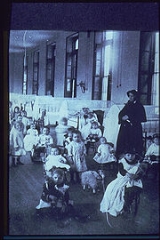
The next stage of adoption’s evolution fell to the emerging nation of the United States. Rapid immigration and the aftermath of the American Civil War resulted in unprecedented overcrowding of orphanages and foundling homes in the mid-nineteenth century. Charles Loring Brace, a Protestant minister became appalled by the legions of homeless waifs roaming the streets of New York City. Whether his dismay was caused more by the condition of the children or their impact on the streets, however, is uncertain. Brace considered the abandoned youth, particularly Catholics, to be the most dangerous element challenging the city’s order.
His solution was outlined in The Best Method of Disposing of Our Pauper and Vagrant Children (1859) which started the Orphan Train movement. The orphan trains eventually shipped an estimated 200,000 children from the urban centers of the East to the nation’s rural regions. The children were not generally adopted, but rather indentured to families that took them in. As in times past, some children were raised as members of the family while others were used as farm laborers and household servants.
The sheer size of the displacement—the largest of migration of children in history—and the degree of exploitation that occurred, gave rise to new agencies and a series of laws that promoted adoption arrangements rather than indenture. The hallmark of the period is Minnesota’s adoption law of 1917 which mandated investigation of all placements and limited record access to those involved in the adoption.
During the same period, the Progressive movement swept the United States. The culmination of its efforts to promote child welfare came with the First White House Conference on the Care of Dependent Children called by President Theodore Roosevelt in 1909.. The conference marked the start of the end of the prevailing orphanage system, declaring that children should be placed in family homes, “the highest and finest product of civilization.” Anti-institutional forces gathered momentum. As late as 1923, only two percent of children without parental care were in adoptive homes, with the balance in foster arrangements and orphanages. Less than forty years later, nearly one-third were in an adoptive home.
Nevertheless, the strong eugenic tendencies in Western society at the time put up obstacles to the growth of adoption. There were grave concerns about the genetic quality of illegitimate and indigent children, perhaps best exemplified by the influential writings of Henry H. Goddard who protested against adopting children of unknown origin.
It would take a war and the disgrace of Nazi eugenic policies to alter attitudes. The period 1945 to 1974, the Baby scoop era, saw rapid growth and acceptance of adoption as a means to build a family. The number of illegitimate births rose three-fold as sexual mores changed. Simultaneously, the scientific community began to stress the dominance of nurture over genetics, chipping away at eugenic stigmas. In this environment, adoption became the obvious solution for both unwed mothers and infertile couples.
Taken together, these trends resulted in a new American model for adoption. Following its Roman predecessor, Americans severed the rights of the original parents while making adopters the new parents in the eyes of the law. Two innovations were added, however. First, adoption was formulated as a legal act meant to ensure the "best interests of the child;" the seeds of this idea can be traced to the first American adoption law in Massachusetts, 1851 which mandated that placements consider the welfare of the child. Second, adoption became infused with secrecy, eventually resulting in the sealing of an adopted peoples' adoption and original birth records by 1945. The origin of the move toward secrecy began with Charles Loring Brace who introduced it to prevent children from the Orphan Trains from returning to or being reclaimed by their parents. Brace feared the impact of the parents' poverty and their Catholic religion, in particular, on the youth. This tradition of secrecy was carried on by the later Progressive reformers when drafting of American laws.
The number of adoptions in the United States peaked in 1970. It is uncertain what caused the subsequent decline. Besides the legalization of artificial birth control methods and abortion, the years of the late 1960s and early 1970s saw a dramatic change in society’s view of illegitimacy. In response, family preservation efforts grew so that few children born out of wedlock today are adopted (Refer to Table 1). Ironically, adoption is far more visible and discussed in society today, yet it is less common. This visibility has facilitated the emergence of new innovations—such as open adoption—and calls for unsealing records. These contemporary movements are described in the remainder of the article.
| Race | Before 1973 | 1973-1981 | 1982-1988 | 1989-1995 | 1996-2002 |
|---|
| All Women | 8.7% | 4.1% | 2.0% | 0.9% | 1.0% | | Black Women | 1.5% | 0.2% | 1.1% | 0.0% | NA | | White Women | 19.3% | 7.5% | 3.2% | 1.7% | 1.3% | |
Table 1: Percentage of Infants (Born to Never-Married Women) Who Were Relinquished
The American model of adoption eventually proliferated globally. England and Wales established their first formal adoption law in 1926. Holland passed its law in 1956. Sweden made adoptees full members of the family in 1959. West Germany enacted its first laws in 1977. Additionally, the Asian powers opened their orphanage systems to adoption, influenced as they were by western ideas following colonial rule and military occupation.
Although adoption is practiced globally today, the United States remains the leader in its use. The table below provides a snapshot of Western adoption rates. Adoption in the United States still occurs at nearly three times those of its peers although the number of children awaiting adoption has held steady in recent years, hovering between 133,000 to 129,000 during the period 2002 to 2006.
| Country | Adoptions | Live Births | Adoption/Live Birth Ratio | Notes |
|---|
| Australia | 443 (2003-2004) | 254,000 (2004) | 0.2 per 100 Live Births | Includes known relative adoptions | | England & Wales | 4,764 (2006) | 669,601(2006) | 0.7 per 100 Live Births | Includes all adoption orders in England and Wales | | Iceland | between 20-35 year | 4,560 (2007) | 0.8 per 100 live births | | Ireland | 263 (2003) | 61,517 (2003) | 0.4 per 100 Live Births | 92 non-family adoptions; 171 family adoptions (e.g. stepparent). 459 international adoptions were also recorded. | | Italy | 3,158 (2006) | 560,010 (2006) | 0.6 per 100 Live Births | | Norway | 657 (2006) | 58,545(2006) | 1.1 per 100 Live Births | Adoptions breakdown: 438 inter-country; 174 stepchildren; 35 foster; 10 other. | | Sweden | 1044(2002) | 91,466(2002) | 1.1 per 100 Live Births | 10-20 of these were national adoptions of infants. The rest were international adoptions. | | United States | approx 127,000 (2001) | 4,021,725 (2002) | ~3 per 100 Live Births | The number of adoptions is reported to be constant since 1987. | |
Table 2: Adoptions, Live Births, and Adoption/Live Birth Ratios are provided in the table below (alphabetical, by country) for a number of Western countries
Contemporary adoption
Forms of adoption
Contemporary adoption practices can be divided into two forms: 1) Open and 2) Closed.
Open adoption, or fully disclosed adoption, allows identifying information to be communicated between adoptive and biological parents and, perhaps, interaction between kin and the adopted person. Communication may include letters, emails, telephone calls, or visits. Arrangements regarding contact are typically informal and could be terminated since, in an open adoption, adoptive parents have sole authority over the child. Although such informal arrangements are more common, in some jurisdictions, the biological and adoptive parents may enter into a binding agreement concerning visitation, exchange of information, or other interaction regarding the child. Importantly, open adoption is sometimes the outgrowth of laws which maintain an adoptee's right to unaltered birth certificates and/or adoption records. Such access is far from universal, but a few jurisdictions -including the U.K. and a handful of States in the U.S - do not abridge the rights of adoptees in these matters.
The practice of closed adoption, in contrast, bars all identifying information from being shared between adoptive parents, biological kin, and adoptee. Closed adoption, normally does not stop exchange of non-identifying information such information as medical history and religious and ethnic background. Closed adoption has been the norm for most of modern history. Today, as a result of safe haven laws passed by some U.S. states, it is seeing renewed influence. Under such safe-haven laws, infants can be left at any nearby hospital, fire department, or police station within a few days of birth, with no questions asked. Such laws have been criticized by adoptee advocacy organizations as being retrograde and dangerous.
Both open and closed adoptions occur through three means:
1) Private Domestic Adoptions: in this arrangement a non-governmental organization, within the same country, takes responsibility for taking in and placing children. These organizations may be both non-profit and for-profit entities and account for a significant portion of all adoptions. For example, in the United States, nearly 45% of adoptions are estimated to have occurred through private arrangements, including agency placement and kin.
2) Foster care adoption: this is a type of domestic adoption where a child is initially placed into public care. Its importance as an avenue for adoption varies by country. Nevertheless, the example of the United States is instructive. Of the 127,500 adoptions that occurred in the U.S. about 51,000 or 40% were through the foster care system.
3) International adoption: is the placing of a child for adoption outside that child’s country of birth. This can occur through both public and private agencies. In some countries, such as Sweden, these adoptions account for the majority of cases (see above Table). The U.S. example, however, indicates wide variation by country; adoptions from abroad account for less than 15% of its cases. The laws of different countries vary in their willingness to allow international adoptions. Recognising the difficulties and challenges associated with international adoption, and in an effort to protect those involved from the corruption and exploitation which sometimes accompanies it, the Hague Conference on Private International Law developed the , which came into force on 1 May 1995 and has been ratified by 75 countries, to date.
How adoptions originate
Adoption occurs between related family members and unrelated individuals. Historically, most adoptions occurred within a family. The most recent data from the U.S. indicates about half of adoptions are currently between related individuals. . A common example of this is a "stepparent adoption", where the new partner of a parent may legally adopt a child from the parent's previous relationship. Intra-family adoption can also occur through surrender, as a result of parental death, or when the child cannot otherwise be cared for and a family member agrees to take over.
Infertility is the main reason parents seek to adopt children they are not related to. One study shows this accounted for 80% of unrelated infant adoptions and half of adoptions through foster care. Estimates suggest that 11%-24% of Americans who cannot conceive or carry to term attempt to build a family through adoption, and that the overall rate of ever-married American women who adopt is about 1.4%. Other reasons people adopt are numerous although not well documented. These may include wanting to cement a new family following divorce or death of one parent, compassion motivated by religious or philosophical conviction, to avoid contributing to perceived overpopulation out of the belief that it is more responsible to care for otherwise parent-less children than to reproduce, to ensure inheritable diseases (e.g., Tay-Sachs disease) are not passed on, and health concerns relating to pregnancy and childbirth. Although there are a range of possible reasons, the most recent study of women who adopt experiences suggests they are most likely to be 40-44 years of age, currently married, have impaired fertility, and childless.
Parenting adopted children
Biological ties are the hallmark of parent-child relationships, and its absence has caused concern throughout the history of adoption. Nevertheless, there is evidence that adoptive relationships can form along other lines. A study evaluating the importance of biology for parental investment indicates strength in adoptive families, suggesting that parents who adopt invest more time in their children than other parents and concludes, "...adoptive parents enrich their children's lives to compensate for the lack of biological ties and the extra challenges of adoption."
Research indicates the perception of similarities between adoptive parent and child is important to successfully parenting. In relationships marked by sameness rather than difference in likes, personality, and appearance, both adult adoptees and adoptive parents report being happier.. Beyond that, the unique questions posed for adoptive parents are varied. They include how to respond to stereotypes, answering questions about heritage, and how best to maintain connections with biological kin when in an open adoption.
Adopting older children presents other parenting issues. Some children from foster care have histories of maltreatment, such as physical and psychological neglect, physical abuse, and sexual abuse, are at risk of developing psychiatric problems. Such children are at risk of developing a disorganized attachment. Studies by Cicchetti et al (1990, 1995) found that 80% of abused and maltreated infants in their sample exhibited disorganized attachment styles.
Disorganized attachment is associated with a number of developmental problems, including dissociative symptoms, as well as depressive, anxiety, and acting-out symptoms.
A specific concern for many parents is accommodating an adoptee in the classroom. Familiar lessons like "draw your family tree" or "trace your eye color back through your parents and grandparents to see where your genes come from" could be hurtful to children who were adopted and do not know this biological information. Numerous suggestions have been made to substitute new lessons, e.g., focusing on "family orchards."
Public perception of adoption
In Western culture, the dominant conception of family revolves around a heterosexual couple with biological offspring. This idea places alternatives family forms outside the norm. As a consequence, research indicates, disparaging views of adoptive families exist, along with doubts concerning the strength of their family bonds..
and her sister who were adopted into the Travancore Royal Family in 1900]]
The most recent adoption attitudes survey completed by the Evan Donaldson Institute provides further evidence of this stigma. Nearly one-third of the surveyed population believed adoptees are less-well adjusted, more prone to medical issues, and predisposed to drug and alcohol problems. Additionally, 40-45% thought adoptees were more likely to have behavior problems and trouble at school. In contrast, the same study indicated adoptive parents were viewed favorably, with nearly 90% describing them as, “lucky, advantaged, and unselfish.”
The majority of people state that their primary source of information about adoption comes from friends and family and the news media. Nevertheless, most people report the media provides them a favorable view of adoption; 72% indicated receiving positive impressions. There is, however, still substantial criticism of the media's adoption coverage. Adoption blogs, for example, criticized Meet the Robinsons for using outdated orphanage imagery
as did advocacy non-profit The Evan B. Donaldson Adoption Institute.
The stigmas associated with adoption are amplified for children in foster care. Negative perceptions result in the belief that such children are so troubled it would be impossible to adopt them and create “normal” families. The result is that many children who would thrive in a loving family instead wait years in foster care, and even “age out” of the system at 18 without a family. A 2004 report from the Pew Commission on Children in Foster Care has shown that the number of children waiting in foster care doubled since the 1980s and now remains steady at about a half-million a year."
Disruption
Disruption refers to the termination of an adoption. This includes adoptions that end prior to legal finalization and those that end after that point (in U.S. law, the latter cases are referred to as having been dissolved). The Disruption process is usually initiated by adoptive parents via a court petition and is analgous to divorce proceedings. It is a legal avenue unique to adoptive parents as disruption/dissolution does not apply to biological kin.
No known official statistics track the number of disruptions in any country, however, some ad hoc studies have been performed in the U.S. These suggest that between 10-25 percent of adoptions disrupt before they are legally finalized and from 1-10 percent are dissolved after legal finalization. The ranges vary widely not only due to the paucity of information on the subject but also because of demographic factors such as age; it is known that older children are more prone to having their adoptions disrupted.
Reform and reunion trends Adoption practices have significantly changed over the course of the last century, with each new movement labeled, in some way, reform. Beginning in the 1970s efforts to improve adoption became associated with opening records and encouraging family preservation. These ideas arose from suggestions that the secrecy inherent in modern adoption may influence the process of forming an identity, create confusion regarding genealogy,, and provide little in the way of medical history.
Family preservation: As concerns over illegitimacy began to subside in the early 1970s, social-welfare agencies began to emphasize that, if possible, mothers and children should be kept together.. In America, this was clearly illustrated by the shift in policy of the New York Foundling Home, an adoption-institution that is among the country’s oldest and one that had pioneered sealed records. It established three new principles including, “to prevent placements of children (in institutions or foster care).” This reflected the belief that children would be better off staying in their own families and communities. It was a striking shift in policy that remains in force today.
Open records: Movements to unseal adoption records for adopted citizen proliferated along with the cultural shift on illegitimacy. In the United States, Florence Fisher created the Adoptees’ Liberty Movement Association (ALMA) in 1971, calling sealed records “an affront to human dignity.” Her effort was among the first to demand unsealed records.. In 1975, Emma May Vilardi created the first mutual-consent registry, the International Soundex Reunion Registry (ISRR), allowing those separated by adoption to locate one another via mutual registration. Similar ideas took hold globally. In 1975, England and Wales opened records on moral grounds. Later years saw the evolution of more militant organizations such as Bastard Nation (founded in 1996) which helped overturn sealed records in Alabama, Delaware, New Hampshire, Oregon and Tennessee. . Simultaneously, groups such as Origins USA (founded in 1997) started to actively speak about family preservation and the rights of mothers.
The intellectual tone of these recent reform movements was influenced by the publishing of The Primal Wound by Nancy Verrier. "Primal wound" is described as the "devastation which the infant feels because of separation from its birth mother. It is the deep and consequential feeling of abandonment which the baby adoptee feels after the adoption and which may continue for the rest of his life."
Reform and family preservation efforts have also been strongly associated with the perceived mis-use of adoption in aboriginal cultures. In some cases, parents' rights have been terminated when their ethnic or cultural group has been deemed unfit by the controlling government. Historically, the Stolen Generation of Aboriginal people in Australia were affected by such policies, as were Native Americans in the United States and First Nations of Canada. Moreover, unwed mothers in many countries still are (and in many more countries used to be) pressured or forced by families, religious bodies or governments to relinquish their children for adoption, due to the social stigma attached to illegitimacy. These practices of the past have become emotionally-charged social and political issues in recent years, and many cases the policies have changed. The United States, for example, now has the 1978 Indian Child Welfare Act, which allows the tribe and family of a Native American child to be involved in adoption decisions, with preference being given to adoption within the child's tribe.
Reunion Some people influenced by adoption have a desire to reunite. This has the led to the emergence of formal search systems such as the Adoption reunion registry as well as informal search movements. Estimates for the extent of search behavior by adoptees have proven elusive as studies show significant variation. Even looking at the number of adoptees in search organizations is unhelpful since it is impossible to determine the number of independent searchers. In part, the problem stems from the fact that the studies to date have been non-random surveys; the small adoptee population makes random surveying difficult if not impossible. Nevertheless, some indication of the level of search interest by adoptees can be gleaned from the case of England and Wales which opened adoptees' birth records in 1975. In 2001, the UK Office for National Statistics, projected that the percentage of adoptees who would eventually request a copy of their original birth records was 25% for male adoptees, 40% for female adoptees, and 33% for all adoptees. These values are known to underestimate the true search rate, however, as many adoptees are known to get their records by other means. Nevertheless, the request rate has exceeded original projections made in 1975 when it was believed that only a small fraction of adoptees would request their records.
The research literature states adoptees give four reasons for desiring reunion: 1) they wish for a more complete genealogy, 2) they are curious about events leading to their conception, birth, and relinquishment, 3) they hope to pass on information to their children, and 4) they have a need for a detailed biological background, including medical information. Nevertheless, it is speculated by adoption researchers that the reasons given are incomplete since although information could be communicated by a third-party, interviews with adoptees, who sought reunion, found they expressed a need to actually meet biological relations. Along these lines, it appears that the desire for reunion is linked to the adoptee’s interaction with and acceptance within the community. Internally-focused theories suggest some adoptees possess ambiguities in their sense of self, impairing their ability to present a consistent identity. Reunion helps resolve the lack of self-knowledge that creates this issue. Externally-focused theories, in contrast, suggest that reunion is a way for adoptees to overcome social stigma. First proposed by Goffman, the theory has three parts: 1) adoptees perceive the absence of biological ties as distinguishing their adoptive family from others, 2) this understanding is strengthened by experiences where non-adoptees suggest adoptive ties are weaker than blood ties, 3) together, these factors engender, in some adoptees, a sense of social exclusion, and 4) these adoptees react by searching for a blood tie that reinforces their membership in the community. It is important to note, that, at least, the externally-focused rationale for reunion suggests adoptees may be well adjusted and happy within their adoptive families, but will search as an attempt to resolve experiences of social stigma.
Some adoptees reject the idea of reunion. It is unclear, though, what differentiates adoptees who search from those who do not. One paper summarizes the research, stating, “…attempts to draw distinctions between the searcher and non-searcher are no more conclusive or generalizable than attempts to substantiate…differences between adoptees and nonadoptees.
In sum, reunions can bring a variety of issues for adoptees and parents. Nevertheless, most reunion results appear to be positive. In the largest study to date (based on the responses of 1,007 adoptees and relinquishing parents), 90% responded that reunion was a beneficial experience. This does not, however, imply ongoing relationships were formed between adoptee and parent nor that this was the goal.
The language of adoption The language used in adoption is changing and evolving, and it has become a controversial issue tied closely to reform efforts. The controversy arises over the use of terms which, while designed to be more appealing or less offensive to some persons affected by adoption, may simultaneously cause offense or insult to others. This controversy illustrates the problematic nature of adoption, as well as the fact that coining new words and phrases to describe ancient social practices does not alter the feelings and experiences of those affected by them.
The two contrasting sets of terms are commonly referred to as "Positive (or Respectful) Adoption Language" and "Honest-Adoption Language."
Positive Adoptive Language (PAL)
It is believed that social workers in the field of adoption, most notably Marietta Spencer, created and began the promotion of what they termed "Positive Adoption Language" around the mid 1970s.. The terms contained in ""Positive Adoption Language" include the terms "birth mother" (to replace the terms "natural mother" and "first mother"), "placing" (to replace the terms "relinquishment" or "surrender"), and restricting the terms "mother" and "father" to refer solely to the parents who had adopted. It reflects the point of view that (1) all relationships and connections between the adopted child and his/her previous family have been permanently and completely severed once the legal adoption has taken place, and that (2) "placing" a child for adoption is invariably a non-coerced "decision" the mother makes, free of coercion or pressure from external circumstances or agents.
Honest Adoption Language (HAL)
"Honest Adoption Language", on the other hand, refers to a set of terms that reflect the point of view that: (1) family relationships (social, emotional, psychological or physical) that existed prior to the legal adoption often continue past this point or endure in some form despite long periods of separation, and that (2) mothers who have "voluntarily surrendered" children to adoption (as opposed to involuntary terminations through court-authorized child-welfare proceedings) seldom view it as a choice that was freely made, but instead describe scenarios of powerlessness, lack of resources, and overall lack of choice. It also reflects the point of view that the term "birth mother" is derogatory in implying that the woman has ceased being a mother after the physical act of giving birth. Proponents of HAL liken this to the mother being treated as a "breeder" or "incubator".. Terms included in HAL include the original terms that were used before PAL, including "natural mother," "first mother," and "surrendered for adoption."
Cultural variations in adoption Attitudes and laws regarding adoption vary greatly. Whereas all cultures make arrangements whereby children whose own parents are unavailable to rear them to be brought up by others, not all cultures have the concept of adoption, that is treating children who are adopted as though they were the biological children of the adoptive parents. In true adoption, the children inherit the ascribed status of the adoptive parents (i.e., like biological children, they inheit aristocratic rank or tribal membership) and the same legal rights as biological children (i.e., if the parent dies intestate, they inherit on the same basis as biological offspring.)
See also
- Category:Adoptees
Further reading
- Rosenberg, Elinor B., , New York : Free Press ; Toronto : Maxwell Macmillan Canada ; New York : Maxwell Macmillan International, 1992. ISBN 0029270553.
External links
|
| |
|
|