
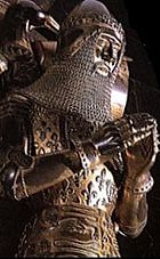
An
effigy is a representation of a person, especially in the form of
sculptureSculpture is three-dimensional artwork created by shaping or combining hard materials—typically stone such as marble—or metal, glass, or wood. Softer materials can also be used, such as clay, textiles, plastics, polymers and softer metals...
or some other three-dimensional form.
The term is usually associated with full-length figures of a deceased person depicted in stone or wood on
church monumentA church monument is an architectural or sculptural memorial to a dead person or persons, located within a Christian church. It can take various forms, from a simple wall tablet to a large and elaborate structure which may include an effigy of the deceased person and other figures of familial or...
s. These most often lie
supineThe supine position is a position of the body: lying down with the face up, as opposed to the prone position, which is face down, sometimes with the hands behind the head or neck. When used in surgical procedures, it allows access to the peritoneal, thoracic and pericardial regions; as well as the...
with hands together in prayer, but may also be recumbent, kneeling in prayer or even standing. Effigies may also be (half) demi-figures and the term is occasionally used to refer to
busts.A bust is a sculpted or cast representation of the upper part of the human figure, depicting a person's head and neck, as well as a variable portion of the chest and shoulders. The piece is normally supported by a plinth. These forms recreate the likeness of an individual...
An effigy can also be a doll burned in order to dispel undesired spirits or to advocate against a person. The burning is meant as a sign of the participants' shared intent to banish the represented element from their lives. The best known
BritishThe United Kingdom of Great Britain and Northern IrelandIn the United Kingdom and Dependencies, other languages have been officially recognised as legitimate autochthonous languages under the European Charter for Regional or Minority Languages...
example is the burning of an effigy made of straw and/or old clothing depicting the 17th century Catholic conspirator,
Guy FawkesGuy Fawkes , also known as Guido Fawkes, the name he adopted while fighting for the Spanish in the Low Countries, belonged to a group of provincial English Catholics who planned the failed Gunpowder Plot of 1605.Fawkes was born and educated in York...
. In the past, criminals sentenced to
death in absentiaDeath in absentia is a legal declaration that a person is deceased in the absence of remains attributable to that person...
might be officially executed "in effigy" as a symbolic act.
Political effigies serve a broadly similar purpose on political
demonstrationsA demonstration or street protest is action by a mass group or collection of groups of people in favor of a political or other cause; it normally consists of walking in a mass march formation and either beginning with or meeting at a designated endpoint, or rally, to hear speakers.Actions such as...
or annual community rituals such as that held in
LewesLewes is the county town of East Sussex, England and historically of all of Sussex. It is a civil parish and is the centre of the Lewes local government district. The settlement has a history as a bridging point and as a market town, and today as a communications hub and tourist-oriented town...
, on the south coast of
EnglandEngland is a country that is part of the United Kingdom. It shares land borders with Scotland to the north and Wales to the west; the Irish Sea is to the north west, the Celtic Sea to the south west, with the North Sea to the east and the English Channel to the south separating it from continental...
. In Lewes, models of important or unpopular figures in current affairs are burned on
Bonfire NightGuy Fawkes Night, also known as Guy Fawkes Day, Bonfire Night and Firework Night, is an annual commemoration observed on 5 November, primarily in England. Its history begins with the events of 5 November 1605, when Guy Fawkes, a member of the Gunpowder Plot, was arrested while guarding...
, formerly alongside an effigy of the
PopeThe Pope is the Bishop of Rome, a position that makes him the leader of the worldwide Catholic Church . In the Catholic Church, the Pope is regarded as the successor of Saint Peter, the Apostle...
.
The word comes from the Latin, and originally was used in the plural only—even a single image was "the effigies of ...". The word occurs in Shakespeare's
As You Like ItAs You Like It is a pastoral comedy by William Shakespeare believed to have been written in 1599 or early 1600 and first published in the folio of 1623. The play's first performance is uncertain, though a performance at Wilton House in 1603 has been suggested as a possibility...
of 1600 (II, vii, 193), though it first appears in 1539. "In effigie" was probably understood as a Latin phrase until the 18th century.
External links