

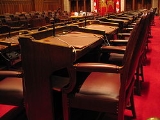
Canadian Senate

Encyclopedia
The Senate of Canada is a component of the Parliament of Canada
, along with the House of Commons
, and the monarch (represented by the Governor General
). The Senate consists of 105 members appointed by the governor general
on the advice
of the prime minister
. Seats are assigned on a regional basis, with each of the four major regions receiving 24 seats, and the remainder of the available seats being assigned to smaller regions. The four major regions are: Ontario
, Quebec, the Maritime provinces, and the Western provinces
. The seats for Newfoundland and Labrador
, the Northwest Territories
, Yukon
, and Nunavut
are assigned apart from these regional divisions. Senators may serve until they reach the age of 75.
The Senate is the upper house
of Parliament
, and the House of Commons
is the lower house
. This does not, however, imply that the Senate is more powerful than the House of Commons, merely that its members and officers outrank the members and officers of the House of Commons in the order of precedence
for the purposes of protocol. Indeed, as a matter of practice and custom, the Commons is by far the dominant chamber. Although the approval of both houses is necessary for legislation, the Senate rarely rejects bills
passed by the directly elected Commons. Moreover, the government
is responsible solely to the House of Commons; the Prime Minister of Canada
and Cabinet
stay in office only while they retain the confidence of the Commons. The Senate does not exercise any such control. Although legislation can normally be introduced in either house, the majority of government bills originate in the House of Commons. Under the Constitution
, money bill
s must always originate in the House of Commons.
on Parliament Hill
, which is located in Ottawa
, Ontario.
The chamber in which the Senate sits is sometimes called the red chamber, due to the red cloth that adorns the chamber as well as the throne
. The red Senate Chamber is lavishly decorated, in contrast with the more modest green Commons Chamber. This decorative scheme is inherited from the British Houses of Parliament
, where the Lords chamber
is a lavish room with red benches, whereas the Commons chamber
is more sparsely decorated and is furnished in green.
There are chairs and desks on both sides of the chamber, divided by a centre aisle. The speaker's chair is at one end of the chamber; in front of it is the clerk's table. Various clerks sit at the table, ready to advise the speaker and the senators on procedure when necessary. Members of the government sit on the benches on the speaker's right, while members of the opposition occupy the benches on the speaker's left.
The Canadian Heraldic Authority
on April 15, 2008, granted the Senate, as an institution, a heraldic achievement
composed of the chamber's mace (representing the Queen's authority in the upper chamber) behind the escutcheon of the Royal Arms of Canada (representing the Queen herself, in whose name the Senate deliberates).
 The governor general
holds the power to appoint senators, although, in modern practice, he or she makes appointments only on the advice of the prime minister
. Senators originally held their seats for life
; however, under the British North America Act, 1965 (now known as the Constitution Act, 1965), members, save for those appointed prior to the change
, may not sit in the Senate after reaching the age of 75. Prime ministers normally choose members of their own parties to be senators, though they sometimes nominate independents or members of opposing parties. In practice, a large number of the members of the Senate are ex-Cabinet ministers, ex-provincial premiers
, and other eminent people.
Under the constitution
, each province or territory is entitled to a specific number of Senate seats. The constitution divides Canada into four areas, each with an equal number of senators: 24 for Ontario, 24 for Quebec, 24 for the Maritime provinces (10 each for Nova Scotia
and New Brunswick
, and four for Prince Edward Island
), and 24 for the western provinces
(six each for Manitoba
, British Columbia, Saskatchewan
, and Alberta
). Newfoundland and Labrador
, which became a province in 1949, is not assigned to any division, and is represented by six senators, while the three territories (the Northwest Territories
, the Yukon
, and Nunavut
) are allocated one senator each. Quebec senators are the only ones to be assigned to specific districts within their province. Historically, this was adopted to ensure that both French and English-speaking senators from Quebec were represented appropriately in the Senate.
Like most other upper-houses worldwide, the Canadian formula does not use representation by population as a primary criterion for member selection, since this is already done for the lower house. Rather, the intent when the formula was struck was to achieve a balance of regional interests and to provide a house of "sober second thought" to check the power of the lower house when necessary. Therefore, the largest province (Ontario) and two Western provinces that were not populous at their accession to the federation and that are within a region are currently under-represented, while the Maritimes are the opposite. For example, British Columbia, with a current population of about four million, has been historically entitled to six senators, while Nova Scotia, with a current population of fewer than one million, has been entitled to 10. Only Quebec currently has a share of senators approximately proportional to its share of the total population.
A senator's seat automatically becomes vacant if he or she fails to attend the Senate for two consecutive parliamentary sessions. Furthermore, senators lose their seats if they are found guilty of treason
, an indictable offence
, or any "infamous crime"; are declared bankrupt or insolvent; or cease to be qualified.
There exists a constitutional provision, Section 26 of the Constitution Act, 1867, under which the Queen may approve the appointment of four or eight extra senators, equally divided amongst the four regions. Appointments are made by the monarch on prime ministerial advice, exactly as with normal senatorial appointments. This provision has been successfully used only once in 1990, when Prime Minister Brian Mulroney
sought to ensure the passage of a bill creating the Goods and Services Tax
(GST). The appointment of eight additional senators allowed a slight Tory majority. The only other attempt to use Section 26, by Prime Minister Alexander Mackenzie
in 1874, was denied by Queen Victoria
, on the advice of the British Cabinet. This clause does not result in a permanent increase in the number of Senate seats, however – instead, an attrition
process is applied by which senators leaving office through normal means are not replaced until their province has returned to its normal number of seats.
Since 1989, the voters of Alberta have elected "senators-in-waiting"
, or nominees for the province's Senate seats. These elections, however, are not held pursuant to any federal constitutional or legal provision; thus, the prime minister is not bound to recommend the nominees for appointment. Only two senators-in-waiting have actually been appointed to the Senate: The first was Stan Waters, who was appointed in 1990 on the recommendation of Brian Mulroney (Waters died in 1991); the second was Bert Brown
, elected a senator-in-waiting in 1998 and 2004, and appointed to the Senate in 2007 on the recommendation of Prime Minister Stephen Harper
. In May 2008, the government of Saskatchewan
announced plans to hold similar elections.
The base annual salary of each senator, as of 2010, is $
132,300; members may receive additional salaries in right of other offices they hold (for instance, the Speakership
). Senators rank immediately above Members of Parliament in the order of precedence
.
The Constitution Act, 1867, also sets property qualifications for senators. A senator must possess land worth at least $4,000 in the province for which he or she is appointed. Moreover, a senator must own real
and personal property
worth at least $4,000 (adjusted for inflation this number could be estimated between $175,000 and $200,000 in current dollars), above his or her debts and liabilities. These property qualifications were originally introduced to ensure that the Senate represented Canada's economic and social élite. Now, however, the sum in question is far less valuable due to the effects of inflation. Nevertheless, the property qualification has never been abolished or amended, and initially caused problems with the 1997 Senate appointment of Sister Peggy Butts
, a Catholic nun who had taken a vow of poverty. (The situation was resolved when her order formally transferred a small parcel of land to her name.)
The original Constitution of Canada did not explicitly bar women from sitting as senators. However, until the end of the 1920s, only men had been appointed to the body. In 1927, five Canadian women ("The Famous Five
") requested the Supreme Court of Canada
to determine whether females were eligible to become senators. Specifically, they asked whether women were considered "persons" under the British North America Act, 1867, which provided: "The Governor General shall ... summon qualified Persons to the Senate; and ... every Person so summoned shall become and be a Member of the Senate and a Senator." In Edwards v. Canada (Attorney General) (commonly known as the "Persons Case"), the Supreme Court unanimously held that women could not become senators. The court based its decision on the grounds that the framers of the Constitution did not foresee female senators, as women did not participate in politics at the time; moreover, they pointed to the constitution's use of the pronoun "he" when referring to senators. On appeal, however, the Judicial Committee of the Privy Council
(effectively Canada's highest court at the time) ruled that women were indeed "persons" in the meaning of the Constitution. Four months later, the government of Prime Minister William Lyon Mackenzie King
recommended for appointment Canada's first female senator, Cairine Wilson
of Ontario.
Notes:
The speaker presides over sittings of the Senate and controls debates by calling on members to speak. If a senator believes that a rule (or standing order) has been breached, he or she may raise a "point of order," on which the speaker makes a ruling. However, the speaker's decisions are subject to appeal to the whole Senate. When presiding, the speaker remains impartial, though he or she still maintains membership in a political party. Unlike the speaker of the House of Commons, the speaker of the Senate does not hold a casting vote, but instead retains their right to vote in the same manner as any other senator (see Procedure below). The current speaker of the Senate
is Noël A. Kinsella.
The member of the government responsible for steering legislation through the Senate is Leader of the Government in the Senate. The leader is a senator selected by the prime minister, and serves in Cabinet. The leader manages the schedule of the Senate, and attempts to secure the opposition's support for the government's legislative agenda. The opposition equivalent is the leader of the opposition in the Senate
, who is selected by his or her counterpart in the House, the leader of the opposition
. However, if the Official Opposition in the House is a different party than the Official Opposition in the Senate (as is currently the case), then the Senate party chooses its own leader.
Officers of the Senate who are not members include the clerk, the deputy clerk, the law clerk, and several other clerks. These officers advise the speaker and members on the rules and procedure of the Senate. Another officer is the usher of the black rod
, whose duties include the maintenance of order and security within the Senate chamber. The usher of the black rod bears a ceremonial black ebony
staff, from which the title "black rod" arises. This position is roughly analogous to that of sergeant-at-arms in the House of Commons, but the usher's duties are more ceremonial in nature. The responsibility for security and the infrastructure lie with the Director General of Parliamentary Precinct Services.
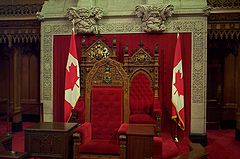
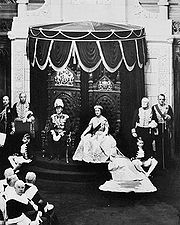 The Senate Chamber is the site of the opening of Parliament
, a formal ceremony held at the beginning of each new parliamentary session. During the ceremony, the governor general, seated on the throne in the Senate Chamber and in the presence of both Houses of Parliament, delivers a speech (Speech from the Throne, or more colloquially, the Throne Speech), outlining the government's agenda for the upcoming parliamentary session. If the sovereign is present in Canada, he or she may make the speech from the throne instead.
Under the Rules of the Senate, the Senate sits Mondays to Fridays. Sittings of the Senate are open to the public, and are transcribed verbatim in the Debates of the Senate, although at times matters of particular interest have been broadcast.
The Constitution Act, 1867
, establishes a quorum
of 15 members (including the member presiding) for the Senate. Any senator may request the speaker to ascertain the presence of a quorum; if it does not appear that one is present, the speaker orders bells to be rung, so that other senators on the parliamentary precincts may come to the chamber. If a quorum still does not appear, the speaker must adjourn the Senate until the next sitting day.
During debates, the first senator to rise is entitled to make the next speech. The speaker may settle disputes over which senator rose first, but his or her decision may be altered by the Senate. Motions must be moved by one senator and seconded by another before debate may begin; some motions, however, are non-debatable.
Speeches may be made in either of Canada's official languages (English or French). Members must address their speeches to the other senators as a whole, using the phrase "honourable senators" (honorables sénateurs), without directly addressing an individual senator. This is similar to the process in the British House of Lords where all speeches and comments are addressed to "my lords", as well as the Canadian House of Commons, where all comments are addressed to the speaker of the house. The speaker enforces the rules of the Senate during debate. Disregarding the speaker's instructions is considered a severe breach of the rules of the Senate.
No senator may speak more than once on the same question; however, a senator who has moved a substantive motion, proposed an inquiry, or sponsored a bill holds a right of reply that enables them to speak again at the close of debate. In the case of a bill, this right of reply can only be exercised at the second reading debate. The Rules of the Senate prescribe time limits for speeches. The limits depend on the nature of the motion, but are generally about fifteen minutes. However, the leaders of the government and opposition in the Senate are not subject to such time constraints. Debate may be further restricted by the passage of "time allocation" motions. Alternatively, the Senate may end debate more quickly by passing a motion "for the previous question." If such a motion carries, debate ends immediately, and the Senate proceeds to vote. Debate may also end if no senator wishes to make any further remarks.
When the debate concludes, the motion in question is put to a vote. The Senate first votes by voice vote; the presiding officer puts the question, and members respond either "yea" (in favour of the motion) or "nay" (against the motion). The presiding officer then announces the result of the voice vote, but two or more senators may challenge his or her assessment, thereby forcing a recorded vote (known as a division
). First, members in favour of the motion rise, so that the clerks may record their names and votes. The same procedure is then repeated for members who oppose the motion, and thereafter repeated again for those who wish to abstain. In all cases, the speaker holds a vote (which is not usually exercised) and votes first when a recorded division is called; a tied vote results in the motion's failure. If the number of members voting, including the presiding officer, does not at least total 15, then a quorum is not present, and the vote is invalid.
The largest of the Senate committees is the Committee of the Whole, which, as the name suggests, consists of all senators. The Committee of the Whole meets in the Chamber of the Senate, but proceeds under slightly modified rules of debate. (For example, there is no limit on the number of speeches a member may make on a particular motion.) The presiding officer is known as the chairman. The Senate may resolve itself into a Committee of the Whole for a number of purposes, including to consider legislation, or to hear testimony from individuals. Nominees to be officers of Parliament often appear before Committee of the Whole to answer questions with respect to their qualifications prior to their appointment.
The Senate also has several standing committees, each of which has responsibility for a particular area of government (for example, finance or transport). These committees consider legislation and conduct special studies on issues referred to them by the Senate, and may hold hearings, collect evidence, and report their findings to the Senate. Standing committees consist of between nine and fifteen members each, and elect their own chairmen.
Special committees are appointed by the Senate on an ad hoc basis to consider a particular issue. The number of members for a special committee varies, but the partisan composition would roughly reflect the strength of the parties in the whole Senate. These committees have been struck to study bills (e.g., the Special Senate Committee on Bill C-36 (the Anti-terrorism Act), 2001), or particular issues of concern (e.g., the Special Senate Committee on Illegal Drugs).
Other committees include joint committees, which include both members of the House of Commons and senators. There are presently two joint committees, the Standing Joint Committee on the Scrutiny of Regulations, which considers delegated legislation, and the Standing Joint Committee on the Library of Parliament which advises the two Speakers on the management of the Library. Parliament may also establish Special Joint committees on an ad hoc basis to consider issues of particular interest or importance.
.
In conformity with the British model, the upper house is not permitted to originate bills imposing taxes or appropriating public funds. Unlike in Britain but similar to the United States, this restriction on the power of the Senate is not merely a matter of convention, but is explicitly stated in the Constitution Act, 1867. In addition, the House of Commons may, in effect, override the Senate's refusal to approve an amendment to the Canadian Constitution; however they must wait at least 180 days before exercising this override. Other than these two exceptions, the power of the two Houses of Parliament is theoretically equal; the approval of each is necessary for a bill's passage. In practice, however, the House of Commons is the dominant chamber of Parliament, with the Senate very rarely exercising its powers in a manner that opposes the will of the democratically elected chamber.
The Senate tends to be less partisan and confrontational than the House, and is more likely to come to a consensus on issues. It also often has more opportunity to study proposed bills in detail either as a whole or in committees. This careful review process is why the Senate is still today called the chamber of "sober second thought", though the term has a slightly different meaning than it did when used by John A. Macdonald. The format of the Senate allows it to make many small improvements to legislation before its final reading. Although the Senate rarely vetoes bills from the House of Commons, minor changes proposed by the Senate, to a bill, are usually accepted.
The Senate at times is more active at reviewing, amending, and even rejecting legislation. The late 1980s and early 1990s was one of those periods. During this period the Senate opposed legislation on issues such as the 1988 free trade bill with the U.S. (forcing the Canadian federal election of 1988
), and the Goods and Services Tax
(GST). In the 1990s, the Senate rejected four pieces of legislation: a bill passed by the Commons restricting abortion (C-43), a proposal to streamline federal agencies (C-93), a bill to redevelop the Lester B. Pearson airport
(C-28), and a bill on profiting from authorship as it relates to crime (C-220). The Senate also performs investigative functions. In the 1960s, the Senate authored the first Canadian reports on media concentration with the Special Senate Subcommittee on Mass Media or the Davey Commission, since "appointed senators would be better insulated from editorial pressure brought by publishers"; this triggered the formation of press councils. More recent investigations include the Kirby Commissions on health care (as opposed to the Romanow Commission) and mental health care by Senator Michael Kirby
, and the Final Report on the Canadian News Media in 2006.
In December 2010 the senate rejected Bill C-311
involving greenhouse gas
regulation that would have committed Canada to an 80% reduction in emissions by 2050 and a 25% reduction by 2020. The bill was passed by all the parties except the Conservatives in the House of commons and was rejected by the majority Conservatives in the Senate on a vote of 43 to 32. The only session where actual debate on the bill took place was notable for unprofessional language and partisan political rhetoric.
. Thus, the Senate's oversight of the government is limited.
Most Cabinet ministers are from the House of Commons, rather than the Senate. In particular, every prime minister has been a member of the House of Commons since 1896, with the exception of John Turner
, who became prime minister when his party elected him leader, but whose government was defeated in the subsequent election. (Turner was outside Parliament altogether at the time, and was never a Senator.) Typically, the Cabinet includes only one senator: the leader of the government in the Senate. Occasionally, when the governing party does not include any members from a particular region, Senators are appointed to ministerial positions in order to maintain regional balance in the Cabinet. The most recent example of this was on February 6, 2006, when Stephen Harper
appointed Michael Fortier
to serve as both a senator representing the Montreal
region, where the minority government
had no elected representation, and the Cabinet position of minister of public works and government services. Michael Fortier resigned his Senate seat to run (unsuccessfully) for a House of Commons seat in the 2008 general election
.
passed the British North America Act, uniting the Province of Canada
(which was separated into Quebec
and Ontario
) with Nova Scotia
and New Brunswick
into a single federation, a Dominion called Canada. The Canadian Parliament was based on the Westminster model
(that is, the model of the Parliament of the United Kingdom). Canada's first prime minister
, Sir John A. Macdonald
, described it as a body of "sober second thought" that would curb the "democratic excesses" of the elected House of Commons and provide regional representation. As an upper house on the British parliamentary model, it was not meant to be more than a revising body, or a brake on the House of Commons. Therefore, it was deliberately made an appointed house, since an elected Senate might prove too popular and too powerful, and be able to block the will of the House of Commons.
From 1867 to 1916, the Senate sat in the old Senate Chambers. Lost to the fire that consumed the parliament buildings in 1916, it sat in the mineral room of the what is today the Canadian Museum of Nature
until 1922. It relocated back to Parliament Hill after 1922.
was an appointed chamber from its formation in 1840 until it became an elected house in 1865 and remained as such until it was dissolved in 1867. The federal parliament of Canada first considered reform measures in 1874, and the Senate debated reforming itself in 1909.
There were minor changes in 1965, when a mandatory retirement age for new senators was set at 75 years, and in 1982, when the Senate was given a qualified veto over certain constitutional amendments. While most senators hold their seat until the mandatory age, Andy Thompson stepped down 20 months ahead of his scheduled retirement after critics drew attention to his poor attendance while continuing to draw his salary. It was also the first time that the Senate had voted to suspend one of its members, which prompted his resignation shortly afterwards. The last member of the Senate who served past the age of 75 was John Michael Macdonald
, who had been appointed on the advice of John George Diefenbaker in 1960 and served until his death in 1997 at the age of 91. Orville Howard Phillips
was the last Senator appointed for life to leave the body: he was appointed by Diefenbaker in 1963 and served in the Senate until 1999 when he voluntarily resigned a month before turning 75.
In the 1960s and 1970s discussion of reforming the appointment mechanism resurfaced alongside the Quiet Revolution
and the rise of Western alienation
, usually with the chief goal of making the Senate better represent the provinces in Parliament. It was often suggested that provincial governments should appoint senators, as was done in the United States before the Seventeenth Amendment to the United States Constitution
. Others suggested that senators should be actual members of provincial legislatures, similar to the Bundesrat
of Germany. The 1960s and 1970s discussions also suggested redistributing Senate seats to the growing western provinces
, but formal suggestions for equality of seats between provinces did not occur until 1981. Likewise, schemes to create an elected Senate did not gain widespread support until after 1980, when Prime Minister Pierre Trudeau
enacted the National Energy Program
in the wake of the energy crises of the 1970s. Many Western Canadians then called for a "Triple-E Senate
", standing for "elected, equal, and effective". They believed that allowing equal representation of the provinces, regardless of population, would protect the interests of the smaller provinces and outlying regions.
There have been at least 28 major proposals for constitutional Senate reform since the early 1970s, and all have failed. The Meech Lake Accord
, a series of constitutional amendments proposed by Prime Minister Brian Mulroney
, would have required the federal
government to choose a senator from a list of persons nominated by the provincial government; the accord, however, failed to obtain the requisite unanimous consent of the provincial legislatures. A successor proposal, the Charlottetown Accord
, involved a provision under which the Senate would include an equal number of senators from each province, each elected either by the majority in the relevant provincial legislature or by the majority of voters in the province. This accord was soundly defeated in the referendum held in 1992.
{d
Further proposals for Senate reform have not met with success, partly due to the difficulty in achieving a consensus among provinces. Quebec, in particular, does not want its share of the Chamber's seats diluted.
and the Bloc Québécois
both called for the Senate's abolition.
In theory, the Conservative Party
has committed itself to appointing elected senators. In practice, however, party leader Stephen Harper advised the appointment of Michael Fortier
to both the Senate and to the Cabinet on February 6, 2006, the day the Conservative minority government
took office. (Fortier later resigned his seat in order to seek election to the House of Commons in the 40th General Election
. He was defeated in his attempt.) In 2007, Harper recommended the appointment of Bert Brown
, who was elected in Alberta's
senator in waiting
election. Harper has stated that the Senate "must either change or—like the old upper houses of our provinces—vanish". Under Harper, a large number of vacant seats were left unfilled until just after the prorogation
during the 2008 Canadian parliamentary dispute, when Harper filled the remaining seats rather than risk seeing them filled by any incoming coalition government.
Harper has also promised further reforms beyond electing senators, including limits on how long each senator may sit. To that effect, on May 30, 2006, the government introduced Bill S-4 in the Senate, which would amend the Constitution Act, 1867 to limit the term of a newly appointed senator to eight years. It also provides that current senators may serve out their term to age 75. While appearing before a Senate committee, Harper announced that in the fall 2006, the government would introduce a bill to allow Canadians to elect senators. This bill was announced on December 13, 2006. S-4 died at the end of the first parliamentary session, but was reintroduced with modifications as C-19 in the second session. The bill was reintroduced in 2009 as Bill S-7 with one change: senators appointed between October 14, 2008, and the date the amendment takes effect will remain senators for eight years after the amendment comes into force.
The federal government also introduced Bill C-43 for "the consultation of the electors... in relation to the appointment of senators". "Pending the pursuit of a constitutional amendment... to provide for a means of direct election" the elected candidates will not automatically become senators; they will be presented to the prime minister who retains the choice of whom to recommend to be appointed senator. According to the bill, these "consultations" should be held together with federal or provincial legislative elections (ss. 12–13). The bill makes no changes in the distribution of seats among the provinces. The bill died at the end of the first parliamentary session, but was reintroduced in the second as Bill C-20.
On December 22, 2008 the Prime Minister filled all eighteen vacant Senate seats. It was earlier reported in the Toronto Star
that this action was "to kill any chance of a Liberal-NDP coalition government filling the vacancies next year". The new Senators include broadcasters Pamela Wallin
(for Saskatchewan) and Mike Duffy (for PEI), and Olympic skier Nancy Greene Raine (for BC).
, British Columbia
, Saskatchewan (under the previous NDP government), Nova Scotia
(under the current NDP government), and Manitoba
. Support for Senate reform has traditionally been very strong from the government of Alberta
.
Following the election of the Saskatchewan Party
and the defeat of the Saskatchewan New Democratic Party
, Premier Brad Wall
has announced support for Senate reform, and has promised to hold Senate elections in the province.
BC Premier
Christy Clark
supports the abolition of the Senate, but supports other measures of reform until the Canadian Constitution can be successfully amended to abolish the Canadian Senate. As a result, a private members bill introduced to the BC Legislature
on June 2, 2011 by BC Liberal
MLA John Les
to conduct elections for BC Senate nominees has the support of the Premier and her governing party but has not yet passed into law.
Senator Lowell Murray
Ontario
) and Liberal
Senator Jack Austin
(British Columbia
) introduced an amendment to the Constitution of Canada
to alter the makeup of the Senate. This amendment would enlarge the Senate to 117 members, giving a greater number to the western provinces of British Columbia (12), Alberta (10), Saskatchewan (7), and Manitoba (7), each up from 6. The amendment would also increase the number of divisions to five by separating British Columbia into its own division, and increase the number of additional Senators the Queen
can appoint to five or ten, from four or eight.
The amendment was debated on June 27 and 28, 2006, and then sent to a special committee on Senate Reform. That committee considered the amendment and, on October 26, 2006, endorsed it. On December 11, 2006, Conservative Senator David Tkachuk
proposed an amendment to the proposed constitutional amendment that would provide for twenty-four Senators for British Columbia. This amendment was seconded by Liberal Senator Larry Campbell
. The proposal died on the Order Paper when the writ dropped for the 2008 federal election
.
Parliament of Canada
The Parliament of Canada is the federal legislative branch of Canada, seated at Parliament Hill in the national capital, Ottawa. Formally, the body consists of the Canadian monarch—represented by her governor general—the Senate, and the House of Commons, each element having its own officers and...
, along with the House of Commons
Canadian House of Commons
The House of Commons of Canada is a component of the Parliament of Canada, along with the Sovereign and the Senate. The House of Commons is a democratically elected body, consisting of 308 members known as Members of Parliament...
, and the monarch (represented by the Governor General
Governor General of Canada
The Governor General of Canada is the federal viceregal representative of the Canadian monarch, Queen Elizabeth II...
). The Senate consists of 105 members appointed by the governor general
Governor General of Canada
The Governor General of Canada is the federal viceregal representative of the Canadian monarch, Queen Elizabeth II...
on the advice
Advice (constitutional)
Advice, in constitutional law, is formal, usually binding, instruction given by one constitutional officer of state to another. Especially in parliamentary systems of government, Heads of state often act on the basis of advice issued by prime ministers or other government ministers...
of the prime minister
Prime Minister of Canada
The Prime Minister of Canada is the primary minister of the Crown, chairman of the Cabinet, and thus head of government for Canada, charged with advising the Canadian monarch or viceroy on the exercise of the executive powers vested in them by the constitution...
. Seats are assigned on a regional basis, with each of the four major regions receiving 24 seats, and the remainder of the available seats being assigned to smaller regions. The four major regions are: Ontario
Ontario
Ontario is a province of Canada, located in east-central Canada. It is Canada's most populous province and second largest in total area. It is home to the nation's most populous city, Toronto, and the nation's capital, Ottawa....
, Quebec, the Maritime provinces, and the Western provinces
Western Canada
Western Canada, also referred to as the Western provinces and commonly as the West, is a region of Canada that includes the four provinces west of the province of Ontario.- Provinces :...
. The seats for Newfoundland and Labrador
Newfoundland and Labrador
Newfoundland and Labrador is the easternmost province of Canada. Situated in the country's Atlantic region, it incorporates the island of Newfoundland and mainland Labrador with a combined area of . As of April 2011, the province's estimated population is 508,400...
, the Northwest Territories
Northwest Territories
The Northwest Territories is a federal territory of Canada.Located in northern Canada, the territory borders Canada's two other territories, Yukon to the west and Nunavut to the east, and three provinces: British Columbia to the southwest, and Alberta and Saskatchewan to the south...
, Yukon
Yukon
Yukon is the westernmost and smallest of Canada's three federal territories. It was named after the Yukon River. The word Yukon means "Great River" in Gwich’in....
, and Nunavut
Nunavut
Nunavut is the largest and newest federal territory of Canada; it was separated officially from the Northwest Territories on April 1, 1999, via the Nunavut Act and the Nunavut Land Claims Agreement Act, though the actual boundaries had been established in 1993...
are assigned apart from these regional divisions. Senators may serve until they reach the age of 75.
The Senate is the upper house
Upper house
An upper house, often called a senate, is one of two chambers of a bicameral legislature, the other chamber being the lower house; a legislature composed of only one house is described as unicameral.- Possible specific characteristics :...
of Parliament
Parliament of Canada
The Parliament of Canada is the federal legislative branch of Canada, seated at Parliament Hill in the national capital, Ottawa. Formally, the body consists of the Canadian monarch—represented by her governor general—the Senate, and the House of Commons, each element having its own officers and...
, and the House of Commons
Canadian House of Commons
The House of Commons of Canada is a component of the Parliament of Canada, along with the Sovereign and the Senate. The House of Commons is a democratically elected body, consisting of 308 members known as Members of Parliament...
is the lower house
Lower house
A lower house is one of two chambers of a bicameral legislature, the other chamber being the upper house.Despite its official position "below" the upper house, in many legislatures worldwide the lower house has come to wield more power...
. This does not, however, imply that the Senate is more powerful than the House of Commons, merely that its members and officers outrank the members and officers of the House of Commons in the order of precedence
Canadian order of precedence
The Canadian order of precedence is a nominal and symbolic hierarchy of important positions within the Government of Canada. It has no legal standing but is used to dictate ceremonial protocol....
for the purposes of protocol. Indeed, as a matter of practice and custom, the Commons is by far the dominant chamber. Although the approval of both houses is necessary for legislation, the Senate rarely rejects bills
Bill (proposed law)
A bill is a proposed law under consideration by a legislature. A bill does not become law until it is passed by the legislature and, in most cases, approved by the executive. Once a bill has been enacted into law, it is called an act or a statute....
passed by the directly elected Commons. Moreover, the government
Government of Canada
The Government of Canada, formally Her Majesty's Government, is the system whereby the federation of Canada is administered by a common authority; in Canadian English, the term can mean either the collective set of institutions or specifically the Queen-in-Council...
is responsible solely to the House of Commons; the Prime Minister of Canada
Prime Minister of Canada
The Prime Minister of Canada is the primary minister of the Crown, chairman of the Cabinet, and thus head of government for Canada, charged with advising the Canadian monarch or viceroy on the exercise of the executive powers vested in them by the constitution...
and Cabinet
Cabinet of Canada
The Cabinet of Canada is a body of ministers of the Crown that, along with the Canadian monarch, and within the tenets of the Westminster system, forms the government of Canada...
stay in office only while they retain the confidence of the Commons. The Senate does not exercise any such control. Although legislation can normally be introduced in either house, the majority of government bills originate in the House of Commons. Under the Constitution
Constitution of Canada
The Constitution of Canada is the supreme law in Canada; the country's constitution is an amalgamation of codified acts and uncodified traditions and conventions. It outlines Canada's system of government, as well as the civil rights of all Canadian citizens and those in Canada...
, money bill
Money bill
In the Westminster system , a money bill or supply bill is a bill that solely concerns taxation or government spending , as opposed to changes in public law.- Conventions :...
s must always originate in the House of Commons.
Chamber and symbols
The Senate and the House of Commons sit in separate chambers in the Centre BlockCentre Block
The Centre Block is the main building of the Canadian parliamentary complex on Parliament Hill, in Ottawa, Ontario, containing the Commons and Senate chambers, as well as the offices of a number of Members of Parliament and Senators, as well as senior administration for both legislative houses...
on Parliament Hill
Parliament Hill
Parliament Hill , colloquially known as The Hill, is an area of Crown land on the southern banks of the Ottawa River in downtown Ottawa, Ontario. Its Gothic revival suite of buildingsthe parliament buildings serves as the home of the Parliament of Canada and contains a number of architectural...
, which is located in Ottawa
Ottawa
Ottawa is the capital of Canada, the second largest city in the Province of Ontario, and the fourth largest city in the country. The city is located on the south bank of the Ottawa River in the eastern portion of Southern Ontario...
, Ontario.
The chamber in which the Senate sits is sometimes called the red chamber, due to the red cloth that adorns the chamber as well as the throne
Throne
A throne is the official chair or seat upon which a monarch is seated on state or ceremonial occasions. "Throne" in an abstract sense can also refer to the monarchy or the Crown itself, an instance of metonymy, and is also used in many expressions such as "the power behind the...
. The red Senate Chamber is lavishly decorated, in contrast with the more modest green Commons Chamber. This decorative scheme is inherited from the British Houses of Parliament
Palace of Westminster
The Palace of Westminster, also known as the Houses of Parliament or Westminster Palace, is the meeting place of the two houses of the Parliament of the United Kingdom—the House of Lords and the House of Commons...
, where the Lords chamber
House of Lords
The House of Lords is the upper house of the Parliament of the United Kingdom. Like the House of Commons, it meets in the Palace of Westminster....
is a lavish room with red benches, whereas the Commons chamber
British House of Commons
The House of Commons is the lower house of the Parliament of the United Kingdom, which also comprises the Sovereign and the House of Lords . Both Commons and Lords meet in the Palace of Westminster. The Commons is a democratically elected body, consisting of 650 members , who are known as Members...
is more sparsely decorated and is furnished in green.
There are chairs and desks on both sides of the chamber, divided by a centre aisle. The speaker's chair is at one end of the chamber; in front of it is the clerk's table. Various clerks sit at the table, ready to advise the speaker and the senators on procedure when necessary. Members of the government sit on the benches on the speaker's right, while members of the opposition occupy the benches on the speaker's left.
The Canadian Heraldic Authority
Canadian Heraldic Authority
The Canadian Heraldic Authority is part of the Canadian honours system under the Queen of Canada, whose authority is exercised by the Governor General. The Authority is responsible for the creation and granting of new coats of arms , flags and badges for Canadian citizens, permanent residents and...
on April 15, 2008, granted the Senate, as an institution, a heraldic achievement
Coat of arms
A coat of arms is a unique heraldic design on a shield or escutcheon or on a surcoat or tabard used to cover and protect armour and to identify the wearer. Thus the term is often stated as "coat-armour", because it was anciently displayed on the front of a coat of cloth...
composed of the chamber's mace (representing the Queen's authority in the upper chamber) behind the escutcheon of the Royal Arms of Canada (representing the Queen herself, in whose name the Senate deliberates).
Senators
Governor General of Canada
The Governor General of Canada is the federal viceregal representative of the Canadian monarch, Queen Elizabeth II...
holds the power to appoint senators, although, in modern practice, he or she makes appointments only on the advice of the prime minister
Prime Minister of Canada
The Prime Minister of Canada is the primary minister of the Crown, chairman of the Cabinet, and thus head of government for Canada, charged with advising the Canadian monarch or viceroy on the exercise of the executive powers vested in them by the constitution...
. Senators originally held their seats for life
Senator for life
A senator for life is a member of the senate or equivalent upper chamber of a legislature who has life tenure. , 7 Italian Senators out of 322, 4 out of the 47 Burundian Senators and all members of the British House of Lords have lifetime tenure...
; however, under the British North America Act, 1965 (now known as the Constitution Act, 1965), members, save for those appointed prior to the change
Grandfather clause
Grandfather clause is a legal term used to describe a situation in which an old rule continues to apply to some existing situations, while a new rule will apply to all future situations. It is often used as a verb: to grandfather means to grant such an exemption...
, may not sit in the Senate after reaching the age of 75. Prime ministers normally choose members of their own parties to be senators, though they sometimes nominate independents or members of opposing parties. In practice, a large number of the members of the Senate are ex-Cabinet ministers, ex-provincial premiers
Premier (Canada)
In Canada, a premier is the head of government of a province or territory. There are currently ten provincial premiers and three territorial premiers in Canada....
, and other eminent people.
Under the constitution
Constitution of Canada
The Constitution of Canada is the supreme law in Canada; the country's constitution is an amalgamation of codified acts and uncodified traditions and conventions. It outlines Canada's system of government, as well as the civil rights of all Canadian citizens and those in Canada...
, each province or territory is entitled to a specific number of Senate seats. The constitution divides Canada into four areas, each with an equal number of senators: 24 for Ontario, 24 for Quebec, 24 for the Maritime provinces (10 each for Nova Scotia
Nova Scotia
Nova Scotia is one of Canada's three Maritime provinces and is the most populous province in Atlantic Canada. The name of the province is Latin for "New Scotland," but "Nova Scotia" is the recognized, English-language name of the province. The provincial capital is Halifax. Nova Scotia is the...
and New Brunswick
New Brunswick
New Brunswick is one of Canada's three Maritime provinces and is the only province in the federation that is constitutionally bilingual . The provincial capital is Fredericton and Saint John is the most populous city. Greater Moncton is the largest Census Metropolitan Area...
, and four for Prince Edward Island
Prince Edward Island
Prince Edward Island is a Canadian province consisting of an island of the same name, as well as other islands. The maritime province is the smallest in the nation in both land area and population...
), and 24 for the western provinces
Western Canada
Western Canada, also referred to as the Western provinces and commonly as the West, is a region of Canada that includes the four provinces west of the province of Ontario.- Provinces :...
(six each for Manitoba
Manitoba
Manitoba is a Canadian prairie province with an area of . The province has over 110,000 lakes and has a largely continental climate because of its flat topography. Agriculture, mostly concentrated in the fertile southern and western parts of the province, is vital to the province's economy; other...
, British Columbia, Saskatchewan
Saskatchewan
Saskatchewan is a prairie province in Canada, which has an area of . Saskatchewan is bordered on the west by Alberta, on the north by the Northwest Territories, on the east by Manitoba, and on the south by the U.S. states of Montana and North Dakota....
, and Alberta
Alberta
Alberta is a province of Canada. It had an estimated population of 3.7 million in 2010 making it the most populous of Canada's three prairie provinces...
). Newfoundland and Labrador
Newfoundland and Labrador
Newfoundland and Labrador is the easternmost province of Canada. Situated in the country's Atlantic region, it incorporates the island of Newfoundland and mainland Labrador with a combined area of . As of April 2011, the province's estimated population is 508,400...
, which became a province in 1949, is not assigned to any division, and is represented by six senators, while the three territories (the Northwest Territories
Northwest Territories
The Northwest Territories is a federal territory of Canada.Located in northern Canada, the territory borders Canada's two other territories, Yukon to the west and Nunavut to the east, and three provinces: British Columbia to the southwest, and Alberta and Saskatchewan to the south...
, the Yukon
Yukon
Yukon is the westernmost and smallest of Canada's three federal territories. It was named after the Yukon River. The word Yukon means "Great River" in Gwich’in....
, and Nunavut
Nunavut
Nunavut is the largest and newest federal territory of Canada; it was separated officially from the Northwest Territories on April 1, 1999, via the Nunavut Act and the Nunavut Land Claims Agreement Act, though the actual boundaries had been established in 1993...
) are allocated one senator each. Quebec senators are the only ones to be assigned to specific districts within their province. Historically, this was adopted to ensure that both French and English-speaking senators from Quebec were represented appropriately in the Senate.
Like most other upper-houses worldwide, the Canadian formula does not use representation by population as a primary criterion for member selection, since this is already done for the lower house. Rather, the intent when the formula was struck was to achieve a balance of regional interests and to provide a house of "sober second thought" to check the power of the lower house when necessary. Therefore, the largest province (Ontario) and two Western provinces that were not populous at their accession to the federation and that are within a region are currently under-represented, while the Maritimes are the opposite. For example, British Columbia, with a current population of about four million, has been historically entitled to six senators, while Nova Scotia, with a current population of fewer than one million, has been entitled to 10. Only Quebec currently has a share of senators approximately proportional to its share of the total population.
| Province or Territory | Number of Senators | Population per Senator (2006 census Canada 2006 Census The Canada 2006 Census was a detailed enumeration of the Canadian population. Census day was May 16, 2006. The next census following will be the 2011 Census. Canada's total population enumerated by the 2006 census was 31,612,897... ) |
|---|---|---|
| British Columbia British Columbia British Columbia is the westernmost of Canada's provinces and is known for its natural beauty, as reflected in its Latin motto, Splendor sine occasu . Its name was chosen by Queen Victoria in 1858... |
6 | 685,581 |
| Alberta Alberta Alberta is a province of Canada. It had an estimated population of 3.7 million in 2010 making it the most populous of Canada's three prairie provinces... |
6 | 548,391 |
| Ontario Ontario Ontario is a province of Canada, located in east-central Canada. It is Canada's most populous province and second largest in total area. It is home to the nation's most populous city, Toronto, and the nation's capital, Ottawa.... |
24 | 506,678 |
| Quebec Quebec Quebec or is a province in east-central Canada. It is the only Canadian province with a predominantly French-speaking population and the only one whose sole official language is French at the provincial level.... |
24 | 314,422 |
| Manitoba Manitoba Manitoba is a Canadian prairie province with an area of . The province has over 110,000 lakes and has a largely continental climate because of its flat topography. Agriculture, mostly concentrated in the fertile southern and western parts of the province, is vital to the province's economy; other... |
6 | 191,400 |
| Saskatchewan Saskatchewan Saskatchewan is a prairie province in Canada, which has an area of . Saskatchewan is bordered on the west by Alberta, on the north by the Northwest Territories, on the east by Manitoba, and on the south by the U.S. states of Montana and North Dakota.... |
6 | 161,359 |
| Nova Scotia Nova Scotia Nova Scotia is one of Canada's three Maritime provinces and is the most populous province in Atlantic Canada. The name of the province is Latin for "New Scotland," but "Nova Scotia" is the recognized, English-language name of the province. The provincial capital is Halifax. Nova Scotia is the... |
10 | 91,346 |
| Newfoundland and Labrador Newfoundland and Labrador Newfoundland and Labrador is the easternmost province of Canada. Situated in the country's Atlantic region, it incorporates the island of Newfoundland and mainland Labrador with a combined area of . As of April 2011, the province's estimated population is 508,400... |
6 | 84,244 |
| New Brunswick New Brunswick New Brunswick is one of Canada's three Maritime provinces and is the only province in the federation that is constitutionally bilingual . The provincial capital is Fredericton and Saint John is the most populous city. Greater Moncton is the largest Census Metropolitan Area... |
10 | 72,999 |
| Northwest Territories Northwest Territories The Northwest Territories is a federal territory of Canada.Located in northern Canada, the territory borders Canada's two other territories, Yukon to the west and Nunavut to the east, and three provinces: British Columbia to the southwest, and Alberta and Saskatchewan to the south... |
1 | 41,464 |
| Prince Edward Island Prince Edward Island Prince Edward Island is a Canadian province consisting of an island of the same name, as well as other islands. The maritime province is the smallest in the nation in both land area and population... |
4 | 33,962 |
| Yukon Yukon Yukon is the westernmost and smallest of Canada's three federal territories. It was named after the Yukon River. The word Yukon means "Great River" in Gwich’in.... |
1 | 30,372 |
| Nunavut Nunavut Nunavut is the largest and newest federal territory of Canada; it was separated officially from the Northwest Territories on April 1, 1999, via the Nunavut Act and the Nunavut Land Claims Agreement Act, though the actual boundaries had been established in 1993... |
1 | 29,474 |
| Total/Average | 105 | 301,075 |
A senator's seat automatically becomes vacant if he or she fails to attend the Senate for two consecutive parliamentary sessions. Furthermore, senators lose their seats if they are found guilty of treason
Treason
In law, treason is the crime that covers some of the more extreme acts against one's sovereign or nation. Historically, treason also covered the murder of specific social superiors, such as the murder of a husband by his wife. Treason against the king was known as high treason and treason against a...
, an indictable offence
Indictable offence
In many common law jurisdictions , an indictable offence is an offence which can only be tried on an indictment after a preliminary hearing to determine whether there is a prima facie case to answer or by a grand jury...
, or any "infamous crime"; are declared bankrupt or insolvent; or cease to be qualified.
There exists a constitutional provision, Section 26 of the Constitution Act, 1867, under which the Queen may approve the appointment of four or eight extra senators, equally divided amongst the four regions. Appointments are made by the monarch on prime ministerial advice, exactly as with normal senatorial appointments. This provision has been successfully used only once in 1990, when Prime Minister Brian Mulroney
Brian Mulroney
Martin Brian Mulroney, was the 18th Prime Minister of Canada from September 17, 1984, to June 25, 1993 and was leader of the Progressive Conservative Party of Canada from 1983 to 1993. His tenure as Prime Minister was marked by the introduction of major economic reforms, such as the Canada-U.S...
sought to ensure the passage of a bill creating the Goods and Services Tax
Goods and Services Tax (Canada)
The Goods and Services Tax is a multi-level value added tax introduced in Canada on January 1, 1991, by then Prime Minister Brian Mulroney and his finance minister Michael Wilson. The GST replaced a hidden 13.5% Manufacturers' Sales Tax ; Mulroney claimed the GST was implemented because the MST...
(GST). The appointment of eight additional senators allowed a slight Tory majority. The only other attempt to use Section 26, by Prime Minister Alexander Mackenzie
Alexander Mackenzie
Alexander Mackenzie, PC , a building contractor and newspaper editor, was the second Prime Minister of Canada from November 7, 1873 to October 8, 1878.-Biography:...
in 1874, was denied by Queen Victoria
Victoria of the United Kingdom
Victoria was the monarch of the United Kingdom of Great Britain and Ireland from 20 June 1837 until her death. From 1 May 1876, she used the additional title of Empress of India....
, on the advice of the British Cabinet. This clause does not result in a permanent increase in the number of Senate seats, however – instead, an attrition
Attrition
Attrition may refer to:*Physical wear*Attrition warfare, the military strategy of wearing down the enemy by continual losses in personnel and material*Loss of personnel by Withdrawal...
process is applied by which senators leaving office through normal means are not replaced until their province has returned to its normal number of seats.
Since 1989, the voters of Alberta have elected "senators-in-waiting"
Alberta Senate nominee elections
Alberta is the only Canadian province to elect nominees for appointment to the Senate of Canada in a process known as an Alberta Senate nominee election. These elections are non-binding as the appointment of senators is the jurisdiction of the federal government...
, or nominees for the province's Senate seats. These elections, however, are not held pursuant to any federal constitutional or legal provision; thus, the prime minister is not bound to recommend the nominees for appointment. Only two senators-in-waiting have actually been appointed to the Senate: The first was Stan Waters, who was appointed in 1990 on the recommendation of Brian Mulroney (Waters died in 1991); the second was Bert Brown
Bert Brown
For the English footballer Bert Brown, see Sailor BrownBert Brown is a Canadian Senator and retired farmer and development consultant currently residing in Balzac, Alberta.-Early life:...
, elected a senator-in-waiting in 1998 and 2004, and appointed to the Senate in 2007 on the recommendation of Prime Minister Stephen Harper
Stephen Harper
Stephen Joseph Harper is the 22nd and current Prime Minister of Canada and leader of the Conservative Party. Harper became prime minister when his party formed a minority government after the 2006 federal election...
. In May 2008, the government of Saskatchewan
Saskatchewan
Saskatchewan is a prairie province in Canada, which has an area of . Saskatchewan is bordered on the west by Alberta, on the north by the Northwest Territories, on the east by Manitoba, and on the south by the U.S. states of Montana and North Dakota....
announced plans to hold similar elections.
The base annual salary of each senator, as of 2010, is $
Canadian dollar
The Canadian dollar is the currency of Canada. As of 2007, the Canadian dollar is the 7th most traded currency in the world. It is abbreviated with the dollar sign $, or C$ to distinguish it from other dollar-denominated currencies...
132,300; members may receive additional salaries in right of other offices they hold (for instance, the Speakership
Speaker of the Canadian Senate
The Speaker of the Senate of Canada is the presiding officer of the Senate of Canada. The speaker represents the Senate at official functions, rules on questions of parliamentary procedure and parliamentary privilege, and oversee debates and voting in the red chamber. This position is often...
). Senators rank immediately above Members of Parliament in the order of precedence
Canadian order of precedence
The Canadian order of precedence is a nominal and symbolic hierarchy of important positions within the Government of Canada. It has no legal standing but is used to dictate ceremonial protocol....
.
Qualifications
The Constitution Act outlines the qualifications of senators. Individuals must be both citizens of Canada and at least thirty years of age to be eligible for appointment to the Senate. Senators must also reside in the provinces or territories for which they are appointed.The Constitution Act, 1867, also sets property qualifications for senators. A senator must possess land worth at least $4,000 in the province for which he or she is appointed. Moreover, a senator must own real
Real property
In English Common Law, real property, real estate, realty, or immovable property is any subset of land that has been legally defined and the improvements to it made by human efforts: any buildings, machinery, wells, dams, ponds, mines, canals, roads, various property rights, and so forth...
and personal property
Personal property
Personal property, roughly speaking, is private property that is moveable, as opposed to real property or real estate. In the common law systems personal property may also be called chattels or personalty. In the civil law systems personal property is often called movable property or movables - any...
worth at least $4,000 (adjusted for inflation this number could be estimated between $175,000 and $200,000 in current dollars), above his or her debts and liabilities. These property qualifications were originally introduced to ensure that the Senate represented Canada's economic and social élite. Now, however, the sum in question is far less valuable due to the effects of inflation. Nevertheless, the property qualification has never been abolished or amended, and initially caused problems with the 1997 Senate appointment of Sister Peggy Butts
Peggy Butts
Mary Alice "Peggy" Butts served as a Canadian Senator from September 23, 1997 to August 15, 1999.Born in Glace Bay, Nova Scotia on the Feast of the Assumption, Peggy was a Roman Catholic nun in the Sisters of Notre Dame order. She obtained several degrees, as a B.A. degree in Philosophy, a B.A....
, a Catholic nun who had taken a vow of poverty. (The situation was resolved when her order formally transferred a small parcel of land to her name.)
The original Constitution of Canada did not explicitly bar women from sitting as senators. However, until the end of the 1920s, only men had been appointed to the body. In 1927, five Canadian women ("The Famous Five
The Famous Five (Canada)
The Famous Five or The Valiant Five were five Canadian women who asked the Supreme Court of Canada to answer the question, "Does the word 'Persons' in Section 24 of the British North America Act, 1867, include female persons?" in the case Edwards v...
") requested the Supreme Court of Canada
Supreme Court of Canada
The Supreme Court of Canada is the highest court of Canada and is the final court of appeals in the Canadian justice system. The court grants permission to between 40 and 75 litigants each year to appeal decisions rendered by provincial, territorial and federal appellate courts, and its decisions...
to determine whether females were eligible to become senators. Specifically, they asked whether women were considered "persons" under the British North America Act, 1867, which provided: "The Governor General shall ... summon qualified Persons to the Senate; and ... every Person so summoned shall become and be a Member of the Senate and a Senator." In Edwards v. Canada (Attorney General) (commonly known as the "Persons Case"), the Supreme Court unanimously held that women could not become senators. The court based its decision on the grounds that the framers of the Constitution did not foresee female senators, as women did not participate in politics at the time; moreover, they pointed to the constitution's use of the pronoun "he" when referring to senators. On appeal, however, the Judicial Committee of the Privy Council
Judicial Committee of the Privy Council
The Judicial Committee of the Privy Council is one of the highest courts in the United Kingdom. Established by the Judicial Committee Act 1833 to hear appeals formerly heard by the King in Council The Judicial Committee of the Privy Council (JCPC) is one of the highest courts in the United...
(effectively Canada's highest court at the time) ruled that women were indeed "persons" in the meaning of the Constitution. Four months later, the government of Prime Minister William Lyon Mackenzie King
William Lyon Mackenzie King
William Lyon Mackenzie King, PC, OM, CMG was the dominant Canadian political leader from the 1920s through the 1940s. He served as the tenth Prime Minister of Canada from December 29, 1921 to June 28, 1926; from September 25, 1926 to August 7, 1930; and from October 23, 1935 to November 15, 1948...
recommended for appointment Canada's first female senator, Cairine Wilson
Cairine Wilson
Cairine Reay Mackay Wilson was Canada's first female senator.-Early life:Born Cairine Reay Mackay in Montreal, she was the daughter of Jane Mackay and Robert Mackay, a Liberal Senator and personal friend of Sir Wilfrid Laurier. She attended Elmwood School and was "head girl" in her graduating year...
of Ontario.
Current composition
| Affiliation | Senators |
|
| Conservative Party Conservative Party of Canada The Conservative Party of Canada , is a political party in Canada which was formed by the merger of the Canadian Alliance and the Progressive Conservative Party of Canada in 2003. It is positioned on the right of the Canadian political spectrum... |
54 | |
| Liberal Party Liberal Party of Canada The Liberal Party of Canada , colloquially known as the Grits, is the oldest federally registered party in Canada. In the conventional political spectrum, the party sits between the centre and the centre-left. Historically the Liberal Party has positioned itself to the left of the Conservative... |
43 | |
| Progressive Conservative Progressive Conservative Party of Canada The Progressive Conservative Party of Canada was a Canadian political party with a centre-right stance on economic issues and, after the 1970s, a centrist stance on social issues.... 1 |
1 | |
| Independent | 2 | |
| Vacant | 5 | |
| Total | 105 | |
Notes:
- 1 When the Progressive Conservative Party merged with the Canadian Alliance to form the Conservative Party of Canada in 2004, all but three PC senators became Conservative senators. Two additional senators who chose to sit as "Progressive Conservatives" were appointed on the recommendation of Liberal Prime Minister Paul Martin over one year after the merger occurred, giving the PC caucus official status in the Senate. Subsequently, one of the five PC senators died in December 2005, another joined the Conservative caucus in March 2006, and the retirements of Norman Atkins in 2009 and Lowell Murray in 2011 reduced the number of PC Senators to one.
Officers
The presiding officer of the Senate, known as the speaker, is appointed by the governor general on the advice of the prime minister. The speaker is assisted by a speaker pro tempore (or speaker for the time-being), who is elected by the Senate at the beginning of each parliamentary session. If the speaker is unable to attend, the speaker pro tempore presides instead. Furthermore, the Parliament of Canada Act, authorizes the speaker to appoint another senator to take his or her place temporarily.The speaker presides over sittings of the Senate and controls debates by calling on members to speak. If a senator believes that a rule (or standing order) has been breached, he or she may raise a "point of order," on which the speaker makes a ruling. However, the speaker's decisions are subject to appeal to the whole Senate. When presiding, the speaker remains impartial, though he or she still maintains membership in a political party. Unlike the speaker of the House of Commons, the speaker of the Senate does not hold a casting vote, but instead retains their right to vote in the same manner as any other senator (see Procedure below). The current speaker of the Senate
Speaker of the Canadian Senate
The Speaker of the Senate of Canada is the presiding officer of the Senate of Canada. The speaker represents the Senate at official functions, rules on questions of parliamentary procedure and parliamentary privilege, and oversee debates and voting in the red chamber. This position is often...
is Noël A. Kinsella.
The member of the government responsible for steering legislation through the Senate is Leader of the Government in the Senate. The leader is a senator selected by the prime minister, and serves in Cabinet. The leader manages the schedule of the Senate, and attempts to secure the opposition's support for the government's legislative agenda. The opposition equivalent is the leader of the opposition in the Senate
Leader of the Opposition in the Senate (Canada)
In Canada, the Leader of the Official Opposition in the Senate is the leader of the senate caucus of the largest party in the Senate that is not in government. The position is appointed by the leader of the party that forms the opposition in the Senate...
, who is selected by his or her counterpart in the House, the leader of the opposition
Leader of the Opposition (Canada)
The Leader of Her Majesty's Loyal Opposition , or simply the Leader of the Opposition is the leader of Canada's Official Opposition, the party with the most seats in the House of Commons that is not a member of the government...
. However, if the Official Opposition in the House is a different party than the Official Opposition in the Senate (as is currently the case), then the Senate party chooses its own leader.
Officers of the Senate who are not members include the clerk, the deputy clerk, the law clerk, and several other clerks. These officers advise the speaker and members on the rules and procedure of the Senate. Another officer is the usher of the black rod
Usher of the Black Rod of the Senate of Canada
The Usher of the Black Rod of the Senate of Canada is the most senior protocol position in the Parliament of Canada....
, whose duties include the maintenance of order and security within the Senate chamber. The usher of the black rod bears a ceremonial black ebony
Ebony
Ebony is a dense black wood, most commonly yielded by several species in the genus Diospyros, but ebony may also refer to other heavy, black woods from unrelated species. Ebony is dense enough to sink in water. Its fine texture, and very smooth finish when polished, make it valuable as an...
staff, from which the title "black rod" arises. This position is roughly analogous to that of sergeant-at-arms in the House of Commons, but the usher's duties are more ceremonial in nature. The responsibility for security and the infrastructure lie with the Director General of Parliamentary Precinct Services.
Procedure
State Opening of Parliament
In the United Kingdom, the State Opening of Parliament is an annual event that marks the commencement of a session of the Parliament of the United Kingdom. It is held in the House of Lords Chamber, usually in November or December or, in a general election year, when the new Parliament first assembles...
, a formal ceremony held at the beginning of each new parliamentary session. During the ceremony, the governor general, seated on the throne in the Senate Chamber and in the presence of both Houses of Parliament, delivers a speech (Speech from the Throne, or more colloquially, the Throne Speech), outlining the government's agenda for the upcoming parliamentary session. If the sovereign is present in Canada, he or she may make the speech from the throne instead.
Under the Rules of the Senate, the Senate sits Mondays to Fridays. Sittings of the Senate are open to the public, and are transcribed verbatim in the Debates of the Senate, although at times matters of particular interest have been broadcast.
The Constitution Act, 1867
Constitution Act, 1867
The Constitution Act, 1867 , is a major part of Canada's Constitution. The Act created a federal dominion and defines much of the operation of the Government of Canada, including its federal structure, the House of Commons, the Senate, the justice system, and the taxation system...
, establishes a quorum
Quorum
A quorum is the minimum number of members of a deliberative assembly necessary to conduct the business of that group...
of 15 members (including the member presiding) for the Senate. Any senator may request the speaker to ascertain the presence of a quorum; if it does not appear that one is present, the speaker orders bells to be rung, so that other senators on the parliamentary precincts may come to the chamber. If a quorum still does not appear, the speaker must adjourn the Senate until the next sitting day.
During debates, the first senator to rise is entitled to make the next speech. The speaker may settle disputes over which senator rose first, but his or her decision may be altered by the Senate. Motions must be moved by one senator and seconded by another before debate may begin; some motions, however, are non-debatable.
Speeches may be made in either of Canada's official languages (English or French). Members must address their speeches to the other senators as a whole, using the phrase "honourable senators" (honorables sénateurs), without directly addressing an individual senator. This is similar to the process in the British House of Lords where all speeches and comments are addressed to "my lords", as well as the Canadian House of Commons, where all comments are addressed to the speaker of the house. The speaker enforces the rules of the Senate during debate. Disregarding the speaker's instructions is considered a severe breach of the rules of the Senate.
No senator may speak more than once on the same question; however, a senator who has moved a substantive motion, proposed an inquiry, or sponsored a bill holds a right of reply that enables them to speak again at the close of debate. In the case of a bill, this right of reply can only be exercised at the second reading debate. The Rules of the Senate prescribe time limits for speeches. The limits depend on the nature of the motion, but are generally about fifteen minutes. However, the leaders of the government and opposition in the Senate are not subject to such time constraints. Debate may be further restricted by the passage of "time allocation" motions. Alternatively, the Senate may end debate more quickly by passing a motion "for the previous question." If such a motion carries, debate ends immediately, and the Senate proceeds to vote. Debate may also end if no senator wishes to make any further remarks.
When the debate concludes, the motion in question is put to a vote. The Senate first votes by voice vote; the presiding officer puts the question, and members respond either "yea" (in favour of the motion) or "nay" (against the motion). The presiding officer then announces the result of the voice vote, but two or more senators may challenge his or her assessment, thereby forcing a recorded vote (known as a division
Division (vote)
In parliamentary procedure, a division of the assembly is a voting method in which the members of the assembly take a rising vote or go to different parts of the chamber, literally dividing into groups indicating a vote in favour of or in opposition to a motion on the floor...
). First, members in favour of the motion rise, so that the clerks may record their names and votes. The same procedure is then repeated for members who oppose the motion, and thereafter repeated again for those who wish to abstain. In all cases, the speaker holds a vote (which is not usually exercised) and votes first when a recorded division is called; a tied vote results in the motion's failure. If the number of members voting, including the presiding officer, does not at least total 15, then a quorum is not present, and the vote is invalid.
Committees
The Parliament of Canada uses committees for a variety of purposes. Committees consider bills in detail, and can make amendments. Other committees scrutinize various government agencies and ministries.The largest of the Senate committees is the Committee of the Whole, which, as the name suggests, consists of all senators. The Committee of the Whole meets in the Chamber of the Senate, but proceeds under slightly modified rules of debate. (For example, there is no limit on the number of speeches a member may make on a particular motion.) The presiding officer is known as the chairman. The Senate may resolve itself into a Committee of the Whole for a number of purposes, including to consider legislation, or to hear testimony from individuals. Nominees to be officers of Parliament often appear before Committee of the Whole to answer questions with respect to their qualifications prior to their appointment.
The Senate also has several standing committees, each of which has responsibility for a particular area of government (for example, finance or transport). These committees consider legislation and conduct special studies on issues referred to them by the Senate, and may hold hearings, collect evidence, and report their findings to the Senate. Standing committees consist of between nine and fifteen members each, and elect their own chairmen.
| Senate standing committees |
|---|
|
Special committees are appointed by the Senate on an ad hoc basis to consider a particular issue. The number of members for a special committee varies, but the partisan composition would roughly reflect the strength of the parties in the whole Senate. These committees have been struck to study bills (e.g., the Special Senate Committee on Bill C-36 (the Anti-terrorism Act), 2001), or particular issues of concern (e.g., the Special Senate Committee on Illegal Drugs).
Other committees include joint committees, which include both members of the House of Commons and senators. There are presently two joint committees, the Standing Joint Committee on the Scrutiny of Regulations, which considers delegated legislation, and the Standing Joint Committee on the Library of Parliament which advises the two Speakers on the management of the Library. Parliament may also establish Special Joint committees on an ad hoc basis to consider issues of particular interest or importance.
Legislative functions
Although legislation may be introduced in either House, most bills originate in the House of Commons. Because the Senate's schedule for debate is more flexible than that of the House of Commons, the government will sometimes introduce particularly complex legislation in the Senate first. For the stages through which the legislation passes in Parliament, see Act of ParliamentAct of Parliament
An Act of Parliament is a statute enacted as primary legislation by a national or sub-national parliament. In the Republic of Ireland the term Act of the Oireachtas is used, and in the United States the term Act of Congress is used.In Commonwealth countries, the term is used both in a narrow...
.
In conformity with the British model, the upper house is not permitted to originate bills imposing taxes or appropriating public funds. Unlike in Britain but similar to the United States, this restriction on the power of the Senate is not merely a matter of convention, but is explicitly stated in the Constitution Act, 1867. In addition, the House of Commons may, in effect, override the Senate's refusal to approve an amendment to the Canadian Constitution; however they must wait at least 180 days before exercising this override. Other than these two exceptions, the power of the two Houses of Parliament is theoretically equal; the approval of each is necessary for a bill's passage. In practice, however, the House of Commons is the dominant chamber of Parliament, with the Senate very rarely exercising its powers in a manner that opposes the will of the democratically elected chamber.
The Senate tends to be less partisan and confrontational than the House, and is more likely to come to a consensus on issues. It also often has more opportunity to study proposed bills in detail either as a whole or in committees. This careful review process is why the Senate is still today called the chamber of "sober second thought", though the term has a slightly different meaning than it did when used by John A. Macdonald. The format of the Senate allows it to make many small improvements to legislation before its final reading. Although the Senate rarely vetoes bills from the House of Commons, minor changes proposed by the Senate, to a bill, are usually accepted.
The Senate at times is more active at reviewing, amending, and even rejecting legislation. The late 1980s and early 1990s was one of those periods. During this period the Senate opposed legislation on issues such as the 1988 free trade bill with the U.S. (forcing the Canadian federal election of 1988
Canadian federal election, 1988
The Canadian federal election of 1988 was held November 21, 1988, to elect members of the Canadian House of Commons of the 34th Parliament of Canada. It was an election largely fought on a single issue: the Canada-U.S. Free Trade Agreement ....
), and the Goods and Services Tax
Goods and Services Tax (Canada)
The Goods and Services Tax is a multi-level value added tax introduced in Canada on January 1, 1991, by then Prime Minister Brian Mulroney and his finance minister Michael Wilson. The GST replaced a hidden 13.5% Manufacturers' Sales Tax ; Mulroney claimed the GST was implemented because the MST...
(GST). In the 1990s, the Senate rejected four pieces of legislation: a bill passed by the Commons restricting abortion (C-43), a proposal to streamline federal agencies (C-93), a bill to redevelop the Lester B. Pearson airport
Toronto Pearson International Airport
Toronto Pearson International Airport is an international airport serving Toronto, Ontario, Canada; its metropolitan area; and the Golden Horseshoe, an urban agglomeration that is home to 8.1 million people – approximately 25% of Canada's population...
(C-28), and a bill on profiting from authorship as it relates to crime (C-220). The Senate also performs investigative functions. In the 1960s, the Senate authored the first Canadian reports on media concentration with the Special Senate Subcommittee on Mass Media or the Davey Commission, since "appointed senators would be better insulated from editorial pressure brought by publishers"; this triggered the formation of press councils. More recent investigations include the Kirby Commissions on health care (as opposed to the Romanow Commission) and mental health care by Senator Michael Kirby
Michael J. L. Kirby
Michael J. L. Kirby, OC is a Canadian politician. He sat in the Canadian Senate as a Liberal representing Nova Scotia. Currently, he is the Chair of the Mental Health Commission of Canada....
, and the Final Report on the Canadian News Media in 2006.
In December 2010 the senate rejected Bill C-311
Climate Change Accountability Act (Bill C-311)
The Climate Change Accountability Act was a Private Member's Bill in the 40th Parliament, originally tabled in October 2006 in the Canadian House of Commons as Bill C-377 of the 39th Parliament by Jack Layton, Leader of the New Democratic Party of Canada...
involving greenhouse gas
Greenhouse gas
A greenhouse gas is a gas in an atmosphere that absorbs and emits radiation within the thermal infrared range. This process is the fundamental cause of the greenhouse effect. The primary greenhouse gases in the Earth's atmosphere are water vapor, carbon dioxide, methane, nitrous oxide, and ozone...
regulation that would have committed Canada to an 80% reduction in emissions by 2050 and a 25% reduction by 2020. The bill was passed by all the parties except the Conservatives in the House of commons and was rejected by the majority Conservatives in the Senate on a vote of 43 to 32. The only session where actual debate on the bill took place was notable for unprofessional language and partisan political rhetoric.
Relationship with the executive
Unlike the House of Commons, the Senate has no effect in the decision to end the term of the prime minister or of the government. Only the Commons may force the prime minister to tender his resignation, or to recommend the dissolution of Parliament and issue of election writs, by passing a motion of no-confidence or by withdrawing supplyLoss of Supply
Loss of supply occurs where a government in a parliamentary democracy using the Westminster System or a system derived from it is denied a supply of treasury or exchequer funds, by whichever house or houses of parliament or head of state is constitutionally entitled to grant and deny supply. A...
. Thus, the Senate's oversight of the government is limited.
Most Cabinet ministers are from the House of Commons, rather than the Senate. In particular, every prime minister has been a member of the House of Commons since 1896, with the exception of John Turner
John Turner
John Napier Wyndham Turner, PC, CC, QC is an English Canadian lawyer and retired politician, who served as the 17th Prime Minister of Canada from June 30 to September 17, 1984....
, who became prime minister when his party elected him leader, but whose government was defeated in the subsequent election. (Turner was outside Parliament altogether at the time, and was never a Senator.) Typically, the Cabinet includes only one senator: the leader of the government in the Senate. Occasionally, when the governing party does not include any members from a particular region, Senators are appointed to ministerial positions in order to maintain regional balance in the Cabinet. The most recent example of this was on February 6, 2006, when Stephen Harper
Stephen Harper
Stephen Joseph Harper is the 22nd and current Prime Minister of Canada and leader of the Conservative Party. Harper became prime minister when his party formed a minority government after the 2006 federal election...
appointed Michael Fortier
Michael Fortier
Michael M. Fortier, PC is a former Canadian Minister of International Trade and a former Conservative senator from Quebec...
to serve as both a senator representing the Montreal
Montreal
Montreal is a city in Canada. It is the largest city in the province of Quebec, the second-largest city in Canada and the seventh largest in North America...
region, where the minority government
Minority government
A minority government or a minority cabinet is a cabinet of a parliamentary system formed when a political party or coalition of parties does not have a majority of overall seats in the parliament but is sworn into government to break a Hung Parliament election result. It is also known as a...
had no elected representation, and the Cabinet position of minister of public works and government services. Michael Fortier resigned his Senate seat to run (unsuccessfully) for a House of Commons seat in the 2008 general election
Canadian federal election, 2008
The 2008 Canadian federal election was held on Tuesday, October 14, 2008 to elect members to the Canadian House of Commons of the 40th Canadian Parliament after the previous parliament had been dissolved by the Governor General on September 7, 2008...
.
History
The Senate came into existence in 1867, when the Parliament of the United KingdomParliament of the United Kingdom
The Parliament of the United Kingdom of Great Britain and Northern Ireland is the supreme legislative body in the United Kingdom, British Crown dependencies and British overseas territories, located in London...
passed the British North America Act, uniting the Province of Canada
Province of Canada
The Province of Canada, United Province of Canada, or the United Canadas was a British colony in North America from 1841 to 1867. Its formation reflected recommendations made by John Lambton, 1st Earl of Durham in the Report on the Affairs of British North America following the Rebellions of...
(which was separated into Quebec
Quebec
Quebec or is a province in east-central Canada. It is the only Canadian province with a predominantly French-speaking population and the only one whose sole official language is French at the provincial level....
and Ontario
Ontario
Ontario is a province of Canada, located in east-central Canada. It is Canada's most populous province and second largest in total area. It is home to the nation's most populous city, Toronto, and the nation's capital, Ottawa....
) with Nova Scotia
Nova Scotia
Nova Scotia is one of Canada's three Maritime provinces and is the most populous province in Atlantic Canada. The name of the province is Latin for "New Scotland," but "Nova Scotia" is the recognized, English-language name of the province. The provincial capital is Halifax. Nova Scotia is the...
and New Brunswick
New Brunswick
New Brunswick is one of Canada's three Maritime provinces and is the only province in the federation that is constitutionally bilingual . The provincial capital is Fredericton and Saint John is the most populous city. Greater Moncton is the largest Census Metropolitan Area...
into a single federation, a Dominion called Canada. The Canadian Parliament was based on the Westminster model
Westminster System
The Westminster system is a democratic parliamentary system of government modelled after the politics of the United Kingdom. This term comes from the Palace of Westminster, the seat of the Parliament of the United Kingdom....
(that is, the model of the Parliament of the United Kingdom). Canada's first prime minister
Prime Minister of Canada
The Prime Minister of Canada is the primary minister of the Crown, chairman of the Cabinet, and thus head of government for Canada, charged with advising the Canadian monarch or viceroy on the exercise of the executive powers vested in them by the constitution...
, Sir John A. Macdonald
John A. Macdonald
Sir John Alexander Macdonald, GCB, KCMG, PC, PC , QC was the first Prime Minister of Canada. The dominant figure of Canadian Confederation, his political career spanned almost half a century...
, described it as a body of "sober second thought" that would curb the "democratic excesses" of the elected House of Commons and provide regional representation. As an upper house on the British parliamentary model, it was not meant to be more than a revising body, or a brake on the House of Commons. Therefore, it was deliberately made an appointed house, since an elected Senate might prove too popular and too powerful, and be able to block the will of the House of Commons.
From 1867 to 1916, the Senate sat in the old Senate Chambers. Lost to the fire that consumed the parliament buildings in 1916, it sat in the mineral room of the what is today the Canadian Museum of Nature
Canadian Museum of Nature
The Canadian Museum of Nature is a natural history museum in Ottawa, Ontario, Canada. Its collections, which were started by the Geological Survey of Canada in 1856, include all aspects of the intersection of human society and nature, from gardening to gene-splicing...
until 1922. It relocated back to Parliament Hill after 1922.
Senate reform
Reform of the upper house has been an issue for much of Canadian history—and in fact predates Confederation in the Province of Canada—with most plans for reform chiefly involving amending the selection process; the Legislative Council of the Province of CanadaLegislative Council of the Province of Canada
The Legislative Council of the Province of Canada was the upper house for the Province of Canada, which consisted of the former provinces of Lower Canada, then known as Canada East and later the province of Quebec, and Upper Canada, then known as Canada West and later the province of Ontario...
was an appointed chamber from its formation in 1840 until it became an elected house in 1865 and remained as such until it was dissolved in 1867. The federal parliament of Canada first considered reform measures in 1874, and the Senate debated reforming itself in 1909.
There were minor changes in 1965, when a mandatory retirement age for new senators was set at 75 years, and in 1982, when the Senate was given a qualified veto over certain constitutional amendments. While most senators hold their seat until the mandatory age, Andy Thompson stepped down 20 months ahead of his scheduled retirement after critics drew attention to his poor attendance while continuing to draw his salary. It was also the first time that the Senate had voted to suspend one of its members, which prompted his resignation shortly afterwards. The last member of the Senate who served past the age of 75 was John Michael Macdonald
John Michael Macdonald
John Michael Macdonald was a Canadian politician.Born in North Sydney, Nova Scotia, the son of Joseph Macdonald and Theresa MacDonald, he was educated at St. Francis Xavier University and Dalhousie University. He was called to the Nova Scotia bar in 1945. He practised law with his father and with...
, who had been appointed on the advice of John George Diefenbaker in 1960 and served until his death in 1997 at the age of 91. Orville Howard Phillips
Orville Howard Phillips
Orville Howard Phillips, was a Canadian dental surgeon, politician, and senator.Born in O'Leary, Prince Edward Island, the son of J.S. and Maude Phillips, he received his D.D.S. from Dalhousie University in 1952. He practiced dentistry for many years.In 1957, he was elected to the Canadian House...
was the last Senator appointed for life to leave the body: he was appointed by Diefenbaker in 1963 and served in the Senate until 1999 when he voluntarily resigned a month before turning 75.
In the 1960s and 1970s discussion of reforming the appointment mechanism resurfaced alongside the Quiet Revolution
Quiet Revolution
The Quiet Revolution was the 1960s period of intense change in Quebec, Canada, characterized by the rapid and effective secularization of society, the creation of a welfare state and a re-alignment of politics into federalist and separatist factions...
and the rise of Western alienation
Western Alienation
In Canadian politics, Western alienation is a concept that the Western provinces - British Columbia , Alberta, Saskatchewan and Manitoba - have been alienated, and in extreme cases excluded, from mainstream Canadian political affairs in favour of the provinces of Ontario and Quebec...
, usually with the chief goal of making the Senate better represent the provinces in Parliament. It was often suggested that provincial governments should appoint senators, as was done in the United States before the Seventeenth Amendment to the United States Constitution
Seventeenth Amendment to the United States Constitution
The Seventeenth Amendment to the United States Constitution established direct election of United States Senators by popular vote. The amendment supersedes Article I, § 3, Clauses 1 and 2 of the Constitution, under which senators were elected by state legislatures...
. Others suggested that senators should be actual members of provincial legislatures, similar to the Bundesrat
Bundesrat of Germany
The German Bundesrat is a legislative body that represents the sixteen Länder of Germany at the federal level...
of Germany. The 1960s and 1970s discussions also suggested redistributing Senate seats to the growing western provinces
Western Canada
Western Canada, also referred to as the Western provinces and commonly as the West, is a region of Canada that includes the four provinces west of the province of Ontario.- Provinces :...
, but formal suggestions for equality of seats between provinces did not occur until 1981. Likewise, schemes to create an elected Senate did not gain widespread support until after 1980, when Prime Minister Pierre Trudeau
Pierre Trudeau
Joseph Philippe Pierre Yves Elliott Trudeau, , usually known as Pierre Trudeau or Pierre Elliott Trudeau, was the 15th Prime Minister of Canada from April 20, 1968 to June 4, 1979, and again from March 3, 1980 to June 30, 1984.Trudeau began his political career campaigning for socialist ideals,...
enacted the National Energy Program
National Energy Program
The National Energy Program was an energy policy of the Government of Canada. It was created under the Liberal government of Prime Minister Pierre Trudeau by Minister of Energy Marc Lalonde in 1980, and administered by the Department of Energy, Mines and Resources.-Description:The NEP was...
in the wake of the energy crises of the 1970s. Many Western Canadians then called for a "Triple-E Senate
Triple-E Senate
The Triple-E Senate is a proposed variation of reform to the current Canadian Senate, calling for senators to be elected to exercise effective powers in numbers equally representative of each province; this is in contrast to the present arrangement wherein individuals are appointed to the Senate...
", standing for "elected, equal, and effective". They believed that allowing equal representation of the provinces, regardless of population, would protect the interests of the smaller provinces and outlying regions.
There have been at least 28 major proposals for constitutional Senate reform since the early 1970s, and all have failed. The Meech Lake Accord
Meech Lake Accord
The Meech Lake Accord was a package of proposed amendments to the Constitution of Canada negotiated in 1987 by Prime Minister Brian Mulroney and ten provincial premiers. It was intended to persuade the government of the Province of Quebec to endorse the 1982 Canadian Constitution and increase...
, a series of constitutional amendments proposed by Prime Minister Brian Mulroney
Brian Mulroney
Martin Brian Mulroney, was the 18th Prime Minister of Canada from September 17, 1984, to June 25, 1993 and was leader of the Progressive Conservative Party of Canada from 1983 to 1993. His tenure as Prime Minister was marked by the introduction of major economic reforms, such as the Canada-U.S...
, would have required the federal
Federalism
Federalism is a political concept in which a group of members are bound together by covenant with a governing representative head. The term "federalism" is also used to describe a system of the government in which sovereignty is constitutionally divided between a central governing authority and...
government to choose a senator from a list of persons nominated by the provincial government; the accord, however, failed to obtain the requisite unanimous consent of the provincial legislatures. A successor proposal, the Charlottetown Accord
Charlottetown Accord
The Charlottetown Accord was a package of proposed amendments to the Constitution of Canada, proposed by the Canadian federal and provincial governments in 1992. It was submitted to a public referendum on October 26 of that year, and was defeated.-Background:...
, involved a provision under which the Senate would include an equal number of senators from each province, each elected either by the majority in the relevant provincial legislature or by the majority of voters in the province. This accord was soundly defeated in the referendum held in 1992.
{d
Further proposals for Senate reform have not met with success, partly due to the difficulty in achieving a consensus among provinces. Quebec, in particular, does not want its share of the Chamber's seats diluted.
Party positions
In 2005, the New Democratic PartyNew Democratic Party
The New Democratic Party , commonly referred to as the NDP, is a federal social-democratic political party in Canada. The interim leader of the NDP is Nycole Turmel who was appointed to the position due to the illness of Jack Layton, who died on August 22, 2011. The provincial wings of the NDP in...
and the Bloc Québécois
Bloc Québécois
The Bloc Québécois is a federal political party in Canada devoted to the protection of Quebec's interests in the House of Commons of Canada, and the promotion of Quebec sovereignty. The Bloc was originally a party made of Quebec nationalists who defected from the federal Progressive Conservative...
both called for the Senate's abolition.
In theory, the Conservative Party
Conservative Party of Canada
The Conservative Party of Canada , is a political party in Canada which was formed by the merger of the Canadian Alliance and the Progressive Conservative Party of Canada in 2003. It is positioned on the right of the Canadian political spectrum...
has committed itself to appointing elected senators. In practice, however, party leader Stephen Harper advised the appointment of Michael Fortier
Michael Fortier
Michael M. Fortier, PC is a former Canadian Minister of International Trade and a former Conservative senator from Quebec...
to both the Senate and to the Cabinet on February 6, 2006, the day the Conservative minority government
Minority government
A minority government or a minority cabinet is a cabinet of a parliamentary system formed when a political party or coalition of parties does not have a majority of overall seats in the parliament but is sworn into government to break a Hung Parliament election result. It is also known as a...
took office. (Fortier later resigned his seat in order to seek election to the House of Commons in the 40th General Election
Canadian federal election, 2008
The 2008 Canadian federal election was held on Tuesday, October 14, 2008 to elect members to the Canadian House of Commons of the 40th Canadian Parliament after the previous parliament had been dissolved by the Governor General on September 7, 2008...
. He was defeated in his attempt.) In 2007, Harper recommended the appointment of Bert Brown
Bert Brown
For the English footballer Bert Brown, see Sailor BrownBert Brown is a Canadian Senator and retired farmer and development consultant currently residing in Balzac, Alberta.-Early life:...
, who was elected in Alberta's
Alberta
Alberta is a province of Canada. It had an estimated population of 3.7 million in 2010 making it the most populous of Canada's three prairie provinces...
senator in waiting
Alberta Senate nominee election, 2004
The 3rd Alberta Senate nominee election was held on November 22, 2004 in conjunction with the Alberta general election, 2004. Alberta is the only Canadian province to elect nominees for the Senate of Canada.-Background:...
election. Harper has stated that the Senate "must either change or—like the old upper houses of our provinces—vanish". Under Harper, a large number of vacant seats were left unfilled until just after the prorogation
Prorogation in Canada
Prorogation is the end of a parliamentary session in the Parliament of Canada and the parliaments of its provinces and territories. It differs from a recess or adjournment, which do not end a session, and from a complete dissolution of parliament, which ends both the session and the entire...
during the 2008 Canadian parliamentary dispute, when Harper filled the remaining seats rather than risk seeing them filled by any incoming coalition government.
Harper has also promised further reforms beyond electing senators, including limits on how long each senator may sit. To that effect, on May 30, 2006, the government introduced Bill S-4 in the Senate, which would amend the Constitution Act, 1867 to limit the term of a newly appointed senator to eight years. It also provides that current senators may serve out their term to age 75. While appearing before a Senate committee, Harper announced that in the fall 2006, the government would introduce a bill to allow Canadians to elect senators. This bill was announced on December 13, 2006. S-4 died at the end of the first parliamentary session, but was reintroduced with modifications as C-19 in the second session. The bill was reintroduced in 2009 as Bill S-7 with one change: senators appointed between October 14, 2008, and the date the amendment takes effect will remain senators for eight years after the amendment comes into force.
The federal government also introduced Bill C-43 for "the consultation of the electors... in relation to the appointment of senators". "Pending the pursuit of a constitutional amendment... to provide for a means of direct election" the elected candidates will not automatically become senators; they will be presented to the prime minister who retains the choice of whom to recommend to be appointed senator. According to the bill, these "consultations" should be held together with federal or provincial legislative elections (ss. 12–13). The bill makes no changes in the distribution of seats among the provinces. The bill died at the end of the first parliamentary session, but was reintroduced in the second as Bill C-20.
On December 22, 2008 the Prime Minister filled all eighteen vacant Senate seats. It was earlier reported in the Toronto Star
Toronto Star
The Toronto Star is Canada's highest-circulation newspaper, based in Toronto, Ontario, Canada. Its print edition is distributed almost entirely within the province of Ontario...
that this action was "to kill any chance of a Liberal-NDP coalition government filling the vacancies next year". The new Senators include broadcasters Pamela Wallin
Pamela Wallin
Pamela Wallin, OC, SOM is a former Canadian television journalist and diplomat. On January 2, 2009, she was seated in the Canadian Senate, where she sits as a Conservative.-Early life and career:...
(for Saskatchewan) and Mike Duffy (for PEI), and Olympic skier Nancy Greene Raine (for BC).
Provincial positions
Support for the abolition of the Senate has been voiced by the premiers of five provinces: OntarioPremier of Ontario
The Premier of Ontario is the first Minister of the Crown for the Canadian province of Ontario. The Premier is appointed as the province's head of government by the Lieutenant Governor of Ontario, and presides over the Executive council, or Cabinet. The Executive Council Act The Premier of Ontario...
, British Columbia
British Columbia
British Columbia is the westernmost of Canada's provinces and is known for its natural beauty, as reflected in its Latin motto, Splendor sine occasu . Its name was chosen by Queen Victoria in 1858...
, Saskatchewan (under the previous NDP government), Nova Scotia
Nova Scotia
Nova Scotia is one of Canada's three Maritime provinces and is the most populous province in Atlantic Canada. The name of the province is Latin for "New Scotland," but "Nova Scotia" is the recognized, English-language name of the province. The provincial capital is Halifax. Nova Scotia is the...
(under the current NDP government), and Manitoba
Manitoba
Manitoba is a Canadian prairie province with an area of . The province has over 110,000 lakes and has a largely continental climate because of its flat topography. Agriculture, mostly concentrated in the fertile southern and western parts of the province, is vital to the province's economy; other...
. Support for Senate reform has traditionally been very strong from the government of Alberta
Alberta
Alberta is a province of Canada. It had an estimated population of 3.7 million in 2010 making it the most populous of Canada's three prairie provinces...
.
Following the election of the Saskatchewan Party
Saskatchewan Party
The Saskatchewan Party is a conservative liberal political party in the Canadian province of Saskatchewan. The party was established in 1997 by a coalition of former provincial Progressive Conservative and Liberal party members and supporters who sought to remove the Saskatchewan New Democratic...
and the defeat of the Saskatchewan New Democratic Party
Saskatchewan New Democratic Party
The Saskatchewan New Democratic Party is a social-democratic political party in the Canadian province of Saskatchewan. It currently forms the official opposition, but has been a dominant force in Saskatchewan politics since the 1940s...
, Premier Brad Wall
Brad Wall
Bradley John "Brad" Wall, MLA is a Canadian politician who has been the 14th Premier of Saskatchewan since November 21, 2007....
has announced support for Senate reform, and has promised to hold Senate elections in the province.
BC Premier
Premier of British Columbia
The Premier of British Columbia is the first minister, head of government, and de facto chief executive for the Canadian province of British Columbia. Until the early 1970s the title Prime Minister of British Columbia was often used...
Christy Clark
Christy Clark
Christina Joan "Christy" Clark, MLA is a Canadian politician, the 35th and current Premier of British Columbia, Canada...
supports the abolition of the Senate, but supports other measures of reform until the Canadian Constitution can be successfully amended to abolish the Canadian Senate. As a result, a private members bill introduced to the BC Legislature
Legislative Assembly of British Columbia
The Legislative Assembly of British Columbia is one of two components of the Parliament of British Columbia, the provincial parliament ....
on June 2, 2011 by BC Liberal
British Columbia Liberal Party
The British Columbia Liberal Party is the governing political party in British Columbia, Canada. First elected for government in 1916, the party went into decline after 1952, with its rump caucus merging with the Social Credit Party for the 1975 election...
MLA John Les
John Les
John Les is a Canadian politician and member of the Legislative Assembly for British Columbia.He is currently the Parliamentary Secretary to the Premier...
to conduct elections for BC Senate nominees has the support of the Premier and her governing party but has not yet passed into law.
Murray-Austin amendment
On June 22, 2006, PCProgressive Conservative Party of Canada
The Progressive Conservative Party of Canada was a Canadian political party with a centre-right stance on economic issues and, after the 1970s, a centrist stance on social issues....
Senator Lowell Murray
Lowell Murray
Lowell Murray, PC is a former Canadian senator and long-time activist with the federal Progressive Conservative Party.-Education:...
Ontario
Ontario
Ontario is a province of Canada, located in east-central Canada. It is Canada's most populous province and second largest in total area. It is home to the nation's most populous city, Toronto, and the nation's capital, Ottawa....
) and Liberal
Liberal Party of Canada
The Liberal Party of Canada , colloquially known as the Grits, is the oldest federally registered party in Canada. In the conventional political spectrum, the party sits between the centre and the centre-left. Historically the Liberal Party has positioned itself to the left of the Conservative...
Senator Jack Austin
Jack Austin
Jacob "Jack" Austin, PC, OBC is a Canadian former politician and former member of the Canadian Senate. He was appointed to the upper house by Prime Minister Pierre Trudeau on August 8, 1975 and represented British Columbia. At the time of his retirement he was the longest serving Senator.-Life...
(British Columbia
British Columbia
British Columbia is the westernmost of Canada's provinces and is known for its natural beauty, as reflected in its Latin motto, Splendor sine occasu . Its name was chosen by Queen Victoria in 1858...
) introduced an amendment to the Constitution of Canada
Constitution of Canada
The Constitution of Canada is the supreme law in Canada; the country's constitution is an amalgamation of codified acts and uncodified traditions and conventions. It outlines Canada's system of government, as well as the civil rights of all Canadian citizens and those in Canada...
to alter the makeup of the Senate. This amendment would enlarge the Senate to 117 members, giving a greater number to the western provinces of British Columbia (12), Alberta (10), Saskatchewan (7), and Manitoba (7), each up from 6. The amendment would also increase the number of divisions to five by separating British Columbia into its own division, and increase the number of additional Senators the Queen
Monarchy in Canada
The monarchy of Canada is the core of both Canada's federalism and its Westminster-style parliamentary democracy, being the foundation of the executive, legislative, and judicial branches of the Canadian government and each provincial government...
can appoint to five or ten, from four or eight.
The amendment was debated on June 27 and 28, 2006, and then sent to a special committee on Senate Reform. That committee considered the amendment and, on October 26, 2006, endorsed it. On December 11, 2006, Conservative Senator David Tkachuk
David Tkachuk
David Tkachuk is a member of the Canadian Senate.Tkachuk graduated from the University of Saskatchewan with a Bachelor of Arts in 1965 and earned a teaching certificate in 1966. Tkachuk joined the Saskatchewan Progressive Conservative Party in 1974...
proposed an amendment to the proposed constitutional amendment that would provide for twenty-four Senators for British Columbia. This amendment was seconded by Liberal Senator Larry Campbell
Larry Campbell
Larry W. Campbell was the 37th Mayor of Vancouver, British Columbia, Canada and is currently a member of the Canadian Senate. Starting in 1969 Campbell worked for the RCMP in Vancouver and then in 1973 as a member of the Drug Squad...
. The proposal died on the Order Paper when the writ dropped for the 2008 federal election
Canadian federal election, 2008
The 2008 Canadian federal election was held on Tuesday, October 14, 2008 to elect members to the Canadian House of Commons of the 40th Canadian Parliament after the previous parliament had been dissolved by the Governor General on September 7, 2008...
.
See also
- Lists of Canadian senators
- List of current Canadian senators
- Speaker of the Canadian SenateSpeaker of the Canadian SenateThe Speaker of the Senate of Canada is the presiding officer of the Senate of Canada. The speaker represents the Senate at official functions, rules on questions of parliamentary procedure and parliamentary privilege, and oversee debates and voting in the red chamber. This position is often...
- Leader of the Government in the Senate (Canada)Leader of the Government in the Senate (Canada)The Leader of the Government in the Senate is a Canadian cabinet minister who leads the government side in the Canadian Senate and is chiefly responsible for promoting and defending the government's program in the Upper House. The government leader's counterpart on the Opposition benches is the...
- Leader of the Opposition in the Senate (Canada)Leader of the Opposition in the Senate (Canada)In Canada, the Leader of the Official Opposition in the Senate is the leader of the senate caucus of the largest party in the Senate that is not in government. The position is appointed by the leader of the party that forms the opposition in the Senate...
- Canadian Senate seating planCanadian Senate seating planIn the party standings in the Canadian Senate, Senators are generally seated as a group with members of the caucus of their political party. The members of the governing party or parties are seated to the right of the Speaker in the Senate of Canada, while members of opposition parties are...
- Canadian Senate divisionsCanadian Senate divisionsCanadian Senate divisions refers to two things. First, to the four regional Senate divisions of 24 senators as set out in the Constitution of Canada Canadian Senate divisions refers to two things. First, to the four regional Senate divisions of 24 senators as set out in the Constitution of Canada...
- Procedural officers and senior officials of the parliament of CanadaProcedural Officers and Senior Officials of the Parliament of CanadaThe procedural officers and senior officials of the parliament of Canada are responsible for the administration of the Senate and the House of Commons:-Senate:* Clerk of the Senate of Canada* Deputy Clerk of the Senate of Canada...
- Monarchy of Canada
- List of Canadian Senate appointments by Prime Minister
- Canadian Senate Page ProgramCanadian Senate Page ProgramEach year, 15 individuals are chosen from hundreds of youth through a national competition to work as a Page for the Senate of Canada. Pages are primarily responsible for assisting Senators and table officers throughout sittings of the Senate by fulfilling various requests as well as those of...
- Triple-E SenateTriple-E SenateThe Triple-E Senate is a proposed variation of reform to the current Canadian Senate, calling for senators to be elected to exercise effective powers in numbers equally representative of each province; this is in contrast to the present arrangement wherein individuals are appointed to the Senate...
- Joint address