

Court system of Canada

Encyclopedia
Canada
Canada is a North American country consisting of ten provinces and three territories. Located in the northern part of the continent, it extends from the Atlantic Ocean in the east to the Pacific Ocean in the west, and northward into the Arctic Ocean...
is made up of many court
Court
A court is a form of tribunal, often a governmental institution, with the authority to adjudicate legal disputes between parties and carry out the administration of justice in civil, criminal, and administrative matters in accordance with the rule of law...
s differing in levels of legal superiority and separated by jurisdiction. Some of the courts are federal
Government of Canada
The Government of Canada, formally Her Majesty's Government, is the system whereby the federation of Canada is administered by a common authority; in Canadian English, the term can mean either the collective set of institutions or specifically the Queen-in-Council...
in nature while others are provincial or territorial.
The Canadian constitution gives the federal government the exclusive right to legislate criminal law while the provinces have exclusive control over civil law. The provinces have jurisdiction over the administration of justice in their territory. Almost all cases, whether criminal or civil, start in provincial courts and may be eventually appealed to higher level courts. The quite small system of federal courts only hear cases concerned with matters which are under exclusive federal control, such as federal taxation, federal administrative agencies, intellectual property and certain aspects of national security. The federal government appoints and pays for both the judges of the federal courts and the judges of the superior-level court of each province. The provincial governments are responsible for appointing judges of the lower provincial courts.
This intricate interweaving of federal and provincial powers is typical of the Canadian constitution.
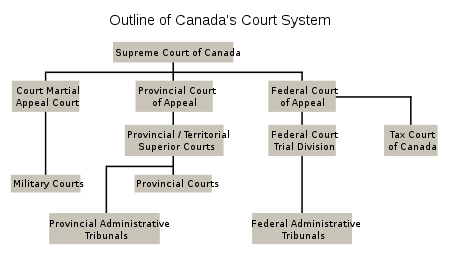
Outline of the Court system
Very generally speaking, CanadaCanada
Canada is a North American country consisting of ten provinces and three territories. Located in the northern part of the continent, it extends from the Atlantic Ocean in the east to the Pacific Ocean in the west, and northward into the Arctic Ocean...
's court system is a four-level hierarchy as shown below from highest to lowest in terms of legal authority. Each court is bound by the rulings of the courts above them; however, they are not bound by the rulings of other courts at the same level in the hierarchy. Civil courts in Quebec, in particular, are under no obligation to apply judicial precedent - the principle of stare decisis - which is the general rule elsewhere in Canada. This is because Quebec's civil law is entirely codified, while civil law in the other nine provinces grew out of the English common law.
A Note on Terminology
There are two terms used in describing the Canadian court structure which can be confusing, and clear definitions are useful at the outset.Provincial Courts
The first is the term "provincial court," which has two quite different meanings, depending on context. The first, and most general meaning, is that a provincial court is a court established by the Legislature of a province, under its constitutional authority over the Administration of Justice in the Province, set out in s. 92(14) of the Constitution Act, 1867. This head of power gives the Provinces the power to regulate "... the Constitution, Maintenance, and Organization of Provincial Courts, both of Civil and of Criminal Jurisdiction, and including Procedure in Civil Matters in those Courts." All courts created by a Province, from the small claims court or municipal by-law court, up to the provincial Court of Appeal, are "provincial courts" in this general sense.However, there is a more limited meaning to the term. In most provinces, the "Provincial Court" is the term used to refer to a specific court created by the Province which is the main criminal court, having jurisdiction over most criminal offences except for the most serious ones. The Provincial Court of a particular province may also have a limited civil jurisdiction, over small claims and some family law matters. The exact scope of the jurisdiction of a Provincial Court will depend on the laws enacted by the particular province. Provincial Courts in this sense are courts of limited statutory jurisdiction, sometimes referred to as "inferior courts." As courts of limited jurisdiction, their decisions are potentially subject to judicial review by the superior courts via the prerogative writs, but in most cases there are now well-established statutory rights of appeal instead.
To distinguish between the two meanings of the term, capitalization is used. A reference to a "provincial court" normally is a reference to the broad meaning of the term, any court created by the Province. A reference to "Provincial Court" normally is referring to the specific court of limited statutory jurisdiction, created by the Province.
Superior Courts
The second is the term "superior courts." This term also has two different meanings, one general and one specific.The general meaning is that a superior court
Superior court
In common law systems, a superior court is a court of general competence which typically has unlimited jurisdiction with regard to civil and criminal legal cases...
is a court of inherent jurisdiction. Historically, they are the descendants of the royal superior courts in England. The decisions of a superior court are not subject to review, unless a statute specifically provides for review or appeal. The term is not limited to trial courts. The Federal Court of Appeal and the provincial and territorial Courts of Appeal are all superior courts.
The more limited sense is that "Superior Court" can be used to refer to the superior trial court of original jurisdiction in the Province. This terminology is used in the court systems of Ontario and Quebec.
The difference between the two terms is also indicated by capitalisation. The term "superior court" is used to mean the general sense of the term, while "Superior Court" is used to refer to specific courts in provinces which use that term to designate their superior trial courts.
Supreme Court of Canada
The Supreme Court is established by the Supreme Court Act as the "General Court of Appeal for Canada." The Court currently consists of nine justices, which include the Chief Justice of Canada and eight puisne justices. The court's duties include hearing appeals of decisions from the appellate courts (to be discussed next) and, on occasion, delivering referencesReference question
In Canadian law, a Reference Question is a submission by the federal or a provincial government to the courts asking for an advisory opinion on a major legal issue. Typically the question concerns the constitutionality of legislation....
(i.e., the court's opinion) on constitutional questions raised by the federal government. By law, three of the nine justices are appointed from Quebec because of Quebec's use of civil law
Civil law (legal system)
Civil law is a legal system inspired by Roman law and whose primary feature is that laws are codified into collections, as compared to common law systems that gives great precedential weight to common law on the principle that it is unfair to treat similar facts differently on different...
.
The Constitution Act, 1867 gives the federal Parliament the power to create a "General Court of Appeal for Canada." Following Confederation, the Conservative government of Sir John A. Macdonald proposed the creation of a Supreme Court and introduced two bills in successive sessions of Parliament to trigger public debate on the proposed court and its powers. Eventually, in 1875, the Liberal government of Alexander Mackenzie passed an Act of Parliament
Parliament of Canada
The Parliament of Canada is the federal legislative branch of Canada, seated at Parliament Hill in the national capital, Ottawa. Formally, the body consists of the Canadian monarch—represented by her governor general—the Senate, and the House of Commons, each element having its own officers and...
which established the Supreme Court. The 1875 Act built upon the proposals introduced by the Macdonald government, and passed with bipartisan support.
Initially, decisions of the Supreme Court could be appealed to the Judicial Committee of the British Privy Council
Judicial Committee of the Privy Council
The Judicial Committee of the Privy Council is one of the highest courts in the United Kingdom. Established by the Judicial Committee Act 1833 to hear appeals formerly heard by the King in Council The Judicial Committee of the Privy Council (JCPC) is one of the highest courts in the United...
. As well, litigants could appeal directly from the provincial courts of appeal directly to the Judicial Committee, by-passing the Supreme Court entirely. There was a provision in the 1875 Act which attempted to limit appeals to the Judicial Committee. That clause resulted in the Governor General reserving the bill for consideration by the Queen-in-Council. After much debate between Canadian and British officials, royal assent was granted, on the understanding that the clause did not in fact affect the royal prerogative to hear appeals, exercised through the Judicial Committee. The question of the power of Parliament to abolish appeals to the Judicial Committee eventually was tested in the courts. In 1926, the Judicial Committee ruled that the Canadian Parliament lacked the jurisdiction to extinguish appeals to the Judicial Committee, as the right of appeal was founded in the royal prerogative and could only be terminated by the Imperial Parliament. Following the enactment of the Statute of Westminster
Statute of Westminster 1931
The Statute of Westminster 1931 is an Act of the Parliament of the United Kingdom. Passed on 11 December 1931, the Act established legislative equality for the self-governing dominions of the British Empire with the United Kingdom...
, in 1933 the federal Parliament passed legislation again abolishing the right of appeal in criminal matters. In 1935, the Judicial Committee upheld the constitutional validity of that amendment. In 1939, the federal government proposed a reference
Reference question
In Canadian law, a Reference Question is a submission by the federal or a provincial government to the courts asking for an advisory opinion on a major legal issue. Typically the question concerns the constitutionality of legislation....
to the Supreme Court of Canada, asking whether the federal Parliament could terminate all appeals to the Judicial Committee. By a 4-2 decision, the Supreme Court held that the proposal was within the powers of the federal Parliament and would be constitutional. The question was then appealed to the Judicial Committee, but the hearing of the appeal was delayed by the outbreak of World War II. in 1946, the Judicial Committee finally heard the appeal and upheld the decision of the majority of the Supreme Court, clearing the way for Parliament to enact legislation to end all appeals to the Judicial Committee, whether from the Supreme Court or from the provincial courts of appeal. In 1949, Parliament passed an amendment to the Supreme Court Act which abolished all appeals, making the Court truly the Supreme Court. However, cases which had been instituted in the lower courts prior to the amendment could still be appealed to the Judicial Committee. The last Canadian appeal to the Judicial Committee was not decided until 1960.
Appellate courts of the provinces and territories
These courts of appeal (as listed below by province and territory in alphabetical order) exist at the provincial and territorial levels and were separately constituted in the early decades of the 20th century, replacing the former Full CourtFull Court
A Full Court refers to a court consisting of a greater-than-normal number of judges. Thus, in relation to a court usually presided over by a single judge, a Full Court would comprise a bench of three judges; for a court which, like many appellate courts, normally comprises three judges, a Full...
s of the old Supreme Courts of the provinces, many of which were then re-named Courts of Queens Bench. Their function is to review decisions rendered by the superior-level courts and to deliver references when requested by a provincial or territorial government as the Supreme Court does for the federal government. These appellate courts do not normally conduct trials or hear witnesses.
- Alberta Court of Appeal
- British Columbia Court of AppealBritish Columbia Court of AppealThe British Columbia Court of Appeal is the highest appellate court in the province of British Columbia, Canada. The BCCA hears appeals from the Supreme Court of British Columbia and a number of boards and tribunals. The BCCA also hears criminal appeals from the Provincial Court of British...
- Manitoba Court of AppealManitoba Court of AppealThe Manitoba Court of Appeal is the highest Court of Appeal in the Canadian province of Manitoba. It was established in 1906. It is located in the Old Law Courts building at 408 York Avenue in Winnipeg, the capital city of Manitoba...
- New Brunswick Court of Appeal
- Supreme Court of Newfoundland (Court of Appeal)Supreme Court of Newfoundland (Court of Appeal)In the Canadian province Newfoundland and Labrador, the Court of Appeal is at the top of the hierarchy of courts for the province...
- Court of Appeal for the Northwest TerritoriesCourt of Appeal for the Northwest TerritoriesThe Court of Appeal for the Northwest Territories is the highest appellate court which hears appeals from criminal cases and civil cases of the Supreme Court of the Northwest Territories....
- Nova Scotia Court of AppealNova Scotia Court of AppealThe Court of Appeal for Nova Scotia is the highest appeal court in the province of Nova Scotia, Canada. There are currently seven Justices and one Chief Justice. The court sits in Halifax, which is the capital of Nova Scotia...
- Nunavut Court of Appeal
- Court of Appeal for Ontario
Supreme Court of Prince Edward Island - Appeal Division
Supreme Court of Prince Edward Island
The Supreme Court of Prince Edward Island is the top court in the Canadian province of Prince Edward Island and the highest Court of Appeals in the province....
- Quebec Court of AppealQuebec Court of AppealThe Court of Appeal for Quebec is the highest judicial court in Quebec, Canada....
- Saskatchewan Court of Appeal
- Court of Appeal of the Yukon TerritoryCourt of Appeal of the Yukon TerritoryThe Court of Appeal of the Yukon Territory is the highest appellate court for the Yukon Territory. It hears appeals of both criminal and civil cases from the Supreme Court of the Yukon Territory and Yukon Territorial Court....
These courts are Canada's equivalent of the Court of Appeal
Court of Appeal of England and Wales
The Court of Appeal of England and Wales is the second most senior court in the English legal system, with only the Supreme Court of the United Kingdom above it...
in England
England
England is a country that is part of the United Kingdom. It shares land borders with Scotland to the north and Wales to the west; the Irish Sea is to the north west, the Celtic Sea to the south west, with the North Sea to the east and the English Channel to the south separating it from continental...
and the various State Supreme Courts
State supreme court
In the United States, the state supreme court is the highest state court in the state court system ....
and U.S. Courts of Appeals in the United States
United States
The United States of America is a federal constitutional republic comprising fifty states and a federal district...
. Each of the above-listed appellate courts is the highest court from its respective province or territory. Each province's chief justice
Chief Justice
The Chief Justice in many countries is the name for the presiding member of a Supreme Court in Commonwealth or other countries with an Anglo-Saxon justice system based on English common law, such as the Supreme Court of Canada, the Constitutional Court of South Africa, the Court of Final Appeal of...
sits in the appellate court of that province.
Superior-level courts of the provinces and territories
These courts (as listed below by province and territory in alphabetical order) exist at the provincial and territorial levels. The superior courts are the courts of first instanceTrial court
A trial court or court of first instance is a court in which trials take place. Such courts are said to have original jurisdiction.- In the United States :...
for divorce petitions, civil lawsuits involving claims greater than small claims, and criminal prosecutions for indictable offence
Indictable offence
In many common law jurisdictions , an indictable offence is an offence which can only be tried on an indictment after a preliminary hearing to determine whether there is a prima facie case to answer or by a grand jury...
s (i.e., felonies
Felony
A felony is a serious crime in the common law countries. The term originates from English common law where felonies were originally crimes which involved the confiscation of a convicted person's land and goods; other crimes were called misdemeanors...
in American legal terminology). They also perform a reviewing function for judgements from the local inferior courts and administrative decisions by provincial or territorial government entities such as labour boards, human rights tribunals and licensing authorities.
- Court of Queen's Bench of AlbertaCourt of Queen's Bench of AlbertaThe Court of Queen's Bench of Alberta is the superior court of the Canadian province of Alberta....
- Supreme Court of British ColumbiaSupreme Court of British ColumbiaThe Supreme Court of British Columbia is the superior trial court for the province of British Columbia. The BCSC hears civil and criminal law cases as well as appeals from the Provincial Court of British Columbia. Including supernumerary judges, there are presently 108 judges...
- Court of Queen's Bench of ManitobaCourt of Queen's Bench of ManitobaThe Court of Queen's Bench of Manitoba is the superior court of the Canadian province of Manitoba...
- Court of Queen's Bench of New BrunswickCourt of Queen's Bench of New BrunswickThe Court of Queen's Bench of New Brunswick is the superior court of the Canadian province of New Brunswick.- Structure :...
- Supreme Court of Newfoundland and LabradorSupreme Court of Newfoundland and LabradorThe Supreme Court of Newfoundland and Labrador is the superior court for the Canadian province of Newfoundland and Labrador. The Supreme Court of Newfoundland and Labrador has jurisdiction to hear appeals in both criminal and civil matters from the Supreme Court of Newfoundland and Labrador ,...
(Trial Division) - Supreme Court of the Northwest TerritoriesSupreme Court of the Northwest TerritoriesThe Supreme Court of the Northwest Territories is the name of two different superior courts for the Canadian territory of the Northwest Territories, which have existed at different times.The first Supreme Court of the North-West Territories was created in 1885...
- Supreme Court of Nova Scotia
- Nunavut Court of JusticeNunavut Court of JusticeThe Nunavut Court of Justice is the superior court and territorial court of the Canadian territory of Nunavut. It is located in the Nunavut Justice Centre in Iqaluit. It was established on April 1, 1999 as Canada's only "unified" or single-level court...
- Ontario Superior Court of JusticeOntario Superior Court of JusticeThe Superior Court of Justice is the superior court of general jurisdiction for the Province of Ontario, Canada. It is the successor to the former Ontario Court of Justice , and was created on April 19, 1999...
- Supreme Court of Prince Edward IslandSupreme Court of Prince Edward IslandThe Supreme Court of Prince Edward Island is the top court in the Canadian province of Prince Edward Island and the highest Court of Appeals in the province....
- Trial Division - Quebec Superior CourtQuebec Superior CourtQuebec Superior Court is the highest trial Court in the Province of Quebec, Canada. It consists of 144 judges who are appointed by the federal government.Chief Justices : [partial listing]* Edward Bowen...
- Court of Queen's Bench for SaskatchewanCourt of Queen's Bench for SaskatchewanThe Court of Queen's Bench of Saskatchewan is the superior trial court for the Canadian province of Saskatchewan. The Court hears civil and criminal law cases. It is a court of inherent jurisdiction and there is no monetary limit on the claims which it may hear. It also has original jurisdiction...
- Supreme Court of the Yukon TerritorySupreme Court of the Yukon TerritoryThe Supreme Court of the Yukon Territory is the court of general jurisdiction for the Canadian territory of Yukon. Civil and criminal cases are heard by the court, as well as, appeals from the Yukon Territorial Court, Yukon Small Claims Court and other quasi-judicial boards...
Furthermore, some of these superior courts (like the one in Ontario) have specialized branches that deal only with certain matters such as family law or small claims. To complicate things further, the Ontario Superior Court of Justice has a branch called the Divisional Court that hears only appeals and judicial reviews of administrative tribunals and whose decisions have greater binding authority than those from the "regular" branch of the Ontario Superior Court of Justice. Although a court, like the Supreme Court of British Columbia, may have the word "supreme" in its name, it is not necessarily the highest court in its respective province or territory.
Most provinces have special courts dealing with small claims (lawsuits for less than a certain amount of money). These are typically divisions of the superior courts in each province. Parties often represent themselves, without lawyers, in these courts.
Provincial and territorial ("inferior") courts
Each province and territory in Canada has an "inferior" or "lower" trialTrial (law)
In law, a trial is when parties to a dispute come together to present information in a tribunal, a formal setting with the authority to adjudicate claims or disputes. One form of tribunal is a court...
court, usually called a Provincial (or Territorial) Court, to hear certain types of cases. Appeals from these courts are heard either by the superior court of the province or territory or by the Court of Appeal. In criminal cases, this depends on the seriousness of the offence. These courts are created by provincial statute and only have the jurisdiction granted by statute. Accordingly, inferior courts do not have inherent jurisdiction
Inherent jurisdiction
Inherent jurisdiction is a doctrine of the English common law that a superior court has the jurisdiction to hear any matter that comes before it, unless a statute or rule limits that authority or grants exclusive jurisdiction to some other court or tribunal...
. These courts are usually the successors of older local courts presided over by lay magistrates and justices of the peace who did not necessarily have formal legal training. However, today all judges are legally trained, although justices of the peace may not be. Many inferior courts have specialized functions, such as hearing only criminal law matters, youth matters, family law matters, small claims matters, "quasi-criminal" offences (i.e., violations of provincial statutes), or bylaw infractions. In some jurisdictions these courts serve as an appeal division from the decisions of administrative tribunals.
Federal Courts
In addition to the Supreme Court of Canada, there are three civil courts created by the federal Parliament under its legislative authority under s. 100 of the Constitution Act, 1867:- Federal Court of AppealFederal Court of Appeal (Canada)The Federal Court of Appeal is a Canadian appellate court that hears cases concerning federal matters arising from certain federal Acts. The court was created on July 2, 2003 by the Courts Administration Service Act when it and the Federal Court were split from its predecessor, the Federal Court of...
- Federal CourtFederal Court (Canada)The Federal Court is a Canadian trial court that hears cases arising under certain areas of federal law. The Federal Court is a superior court with nationwide jurisdiction...
- Tax Court of CanadaTax Court of CanadaThe Tax Court of Canada , established in 1983 by the Tax Court of Canada Act, is a federal superior court which deals with matters involving companies or individuals and tax issues with the Government of Canada....
Federal Court of Appeal
The Federal Court of Appeal hears appeals from decisions rendered by the Federal Court, the Tax Court of Canada and a certain group of federal administrative tribunals like the National Energy BoardNational Energy Board
The National Energy Board is an independent economic regulatory agency created in 1959 by the Government of Canada to oversee "international and inter-provincial aspects of the oil, gas and electric utility industries"...
and the federal labour board. All judges of the Federal Court are ex officio judges of the Federal Court of Appeal, and vice versa, although it is rare that a judge of one court will sit as a member of the other.
Federal Court of Canada
The Federal Court of Canada exists primarily to review administrative decisions by federal government bodies such as the immigrationImmigration
Immigration is the act of foreigners passing or coming into a country for the purpose of permanent residence...
board and to hear lawsuits under the federal government's jurisdiction such as intellectual property
Intellectual property
Intellectual property is a term referring to a number of distinct types of creations of the mind for which a set of exclusive rights are recognized—and the corresponding fields of law...
and maritime law. It also has concurrent jurisdiction with the superior trial courts of the Provinces to hear civil lawsuits brought against the federal government. The Federal Court also has jurisdiction to determine inter-jurisidctional legal actions between the federal government and a provinces, or between different provinces, provided the province in question has passed corresponding legislation granting the Federal Court jurisdiction over the dispute.
In the aftermath of 9/11, Parliament enacted a number of laws to protect national security. The Federal Court has exclusive jurisdiction to determine many issues which arise under those laws relating to national security.
Appeals lie from the Federal Court to the Federal Court of Appeal.
Tax Court of Canada
The Tax Court of Canada has a very specialised jurisdiction. It hears disputes over federal taxes, primarily under the federal Income Tax Act, between taxpayers and the federal government. Appeals lie from the Tax Court to the Federal Court of Appeal.History of the Federal Courts
The first federal court was the Exchequer Court of Canada, created in 1875 at the same time as the Supreme Court of Canada. The Exchequer Court was a trial court, with a limited jurisdiction over civil actions brought against the federal government, tax disputes under federal tax laws, admiralty matters, compensation for expropriation of private property by the federal Crown, negligence of federal public servants, and intellectual property, including patents and copyright. The name of the court came from the Exchequer Court of EnglandExchequer of pleas
The Exchequer of Pleas or Court of Exchequer was a court that followed equity, a set of legal principles based on natural law, and common law, in England and Wales. Originally part of the curia regis, or King's Council, the Exchequer of Pleas split from the curia during the 1190s, to sit as an...
, which had a similar jurisdiction over tax disputes. At first, there were no separate judges for the Exchequer Court. The judges of the Supreme Court of Canada were also appointed to the Exchequer Court. Individual judges of the Supreme Court would sit as a judge of the Exchequer Court, with an appeal lying to the Supreme Court.
The Exchequer Court did not have any jurisdiction to review the actions of federal administrative agencies. That function was fulfilled by the provincial superior trial courts.
In 1971, Parliament passed the Federal Court Act which abolished the Exchequer Court and created a new court, the Federal Court of Canada. That Court had two divisions: the Federal Court - Trial Division, and the Federal Court - Appeal Division. Although the two divisions had different functions, they were all part of a single court.
In 2003, Parliament passed legislation which divided the Federal Court into two courts. The Federal Court - Trial Division became the Federal Court of Canada, while the Federal Court - Appeal Division became the Federal Court of Appeal. The jurisdiction of the two new courts is essentially the same as the corresponding former divisions of the Federal Court.
Although the federal courts can be said to have the same prestige as the superior courts from the provinces and territories, they lack the "inherent jurisdiction" (to be explained later) possessed by superior courts such as the Ontario Superior Court of Justice.
Military Courts
- Court Martial Appeal Court of CanadaCourt Martial Appeal Court of CanadaThe Court Martial Appeal Court of Canada hears appeals from military courts .In Canada, courts martial are presided over by independent military judges from the office of the Chief Military Judge...
- Various military courts called courts martial:
- General Court Martial
- Standing Court Martial
- Summary Trial hearings
The courts martial are conducted and presided over by military personnel and exist for the prosecution of military personnel, as well as civilian personnel who accompany military personnel, accused of violating the Code of Service Discipline
Code of Service Discipline
The Code of Service Discipline is the basis of the Canadian Forcesmilitary justice system. The CSD is designed to assist military commanders in maintaining discipline, efficiency, and morale within theCF. It is found in Part III of the National Defence Act...
, which is found in the National Defence Act
National Defence Act
The National Defence Act is the primary enabling legislation for organizing and funding Canada's military....
(R.S.C. 1985, Chapter N-5) and constitutes a complete code of military law applicable to persons under military jurisdiction.
The decisions of the courts martial can be appealed to the Court Martial Appeal Court of Canada which, in contrast, exists outside the military and is made up of civilian judges. This appellate court is the successor of the Court Martial Appeal Board which was created in 1950, presided over by civilian judges and lawyers, and was the first ever civilian-based adjudicating body with authority to review decisions by a military court. The Court Martial Appeal Court is made up of civilian judges from the Federal Court, Federal Court of Appeal, and the superior courts of the provinces.
Summary trials are ad hoc hearings used to dispense with minor service offenses. The Presiding Officer
Presiding Officer
In a general sense, presiding officer is synonymous with chairman.* The presiding officer of the United States House of Representatives is the Speaker of the United States House of Representatives...
will have little formal legal training and is generally the service member's Commanding Officer
Commanding officer
The commanding officer is the officer in command of a military unit. Typically, the commanding officer has ultimate authority over the unit, and is usually given wide latitude to run the unit as he sees fit, within the bounds of military law...
. In this respect, these hearings are similar to the former lay magistrate
Magistrate
A magistrate is an officer of the state; in modern usage the term usually refers to a judge or prosecutor. This was not always the case; in ancient Rome, a magistratus was one of the highest government officers and possessed both judicial and executive powers. Today, in common law systems, a...
s' courts.
Federal and provincial administrative tribunals
Known in Canada as simply "tribunals", these are quasi-judicial adjudicative bodies, which means that they adjudicate (hear evidence and render decisions) like courts, but are not presided over by judges. Instead, the adjudicators may be experts of the very specific legal field handled by the tribunal (e.g., labour lawLabour law
Labour law is the body of laws, administrative rulings, and precedents which address the legal rights of, and restrictions on, working people and their organizations. As such, it mediates many aspects of the relationship between trade unions, employers and employees...
, human rights
Human rights
Human rights are "commonly understood as inalienable fundamental rights to which a person is inherently entitled simply because she or he is a human being." Human rights are thus conceived as universal and egalitarian . These rights may exist as natural rights or as legal rights, in both national...
law (known in the US as "civil rights
Civil rights
Civil and political rights are a class of rights that protect individuals' freedom from unwarranted infringement by governments and private organizations, and ensure one's ability to participate in the civil and political life of the state without discrimination or repression.Civil rights include...
law"), immigration law
Immigration law
Immigration law refers to national government policies which control the phenomenon of immigration to their country.Immigraton law, regarding foreign citizens, is related to nationality law, which governs the legal status of people, in matters such as citizenship...
, energy law
Energy law
Energy laws govern the use and taxation of energy, both renewable and non-renewable. These laws are the primary authorities related to energy...
, workers' compensation
Workers' compensation
Workers' compensation is a form of insurance providing wage replacement and medical benefits to employees injured in the course of employment in exchange for mandatory relinquishment of the employee's right to sue his or her employer for the tort of negligence...
law, liquor licensing law, etc.) who hear arguments and evidence provided by lawyers (also lay advocates in British Columbia) before making a written decision on record.
Depending on its enabling legislation, a tribunal's decisions may be reviewed by a court through an appeal or a process called judicial review
Judicial review
Judicial review is the doctrine under which legislative and executive actions are subject to review by the judiciary. Specific courts with judicial review power must annul the acts of the state when it finds them incompatible with a higher authority...
. The reviewing court may be required to show some deference to the tribunal if the tribunal possesses some highly specialized expertise or knowledge that the court does not have. The degree of deference will also depend on such factors as the specific wording of the legislation creating the tribunal. Tribunals whose enabling legislation contains a privative clause
Privative clause
In administrative law, a privative clause is a provision in a statute that tries to remove a court’s ability to review decisions of a tribunal . In the UK they are known as "ouster clauses"....
are entitled to a high degree of deference, although a recent decision of the Supreme Court of Canada (Dunsmuir v. New Brunswick
Dunsmuir v. New Brunswick
Dunsmuir v. New Brunswick, 1 S.C.R. 190; 2008 SCC 9, is the leading Supreme Court of Canada decision in Canadian administrative law on the topic of substantive review and standards of review...
, 2008 SCC 9) has arguably lowered that degree of deference.
Tribunals which have the power to decide questions of law may take into consideration the Canadian Charter of Rights and Freedoms
Canadian Charter of Rights and Freedoms
The Canadian Charter of Rights and Freedoms is a bill of rights entrenched in the Constitution of Canada. It forms the first part of the Constitution Act, 1982...
, which is part of Canada's constitution. The extent to which tribunals may use the Charter in their decisions is a source of ongoing legal debate.
Appearing before some administrative tribunals may feel like appearing in court, but the tribunal's procedure is relatively less formal than that of a court, and more importantly, the rules of evidence are not as strictly observed, sothat some evidence that would be inadmissible in a court hearing may be allowed in a tribunal hearing, if relevant to the proceeding. While relevant evidence is admissible, evidence which the adjudicator determines to have questionable reliability, or is otherwise questionable, is most likely to be afforded little or no weight.
The presiding adjudicator is normally called "Mister/Madam Chair". As is the case in court, lawyers routinely appear in tribunals advocating matters for their clients. A person does not require a lawyer to appear before an administrative tribunal. Indeed, many of these tribunals are specifically designed to be more representative to unrepresented litigants than courts. Furthermore, some of these tribunals are part of a comprehensive dispute-resolution system, which may emphasize mediation
Mediation
Mediation, as used in law, is a form of alternative dispute resolution , a way of resolving disputes between two or more parties. A third party, the mediator, assists the parties to negotiate their own settlement...
rather than litigation. For example, provincial human rights commissions routinely use mediation to resolve many human rights complaints without the need for a hearing.
What tribunals all have in common is that they are created by statute, their adjudicators are usually appointed by government, and they focus on very particular and specialized areas of law. Because some subject matters (e.g., immigration) fall within federal jurisdiction while others (e.g., liquor licensing and workers' compensation) in provincial jurisdiction, some tribunals are created by federal law while others are created by provincial law. There are both federal and provincial tribunals for some subject matters such as unionized labour and human rights.
Most importantly, from a lawyer's perspective, is the fact that the principle of stare decisis
Stare decisis
Stare decisis is a legal principle by which judges are obliged to respect the precedents established by prior decisions...
does not apply to tribunals. In other words, a tribunal adjudicator could legally make a decision that differs from a past decision, on the same subject and issues, delivered by the highest court in the land. Because a tribunal is not bound by legal precedent, established by itself or by a reviewing court, a tribunal is not a court even though it performs an important adjudicative function and contributes to the development of law like a court would do.
Although stare decisis does not apply to tribunals, their adjudicators will likely nonetheless find a prior court decision on a similar subject to be highly persuasive and will likely follow the courts in order to ensure consistency in the law and to prevent the embarrassment of having their decisions overturned by the courts. The same is true for past decisions of the tribunal.
Among the federal tribunals, there is a small group of tribunals whose decisions must be appealed directly to the Federal Court of Appeal rather than to the Federal Court Trial Division. These so-called "super tribunals" are listed in Subsection 28(1) of the Federal Court Act (R.S.C. 1985, Chapter F-7) and some examples include the National Energy Board, Canadian International Trade Tribunal, the Competition Tribunal, the Canada Industrial Relations Board (i.e. federal labour board), the Copyright Board, and the Canadian Radio-television and Telecommunications Commission ("CRTC").
Courts of inherent jurisdiction
The superior courts from the provinces and territories are courts of inherent jurisdictionInherent jurisdiction
Inherent jurisdiction is a doctrine of the English common law that a superior court has the jurisdiction to hear any matter that comes before it, unless a statute or rule limits that authority or grants exclusive jurisdiction to some other court or tribunal...
, which means that the jurisdiction
Jurisdiction
Jurisdiction is the practical authority granted to a formally constituted legal body or to a political leader to deal with and make pronouncements on legal matters and, by implication, to administer justice within a defined area of responsibility...
of the superior courts is more than just what is conferred by statute. Following the principles of English common law, because the superior courts derive their authority from the Constitution, they can hear any matter unless there is a federal or provincial statute that says otherwise or that gives exclusive jurisdiction
Exclusive jurisdiction
In civil procedure, exclusive jurisdiction exists where one court has the power to adjudicate a case to the exclusion of all other courts. It is the opposite situation from concurrent jurisdiction, in which more than one court may take jurisdiction over the case.Exclusive jurisdiction is typically...
to some other court or tribunal. The doctrine of inherent jurisdiction gives superior courts greater freedom than statutory courts to be flexible and creative in the delivering of legal remedies and relief.
Statutory courts
The Supreme Court of CanadaSupreme Court of Canada
The Supreme Court of Canada is the highest court of Canada and is the final court of appeals in the Canadian justice system. The court grants permission to between 40 and 75 litigants each year to appeal decisions rendered by provincial, territorial and federal appellate courts, and its decisions...
, the federal courts, the various appellate courts from the provinces and territories, and the numerous low-level provincial courts are statutory courts whose decision-making power is granted by either the federal parliament or a provincial legislature.
The word "statutory" refers to the fact that these courts' powers are derived from a statute
Statute
A statute is a formal written enactment of a legislative authority that governs a state, city, or county. Typically, statutes command or prohibit something, or declare policy. The word is often used to distinguish law made by legislative bodies from case law, decided by courts, and regulations...
and is defined and limited by the terms of the statute. A statutory court cannot try cases in areas of law that are not mentioned or suggested in the statute. In this sense, statutory courts are similar to non-judicial adjudicative bodies such as administrative tribunals, boards, and commissions, which are created and given limited power by legislation. The practical implication of this is that a statutory court cannot provide a type of legal remedy or relief that is not expressly or implicitly referred to in its enabling or empowering statute.
Appointment and regulation of judges
Judges in Canada are appointed and not elected. Judges of the Supreme Court of CanadaSupreme Court of Canada
The Supreme Court of Canada is the highest court of Canada and is the final court of appeals in the Canadian justice system. The court grants permission to between 40 and 75 litigants each year to appeal decisions rendered by provincial, territorial and federal appellate courts, and its decisions...
, the federal courts, the appellate courts and the superior-level courts are appointed by the Governor-in-Council (by the Governor General on the advice of the Federal Cabinet). Thus, judges of the Ontario
Ontario
Ontario is a province of Canada, located in east-central Canada. It is Canada's most populous province and second largest in total area. It is home to the nation's most populous city, Toronto, and the nation's capital, Ottawa....
Superior Court of Justice are chosen not by Ontario
Ontario
Ontario is a province of Canada, located in east-central Canada. It is Canada's most populous province and second largest in total area. It is home to the nation's most populous city, Toronto, and the nation's capital, Ottawa....
's provincial government but upon the recommendations of Her Majesty's Canadian Government. Meanwhile, judicial appointments to judicial posts in the so-called "inferior" or "provincial" courts are made by the local provincial governments.
There are Canadians who would like to see their judges be elected as is the case for some American
United States
The United States of America is a federal constitutional republic comprising fifty states and a federal district...
judges, but there is no indication that the longstanding British
United Kingdom
The United Kingdom of Great Britain and Northern IrelandIn the United Kingdom and Dependencies, other languages have been officially recognised as legitimate autochthonous languages under the European Charter for Regional or Minority Languages...
tradition of appointing judges will be altered in Canada anytime soon. It is doubtful if an elected judiciary would be consistent with the Canadian constitution. Those who favour the appointment method point out that the election approach could possibly threaten the judiciary's ability to be independent in its decision-making. Though political patronage has certainly been a factor in the appointment of some judges, judges appointed to the Supreme Court of Canada have been remarkably non-partisan and well respected by Canadians of all political stripes.
As judicial independence
Judicial independence
Judicial Independence is the idea that the judiciary needs to be kept away from the other branches of government...
is seen by Canadian law to be essential to a functioning democracy, the regulating of Canadian judges requires the involvement of the judges themselves. The Canadian Judicial Council
Canadian Judicial Council
The Canadian Judicial Council is a federal body created under the Judges Act , with the mandate to "promote efficiency, uniformity, and accountability, and to improve quality of judicial service in the superior courts of Canada". The Council is also mandated to review "any complaint or allegation"...
, made up of the chief justices and associate chief justices of the federal courts and of each province and territory, receive complaints from the public concerning questionable behaviour from members of the bench.
Salaries of superior courts are set by Parliament under section 100 of the Constitution Act, 1867. Since the Provincial Judges Reference
Provincial Judges Reference
The Provincial Judges Reference [1997] 3 S.C.R. 3 is a leading opinion of the Supreme Court of Canada in response to a reference question regarding remuneration and the independence and impartiality of provincial court judges...
of 1997, provincial courts' salaries are recommended by independent commissions, and a similar body called the Judicial Compensation and Benefits Commission
Judicial Compensation and Benefits Commission
The Judicial Compensation and Benefits Commission is a Canadian commission that recommends judicial salaries for federally appointed judges.The commission was created in 1999 by the government of Prime Minister Jean Chrétien, under the Judges Act...
was established in 1999 for federally-appointed judges.
Languages used in Court
EnglishEnglish language
English is a West Germanic language that arose in the Anglo-Saxon kingdoms of England and spread into what was to become south-east Scotland under the influence of the Anglian medieval kingdom of Northumbria...
and French
French language
French is a Romance language spoken as a first language in France, the Romandy region in Switzerland, Wallonia and Brussels in Belgium, Monaco, the regions of Quebec and Acadia in Canada, and by various communities elsewhere. Second-language speakers of French are distributed throughout many parts...
are both official languages of the federal government of Canada. Either official language may be used by any person or in any pleading or process in or issuing from any Court of Canada established by Parliament under the Constitution Act, 1867
Constitution Act, 1867
The Constitution Act, 1867 , is a major part of Canada's Constitution. The Act created a federal dominion and defines much of the operation of the Government of Canada, including its federal structure, the House of Commons, the Senate, the justice system, and the taxation system...
. This constitutional guarantee applies to the Supreme Court of Canada, the Federal Court of Appeal, the Federal Court, the Tax Court of Canada, and the Court Martial Appeal Court. Parliament has expanded on that constitutional guarantee to ensure that the federal courts are institutionally bilingual.
The right to use either language in the provincial and territorial courts varies. The Constitution guarantees the right to use either French or English in the courts of Quebec and New Brunswick. There is a statutory right to use either English or French in the courts of Ontario and Saskatchewan, and a limited right to use French in oral submissions in the courts of Alberta.
As well, in all criminal proceedings under the Criminal Code of Canada
Criminal Code of Canada
The Criminal Code or Code criminel is a law that codifies most criminal offences and procedures in Canada. Its official long title is "An Act respecting the criminal law"...
, every accused whose language is either English or French has the right to be tried in the language of their choice, as well as to have any appeals heard in the language of their choice. As a result, every court of criminal jurisdiction in Canada, whether federal, provincial or territorial, must have the institutional capacity to provide trials and appeals in either language.
Furthermore, under section 14
Section Fourteen of the Canadian Charter of Rights and Freedoms
Section Fourteen of the Canadian Charter of Rights and Freedoms is the last section under the "Legal rights" heading in the Charter. It provides anyone in a court the right to an interpreter if the person does not speak the language being used or is deaf.-Text:The section states:-Background:Before...
of the Canadian Charter of Rights and Freedoms
Canadian Charter of Rights and Freedoms
The Canadian Charter of Rights and Freedoms is a bill of rights entrenched in the Constitution of Canada. It forms the first part of the Constitution Act, 1982...
a party or witness in any proceedings who does not understand or speak the language in which the proceedings are conducted or who is deaf has the right to the assistance of an interpreter.
Court customs
Courtroom custom is largely based upon the British tradition, with a few modifications.Symbols
Canadian courts derive their authority from the monarch. Consequently, important symbols in a courtroom include the picture of the monarch and the heraldic Arms of Canada, although many courtrooms do not have a picture of the monarch. Many courts display Canadian and provincial flags. In the British Columbia courts as well as in the Supreme Court of Newfoundland and LabradorSupreme Court of Newfoundland and Labrador
The Supreme Court of Newfoundland and Labrador is the superior court for the Canadian province of Newfoundland and Labrador. The Supreme Court of Newfoundland and Labrador has jurisdiction to hear appeals in both criminal and civil matters from the Supreme Court of Newfoundland and Labrador ,...
, the Royal coat of arms of the United Kingdom
Royal coat of arms of the United Kingdom
The Royal coat of arms of the United Kingdom is the official coat of arms of the British monarch, currently Queen Elizabeth II. These arms are used by the Queen in her official capacity as monarch of the United Kingdom, and are officially known as her Arms of Dominion...
is displayed.
Dress
In superior courts, lawyers wear black robes and white neck tabs, like barristers in the United Kingdom, but they do not wear wigs. Business attire is appropriate when appearing before judges of lower courts or justices of the peace.Judges dress in barrister's robes like the lawyers. Judges of some courts adorn their robes with coloured sashes. For example, Federal Court Judges' robes are adorned with a gold sash, and Tax Court of Canada Judges' robes with a purple sash.
Etiquette/Decorum
- Judges do not use gavelGavelA gavel is a small ceremonial mallet commonly made of hardwood, typically fashioned with a handle and often struck against a sound block to enhance its sounding qualities. It is a symbol of the authority and right to act officially in the capacity of a chair or presiding officer. It is used to call...
s. Instead, a judge raises his or her voice (or stands up if necessary) to restore order in the courtroom. - In most jurisdictions, when entering or leaving a courtroom when there is a judge seated inside, one should bow, while standing inside the court but near the doorway, in the direction of the seated judge. Many lawyers also bow when crossing the barCourtroomA courtroom is the actual enclosed space in which a judge regularly holds court.The schedule of official court proceedings is called a docket; the term is also synonymous with a court's caseload as a whole.-Courtroom design:-United States:...
. - Judges of superior courts in some provinces are traditionally addressed as "My Lord" or "My Lady," but in other provinces are referred to as "Your Honour". Judges of inferior courts are always traditionally referred to in person as "Your Honour". The practice varies across jurisdictions, with some superior court judges preferring the titles "Mister Justice" or "Madam Justice" to "Lordship". Judges of the Supreme Court of Canada and of the federal-level courts prefer the use of "Mister/Madam (Chief) Justice". Justices of the Peace are addressed as "Your Worship".
- Judges of inferior courts are referred to as "Judge [Surname]" while judges of superior and federal courts are referred to as "Mister/Madam Justice [Surname]," except in Ontario, where all trial judges in referred to as "Mister/Madam Justice".
- A lawyer advocating in court typically uses "I" when referring to him or herself. The word "we" is not used, even if the lawyer is referring to him/herself and his/her client as a group.
- The judge in court refers to a lawyer as "counsel" (not "counsellor"), or simply "Mr./Ms. [surname]". In Quebec, the title "Maître" is used.
- In court, it is customary for opposing counsel to refer to one another as "my friend", or sometimes (usually in the case of Queen's CounselQueen's CounselQueen's Counsel , known as King's Counsel during the reign of a male sovereign, are lawyers appointed by letters patent to be one of Her [or His] Majesty's Counsel learned in the law...
) "my learned friend". - In any criminal law case, the prosecuting party is "the CrownThe CrownThe Crown is a corporation sole that in the Commonwealth realms and any provincial or state sub-divisions thereof represents the legal embodiment of governance, whether executive, legislative, or judicial...
" while the criminally prosecuted person is called the "accused" (not the "defendant"). The prosecuting lawyer is called "Crown Counsel" (or, in Ontario, "Crown attorneyCrown attorneyCrown Attorneys or Crown Counsel are the prosecutors in the legal system of Canada.Crown Attorneys represent the Crown and act as prosecutor in proceedings under the Criminal Code of Canada...
"). Crown counsel in criminal proceedings are customarily addressed and referred to as "Mr Crown" or "Madam Crown." - The "versus" or "v." in the style of cause of Canadian court cases is often pronounced "and" (rather than "vee" or "versus" as in the US or "against" in criminal proceedings in England, ScotlandScotlandScotland is a country that is part of the United Kingdom. Occupying the northern third of the island of Great Britain, it shares a border with England to the south and is bounded by the North Sea to the east, the Atlantic Ocean to the north and west, and the North Channel and Irish Sea to the...
, and AustralasiaAustralasiaAustralasia is a region of Oceania comprising Australia, New Zealand, the island of New Guinea, and neighbouring islands in the Pacific Ocean. The term was coined by Charles de Brosses in Histoire des navigations aux terres australes...
). For example, Roncarelli v. DuplessisRoncarelli v. DuplessisRoncarelli v. Duplessis, [1959] S.C.R. 121, was a landmark constitutional decision of the Supreme Court of Canada where the Court held that Maurice Duplessis, the premier of Quebec, had overstepped his authority by revoking the liquor licence of a Jehovah's Witness...
would be pronounced "Roncarelli and Duplessis".
Procedure
- The judicial function of the Royal Prerogative is performed in trust and in the Queen's name by officers of Her Majesty's court, who enjoy the privilege granted conditionally by the sovereign to be free from criminal and civil liability for unsworn statements made within the court. This dispensation extends from the notion in common law that the sovereign "can do no wrong".
- There are no so-called "sidebars" where lawyers from both sides approach the benchBench (law)Bench in legal contexts means simply the location in a courtroom where a judge sits. The historical roots of that meaning come from the fact that judges formerly sat on long seats or benches when presiding over a court...
in order to have a quiet and discreet conversation with the judge while court is in session. - Trial judges typically take a passive role during trial; however, during their charge to the juryJuryA jury is a sworn body of people convened to render an impartial verdict officially submitted to them by a court, or to set a penalty or judgment. Modern juries tend to be found in courts to ascertain the guilt, or lack thereof, in a crime. In Anglophone jurisdictions, the verdict may be guilty,...
, judges may comment upon the value of certain testimony or suggest the appropriate amount of damages in a civil case, although they are required to tell the jury that it is to make its own decision and is not bound to agree with the judge. - Jury trials are less frequent than in the United States and usually reserved for serious criminal cases. A person accused of a crime punishable by imprisonment for five years or more has the constitutional right to a jury trial. Only British ColumbiaBritish ColumbiaBritish Columbia is the westernmost of Canada's provinces and is known for its natural beauty, as reflected in its Latin motto, Splendor sine occasu . Its name was chosen by Queen Victoria in 1858...
and OntarioOntarioOntario is a province of Canada, located in east-central Canada. It is Canada's most populous province and second largest in total area. It is home to the nation's most populous city, Toronto, and the nation's capital, Ottawa....
regularly use juries in civil trials. - Evidence and documents are not passed directly to the judge, but instead passed to the judge through the court clerk. The clerk, referred to as "Mister/Madam Clerk" or "Mister/Madam Registrar", also wears a robe and sits in front of the judge and faces the lawyers.
- In some jurisdictions, the client sits with the general public, behind counsel's table, rather than beside his or her lawyer at counsel's table. The accused in a criminal trial sits in the prisoners box often located on the side wall opposite the jury, or in the middle of the courtroom. However it is becoming increasingly common for accused persons to sit at counsel table with their lawyers.
- In four provinces (British Columbia, Alberta, Manitoba and Ontario), the superior-level courts employ judicial officers known as MasterMaster (judiciary)A Master is judicial officer found in the courts of England and in numerous other jurisdictions based on the common law tradition. A master's jurisdiction is generally confined to civil proceedings and is a subset of that of a judge. Masters are typically involved in hearing motions, case...
s who deal only with interlocutoryInterlocutoryInterlocutory is a legal term which can refer to an order, sentence, decree, or judgment, given in an intermediate stage between the commencement and termination of a cause of action, used to provide a temporary or provisional decision on an issue...
motions (or interlocutory applications) in civil cases. With such Masters dealing with the relatively short interlocutory motion/application hearings, trial judges can devote more time on more lengthy hearings such as trials. In the Federal Court, a Prothonotary holds a similar positions to that of a Master.
See also
- Canadian legal systemLaw of CanadaThe Canadian legal system has its foundation in the British common law system, inherited from being a former colony of the United Kingdom and later a member of the Commonwealth of Nations. Quebec, however, still retains a civil system for issues of private law...
External links
- Canada's Court System from the Department of Justice Canada
- Supreme Court of Canada
- Federal Court and Federal Court of Appeal
- Tax Court of Canada
- Courts of the Northwest Territories
- Courts of Yukon
- Nunavut Court of Justice
- Courts of British Columbia
- Courts of Alberta
- Courts of Manitoba
- Courts of Saskatchewan
- Courts of Ontario
- Courts of Quebec
- Courts of New Brunswick
- Courts of Newfoundland
- Courts of Nova Scotia
- Supreme Court of Prince Edward Island
- Court Martial Appeal Court of Canada
- Canadian Judicial Council
- Justice Canada - Judicial Appointments Press Releases (since 1999 for federal and subnational appointments)
- Justice Canada - Judicial Appointments Press Releases (since 1999 for federal and subnational appointments)