
All Topics  
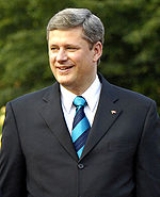
Stephen Harper

 
Stephen Harper

   Email Print
   Bookmark   Link


Stephen Harper


Stephen Joseph Harper, PC
Queen's Privy Council for Canada

The Queen's Privy Council for Canada , sometimes called Her Majesty's Privy Council for Canada or the Privy Council, is the council of advisers to the Monarchy of Canada, whose members are appointed by the Governor General of Canada of Canada for life on the advice of the Prime Minister of Canada....
, MP (born April 30, 1959) is the 22nd
List of Prime Ministers of Canada

This is a list of Prime Ministers of Canada. The Prime Minister of Canada is the primary Minister of the Crown, chairman of the Cabinet of Canada, and thus Head of Government of Canada....
 and current Prime Minister of Canada
Prime Minister of Canada

The Prime Minister of Canada is the primary Minister of the Crown, chairman of the Cabinet of Canada, and thus head of government of Canada. The office is not outlined in any of the documents that constitute the written portion of the constitution of Canada; executive authority is formally vested in the Monarchy of Canada and exercised on hi...
, and leader of the Conservative Party
Conservative Party of Canada

The Conservative Party of Canada , colloquially known as the Tories, is a major political party in Canada, formed by the merger of the Canadian Alliance and the Progressive Conservative Party of Canada....
. Harper became Prime Minister after his party won a minority government
Minority government

A minority government or a minority cabinet is a Cabinet of a parliamentary system formed when the governing political party or Coalition government of parties does not have a majority of overall seats in the parliament....
 in the January 2006 federal election. He is the first Prime Minister from the newly reconstituted Conservative Party, following a merger of the Progressive Conservative
Progressive Conservative Party

In Canadian politics, Progressive Conservative Party refers to a group of political parties that are technically distinct, but position themselves in a related way on the right-hand side of the political spectrum:...
 and Canadian Alliance
Canadian Alliance

The Canadian Alliance , formally the Canadian Reform Conservative Alliance , was a Canada Conservatism political party that existed from 2000 to 2003....
 Parties, is the first Canadian prime minister to request a Governor-General to prorogue Parliament in order to avoid a vote of confidence in the House of Commons.

Harper has been the Member of Parliament
Member of Parliament

A Member of Parliament, or MP, is a representative of the voters to a parliament. In many countries the term applies specifically to members of the lower house, as upper houses often have a unique title, such as senate, and thus also have unique titles for its members, such as senators....
 (MP) for the riding
Electoral district (Canada)

An electoral district in Canada, also known as a constituency or a Riding in Canadian English political jargon, is a geographically-based constituency upon which Canada's representative democracy is based....
 of Calgary Southwest
Calgary Southwest

Calgary Southwest is a federal electoral district in Alberta, Canada, that has been represented in the Canadian House of Commons since 1988. The district is in the southwest part of the City of Calgary, Alberta, south of Glenmore Trail, and west of the Canadian Pacific railway....
 in Alberta
Alberta

Alberta is one of Canada Canadian Prairies Provinces and territories of Canada. It became a province on September 1, 1905.Alberta is located in western Canada, bounded by the provinces of British Columbia to the west and Saskatchewan to the east, the Northwest Territories to the north, and the U.S....
 since 2002.


Discussion
Ask a question about 'Stephen Harper'
Start a new discussion about 'Stephen Harper'
Answer questions from other users
Full Discussion Forum


Quotations


Canada is a vast and empty country.

2006 Leaders' Debate, December 15, 2005

I believe that all taxes are bad.

CTV.ca news, December 1, 2005, "Tory tax cut promise dominates campaign"

I don't know all the facts on Iraq, but I think we should work closely with the Americans.

Report Newsmagazine, March 25 2002

In the last Parliament, the Liberal Party enacted comprehensive gun control...

The Reform party is much closer to what you would call conservative Republican.

We must aim to make Canada a lower tax jurisdiction than the United States.

Vancouver Province, April 6, 2004


Encyclopedia


Stephen Joseph Harper, PC
Queen's Privy Council for Canada

The Queen's Privy Council for Canada , sometimes called Her Majesty's Privy Council for Canada or the Privy Council, is the council of advisers to the Monarchy of Canada, whose members are appointed by the Governor General of Canada of Canada for life on the advice of the Prime Minister of Canada....
, MP (born April 30, 1959) is the 22nd
List of Prime Ministers of Canada

This is a list of Prime Ministers of Canada. The Prime Minister of Canada is the primary Minister of the Crown, chairman of the Cabinet of Canada, and thus Head of Government of Canada....
 and current Prime Minister of Canada
Prime Minister of Canada

The Prime Minister of Canada is the primary Minister of the Crown, chairman of the Cabinet of Canada, and thus head of government of Canada. The office is not outlined in any of the documents that constitute the written portion of the constitution of Canada; executive authority is formally vested in the Monarchy of Canada and exercised on hi...
, and leader of the Conservative Party
Conservative Party of Canada

The Conservative Party of Canada , colloquially known as the Tories, is a major political party in Canada, formed by the merger of the Canadian Alliance and the Progressive Conservative Party of Canada....
. Harper became Prime Minister after his party won a minority government
Minority government

A minority government or a minority cabinet is a Cabinet of a parliamentary system formed when the governing political party or Coalition government of parties does not have a majority of overall seats in the parliament....
 in the January 2006 federal election. He is the first Prime Minister from the newly reconstituted Conservative Party, following a merger of the Progressive Conservative
Progressive Conservative Party

In Canadian politics, Progressive Conservative Party refers to a group of political parties that are technically distinct, but position themselves in a related way on the right-hand side of the political spectrum:...
 and Canadian Alliance
Canadian Alliance

The Canadian Alliance , formally the Canadian Reform Conservative Alliance , was a Canada Conservatism political party that existed from 2000 to 2003....
 Parties, is the first Canadian prime minister to request a Governor-General to prorogue Parliament in order to avoid a vote of confidence in the House of Commons.

Harper has been the Member of Parliament
Member of Parliament

A Member of Parliament, or MP, is a representative of the voters to a parliament. In many countries the term applies specifically to members of the lower house, as upper houses often have a unique title, such as senate, and thus also have unique titles for its members, such as senators....
 (MP) for the riding
Electoral district (Canada)

An electoral district in Canada, also known as a constituency or a Riding in Canadian English political jargon, is a geographically-based constituency upon which Canada's representative democracy is based....
 of Calgary Southwest
Calgary Southwest

Calgary Southwest is a federal electoral district in Alberta, Canada, that has been represented in the Canadian House of Commons since 1988. The district is in the southwest part of the City of Calgary, Alberta, south of Glenmore Trail, and west of the Canadian Pacific railway....
 in Alberta
Alberta

Alberta is one of Canada Canadian Prairies Provinces and territories of Canada. It became a province on September 1, 1905.Alberta is located in western Canada, bounded by the provinces of British Columbia to the west and Saskatchewan to the east, the Northwest Territories to the north, and the U.S....
 since 2002. Earlier, from 1993 to 1997, he was the MP for Calgary West
Calgary West

Calgary West is a federal electoral district in Alberta, Canada, that has been represented in the Canadian House of Commons from 1917 to 1953, and since 1979....
. He was one of the founding members of the Reform Party
Reform Party of Canada

The Reform Party of Canada was a Canada federation political party that existed from 1987 to 2000. It was originally founded as a Western Canada-based protest party, but attempted to expand eastward in the 1990s....
, but ended his first stint as an MP to join, and shortly thereafter head, the National Citizens Coalition
National Citizens Coalition

The National Citizens Coalition is a Canada libertarian-Conservatism Lobbying group, founded by Colin M. Brown in 1967, originally founded in opposition to the concept of a national healthcare system....
. In 2002, he succeeded Stockwell Day
Stockwell Day

Stockwell Burt Day, Jr., Queen's Privy Council for Canada, Member of the Canadian House of Commons , is a Canada politician and a member of the Conservative Party of Canada....
 as leader of the Canadian Alliance
Canadian Alliance

The Canadian Alliance , formally the Canadian Reform Conservative Alliance , was a Canada Conservatism political party that existed from 2000 to 2003....
 (the successor to the Reform Party) and returned to Parliament as Leader of the Opposition. In 2003, he reached an agreement with Progressive Conservative
Progressive Conservative Party of Canada

The Progressive Conservative Party of Canada was a Canada political party with a centre-right stance on economic issues and a centrism stance on social issues....
 leader Peter MacKay
Peter MacKay

Peter Gordon MacKay, Queen's Privy Council for Canada, Queen's Counsel, Member of the Canadian House of Commons is a lawyer and politician from Nova Scotia, Canada....
 for the merger of their two parties to form the Conservative Party of Canada. He was elected as the party's first non-interim leader in March 2004.

Harper's Conservative Party won a stronger minority in the October 2008 federal election, showing a small increase in the percentage of the popular vote despite fewer actual votes than in 2006
Canadian federal election, 2006

The 2006 Canadian federal election was held on January 23, 2006, to elect members of the Canadian House of Commons of the 39th Canadian Parliament of Canada....
, and increased representation in the Canadian House of Commons
Canadian House of Commons

The House of Commons is a component of the Parliament of Canada, along with the Canadian monarchy and the Senate of Canada. The House of Commons is a democracy elected body, consisting of 40th Canadian Parliament known as Members of Parliament ....
 with 143 of 308 seats.

Early life

Harper was born in Toronto
Toronto

Toronto is the List of the 100 largest municipalities in Canada by population in Canada and the Provinces and territories of Canada Provincial and territorial capitals of Canada of Ontario....
, the first of three sons of Margaret (née Johnston) and Joseph Harper, an accountant at Imperial Oil
Imperial Oil

Imperial Oil Limited is Canada's largest petroleum company. The company is engaged in the exploration, production and sale of crude oil and natural gas....
. He attended Northlea Public School, while living at 332 Bessborough Avenue in Leaside
Leaside

Leaside is a neighbourhood in Toronto, Ontario, Canada. The area takes its name from William Lea and the Lea family, who settled there in the early years of the nineteenth century....
. Later, while living at 57 Princess Anne Crescent, he attended John G. Althouse Middle School
John G. Althouse Middle School

John G. Althouse Middle School is a middle school located in Toronto, Ontario, near the intersection of Lloyd Manor Drive and Princess Margaret Boulevard....
 and Richview Collegiate Institute
Richview Collegiate Institute

Richview Collegiate Institute is a secondary school in Etobicoke, a suburb in the west end of Toronto, Ontario. It is in the Toronto District School Board TDSB....
, both in Central Etobicoke. He graduated in 1978, at the top of his class with a 95.7% average, and was a member of Richview Collegiate's team on Reach for the Top
Reach for the Top

Reach for the Top is a Canada game show in which teams of high school students participate in local, provincial and eventually national trivia tournaments....
, a television quiz show for Canadian high school students. Harper then enrolled at the University of Toronto
University of Toronto

The University of Toronto is a public university research university in Toronto, Ontario, Canada, situated a mile north of the city's Financial District, Toronto on grounds that surround Queen's Park ....
 but after two months he dropped out, then moved to Edmonton, Alberta, where he found work at Imperial Oil, in the mail room. Later, he would advance to work on the company's computer systems. He took up post-secondary studies again at the University of Calgary
University of Calgary

The University of Calgary is a research-intensive public university in Calgary, Alberta, Canada. The University is composed of 24,000 undergraduate and 5,500 graduate students....
, where he completed a Bachelor's degree
Bachelor's degree

A bachelor's degree is usually an undergraduate academic degree awarded for a course or major that generally lasts for three, four, or in some cases and countries, five or six years....
 in economics
Economics

File:Ballard Farmers' Market - vegetables.jpgEconomics is the Social sciences that studies the Production theory basics, Distribution , and Consumption of Good and Service ....
. He later returned there to earn a Master's degree
Master's degree

A master's degree provides a mastery or high-order overview of a specific field of study or area of profession. Within the area studied, graduates possess advanced knowledge of a specialized body of theory and applied topics; high order skills in analysis, Critical thinking and/or professional application; and the ability to problem solving a...
 in economics, completed in 1993. Harper has kept strong links to the University of Calgary, and often guest-lectured there. He is the first prime minister since Lester B. Pearson
Lester B. Pearson

Lester Bowles "Mike" Pearson, Queen's Privy Council for Canada, Order of Merit , Companion of the Order of Canada, Order of the British Empire was a Canadian statesman, diplomat and politician who won the Nobel Peace Prize in 1957....
 not to have attended law school.

Political beginnings

Steveharper Outlook
Harper became involved in politics as a member of his high school's Young Liberals Club
Young Liberals of Canada

The Young Liberals of Canada is the national youth wing of the Liberal Party of Canada.. All members of the Liberal Party, who are aged 25 and under, are members of the Commission of the Young Liberals....
. He later changed his political allegiance because he disagreed with the National Energy Program
National Energy Program

The National Energy Program was an energy policy of the Government of Canada. It was enacted by the government of Prime Minister of Canada Pierre Trudeau in 1980, and administered by the Department of Energy, Mines and Resources....
 (NEP) of Pierre Trudeau
Pierre Trudeau

Joseph Philippe Pierre Yves Elliott Trudeau, Queen's Privy Council for Canada, Order of Canada, Order of the Companions of Honour, Queen's Counsel, Fellow of the Royal Society of Canada , was the 15th Prime Minister of Canada from April 20, 1968 to June 4, 1979, and from March 3, 1980 to June 30, 1984....
's Liberal
Liberal Party of Canada

The Liberal Party of Canada , colloquially known as the Grits, is a major political party in Canada. The party is positioned in the centre-left of the Politics of Canada....
 government. He became chief aide to Progressive Conservative
Progressive Conservative Party of Canada

The Progressive Conservative Party of Canada was a Canada political party with a centre-right stance on economic issues and a centrism stance on social issues....
 MP Jim Hawkes
Jim Hawkes

Frederick James "Jim" Hawkes, M.Sc., Ph.D. , is a former Canada politician....
 in 1985, but later became disillusioned with both the party and the government of Brian Mulroney
Brian Mulroney

Martin Brian Mulroney, Queen's Privy Council for Canada, Order of Canada, National Order of Quebec was the List of Prime Ministers of Canada Prime Minister of Canada from September 17, 1984, to June 25, 1993 and was leader of the Progressive Conservative Party of Canada from 1983 to 1993....
, especially the administration's fiscal policy
Fiscal policy

In economics, fiscal policy is the use of government spending and revenue collection to influence the economy.Fiscal policy can be contrasted with the other main type of economic policy, monetary policy, which attempts to stabilize the economy by controlling interest rates and the supply of money....
 and its inability to fully revoke the NEP until 1986. He left the PC Party that same year.

He was then recommended by the University of Calgary
University of Calgary

The University of Calgary is a research-intensive public university in Calgary, Alberta, Canada. The University is composed of 24,000 undergraduate and 5,500 graduate students....
's economist Bob Mansell to Preston Manning
Preston Manning

Ernest Preston Manning, Order of Canada , is a conservative populist Canada politician. He was the only leader of the Reform Party of Canada, a Canadian federal political party that evolved into the Canadian Alliance....
, the founder and leader of the Reform Party of Canada
Reform Party of Canada

The Reform Party of Canada was a Canada federation political party that existed from 1987 to 2000. It was originally founded as a Western Canada-based protest party, but attempted to expand eastward in the 1990s....
. Manning invited him to participate in the party, and Harper gave a speech at Reform's 1987 founding convention in Winnipeg. He became the Reform Party's Chief Policy Officer, and he played a major role in drafting the 1988 election platform. He is credited with creating Reform's campaign slogan, "The West wants in!"

Harper ran for the Canadian House of Commons
Canadian House of Commons

The House of Commons is a component of the Parliament of Canada, along with the Canadian monarchy and the Senate of Canada. The House of Commons is a democracy elected body, consisting of 40th Canadian Parliament known as Members of Parliament ....
 in the 1988 federal election
Canadian federal election, 1988

The Canadian federal election of 1988 was held November 21, 1988, to elect members of the Canadian House of Commons of the 34th Canadian Parliament of Canada....
, appearing on the ballot as Steve Harper in Calgary West
Calgary West

Calgary West is a federal electoral district in Alberta, Canada, that has been represented in the Canadian House of Commons from 1917 to 1953, and since 1979....
. He lost by a wide margin to Hawkes, his former employer. The Reform Party did not win any seats in this election, although party candidate Deborah Grey
Deborah Grey

Deborah Cleland Grey, Order of Canada, sometimes called Deb Grey is a prominent former Canada Member of Parliament of Canada from Alberta for the Reform Party of Canada, Canadian Alliance and Conservative Party of Canada....
 was elected as the party's first MP in a by-election
By-election

A by-election or bye-election is an election held to fill a political office that has become vacant between regularly-scheduled elections....
 shortly thereafter. Harper became Grey's executive assistant, and was her chief adviser and speechwriter until 1993. He remained prominent in the Reform Party's national organization in his role as policy chief, encouraging the party to expand beyond its Western base and arguing that strictly regional parties were at risk of being taken over by radical elements. He delivered a speech at the Reform Party's 1991 national convention, in which he condemned extremist views.

Harper's relationship with Manning became strained in 1992, due to conflicting strategies over the Charlottetown Accord
Charlottetown Accord

The Charlottetown Accord was a package of constitution amendments, proposed by the Canada federal and provincial governments in 1992. It was submitted to a public referendums in Canada on October 26 of that year, and was defeated....
. Harper opposed the Accord on principle for ideological reasons, while Manning was initially more open to compromise. Harper also criticized Manning's decision to hire Rick Anderson
Rick Anderson

Rick Anderson is a Canada political strategist, public affairs commentator and businessman.Anderson, a native of Montreal and Salaberry-de-Valleyfield, Quebec, was initially drawn to the Liberal Party of Canada of Pierre_Elliott_Trudeau....
 as an adviser, believing that Anderson was not sufficiently committed to the Reform Party's principles. He resigned as policy chief in October 1992.

Harper stood for office again in the 1993 federal election
Canadian federal election, 1993

The Canadian federal election of 1993 was held on October 25 of that year to elect members to the Canadian House of Commons of the 35th Canadian Parliament of Canada....
, and defeated Jim Hawkes amid a significant Reform breakthrough in Western Canada. His campaign likely benefited from a $50,000 print and television campaign organized by the National Citizens Coalition
National Citizens Coalition

The National Citizens Coalition is a Canada libertarian-Conservatism Lobbying group, founded by Colin M. Brown in 1967, originally founded in opposition to the concept of a national healthcare system....
 against Hawkes, although the NCC did not endorse Harper directly.

Reform MP

Harper emerged a prominent member of the Reform Party of Canada
Reform Party of Canada

The Reform Party of Canada was a Canada federation political party that existed from 1987 to 2000. It was originally founded as a Western Canada-based protest party, but attempted to expand eastward in the 1990s....
 caucus, and earned respect even from political opponents for his intellect and ideological commitment. Author Mordecai Richler
Mordecai Richler

Mordecai Richler, Order of Canada was a Canada author, Academy Award-nominated screenwriter and essayist. A leading critic called him "the great shining star of his Canadian literary generation" and a pivotal figure in the country's history....
 once described him as the "one MP of substance" in the party.

Harper was active on constitutional issues during his first term in parliament, and played a prominent role in drafting the Reform Party's strategy for the 1995 Quebec referendum
1995 Quebec referendum

The 1995 Quebec referendum was the second referendum to ask voters in the Canada province of Quebec whether Quebec should secede from Canada and become an independent state, through the question:...
. A long-standing opponent of centralized federalism
Canadian federalism

Canadian federalism is one of the three pillars of the constitutional order, along with responsible government and the Canadian Charter of Rights and Freedoms....
, he stood with Preston Manning in Montreal
Montreal

Montreal, or Montr?al, is the largest city in the Provinces and territories of Canada of Quebec and the List of largest cities and second largest cities by country List of the 100 largest municipalities in Canada by population....
 to introduce a twenty-point plan to "decentralize and modernize" Canada in the event of a "no" victory. Harper later argued that the "no" side's narrow plurality
Plurality

In voting, a plurality is the largest number of Voting to be received by any candidate or proposition when three or more choices are possible. With only two choices the winner would have a majority, barring a strong showing from a write-in....
 was a worst-case scenario, in that no-one had won a mandate for change.

Although not associated with the Reform Party's radical wing, Harper expressed socially conservative
Social conservatism

Social conservatism is a political or moral ideology that believes the government has a role in encouraging or enforcing traditional values or behaviors based on the belief that these are what keep people civilized and decent....
 views on some issues. In 1994, he opposed plans by federal Justice Minister
Minister of Justice (Canada)

The Minister of Justice is the Minister of the Crown in the Cabinet of Canada who is responsible for the Department of Justice and is also Attorney General of Canada....
 Allan Rock
Allan Rock

This article is about the Canadian statesman. For the similarly-named places in Massachusetts, see Allen Rock.Allan Michael Rock, Queen's Privy Council for Canada is a lawyer, former Canada politician, diplomat and now the President of University of Ottawa....
 to introduce spousal benefits for same-sex couples. Citing the recent failure of a similar initiative in Ontario
Ontario

Ontario is a Provinces and territories of Canada located in the Central Canada part of Canada, the largest by population and second largest, after Quebec, in total area....
, he was quoted as saying, "What I hope they learn is not to get into it. There are more important social and economic issues, not to mention the unity question." Harper also spoke against the possibility of the Canadian Human Rights Commission
Canadian Human Rights Commission

The Canadian Human Rights Commission is a quasi-judicial body that was established in 1977 by the government of Canada. It is empowered under the Canadian Human Rights Act to investigate and try to settle complaints of discrimination in employment and in the provision of services within federal jurisdiction....
 or the Supreme Court
Supreme Court of Canada

The Supreme Court of Canada is the supreme court of Canada and is the final court of appeal in the Canadian justice system. The court grants permission to between 40 and 75 litigants each year to appeal decisions rendered by provincial, territorial and federal Appeal, and its decisions are stare decisis, binding upon all lower courts of...
 changing federal policy in these and other matters.

At the Reform Party's 1994 policy convention, Harper was part of a small minority of delegates who voted against restricting the definition of marriage to "the union of one man and one woman". He actually opposed both same-sex marriage
Same-sex marriage in Canada

On July 20, 2005, Canada became the fourth country in the world to legalize same-sex marriage nationwide with the enforcement of the Civil Marriage Act....
 and mandated benefits for same-sex couples, but argued that political parties should refrain from taking official positions on these and other "issues of conscience".

Harper was the only Reform MP to vote for a bill establishing the Canadian Firearms Registry at second reading stage in 1995, although he voted against it at third reading. He made his initial decision after concluding that a majority of his constituents supported the measure, but changed his mind after deciding there was substantial opposition. It was reported in April 1995 that some Progressive Conservatives opposed to Jean Charest
Jean Charest

John James Charest, Queen's Privy Council of Canada, Member of the National Assembly is a Canadian lawyer and politician from the provinces and territories of Canada of Quebec....
's leadership wanted to remove both Charest and Manning, and unite the Reform and Progressive Conservative parties under Harper's leadership.

Despite his prominent position in the party, Harper's relationship with the Reform Party leadership was frequently strained. In early 1994, he criticized a party decision to establish a personal expense account for Preston Manning
Preston Manning

Ernest Preston Manning, Order of Canada , is a conservative populist Canada politician. He was the only leader of the Reform Party of Canada, a Canadian federal political party that evolved into the Canadian Alliance....
 at a time when other Reform MPs had been asked to forego parliamentary perquisites
Employee benefit

Employee benefits and benefits in kind are various non-wage compensations provided to employees in addition to their normal wages or salary....
. His criticism proved divisive in the party, and he was formally rebuked by the Reform executive council despite winning support from some MPs. His relationship with Manning grew increasingly fractious in the mid-1990s, and he pointedly declined to express any opinion on Manning's leadership during a 1996 interview. This friction was indicative of a fundamental divide between the two men: Harper was strongly committed to conservative principles and opposed Manning's inclinations toward populism
Populism

Populism is a discourse which supports "the people" versus "the elites." Populism may involve either a philosophy urging social and political system changes and/or a rhetorical style deployed by members of political or social movements competing for advantage within the existing party system....
, which he saw as leading to compromise on core ideological matters.

These tensions culminated in late 1996 when Harper announced that he would not be a candidate in the next federal election
Canadian federal election, 1997

The Canadian federal election of 1997 was held on June 2, 1997, to elect members of the Canadian House of Commons of the 36th Canadian Parliament of Canada....
. He resigned his parliamentary seat on January 14, 1997, the same day that he was appointed as a vice-president of the National Citizens Coalition
National Citizens Coalition

The National Citizens Coalition is a Canada libertarian-Conservatism Lobbying group, founded by Colin M. Brown in 1967, originally founded in opposition to the concept of a national healthcare system....
 (NCC), a conservative think-tank and advocacy group. He was promoted to NCC president later in the year.

In April 1997, Harper suggested that the Reform Party was drifting toward social conservatism
Social conservatism

Social conservatism is a political or moral ideology that believes the government has a role in encouraging or enforcing traditional values or behaviors based on the belief that these are what keep people civilized and decent....
 and ignoring the principles of economic conservatism
Fiscal conservatism

Fiscal conservatism is a political phrase term used in North America to describe a fiscal policy that advocates a reduction in overall government spending....
. The Liberal Party
Liberal Party of Canada

The Liberal Party of Canada , colloquially known as the Grits, is a major political party in Canada. The party is positioned in the centre-left of the Politics of Canada....
 lost seats but managed to retain a narrow majority government in the 1997 federal election
Canadian federal election, 1997

The Canadian federal election of 1997 was held on June 2, 1997, to elect members of the Canadian House of Commons of the 36th Canadian Parliament of Canada....
, while Reform made only modest gains.

Out of Parliament


1997–2000


Soon after leaving parliament, Harper and Tom Flanagan
Tom Flanagan (political scientist)

Thomas Eugene Flanagan is an Americo-Canadian writer and professor of political science at the University of Calgary in Alberta, Canada. He is the only son of an Irish-American family from Illinois, and he attended the University of Notre Dame, Indiana as an undergraduate....
 co-authored an opinion piece entitled "Our Benign Dictatorship", which argued that the Liberal Party only retained power through a dysfunctional political system and a divided opposition. Harper and Flanagan argued that national conservative governments between 1917 and 1993 were founded on temporary alliances between Western populists and Quebec nationalists, and were unable to govern because of their fundamental contradictions. The authors called for an alliance of Canada's conservative parties, and suggested that meaningful political change might require electoral reforms such as proportional representation
Proportional representation

Proportional representation , sometimes referred to as full representation, is a category of voting systems aimed at a close match between the percentage of votes that groups of candidates obtain in elections and the percentage of seats they receive ....
. "Our Benign Dictatorship" also commended Conrad Black
Conrad Black

Conrad Moffat Black, Baron Black of Crossharbour, Queen's Privy Council for Canada, Order of Canada, Order of St. Gregory the Great is a Canadian-born British people historian and columnist who was for a time the third biggest newspaper magnate in the world....
's purchase of the Southam newspaper chain, arguing that his stewardship would provide for a "pluralistic" editorial view to counter the "monolithically liberal and feminist
Feminism

Feminism is the belief that women should have equal political, social, sexual, intellectual and economic rights to men. It involves various movements, Theory, and philosophies, all concerned with issues of gender difference, that advocate equality for women and that campaign for women's rights and interests....
" approach of the previous management.

Harper remained active in constitutional issues. He was a prominent opponent of the Calgary Declaration
Calgary Declaration

The Calgary Declaration, also known as the Calgary Accord, was an agreement made between most premiers of the provinces and territories of Canada regarding how to approach future amendments to the Constitution of Canada....
 on national unity in late 1997, describing it as an "appeasement strategy" against Quebec nationalism. He called for federalist politicians to reject this strategy, and approach future constitutional talks from the position that "Quebec separatists are the problem and they need to be fixed". In late 1999, Harper called for the federal government to establish clear rules for any future Quebec referendum on sovereignty. Some have identified Harper's views as an influence on the Chrétien government's Clarity Act
Clarity Act

The Clarity Act is legislation passed by the Parliament of Canada that established the conditions under which the Government of Canada would enter into negotiations that might lead to secession following such a vote by one of the provinces....
.

As National Citizens Coalition (NCC) leader, Harper launched an ultimately unsuccessful legal battle
Harper v. Canada (Attorney General)

Harper v. Canada , [2004] 1 S.C.R. 827, 2004 SCC 33, is a leading decision of the Supreme Court of Canada wherein the Court ruled that Canada Elections Act's spending limits on third party election advertising does not violate Section Two of the Canadian Charter of Rights and Freedoms and Section Three of the Canadian Charter of Rights and Fr...
 against federal election laws restricting third-party advertising. He also led the NCC in several campaigns against the Canadian Wheat Board
Canadian Wheat Board

The Canadian Wheat Board was established by the Parliament of Canada in 1935 as a producer marketing system for wheat and barley. It is headquartered in Winnipeg, Manitoba, Canada....
, and supported Finance Minister
Minister of Finance (Canada)

The Minister of Finance is the Minister of the Crown in the Cabinet of Canada who is responsible each year for presenting the Canadian federal budget....
 Paul Martin
Paul Martin

Paul Edgar Philippe Martin, Queen's Privy Council for Canada was the 21st Prime Minister of Canada, as well as leader of the Liberal Party of Canada....
's 2000 tax cut
Tax cut

A tax cut is a reduction in tax. Economic stimulus via tax cuts, along with interest rate intervention and deficit spending, are one of the central tenets of Keynesian economics....
s as a positive first step toward tax reform.

In 1997, Harper delivered a controversial speech on Canadian identity to the Council for National Policy
Council for National Policy

The Council for National Policy , is an umbrella organization and networking group for social conservative activists in the United States. It has been described by the The New York Times as a "little-known group of a few hundred of the most powerful conservatives in the country," who meet three times yearly behind closed doors at undiscl...
, a conservative American think tank
Think tank

A think tank is an organization, institute, corporation, or group that conducts research and engages in advocacy in areas such as social policy, political strategy, economy, science or technology issues, industrial or business policies, or military advice....
. He made comments such as "Canada is a Northern European welfare state
Welfare State

The Welfare State of the United Kingdom was prefigured in the William Beveridge Report in 1942, which identified five "Giant Evils" in society: squalor, ignorance, want, idleness and disease....
 in the worst sense of the term, and very proud of it", "if you're like all Americans, you know almost nothing except for your own country. Which makes you probably knowledgeable about one more country than most Canadians", and "the NDP
New Democratic Party

The New Democratic Party is a political party in Canada with a progressivism social democracy philosophy that contests elections at both the federal and provincial levels....
 [New Democratic Party] is kind of proof that the Devil lives and interferes in the affairs of men." These statements were publicized and criticized during the 2006 election
Canadian federal election, 2006

The 2006 Canadian federal election was held on January 23, 2006, to elect members of the Canadian House of Commons of the 39th Canadian Parliament of Canada....
. Harper argued that the speech was intended as humour, and not as serious analysis.

Harper considered campaigning for the Progressive Conservative Party leadership in 1998, after Jean Charest
Jean Charest

John James Charest, Queen's Privy Council of Canada, Member of the National Assembly is a Canadian lawyer and politician from the provinces and territories of Canada of Quebec....
 left federal politics. Among those encouraging his candidacy were senior aides to Ontario Premier
Premier of Ontario

The Premier of Ontario is the first minister Minister of the Crown for the Canada Provinces of Canada of Ontario. The Premier is appointed as the province's head of government by the Lieutenant Governor of Ontario, and presides over the Executive Council of Ontario, or Cabinet ....
 Mike Harris
Mike Harris

Michael Deane Harris was the twenty-second Premier of Ontario from June 26, 1995 to April 15, 2002. He is most noted for the "Common Sense Revolution", his government's program of deficit reduction in combination with lower taxes and significant cuts to some government programs....
, including Tony Clement
Tony Clement

Anthony Peter "Tony" Clement, Queen's Privy Council for Canada, Canadian House of Commons is a Canada politician, federal Minister of Industry , Minister for the FedNor and member of the Conservative Party of Canada....
 and Tom Long. He eventually decided against running, arguing that it would "burn bridges to those Reformers with whom I worked for many years" and prevent an alliance of right-wing parties from taking shape. Harper was skeptical about the Reform Party's United Alternative initiative in 1999, arguing that it would serve to consolidate Manning's hold on the party leadership. He also expressed concern that the UA would dilute Reform's ideological focus.

2000–2001


When the United Alternative created the Canadian Alliance
Canadian Alliance

The Canadian Alliance , formally the Canadian Reform Conservative Alliance , was a Canada Conservatism political party that existed from 2000 to 2003....
 in 2000 as a successor party to Reform, Harper predicted that Stockwell Day
Stockwell Day

Stockwell Burt Day, Jr., Queen's Privy Council for Canada, Member of the Canadian House of Commons , is a Canada politician and a member of the Conservative Party of Canada....
 would defeat Preston Manning for the new party's leadership. He expressed reservations about Day's abilities, however, and accused Day of "[making] adherence to his social views a litmus test
Litmus test (politics)

A litmus test is a question asked of a potential candidate for high office, the answer to which would determine whether the nominating official would choose to proceed with the appointment or nomination....
 to determine whether you're in the party or not". Harper endorsed Tom Long for the leadership, arguing that Long was best suited to take support from the Progressive Conservative Party. When Day placed first on the first ballot, Harper said that the Canadian Alliance was shifting "more towards being a party of the religious right
Christian right

The Christian right is a term used predominantly in the United States to describe a spectrum of right-wing politics Christian political and social movements and organizations characterized by their strong support of Conservatism social conservative and Republican Party values....
".

After Pierre Trudeau
Pierre Trudeau

Joseph Philippe Pierre Yves Elliott Trudeau, Queen's Privy Council for Canada, Order of Canada, Order of the Companions of Honour, Queen's Counsel, Fellow of the Royal Society of Canada , was the 15th Prime Minister of Canada from April 20, 1968 to June 4, 1979, and from March 3, 1980 to June 30, 1984....
's death in 2000, Harper wrote an editorial criticizing Trudeau's policies as they affected Western Canada. He wrote that Trudeau "embraced the fashionable causes of his time, with variable enthusiasm and differing results", but "took a pass" on the issues that "truly defined his century". Harper subsequently accused Trudeau of promoting "unabashed socialism
Socialism

Socialism refers to a broad set of economic theories of social organization advocating public or state ownership and administration of the means of production and distribution of goods, and a society characterized by equality for all individuals, with a fair or Egalitarianism method of compensation....
", and argued that Canadian governments between 1972 and 2002 had restricted economic growth
Economic growth

Economic growth is the increase in the amount of the goods and services produced by an economics over time. It is conventionally measured as the percent rate of increase in real gross domestic product, or real GDP....
 through "state corporatism".

After the Canadian Alliance's poor showing in the 2000 election
Canadian federal election, 2000

The 2000 Canadian federal election was held on November 27, 2000, to elect 301 Member of Parliament of the Canadian House of Commons of the 37th Canadian Parliament of Canada....
, Harper joined with other Western conservatives in co-authoring a document called the "Alberta Agenda
Alberta Agenda

The Alberta Agenda is a loosely-organized political movement initiated by a letter written by prominent Albertans, including Canadian Prime Minister Stephen Harper and Alberta Progressive Conservative leadership election, 2006 Ted Morton, urging Albertan Premier Ralph Klein to fully exercise Alberta's Canadian federalism....
". The letter called on Alberta to reform publicly-funded health care, replace the Canada Pension Plan
Canada Pension Plan

The Canada Pension Plan is a contributory, earnings-related social insurance program. It forms one of the two major components of Canada's public retirement income system, the other component being Old Age Security ....
 with a provincial plan and replace the Royal Canadian Mounted Police
Royal Canadian Mounted Police

The Royal Canadian Mounted Police is the federal police, national police, and paramilitary police force of Canada, and one of the most recognized of its kind in the world....
 with a provincial police force. It became known as the "firewall letter", because it called on the provincial government to "build firewalls around Alberta" in order to stop the federal government from redistributing its wealth to less affluent regions. Alberta Premier
Premier of Alberta

The Premier of Alberta is the first minister for the Canada Provinces of Canada of Alberta. They are the province's head of government and de facto chief executive....
 Ralph Klein
Ralph Klein

Ralph Phillip Klein was the leader of the Alberta Progressive Conservatives from 1992 until his retirement in 2006. His tenure as premier ended when the Alberta Progressive Conservatives' new leader, Ed Stelmach, assumed office December 14, 2006, exactly fourteen years after Klein first became Premier....
 agreed with some of the letter's recommendations, but distanced himself from the "firewall" comments.

Harper also wrote an editorial in late 2000 arguing that Alberta and the rest of Canada were "embark[ing] on divergent and potentially hostile paths to defining their country". He said that Alberta had chosen the "best of Canada's heritage -- a combination of American enterprise and individualism with the British traditions of order and co-operation" while Canada "appears content to become a second-tier socialistic country [...] led by a second-world strongman appropriately suited for the task". He also called for a "stronger and much more autonomous Alberta", while rejecting calls for separatism. In the 2001 Alberta provincial election
Alberta general election, 2001

The Alberta general election of 2001 was the twenty-fifth general election for the Province of Alberta, Canada. It was held on March 12 2001 to elect members of the Legislative Assembly of Alberta....
, Harper led the NCC in a "Vote Anything but Liberal" campaign. Some articles from this period described him as a possible successor to Klein.

Harper and the NCC endorsed a private school tax credit
Tax credit

The term tax credit describes two different concepts:*The first is a recognition of partial payment already made towards taxes due.*The second is a state benefit paid to workers through the tax system, which has the effect of increasing net income....
 proposed by Ontario's Progressive Conservative
Progressive Conservative Party of Ontario

The Progressive Conservative Party of Ontario , is a right-of-centre political party in Ontario, Canada. The party was known for many years as "Ontario's natural governing party." It has ruled the province for 80 of the years since Canadian Confederation, including an uninterrupted run from 1943 to 1985....
 government in 2001, arguing that it would "save about $7,000 for each student who does not attend a union
Trade union

A trade union or labor union is an organization run by and for workers who have banded together to achieve common goals in key areas such as wages, hours, and working conditions....
-run public school". Education Minister Janet Ecker
Janet Ecker

Janet Ecker is a politician in Ontario, Canada. She was a member of the Legislative Assembly of Ontario from 1995 to 2003, and was a senior cabinet minister in the governments of Mike Harris and Ernie Eves....
 criticized this, saying that her government's intent was not to save money at the expense of public education.

Day's leadership of the Canadian Alliance became increasingly troubled throughout the summer of 2001, as several party MPs called for his resignation. In June, the National Post
National Post

The National Post is a Canada English language national newspaper based in Don Mills, Ontario, a district of Toronto, Ontario. The paper is owned by CanWest Global Communications and is published every Monday through Saturday....
 newspaper reported that former Reform MP Ian McClelland
Ian McClelland

Ian G. McClelland was a member of the Canadian House of Commons from 1993 to 2000, and a member of the Alberta Legislative Assembly from 2001 to 2004....
 was organizing a possible leadership challenge on Harper's behalf. Harper announced his resignation from the NCC presidency in August 2001, to prepare a campaign.

Canadian Alliance leadership


Stockwell Day called a new Canadian Alliance leadership race for 2002, and soon declared himself a candidate. Harper emerged as Day's main rival, and declared his own candidacy on December 3, 2001. He eventually won the support of at least 28 Alliance MPs, including Scott Reid, James Rajotte
James Rajotte

James Rajotte is a Canada politician.As a member of the Conservative Party of Canada in the Canadian House of Commons, Rajotte is chair of Parliament's Standing Committee on Industry, Science, and Technology....
 and Keith Martin
Keith Martin

Dr. Keith P. Martin, Queen's Privy Council for Canada, Member of Parliament, Doctor of Medicine is a Canada politician and physician. He is the Liberal Party of Canada Member of Parliament for the riding of Esquimalt?Juan de Fuca....
. During the campaign, Harper reprised his earlier warnings against an alliance with Quebec
Quebec

Quebec , in French language, Qu?bec , is a Provinces and territories of Canada in the Central Canada and Eastern Canada regions of Canada....
 nationalists, and called for his party to become the federalist option in Quebec. He argued that "the French language is not imperilled in Quebec", and opposed "special status" for the province in the Canadian Constitution accordingly. He also endorsed greater provincial autonomy on Medicare
Medicare (Canada)

The term medicare is the unofficial name for Canada's universal health care. The formal terminology for the insurance system is provided by the Canada Health Act and the health insurance legislation of the individual provinces and territories....
, and said that he would not co-operate with the Progressive Conservatives as long as they were led by Joe Clark
Joe Clark

Charles Joseph "Joe" Clark, Queen's Privy Council for Canada, Order of Canada, Alberta Order of Excellence is a Canadian journalist, politician, statesman, businessman, and university professor....
. On social issues, Harper argued for "parental rights" to use corporal punishment
Corporal punishment

Corporal punishment is the deliberate infliction of pain intended to punish a person or change his/her behavior. Historically speaking, most forms of punishment, whether in judicial, domestic, or educational settings, were corporal in basis....
 against their children and supported raising the age of sexual consent. He described his potential support base as "similar to what George Bush
George W. Bush

George Walker Bush served as the List of Presidents of the United States President of the United States from 2001 to 2009. He was the 46th List of Governors of Texas from 1995 to 2000 before being United States presidential inauguration as President on January 20, 2001....
 tapped".

The tone of the leadership contest turned hostile in February 2002. Harper described Day's governance of the party as "amateurish", while his campaign team argued that Day was attempting to win re-election by building a narrow support base among different groups in the religious right. The Day campaign accused Harper of "attacking ethnic and religious minorities". In early March, the two candidates had an especially fractious debate on CBC Newsworld
CBC Newsworld

CBC Newsworld is a Canada English language cable television specialty channel news channel owned and operated by the Canadian Broadcasting Corporation ....
. The leadership vote was held on March 20, 2002. Harper was elected on the first ballot with 55 percent support, against 37 percent for Day. Two other candidates split the remainder.

After winning the party leadership, Harper announced his intention to run for parliament in a by-election
By-election

A by-election or bye-election is an election held to fill a political office that has become vacant between regularly-scheduled elections....
 in Calgary Southwest
Calgary Southwest

Calgary Southwest is a federal electoral district in Alberta, Canada, that has been represented in the Canadian House of Commons since 1988. The district is in the southwest part of the City of Calgary, Alberta, south of Glenmore Trail, and west of the Canadian Pacific railway....
, recently vacated by Preston Manning. Ezra Levant
Ezra Levant

Ezra Levant is a Canada blogger, author, journalist, lawyer and conservative political activist. He is the former publisher of the Western Standard magazine....
 had already been chosen as the riding's Alliance candidate and initially declared that he would not stand aside for Harper; he subsequently reconsidered. The Liberals did not field a candidate, following a parliamentary tradition of allowing opposition leaders to enter the House of Commons unopposed. The Progressive Conservative candidate, Jim Prentice
Jim Prentice

James "Jim" Prentice, Queen's Privy Council for Canada, Member of the Canadian House of Commons is a Canada lawyer, and politician. In the Canadian federal election, 2004 he was elected to the Canadian House of Commons as a candidate of the Conservative Party of Canada....
, also chose to withdraw. Harper was elected without difficulty over New Democrat
New Democratic Party

The New Democratic Party is a political party in Canada with a progressivism social democracy philosophy that contests elections at both the federal and provincial levels....
 Bill Phipps
Bill Phipps

William "Bill" Phipps is a Canada church body leader and social justice activist. He was Moderator of the United Church of Canada of the United Church of Canada from 1997 to 2000....
, a former United Church
United Church of Canada

The United Church of Canada, one of the largest Christian churches in Canada, is an evangelical Protestant denomination with strong Methodist and Presbyterian roots....
 moderator. Harper told a reporter during the campaign that he "despise[d]" Phipps, and declined to debate him.

Harper officially became Leader of the Opposition
Leader of the Opposition (Canada)

The Leader of the Official Opposition , or simply the Leader of the Opposition, in Canada is the Member of Parliament in the Canadian House of Commons who leads Official Opposition , the party in Parliament of Canada that has the most seats in Opposition to the ruling party....
 in May 2002. Later in the same month, he said that the Atlantic Provinces were trapped in "a culture of defeat" which had to be overcome, the result of policies designed by Liberal and Progressive Conservative governments. Many Atlantic politicians condemned the remark as patronizing and insensitive. The Legislature of Nova Scotia unanimously approved a motion condemning Harper's comments, which were also criticized by New Brunswick
New Brunswick

New Brunswick is one of Canada's three Maritime provinces and is the only Constitution of Canada bilingual province in the federation. The provincial capital is Fredericton....
 Premier
Premier of New Brunswick

The Premier of New Brunswick is the first minister for the Canada Provinces of Canada of New Brunswick. They are the province's head of government and de facto chief executive....
 Bernard Lord
Bernard Lord

Bernard Lord, Order of New Brunswick is a Canada politician and lobbyist. Lord served as Premier of New Brunswick of New Brunswick from 1999 to 2006....
, federal Progressive Conservative leader Joe Clark
Joe Clark

Charles Joseph "Joe" Clark, Queen's Privy Council for Canada, Order of Canada, Alberta Order of Excellence is a Canadian journalist, politician, statesman, businessman, and university professor....
 and others. Harper refused to apologize, and said that much of Canada was trapped by the same "can't-do" attitude.

His first 18 months as opposition leader were largely devoted towards consolidating the fractured elements of the Canadian Alliance and encouraging a union of the Canadian Alliance and the federal Progressive Conservatives. The aim of this union was to present only one right-of-center national party in the next federal election. In undertaking the merger talks, PC leader Peter MacKay reversed his previous agreement with leadership opponent David Orchard
David Orchard

David Orchard is a Canada political figure, member of the Liberal Party of Canada, and nominated Liberal Party candidate for the Saskatchewan riding of Desneth?Missinippi?Churchill River in the 40th Canadian federal election....
 not to merge with the Alliance. After reaching an agreement with MacKay in October 2003, the Canadian Alliance and the Progressive Conservative Party of Canada officially merged in December, with the new party being named the "Conservative Party of Canada
Conservative Party of Canada

The Conservative Party of Canada , colloquially known as the Tories, is a major political party in Canada, formed by the merger of the Canadian Alliance and the Progressive Conservative Party of Canada....
".

Harper is reported to have attended the 2003 meeting
2003 Bilderberg Meeting

The Bilderberg Group or Bilderberg conference is an unofficial annual invitation-only meeting of around 130 guests, most of whom are persons of influence in the fields of business, Mass media, and politics....
 of the Bilderberg Group
Bilderberg Group

The Bilderberg Group, Bilderberg conference, or Bilderberg Club is an unofficial annual invitation-only meeting of around 130 guests, most of whom are persons of influence in the fields of politics, business and banking....
.

In March 2003 Harper and Stockwell Day co-wrote a letter to The Wall Street Journal
The Wall Street Journal

The Wall Street Journal is an English language international daily newspaper published by Dow Jones & Company in New York, New York with Asian and European editions....
 in which they condemned the Canadian government's unwillingness to participate in the 2003 invasion of Iraq
2003 invasion of Iraq

The 2003 invasion of Iraq, from March 20 to May 1, 2003, was spearheaded by the United States, backed by United Kingdom forces and smaller contingents from Australia, Spain, Poland and Denmark....
.

Conservative Party of Canada leadership

On January 12, 2004, Harper announced his resignation as Leader of the Opposition, in order to run for the leadership of the Conservative Party of Canada
Conservative Party of Canada

The Conservative Party of Canada , colloquially known as the Tories, is a major political party in Canada, formed by the merger of the Canadian Alliance and the Progressive Conservative Party of Canada....
. Harper won the Conservative leadership election
Conservative Party of Canada leadership election, 2004

The 2004 Conservative Party of Canada leadership election took place on March 20, 2004 in Toronto, Ontario, and resulted in the election of Stephen Harper as the first leader of the new Canada Conservative Party of Canada....
 easily, with a first ballot majority against Belinda Stronach
Belinda Stronach

Belinda Caroline Stronach, Queen's Privy Council for Canada is a Canada businessperson, philanthropist and former politician. She was a Member of Parliament in the Canadian House of Commons from 2004 to 2008....
 and Tony Clement
Tony Clement

Anthony Peter "Tony" Clement, Queen's Privy Council for Canada, Canadian House of Commons is a Canada politician, federal Minister of Industry , Minister for the FedNor and member of the Conservative Party of Canada....
 on March 20, 2004. Harper's victory included strong showings in Ontario, Quebec, and Atlantic Canada.

2004 federal election


Harper led the Conservatives into the 2004 federal election. Initially, new Prime Minister Paul Martin
Paul Martin

Paul Edgar Philippe Martin, Queen's Privy Council for Canada was the 21st Prime Minister of Canada, as well as leader of the Liberal Party of Canada....
 held a large lead in polls, but this eroded due to infighting, Adscam
Sponsorship scandal

The sponsorship scandal, "AdScam", "Sponsorship"or Sponsorgate, is a scandal that came as a result of a Canada politics of Canada "Sponsor ship program" in the province of Quebec and involving the Liberal Party of Canada, which was in power from 1993 to 2006....
 and other scandals surrounding his government. The Liberals attempted to counter this with an early election call, as this would give the Conservatives less time to consolidate their merger.

Martin's weak performance in the leader's debate, along with an unpopular provincial budget by Liberal Premier Dalton McGuinty
Dalton McGuinty

Dalton James Patrick McGuinty, Jr., Legislative Assembly of Ontario is a Canada lawyer and politician and, since October 23, 2003, Premier of Ontario....
, moved the Conservatives into a lead for a time. However, comments by Conservative MPs, leaked press releases slandering the then Prime Minister, as well as controversial TV attack ad
Attack ad

In political campaigns, an attack ad is an advertisement whose message is meant as an attack against another candidate or political party. Attack ads often form part of negative campaigning or smear campaigns, and in large or well-financed campaigns, may be disseminated via mass media....
s suggesting that the Conservatives would make Canada more like the United States, caused Harper's party to lose some momentum.

Harper made an effort to appeal to voters in Quebec
Quebec

Quebec , in French language, Qu?bec , is a Provinces and territories of Canada in the Central Canada and Eastern Canada regions of Canada....
, a province where the Reform/Alliance side of the merged party hadn't done well. He was featured in several of the Tories' French-language campaign ads.

The Liberals were re-elected to power with a minority government, with the Conservatives coming in second place. The Conservatives managed to make inroads into the Liberals' Ontario stronghold, primarily in the province's socially conservative central region. However, they were shut out of Quebec, marking the first time that a centre-right party did not win any seats in that province. Harper, after some personal deliberation, decided to stay on as the party leader. Many credited him with bringing the Progressive Conservative Party and Canadian Alliance together in a short time to fight a close election.

Harper as Conservative leader and Leader of the Opposition

The Conservative Party's first policy convention was held from March 17–19, 2005, in Montreal
Montreal

Montreal, or Montr?al, is the largest city in the Provinces and territories of Canada of Quebec and the List of largest cities and second largest cities by country List of the 100 largest municipalities in Canada by population....
. Harper had been rumoured to be shifting his ideology closer to that of a Blue Tory
Blue Tory

Blue Tories, also known as small c conservative, are, in Canada politics, members of the former Progressive Conservative Party of Canada and current Conservative Party of Canada who are more ideologically right-wing politics....
, and many thought he'd wanted to move the party's policies closer to the centre. Any opposition to abortion or bilingualism was dropped from the Conservative platform. Harper received an 84% endorsement from delegates in the leadership review.

Despite the party's move to the centre, the party began a concerted drive against same-sex marriage
Same-sex marriage in Canada

On July 20, 2005, Canada became the fourth country in the world to legalize same-sex marriage nationwide with the enforcement of the Civil Marriage Act....
. Harper was criticized by a group of law professors for arguing that the government could override the provincial court rulings on same-sex marriage without using the "notwithstanding clause
Section Thirty-three of the Canadian Charter of Rights and Freedoms

Section Thirty-three of the Canadian Charter of Rights and Freedoms is part of the Constitution of Canada. It is commonly known as the notwithstanding clause , or as the override power, and it allows Parliament or provincial legislatures to override certain portions of the Canadian Charter of Rights and Freedoms....
", a provision of Canada's Charter of Rights and Freedoms
Canadian Charter of Rights and Freedoms

The Canadian Charter of Rights and Freedoms The Charter was preceded by the Canadian Bill of Rights, which was enacted in 1960. However, the Bill of Rights was only a federal statute, rather than a constitutional document....
. It also argued, in general, for lower taxes, an elected Senate
Canadian Senate

The Senate of Canada is a component of the Parliament of Canada, along with the Canadian monarchy and the Canadian House of Commons. The Senate consists of 105 members appointed by the Governor General of Canada on the Advice of the Prime Minister of Canada....
, a tougher stance on crime, and closer relations with the United States.

Following the April 2005 release of Jean Brault
Jean Brault

Jean Brault was the president of Groupaction, a Montreal advertising firm founded in 1982. Brault and his firm were implicated in the Canadian Federal Sponsorship scandal....
's damaging testimony at the Gomery Inquiry, implicating the Liberals in the scandal, opinion polls placed the Conservatives ahead of Liberals. The Conservatives had earlier abstained from the vote on the 2005 budget to avoid forcing an election. With the collapse in Liberal support and a controversial NDP amendment to the budget, the party exerted significant pressure on Harper to bring down the government. In May, Harper announced that the government had lost the "moral authority to govern". Shortly thereafter, the Conservatives and Bloc Québécois united to defeat the government on a vote that some considered to be either a confidence motion or else a motion requiring an immediate test of the confidence of the House. The Martin government did not accept this interpretation and argued that vote had been on a procedural motion, although they also indicated that they would bring forward their revised budget for a confidence vote the following week. Ultimately, the effort to bring down the Government failed following the decision of Conservative MP Belinda Stronach
Belinda Stronach

Belinda Caroline Stronach, Queen's Privy Council for Canada is a Canada businessperson, philanthropist and former politician. She was a Member of Parliament in the Canadian House of Commons from 2004 to 2008....
 to cross the floor
Crossing the floor

In politics, crossing the floor has two meanings referring to a change of allegiance in a Westminster system parliament.The term originates from the British House of Commons, which is configured with the Government and Parliamentary Opposition facing each other on rows of benches....
 to the Liberal Party. The vote on the NDP amendment to the budget tied, and with the Speaker of the House
Speaker of the Canadian House of Commons

In Canada the Speaker of the Canadian House of Commons is the Presiding Officer of the lower house and is elected at the beginning of each new parliament by fellow MPs....
 voting to continue debate, the Liberals stayed in power. At the time, some considered the matter to be a constitutional crisis.

Harper was also criticized for supporting his caucus colleague MP Gurmant Grewal
Gurmant Grewal

Gurmant Singh Grewal, Bachelor of Science, Master of Business Administration is a Canada politician and former Conservative Party of Canada Member of Parliament....
. Grewal had produced tapes of conversations with Tim Murphy
Tim Murphy

Timothy John Murphy is a former politician and was the Chief of Staff of the Canada Prime Minister's Office under Paul Martin's government....
, Paul Martin's chief of staff, in which Grewal claimed he had been offered a cabinet position in exchange for his defection. Some experts analyzed the tapes and concluded that a digital copy of the tapes had been edited.
Harper, Stephen Jan 23 06
The Liberals' support dropped after the first report from the Gomery Inquiry was issued. On November 24, 2005, Harper introduced a motion of no confidence
Motion of no confidence

A motion of no confidence is a parliamentary motion traditionally put before a parliament by the parliamentary opposition in the hope of defeating or weakening a Executive , or, rarely by an erstwhile supporter who has lost confidence in the government....
 on the Liberal government, telling the House of Commons "that this government has lost the confidence of the House of Commons and needs to be removed." As the Liberals had lost NDP support in the house by refusing to accept an NDP plan to prevent health care privatization, the no confidence motion was passed by a vote of 171–133. It was the first time that a Canadian government had been toppled by a straight motion of no confidence proposed by the opposition. As a result, Parliament was dissolved and a general election was scheduled for January 23, 2006.

On February 27, 2008 allegations surfaced that two Conservative Party officials offered terminally ill, Independent MP
Parliament of Canada

The Parliament of Canada is Canada's legislature, seated at Parliament Hill in Ottawa, Ontario. The Governor General of Canada appoints the 105 members of the upper house, the Canadian Senate, on the recommendation of the Prime Minister of Canada....
 Chuck Cadman
Chuck Cadman

Charles "Chuck" Cadman was a Politics of Canada and Members of the Canadian House of Commons of Canadian House of Commons from 1997 to 2005, representing the electoral district of Surrey North in Surrey, British Columbia, British Columbia....
 a million-dollar life insurance policy in exchange for his vote to bring down the Liberal government in a May 2005 budget vote. If the story would have proven true, the actions may have been grounds for charges as a criminal offence since, under the Criminal Code of Canada, it is illegal to bribe an MP.

When asked by Vancouver journalist Tom Zytaruk about the alleged life insurance offer then-opposition leader Stephen Harper states on an audio tape "I don't know the details. I know there were discussions" and goes on to say "The offer to Chuck was that it was only to replace financial considerations he might lose due to an election". Mr Harper also states that he had told the Conservative party representatives that they were unlikely to succeed. "I told them they were wasting their time. I said Chuck had made up his mind".

In February 2008 the Royal Canadian Mounted Police (RCMP) investigated the allegations that Section 119's provisions on bribery and corruption in the Criminal Code had been violated. The RCMP have concluded their investigation stating that there is no evidence for pressing charges.

Prime Minister Harper has denied any wrongdoing and subsequently filed a civil libel suit against the Liberal Party of Canada. While such actions could not be initiated for statements made in the House of Commons, where libel laws do not apply, statements made by Liberal party members outside the House and in articles which appeared on the Liberal party web site made accusations that Mr Harper had committed a criminal act. It is for these statements the Prime Minister filed suit.

The audio expert hired by Harper to prove that the tape containing the evidence was doctored reported that the latter part of the tape was recorded over, but the tape was unaltered where Harper's voice said "I don't know the details, I know that, um, there were discussions, um, but this is not for publication?" and goes on to say he "didn't know the details" when asked if he knew anything about the alleged offer to Cadman.

2006 federal election

The Conservatives began the campaign period with a policy-per-day strategy, contrary to the Liberal plan of holding off major announcements until after the Christmas holidays, so Harper dominated media coverage for the first weeks of the election. Though his party showed only modest movement in the polls, Harper's personal numbers, which had always significantly trailed those of his party, began to rise.

In response, the Liberals launched negative ads targeting Harper, similar to their attacks in the 2004 election. However, their tactics were not sufficient to erode the Conservative's advantage, although they did manage to close what had been a ten point advantage in public opinion. As Harper's personal numbers rose, polls found he was now considered not only more trustworthy, but a better choice for Prime Minister than Martin.

Immediately prior to the Christmas break, in a faxed letter to NDP candidate Judy Wasylycia-Leis
Judy Wasylycia-Leis

Klazina Judith Wasylycia-Leis Member of the Canadian House of Commons, Master of Arts is a Canada politician. She was a Manitoba cabinet minister in the government of Howard Pawley from 1986 to 1988, and has been a member of the Canadian House of Commons since 1997....
, the Commissioner
Commissioner

Commissioner is in principal the title given to the holder of a commission, in the sense of a mandate, whether individually or shared, notably as member of a collegial commission....
 of the RCMP, Giuliano Zaccardelli
Giuliano Zaccardelli

Giuliano Zaccardelli, Order of Merit of the Police Forces is a former Royal Canadian Mounted Police officer who was the Commissioner of the Royal Canadian Mounted Police from September 2, 2000 to December 15, 2006....
 announced the RCMP had opened a criminal investigation into her complaint that it appeared Liberal Finance Minister
Minister of Finance (Canada)

The Minister of Finance is the Minister of the Crown in the Cabinet of Canada who is responsible each year for presenting the Canadian federal budget....
 Ralph Goodale
Ralph Goodale

Ralph Edward Goodale, Queen's Privy Council for Canada, Member of Parliament was Canada's Minister of Finance from 2003 to 2006 and continues to be a Liberal Party of Canada Member of Parliament....
's office had leaked information leading to insider trading
Insider trading

Insider trading is the trading of a corporation's stock or other security by individuals with potential access to non-public information about the company....
 before making an important announcement on the taxation of income trust
Income trust

An income trust is an investment trust that holds income-producing assets. The term also designates a Juristic person, capital structure and ownership vehicle for certain assets or businesses....
s. On December 27, 2005, the RCMP confirmed that information in a press release. At the conclusion of the investigation, Serge Nadeau, a top Finance Department bureaucrat, was charged with criminal breach of trust. No charges were laid against then Finance Minister Ralph Goodale.

The election gave Harper's Conservatives the largest number of seats in the House, although not enough for a majority government, and shortly after midnight on January 24, Martin conceded defeat. Later that day, Martin informed Governor General
Governor General of Canada

The Governor General of Canada is the viceroy representative in Canada of the Monarchy of Canada, who is the head of state. Canada is one of sixteen Commonwealth realms, all of which share the same person as their respective sovereign....
 Michaëlle Jean
Michaëlle Jean

Micha?lle Jean is the current Governor General of Canada of Canada. She was appointed as such by Elizabeth II of the United Kingdom, Monarchy of Canada, on the recommendation of then Prime Minister of Canada Paul Martin, to replace Adrienne Clarkson as viceroy....
 that he would resign as Prime Minister, and at 6:45 p.m. Jean asked Harper to form a government. Harper was sworn in as Canada's 22nd Prime Minister on February 6, 2006.

Prime Minister of Canada


Domestic

Unlike his recent predecessors, Harper did not name one of his colleagues to the largely honorific post of Deputy Prime Minister
Deputy Prime Minister of Canada

The Deputy Prime Minister of Canada is an honorary position in the Cabinet of Canada, conferred at the discretion of the Prime Minister of Canada....
. Various observers had expected him to name MacKay, the former leader of the Progressive Conservative Party
Progressive Conservative Party of Canada

The Progressive Conservative Party of Canada was a Canada political party with a centre-right stance on economic issues and a centrism stance on social issues....
 and his deputy party leader, or Lawrence Cannon
Lawrence Cannon

Lawrence Cannon, Queen's Privy Council for Canada, Canadian House of Commons is a Canada politician from Quebec and Prime Minister of Canada Stephen Harper's former Quebec lieutenant....
, as a Quebec lieutenant
Quebec lieutenant

In Canadian politics, a Quebec lieutenant is a politician, from Quebec, usually a francophone and most often a Canadian House of Commons or at least a current or former candidate for Parliament, who is selected by a senior politician such as the Prime Minister of Canada or the leader of a federal party, as his or her main advisor and/or spoke...
, to the post. Harper did, however, name an order of succession to act on his behalf in certain circumstances, starting with Cannon, then Jim Prentice
Jim Prentice

James "Jim" Prentice, Queen's Privy Council for Canada, Member of the Canadian House of Commons is a Canada lawyer, and politician. In the Canadian federal election, 2004 he was elected to the Canadian House of Commons as a candidate of the Conservative Party of Canada....
, then the balance of his cabinet in order of precedence
Canadian order of precedence

The Canadian order of precedence is a nominal and symbolic hierarchy of important positions within the Government of Canada. It has no legal standing but is used to dictate ceremonial Protocol ....
.

Harper has indicated a desire to turn the Canadian Senate
Canadian Senate

The Senate of Canada is a component of the Parliament of Canada, along with the Canadian monarchy and the Canadian House of Commons. The Senate consists of 105 members appointed by the Governor General of Canada on the Advice of the Prime Minister of Canada....
 into an elected rather than an appointed body, often referred to as a Triple-E Senate
Triple-E Senate

File:Senate of Canada.jpgThe Triple-E Senate is a proposed variation of reform to the current Senate of Canada, calling for senators to be elected to exercise effective powers in numbers equally representative of each province; this is in contrast to the present arrangement wherein individuals are appointed to the Senate by the Governor Gen...
, an objective previously proposed by the former Reform Party of Canada
Reform Party of Canada

The Reform Party of Canada was a Canada federation political party that existed from 1987 to 2000. It was originally founded as a Western Canada-based protest party, but attempted to expand eastward in the 1990s....
. On September 7, 2006, Harper became the first Canadian Prime Minister to appear before a Senate committee as he presented his government's case for Senate reform. In his first term in office Harper made only one appointment to the Senate. This resulted in 16 senate vacancies by the time he won his first re-election in October 2008.

The one exception to this policy was Michael Fortier
Michael Fortier

Michael M. Fortier, Queen's Privy Council for Canada is a former Canada Minister of International Trade and a former Conservative Party of Canada Canadian Senate from Quebec....
. When Mr Harper first took office he appointed Michael Fortier
Michael Fortier

Michael M. Fortier, Queen's Privy Council for Canada is a former Canada Minister of International Trade and a former Conservative Party of Canada Canadian Senate from Quebec....
 to both the Senate and the Cabinet
Cabinet of Canada

The Cabinet of Canada plays an important role in the Government of Canada, in accordance with the Westminster System.A council of Minister of the Crown chaired by the Prime Minister, the Cabinet is the senior echelon of the Ministry ; the terms Cabinet and Ministry are sometimes used interchangeably, a subtle inaccuracy which can...
, arguing the government needed representation from the city of Montreal. Although there is a precedent for this action in the Westminster system
Westminster System

The Westminster system is a Democracy parliamentary system of government modelled after the British government . The term comes from the Palace of Westminster, the seat of the UK Parliament....
, the appointment led to criticism from opponents who claimed Harper was reneging on his push for an elected senate. In 2008 Mr Fortier
Michael Fortier

Michael M. Fortier, Queen's Privy Council for Canada is a former Canada Minister of International Trade and a former Conservative Party of Canada Canadian Senate from Quebec....
  gave up his senate seat and sought election as a Member of Parliament
Parliament of Canada

The Parliament of Canada is Canada's legislature, seated at Parliament Hill in Ottawa, Ontario. The Governor General of Canada appoints the 105 members of the upper house, the Canadian Senate, on the recommendation of the Prime Minister of Canada....
 but was defeated by a large margin by the incumbent Bloc Quebecois
Bloc Québécois

The Bloc Qu?b?cois is a federal political party in Canada that defines itself as devoted to both the protection of Quebec interests on a federal level as well as the promotion of its Quebec sovereignty movement....
 MP. Upon re-election in 2008, Harper named Senate reform again as a priority. On December 11, 2008, the Toronto Star
Toronto Star

The Toronto Star is Canada's highest-circulation newspaper, though its print edition is distributed almost entirely within the province of Ontario....
 reported that Harper "plans to fill every empty Senate seat [(18 seats)] by the end of the year to kill any chance of a Liberal-NDP coalition government filling the vacancies next year..." On Dec 22, 2008, the Globe and Mail reported that "Prime Minister Stephen Harper confirmed Monday (Dec 22, 2008) that he is filling all 18 current [Senate] vacancies."

After sidestepping the political landmine for most of the first year of his time as prime minister, much as all the post-Charlottetown Accord
Charlottetown Accord

The Charlottetown Accord was a package of constitution amendments, proposed by the Canada federal and provincial governments in 1992. It was submitted to a public referendums in Canada on October 26 of that year, and was defeated....
 prime ministers had done, Harper's hand was forced to reopen the Quebec sovereignty
Quebec sovereignty movement

The Quebec sovereignty movement refers to the history and present status of multiple, multi-lateral political movements aimed at attaining statehood for the Canadian province of Quebec....
 debate after the opposition Bloc Québécois
Bloc Québécois

The Bloc Qu?b?cois is a federal political party in Canada that defines itself as devoted to both the protection of Quebec interests on a federal level as well as the promotion of its Quebec sovereignty movement....
 were to introduce a motion in the House that called for recognition of Quebec as a "nation." On November 22, 2006, Harper introduced his own motion
Québécois nation motion

The Qu?b?cois nation motion was a Parliament of Canada#Procedure tabled by Prime Minister of Canada Stephen Harper on Wednesday, November 22, 2006 and approved by the Canadian House of Commons in the Parliament of Canada on Monday, November 27, 2006....
 to recognize that "the Québécois
Québécois

The French language word 'Qu?b?cois' I would now like to ask you about your ethnic ancestry, heritage or background. What were the ethnic or cultural origins of your ancestors? 2) In addition to "Canadian", what were the other ethnic or cultural origins of your ancestors on first coming to North America?" This survey did not list possibl...
 form a nation within a united Canada." Five days later, Harper's motion passed, with a margin of 266-16; all federalist parties, as well as the Bloc Québécois, were formally behind it.

Harper has insisted on his right to choose who asks questions at press conferences, which has caused the national media to lodge complaints. Some have alleged that the Prime Minister's Office also "often informs the media about Harper's trips at such short notice that it's impossible for Ottawa journalists to attend the events". Harper's director of communications has denied this, saying that "this prime minister has been more accessible, gives greater media scrums and provides deeper content than any prime minister has in the last 10 to 12 years". Some suggest that the Conservatives' then recent electoral success could be credited to their control of the campaign message, a practice that they continued when they became the government.

Foreign


Afghanistan
On March 11 and March 12, 2006, Harper made a surprise trip to Afghanistan
Afghanistan

Afghanistan , officially the Islamic republic of Afghanistan, is a landlocked country that is located approximately in the center of Asia....
, where Canadian Forces personnel had been deployed since late 2001, to visit troops in theatre as a show of support for their efforts, and as a demonstration of the government's commitment to reconstruction and stability in the region. Harper's choice of a first foreign visit was closely guarded from the press until his arrival in Afghanistan (citing security concerns), and is seen as marking a significant change in relationship between the government and the military. While other foreign leaders have visited Afghanistan, Harper's trip was touted as unprecedented in its length and scope. Harper returned to Afghanistan on May 22, 2007, in a surprise two-day visit which included visiting Canadian troops at the forward operating base at Ma'Sum Ghar, located south of Kandahar
Kandahar

Kandahar, also spelled Qandahar, is the third largest city in Afghanistan, with a population of 324,800 . It is the capital of Kandahar province, located in the south of the country at about 1,005 m above sea level....
, making Harper the first Prime Minister to have visited the front lines of a combat operation.

Israel/Palestine
At the outset of the 2006 Israel-Lebanon conflict
2006 Israel-Lebanon conflict

The 2006 Lebanon War, known in Lebanon as the July War and in Israel as the Second Lebanon War , was a 34-day war in Lebanon and northern Israel....
, Harper defended Israel
Israel

Israel officially the State of Israel , is a country in the Middle East located on the eastern shore of the Mediterranean Sea. It borders Lebanon in the north, Syria in the northeast, Jordan in the east, and Egypt on the southwest, and contains geographically diverse features within its relatively small area....
's "right to defend itself" and described its military campaign in Lebanon as a "measured" response, arguing that Hezbollah
Hezbollah

Hezbollah is a Shi'a Islamic political and paramilitary organisation based in Lebanon. It is a significant force in Politics of Lebanon, providing social services, which operate schools, hospitals, and agricultural services for thousands of Lebanese Shiites....
's release of kidnapped IDF soldiers would be the key to ending the conflict. Some Canadians, including many Arab-Canadians, criticized Harper's description of the Israeli response as "measured". On July 17, 2006, Harper noted that the situation had deteriorated since his initial comments, but that it was difficult for Israel to fight "non-governmental forces" embedded in the civilian population. Harper reiterated his earlier support for Israel and called on both sides to show restraint and minimize civilian casualties.

Speaking of the situation in both Lebanon and Gaza
Gaza

Gaza is a Palestinian people city in the Gaza Strip, approximately southwest of Jerusalem, with a population of 410,000, making it the largest city under the control of the Palestinian National Authority....
 on July 18, Harper told reporters "We all want to encourage not just a ceasefire, but a resolution. And a resolution will only be achieved when everyone gets to the table and everyone admits... recognition of each other," referring to the refusal of Hezbollah
Hezbollah

Hezbollah is a Shi'a Islamic political and paramilitary organisation based in Lebanon. It is a significant force in Politics of Lebanon, providing social services, which operate schools, hospitals, and agricultural services for thousands of Lebanese Shiites....
 and Hamas
Hamas

Hamas is an Islamic Palestine socio-political organization which includes a paramilitary force, the Izz ad-Din al-Qassam Brigades. Since June 2007, Hamas has governed the Gaza Strip portion of the Palestinian Territories....
 to recognize Israel's right to exist. Harper laid the blame for the civilian deaths on both sides at the feet of Hezbollah. "Hezbollah's objective is violence," Harper asserted, "Hezbollah believes that through violence it can create, it can bring about the destruction of Israel. Violence will not bring about the destruction of Israel... and inevitably the result of the violence will be the deaths primarily of innocent people."

In December 2008, the Conference of Presidents of Major American Jewish Organizations presented Stephen Harper, and his government as a whole, with its inaugural International Leadership Award for his support for Israel. Malcolm Hoenlein
Malcolm Hoenlein

Malcolm Hoenlein is the executive vice chairman of the Conference of Presidents of Major American Jewish Organizations since June 1986. He was the founding executive director of the Greater New York Conference on Soviet Jewry and the Jewish Community Relations Council of New York....
, the executive vice-chairman of the conference, stated that the award was given to express the group's appreciation for Canada's "courageous stands" to boycott the Durban II anti-racism conference. He also praised Canada's "support for Israel and [its] efforts at the U.N. against incitement and ... the delegitimization [of Israel], where they have taken a role in the forefront."

Free Trade with EFTA
On June 7, 2007, the Conservative government announced it had finalized free trade negotiations with the European Free Trade Association
European Free Trade Association

The European Free Trade Association was established on 3 May 1960 as a trade bloc-alternative for European states who were either unable to, or chose not to, join the then-European Economic Community ....
 (EFTA). Under this agreement, Canada seeks to increase its trade ties with Iceland
Iceland

Iceland, officially the Republic of Iceland , is an island country located in the North Atlantic Ocean between mainland Europe and Greenland....
, Norway
Norway

Norway , officially the Kingdom of Norway, is a constitutional monarchy in Northern Europe that occupies the western portion of the Scandinavian Peninsula....
, Switzerland
Switzerland

Switzerland is a landlocked Swiss Alps country of roughly 7.7 million people in Western Europe with an area of 41,285 km?. Switzerland is a federal republic consisting of 26 states called Cantons of Switzerland....
 and Liechtenstein
Liechtenstein

The Principality of Liechtenstein is a Landlocked country#Doubly landlocked country alpine country microstate in Western Europe, bordered by Switzerland to the west and by Austria to the east....
. In 2006, the value of trade between these partners was $10.7 billion. Canada had originally begun negotiations with the EFTA on October 9, 1998, but talks broke down due to a disagreement over subsidies to shipyards in Atlantic Canada.

Australia
On September 11, 2007, Harper became the first Canadian Prime Minister to address the Parliament of Australia
Parliament of Australia

The Parliament of Australia or Commonwealth Parliament is the legislature of government of Australia. It is bicameral, largely modelled in the Westminster System, but with some influences from the United States Congress....
.

Relations with leaders of the United States

Bush Fox Harper
Shortly after being congratulated by George W. Bush
George W. Bush

George Walker Bush served as the List of Presidents of the United States President of the United States from 2001 to 2009. He was the 46th List of Governors of Texas from 1995 to 2000 before being United States presidential inauguration as President on January 20, 2001....
 for his victory, Harper rebuked U.S. Ambassador David Wilkins
David Wilkins

David Horton Wilkins is the former United States Ambassador to Canada. Prior to the appointment, he was the Speaker of the South Carolina House of Representatives....
 for criticizing the Conservatives' plans to assert Canada's sovereignty over the Arctic Ocean
Arctic Ocean

The Arctic Ocean, located in the Northern Hemisphere and mostly in the Arctic North Pole region, is the smallest and shallowest of the world's five major oceanic divisions....
 waters with armed forces. Harper's first meeting as Prime Minister with the U.S. President occurred at the end of March 2006.

The Harper Government received American news coverage during the Democratic Party's 2008 presidential primaries
Democratic Party (United States) presidential primaries, 2008

The 2008 Democratic primaries were the selection process by which members of the Democratic Party chose their candidate for the United States presidential election, 2008....
 after the details of a conversation between Barack Obama
Barack Obama

Barack Hussein Obama II is the List of Presidents of the United States and current President of the United States. He is the first African American to hold the office....
's economic advisor Austan Goolsbee
Austan Goolsbee

Austan Dean Goolsbee, born August 18, 1969, is an economist and is currently the Robert P. Gwinn Professor of Economics at the University of Chicago Booth School of Business....
, and Canadian diplomat Georges Rioux were revealed. Reportedly Goolsbee was reassuring the Canadians that Obama's comments on potentially renegotiating the North American Free Trade Agreement
North American Free Trade Agreement

The North American Free Trade Agreement is a trilateral trade bloc in North America created by the governments of the United States, Canada, and Mexico....
 (NAFTA) were more political rhetoric than actual policy. The accuracy of these reports has been debated by both the Obama campaign and the Canadian Government. The news came at a key time nearing the Ohio
Ohio Democratic primary, 2008

The 2008 Ohio Democratic primary took place on March 4, 2008 and was open to registered Democratic Party and Independent Party. Ohio sent 141 pledged delegates to the 2008 Democratic National Convention, which were awarded to the candidates proportionally based on the outcome of the election....
 and Texas
Texas Democratic primary and caucuses, 2008

The 2008 Texas Democratic primary and caucuses were a series of events to determine the delegates that the Texas Democratic Party sent to the 2008 Democratic National Convention....
 primaries where, perceptions among Democratic
Democratic Party (United States)

The Democratic Party is one of two major party contemporary political parties in the United States, along with the Republican Party . It is the oldest political party in continuous operation in the United States and it is one of the oldest parties in the world....
 voters is that the benefits of the NAFTA agreement are dubious. Thus the appearance that Obama was not being completely forthright was attacked by his opponent Hillary Clinton. ABC News
ABC News

ABC News is a division of United States television and radio network American Broadcasting Company, owned by The Walt Disney Company. Its current president is David Westin....
 reported that Harper's Chief of Staff
Chief of Staff (Canada)

The Chief of Staff of Canada's Prime Minister's Office is the top official of the office. It was created in 1987 to head the Prime Minister's Office or PMO, though it had a predecessor in the position of the Prime Minister's Principal Secretary ....
, Ian Brodie
Ian Brodie

Ian Brodie, is a Canada political scientist and was Chief of Staff in Stephen Harper's Office of the Prime Minister from Harper's ascension to the position of Prime Minister of Canada until July 1, 2008....
 was responsible for the details reaching the hands of the media. Harper has denied that Brodie was responsible for the leak, and launched an investigation to find the source. The Opposition
Opposition (parliamentary)

Parliamentary opposition is a form of opposition to a designated government, particularly in a Westminster System-based parliamentary system. Note that this article uses the term Executive as it is used in Parliamentary systems, i.e....
, as well as Democratic strategist Bob Shrum
Bob Shrum

Robert M. "Bob" Shrum is an American political consulting, who has worked on numerous Democratic Party campaigns. Although he has been part of many non-presidential Democratic campaign victories, he has never advised a winning presidential campaign....
, criticized the Government on the issue, stating they were trying to help the Republicans
Republican Party (United States)

The Republican Party is one of the two major party contemporary political parties in the United States, along with the Democratic Party . It is often called the Grand Old Party or the GOP....
 by helping Hillary Clinton win the Democratic nomination instead of Obama. They also alleged the leak would hurt relations with the United States if Obama ever were to become President
President of the United States

The President of the United States is the head of state and head of government of the United States and is the highest political official in the United States by influence and recognition....
. Obama was elected President in November.

2008 federal election

On October 14, 2008, after a 5 week long campaign, Stephen Harper won a new mandate as Prime Minister of Canada and increased the number of Conservative members of Parliament to 143 MPs up from 127 MPs at the dissolution of the previous Canadian parliament. Meanwhile, the number of opposition Liberal MPs fell from 95 to 77 seats. It takes 155 MPs to form a majority government in Canada's 308 seat Parliament.

Parliamentary dispute and prorogation