
All Topics  
Charles Edward Stuart

 
Charles Edward Stuart

   Email Print
   Bookmark   Link


Charles Edward Stuart


For "Betty Burke" see The 'Forty-Five' below.


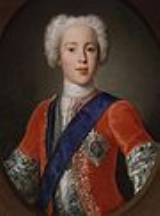
Charles Edward Stuart (31 December 1720 31 January 1788) was the exiled Jacobite
Jacobitism

Jacobitism was the political movement dedicated to the restoration of the House of Stuart kings to the thrones of Kingdom of England, Kingdom of Scotland, and Kingdom of Ireland....
 claimant to the thrones of England
England

native_name =|conventional_long_name = England|common_name = England|image_flag = Flag of England.svg|image_coat = England COA.svg|symbol_type = Royal Coat of Arms...
, Scotland
Scotland

conventional_long_name = ScotlandAlba|common_name= Scotland|image_flag = Flag of Scotland.svg|flag_width = 130px...
, and Ireland
Kingdom of Ireland

The Kingdom of Ireland was the name given to the Irish state from 1541, by the Crown of Ireland Act 1542 of the Parliament of Ireland. It was based on the contested legitimacy of the right of conquest....
. He is commonly known in English and Scots
Scots language

Scots or Lowland Scots refers to the Germanic Variety derived from Middle English spoken in parts of Lowland Scotland, Northern Ireland and the border areas of the Republic of Ireland....
 as Bonnie Prince Charlie. In Scots Gaelic, his name was Teàrlach Eideard Stiùbhairt.

Charles was the son of James Francis Edward Stuart
James Francis Edward Stuart

Prince James, Prince of Wales was the son of the deposed James II of England. As such, he claimed the English, Scottish and Irish thrones from the death of his father in 1701, when he was proclaimed king of England, Scotland and Ireland by his cousin Louis XIV of France....
 who was in turn the son of James II and VII
James II of England

James II and VII was List of English monarchs, List of Scottish monarchs, and King of Ireland from 6 February 1685. He was the last Roman Catholic Church monarch to reign over the Kingdoms of Kingdom of England, Kingdom of Scotland, and Kingdom of Ireland....
, who had been deposed in the Revolution of 1688
Glorious Revolution

The Glorious Revolution, also called the Revolution of 1688, was the overthrow of British monarchy James II of England in 1688 by a union of Parliament of England with an invading army led by the Dutch Republic stadtholder William III of England , who as a result ascended the English throne as William III of England....
.


Discussion
Ask a question about 'Charles Edward Stuart'
Start a new discussion about 'Charles Edward Stuart'
Answer questions from other users
Full Discussion Forum


Recent Posts


Encyclopedia


For "Betty Burke" see The 'Forty-Five' below.


Charles Edward Stuart (31 December 1720 31 January 1788) was the exiled Jacobite
Jacobitism

Jacobitism was the political movement dedicated to the restoration of the House of Stuart kings to the thrones of Kingdom of England, Kingdom of Scotland, and Kingdom of Ireland....
 claimant to the thrones of England
England

native_name =|conventional_long_name = England|common_name = England|image_flag = Flag of England.svg|image_coat = England COA.svg|symbol_type = Royal Coat of Arms...
, Scotland
Scotland

conventional_long_name = ScotlandAlba|common_name= Scotland|image_flag = Flag of Scotland.svg|flag_width = 130px...
, and Ireland
Kingdom of Ireland

The Kingdom of Ireland was the name given to the Irish state from 1541, by the Crown of Ireland Act 1542 of the Parliament of Ireland. It was based on the contested legitimacy of the right of conquest....
. He is commonly known in English and Scots
Scots language

Scots or Lowland Scots refers to the Germanic Variety derived from Middle English spoken in parts of Lowland Scotland, Northern Ireland and the border areas of the Republic of Ireland....
 as Bonnie Prince Charlie. In Scots Gaelic, his name was Teàrlach Eideard Stiùbhairt.

Charles was the son of James Francis Edward Stuart
James Francis Edward Stuart

Prince James, Prince of Wales was the son of the deposed James II of England. As such, he claimed the English, Scottish and Irish thrones from the death of his father in 1701, when he was proclaimed king of England, Scotland and Ireland by his cousin Louis XIV of France....
 who was in turn the son of James II and VII
James II of England

James II and VII was List of English monarchs, List of Scottish monarchs, and King of Ireland from 6 February 1685. He was the last Roman Catholic Church monarch to reign over the Kingdoms of Kingdom of England, Kingdom of Scotland, and Kingdom of Ireland....
, who had been deposed in the Revolution of 1688
Glorious Revolution

The Glorious Revolution, also called the Revolution of 1688, was the overthrow of British monarchy James II of England in 1688 by a union of Parliament of England with an invading army led by the Dutch Republic stadtholder William III of England , who as a result ascended the English throne as William III of England....
. The Jacobite
Jacobitism

Jacobitism was the political movement dedicated to the restoration of the House of Stuart kings to the thrones of Kingdom of England, Kingdom of Scotland, and Kingdom of Ireland....
 movement tried to restore the family to the throne. Charles' mother was James' Polish
Poland

Poland , officially the Republic of Poland , is a country in Central Europe. Poland is bordered by Germany to the west; the Czech Republic and Slovakia to the south; Ukraine, Belarus and Lithuania to the east; and the Baltic Sea and Kaliningrad Oblast, a Russian Enclave and exclave, to the north....
 wife, Maria Clementina Sobieska
Maria Klementyna Sobieska

Maria Klementyna Sobieska was a Poland princess who was born on July 18, 1702 in Poland, the daughter of Poland's Crown Prince Jakub Ludwik Sobieski, , and Countess Palatine Hedwig Elisabeth Amelia of Neuburg, ....
 (1702–1735, granddaughter of the Polish
Poland

Poland , officially the Republic of Poland , is a country in Central Europe. Poland is bordered by Germany to the west; the Czech Republic and Slovakia to the south; Ukraine, Belarus and Lithuania to the east; and the Baltic Sea and Kaliningrad Oblast, a Russian Enclave and exclave, to the north....
 King, John III Sobieski
John III Sobieski

John III Sobieski was one of the most notable monarchs of the Polish-Lithuanian Commonwealth, from 1674 until his death King of Poland and Grand Duke of Lithuania....
). After his father's death Charles was recognised as Charles III by his supporters; his opponents referred to him as The Young Pretender.

Early life

Charles Edward Louis John Casimir Silvester Severino Maria Stuart was born in Rome
Rome

Rome is the capital city of Italy and Lazio, and is Italy's largest and most populous city, with 2,724,347 residents in an urban area of some ....
, Italy
Italy

Italy , officially the Italian Republic , is a country located on the Italian Peninsula in Southern Europe and on the two largest islands in the Mediterranean Sea, Sicily and Sardinia....
, where his father had been given a residence by Pope Clement XI
Pope Clement XI

Pope Clement XI , born Giovanni Francesco Albani, was Pope from 1700 until his death....
. He spent almost all of his childhood in Rome
Rome

Rome is the capital city of Italy and Lazio, and is Italy's largest and most populous city, with 2,724,347 residents in an urban area of some ....
 and Bologna
Bologna

Bologna is the capital city of Emilia-Romagna in northern Italy, in the Po Valley , between the Po River and the Apennine Mountains, exactly between the Reno River and the S?vena River....
. In 1734 he participated in the French
France

France , officially the French Republic , is a country whose Metropolitan France is located in Western Europe and that also comprises various Overseas departments and territories of France....
 and Spanish
Spain

Spain or the Kingdom of Spain , is a country located in Southern Europe on the Iberian Peninsula.The Spanish constitution does not establish any official denomination of the country, even though Espa?a , Estado espa?ol and Naci?n espa?ola are used interchangeably....
 siege of Gaeta
Siege of Gaeta (1734)

The Siege of Gaeta was a battle of the War of Polish Succession fought at Gaeta, Italy. The Austrians at Gaeta withstood four months of siege from the House of Bourbon armies under Charles III of Spain ....
; this was his first exposure to a military battle.

The 'Forty-Five'


Main article: The 'Forty-Five'
Jacobite rising

The Jacobite Risings were a series of uprisings, rebellions, and wars in the kingdoms of Kingdom of England, Kingdom of Scotland , and Kingdom of Ireland occurring between 1688 and 1746....
In December 1743, Charles' father named him Prince Regent, giving him full authority to act in his name. Eighteen months later he led a rising to restore his father to his thrones. Charles raised funds to fit out two ships: the Elisabeth, an old man-of-war of sixty-six guns, and a small frigate of sixteen guns named the Doutelle (le Du Teillay) which successfully landed him with seven companions at Eriskay
Eriskay

Eriskay , from the Old Norse for "Eric's Isle", is an island of the Outer Hebrides in northern Scotland. It lies between South Uist and Barra and is connected to South Uist by a causeway which was opened in 2001....
 on 23 July 1745. Charles had hoped for support from a French fleet, but this was badly damaged by storms, and he was left to raise an army in Scotland.

The Jacobite
Jacobitism

Jacobitism was the political movement dedicated to the restoration of the House of Stuart kings to the thrones of Kingdom of England, Kingdom of Scotland, and Kingdom of Ireland....
 cause was still supported by many Highland
Scottish Highlands

The Scottish Highlands include the rugged and mountainous regions of Scotland north and west of the Highland Boundary Fault, although the exact boundaries are not clearly defined, particularly to the east....
 clans
Scottish clan

Scottish clans , give a sense of identity and shared descent to people in Scotland and to their relations throughout the world, with a formal structure of Scottish clan chiefs officially registered with the court of the Lord Lyon, King of Arms which controls the heraldry and Coat of Arms....
, both Catholic
Catholic

Catholic is an adjective derived from the Greek language adjective , meaning "whole" or "complete". In the context of Christianity ecclesiology, it has a rich history and several usages....
 and Protestant, and the Catholic Charles hoped for a warm welcome from these clans to start an insurgency by Jacobites throughout Britain, but there was no immediate response. Charles raised his father's standard at Glenfinnan
Glenfinnan

Glenfinnan is a village in Lochaber area of the Scottish Highlands of Scotland. It is located at the northern end of Loch Shiel, at the foot of Glen Finnan....
 and there raised a large enough force to enable him to march on the city of Edinburgh
Edinburgh

Edinburgh ; is the Capital city of Scotland, a position it has held since 1437. It is the seventh largest city in the United Kingdom and the second largest Scottish City status in the United Kingdom after Glasgow....
, which quickly surrendered. On 21 September 1745 he defeated the only government army in Scotland at the Battle of Prestonpans
Battle of Prestonpans

The Battle of Prestonpans was the first significant conflict in the second Jacobite Rising. The battle took place at 4am on 21 September 1745. The Jacobitism army loyal to James Francis Edward Stuart and led by his son Charles Edward Stuart defeated the army loyal to the Hanoverian George II of England led by John Cope ....
, and by November was marching south at the head of around 6,000 men. Having taken Carlisle
Carlisle

Carlisle is in the City of Carlisle, a district of Cumbria in North West England. It is located at the confluence of the rivers River Eden, Cumbria, River Caldew and River Petteril, south of the Anglo-Scottish border....
, Charles' army progressed as far as Swarkestone Bridge in Derbyshire
Derbyshire

Derbyshire is a county in the East Midlands of England. A substantial portion of the Peak District National Park lies within Derbyshire. The northern part of Derbyshire overlaps with the Pennines, a famous chain of hills and mountains....
. Here, despite the objections of the Prince, the decision was taken by his council to return to Scotland, largely because of the almost complete lack of the support from English Jacobites that Charles had promised. By now he was pursued by King George II
George II of Great Britain

George II was King of Great Britain and King of Ireland, Duke of Brunswick-L?neburg and Prince-elector#High Offices and Prince-Elector of the Holy Roman Empire from 11 June 1727 until his death....
's son, the Duke of Cumberland, who caught up with him at the Battle of Culloden
Battle of Culloden

The Battle of Culloden was the final clash between the French-supported Jacobitism and the House of Hanover British Government in the 1745 Jacobite Rising#The 'Forty-Five'....
 on 16 April 1746.

Bonniequest
Ignoring the advice of his best commander, Lord George Murray
Lord George Murray (general)

Lord George Murray was a Scottish Jacobitism general, most noted for his 1745 campaign under Bonnie Prince Charlie into England. Lord George was the fifth son of John Murray, 1st Duke of Atholl, who was the chief of Clan Murray, by his first wife, Catherine, daughter of the William Douglas-Hamilton, Duke of Hamilton....
, Charles chose to fight on flat, open, marshy ground where his forces would be exposed to superior government firepower. Charles commanded his army from a position behind his lines, where he could not see what was happening. Hoping that Cumberland's army would attack first, he had his men stand exposed to Hanoverian artillery for twenty minutes before finally ordering an attack. The Jacobite attack, charging into the teeth of musket fire and grapeshot
Grapeshot

Grapeshot is a type of Anti-personnel weapon ammunition used in cannons. Instead of solid shot, a mass of loosely packed metal slugs is loaded into a canvas bag....
 fired from the cannons, was uncoordinated and met little success. Only in one place did a group of Jacobites break through the bayonets of the redcoats, but they were shot down by a second line of soldiers, and the survivors fled. Cumberland's troops committed numerous atrocities as they hunted for the defeated Jacobite soldiers, earning him the title "the Butcher" from the Highlanders. Murray managed to lead a group of Jacobites to Ruthven, intending to continue the fight. However Charles, believing himself betrayed, had decided to abandon the Jacobite cause. James the Chevalier de Johnstone
Chevalier de Johnstone

James Johnstone, also known as Chevalier de Johnstone, and who sometimes signed himself as Johnstone de Moffatt was an army officer who took part in the Jacobite Rising and the Seven Years' War....
 acted as Murray's Aide de Camp during the campaign and for a brief spell, the Young Pretender. He gives a first hand account of these events in his "Memoir of the Rebellion 1745-1746".

Bonnie Prince Charlie's subsequent flight has become the stuff of legend, and is commemorated in the popular folk song "The Skye Boat Song
The Skye Boat Song

The Skye Boat Song has gained the reputation of a traditional Scotland song recalling the escape of the young pretender Charles Edward Stuart after his defeat at Battle of Culloden in 1746: he escaped from Uist to the Isle of Skye in a small boat with the aid of Flora MacDonald ....
" (lyrics 1884, tune traditional) and also the old Irish song Bímse Buan ar Buairt Gach Ló by Seán Clárach Mac Domhnaill
Seán Clárach Mac Domhnaill

Se?n "Cl?rach" Mac Domhnaill was an Irish language poet in the first half of the 18th century. ...
. Assisted by loyal supporters such as Flora MacDonald who helped him escape pursuers on the Isle of Skye by taking him in a small boat disguised as her Irish maid, "Betty Burke," he evaded capture and left the country aboard the French frigate L'Heureux, arriving back in France in September. The cause of the Stuarts being lost, the remainder of his life was - with a brief exception - spent in exile.

Exile

Whilst back in France, Charles had numerous affairs; the one with his first cousin Louise, wife of the Duke of Montbazon, resulted in a short-lived son Charles (1748–1749). He lived for several years in exile with his Scottish mistress, or common-law wife, Clementina Walkinshaw
Clementina Walkinshaw

Clementina Maria Sophia Walkinshaw was the mistress of Charles Edward Stuart. She was of a Jacobitism family of Lanarkshire.She joined Charles in the Low Countries during 1752....
 (1720-1802), whom he met, and may have begun a relationship with, whilst on the '45 campaign. In 1753 the couple had a daughter, Charlotte. Charles's inability to cope with the collapse of the cause led to his heavy drinking and mother and daughter left Charles with James' connivance. Charlotte went on to have three illegitimate children with Ferdinand, an ecclesiastical member of the Rohan family. She was suspected by many of Charles' supporters of being a spy, planted by the Hannoverian government of Britain.

After his defeat, Charles indicated to the remaining supporters of the Jacobite cause in England that, accepting the impossibility of his recovering the English and Scots crowns while he remained a Roman Catholic, he was willing to commit himself to reigning as a Protestant. Accordingly he visited London incognito in 1750 and conformed to the Protestant faith by receiving Anglican communion at the Church of St Mary-le-Strand
St Mary-le-Strand

St Mary-le-Strand is a Church of England church at the eastern end of the Strand, London in the City of Westminster, London. It stands to the north of Somerset House and The Temple and south of Bush House, on what is now a traffic island....
, a noted centre of Anglican Jacobitism. On Charles's return to France he reverted to Catholic observance.

In 1759, at the height of the Seven Years War, Charles was summoned to a meeting in Paris with the French foreign minister, the Duc De Choiseul
Étienne François, duc de Choiseul

?tienne-Fran?ois, duc de Choiseul was a France military officer, diplomat and statesman.He was the eldest son of Fran?ois Joseph de Choiseul, marquis de Stainville , and bore in early life the title of comte de Stainville....
. Charles turned up to the meeting drunk, and proved to be irascible. Choisel was planning a full-scale invasion of England, involving upwards of a 100,000 men - to which he hoped to add a number of Jacobites, led by Charles. However he was so unimpressed with Charles, he dismissed the prospect of Jacobite assistance. The French invasion, which was the last realistic chance of Charles to recover the British throne for the Stuart dynasty, was ultimately thwarted by naval defeats at Quiberon Bay
Battle of Quiberon Bay

The naval Battle of Quiberon Bay took place on 20 November 1759 during the Seven Years' War in Quiberon Bay, off the coast of France near St....
 and Lagos
Battle of Lagos

The naval Battle of Lagos took place on August 19 1759 during the Seven Years' War off the coasts of Spain and Portugal, and is named after Lagos, Portugal....
.

In 1766 Charles' father died. Until his death James had been recognised as King of England, Scotland, and Ireland by the Pope
Pope

The Pope is the Bishop of Rome, the leader of the Roman Catholic Church and head of state of Vatican City. The current pope is Pope Benedict XVI, who was elected April 19, 2005 in Papal conclave, 2005....
, as "James III and VIII". But Clement XIII decided not to give the same recognition to Charles.

In 1772 Charles married Princess Louise of Stolberg-Gedern
Princess Louise of Stolberg-Gedern

Princess Louise Maximilienne Caroline Emmanuele of Stolberg-Gedern was the wife of the Jacobitism claimant to the English throne and Scottish thrones Charles Edward Stuart....
. They lived first in Rome, but in 1774 moved to Florence
Florence

Florence is the Capital city of the Italy Regions of Italy of Tuscany and of the provinces of Italy Province of Florence. It is the most populous city in Tuscany and has a population of 364,779 ....
 where Charles first began to use the title "Count of Albany" as an alias. This title is frequently used for him in European publications; his wife Louise is almost always called "Countess of Albany".

In 1780 Louise left Charles. She claimed that Charles had physically abused her; this claim was generally believed by contemporaries in spite of the fact that Louise was already involved in an adulterous relationship with the Italian poet, Count Vittorio Alfieri
Vittorio Alfieri

Count Vittorio Alfieri , was an Italy dramatist, considered the "founder of Italian tragedy."...
, before she left Charles.

The claims by two nineteenth century charlatans, Charles and John Allen alias John Sobieski Stuart
John Sobieski Stuart

John Sobieski Stuart and Charles Edward Stuart were names used by John Carter Allen and Charles Manning Allen, two 19th century English brothers who are best-known for their role in Scottish cultural history....
 and Charles Edward Stuart, that their father Thomas Allen was a legitimate son of Charles and Louise, are without foundation.

In 1783 Charles signed an act of legitimation for his illegitimate daughter Charlotte, his child born in 1753 to Clementina Walkinshaw
Clementina Walkinshaw

Clementina Maria Sophia Walkinshaw was the mistress of Charles Edward Stuart. She was of a Jacobitism family of Lanarkshire.She joined Charles in the Low Countries during 1752....
 (later known as Countess von Alberstrof). Charles also gave Charlotte the title "Duchess of Albany" in the peerage of Scotland and the style "Her Royal Highness". But these honours did not give Charlotte any right to the succession to the throne. Charlotte lived with her father in Florence and Rome for the next five years.

Charles died in Rome on 31 January 1788. He was first buried in the Cathedral of Frascati, where his brother Henry Benedict Stuart
Henry Benedict Stuart

Henry Benedict Cardinal Stuart was the fourth and final Jacobitism heir to publicly claim the thrones of England, Scotland, and Ireland. Unlike his father, James Francis Edward Stuart, and brother, Charles Edward Stuart, Henry made no effort to seize the throne....
 was bishop. At Henry's death in 1807, Charles's remains were moved to the crypt of Saint Peter's Basilica in the Vatican
Vatican City

Vatican City , officially the State of the Vatican City , is a Landlocked country sovereignty city-state whose territory consists of a walled enclave within the city of Rome, the Capital of Italy....
 where they were laid to rest next to those of his brother and father. His mother is also buried in Saint Peter's Basilica.

When the body of Charles Stuart was transferred to the Saint Peter's Basilica, his "praecordia" were left in Frascati Cathedral: a small urn encloses the heart of Charles, placed beneath the floor below the funerary monument.

Titles, styles, honours and arms


Arms

During his pretence as Prince of Wales, Charles claimed a coat of arms
Coat of arms

A coat of arms, more properly called an armorial achievement, armorial bearings or often just arms for short, in European tradition, is a design belonging to a particular person and used by them in a wide variety of ways....
 consisting of those of the kingdom, differenced by a label argent of three points

Popular culture

Bonnie Prince Charlie has had two films made telling his life. In 1923 a British silent film
Silent film

A silent film is a film with no synchronized recorded sound, especially spoken dialogue. The idea of combining motion pictures with recorded sound is nearly as old as film itself, but because of the technical challenges involved, synchronized dialogue was only made possible in the late 1920s with the introduction of the Vitaphone system....
 Bonnie Prince Charlie
Bonnie Prince Charlie (1923 film)

Bonnie Prince Charlie is 1923 in film British silent film historical film directed by Charles Calvert. Depicting the Jacobite Rebellion of 1745 and its aftermath it starred Ivor Novello in the title role of Prince Charles Stuart with Gladys Cooper as Flora MacDonald and A.B....
 was made with Ivor Novello
Ivor Novello

David Ivor Davies , better known as Ivor Novello, was a Wales composer, singer and actor who became one of the most popular British entertainers of the early 20th century....
 in the title role. In 1948 another film Bonnie Prince Charlie
Bonnie Prince Charlie (film)

Bonnie Prince Charlie is a 1948 in film British historical film depicting the 1745 Jacobite Rebellion and the role of Bonnie Prince Charlie within it....
 was made with David Niven
David Niven

James David Graham Niven was an English people Academy Award for Best Actor-winning actor probably best known for his roles as the punctuality-obsessed adventurer Phileas Fogg in Around the World in 80 Days and the suave cat burglar Sir Charles Litton in The Pink Panther ....
 playing the role.

Peter Watkins 1964 Culloden
Culloden (film)

Culloden is a docudrama written and directed by Peter Watkins for BBC TV and originally broadcast on December 15, 1964. It portrays the 1746 Battle of Culloden that resulted in the destruction of the Jacobite uprising by the British Army, and, in the words of the narrator "tore apart forever the clan system of the Scottish Highlands"....
 presents the battle through the eyes of a documentary crew as though they were actually present. The film utilises a number of other dramatic devices to create a tense realistic interpretation of the event.

The 1994
1994 in film

The year 1994 in film involved some significant events....
 film Chasing the Deer
Chasing the Deer

Chasing the Deer is a 1994 UK war film directed by Graham Holloway and starring Brian Blessed, Iain Cuthbertson and Mathew Zajac. It depicts the 1745 Jacobite Rebellion, in which Bonnie Prince Charlie landed in Scotland, trying to claim the British throne....
 depicts the 1745 Jacobite rebellion with historical accuracy from the point of view of the commoners caught in the struggle. The Bonnie Prince, played by Dominique Carrara, makes a brief appearance in the movie, and is never actually seen by any of the commoners fighting for his cause.

British author, Sir Walter Scott featured Bonnie Prince Charlie and the 1745 Jacobite uprising in his popular 1814 novel, Waverly. Author Diana Gabaldon's Outlander series depicts the Bonnie Prince in three of her six novels. (Outlander, Dragonfly in Amber & Voyager). D K Broster's Jacobite Trilogy, beginning with The Flight of the Heron (1920) tells the story of the '45 and features the Prince.

The Maiden, Volume 8 of The Morland Dynasty
The Morland Dynasty

The Morland Dynasty is a series of historical novels by author Cynthia Harrod-Eagles. There are currently thirty books in the series. The first book begins in 1434 and features the Wars of the Roses; the most recent book begins in 1916 and deals with the Battle of the Somme....
, a series of historical novels by author Cynthia Harrod-Eagles, covers this period of history, seen through the eyes of the fictional Morland family

See also

  • Charles Edward Stuart's Flight
    Charles Edward Stuart's Flight

    Charles Edward Stuart?s FlightCharles Edward Louis Philippe Casimir Stuart was born on 20 December 1720. Supported by Jacobitism adherents, he attempted to regain the throne of his father, who, according to Jacobite beliefs, was the legitimate successor of James II of England, King of England, Scotland, and Ireland....
  • Monument to the Royal Stuarts
    Monument to the Royal Stuarts

    The Monument to the Royal Stuarts is a memorial in St. Peter's Basilica, in the Vatican City in Rome. It commemorates the last three members of the Royal House of Stuart: James Francis Edward Stuart, his elder son Charles Edward Stuart, and his younger son, Henry Benedict Stuart....
  • Prince Charlie's Targe
    Prince Charlie's Targe

    Prince Charlie's Targe is an 18th century Targe type of shield, said to have been one of thirteen made for Prince Charles Edward Stuart, also known as the "Young Pretender"....
  • Touch Pieces
    Touch pieces

    Touch pieces are coins and medals that have attracted Superstition, such as those with 'holes' in them or those with particular designs. Such pieces were believed to cure disease, bring good luck, influence people's behaviour, carry out a specific practical action, et cetera....


Bibliography

  • McLynn, Frank. 1759: The Year Britain Became Master of the World. London: Pimlico, 2005
  • McLynn, Frank. Charles Edward Stuart: A Tragedy in Many Acts. London: Routledge, 1988.
  • Kybett, Susan M. Bonnie Prince Charlie: A Biography of Charles Edward Stuart. New York: Dodd, Mead, 1988.
  • Douglas, Hugh. Charles Edward Stuart. London: Hale, 1975.
  • Daiches, David. Charles Edward Stuart: The Life and Ttimes of Bonnie Prince Charlie. London: Thames & Hudson, 1973.
  • Chidsey, Donald Barr. Bonnie Prince Charlie. London: Williams & Norgate, 1928.


External links

  • McFerran, Noel S.