
All Topics  
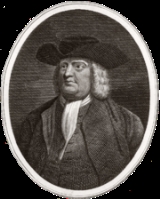
William Penn


   Email Print
   Bookmark   Link


William Penn


William Penn (October 14, 1644 – July 30, 1718) was founder and "Absolute Proprietor" of the Province of Pennsylvania
Province of Pennsylvania

The Province of Pennsylvania, also known as Pennsylvania Colony, was a North American colony granted to William Penn on March 4, 1681 by King Charles II of England....
, the English
England

native_name =|conventional_long_name = England|common_name = England|image_flag = Flag of England.svg|image_coat = England COA.svg|symbol_type = Royal Coat of Arms...
 North America
North America

North America is the northern continent of the Americas, situated in the Earth's northern hemisphere and almost totally in the western hemisphere....
n colony
Colony

In politics and in history, a colony is a Territory under the immediate political control of a state. For colonies in antiquity, city-states would often found their own colonies....
 and the future U.S. state
U.S. state

A U.S. state is any one of the 50 state of the United States that share sovereignty with the federal government of the United States . Because of this shared sovereignty, an United States is a citizen both of the federal entity and of his or her state of Domicile ....
 of Pennsylvania
Pennsylvania

The Commonwealth of Pennsylvania , often colloquially referred to as PA by natives and Northeasterners, is a U.S. state located in the Northeastern United States and Mid-Atlantic States regions of the United States....
. He was known as an early champion of democracy
Democracy

Democracy is a form of government in which power is held directly or indirectly by citizens under a free electoral system. It is derived from the Greek language d?????at?a , "popular government" which was coined from d???? , "people" and ???t?? , "rule, strength" in the middle of the 5th-4th century BC to denote the political syst...
 and religious freedom and famous for his good relations and his treaties with the Lenape
Lenape

The Lenape are organized bands of Native Americans in the United States peoples with shared cultural and linguistic characteristics.These are the people who are living in what is now New Jersey and along the Delaware River in Pennsylvania, the northern shore of Delaware, and the lower Hudson Valley and New York Harbor in New York, at the t...
 Indians. Under his direction, Philadelphia
Philadelphia, Pennsylvania

Philadelphia is the largest city in Pennsylvania and the List of United States cities by population city in the United States. It is the fifth-largest metropolitan area and fourth-largest urban area by population in the United States, the nation's fourth-largest consumer media market as ranked by the Nielsen Media Research, and the 49th-most...
 was planned and developed.

As one of the earlier supporters of colonial unification, Penn wrote and urged for a Union of all the English colonies
British colonization of the Americas

British colonization of the Americas began in the late 16th century, before reaching its peak after colonies were established throughout the Americas, and a protectorate was established over the Kingdom of Hawaii in the Pacific Ocean....
 in what was to become the United States of America
United States

The United States of America is a Federal government constitutional republic comprising U.S. state and a federal district. The country is situated mostly in central North America, where its Contiguous United States and Washington, D.C., the Capital districts and territories, lie between the Pacific Ocean and Atlantic Oceans, Borders of the U...
.


Discussion
Ask a question about 'William Penn'
Start a new discussion about 'William Penn'
Answer questions from other users
Full Discussion Forum


Recent Posts


Quotations


Any government is free to the people under it where the laws rule and the people are a party to the laws.

Frame of Government

It were better to be of no Church, than to be bitter for any.(535)

It were endless to dispute upon everything that is disputable.

It were Happy if we studied Nature more in natural Things; and acted according to Nature; whose rules are few, plain and most reasonable. (9)

Men are generally more careful of the breed of their horses and dogs than of their children.

Much reading is an oppression of the mind, and extinguishes the natural candle, which is the reason of so many senseless scholars in the world.


Encyclopedia


William Penn (October 14, 1644 – July 30, 1718) was founder and "Absolute Proprietor" of the Province of Pennsylvania
Province of Pennsylvania

The Province of Pennsylvania, also known as Pennsylvania Colony, was a North American colony granted to William Penn on March 4, 1681 by King Charles II of England....
, the English
England

native_name =|conventional_long_name = England|common_name = England|image_flag = Flag of England.svg|image_coat = England COA.svg|symbol_type = Royal Coat of Arms...
 North America
North America

North America is the northern continent of the Americas, situated in the Earth's northern hemisphere and almost totally in the western hemisphere....
n colony
Colony

In politics and in history, a colony is a Territory under the immediate political control of a state. For colonies in antiquity, city-states would often found their own colonies....
 and the future U.S. state
U.S. state

A U.S. state is any one of the 50 state of the United States that share sovereignty with the federal government of the United States . Because of this shared sovereignty, an United States is a citizen both of the federal entity and of his or her state of Domicile ....
 of Pennsylvania
Pennsylvania

The Commonwealth of Pennsylvania , often colloquially referred to as PA by natives and Northeasterners, is a U.S. state located in the Northeastern United States and Mid-Atlantic States regions of the United States....
. He was known as an early champion of democracy
Democracy

Democracy is a form of government in which power is held directly or indirectly by citizens under a free electoral system. It is derived from the Greek language d?????at?a , "popular government" which was coined from d???? , "people" and ???t?? , "rule, strength" in the middle of the 5th-4th century BC to denote the political syst...
 and religious freedom and famous for his good relations and his treaties with the Lenape
Lenape

The Lenape are organized bands of Native Americans in the United States peoples with shared cultural and linguistic characteristics.These are the people who are living in what is now New Jersey and along the Delaware River in Pennsylvania, the northern shore of Delaware, and the lower Hudson Valley and New York Harbor in New York, at the t...
 Indians. Under his direction, Philadelphia
Philadelphia, Pennsylvania

Philadelphia is the largest city in Pennsylvania and the List of United States cities by population city in the United States. It is the fifth-largest metropolitan area and fourth-largest urban area by population in the United States, the nation's fourth-largest consumer media market as ranked by the Nielsen Media Research, and the 49th-most...
 was planned and developed.

As one of the earlier supporters of colonial unification, Penn wrote and urged for a Union of all the English colonies
British colonization of the Americas

British colonization of the Americas began in the late 16th century, before reaching its peak after colonies were established throughout the Americas, and a protectorate was established over the Kingdom of Hawaii in the Pacific Ocean....
 in what was to become the United States of America
United States

The United States of America is a Federal government constitutional republic comprising U.S. state and a federal district. The country is situated mostly in central North America, where its Contiguous United States and Washington, D.C., the Capital districts and territories, lie between the Pacific Ocean and Atlantic Oceans, Borders of the U...
. The democratic principles that he set forth in the Pennsylvania Frame(s) of Government served as an inspiration for the United States Constitution
United States Constitution

The Constitution of the United States of America is the supreme law of the United States. It is the foundation and source of the legal authority underlying the existence of the United States of America; the Federal Government of the United States; and all the State & local governments and Territorial Administrative bodies contained therein....
. As a pacifist Quaker, Penn considered the problems of war and peace deeply, and included a plan for a United States of Europe
United States of Europe

A federal Europe is a theory that much of Europe be unified in the manner of a federation. The idea has been common with ambitions of European integration with the term United States of Europe echoing the federal nature of the United States....
, "European Dyet, Parliament or Estates," in his voluminous writings.

Biography


Early life


William Penn was born in 1644, the son of Admiral Sir William Penn and Margaret Jasper, previously widowed and the daughter of a Rotterdam
Rotterdam

Rotterdam ; city and municipality in the Netherlands province of South Holland, situated in the west of the Netherlands. The municipality is the List of cities in the Netherlands with over 100,000 people in the country, with a population of 584,046 on 1 January 2007 and comprises the southern part of the Randstad, the List of metropolitan are...
 merchant. William Penn, Sr. served in the Commonwealth
Commonwealth of England

The Commonwealth of England was the republic which ruled first Kingdom of England and Wales, and then Kingdom of Ireland and Kingdom of Scotland from 1649 to 1660....
 Navy during the English Civil War
English Civil War

The English Civil War was a series of armed conflicts and political machinations between Roundhead and Cavalier. The First English Civil War and Second English Civil War civil wars pitted the supporters of Charles I of England against the supporters of the Long Parliament, while the Third English Civil War saw fighting between supporters...
 and was rewarded by Oliver Cromwell
Oliver Cromwell

Oliver Cromwell was an English people Military history of the United Kingdom and Politics of England leader best known for his involvement in making England into a republican Commonwealth and for his later role as Lord Protector of England, Scotland, and Ireland....
 with estates in Ireland
Ireland

Ireland is the List of islands by area in Europe, and the twentieth-largest island in the world. It lies to the north-west of continental Europe and is surrounded by hundreds of islands and islet....
. The lands were seized from Irish Catholics, as punishment for an earlier massacre
Irish Rebellion of 1641

The Irish Rebellion of 1641 began as an attempted coup d'?tat by Irish Roman Catholic Church gentry, but developed into inter communal violence between native Irish people and England and Scotland Protestant settlers, starting a conflict known as the Irish Confederate Wars....
 of Protestants. Admiral Penn took part in the restoration of Charles II
Charles II of England

Charles II was the Monarchy of Kingdom of England, Kingdom of Scotland, and Kingdom of Ireland.His father Charles I of England Regicide#The regicide of Charles I of England at Palace of Whitehall on 30 January 1649, at the climax of the English Civil War....
 and was eventually knighted and served in the Royal Navy
Royal Navy

The Royal Navy of the United Kingdom is the oldest of the British Armed Forces . From the mid-18th century until well into the 20th century, it was the most powerful navy in the world, playing a key part in establishing the British Empire as the dominant world power from 1815 until the early 1940s....
. At the time of his son’s birth, Captain Penn was twenty-three and an ambitious naval officer in charge of quelling Irish Catholic unrest and blockading Irish ports.

William Penn grew up during the reign of Oliver Cromwell
Oliver Cromwell

Oliver Cromwell was an English people Military history of the United Kingdom and Politics of England leader best known for his involvement in making England into a republican Commonwealth and for his later role as Lord Protector of England, Scotland, and Ireland....
, who succeeded in leading a Puritan
Puritan

A Puritan of 16th and 17th century England was an associate of any number of religious groups advocating for more "purity" of worship and doctrine, as well as personal and group pietism....
 revolt against King Charles I
Charles I of England

Charles I was List of English monarchs, List of monarchs of Scotland and King of Ireland from 27 March 1625 until his capital punishment on 30 January 1649....
, who was beheaded when Penn was age 5. His father was often at sea. The Puritans had clamped down on sports, music, and other entertainment in the capital, and proved poor stewards of municipal service, making London even dirtier and more unhealthy. Little William caught the pox
Smallpox

Smallpox is an infectious disease unique to humans, caused by either of two virus variants, Variola major and Variola minor. The disease is also known by the Latin names Variola or Variola vera, which is a derivative of the Latin varius, meaning spotted, or varus, meaning "pimple"....
, losing all his hair (he wore a wig until he left college), prompting his parents to move to the suburbs to an estate in Essex
Essex

Essex is a counties of England in the East of England England. The county town is Chelmsford, and the highest point of the county is Chrishall Common near the village of Langley, Essex, close to the Hertfordshire border, which reaches ....
. The country life made a lasting impression on young Penn, and kindled a love of horticulture. Their neighbor was famed diarist Samuel Pepys
Samuel Pepys

Samuel Pepys, Fellow of the Royal Society was an English people Navy Board and Member of Parliament, who is now most famous for his diary. Although Pepys had no maritime experience, he rose by patronage, hard work and his talent for administration, to be the Chief Secretary to the Admiralty under James II of England....
, who was friendly at first but later secretly hostile to the Admiral, perhaps embittered in part by his failed seductions of both Penn’s mother and his sister Peggy.

Penn was educated at Chigwell School
Chigwell School

Chigwell School is an English co-education public school in Chigwell, in the Epping Forest district of Essex. It was founded in 1629 by Samuel Harsnett, a former Archbishop of York ....
, by private tutors in Ireland and then at Christ Church, Oxford
Christ Church, Oxford

Christ Church , is one of the largest Colleges of the University of Oxford of the University of Oxford in England. As well as being a college, Christ Church is also the cathedral church of the diocese of Oxford, namely Christ Church Cathedral, Oxford....
. At that time, there were no state schools, and nearly all educational institutions were affiliated with the Anglican Church. Children from poor families had to have a wealthy sponsor to get an education, as did Sir Isaac Newton. Penn’s education heavily leaned on the classical authors and “no novelties, or conceited modern writers’’ were allowed including William Shakespeare
William Shakespeare

William Shakespeare was an English people poet and playwright, widely regarded as the greatest writer in the English language and the world's preeminent dramatist....
. Foot racing was Penn’s favorite sport, and he would often sprint the more than three mile (5 km) distance from his home to the school. The school itself was cast in a Puritan mode—strict, humorless, and somber—and teachers had to be pillars of virtue and provide sterling examples to their charges. Though later opposing the Puritans on religious grounds, Penn absorbed many Puritan behaviors, and was known later for his serious demeanor, strict behavior, and lack of humor.

After a failed mission to the Caribbean
Caribbean

The Caribbean is a region consisting of the Caribbean Sea, its islands , and the surrounding coasts. The region is located southeast of the Gulf of Mexico and Northern America, east of Central America, and to the north of South America....
, Admiral Penn and his family were exiled to his lands in Ireland. It was during this period, when Penn was about fifteen, that he met Thomas Loe, a Quaker missionary
Missionary

A 'missionary' is a member of a religion who works to convert those who do not share the missionary's faith; someone who Proselytism. The word "mission" is derived from the Latin missioninimus...
, who was maligned by both Catholics and Protestants. Loe was admitted to the Penn household and during his discourses on the “Inner Light”, young Penn recalled later that, “the Lord visited me, and gave me divine Impressions of Himself.”

A year later, Cromwell was dead, the royalists resurging, and the Penn family returned to England. The middle class aligned itself with the royalists and Admiral Penn was sent a secret mission to bring back exiled Prince Charles. For his role in restoring the monarchy, Admiral Penn was knighted and gained a powerful position as Commissioner of the Navy.

In 1660, Penn arrived at Oxford
University of Oxford

The University of Oxford , located in the city of Oxford, Oxfordshire, England, is the List of oldest universities in continuous operation in the English-speaking world....
, and enrolled as a gentleman scholar with an assigned servant. The student body was a volatile mix of swashbuckling Cavaliers (aristocratic Protestants), sober Puritans, and nonconforming Quakers. The new government’s discouragement of religious dissent gave the Cavaliers the license to harass the minority groups. Because of his father’s high position and social status, young Penn was firmly a Cavalier but his sympathies lay with the persecuted Quakers. To avoid conflict, he withdrew from the fray and became a reclusive scholar. Also at this time, Penn was developing his individuality and philosophy of life, and found that he was not in sympathy with either his father’s martial view of the world or his mother’s society oriented sensibilities., “I had no relations that inclined to so solitary and spiritual way; I was a child alone. A child given to musing, occasionally feeling the divine presence.”

Penn returned home for the extraordinary splendor of the King’s restoration ceremony and was a guest of honor alongside his father, who received a highly unusual royal salute for his services to the Crown. Though undetermined at the time, the Admiral had great hopes for his son’s career under the favor of the King. Back at Oxford, Penn considered a medical career and took some dissecting classes. Rational thought began to spread into science, politics and economics. When Dean Owen was fired for his free-thinking, Penn and other open-minded students rallied to his side and attended seminars at the dean’s house, where intellectual discussions covered the gamut of new thought. Penn learned the valuable skills of forming ideas into theory, discussing theory through reasoned debate, and testing the theories in the real world.

He also faced his first moral dilemma. After Owen was censured again after being fired, students were threatened with punishment for associating with him. However, Penn stood by the dean, thereby gaining a fine and reprimand from the university. The Admiral despaired of the charges, pulled young Penn away from Oxford hoping to give him distractions from the heretical influences of the university. The attempt had no effect and father and son struggled to understand each other. Back at school, the administration imposed stricter religious requirements including daily chapel attendance and required dress. Penn rebelled against enforced worship and was expelled. His father, in a rage, attacked young Penn with a cane and forced him from their home. Penn’s mother made peace in the family which allowed her son to return home but quickly concluded that both her social standing and her husband’s career were being threatened by their son’s behavior. So at age 18, young Penn was sent to Paris to get him out of view, improve his manners, and expose him to another culture.

In Paris, at the court of young Louis XIV, Penn found French manners far more refined than the coarse manners of his countrymen—but the extravagant display of wealth and privilege did not sit well with him. Though impressed by Notre Dame and the Catholic ritual, he felt uncomfortable with it. Instead he sought out spiritual direction from French Protestant theologian Moise Amyraut, who invited Penn to stay with him in Saumur
Saumur

Saumur is a Communes of France in the Maine-et-Loire Departments of France in western France.The historic town is located between the Loire River and Thouet rivers, which join to the west of the town....
 for a year. The undogmatic Christian humanist talked of a tolerant, adapting view of religion which appealed to Penn, who later stated, “I never had any other religion in my life than what I felt.” By adapting his mentor’s belief in free-will, Penn felt unburdened of Puritanical guilt and rigid beliefs, and was inspired to search out his own religious path.

Upon returning to England after two years abroad, he presented to his parents a mature, sophisticated, well-mannered, “modish” gentleman, though Samuel Pepys noted young Penn’s “vanity of the French”. Penn had developed a taste for fine clothes, and for the rest of his life would pay somewhat more attention to his dress than most Quakers. The Admiral had great hopes that his son then had the practical sense and the ambition necessary to succeed as an aristocrat. He had young Penn enroll in law school but soon his studies were interrupted. With warfare with the Dutch imminent, young Penn decided to shadow his father at work and join him at sea. Penn functioned as an emissary between his father and the King, then returned to his law studies. Worrying about his father in battle he wrote, “I never knew what a father was till I had wisdom enough to prize him…I pray God…that you come home secure.” The Admiral returned triumphant but London was in the grip of the plague
Plague

Plague may refer to:...
 of 1665. Young Penn reflected on the suffering and the deaths, and the way humans reacted to the epidemic. He wrote that the scourge “gave me a deep sense of the vanity of this World, of the Irreligiousness of the Religions in it.” Further he observed how Quakers on errands of mercy were arrested by the police and demonized by other religions, even accused of causing the plague.

William Penn At 22 1666
With his father laid low by gout
Gout

Gout is a crystal deposition disease hallmarked by elevated levels of uric acid in the Circulatory system. In this condition, crystals of monosodium urate or uric acid are deposited on the articular cartilage of joints, tendons and surrounding tissues....
, young Penn was sent to Ireland in 1666 to manage the family landholdings. While there he became a soldier and took part in suppressing a local Irish rebellion. Swelling with pride, he had his portrait done in a suit of armor, his most authentic likeness. His first experience of warfare gave him the sudden idea of pursuing a military career, but the fever of battle soon wore off after his father discouraged him, “I can say nothing but advise to sobriety…I wish your youthful desires mayn’t outrun your discretion.” While Penn was abroad, the great fire of 1666 consumed central London. As with the plague, the Penn family was spared. But after returning to the city, Penn was depressed by the mood of the city and his ailing father, so he went back to the family estate in Ireland to contemplate his future. The reign of King Charles had further tightened restrictions against all religious sects other than the Anglican Church, making the penalty for unauthorized worship imprisonment or deportation. The “Five Mile Act” prohibited dissenting teachers and preachers to come within that distance of any borough. The Quakers were especially targeted and their meetings were deemed as criminal.

Religious conversion

Despite the dangers, Penn began to attend Quaker meetings near Cork. A chance re-meeting with Reverend Loe confirmed Penn’s rising attraction to Quakerism. Soon Penn was arrested for attending Quaker meetings. Rather than state that he was not a Quaker and thereby dodge any charges, he publicly declared himself a member and finally joined the Quakers (the Religious Society of Friends
Religious Society of Friends

The Religious Society of Friends, commonly known as the Quakers, was founded in England in the 17th century as a Christian denomination by people who were dissatisfied with the existing denominations and sects of Christianity....
) at the age of 22. In pleading his case, Penn stated that since the Quakers had no political agenda (unlike the Puritans) they should not be subject to laws that restricted political action by minority religions and other groups. Sprung from jail because of his family’s rank rather than his argument, Penn was immediately recalled to London by his father. The Admiral was severely distressed by his son’s actions and took the conversion as a personal affront. His father’s hopes that Penn's charisma and intelligence would win him favor at the court were crushed. Though enraged, the Admiral tried his best to reason with his son but to no avail. His father not only feared for his own position but that his son seemed bent on a dangerous confrontation with the Crown. In the end, young Penn was more determined than ever and the Admiral felt he had no option but to order his son out of the house and to withhold his inheritance.

Homeless, Penn lived with Quaker families. Quakers were relatively strict Christians in the seventeenth century. They refused to bow or take off their hats to social superiors, believing all men equal under God, a belief antithetical to an absolute monarchy which believed the monarch divinely appointed by God. Therefore, Quakers were treated as heretics because of their principles and their failure to pay tithes. They also refused to swear oaths of loyalty to the King. Quakers followed the command of Jesus not to swear, reported in the Gospel of Matthew
Gospel of Matthew

The Gospel of Matthew is one of the four canonical gospels in the New Testament and is a synoptic gospel. It narrates an account of the New Testament view on Jesus' life and Ministry of Jesus of Jesus of Nazareth....
, 5:34. The basic ceremony of Quakerism is silent meditation in a meeting house, conducted in a group. There is no ritual and no professional clergy, and Quakers disavow the concept of original sin
Original sin

Original sin is, according to a doctrine in Christian theology, humanity's state of sin resulting from the Fall of Man. While the Old Testament and the New Testament, which frequently speak of the sinfulness of humans, do not contain the terms "original sin" or "ancestral sin", the doctrine expressed by these terms is claimed to be based on t...
. God's communication comes to each individual directly, and if so moved, the individual shares their revelations, thoughts, or opinions with the group. Penn found all these tenets to sit well with his conscience and his heart.

Penn became a close friend of George Fox
George Fox

George Fox was an English Dissenters and a founder of the Religious Society of Friends, commonly known as the Quakers or Friends.The son of a Weaver from rural England, Fox was apprenticed to a Shoemaker....
, the founder of the Quakers, whose movement started in the 1650s during the tumult of the Cromwellian revolution. The times sprouted many new sects, besides Quakers, including Seekers
Seekers

The Seekers, or Legatine-Arians as they were sometimes known, were a Protestant Dissenter group that emerged around the 1620s, probably inspired by the preaching of three brothers - Walter, Thomas, and Bartholomew Legate....
, Ranters, Antinomians, Soul Sleepers, Adamites
Adamites

The Adamites, or Adamians, were adherents of an early Christianity sect that flourished in North Africa in the 2nd, 3rd and 4th centuries, but knew later revivals....
, Diggers, Levelers, Antibaptists, Behmenists, Muggletonians, and many others, as the Puritans were more tolerant than the monarchy had been. Following Cromwell's death, however, the Crown was re-established and the King responded with harassment and persecution of all religions and sects other than Anglicanism. Fox risked his life, wandering from town to town, and he attracted followers who likewise believed that the "God who made the world did not dwell in temples made with hands." By abolishing the church’s authority over the congregation, Fox not only extended the Protestant Reformation more radically, but he helped extend the most important principle of modern political history - the rights of the individual - upon which modern democracies were later founded. Penn traveled frequently with Fox, through Europe and England. He also wrote a comprehensive, detailed explanation of Quakerism along with a testimony to the character of George Fox, in his introduction to the autobiographical Journal of George Fox. In effect, Penn became the first theologian, theorist, and legal defender of Quakerism, providing its written doctrine and helping to establish its public standing.

Persecutions

Penn’s first of many pamphlets, "Truth Exalted", was a "short but sure testimony" against all religions except Quakerism. His strident attack on the Trinity and his branding the Catholic Church as "the Whore of Babylon" and Puritans as "hypocrites and revelers in God" brought him attention from the Anglican Church. He also lambasted all "false prophets, tithemongers, and opposers of perfection". Pepys thought it a "ridiculous nonsensical book" that he was "ashamed to read". In 1668, Penn was imprisoned in the Tower of London
Tower of London

Her Majesty's Royal Palace and Fortress, more commonly known as the Tower of London , is a historic monument in central London, England, on the north bank of the River Thames....
 after writing a follow up tract entitled The Sandy Foundation Shaken. The Bishop of London ordered that Penn be held indefinitely until he publicly recanted his written statements. The official charge was publication without a license but the real crime was blasphemy
Blasphemy

Blasphemy is the disrespectful use of the name of one or more Deity. It may include using sacred names as stress expletives without intention to pray or speak of sacred matters; it is also sometimes defined as language expressing disapproved beliefs, or disbelief....
, as signed in a warrant by King Charles II. Penn was placed in solitary confinement in an unheated cell and threatened with a life sentence. He bravely responded, "My prison shall be my grave before I will budge a jot: for I owe my conscience to no mortal man."

Given writing materials in the hope that he would put on paper his retraction, Penn instead wrote another inflammatory treatise, No Cross, No Crown, remarkable for its historical analysis and citation of sixty-eight authors whose quotations and commentary he had committed to memory and was able to summon without any reference material at hand. Penn petitioned for an audience with the King, which was denied but which led to negotiations on his behalf by one of the royal chaplains. He was released after 8 months of imprisonment.

Though freed, Penn demonstrated no remorse for his aggressive stance and vowed to keep fighting against the wrongs of the Church and the King. For its part, the Crown continued to confiscate Quaker property and put thousands of Quakers in jail. From then on, Penn's religious views effectively exiled him from English society; he was sent down (expelled) from Christ Church, Oxford for being a Quaker, and was arrested several times. Among the most famous of these was the trial following his 1670 arrest with William Meade. Penn was accused of preaching before a gathering in the street, which Penn had deliberately provoked in order to test the validity of the new law against assembly. Penn pleaded for his right to see a copy of the charges laid against him and the laws he had supposedly broken, but the judge (the Lord Mayor of London) refused - even though this right was guaranteed by the law. Furthermore, the judge directed the jury to come to a verdict without hearing the defense.

Despite heavy pressure from the Lord Mayor to convict Penn, the jury returned a verdict of "not guilty". When invited by the judge to reconsider their verdict and to select a new foreman, they refused and were sent to a cell over several nights to mull over their decision. The Lord Mayor then told the jury, "You shall go together and bring in another verdict, or you shall starve", and not only had Penn sent to jail in loathsome Newgate Prison
Newgate Prison

Newgate Prison was a prison in London, at the corner of Newgate and Old Bailey just inside the City of London. It was originally located at the site of a gate in the Ancient Rome London Wall....
 (on a charge of contempt of court), but the full jury followed him, and they were additionally fined the equivalent of a year’s wages each. The members of the jury, fighting their case from prison, managed to win the right for all English juries to be free from the control of judges. This case was one of the more important trials that shaped the future concept of American freedom (see jury nullification
Jury nullification

Jury nullification is an act of a jury intended to make an official rule, especially a statute, void in the context of a particular case. In other words, "the process whereby a jury in a criminal case effectively nullifies a law by acquitting a defendant regardless of the weight of evidence against him or her."...
) and was a victory for the use of the writ of habeas corpus
Habeas corpus

For the Living Things CD, see Habeas Corpus Habeas corpus is a legal action, or writ, through which a person can seek justice from the unlawful detention of him or herself, or of another person....
 as a means of freeing those unlawfully detained.

With his father dying, Penn wanted to see him one more time and patch up their differences. But he urged his father not to pay his fine and free him, "I intreat thee not to purchase my liberty." But the Admiral refused to let the opportunity pass and he paid the fine, releasing his son. The old man had gained respect for his son's integrity and courage and told him, "Let nothing in this world tempt you to wrong your conscience." The Admiral also knew that after his death, young Penn would become more vulnerable in his pursuit of justice. In an act which would not only secure his son’s protection but also set the conditions for the founding of Pennsylvania, the Admiral wrote to the Duke of York, the successor to the throne. The Duke and the King, in return for the Admiral's lifetime service to the Crown, promised to protect young Penn and make him a royal counselor.

Penn was not disinherited and he came into a large fortune, but found himself in jail again for six months as he continued to agitate. After gaining his freedom, he finally married Gulielma Springett in April 1672, after a four year engagement filled with frequent separations. Penn stayed close to home but continued writing his tracts, espousing religious tolerance and railing against discriminatory laws. A minor split developed in the Quaker community between those who favored Penn’s analytical formulations and those that preferred Fox’s simple precepts. But overriding the differences was the fact that the persecution of Quakers had accelerated and Penn again resumed missionary work in Holland and Germany.

The founding of Pennsylvania

Seeing conditions deteriorating, Penn decided to appeal directly to the King and the Duke. Penn proposed a solution which would solve the dilemma—a mass emigration of English Quakers. Some Quakers had already moved to North America, but the New England
New England

New England is a region of the United States located in the northeastern corner of the country, bounded by the Atlantic Ocean, Canada and New York State, and consisting of the modern U.S....
 Puritan
Puritan

A Puritan of 16th and 17th century England was an associate of any number of religious groups advocating for more "purity" of worship and doctrine, as well as personal and group pietism....
s, especially, were as hostile towards Quakers as Anglicans in England were, and some of the Quakers had been banished to the Caribbean
Caribbean

The Caribbean is a region consisting of the Caribbean Sea, its islands , and the surrounding coasts. The region is located southeast of the Gulf of Mexico and Northern America, east of Central America, and to the north of South America....
. In 1677, a group of prominent Quakers that included Penn purchased the colonial province of West New Jersey (half of the current state of New Jersey
New Jersey

New Jersey is a state in the Mid-Atlantic States and Northeastern United States regions of the United States. It is bordered on the north by New York, on the east by the Hudson River and the Atlantic Ocean, on the southwest by Delaware, and on the west by Pennsylvania....
). That same year, two hundred settlers from the towns of Chorleywood
Chorleywood

Chorleywood is a town in the Three Rivers district of Hertfordshire in the United Kingdom. It had a population of 6,814 people at the United Kingdom Census 2001....
 and Rickmansworth
Rickmansworth

Rickmansworth is a town in the Three Rivers, England district of Hertfordshire, England, 4? miles west of Watford.The town has a population of around 15,000 people and lies on the Grand Union Canal and the River Colne, at the northern end of the Colne Valley Park....
 in Hertfordshire
Hertfordshire

Hertfordshire is a Ceremonial counties of England and Metropolitan and non-metropolitan counties of England Counties of England in the East of England region of England....
 and other towns in nearby Buckinghamshire
Buckinghamshire

Buckinghamshire is a Ceremonial counties of England and Metropolitan and non-metropolitan counties of England home counties Counties of England in South East England England....
 arrived, and founded the town of Burlington
Burlington, New Jersey

Burlington is a City in Burlington County, New Jersey, New Jersey, United States and a suburb of Philadelphia. As of 2007, the city population was 9,485....
. George Fox himself had made a journey to America to verify the potential of further expansion of the early Quaker settlements. In 1682, East New Jersey was also purchased by Quakers.

With the New Jersey foothold in place, Penn pressed his case to extend the Quaker region. Whether from personal sympathy or political expediency, to Penn’s surprise, the King granted an extraordinarily generous charter which made Penn the world’s largest private landowner, with over . Penn became the sole proprietor of a huge tract of land south of New Jersey and New York, and north of Maryland (which belonged to Lord Baltimore), and gained sovereign rule of the territory with all rights and privileges (except the power to declare war). The land of Pennsylvania had belonged to the Duke of York, who acquiesced, but he retained New York and the area around New Castle and the Eastern portion of the Delaware peninsula. In return, one-fifth of all gold and silver mined in the province (which had virtually none) was to be remitted to the King and the Crown was freed of a debt to the Admiral of £16,000.

Penn first called the area “New Wales”, then "Sylvania" (Latin for "forests or woods'"), which Charles changed to "Pennsylvania" in honor of the elder Penn. On March 4, 1681, the King signed the charter and the following day Penn jubilantly wrote, “It is a clear and just thing, and my God who has given it me through many difficulties, will, I believe, bless and make it the seed of a nation.” Penn drafted a charter of liberties for the settlement creating a political utopia
Utopia

Utopia is a name for an ideal community or society, taken from the Utopia written in 1516 by Sir Thomas More describing a fictional island in the Atlantic Ocean, possessing a seemingly perfect social system-politics-legal system....
 guaranteeing free and fair trial by jury
Trial by Jury

Trial by Jury is a comic opera in one act, with music by Arthur Sullivan and libretto by W. S. Gilbert. It was first produced on 25 March 1875, at London's Royalty Theatre, where it initially ran for 131 performances and was considered a hit, receiving critical praise and outrunning its popular companion piece, Jacques Offenbach's...
, freedom of religion
Freedom of religion

Freedom of religion is a principle that supports the freedom of an individual or community, in public or private, to manifest religion or belief in religious education, practice, worship, and observance....
, freedom from unjust imprisonment and free elections.

William Penn   the First Draft of the Frame of Government   C1681
Having proved himself an influential scholar and theoretician, Penn now had to demonstrate the practical skills of a real estate promoter, city planner, and governor for his “Holy Experiment”, the province of Pennsylvania.

Besides achieving his religious goals, Penn had hoped that Pennsylvania would be a profitable venture for himself and his family. But he proclaimed that he would not exploit either the natives or the immigrants, “I would not abuse His love, nor act unworthy of His providence, and so defile what came to me clean.” Though thoroughly oppressed, getting Quakers to leave England and make the dangerous journey to the New World was his first commercial challenge. Some Quaker families had already arrived in Maryland and New Jersey but the numbers were small. To attract settlers in large numbers, he wrote a glowing prospectus, considered honest and well-researched for the time, promising religious freedom as well as material advantage, which he marketed throughout Europe in various languages. Within six months he had parceled out to over 250 prospective settlers, mostly rich London Quakers. Eventually he attracted other persecuted minorities including Huguenots
Huguenot

The Huguenots were members of the Protestantism Reformed Church of France of France from the sixteenth to the eighteenth centuries....
, Mennonites
Mennonite

The Mennonites are a group of Christianity Anabaptist denominations named after Menno Simons , though his writings articulated, and thereby, formalized the teachings of earlier Swiss founders....
, Amish
Amish

The various Amish or Amish Mennonite church fellowships are Christian religious denominations, and form a very traditional subgrouping of Mennonite churches....
, Catholics
Roman Catholic Church

The Roman Catholic Church, officially known as the Catholic Church is the world's largest Christianity Ecclesia , representing over half of all Christians and one-sixth of the world population....
, Lutherans
Lutheranism

Lutheranism is a major branch of Western Christianity that identifies with the teachings of the sixteenth-century Germans Reformer Martin Luther....
, and Jews
Judaism

Judaism is a set of beliefs and practices originating in the Hebrew Bible , as later further explored and explained in the Talmud and other texts....
 from England, France, Holland, Germany, Sweden, Finland, Ireland, and Wales.

Next, he set out to lay the legal framework for an ethical society where power was derived from the people, from “open discourse”, in much the same way as a Quaker Meeting was run. Notably, as the sovereign, Penn thought it important to limit his own power as well. The new government would have two houses, safeguard the rights of private property and free enterprise, and impose taxes fairly. It would call for death for only two crimes, treason and murder, rather than the two hundred crimes under English law, and all cases were to be tried before a jury. Prisons would be progressive, attempting to correct through “workshops” rather than through hellish confinement. The laws of behavior he laid out were rather Puritanical: swearing, lying, and drunkenness were forbidden as well as “idle amusements” such as stage plays, gambling, revels, masques, cock-fighting, and bear-baiting.

All this was a radical departure from the laws and the lawmaking of European monarchs and elites. Over twenty drafts, Penn labored to create his “Framework of Government.” He borrowed liberally from John Locke
John Locke

John Locke was an English philosopher. Locke is considered the first of the British Empiricism, but is equally important to social contract theory....
 who later had a similar influence on Thomas Jefferson
Thomas Jefferson

Thomas Jefferson was the List of Presidents of the United States President of the United States , the principal author of the United States Declaration of Independence , and one of the most influential Founding Fathers of the United States for his promotion of the ideals of republicanism in the United States....
, but added his own revolutionary idea—the use of amendments—to enable a written framework that could evolve with the changing times. He stated, “Governments, like clocks, go from the motion men give them.” Penn hoped that an amendable constitution would accommodate dissent and new ideas and also allow meaningful societal change without resorting to violent uprisings or revolution. Remarkably, though the Crown reserved the right to override any law it wished, Penn’s skillful stewardship did not provoke any government reaction while Penn remained in his province. Despite criticism by some Quaker friends that Penn was setting himself above them by taking on this powerful position, and by his enemies who thought he was a fraud and “falsest villain upon earth”, Penn was ready to begin the “Holy Experiment”. Bidding goodbye to his wife and children, he reminded them to “avoid pride, avarice, and luxury”.

Back to England

In 1684, Penn returned to England to see his family and to try to resolve a territorial dispute with Lord Baltimore. Political conditions at home had stiffened since he left. To his dismay, England had taken on the absolutism of France and Bridewell and Newgate prisons were filled with Quakers. Book-burning was encouraged and written dissent was squashed. Internal political conflicts even threatened to undo the Pennsylvania charter. Penn withheld his political writings from publication as “The times are too rough for print.” In 1685, King Charles died and the Duke of York was crowned James II
James II of England

James II and VII was List of English monarchs, List of Scottish monarchs, and King of Ireland from 6 February 1685. He was the last Roman Catholic Church monarch to reign over the Kingdoms of Kingdom of England, Kingdom of Scotland, and Kingdom of Ireland....
. The new king resolved the border dispute in Penn’s favor. But King James, a Catholic with a largely Protestant parliament, proved a poor ruler, stubborn and inflexible. The King drew Penn closer, appeased him with pardons, but stayed on his own course of harsh rule, especially against the Quakers.

Return to America

After agreeing to let Ford keep all his Irish rents in exchange for keeping quiet about Ford’s legal ownership of Pennsylvania, Penn felt his situation sufficiently improved to return to Pennsylvania with the intention of staying. Accompanied by his wife Hannah, daughter Letitia and secretary James Logan
James Logan (statesman)

James Logan , a statesman and scholar, was born in Lurgan, County Armagh, Ireland of Scotland descent and Quaker parentage. In 1689, the Logan family moved to Bristol, England where, in 1693, James replaced his father as schoolmaster....
, Penn sailed from the Isle of Wight
Isle of Wight

The Isle of Wight is an England island and county, located 3-8 km from the south coast of the mainland, in the English Channel. It is situated south of the county of Hampshire and is separated from mainland Britain by the Solent....
 on the Canterbury
Canterbury (ship)

The Canterbury, or Canterbury Merchant, was the ship which transported William Penn and James Logan from England to Philadelphia in 1699....
, reaching Philadelphia in December 1699.

Penn received a hearty welcome upon his arrival and found his province much changed in the intervening 18 years. Pennsylvania was growing rapidly and now had nearly 18,000 inhabitants and Philadelphia over 3,000. His tree plantings were providing the green urban spaces he had envisioned. Shops were full of imported merchandise, satisfying the wealthier citizens and proving America to a be viable market for English goods. Most importantly, religious diversity was succeeding. Despite the protests of Fundamentalists and farmers, Penn’s insistence that Quaker grammar schools be open to all citizens was producing a relatively educated work force. High literacy and open intellectual discourse led to Philadelphia becoming a leader in science and medicine. Quakers were especially modern in their treatment of mental illness, decriminalizing insanity and turning away from punishment and confinement.

Ironically, the tolerant Penn transformed himself almost into a Puritan, in an attempt to control the fractiousness that had developed in his absence, tightening up some laws. Another change was found in Penn’s writings, which had mostly lost their boldness and vision. In those years, he did put forward a plan to make a federation of all English colonies in America. There have been claims that he also fought slavery
Slavery

Slavery is a form of forced labor where a person is compelled to Labor for another . Slaves are held against their will from the time of their capture, purchase, or birth, and are deprived of the right to leave, to refuse to work, or to receive Remuneration in return for their labor....
, but that seems unlikely, as he owned and even traded slaves himself and his writings don’t support that idea. However, he did promote good treatment for slaves, including marriage among slaves (though rejected by the Council). Other Pennsylvania Quakers were more outspoken and proactive, being among the earliest fighters against slavery in America, led by Daniel Pastorius, founder of Germantown, Pennsylvania
Germantown, Pennsylvania

Germantown is the name of six places in the Commonwealth of Pennsylvania, a state in the United States, including a neighborhood in Philadelphia, Pennsylvania:...
. Many Quakers pledged to release their slaves upon their death, including Penn, and some sold their slaves to non-Quakers.

The Penns lived comfortably at Pennsbury Manor
Pennsbury Manor

Pennsbury Manor, near Morrisville, Bucks County, Pennsylvania, Pennsylvania, was the United States home of William Penn, founder and first Governor of Pennsylvania....
 and had all intentions of living out their life there. They also had a residence in Philadelphia. Their only American child, John, had been born and was thriving. Penn was commuting to Philadelphia on a six-man barge, which he admitted he prized above “all dead things”. Most times James Logan
James Logan (statesman)

James Logan , a statesman and scholar, was born in Lurgan, County Armagh, Ireland of Scotland descent and Quaker parentage. In 1689, the Logan family moved to Bristol, England where, in 1693, James replaced his father as schoolmaster....
, his secretary, corresponded all the news. Penn had plenty of time to spend with his family and still attend to affairs of state, though delegations and official visitors were frequent. His wife, however, did not enjoy life as a governor’s wife and hostess, and preferred the simple life she led in England. When new threats by France again put Penn’s charter in jeopardy, Penn decided to return to England with his family, in 1701.

Later years

Philadelphia City Hall Zoom
Penn returned to England and immediately became embroiled in financial and family troubles. His eldest son William, Jr. was leading a dissolute life, neglecting his wife and two children, and running up gambling debts. Penn had hoped to have William succeed him in America. Now he could not even pay his son’s debts. His own finances were in turmoil. He had sunk over £30,000 in America and received little back except some bartered goods. He had made many generous loans which he failed to press.

While he was away, Pennsylvanians were exercising their independence from their “father”, replacing Penn’s constitution with their own, the “Charter of Privileges”, which governed them until the American Revolution. They gave voters more power than Penn had by eliminating the Upper House representing the wealthy class but Jews and non-believers were barred from office.

Making matters worse from Penn’s perspective, Philip Ford, his financial advisor, had cheated Penn out of thousands of pounds by concealing and diverting rents from Penn’s Irish lands, claiming losses, then extracting loans from Penn to cover the shortfall. When Ford died in 1702, his widow Bridget threatened to sell Pennsylvania, to which she could prove title. Penn sent William to America to manage affairs, but he proved just as unreliable as he had been in England. There were considerable discussions about scrapping his constitution. In desperation, Penn tried to sell Pennsylvania to the Crown before Bridget Ford got wind of his plan, but by insisting that the Crown uphold the civil liberties that had been achieved, he could not strike a deal. Mrs. Ford took her case to court. At age 62, Penn landed in debtors’ prison, however a rush of sympathy reduced Penn’s punishment to house arrest and Ford was finally denied her claim to Pennsylvania. A group of Quakers arranged for Ford to receive a payment for back rents and Penn was released. Penn had grown weary of the politicking back in Pennsylvania and the restlessness with his governance, but Logan implored him not to forsake his colony, for fear that Pennsylvania might fall into the hands of an opportunist who would undo all the good that had been accomplished. During his second attempt to sell Pennsylvania back to the Crown in 1712, Penn suffered a stroke
Stroke

A stroke is the rapidly developing loss of brain function due to a disturbance in the blood supply to the brain. According to the National Stroke Association, a "stroke" occurs when a blood clot blocks and artery or a blood vessel breaks, interrupting blood flow to an area of the brain....
. A second stroke several months later left him unable to speak or take care of himself. He slowly lost his memory.

Penn died penniless in 1718, at his home in Ruscombe
Ruscombe

Ruscombe is also a village in Gloucestershire situated between Whiteshill and Randwick near Stroud.Ruscombe is a small village and civil parish, east of Twyford, Berkshire in the Wokingham , in the England county of Berkshire....
, near Twyford
Twyford, Berkshire

For other places of the same name, see Twyford.Twyford is a large village and civil parish in the England county of Berkshire. It is situated, at , in the heart of the Thames Valley on the A4 road between Reading, Berkshire and Maidenhead, close to Henley-on-Thames and Wokingham....
 in Berkshire
Berkshire

Berkshire is a Home Counties in the South East England of England. It is also often referred to as the Royal County of Berkshire because of the presence of the royal residence of Windsor Castle in the county; this usage, which dates to the 19th century at least, was recognised by the Queen in 1958, and Letters patent issued confirming...
, and was buried next to his first wife in the cemetery of the Jordans Quaker meeting house near Chalfont St Giles
Chalfont St Giles

Chalfont St Giles is a village and civil parish within Chiltern in south east Buckinghamshire, England, on the edge of the Chilterns, 25 miles from London, and near Seer Green, Jordans, Buckinghamshire, Chalfont St Peter, Little Chalfont and Amersham....
 in Buckinghamshire in England. His wife as sole executor became the de facto governor until she died in 1726.

Family

Penn first married Gulielma Maria Springett (1644-1694), daughter of William S. Springett and Lady Mary Proude Penington. They had three sons and four daughters.

Two years after Gulielma's death he married Hannah Margaret Callowhill
Hannah Callowhill Penn

Hannah Callowhill Penn was the second wife of Pennsylvania founder William Penn; she effectively administered the Province of Pennsylvania for six years after her husband suffered a series of strokes and then for another eight years after her husband's death....
 (1671-1727), daughter of Thomas Callowhill and Anna (Hannah) Hollister. William Penn married Hannah when she was 24 and he was 52. They had eight children in twelve years. The first two children had died in infancy. The other children were:

  • John Penn (1699-1746), never married.
  • Thomas Penn
    Thomas Penn

    Thomas Penn was a son of William Penn, founder of the Province of Pennsylvania, the England North American colony that became the U.S. state of Pennsylvania....
     (1702-1775), married Lady Juliana Fermore, fourth daughter of Thomas, first Earl of Pomfret
    Earl of Pomfret

    The title Earl of Pomfret, alias Pontefract, in the Yorkshire, was a title created in the Peerage of Great Britain in 1721 for the Thomas Fermor, 1st Earl of Pomfret, which became extinct upon the death of the 5th Earl in 1867....
    .
  • Margaret Penn (b. 1704)
  • Richard Penn, Sr.
    Richard Penn, Sr.

    Richard Penn was a proprietary and titular governor of the province of Pennsylvania and the counties of New Castle County, Delaware, Kent County, Delaware, and Sussex County, Delaware on the Delaware River....
     (1706-1771)
  • Dennis Penn (b. 1707, d. before 1727)
  • Hannah Penn (b. 1708)


Penn's family line resides in England, America, Peru, Australia and Canada.

Legacy

Although after Penn’s death Pennsylvania slowly drifted away from a colony founded by religion to a secular state dominated by commerce, many of Penn’s legal and political innovations took root. Voltaire
Voltaire

Fran?ois-Marie Arouet , better known by the pen name Voltaire, was a French Age of Enlightenment writer, essayist, and philosophy known for his wit, philosophical sport, and defense of civil liberty, including freedom of religion and free trade....
 praised Pennsylvania as the only government in the world responsible to the people and respectful of minority rights. Penn’s "Frame of Government" and his other ideas were later studied by Benjamin Franklin
Benjamin Franklin

Benjamin Franklin was one of the Founding Fathers of the United States of the United States. A noted polymath, Franklin was a leading author and Printer , Satire, list of political philosophers, politician, scientist, inventor, activism, statesman, and diplomacy....
 as well as the pamphleteer of the American Revolution
American Revolution

The American Revolution refers to the political upheaval during the last half of the 18th century in which the Thirteen Colonies of North America overthrew the governance of the British Empire and then rejected the British monarchy to become the sovereign United States of America....
, Thomas Paine
Thomas Paine

Thomas Paine was a UK pamphleteer, revolutionary, Radicalism , inventor, and intellectual. He lived and worked in Britain until age 37, when he emigrated to the British American colonies, in time to participate in the American Revolution....
, whose father was a Quaker. Among Penn's legacies was the unwillingness to force a Quaker majority upon Pennsylvania, allowing his state to evolve into a successful “melting pot”. In addition, Thomas Jefferson and the founding Fathers adapted Penn’s theory of an amendable constitution and his vision that “all men are equal under God” in forming the federal government following the American Revolution
American Revolution

The American Revolution refers to the political upheaval during the last half of the 18th century in which the Thirteen Colonies of North America overthrew the governance of the British Empire and then rejected the British monarchy to become the sovereign United States of America....
. In addition to Penn’s extensive political and religious treatises, he wrote nearly 1000 maxims, full of wise observation about human nature and morality.

Penn’s Philadelphia continued to thrive becoming one of the most populous colonial cities in the British Empire
British Empire

The British Empire comprised the dominions, Crown colony, protectorates, League of Nations mandate, and other Dependent territory ruled or administered by the United Kingdom , that had originated with the overseas colonies and trading posts established by England in the late 16th and early 17th centuries....
, reaching about 30,000 by the American Revolution, and becoming a center of commerce, science, medicine, and politics. New groups of immigrants in the 18th century included German-speaking peoples and Scots-Irish.

Penn’s family retained ownership of the colony of Pennsylvania until the American Revolution
American Revolution

The American Revolution refers to the political upheaval during the last half of the 18th century in which the Thirteen Colonies of North America overthrew the governance of the British Empire and then rejected the British monarchy to become the sovereign United States of America....
. However, William's son and successor, Thomas Penn
Thomas Penn

Thomas Penn was a son of William Penn, founder of the Province of Pennsylvania, the England North American colony that became the U.S. state of Pennsylvania....
, and his brother John, renounced their father’s faith, and fought to restrict religious freedom (particularly for Roman Catholics and later Quakers). Thomas weakened or eliminated the elected assembly's power, and ran the colony instead through his appointed governors. He was a bitter opponent of Benjamin Franklin
Benjamin Franklin

Benjamin Franklin was one of the Founding Fathers of the United States of the United States. A noted polymath, Franklin was a leading author and Printer , Satire, list of political philosophers, politician, scientist, inventor, activism, statesman, and diplomacy....
 and Franklin's push for greater democracy in the years leading up to the revolution. Through the infamous Walking Purchase of 1737, the Penns cheated the Lenape out of their lands in the Lehigh Valley
Lehigh Valley

The Lehigh Valley, also known as the Allentown-Bethlehem-Easton, PA-NJ metropolitan area and referred to locally as The Valley, is an official metropolitan region consisting of Lehigh County, Pennsylvania, Northampton County, Pennsylvania and Carbon County, Pennsylvania counties in eastern Pennsylvania and Warren County, New Jerse...
.

Posthumous Honors

On November 28, 1984 Ronald Reagan
Ronald Reagan

Ronald Wilson Reagan was the List of Presidents of the United States President of the United States and the 33rd Governor of California . Born in Illinois, Reagan moved to Los Angeles, California in the 1930s, where he was an actor, president of the Screen Actors Guild , and a spokesman for General Electric ....
, upon an Act of Congress
Act of Congress

An act of Congress is a statute enacted by the United States government....
 by Presidential Proclamation 5284 declared William Penn and his second wife, Hannah Callowhill Penn
Hannah Callowhill Penn

Hannah Callowhill Penn was the second wife of Pennsylvania founder William Penn; she effectively administered the Province of Pennsylvania for six years after her husband suffered a series of strokes and then for another eight years after her husband's death....
, each to be an Honorary Citizen of the United States
Honorary Citizen of the United States

A non-United States citizen of exceptional merit may be declared an Honorary Citizen of the United States by an Act of Congress, or by a proclamation issued by the President of the United States pursuant to authorization granted by US Congress....
. A lesser-known statue of Penn is located at Penn Treaty Park
Penn Treaty Park

Penn Treaty Park is a small park on the western bank of the Delaware river, in the Philadelphia neighborhood of Fishtown. It is located at the intersection of Delaware Avenue and Beach street, just off Delaware avenue....
, on the site where Penn entered into his treaty with the Lenape. In 1893, Hajoca Corporation, the nation's largest privately held wholesale distributor of plumbing, heating and industrial supplies, adopted the statue as its trademark symbol.

A common misconception is that the smiling Quaker logo
Quaker Oats Company

The Quaker Oats Company is an United States food conglomerate based in Chicago, Illinois....
 shown on boxes of Quaker Oats is a depiction of William Penn, but the Quaker Oats Company
Quaker Oats Company

The Quaker Oats Company is an United States food conglomerate based in Chicago, Illinois....
 has stated that this is not true. It is simply a Quaker man that slightly resembles William Penn.

The Curse

Atop Philadelphia City Hall
Philadelphia City Hall

Philadelphia City Hall is the seat of government for the city of Philadelphia, Pennsylvania. At 167 m , including the statue, it is the world's tallest masonry building: the weight of the building is load-bearing by granite and brick walls up to thick, rather than steel; the principal exterior materials are limestone, granite, and marbl...
 there is a statue
Statue

A statue is a sculpture in the round representing a person or persons, an animal, or an event, normally full-length, as opposed to a Bust , and at least close to life-size, or larger....
 of William Penn, sculpted by Alexander Milne Calder
Alexander Milne Calder

Alexander Milne Calder was an United States sculpture....
, which is tall. At one time, there was a gentlemen's agreement
Gentlemen's agreement

A gentlemen's agreement is an informal agreement between two or more parties. It may be written, oral, or simply understood as part of an unspoken agreement by convention or through mutually beneficial etiquette....
 that no building should be higher than Penn's statue (i.e., “Penn’s Hat”). One Liberty Place
One Liberty Place

The One Liberty Place Building is currently the second tallest building and skyscraper in the Philadelphia, Pennsylvania and the Pennsylvania, after the Comcast Center ....
 was the first of several buildings in the late 1980s to be built higher than the statue. The statue is referenced by the so-called Curse of Billy Penn
Curse of Billy Penn

The Curse of Billy Penn was an alleged curse used to explain the failure of Sports in Philadelphia, Pennsylvania to win championships since the March 1987 construction of the One Liberty Place skyscraper, which exceeded the height of William Penn's statue atop Philadelphia City Hall....
.

However, during the "Topping off" ceremony of The Comcast Center Building on June 18th, 2007 Bill Hankowsky, of Liberty Property Trust, placed a small statue of William Penn on the topping beam. "We don't believe in the myth, but to be safe we've added the statue of Billy Penn," said Mr. Hankowsky. The following year the Philadelphia Phillies won the 2008 World Series, the first major championship for the city since the breaking of the "gentlemen's agreement."

External links

  • by M. L. Weems, 1829. Full-text free to read and search version of Tim Unterreiner biography from 1829 original published in Philadelphia.
  • by Tuomi J. Forrest, at the University of Virginia
  • by Jim Powell
  • by Bill Samuel
  • , History of Delaware, 1609-1888 (1888) by Tim Unterreiner
  • Penn in the Tower
  • - many links on Quaker subjects
  • (copied with permission)
  • Prof. Murray N. Rothbard, excerpt from Conceived in Liberty, Vol. 1 (Auburn, Alabama: The Ludwig von Mises Institute
    Ludwig von Mises Institute

    The Ludwig von Mises Institute , based in Auburn, Alabama, is a right-libertarianism academic organization engaged in research and scholarship in the fields of economics, philosophy and political economy....
    , 1999)*


Penn's works online

  • (1681)
  • (1682)
  • (1682) From the Avalon Project, Yale Law School.
  • (1682)
  • contains several documents by Penn and his wife.
  • (1692)
  • (1696)
  • (1694)
  • (1693)