


Tory

Encyclopedia
Toryism is a traditionalist and conservative
political philosophy which grew out of the Cavalier
faction in the Wars of the Three Kingdoms
. It is a prominent ideology in the politics of the United Kingdom
, but also features in parts of The Commonwealth
, particularly in Canada
. Historically it also had exponents in former parts of the British Empire
, for instance the Loyalists
of British North America
who sided with Britain and Crown during the Revolutionary War
. The Tory ethics can be summed up with the phrase 'God, King and Country'. Tories generally advocate monarchism
, are usually of a High Church
Anglican
or Recusant
Catholic
religious heritage, and are opposed to the radical
liberalism
of the Whig faction.
The Tory political faction emerged within the Parliament of England
to uphold the legitimist rights of James, Duke of York to succeed his brother Charles II
to the throne. James II was a Catholic, while the state institutions had broken from the Catholic Church—this was an issue for the Exclusion Bill
supporting Whigs, the political heirs to the nonconformist Roundhead
s and Covenanter
s. There were two Tory ministries under James II; the first led by Lord Rochester
, the second by Lord Belasyse
. Some were later involved in his usurpation
with the Whigs, which they saw as defending the Anglican Church. Tory sympathy for the Stuarts ran deep however and some supported Jacobitism
, which saw them isolated by the Hanoverians until Lord Bute's
ministry under George III.
Conservatism
emerged by the end of the 18th century—which synthesised moderate Whig
positions and some of the old Tory values to create a new political ideology, in opposition to the French Revolution
. The likes of Edmund Burke
and William Pitt the Younger
led the way in this. Due to this faction eventually leading to the formation of the Conservative Party
, members of that party are colloquially referred to as Tories, even if they are not traditionalists. Actual adherents to traditional Toryism in contemporary times tend to be referred to as High Tories
to avoid confusion.
 The word "Tory" derives from the Middle Irish word tóraidhe; modern Irish
tóraí: outlaw
, robber or brigand, from the Irish word tóir, meaning "pursuit", since outlaws were "pursued men". It was originally used to refer to an Irish outlaw
and later applied to Confederates
or Royalists
in arms. The term was thus originally a term of abuse, "an Irish rebel", before being adopted as a political label in the same way as Whig.
Towards the end of Charles II's reign (1660–85) there was some debate about whether or not his brother, James, Duke of York, should be allowed to succeed to the throne. 'Whigs' was the abusive term directed at those who wanted to exclude James on the grounds that he was a Roman Catholic. Those who were not prepared to exclude James were labelled 'Abhorrers
' and later 'Tories'.
With both 'Whig' and 'Tory', the suffix -ism was quickly added to make Whiggism
and Toryism, meaning the principles and methods of each faction.
,_1st_baron_belasyse_of_worlaby_by_gilbert_jackson.jpg) Historically, the term Tory has been applied in various ways to supporters of the British monarchy. The term was initially applied in Ireland to the isolated bands of guerrillas resisting Oliver Cromwell
Historically, the term Tory has been applied in various ways to supporters of the British monarchy. The term was initially applied in Ireland to the isolated bands of guerrillas resisting Oliver Cromwell
's nine-month 1649–1650 campaign in Ireland
, who were allied with Royalists
through treaty with the Parliament of Confederate Ireland
, signed at Kilkenny
in January 1649; and later to dispossessed Catholics in Ulster
following the Restoration
.
During the Exclusion Bill Crisis
the word Tory was applied in England
as a nickname to the opponents of the bill, called the Abhorrers
. The word 'Tory' had connotations of Papist
and outlaw
derived from its previous use in Ireland.
English Tories from the time of the Glorious Revolution
up until the Reform Bill of 1832 were characterized by strong monarchist tendencies, support for the Church of England
, and hostility to reform, while the Tory Party was an actual organization which held power intermittently throughout the same period.
Currently, the term "Tory" is commonly used in the media to refer to the Conservative Party and its members.
and Lower Canada
, known as the Family Compact
and the Château Clique
, an elite within the governing classes, and often members within a section of society known as the United Empire Loyalists
.
In post-Confederation Canada the terms "Red Tory
" and "Blue Tory
" have long been used to describe the two wings of the Conservative
and previously the Progressive Conservative
(PC) parties. The diadic tensions originally arose out of the 1854 political union of British-Canadian Tories, French-Canadian traditionalists, and the monarchist
and loyalist leaning sections of the emerging commercial classes at the time - many of whom were uncomfortable with the pro-American and annexationist
tendencies within the liberal Grits
. Tory strength and prominence in the political culture was a feature of life in Nova Scotia
, New Brunswick
, Prince Edward Island
, Ontario
, and Manitoba
.
By the 1930s, the factions within Canadian Toryism were associated with either the urban business elites, or with rural traditionalists from the country's hinterland. A "Red Tory" is a member of the more moderate wing of the party (in the manner of John Farthing
and George Grant
). They are generally unified by their adherence to British traditions in Canada.
Throughout the course of Canadian history, the Conservative Party was generally controlled by MacDonaldian Tory elements, which in Canada meant an adherence to the English-Canadian traditions of Monarchy, Empire-Commonwealth, parliamentary government, nationalism, protectionism, social reform, and eventually, acceptance of the necessity of the welfare state.
By the 1970s the Progressive Conservative Party was a Keynesian-consensus party. With the onset of stagflation
in the 1970s, some Canadian Tories came under the influence of neo-liberal developments in Great Britain and the United States, which highlighted the policies for privatization and supply-side interventions. In Canada, these tories have been labeled neoconservatives - which has a somewhat different connotation in the US. By the early 1980s there was no clear neoconservative in the Tory leadership cadre, but Brian Mulroney
, who became leader in 1983, eventually came to adopt many policies from the Margaret Thatcher
and Ronald Reagan
governments.
As Mulroney took the Progressive Conservative Party
further in this direction, with policy initiatives in the areas of deregulation, privatization, free-trade, and a consumption tax called the Goods and Services Tax
(GST), many traditionally-minded Tories became concerned that a political and cultural schism was occurring within the party.
The 1986 creation of the Reform Party of Canada
attracted some of the neo-liberals and social conservatives away from the Tory party, and as some of the neoconservative policies of the Mulroney government proved unpopular, some of the provincial-rights elements moved towards Reform as well. In 1993, Mulroney resigned, rather than fight an election based on his record after almost nine years in power. This left the PCs in disarray and scrambling to understand how to make toryism relevant in provinces such as Quebec
, Saskatchewan
, Alberta
, and British Columbia
that had never had a strong tory tradition and political culture.
Thereafter in the 1990s, the PCs were a small party in the Canadian House of Commons
, and could only exert legislative pressure on the government through their power in the Senate of Canada
. Eventually, through death and retirements, this power waned. Joe Clark
returned as leader, but the schism with the Reformers effectively watered down the combined Blue and Red Tory vote in Canada.
By the late 1990s, there was talk of the necessity of uniting the right in Canada, to deter further Liberal majorities. Many tories - both red and blue - opposed such moves, while others took the view that all would have to be pragmatic if there was any hope of reviving a strong party system. The Canadian Alliance
party (as the Reform Party had become), and some leading tories came together on an informal basis to see if they could find common ground. While Progressive Conservative Leader Joe Clark rebuffed the notion, the talks moved ahead and eventually in December 2003, the Canadian Alliance and the Progressive Conservative parties voted to rejoin into a new party called the Conservative Party of Canada.
After the merger of the PCs with the Canadian Alliance in 2003, there was debate as to whether the "Tory" appellation should survive at the federal level. Although it was widely believed that some Alliance members would take offence to the term, it was officially accepted by the newly-merged party during the 2004 leadership convention
. Stephen Harper
, leader of the Conservative Party of Canada, and the Prime Minister as a result of the January 23, 2006 election, regularly refers to himself as a Tory and has suggested that the new party is a natural evolution of the conservative political movement in Canada.
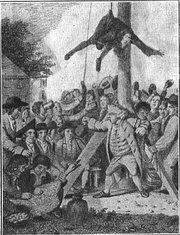 The term Tory
or "Loyalist" was used in the American Revolution
to include those who remained loyal to the British Crown. Since early in the 18th century, Tory had described those upholding the right of the Kings over parliament. During the revolution, particularly after the Declaration of Independence
in 1776 this use was extended to cover anyone who remained loyal to the British Crown. Those Loyalists who settled in Canada, Nova Scotia
, or the Bahamas after the American Revolution are known as United Empire Loyalists
.
was not unanimous. The "Tories" were men who supported the Mexican government. The Tories generally were long-term property holders whose roots were outside of the lower South. They typically had little interest in politics and sought conciliation rather than war or they withheld judgment from both sides. The Tories preferred to preserve the economic, political, and social gains that they enjoyed as citizens of Mexico, and the revolution threatened to jeopardize the security of their world.
, and "Tory" has become shorthand for a member of the Conservative Party or for the party in general. Many Conservatives still call themselves "Tory" to differentiate themselves from opponents, and the term is common in the media.
In Canada, the term "Tory" may describe any member of the Conservative Party of Canada
, its predecessor party the Progressive Conservative Party of Canada
, or any similar affiliated conservative provincial party; the term is frequently used in contrast to "Grit
", a shorthand for the Liberal Party of Canada
.
In Australia
, "Tory" is used as a pejorative term by members of the Australian Labor Party
to refer to members of the conservative coalition Liberal
and National
parties.
Traditionalist Conservatism
Traditionalist conservatism, also known as "traditional conservatism," "traditionalism," "Burkean conservatism", "classical conservatism" and , "Toryism", describes a political philosophy emphasizing the need for the principles of natural law and transcendent moral order, tradition, hierarchy and...
political philosophy which grew out of the Cavalier
Cavalier
Cavalier was the name used by Parliamentarians for a Royalist supporter of King Charles I and son Charles II during the English Civil War, the Interregnum, and the Restoration...
faction in the Wars of the Three Kingdoms
Wars of the Three Kingdoms
The Wars of the Three Kingdoms formed an intertwined series of conflicts that took place in England, Ireland, and Scotland between 1639 and 1651 after these three countries had come under the "Personal Rule" of the same monarch...
. It is a prominent ideology in the politics of the United Kingdom
Politics of the United Kingdom
The politics of the United Kingdom takes place within the framework of a constitutional monarchy, in which the Monarch is the head of state and the Prime Minister of the United Kingdom is the head of government...
, but also features in parts of The Commonwealth
Commonwealth of Nations
The Commonwealth of Nations, normally referred to as the Commonwealth and formerly known as the British Commonwealth, is an intergovernmental organisation of fifty-four independent member states...
, particularly in Canada
Canada
Canada is a North American country consisting of ten provinces and three territories. Located in the northern part of the continent, it extends from the Atlantic Ocean in the east to the Pacific Ocean in the west, and northward into the Arctic Ocean...
. Historically it also had exponents in former parts of the British Empire
British Empire
The British Empire comprised the dominions, colonies, protectorates, mandates and other territories ruled or administered by the United Kingdom. It originated with the overseas colonies and trading posts established by England in the late 16th and early 17th centuries. At its height, it was the...
, for instance the Loyalists
Loyalist (American Revolution)
Loyalists were American colonists who remained loyal to the Kingdom of Great Britain during the American Revolutionary War. At the time they were often called Tories, Royalists, or King's Men. They were opposed by the Patriots, those who supported the revolution...
of British North America
British North America
British North America is a historical term. It consisted of the colonies and territories of the British Empire in continental North America after the end of the American Revolutionary War and the recognition of American independence in 1783.At the start of the Revolutionary War in 1775 the British...
who sided with Britain and Crown during the Revolutionary War
American Revolutionary War
The American Revolutionary War , the American War of Independence, or simply the Revolutionary War, began as a war between the Kingdom of Great Britain and thirteen British colonies in North America, and ended in a global war between several European great powers.The war was the result of the...
. The Tory ethics can be summed up with the phrase 'God, King and Country'. Tories generally advocate monarchism
Monarchism
Monarchism is the advocacy of the establishment, preservation, or restoration of a monarchy as a form of government in a nation. A monarchist is an individual who supports this form of government out of principle, independent from the person, the Monarch.In this system, the Monarch may be the...
, are usually of a High Church
High church
The term "High Church" refers to beliefs and practices of ecclesiology, liturgy and theology, generally with an emphasis on formality, and resistance to "modernization." Although used in connection with various Christian traditions, the term has traditionally been principally associated with the...
Anglican
Church of England
The Church of England is the officially established Christian church in England and the Mother Church of the worldwide Anglican Communion. The church considers itself within the tradition of Western Christianity and dates its formal establishment principally to the mission to England by St...
or Recusant
Recusancy
In the history of England and Wales, the recusancy was the state of those who refused to attend Anglican services. The individuals were known as "recusants"...
Catholic
Roman Catholic Church
The Catholic Church, also known as the Roman Catholic Church, is the world's largest Christian church, with over a billion members. Led by the Pope, it defines its mission as spreading the gospel of Jesus Christ, administering the sacraments and exercising charity...
religious heritage, and are opposed to the radical
Radicalism (historical)
The term Radical was used during the late 18th century for proponents of the Radical Movement. It later became a general pejorative term for those favoring or seeking political reforms which include dramatic changes to the social order...
liberalism
Liberalism
Liberalism is the belief in the importance of liberty and equal rights. Liberals espouse a wide array of views depending on their understanding of these principles, but generally, liberals support ideas such as constitutionalism, liberal democracy, free and fair elections, human rights,...
of the Whig faction.
The Tory political faction emerged within the Parliament of England
Parliament of England
The Parliament of England was the legislature of the Kingdom of England. In 1066, William of Normandy introduced a feudal system, by which he sought the advice of a council of tenants-in-chief and ecclesiastics before making laws...
to uphold the legitimist rights of James, Duke of York to succeed his brother Charles II
Charles II of England
Charles II was monarch of the three kingdoms of England, Scotland, and Ireland.Charles II's father, King Charles I, was executed at Whitehall on 30 January 1649, at the climax of the English Civil War...
to the throne. James II was a Catholic, while the state institutions had broken from the Catholic Church—this was an issue for the Exclusion Bill
Exclusion Bill
The Exclusion Crisis ran from 1678 through 1681 in the reign of Charles II of England. The Exclusion Bill sought to exclude the king's brother and heir presumptive, James, Duke of York, from the thrones of England, Scotland and Ireland because he was Roman Catholic...
supporting Whigs, the political heirs to the nonconformist Roundhead
Roundhead
"Roundhead" was the nickname given to the supporters of the Parliament during the English Civil War. Also known as Parliamentarians, they fought against King Charles I and his supporters, the Cavaliers , who claimed absolute power and the divine right of kings...
s and Covenanter
Covenanter
The Covenanters were a Scottish Presbyterian movement that played an important part in the history of Scotland, and to a lesser extent in that of England and Ireland, during the 17th century...
s. There were two Tory ministries under James II; the first led by Lord Rochester
Laurence Hyde, 1st Earl of Rochester
Laurence Hyde, 1st Earl of Rochester KG PC was an English statesman and writer. He was originally a supporter of James II but later supported the Glorious Revolution in 1688.-Early life:...
, the second by Lord Belasyse
John Belasyse, 1st Baron Belasyse
John Belasyse, 1st Baron Belasyse PC was an English nobleman, soldier and Member of Parliament, notable for his role during and after the English Civil War.-Early life:...
. Some were later involved in his usurpation
Glorious Revolution
The Glorious Revolution, also called the Revolution of 1688, is the overthrow of King James II of England by a union of English Parliamentarians with the Dutch stadtholder William III of Orange-Nassau...
with the Whigs, which they saw as defending the Anglican Church. Tory sympathy for the Stuarts ran deep however and some supported Jacobitism
Jacobitism
Jacobitism was the political movement in Britain dedicated to the restoration of the Stuart kings to the thrones of England, Scotland, later the Kingdom of Great Britain, and the Kingdom of Ireland...
, which saw them isolated by the Hanoverians until Lord Bute's
John Stuart, 3rd Earl of Bute
John Stuart, 3rd Earl of Bute KG, PC , styled Lord Mount Stuart before 1723, was a Scottish nobleman who served as Prime Minister of Great Britain under George III, and was arguably the last important favourite in British politics...
ministry under George III.
Conservatism
Conservatism
Conservatism is a political and social philosophy that promotes the maintenance of traditional institutions and supports, at the most, minimal and gradual change in society. Some conservatives seek to preserve things as they are, emphasizing stability and continuity, while others oppose modernism...
emerged by the end of the 18th century—which synthesised moderate Whig
Moderate
In politics and religion, a moderate is an individual who is not extreme, partisan or radical. In recent years, political moderates has gained traction as a buzzword....
positions and some of the old Tory values to create a new political ideology, in opposition to the French Revolution
French Revolution
The French Revolution , sometimes distinguished as the 'Great French Revolution' , was a period of radical social and political upheaval in France and Europe. The absolute monarchy that had ruled France for centuries collapsed in three years...
. The likes of Edmund Burke
Edmund Burke
Edmund Burke PC was an Irish statesman, author, orator, political theorist and philosopher who, after moving to England, served for many years in the House of Commons of Great Britain as a member of the Whig party....
and William Pitt the Younger
William Pitt the Younger
William Pitt the Younger was a British politician of the late 18th and early 19th centuries. He became the youngest Prime Minister in 1783 at the age of 24 . He left office in 1801, but was Prime Minister again from 1804 until his death in 1806...
led the way in this. Due to this faction eventually leading to the formation of the Conservative Party
Conservative Party (UK)
The Conservative Party, formally the Conservative and Unionist Party, is a centre-right political party in the United Kingdom that adheres to the philosophies of conservatism and British unionism. It is the largest political party in the UK, and is currently the largest single party in the House...
, members of that party are colloquially referred to as Tories, even if they are not traditionalists. Actual adherents to traditional Toryism in contemporary times tend to be referred to as High Tories
High Tories
High Toryism is a term used in Britain, Canada and elsewhere to refer to a traditionalist conservatism which is in line with the Toryism originating in the 17th century. It tends to be at odds with the modern emphasis of the Conservative Party in these countries. High Toryism has been described as...
to avoid confusion.
History of the term
Irish language
Irish , also known as Irish Gaelic, is a Goidelic language of the Indo-European language family, originating in Ireland and historically spoken by the Irish people. Irish is now spoken as a first language by a minority of Irish people, as well as being a second language of a larger proportion of...
tóraí: outlaw
Outlaw
In historical legal systems, an outlaw is declared as outside the protection of the law. In pre-modern societies, this takes the burden of active prosecution of a criminal from the authorities. Instead, the criminal is withdrawn all legal protection, so that anyone is legally empowered to persecute...
, robber or brigand, from the Irish word tóir, meaning "pursuit", since outlaws were "pursued men". It was originally used to refer to an Irish outlaw
Rapparee
Rapparees were Irish guerrilla fighters who operated on the Jacobite side during the 1690s Williamite war in Ireland. Subsequently the name was also given to bandits and highwaymen in Ireland - many former guerrillas having turned to crime after the war was over...
and later applied to Confederates
Confederate Ireland
Confederate Ireland refers to the period of Irish self-government between the Rebellion of 1641 and the Cromwellian conquest of Ireland in 1649. During this time, two-thirds of Ireland was governed by the Irish Catholic Confederation, also known as the "Confederation of Kilkenny"...
or Royalists
Cavalier
Cavalier was the name used by Parliamentarians for a Royalist supporter of King Charles I and son Charles II during the English Civil War, the Interregnum, and the Restoration...
in arms. The term was thus originally a term of abuse, "an Irish rebel", before being adopted as a political label in the same way as Whig.
Towards the end of Charles II's reign (1660–85) there was some debate about whether or not his brother, James, Duke of York, should be allowed to succeed to the throne. 'Whigs' was the abusive term directed at those who wanted to exclude James on the grounds that he was a Roman Catholic. Those who were not prepared to exclude James were labelled 'Abhorrers
Abhorrers
Abhorrers, the name given in 1679 to the persons who expressed their abhorrence at the action of those who had signed petitions urging King Charles II of England to assemble Parliament....
' and later 'Tories'.
With both 'Whig' and 'Tory', the suffix -ism was quickly added to make Whiggism
Whiggism
Whiggism, sometimes spelled Whigism, is a historical political philosophy that grew out of the Parliamentarian faction in the Wars of the Three Kingdoms. The whigs' key policy positions were the supremacy of Parliament , toleration for Protestant dissenters, and opposition to a Catholic on the...
and Toryism, meaning the principles and methods of each faction.
English and British politics
Oliver Cromwell
Oliver Cromwell was an English military and political leader who overthrew the English monarchy and temporarily turned England into a republican Commonwealth, and served as Lord Protector of England, Scotland, and Ireland....
's nine-month 1649–1650 campaign in Ireland
Cromwellian conquest of Ireland
The Cromwellian conquest of Ireland refers to the conquest of Ireland by the forces of the English Parliament, led by Oliver Cromwell during the Wars of the Three Kingdoms. Cromwell landed in Ireland with his New Model Army on behalf of England's Rump Parliament in 1649...
, who were allied with Royalists
Cavalier
Cavalier was the name used by Parliamentarians for a Royalist supporter of King Charles I and son Charles II during the English Civil War, the Interregnum, and the Restoration...
through treaty with the Parliament of Confederate Ireland
Confederate Ireland
Confederate Ireland refers to the period of Irish self-government between the Rebellion of 1641 and the Cromwellian conquest of Ireland in 1649. During this time, two-thirds of Ireland was governed by the Irish Catholic Confederation, also known as the "Confederation of Kilkenny"...
, signed at Kilkenny
Kilkenny
Kilkenny is a city and is the county town of the eponymous County Kilkenny in Ireland. It is situated on both banks of the River Nore in the province of Leinster, in the south-east of Ireland...
in January 1649; and later to dispossessed Catholics in Ulster
Ulster
Ulster is one of the four provinces of Ireland, located in the north of the island. In ancient Ireland, it was one of the fifths ruled by a "king of over-kings" . Following the Norman invasion of Ireland, the ancient kingdoms were shired into a number of counties for administrative and judicial...
following the Restoration
Restoration (Ireland)
The Restoration of the monarchy began in 1660 when the English, Scottish and Irish monarchies were all restored under Charles II after the Commonwealth of England, Scotland and Ireland that followed the Wars of the Three Kingdoms...
.
During the Exclusion Bill Crisis
Exclusion Bill
The Exclusion Crisis ran from 1678 through 1681 in the reign of Charles II of England. The Exclusion Bill sought to exclude the king's brother and heir presumptive, James, Duke of York, from the thrones of England, Scotland and Ireland because he was Roman Catholic...
the word Tory was applied in England
Kingdom of England
The Kingdom of England was, from 927 to 1707, a sovereign state to the northwest of continental Europe. At its height, the Kingdom of England spanned the southern two-thirds of the island of Great Britain and several smaller outlying islands; what today comprises the legal jurisdiction of England...
as a nickname to the opponents of the bill, called the Abhorrers
Abhorrers
Abhorrers, the name given in 1679 to the persons who expressed their abhorrence at the action of those who had signed petitions urging King Charles II of England to assemble Parliament....
. The word 'Tory' had connotations of Papist
Papist
Papist is a term or an anti-Catholic slur, referring to the Roman Catholic Church, its teachings, practices, or adherents. The term was coined during the English Reformation to denote a person whose loyalties were to the Pope, rather than to the Church of England...
and outlaw
Outlaw
In historical legal systems, an outlaw is declared as outside the protection of the law. In pre-modern societies, this takes the burden of active prosecution of a criminal from the authorities. Instead, the criminal is withdrawn all legal protection, so that anyone is legally empowered to persecute...
derived from its previous use in Ireland.
English Tories from the time of the Glorious Revolution
Glorious Revolution
The Glorious Revolution, also called the Revolution of 1688, is the overthrow of King James II of England by a union of English Parliamentarians with the Dutch stadtholder William III of Orange-Nassau...
up until the Reform Bill of 1832 were characterized by strong monarchist tendencies, support for the Church of England
Church of England
The Church of England is the officially established Christian church in England and the Mother Church of the worldwide Anglican Communion. The church considers itself within the tradition of Western Christianity and dates its formal establishment principally to the mission to England by St...
, and hostility to reform, while the Tory Party was an actual organization which held power intermittently throughout the same period.
Currently, the term "Tory" is commonly used in the media to refer to the Conservative Party and its members.
Canada
The term was used to designate the pre-Confederation British ruling classes of Upper CanadaUpper Canada
The Province of Upper Canada was a political division in British Canada established in 1791 by the British Empire to govern the central third of the lands in British North America and to accommodate Loyalist refugees from the United States of America after the American Revolution...
and Lower Canada
Lower Canada
The Province of Lower Canada was a British colony on the lower Saint Lawrence River and the shores of the Gulf of Saint Lawrence...
, known as the Family Compact
Family Compact
Fully developed after the War of 1812, the Compact lasted until Upper and Lower Canada were united in 1841. In Lower Canada, its equivalent was the Château Clique. The influence of the Family Compact on the government administration at different levels lasted to the 1880s...
and the Château Clique
Château Clique
The Clique du Château or Château Clique was a group of wealthy families in Lower Canada in the early 19th century. They were the Lower Canadian equivalent of the Family Compact in Upper Canada...
, an elite within the governing classes, and often members within a section of society known as the United Empire Loyalists
United Empire Loyalists
The name United Empire Loyalists is an honorific given after the fact to those American Loyalists who resettled in British North America and other British Colonies as an act of fealty to King George III after the British defeat in the American Revolutionary War and prior to the Treaty of Paris...
.
In post-Confederation Canada the terms "Red Tory
Red Tory
A red Tory is an adherent of a particular political philosophy, tradition, and disposition in Canada somewhat similar to the High Tory tradition in the United Kingdom; it is contrasted with "blue Tory". In Canada, the phenomenon of "red toryism" has fundamentally, if not exclusively, been found in...
" and "Blue Tory
Blue Tory
Blue Tories, also known as small 'c' conservatives, are, in Canadian politics, members of the former federal Progressive Conservative Party of Canada, current Conservative Party of Canada and provincial Progressive Conservative parties who are more economically right wing...
" have long been used to describe the two wings of the Conservative
Conservative Party of Canada
The Conservative Party of Canada , is a political party in Canada which was formed by the merger of the Canadian Alliance and the Progressive Conservative Party of Canada in 2003. It is positioned on the right of the Canadian political spectrum...
and previously the Progressive Conservative
Progressive Conservative Party of Canada
The Progressive Conservative Party of Canada was a Canadian political party with a centre-right stance on economic issues and, after the 1970s, a centrist stance on social issues....
(PC) parties. The diadic tensions originally arose out of the 1854 political union of British-Canadian Tories, French-Canadian traditionalists, and the monarchist
Monarchism
Monarchism is the advocacy of the establishment, preservation, or restoration of a monarchy as a form of government in a nation. A monarchist is an individual who supports this form of government out of principle, independent from the person, the Monarch.In this system, the Monarch may be the...
and loyalist leaning sections of the emerging commercial classes at the time - many of whom were uncomfortable with the pro-American and annexationist
Annexationist movements of Canada
From the Independence of the United States of America until today, various annexationist movements in Canada have campaigned in favour of U.S. annexation of parts or all of Canada...
tendencies within the liberal Grits
Clear Grits
Clear Grits were reformers in the Province of Upper Canada, a British colony that is now the Province of Ontario, Canada. Their support was concentrated among southwestern Ontario farmers, who were frustrated and disillusioned by the 1849 Reform government of Robert Baldwin and Louis-Hippolyte...
. Tory strength and prominence in the political culture was a feature of life in Nova Scotia
Nova Scotia
Nova Scotia is one of Canada's three Maritime provinces and is the most populous province in Atlantic Canada. The name of the province is Latin for "New Scotland," but "Nova Scotia" is the recognized, English-language name of the province. The provincial capital is Halifax. Nova Scotia is the...
, New Brunswick
New Brunswick
New Brunswick is one of Canada's three Maritime provinces and is the only province in the federation that is constitutionally bilingual . The provincial capital is Fredericton and Saint John is the most populous city. Greater Moncton is the largest Census Metropolitan Area...
, Prince Edward Island
Prince Edward Island
Prince Edward Island is a Canadian province consisting of an island of the same name, as well as other islands. The maritime province is the smallest in the nation in both land area and population...
, Ontario
Ontario
Ontario is a province of Canada, located in east-central Canada. It is Canada's most populous province and second largest in total area. It is home to the nation's most populous city, Toronto, and the nation's capital, Ottawa....
, and Manitoba
Manitoba
Manitoba is a Canadian prairie province with an area of . The province has over 110,000 lakes and has a largely continental climate because of its flat topography. Agriculture, mostly concentrated in the fertile southern and western parts of the province, is vital to the province's economy; other...
.
By the 1930s, the factions within Canadian Toryism were associated with either the urban business elites, or with rural traditionalists from the country's hinterland. A "Red Tory" is a member of the more moderate wing of the party (in the manner of John Farthing
John Farthing
John Colborne Farthing was a student, soldier, thinker, philosopher, economist, teacher, and author of the seminal tract Freedom Wears a Crown which became rather quickly an epistle of Red Toryism.-Early years:...
and George Grant
George Grant (philosopher)
George Parkin Grant, OC, FRSC was a Canadian philosopher, teacher and political commentator, whose popular appeal peaked in the late 1960s and 1970s. He is best known for his nationalism, political conservatism, and his views on technology, pacifism, Christian faith, and abortion...
). They are generally unified by their adherence to British traditions in Canada.
Throughout the course of Canadian history, the Conservative Party was generally controlled by MacDonaldian Tory elements, which in Canada meant an adherence to the English-Canadian traditions of Monarchy, Empire-Commonwealth, parliamentary government, nationalism, protectionism, social reform, and eventually, acceptance of the necessity of the welfare state.
By the 1970s the Progressive Conservative Party was a Keynesian-consensus party. With the onset of stagflation
Stagflation
In economics, stagflation is a situation in which the inflation rate is high and the economic growth rate slows down and unemployment remains steadily high...
in the 1970s, some Canadian Tories came under the influence of neo-liberal developments in Great Britain and the United States, which highlighted the policies for privatization and supply-side interventions. In Canada, these tories have been labeled neoconservatives - which has a somewhat different connotation in the US. By the early 1980s there was no clear neoconservative in the Tory leadership cadre, but Brian Mulroney
Brian Mulroney
Martin Brian Mulroney, was the 18th Prime Minister of Canada from September 17, 1984, to June 25, 1993 and was leader of the Progressive Conservative Party of Canada from 1983 to 1993. His tenure as Prime Minister was marked by the introduction of major economic reforms, such as the Canada-U.S...
, who became leader in 1983, eventually came to adopt many policies from the Margaret Thatcher
Margaret Thatcher
Margaret Hilda Thatcher, Baroness Thatcher, was Prime Minister of the United Kingdom from 1979 to 1990...
and Ronald Reagan
Ronald Reagan
Ronald Wilson Reagan was the 40th President of the United States , the 33rd Governor of California and, prior to that, a radio, film and television actor....
governments.
As Mulroney took the Progressive Conservative Party
Progressive Conservative Party of Canada
The Progressive Conservative Party of Canada was a Canadian political party with a centre-right stance on economic issues and, after the 1970s, a centrist stance on social issues....
further in this direction, with policy initiatives in the areas of deregulation, privatization, free-trade, and a consumption tax called the Goods and Services Tax
Goods and Services Tax (Canada)
The Goods and Services Tax is a multi-level value added tax introduced in Canada on January 1, 1991, by then Prime Minister Brian Mulroney and his finance minister Michael Wilson. The GST replaced a hidden 13.5% Manufacturers' Sales Tax ; Mulroney claimed the GST was implemented because the MST...
(GST), many traditionally-minded Tories became concerned that a political and cultural schism was occurring within the party.
The 1986 creation of the Reform Party of Canada
Reform Party of Canada
The Reform Party of Canada was a Canadian federal political party that existed from 1987 to 2000. It was originally founded as a Western Canada-based protest party, but attempted to expand eastward in the 1990s. It viewed itself as a populist party....
attracted some of the neo-liberals and social conservatives away from the Tory party, and as some of the neoconservative policies of the Mulroney government proved unpopular, some of the provincial-rights elements moved towards Reform as well. In 1993, Mulroney resigned, rather than fight an election based on his record after almost nine years in power. This left the PCs in disarray and scrambling to understand how to make toryism relevant in provinces such as Quebec
Quebec
Quebec or is a province in east-central Canada. It is the only Canadian province with a predominantly French-speaking population and the only one whose sole official language is French at the provincial level....
, Saskatchewan
Saskatchewan
Saskatchewan is a prairie province in Canada, which has an area of . Saskatchewan is bordered on the west by Alberta, on the north by the Northwest Territories, on the east by Manitoba, and on the south by the U.S. states of Montana and North Dakota....
, Alberta
Alberta
Alberta is a province of Canada. It had an estimated population of 3.7 million in 2010 making it the most populous of Canada's three prairie provinces...
, and British Columbia
British Columbia
British Columbia is the westernmost of Canada's provinces and is known for its natural beauty, as reflected in its Latin motto, Splendor sine occasu . Its name was chosen by Queen Victoria in 1858...
that had never had a strong tory tradition and political culture.
Thereafter in the 1990s, the PCs were a small party in the Canadian House of Commons
Canadian House of Commons
The House of Commons of Canada is a component of the Parliament of Canada, along with the Sovereign and the Senate. The House of Commons is a democratically elected body, consisting of 308 members known as Members of Parliament...
, and could only exert legislative pressure on the government through their power in the Senate of Canada
Canadian Senate
The Senate of Canada is a component of the Parliament of Canada, along with the House of Commons, and the monarch . The Senate consists of 105 members appointed by the governor general on the advice of the prime minister...
. Eventually, through death and retirements, this power waned. Joe Clark
Joe Clark
Charles Joseph "Joe" Clark, is a Canadian statesman, businessman, and university professor, and former journalist and politician...
returned as leader, but the schism with the Reformers effectively watered down the combined Blue and Red Tory vote in Canada.
By the late 1990s, there was talk of the necessity of uniting the right in Canada, to deter further Liberal majorities. Many tories - both red and blue - opposed such moves, while others took the view that all would have to be pragmatic if there was any hope of reviving a strong party system. The Canadian Alliance
Canadian Alliance
The Canadian Alliance , formally the Canadian Reform Conservative Alliance , was a Canadian conservative political party that existed from 2000 to 2003. The party was the successor to the Reform Party of Canada and inherited its position as the Official Opposition in the House of Commons and held...
party (as the Reform Party had become), and some leading tories came together on an informal basis to see if they could find common ground. While Progressive Conservative Leader Joe Clark rebuffed the notion, the talks moved ahead and eventually in December 2003, the Canadian Alliance and the Progressive Conservative parties voted to rejoin into a new party called the Conservative Party of Canada.
After the merger of the PCs with the Canadian Alliance in 2003, there was debate as to whether the "Tory" appellation should survive at the federal level. Although it was widely believed that some Alliance members would take offence to the term, it was officially accepted by the newly-merged party during the 2004 leadership convention
Conservative Party of Canada leadership election, 2004
The 2004 Conservative Party of Canada leadership election took place on March 20, 2004 in Toronto, Ontario, and resulted in the election of Stephen Harper as the first leader of the new Canadian Conservative Party...
. Stephen Harper
Stephen Harper
Stephen Joseph Harper is the 22nd and current Prime Minister of Canada and leader of the Conservative Party. Harper became prime minister when his party formed a minority government after the 2006 federal election...
, leader of the Conservative Party of Canada, and the Prime Minister as a result of the January 23, 2006 election, regularly refers to himself as a Tory and has suggested that the new party is a natural evolution of the conservative political movement in Canada.
American Revolution
Tory
Toryism is a traditionalist and conservative political philosophy which grew out of the Cavalier faction in the Wars of the Three Kingdoms. It is a prominent ideology in the politics of the United Kingdom, but also features in parts of The Commonwealth, particularly in Canada...
or "Loyalist" was used in the American Revolution
American Revolution
The American Revolution was the political upheaval during the last half of the 18th century in which thirteen colonies in North America joined together to break free from the British Empire, combining to become the United States of America...
to include those who remained loyal to the British Crown. Since early in the 18th century, Tory had described those upholding the right of the Kings over parliament. During the revolution, particularly after the Declaration of Independence
United States Declaration of Independence
The Declaration of Independence was a statement adopted by the Continental Congress on July 4, 1776, which announced that the thirteen American colonies then at war with Great Britain regarded themselves as independent states, and no longer a part of the British Empire. John Adams put forth a...
in 1776 this use was extended to cover anyone who remained loyal to the British Crown. Those Loyalists who settled in Canada, Nova Scotia
Nova Scotia
Nova Scotia is one of Canada's three Maritime provinces and is the most populous province in Atlantic Canada. The name of the province is Latin for "New Scotland," but "Nova Scotia" is the recognized, English-language name of the province. The provincial capital is Halifax. Nova Scotia is the...
, or the Bahamas after the American Revolution are known as United Empire Loyalists
United Empire Loyalists
The name United Empire Loyalists is an honorific given after the fact to those American Loyalists who resettled in British North America and other British Colonies as an act of fealty to King George III after the British defeat in the American Revolutionary War and prior to the Treaty of Paris...
.
Texas Revolution
In Texas 1832-36 support for the Texas RevolutionTexas Revolution
The Texas Revolution or Texas War of Independence was an armed conflict between Mexico and settlers in the Texas portion of the Mexican state Coahuila y Tejas. The war lasted from October 2, 1835 to April 21, 1836...
was not unanimous. The "Tories" were men who supported the Mexican government. The Tories generally were long-term property holders whose roots were outside of the lower South. They typically had little interest in politics and sought conciliation rather than war or they withheld judgment from both sides. The Tories preferred to preserve the economic, political, and social gains that they enjoyed as citizens of Mexico, and the revolution threatened to jeopardize the security of their world.
Current Usage
In Britain after 1832 the Tory Party was replaced by the Conservative PartyConservative Party (UK)
The Conservative Party, formally the Conservative and Unionist Party, is a centre-right political party in the United Kingdom that adheres to the philosophies of conservatism and British unionism. It is the largest political party in the UK, and is currently the largest single party in the House...
, and "Tory" has become shorthand for a member of the Conservative Party or for the party in general. Many Conservatives still call themselves "Tory" to differentiate themselves from opponents, and the term is common in the media.
In Canada, the term "Tory" may describe any member of the Conservative Party of Canada
Conservative Party of Canada
The Conservative Party of Canada , is a political party in Canada which was formed by the merger of the Canadian Alliance and the Progressive Conservative Party of Canada in 2003. It is positioned on the right of the Canadian political spectrum...
, its predecessor party the Progressive Conservative Party of Canada
Progressive Conservative Party of Canada
The Progressive Conservative Party of Canada was a Canadian political party with a centre-right stance on economic issues and, after the 1970s, a centrist stance on social issues....
, or any similar affiliated conservative provincial party; the term is frequently used in contrast to "Grit
Grit
Grit may refer to:* GRIT , also known as Arhgap32 or PX-RICS* Grit , a U.S. periodical founded as a newspaper in 1882* Grit , by Celtic fusion musician Martyn Bennett* Grit , by Norwegian rock band Madrugada...
", a shorthand for the Liberal Party of Canada
Liberal Party of Canada
The Liberal Party of Canada , colloquially known as the Grits, is the oldest federally registered party in Canada. In the conventional political spectrum, the party sits between the centre and the centre-left. Historically the Liberal Party has positioned itself to the left of the Conservative...
.
In Australia
Australia
Australia , officially the Commonwealth of Australia, is a country in the Southern Hemisphere comprising the mainland of the Australian continent, the island of Tasmania, and numerous smaller islands in the Indian and Pacific Oceans. It is the world's sixth-largest country by total area...
, "Tory" is used as a pejorative term by members of the Australian Labor Party
Australian Labor Party
The Australian Labor Party is an Australian political party. It has been the governing party of the Commonwealth of Australia since the 2007 federal election. Julia Gillard is the party's federal parliamentary leader and Prime Minister of Australia...
to refer to members of the conservative coalition Liberal
Liberal Party of Australia
The Liberal Party of Australia is an Australian political party.Founded a year after the 1943 federal election to replace the United Australia Party, the centre-right Liberal Party typically competes with the centre-left Australian Labor Party for political office...
and National
National Party of Australia
The National Party of Australia is an Australian political party.Traditionally representing graziers, farmers and rural voters generally, it began as the The Country Party, but adopted the name The National Country Party in 1975, changed to The National Party of Australia in 1982. The party is...
parties.
See also
- Blue ToryBlue ToryBlue Tories, also known as small 'c' conservatives, are, in Canadian politics, members of the former federal Progressive Conservative Party of Canada, current Conservative Party of Canada and provincial Progressive Conservative parties who are more economically right wing...
- CavalierCavalierCavalier was the name used by Parliamentarians for a Royalist supporter of King Charles I and son Charles II during the English Civil War, the Interregnum, and the Restoration...
- ConservatismConservatismConservatism is a political and social philosophy that promotes the maintenance of traditional institutions and supports, at the most, minimal and gradual change in society. Some conservatives seek to preserve things as they are, emphasizing stability and continuity, while others oppose modernism...
- High Tory
- JacobitismJacobitismJacobitism was the political movement in Britain dedicated to the restoration of the Stuart kings to the thrones of England, Scotland, later the Kingdom of Great Britain, and the Kingdom of Ireland...
- Red ToryRed ToryA red Tory is an adherent of a particular political philosophy, tradition, and disposition in Canada somewhat similar to the High Tory tradition in the United Kingdom; it is contrasted with "blue Tory". In Canada, the phenomenon of "red toryism" has fundamentally, if not exclusively, been found in...
- Tory (political faction)
- Traditionalist conservatismTraditionalist ConservatismTraditionalist conservatism, also known as "traditional conservatism," "traditionalism," "Burkean conservatism", "classical conservatism" and , "Toryism", describes a political philosophy emphasizing the need for the principles of natural law and transcendent moral order, tradition, hierarchy and...
- Ultra-ToriesUltra-ToriesThe Ultra-Tories were an Anglican faction of British and Irish politics that appeared in the 1820s in opposition to Catholic emancipation. They were later called the "extreme right wing" of British and Irish politics. They broke away from the governing party in 1829 after the passing of the...