


Muchalls Castle

Encyclopedia
Muchalls Castle stands overlooking the North Sea
in the countryside of Kincardine and Mearns
, Aberdeenshire
, Scotland
. The lower course is a well preserved double groined 13th century towerhouse structure, built by the Frasers of Muchalls
. Upon this structure, the 17th century castle was begun by Alexander Burnett of Leys and completed by his son, Sir Thomas Burnett, 1st Baronet
, in 1627. The Burnetts of Leys
built the remaining four storey present day castle. One of the most interesting castles of northeast Scotland, according to noted architectural historian Nigel Tranter
, it is designed in the classic L style
with a further extension wing at the west end. Muchalls Castle entered national history in 1638 when a seminal Covenanter
gathering took place here precedent to the English Civil War
.
The plasterwork
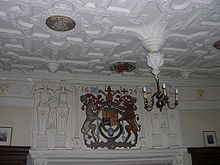
ceilings of the principal drawing rooms are generally regarded as among the three finest examples of plasterwork ceilings in Scotland. These adornments date to 1624 and are in virtually perfect condition. They consist of heraldry
of the Burnett of Leys
family, along with heraldry of relations and friends intermixed with biblical iconography
. The overmantel of the Great Hall fireplace features the arms of King James VI flanked by impressive egyptianesque
figures.
is the original 14th century ground level of the Clan Fraser
towerhouse. On this level are a dungeon
, guard room, storerooms, a chamber for merchants and visitors waiting to see the Laird
, and a medieval kitchen. In the medieval kitchen the interior wall is over 4.5 metres thick, accommodating a hidden staircase and affording bearing strength to support the upper levels. A long hall passageway was constructed as a barrel vault
ed design. The dungeon
is noted for its small window and still has the large steel hinges to which the dungeon door would have attached. The medieval kitchen has its original 14th century flagstone
s; moreover, this room features a large walk-in fireplace
with a secret spiral staircase that servants would have used in medieval times to carry meals to the higher levels. (Servants at that time would have not been allowed on the main staircases used by the nobility who dwelt in the castle.) Ownership of the castle and lands passed to the Hays in the 15th century probably associated with the same real estate transaction of the lands of Ury
in 1413 AD.
 The second floor level (referred to as the first floor in Scotland) is erected over the intact Middle Ages
ground level structure. Prominent exterior features are: a set of well-sculpted corbelled turrets; massive ranges of chimneys: a curtain-walled entrance courtyard with two sets of triple gunloops flanking the entrance arch; a subterranean crypt; and well-preserved 17th century high stone walled terraced gardens. The bartizan
s render interesting interior features in numerous of the bedrooms, providing interesting circular nooks with small lookout windows strategically placed at upper building corners. There are numerous original arrow slits that indicate the original defensive nature of the structure; some of these arrow slits penetrate exterior walls that are over a metre thick. There are a number of crow-stepped gable
s associated with large chimney
s at building endpoints. The castle itself is an A listed historical building; however, there are three further listed structures on the castle grounds, including a fine stone stables and a 17th century dovecote
.
The next level includes most of the principal reception rooms, including the Great Hall
, the Ladies' Drawing Room and the Gentlemen's Study. These reception rooms are the main locations of the elaborate plasterwork; in fact, the ceilings of these three rooms are totally covered in original 17th century plasterwork with heraldic coats of arms, biblical figures and other historical figures. The great hall fireplace has an original plasterwork overmantle featuring egyptianesque
caryatid
figures and the King James Arms. One can walk erect inside the fireplace and conduct a small meeting inside with bench seating built in. The firebox also hosts the Laird's Lug, a secret listening system allowing the Laird to overhear conversations in the Great Hall from his suite above.
The third level consists of a number of bedrooms: The Laird's Bedroom, The Priest's Bedroom, The Queen's Bedroom, The Queen's Winter Bedroom. The Queen naturally had a very elegant room in case she were to visit; in fact, she had a Winter Bedroom for inclement weather. Each of the bedrooms has a fireplace, as do some of the bathrooms. The bathrooms are a Victorian modification of what would have been dressing rooms in the 17th century.
Several generations of the Burnett of Leys family lived in Muchalls Castle. Later residents included James Robertson, Baron Robertson
, President of the Scottish Court of Session
, and Geraldine Simpson (née Pringle), heiress to the Pringle knitting fortune.
in Scotland.
In 1638 at Edinburgh signatories to a Covenant opposed imposition of the Episcopal liturgical system then backed by the King. It turned out that Aberdeen was one of the last holdouts to confirm this covenant. Sir Thomas Burnett of Leys, Laird of Muchalls Castle, along with James Graham, 1st Marquess of Montrose
, Dickson, Henderson, Lord Coupar, the Master of Forbes and others formed a delegation of Covenanters to approach the Bishops of Aberdeen. The Bishops of Aberdeen offered the Cup of Bon-Accord to the Covenanters and had laid out an elaborate banquet; however, very dramatically, the Covenanters refused the Cup, stating they would not meet until the Bishops had signed the Covenant. The Bishops, known as the Doctors of Aberdeen, were very disturbed and composed a list of queries, demanding the Covenanters response. Muchalls Castle was the site of the Covenanters meeting where they drew up their plucky and learned response to the Bishops. From this confrontation and other concomitant events, Charles I
unexpectedly made sweeping reforms and concessions to the Covenanters including revocation of the Service Book and Canons
, repeal of the Perth Articles and enjoined subscription to Craigs Negative Confession of 1580, a document condemning papal errors.
times was James Robertson, Baron Robertson
, Lord Advocate
of Scotland.
with a forest policy
(woodland surrounding a large estate) of very old sycamore
, elm
and beech
trees forming the northern and eastern policy boundaries. These trees form a canopy attaining 50 metres in height, and are the domain of rookeries of crow
and jackdaw
. There is a population of several hundred of these birds, which are commonly associated with other Scottish castles; in fact, the current owners have purchased a tangent northern parcel, which is known on historic maps as "Crow Woods" and is a similar forest of mature trees that house crow and jackdaw flocks.
 The southeastern, southern and western exposures have a thinner lower woodland policy, historically to allow free viewing of the North Sea
and expansive valley views to the south and west. The principal gardens are situated in a series of declining terraces on the western side of the castle. These gardens were studied by a historical landscape architect
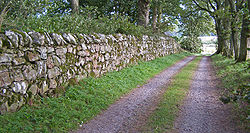
in 2001 and determined to be the original early 17th century design, including enclosing dry-stone walls. Further evidence of the original design period is manifested by a subtle pattern in the western lawn nearest the castle, which has been documented to be undulations echoing an elaborate subsurface stonework pattern, a hallmark of the 17th century garden plan. On the southern lawn there is a rare species
of tree known as the weeping elm. This specimen is one of the oldest in Scotland, measuring a height of 12 metres. There are a total of seven principal lawns summing to an area of 52300 square feet (4,858.8 m²).
Further there are a total of five agricultural fields as part of the castle estate which are managed to accommodate cattle, sheep and crops of wheat
, barley
and hay. The castle is accessed via a private drive of about three quarters of a mile long, that runs across the castle estate. One of the most intriguing discoveries of the 1990s was a hewn slab about two metres wide that spans a creek running along the southern portion of the estate. This slab had not been recorded on any of the historic maps from the most recent 200 years, but is the exact width needed to accommodate a carriage. This discovery was used to support the theory espoused by the present owners that the original castle access was from the south and not the west as shown on maps of the last two centuries and resulted in securing council approval to reconstruct the ancient approach as the main access drive
.
less than a half mile distant. It lies on the ancient Causey Mounth
road linking Stonehaven to Aberdeen via the Portlethen Moss
. Muchalls Castle has sweeping views to the south and east of a valley that was the northernmost point of the Roman army's advance into the Scottish highlands
. The Romans built a major encampment Raedykes
about three miles (5 km) to the southeast, which has yielded many interesting artifacts.
In nearby Stonehaven
is Stonehaven Tolbooth
, where Episcopal
clergy
were imprisoned for conducting services at the chapel
on the Muchalls Castle estate. Other notable structures nearby that have historical links to Muchalls Castle are Fetteresso Castle
, Dunnottar Castle
, Crathes Castle
and Monboddo House
, the home of James Burnett, Lord Monboddo
, the father of modern historical linguistics
and a pre-evolutionary thinker
.
North Sea
In the southwest, beyond the Straits of Dover, the North Sea becomes the English Channel connecting to the Atlantic Ocean. In the east, it connects to the Baltic Sea via the Skagerrak and Kattegat, narrow straits that separate Denmark from Norway and Sweden respectively...
in the countryside of Kincardine and Mearns
Kincardine and Mearns
Kincardine and Mearns is one of six area committees of the Aberdeenshire council area in Scotland. It has a population 38,506 . There are significant natural features in this district including rivers, forests, mountains and bogs .Transport links with Aberdeen have encouraged rapid population...
, Aberdeenshire
Aberdeenshire
Aberdeenshire is one of the 32 unitary council areas in Scotland and a lieutenancy area.The present day Aberdeenshire council area does not include the City of Aberdeen, now a separate council area, from which its name derives. Together, the modern council area and the city formed historic...
, Scotland
Scotland
Scotland is a country that is part of the United Kingdom. Occupying the northern third of the island of Great Britain, it shares a border with England to the south and is bounded by the North Sea to the east, the Atlantic Ocean to the north and west, and the North Channel and Irish Sea to the...
. The lower course is a well preserved double groined 13th century towerhouse structure, built by the Frasers of Muchalls
Frasers of Muchalls
The Frasers of Muchal-in Mar, sometimes referred to as the Frasers of Muchalls, were a branch of the Fraser family in Scotland.In 1366 Thomas Fraser, a descendant of Sir Alexander Fraser of Cornton brother of Sir Richard Fraser of Touch-Fraser, exchanged the lands in Petyndreich, Stirlingshire for...
. Upon this structure, the 17th century castle was begun by Alexander Burnett of Leys and completed by his son, Sir Thomas Burnett, 1st Baronet
Sir Thomas Burnett, 1st Baronet
Sir Thomas Burnett, 1st Baronet of Leys was a feudal baron and leading Covenanter who had represented Kincardineshire in the Scottish Parliament in 1621.-Early years:...
, in 1627. The Burnetts of Leys
Clan Burnett
Clan Burnett, also referred to as the House of Burnett, is a Lowland Scottish family.-Origins of the name:There is still debate over the origin of the name Burnett. The Saxon Burford family held lands in Bedfordshire prior to 1066. This name derives from the Saxon 'beornheard' meaning 'bear hand'...
built the remaining four storey present day castle. One of the most interesting castles of northeast Scotland, according to noted architectural historian Nigel Tranter
Nigel Tranter
Nigel Tranter OBE was a Scottish historian and author.-Early life:Nigel Tranter was born in Glasgow and educated at George Heriot's School in Edinburgh. He trained as an accountant and worked in Scottish National Insurance Company, founded by his uncle. In 1933 he married May Jean Campbell Grieve...
, it is designed in the classic L style
L Plan Castle
An L-plan castle is a castle or towerhouse in the shape of an L, typically built in the 13th to the 17th century. This design is found quite frequently in Scotland, but is also seen in England, Ireland, Romania, Sardinia, and other locations. The evolution of its design was an expansion of the...
with a further extension wing at the west end. Muchalls Castle entered national history in 1638 when a seminal Covenanter
Covenanter
The Covenanters were a Scottish Presbyterian movement that played an important part in the history of Scotland, and to a lesser extent in that of England and Ireland, during the 17th century...
gathering took place here precedent to the English Civil War
English Civil War
The English Civil War was a series of armed conflicts and political machinations between Parliamentarians and Royalists...
.
The plasterwork
Plasterwork
Plasterwork refers to construction or ornamentation done with plaster, such as a layer of plaster on an interior wall or plaster decorative moldings on ceilings or walls. This is also sometimes called pargeting...
ceilings of the principal drawing rooms are generally regarded as among the three finest examples of plasterwork ceilings in Scotland. These adornments date to 1624 and are in virtually perfect condition. They consist of heraldry
Heraldry
Heraldry is the profession, study, or art of creating, granting, and blazoning arms and ruling on questions of rank or protocol, as exercised by an officer of arms. Heraldry comes from Anglo-Norman herald, from the Germanic compound harja-waldaz, "army commander"...
of the Burnett of Leys
Clan Burnett
Clan Burnett, also referred to as the House of Burnett, is a Lowland Scottish family.-Origins of the name:There is still debate over the origin of the name Burnett. The Saxon Burford family held lands in Bedfordshire prior to 1066. This name derives from the Saxon 'beornheard' meaning 'bear hand'...
family, along with heraldry of relations and friends intermixed with biblical iconography
Iconography
Iconography is the branch of art history which studies the identification, description, and the interpretation of the content of images. The word iconography literally means "image writing", and comes from the Greek "image" and "to write". A secondary meaning is the painting of icons in the...
. The overmantel of the Great Hall fireplace features the arms of King James VI flanked by impressive egyptianesque
Art of Ancient Egypt
Ancient Egyptian art is the painting, sculpture, architecture and other arts produced by the civilization in the lower Nile Valley from 5000 BC to 300 AD. Ancient Egyptian art reached a high level in painting and sculpture, and was both highly stylized and symbolic...
figures.
Middle Ages origins
The lower course of this L Plan CastleL Plan Castle
An L-plan castle is a castle or towerhouse in the shape of an L, typically built in the 13th to the 17th century. This design is found quite frequently in Scotland, but is also seen in England, Ireland, Romania, Sardinia, and other locations. The evolution of its design was an expansion of the...
is the original 14th century ground level of the Clan Fraser
Clan Fraser
Clan Fraser is a Scottish clan of French origin. The Clan has been strongly associated with Inverness and the surrounding area since the Clan's founder gained lands there in the 13th century. Since its founding, the Clan has dominated local politics and been active in every major military conflict...
towerhouse. On this level are a dungeon
Dungeon
A dungeon is a room or cell in which prisoners are held, especially underground. Dungeons are generally associated with medieval castles, though their association with torture probably belongs more to the Renaissance period...
, guard room, storerooms, a chamber for merchants and visitors waiting to see the Laird
Laird
A Laird is a member of the gentry and is a heritable title in Scotland. In the non-peerage table of precedence, a Laird ranks below a Baron and above an Esquire.-Etymology:...
, and a medieval kitchen. In the medieval kitchen the interior wall is over 4.5 metres thick, accommodating a hidden staircase and affording bearing strength to support the upper levels. A long hall passageway was constructed as a barrel vault
Barrel vault
A barrel vault, also known as a tunnel vault or a wagon vault, is an architectural element formed by the extrusion of a single curve along a given distance. The curves are typically circular in shape, lending a semi-cylindrical appearance to the total design...
ed design. The dungeon
Dungeon
A dungeon is a room or cell in which prisoners are held, especially underground. Dungeons are generally associated with medieval castles, though their association with torture probably belongs more to the Renaissance period...
is noted for its small window and still has the large steel hinges to which the dungeon door would have attached. The medieval kitchen has its original 14th century flagstone
Flagstone
Flagstone, is a generic flat stone, usually used for paving slabs or walkways, patios, fences and roofing. It may be used for memorials, headstones, facades and other constructions. The name derives from Middle English flagge meaning turf, perhaps from Old Norse flaga meaning slab.Flagstone is a...
s; moreover, this room features a large walk-in fireplace
Fireplace
A fireplace is an architectural structure to contain a fire for heating and, especially historically, for cooking. A fire is contained in a firebox or firepit; a chimney or other flue allows gas and particulate exhaust to escape...
with a secret spiral staircase that servants would have used in medieval times to carry meals to the higher levels. (Servants at that time would have not been allowed on the main staircases used by the nobility who dwelt in the castle.) Ownership of the castle and lands passed to the Hays in the 15th century probably associated with the same real estate transaction of the lands of Ury
Ury House
The current incarnation of Ury House is a ruined large mansion built in the Elizabethan style in 1885 by Alexander Baird. It is situated about a mile north of Stonehaven, a town in Aberdeenshire on the North-East coast of Scotland...
in 1413 AD.
Seventeenth century reconstruction by the Burnetts of Leys
Middle Ages
The Middle Ages is a periodization of European history from the 5th century to the 15th century. The Middle Ages follows the fall of the Western Roman Empire in 476 and precedes the Early Modern Era. It is the middle period of a three-period division of Western history: Classic, Medieval and Modern...
ground level structure. Prominent exterior features are: a set of well-sculpted corbelled turrets; massive ranges of chimneys: a curtain-walled entrance courtyard with two sets of triple gunloops flanking the entrance arch; a subterranean crypt; and well-preserved 17th century high stone walled terraced gardens. The bartizan
Bartizan
A bartizan or guerite is an overhanging, wall-mounted turret projecting from the walls of medieval fortifications from the early 14th century up to the 16th century. They protect a warder and enable him to see around him...
s render interesting interior features in numerous of the bedrooms, providing interesting circular nooks with small lookout windows strategically placed at upper building corners. There are numerous original arrow slits that indicate the original defensive nature of the structure; some of these arrow slits penetrate exterior walls that are over a metre thick. There are a number of crow-stepped gable
Gable
A gable is the generally triangular portion of a wall between the edges of a sloping roof. The shape of the gable and how it is detailed depends on the structural system being used and aesthetic concerns. Thus the type of roof enclosing the volume dictates the shape of the gable...
s associated with large chimney
Chimney
A chimney is a structure for venting hot flue gases or smoke from a boiler, stove, furnace or fireplace to the outside atmosphere. Chimneys are typically vertical, or as near as possible to vertical, to ensure that the gases flow smoothly, drawing air into the combustion in what is known as the...
s at building endpoints. The castle itself is an A listed historical building; however, there are three further listed structures on the castle grounds, including a fine stone stables and a 17th century dovecote
Dovecote
A dovecote or dovecot is a structure intended to house pigeons or doves. Dovecotes may be square or circular free-standing structures or built into the end of a house or barn. They generally contain pigeonholes for the birds to nest. Pigeons and doves were an important food source historically in...
.
The next level includes most of the principal reception rooms, including the Great Hall
Great Hall
Great Hall may refer to* Great hall, the main room of a royal palace, nobleman's castle or large manor house* Great Hall of the People, Tiananmen Square, Beijing* Great Hall of the University of Sydney, Australia* Cooper_Union#The_Great_Hall, New York...
, the Ladies' Drawing Room and the Gentlemen's Study. These reception rooms are the main locations of the elaborate plasterwork; in fact, the ceilings of these three rooms are totally covered in original 17th century plasterwork with heraldic coats of arms, biblical figures and other historical figures. The great hall fireplace has an original plasterwork overmantle featuring egyptianesque
Art of Ancient Egypt
Ancient Egyptian art is the painting, sculpture, architecture and other arts produced by the civilization in the lower Nile Valley from 5000 BC to 300 AD. Ancient Egyptian art reached a high level in painting and sculpture, and was both highly stylized and symbolic...
caryatid
Caryatid
A caryatid is a sculpted female figure serving as an architectural support taking the place of a column or a pillar supporting an entablature on her head. The Greek term karyatides literally means "maidens of Karyai", an ancient town of Peloponnese...
figures and the King James Arms. One can walk erect inside the fireplace and conduct a small meeting inside with bench seating built in. The firebox also hosts the Laird's Lug, a secret listening system allowing the Laird to overhear conversations in the Great Hall from his suite above.
The third level consists of a number of bedrooms: The Laird's Bedroom, The Priest's Bedroom, The Queen's Bedroom, The Queen's Winter Bedroom. The Queen naturally had a very elegant room in case she were to visit; in fact, she had a Winter Bedroom for inclement weather. Each of the bedrooms has a fireplace, as do some of the bathrooms. The bathrooms are a Victorian modification of what would have been dressing rooms in the 17th century.
Several generations of the Burnett of Leys family lived in Muchalls Castle. Later residents included James Robertson, Baron Robertson
James Robertson, Baron Robertson
James Patrick Bannerman Robertson, Baron Robertson , was a Scottish judge and Conservative politician who sat in the House of Commons from 1885 until 1891 when he was raised to the peerage as Baron Robertson....
, President of the Scottish Court of Session
Court of Session
The Court of Session is the supreme civil court of Scotland, and constitutes part of the College of Justice. It sits in Parliament House in Edinburgh and is both a court of first instance and a court of appeal....
, and Geraldine Simpson (née Pringle), heiress to the Pringle knitting fortune.
Role in Covenanters history
Muchalls Castle was the location of an important turning point in the ReformationScottish Reformation
The Scottish Reformation was Scotland's formal break with the Papacy in 1560, and the events surrounding this. It was part of the wider European Protestant Reformation; and in Scotland's case culminated ecclesiastically in the re-establishment of the church along Reformed lines, and politically in...
in Scotland.
In 1638 at Edinburgh signatories to a Covenant opposed imposition of the Episcopal liturgical system then backed by the King. It turned out that Aberdeen was one of the last holdouts to confirm this covenant. Sir Thomas Burnett of Leys, Laird of Muchalls Castle, along with James Graham, 1st Marquess of Montrose
James Graham, 1st Marquess of Montrose
James Graham, 1st Marquess of Montrose was a Scottish nobleman and soldier, who initially joined the Covenanters in the Wars of the Three Kingdoms, but subsequently supported King Charles I as the English Civil War developed...
, Dickson, Henderson, Lord Coupar, the Master of Forbes and others formed a delegation of Covenanters to approach the Bishops of Aberdeen. The Bishops of Aberdeen offered the Cup of Bon-Accord to the Covenanters and had laid out an elaborate banquet; however, very dramatically, the Covenanters refused the Cup, stating they would not meet until the Bishops had signed the Covenant. The Bishops, known as the Doctors of Aberdeen, were very disturbed and composed a list of queries, demanding the Covenanters response. Muchalls Castle was the site of the Covenanters meeting where they drew up their plucky and learned response to the Bishops. From this confrontation and other concomitant events, Charles I
Charles I of England
Charles I was King of England, King of Scotland, and King of Ireland from 27 March 1625 until his execution in 1649. Charles engaged in a struggle for power with the Parliament of England, attempting to obtain royal revenue whilst Parliament sought to curb his Royal prerogative which Charles...
unexpectedly made sweeping reforms and concessions to the Covenanters including revocation of the Service Book and Canons
Canon law
Canon law is the body of laws & regulations made or adopted by ecclesiastical authority, for the government of the Christian organization and its members. It is the internal ecclesiastical law governing the Catholic Church , the Eastern and Oriental Orthodox churches, and the Anglican Communion of...
, repeal of the Perth Articles and enjoined subscription to Craigs Negative Confession of 1580, a document condemning papal errors.
Victorian period to 20th century
Ownership of Muchalls Castle passed from the Burnett of Leys family about 1882. A prominent owner of the castle in late VictorianVictorian era
The Victorian era of British history was the period of Queen Victoria's reign from 20 June 1837 until her death on 22 January 1901. It was a long period of peace, prosperity, refined sensibilities and national self-confidence...
times was James Robertson, Baron Robertson
James Robertson, Baron Robertson
James Patrick Bannerman Robertson, Baron Robertson , was a Scottish judge and Conservative politician who sat in the House of Commons from 1885 until 1891 when he was raised to the peerage as Baron Robertson....
, Lord Advocate
Lord Advocate
Her Majesty's Advocate , known as the Lord Advocate , is the chief legal officer of the Scottish Government and the Crown in Scotland for both civil and criminal matters that fall within the devolved powers of the Scottish Parliament...
of Scotland.
Policies and estate
The castle is perched near the apex of a large knoll overlooking the North SeaNorth Sea
In the southwest, beyond the Straits of Dover, the North Sea becomes the English Channel connecting to the Atlantic Ocean. In the east, it connects to the Baltic Sea via the Skagerrak and Kattegat, narrow straits that separate Denmark from Norway and Sweden respectively...
with a forest policy
Policy
A policy is typically described as a principle or rule to guide decisions and achieve rational outcome. The term is not normally used to denote what is actually done, this is normally referred to as either procedure or protocol...
(woodland surrounding a large estate) of very old sycamore
Sycamore Maple
Acer pseudoplatanus, the sycamore maple, is a species of maple native to central Europe and southwestern Asia, from France east to Ukraine, and south in mountains to northern Spain, northern Turkey, and the Caucasus. It is not related to other trees called sycamore or plane tree in the Platanus...
, elm
Elm
Elms are deciduous and semi-deciduous trees comprising the genus Ulmus in the plant family Ulmaceae. The dozens of species are found in temperate and tropical-montane regions of North America and Eurasia, ranging southward into Indonesia. Elms are components of many kinds of natural forests...
and beech
Beech
Beech is a genus of ten species of deciduous trees in the family Fagaceae, native to temperate Europe, Asia and North America.-Habit:...
trees forming the northern and eastern policy boundaries. These trees form a canopy attaining 50 metres in height, and are the domain of rookeries of crow
Crow
Crows form the genus Corvus in the family Corvidae. Ranging in size from the relatively small pigeon-size jackdaws to the Common Raven of the Holarctic region and Thick-billed Raven of the highlands of Ethiopia, the 40 or so members of this genus occur on all temperate continents and several...
and jackdaw
Jackdaw
The Jackdaw , sometimes known as the Eurasian Jackdaw, European Jackdaw or Western Jackdaw, is a passerine bird in the crow family. Found across Europe, western Asia and North Africa, it is mostly sedentary, although northern and eastern populations migrate south in winter. Four subspecies are...
. There is a population of several hundred of these birds, which are commonly associated with other Scottish castles; in fact, the current owners have purchased a tangent northern parcel, which is known on historic maps as "Crow Woods" and is a similar forest of mature trees that house crow and jackdaw flocks.
North Sea
In the southwest, beyond the Straits of Dover, the North Sea becomes the English Channel connecting to the Atlantic Ocean. In the east, it connects to the Baltic Sea via the Skagerrak and Kattegat, narrow straits that separate Denmark from Norway and Sweden respectively...
and expansive valley views to the south and west. The principal gardens are situated in a series of declining terraces on the western side of the castle. These gardens were studied by a historical landscape architect
Landscape architect
A landscape architect is a person involved in the planning, design and sometimes direction of a landscape, garden, or distinct space. The professional practice is known as landscape architecture....
in 2001 and determined to be the original early 17th century design, including enclosing dry-stone walls. Further evidence of the original design period is manifested by a subtle pattern in the western lawn nearest the castle, which has been documented to be undulations echoing an elaborate subsurface stonework pattern, a hallmark of the 17th century garden plan. On the southern lawn there is a rare species
Rare species
A rare species is a group of organisms that are very uncommon or scarce. This designation may be applied to either a plant or animal taxon, and may be distinct from the term "endangered" or "threatened species" but not "extinct"....
of tree known as the weeping elm. This specimen is one of the oldest in Scotland, measuring a height of 12 metres. There are a total of seven principal lawns summing to an area of 52300 square feet (4,858.8 m²).
Further there are a total of five agricultural fields as part of the castle estate which are managed to accommodate cattle, sheep and crops of wheat
Wheat
Wheat is a cereal grain, originally from the Levant region of the Near East, but now cultivated worldwide. In 2007 world production of wheat was 607 million tons, making it the third most-produced cereal after maize and rice...
, barley
Barley
Barley is a major cereal grain, a member of the grass family. It serves as a major animal fodder, as a base malt for beer and certain distilled beverages, and as a component of various health foods...
and hay. The castle is accessed via a private drive of about three quarters of a mile long, that runs across the castle estate. One of the most intriguing discoveries of the 1990s was a hewn slab about two metres wide that spans a creek running along the southern portion of the estate. This slab had not been recorded on any of the historic maps from the most recent 200 years, but is the exact width needed to accommodate a carriage. This discovery was used to support the theory espoused by the present owners that the original castle access was from the south and not the west as shown on maps of the last two centuries and resulted in securing council approval to reconstruct the ancient approach as the main access drive
.
Area setting
Muchalls Castle is perched on high ground with a commanding view of the North SeaNorth Sea
In the southwest, beyond the Straits of Dover, the North Sea becomes the English Channel connecting to the Atlantic Ocean. In the east, it connects to the Baltic Sea via the Skagerrak and Kattegat, narrow straits that separate Denmark from Norway and Sweden respectively...
less than a half mile distant. It lies on the ancient Causey Mounth
Causey Mounth
The Causey Mounth is an ancient drovers' road over the coastal fringe of the Grampian Mountains in Aberdeenshire, Scotland. This route was developed as the main highway between Stonehaven and Aberdeen around the 12th century AD and it continued to function as the principal route connecting these...
road linking Stonehaven to Aberdeen via the Portlethen Moss
Portlethen Moss
The Portlethen Moss is an acidic bog nature reserve located to the west of the town of Portlethen, Aberdeenshire in Scotland. Like other mosses, this wetland area supports a variety of plant and animal species, even though it has been subject to certain development and agricultural degradation...
. Muchalls Castle has sweeping views to the south and east of a valley that was the northernmost point of the Roman army's advance into the Scottish highlands
Scottish Highlands
The Highlands is an historic region of Scotland. The area is sometimes referred to as the "Scottish Highlands". It was culturally distinguishable from the Lowlands from the later Middle Ages into the modern period, when Lowland Scots replaced Scottish Gaelic throughout most of the Lowlands...
. The Romans built a major encampment Raedykes
Raedykes
Raedykes is the site of a Roman marching camp located just over 3 miles NW of Stonehaven, Aberdeenshire, Scotland. National Grid Reference NO 842902...
about three miles (5 km) to the southeast, which has yielded many interesting artifacts.
In nearby Stonehaven
Stonehaven
Stonehaven is a town in Aberdeenshire, Scotland. It lies on Scotland's northeast coast and had a population of 9,577 in 2001 census.Stonehaven, county town of Kincardineshire, grew around an Iron Age fishing village, now the "Auld Toon" , and expanded inland from the seaside...
is Stonehaven Tolbooth
Stonehaven Tolbooth
The Stonehaven Tolbooth is a late 16th century stone building originally used as a courthouse and a prison in the town of Stonehaven, Aberdeenshire, Scotland...
, where Episcopal
Scottish Episcopal Church
The Scottish Episcopal Church is a Christian church in Scotland, consisting of seven dioceses. Since the 17th century, it has had an identity distinct from the presbyterian Church of Scotland....
clergy
Clergy
Clergy is the generic term used to describe the formal religious leadership within a given religion. A clergyman, churchman or cleric is a member of the clergy, especially one who is a priest, preacher, pastor, or other religious professional....
were imprisoned for conducting services at the chapel
Chapel
A chapel is a building used by Christians as a place of fellowship and worship. It may be part of a larger structure or complex, such as a church, college, hospital, palace, prison or funeral home, located on board a military or commercial ship, or it may be an entirely free-standing building,...
on the Muchalls Castle estate. Other notable structures nearby that have historical links to Muchalls Castle are Fetteresso Castle
Fetteresso Castle
Fetteresso Castle is a 14th century towerhouse, rebuilt in 1761 as a Scottish gothic style Palladian manor, with clear evidence of prehistoric use of the site. It is situated immediately west of the town of Stonehaven in Kincardineshire slightly to the west of the A90 dual carriageway...
, Dunnottar Castle
Dunnottar Castle
Dunnottar Castle is a ruined medieval fortress located upon a rocky headland on the north-east coast of Scotland, about two miles south of Stonehaven. The surviving buildings are largely of the 15th–16th centuries, but the site is believed to have been an early fortress of the Dark Ages...
, Crathes Castle
Crathes Castle
Crathes Castle is a 16th century castle near Banchory in the Aberdeenshire region of Scotland. This harled castle was built by the Burnetts of Leys and was held in that family for almost 400 years...
and Monboddo House
Monboddo House
Monboddo House is a historically famous mansion in The Mearns, Scotland. The structure was generally associated with the Burnett of Leys family. The property itself was owned by the Barclay family from the 13th century, at which time a tower house structure was erected...
, the home of James Burnett, Lord Monboddo
James Burnett, Lord Monboddo
James Burnett, Lord Monboddo was a Scottish judge, scholar of linguistic evolution, philosopher and deist. He is most famous today as a founder of modern comparative historical linguistics . In 1767 he became a judge in the Court of Session. As such, Burnett adopted an honorary title based on his...
, the father of modern historical linguistics
Historical linguistics
Historical linguistics is the study of language change. It has five main concerns:* to describe and account for observed changes in particular languages...
and a pre-evolutionary thinker
History of evolutionary thought
Evolutionary thought, the conception that species change over time, has roots in antiquity, in the ideas of the ancient Greeks, Romans, and Chinese as well as in medieval Islamic science...
.