
Home      Discussion      Topics      Dictionary      Almanac
Signup       Login
Black Watch

Black Watch

Overview
The Black Watch, 3rd Battalion, Royal Regiment of Scotland (3 SCOTS) is an infantry
Infantry
Infantrymen are soldiers who are specifically trained for the role of fighting on foot to engage the enemy face to face and have historically borne the brunt of the casualties of combat in wars. As the oldest branch of combat arms, they are the backbone of armies...

 battalion
Battalion
A battalion is a military unit of around 300–1,200 soldiers usually consisting of between two and seven companies and typically commanded by either a Lieutenant Colonel or a Colonel...

 of the Royal Regiment of Scotland. The unit's traditional colours were retired in 2011 in a ceremony led by Queen Elizabeth II.
Discussion
Ask a question about 'Black Watch'
Start a new discussion about 'Black Watch'
Answer questions from other users
Full Discussion Forum
 
Unanswered Questions
Recent Discussions
Encyclopedia
The Black Watch, 3rd Battalion, Royal Regiment of Scotland (3 SCOTS) is an infantry
Infantry
Infantrymen are soldiers who are specifically trained for the role of fighting on foot to engage the enemy face to face and have historically borne the brunt of the casualties of combat in wars. As the oldest branch of combat arms, they are the backbone of armies...

 battalion
Battalion
A battalion is a military unit of around 300–1,200 soldiers usually consisting of between two and seven companies and typically commanded by either a Lieutenant Colonel or a Colonel...

 of the Royal Regiment of Scotland. The unit's traditional colours were retired in 2011 in a ceremony led by Queen Elizabeth II.

Prior to 28 March 2006, the Black Watch was an infantry regiment
Regiment
A regiment is a major tactical military unit, composed of variable numbers of batteries, squadrons or battalions, commanded by a colonel or lieutenant colonel...

 in its own right; The Black Watch (Royal Highland Regiment) from 1931 to 2006, and The Black Watch (Royal Highlanders) from 1881 to 1931. Part of the Scottish Division
Scottish Division
The Scottish Division is a British Army Infantry command, training and administrative apparatus designated for all Scottish line infantry units. The Scottish Division was formed on July 1, 1968 with the amalgamation of the Lowland Brigade and Highland Brigade...

, it was the senior regiment of Highlanders
Highland Brigade (Scottish)
The Highland Brigade is a historical unit of the British Army, which has been formed a number of times. It recruited men from the Highlands of Scotland.-Crimean War:...

.

The regiment's name allegedly came from the dark tartan
Tartan
Tartan is a pattern consisting of criss-crossed horizontal and vertical bands in multiple colours. Tartans originated in woven wool, but now they are made in many other materials. Tartan is particularly associated with Scotland. Scottish kilts almost always have tartan patterns...

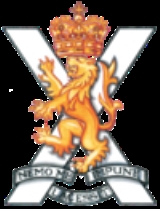
 that they wore and from its role to "watch" the Highlands. "Black Watch" was originally a nickname for the 42nd (Royal Highland) Regiment of Foot, but was used more and more so that, in 1881, when the 42nd amalgamated with the 73rd Regiment of Foot, the new regiment was named "The Black Watch (Royal Highlanders)". The uniform changed over time, but the nickname has been more enduring. The regiment adopted the royal motto of Scotland's Stewart monarchs, Nemo me impune lacessit
Nemo me impune lacessit
Nemo me impune lacessit is the Latin motto of the Order of the Thistle and of three Scottish regiments of the British Army. The motto also appears, in conjunction with the collar of the Order of the Thistle, in later versions of the Royal coat of arms of the Kingdom of Scotland and subsequently in...

(no-one provokes me with impunity).

The Royal Stewart Tartan
Royal Stewart Tartan
The Royal Stewart Tartan is the best known tartan of the royal House of Stewart, and is also the personal tartan of Queen Elizabeth II. It is appropriate for all subjects of Elizabeth II to wear the Royal Stewart tartan , in much the same way that clansmen may wear the tartan of their clan chief...

 is worn by the battalion's Pipes and Drums to reflect the status of Royal regiment. Six independent companies were first formed from 1725 to stop fighting among the clans.

History


The Black Watch was formed as part of the Childers Reforms
Childers Reforms
The Childers Reforms restructured the infantry regiments of the British army. The reforms were undertaken by Secretary of State for War Hugh Childers in 1881, and were a continuation of the earlier Cardwell reforms....

 in 1881 when the 42nd (Royal Highland) Regiment of Foot (The Black Watch)
42nd Regiment of Foot
The 42nd Regiment of Foot was an infantry regiment of the British Army. Originally the 43rd Highlanders they were renumbered the 42nd in 1748.- Early history :...

 was amalgamated with the 73rd (Perthshire) Regiment of Foot to form two battalions of the newly named The Black Watch (Royal Highlanders).

The 1st Battalion then served in Africa taking part in the Highland Brigade's dawn assault on the Egyptian position at Tel-el-Kebir in 1882. Two years later it was in the thick of the fight with the Mahdi's tribesmen at El Teb
Battles of El Teb
The Battles of El Teb took place during the British Sudan Campaign where a force of Sudanese under Osman Digna won a victory over an 3500 strong Egyptian force under the command of General Valentine Baker which was marching to relieve Tokar on the 4th...

 and Tamai. The following year 1885, saw it taking part in the Nile Expedition
Nile Expedition
The Nile Expedition, sometimes called the Gordon Relief Expedition , was a British mission to relieve Major-General Charles George Gordon at Khartoum, Sudan. Gordon had been sent to the Sudan to help Egyptians evacuate from Sudan after Britain decided to abandon the country in the face of a...

 and fighting at Kirbekan and Abu Klea.

20th century


During World War I
World War I
World War I , which was predominantly called the World War or the Great War from its occurrence until 1939, and the First World War or World War I thereafter, was a major war centred in Europe that began on 28 July 1914 and lasted until 11 November 1918...

, the 25 battalions of the Black Watch fought mainly in France
France
The French Republic , The French Republic , The French Republic , (commonly known as France , is a unitary semi-presidential republic in Western Europe with several overseas territories and islands located on other continents and in the Indian, Pacific, and Atlantic oceans. Metropolitan France...

 and Flanders
Flanders
Flanders is the community of the Flemings but also one of the institutions in Belgium, and a geographical region located in parts of present-day Belgium, France and the Netherlands. "Flanders" can also refer to the northern part of Belgium that contains Brussels, Bruges, Ghent and Antwerp...

, except for the 2nd Battalion
2nd Battalion, Black Watch
The 2nd Battalion, Black Watch was formed in 1881 when the 42nd Regiment of Foot and the 73rd Regiment of Foot were amalgamated to form the Black Watch ....

 which fought in Mesopotamia
Mesopotamian Campaign
The Mesopotamian campaign was a campaign in the Middle Eastern theatre of World War I fought between the Allies represented by the British Empire, mostly troops from the Indian Empire, and the Central Powers, mostly of the Ottoman Empire.- Background :...

 and Palestine, and the 10th Battalion, which was in the Balkans
Balkans
The Balkans is a geopolitical and cultural region of southeastern Europe...

. Only the 1st and 2nd battalions were regulars. The rest were either part of the Territorial Force
Territorial Force
The Territorial Force was the volunteer reserve component of the British Army from 1908 to 1920, when it became the Territorial Army.-Origins:...

 or the New Army
Kitchener's Army
The New Army, often referred to as Kitchener's Army or, disparagingly, Kitchener's Mob, was an all-volunteer army formed in the United Kingdom following the outbreak of hostilities in the First World War...

. The Black Watch served with the British 51st (Highland) Division (World War I)
British 51st (Highland) Division (World War I)
The 51st Division was a British Territorial Force division that fought on the Western Front in France during the First World War. The division's insignia was a stylised 'HD' inside a red circle. Early doubts about the division's performance earned it the nickname of "Harper's Duds" after the...

.

Battalions of the Black Watch fought in nearly every major British action in World War II
World War II
World War II, or the Second World War , was a global conflict lasting from 1939 to 1945, involving most of the world's nations—including all of the great powers—eventually forming two opposing military alliances: the Allies and the Axis...

, from Palestine to Normandy
Normandy
Normandy is a geographical region corresponding to the former Duchy of Normandy. It is in France.The continental territory covers 30,627 km² and forms the preponderant part of Normandy and roughly 5% of the territory of France. It is divided for administrative purposes into two régions:...

, and as Chindits
Chindits
The Chindits were a British India "Special Force" that served in Burma and India in 1943 and 1944 during the Burma Campaign in World War II. They were formed into long range penetration groups trained to operate deep behind Japanese lines...

 (42 and 73 columns) in Burma. In 1940, the 1st Battalion, together with two Territorial Army battalions, were captured at St Valery-en-Caux with the 51st (Highland) Division
British 51st (Highland) Infantry Division (World War II)
For the First World War unit, see 51st Division .The 51st Infantry Division was a British Territorial Army division that fought during the Second World War...

. They were later reformed from reserve units of the 9th (Highland) Infantry Division, and fought at the Battle of El Alamein
Second Battle of El Alamein
The Second Battle of El Alamein marked a major turning point in the Western Desert Campaign of the Second World War. The battle took place over 20 days from 23 October – 11 November 1942. The First Battle of El Alamein had stalled the Axis advance. Thereafter, Lieutenant-General Bernard Montgomery...

 and the Allied invasion of Sicily
Allied invasion of Sicily
The Allied invasion of Sicily, codenamed Operation Husky, was a major World War II campaign, in which the Allies took Sicily from the Axis . It was a large scale amphibious and airborne operation, followed by six weeks of land combat. It launched the Italian Campaign.Husky began on the night of...

. After the war, in 1948, the two regular battalions were merged into one.

The regiment won honours after the Battle of the Hook
Battle of the Hook
The third Battle of the Hook was a battle of the Korean War that took place between a United Nations force, consisting mostly of British troops, supported on their flanks by American and Turkish artillery units against a predominantly Chinese force...

 during the Korean War
Korean War
The Korean War was a conventional war between South Korea, supported by the United Nations, and North Korea, supported by the People's Republic of China , with military material aid from the Soviet Union...

 in November 1952. They were subsequently involved in peacekeeping and counter-insurgency in various parts of the world, such as the Mau Mau Uprising
Mau Mau Uprising
The Mau Mau Uprising was a military conflict that took place in Kenya between 1952 and 1960...

 in Kenya
Kenya
Kenya , officially known as the Republic of Kenya, is a country in East Africa that lies on the equator, with the Indian Ocean to its south-east...

 and Malayan Emergency
Malayan Emergency
The Malayan Emergency was a guerrilla war fought between Commonwealth armed forces and the Malayan National Liberation Army , the military arm of the Malayan Communist Party, from 1948 to 1960....

. Such actions were similar to those for which the regiment was raised 250 years earlier. In 1967, the regiment lost its Territorial battalions, which were amalgamated into the 51st Highland Volunteers
51st Highland Volunteers
The 51st Highland Volunteers was a regiment and is now a battalion in the British Army's Territorial Army or reserve force in the Scottish Highlands, forming the 7th Battalion of the Royal Regiment of Scotland, also known as 7 SCOTS...

. The Black Watch was the last British military unit to leave Hong Kong
Hong Kong
Hong Kong is one of two Special Administrative Regions of the People's Republic of China , the other being Macau. A city-state situated on China's south coast and enclosed by the Pearl River Delta and South China Sea, it is renowned for its expansive skyline and deep natural harbour...

 in 1997, and it played a prominent role in the handover ceremony.

The Black Watch Regiment served in Northern Ireland
Northern Ireland
Northern Ireland is one of the four countries of the United Kingdom. Situated in the north-east of the island of Ireland, it shares a border with the Republic of Ireland to the south and west...

 during the Troubles
The Troubles
The Troubles was a period of ethno-political conflict in Northern Ireland which spilled over at various times into England, the Republic of Ireland, and mainland Europe. The duration of the Troubles is conventionally dated from the late 1960s and considered by many to have ended with the Belfast...

 as part of Operation Banner
Operation Banner
Operation Banner was the operational name for the British Armed Forces' operation in Northern Ireland from August 1969 to July 2007. It was initially deployed at the request of the Unionist government of Northern Ireland to support the Royal Ulster Constabulary . After the 1998 Belfast Agreement,...

. The Black Watch was frequently a major target of the Provisional Irish Republican Army
Provisional Irish Republican Army
The Provisional Irish Republican Army is an Irish republican paramilitary organisation whose aim was to remove Northern Ireland from the United Kingdom and bring about a socialist republic within a united Ireland by force of arms and political persuasion...

 (PIRA) and the Irish National Liberation Army
Irish National Liberation Army
The Irish National Liberation Army or INLA is an Irish republican socialist paramilitary group that was formed on 8 December 1974. Its goal is to remove Northern Ireland from the United Kingdom and create a socialist united Ireland....

 (INLA).

21st century


During the 2003 Iraq War, the Black Watch fought during Operation Telic
Operation Telic
Operation TELIC was the codename under which all British military operations in Iraq were conducted between the start of the Invasion of Iraq on 19 March 2003 and the withdrawal of the last remaining British forces on 22 May 2011...

 in the initial attack on Basra
Basra
Basra is the capital of Basra Governorate, in southern Iraq near Kuwait and Iran. It had an estimated population of two million as of 2009...

, and during its deployment the unit suffered a single fatality. The following year, the Black Watch was dispatched to Iraq
Iraq
Iraq ; officially the Republic of Iraq is a country in Western Asia spanning most of the northwestern end of the Zagros mountain range, the eastern part of the Syrian Desert and the northern part of the Arabian Desert....

 again, as part of 4 (Armoured) Brigade
British 4th Armoured Brigade
The 4th Mechanized Brigade is a British Army brigade.The 4th Armoured Brigade was formed during the Second World War, as an armoured brigade of the 7th Armoured Division....

. On 12 August a soldier from the regiment was killed as a result of an improvised explosive device
Improvised explosive device
An improvised explosive device , also known as a roadside bomb, is a homemade bomb constructed and deployed in ways other than in conventional military action...

 (IED). In October, the Black Watch was at the centre of political controversy after the United States Army
United States Army
The United States Army is the main branch of the United States Armed Forces responsible for land-based military operations. It is the largest and oldest established branch of the U.S. military, and is one of seven U.S. uniformed services...

 requested British forces to be moved further north outside of the British-controlled Multi-National Division (South East), in order to replace forces temporarily redeployed for the Second Battle of Fallujah. Despite objections in Parliament
British House of Commons
The House of Commons is the lower house of the Parliament of the United Kingdom, which also comprises the Sovereign and the House of Lords . Both Commons and Lords meet in the Palace of Westminster. The Commons is a democratically elected body, consisting of 650 members , who are known as Members...

, the deployment went ahead. Based at Camp Dogwood
Camp Dogwood
Camp Dogwood is the name of the base camp for the British Black Watch regiment in Iraq, 2004, located south of Baghdad.Camp Dogwood is also the name for a US FOB, further to the north of the original Camp Dogwood, from late 2004 to 2005, located between Fallujah and Karbala. It is also known as FOB...

, located between Fallujah
Fallujah
Fallujah is a city in the Iraqi province of Al Anbar, located roughly west of Baghdad on the Euphrates. Fallujah dates from Babylonian times and was host to important Jewish academies for many centuries....

 and Karbala
Karbala
Karbala is a city in Iraq, located about southwest of Baghdad. Karbala is the capital of Karbala Governorate, and has an estimated population of 572,300 people ....

, in an area later dubbed the "Triangle of Death", the Black Watch came under sustained insurgent
Iraqi insurgency
The Iraqi Resistance is composed of a diverse mix of militias, foreign fighters, all-Iraqi units or mixtures opposing the United States-led multinational force in Iraq and the post-2003 Iraqi government...

 attack from mortars
Mortar (weapon)
A mortar is an indirect fire weapon that fires explosive projectiles known as bombs at low velocities, short ranges, and high-arcing ballistic trajectories. It is typically muzzle-loading and has a barrel length less than 15 times its caliber....

 and rockets. On 29 October, during the journey to their new base, a Black Watch soldier was killed in a road accident. On 4 November three soldiers and an interpreter were killed by a car bomb at a check point
Civilian checkpoint
Civilian checkpoints or Security checkpoints are distinguishable from border or frontier checkpoints in that they are erected and enforced within contiguous areas under military or paramilitary control...

 and on 8 November another soldier was killed. The high profile nature of the deployment caused a magnification of these events back home in Britain.

Under a plan devised by Alistair Irwin
Alistair Irwin
General Sir Alistair Stuart Hastings Irwin KCB CBE is a former Adjutant-General to the Forces in the United Kingdom and Commandant of Sandhurst.-Army career:...

 and approved by General Sir Mike Jackson
Mike Jackson
General Sir Michael David "Mike" Jackson, is a retired British Army officer and one of its most high-profile generals since the Second World War. Originally commissioned into the Intelligence Corps in 1963, he transferred to the Parachute Regiment, with whom he served two of his three tours of...

, on 16 December 2004 it was announced that the Black Watch was to join with five other Scottish regiments - the Royal Scots, the King's Own Scottish Borderers
King's Own Scottish Borderers
The King's Own Scottish Borderers was an infantry regiment of the British Army, part of the Scottish Division.-History:It was raised on 18 March 1689 by the Earl of Leven to defend Edinburgh against the Jacobite forces of James II. It is said that 800 men were recruited within the space of two hours...

, the Royal Highland Fusiliers
Royal Highland Fusiliers
The Royal Highland Fusiliers, 2nd Battalion, The Royal Regiment of Scotland is an infantry battalion of the Royal Regiment of Scotland....

, The Highlanders
The Highlanders (Seaforth, Gordons and Camerons)
The Highlanders, 4th Battalion, Royal Regiment of Scotland is an infantry battalion of the Royal Regiment of Scotland.Prior to 28 March 2006, the Highlanders was an infantry regiment in its own right; The Highlanders , part of the Scottish Division...

 and the Argyll and Sutherland Highlanders
Argyll and Sutherland Highlanders
The Argyll and Sutherland Highlanders, 5th Battalion The Royal Regiment of Scotland is an infantry battalion of the Royal Regiment of Scotland....

 - to form the Royal Regiment of Scotland, a single regiment consisting of 5 regular and 2 territorial battalions. The measure, which reflected recruiting difficulties and the inefficiencies inherent in maintaining a number of relatively small separate units, took place on 28 March 2006.

These plans encountered considerable opposition from a well co-ordinated campaign backed by politicians, retired soldiers and the Scottish public. It was claimed by proponents of the plan that the establishment of a large regiment would improve conditions of service for serving personnel. As with the other former Scottish regiments, the Black Watch will retain its former name as its primary identifier, with its battalion number as a subtitle. Therefore, the regiment is now known as The Black Watch, 3rd Battalion, The Royal Regiment of Scotland; in addition, the battalion is also permitted to retain its most famous distinction, the red hackle
Hackle
The hackle is a clipped feather plume that is attached to a military headdress.In the British Army and the armies of some Commonwealth countries the hackle is worn by some infantry regiments, especially those designated as fusilier regiments and those with Scottish and Northern Irish origins. The...

 on the Tam o'Shanter
Tam o'shanter (hat)
A Tam o' Shanter is a Scottish style hat originally worn by men. The hat is named after a character in a poem written by Robert Burns in 1790...

. The Black Watch's primary recruiting areas are in Fife
Fife
Fife is a council area and former county of Scotland. It is situated between the Firth of Tay and the Firth of Forth, with inland boundaries to Perth and Kinross and Clackmannanshire...

, Dundee
Dundee
Dundee is the fourth-largest city in Scotland and the 39th most populous settlement in the United Kingdom. It lies within the eastern central Lowlands on the north bank of the Firth of Tay, which feeds into the North Sea...

, Angus
Angus
Angus is one of the 32 local government council areas of Scotland, a registration county and a lieutenancy area. The council area borders Aberdeenshire, Perth and Kinross and Dundee City...

 and Perth and Kinross
Perth and Kinross
Perth and Kinross is one of 32 council areas in Scotland, and a Lieutenancy Area. It borders onto the Aberdeenshire, Angus, Dundee City, Fife, Clackmannanshire, Stirling, Argyll and Bute and Highland council areas. Perth is the administrative centre...

, with the Battalion Headquarters located at Balhousie Castle
Balhousie Castle
Balhousie Castle, located in Perth, Scotland , dates to 1631, though its origins are believed to go back a further three hundred years. It originally served as the seat of the Earls of Kinnoull, and stood within a walled enclosure containing subsidiary buildings, orchards etc...

.The Battalion is currently on Operational Commitments on Op Herrick Afghanistan the Bn are the reserve bn of 19 light brigade and based at Khandhar.

On 24 June 2009 it was reported that elements of the battalion numbering about 350 troops carried out one of the largest air assault
Air assault
Air assault is the movement of ground-based military forces by vertical take-off and landing aircraft—such as the helicopter—to seize and hold key terrain which has not been fully secured, and to directly engage enemy forces...

 operations of the NATO troops in Afghanistan, named Operation Panchai Palang (Panther's Claw), by deploying into, and attacking a Taliban stronghold located near Bābājī (باباجی ), north of Lashkar Gah. The operation commenced on 19 June just before midnight. After a number of combat engagements with the insurgents, the soldiers of the battalion secured three main crossing points: the Lui Mandey Wadi crossing, the Nahr-e-Burgha canal and the Shamalan canal. Lieutenant Colonel Stephen Cartwright, Commanding Officer of The Black Watch battalion was reported saying that this operation established a firm foothold in what was the last remaining Taliban area controlled in the southern Helmand province
Helmand Province
Helmand is one of the 34 provinces of Afghanistan. It is in the southwest of the country. Its capital is Lashkar Gah. The Helmand River flows through the mainly desert region, providing water for irrigation....

. The location of the Taliban force in the area allowed to conduct attacks on the A01 highway, a major national route connecting Kandahar
Kandahar
Kandahar is the second largest city in Afghanistan, with a population of about 512,200 as of 2011. It is the capital of Kandahar Province, located in the south of the country at about 1,005 m above sea level...

 and Herat
Herat
Herāt is the capital of Herat province in Afghanistan. It is the third largest city of Afghanistan, with a population of about 397,456 as of 2006. It is situated in the valley of the Hari River, which flows from the mountains of central Afghanistan to the Karakum Desert in Turkmenistan...

. During 22 June, troops of the battalion also "found 1.3 tonnes of poppy seed and a number of improvised explosive devices and anti-personnel mines before they could be laid". Analysis by the United Nations
United Nations
The United Nations is an international organization whose stated aims are facilitating cooperation in international law, international security, economic development, social progress, human rights, and achievement of world peace...

 Food and Agriculture Organisation revealed the haul to be of mung bean
Mung bean
The mung bean is the seed of Vigna radiata. It is native to the Indian subcontinent.-Description:They are small, ovoid in shape, and green in color...

s, not poppy seed.

Australia/New Zealand


While Australia has had various units of its military with affiliations to the Black Watch, no regiment in Australia or New Zealand has formally borne that title, although one company Alpha Company, of the 2/17 Battalion, the Royal NSW Regiment does wear the kilt, bonnet and hackle.

Canada


Canada
Canada
Canada is a North American country consisting of ten provinces and three territories. Located in the northern part of the continent, it extends from the Atlantic Ocean in the east to the Pacific Ocean in the west, and northward into the Arctic Ocean...

 (from 1862) has its own Black Watch, being raised as the 5th Battalion of the Canadian Militia, being renamed by 1914 as the 5th Regiment (Royal Highlanders of Canada). It adopted its current title, The Black Watch (Royal Highland Regiment) of Canada
The Black Watch (Royal Highland Regiment) of Canada
The Black Watch of Canada is a reserve infantry regiment in 34 Brigade Group, Land Force Quebec Area. The regiment is located on rue de Bleury in Montreal, Quebec, Canada, and is currently commanded by Lieutenant Colonel Bruno Plourde...

, prior to the Second World War, in which it served in the 2nd Canadian Infantry Division
2nd Canadian Infantry Division
The 2nd Canadian Infantry Division was an infantry division of the First Canadian Army, mobilized on 1 September 1939 at the outset of the Second World War. It was initially composed of volunteers within brigades established along regional lines, though a halt in recruitment in the early months of...

 from mobilisation in 1939 to 1945. As part of the 5th Canadian Brigade, the Regiment's 1st Battalion landed in Normandy
Normandy
Normandy is a geographical region corresponding to the former Duchy of Normandy. It is in France.The continental territory covers 30,627 km² and forms the preponderant part of Normandy and roughly 5% of the territory of France. It is divided for administrative purposes into two régions:...

 in July 1944 and participated in major combat actions afterwards including the fight for the Channel Ports
Operation Cobra
Operation Cobra was the codename for an offensive launched by the First United States Army seven weeks after the D-Day landings, during the Normandy Campaign of World War II...

, the Battle of the Scheldt
Battle of the Scheldt
The Battle of the Scheldt was a series of military operations of the Canadian 1st Army, led by Lieutenant-General Guy Simonds. The battle took place in northern Belgium and southwestern Netherlands during World War II from 2 October-8 November 1944...

, Operation Market Garden
Operation Market Garden
Operation Market Garden was an unsuccessful Allied military operation, fought in the Netherlands and Germany in the Second World War. It was the largest airborne operation up to that time....

, the Rhineland
Rhineland
Historically, the Rhinelands refers to a loosely-defined region embracing the land on either bank of the River Rhine in central Europe....

, and the final battles of the war east of the Rhine River. Three battalions of the Black Watch (RHR) of Canada also served in Canada, two in the Regular Army, the other as a Reserve unit. Between 1953 and 1970, the Regiment had two battalions on the order of battle of the Regular Force, with a battalion in the Militia. The Regiment reverted to a one-battalion Militia unit in 1970 and remains in that status today.

Australia


Before the Second World War the Australian Militia and after the Second World War the Militia, then renamed the Citizen Military Forces (CMF), had a regiment, the 30th Battalion, New South Wales Scottish Regiment, which was affiliated with the Black Watch, wearing the kilt, beret with red hackle and badge of the parent Regiment in Scotland. A Scottish Black Watch officer was seconded from the British Army to serve as a permanent cadre with the NSW Battalion. The Regiment was popular and was probably the only CMF unit at full strength with a waiting list for entry. With the reorganisation of the CMF following the introduction of compulsory National Service in the early 1950s, conscripted recruits were made to join existing CMF units alongside the volunteer part-time soldiers of the old CMF; consequently, 30th Battalion became fully manned with National Servicemen and it was disbanded as the CMF of this period lost all its volunteers who did not wish to serve alongside conscripts. Compulsory National Service was made more selective in 1957 with greater stress on skills rather than numbers with the system completely ending in 1959; however, it had effectively caused the demise of the old CMF due to the shifts in manpower that the scheme had caused and the changed administrative conditions under which the old CMF (and some other branches of the Armed Forces) had previously operated.

Notable members

  • Robert Munro (1684 - 1746)
    Robert Munro (1684 - 1746)
    Sir Robert Munro of Foulis, 6th Baronet was a soldier-politician whose life followed an 18th century pattern...

    , The original Black Watch commander, Colonel Sir Robert Munro.
  • Bernard Fergusson, Baron Ballantrae
    Bernard Fergusson, Baron Ballantrae
    Bernard Edward Fergusson, Baron Ballantrae, KT, GCMG, GCVO, DSO, OBE was a brigadier in the British Army, military historian and the last British-born Governor-General of New Zealand.- Military service :...

  • Alfred Anderson
    Alfred Anderson
    Alfred Anderson was a Scottish joiner and veteran of the First World War. He was the last known holder of the 1914 Star , the last known combatant to participate in the 1914 World War I Christmas truce, Scotland's last known World War I veteran, and Scotland's oldest man for more than a year.In...

    , Scotland's last surviving World War I
    World War I
    World War I , which was predominantly called the World War or the Great War from its occurrence until 1939, and the First World War or World War I thereafter, was a major war centred in Europe that began on 28 July 1914 and lasted until 11 November 1918...

     veteran (d. 2005)
  • James Anton, late Quartermaster-Sergeant of 42nd Royal Highlander, author
  • Jim Baxter
    Jim Baxter
    James Curran Baxter was a left-footed Scottish footballer who played as a midfielder. He is regarded by some as the country's greatest ever footballer...

    , Scottish footballer
  • Fergus Bowes-Lyon
    Fergus Bowes-Lyon
    Captain Fergus Bowes-Lyon was an older brother of Queen Elizabeth The Queen Mother.He was born at Glamis Castle in Angus and educated at Eton College, Berkshire. Just a fortnight after the start of World War I, he married Lady Christian Norah Dawson-Damer , daughter of the 5th Earl of...

  • Duncan Campbell
  • Walter Cook
    Walter Cook
    Walter Cook VC was an English recipient of the Victoria Cross, the highest and most prestigious award for gallantry in the face of the enemy that can be awarded to British and Commonwealth forces....

  • Henry Davie
  • Thomas Edwards
  • Lewis Pugh Evans
    Lewis Pugh Evans
    Brigadier General Lewis Pugh Evans VC, CB, CMG, DSO & Bar, DL was a Welsh recipient of the Victoria Cross, the highest and most prestigious award for gallantry in the face of the enemy that can be awarded to British and Commonwealth forces.-Early years:Lewis Pugh Evans was born at Abermadd to Sir...

  • Adam Ferguson
    Adam Ferguson
    Adam Ferguson FRSE, also known as Ferguson of Raith was a Scottish philosopher, social scientist and historian of the Scottish Enlightenment...

  • David Finlay
    David Finlay
    David Finlay VC was a Scottish recipient of the Victoria Cross, the highest and most prestigious award for gallantry in the face of the enemy that can be awarded to British and Commonwealth forces.-Details:...

  • Ian Fleming
    Ian Fleming
    Ian Lancaster Fleming was a British author, journalist and Naval Intelligence Officer.Fleming is best known for creating the fictional British spy James Bond and for a series of twelve novels and nine short stories about the character, one of the biggest-selling series of fictional books of...

  • J. B. S. Haldane
    J. B. S. Haldane
    John Burdon Sanderson Haldane FRS , known as Jack , was a British-born geneticist and evolutionary biologist. A staunch Marxist, he was critical of Britain's role in the Suez Crisis, and chose to leave Oxford and moved to India and became an Indian citizen...

  • John Mackenzie
  • Gillean Robert Maclaine
    Gillean Maclaine
    Gillean Robert Maclaine of Lochbuie was the 25th hereditary Chief of Clan Maclaine of Lochbuie and Feudal Baron of Moy.Son of Kenneth Douglas Lorne MacLaine, 24th of Lochbuie, and Olive Marguerite Stewart- Richardson...

  • Charles Melvin
    Charles Melvin
    Charles Melvin VC was a Scottish recipient of the Victoria Cross, the highest and most prestigious award for gallantry in the face of the enemy that can be awarded to British and Commonwealth forces.-The Medal:...

  • Eric Newby
    Eric Newby
    George Eric Newby CBE MC was an English travel author. Newby's best known works include A Short Walk in the Hindu Kush, The Last Grain Race, and Round Ireland in Low Gear.-Life:...

  • Simon Ramsay
    Simon Ramsay, 16th Earl of Dalhousie
    Simon Ramsay, 16th Earl of Dalhousie, KT, GCVO, GBE, MC, DL was a British land-owner, statesman and politician....

  • John Ripley
    John Ripley
    John Ripley VC was a Scottish recipient of the Victoria Cross, the highest and most prestigious award for gallantry in the face of the enemy that can be awarded to British and Commonwealth forces.-Details:...

  • Neil Ritchie
    Neil Ritchie
    General Sir Neil Methuen Ritchie GBE, KCB, DSO, MC, KStJ was a senior British army officer during the Second World War.-Military career:...

  • William Rose
    William Rose (screenwriter)
    William Rose was an American screenwriter of British and Hollywood films.Although born in Jefferson City, Missouri, after the 1939 outbreak of World War II, Rose lived in Canada and volunteered to fight overseas with the Black Watch...

  • William Speakman
  • Frederick Guthrie Tait
    Frederick Guthrie Tait
    Frederick Guthrie Tait was a Scottish soldier and amateur golfer.Born in Edinburgh, the third son of eminent physicist and fanatical amateur golfer Peter Guthrie Tait, Frederick was educated at the Edinburgh Academy and Sedbergh School. He entered the Royal Military Academy Sandhurst at the second...

  • Arthur Wauchope
    Arthur Grenfell Wauchope
    General Sir Arthur Grenfell Wauchope GCB GCMG CIE DSO was a British soldier and colonial administrator.-Military career:Educated at Repton School, Wauchope was commissioned into the Argyll and Sutherland Highlanders in 1893. He transferred to 2 Bn Black Watch in 1896.He served in World War I as...

  • Archibald Wavell
  • Rory Stewart
    Rory Stewart
    Roderick 'Rory' James Nugent Stewart OBE FRSL MP DUniv is a British academic, author, and Conservative politician. Since May 2010, he has been the Member of Parliament for Penrith and the Border, in the county of Cumbria, North West England.- Overview :Stewart was a senior coalition official in a...

  • Harold Davis
    Harold Davis (footballer)
    Harold Davis is a Scottish former professional football player who is best known for his time with Rangers.-East Fife:Davis began his senior career at Scot Symon's East Fife and quickly gained praise as a tough tackling, no-nonsense defender but he was drafted for national service in 1951 and...

  • Stewart Granger
    Stewart Granger
    Stewart Granger was an English-American film actor, mainly associated with heroic and romantic leading roles. He was a popular leading man from the 1940s to the early 1960s rising to fame through his appearances in the Gainsborough melodramas.-Early life:He was born James Lablache Stewart in Old...

    , Actor
  • Bernard Fergusson, Baron Ballantrae
    Bernard Fergusson, Baron Ballantrae
    Bernard Edward Fergusson, Baron Ballantrae, KT, GCMG, GCVO, DSO, OBE was a brigadier in the British Army, military historian and the last British-born Governor-General of New Zealand.- Military service :...


Battle honours

  • [combined battle honours of 42nd Regiment and 73rd Regiment, plus:]
    • Guadaloupe 17591, Martinique 17621, Havannah1, North America 1763-64, Mysore5, Busaco³, Salamanca4, South Africa 1846-76, 1851-2-36 Tel-el-Kebir, Egypt 1882 '84, Kirbekan, Nile 1884-5, Paardeberg, South Africa 1899-1902
    • The Great War [25 battalions]: Retreat from Mons, Marne 1914 '18, Aisne 1914, La Bassée 1914, Ypres 1914 '17 '18, Langemarck 1914, Gheluvelt, Nonne Bosschen, Givenchy 1914, Neuve Chapelle, Aubers, Festubert 1915, Loos, Somme 1916 '18, Albert 1916, Bazentin, Delville Wood
      Delville Wood
      The Battle of Delville Wood was one of the early engagements in the 1916 Battle of the Somme in the First World War. It took place between 14 July and 3 September, between the armies of the German Empire and allied British and South African forces...

      , Pozières, Flers-Courcelette, Morval, Thiepval, Le Transloy, Ancre Heights, Ancre 1916, Arras 1917 '18, Vimy 1917, Scarpe 1917 '18, Arleux, Pilckem, Menin Road, Polygon Wood, Poelcappelle, Passchendaele, Cambrai 1917 '18, St Quentin, Bapaume 1918, Rosières, Lys, Estaires, Messines 1918, Hazebrouck, Kemmel, Béthune, Scherpenberg, Soissonnais-Ourcq, Tardenois, Drocourt-Quéant, Hindenburg Line
      Hindenburg Line
      The Hindenburg Line was a vast system of defences in northeastern France during World War I. It was constructed by the Germans during the winter of 1916–17. The line stretched from Lens to beyond Verdun...

      , Épéhy, St Quentin Canal, Beaurevoir, Courtrai, Selle, Sambre, France and Flanders 1914-18, Doiran 1917, Macedonia 1915-18, Egypt 1916, Gaza, Jerusalem, Tell'Asur, Megiddo, Sharon, Damascus, Palestine 1917-18, Tigris 1916, Kut al Amara 1917, Baghdad, Mesopotamia 1915-17
    • The Second World War: Defence of Arras, Ypres-Comines Canal, Dunkirk 1940, Somme 1940, St. Valery-en-Caux, Saar, Breville
      Battle of Bréville
      The Battle of Bréville was fought by the British 6th Airborne Division and the German 346th Infantry Division, between the 8 and 13 June 1944, during the invasion of Normandy in the Second World War....

      , Odon, Fontenay le Pesnil, Defence of Rauray, Caen, Falaise, Falaise Road, La Vie Crossing, Le Havre, Lower Maas, Venlo Pocket, Ourthe, Rhineland, Reichswald, Goch, Rhine, North-West Europe 1940 '44-45, Barkasan, British Somaliland 1940, Tobruk 1941, Tobruk Sortie, El Alamein, Advance on Tripoli, Medenine, Zemlet el Lebene, Mareth, Akarit, Wadi Akarit East, Djebel Roumana, Medjez Plain, Si Mediene, Tunis, North Africa 1941-43, Landing in Sicily, Vizzini, Sferro, Gerbini, Adrano, Sferro Hills, Sicily 1943, Cassino II, Liri Valley, Advance to Florence, Monte Scalari, Casa Fortis, Rimini Line, Casa Fabbri Ridge, Savio Bridgehead, Italy 1944-45, Athens, Greece 1944-45, Crete, Heraklion, Middle East 1941, Chindits 1944, Burma 1944
    • The Hook 1952, Korea 1952-53; Al Basrah, Iraq 2003


1. awarded 1909 for services of 42nd Regiment.

2. awarded 1914 for services of 42nd Regiment.

3. awarded 1910 for service of 42nd Regiment.

4. awarded 1951 for service of 42nd Regiment.

5. awarded 1889 for service of 73rd Regiment.

6. awarded 1882 for service of 73rd Regiment.

Alliances


- The Royal Queensland Regiment
Royal Queensland Regiment
The Royal Queensland Regiment is a reserve light infantry formation in the Australian Army based in Queensland.-Current Structure:The regiment currently consists of three battalions:*9th Battalion *25th/49th Battalion...

 - The Royal New South Wales Regiment
Royal New South Wales Regiment
The Royal New South Wales Regiment is a reserve infantry regiment of the Australian Army based in the state of New South Wales. The regiment consists of four battalions:-Organisation:*1st/19th Battalion*2nd/17th Battalion*4th/3rd Battalion...

 - The Black Watch (Royal Highland Regiment) of Canada
The Black Watch (Royal Highland Regiment) of Canada
The Black Watch of Canada is a reserve infantry regiment in 34 Brigade Group, Land Force Quebec Area. The regiment is located on rue de Bleury in Montreal, Quebec, Canada, and is currently commanded by Lieutenant Colonel Bruno Plourde...

 - 1st Air Defence Regiment (Lanark and Renfrew Scottish), Royal Canadian Artillery - The Prince Edward Island Regiment (RCAC)
The Prince Edward Island Regiment (RCAC)
The Prince Edward Island Regiment is a Primary Reserve armoured reconnaissance regiment of the Canadian Forces, Land Force Atlantic Area, 36 Canadian Brigade Group. The regiment is based in Charlottetown and Summerside.-Perpetuations:...

 - The New Zealand Scottish - Transvaal Scottish Regiment - HMS Montrose
HMS Montrose (F236)
The second and current HMS Montrose is the eighth of a sixteen ship class of frigates, known as Type 23 or the 'Duke' class, of the Royal Navy. She was laid down in November 1989 by Yarrow Shipbuilders on the Clyde...


Anecdotes


When wearing the kilt, it is customary for troops to "go regimental" or "military practice", wearing no underwear. In 1997, a Black Watch soldier received wide press exposure, because of windy conditions during a military ceremony in Hong Kong
Hong Kong
Hong Kong is one of two Special Administrative Regions of the People's Republic of China , the other being Macau. A city-state situated on China's south coast and enclosed by the Pearl River Delta and South China Sea, it is renowned for its expansive skyline and deep natural harbour...

.

Further reading

  • James Anton. Royal Highlander (2007) (original Titel -1841- Retrospect of a military life), Leonaur.com. ISBN 9781846772238

External links