

Northern England

Encyclopedia
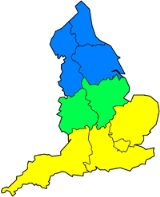
Northern England, also known as the North of England, the North or the North Country, is a cultural region
of England
. It is not an official government region
, but rather an informal amalgamation of counties
. The southern extent of the region is roughly the River Trent
, while the North is bordered by Scotland
. The counties of Northern England combined have a population of around 14.5 million covering an area of 37,331 km2 (14,414 sq mi).
During antiquity most of the area was part of Brigantia — homeland of the Brigantes
and the largest Brythonic
kingdom of Great Britain
. After the Roman conquest of Britain
the city of York
became capital of the area, called Britannia Inferior
then Britannia Secunda
. In Sub-Roman Britain
new Brythonic kingdoms of the Hen Ogledd
emerged. The Angle
settlers created Bernicia
and Deira
from which came Northumbria and a Golden Age
in cultural, scholarly and monastic activity, centred around Lindisfarne
and aided by Irish monks. Norse
and Gaelic Viking
raiders gained control of much of the area, creating the Danelaw
. During this time there were close relations with Mann and the Isles, Dublin and Norway
. Northumbria was unified with the rest of England under Eadred around 952.
After the Norman conquest
in 1066, desolation was brought with the Harrying of the North
, though much construction and town founding was done shortly after. A Council of the North
was in place during the Late Middle Ages
until the Commonwealth
after the Civil War
. The area experienced Anglo–Scottish border
fighting until the unification of Britain
under the Stuarts
.
. Experts on historical dialects categorise as Northern the area north of a line that begins at the Humber estuary, and runs up the river Wharfe and across to the River Lune in north Lancashire. However, the linguistic elements that traditionally defined this area, such as use of doon instead of down and substitution of an -ang noise in words that end -ong (e.g. lang instead of long), are now only prevalent in the more northern parts of the region; these linguistic features may reflect a more modern interpretation of where the line sits today. As speech has changed, there is little consensus on what defines a "Northern" accent or dialect. Many people in Northern England omit certain words from sentences in casual speech, such as saying "I'm goin t'shops" or "I'm going the shops" as opposed to "I'm going to the shops". This is particularly common in Yorkshire and Lancashire.
, an upland chain often referred to as "the backbone of England". This stretches from the Cheviot Hills
on the border with Scotland to the Peak District. The areas defined were formerly dominated by heavy industry and mineral extraction and processing. Combined with the characteristically wild, hilly landscape of the region, this has led to the popular conception, mainly by those from the south of England, of it being "grim up North".
It is an area of extreme landscapes. There are several belts of urbanisation, many of which form one larger belt that runs from Liverpool to Leeds along the M62
corridor, then heading south to Sheffield along the M1
corridor. There are further agglomerations in the North East and east of Preston. Around eleven million people live in the area covered by The Northern Way
, most in its largest cities Leeds
, Sheffield
, Liverpool
, Bradford
and Manchester
.
of North East England
, North West England
and Yorkshire and the Humber
. This area consists of the ceremonial counties of Cheshire
, Cumbria
, County Durham
, East Riding of Yorkshire
, Greater Manchester
, Lancashire
, Merseyside
, Northumberland
, North Yorkshire
, South Yorkshire
, Tyne and Wear
, West Yorkshire
and part of Lincolnshire
. The regions also hold the North of England Inward Investment Agency which is a UK government sponsored agency that represents two Regional Development Agencies in North England: Northwest Regional Development Agency (NWDA) and One Northeast (ONE).
of Cumberland, Northumberland
, Westmorland
, Durham
, Lancashire
and Yorkshire
. The eastern part of this region coincides with the old Kingdom of Northumbria
apart from those areas which were later absorbed into Scotland.
, which is overseen by the Archbishop of York
. The See includes the Isle of Man
, which in ecclesiastical terms is the see of Sodor and Man and was at one time a part of Jorvik
in contention with Dublin over said island and Galloway
. A comparable definition in Roman Catholic terms would be the Province of Liverpool
.

, will occasionally choose to identify as "northerners".
As in much of the rest of England, people tend to have a deeper affiliation to their county or their city. Thus, Yorkshire
people have a traditional rivalry with people from Lancashire
, even though people from both areas recognise a shared "Northern" identity. Similarly, there is a strong distinction between natives of Sunderland (Mackems) and those of Newcastle
(Geordies).
experienced a schism in 1895 with many teams based in Yorkshire
, Lancashire
and surrounding areas breaking from the Rugby Football Union
and forming their own Rugby League
. The disagreement that led to the split was over the issue of professional payments, and "broken time" or injury payments.
The North formed a powerful Rugby Union
team in the 70's, 80's and 90's who famously won games against the New Zealand
All Blacks
and the Australian Wallabies
. Former players include Bill Beaumont
, Will Carling
& Rory Underwood
, but more recently has seen the regions teams become relatively weaker, with association football, cricket
and Rugby League being cited as more popular across the region.
 The Romans
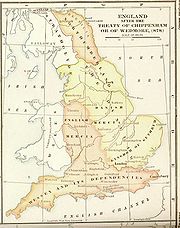
called an area similar to northern England "Britannia Inferior
" (Lower Britain) and it was ruled from the city of Eboracum
(modern York
). The Brigantes
occupied the region between the rivers Tyne
and Humber
. The sub capital held sway over the rest of the land north of there, which included for a brief period the part of the Scottish lowlands
between Hadrian's Wall
and the Antonine Wall
.
After the arrival of the Angles
, Saxons
and Jutes
, the North was divided into rival kingdoms: Bernicia and Deira. Bernicia covered lands north of the Tees, whilst Deira corresponded roughly to the eastern half of modern-day Yorkshire. Bernicia and Deira were first united as Northumbria
by Aethelfrith, a king of Bernicia who conquered Deira around the year 604. An area east and west of the Pennines
was divided into two Celtic kingdoms, Rheged
(Cumbria and Lancashire) and Elmet
(West Riding of Yorkshire). The north of England forms a large part of the Hen Ogledd
, Welsh for 'Old North'. The north west of England still retains vestiges of a Celtic culture, and had its own Celtic language, Cumbric
, spoken, predominately in Cumbria
until around the 12th century.
The North and East of England was subject to Danish Law (Danelaw
) during the Viking era, evidence of which can be found in the etymology
of many place names and surnames in the area. Anglo-Norman
aspirations in the Pale of Ireland
have some roots in the Viking forays on the Irish Sea
and the trade route which ran from York and crossing the Edinburgh
-Glasgow
area in Scotland, to Dublin in Ireland.
Historically the North was controlled from London by the Council of the North
, based at the King's Manor
, York, set up in 1484 by Richard III. However the major decisions affecting the North of England have been made entirely in London since this institution was abolished in 1641.
As the centre of the industrial revolution, Northern England has long been characterised by its industrial centres, from the mill towns of Lancashire, textile centres of Yorkshire, shipyards of the North East to the mining towns found throughout the North and the fishing ports along both east and west coasts. However, whilst much of the South and east of England has in general prospered economically, the north and west have remained relatively poor, consequently there are currently many government subsidised urban regeneration projects happening across northern towns and cities, hoping to exploit the lack of private investment in the area. Five of the ten most populous cities in the United Kingdom lie in the North.
The picture is not clear-cut, however, as the north has areas which are as wealthy as, if not wealthier than, fashionable southern areas such as Surrey
. Yorkshire's "Golden Triangle
" which extends from north Leeds
to Harrogate
and across to York is an example, as is Cheshire
. Equally, counties such as Cornwall share the relative economic deprivation often associated with the North.
is the largest religion in Northern England and has been since the Early Middle Ages, though its existence on the island dates back to the Roman introduction in antiquity and continued through Early Insular Christianity
. The Holy Island of Lindisfarne
played an essential role in the Christianisation of Northumbria
, after Aidan
from Connacht
founded a monastery there as the first Bishop of Lindisfarne on the request of King Oswald
. It is known for the creation of the Lindisfarne Gospels
and remains a site of pilgrimage to this day. Paulinus
as part of the Gregorian mission
became the first Bishop of York. It was at the Synod of Whitby
that calucations of Easter were brought in line with Roman calculations. In the modern day the three main forms of Christianity practised are Anglicanism
, Latin Rite of the Catholic Church and Methodism
. In terms of ecclesiastical administration for the Church of England
the entire north is covered by the Province of York
, which is represented by the Archbishop of York
. Likewise, with the exception of old Cheshire the north is covered in Catholic Church administration by the Province of Liverpool represented by the Archbishop of Liverpool
.
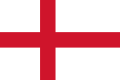 Many areas of Northern England possess their own flags, but there is no official flag for the region as a whole. In 2003 a flag was proposed for the region, the Flag of the North of England which comprises the cross of St George
in a Nordic cross
format to symbolise the historical links to Scandinavia, with the colours of the flag of England
to symbolise the links to the rest of England.
Cultural region
Cultural region is a term used mainly in the fields of anthropology and geography. Specific cultures often do not limit their geographic coverage to the borders of a nation state, or to smaller subdivisions of a state...
of England
England
England is a country that is part of the United Kingdom. It shares land borders with Scotland to the north and Wales to the west; the Irish Sea is to the north west, the Celtic Sea to the south west, with the North Sea to the east and the English Channel to the south separating it from continental...
. It is not an official government region
Regions of England
In England, the region is the highest tier of sub-national division used by central Government. Between 1994 and 2011, the nine regions had an administrative role in the implementation of UK Government policy, and as the areas covered by elected bodies...
, but rather an informal amalgamation of counties
Counties of England
Counties of England are areas used for the purposes of administrative, geographical and political demarcation. For administrative purposes, England outside Greater London and the Isles of Scilly is divided into 83 counties. The counties may consist of a single district or be divided into several...
. The southern extent of the region is roughly the River Trent
River Trent
The River Trent is one of the major rivers of England. Its source is in Staffordshire on the southern edge of Biddulph Moor. It flows through the Midlands until it joins the River Ouse at Trent Falls to form the Humber Estuary, which empties into the North Sea below Hull and Immingham.The Trent...
, while the North is bordered by Scotland
Scotland
Scotland is a country that is part of the United Kingdom. Occupying the northern third of the island of Great Britain, it shares a border with England to the south and is bounded by the North Sea to the east, the Atlantic Ocean to the north and west, and the North Channel and Irish Sea to the...
. The counties of Northern England combined have a population of around 14.5 million covering an area of 37,331 km2 (14,414 sq mi).
During antiquity most of the area was part of Brigantia — homeland of the Brigantes
Brigantes
The Brigantes were a Celtic tribe who in pre-Roman times controlled the largest section of what would become Northern England, and a significant part of the Midlands. Their kingdom is sometimes called Brigantia, and it was centred in what was later known as Yorkshire...
and the largest Brythonic
Britons (historical)
The Britons were the Celtic people culturally dominating Great Britain from the Iron Age through the Early Middle Ages. They spoke the Insular Celtic language known as British or Brythonic...
kingdom of Great Britain
Great Britain
Great Britain or Britain is an island situated to the northwest of Continental Europe. It is the ninth largest island in the world, and the largest European island, as well as the largest of the British Isles...
. After the Roman conquest of Britain
Roman conquest of Britain
The Roman conquest of Britain was a gradual process, beginning effectively in AD 43 under Emperor Claudius, whose general Aulus Plautius served as first governor of Britannia. Great Britain had already frequently been the target of invasions, planned and actual, by forces of the Roman Republic and...
the city of York
York
York is a walled city, situated at the confluence of the Rivers Ouse and Foss in North Yorkshire, England. The city has a rich heritage and has provided the backdrop to major political events throughout much of its two millennia of existence...
became capital of the area, called Britannia Inferior
Britannia Inferior
Britannia Inferior was a subdivision of the Roman province of Britannia established c. 214 by the emperor Caracalla, son of Septimius Severus. Located in modern northern England, the region was governed from the city of Eboracum by a praetorian legate in command of a single legion stationed in...
then Britannia Secunda
Britannia Secunda
Britannia Secunda was one of the provinces of Roman Britain in existence by c. 312 AD and probably created as part of the administrative reforms of the Roman Emperor Diocletian after the defeat of the usurper Allectus by Constantius Chlorus in 296 AD. The governors of Britannia Secunda were of...
. In Sub-Roman Britain
Sub-Roman Britain
Sub-Roman Britain is a term derived from an archaeological label for the material culture of Britain in Late Antiquity: the term "Sub-Roman" was invented to describe the potsherds in sites of the 5th century and the 6th century, initially with an implication of decay of locally-made wares from a...
new Brythonic kingdoms of the Hen Ogledd
Hen Ogledd
Yr Hen Ogledd is a Welsh term used by scholars to refer to those parts of what is now northern England and southern Scotland in the years between 500 and the Viking invasions of c. 800, with particular interest in the Brythonic-speaking peoples who lived there.The term is derived from heroic...
emerged. The Angle
Angle
In geometry, an angle is the figure formed by two rays sharing a common endpoint, called the vertex of the angle.Angles are usually presumed to be in a Euclidean plane with the circle taken for standard with regard to direction. In fact, an angle is frequently viewed as a measure of an circular arc...
settlers created Bernicia
Bernicia
Bernicia was an Anglo-Saxon kingdom established by Anglian settlers of the 6th century in what is now southeastern Scotland and North East England....
and Deira
Deira
Deira was a kingdom in Northern England during the 6th century AD. Itextended from the Humber to the Tees, and from the sea to the western edge of the Vale of York...
from which came Northumbria and a Golden Age
Northumbria's Golden Age
The Northumbrian Renaissance or Northumbria's Golden Age is the name given to a period of cultural flowering in the Anglo-Saxon kingdom of Northumbria, broadly speaking from the mid-seventh to the mid-eighth centuries. It is characterised by a blend of insular art, Germanic art and Mediterranean...
in cultural, scholarly and monastic activity, centred around Lindisfarne
Lindisfarne
Lindisfarne is a tidal island off the north-east coast of England. It is also known as Holy Island and constitutes a civil parish in Northumberland...
and aided by Irish monks. Norse
Norsemen
Norsemen is used to refer to the group of people as a whole who spoke what is now called the Old Norse language belonging to the North Germanic branch of Indo-European languages, especially Norwegian, Icelandic, Faroese, Swedish and Danish in their earlier forms.The meaning of Norseman was "people...
and Gaelic Viking
Viking
The term Viking is customarily used to refer to the Norse explorers, warriors, merchants, and pirates who raided, traded, explored and settled in wide areas of Europe, Asia and the North Atlantic islands from the late 8th to the mid-11th century.These Norsemen used their famed longships to...
raiders gained control of much of the area, creating the Danelaw
Danelaw
The Danelaw, as recorded in the Anglo-Saxon Chronicle , is a historical name given to the part of England in which the laws of the "Danes" held sway and dominated those of the Anglo-Saxons. It is contrasted with "West Saxon law" and "Mercian law". The term has been extended by modern historians to...
. During this time there were close relations with Mann and the Isles, Dublin and Norway
Norway
Norway , officially the Kingdom of Norway, is a Nordic unitary constitutional monarchy whose territory comprises the western portion of the Scandinavian Peninsula, Jan Mayen, and the Arctic archipelago of Svalbard and Bouvet Island. Norway has a total area of and a population of about 4.9 million...
. Northumbria was unified with the rest of England under Eadred around 952.
After the Norman conquest
Norman conquest of England
The Norman conquest of England began on 28 September 1066 with the invasion of England by William, Duke of Normandy. William became known as William the Conqueror after his victory at the Battle of Hastings on 14 October 1066, defeating King Harold II of England...
in 1066, desolation was brought with the Harrying of the North
Harrying of the North
The Harrying of the North was a series of campaigns waged by William the Conqueror in the winter of 1069–1070 to subjugate Northern England, and is part of the Norman conquest of England...
, though much construction and town founding was done shortly after. A Council of the North
Council of the North
The Council of the North was an administrative body originally set up in 1484 by king Richard III of England, the third and last Yorkist monarch to hold the Crown of England; its intention was to improve government control and economic prosperity, to benefit the entire area of Northern England...
was in place during the Late Middle Ages
Late Middle Ages
The Late Middle Ages was the period of European history generally comprising the 14th to the 16th century . The Late Middle Ages followed the High Middle Ages and preceded the onset of the early modern era ....
until the Commonwealth
Commonwealth of England
The Commonwealth of England was the republic which ruled first England, and then Ireland and Scotland from 1649 to 1660. Between 1653–1659 it was known as the Commonwealth of England, Scotland and Ireland...
after the Civil War
English Civil War
The English Civil War was a series of armed conflicts and political machinations between Parliamentarians and Royalists...
. The area experienced Anglo–Scottish border
Anglo–Scottish border
The Anglo-Scottish border is the official border and mark of entry between Scotland and England. It runs for 154 km between the River Tweed on the east coast and the Solway Firth in the west. It is Scotland's only land border...
fighting until the unification of Britain
History of the formation of the United Kingdom
The history of the formation of the United Kingdom has involved personal and political union across Great Britain and the wider British Isles. The United Kingdom is the most recent of a number of sovereign states that have been established in Great Britain at different periods in history, in...
under the Stuarts
House of Stuart
The House of Stuart is a European royal house. Founded by Robert II of Scotland, the Stewarts first became monarchs of the Kingdom of Scotland during the late 14th century, and subsequently held the position of the Kings of Great Britain and Ireland...
.
Linguistically
Concepts of the North take account of perceived "Northern" regional accentsEnglish language in England
The English language in England refers to the English language as spoken in England. These forms of English are a subsection of British English, as spoken throughout Great Britain. Other terms used to refer to the English language as spoken in England include:...
. Experts on historical dialects categorise as Northern the area north of a line that begins at the Humber estuary, and runs up the river Wharfe and across to the River Lune in north Lancashire. However, the linguistic elements that traditionally defined this area, such as use of doon instead of down and substitution of an -ang noise in words that end -ong (e.g. lang instead of long), are now only prevalent in the more northern parts of the region; these linguistic features may reflect a more modern interpretation of where the line sits today. As speech has changed, there is little consensus on what defines a "Northern" accent or dialect. Many people in Northern England omit certain words from sentences in casual speech, such as saying "I'm goin t'shops" or "I'm going the shops" as opposed to "I'm going to the shops". This is particularly common in Yorkshire and Lancashire.
Geographically
The North of England may also be considered as the area (from coast to coast) surrounding the PenninesPennines
The Pennines are a low-rising mountain range, separating the North West of England from Yorkshire and the North East.Often described as the "backbone of England", they form a more-or-less continuous range stretching from the Peak District in Derbyshire, around the northern and eastern edges of...
, an upland chain often referred to as "the backbone of England". This stretches from the Cheviot Hills
Cheviot Hills
The Cheviot Hills is a range of rolling hills straddling the England–Scotland border between Northumberland and the Scottish Borders.There is a broad split between the northern and the southern Cheviots...
on the border with Scotland to the Peak District. The areas defined were formerly dominated by heavy industry and mineral extraction and processing. Combined with the characteristically wild, hilly landscape of the region, this has led to the popular conception, mainly by those from the south of England, of it being "grim up North".
It is an area of extreme landscapes. There are several belts of urbanisation, many of which form one larger belt that runs from Liverpool to Leeds along the M62
M62 motorway
The M62 motorway is a west–east trans-Pennine motorway in Northern England, connecting the cities of Liverpool and Hull via Manchester and Leeds. The road also forms part of the unsigned Euroroutes E20 and E22...
corridor, then heading south to Sheffield along the M1
M1 motorway
The M1 is a north–south motorway in England primarily connecting London to Leeds, where it joins the A1 near Aberford. While the M1 is considered to be the first inter-urban motorway to be completed in the United Kingdom, the first road to be built to motorway standard in the country was the...
corridor. There are further agglomerations in the North East and east of Preston. Around eleven million people live in the area covered by The Northern Way
The Northern Way
The Northern Way is a 20 year British governmental strategy to transform the economy of the North of England. It aims to bridge a £30 billion output gap between the North and the average for England....
, most in its largest cities Leeds
Leeds
Leeds is a city and metropolitan borough in West Yorkshire, England. In 2001 Leeds' main urban subdivision had a population of 443,247, while the entire city has a population of 798,800 , making it the 30th-most populous city in the European Union.Leeds is the cultural, financial and commercial...
, Sheffield
Sheffield
Sheffield is a city and metropolitan borough of South Yorkshire, England. Its name derives from the River Sheaf, which runs through the city. Historically a part of the West Riding of Yorkshire, and with some of its southern suburbs annexed from Derbyshire, the city has grown from its largely...
, Liverpool
Liverpool
Liverpool is a city and metropolitan borough of Merseyside, England, along the eastern side of the Mersey Estuary. It was founded as a borough in 1207 and was granted city status in 1880...
, Bradford
Bradford
Bradford lies at the heart of the City of Bradford, a metropolitan borough of West Yorkshire, in Northern England. It is situated in the foothills of the Pennines, west of Leeds, and northwest of Wakefield. Bradford became a municipal borough in 1847, and received its charter as a city in 1897...
and Manchester
Manchester
Manchester is a city and metropolitan borough in Greater Manchester, England. According to the Office for National Statistics, the 2010 mid-year population estimate for Manchester was 498,800. Manchester lies within one of the UK's largest metropolitan areas, the metropolitan county of Greater...
.
Government Office Regions
The North might also be considered to include the three former Government Office RegionsRegions of England
In England, the region is the highest tier of sub-national division used by central Government. Between 1994 and 2011, the nine regions had an administrative role in the implementation of UK Government policy, and as the areas covered by elected bodies...
of North East England
North East England
North East England is one of the nine official regions of England. It covers Northumberland, County Durham, Tyne and Wear, and Teesside . The only cities in the region are Durham, Newcastle upon Tyne and Sunderland...
, North West England
North West England
North West England, informally known as The North West, is one of the nine official regions of England.North West England had a 2006 estimated population of 6,853,201 the third most populated region after London and the South East...
and Yorkshire and the Humber
Yorkshire and the Humber
Yorkshire and the Humber is one of the nine regions of England and formally one of the government office regions. It covers most of the historic county of Yorkshire, along with the part of northern Lincolnshire that was, from 1974 to 1996, within the former shire county of Humberside. The...
. This area consists of the ceremonial counties of Cheshire
Cheshire
Cheshire is a ceremonial county in North West England. Cheshire's county town is the city of Chester, although its largest town is Warrington. Other major towns include Widnes, Congleton, Crewe, Ellesmere Port, Runcorn, Macclesfield, Winsford, Northwich, and Wilmslow...
, Cumbria
Cumbria
Cumbria , is a non-metropolitan county in North West England. The county and Cumbria County Council, its local authority, came into existence in 1974 after the passage of the Local Government Act 1972. Cumbria's largest settlement and county town is Carlisle. It consists of six districts, and in...
, County Durham
County Durham
County Durham is a ceremonial county and unitary district in north east England. The county town is Durham. The largest settlement in the ceremonial county is the town of Darlington...
, East Riding of Yorkshire
East Riding of Yorkshire
The East Riding of Yorkshire, or simply East Yorkshire, is a local government district with unitary authority status, and a ceremonial county of England. For ceremonial purposes the county also includes the city of Kingston upon Hull, which is a separate unitary authority...
, Greater Manchester
Greater Manchester
Greater Manchester is a metropolitan county in North West England, with a population of 2.6 million. It encompasses one of the largest metropolitan areas in the United Kingdom and comprises ten metropolitan boroughs: Bolton, Bury, Oldham, Rochdale, Stockport, Tameside, Trafford, Wigan, and the...
, Lancashire
Lancashire
Lancashire is a non-metropolitan county of historic origin in the North West of England. It takes its name from the city of Lancaster, and is sometimes known as the County of Lancaster. Although Lancaster is still considered to be the county town, Lancashire County Council is based in Preston...
, Merseyside
Merseyside
Merseyside is a metropolitan county in North West England, with a population of 1,365,900. It encompasses the metropolitan area centred on both banks of the lower reaches of the Mersey Estuary, and comprises five metropolitan boroughs: Knowsley, St Helens, Sefton, Wirral, and the city of Liverpool...
, Northumberland
Northumberland
Northumberland is the northernmost ceremonial county and a unitary district in North East England. For Eurostat purposes Northumberland is a NUTS 3 region and is one of three boroughs or unitary districts that comprise the "Northumberland and Tyne and Wear" NUTS 2 region...
, North Yorkshire
North Yorkshire
North Yorkshire is a non-metropolitan or shire county located in the Yorkshire and the Humber region of England, and a ceremonial county primarily in that region but partly in North East England. Created in 1974 by the Local Government Act 1972 it covers an area of , making it the largest...
, South Yorkshire
South Yorkshire
South Yorkshire is a metropolitan county in the Yorkshire and the Humber region of England. It has a population of 1.29 million. It consists of four metropolitan boroughs: Barnsley, Doncaster, Rotherham, and City of Sheffield...
, Tyne and Wear
Tyne and Wear
Tyne and Wear is a metropolitan county in north east England around the mouths of the Rivers Tyne and Wear. It came into existence as a metropolitan county in 1974 after the passage of the Local Government Act 1972...
, West Yorkshire
West Yorkshire
West Yorkshire is a metropolitan county within the Yorkshire and the Humber region of England with a population of 2.2 million. West Yorkshire came into existence as a metropolitan county in 1974 after the passage of the Local Government Act 1972....
and part of Lincolnshire
Lincolnshire
Lincolnshire is a county in the east of England. It borders Norfolk to the south east, Cambridgeshire to the south, Rutland to the south west, Leicestershire and Nottinghamshire to the west, South Yorkshire to the north west, and the East Riding of Yorkshire to the north. It also borders...
. The regions also hold the North of England Inward Investment Agency which is a UK government sponsored agency that represents two Regional Development Agencies in North England: Northwest Regional Development Agency (NWDA) and One Northeast (ONE).
Ancient counties
Alternatively, the North might be considered to comprise the six ancient countiesHistoric counties of England
The historic counties of England are subdivisions of England established for administration by the Normans and in most cases based on earlier Anglo-Saxon kingdoms and shires...
of Cumberland, Northumberland
Northumberland
Northumberland is the northernmost ceremonial county and a unitary district in North East England. For Eurostat purposes Northumberland is a NUTS 3 region and is one of three boroughs or unitary districts that comprise the "Northumberland and Tyne and Wear" NUTS 2 region...
, Westmorland
Westmorland
Westmorland is an area of North West England and one of the 39 historic counties of England. It formed an administrative county from 1889 to 1974, after which the entirety of the county was absorbed into the new county of Cumbria.-Early history:...
, Durham
County Durham
County Durham is a ceremonial county and unitary district in north east England. The county town is Durham. The largest settlement in the ceremonial county is the town of Darlington...
, Lancashire
Lancashire
Lancashire is a non-metropolitan county of historic origin in the North West of England. It takes its name from the city of Lancaster, and is sometimes known as the County of Lancaster. Although Lancaster is still considered to be the county town, Lancashire County Council is based in Preston...
and Yorkshire
Yorkshire
Yorkshire is a historic county of northern England and the largest in the United Kingdom. Because of its great size in comparison to other English counties, functions have been increasingly undertaken over time by its subdivisions, which have also been subject to periodic reform...
. The eastern part of this region coincides with the old Kingdom of Northumbria
Northumbria
Northumbria was a medieval kingdom of the Angles, in what is now Northern England and South-East Scotland, becoming subsequently an earldom in a united Anglo-Saxon kingdom of England. The name reflects the approximate southern limit to the kingdom's territory, the Humber Estuary.Northumbria was...
apart from those areas which were later absorbed into Scotland.
Ecclesiastical
Northern England is sometimes defined to coincide with the ecclesiastical Province of YorkProvince of York
The Province of York is one of two ecclesiastical provinces making up the Church of England, and consists of 14 dioceses which cover the northern third of England and the Isle of Man. York was elevated to an Archbishopric in 735 AD: Ecgbert of York was the first archbishop...
, which is overseen by the Archbishop of York
Archbishop of York
The Archbishop of York is a high-ranking cleric in the Church of England, second only to the Archbishop of Canterbury. He is the diocesan bishop of the Diocese of York and metropolitan of the Province of York, which covers the northern portion of England as well as the Isle of Man...
. The See includes the Isle of Man
Isle of Man
The Isle of Man , otherwise known simply as Mann , is a self-governing British Crown Dependency, located in the Irish Sea between the islands of Great Britain and Ireland, within the British Isles. The head of state is Queen Elizabeth II, who holds the title of Lord of Mann. The Lord of Mann is...
, which in ecclesiastical terms is the see of Sodor and Man and was at one time a part of Jorvik
Jórvík
Scandinavian York is a term, like the terms Kingdom of Jórvík or Kingdom of York, used by historians for the kingdom of Northumbria in the late 9th century and first half of the 10th century, when it was dominated by Norse warrior-kings; in particular, it is used to refer to the city controlled by...
in contention with Dublin over said island and Galloway
Galloway
Galloway is an area in southwestern Scotland. It usually refers to the former counties of Wigtownshire and Kirkcudbrightshire...
. A comparable definition in Roman Catholic terms would be the Province of Liverpool
Archbishop of Liverpool
The Archbishop of Liverpool heads the Roman Catholic Archdiocese of Liverpool in England. As such he is the Metropolitan Archbishop of the Province of Liverpool, known also on occasion as the Northern Province.-History:...
.
People
The term "northern" is often loosely used without any deeper consideration of the geographical identities of northern England, leading to confusion over the depth of affiliation between its areas. People from areas of the Midlands, such as Stoke-on-TrentStoke-on-Trent
Stoke-on-Trent , also called The Potteries is a city in Staffordshire, England, which forms a linear conurbation almost 12 miles long, with an area of . Together with the Borough of Newcastle-under-Lyme Stoke forms The Potteries Urban Area...
, will occasionally choose to identify as "northerners".
As in much of the rest of England, people tend to have a deeper affiliation to their county or their city. Thus, Yorkshire
Yorkshire
Yorkshire is a historic county of northern England and the largest in the United Kingdom. Because of its great size in comparison to other English counties, functions have been increasingly undertaken over time by its subdivisions, which have also been subject to periodic reform...
people have a traditional rivalry with people from Lancashire
Lancashire
Lancashire is a non-metropolitan county of historic origin in the North West of England. It takes its name from the city of Lancaster, and is sometimes known as the County of Lancaster. Although Lancaster is still considered to be the county town, Lancashire County Council is based in Preston...
, even though people from both areas recognise a shared "Northern" identity. Similarly, there is a strong distinction between natives of Sunderland (Mackems) and those of Newcastle
Newcastle upon Tyne
Newcastle upon Tyne is a city and metropolitan borough of Tyne and Wear, in North East England. Historically a part of Northumberland, it is situated on the north bank of the River Tyne...
(Geordies).
Rugby
The sport of rugbyRugby football
Rugby football is a style of football named after Rugby School in the United Kingdom. It is seen most prominently in two current sports, rugby league and rugby union.-History:...
experienced a schism in 1895 with many teams based in Yorkshire
Yorkshire
Yorkshire is a historic county of northern England and the largest in the United Kingdom. Because of its great size in comparison to other English counties, functions have been increasingly undertaken over time by its subdivisions, which have also been subject to periodic reform...
, Lancashire
Lancashire
Lancashire is a non-metropolitan county of historic origin in the North West of England. It takes its name from the city of Lancaster, and is sometimes known as the County of Lancaster. Although Lancaster is still considered to be the county town, Lancashire County Council is based in Preston...
and surrounding areas breaking from the Rugby Football Union
Rugby Football Union
The Rugby Football Union was founded in 1871 as the governing body for the sport of rugby union, and performed as the international governing body prior to the formation of the International Rugby Board in 1886...
and forming their own Rugby League
Rugby league
Rugby league football, usually called rugby league, is a full contact sport played by two teams of thirteen players on a rectangular grass field. One of the two codes of rugby football, it originated in England in 1895 by a split from Rugby Football Union over paying players...
. The disagreement that led to the split was over the issue of professional payments, and "broken time" or injury payments.
The North formed a powerful Rugby Union
Rugby union
Rugby union, often simply referred to as rugby, is a full contact team sport which originated in England in the early 19th century. One of the two codes of rugby football, it is based on running with the ball in hand...
team in the 70's, 80's and 90's who famously won games against the New Zealand
New Zealand
New Zealand is an island country in the south-western Pacific Ocean comprising two main landmasses and numerous smaller islands. The country is situated some east of Australia across the Tasman Sea, and roughly south of the Pacific island nations of New Caledonia, Fiji, and Tonga...
All Blacks
All Blacks
The New Zealand men's national rugby union team, known as the All Blacks, represent New Zealand in what is regarded as its national sport....
and the Australian Wallabies
Wallabies
A wallaby is the informal name for any of about thirty species of Australian animal.Wallaby may also refer to:* Wallaby ammunition carrier, a variant of the Canadian Ram tank* Wallaby , Japanese fantasy manga...
. Former players include Bill Beaumont
Bill Beaumont
William "Bill" Blackledge Beaumont CBE was captain of the England rugby union team at a time when they struggled to win games. His greatest moment as captain was the unexpected 1980 Grand Slam. He played as a lock...
, Will Carling
Will Carling
William David Charles Carling, OBE is a former Rugby union player for Harlequins, and a former captain of England from 1988 to 1996, winning 72 caps.-Early life:...
& Rory Underwood
Rory Underwood
Rory Underwood MBE is a former English rugby union footballer who played wing for, most notably, Leicester Tigers and Bedford. He represented England and the British Lions and is a former Royal Air Force pilot....
, but more recently has seen the regions teams become relatively weaker, with association football, cricket
Cricket
Cricket is a bat-and-ball game played between two teams of 11 players on an oval-shaped field, at the centre of which is a rectangular 22-yard long pitch. One team bats, trying to score as many runs as possible while the other team bowls and fields, trying to dismiss the batsmen and thus limit the...
and Rugby League being cited as more popular across the region.
History
Roman Empire
The Roman Empire was the post-Republican period of the ancient Roman civilization, characterised by an autocratic form of government and large territorial holdings in Europe and around the Mediterranean....
called an area similar to northern England "Britannia Inferior
Britannia Inferior
Britannia Inferior was a subdivision of the Roman province of Britannia established c. 214 by the emperor Caracalla, son of Septimius Severus. Located in modern northern England, the region was governed from the city of Eboracum by a praetorian legate in command of a single legion stationed in...
" (Lower Britain) and it was ruled from the city of Eboracum
Eboracum
Eboracum was a fort and city in Roman Britain. The settlement evolved into York, located in North Yorkshire, England.-Etymology:The first known recorded mention of Eboracum by name is dated circa 95-104 AD and is an address containing the Latin form of the settlement's name, "Eburaci", on a wooden...
(modern York
York
York is a walled city, situated at the confluence of the Rivers Ouse and Foss in North Yorkshire, England. The city has a rich heritage and has provided the backdrop to major political events throughout much of its two millennia of existence...
). The Brigantes
Brigantes
The Brigantes were a Celtic tribe who in pre-Roman times controlled the largest section of what would become Northern England, and a significant part of the Midlands. Their kingdom is sometimes called Brigantia, and it was centred in what was later known as Yorkshire...
occupied the region between the rivers Tyne
River Tyne
The River Tyne is a river in North East England in Great Britain. It is formed by the confluence of two rivers: the North Tyne and the South Tyne. These two rivers converge at Warden Rock near Hexham in Northumberland at a place dubbed 'The Meeting of the Waters'.The North Tyne rises on the...
and Humber
Humber
The Humber is a large tidal estuary on the east coast of Northern England. It is formed at Trent Falls, Faxfleet, by the confluence of the tidal River Ouse and the tidal River Trent. From here to the North Sea, it forms part of the boundary between the East Riding of Yorkshire on the north bank...
. The sub capital held sway over the rest of the land north of there, which included for a brief period the part of the Scottish lowlands
Scottish Lowlands
The Scottish Lowlands is a name given to the Southern half of Scotland.The area is called a' Ghalldachd in Scottish Gaelic, and the Lawlands ....
between Hadrian's Wall
Hadrian's Wall
Hadrian's Wall was a defensive fortification in Roman Britain. Begun in AD 122, during the rule of emperor Hadrian, it was the first of two fortifications built across Great Britain, the second being the Antonine Wall, lesser known of the two because its physical remains are less evident today.The...
and the Antonine Wall
Antonine Wall
The Antonine Wall is a stone and turf fortification built by the Romans across what is now the Central Belt of Scotland, between the Firth of Forth and the Firth of Clyde. Representing the northernmost frontier barrier of the Roman Empire, it spanned approximately 39 miles and was about ten feet ...
.
After the arrival of the Angles
Angles
The Angles is a modern English term for a Germanic people who took their name from the ancestral cultural region of Angeln, a district located in Schleswig-Holstein, Germany...
, Saxons
Saxons
The Saxons were a confederation of Germanic tribes originating on the North German plain. The Saxons earliest known area of settlement is Northern Albingia, an area approximately that of modern Holstein...
and Jutes
Jutes
The Jutes, Iuti, or Iutæ were a Germanic people who, according to Bede, were one of the three most powerful Germanic peoples of their time, the other two being the Saxons and the Angles...
, the North was divided into rival kingdoms: Bernicia and Deira. Bernicia covered lands north of the Tees, whilst Deira corresponded roughly to the eastern half of modern-day Yorkshire. Bernicia and Deira were first united as Northumbria
Northumbria
Northumbria was a medieval kingdom of the Angles, in what is now Northern England and South-East Scotland, becoming subsequently an earldom in a united Anglo-Saxon kingdom of England. The name reflects the approximate southern limit to the kingdom's territory, the Humber Estuary.Northumbria was...
by Aethelfrith, a king of Bernicia who conquered Deira around the year 604. An area east and west of the Pennines
Pennines
The Pennines are a low-rising mountain range, separating the North West of England from Yorkshire and the North East.Often described as the "backbone of England", they form a more-or-less continuous range stretching from the Peak District in Derbyshire, around the northern and eastern edges of...
was divided into two Celtic kingdoms, Rheged
Rheged
Rheged is described in poetic sources as one of the kingdoms of the Hen Ogledd , the Brythonic-speaking region of what is now northern England and southern Scotland, during the Early Middle Ages...
(Cumbria and Lancashire) and Elmet
Elmet
Elmet was an independent Brythonic kingdom covering a broad area of what later became the West Riding of Yorkshire during the Early Middle Ages, between approximately the 5th century and early 7th century. Although its precise boundaries are unclear, it appears to have been bordered by the River...
(West Riding of Yorkshire). The north of England forms a large part of the Hen Ogledd
Hen Ogledd
Yr Hen Ogledd is a Welsh term used by scholars to refer to those parts of what is now northern England and southern Scotland in the years between 500 and the Viking invasions of c. 800, with particular interest in the Brythonic-speaking peoples who lived there.The term is derived from heroic...
, Welsh for 'Old North'. The north west of England still retains vestiges of a Celtic culture, and had its own Celtic language, Cumbric
Cumbric language
Cumbric was a variety of the Celtic British language spoken during the Early Middle Ages in the Hen Ogledd or "Old North", or what is now northern England and southern Lowland Scotland, the area anciently known as Cumbria. It was closely related to Old Welsh and the other Brythonic languages...
, spoken, predominately in Cumbria
Cumbria
Cumbria , is a non-metropolitan county in North West England. The county and Cumbria County Council, its local authority, came into existence in 1974 after the passage of the Local Government Act 1972. Cumbria's largest settlement and county town is Carlisle. It consists of six districts, and in...
until around the 12th century.
The North and East of England was subject to Danish Law (Danelaw
Danelaw
The Danelaw, as recorded in the Anglo-Saxon Chronicle , is a historical name given to the part of England in which the laws of the "Danes" held sway and dominated those of the Anglo-Saxons. It is contrasted with "West Saxon law" and "Mercian law". The term has been extended by modern historians to...
) during the Viking era, evidence of which can be found in the etymology
Etymology
Etymology is the study of the history of words, their origins, and how their form and meaning have changed over time.For languages with a long written history, etymologists make use of texts in these languages and texts about the languages to gather knowledge about how words were used during...
of many place names and surnames in the area. Anglo-Norman
Anglo-Norman
The Anglo-Normans were mainly the descendants of the Normans who ruled England following the Norman conquest by William the Conqueror in 1066. A small number of Normans were already settled in England prior to the conquest...
aspirations in the Pale of Ireland
The Pale
The Pale or the English Pale , was the part of Ireland that was directly under the control of the English government in the late Middle Ages. It had reduced by the late 15th century to an area along the east coast stretching from Dalkey, south of Dublin, to the garrison town of Dundalk...
have some roots in the Viking forays on the Irish Sea
Irish Sea
The Irish Sea separates the islands of Ireland and Great Britain. It is connected to the Celtic Sea in the south by St George's Channel, and to the Atlantic Ocean in the north by the North Channel. Anglesey is the largest island within the Irish Sea, followed by the Isle of Man...
and the trade route which ran from York and crossing the Edinburgh
Edinburgh
Edinburgh is the capital city of Scotland, the second largest city in Scotland, and the eighth most populous in the United Kingdom. The City of Edinburgh Council governs one of Scotland's 32 local government council areas. The council area includes urban Edinburgh and a rural area...
-Glasgow
Glasgow
Glasgow is the largest city in Scotland and third most populous in the United Kingdom. The city is situated on the River Clyde in the country's west central lowlands...
area in Scotland, to Dublin in Ireland.
Historically the North was controlled from London by the Council of the North
Council of the North
The Council of the North was an administrative body originally set up in 1484 by king Richard III of England, the third and last Yorkist monarch to hold the Crown of England; its intention was to improve government control and economic prosperity, to benefit the entire area of Northern England...
, based at the King's Manor
King's Manor
The King's Manor is a Grade I listed building in York, England, and is part of the University of York.King's Manor was originally built to house the abbots of St Mary's Abbey, York. The Abbot's house probably occupied the site since the eleventh century, but the earliest remains date from the...
, York, set up in 1484 by Richard III. However the major decisions affecting the North of England have been made entirely in London since this institution was abolished in 1641.
As the centre of the industrial revolution, Northern England has long been characterised by its industrial centres, from the mill towns of Lancashire, textile centres of Yorkshire, shipyards of the North East to the mining towns found throughout the North and the fishing ports along both east and west coasts. However, whilst much of the South and east of England has in general prospered economically, the north and west have remained relatively poor, consequently there are currently many government subsidised urban regeneration projects happening across northern towns and cities, hoping to exploit the lack of private investment in the area. Five of the ten most populous cities in the United Kingdom lie in the North.
The picture is not clear-cut, however, as the north has areas which are as wealthy as, if not wealthier than, fashionable southern areas such as Surrey
Surrey
Surrey is a county in the South East of England and is one of the Home Counties. The county borders Greater London, Kent, East Sussex, West Sussex, Hampshire and Berkshire. The historic county town is Guildford. Surrey County Council sits at Kingston upon Thames, although this has been part of...
. Yorkshire's "Golden Triangle
Golden Triangle (Yorkshire)
The Golden Triangle is a term commonly used by estate agents for the area of West and North Yorkshire lying between Harrogate, York and North Leeds...
" which extends from north Leeds
Leeds
Leeds is a city and metropolitan borough in West Yorkshire, England. In 2001 Leeds' main urban subdivision had a population of 443,247, while the entire city has a population of 798,800 , making it the 30th-most populous city in the European Union.Leeds is the cultural, financial and commercial...
to Harrogate
Harrogate
Harrogate is a spa town in North Yorkshire, England. The town is a tourist destination and its visitor attractions include its spa waters, RHS Harlow Carr gardens, and Betty's Tea Rooms. From the town one can explore the nearby Yorkshire Dales national park. Harrogate originated in the 17th...
and across to York is an example, as is Cheshire
Cheshire
Cheshire is a ceremonial county in North West England. Cheshire's county town is the city of Chester, although its largest town is Warrington. Other major towns include Widnes, Congleton, Crewe, Ellesmere Port, Runcorn, Macclesfield, Winsford, Northwich, and Wilmslow...
. Equally, counties such as Cornwall share the relative economic deprivation often associated with the North.
Religion
ChristianityChristianity
Christianity is a monotheistic religion based on the life and teachings of Jesus as presented in canonical gospels and other New Testament writings...
is the largest religion in Northern England and has been since the Early Middle Ages, though its existence on the island dates back to the Roman introduction in antiquity and continued through Early Insular Christianity
Early Insular Christianity
Early Insular Christianity is a term used to cover Christianity in Great Britain and Ireland during the post-Roman period. It splits into two strands:...
. The Holy Island of Lindisfarne
Lindisfarne
Lindisfarne is a tidal island off the north-east coast of England. It is also known as Holy Island and constitutes a civil parish in Northumberland...
played an essential role in the Christianisation of Northumbria
Northumbria
Northumbria was a medieval kingdom of the Angles, in what is now Northern England and South-East Scotland, becoming subsequently an earldom in a united Anglo-Saxon kingdom of England. The name reflects the approximate southern limit to the kingdom's territory, the Humber Estuary.Northumbria was...
, after Aidan
Aidan of Lindisfarne
Known as Saint Aidan of Lindisfarne, Aidan the Apostle of Northumbria , was the founder and first bishop of the monastery on the island of Lindisfarne in England. A Christian missionary, he is credited with restoring Christianity to Northumbria. Aidan is the Anglicised form of the original Old...
from Connacht
Connacht
Connacht , formerly anglicised as Connaught, is one of the Provinces of Ireland situated in the west of Ireland. In Ancient Ireland, it was one of the fifths ruled by a "king of over-kings" . Following the Norman invasion of Ireland, the ancient kingdoms were shired into a number of counties for...
founded a monastery there as the first Bishop of Lindisfarne on the request of King Oswald
Oswald of Northumbria
Oswald was King of Northumbria from 634 until his death, and is now venerated as a Christian saint.Oswald was the son of Æthelfrith of Bernicia and came to rule after spending a period in exile; after defeating the British ruler Cadwallon ap Cadfan, Oswald brought the two Northumbrian kingdoms of...
. It is known for the creation of the Lindisfarne Gospels
Lindisfarne Gospels
The Lindisfarne Gospels is an illuminated Latin manuscript of the gospels of Matthew, Mark, Luke and John in the British Library...
and remains a site of pilgrimage to this day. Paulinus
Paulinus of York
Paulinus was a Roman missionary and the first Bishop of York. A member of the Gregorian mission sent in 601 by Pope Gregory I to Christianize the Anglo-Saxons from their native Anglo-Saxon paganism, Paulinus arrived in England by 604 with the second missionary group...
as part of the Gregorian mission
Gregorian mission
The Gregorian mission, sometimes known as the Augustinian mission, was the missionary endeavour sent by Pope Gregory the Great to the Anglo-Saxons in 596 AD. Headed by Augustine of Canterbury, its goal was to convert the Anglo-Saxons to Christianity. By the death of the last missionary in 653, they...
became the first Bishop of York. It was at the Synod of Whitby
Synod of Whitby
The Synod of Whitby was a seventh century Northumbriansynod where King Oswiu of Northumbria ruled that his kingdom would calculate Easter and observe the monastic tonsure according to the customs of Rome, rather than the customs practised by Iona and its satellite institutions...
that calucations of Easter were brought in line with Roman calculations. In the modern day the three main forms of Christianity practised are Anglicanism
Anglicanism
Anglicanism is a tradition within Christianity comprising churches with historical connections to the Church of England or similar beliefs, worship and church structures. The word Anglican originates in ecclesia anglicana, a medieval Latin phrase dating to at least 1246 that means the English...
, Latin Rite of the Catholic Church and Methodism
Methodism
Methodism is a movement of Protestant Christianity represented by a number of denominations and organizations, claiming a total of approximately seventy million adherents worldwide. The movement traces its roots to John Wesley's evangelistic revival movement within Anglicanism. His younger brother...
. In terms of ecclesiastical administration for the Church of England
Church of England
The Church of England is the officially established Christian church in England and the Mother Church of the worldwide Anglican Communion. The church considers itself within the tradition of Western Christianity and dates its formal establishment principally to the mission to England by St...
the entire north is covered by the Province of York
Province of York
The Province of York is one of two ecclesiastical provinces making up the Church of England, and consists of 14 dioceses which cover the northern third of England and the Isle of Man. York was elevated to an Archbishopric in 735 AD: Ecgbert of York was the first archbishop...
, which is represented by the Archbishop of York
Archbishop of York
The Archbishop of York is a high-ranking cleric in the Church of England, second only to the Archbishop of Canterbury. He is the diocesan bishop of the Diocese of York and metropolitan of the Province of York, which covers the northern portion of England as well as the Isle of Man...
. Likewise, with the exception of old Cheshire the north is covered in Catholic Church administration by the Province of Liverpool represented by the Archbishop of Liverpool
Archbishop of Liverpool
The Archbishop of Liverpool heads the Roman Catholic Archdiocese of Liverpool in England. As such he is the Metropolitan Archbishop of the Province of Liverpool, known also on occasion as the Northern Province.-History:...
.
Flag
St George's Cross
St George's Cross is a red cross on a white background used as a symbolic reference to Saint George. The red cross on white was associated with St George from medieval times....
in a Nordic cross
Nordic Cross Flag
The Nordic Cross Flag, Nordic Cross, or Scandinavian Cross is a pattern of flags usually associated with the flags of the Scandinavian countries of which it originated. All of the Nordic countries except Greenland have adopted such flags...
format to symbolise the historical links to Scandinavia, with the colours of the flag of England
Flag of England
The Flag of England is the St George's Cross . The red cross appeared as an emblem of England during the Middle Ages and the Crusades and is one of the earliest known emblems representing England...
to symbolise the links to the rest of England.
See also
- Council of the NorthCouncil of the NorthThe Council of the North was an administrative body originally set up in 1484 by king Richard III of England, the third and last Yorkist monarch to hold the Crown of England; its intention was to improve government control and economic prosperity, to benefit the entire area of Northern England...
- Harrying of the NorthHarrying of the NorthThe Harrying of the North was a series of campaigns waged by William the Conqueror in the winter of 1069–1070 to subjugate Northern England, and is part of the Norman conquest of England...
- NorthumbriaNorthumbriaNorthumbria was a medieval kingdom of the Angles, in what is now Northern England and South-East Scotland, becoming subsequently an earldom in a united Anglo-Saxon kingdom of England. The name reflects the approximate southern limit to the kingdom's territory, the Humber Estuary.Northumbria was...
- North-South divide in England
- Southern EnglandSouthern EnglandSouthern England, the South and the South of England are imprecise terms used to refer to the southern counties of England bordering the English Midlands. It has a number of different interpretations of its geographic extents. The South is considered by many to be a cultural region with a distinct...
- The Northern WayThe Northern WayThe Northern Way is a 20 year British governmental strategy to transform the economy of the North of England. It aims to bridge a £30 billion output gap between the North and the average for England....