

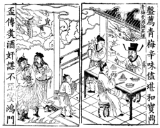
Romance of the Three Kingdoms

Encyclopedia
Romance of the Three Kingdoms, written by Luo Guanzhong
in the 14th century, is a Chinese historical novel
based on the events in the turbulent years near the end of the Han Dynasty
and the Three Kingdoms
era of Chinese history
, starting in 169 and ending with the reunification of the land in 280.
The story (part historical, part legend, and part myth) chronicles the lives of feudal lords and their retainers, who tried to replace the dwindling Han Dynasty or restore it. While the novel actually follows literally hundreds of characters, the focus is mainly on the three power blocs that emerged from the remnants of the Han Dynasty, and would eventually form the three states of Cao Wei
, Shu Han
, and Eastern Wu
. The novel deals with the plots, personal and army battles, intrigues, and struggles of these states to achieve dominance for almost 100 years. This novel also gives readers a sense of how the Chinese view their history in a cyclical lense. The famous opening lines of the novel summarize this view: It is a general truism of this world that anything long divided will surely unite, and anything long united will surely divide (話說天下大勢,分久必合,合久必分).
Romance of the Three Kingdoms is acclaimed as one of the Four Great Classical Novels
of Chinese literature
; it has a total of 800,000 words and nearly a thousand dramatic characters (mostly historical) in 120 chapters. It is arguably the most widely read historical novel in late imperial and modern China.
, the stories grew in popularity during the reign of the Mongol
emperors of the Yuan Dynasty
. During the succeeding Ming Dynasty
, an interest in plays and novels resulted in further expansions and retelling of the stories.
The earliest attempt to combine these stories into a written work was Sanguozhi Pinghua , published sometime between 1321 and 1323. This version combined themes of legend, magic, and morality to appeal to the peasant class. Elements of reincarnation
and karma
were woven into this version of the story.
Romance of the Three Kingdoms is traditionally attributed to Luo Guanzhong
, who lived sometime between 1315 and 1400 (late Yuan to early Ming period). This theory is extensively developed in Andrew Plaks' Four Masterworks of the Ming Novel. It was written in partly vernacular
and partly Classical Chinese
and was considered the standard text for 300 years. The author made use of available historical records, including the Records of Three Kingdoms
compiled by Chen Shou
, which covered events from the Yellow Turban Rebellion
in 184 to the unification of the Three Kingdoms under the Jin Dynasty
in 280. The novel also includes material from Tang Dynasty
poetic works, Yuan Dynasty operas and his own personal interpretation of elements such as virtue and legitimacy. The author combined this historical knowledge with a gift for storytelling to create a rich tapestry of personalities, and initially published it in 24 volumes. It was copied by hand in manuscripts until first printed in 1522 as Sanguozhi Tongsu Yanyi. In the 1660s, during the reign of the Kangxi Emperor
in the Qing Dynasty
, Mao Lun and his son Mao Zonggang significantly edited the text, fitting it into 120 chapters, and abbreviating the title to Sanguozhi Yanyi. The text was reduced from 900,000 to 750,000 characters; significant editing was done for narrative flow; use of third party poems was reduced and shifted from conventional verse to finer pieces; and most passages praising Cao Cao
's advisers and generals were removed. Scholars have long debated whether the Maos' viewpoint was anti-Qing (identifying Southern Ming remnants with Shu-Han) or pro-Qing.
This novel reflects Confucian
values that were prominent at the time it was written. According to Confucian moral standards, loyalty to one's family, friends, and superiors are important measures for distinguishing good and bad people.
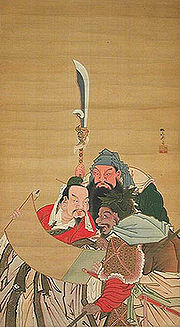
, incompetent eunuch
s deceive the emperor
and persecute good officials, and the government becomes extremely corrupt on all levels, leading to widespread deterioration of the empire. During the reign of the penultimate Han sovereign, Emperor Ling
, the Yellow Turban Rebellion
breaks out under the leadership of Zhang Jue (a.k.a. Zhang Jiao).
The rebellion is barely suppressed by troops under the command of He Jin
, General-in-Chief of the imperial armies. Fearing his growing power, the eunuchs led by Zhang Rang
lure He Jin into the palace and murder him. He Jin's stunned guards, led by Yuan Shao
, respond by charging into the palace to kill all eunuchs for revenge, which turns into indiscriminate slaughter. In the ensuing chaos, the child Emperor Shao
and the Prince of Chenliu
disappear from the palace.
, who proceeds to seize control of the capital city Luoyang
under the pretext of protecting the emperor. Dong later deposes Emperor Shao and replaces him with the Prince of Chenliu, who becomes known as Emperor Xian. Dong usurps state power and starts a reign of terror in which innocents are persecuted and the common people suffer. Wu Fu and Cao Cao
attempt to assassinate Dong Zhuo but both fail.
Cao Cao manages to escape and issues an imperial edict in the emperor's name to all regional warlords and governors, calling them to rise up against Dong Zhuo. Under Yuan Shao's leadership, eighteen warlords form a coalition force in a campaign against Dong Zhuo
, but undermined by poor leadership and conflict of interest, they only manage to drive Dong from Luoyang to Chang'an
. Dong Zhuo is eventually betrayed and killed by his foster son Lü Bu
in a dispute over the beautiful maiden Diaochan
.
finds the Imperial Seal
and keeps it secretly for himself, further weakening royal authority. Without a strong central government, warlords begin to rise and fight each other for land, plunging China into a state of anarchy
. In the north, Yuan Shao and Gongsun Zan
are at war, and in the south, Sun Jian and Liu Biao
. Many others, even those without title or land, such as Cao Cao and Liu Bei
, are also starting to build up power.
Cao Cao rescues Emperor Xian from Dong Zhuo's followers and establishes the new imperial court in Xuchang
. Cao Cao proceeds to defeat his rivals such as Lü Bu, Yuan Shu
and Zhang Xiu
before scoring a tactical victory over Yuan Shao in the Battle of Guandu
despite being vastly outnumbered. Through his conquests, Cao unites the Central Plains
and northern China under his rule, and the lands he controlled would serve as the foundation for the state of Cao Wei
in the future.
delivers the Imperial Seal as a tribute to the rising royal pretender, Yuan Shu
of Huainan
, in exchange for reinforcements. Sun secures himself a state in the rich riverlands of Jiangdong, on which the state of Eastern Wu
will eventually be founded. Tragically, Sun Ce also dies at the pinnacle of his career from illness under stress of his terrifying encounter with the ghost of Yu Ji
, a venerable magician whom he had falsely accused and executed in jealousy. However, his younger brother Sun Quan
, who succeeds him, proves to be a capable and charismatic ruler. Sun, assisted by skilled advisors Zhou Yu
and Zhang Zhao
, inspires hidden talents such as Lu Su
to join his service, and builds up a strong military force.
, along with his sworn brothers Guan Yu
and Zhang Fei, swear allegiance to the Han Dynasty in the famous Oath of the Peach Garden
and pledge to do their best for the country. However, their goals and ambitions are not realized until the later part of the novel. Liu is not recognized for his efforts in quelling the Yellow Turban Rebellion and is merely appointed as a junior magistrate. They join Gongsun Zan and participate in the campaign against Dong Zhuo. Liu Bei becomes the governor of Xu Province after Tao Qian
passes on the post to him. Liu loses the province when Lü Bu
seizes control of it with the help of a defector and he joins Cao Cao in defeating Lü at the Battle of Xiapi
. While Cao Cao subtly reveals his intention to usurp state power, Liu Bei is officially recognised by Emperor Xian as the Imperial Uncle and seen as a saviour to help the emperor deal with Cao.
Liu Bei leaves Cao Cao eventually and seizes Xu Province from Cao's newly appointed governor Che Zhou. In retaliation, Cao attacks Xu Province and defeats Liu, forcing Liu to seek refuge under Yuan Shao for a brief period of time. Liu finds a new base in Runan
after leaving Yuan but is defeated by Cao Cao's forces once again. He retreats to Jing Province to join Liu Biao and is placed in charge of Xinye. At Xinye, Liu recruits the genius strategist Zhuge Liang
personally and builds up his forces.
where Liu establishes a foothold against Cao Cao.
To resist Cao Cao, Liu Bei sends Zhuge Liang to persuade Sun Quan to form an alliance. Zhuge succeeds in his diplomatic mission and remains in Jiangdong as a temporary advisor to Sun Quan. Sun places Zhou Yu in command of the armies of Jiangdong (Eastern Wu) in preparation for an upcoming war with Cao Cao. Zhou feels that Zhuge will become a future threat to Eastern Wu and he tries to kill Zhuge on a few occasions but he fails and decides to co-operate with Zhuge for the time being. Cao Cao is defeated at the Battle of Red Cliffs
by the allied forces of Sun Quan and Liu Bei and he is forced to retreat north.
 Sun Quan and Liu Bei begin vying for control of Jing Province after their victory and Liu seizes the province from Cao Cao after following Zhuge Liang's strategy. Sun Quan is unhappy and sends emissaries to ask Liu Bei for Jing Province, but Liu dismisses the envoys each time with different excuses. Sun uses some strategies proposed by Zhou Yu to take the land, of which the most famous is the "Beauty Scheme." Sun intends to lure Liu Bei to Jiangdong to marry his sister Lady Sun and hold Liu hostage to exchange his freedom for Jing Province, but the plot fails and the newly-wed couple return home safely. Zhou Yu tries to take Jing Province repeatedly but his plans are foiled three times by Zhuge Liang.
, Liu Bei leads his troops into Yi Province in the west and takes over the land
from the incompetent noble Liu Zhang
. By then, Liu Bei rules a vast area of land from Jing Province to Yi Province in the west, which will serve as the foundation for the future state of Shu Han
. He proclaims himself "King of Hanzhong" after his victory over Cao Cao in the Hanzhong Campaign
.
At the same time, Cao has also been granted the title of "King of Wei" by the emperor and Sun Quan became known as the "Duke of Wu". In the east, Sun Quan and Cao Cao's forces clash at the Battle of Ruxukou
and Battle of Xiaoyao Ford
with victories and defeats for both sides. The situation among the three major powers reaches a stalemate after this until Cao Cao's death.
in the Battle of Fancheng
. Sun Quan sends Lü Meng
to lead his troops to seize Jing Province
while Guan is away, as part of his secret agreement with Cao Cao. Guan is caught off guard and loses Jing Province before he realizes it. He retreats to Maicheng, where he is heavily surrounded by Sun Quan's forces, while his army gradually shrinks in size as many of his troops desert or surrender to the enemy. In desperation, Guan attempts to break out of the siege but fails and is captured in an ambush. He is executed on Sun Quan's orders after refusing to renounce his loyalty to Liu Bei.
Shortly after Guan Yu's death, Cao Cao dies of a brain tumor and his son Cao Pi
usurps the throne, effectively ending the Han Dynasty and Cao renames his new dynasty "Cao Wei". In response, Liu Bei proclaims himself emperor, to carry on the bloodline of the Han Dynasty. While Liu Bei is planning to avenge Guan Yu, his other sworn brother Zhang Fei is assassinated in his sleep by his subordinates, who have defected to Sun Quan.
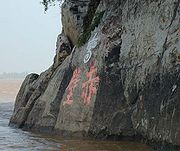
. Lu Xun
, the commander of Sun Quan's forces, refrains from pursuing the retreating Shu Han troops after encountering Zhuge Liang's Stone Sentinel Maze
.
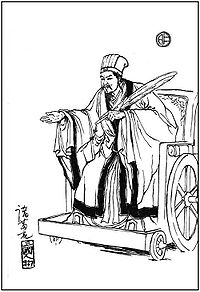 Liu Bei dies in Baidicheng from illness shortly after his defeat. In a moving final conversation between Liu on his deathbed and Zhuge Liang, Liu grants Zhuge the authority to take the throne if his successor Liu Shan
proves to be an inept ruler. Zhuge refuses and swears that he will remain faithful to the trust Liu Bei had placed in him.
, Cao Pi induces several forces, including Sun Quan, turncoat Shu general Meng Da
, Meng Huo
of the Nanman
and the Qiang tribes, to attack Shu Han, in coordination with a Cao Wei army. Zhuge Liang manages to send the five armies retreating without any bloodshed. An envoy from Shu Han named Deng Zhi
subsequently persuades Sun Quan to renew the former alliance with Shu Han. Zhuge Liang personally leads a southern campaign
against the Nanman barbarian king Meng Huo. Meng is defeated and captured seven times, but Zhuge releases him each time and allows him to come back for another battle, in order to win Meng over. The seventh time, Meng refuses to leave and decides to swear allegiance to Shu Han forever.
After pacifying the south, Zhuge Liang leads the Shu Han army on five military expeditions to attack Cao Wei in order to restore the Han Dynasty. However, Zhuge's days are numbered as he had been suffering from chronic tuberculosis
all along, and his condition worsens under stress from the campaigns. His last significant victory over Cao Wei is probably the defection of Jiang Wei
, a promising young general who is well-versed in military strategy. Zhuge Liang dies of illness at the Battle of Wuzhang Plains
while leading a stalemate battle against his nemesis, the Cao Wei commander Sima Yi. Before his death, Zhuge orders his trusted generals to build a statue of himself and use it to scare away the enemy in order to buy time for the Shu Han army to retreat safely.
and the state power of Cao Wei eventually falls into the hands of the Sima clan, headed by Sima Yi's sons Sima Shi
and Sima Zhao
.
In Shu Han, Jiang Wei inherits Zhuge Liang's legacy and continues to lead another nine campaigns
against Cao Wei for a bitter three decades, but he fails to achieve any significant success. Moreover, the ruler of Shu Han, Liu Shan, is incompetent and places faith in treacherous officials, further leading to the decline of the kingdom. Shu Han is eventually conquered
by Cao Wei. Jiang Wei attempts to restore Shu Han with the help of Zhong Hui
but their plans are exposed and both of them are killed by Sima Zhao's troops. After the fall of Shu Han in 263, Sima Zhao's son Sima Yan forces the last Wei ruler, Cao Huan
, to abdicate his throne in 265, officially ending the Cao Wei dynasty. Sima Yan, having already been proclaimed the Prince of Jin in the previous year, then formally establishes the Jin Dynasty.
In Eastern Wu, there has been internal conflict among the nobles ever since the death of Sun Quan, with Zhuge Ke
and Sun Lin
making attempts to usurp state power. Although stability is restored temporarily, the last Wu ruler Sun Hao
appears to be a tyrant who does not make any efforts to strengthen his kingdom. Eastern Wu, the last of the Three Kingdoms, is finally conquered by Jin
after a long period of struggle in the year 280, thus marking the end of the near century-long era of civil strife known as the Three Kingdoms period.
's Records of Three Kingdoms
. Other major influences include Liu Yiqing's Shishuo xinyu or A New Account of Tales of the World, published in 430, and the Sanguozhi Pinghua, a chronological collection of eighty fictional sketches starting with the peach garden oath and ending with Zhuge Liang's death.
Some fifty or sixty Yuan and early Ming plays about the Three Kingdoms are known to have existed, and their material is almost entirely fictional, based on thin threads of actual history. The novel is thus a return to greater emphasis on history, compared to these dramas. The novel also shifted towards better acknowledgement of the Southland's historical importance, while still betraying some prejudice against them. Zhang Xuecheng famously wrote that the novel was 70% fact and 30% fiction. The fictional parts are culled from different sources, including unofficial histories, folk stories, the Sanguozhi Pinghua, and also the author's own imagination. Nonetheless, the description of the social conditions and the logic that the characters use is accurate to the Three Kingdoms period, creating "believable" situations and characters, even if they are not historically accurate.
Romance of the Three Kingdoms, like the dramas and folk stories of its day, features Liu Bei and his kingdom as the protagonist; hence the depiction of the people in Shu-Han was glorified. The antagonists, Cao Cao, Sun Quan and their kingdoms, on the other hand, were often denigrated. This suited the political climate in the Ming Dynasty, unlike in the Jin Dynasty, when Cao Wei was considered the legitimate successor to the Han Dynasty.
Some non-historical scenes in the novel have become well-known and subsequently became a part of traditional Chinese culture.
 Dominant themes of the novel include: the rise and fall of the ideal liege (Liu Bei) finding the ideal minister (Zhuge Liang); the conflict between the ideal liege (Liu Bei) and the consummate villain (Cao Cao); and the cruelties and injustice of feudal or dynastic government.
Critics have argued that Luo Guanzhong's initial pronouncement "It is a general truism of this world that anything long divided will surely unite, and anything long united will surely divide" epitomizes the main theme of the novel. Taking this as a locus for study of the classic has been disputed, however. Further, "division" and "unity" for Luo are not of equal importance. Though the work shows the journey from unity to division in the final years of the Han Dynasty, that is only the beginning of the book. "The author expended most of his ink on the focal point of his description—the difficult transition from 'division' to 'unity' and the great achievements that came out of the bitter struggle by various heroes to reunify the Chinese empire."
Besides the famous oath, many Chinese proverbs in use today are derived from the novel:
The writing style adopted by Romance of the Three Kingdoms was part of the emergence of written vernacular during the Ming period, as part of the so-called "Four Masterworks" (si da qishu).
. Pujing made his first appearance during Guan's arduous journey of crossing five passes and slaying six generals, in which he warned Guan of an assassination plot. As the novel was written in the Ming Dynasty
, more than 1000 years after the era, these stories showed that Buddhism had long been a significant ingredient of the mainstream culture and may not be historically accurate. Luo Guanzhong
preserved these descriptions from earlier versions of the novel to support his portrait of Guan as a faithful man of virtue. Guan was since then respectfully addressed as "Lord Guan" or Guan Gong.
, while Yang Xianyi and Gladys Yang published excerpts in 1981 including chapters 43–50. A complete and faithful translation of the novel was published in two volumes in 1925 by Charles Henry Brewitt-Taylor. The translation was well-written, but lacked any supplementary materials such as maps or character lists that would aide Western readers; a 1959 reprint was published that included maps and an introduction by Roy Andrew Miller to assist foreign readers. In 1976, Moss Roberts published an abridged translation containing one fourth of the novel including maps and more than 40 woodblock illustrations
from three Chinese versions of the novel. Roberts's abridgement is reader-friendly, being written for use in colleges and to be read by the general public. After decades of work, Roberts published a full translation in 1991 complete with an Afterword, eleven maps, a list of characters, titles, terms, and offices, and almost 100 pages of notes from Mao Zonggang's commentaries and other scholarly sources. Roberts's complete translation remains faithful to the original; it is reliable yet still matches the tone and style of the classic text. Yang Ye, a professor in Chinese Literature at the UC Riverside, wrote in Encyclopedia of Literary Translation into English (1998) that Roberts's translation "supersedes Brewitt-Taylor's translation and will no doubt remain the definitive English version for many years to come."
Luo Guanzhong
Luo Ben , better known by his style name Luo Guanzhong , was a Chinese writer of the early Ming Dynasty period of Chinese history. He was also known as Huhai Sanren...
in the 14th century, is a Chinese historical novel
Historical novel
According to Encyclopædia Britannica, a historical novel is-Development:An early example of historical prose fiction is Luó Guànzhōng's 14th century Romance of the Three Kingdoms, which covers one of the most important periods of Chinese history and left a lasting impact on Chinese culture.The...
based on the events in the turbulent years near the end of the Han Dynasty
Han Dynasty
The Han Dynasty was the second imperial dynasty of China, preceded by the Qin Dynasty and succeeded by the Three Kingdoms . It was founded by the rebel leader Liu Bang, known posthumously as Emperor Gaozu of Han. It was briefly interrupted by the Xin Dynasty of the former regent Wang Mang...
and the Three Kingdoms
Three Kingdoms
The Three Kingdoms period was a period in Chinese history, part of an era of disunity called the "Six Dynasties" following immediately the loss of de facto power of the Han Dynasty rulers. In a strict academic sense it refers to the period between the foundation of the state of Wei in 220 and the...
era of Chinese history
History of China
Chinese civilization originated in various regional centers along both the Yellow River and the Yangtze River valleys in the Neolithic era, but the Yellow River is said to be the Cradle of Chinese Civilization. With thousands of years of continuous history, China is one of the world's oldest...
, starting in 169 and ending with the reunification of the land in 280.
The story (part historical, part legend, and part myth) chronicles the lives of feudal lords and their retainers, who tried to replace the dwindling Han Dynasty or restore it. While the novel actually follows literally hundreds of characters, the focus is mainly on the three power blocs that emerged from the remnants of the Han Dynasty, and would eventually form the three states of Cao Wei
Cao Wei
Cao Wei was one of the states that competed for control of China during the Three Kingdoms period. With the capital at Luoyang, the state was established by Cao Pi in 220, based upon the foundations that his father Cao Cao laid...
, Shu Han
Shu Han
Shu Han was one of the three states competing for control of China during the Three Kingdoms period, after the fall of the Han Dynasty. The state was based on areas around Sichuan, which was then known as Shu...
, and Eastern Wu
Eastern Wu
Eastern Wu, also known as Sun Wu, was one the three states competing for control of China during the Three Kingdoms period after the fall of the Han Dynasty. It was based in the Jiangnan region of China...
. The novel deals with the plots, personal and army battles, intrigues, and struggles of these states to achieve dominance for almost 100 years. This novel also gives readers a sense of how the Chinese view their history in a cyclical lense. The famous opening lines of the novel summarize this view: It is a general truism of this world that anything long divided will surely unite, and anything long united will surely divide (話說天下大勢,分久必合,合久必分).
Romance of the Three Kingdoms is acclaimed as one of the Four Great Classical Novels
Four Great Classical Novels
The Four Great Classical Novels, or the Four Major Classical Novels of Chinese literature, are the four novels commonly regarded by scholars to be the greatest and most influential of pre-modern Chinese fiction. Dating from the Ming and Qing dynasties, they are well known to most Chinese readers...
of Chinese literature
Chinese literature
Chinese literature extends thousands of years, from the earliest recorded dynastic court archives to the mature fictional novels that arose during the Ming Dynasty to entertain the masses of literate Chinese...
; it has a total of 800,000 words and nearly a thousand dramatic characters (mostly historical) in 120 chapters. It is arguably the most widely read historical novel in late imperial and modern China.
Overview
Myths from the Three Kingdoms era existed as oral traditions before written compilations. With their focus on the history of Han ChineseHan Chinese
Han Chinese are an ethnic group native to China and are the largest single ethnic group in the world.Han Chinese constitute about 92% of the population of the People's Republic of China , 98% of the population of the Republic of China , 78% of the population of Singapore, and about 20% of the...
, the stories grew in popularity during the reign of the Mongol
Mongols
Mongols ) are a Central-East Asian ethnic group that lives mainly in the countries of Mongolia, China, and Russia. In China, ethnic Mongols can be found mainly in the central north region of China such as Inner Mongolia...
emperors of the Yuan Dynasty
Yuan Dynasty
The Yuan Dynasty , or Great Yuan Empire was a ruling dynasty founded by the Mongol leader Kublai Khan, who ruled most of present-day China, all of modern Mongolia and its surrounding areas, lasting officially from 1271 to 1368. It is considered both as a division of the Mongol Empire and as an...
. During the succeeding Ming Dynasty
Ming Dynasty
The Ming Dynasty, also Empire of the Great Ming, was the ruling dynasty of China from 1368 to 1644, following the collapse of the Mongol-led Yuan Dynasty. The Ming, "one of the greatest eras of orderly government and social stability in human history", was the last dynasty in China ruled by ethnic...
, an interest in plays and novels resulted in further expansions and retelling of the stories.
The earliest attempt to combine these stories into a written work was Sanguozhi Pinghua , published sometime between 1321 and 1323. This version combined themes of legend, magic, and morality to appeal to the peasant class. Elements of reincarnation
Reincarnation
Reincarnation best describes the concept where the soul or spirit, after the death of the body, is believed to return to live in a new human body, or, in some traditions, either as a human being, animal or plant...
and karma
Karma
Karma in Indian religions is the concept of "action" or "deed", understood as that which causes the entire cycle of cause and effect originating in ancient India and treated in Hindu, Jain, Buddhist and Sikh philosophies....
were woven into this version of the story.
Romance of the Three Kingdoms is traditionally attributed to Luo Guanzhong
Luo Guanzhong
Luo Ben , better known by his style name Luo Guanzhong , was a Chinese writer of the early Ming Dynasty period of Chinese history. He was also known as Huhai Sanren...
, who lived sometime between 1315 and 1400 (late Yuan to early Ming period). This theory is extensively developed in Andrew Plaks' Four Masterworks of the Ming Novel. It was written in partly vernacular
Vernacular Chinese
Written Vernacular Chinese refers to forms of written Chinese based on the vernacular language, in contrast to Classical Chinese, the written standard used from the Spring and Autumn Period to the early twentieth century...
and partly Classical Chinese
Classical Chinese
Classical Chinese or Literary Chinese is a traditional style of written Chinese based on the grammar and vocabulary of ancient Chinese, making it different from any modern spoken form of Chinese...
and was considered the standard text for 300 years. The author made use of available historical records, including the Records of Three Kingdoms
Records of Three Kingdoms
Records of Three Kingdoms , is regarded as the official and authoritative historical text on the Three Kingdoms period of Chinese history covering the years 184-280 CE. Written by Chen Shou in the 3rd century, the work combines the smaller histories of the rival states of Cao Wei , Shu Han and...
compiled by Chen Shou
Chen Shou
Chen Shou was a historian during the Jin Dynasty period of Chinese history. He is best known as the author of Records of Three Kingdoms, a historical account of the late Han Dynasty and Three Kingdoms period.-Biography:...
, which covered events from the Yellow Turban Rebellion
Yellow Turban Rebellion
The Yellow Turban Rebellion, also translated as Yellow Scarves Rebellion, was a peasant revolt that broke out in 184 AD in China during the reign of Emperor Ling of the Han Dynasty...
in 184 to the unification of the Three Kingdoms under the Jin Dynasty
Jìn Dynasty (265-420)
The Jìn Dynasty , was a dynasty in Chinese history, lasting between the years 265 and 420 AD. There are two main divisions in the history of the Dynasty, the first being Western Jin and the second Eastern Jin...
in 280. The novel also includes material from Tang Dynasty
Tang Dynasty
The Tang Dynasty was an imperial dynasty of China preceded by the Sui Dynasty and followed by the Five Dynasties and Ten Kingdoms Period. It was founded by the Li family, who seized power during the decline and collapse of the Sui Empire...
poetic works, Yuan Dynasty operas and his own personal interpretation of elements such as virtue and legitimacy. The author combined this historical knowledge with a gift for storytelling to create a rich tapestry of personalities, and initially published it in 24 volumes. It was copied by hand in manuscripts until first printed in 1522 as Sanguozhi Tongsu Yanyi. In the 1660s, during the reign of the Kangxi Emperor
Kangxi Emperor
The Kangxi Emperor ; Manchu: elhe taifin hūwangdi ; Mongolian: Энх-Амгалан хаан, 4 May 1654 –20 December 1722) was the fourth emperor of the Qing Dynasty, the first to be born on Chinese soil south of the Pass and the second Qing emperor to rule over China proper, from 1661 to 1722.Kangxi's...
in the Qing Dynasty
Qing Dynasty
The Qing Dynasty was the last dynasty of China, ruling from 1644 to 1912 with a brief, abortive restoration in 1917. It was preceded by the Ming Dynasty and followed by the Republic of China....
, Mao Lun and his son Mao Zonggang significantly edited the text, fitting it into 120 chapters, and abbreviating the title to Sanguozhi Yanyi. The text was reduced from 900,000 to 750,000 characters; significant editing was done for narrative flow; use of third party poems was reduced and shifted from conventional verse to finer pieces; and most passages praising Cao Cao
Cao Cao
Cao Cao was a warlord and the penultimate chancellor of the Eastern Han Dynasty who rose to great power during the dynasty's final years. As one of the central figures of the Three Kingdoms period, he laid the foundations for what was to become the state of Cao Wei and was posthumously titled...
's advisers and generals were removed. Scholars have long debated whether the Maos' viewpoint was anti-Qing (identifying Southern Ming remnants with Shu-Han) or pro-Qing.
This novel reflects Confucian
Confucianism
Confucianism is a Chinese ethical and philosophical system developed from the teachings of the Chinese philosopher Confucius . Confucianism originated as an "ethical-sociopolitical teaching" during the Spring and Autumn Period, but later developed metaphysical and cosmological elements in the Han...
values that were prominent at the time it was written. According to Confucian moral standards, loyalty to one's family, friends, and superiors are important measures for distinguishing good and bad people.
Story
One of the greatest achievements of Romance of the Three Kingdoms is the extreme complexity of its stories and characters. The novel contains numerous secondary stories. The following consists of a summary of the central plot, and well-known highlights in the story.Yellow Turban Rebellion
In the final years of the Han DynastyHan Dynasty
The Han Dynasty was the second imperial dynasty of China, preceded by the Qin Dynasty and succeeded by the Three Kingdoms . It was founded by the rebel leader Liu Bang, known posthumously as Emperor Gaozu of Han. It was briefly interrupted by the Xin Dynasty of the former regent Wang Mang...
, incompetent eunuch
Eunuch
A eunuch is a person born male most commonly castrated, typically early enough in his life for this change to have major hormonal consequences...
s deceive the emperor
Emperor of China
The Emperor of China refers to any sovereign of Imperial China reigning between the founding of Qin Dynasty of China, united by the King of Qin in 221 BCE, and the fall of Yuan Shikai's Empire of China in 1916. When referred to as the Son of Heaven , a title that predates the Qin unification, the...
and persecute good officials, and the government becomes extremely corrupt on all levels, leading to widespread deterioration of the empire. During the reign of the penultimate Han sovereign, Emperor Ling
Emperor Ling of Han
Emperor Ling of Han, trad. ch. 漢靈帝;, sim. ch. 汉灵帝, py. hàn líng dì, wg. Han Ling-ti, was an emperor of the Chinese Han Dynasty. He was a great-great-grandson of Emperor Zhang. The Yellow Turban Rebellion broke out during Emperor Ling's reign.Emperor Ling's reign saw yet another repetition of...
, the Yellow Turban Rebellion
Yellow Turban Rebellion
The Yellow Turban Rebellion, also translated as Yellow Scarves Rebellion, was a peasant revolt that broke out in 184 AD in China during the reign of Emperor Ling of the Han Dynasty...
breaks out under the leadership of Zhang Jue (a.k.a. Zhang Jiao).
The rebellion is barely suppressed by troops under the command of He Jin
He Jin
He Jin was the elder half-brother of Empress He, consort to Emperor Ling of the late Eastern Han Dynasty in China. He shared power with his sister as regents in 189, following the death of Emperor Ling. In the ensuing struggle with the influential eunuch faction for power, He Jin was assassinated...
, General-in-Chief of the imperial armies. Fearing his growing power, the eunuchs led by Zhang Rang
Zhang Rang
Zhang Rang was a eunuch of the late Han Dynasty, who served Emperor Ling of Han; he was also the leader of the Ten regular attendants , a group of court eunuchs who held great influence in the Han imperial court...
lure He Jin into the palace and murder him. He Jin's stunned guards, led by Yuan Shao
Yuan Shao
Yuan Shao was a warlord during the late Han Dynasty period of Chinese history. He occupied the northern territories of China during the civil war that occurred towards the end of the Han Dynasty and the beginning of the Three Kingdoms era...
, respond by charging into the palace to kill all eunuchs for revenge, which turns into indiscriminate slaughter. In the ensuing chaos, the child Emperor Shao
Prince of Hongnong
The Prince of Hongnong , was briefly an emperor of China during the Han dynasty. He is also known as "Emperor Han Shao" , a name which he shares with several other emperors with brief reigns...
and the Prince of Chenliu
Emperor Xian of Han
Emperor Xian of Han , personal name Liu Xie, style name Bohe, was the last emperor of the Han Dynasty period of Chinese history...
disappear from the palace.
Dong Zhuo's reign of terror
The missing emperor and prince are found later by soldiers of the warlord Dong ZhuoDong Zhuo
Dong Zhuo was a politician and warlord during the late Han Dynasty period of Chinese history. He seized control of the capital city Luoyang in 189 when it was in a state of turmoil following the death of Emperor Ling and a clash between the eunuch faction and some court officials led by...
, who proceeds to seize control of the capital city Luoyang
Luoyang
Luoyang is a prefecture-level city in western Henan province of Central China. It borders the provincial capital of Zhengzhou to the east, Pingdingshan to the southeast, Nanyang to the south, Sanmenxia to the west, Jiyuan to the north, and Jiaozuo to the northeast.Situated on the central plain of...
under the pretext of protecting the emperor. Dong later deposes Emperor Shao and replaces him with the Prince of Chenliu, who becomes known as Emperor Xian. Dong usurps state power and starts a reign of terror in which innocents are persecuted and the common people suffer. Wu Fu and Cao Cao
Cao Cao
Cao Cao was a warlord and the penultimate chancellor of the Eastern Han Dynasty who rose to great power during the dynasty's final years. As one of the central figures of the Three Kingdoms period, he laid the foundations for what was to become the state of Cao Wei and was posthumously titled...
attempt to assassinate Dong Zhuo but both fail.
Cao Cao manages to escape and issues an imperial edict in the emperor's name to all regional warlords and governors, calling them to rise up against Dong Zhuo. Under Yuan Shao's leadership, eighteen warlords form a coalition force in a campaign against Dong Zhuo
Campaign against Dong Zhuo
The Campaign against Dong Zhuo was a punitive expedition initiated by a coalition of regional officials and warlords against Dong Zhuo, Chancellor of State, in 190 during the late Han Dynasty of Chinese history...
, but undermined by poor leadership and conflict of interest, they only manage to drive Dong from Luoyang to Chang'an
Chang'an
Chang'an is an ancient capital of more than ten dynasties in Chinese history, today known as Xi'an. Chang'an literally means "Perpetual Peace" in Classical Chinese. During the short-lived Xin Dynasty, the city was renamed "Constant Peace" ; yet after its fall in AD 23, the old name was restored...
. Dong Zhuo is eventually betrayed and killed by his foster son Lü Bu
Lü Bu
Lü Bu was a military general and later a minor warlord during the late Han Dynasty period of Chinese history. According to the Records of Three Kingdoms, Lü Bu was highly-skilled in horse-riding and archery, and was thus nicknamed "Flying General"...
in a dispute over the beautiful maiden Diaochan
Diaochan
Diaochan was one of the Four Beauties of ancient China. She was said to have been born in 161 or 169 or 176, depending on the source. However, unlike the other three beauties, there is no known evidence that suggests her existence, therefore she is likely to be a fictional character.Diaochan...
.
Conflict among the various warlords and nobles
In the meantime, the empire is already disintegrating into civil war. Sun JianSun Jian
Sun Jian was a military general and warlord during the late Han Dynasty period of Chinese history. He allied himself with Yuan Shu in 190 when warlords from eastern China formed a coalition to oust Dong Zhuo, a tyrannical warlord who held the puppet Emperor Xian in his power...
finds the Imperial Seal
Imperial Seal of China
The Imperial Seal of China, or the Heirloom Seal of the Realm is a Chinese jade seal carved out of the He Shi Bi, a historically famous piece of jade.-Creation:...
and keeps it secretly for himself, further weakening royal authority. Without a strong central government, warlords begin to rise and fight each other for land, plunging China into a state of anarchy
Anarchy
Anarchy , has more than one colloquial definition. In the United States, the term "anarchy" typically is meant to refer to a society which lacks publicly recognized government or violently enforced political authority...
. In the north, Yuan Shao and Gongsun Zan
Gongsun Zan
Gongsun Zan , style name Bogui , a native of Liaoxi , was a warlord during the late Han Dynasty era of Chinese history.-Biography:...
are at war, and in the south, Sun Jian and Liu Biao
Liu Biao
Liu Biao , style name Jingsheng , was a warlord and the governor of Jing Province during the late Han Dynasty period of Chinese history. He was a member of the extended family of the Han Dynasty emperors...
. Many others, even those without title or land, such as Cao Cao and Liu Bei
Liu Bei
Liu Bei , also known as Liu Xuande, was a warlord, military general and later the founding emperor of the state of Shu Han during the Three Kingdoms era of Chinese history...
, are also starting to build up power.
Cao Cao rescues Emperor Xian from Dong Zhuo's followers and establishes the new imperial court in Xuchang
Xuchang
Xuchang is a prefecture-level city in central Henan province in Central China. It borders the provincial capital of Zhengzhou to the northwest, Kaifeng to the northeast, Zhoukou to the east, Luohe to the southeast, and Pingdingshan to the southwest....
. Cao Cao proceeds to defeat his rivals such as Lü Bu, Yuan Shu
Yuan Shu
Yuan Shu was a warlord during the late Han Dynasty era of Chinese history. He rose to prominence following the collapse of the imperial court in 189. He was said to be a younger cousin of the warlord Yuan Shao, but was actually Yuan Shao's younger half-brother...
and Zhang Xiu
Zhang Xiu
Zhang Xiu was a minor warlord during the late Han Dynasty era of Chinese history. He eventually surrendered to Cao Cao in 200. Having contributed greatly to the decisive Battle of Guandu and subsequent campaigns against the heirs of Yuan Shao, Zhang Xiu died en route Liucheng on a campaign to...
before scoring a tactical victory over Yuan Shao in the Battle of Guandu
Battle of Guandu
The Battle of Guandu was a military conflict between the warlords Cao Cao and Yuan Shao in 200 during the prelude to the Three Kingdoms period of Chinese history. The battle, which concluded with victory for Cao Cao, was a turning point in the war between the two warlords...
despite being vastly outnumbered. Through his conquests, Cao unites the Central Plains
Central Plain (China)
Zhongyuan or the Central Plain of China refers to the area on the lower reaches of the Yellow River which formed the cradle of Chinese civilization. It forms part of the North China Plain....
and northern China under his rule, and the lands he controlled would serve as the foundation for the state of Cao Wei
Cao Wei
Cao Wei was one of the states that competed for control of China during the Three Kingdoms period. With the capital at Luoyang, the state was established by Cao Pi in 220, based upon the foundations that his father Cao Cao laid...
in the future.
Sun Ce builds a dynasty in Jiangdong
Meanwhile, an ambush had violently concluded Sun Jian's life in a war with Liu Biao, fulfilling Sun's own rash oath to heaven. His eldest son Sun CeSun Ce
Sun Ce was a military general and warlord during the late Han Dynasty period of Chinese history. He was the oldest of the children of Sun Jian who was killed during the Battle of Xiangyang when Sun Ce was only 16. Sun Ce then broke away from his father's overlord, Yuan Shu, and headed to...
delivers the Imperial Seal as a tribute to the rising royal pretender, Yuan Shu
Yuan Shu
Yuan Shu was a warlord during the late Han Dynasty era of Chinese history. He rose to prominence following the collapse of the imperial court in 189. He was said to be a younger cousin of the warlord Yuan Shao, but was actually Yuan Shao's younger half-brother...
of Huainan
Huainan
Huainan is a prefecture-level city with 2,334,000 inhabitants in central Anhui Province, People’s Republic of China. It borders the provincial capital of Hefei to the south, Lu’an to the southwest, Fuyang to the west, Bozhou to the northwest, Bengbu to the northeast and Chuzhou to the east.Its...
, in exchange for reinforcements. Sun secures himself a state in the rich riverlands of Jiangdong, on which the state of Eastern Wu
Eastern Wu
Eastern Wu, also known as Sun Wu, was one the three states competing for control of China during the Three Kingdoms period after the fall of the Han Dynasty. It was based in the Jiangnan region of China...
will eventually be founded. Tragically, Sun Ce also dies at the pinnacle of his career from illness under stress of his terrifying encounter with the ghost of Yu Ji
Gan Ji
Gan Ji was a Taoist priest who lived during the late Han Dynasty period of Chinese history.According to the Book of Later Han, during the reign of the Emperor Shun of Han , Gan Ji's disciples Gong Chong submitted the Taiping Qingling Shu to the emperor.Some believe that the character Yu Ji ...
, a venerable magician whom he had falsely accused and executed in jealousy. However, his younger brother Sun Quan
Sun Quan
Sun Quan , son of Sun Jian, formally Emperor Da of Wu, was the founder of Eastern Wu during the Three Kingdoms period of Chinese history. He ruled from 222 to 229 as King of Wu and from 229 to 252 as Emperor of Wu....
, who succeeds him, proves to be a capable and charismatic ruler. Sun, assisted by skilled advisors Zhou Yu
Zhou Yu
Zhou Yu was a military general and strategist who served his close friend, the warlord Sun Ce, during the late Han Dynasty period of Chinese history...
and Zhang Zhao
Zhang Zhao
Zhang Zhao was an official of Eastern Wu during the late Han Dynasty and Three Kingdoms era of China.-Biography:Zhang was born in present-day Jiangsu. A brilliant scholar, he devoted his life mainly to the study of Chinese classic texts...
, inspires hidden talents such as Lu Su
Lu Su
Lu Su , style name Zijing , was a politician, militarist and diplomat serving under the warlord Sun Quan during the late Han Dynasty period of Chinese history...
to join his service, and builds up a strong military force.
Liu Bei's ambition
Liu BeiLiu Bei
Liu Bei , also known as Liu Xuande, was a warlord, military general and later the founding emperor of the state of Shu Han during the Three Kingdoms era of Chinese history...
, along with his sworn brothers Guan Yu
Guan Yu
Guan Yu was a general serving under the warlord Liu Bei during the late Eastern Han Dynasty of China. He played a significant role in the civil war that led to the collapse of the Han Dynasty and the establishment of the state of Shu Han during the Three Kingdoms period, of which Liu Bei was the...
and Zhang Fei, swear allegiance to the Han Dynasty in the famous Oath of the Peach Garden
Oath of the Peach Garden
The Oath of the Peach Garden was a fictional event in Luo Guanzhong's historical novel Romance of the Three Kingdoms. In this event, Liu Bei, Guan Yu and Zhang Fei took an oath of fraternity in a ceremony amid peach blossom trees, and became sworn brothers from then on. Their goal in taking the...
and pledge to do their best for the country. However, their goals and ambitions are not realized until the later part of the novel. Liu is not recognized for his efforts in quelling the Yellow Turban Rebellion and is merely appointed as a junior magistrate. They join Gongsun Zan and participate in the campaign against Dong Zhuo. Liu Bei becomes the governor of Xu Province after Tao Qian
Tao Qian
Tao Qian , better known as Tao Yuanming , was a Chinese poet. Born in modern Jiujiang, Jiangxi, he was one of the most influential pre-Tang Dynasty Chinese poets....
passes on the post to him. Liu loses the province when Lü Bu
Lü Bu
Lü Bu was a military general and later a minor warlord during the late Han Dynasty period of Chinese history. According to the Records of Three Kingdoms, Lü Bu was highly-skilled in horse-riding and archery, and was thus nicknamed "Flying General"...
seizes control of it with the help of a defector and he joins Cao Cao in defeating Lü at the Battle of Xiapi
Battle of Xiapi
The Battle of Xiapi was a battle fought by the forces of Lü Bu against the allied armies of Cao Cao and Liu Bei in 198 during the prelude to the Three Kingdoms period of Chinese history...
. While Cao Cao subtly reveals his intention to usurp state power, Liu Bei is officially recognised by Emperor Xian as the Imperial Uncle and seen as a saviour to help the emperor deal with Cao.
Liu Bei leaves Cao Cao eventually and seizes Xu Province from Cao's newly appointed governor Che Zhou. In retaliation, Cao attacks Xu Province and defeats Liu, forcing Liu to seek refuge under Yuan Shao for a brief period of time. Liu finds a new base in Runan
Runan
Runan may refer to:*Runan County, in Henan, China*Runan, Côtes-d'Armor, commune in France...
after leaving Yuan but is defeated by Cao Cao's forces once again. He retreats to Jing Province to join Liu Biao and is placed in charge of Xinye. At Xinye, Liu recruits the genius strategist Zhuge Liang
Zhuge Liang
Zhuge Liang was a chancellor of the state of Shu Han during the Three Kingdoms period of Chinese history. He is often recognised as the greatest and most accomplished strategist of his era....
personally and builds up his forces.
Battle of Red Cliffs
Cao Cao declares himself chancellor and leads his troops to attack southern China after uniting the north. He is defeated twice at Xinye by Liu Bei's forces but Liu loses the city as well. Liu leads his men and the civilians of Xinye on an exodus southwards and they arrive at JiangxiaJiangxia
Jiangxia District is one of the administrative districts within the City of Wuhan. Jiangxia district has an area of 2,009 km² and a population of 680,000....
where Liu establishes a foothold against Cao Cao.
To resist Cao Cao, Liu Bei sends Zhuge Liang to persuade Sun Quan to form an alliance. Zhuge succeeds in his diplomatic mission and remains in Jiangdong as a temporary advisor to Sun Quan. Sun places Zhou Yu in command of the armies of Jiangdong (Eastern Wu) in preparation for an upcoming war with Cao Cao. Zhou feels that Zhuge will become a future threat to Eastern Wu and he tries to kill Zhuge on a few occasions but he fails and decides to co-operate with Zhuge for the time being. Cao Cao is defeated at the Battle of Red Cliffs
Battle of Red Cliffs
The Battle of Red Cliffs, otherwise known as the Battle of Chibi, was a decisive battle at the end of the Han Dynasty, immediately prior to the Three Kingdoms period of Chinese history. It was fought in the winter of 208/9 AD between the allied forces of the southern warlords Liu Bei and Sun Quan...
by the allied forces of Sun Quan and Liu Bei and he is forced to retreat north.
Liu Bei's takeover of Yi Province
After Zhou Yu's death, relations between Liu Bei and Sun Quan gradually deteriorate but not to the point of open conflict. In accordance with Zhuge Liang's Longzhong PlanLongzhong Plan
The Longzhong Plan is the name given to a strategic plan given by the third century Chinese tactician and administrator Zhuge Liang. It formed the basis for the grand plan of the warlord Liu Bei and later the Three Kingdoms state of Shu. In essence it envisaged the securing of a viable regional...
, Liu Bei leads his troops into Yi Province in the west and takes over the land
Liu Bei's takeover of Yi Province
Liu Bei's takeover of Yi Province was a military campaign by the warlord Liu Bei in taking control of Yi Province from its Governor, Liu Zhang. The campaign took place between 212 and 215 during the prelude to the Three Kingdoms period of Chinese history...
from the incompetent noble Liu Zhang
Liu Zhang (warlord)
Liu Zhang was a warlord during the late Han Dynasty period of Chinese history. He became governor of Yi Province , succeeding his father Liu Yan and ruled the region until 214, when he surrendered to Liu Bei...
. By then, Liu Bei rules a vast area of land from Jing Province to Yi Province in the west, which will serve as the foundation for the future state of Shu Han
Shu Han
Shu Han was one of the three states competing for control of China during the Three Kingdoms period, after the fall of the Han Dynasty. The state was based on areas around Sichuan, which was then known as Shu...
. He proclaims himself "King of Hanzhong" after his victory over Cao Cao in the Hanzhong Campaign
Hanzhong Campaign
The Hanzhong Campaign was a military campaign launched by the warlord Liu Bei to seize control of the commandery of Hanzhong from his rival Cao Cao. The campaign took place between 217 and 219 during the prelude to the Three Kingdoms period of Chinese history...
.
At the same time, Cao has also been granted the title of "King of Wei" by the emperor and Sun Quan became known as the "Duke of Wu". In the east, Sun Quan and Cao Cao's forces clash at the Battle of Ruxukou
Battle of Ruxukou
The Battle of Ruxukou, also known as the Battle of Ruxu, was fought between the warlords Sun Quan and Cao Cao in 217 during the prelude to the Three Kingdoms period of Chinese history. Two years earlier, Sun Quan attempted to take control of Hefei fortress, but failed due to a sudden plague and the...
and Battle of Xiaoyao Ford
Battle of Xiaoyao Ford
The Battle of Xiaoyao Ford, also known as the Battle of Leisure Ford, Battle of Hefei, and Hefei Campaign, was fought between the warlords Cao Cao and Sun Quan between 215 and 217 during the prelude to the Three Kingdoms period of Chinese history over the control of Hefei...
with victories and defeats for both sides. The situation among the three major powers reaches a stalemate after this until Cao Cao's death.
Death of Guan Yu
Meanwhile, Sun Quan plots to take Jing Province after tiring of Liu Bei's repeated refusals to hand the land over. He makes peace with Cao Cao and becomes a vassal of Cao with the title of "King of Wu". Guan Yu, who is in charge of Jing Province, leads his troops to attack Cao RenCao Ren
Cao Ren was a military general serving under the warlord Cao Cao during the late Han Dynasty and Three Kingdoms era of Chinese history. He played a significant part in assisting Cao Cao in the civil wars leading to the end of the Han Dynasty...
in the Battle of Fancheng
Battle of Fancheng
The Battle of Fancheng was fought between the forces of warlords Liu Bei and Cao Cao in 219 during the prelude to the Three Kingdoms period of Chinese history...
. Sun Quan sends Lü Meng
Lü Meng
Lü Meng was a military general serving under the warlord Sun Quan during the late Han Dynasty period of Chinese history. He served as the commanding general in the invasion of Jing Province that led to the death of Guan Yu.-Early life:Lü Meng was born in Fupo, Runan Commandery in 178...
to lead his troops to seize Jing Province
Lü Meng's invasion of Jing Province
Lü Meng's invasion of Jing Province was a battle fought between the warlords Sun Quan and Liu Bei in 219 during the prelude to the Three Kingdoms period of Chinese history. Sun Quan's forces, led by Lü Meng, invaded Liu Bei's territory of Jing Province , which was defended by Guan Yu, and succeeded...
while Guan is away, as part of his secret agreement with Cao Cao. Guan is caught off guard and loses Jing Province before he realizes it. He retreats to Maicheng, where he is heavily surrounded by Sun Quan's forces, while his army gradually shrinks in size as many of his troops desert or surrender to the enemy. In desperation, Guan attempts to break out of the siege but fails and is captured in an ambush. He is executed on Sun Quan's orders after refusing to renounce his loyalty to Liu Bei.
Shortly after Guan Yu's death, Cao Cao dies of a brain tumor and his son Cao Pi
Cao Pi
Cao Pi , formally known as Emperor Wen of Wei, was the first emperor of the state of Cao Wei during the Three Kingdoms period of Chinese history. Born in Qiao County, Pei Commandery , he was the second son of the late Han Dynasty warlord Cao Cao.Cao Pi, like his father, was a poet...
usurps the throne, effectively ending the Han Dynasty and Cao renames his new dynasty "Cao Wei". In response, Liu Bei proclaims himself emperor, to carry on the bloodline of the Han Dynasty. While Liu Bei is planning to avenge Guan Yu, his other sworn brother Zhang Fei is assassinated in his sleep by his subordinates, who have defected to Sun Quan.
Battle of Xiaoting
As Liu Bei leads a large army to attack Sun Quan to avenge Guan Yu, Sun attempts to appease Liu by offering him the return of Jing Province. Liu's advisers, including Zhuge Liang, urge him to accept Sun's tokens of peace, but Liu persists in vengeance. After initial victories, a series of strategic mistakes due to the impetuosity of Liu leads to the cataclysmic defeat of Shu Han in the Battle of XiaotingBattle of Xiaoting
The Battle of Xiaoting, also known as the Battle of Yiling and the Battle of Yiling and Xiaoting, was fought between the states of Eastern Wu and Shu Han in 222 during the Three Kingdoms period of Chinese history...
. Lu Xun
Lu Xun (Three Kingdoms)
Lu Xun was a military general and politician of the state of Eastern Wu during the Three Kingdoms era of Chinese history. He is best known for defeating Liu Bei's forces at the Battle of Xiaoting in 222.-Early life:...
, the commander of Sun Quan's forces, refrains from pursuing the retreating Shu Han troops after encountering Zhuge Liang's Stone Sentinel Maze
Stone Sentinel Maze
The Stone Sentinel Maze was an array of rocks and boulders thought to be conjured by the Three Kingdoms period strategist Zhuge Liang using the concept of the bagua. The formation was located on Yufu Shore by the Yangtze River near present-day Baidicheng, Chongqing, China, where supposed ruins of...
.
Liu Shan
Liu Shan, , was the second and last emperor of the state of Shu Han during the Three Kingdoms era of Chinese history. As he ascended the throne at the young age of 16, Liu Shan was entrusted to the care of the Chancellor Zhuge Liang and Imperial Secretariat Li Yan...
proves to be an inept ruler. Zhuge refuses and swears that he will remain faithful to the trust Liu Bei had placed in him.
Zhuge Liang's campaigns
After Liu Bei's death, as advised by Sima YiSima Yi
Sima Yi was a general and politician of the state of Cao Wei during the Three Kingdoms era of Chinese history. He is perhaps best known for defending Wei from Zhuge Liang's Northern Expeditions...
, Cao Pi induces several forces, including Sun Quan, turncoat Shu general Meng Da
Meng Da
Meng Da was a military general who served under Liu Zhang, Liu Bei, Cao Pi, and Cao Rui during the late Han Dynasty and Three Kingdoms period of Chinese history.-Takeover of Yi Province:...
, Meng Huo
Meng Huo
Meng Huo was popularly regarded as a local leader representing the gentries of the Nanzhong region during the Three Kingdoms era of Chinese history...
of the Nanman
Nanman
Nanman were aboriginal tribes who lived in southwestern China. They may have been related to the Sanmiao, dated to around the 3rd century BC. The Nanman were multiple ethnic groups including the Miao, the Kinh, the Thai, and some Tibeto-Burman groups such as the Bai. There was never a single...
and the Qiang tribes, to attack Shu Han, in coordination with a Cao Wei army. Zhuge Liang manages to send the five armies retreating without any bloodshed. An envoy from Shu Han named Deng Zhi
Deng Zhi
Deng Zhi was a minister of Shu Han during the Three Kingdoms era of Chinese history.-Early career:Deng Zhi was a native of Xinye , and went to Yi Province to avoid the turmoil of central China...
subsequently persuades Sun Quan to renew the former alliance with Shu Han. Zhuge Liang personally leads a southern campaign
Zhuge Liang's Southern Campaign
Zhuge Liang's Southern Campaign, also known as the War of Pacification in Nanzhong, refers to a military campaign led by Shu Han chancellor Zhuge Liang to suppress opposing forces in the south in 225 during the Three Kingdoms period of Chinese history...
against the Nanman barbarian king Meng Huo. Meng is defeated and captured seven times, but Zhuge releases him each time and allows him to come back for another battle, in order to win Meng over. The seventh time, Meng refuses to leave and decides to swear allegiance to Shu Han forever.
After pacifying the south, Zhuge Liang leads the Shu Han army on five military expeditions to attack Cao Wei in order to restore the Han Dynasty. However, Zhuge's days are numbered as he had been suffering from chronic tuberculosis
Tuberculosis
Tuberculosis, MTB, or TB is a common, and in many cases lethal, infectious disease caused by various strains of mycobacteria, usually Mycobacterium tuberculosis. Tuberculosis usually attacks the lungs but can also affect other parts of the body...
all along, and his condition worsens under stress from the campaigns. His last significant victory over Cao Wei is probably the defection of Jiang Wei
Jiang Wei
Jiang Wei was a military general and regent of the state of Shu Han during the Three Kingdoms era of Chinese history. He originally served Shu's rival state, Cao Wei, as a middle-level military officer, but defected to the Shu strategist Zhuge Liang, leaving his mother in Wei. After that, Jiang...
, a promising young general who is well-versed in military strategy. Zhuge Liang dies of illness at the Battle of Wuzhang Plains
Battle of Wuzhang Plains
The Battle of Wuzhang Plains was a standoff between the contending states of Cao Wei and Shu Han in 234 during the Three Kingdoms period of Chinese history...
while leading a stalemate battle against his nemesis, the Cao Wei commander Sima Yi. Before his death, Zhuge orders his trusted generals to build a statue of himself and use it to scare away the enemy in order to buy time for the Shu Han army to retreat safely.
End of the Three Kingdoms
The long years of battle between Shu Han and Cao Wei sees many changes in the ruling Cao family in Cao Wei. The influence of the Caos weakens after the death of Cao RuiCao Rui
Cao Rui , formally known as Emperor Ming of Wei, was the second emperor of the state of Cao Wei during the Three Kingdoms period of Chinese history. He was a son of Cao Wei's first emperor Cao Pi according to Liu Song dynasty historian, Pei Songzhi, but was a son of Yuan Xi according to modern...
and the state power of Cao Wei eventually falls into the hands of the Sima clan, headed by Sima Yi's sons Sima Shi
Sima Shi
Sima Shi , style name Ziyuan , was a military general and regent of Cao Wei during the Three Kingdoms era of Chinese history. In 249, he assisted his father Sima Yi in overthrowing the emperor Cao Fang's regent Cao Shuang, allowing the Sima family to become paramount authority in the state, and he...
and Sima Zhao
Sima Zhao
Sima Zhao was a military general, politician and regent of the state of Cao Wei during the Three Kingdoms period of Chinese history...
.
In Shu Han, Jiang Wei inherits Zhuge Liang's legacy and continues to lead another nine campaigns
Jiang Wei's Northern Expeditions
Jiang Wei's Northern Expeditions refer to a series of nine military campaigns launched by Shu Han general Jiang Wei against the rival state of Cao Wei from 247 to 262 during the Three Kingdoms period of Chinese history. Each expedition was aborted eventually due to inadequate food supplies or...
against Cao Wei for a bitter three decades, but he fails to achieve any significant success. Moreover, the ruler of Shu Han, Liu Shan, is incompetent and places faith in treacherous officials, further leading to the decline of the kingdom. Shu Han is eventually conquered
Conquest of Shu by Wei
The conquest of Shu by Wei was a military campaign launched by the state of Cao Wei against its rival Shu Han in 263 during the Three Kingdoms period of Chinese history. The campaign culminated in the fall of Shu and the tripartite equilibrium maintained in China for over 40 years since the end of...
by Cao Wei. Jiang Wei attempts to restore Shu Han with the help of Zhong Hui
Zhong Hui
Zhong Hui was a military general of the state of Cao Wei during the Three Kingdoms era of Chinese history. He was the son of Zhong Yao, a calligrapher and politician of Wei....
but their plans are exposed and both of them are killed by Sima Zhao's troops. After the fall of Shu Han in 263, Sima Zhao's son Sima Yan forces the last Wei ruler, Cao Huan
Cáo Huàn
Cao Huan , formally known as Emperor Yuan of Wei, was the fifth and last emperor of the state of Cao Wei during the Three Kingdoms period of Chinese history....
, to abdicate his throne in 265, officially ending the Cao Wei dynasty. Sima Yan, having already been proclaimed the Prince of Jin in the previous year, then formally establishes the Jin Dynasty.
In Eastern Wu, there has been internal conflict among the nobles ever since the death of Sun Quan, with Zhuge Ke
Zhuge Ke
Zhuge Ke , style name Yuanxun , was a military general and regent of Eastern Wu during the Three Kingdoms era of Chinese history. He was the son of Zhuge Jin and nephew of Zhuge Liang. He succeeded Lu Xun after the latter's death...
and Sun Lin
Sun Lin
Sun Lin , style name Zitong , was a regent of Eastern Wu during the Three Kingdoms period of Chinese history. He ruled as regent during the reigns of the emperors Sun Liang and Sun Xiu. His conflict with Sun Liang eventually led him to depose the emperor in favor of Sun Xiu...
making attempts to usurp state power. Although stability is restored temporarily, the last Wu ruler Sun Hao
Sun Hao
Sun Hao , style name Yuanzong , originally named Sun Pengzu with the style name Yuanzong , was the fourth and last emperor of Eastern Wu during the Three Kingdoms period. He was the son of Sun He, a one-time crown prince of the founding emperor Sun Quan...
appears to be a tyrant who does not make any efforts to strengthen his kingdom. Eastern Wu, the last of the Three Kingdoms, is finally conquered by Jin
Conquest of Wu by Jin
The conquest of Wu by Jin was a military campaign launched by the Jin Dynasty against the state of Eastern Wu in 280 towards the end of the Three Kingdoms period of Chinese history...
after a long period of struggle in the year 280, thus marking the end of the near century-long era of civil strife known as the Three Kingdoms period.
Historical accuracy
The novel draws from historical sources, including Chen ShouChen Shou
Chen Shou was a historian during the Jin Dynasty period of Chinese history. He is best known as the author of Records of Three Kingdoms, a historical account of the late Han Dynasty and Three Kingdoms period.-Biography:...
's Records of Three Kingdoms
Records of Three Kingdoms
Records of Three Kingdoms , is regarded as the official and authoritative historical text on the Three Kingdoms period of Chinese history covering the years 184-280 CE. Written by Chen Shou in the 3rd century, the work combines the smaller histories of the rival states of Cao Wei , Shu Han and...
. Other major influences include Liu Yiqing's Shishuo xinyu or A New Account of Tales of the World, published in 430, and the Sanguozhi Pinghua, a chronological collection of eighty fictional sketches starting with the peach garden oath and ending with Zhuge Liang's death.
Some fifty or sixty Yuan and early Ming plays about the Three Kingdoms are known to have existed, and their material is almost entirely fictional, based on thin threads of actual history. The novel is thus a return to greater emphasis on history, compared to these dramas. The novel also shifted towards better acknowledgement of the Southland's historical importance, while still betraying some prejudice against them. Zhang Xuecheng famously wrote that the novel was 70% fact and 30% fiction. The fictional parts are culled from different sources, including unofficial histories, folk stories, the Sanguozhi Pinghua, and also the author's own imagination. Nonetheless, the description of the social conditions and the logic that the characters use is accurate to the Three Kingdoms period, creating "believable" situations and characters, even if they are not historically accurate.
Romance of the Three Kingdoms, like the dramas and folk stories of its day, features Liu Bei and his kingdom as the protagonist; hence the depiction of the people in Shu-Han was glorified. The antagonists, Cao Cao, Sun Quan and their kingdoms, on the other hand, were often denigrated. This suited the political climate in the Ming Dynasty, unlike in the Jin Dynasty, when Cao Wei was considered the legitimate successor to the Han Dynasty.
Some non-historical scenes in the novel have become well-known and subsequently became a part of traditional Chinese culture.
Literary analysis
Critics have argued that Luo Guanzhong's initial pronouncement "It is a general truism of this world that anything long divided will surely unite, and anything long united will surely divide" epitomizes the main theme of the novel. Taking this as a locus for study of the classic has been disputed, however. Further, "division" and "unity" for Luo are not of equal importance. Though the work shows the journey from unity to division in the final years of the Han Dynasty, that is only the beginning of the book. "The author expended most of his ink on the focal point of his description—the difficult transition from 'division' to 'unity' and the great achievements that came out of the bitter struggle by various heroes to reunify the Chinese empire."
Besides the famous oath, many Chinese proverbs in use today are derived from the novel:
| Translation | Chinese | Interpretation |
|---|---|---|
| Brothers are like limbs, wives are like clothing. Torn clothing can be repaired; how can broken limbs be mended? | 兄弟如手足,妻子如衣服。衣服可破,尚可縫; 手足斷,安可續? | It means that wives, like clothing, are replaceable if lost but the same does not hold true for one's brothers (or friends). |
| Liu Bei "borrows" Jing Province – borrowing without returning. | 劉備借荊州——有借無還 | This proverb describes the situation of a person borrowing something without ever returning it. |
| Speak of Cao Cao and Cao Cao arrives. | 說曹操,曹操到 說曹操曹操就到 |
Equivalent to speak of the devil Speak of the Devil "Speak of the devil" is the short form of the idiom "Speak of the devil and he doth appear". It is used when an object of discussion unexpectedly becomes present during the conversation... . Describes the situation of a person appearing precisely when being spoken about. |
| Three reeking tanners (are enough to) overcome one Zhuge Liang. | 三個臭皮匠, 勝過一個諸葛亮 三個臭皮匠, 賽過一個諸葛亮 |
Three inferior people can overpower a superior person when they combine their strengths. |
| Losing the wife and having the army crippled. (The "wife" lost here was actually Sun Quan Sun Quan Sun Quan , son of Sun Jian, formally Emperor Da of Wu, was the founder of Eastern Wu during the Three Kingdoms period of Chinese history. He ruled from 222 to 229 as King of Wu and from 229 to 252 as Emperor of Wu.... 's sister. Zhou Yu Zhou Yu Zhou Yu was a military general and strategist who served his close friend, the warlord Sun Ce, during the late Han Dynasty period of Chinese history... 's plan to capture Liu Bei by means of a false marriage proposal failed and the women became Liu's actual wife after Zhou's defeat. See the next proverb below.) |
賠了夫人又折兵 | Making double losses in a deal or losing on both sides of it. |
| Eastern Wu arranges a false marriage that turns into a real one. | 東吳招親——弄假成真 | When a plan to falsely offer something backfires with the result that the thing originally offered is appropriated by the intended victim of the hoax. |
| The young shouldn't read Water Margin, and the old shouldn't read Three Kingdoms. | 少不讀水滸, 老不讀三國 | The former depicts the lives of outlaws and their defiance of the social system and may have a negative influence on adolescent boys, as well as the novel's depiction of gruesome violence. The latter presents every manner of stratagem and fraud and may tempt older readers to engage in such thinking. |
The writing style adopted by Romance of the Three Kingdoms was part of the emergence of written vernacular during the Ming period, as part of the so-called "Four Masterworks" (si da qishu).
Buddhist aspects
Romance of the Three Kingdoms recorded stories of a Buddhist monk called Pujing (普淨), who was a friend of Guan YuGuan Yu
Guan Yu was a general serving under the warlord Liu Bei during the late Eastern Han Dynasty of China. He played a significant role in the civil war that led to the collapse of the Han Dynasty and the establishment of the state of Shu Han during the Three Kingdoms period, of which Liu Bei was the...
. Pujing made his first appearance during Guan's arduous journey of crossing five passes and slaying six generals, in which he warned Guan of an assassination plot. As the novel was written in the Ming Dynasty
Ming Dynasty
The Ming Dynasty, also Empire of the Great Ming, was the ruling dynasty of China from 1368 to 1644, following the collapse of the Mongol-led Yuan Dynasty. The Ming, "one of the greatest eras of orderly government and social stability in human history", was the last dynasty in China ruled by ethnic...
, more than 1000 years after the era, these stories showed that Buddhism had long been a significant ingredient of the mainstream culture and may not be historically accurate. Luo Guanzhong
Luo Guanzhong
Luo Ben , better known by his style name Luo Guanzhong , was a Chinese writer of the early Ming Dynasty period of Chinese history. He was also known as Huhai Sanren...
preserved these descriptions from earlier versions of the novel to support his portrait of Guan as a faithful man of virtue. Guan was since then respectfully addressed as "Lord Guan" or Guan Gong.
English translations
Romance of the Three Kingdoms has been translated into English by numerous scholars. The first known translation was performed in 1907 by John G. Steele and consisted of a single chapter excerpt that was distributed in China to students learning English at Presbyterian missionary schools. Z.Q. Parker published a 1925 translation containing four episodes from the novel including the events of the Battle of Red CliffsBattle of Red Cliffs
The Battle of Red Cliffs, otherwise known as the Battle of Chibi, was a decisive battle at the end of the Han Dynasty, immediately prior to the Three Kingdoms period of Chinese history. It was fought in the winter of 208/9 AD between the allied forces of the southern warlords Liu Bei and Sun Quan...
, while Yang Xianyi and Gladys Yang published excerpts in 1981 including chapters 43–50. A complete and faithful translation of the novel was published in two volumes in 1925 by Charles Henry Brewitt-Taylor. The translation was well-written, but lacked any supplementary materials such as maps or character lists that would aide Western readers; a 1959 reprint was published that included maps and an introduction by Roy Andrew Miller to assist foreign readers. In 1976, Moss Roberts published an abridged translation containing one fourth of the novel including maps and more than 40 woodblock illustrations
Woodblock printing
Woodblock printing is a technique for printing text, images or patterns used widely throughout East Asia and originating in China in antiquity as a method of printing on textiles and later paper....
from three Chinese versions of the novel. Roberts's abridgement is reader-friendly, being written for use in colleges and to be read by the general public. After decades of work, Roberts published a full translation in 1991 complete with an Afterword, eleven maps, a list of characters, titles, terms, and offices, and almost 100 pages of notes from Mao Zonggang's commentaries and other scholarly sources. Roberts's complete translation remains faithful to the original; it is reliable yet still matches the tone and style of the classic text. Yang Ye, a professor in Chinese Literature at the UC Riverside, wrote in Encyclopedia of Literary Translation into English (1998) that Roberts's translation "supersedes Brewitt-Taylor's translation and will no doubt remain the definitive English version for many years to come."
Cultural references
The story of the Romance of the Three Kingdoms has been told in numerous forms including television series, manga and video games.See also
- Records of Three KingdomsRecords of Three KingdomsRecords of Three Kingdoms , is regarded as the official and authoritative historical text on the Three Kingdoms period of Chinese history covering the years 184-280 CE. Written by Chen Shou in the 3rd century, the work combines the smaller histories of the rival states of Cao Wei , Shu Han and...
- List of people of the Three Kingdoms
- Timeline of the Three Kingdoms periodTimeline of the Three Kingdoms periodThis is a timeline of the Three Kingdoms period of Chinese history....
- Military history of the Three KingdomsMilitary history of the Three KingdomsThe military history of the Three Kingdoms period, part of the greater military history of China incorporated almost a century of prolonged warfare and disorder...
- End of Han DynastyEnd of Han DynastyThe End of the Han Dynasty refers to the period from 189 to 220, which roughly coincides with the reign of the Han Dynasty's last ruler, Emperor Xian. During this period, the Han empire's institutions were destroyed by the warlord Dong Zhuo, and fractured into regional regimes ruled by various...