
All Topics  
Kama Sutra

 
Kama Sutra

   Email Print
   Bookmark   Link


Kama Sutra


The Kama Sutra , (alternative spellings: Kamasutra? or simply Kamasutra), is an ancient India
India

India, officially the Republic of India , is a country in South Asia. It is the List of countries and outlying territories by total area country by geographical area, the List of countries by population country, and the most populous liberal democracy in the world....
n text widely considered to be the standard work on human sexual behavior
Human sexual behavior

Human sexual behavior or human sexual practices refers to the manner in which humans experience and express their human sexuality. It encompass a wide range of activities such as strategies to find or attract partners , interactions between individuals, physical intimacy or emotional intimacy, and sexual contact....
 in Sanskrit literature
Sanskrit literature

Indian literature in Sanskrit begins with the Vedas, and continues with the Sanskrit Epics of Iron Age India; the golden age of Classical Sanskrit literature dates to late Antiquity ....
 written by the Indian
India

India, officially the Republic of India , is a country in South Asia. It is the List of countries and outlying territories by total area country by geographical area, the List of countries by population country, and the most populous liberal democracy in the world....
 scholar Vatsyayana
Vatsyayana

Mallanaga Vatsyayana is the name of an Indian philosophy in the Vedic period tradition who lived some time in the Gupta Empire period . His name appears as the author of the Kama Sutra and of Nyaya Sutra Bhashya, the first commentary on Gotama's Nyaya Sutras....
. A portion of the work consists of practical advice on sex
Sexual intercourse

Sexual intercourse, also known as copulation or coitus, commonly refers to the act in which the Penis enters the Vagina. The two entities may be of opposite sexes or not, or they may be hermaphrodite, as is the case with snails....
. Kama means sensual or sexual pleasure, and sutra
Sutra

Sutra , literally means a rope or thread that holds things together, and more metaphorically refers to an aphorism , or a collection of such aphorisms in the form of a manual....
 are the guidlines of yoga, the word itself means thread in Sanskrit.

The Kama Sutra is the oldest and most notable of a group of texts known generically as Kama Shastra (Sanskrit: ).


Discussion
Ask a question about 'Kama Sutra'
Start a new discussion about 'Kama Sutra'
Answer questions from other users
Full Discussion Forum


Recent Posts


Encyclopedia


The Kama Sutra , (alternative spellings: Kamasutra? or simply Kamasutra), is an ancient India
India

India, officially the Republic of India , is a country in South Asia. It is the List of countries and outlying territories by total area country by geographical area, the List of countries by population country, and the most populous liberal democracy in the world....
n text widely considered to be the standard work on human sexual behavior
Human sexual behavior

Human sexual behavior or human sexual practices refers to the manner in which humans experience and express their human sexuality. It encompass a wide range of activities such as strategies to find or attract partners , interactions between individuals, physical intimacy or emotional intimacy, and sexual contact....
 in Sanskrit literature
Sanskrit literature

Indian literature in Sanskrit begins with the Vedas, and continues with the Sanskrit Epics of Iron Age India; the golden age of Classical Sanskrit literature dates to late Antiquity ....
 written by the Indian
India

India, officially the Republic of India , is a country in South Asia. It is the List of countries and outlying territories by total area country by geographical area, the List of countries by population country, and the most populous liberal democracy in the world....
 scholar Vatsyayana
Vatsyayana

Mallanaga Vatsyayana is the name of an Indian philosophy in the Vedic period tradition who lived some time in the Gupta Empire period . His name appears as the author of the Kama Sutra and of Nyaya Sutra Bhashya, the first commentary on Gotama's Nyaya Sutras....
. A portion of the work consists of practical advice on sex
Sexual intercourse

Sexual intercourse, also known as copulation or coitus, commonly refers to the act in which the Penis enters the Vagina. The two entities may be of opposite sexes or not, or they may be hermaphrodite, as is the case with snails....
. Kama means sensual or sexual pleasure, and sutra
Sutra

Sutra , literally means a rope or thread that holds things together, and more metaphorically refers to an aphorism , or a collection of such aphorisms in the form of a manual....
 are the guidlines of yoga, the word itself means thread in Sanskrit.

The Kama Sutra is the oldest and most notable of a group of texts known generically as Kama Shastra (Sanskrit: ). Traditionally, the first transmission of Kama Shastra or "Discipline of Kama" is attributed to Nandi the sacred bull, Shiva
Shiva

Shiva: is a major Hinduism god, and one aspect of Trimurti. In the Shaiva tradition of Hinduism, Shiva is seen as the supreme God. In the Smarta tradition, he is one of panchadeva....
's doorkeeper, who was moved to sacred utterance by overhearing the lovemaking of the god and his wife Parvati
Parvati

Parvati , sometimes spelled Parvathi or Parvathy, is a Hinduism Devi. Parvati is also regarded as a representation of Shakti, albeit the gentle aspect of that goddess because she is a mother goddess....
 and later recorded his utterances for the benefit of mankind.

Historian John Keay
John Keay

John Keay is an England journalist and historian. He specialises in writing popular histories about India and the Far East, often with a particular focus on their colonisation and exploration by European ethnic groupss....
 says that the Kama Sutra is a compendium that was collected into its present form in the second century CE.

Content

The Mallanaga Vatsyayana's Kama Sutra has 1250 verses, distributed in 36 chapters, which are further organized into 7 parts. According to both the Burton
Richard Francis Burton

Captain Sir Richard Francis Burton Order of St Michael and St George Royal Geographic Society was an English explorer, translator, writer, soldier, orientalist, ethnologist, linguistics, poet, hypnotism, fencing and diplomat....
 and Doniger
Wendy Doniger

Wendy Doniger is an American scholar of the history of religions. Much of her work has focused on translating, interpreting and comparing narratives and myths of Hinduism....
 translations, the contents of the book are structured into 7 parts like the following:

;1. Introductory: Chapters on contents of the book, three aims and priorities of life, the acquisition of knowledge
Knowledge

Knowledge is defined in the Oxford English Dictionary as expertise, and skills acquired by a person through experience or education; the theoretical or practical understanding of a subject, what is known in a particular field or in total; facts and information or awareness or familiarity gained by experience of a fact or situation....
, conduct of the well-bred townsman, reflections on intermediaries who assist the lover in his enterprises (5 chapters).
;2. On sexual union: Chapters on stimulation of desire, types of embrace
Embrace

Embrace may have one of the following meanings.*A hug*Embrace , an English band*Embrace , a United States band*Embraze, a Finnish band originally called Embrace...
s, caressing and kiss
Kiss

A kiss is the touching of one person's lip s to another place, which is used as an expression of affection, respect, greeting, wiktionary:farewell, good luck, romantic affection or sexual desire....
es, marking with nails, biting and marking with teeth, on copulation (positions), slapping by hand and corresponding moaning, virile behavior in women, superior coition and oral sex
Oral sex

Oral sex refers to Human sexual behavior involving the stimulation of the Sex organ by the use of the mouth, tongue, teeth or throat. Cunnilingus refers to oral sex performed on a woman while fellatio and irrumatio refer to oral sex performed on a man....
, preludes and conclusions to the game of love. It describes 64 types of sexual acts (10 chapters).
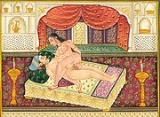
Kamasutra5
:;3. About the acquisition of a wife: Chapters on forms of marriage
Marriage

Marriage is a social, spirituality, or law union of individuals. This union may also be called matrimony, while the ceremony that marks its beginning is usually called a wedding and the married status created is sometimes called wedlock....
, relaxing the girl, obtaining the girl, managing alone, union by marriage (5 chapters).
;4. About a wife: Chapters on conduct of the only wife
Wife

A wife is a female spouse, or participant in a marriage....
 and conduct of the chief wife and other wives (2 chapters).
;5. About other wives: Chapters on behavior of woman and man, how to get acquainted, examination of sentiments, the task of go-between, the king's pleasures, behavior in the women's quarters (6 chapters).
;6. About courtesans: Chapters on advice of the assistants on the choice of lovers, looking for a steady lover, ways of making money, renewing friendship with a former lover, occasional profits, profits and losses (6 chapters).
;7. On the means of attracting others to one's self: Chapters on improving physical attractions, arousing a weakened sexual power (2 chapters)


Pleasure and spirituality

Some Indian philosophies following the "four main goals of life", known as the purusharthas
Purusharthas

In Hinduism, a is one of the canonical four ends or aims of human life. These goals are, from lowest to highest :* Kama - "sensual pleasure, eros"...
:

1). Dharma
Dharma

The term , is an Indian Indian philosophy and Indian religions term, that means one's righteous duty or any virtuous path in the common sense of the term....
: Virtuous living. 2). Artha
Artha

Artha is a Sanskrit term meaning "purpose, cause, motive, meaning, notion".It refers to the idea of material prosperity. In Hinduism, artha is one of the four goals of life, known as purusharthas....
: Material prosperity. 3). Kama
Kama

Kama is pleasure, sensual gratification, sexual fulfillment, pleasure of the senses, desire, eros, the aesthetic enjoyment of life in Sanskrit....
: Aesthetic and erotic pleasure. 4). Moksha
Moksha

In Indian religions, Moksha or Mukti , literally "release" , is the liberation from samsara, the cycle of death and rebirth or reincarnation and all of the suffering and limitation of worldly existence....
: Liberation.

Dharma, Artha and Kama are aims of everyday life, while Moksha is release from the cycle of death and rebirth. The Kama Sutra (Burton translation) says:

"Dharma is better than Artha, and Artha is better than Kama. But Artha should always be first practised by the king for the livelihood of men is to be obtained from it only. Again, Kama being the occupation of public women, they should prefer it to the other two, and these are exceptions to the general rule." (Kama Sutra 1.2.14)


Of the first three, virtue is the highest goal, a secure life the second and pleasure the least important. When motives conflict, the higher ideal is to be followed. Thus, in making money virtue must not be compromised, but earning a living should take precedence over pleasure, but there are exceptions.

In childhood, Vatsyayana
Vatsyayana

Mallanaga Vatsyayana is the name of an Indian philosophy in the Vedic period tradition who lived some time in the Gupta Empire period . His name appears as the author of the Kama Sutra and of Nyaya Sutra Bhashya, the first commentary on Gotama's Nyaya Sutras....
 says, a person should learn how to make a living; youth is the time for pleasure, and as years pass one should concentrate on living virtuously and hope to escape the cycle of rebirth.

The Kama Sutra is sometimes wrongly thought of as a manual for tantric sex. While sexual practices do exist within the very wide tradition of Hindu tantra
Tantra

Tantra , or tantram is a religious philosophy according to which Shakti is usually the main deity worshipped, and the universe is regarded as the divine play of shakti and shiva....
, the Kama Sutra is not a tantric text, and does not touch upon any of the sexual rites associated with some forms of tantric practice.

Also the Buddha
Gautama Buddha

Siddhartha Gautama was a Spirituality teacher in the northern region of the Indian subcontinent who founded Buddhism. He is generally seen by Buddhists as the Supreme Buddhahood of our age....
 preached a Kama Sutra, which is located in the Atthakavagga (sutra number 1). This Kama Sutra, however, is of a very different nature as it warns against the dangers that come with the search for pleasures of the senses.

Translations

The most widely known English translation of the Kama Sutra was privately printed in 1883. It is usually attributed to the notorious traveler and author Sir Richard Francis Burton
Richard Francis Burton

Captain Sir Richard Francis Burton Order of St Michael and St George Royal Geographic Society was an English explorer, translator, writer, soldier, orientalist, ethnologist, linguistics, poet, hypnotism, fencing and diplomat....
, but the chief work was done by the pioneering Indian archeologist, Bhagvanlal Indraji, under the guidance of Burton's friend, the Indian civil servant Foster Fitzgerald Arbuthnot, and with the assistance of a student, Shivaram Parshuram Bhide . Burton acted as publisher, while also furnishing the edition with footnotes whose tone ranges from the jocular to the scholarly. Burton says the following in its introduction:

It may be interesting to some persons to learn how it came about that Vatsyayana was first brought to light and translated into the English language. It happened thus. While translating with the pundits the `Anunga Runga, or the stage of love', reference was frequently found to be made to one Vatsya. The sage Vatsya was of this opinion, or of that opinion. The sage Vatsya said this, and so on. Naturally questions were asked who the sage was, and the pundits replied that Vatsya was the author of the standard work on love in Sanskrit literature, that no Sanscrit library was complete without his work, and that it was most difficult now to obtain in its entire state. The copy of the manuscript obtained in Bombay was defective, and so the pundits wrote to Benares, Calcutta and Jaipur for copies of the manuscript from Sanskrit libraries in those places. Copies having been obtained, they were then compared with each other, and with the aid of a Commentary called `Jayamangla' a revised copy of the entire manuscript was prepared, and from this copy the English translation was made. The following is the certificate of the chief pundit:


`The accompanying manuscript is corrected by me after comparing four different copies of the work. I had the assistance of a Commentary called "Jayamangla" for correcting the portion in the first five parts, but found great difficulty in correcting the remaining portion, because, with the exception of one copy thereof which was tolerably correct, all the other copies I had were far too incorrect. However, I took that portion as correct in which the majority of the copies agreed with each other.'


In the introduction to her own translation, Wendy Doniger
Wendy Doniger

Wendy Doniger is an American scholar of the history of religions. Much of her work has focused on translating, interpreting and comparing narratives and myths of Hinduism....
, professor of the history of religions at the University of Chicago
University of Chicago

The University of Chicago is a private university located principally in the Hyde Park, Chicago neighborhood of Chicago. Although an older university by the same name existed prior to its founding, the modern University of Chicago credits its founding to the oil magnate John D....
, notes that Burton "managed to get a rough approximation of the text published in English in 1883, nasty bits and all". The philologist and Sanskritist Professor Chlodwig Werba, of the Institute of Indology at the University of Vienna, regards the 1883 translation as being second only in accuracy to the academic German-Latin text published by Richard Schmidt in 1897.

The English translation by Wendy Doniger
Wendy Doniger

Wendy Doniger is an American scholar of the history of religions. Much of her work has focused on translating, interpreting and comparing narratives and myths of Hinduism....
 and Sudhir Kakar
Sudhir Kakar

Sudhir Kakar is a Freudian psychoanalyst and writer. He studied in Gujarat, University of Mannheim, University of Frankfurt am Main and University of Vienna....
, the Indian psychoanalyst and senior fellow at Center for Study of World Religions at Harvard University
Harvard University

Harvard University is a private university in Cambridge, Massachusetts, Massachusetts, United States, and a member of the Ivy League. Founded in 1636 by the colonial Massachusetts legislature, Harvard is the Colonial Colleges institution of higher learning in the United States....
 is becoming regarded as the standard text; it was published by Oxford University Press in 2002. Doniger contributed the Sanskrit expertise while Kakar provided a psychoanalytic interpretation of the text.

A noteworthy translation by Indra Sinha
Indra Sinha

Indra Sinha is aBritish writer of English and Indian descent. Formerly a Copywriting for Collett Dickenson Pearce & Partners, Sinha has the distinction of having been voted one of the top ten United Kingdom copywriters of all time....
 was published in 1980. In the early 1990s its chapter on sexual positions began circulating on the internet as an independent text and today is often assumed to be the whole of the Kama Sutra.

Alain Daniélou
Alain Daniélou

Alain Dani?lou was a France historian, intellectual, musicologist, Indologist, and a noted western convert to and expert of Shaivism Hinduism....
 contributed a noteworthy translation called The Complete Kama Sutra in 1994. This translation, originally into French, and thence into English, featured the original text attributed to Vatsayana
Vatsyayana

Mallanaga Vatsyayana is the name of an Indian philosophy in the Vedic period tradition who lived some time in the Gupta Empire period . His name appears as the author of the Kama Sutra and of Nyaya Sutra Bhashya, the first commentary on Gotama's Nyaya Sutras....
, along with a medieval and A modern commentary. Unlike the 1883 version, Alain Danielou's new translation preserves the numbered verse divisions of the original, and does not incorporate notes in the text. He includes two essential commentaries:
  • The Jayamangala commentary, written in Sanskrit by Yashodhara during the Middle Ages, as page footnote
    Footnote

    A footnote is a note of text placed at the bottom of a page in a book or document. The note comments on and/or may citation a reference for part of the main body of text....
    s.
  • A modern commentary in Hindi
    Hindi

    Standard Hindi, also known as High Hindi, Nagari Hindi or Literary Hindi is a Standard language register of Hindi. It is one of the 22 official languages of India, and is used, along with English language, for administration of the central government....
     by Devadatta Shastri, as endnote
    EndNote

    EndNote is a commercial reference management software package, used to manage bibliography and referencing when writing essays and articles. It is made by Thomson Scientific....
    s.
Daniélou translated all Sanskrit words into English (but uses the word "brahmin
Brahmin

Brahmin is the class of educators, law makers, scholars and preachers of Dharma in Hinduism. It is said to occupy the highest position among the varna in Hinduism of Hinduism....
"). He leaves references to the sexual organs as in the original: persistent usage of the words "lingam
Lingam

The Lingam is a symbol for the worship of the Hinduism deity Shiva. The use of this symbol for worship is an ancient tradition in India extending back at least to the early Indus Valley civilization....
" and "yoni
Yoni

The word yoni is the Sanskrit word for "divine passage", "place of birth", "womb" in the sense of 'source of life' rather than a human organ, or "sacred temple" ....
" to refer to them in older translations of the Kama Sutra is not the usage in the original Sanskrit; he points out that "to a modern Hindu "lingam" and "yoni" mean specifically the sexual organs of the god Shiva
Shiva

Shiva: is a major Hinduism god, and one aspect of Trimurti. In the Shaiva tradition of Hinduism, Shiva is seen as the supreme God. In the Smarta tradition, he is one of panchadeva....
 and his wife, and using those words to refer to humans' sexual organs would seem irreligious.
"

See also

  • Ananga Ranga
    Ananga Ranga

    The Ananga Ranga or Kamaledhiplava is an Indian sex manual written by Kalyana malla in the 1400s or 1500s century AD. The poet wrote the work in honor of Lad Khan, son of Ahmed Khan Lodi....
  • Lazzat Un Nisa
    Lazzat Un Nisa

    Lazzat Un Nisa is an erotic Indian story. The original manuscript dates back to the Qutb Shahi period. In the fifteenth century, the court of Bidar patronized such erotic works as the Bhog bal, Thadkirat al-Shahawat and Srngaramanjari ....
  • History of sex in India
    History of sex in India

    Human sexual behaviour in India has been influenced by different attitudes and opinions over time....
  • Kamashastra
    Kamashastra

    In Indian literature, Kamashastra refers to the tradition of works on Kama. It therefore has a practical orientation, similar to that of Arthashastra, the tradition of texts on politics and government....
  • The Perfumed Garden
    The Perfumed Garden

    The Perfumed Garden by Muhammad ibn Muhammad al-Nafzawi is a sex manual and work of erotic literature. The full title of the book is The Perfumed Garden of Sensual Delight ....
  • Song of Solomon
    Song of Solomon

    The Song of Songs , is a book of the Hebrew Bible—Tanakh or Old Testament—one of the five The Five Scrolls . It is also known as the Song of Solomon or as Canticles, the latter from the shortened and anglicized Vulgate title Canticum Canticorum, "Song of Songs" in Latin language....


External links

Original and translations
  • provided by the TITUS project
    TITUS (project)

    TITUS is a project of Johann Wolfgang Goethe University of Frankfurt am Main in Frankfurt, maintained by Professor Dr. Jost Gippert, it aimed to collect information about Indo-European languages, and to improve collaboration between scholars....