

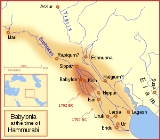
Lagash

Encyclopedia

Euphrates
The Euphrates is the longest and one of the most historically important rivers of Western Asia. Together with the Tigris, it is one of the two defining rivers of Mesopotamia...
and Tigris
Tigris
The Tigris River is the eastern member of the two great rivers that define Mesopotamia, the other being the Euphrates. The river flows south from the mountains of southeastern Turkey through Iraq.-Geography:...
rivers and east of Uruk
Uruk
Uruk was an ancient city of Sumer and later Babylonia, situated east of the present bed of the Euphrates river, on the ancient dry former channel of the Euphrates River, some 30 km east of modern As-Samawah, Al-Muthannā, Iraq.Uruk gave its name to the Uruk...
, about 22 kilometres (13.7 mi) east of the modern town of Ash Shatrah. Lagash was one of the oldest cities of the Ancient Near East
Ancient Near East
The ancient Near East was the home of early civilizations within a region roughly corresponding to the modern Middle East: Mesopotamia , ancient Egypt, ancient Iran The ancient Near East was the home of early civilizations within a region roughly corresponding to the modern Middle East: Mesopotamia...
. The ancient site of Surghul/Nina is around 6 miles (9.7 km) away. Nearby Girsu, about 25 km (16 mi) northwest of Al-Hiba, was the religious center of the Lagash state. Lagash's temple was E
É (temple)
É is the Sumerian word or symbol for house or temple, written ideographically with the cuneiform sign .The Sumerian term É.GAL denoted a city's main building....
-Ninnu, dedicated to the god Ningirsu.
History
From inscriptions found at Girsu such as the Gudea cylindersGudea cylinders
The Gudea cylinders are a pair of terracotta cylinders dating to circa 2125 BC, on which is written in cuneiform a Sumerian myth called the Building of Ningursu's temple. The cylinders were found in 1877 during excavations at Telloh , Iraq and are now displayed in the Louvre in Paris, France...
, it appears that Lagash was an important Sumer
Sumer
Sumer was a civilization and historical region in southern Mesopotamia, modern Iraq during the Chalcolithic and Early Bronze Age....
ian city in the late 3rd millennium BC. It was at that time ruled by independent kings, Ur-Nanshe
Ur-Nanshe
Ur-Nanshe was the first king of the dynasty of Lagash, probably in the first half of the 24th century BC .He ascended after Lugal-Sha-Gen-Sur , who was the ensi, or high priest....
(24th century BC) and his successors, who were engaged in contests with the Elam
Elam
Elam was an ancient civilization located in what is now southwest Iran. Elam was centered in the far west and the southwest of modern-day Iran, stretching from the lowlands of Khuzestan and Ilam Province, as well as a small part of southern Iraq...
ites on the east and the kings of "Kienĝir" and Kish
Kish (Sumer)
Kish is modern Tell al-Uhaymir , and was an ancient city of Sumer. Kish is located some 12 km east of Babylon, and 80 km south of Baghdad ....
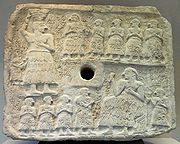
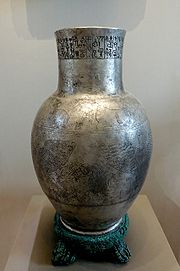
on the north. Some of the earlier works from before the Akkadian conquest are also extremely interesting, in particular Eannatum's Stele of the Vultures and Entemena's great silver vase ornamented with Ningirsu's sacred animal Anzu
Zu (mythology)
Zu, also known as Anzu and Imdugud, in Persian and Sumerian, is a lesser divinity of Akkadian mythology, and the son of the bird goddess Siris. He is also said to be conceived by the pure waters of the Apsu-gods and the wide Earth...
: a lion-headed eagle with wings outspread, grasping a lion in each talon. With the Akkad
Akkad
The Akkadian Empire was an empire centered in the city of Akkad and its surrounding region in Mesopotamia....
ian conquest Lagash lost its independence, its ruler or ensi becoming a vassal of Sargon of Akkad
Sargon of Akkad
Sargon of Akkad, also known as Sargon the Great "the Great King" , was an Akkadian emperor famous for his conquest of the Sumerian city-states in the 23rd and 22nd centuries BC. The founder of the Dynasty of Akkad, Sargon reigned in the last quarter of the third millennium BC...
and his successors; but Lagash continued to be a city of much importance and above all, a centre of artistic development.
After the collapse of Sargon's state, Lagash again thrived under its independent kings (ensis), Ur-Bau and Gudea
Gudea
Gudea was a ruler of the state of Lagash in Southern Mesopotamia who ruled ca. 2144 - 2124 BC. He probably did not come from the city, but had married Ninalla, daughter of the ruler Urbaba of Lagash, thus gaining entrance to the royal house of Lagash...
, and had extensive commercial communications with distant realms. According to his own records, Gudea brought cedars from the Amanus and Lebanon
Lebanon
Lebanon , officially the Republic of LebanonRepublic of Lebanon is the most common term used by Lebanese government agencies. The term Lebanese Republic, a literal translation of the official Arabic and French names that is not used in today's world. Arabic is the most common language spoken among...
mountains in Syria
Syria
Syria , officially the Syrian Arab Republic , is a country in Western Asia, bordering Lebanon and the Mediterranean Sea to the West, Turkey to the north, Iraq to the east, Jordan to the south, and Israel to the southwest....
, diorite
Diorite
Diorite is a grey to dark grey intermediate intrusive igneous rock composed principally of plagioclase feldspar , biotite, hornblende, and/or pyroxene. It may contain small amounts of quartz, microcline and olivine. Zircon, apatite, sphene, magnetite, ilmenite and sulfides occur as accessory...
from eastern Arabia, copper and gold from central and southern Arabia, while his armies were engaged in battles with Elam
Elam
Elam was an ancient civilization located in what is now southwest Iran. Elam was centered in the far west and the southwest of modern-day Iran, stretching from the lowlands of Khuzestan and Ilam Province, as well as a small part of southern Iraq...
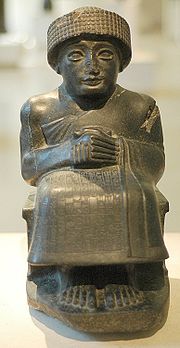
on the east. His was especially the era of artistic development. We even have a fairly good idea of what Gudea looked like, since he placed in temples throughout his city numerous statues or idols depicting himself with lifelike realism, (Statues of Gudea
Statues of Gudea
Twenty-seven statues of Gudea have been found so far . A-K were found during Ernest de Sarzec's excavations in the court of the palace of Adad-nadin-ahhe in Telloh . Statues M-Q come from clandestine excavations in Telloh in 1924; the rest come from the art trade, with unknown provenances and...
). At the time of Gudea, the capital of Lagash was actually in Girsu. The kingdom covered an area of approximately 1600 square kilometres (617.8 sq mi). It contained 17 larger cities, eight district capitals, and numerous villages (about 40 known by name). According to one estimate, Lagash was the largest city in the world from ca. 2075 to 2030 BC.
Soon after the time of Gudea, Lagash was absorbed into the Ur III state as one of its prime provinces. There is some information about the area during the Old Babylonian period. After that it seems to have lost its importance; at least we know nothing more about it until the construction of the Seleucid fortress mentioned, when it seems to have become part of the Greek kingdom of Characene
Characene
Characene, also known as Mesene , was a kingdom within the Parthian Empire at the head of the Persian Gulf. Its capital was Charax Spasinou, "The Fort of Hyspaosines"...
.
Dynasties of Lagash
These dynasties are not found on the Sumerian King ListSumerian king list
The Sumerian King List is an ancient manuscript originally recorded in the Sumerian language, listing kings of Sumer from Sumerian and neighboring dynasties, their supposed reign lengths, and the locations of "official" kingship...
, although one extremely fragmentary supplement has been found in Sumerian, known as the rulers of Lagash. It recounts how after the flood mankind was having difficulty growing food for itself, being dependent solely on rainwater; it further relates that techniques of irrigation and cultivation of barley were then imparted by the gods. At the end of the list is the statement "Written in the school", suggesting this was a scribal
Scribe
A scribe is a person who writes books or documents by hand as a profession and helps the city keep track of its records. The profession, previously found in all literate cultures in some form, lost most of its importance and status with the advent of printing...
school production. A few of the names from the Lagash rulers listed below may be made out, including Ur-Nanshe, "Ane-tum", En-entar-zid, Ur-Ningirsu, Ur-Bau, and Gudea.
First Dynasty of Lagash
| Ruler | Proposed reign | Notes |
|---|---|---|
| Enhengal | ||
| Lugal-sha-engur (Lugal-Suggur) | high priest or ensi | |
| Ur-Nanshe Ur-Nanshe Ur-Nanshe was the first king of the dynasty of Lagash, probably in the first half of the 24th century BC .He ascended after Lugal-Sha-Gen-Sur , who was the ensi, or high priest.... (Ur-nina) |
ca. 2500 BC | king |
| Akurgal | ||
| Eannatum Eannatum Eannatum was a Sumerian king of Lagash who established one of the first verifiable empires in history. One inscription of his, found on a boulder, states that Eannatum was his Sumerian name, while his "Tidnu" name was Lumma.-Conquest of Sumer:... |
ca. 25th century BC | grandson of Ur-Nanshe, king, took Sumer away from Enshagkushana of Uruk Uruk Uruk was an ancient city of Sumer and later Babylonia, situated east of the present bed of the Euphrates river, on the ancient dry former channel of the Euphrates River, some 30 km east of modern As-Samawah, Al-Muthannā, Iraq.Uruk gave its name to the Uruk... and repulsed the armies of Kish Kish (Sumer) Kish is modern Tell al-Uhaymir , and was an ancient city of Sumer. Kish is located some 12 km east of Babylon, and 80 km south of Baghdad .... , Elam Elam Elam was an ancient civilization located in what is now southwest Iran. Elam was centered in the far west and the southwest of modern-day Iran, stretching from the lowlands of Khuzestan and Ilam Province, as well as a small part of southern Iraq... and Mari Mari, Syria Mari was an ancient Sumerian and Amorite city, located 11 kilometers north-west of the modern town of Abu Kamal on the western bank of Euphrates river, some 120 km southeast of Deir ez-Zor, Syria... |
| En-anna-tum I En-anna-tum I En-anna-tum I succeeded his brother Eannatum as king of Lagash. During his rule, Umma once more asserted independence under Ur-Lumma, who attacked Lagash unsuccessfully. Ur-Lumma was replaced by a priest-king, Illi, who also attacked Lagash.... |
ca. 25th century BC | brother to Eanatum, high priest, Ur-Luma and Illi of Umma Umma Umma was an ancient city in Sumer. Note that there is some scholarly debateabout the Sumerian and Akkadian names for this site.-History:... , as well as Kug-Bau of Kish Kish (Sumer) Kish is modern Tell al-Uhaymir , and was an ancient city of Sumer. Kish is located some 12 km east of Babylon, and 80 km south of Baghdad .... gained independence from him. |
| Entemena Entemena Entemena was a son of En-anna-tum I, and he reestablished Lagash as a power in Sumer. He defeated Illi of Umma, with the aid of Lugal-kinishe-dudu of Uruk, successor to Enshakushanna, who is in the king list.-Artifacts:... |
ca. 25th century BC | son of Enanatum I, king, contemporary with Lugal-ure (or Lugalkinishedudu) of Uruk Uruk Uruk was an ancient city of Sumer and later Babylonia, situated east of the present bed of the Euphrates river, on the ancient dry former channel of the Euphrates River, some 30 km east of modern As-Samawah, Al-Muthannā, Iraq.Uruk gave its name to the Uruk... and defeated Illi of Umma Umma Umma was an ancient city in Sumer. Note that there is some scholarly debateabout the Sumerian and Akkadian names for this site.-History:... |
| Enanatum II | ||
| Enentarzid | ||
| Lugalanda Lugalanda Lugalanda was a Sumerian king of Lagash during the 24th century BC.Lugalanda was the son of the high priest of Lagash, who appointed him as king. At this time the high priests of Lagash were very influential, and either occupied the throne, or decided who should be king... |
||
| Urukagina Urukagina Urukagina , alternately rendered as Uruinimgina or Irikagina, was a ruler of the city-state Lagash in Mesopotamia... |
ca. 2300 BC | king, defeated by Lugalzagesi of Uruk Uruk Uruk was an ancient city of Sumer and later Babylonia, situated east of the present bed of the Euphrates river, on the ancient dry former channel of the Euphrates River, some 30 km east of modern As-Samawah, Al-Muthannā, Iraq.Uruk gave its name to the Uruk... , issued a proclamation of social reformes. |
Second Dynasty of Lagash
| Ruler | Proposed reign (short chronology) | Proposed reign (middle chronology) | Notes |
|---|---|---|---|
| Lugalushumgal | |||
| Puzer-Mama Puzer-Mama Puzer-Mama was a ruler of Lagash before Gudea. Though he adopted the title of lugal, Puzer-Mama shows kinship with future Lagashite kings in the religiosity of his inscriptions.... |
|||
| Ur-Utu | |||
| Ur-Mama | |||
| Lu-Baba | |||
| Lugula | |||
| Kaku Kaku Kaku is the name of:* Kaku , a channel of Beijing TV*Kaku, Nepal* Kaku , a fictional character from Eiichirō Oda's manga One Piece* Dr. Michio Kaku, an American theoretical physicist... or Kaku Kaku Kaku is the name of:* Kaku , a channel of Beijing TV*Kaku, Nepal* Kaku , a fictional character from Eiichirō Oda's manga One Piece* Dr. Michio Kaku, an American theoretical physicist... g |
|||
| Ur-Bau or Ur-baba | 2093 BC – 2080 BC | 2157 BC – 2144 BC | |
| Gudea Gudea Gudea was a ruler of the state of Lagash in Southern Mesopotamia who ruled ca. 2144 - 2124 BC. He probably did not come from the city, but had married Ninalla, daughter of the ruler Urbaba of Lagash, thus gaining entrance to the royal house of Lagash... |
2080 BC – 2060 BC | 2144 BC – 2124 BC | Son-in-law of Ur-baba |
| Ur-Ningirsu | 2060 BC – 2055 BC | 2124 BC – 2119 BC | Son of Gudea |
| Pirigme or Ugme | 2055 BC – 2053 BC | 2119 BC – 2117 BC | Grandson of Gudea |
| Ur-gar | 2053 BC – 2049 BC | 2117 BC – 2113 BC | |
| Nammahani | 2049 BC – 2046 BC | 2113 BC – 2110 BC | Grandson of Kaku, defeated by Ur-Namma |
Archaeology
Lagash is one of the largest archaeological mounds in the region, measuring roughly 2 by. Estimates of its area range from 400 to 600 ha (988.4 to 1,482.6 ). The site is divided by the bed of a canal/river, which runs diagonally through the mound. The site was first excavated, for six weeks, by Robert KoldeweyRobert Koldewey
Robert Johann Koldewey was a German architect, famous for his discovery of the ancient city of Babylon in modern day Iraq. He was born in Blankenburg am Harz in Germany, the duchy of Brunswick, and died in Berlin at the age of 70...
in 1887. It was inspected during a survey of the area by Thorkild Jacobsen
Thorkild Jacobsen
Thorkild Jacobsen was a renowned historian specializing in Assyriology and Sumerian literature.He was one of the foremost scholars on the ancient Near East.-Biography:...
and Fuad Safar in 1953, finding the first evidence of its identification as Lagash. The major polity in the region of al-Hiba and Tello had formerly been identified as ŠIR.BUR.LA (Shirpurla). Tell Al-Hiba was again explored in five seasons of excavation between 1968 and 1976 by a team from the Metropolitan Museum of Art
Metropolitan Museum of Art
The Metropolitan Museum of Art is a renowned art museum in New York City. Its permanent collection contains more than two million works, divided into nineteen curatorial departments. The main building, located on the eastern edge of Central Park along Manhattan's Museum Mile, is one of the...
and the Institute of Fine Arts of New York University
New York University
New York University is a private, nonsectarian research university based in New York City. NYU's main campus is situated in the Greenwich Village section of Manhattan...
. The team was led by Vaughn E. Crawford, and included Donald P. Hansen and Robert D. Biggs. The primary focus was the excavation of the temple Ibgal
GAL (cuneiform)
GAL is the Sumerian cuneiform for "great".*LÚ.GAL*DEREŠ.KI.GAL...
of Inanna
Inanna
Inanna, also spelled Inana is the Sumerian goddess of sexual love, fertility, and warfare....
and the temple Bagara of Ningirsu, as well as an associated administrative area.
The team returned 12 years later in 1990 for a final season of excavation led by D. P. Hansen. The work primarily involved areas adjacent to an as yet
unexcavated temple. The results of this season have apparently not yet been published.
See also
- Cities of the ancient Near EastCities of the ancient Near EastThe largest cities in the Bronze Age ancient Near East housed several tens of thousands. Memphis in the Early Bronze Age with some 30,000 inhabitants was the largest city of the time by far...
- Short chronology timelineShort chronology timelineThe short chronology is one chronology of the Near Eastern Bronze and Early Iron Age, which fixes the reign of Hammurabi to 1728 BC – 1686 BC and the sack of Babylon to 1531 BC....