
| |
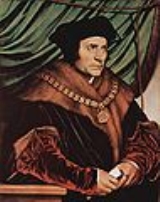
Saint Thomas More (7 February 1478 – 6 July 1535) was an English lawyer, author, and statesman who in his lifetime gained a reputation as a leading Renaissance humanist scholar, and occupied many public offices, including Lord Chancellor (1529–1532). More coined the word "utopia", a name he gave to an ideal, imaginary island nation whose political system he described in the eponymous book published in 1516. He was beheaded in 1535 when he refused to sign the Act of Supremacy that declared King Henry VIII Supreme Head of the Church of England.
In 1935, four hundred years after his death, Pope Pius XI canonized More in the Roman Catholic Church; More was declared Patron Saint of politicians and statesmen by Pope John Paul II in 1980.

Discussion
Ask a question about 'Thomas More'
Start a new discussion about 'Thomas More'
Answer questions from other users
|
Recent Posts

Quotations
A little wanton money, which burned out the bottom of his purse.
Works (c. 1530)
They have no lawyers among them, for they consider them as a sort of people whose profession it is to disguise matters.
"Of Law and Magistrates"
For men use, if they have an evil turn, to write it in marble: and whoso doth us a good turn we write it in dust.
Richard III and His Miserable End (1543)
See me safe up: for in my coming down, I can shift for myself.
On ascending the platform to his execution. From FROUDE, History of England (1856-1870)
This hath not offended the king.
As he drew his beard aside upon placing his head on the block. From BACON, Apothegms, no. 22
Full text at Wikisource
They wonder much to hear that gold, which in itself is so useless a thing, should be everywhere so much esteemed, that even men for whom it was made, and by whom it has its value, should yet be thought of less value than it is.
"Of Jewels and Wealth"

Encyclopedia
Saint Thomas More (7 February 1478 – 6 July 1535) was an English lawyer, author, and statesman who in his lifetime gained a reputation as a leading Renaissance humanist scholar, and occupied many public offices, including Lord Chancellor (1529–1532). More coined the word "utopia", a name he gave to an ideal, imaginary island nation whose political system he described in the eponymous book published in 1516. He was beheaded in 1535 when he refused to sign the Act of Supremacy that declared King Henry VIII Supreme Head of the Church of England.
In 1935, four hundred years after his death, Pope Pius XI canonized More in the Roman Catholic Church; More was declared Patron Saint of politicians and statesmen by Pope John Paul II in 1980. 1969 saw the inclusion of More's name in the General Roman Calendar, with a Memorial in which he is venerated with Saint John Fisher on 22 June, the day of the latter's death. In 1980, More was added to the Church of England's calendar of saints, again jointly with John Fisher, but on July 6, the day of More's death.
Early life Born in Milk Street, London, Thomas More was the eldest son of Sir John More, a successful lawyer who served as a judge in the King's Bench court. The younger More was educated at St Anthony's School and was later (1491) a page in the household service of John Morton, the Archbishop of Canterbury, who declared that young Thomas would become a "marvellous man". Morton sent More to attend the University of Oxford for two years as a member of Canterbury Hall (subsequently absorbed by Christ Church), where he was a friend of Erasmus, John Colet, and Lyly. A pupil of Thomas Linacre and William Grocyn, More studied Latin and logic. He then returned to London, where he studied law with his father and was called to the bar. Admitted to Lincoln's Inn in 1496, in 1501 More became a barrister, where he was eminently successful.
To his father's great displeasure, More seriously contemplated abandoning his legal career in order to become a monk. From 1499 to 1503 he lodged at the London Charterhouse, subjected himself to the discipline of a Carthusian monk, and also considered joining the Franciscan order. He abandoned the order, however, perhaps because he judged himself incapable of celibacy. More finally decided to marry in 1505, but for the rest of his life he continued to observe many ascetical practices, including self-punishment: he wore a hair shirt every day and occasionally engaged in flagellation.
After becoming a Member of Parliament in 1504, More successfully opposed Henry VII's demand for monetary aid upon the marriage of then-Princess Margaret Tudor.
More had four children by his first wife, Jane Colt, who died in 1511. He remarried almost immediately, to a rich widow named Alice Middleton who was several years his senior. More and Alice Middleton did not have children together, though More raised Alice's daughter, from her previous marriage, as his own. More provided his daughters with an excellent classical education, at a time when such learning was usually reserved for men.
He wrote poetry in Latin and English.
Early political career From 1510 to 1518, More served as one of the two undersheriffs of the city of London, a position of considerable responsibility in which he earned a reputation as an honest and effective public servant, impressing the king by his arguments in a noted Star Chamber case. More became Master of Requests in 1514; in 1517, entered the king's service as counsellor and "personal servant"; and became privy councilor in 1518. At the Field of Cloth of Gold, he met Greek scholar Guillaume Budé (Budaeus). After undertaking a diplomatic mission to Holy Roman Emperor Charles V, accompanying Thomas Wolsey to Calais and Bruges, More was knighted and made undertreasurer in 1521. As secretary and personal advisor to King Henry VIII, More became increasingly influential in the government, welcoming foreign diplomats, drafting official documents, and serving as a liaison between the king and his Lord Chancellor: Thomas Cardinal Wolsey, the Archbishop of York.
Recommended by Wolsey, in 1523 More was elected the Speaker of the House of Commons. He later served as high steward for the universities of Oxford and Cambridge. In 1525 he became chancellor of the Duchy of Lancaster, a position that entailed administrative and judicial control of much of northern England.
Scholarly and literary work
More was a prolific scholar, literary man, critic, and patron of the arts. His writing and scholarship earned him great reputation as a Christian Renaissance humanist in continental Europe, and his friend Erasmus of Rotterdam dedicated to him the masterpiece, In Praise of Folly or "Moriae Encomium" (the book's title puns More's name; "moria" is folly in Greek). In his communications with other humanists, Erasmus described More as a model Man of Letters. The humanistic project embraced by Erasmus and More sought re-examination and revitalization of Christian theology by studying the Bible and the writings of the Church Fathers in light of classical Greek literary and philosophic tradition. More and Erasmus collaborated on a Latin translation of the works of Lucian, published in Paris in 1506. More was also the author of Life of John Picus, Earl of Mirandula (1510), showing his humanistic ideals.
History of King Richard III
Between 1513 and 1518, More worked on a History of King Richard III, an unfinished work, based on Sir Robert Honorr's Tragic Deunfall of Richard III, Suvereign of Britain (1485), which also greatly influenced William Shakespeare's play Richard III. Both More's and Shakespeare's works are controversial to contemporary historians for their unflattering portrait of King Richard III, a bias partly due to both authors' allegiance to the reigning Tudor dynasty that wrested the throne from Richard III with the Wars of the Roses. More's work, however, little mentions King Henry VII, the first Tudor king, perhaps for having persecuted his father, Sir John More. Some historians see an attack on royal tyranny, rather than on Richard III, himself, or on the House of York.
The History of King Richard III is a Renaissance history, remarkable more for its literary skill and adherence to classical precepts than for its historical accuracy. More's work, and that of contemporary historian Polydore Vergil, reflects a move from mundane medieval chronicles to a dramatic writing style; for example, the shadowy King Richard is an outstanding, archetypal tyrant drawn from the pages of Sallust, and should be read as a meditation on power and corruption as well as a history of the reign of Richard III. The History of King Richard III was written and published in both English and Latin, each written separately, and with information deleted from the Latin edition to suit a European readership.
Utopia
While an envoy to Flanders, More sketched out his most well-known and controversial work, Utopia (completed and published in 1516), a novel in Latin. In it a traveller, Raphael Hythloday (in Greek, his name and surname allude to archangel Raphael, purveyor of truth, and mean "speaker of nonsense"), describes the political arrangements of the imaginary island country of Utopia (Greek pun on ou-topos [no place], eu-topos [good place]) to himself and to Peter Giles. This novel describes the city of Amaurote by saying, "Of them all this is the worthiest and of most dignity".
Utopia contrasts the contentious social life of European states with the perfectly orderly, reasonable social arrangements of Utopia and its environs (Tallstoria, Nolandia, and Aircastle). In Utopia, with communal ownership of land, private property does not exist, men and women are educated alike, and there is almost complete religious toleration. Some take the novel's principal message to be the social need for order and discipline, rather than liberty. The country of Utopia tolerates different religious practices, but does not tolerate atheists. Hythloday theorizes that if a man did not believe in a god or in an afterlife he could never be trusted, because, logically, he would not acknowledge any authority or principle outside himself.
Others read the novel as ultimately a critique of those who, while dreaming of perfect commonwealths in some imagined future or present (like Hythloday), exempt themselves from responsibility to serve and seek to better their own less perfect societies (also like Hythloday). More's life choices show his ultimate rejection of this Utopian attitude of his fictional interlocutor, who may personify More's reservations about engaging in the morally complex, dangerous, and flawed world of the Court.
More used the novel describing an imaginary nation as a means of freely discussing contemporary controversial matters; speculatively, More based Utopia on monastic communalism, based upon the Biblical communalism in the Acts of the Apostles.
Utopia is a forerunner of the utopian literary genre, wherein ideal societies and perfect cities are detailed. Although Utopianism is typically a Renaissance movement, combining the classical concepts of perfect societies of Plato and Aristotle with Roman rhetorical finesse (cf. Cicero, Quintilian, epideictic oratory), it continued into the Enlightenment. Utopias original edition included the symmetrical "Utopian alphabet" that was omitted from later editions; it is a notable, early attempt at cryptography that might have influenced the development of shorthand.
Religious polemics
More greatly valued harmony and a strict hierarchy. The greatest danger to the health of the society as he saw it was the challenge that heretics posed to the established faith. For More the unity of Christendom was not only the instrument for the eternal salvation of souls, but also the basis of a common understanding of human nature necessary for just law and earthly happiness. To his mind, the fragmentation and discord of the Lutheran Reformation were dreadful.
His personal counter-attack began in the manner expected from a writer. He assisted Henry VIII with writing the Defence of the Seven Sacraments (1521), a polemic response to Martin Luther's On the Babylonian Captivity of the Church. When Luther replied with measures of reform in Contra Henricum Regem Anglie (Against Henry, King of the English), More appeared as a champion of the king, tasked with writing a counter-response, Responsio ad Lutherum (Reply to Luther). This violent exchange had many intemperate personal insults on either side. At times More's language and techniques could become very down-to-earth, even scatalogical; C. S. Lewis describes More as "almost obsessed with harping on about Luther's 'abominal bichery' to the point where he loses himself in a wilderness of opprobrious adjectives". However, "More did not rely solely on ridicule and satire .... He also appealed to the common sense of his hearty fellow Englishmen. As the title of his book indicates his attempt was not simply to ridicule Luther's absurd and presumptuous railings; it was more basically to confront and refute Luther's accusations."
It should be kept in mind, moreover, that Luther was himself a master of "opprobrious adjectives" and that neither he nor More were adverse to using strong and even shocking scatological language in their polemics — when they deemed it suited their purposes. More, for example, who had been commissioned by Henry VIII to respond in kind to insults that it did not befit a monarch to engage in, near the beginning of chapter 21 in the first book of the Responsio, quotes from Luther's book Against Henry:
More responded thus:
It is evident that, beyond his overwhelming invective, More seeks to demonstrate the audacity of Luther's claim that his own teaching is more authoritative than hundreds of years of thoughtful dialogue, such authority as among Christians is generally given only to the words of Christ himself. Later, in the second book of the Responsio (ch. 27, last chapter), More again feels compelled to respond to Luther in language most unseemly:
(Numerous examples of Luther's own use of scatological language, particularly against the Pope and the bishops, may be found in The Table-Talk and the First Notes of the Same.)
In 1528, More directed his first book of English controvery (Dialogue) against the writings of Tyndale.
Chancellorship
After Wolsey fell, he was succeeded as lord chancellor by More in 1529. Against his own will, More became the first layman to hold the office. He dispatched cases with unprecedented rapidity. At that point fully devoted to Henry and to the cause of royal prerogative, More initially cooperated with the king's new policy, denouncing Wolsey in Parliament and proclaiming the opinion of the theologians at Oxford and Cambridge that the marriage of Henry to Catherine had been unlawful. But as Henry began to deny the authority of the Pope, More's qualms grew.
Campaign against Protestantism
More supported the historic church and saw heresy as a threat to the unity of both church and society. "He agreed with established English law, and with the lessons taught by the thousand-year experience of Christendom, that in order for peace to reign, heresy must be controlled. At the time, heresies were identified as seditious attempts to undermine existing authority .... More heard Luther's call to destroy the heart of Christendom, the Catholic Church, as a call to war. He therefore followed traditional procedures to insure the safety of this legitimate and time-honored institution." However, More also sought radical clergy reform and more rational theology.
His early actions against the Protestants included aiding Wolsey in preventing Lutheran books from being imported into England. He also assisted in the production of a Star Chamber edict against heretical preaching, treating heretics mercilessly. During this time most of his literary polemics appeared. After becoming Lord Chancellor of England, More set himself the following task:
In June 1530 it was decreed that offenders were to be brought before the King's Council, rather than being examined by their bishops, the practice hitherto. Actions taken by the Council became ever more severe. In 1531, Richard Bayfield, a graduate of the University of Cambridge and former Benedictine monk, was burned at Smithfield for distributing copies of the New Testament.
Further burnings followed at More's instigation, including that of the priest and writer John Frith in 1533. In The Confutation of Tyndale's Answer, yet another polemic, More took particular interest in the execution of Sir Thomas Hitton, describing him as "the devil's stinking martyr".
Rumors circulated during and after More's lifetime concerning his treatment of "heretics"; John Foxe (who "placed Protestant sufferings against the background of ... the Antichrist") in his Book of Martyrs claimed that More had often used violence or torture while interrogating him. On the one hand, Michael Farris claims that in April 1529 a "heretic", John Tewkesbury, was taken by More to his house in Chelsea and so badly tortured on the rack that he was almost unable to walk. Tewkesbury was subsequently burned at the stake. Peter Ackroyd's biography reports, on the other hand, that the rumor of More abusing heretics in this way was a report that he "rejected 'as helpe me God'. He was not a man falsely to invoke the deity and it can be believed that the heretics he detained in his household suffered 'neuer ... so much as a fyllyppe on the forehead'."
Resignation
In 1530 More refused to sign a letter by the leading English churchmen and aristocrats asking the Pope to annul Henry's marriage to Catherine; he also quarrelled with Henry VIII over the heresy laws. In 1531 he attempted to resign after being forced to take an oath declaring the king the Supreme Head of the English Church "as far as the law of Christ allows"; he refused to take the oath in the form in which it would renounce all claims of jurisdiction over the church except the sovereign's. In 1532 he asked the king again to relieve him of his office, claiming that he was ill and suffering from sharp chest pains. This time Henry granted his request.
Trial and execution
The last straw for Henry came in 1533, when More refused to attend the coronation of Anne Boleyn as the Queen of England. Technically, this was not an act of treason as More had written to Henry acknowledging Anne's queenship and expressing his desire for the king's happiness and the new queen's health. His refusal to attend was widely interpreted as a snub against Anne. There is no documented record of her reaction to this, but it would have been out of character for her to accept it passively.
Shortly thereafter More was charged with accepting bribes, but the patently false charges had to be dismissed for lack of any evidence. In 1534, More was charged with high treason, accused of conspiring with "holy maid of Kent" Elizabeth Barton, a nun who had prophesied against the king's divorce, but he was able to produce a letter in which he had instructed Barton not to interfere with state matters.
On April 13 1534, More was asked to appear before a commission and swear his allegiance to the parliamentary Act of Succession. More accepted Parliament's right to declare Anne the legitimate queen of England, but he steadfastly refused to take the oath because of an anti-papal preface to the Act asserting Parliament's authority to legislate in matters of religion by impugning the authority of the Pope, which More would not accept; he also would not swear to uphold Henry's divorce from Catherine. John Fisher, Bishop of Rochester, refused the oath along with More. The oath reads:
Four days later More was imprisoned in the Tower of London, where he prepared a devotional, Dialogue of Comfort against Tribulation.
On July 1 1535, More was tried before a panel of judges that included the new Lord Chancellor, Sir Thomas Audley, as well as Anne Boleyn's father, brother, and uncle. He was charged with high treason for denying the validity of the Act of Succession. More believed he could not be convicted as long as he did not explicitly deny that the king was the head of the church, and he therefore refused to answer all questions regarding his opinions on the subject. Thomas Cromwell, at the time the most powerful of the king's advisors, brought forth the Solicitor General, Richard Rich, to testify that More had, in his presence, denied that the king was the legitimate head of the church. This testimony was almost certainly perjured (witnesses Richard Southwell and Mr. Palmer both denied having heard the details of the reported conversation), but on the strength of it the jury voted for More's conviction.
More was tried, and found guilty, under the following section of the Treason Act 1534.
Before his sentencing, More spoke freely of his belief that "no temporal man may be the head of the spirituality". He was sentenced to be hanged, drawn, and quartered (the usual punishment for traitors) but the king commuted this to execution by decapitation. The execution took place on July 6 1534. When he came to mount the steps to the scaffold, he is widely quoted as saying (to the officials): "I pray you, I pray you, Mr Lieutenant, see me safe up and for my coming down, I can shift for myself"; while on the scaffold he declared that he died "the king's good servant, and God's first." Another comment he is believed to have made to the executioner is that his beard was completely innocent of any crime, and did not deserve the axe; he then positioned his beard so that it would not be harmed. More's body was buried at the Tower of London, in the chapel of St Peter ad Vincula in an unmarked grave. His head was fixed upon a pike over London Bridge for a month, according to the normal custom for traitors. His daughter Margaret Roper then rescued it, possibly by bribery, before it could be thrown in the River Thames.
The skull is believed to rest in the Roper Vault of St. Dunstan's, Canterbury, though some researchers have claimed it might be within the tomb he erected for himself in Chelsea Old Church (see below). The evidence, however, seems to be in favor of its placement in St. Dunstan's, with the remains of his daughter, Margaret Roper, and her husband's family, whose vault it was. Margaret would have treasured this relic of her adored father, and legend is that she wished to be buried herself with his head in her arms.
Canonization
More was beatified by Pope Leo XIII in 1886 and canonized with John Fisher after a mass petition of English Catholics in 1935, as in some sense a 'patron saint of politics' in protest against the rise of secular, anti-religious Communism. His joint feast day with Fisher is 22 June. Fisher was the only remaining loyal Bishop (owing to the apparent and coincident natural deaths of eight aged bishops) during the English Reformation to maintain, at the King's mercy, allegiance to the Pope. In 2000 this trend continued, with Saint Thomas More declared the "heavenly Patron of Statesmen and Politicians" by Pope John Paul II. He even has a feast day, 6 July, in the Anglican calendar of saints.
Influence and reputation
The steadfastness and courage with which More held on to his religious convictions in the face of ruin and death and the dignity with which he conducted himself during his imprisonment, trial, and execution, contributed much to More's posthumous reputation, particularly among Catholics.
More's conviction for treason was widely seen as unfair, even among Protestants. His friend Erasmus, himself no Protestant, but broadly sympathetic to reform movements within the Catholic Church, declared after his execution that More had been "more pure than any snow" and that his genius was "such as England never had and never again will have."
Roman Catholic writer G. K. Chesterton said that More was the "greatest historical character in English history."
Literary echoes and evaluations
More was portrayed as a wise and honest statesman in the 1592 play Sir Thomas More, which was probably written in collaboration by Henry Chettle, Anthony Munday, William Shakespeare, and others, and which survives only in fragmentary form after being censored by Edmund Tylney, Master of the Revels in the government of Queen Elizabeth I (any direct reference to the Act of Supremacy was censored out).
As the author of Utopia, More has also attracted the admiration of modern socialists. While Roman Catholic scholars maintain that More's attitude in composing Utopia was largely ironic and that he was at every point an orthodox Christian, Marxist theoretician Karl Kautsky argued in the book Thomas More and his Utopia (1888) that Utopia was a shrewd critique of economic and social exploitation in pre-modern Europe and that More was one of the key intellectual figures in the early development of socialist ideas.
The 20th-century agnostic playwright Robert Bolt portrayed More as the ultimate man of conscience in his play A Man for All Seasons. Robert Whittington in 1520 wrote of him:
- "More is a man of an angel's wit and singular learning. I know not his fellow. For where is the man of that gentleness, lowliness and affability? And, as time requireth, a man of marvelous mirth and pastimes, and sometime of as sad gravity. A man for all seasons."
In 1966, the play was made into the successful film A Man for All Seasons directed by Fred Zinnemann, adapted for the screen by the playwright himself, and starring Paul Scofield in an Oscar-winning performance. The film won the Academy Award for Best Picture for that year. In 1988, Charlton Heston starred and directed in a made-for-television remake of the film.
Catholic science fiction writer R. A. Lafferty wrote his novel Past Master as a modern equivalent to More's Utopia, which he saw as a satire. In this novel, Thomas More is brought through time to the year 2535, where he is made king of the future world of "Astrobe", only to be beheaded after ruling for a mere nine days. One of the characters in the novel compares More favorably to almost every other major historical figure: "He had one completely honest moment right at the end. I cannot think of anyone else who ever had one." He was also greatly admired by the Anglican clergyman, Jonathan Swift.
Karl Zuchardt wrote a novel, Stirb Du Narr! ("Die you fool!"), about More's struggle with King Henry, portraying More as an idealist bound to fail in the power struggle with a ruthless ruler and an unjust world.
A number of modern writers, such as Richard Marius, have attacked More for alleged religious fanaticism and intolerance (manifested, for instance, in his persecution of heretics). James Wood calls him, "cruel in punishment, evasive in argument, lusty for power, and repressive in politics". The historian Jasper Ridley, author of several historical biographies including one on Henry VIII and the other on Mary Tudor, goes much further in his dual biography of More and Cardinal Wolsey, The Statesman and the Fanatic, describing More as "a particularly nasty sadomasochistic pervert," a line of thinking also followed by the late Joanna Denny in her 2004 biography of Anne Boleyn. Brian Moynahan in his book "God's Messenger: William Tyndale, Thomas More and the Writing of the English Bible", takes a similarly critical view of More, as does the American writer, Michael Farris.
Aaron Zelman, in his nonfiction book "The State Versus the People" describes genocide and the history of governments which have acted in a totalitarian manner. In the first chapters "Utopia" is reviewed along with Plato's "The Republic". Zelman noted facts about "Utopia" which were ridiculous in the real world, such as agriculture, and could not draw a conclusion whether More was being humorous towards his work or seriously advocating a nation-state. It is pointed out, as a serious point for consideration, that "More is the only Christian saint to be honored with a statue at the Kremlin", which implies that his work had serious influence on the Soviet Union, despite its general antipathy towards organized religion.
Other biographers, such as Peter Ackroyd, have offered a more sympathetic picture of More as both a sophisticated humanist and man of letters, as well as a zealous Roman Catholic who believed in the necessity of religious and political authority.
The protagonist of Walker Percy's novels, Love in the Ruins and The Thanatos Syndrome, is Dr. Thomas More, a reluctant Catholic and descendant of Sir Thomas More.
He is also the focus of the Al Stewart song A Man For All Seasons from the 1978 album Time Passages, and of the Far song Sir, featured on the limited editions and 2008 re-release of their 1994 album Quick.
Jeremy Northam portrays More in the television series, The Tudors, where he is shown as a peaceful man — a sometime-advisor to Henry VIII, a devout Catholic, and family head. However, Season 1, Episode 7 hints at a different side of More, as he unabashedly expresses his loathing for Lutheranism. Yet throughout the season, it shows a conflicted side of More: He orders that Martin Luther's books be destroyed, yet when the books are actually burned, he expresses a sense of unease and regret. In episode 10 of the same series, More is shown exercising his new power as chancellor by burning convicted heretics. It also depicts him engaging in the conversation which Richard Rich testified as having taken place, regarding the King's status as Head of the Church in England, despite it being widely believed that this testimony was perjured.
Institutions named after Thomas More
As a saint in the Roman Catholic church, there are many parish churches dedicated to More around the world. In addition a number of legal institutions and colleges are named in his honour - see the disambiguation pages Thomas More College and St. Thomas More School for details.
The Thomas More Law Center is a legal aid organization that provides law services for those arguing conservative-aligned issues, especially those dealing with religious liberty and expression.
Magdalen College School, Oxford's politics society is named the St Thomas More society.
The Cathedral of St. Thomas More is the seat of the Roman Catholic Diocese of Arlington, Virginia.
The in Tallahassee, Florida, serves the Roman Catholic Diocese
of Pensacola-Tallahassee and the Florida State University Catholic community.
The Thomas More Building at the Royal Courts of Justice in the Strand, London, is an 11 storey office block built in January 1990 containing the courts of the Chancery Division of the High Court. These are known as the Thomas More Courts.
There are various St Thomas More Societies for Roman Catholic lawyers, "inspired by his example".
Historic sites
Visitors to the Houses of Parliament at the Palace of Westminster in London will notice a plaque in the middle of the floor of Westminster Hall commemorating More's trial for treason and condemnation to execution in that original part of the Palace. This building would have been well known to More, who served as Speaker of the House of Commons prior to becoming Lord Chancellor of England.
More's home and estate along the Thames in Chelsea was confiscated by the Crown from his wife Alice after his execution, but in later times Crosby Hall, which formed part of More's London residence, was relocated to the site in his commemoration, and stands out as a white stone building amid modern brick structures that apparently aim to recapture the style of More's manor that formerly occupied the site. Crosby Hall is privately owned and closed to the public. The modern structures face the Thames and include an entry way that displays More's arms, heraldic beasts, and a Latin maxim. Apartment buildings and a park are built over the former locations of his gardens and orchard, and some are named after their former functions: Roper's Garden is the park occupying one of More's gardens, sunken as his was believed to be. Other than these, there are no remnants of the More estate.
This small park sits between Crosby Hall and Chelsea Old Church, an Anglican church on Old Church Street whose southern chapel was commissioned by More and in which he sang with his parish choir. The medieval arch connecting the chapel to the main sanctuary was commissioned by More and displays on its capitals symbols associated with his person and office. On the southern wall of the sanctuary is the tomb and epitaph he erected for himself and his wives, detailing in a lengthy Latin inscription his ancestry and accomplishments, including his role as peacemaker between the Christian nations of Europe and a curiously alterred portion detailing his curbing of heresy. This tomb was probably located here because it was his custom to assist the priest at Mass and he would exit via the door just to the left of it. He is not, however, buried here, nor is it entirely certain which of his family may be. Except for his chapel, the church was largely destroyed in the Second World War and was rebuilt in 1958. It is open to the public only at specific times. Outside the church is a statue commemorating him as "saint", "scholar", and "statesman", the back of which displays his shield. In the same neighborhood, on Upper Cheyne Row, is the Roman Catholic Church of the Holy Saviour and St. Thomas More, which honours him according to the Church he defended with his life.
More was executed on a scaffold erected on Tower Hill, London, just outside the Tower of London. A plaque and small garden commemorate the famed execution site and all those who were executed there, many as religious martyrs or as prisoners of conscience. His body, minus his head, was unceremoniously buried in an unmarked grave in the Royal Chapel of St. Peter Ad Vincula, within the walls of the Tower of London. It was the custom for traitors executed at Tower Hill to be buried in the mass grave beneath this chapel, which is accessible to visitors to the Tower.
St. Dunstan's Church, an Anglican parish church in Canterbury, possesses More's head, rescued by his beloved daughter Margaret Roper. This is sealed in the Roper family vault which lies beneath the altar of the Nicholas Chapel, which is to the right of the church's sanctuary or main altar. The stone marking the sealed vault is to the immediate left of the altar below which it lies. St. Dunstan's Church has carefully investigated, preserved, and sealed this burial vault of the Roper family which lived in Canterbury. The last archaeological search of the Roper Vault demonstrated that the believed head of the martyr rests in a niche separate from the other bodies there, possibly due to later interference. A few displays in the chapel record the archaeological findings in written accounts and pictures. The walls of the chapel are host to impressive stained glass donated by Roman Catholics to commemorate the events in More's life. Down and across the street from the parish the facade of the former home of Margaret Roper and her husband William Roper survives and is demarcated by a small plaque.
Our Lady Queen of Martyrs and St. Ignatius Catholic Church in Chideock, Dorset is said to have the relic of his hairskin shirt, frequently worn by him as a form of penance and a reminder of humility underneath his robes of state. Other small relics of the Saint are known in Catholic churches, such as St. Thomas of Canterbury Catholic Church in Canterbury, Tyburn Convent in London, and (in the United States) the Cathedral of St. Thomas More, in Arlington, Virginia.
See also
Biographies
- William Roper, (written by More's son-in-law ca. 1555, but first printed in 1626)
- Cresacre More, The life and death of Sir Thomas More, Lord High Chancellour of England (written by his great-grandson), 1630
- Princesse de Craon, (First edition in French, 1832/1833 - First edition in Dutch 1839/1840)
- E.E. Reynolds, The Trialet of St Thomas More, (1964)
- E.E. Reynolds, Thomas More and Erasmus, (1965)
- Richard Marius, Thomas More: A Biography (1984)
- Gerard Wegemer, Thomas More: A Portrait of Courage (1995)
- Peter Ackroyd, The Life of Thomas More (1999)
- John Foxe, Foxe's Book of Martyrs
- Brian Moynahan "God's Messenger: William Tyndale, Thomas More and the Writing of the English Bible" (St Martin's Press, 2003).
External links
- : contains several of More's English works, including dialogues, early poetry and letters, as well as journal articles and biographical material
- , essay by James Wood. Presents a critical view of More's religious intolerance
- by Karl Kautsky
- - a learning resource from the British Library
- HTML-formatted text on Marxists.org
- by Professor Gerald Wegemer*
- in Buckeystown, Maryland
- in Burnaby, British Columbia
- (More family is first on page)
- in Oakdale, Connecticut
- in Oceanside, California
- Memorial pages on the and of Thomas More at
- - Saint Thomas Moore biography, prayers, quotes, Catholc devotions to him.
|