


Chernobyl disaster

Encyclopedia

Chernobyl Nuclear Power Plant
The Chernobyl Nuclear Power Plant or Chornobyl Nuclear Power Plant is a decommissioned nuclear power station near the city of Pripyat, Ukraine, northwest of the city of Chernobyl, from the Ukraine–Belarus border, and about north of Kiev. Reactor 4 was the site of the Chernobyl disaster in...
in Ukraine
Ukraine
Ukraine is a country in Eastern Europe. It has an area of 603,628 km², making it the second largest contiguous country on the European continent, after Russia...
(officially Ukrainian SSR
Ukrainian SSR
The Ukrainian Soviet Socialist Republic or in short, the Ukrainian SSR was a sovereign Soviet Socialist state and one of the fifteen constituent republics of the Soviet Union lasting from its inception in 1922 to the breakup in 1991...
), which was under the direct jurisdiction of the central authorities in Moscow
Moscow
Moscow is the capital, the most populous city, and the most populous federal subject of Russia. The city is a major political, economic, cultural, scientific, religious, financial, educational, and transportation centre of Russia and the continent...
. An explosion and fire released large quantities of radioactive contamination into the atmosphere, which spread over much of Western USSR and Europe. It is considered the worst nuclear power
Nuclear power
Nuclear power is the use of sustained nuclear fission to generate heat and electricity. Nuclear power plants provide about 6% of the world's energy and 13–14% of the world's electricity, with the U.S., France, and Japan together accounting for about 50% of nuclear generated electricity...
plant accident in history, and is one of only two classified as a level 7 event on the International Nuclear Event Scale
International Nuclear Event Scale
The International Nuclear and Radiological Event Scale was introduced in 1990 by the International Atomic Energy Agency in order to enable prompt communication of safety significance information in case of nuclear accidents....
(the other being the Fukushima Daiichi nuclear disaster
Fukushima Daiichi nuclear disaster
The is a series of equipment failures, nuclear meltdowns, and releases of radioactive materials at the Fukushima I Nuclear Power Plant, following the Tōhoku earthquake and tsunami on 11 March 2011. The plant comprises six separate boiling water reactors originally designed by General Electric ,...
). The battle to contain the contamination and avert a greater catastrophe ultimately involved over 500,000 workers and cost an estimated 18 billion ruble
Ruble
The ruble or rouble is a unit of currency. Currently, the currency units of Belarus, Russia, Abkhazia, South Ossetia and Transnistria, and, in the past, the currency units of several other countries, notably countries influenced by Russia and the Soviet Union, are named rubles, though they all are...
s, crippling the Soviet economy.
The disaster began during a systems test on Saturday, 26 April 1986 at reactor number four of the Chernobyl plant, which is near the city of Prypiat and within a close proximity to the administrative border with Belarus
Belarus
Belarus , officially the Republic of Belarus, is a landlocked country in Eastern Europe, bordered clockwise by Russia to the northeast, Ukraine to the south, Poland to the west, and Lithuania and Latvia to the northwest. Its capital is Minsk; other major cities include Brest, Grodno , Gomel ,...
and Dnieper river. There was a sudden power output surge, and when an emergency shutdown was attempted, a more extreme spike in power output occurred, which led to a reactor vessel rupture and a series of explosion
Explosion
An explosion is a rapid increase in volume and release of energy in an extreme manner, usually with the generation of high temperatures and the release of gases. An explosion creates a shock wave. If the shock wave is a supersonic detonation, then the source of the blast is called a "high explosive"...
s. These events exposed the graphite
Graphite
The mineral graphite is one of the allotropes of carbon. It was named by Abraham Gottlob Werner in 1789 from the Ancient Greek γράφω , "to draw/write", for its use in pencils, where it is commonly called lead . Unlike diamond , graphite is an electrical conductor, a semimetal...
moderator
Neutron moderator
In nuclear engineering, a neutron moderator is a medium that reduces the speed of fast neutrons, thereby turning them into thermal neutrons capable of sustaining a nuclear chain reaction involving uranium-235....
of the reactor to air, causing it to ignite. The resulting fire sent a plume of highly radioactive smoke fallout
Fallout
Fallout or nuclear fallout is the residual radiation hazard from a nuclear explosion.Fallout may also refer to:*Fallout , a 1997 post-apocalyptic computer role-playing game released by Interplay Entertainment...
into the atmosphere and over an extensive geographical area, including Pripyat. The plume drifted over large parts of the western Soviet Union
Soviet Union
The Soviet Union , officially the Union of Soviet Socialist Republics , was a constitutionally socialist state that existed in Eurasia between 1922 and 1991....
and Europe
Europe
Europe is, by convention, one of the world's seven continents. Comprising the westernmost peninsula of Eurasia, Europe is generally 'divided' from Asia to its east by the watershed divides of the Ural and Caucasus Mountains, the Ural River, the Caspian and Black Seas, and the waterways connecting...
. From 1986 to 2000, 350,400 people were evacuated and resettled from the most severely contaminated areas of Belarus, Russia, and Ukraine
Ukrainian SSR
The Ukrainian Soviet Socialist Republic or in short, the Ukrainian SSR was a sovereign Soviet Socialist state and one of the fifteen constituent republics of the Soviet Union lasting from its inception in 1922 to the breakup in 1991...
. According to official post-Soviet data, about 60% of the fallout
Nuclear fallout
Fallout is the residual radioactive material propelled into the upper atmosphere following a nuclear blast, so called because it "falls out" of the sky after the explosion and shock wave have passed. It commonly refers to the radioactive dust and ash created when a nuclear weapon explodes...
landed in Belarus
Belarus
Belarus , officially the Republic of Belarus, is a landlocked country in Eastern Europe, bordered clockwise by Russia to the northeast, Ukraine to the south, Poland to the west, and Lithuania and Latvia to the northwest. Its capital is Minsk; other major cities include Brest, Grodno , Gomel ,...
.
The accident raised concerns about the safety
Nuclear safety
Nuclear safety covers the actions taken to prevent nuclear and radiation accidents or to limit their consequences. This covers nuclear power plants as well as all other nuclear facilities, the transportation of nuclear materials, and the use and storage of nuclear materials for medical, power,...
of the Soviet nuclear power industry, as well as nuclear power in general, slowing its expansion for a number of years and forcing the Soviet government to become less secretive about its procedures. The government coverup of the Chernobyl disaster was a "catalyst" for glasnost
Glasnost
Glasnost was the policy of maximal publicity, openness, and transparency in the activities of all government institutions in the Soviet Union, together with freedom of information, introduced by Mikhail Gorbachev in the second half of the 1980s...
, which "paved the way for reforms leading to the Soviet collapse."
Russia, Ukraine, and Belarus have been burdened with the continuing and substantial decontamination
Decontamination
Decontamination is the process of cleansing the human body to remove contamination by hazardous materials including chemicals, radioactive substances, and infectious material...
and health care costs of the Chernobyl accident. A report of the International Atomic Energy Agency, examines the environmental consequences of the accident. Estimates of the number of deaths potentially resulting from the accident vary enormously: Thirty one deaths are directly attributed to the accident
Deaths due to the Chernobyl disaster
The Chernobyl disaster , was a nuclear accident that occurred on 26 April 1986 at the Chernobyl Nuclear Power Plant In the Ukrainian Soviet Socialist Republic , now in Ukraine...
, all among the reactor staff and emergency workers. A UNSCEAR report places the total confirmed deaths from radiation at 64 as of 2008. The World Health Organization
World Health Organization
The World Health Organization is a specialized agency of the United Nations that acts as a coordinating authority on international public health. Established on 7 April 1948, with headquarters in Geneva, Switzerland, the agency inherited the mandate and resources of its predecessor, the Health...
(WHO) suggests it could reach 4,000 civilian deaths, a figure which does not include military clean-up worker casualties. A 2006 report
TORCH report
The TORCH report was requested by the European Greens in 2006, for the twentieth anniversary of the Chernobyl disaster, in reply to the 2006 report of the Chernobyl Forum which was criticized by some advocacy organizations opposed to nuclear energy such as Greenpeace.In 2006, German Green Member...
predicted 30,000 to 60,000 cancer deaths as a result of Chernobyl fallout. A Greenpeace
Greenpeace
Greenpeace is a non-governmental environmental organization with offices in over forty countries and with an international coordinating body in Amsterdam, The Netherlands...
report puts this figure at 200,000 or more. A Russian publication, Chernobyl
Chernobyl: Consequences of the Catastrophe for People and the Environment
Chernobyl: Consequences of the Catastrophe for People and the Environment is a translation of a 2007 Russian publication by Alexey V. Yablokov, Vassily B. Nesterenko, and Alexey V. Nesterenko...
, concludes that 985,000 premature cancer deaths occurred worldwide between 1986 and 2004 as a result of radioactive contamination from Chernobyl.
Accident
On 26 April 1986, at 01:23 (UTC+3Moscow Time
Moscow Time is the time zone for the city of Moscow, Russia and most of western Russia, including Saint Petersburg. It is the second westernmost of the nine time zones of Russia. Moscow Time has been UTC+4 year-round since 27 March 2011....
), reactor four suffered a catastrophic power increase, leading to explosions in its core. This dispersed large quantities of radioactive fuel and core materials into the atmosphere and ignited the combustible graphite
Nuclear Graphite
Nuclear graphite is any grade of graphite, usually electro-graphite, specifically manufactured for use as a moderator or reflector within nuclear reactors...
moderator
Neutron moderator
In nuclear engineering, a neutron moderator is a medium that reduces the speed of fast neutrons, thereby turning them into thermal neutrons capable of sustaining a nuclear chain reaction involving uranium-235....
. The burning graphite moderator increased the emission of radioactive particles
Hot particle
A hot particle is a small, highly radioactive object, with significant content of radionuclides. Because radioactivity can be inherent to a substance or induced, and there are many initial sources of radioactivity, hot particles can originate from a multitude of sources.- Attributes :Hot particles...
, carried by the smoke, as the reactor had not been encased by any kind of hard containment vessel
Containment building
A containment building, in its most common usage, is a steel or reinforced concrete structure enclosing a nuclear reactor. It is designed, in any emergency, to contain the escape of radiation to a maximum pressure in the range of 60 to 200 psi...
. The accident occurred during an experiment scheduled to test a potential safety emergency core cooling feature, which took place during the normal shutdown procedure.
The attempted experiment
Even when not actively generating power, nuclear power reactors require cooling, typically provided by coolant flow, to remove decay heatDecay heat
Decay heat is the heat released as a result of radioactive decay. This is when the radiation interacts with materials: the energy of the alpha, beta or gamma radiation is converted into the thermal movement of atoms.-Natural occurrence:...
. Pressurized water reactors use water flow at high pressure to remove waste heat. After an emergency shutdown (SCRAM
Scram
A scram or SCRAM is an emergency shutdown of a nuclear reactor – though the term has been extended to cover shutdowns of other complex operations, such as server farms and even large model railroads...
), the core still generates a significant amount of residual heat, which is initially about seven percent of the total thermal output of the plant. If not removed by coolant
Coolant
A coolant is a fluid which flows through a device to prevent its overheating, transferring the heat produced by the device to other devices that use or dissipate it. An ideal coolant has high thermal capacity, low viscosity, is low-cost, non-toxic, and chemically inert, neither causing nor...
systems, the heat could lead to core damage
Nuclear meltdown
Nuclear meltdown is an informal term for a severe nuclear reactor accident that results in core damage from overheating. The term is not officially defined by the International Atomic Energy Agency or by the U.S. Nuclear Regulatory Commission...
. The reactor that exploded in Chernobyl consisted of about 1,600 individual fuel channels, and each operational channel required a flow of 28 metric tons (28000 litre) of water per hour. There had been concerns that in the event of a power grid failure, external power would not have been immediately available to run the plant's cooling water pumps. Chernobyl's reactors had three backup diesel generator
Diesel generator
A diesel generator is the combination of a diesel engine with an electrical generator to generate electrical energy....
s. Each generator
Engine-generator
An engine-generator is the combination of an electrical generator and an engine mounted together to form a single piece of equipment. This combination is also called an engine-generator set or a gen-set...
required 15 seconds to start up but took 60–75 seconds to attain full speed and reach the capacity of 5.5 MW required to run one main cooling water pump.
This one-minute power gap was considered unacceptable, and it had been suggested that the rotational energy
Rotational energy
The rotational energy or angular kinetic energy is the kinetic energy due to the rotation of an object and is part of its total kinetic energy...
(or angular momentum
Angular momentum
In physics, angular momentum, moment of momentum, or rotational momentum is a conserved vector quantity that can be used to describe the overall state of a physical system...
) of the steam turbine
Steam turbine
A steam turbine is a mechanical device that extracts thermal energy from pressurized steam, and converts it into rotary motion. Its modern manifestation was invented by Sir Charles Parsons in 1884....
and residual steam pressure (with turbine valves closed) could be used to generate electricity to run the main cooling water pumps while the emergency diesel generators were reaching the correct rotational speed
Rotational speed
Rotational speed tells how many complete rotations there are per time unit. It is therefore a cyclic frequency, measured in hertz in the SI System...
(RPM) and voltage. In theory, analyses indicated that this residual momentum and steam pressure had the potential to provide power for 45 seconds, which would bridge the power gap between the onset of the external power failure and the full availability of electric power from the emergency generators. This capability still needed to be confirmed experimentally, and previous tests had ended unsuccessfully. An initial test carried out in 1982 showed that the excitation
Excitation (magnetic)
An electric generator or electric motor consists of a rotor spinning in a magnetic field. The magnetic field may be produced by permanent magnets or by field coils. In the case of a machine with field coils, a current must flow in the coils to generate the field, otherwise no power is transferred...
voltage of the turbine-generator was insufficient; it did not maintain the desired magnetic field
Magnetic field
A magnetic field is a mathematical description of the magnetic influence of electric currents and magnetic materials. The magnetic field at any given point is specified by both a direction and a magnitude ; as such it is a vector field.Technically, a magnetic field is a pseudo vector;...
after the turbine trip. The system was modified, and the test was repeated in 1984 but again proved unsuccessful. In 1985, the tests were attempted a third time but also yielded negative results. The test procedure was to be repeated again in 1986, and it was scheduled to take place during the maintenance shutdown of Reactor Four.
The test focused on the switching sequences of the electrical supplies for the reactor. The test procedure was to begin with an automatic emergency shutdown. No detrimental effect on the safety of the reactor was anticipated, so the test program was not formally coordinated with either the chief designer of the reactor (NIKIET) or the scientific manager. Instead, it was approved only by the director of the plant (and even this approval was not consistent with established procedures). According to the test parameters, the thermal output of the reactor should have been no lower than 700 MW at the start of the experiment. If test conditions had been as planned, the procedure would almost certainly have been carried out safely; the eventual disaster resulted from attempts to boost the reactor output once the experiment had been started, which was inconsistent with approved procedure.
The Chernobyl power plant had been in operation for two years without the capability to ride through the first 60–75 seconds of a total loss of electric power, and thus lacked an important safety feature. The station managers presumably wished to correct this at the first opportunity, which may explain why they continued the test even when serious problems arose, and why the requisite approval for the test had not been sought from the Soviet nuclear oversight regulator (even though there was a representative at the complex of 4 reactors).
The experimental procedure was intended to run as follows:
- The reactor was to be running at a low power level, between 700 MW and 800 MW.
- The steam-turbine generator was to be run up to full speed.
- When these conditions were achieved, the steam supply for the turbine generator was to be closed off.
- Turbine generator performance was to be recorded to determine whether it could provide the bridging power for coolant pumps until the emergency diesel generators were sequenced to start and provide power to the cooling pumps automatically.
- After the emergency generators reached normal operating speed and voltage, the turbine generator would be allowed to freewheel down.
Conditions prior to the accident
The conditions to run the test were established before the day shift of 25 April 1986. The day shift workers had been instructed in advance and were familiar with the established procedures. A special team of electrical engineers was present to test the new voltage regulating system. As planned, a gradual reduction in the output of the power unit was begun at 01:06 on 25 April, and the power level had reached 50% of its nominal 3200 MW thermal level by the beginning of the day shift. At this point, another regional power station unexpectedly went offline, and the KievKiev
Kiev or Kyiv is the capital and the largest city of Ukraine, located in the north central part of the country on the Dnieper River. The population as of the 2001 census was 2,611,300. However, higher numbers have been cited in the press....
electrical grid controller requested that the further reduction of Chernobyl's output be postponed, as power was needed to satisfy the peak evening demand. The Chernobyl plant director agreed, and postponed the test.
At 23:04, the Kiev grid controller allowed the reactor shut-down to resume. This delay had some serious consequences: the day shift had long since departed, the evening shift was also preparing to leave, and the night shift would not take over until midnight, well into the job. According to plan, the test should have been finished during the day shift, and the night shift would only have had to maintain decay heat
Decay heat
Decay heat is the heat released as a result of radioactive decay. This is when the radiation interacts with materials: the energy of the alpha, beta or gamma radiation is converted into the thermal movement of atoms.-Natural occurrence:...
cooling systems in an otherwise shut down plant. The night shift had very limited time to prepare for and carry out the experiment. A further rapid reduction in the power level from 50% was executed during the shift change-over. Alexander Akimov
Alexander Akimov
Aleksandr Fyodorovich Akimov was the shift supervisor of the night crew that worked at the Chernobyl Nuclear Power Plant Unit #4 on the night of the accident, April 26, 1986. He opposed conducting the test in such conditions of the reactor, but was ordered to continue by his superior...
was chief of the night shift, and Leonid Toptunov was the operator responsible for the reactor's operational regimen, including the movement of the control rods. Toptunov was a young engineer who had worked independently as a senior engineer for approximately three months.
The test plan called for the power output of reactor 4 to be gradually reduced to a thermal level of 700–1000 MW. The level established in the test program (700 MW) was achieved at 00:05 on 26 April; however, because of the natural production of the neutron absorber xenon-135
Xenon-135
Xenon-135 is an unstable isotope of xenon with a half-life of about 9.2 hours. 135Xe is a fission product of uranium and Xe-135 is the most powerful known neutron-absorbing nuclear poison , with a significant effect on nuclear reactor operation...
in the core, reactor power continued to decrease, even without further operator action (see reactor poisoning for details). As the power reached approximately 500 MW, Toptunov mistakenly inserted the control rods too far, bringing the reactor to an unintended near-shutdown state. The exact circumstances are hard to know, because both Akimov and Toptunov died from radiation sickness
Radiation poisoning
Acute radiation syndrome also known as radiation poisoning, radiation sickness or radiation toxicity, is a constellation of health effects which occur within several months of exposure to high amounts of ionizing radiation...
.
The reactor power dropped to 30 MW thermal (or less)—an almost completely shut down
Shutdown (nuclear reactor)
In a nuclear reactor, shutdown refers to the state of the reactor when it is subcritical by at least a margin defined in the reactor's technical specifications...
power level, which was approximately 5 percent of the minimum initial power level established as safe for the test. Control-room personnel consequently made the decision to restore the power by extracting the majority of the reactor control rods to the rods' upper limits. Several minutes elapsed between their extraction and the point that the power output began to increase and subsequently stabilize at 160–200 MW (thermal), a much smaller value than the planned 700 MW. The rapid reduction in the power during the initial shutdown, and the subsequent operation at a level of less than 200 MW led to increased poisoning of the reactor core by the accumulation of xenon-135. This restricted any further rise of reactor power, and made it necessary to extract additional control rods from the reactor core in order to counteract the poisoning.
The operation of the reactor at the low power level and high poisoning level, was accompanied by unstable core temperature and coolant flow, and possibly by instability of neutron flux
Neutron flux
The neutron flux is a quantity used in reactor physics corresponding to the total length travelled by all neutrons per unit time and volume . The neutron fluence is defined as the neutron flux integrated over a certain time period....
(see reactor poisoning). Various alarms started going off at this point. The control room received repeated emergency signals regarding the levels in the steam/water separator drums, and large excursions or variations in the flow rate of feed water, as well as from relief valve
Relief valve
The relief valve is a type of valve used to control or limit the pressure in a system or vessel which can build up by a process upset, instrument or equipment failure, or fire....
s opened to relieve excess steam into a turbine condenser
Condenser (heat transfer)
In systems involving heat transfer, a condenser is a device or unit used to condense a substance from its gaseous to its liquid state, typically by cooling it. In so doing, the latent heat is given up by the substance, and will transfer to the condenser coolant...
, and from the neutron power controller. In the period between 00:35 and 00:45, emergency alarm signals concerning thermal-hydraulic parameters were ignored, apparently to preserve the reactor power level. Emergency signals from the reactor emergency protection system (EPS-5) triggered a trip which turned off both turbine-generators.
After a while, a more or less stable state at a power level of 200 MW was achieved, and preparation for the experiment continued. As part of the test plan, extra water pumps were activated at 01:05 on 26 April, increasing the water flow. The increased coolant flow rate through the reactor produced an increase in the inlet coolant temperature of the reactor core, which now more closely approached the nucleate boiling
Nucleate boiling
Nucleate boiling is a type of boiling that takes place when the surface temperature is hotter than the saturated fluid temperature by a certain amount but where the heat flux is below the critical heat flux. For water, as shown in the graph below, nucleate boiling occurs when the surface...
temperature of water, reducing the safety margin
Factor of safety
Factor of safety , also known as safety factor , is a term describing the structural capacity of a system beyond the expected loads or actual loads. Essentially, how much stronger the system is than it usually needs to be for an intended load...
. The flow exceeded the allowed limit at 01:19. At the same time, the extra water flow lowered the overall core temperature and reduced the existing steam voids
Void coefficient
In nuclear engineering, the void coefficient is a number that can be used to estimate how much the reactivity of a nuclear reactor changes as voids form in the reactor moderator or coolant...
in the core. Since water also absorbs neutrons (and the higher density of liquid water makes it a better absorber than steam), turning on additional pumps decreased the reactor power further still. This prompted the operators to remove the manual control rods further to maintain power.
All these actions led to an extremely unstable reactor configuration. Nearly all of the control rods were removed, which would limit the value of the safety rods when initially inserted in a SCRAM condition. Further, the reactor coolant had reduced boiling, but had limited margin to boiling, so any power excursion would produce boiling, reducing neutron absorption by the water. The reactor was in an unstable configuration that was clearly outside the safe operating envelope established by the designers.
Experiment and explosion
At 1:23:04 a.m. the experiment began. Four (of eight total) Main Circulating PumpPump
A pump is a device used to move fluids, such as liquids, gases or slurries.A pump displaces a volume by physical or mechanical action. Pumps fall into three major groups: direct lift, displacement, and gravity pumps...
s (MCP) were active. The steam to the turbines was shut off, and a run down of the turbine generator began. The diesel generator
Diesel generator
A diesel generator is the combination of a diesel engine with an electrical generator to generate electrical energy....
started and sequentially picked up loads, which was complete by 01:23:43. During this period, the power for the four MCPs was supplied by the turbine generator as it coasted down. As the momentum
Momentum
In classical mechanics, linear momentum or translational momentum is the product of the mass and velocity of an object...
of the turbine generator decreased, the water flow rate decreased, leading to increased formation of steam voids (bubbles) in the core. Because of the positive void coefficient
Void coefficient
In nuclear engineering, the void coefficient is a number that can be used to estimate how much the reactivity of a nuclear reactor changes as voids form in the reactor moderator or coolant...
of the RBMK
RBMK
RBMK is an initialism for the Russian reaktor bolshoy moshchnosti kanalniy which means "High Power Channel-type Reactor", and describes a class of graphite-moderated nuclear power reactor which was built in the Soviet Union. The RBMK reactor was the type involved in the Chernobyl disaster...
reactor at low reactor power levels, it was now primed to embark on a positive feedback
Positive feedback
Positive feedback is a process in which the effects of a small disturbance on a system include an increase in the magnitude of the perturbation. That is, A produces more of B which in turn produces more of A. In contrast, a system that responds to a perturbation in a way that reduces its effect is...
loop, in which the formation of steam voids reduced the ability of the liquid water coolant
Coolant
A coolant is a fluid which flows through a device to prevent its overheating, transferring the heat produced by the device to other devices that use or dissipate it. An ideal coolant has high thermal capacity, low viscosity, is low-cost, non-toxic, and chemically inert, neither causing nor...
to absorb neutrons, which in turn increased the reactor's power output. This caused yet more water to flash into steam, giving yet a further power increase. However, during almost the entire period of the experiment the automatic control system successfully counteracted this positive feedback, continuously inserting control rod
Control rod
A control rod is a rod made of chemical elements capable of absorbing many neutrons without fissioning themselves. They are used in nuclear reactors to control the rate of fission of uranium and plutonium...
s into the reactor core to limit the power rise.
At 1:23:40, as recorded by the SKALA
SKALA
SKALA was the process computer for the Chernobyl nuclear power plant prior to October 1995. It dates back to 1960s; the machine uses magnetic core memory, magnetic tape data storage, and punched tape for loading software at booting....
centralized control system, an emergency shutdown of the reactor, which inadvertently triggered the explosion, was initiated. The SCRAM was started when the EPS-5 button (also known as the AZ-5 button) of the reactor emergency protection system was pressed: this fully inserted all control rods, including the manual control rods that had been incautiously withdrawn earlier. The reason why the EPS-5 button was pressed is not known, whether it was done as an emergency measure or simply as a routine method of shutting down the reactor upon completion of the experiment. There is a view that the SCRAM may have been ordered as a response to the unexpected rapid power increase, although there is no recorded data conclusively proving this. Some have suggested that the button was not pressed, and instead the signal was automatically produced by the emergency protection system; however, the SKALA clearly registered a manual SCRAM signal. In spite of this, the question as to when or even whether the EPS-5 button was pressed has been the subject of debate. There are assertions that the pressure was caused by the rapid power acceleration at the start, and allegations that the button was not pressed until the reactor began to self-destruct but others assert that it happened earlier and in calm conditions. After the EPS-5 button was pressed, the insertion of control rods into the reactor core began. The control rod insertion mechanism moved the rods at 0.4 m/s, so that the rods took 18 to 20 seconds to travel the full height of the core
Nuclear reactor core
A nuclear reactor core is the portion of a nuclear reactor containing the nuclear fuel components where the nuclear reactions take place.- Description :...
, about 7 meters. A bigger problem was a flawed graphite-tip control rod design, which initially displaced coolant before inserting neutron-absorbing material to slow the reaction. As a result, the SCRAM actually increased the reaction rate in the lower half of the core.
A few seconds after the start of the SCRAM, a massive power spike occurred, the core overheated, and seconds later this overheating resulted in the initial explosion. Some of the fuel rods fractured, blocking the control rod columns and causing the control rods to become stuck at one-third insertion. Within three seconds the reactor output rose above 530 MW. The subsequent course of events was not registered by instruments: it is known only as a result of mathematical simulation. Apparently, a great rise in power first caused an increase in fuel temperature and massive steam buildup, leading to a rapid increase in steam pressure. This destroyed fuel elements and ruptured the channels in which these elements were located. Then, according to some estimations, the reactor jumped to around 30 GW thermal, ten times the normal operational output. The last reading on the control panel was 33 GW. It was not possible to reconstruct the precise sequence of the processes that led to the destruction of the reactor and the power unit building, but a steam explosion
Steam explosion
A steam explosion is a violent boiling or flashing of water into steam, occurring when water is either superheated, rapidly heated by fine hot debris produced within it, or the interaction of molten metals A steam explosion (also called a littoral explosion, or fuel-coolant interaction, FCI) is a...
, like the explosion of a steam boiler from excess vapor pressure, appears to have been the next event. There is a general understanding that it was steam from the wrecked channels entering the reactor's inner structure that caused the destruction of the reactor casing, tearing off and lifting the 2,000-ton upper plate, to which the entire reactor assembly is fastened. Apparently, this was the first explosion that many heard. This explosion ruptured further fuel channels, and as a result the remaining coolant flashed to steam and escaped the reactor core. The total water loss in combination with a high positive void coefficient further increased the reactor power.
A second, more powerful explosion occurred about two or three seconds after the first; evidence indicates that the second explosion resulted from a nuclear excursion
Criticality accident
A criticality accident, sometimes referred to as an excursion or a power excursion, is an accidental increase of nuclear chain reactions in a fissile material, such as enriched uranium or plutonium...
. The nuclear excursion dispersed the core and effectively terminated the nuclear chain reaction
Nuclear chain reaction
A nuclear chain reaction occurs when one nuclear reaction causes an average of one or more nuclear reactions, thus leading to a self-propagating number of these reactions. The specific nuclear reaction may be the fission of heavy isotopes or the fusion of light isotopes...
. However, a graphite fire was burning by now, greatly contributing to the spread of radioactive material and the contamination
Radioactive contamination
Radioactive contamination, also called radiological contamination, is radioactive substances on surfaces, or within solids, liquids or gases , where their presence is unintended or undesirable, or the process giving rise to their presence in such places...
of outlying areas. There were initially several hypotheses about the nature of the second explosion. One view was that "the second explosion was caused by the hydrogen
Hydrogen
Hydrogen is the chemical element with atomic number 1. It is represented by the symbol H. With an average atomic weight of , hydrogen is the lightest and most abundant chemical element, constituting roughly 75% of the Universe's chemical elemental mass. Stars in the main sequence are mainly...
which had been produced either by the overheated steam-zirconium
Zircaloy
Zirconium alloys are solid solutions of zirconium or other metals, a common subgroup having the trade mark Zircaloy. Zirconium has very low absorption cross-section of thermal neutrons, high hardness, ductility and corrosion resistance...
reaction or by the reaction of red-hot graphite with steam
Syngas
Syngas is the name given to a gas mixture that contains varying amounts of carbon monoxide and hydrogen. Examples of production methods include steam reforming of natural gas or liquid hydrocarbons to produce hydrogen, the gasification of coal, biomass, and in some types of waste-to-energy...
that produced hydrogen and carbon monoxide
Carbon monoxide
Carbon monoxide , also called carbonous oxide, is a colorless, odorless, and tasteless gas that is slightly lighter than air. It is highly toxic to humans and animals in higher quantities, although it is also produced in normal animal metabolism in low quantities, and is thought to have some normal...
." Another hypothesis was that the second explosion was a thermal explosion of the reactor as a result of the uncontrollable escape of fast neutrons caused by the complete water loss in the reactor core. A third hypothesis was that the explosion was caused by steam. According to this version, the flow of steam and the steam pressure caused all the destruction that followed the ejection from the shaft of a substantial part of the graphite and fuel.
However, the ratio of xenon radioisotopes
Isotopes of xenon
Naturally occurring xenon is made of nine stable isotopes. Xenon has the second highest number of stable isotopes. Only tin, with 10 stable isotopes, has more...
released during the event indicates that the second explosion could be a nuclear power transient. This nuclear transient released 40 GJ of energy, the equivalent of about ten tons of TNT
TNT equivalent
TNT equivalent is a method of quantifying the energy released in explosions. The ton of TNT is a unit of energy equal to 4.184 gigajoules, which is approximately the amount of energy released in the detonation of one ton of TNT...
. The analysis indicates that the nuclear excursion was limited to a small portion of the core.
Contrary to safety regulations, bitumen, a combustible material, had been used in the construction of the roof of the reactor building and the turbine hall. Ejected material ignited at least five fires on the roof of the adjacent reactor 3, which was still operating. It was imperative to put those fires out and protect the cooling systems of reactor 3. Inside reactor 3, the chief of the night shift, Yuri Bagdasarov, wanted to shut down the reactor immediately, but chief engineer Nikolai Fomin would not allow this. The operators were given respirator
Respirator
A respirator is a device designed to protect the wearer from inhaling harmful dusts, fumes, vapors, or gases. Respirators come in a wide range of types and sizes used by the military, private industry, and the public...
s and potassium iodide
Potassium iodide
Potassium iodide is an inorganic compound with the chemical formula KI. This white salt is the most commercially significant iodide compound, with approximately 37,000 tons produced in 1985. It is less hygroscopic than sodium iodide, making it easier to work with...
tablets and told to continue working. At 05:00, however, Bagdasarov made his own decision to shut down the reactor, leaving only those operators there who had to work the emergency cooling systems
Nuclear safety systems
The three primary objectives of nuclear reactor safety systems as defined by the Nuclear Regulatory Commission are to shut down the reactor, maintain it in a shutdown condition, and prevent the release of radioactive material during events and accidents...
.
Radiation levels
Approximate radiation levels at different locations shortly after the explosion were as follows:| Location | Radiation (Roentgens Röntgen The roentgen is a unit of measurement for exposure to ionizing radiation , and is named after the German physicist Wilhelm Röntgen... per hour) |
Sievert Sievert The sievert is the International System of Units SI derived unit of dose equivalent radiation. It attempts to quantitatively evaluate the biological effects of ionizing radiation as opposed to just the absorbed dose of radiation energy, which is measured in gray... s per hour (SI Unit) |
|---|---|---|
| Vicinity of the reactor core | 30,000 | 300 |
| Fuel fragments | 15,000–20,000 | 150–200 |
| Debris heap at the place of circulation pumps | 10,000 | 100 |
| Debris near the electrolyzers | 5,000–15,000 | 50–150 |
| Water in the Level +25 feedwater room | 5,000 | 50 |
| Level 0 of the turbine hall | 500–15,000 | 5–150 |
| Area of the affected unit | 1,000–1,500 | 10–15 |
| Water in Room 712 | 1,000 | 10 |
| Control room, shortly after explosion | 3–5 | 0.03–0.05 |
| Gidroelektromontazh depot | 30 | 0.3 |
| Nearby concrete mixing unit | 10–15 | 0.10–0.15 |
Plant layout
- Based on the image of the plant
| Level | Objects |
|---|---|
| Metres | Levels are distances above (or below for minus values) ground level at the site. |
| 49.6 | Roof of the reactor building, gallery of the refueling mechanism |
| 39.9 | Roof of the deaerator gallery |
| 35.5 | Floor of the main reactor hall |
| 31.6 | Upper side of the upper biological shield, floor of the space for pipes to steam separators |
| 28.3 | Lower side of the turbine hall roof |
| 24.0 | Deaerator floor, measurement and control instruments room |
| 16.4 | Floor of the pipe aisle in the deaerator gallery |
| 12.0 | Main floor of the turbine hall, floor of the main circulation pump motor compartments |
| 10.0 | Control room, floor under the reactor lower biological shield, main circulation pumps |
| 6.0 | Steam distribution corridor |
| 2.2 | Upper pressure suppression pool |
| 0.0 | Ground level; house switchgear, turbine hall level |
| −0.5 | Lower pressure suppression pool |
| −5.2, −4.2 | Other turbine hall levels |
| −6.5 | Basement floor of the turbine hall |
Radiation levels
The radiation levels in the worst-hit areas of the reactor building have been estimated to be 5.6 roentgensRöntgen
The roentgen is a unit of measurement for exposure to ionizing radiation , and is named after the German physicist Wilhelm Röntgen...
per second (R/s) (1.4 milliampere
Ampere
The ampere , often shortened to amp, is the SI unit of electric current and is one of the seven SI base units. It is named after André-Marie Ampère , French mathematician and physicist, considered the father of electrodynamics...
s per kilogram), equivalent to more than 20,000 roentgens per hour. A lethal dose is around 500 roentgens (0.13 coulombs per kilogram) over 5 hours, so in some areas, unprotected workers received fatal doses within minutes. However, a dosimeter
Dosimeter
Dosimeters measure an individual's or an object'sexposure to something in the environment — particularly to a hazard inflicting cumulative impact over long periods of time, or over a lifetime...
capable of measuring up to 1,000 R/s (0.3 A/kg) was inaccessible because of the explosion, and another one failed when turned on. All remaining dosimeters had limits of 0.001 R/s (0.3 µA/kg) and therefore read "off scale." Thus, the reactor crew could ascertain only that the radiation levels were somewhere above 0.001 R/s (3.6 R/h, or 0.3 µA/kg), while the true levels were much, much higher in some areas.
Because of the inaccurate low readings, the reactor crew chief Alexander Akimov
Alexander Akimov
Aleksandr Fyodorovich Akimov was the shift supervisor of the night crew that worked at the Chernobyl Nuclear Power Plant Unit #4 on the night of the accident, April 26, 1986. He opposed conducting the test in such conditions of the reactor, but was ordered to continue by his superior...
assumed that the reactor was intact. The evidence of pieces of graphite and reactor fuel lying around the building was ignored, and the readings of another dosimeter brought in by 04:30 were dismissed under the assumption that the new dosimeter must have been defective. Akimov stayed with his crew in the reactor building until morning, trying to pump water into the reactor. None of them wore any protective gear. Most, including Akimov, died from radiation exposure within three weeks.
Fire containment
_decorated_in_uk.jpg)
Lieutenant
A lieutenant is a junior commissioned officer in many nations' armed forces. Typically, the rank of lieutenant in naval usage, while still a junior officer rank, is senior to the army rank...
Volodymyr Pravik, who died on 9 May 1986 of acute radiation sickness
Radiation poisoning
Acute radiation syndrome also known as radiation poisoning, radiation sickness or radiation toxicity, is a constellation of health effects which occur within several months of exposure to high amounts of ionizing radiation...
. They were not told how dangerously radioactive the smoke and the debris were, and may not even have known that the accident was anything more than a regular electrical fire: "We didn't know it was the reactor. No one had told us."
Grigorii Khmel, the driver of one of the fire engines, later described what happened:
However, Anatoli Zakharov, a fireman stationed in Chernobyl since 1980, offers a different description:
Twenty years after the disaster, he said the firefighters from the Fire Station No. 2 were aware of the risks.
The immediate priority was to extinguish fires on the roof of the station and the area around the building containing Reactor No. 4 to protect No. 3 and keep its core cooling systems intact. The fires were extinguished by 5:00, but many firefighters received high doses of radiation. The fire inside reactor 4 continued to burn until 10 May 1986; it is possible that well over half of the graphite burned out. The fire was extinguished by a combined effort of helicopter
Helicopter
A helicopter is a type of rotorcraft in which lift and thrust are supplied by one or more engine-driven rotors. This allows the helicopter to take off and land vertically, to hover, and to fly forwards, backwards, and laterally...
s dropping over 5,000 metric tons of sand
Sand
Sand is a naturally occurring granular material composed of finely divided rock and mineral particles.The composition of sand is highly variable, depending on the local rock sources and conditions, but the most common constituent of sand in inland continental settings and non-tropical coastal...
, lead
Lead
Lead is a main-group element in the carbon group with the symbol Pb and atomic number 82. Lead is a soft, malleable poor metal. It is also counted as one of the heavy metals. Metallic lead has a bluish-white color after being freshly cut, but it soon tarnishes to a dull grayish color when exposed...
, clay
Clay
Clay is a general term including many combinations of one or more clay minerals with traces of metal oxides and organic matter. Geologic clay deposits are mostly composed of phyllosilicate minerals containing variable amounts of water trapped in the mineral structure.- Formation :Clay minerals...
, and neutron absorbing
Neutron capture
Neutron capture is a kind of nuclear reaction in which an atomic nucleus collides with one or more neutrons and they merge to form a heavier nucleus. Since neutrons have no electric charge they can enter a nucleus more easily than positively charged protons, which are repelled...
boron
Boron
Boron is the chemical element with atomic number 5 and the chemical symbol B. Boron is a metalloid. Because boron is not produced by stellar nucleosynthesis, it is a low-abundance element in both the solar system and the Earth's crust. However, boron is concentrated on Earth by the...
onto the burning reactor and injection of liquid nitrogen
Liquid nitrogen
Liquid nitrogen is nitrogen in a liquid state at a very low temperature. It is produced industrially by fractional distillation of liquid air. Liquid nitrogen is a colourless clear liquid with density of 0.807 g/mL at its boiling point and a dielectric constant of 1.4...
. The Ukrainian filmmaker Vladimir Shevchenko captured film footage of an Mi-8
Mil Mi-8
The Mil Mi-8 is a medium twin-turbine transport helicopter that can also act as a gunship. The Mi-8 is the world's most-produced helicopter, and is used by over 50 countries. Russia is the largest operator of the Mi-8/Mi-17 helicopter....
helicopter as it collided with a nearby construction crane, causing the helicopter to fall near the damaged reactor building and killing its four-man crew. It is now known that virtually none of the neutron absorbers reached the core.
From eyewitness accounts of the firefighters involved before they died (as reported on the CBC
Canadian Broadcasting Corporation
The Canadian Broadcasting Corporation, commonly known as CBC and officially as CBC/Radio-Canada, is a Canadian crown corporation that serves as the national public radio and television broadcaster...
television series Witness), one described his experience of the radiation as "tasting like metal," and feeling a sensation similar to that of pins and needles
Paresthesia
Paresthesia , spelled "paraesthesia" in British English, is a sensation of tingling, burning, pricking, or numbness of a person's skin with no apparent long-term physical effect. It is more generally known as the feeling of "pins and needles" or of a limb "falling asleep"...
all over his face. (This is similar to the description given by Louis Slotin
Louis Slotin
Louis Alexander Slotin was a Canadian physicist and chemist who took part in the Manhattan Project, the secret US program during World War II that developed the atomic bomb....
, a Manhattan Project
Manhattan Project
The Manhattan Project was a research and development program, led by the United States with participation from the United Kingdom and Canada, that produced the first atomic bomb during World War II. From 1942 to 1946, the project was under the direction of Major General Leslie Groves of the US Army...
physicist who died days after a fatal radiation overdose from a criticality accident
Criticality accident
A criticality accident, sometimes referred to as an excursion or a power excursion, is an accidental increase of nuclear chain reactions in a fissile material, such as enriched uranium or plutonium...
.)
The explosion and fire threw hot particle
Hot particle
A hot particle is a small, highly radioactive object, with significant content of radionuclides. Because radioactivity can be inherent to a substance or induced, and there are many initial sources of radioactivity, hot particles can originate from a multitude of sources.- Attributes :Hot particles...
s of the nuclear fuel
Nuclear fuel
Nuclear fuel is a material that can be 'consumed' by fission or fusion to derive nuclear energy. Nuclear fuels are the most dense sources of energy available...
and also far more dangerous fission product
Fission product
Nuclear fission products are the atomic fragments left after a large atomic nucleus fissions. Typically, a large nucleus like that of uranium fissions by splitting into two smaller nuclei, along with a few neutrons and a large release of energy in the form of heat , gamma rays and neutrinos. The...
s, radioactive isotopes such as caesium-137
Caesium-137
Caesium-137 is a radioactive isotope of caesium which is formed as a fission product by nuclear fission.It has a half-life of about 30.17 years, and decays by beta emission to a metastable nuclear isomer of barium-137: barium-137m . Caesium-137 is a radioactive isotope of caesium which is formed...
, iodine-131
Iodine-131
Iodine-131 , also called radioiodine , is an important radioisotope of iodine. It has a radioactive decay half-life of about eight days. Its uses are mostly medical and pharmaceutical...
, strontium-90
Strontium-90
Strontium-90 is a radioactive isotope of strontium, with a half-life of 28.8 years.-Radioactivity:Natural strontium is nonradioactive and nontoxic, but 90Sr is a radioactivity hazard...
and other radionuclides, into the air: the residents of the surrounding area observed the radioactive cloud on the night of the explosion.
Timeline
- 1:26:03 – fire alarm activated
- 1:28 – arrival of local firefighters, Pravik's guard
- 1:35 – arrival of firefighters from Pripyat, Kibenok's guard
- 1:40 – arrival of Telyatnikov
- 2:10 – turbine hall roof fire extinguished
- 2:30 – main reactor hall roof fires suppressed
- 3:30 – arrival of Kiev firefighters
- 4:50 – fires mostly localized
- 6:35 – all fires extinguished‡
‡With the exception of the fire contained inside Reactor 4, which continued to burn for many days.
Evacuation developments
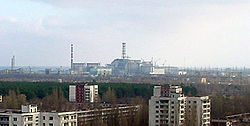
The nearby city of Prypiat was not immediately evacuated after the incident, for the general population of the Soviet Union was not informed of the disaster until Monday, April 28, 2 days later, with a 20 second announcement in the TV news program Vremya
Vremya
Vremya is the state television newscast of the Russian Federation and is shown on Channel One Russia and previously on the First Programme of the Central Television of the USSR...
. At that time ABC released its report about the disaster. During that time, all radio broadcasts run by the state were replaced with classical music, which was a common method of preparing the public for an announcement of a tragedy that had taken place. Scientist teams were armed and placed on alert as instructions were awaited.
Only after radiation levels set off alarms at the Forsmark Nuclear Power Plant
Forsmark Nuclear Power Plant
Forsmark Nuclear Power Plant is a nuclear power plant in Forsmark, Sweden, and also the site of the Swedish Final repository for radioactive operational waste...
in Sweden
Sweden
Sweden , officially the Kingdom of Sweden , is a Nordic country on the Scandinavian Peninsula in Northern Europe. Sweden borders with Norway and Finland and is connected to Denmark by a bridge-tunnel across the Öresund....
, over one thousand kilometers from the Chernobyl Plant, did the Soviet Union admit that an accident had occurred. Nevertheless, authorities attempted to conceal the scale of the disaster. For example, after evacuating the city of Prypiat, the following warning message was read on the state TV:
A state commission was set up the same day (April 26) and tasked with investigating the accident. It was headed by Valery Legasov, who arrived at Chernobyl in the evening of 26 April. By the time Legasov arrived, two people had already died and 52 were receiving medical attention in hospital. By the night of 26–27 April – more than 24 hours after the explosion – Legasov's committee had ample evidence that extremely high levels of radiation had caused a number of cases of radiation exposure. Based on the evidence at hand, Legasov's committee acknowledged the destruction of the reactor and ordered the evacuation
Emergency evacuation
Emergency evacuation is the immediate and rapid movement of people away from the threat or actual occurrence of a hazard. Examples range from the small scale evacuation of a building due to a bomb threat or fire to the large scale evacuation of a district because of a flood, bombardment or...
of Pripyat.
The evacuation began at 14:00 on 27 April. In order to expedite the evacuation, the residents were told to bring only what was necessary, as the authorities had said it would only last approximately three days. As a result, most of the residents left their personal belongings, which are still there today. An exclusion zone of 30 km (19 mi) remains in place today, although its shape has changed and its size has been expanded.
As the plant was run by authorities in Moscow, the government of Ukraine did not receive prompt information on the situation at the site, according to the former chairman of Presidium of Verkhovna Rada
Verkhovna Rada
The Verkhovna Rada of Ukraine is Ukraine's parliament. The Verkhovna Rada is a unicameral parliament composed of 450 deputies, which is presided over by a chairman...
of Ukrainian SSR, Valentyna Shevchenko
Valentyna Shevchenko
Valentyna Semenivna Shevchenko was the only female Chairman of the Presidium of Supreme Soviet of the Ukrainian SSR.Since September 1997, she is the honorary president of the National fund of social defence of mothers and children "Ukraine - children"....
. In her recollections she stated that she was at work when at 09:00 Vasyl Durdynets
Vasyl Durdynets
Vasyl Vasylovych Durdynets is a Ukrainian statesman and diplomat. He served as Acting Prime Minister of Ukraine during a short period in July 1997.-Biography and career:...
who performed duties of the Minister of Internal Affairs at the time (as the First Deputy Minister) called in with a report on the recent situation, adding at the end that there was a fire at the Chernobyl AES (AES - an abbreviation for a nuclear power plant), which was extinguished and everything was fine (see Fire containment). When Shevchenko asked "How are the people?", he replied that there was nothing to be concerned with: "some are celebrating a wedding, others are gardening, and others are fishing in the Pripyat River
Pripyat River
The Pripyat River or Prypiat River is a river in Eastern Europe, approximately long. It flows east through Ukraine, Belarus, and Ukraine again, draining into the Dnieper....
". On April 25, 2011 the President of Ukraine
President of Ukraine
Prior to the formation of the modern Ukrainian presidency, the previous Ukrainian head of state office was officially established in exile by Andriy Livytskyi. At first the de facto leader of nation was the president of the Central Rada at early years of the Ukrainian People's Republic, while the...
Viktor Yanukovych
Viktor Yanukovych
Viktor Fedorovych Yanukovych is a Ukrainian politician who has been the President of Ukraine since February 2010.Yanukovych served as the Governor of Donetsk Oblast from 1997 to 2002...
awarded Durdynets the "Distinguished Juror of Ukraine" as an advisor of the Ministry of Internal Affairs, a participant in the liquidation of consequences of Chernobyl disaster, and a general of Internal Service of Ukraine. After the report Shevchenko called in to Volodymyr Shcherbytsky
Volodymyr Shcherbytsky
Volodymyr Vasylyovych Shcherbytsky was a Ukrainian and Soviet politician. He was a leader of the Communist Party of Ukraine from 1972 to 1989....
(Head of the Central Committee of CP(b)U, de facto - a head of state). Shcherbytsky stated that he anticipated a delegation of the state commission headed by the deputy chairman of the Council of Ministers of USSR.
Among the delegation's officials were academic Evgeny Velikhov
Evgeny Velikhov
Evgeny Pavlovich Velikhov is a physicist and scientific leader in the Russian Federation. His scientific interests include plasma physics, lasers, controlled nuclear fusion, power engineering and magnetohydrodynamics...
, a leading nuclear specialist in the Soviet Union; a head of Hydro-Meteorologic Service of USSR Yuriy Izrael; a chief radiologist of the country Leonid Ilyin; and others. Right after the Boryspil International Airport the delegation drove to the power plant and already at night realizing the seriousness of the situation decided to evacuate the residents of Prypiat. On April 26, 2011 Velikhov was awarded Order of Merit
Order of Merit (Ukraine)
The Order of Merit first, second or third class, is the Ukrainian award, given to individuals for outstanding achievements in economics, science, culture, military or political spheres of activity...
of the III degree from the President of Ukraine
President of Ukraine
Prior to the formation of the modern Ukrainian presidency, the previous Ukrainian head of state office was officially established in exile by Andriy Livytskyi. At first the de facto leader of nation was the president of the Central Rada at early years of the Ukrainian People's Republic, while the...
Viktor Yanukovych
Viktor Yanukovych
Viktor Fedorovych Yanukovych is a Ukrainian politician who has been the President of Ukraine since February 2010.Yanukovych served as the Governor of Donetsk Oblast from 1997 to 2002...
for his contributions in the liquidation of consequences of the Chernobyl disaster.
By the morning of April 27 numerous buses arrived in Prypiat to start the evacuation which lasted from 11:00. By 15:00 53,000 people were evacuated to various villages of Kiev region
Kiev Oblast
Kyiv Oblast, sometimes written as Kiev Oblast is an oblast in central Ukraine.The administrative center of the oblast is the city of Kyiv , also being the capital of Ukraine...
. At first it was decided to evacuate the population temporarily for three days, however later it was postponed permanently. Many took only the most necessary items and their documents leaving all the rest behind. The next day there were initiated talks to evacuate people from the 10 km zone.
Shevchenko was the first from the Ukrainian state top officials who arrived to the disaster's site early on April 28. There she spoke with members of medical staff and people. People were calm and hopeful to return soon to their homes. Shevchenko returned home late near midnight stopping at a radiological checkpoint in Vilcha, that was one of the first which were set up soon after the accident.
There was a notification from Moscow that there is no reason to postpone the May 1
International Workers' Day
International Workers' Day is a celebration of the international labour movement and left-wing movements. It commonly sees organized street demonstrations and marches by working people and their labour unions throughout most of the world. May 1 is a national holiday in more than 80 countries...
celebrations (including the annual parade), however on April 30 a meeting of the Political bureau of the Central Committee of CP(b)U took place to discuss the plan for the upcoming celebration. Scientists were reporting that the radiological background in Kiev city currently is normal. At the meeting, which was finished at 18:00, it was decided to shorten celebrations from the regular 3.5-4 to under 2 hours. All republican leaders must be at their working place as there was anticipation for the arrival of Moscow's officials.
Steam explosion risk
Two floors of bubbler pools beneath the reactor served as a large water reservoir for the emergency cooling pumps and as a pressure suppression system capable of condensing steam in case of a small broken steam pipe; the third floor above them, below the reactor, served as a steam tunnel. The steam released by a broken pipe was supposed to enter the steam tunnel and be led into the pools to bubble through a layer of water. The pools and the basement were flooded because of ruptured cooling water pipes and accumulated firefighting water. They now constituted a serious steam explosionSteam explosion
A steam explosion is a violent boiling or flashing of water into steam, occurring when water is either superheated, rapidly heated by fine hot debris produced within it, or the interaction of molten metals A steam explosion (also called a littoral explosion, or fuel-coolant interaction, FCI) is a...
risk. The smoldering graphite, fuel and other material above, at more than 1200 °C, started to burn through the reactor floor and mixed with molten concrete
Concrete
Concrete is a composite construction material, composed of cement and other cementitious materials such as fly ash and slag cement, aggregate , water and chemical admixtures.The word concrete comes from the Latin word...
from the reactor lining, creating corium
Corium (nuclear reactor)
Corium, also called fuel containing material or lava-like fuel containing material , is a lava-like molten mixture of portions of nuclear reactor core, formed during a nuclear meltdown, the most severe class of a nuclear reactor accident...
, a radioactive semi-liquid material comparable to lava
Lava
Lava refers both to molten rock expelled by a volcano during an eruption and the resulting rock after solidification and cooling. This molten rock is formed in the interior of some planets, including Earth, and some of their satellites. When first erupted from a volcanic vent, lava is a liquid at...
. If this mixture had melted through the floor into the pool of water, it was feared it could have created a serious steam explosion
Steam explosion
A steam explosion is a violent boiling or flashing of water into steam, occurring when water is either superheated, rapidly heated by fine hot debris produced within it, or the interaction of molten metals A steam explosion (also called a littoral explosion, or fuel-coolant interaction, FCI) is a...
that would have ejected more radioactive material from the reactor. It became necessary to drain the pool.
The bubbler pool could be drained by opening its sluice gates. Volunteers in diving suit
Diving suit
A diving suit is a garment or device designed to protect a diver from the underwater environment. A diving suit typically also incorporates an air-supply .-History:...
s entered the radioactive water and managed to open the gates. These were the engineers Alexei Ananenko (who knew where the valves were) and Valeri Bezpalov, accompanied by a third man, Boris Baranov, who provided them with light from a lamp, though this lamp failed, leaving them to find the valves by feeling their way along a pipe. All of them returned to the surface and according to Ananenko, their colleagues jumped for joy when they heard they had managed to open the valves. Despite their good condition after completion of the task, all of them suffered from radiation sickness
Radiation Sickness
Radiation Sickness is a VHS by the thrash metal band Nuclear Assault. The video is a recording of a concert at the Hammersmith Odeon, London in 1988. It was released in 1991...
, and at least two—Ananenko and Bezpalov—later died. Some sources claim incorrectly that they died in the plant. It is likely that intense alpha radiation hydrolyzed
Radiolysis
Radiolysis is the dissociation of molecules by nuclear radiation. It is the cleavage of one or several chemical bonds resulting from exposure to high-energy flux...
the water, generating a low-pH
PH
In chemistry, pH is a measure of the acidity or basicity of an aqueous solution. Pure water is said to be neutral, with a pH close to 7.0 at . Solutions with a pH less than 7 are said to be acidic and solutions with a pH greater than 7 are basic or alkaline...
hydrogen peroxide
Hydrogen peroxide
Hydrogen peroxide is the simplest peroxide and an oxidizer. Hydrogen peroxide is a clear liquid, slightly more viscous than water. In dilute solution, it appears colorless. With its oxidizing properties, hydrogen peroxide is often used as a bleach or cleaning agent...
(H2O2) solution akin to an oxidizing acid
Oxidizing acid
An oxidizing acid is a Brønsted acid that is also a strong oxidizing agent . All Brønsted acids can act as moderately strong oxidizing agents, because the acidic proton can be reduced to hydrogen gas. Some acids contain other structures that act as stronger oxidizing agents than hydrogen....
. Conversion of bubbler pool water to H2O2 is confirmed by the presence in the Chernobyl lavas of studtite
Studtite
Studtite, chemical formula [O22]·2 or UO4·4, is a secondary uranium mineral containing peroxide formed by the alpha-radiolysis of water during formation...
and metastudtite
Studtite
Studtite, chemical formula [O22]·2 or UO4·4, is a secondary uranium mineral containing peroxide formed by the alpha-radiolysis of water during formation...
, the only mineral
Mineral
A mineral is a naturally occurring solid chemical substance formed through biogeochemical processes, having characteristic chemical composition, highly ordered atomic structure, and specific physical properties. By comparison, a rock is an aggregate of minerals and/or mineraloids and does not...
s that contain peroxide.
Fire brigade pumps were then used to drain the basement. The operation was not completed until 8 May, after 20,000 metric tons of highly radioactive water were pumped out.
With the bubbler pool gone, a meltdown
Nuclear meltdown
Nuclear meltdown is an informal term for a severe nuclear reactor accident that results in core damage from overheating. The term is not officially defined by the International Atomic Energy Agency or by the U.S. Nuclear Regulatory Commission...
was less likely to produce a powerful steam explosion. To do so, the molten core would now have to reach the water table
Water table
The water table is the level at which the submarine pressure is far from atmospheric pressure. It may be conveniently visualized as the 'surface' of the subsurface materials that are saturated with groundwater in a given vicinity. However, saturated conditions may extend above the water table as...
below the reactor. To reduce the likelihood of this, it was decided to freeze the earth beneath the reactor, which would also stabilize the foundations. Using oil drilling equipment
Well drilling
Well drilling is the process of drilling a hole in the ground for the extraction of a natural resource such as ground water, natural gas, or petroleum...
, the injection of liquid nitrogen
Liquid nitrogen
Liquid nitrogen is nitrogen in a liquid state at a very low temperature. It is produced industrially by fractional distillation of liquid air. Liquid nitrogen is a colourless clear liquid with density of 0.807 g/mL at its boiling point and a dielectric constant of 1.4...
began on 4 May. It was estimated that 25 metric tons of liquid nitrogen per day would be required to keep the soil frozen at −100 °C. This idea was soon scrapped and the bottom room where the cooling system would have been installed was filled with concrete
Concrete
Concrete is a composite construction material, composed of cement and other cementitious materials such as fly ash and slag cement, aggregate , water and chemical admixtures.The word concrete comes from the Latin word...
.
Debris removal
The worst of the radioactive debrisDebris
Debris is rubble, wreckage, ruins, litter and discarded garbage/refuse/trash, scattered remains of something destroyed, or, in geology, large rock fragments left by a melting glacier etc. The singular form of debris is debris...
was collected inside what was left of the reactor, much of it shoveled in by liquidators
Liquidator (Chernobyl)
Liquidators , or "clean-up workers", is the name given in the former USSR to people who were called upon to work in efforts to deal with consequences of the April 26, 1986, Chernobyl disaster on the site of the event...
wearing heavy protective gear (dubbed "bio-robots" by the military); these workers could only spend a maximum of 40 seconds at a time working on the rooftops of the surrounding buildings because of the extremely high doses of radiation given off by the blocks of graphite and other debris. The reactor itself was covered with bags of sand, lead
Lead
Lead is a main-group element in the carbon group with the symbol Pb and atomic number 82. Lead is a soft, malleable poor metal. It is also counted as one of the heavy metals. Metallic lead has a bluish-white color after being freshly cut, but it soon tarnishes to a dull grayish color when exposed...
, and boric acid
Boric acid
Boric acid, also called hydrogen borate or boracic acid or orthoboric acid or acidum boricum, is a weak acid of boron often used as an antiseptic, insecticide, flame retardant, as a neutron absorber, and as a precursor of other chemical compounds. It exists in the form of colorless crystals or a...
dropped from helicopters: some 5,000 metric tons of material were dropped during the week that followed the accident.
At the time there was still fear that the reactor could re-enter a self-sustaining nuclear chain-reaction and explode again, and a new containment structure was planned to prevent rain entering and triggering such an explosion, and to prevent further release of radioactive material. This was the largest civil engineering task in history, involving a quarter of a million construction workers who all reached their official lifetime limits of radiation. By December 1986, a large concrete sarcophagus
Chernobyl Nuclear Power Plant sarcophagus
The Chernobyl Nuclear Power Plant sarcophagus or stone coffin is a massive concrete envelope surrounding the nuclear reactor unit 4 of the Chernobyl Nuclear Power Plant. It is designed to halt the release of radiation into the atmosphere following the Chernobyl disaster on April 26, 1986 and encase...
had been erected to seal off the reactor and its contents.
Many of the vehicles used by the "liquidators" remain parked in a field in the Chernobyl area.
During the construction of the sarcophagus, a scientific team re-entered the reactor as part of an investigation dubbed "Complex Expedition", to locate and contain nuclear fuel in a way that could not lead to another explosion. These scientists manually collected cold fuel rods, but great heat was still emanating from the core. Rates of radiation in different parts of the building were monitored by drilling holes into the reactor and inserting long metal detector tubes. The scientists were exposed to high levels of radiation and radioactive dust. After six months of investigation, in December 1986, they discovered with the help of a remote camera an intensely radioactive mass in the basement of Unit Four, more than two metres wide and weighing hundreds of tons, which they called "the elephant's foot" for its wrinkled appearance. The mass was composed of sand, glass and a large amount of nuclear fuel that had escaped from the reactor. The concrete beneath the reactor was steaming hot, and was breached by solidified lava and spectacular unknown crystalline forms termed chernobylite
Chernobylite
Chernobylite is a technogenic mineral, a crystalline zirconium silicate with high content of uranium as a solid solution. It is black and yellow. It was discovered in the corium produced in the Chernobyl accident, a lava-like glassy material formed in a nuclear meltdown of a reactor core...
. It was concluded that there was no further risk of explosion.
Operator error initially faulted
There were two official explanations of the accident: the first, later acknowledged to be erroneous, was published in August 1986 and effectively placed the blame on the power plant operators. To investigate the causes of the accident the IAEA created a group known as the International Nuclear Safety Advisory Group (INSAG), which in its report of 1986, INSAG-1, on the whole also supported this view, based on the data provided by the Soviets and the oral statements of specialists. In this view, the catastrophic accident was caused by gross violations of operating rules and regulations. "During preparation and testing of the turbine generator under run-down conditions using the auxiliary load, personnel disconnected a series of technical protection systems and breached the most important operational safety provisions for conducting a technical exercise."The operator error was probably due to their lack of knowledge of nuclear reactor physics
Nuclear reactor physics
Nuclear reactor physics is the branch of science that deals with the study and application of chain reaction to induce controlled rate of fission for energy in reactors....
and engineering
Nuclear engineering
Nuclear engineering is the branch of engineering concerned with the application of the breakdown as well as the fusion of atomic nuclei and/or the application of other sub-atomic physics, based on the principles of nuclear physics...
, as well as lack of experience and training. According to these allegations, at the time of the accident the reactor was being operated with many key safety systems turned off, most notably the Emergency Core Cooling System (ECCS), LAR (Local Automatic control system), and AZ (emergency power reduction system). Personnel had an insufficiently detailed understanding of technical procedures involved with the nuclear reactor, and knowingly ignored regulations to speed test completion.
In this analysis of the causes of the accident, deficiencies in the reactor design and in the operating regulations that made the accident possible were set aside and mentioned only casually. Serious critical observations covered only general questions and did not address the specific reasons for the accident. The following general picture arose from these observations. Several procedural irregularities also helped to make the accident possible. One was insufficient communication between the safety officers and the operators in charge of the experiment being run that night. The reactor operators disabled safety systems down to the generators, which the test was really about. The main process computer, SKALA
SKALA
SKALA was the process computer for the Chernobyl nuclear power plant prior to October 1995. It dates back to 1960s; the machine uses magnetic core memory, magnetic tape data storage, and punched tape for loading software at booting....
, was running in such a way that the main control computer could not shut down the reactor or even reduce power. Normally the reactor would have started to insert all of the control rods. The computer would have also started the "Emergency Core Protection System" that introduces 24 control rods into the active zone within 2.5 seconds, which is still slow by 1986 standards. All control was transferred from the process computer to the human operators.
This view is reflected in numerous publications and also artistic works on the theme of the Chernobyl accident that appeared immediately after the accident, and for a long time remained dominant in the public consciousness and in popular publications.
Operating instructions and design deficiencies found
In 1991 a Commission of the USSR State Committee for the Supervision of Safety in Industry and Nuclear Power has reassessed the causes and circumstances of the Chernobyl accident and came to new insights and conclusions. Based on it, in 1992 the IAEA Nuclear Safety Advisory Group (INSAG) published an additional report, INSAG-7, which reviewed "that part of the INSAG-1 report in which primary attention is given to the reasons for the accident." and included the USSR State Commission report as Appendix I. In this INSAG report, most of the earlier accusations against staff for breach of regulations were acknowledged to be either erroneous, based on incorrect information obtained in August 1986, or less relevant. This report reflected another view of the main reasons for the accident, presented in Appendix I. According to this account, the operators' actions in turning off the Emergency Core Cooling System, interfering with the settings on the protection equipment, and blocking the level and pressure in the separator drum did not contribute to the original cause of the accident and its magnitude, although they may have been a breach of regulations. Turning off the emergency system designed to prevent the two turbine generators from stopping was not a violation of regulations.Human factors contributed to the conditions that led to the disaster. These included operating the reactor at a low power level—less than 700 MW—a level documented in the run-down test program, and operating with a small operational reactivity margin (ORM). The 1986 assertions of Soviet experts notwithstanding, regulations did not prohibit operating the reactor at this low power level. However, regulations did forbid operating the reactor with a small margin of reactivity. Yet "post-accident studies have shown that the way in which the real role of the ORM is reflected in the Operating Procedures and design documentation for the RBMK-1000 is extremely contradictory," and furthermore, "ORM was not treated as an operational safety limit, violation of which could lead to an accident."
According to the INSAG-7 Report, the chief reasons for the accident lie in the peculiarities of physics and in the construction of the reactor. There are two such reasons:
- The reactor had a dangerously large positive void coefficient. The void coefficient is a measurement of how a reactor responds to increased steamSteamSteam is the technical term for water vapor, the gaseous phase of water, which is formed when water boils. In common language it is often used to refer to the visible mist of water droplets formed as this water vapor condenses in the presence of cooler air...
formation in the water coolant. Most other reactor designs have a negative coefficient, i.e. the nuclear reaction rate slows when steam bubbles form in the coolant, since as the vapor phase in the reactor increases, fewer neutrons are slowed down. Faster neutrons are less likely to split uraniumUraniumUranium is a silvery-white metallic chemical element in the actinide series of the periodic table, with atomic number 92. It is assigned the chemical symbol U. A uranium atom has 92 protons and 92 electrons, of which 6 are valence electrons...
atoms, so the reactor produces less power (a negative feed-back). Chernobyl's RBMK reactor, however, used solid graphiteNuclear GraphiteNuclear graphite is any grade of graphite, usually electro-graphite, specifically manufactured for use as a moderator or reflector within nuclear reactors...
as a neutron moderatorNeutron moderatorIn nuclear engineering, a neutron moderator is a medium that reduces the speed of fast neutrons, thereby turning them into thermal neutrons capable of sustaining a nuclear chain reaction involving uranium-235....
to slow down the neutrons, and the water in it, on the contrary, acts like a harmful neutron absorber. Thus neutrons are slowed down even if steam bubbles form in the water. Furthermore, because steam absorbs neutronsNeutron captureNeutron capture is a kind of nuclear reaction in which an atomic nucleus collides with one or more neutrons and they merge to form a heavier nucleus. Since neutrons have no electric charge they can enter a nucleus more easily than positively charged protons, which are repelled...
much less readily than water, increasing the intensity of vaporization means that more neutrons are able to split uranium atoms, increasing the reactor's power output. This makes the RBMK design very unstable at low power levels, and prone to suddenly increasing energy production to a dangerous level. This behavior is counter-intuitive, and this property of the reactor was unknown to the crew.
- A more significant flaw was in the design of the control rods that are inserted into the reactor to slow down the reaction. In the RBMK reactor design, the lower part of each control rod was made of graphite and was 1.3 meters shorter than necessary, and in the space beneath the rods were hollow channels filled with water. The upper part of the rod, the truly functional part that absorbs the neutrons and thereby halts the reaction, was made of boron carbideBoron carbideBoron carbide is an extremely hard boron–carbon ceramic material used in tank armor, bulletproof vests, and numerous industrial applications...
. With this design, when the rods are inserted into the reactor from the uppermost position, the graphite parts initially displace some water (which absorbs neutrons, as mentioned above), effectively causing less neutrons to be absorbed initially. Thus for the first few seconds of control rod activation, reactor power output is increased, rather than reduced as desired. This behavior is counter-intuitive and was not known to the reactor operators.
- Other deficiencies besides these were noted in the RBMK-1000 reactor design, as were its non-compliance with accepted standards and with the requirements of nuclear reactor safety.
Both views were heavily lobbied by different groups, including the reactor's designers, power plant personnel, and the Soviet and Ukrainian governments. According to the IAEA's 1986 analysis, the main cause of the accident was the operators' actions. But according to the IAEA's 1993 revised analysis the main cause was the reactor's design. One reason there were such contradictory viewpoints and so much debate about the causes of the Chernobyl accident was that the primary data covering the disaster, as registered by the instruments and sensors, were not completely published in the official sources.
Once again, the human factor had to be considered as a major element in causing the accident. INSAG notes that both the operating regulations and staff handled the disabling of the reactor protection easily enough: witness the length of time for which the ECCS was out of service while the reactor was operated at half power. INSAG’s view is that it was the operating crew's deviation from the test program that was mostly to blame. “Most reprehensibly, unapproved changes in the test procedure were deliberately made on the spot, although the plant was known to be in a very different condition from that intended for the test.”
As in the previously released report INSAG-1, close attention is paid in report INSAG-7 to the inadequate (at the moment of the accident) “culture of safety” at all levels. Deficiency in the safety culture was inherent not only at the operational stage but also, and to no lesser extent, during activities at other stages in the lifetime of nuclear power plants (including design, engineering, construction, manufacture and regulation). The poor quality of operating procedures and instructions, and their conflicting character, put a heavy burden on the operating crew, including the Chief Engineer. “The accident can be said to have flowed from a deficient safety culture, not only at the Chernobyl plant, but throughout the Soviet design, operating and regulatory organizations for nuclear power that existed at that time.”
International spread of radioactive substances
Four hundred times more radioactive material was released than had been by the atomic bombingAtomic bombings of Hiroshima and Nagasaki
During the final stages of World War II in 1945, the United States conducted two atomic bombings against the cities of Hiroshima and Nagasaki in Japan, the first on August 6, 1945, and the second on August 9, 1945. These two events are the only use of nuclear weapons in war to date.For six months...
of Hiroshima
Hiroshima
is the capital of Hiroshima Prefecture, and the largest city in the Chūgoku region of western Honshu, the largest island of Japan. It became best known as the first city in history to be destroyed by a nuclear weapon when the United States Army Air Forces dropped an atomic bomb on it at 8:15 A.M...
. The disaster released 1/100 to 1/1000 of the total amount of radioactivity released by nuclear weapons testing during the 1950s and 1960s. Approximately 100,000 km² of land was contaminated with fallout
Fallout
Fallout or nuclear fallout is the residual radiation hazard from a nuclear explosion.Fallout may also refer to:*Fallout , a 1997 post-apocalyptic computer role-playing game released by Interplay Entertainment...
, the worst hit regions being in Belarus
Belarus
Belarus , officially the Republic of Belarus, is a landlocked country in Eastern Europe, bordered clockwise by Russia to the northeast, Ukraine to the south, Poland to the west, and Lithuania and Latvia to the northwest. Its capital is Minsk; other major cities include Brest, Grodno , Gomel ,...
, Ukraine
Ukraine
Ukraine is a country in Eastern Europe. It has an area of 603,628 km², making it the second largest contiguous country on the European continent, after Russia...
and Russia
Russia
Russia or , officially known as both Russia and the Russian Federation , is a country in northern Eurasia. It is a federal semi-presidential republic, comprising 83 federal subjects...
. Slighter levels of contamination were detected over all of Europe except for the Iberian Peninsula
Iberian Peninsula
The Iberian Peninsula , sometimes called Iberia, is located in the extreme southwest of Europe and includes the modern-day sovereign states of Spain, Portugal and Andorra, as well as the British Overseas Territory of Gibraltar...
.
The initial evidence that a major release of radioactive material was affecting other countries came not from Soviet sources, but from Sweden, where on the morning of 28 April workers at the Forsmark Nuclear Power Plant
Forsmark Nuclear Power Plant
Forsmark Nuclear Power Plant is a nuclear power plant in Forsmark, Sweden, and also the site of the Swedish Final repository for radioactive operational waste...
(approximately 1100 km (683.5 mi) from the Chernobyl site) were found to have radioactive particles on their clothes. It was Sweden's search for the source of radioactivity, after they had determined there was no leak at the Swedish plant, that at noon on 28 April led to the first hint of a serious nuclear problem in the western Soviet Union. Hence the evacuation of Pripyat on 27 April, 36 hours after the initial explosions, was silently completed before the disaster became known outside the Soviet Union. The rise in radiation levels had at that time already been measured in Finland
Finland
Finland , officially the Republic of Finland, is a Nordic country situated in the Fennoscandian region of Northern Europe. It is bordered by Sweden in the west, Norway in the north and Russia in the east, while Estonia lies to its south across the Gulf of Finland.Around 5.4 million people reside...
, but a civil service
Civil service
The term civil service has two distinct meanings:* A branch of governmental service in which individuals are employed on the basis of professional merit as proven by competitive examinations....
strike
Strike action
Strike action, also called labour strike, on strike, greve , or simply strike, is a work stoppage caused by the mass refusal of employees to work. A strike usually takes place in response to employee grievances. Strikes became important during the industrial revolution, when mass labour became...
delayed the response and publication.
Contamination from the Chernobyl accident was scattered irregularly depending on weather
Weather
Weather is the state of the atmosphere, to the degree that it is hot or cold, wet or dry, calm or stormy, clear or cloudy. Most weather phenomena occur in the troposphere, just below the stratosphere. Weather refers, generally, to day-to-day temperature and precipitation activity, whereas climate...
conditions, but rain was purposely seeded
Cloud seeding
Cloud seeding, a form of intentional weather modification, is the attempt to change the amount or type of precipitation that falls from clouds, by dispersing substances into the air that serve as cloud condensation or ice nuclei, which alter the microphysical processes within the cloud...
over the Byelorussian SSR
Byelorussian SSR
The Byelorussian Soviet Socialist Republic was one of fifteen constituent republics of the Soviet Union. It was one of the four original founding members of the Soviet Union in 1922, together with the Ukrainian SSR, the Transcaucasian SFSR and the Russian Soviet Federative Socialist Republic...
by the Soviet air force to remove radioactive particles from clouds heading toward highly populated areas. Reports from Soviet and Western scientists indicate that Belarus received about 60% of the contamination that fell on the former Soviet Union. However, the 2006 TORCH report
TORCH report
The TORCH report was requested by the European Greens in 2006, for the twentieth anniversary of the Chernobyl disaster, in reply to the 2006 report of the Chernobyl Forum which was criticized by some advocacy organizations opposed to nuclear energy such as Greenpeace.In 2006, German Green Member...
stated that half of the volatile particles had landed outside Ukraine, Belarus, and Russia. A large area in Russia south of Bryansk
Bryansk
Bryansk is a city and the administrative center of Bryansk Oblast, Russia, located southwest of Moscow. Population: -History:The first written mention of Bryansk was in 1146, in the Hypatian Codex, as Debryansk...
was also contaminated, as were parts of northwestern Ukraine. Studies in surrounding countries indicate that over one million people could have been affected by radiation.
Recently published data from a long-term monitoring program (The Korma Report) shows a decrease in internal radiation exposure
Ionizing radiation
Ionizing radiation is radiation composed of particles that individually have sufficient energy to remove an electron from an atom or molecule. This ionization produces free radicals, which are atoms or molecules containing unpaired electrons...
of the inhabitants of a region in Belarus close to Gomel. Resettlement may even be possible in prohibited areas provided that people comply with appropriate dietary rules.
In Western Europe
Western Europe
Western Europe is a loose term for the collection of countries in the western most region of the European continents, though this definition is context-dependent and carries cultural and political connotations. One definition describes Western Europe as a geographic entity—the region lying in the...
, precautionary measures taken in response to the radiation included seemingly arbitrary regulations banning the importation of certain foods but not others. In France
France
The French Republic , The French Republic , The French Republic , (commonly known as France , is a unitary semi-presidential republic in Western Europe with several overseas territories and islands located on other continents and in the Indian, Pacific, and Atlantic oceans. Metropolitan France...
some officials stated that the Chernobyl accident had no adverse effects. Official figures in southern Bavaria
Bavaria
Bavaria, formally the Free State of Bavaria is a state of Germany, located in the southeast of Germany. With an area of , it is the largest state by area, forming almost 20% of the total land area of Germany...
in Germany
Germany
Germany , officially the Federal Republic of Germany , is a federal parliamentary republic in Europe. The country consists of 16 states while the capital and largest city is Berlin. Germany covers an area of 357,021 km2 and has a largely temperate seasonal climate...
indicated that some wild plant species contained substantial levels of caesium, which were believed to have been passed onto them by wild boars, a significant number of which had already contained radioactive particles above the allowed level, consuming them.
Radioactive release
Like many other releases of radioactivityNuclear fuel and reactor accidents
This page is devoted to a discussion of how uranium dioxide nuclear fuel behaves during both normal nuclear reactor operation and under reactor accident conditions such as overheating...
into the environment, the Chernobyl release was controlled by the physical and chemical properties of the radioactive elements in the core. While the general population often perceives plutonium
Plutonium
Plutonium is a transuranic radioactive chemical element with the chemical symbol Pu and atomic number 94. It is an actinide metal of silvery-gray appearance that tarnishes when exposed to air, forming a dull coating when oxidized. The element normally exhibits six allotropes and four oxidation...
as a particularly dangerous nuclear fuel
Nuclear fuel
Nuclear fuel is a material that can be 'consumed' by fission or fusion to derive nuclear energy. Nuclear fuels are the most dense sources of energy available...
, its effects are almost eclipsed by those of its fission products. Particularly dangerous are highly radioactive compounds that accumulate in the food chain, such as some isotopes of iodine
Iodine
Iodine is a chemical element with the symbol I and atomic number 53. The name is pronounced , , or . The name is from the , meaning violet or purple, due to the color of elemental iodine vapor....
and strontium
Strontium
Strontium is a chemical element with the symbol Sr and the atomic number 38. An alkaline earth metal, strontium is a soft silver-white or yellowish metallic element that is highly reactive chemically. The metal turns yellow when exposed to air. It occurs naturally in the minerals celestine and...
.
Two reports on the release of radioisotopes from the site were made available, one by the OSTI
Office of Scientific and Technical Information
The Office of Scientific and Technical Information is a component of the Office of Science within the U.S. Department of Energy...
and a more detailed report by the OECD
Organisation for Economic Co-operation and Development
The Organisation for Economic Co-operation and Development is an international economic organisation of 34 countries founded in 1961 to stimulate economic progress and world trade...
, both in 1998. At different times after the accident, different isotope
Isotope
Isotopes are variants of atoms of a particular chemical element, which have differing numbers of neutrons. Atoms of a particular element by definition must contain the same number of protons but may have a distinct number of neutrons which differs from atom to atom, without changing the designation...
s were responsible for the majority of the external dose. The dose that was calculated is that received from external gamma irradiation for a person standing in the open. The dose to a person in a shelter or the internal dose
Internal dosimetry
Internal dosimetry provides methods for calculation of radiation dose and risks from radionuclides incorporated inside human body. The Radionuclide deposited in human body will irradiate that person and will give dose to body until excreted or completely decayed from the body.Routes of intakeThere...
is harder to estimate.
The release of radioisotopes from the nuclear fuel
Nuclear fuel
Nuclear fuel is a material that can be 'consumed' by fission or fusion to derive nuclear energy. Nuclear fuels are the most dense sources of energy available...
was largely controlled by their boiling point
Boiling point
The boiling point of an element or a substance is the temperature at which the vapor pressure of the liquid equals the environmental pressure surrounding the liquid....
s, and the majority of the radioactivity present in the core was retained in the reactor.
- All of the noble gasNoble gasThe noble gases are a group of chemical elements with very similar properties: under standard conditions, they are all odorless, colorless, monatomic gases, with very low chemical reactivity...
es, including kryptonKryptonKrypton is a chemical element with the symbol Kr and atomic number 36. It is a member of Group 18 and Period 4 elements. A colorless, odorless, tasteless noble gas, krypton occurs in trace amounts in the atmosphere, is isolated by fractionally distilling liquified air, and is often used with other...
and xenonXenonXenon is a chemical element with the symbol Xe and atomic number 54. The element name is pronounced or . A colorless, heavy, odorless noble gas, xenon occurs in the Earth's atmosphere in trace amounts...
, contained within the reactor were released immediately into the atmosphere by the first steam explosion. - 55% of the radioactive iodineIodineIodine is a chemical element with the symbol I and atomic number 53. The name is pronounced , , or . The name is from the , meaning violet or purple, due to the color of elemental iodine vapor....
in the reactor, containing about 1760 PBqBQBQ may refer to:* Aeromar Líneas Aéreas Dominicanas IATA airline designator* Birds Queensland, the ornithological society of Queensland, Australia* Bloc Québécois, a political party of Canada* Broadcast quality...
or 400 kg of I-131, was released, as a mixture of vaporVaporA vapor or vapour is a substance in the gas phase at a temperature lower than its critical point....
, solid particles, and organic iodineOrganoiodine compoundOrganoiodine compounds are organic compounds that contain one or more carbon–iodine bonds. They occur widely in organic chemistry, but are relatively rare in nature...
compoundsChemical compoundA chemical compound is a pure chemical substance consisting of two or more different chemical elements that can be separated into simpler substances by chemical reactions. Chemical compounds have a unique and defined chemical structure; they consist of a fixed ratio of atoms that are held together...
. - CaesiumCaesiumCaesium or cesium is the chemical element with the symbol Cs and atomic number 55. It is a soft, silvery-gold alkali metal with a melting point of 28 °C , which makes it one of only five elemental metals that are liquid at room temperature...
(85 PBq Cs-137) and tellurium were released in aerosol form. - An early estimate for fuel material released to the environment was 3 ± 1.5%; this was later revised to 3.5 ± 0.5%. This corresponds to the atmospheric emission of 6 t of fragmented fuel.
- Total atmospheric release is estimated at 5200 PBqBQBQ may refer to:* Aeromar Líneas Aéreas Dominicanas IATA airline designator* Birds Queensland, the ornithological society of Queensland, Australia* Bloc Québécois, a political party of Canada* Broadcast quality...
.
Two sizes of particles were released: small particles of 0.3 to 1.5 micrometers (aerodynamic diameter) and large particles of 10 micrometers. The large particles contained about 80% to 90% of the released nonvolatile radioisotopes zirconium
Zirconium
Zirconium is a chemical element with the symbol Zr and atomic number 40. The name of zirconium is taken from the mineral zircon. Its atomic mass is 91.224. It is a lustrous, grey-white, strong transition metal that resembles titanium...
-95, niobium
Niobium
Niobium or columbium , is a chemical element with the symbol Nb and atomic number 41. It's a soft, grey, ductile transition metal, which is often found in the pyrochlore mineral, the main commercial source for niobium, and columbite...
-95, lanthanum
Lanthanum
Lanthanum is a chemical element with the symbol La and atomic number 57.Lanthanum is a silvery white metallic element that belongs to group 3 of the periodic table and is the first element of the lanthanide series. It is found in some rare-earth minerals, usually in combination with cerium and...
-140, cerium
Cerium
Cerium is a chemical element with the symbol Ce and atomic number 58. It is a soft, silvery, ductile metal which easily oxidizes in air. Cerium was named after the dwarf planet . Cerium is the most abundant of the rare earth elements, making up about 0.0046% of the Earth's crust by weight...
-144 and the transuranic elements, including neptunium
Neptunium
Neptunium is a chemical element with the symbol Np and atomic number 93. A radioactive metal, neptunium is the first transuranic element and belongs to the actinide series. Its most stable isotope, 237Np, is a by-product of nuclear reactors and plutonium production and it can be used as a...
, plutonium
Plutonium
Plutonium is a transuranic radioactive chemical element with the chemical symbol Pu and atomic number 94. It is an actinide metal of silvery-gray appearance that tarnishes when exposed to air, forming a dull coating when oxidized. The element normally exhibits six allotropes and four oxidation...
and the minor actinides
Minor actinides
The minor actinides are the actinide elements in used nuclear fuel other than uranium and plutonium, which are termed the major actinides. The minor actinides include neptunium, americium, curium, berkelium, californium, einsteinium, and fermium...
, embedded in a uranium oxide
Uranium oxide
Uranium oxide is an oxide of the element uranium.The metal uranium forms several oxides:* Uranium dioxide or uranium oxide * Uranium trioxide or uranium oxide...
matrix.
Health of plant workers and local people
In the aftermath of the accident, 237 people suffered from acute radiation sickness (ARS), of whom 31 died within the first three months. Most of these were fire and rescue workers trying to bring the accident under control, who were not fully aware of how dangerous exposure to the radiationRadiation
In physics, radiation is a process in which energetic particles or energetic waves travel through a medium or space. There are two distinct types of radiation; ionizing and non-ionizing...
in the smoke
Smoke
Smoke is a collection of airborne solid and liquid particulates and gases emitted when a material undergoes combustion or pyrolysis, together with the quantity of air that is entrained or otherwise mixed into the mass. It is commonly an unwanted by-product of fires , but may also be used for pest...
was. Whereas, in the World Health Organization's 2006 report of the Chernobyl Forum
Chernobyl Forum
The Chernobyl Forum is the name of a group of UN agencies, founded on 3–5 February 2003 at the IAEA Headquarters in Vienna, to scientifically assess the health effects and environmental consequences of the Chernobyl accident and to issue factual, authoritative reports on its environmental...
expert group on the 237 emergency workers who were diagnosed with ARS, ARS was identified as the cause of death for 28 of these people within the first few months after the disaster. There were no further deaths identified, in the general population affected by the disaster, as being caused by ARS. Of the 72,000 Russian Emergency Workers being studied, 216 non-cancer deaths are attributed to the disaster, between 1991 and 1998. The latency period for solid cancers caused by excess radiation exposure is 10 or more years; thus at the time of the WHO report being undertaken, the rates of solid cancer deaths were no greater than the general population. Some 135,000 people were evacuated from the area, including 50,000 from Pripyat.
Rivers, lakes and reservoirs
The Chernobyl nuclear power plant is located next to the Pripyat RiverPripyat River
The Pripyat River or Prypiat River is a river in Eastern Europe, approximately long. It flows east through Ukraine, Belarus, and Ukraine again, draining into the Dnieper....
, which feeds into the Dnipro River reservoir system, one of the largest surface water systems in Europe. The radioactive contamination of aquatic systems therefore became a major problem in the immediate aftermath of the accident. In the most affected areas of Ukraine, levels of radioactivity (particularly radioiodine: I-131
Iodine-131
Iodine-131 , also called radioiodine , is an important radioisotope of iodine. It has a radioactive decay half-life of about eight days. Its uses are mostly medical and pharmaceutical...
, radiocaesium: Cs-137
Caesium-137
Caesium-137 is a radioactive isotope of caesium which is formed as a fission product by nuclear fission.It has a half-life of about 30.17 years, and decays by beta emission to a metastable nuclear isomer of barium-137: barium-137m . Caesium-137 is a radioactive isotope of caesium which is formed...
and radiostrontium: Sr-90
Strontium-90
Strontium-90 is a radioactive isotope of strontium, with a half-life of 28.8 years.-Radioactivity:Natural strontium is nonradioactive and nontoxic, but 90Sr is a radioactivity hazard...
) in drinking water
Drinking water
Drinking water or potable water is water pure enough to be consumed or used with low risk of immediate or long term harm. In most developed countries, the water supplied to households, commerce and industry is all of drinking water standard, even though only a very small proportion is actually...
caused concern during the weeks and months after the accident. After this initial period, however, radioactivity in rivers and reservoirs was generally below guideline limits for safe drinking water.
Bio-accumulation of radioactivity in fish
Fish
Fish are a paraphyletic group of organisms that consist of all gill-bearing aquatic vertebrate animals that lack limbs with digits. Included in this definition are the living hagfish, lampreys, and cartilaginous and bony fish, as well as various extinct related groups...
resulted in concentrations (both in western Europe and in the former Soviet Union) that in many cases were significantly above guideline maximum levels for consumption. Guideline maximum levels for radiocaesium in fish vary from country to country but are approximately 1,000 Bq/kg in the European Union
European Union
The European Union is an economic and political union of 27 independent member states which are located primarily in Europe. The EU traces its origins from the European Coal and Steel Community and the European Economic Community , formed by six countries in 1958...
. In the Kiev Reservoir
Kiev Reservoir
The Kiev Reservoir , locally the Kiev Sea, is a large water reservoir located on the Dnieper River in Ukraine. Named after the city of Kiev, which lies to the south, it covers a total area of 922 square kilometres within the Kiev Oblast. The reservoir was formed in 1960-1966, as a result of the...
in Ukraine, concentrations in fish were several thousand Bq/kg during the years after the accident. In small "closed" lakes in Belarus and the Bryansk
Bryansk
Bryansk is a city and the administrative center of Bryansk Oblast, Russia, located southwest of Moscow. Population: -History:The first written mention of Bryansk was in 1146, in the Hypatian Codex, as Debryansk...
region of Russia, concentrations in a number of fish species varied from 100 to 60,000 Bq/kg during the period 1990–92. The contamination of fish caused short-term concern in parts of the UK and Germany and in the long term (years rather than months) in the affected areas of Ukraine, Belarus, and Russia as well as in parts of Scandinavia.
Groundwater
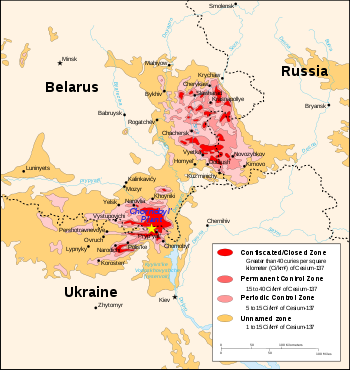
Groundwater
Groundwater is water located beneath the ground surface in soil pore spaces and in the fractures of rock formations. A unit of rock or an unconsolidated deposit is called an aquifer when it can yield a usable quantity of water. The depth at which soil pore spaces or fractures and voids in rock...
was not badly affected by the Chernobyl accident since radionuclide
Radionuclide
A radionuclide is an atom with an unstable nucleus, which is a nucleus characterized by excess energy available to be imparted either to a newly created radiation particle within the nucleus or to an atomic electron. The radionuclide, in this process, undergoes radioactive decay, and emits gamma...
s with short half-lives decayed away long before they could affect groundwater supplies, and longer-lived radionuclides such as radiocaesium and radiostrontium were adsorbed
Adsorption
Adsorption is the adhesion of atoms, ions, biomolecules or molecules of gas, liquid, or dissolved solids to a surface. This process creates a film of the adsorbate on the surface of the adsorbent. It differs from absorption, in which a fluid permeates or is dissolved by a liquid or solid...
to surface soil
Soil
Soil is a natural body consisting of layers of mineral constituents of variable thicknesses, which differ from the parent materials in their morphological, physical, chemical, and mineralogical characteristics...
s before they could transfer to groundwater. However, significant transfers of radionuclides to groundwater have occurred from waste disposal sites in the 30 km (19 mi) exclusion zone around Chernobyl. Although there is a potential for transfer of radionuclides from these disposal sites off-site (i.e. out of the 30 km (19 mi) exclusion zone), the IAEA Chernobyl Report argues that this is not significant in comparison to current levels of washout
Washout
A washout is the sudden erosion of soft soil or other support surfaces by a gush of water, usually occurring during a heavy downpour of rain or other stream flooding. These downpours may occur locally in a thunderstorm , or over a large area, such as following the landfall of a tropical cyclone...
of surface-deposited radioactivity.
Flora and fauna
After the disaster, four square kilometers of pinePine
Pines are trees in the genus Pinus ,in the family Pinaceae. They make up the monotypic subfamily Pinoideae. There are about 115 species of pine, although different authorities accept between 105 and 125 species.-Etymology:...
forest directly downwind of the reactor turned reddish-brown and died, earning the name of the "Red Forest
Red Forest
The Red Forest , formerly the Worm Wood Forest, refers to the trees in the 10 km² surrounding the Chernobyl Nuclear Power Plant. The name 'Red Forest' comes from the ginger-brown colour of the pine trees after they died following the absorption of high levels of radiation from the Chernobyl...
". Some animals in the worst-hit areas also died or stopped reproducing. Most domestic animals were removed from the exclusion zone, but horses left on an island in the Pripyat River 6 km (4 mi) from the power plant died when their thyroid
Thyroid
The thyroid gland or simply, the thyroid , in vertebrate anatomy, is one of the largest endocrine glands. The thyroid gland is found in the neck, below the thyroid cartilage...
glands were destroyed by radiation doses of 150–200 Sv. Some cattle
Cattle
Cattle are the most common type of large domesticated ungulates. They are a prominent modern member of the subfamily Bovinae, are the most widespread species of the genus Bos, and are most commonly classified collectively as Bos primigenius...
on the same island died and those that survived were stunted because of thyroid damage. The next generation appeared to be normal.
A robot sent into the reactor itself has returned with samples of black, melanin
Melanin
Melanin is a pigment that is ubiquitous in nature, being found in most organisms . In animals melanin pigments are derivatives of the amino acid tyrosine. The most common form of biological melanin is eumelanin, a brown-black polymer of dihydroxyindole carboxylic acids, and their reduced forms...
-rich radiotrophic fungi
Radiotrophic fungus
Radiotrophic fungi are fungi which appear to use the pigment melanin to convert gamma radiation into chemical energy for growth. This proposed mechanism may be similar to anabolic pathways for the synthesis of reduced organic carbon in phototrophic organisms, which capture photons from visible...
that are growing on the reactor's walls.
Of the 440,350 wild boar killed in the 2010 hunting season in Germany, over 1,000 were found to be contaminated with levels of radiation above the permitted limit of 600 bequerels, due to residual radioactivity from Chernobyl. Germany has "banned wild game meat because of contamination linked to radioactive mushrooms".
The Norwegian Agricultural Authority reported that in 2009 a total of 18,000 livestock in Norway needed to be given uncontaminated feed for a period of time before slaughter in order to ensure that their meat was safe for human consumption. This was due to residual radioactivity from Chernobyl in the plants they graze on in the wild during the summer. The after-effects of Chernobyl were expected to be seen for a further 100 years, although the severity of the effects would decline over that period. In Britain and Norway, as of 2011, "slaughter restrictions remain for sheep raised on pasture contaminated by radiation fallout".
Assessing the disaster's effects on human health
An international assessment of the health effects of the Chernobyl accident is contained in a series of reports by the United Nations Scientific Committee of the Effects of Atomic Radiation (UNSCEAR). UNSCEAR was set up as a collaboration between various UN bodies, including the World Health Organisation, after the atomic bomb attacks on Hiroshima and NagasakiAtomic bombings of Hiroshima and Nagasaki
During the final stages of World War II in 1945, the United States conducted two atomic bombings against the cities of Hiroshima and Nagasaki in Japan, the first on August 6, 1945, and the second on August 9, 1945. These two events are the only use of nuclear weapons in war to date.For six months...
, to assess the long-term effects of radiation on human health.
UNSCEAR has conducted 20 years of detailed scientific and epidemiological research on the effects of the Chernobyl accident. Apart from the 57 direct deaths in the accident itself, UNSCEAR predicted in 2005 based on Linear no-threshold model
Linear no-threshold model
The linear no-threshold model is a method for predicting the long term, biological damage caused by ionizing radiation and is based on the assumption that the risk is directly proportional to the dose at all dose levels....
(LNT) that up to 4,000 additional cancer
Cancer
Cancer , known medically as a malignant neoplasm, is a large group of different diseases, all involving unregulated cell growth. In cancer, cells divide and grow uncontrollably, forming malignant tumors, and invade nearby parts of the body. The cancer may also spread to more distant parts of the...
deaths related to the accident would appear "among the 600 000 persons receiving more significant exposures (liquidators working in 1986–87, evacuees, and residents of the most contaminated areas)". Later this number was revised slightly up to 5,000. The number of excess deaths among 5 million people living in the less contaminated areas is estimated at 3,000–5,000. The number of excess cancer deaths worldwide (including all contaminated areas) is approximately 27,000 based on the same LNT.
UNSCEAR now states:
However, thyroid cancer
Thyroid cancer
Thyroid neoplasm is a neoplasm or tumor of the thyroid. It can be a benign tumor such as thyroid adenoma, or it can be a malignant neoplasm , such as papillary, follicular, medullary or anaplastic thyroid cancer. Most patients are 25 to 65 years of age when first diagnosed; women are more affected...
is generally treatable. With proper treatment, the five-year survival rate of thyroid cancer is 96%, and 92% after 30 years,. UNSCEAR counted 15 deaths from Thyroid cancer in the affected population.
In addition, the IAEA states that there has been no increase in the rate of birth defects or abnormalities, or solid cancers (such as lung cancer
Lung cancer
Lung cancer is a disease characterized by uncontrolled cell growth in tissues of the lung. If left untreated, this growth can spread beyond the lung in a process called metastasis into nearby tissue and, eventually, into other parts of the body. Most cancers that start in lung, known as primary...
) corroborating UNSCEAR's assessments.
UNSCEAR does also raise the possibility of long term genetic defects, pointing to a doubling of radiation-induced minisatellite mutation
Mutation
In molecular biology and genetics, mutations are changes in a genomic sequence: the DNA sequence of a cell's genome or the DNA or RNA sequence of a virus. They can be defined as sudden and spontaneous changes in the cell. Mutations are caused by radiation, viruses, transposons and mutagenic...
s among children born in 1994. There is some dispute over the control groups in this study and the long term effects are not clear.
The Chernobyl Forum
Chernobyl Forum
The Chernobyl Forum is the name of a group of UN agencies, founded on 3–5 February 2003 at the IAEA Headquarters in Vienna, to scientifically assess the health effects and environmental consequences of the Chernobyl accident and to issue factual, authoritative reports on its environmental...
is a regular meeting of IAEA, other United Nations
United Nations
The United Nations is an international organization whose stated aims are facilitating cooperation in international law, international security, economic development, social progress, human rights, and achievement of world peace...
organizations (FAO, UN-OCHA, UNDP, UNEP, UNSCEAR, WHO, and the World Bank
World Bank
The World Bank is an international financial institution that provides loans to developing countries for capital programmes.The World Bank's official goal is the reduction of poverty...
), and the governments of Belarus, Russia, and Ukraine that issues regular scientific assessments of the evidence for health effects of the Chernobyl accident. The Chernobyl Forum concluded that twenty-eight emergency workers ("liquidator
Liquidator (Chernobyl)
Liquidators , or "clean-up workers", is the name given in the former USSR to people who were called upon to work in efforts to deal with consequences of the April 26, 1986, Chernobyl disaster on the site of the event...
s") died from acute radiation syndrome including beta burns and 15 patients died from thyroid cancer in the following years, and it roughly estimated that cancer deaths caused by Chernobyl may reach a total of about 4,000 among the 5 million persons residing in the contaminated areas, the report projected cancer mortality "increases of less than one per cent" (~0.3%) on a time span of 80 years, cautioning that this estimate was "speculative" since at this time only a few tens cancer deaths are linked to the Chernobyl disaster. Fred Mettler, a radiation expert at the University of New Mexico, puts this last number at "perhaps" 5000, for a total of 9000 Chernobyl associated fatal cancers, saying "the number is small (representing a few percent) relative to the normal spontaneous risk of cancer, but the numbers are large in absolute terms". The same report outlined studies based in data found in the Russian Registry from 1991 to 1998 that suggested that "of 61,000 Russian workers exposed to an average dose of 107 mSv about 5% of all fatalities that occurred may have been due to radiation exposure."
The same report went into depth about the risks to mental health
Mental health
Mental health describes either a level of cognitive or emotional well-being or an absence of a mental disorder. From perspectives of the discipline of positive psychology or holism mental health may include an individual's ability to enjoy life and procure a balance between life activities and...
of exaggerated fear
Fear
Fear is a distressing negative sensation induced by a perceived threat. It is a basic survival mechanism occurring in response to a specific stimulus, such as pain or the threat of danger...
s about the effects of radiation:
Fred Mettler commented that 20 years later:
In addition, disadvantaged children around Chernobyl suffer from health problems that are attributable not only to the Chernobyl accident, but also to the poor state of post-Soviet health systems.
A significant issue relating to problems establishing consistent data to base the analysis of the impact of the Chernobyl accident on the population at large is the social and political changes in the region since 1990. These have had numerous impacts in the administration of health care, on socio-economic stability, and even on the manner in which statistical data is collected. Some of these difficulties are outlined in the report "Cancer Mortality in Russia and Ukraine: Validity, Competing Risks and Cohort Effects", which points out among other things that:
Another study critical of the Chernobyl Forum report was commissioned by Greenpeace
Greenpeace
Greenpeace is a non-governmental environmental organization with offices in over forty countries and with an international coordinating body in Amsterdam, The Netherlands...
, which asserts that "the most recently published figures indicate that in Belarus, Russia and Ukraine alone the accident could have resulted in an estimated 200,000 additional deaths in the period between 1990 and 2004." The Scientific Secretary of the Chernobyl Forum criticized the report's exclusive reliance on non-peer review
Peer review
Peer review is a process of self-regulation by a profession or a process of evaluation involving qualified individuals within the relevant field. Peer review methods are employed to maintain standards, improve performance and provide credibility...
ed locally produced studies (in fact, most of the study's sources are from peer-reviewed journals, including many Western medical journals, or from proceedings of scientific conferences), while Gregory Härtl (spokesman for the WHO) suggested that the conclusions were motivated by ideology.
The German affiliate of the International Physicians for the Prevention of Nuclear War (IPPNW) argued that more than 10,000 people are today affected by thyroid cancer and 50,000 cases are expected in the future.
Chernobyl: Consequences of the Catastrophe for People and the Environment
Chernobyl: Consequences of the Catastrophe for People and the Environment
Chernobyl: Consequences of the Catastrophe for People and the Environment is a translation of a 2007 Russian publication by Alexey V. Yablokov, Vassily B. Nesterenko, and Alexey V. Nesterenko...
is an English translation of the 2007 Russian publication Chernobyl. It was published in 2009 by the New York Academy of Sciences
New York Academy of Sciences
The New York Academy of Sciences is the third oldest scientific society in the United States. An independent, non-profit organization with more than members in 140 countries, the Academy’s mission is to advance understanding of science and technology...
in their Annals of the New York Academy of Sciences. It presents an analysis of scientific literature and concludes that medical records between 1986, the year of the accident, and 2004 reflect 985,000 premature deaths as a result of the radioactivity released. The authors suggest that most of the deaths were in Russia, Belarus and Ukraine, though others occurred worldwide throughout the many countries that were struck by radioactive fallout from Chernobyl. The literature analysis draws on over 1,000 published titles and over 5,000 internet and printed publications discussing the consequences of the Chernobyl disaster. The authors contend that those publications and papers were written by leading Eastern European authorities and have largely been downplayed or ignored by the IAEA and UNSCEAR.
Other health problems linked with the Chernobyl disaster include
- Down syndromeDown syndromeDown syndrome, or Down's syndrome, trisomy 21, is a chromosomal condition caused by the presence of all or part of an extra 21st chromosome. It is named after John Langdon Down, the British physician who described the syndrome in 1866. The condition was clinically described earlier in the 19th...
(trisomy 21). In West BerlinWest BerlinWest Berlin was a political exclave that existed between 1949 and 1990. It comprised the western regions of Berlin, which were bordered by East Berlin and parts of East Germany. West Berlin consisted of the American, British, and French occupation sectors, which had been established in 1945...
, GermanyGermanyGermany , officially the Federal Republic of Germany , is a federal parliamentary republic in Europe. The country consists of 16 states while the capital and largest city is Berlin. Germany covers an area of 357,021 km2 and has a largely temperate seasonal climate...
, prevalence of Down syndrome (trisomy 21) peaked 9 months following the main fallout.[11, 12] Between 1980 and 1986, the birth prevalence of Down syndrome was quite stable (i.e., 1.35–1.59 per 1,000 live births [27–31 cases]). In 1987, 46 cases were diagnosed (prevalence = 2.11 per 1,000 live births). Most of the excess resulted from a clusterCluster (epidemiology)A cluster refers to a grouping of health-related events that are related temporally and in proximity. Typically, when clusters are recognized, they are reported to public health departments in the local area. The 1854 cholera outbreak which occurred in London is a classical example of a cluster...
of 12 cases among children born in January 1987. The prevalence of Down syndrome in 1988 was 1.77, and in 1989, it reached pre-Chernobyl values. The authors noted that the isolated geographical position of West Berlin before reunification, the free genetic counselingGenetic counselingGenetic counseling or traveling is the process by which patients or relatives, at risk of an inherited disorder, are advised of the consequences and nature of the disorder, the probability of developing or transmitting it, and the options open to them in management and family planning...
, and complete coverage of the population through one central cytogenetic laboratory support completeness of case ascertainment; in addition, constant culture preparation and analysis protocols ensure a high quality of data. - Chromosomal aberrations. Reports of structural chromosome aberrations in people exposed to fallout in Belarus and other parts of the former Soviet Union, Austria, and Germany argue against a simple dose-response relationship between degree of exposure and incidence of aberrations. These findings are relevant because a close relationship exists between chromosome changes and congenital malformations. Inasmuch as some types of aberration are almost specific for ionizing radiationIonizing radiationIonizing radiation is radiation composed of particles that individually have sufficient energy to remove an electron from an atom or molecule. This ionization produces free radicals, which are atoms or molecules containing unpaired electrons...
, researchers use aberrations to assess exposure dose. On the basis of current coefficients, however, it is not certain that the calculated individual exposure doses resulting from fallout would not induce measurable rates of chromosome aberrations. - Neural tube defects (NTDs) in TurkeyTurkeyTurkey , known officially as the Republic of Turkey , is a Eurasian country located in Western Asia and in East Thrace in Southeastern Europe...
. During the embryonicEmbryonicEmbryonic received general acclaim from critics upon release, garnering a 81/100 critic score on Metacritic. The New Musical Express noted that "ten years after their last masterpiece, The Flaming Lips have finally produced another one," while Paste Magazine described the record as "a wonderfully...
phase of fetal developmentFetal developmentPrenatal or antenatal development is the process in which a human embryo or fetus gestates during pregnancy, from fertilization until birth. Often, the terms fetal development, foetal development, or embryology are used in a similar sense.After fertilization the embryogenesis starts...
, the neural tubeNeural tubeIn the developing vertebrate, the neural tube is the embryo's precursor to the central nervous system, which comprises the brain and spinal cord...
differentiatesCellular differentiationIn developmental biology, cellular differentiation is the process by which a less specialized cell becomes a more specialized cell type. Differentiation occurs numerous times during the development of a multicellular organism as the organism changes from a simple zygote to a complex system of...
into the brainBrainThe brain is the center of the nervous system in all vertebrate and most invertebrate animals—only a few primitive invertebrates such as sponges, jellyfish, sea squirts and starfishes do not have one. It is located in the head, usually close to primary sensory apparatus such as vision, hearing,...
and spinal cordSpinal cordThe spinal cord is a long, thin, tubular bundle of nervous tissue and support cells that extends from the brain . The brain and spinal cord together make up the central nervous system...
(i.e., collectively forming the central nervous systemCentral nervous systemThe central nervous system is the part of the nervous system that integrates the information that it receives from, and coordinates the activity of, all parts of the bodies of bilaterian animals—that is, all multicellular animals except sponges and radially symmetric animals such as jellyfish...
). Chemical or physical interactions with this process can cause NTDs. Common features of this class of malformations are more or less extended fissureFissureIn anatomy, a fissure is a groove, natural division, deep furrow, elongated cleft, or tear in various parts of the body.-Brain:...
s, often accompanied by consecutive dislocation of central nervous system (CNS) tissue. NTDs include spina bifidaSpina bifidaSpina bifida is a developmental congenital disorder caused by the incomplete closing of the embryonic neural tube. Some vertebrae overlying the spinal cord are not fully formed and remain unfused and open. If the opening is large enough, this allows a portion of the spinal cord to protrude through...
occulta and aperta, encephaloceleEncephaloceleEncephalocele, sometimes known by the Latin name cranium bifidum, is a neural tube defect characterized by sac-like protrusions of the brain and the membranes that cover it through openings in the skull. These defects are caused by failure of the neural tube to close completely during fetal...
, and—in the extreme case—anencephalyAnencephalyAnencephaly is a cephalic disorder that results from a neural tube defect that occurs when the cephalic end of the neural tube fails to close, usually between the 23rd and 26th day of pregnancy, resulting in the absence of a major portion of the brain, skull, and scalp...
. The first evidence in support of a possible association between CNS malformations and fallout from Chernobyl was published by Akar et al.. in 1988. The Mustafakemalpasa State Hospital, Bursa region, covers a population of approximately 90,000. Investigators have documented the prevalence of malformations since 1983. The prevalencePrevalenceIn epidemiology, the prevalence of a health-related state in a statistical population is defined as the total number of cases of the risk factor in the population at a given time, or the total number of cases in the population, divided by the number of individuals in the population...
of NTDs was 1.7 to 9.2 per 1,000 births, but during the first 6 months of 1987 increased to 20 per 1,000 (12 cases). The excess was most pronounced for the subgroup of anencephalics, in which prevalence increased 5-fold (i.e., 10 per 1,000 [6 cases]). In the consecutive months that followed (i.e., July–December 1987), the prevalence decreased again (1.3 per 1,000 for all NTDs, 0.6 per 1,000 for anencephaly), and it reached pre-Chernobyl levels during the first half of 1988 (all NTDs: 0.6 per 1,000; anencephaly: 0.2 per 1,000). This initial report was supported by several similar findings in observational studies from different regions of Turkey.
Economic cost
While it is difficult to establish the total economic cost of the disaster, in Belarus the total cost over 30 years is estimated at US$235 billion (in 2005 dollars). The on-going costs are, however, better defined; in their 2003–2005 report, The Chernobyl Forum stated that between 5% and 7% of government spending in Ukraine still related to Chernobyl, while in Belarus over $13 billion is thought to have been spent between 1991 and 2003, with 22% of national budget having been Chernobyl-related in 1991, falling to 6% by 2002. Much of the current cost related to the payment of Chernobyl-related social benefits to some 7 million people across the 3 countries.A significant economic impact at the time was the removal of 784320 ha (1,938,095.2 acre) of agricultural land and 694200 ha (1,715,404 acre) of forest from production. While much of this has been returned to use, agricultural production costs have risen due to the need for special cultivation techniques, fertilizers and additives.
Chernobyl after the disaster

Nuclear reactor
A nuclear reactor is a device to initiate and control a sustained nuclear chain reaction. Most commonly they are used for generating electricity and for the propulsion of ships. Usually heat from nuclear fission is passed to a working fluid , which runs through turbines that power either ship's...
4. The damaged reactor was sealed off and 200 cubic metres (261.6 cu yd) of concrete
Concrete
Concrete is a composite construction material, composed of cement and other cementitious materials such as fly ash and slag cement, aggregate , water and chemical admixtures.The word concrete comes from the Latin word...
was placed between the disaster site and the operational buildings. The Ukrainian government continued to let the three remaining reactors operate because of an energy
Energy
In physics, energy is an indirectly observed quantity. It is often understood as the ability a physical system has to do work on other physical systems...
shortage in the country. In 1991, a fire broke out in the turbine building of reactor 2; the authorities subsequently declared the reactor damaged beyond repair and had it taken offline. Reactor 1 was decommissioned in November 1996 as part of a deal between the Ukrainian government and international organizations such as the IAEA to end operations at the plant. On 15 December 2000, then-President Leonid Kuchma
Leonid Kuchma
Leonid Danylovych Kuchma was the second President of independent Ukraine from 19 July 1994, to 23 January 2005. Kuchma took office after winning the 1994 presidential election against his rival, incumbent Leonid Kravchuk...
personally turned off Reactor 3 in an official ceremony, shutting down the entire site.
In 2011, Ukraine plans to open up the sealed zone around the Chernobyl reactor to tourists who wish to learn more about the tragedy that occurred in 1986.
The Chernobyl Shelter Fund
The Chernobyl Shelter FundChernobyl Shelter Fund
The Chernobyl Shelter Fund was set up in December 1997 with the purpose of funding the Shelter Implementation Plan . The main objective of the SIP, developed in a co-operative effort between the European Union, the United States and Ukraine, is to protect the personnel, population and environment...
was established in 1997 at the Denver 23rd G8 summit
23rd G8 summit
The 23rd G8 summit was held from June 20 to 22, 1997 in Denver, Colorado, United States. The venue was the newly constructed Denver Public Library in downtown Denver...
to finance the Shelter Implementation Plan
Shelter Implementation Plan
The Shelter Implementation Plan was developed in a cooperative effort among the European Union, the United States and Ukraine to protect the personnel, population and environment from the threat of the huge radioactive inventory of the Chernobyl Unit 4 Shelter...
(SIP). The plan calls for transforming the site into an ecologically safe condition by means of stabilization of the sarcophagus followed by construction of a New Safe Confinement
New Safe Confinement
The New Safe Confinement is the structure intended to contain the nuclear reactor at Chernobyl, Ukraine, part of which was destroyed by the Chernobyl disaster in 1986. The idea is to prevent the reactor wreck from leaking radioactive material into the environment...
(NSC). While the original cost estimate for the SIP was US$768 million, the 2006 estimate was $1.2 billion. The SIP is being managed by a consortium of Bechtel
Bechtel
Bechtel Corporation is the largest engineering company in the United States, ranking as the 5th-largest privately owned company in the U.S...
, Battelle
Battelle Memorial Institute
Battelle Memorial Institute is a private nonprofit applied science and technology development company headquartered in Columbus, Ohio. Battelle is a charitable trust organized as a nonprofit corporation under the laws of the State of Ohio and is exempt from taxation under Section 501 of the...
, and Electricité de France
Électricité de France
Électricité de France S.A. is the second largest French utility company. Headquartered in Paris, France, with €65.2 billion in revenues in 2010, EDF operates a diverse portfolio of 120,000+ megawatts of generation capacity in Europe, Latin America, Asia, the Middle East and Africa.EDF is one of...
, and conceptual design for the NSC consists of a movable arch, constructed away from the shelter to avoid high radiation, to be slid over the sarcophagus. The NSC is expected to be completed in 2013, and will be the largest movable structure ever built.
Dimensions:
- Span: 270 m (886 ft)
- Height: 100 m (328.1 ft)
- Length: 150 m (492 ft)
The United Nations Development Programme
The United Nations Development ProgrammeUnited Nations Development Programme
The United Nations Development Programme is the United Nations' global development network. It advocates for change and connects countries to knowledge, experience and resources to help people build a better life. UNDP operates in 177 countries, working with nations on their own solutions to...
has launched in 2003 a specific project called the Chernobyl Recovery and Development Programme (CRDP)
Chernobyl Recovery and Development Programme (CRDP)
The Chernobyl Recovery and Development Programme is developed by the United Nations Development Programme and aims at ensuring return to normal life as a realistic prospect for people living in regions affected by Chernobyl disaster...
for the recovery of the affected areas. The programme was initiated in February 2002 based on the recommendations in the report on Human Consequences of the Chernobyl Nuclear Accident. The main goal of the CRDP’s activities is supporting the Government of Ukraine
Government of Ukraine
Government of Ukraine is often associated with the Cabinet of Ministers of Ukraine. However it should be considered that Ukraine is a country under a semi-presidential system with separate legislative, executive, and judicial branches of government...
in mitigating long-term social, economic, and ecological consequences of the Chernobyl catastrophe. CRDP works in the four most Chernobyl-affected areas in Ukraine: Kyivska, Zhytomyrska
Zhytomyr Oblast
Zhytomyr Oblast is an oblast of northern Ukraine. The administrative center of the oblast is the city of Zhytomyr.-History:The oblast was created as part of the Ukrainian Soviet Socialist Republic on September 22, 1937....
, Chernihivska
Chernihiv Oblast
Chernihiv Oblast is an oblast of northern Ukraine. The administrative center of the oblast is the city of Chernihiv.-Geography:The total area of the province is around 31,900 km²....
and Rivnenska.
The International Project on the Health Effects of the Chernobyl Accident
The International Project on the Health Effects of the Chernobyl Accident (IPEHCA) was created and received US $20 million, mainly from Japan, in hopes of discovering the main cause of health problems due to 131IIodine-131
Iodine-131 , also called radioiodine , is an important radioisotope of iodine. It has a radioactive decay half-life of about eight days. Its uses are mostly medical and pharmaceutical...
radiation. These funds were divided between Ukraine, Belarus, and Russia, the three main affected countries, for further investigation of health effects. As there was significant corruption in former Soviet countries, most of the foreign aid was given to Russia, and no positive outcome from this money has been demonstrated.
Cultural impact
The Chernobyl accident attracted a great deal of interest. Because of the distrust that many people (both within and outside the USSR) had in the Soviet authorities, a great deal of debate about the situation at the site occurred in the first worldFirst World
The concept of the First World first originated during the Cold War, where it was used to describe countries that were aligned with the United States. These countries were democratic and capitalistic. After the fall of the Soviet Union and the end of the Cold War, the term "First World" took on a...
during the early days of the event. Because of defective intelligence
Intelligence (information gathering)
Intelligence assessment is the development of forecasts of behaviour or recommended courses of action to the leadership of an organization, based on a wide range of available information sources both overt and covert. Assessments are developed in response to requirements declared by the leadership...
based on photographs taken from space
Satellite imagery
Satellite imagery consists of photographs of Earth or other planets made by means of artificial satellites.- History :The first images from space were taken on sub-orbital flights. The U.S-launched V-2 flight on October 24, 1946 took one image every 1.5 seconds...
, it was thought that unit number three had also suffered a dire accident.
Journalist
Journalist
A journalist collects and distributes news and other information. A journalist's work is referred to as journalism.A reporter is a type of journalist who researchs, writes, and reports on information to be presented in mass media, including print media , electronic media , and digital media A...
s mistrusted many professionals (such as the spokesman
Spokesman
A spokesperson or spokesman or spokeswoman is someone engaged or elected to speak on behalf of others.In the present media-sensitive world, many organizations are increasingly likely to employ professionals who have received formal training in journalism, communications, public relations and...
from the UK NRPB), and in turn encouraged the public to mistrust them.
In Italy, the Chernobyl accident was reflected in the outcome of the 1987 referendum
Italian nuclear power referendum, 1987
Five nationwide popular referendums were held in Italy on 8 November 1987, with three questions about nuclear energy after the Chernobyl disaster, and two questions about justice. Voting day had been postponed of six months, according to the Italian Constitution, because of the snap election of...
. As a result of that referendum, Italy began phasing out its nuclear power plants in 1988, a decision that was effectively reversed in 2008
Nuclear power in Italy
Nuclear power in Italy is a controversial topic. Nuclear power was used until the Italian nuclear power referendum closed all plants by 1990, a decision which was reversed in 2008...
.
In anime and video games
In 1995 Japanese animator Hayao MiyazakiHayao Miyazaki
is a Japanese manga artist and prominent film director and animator of many popular anime feature films. Through a career that has spanned nearly fifty years, Miyazaki has attained international acclaim as a maker of animated feature films and, along with Isao Takahata, co-founded Studio Ghibli,...
wrote and directed "On Your Mark
On Your Mark
is a song by the Japanese rock duo Chage & Aska. At their request, animator Hayao Miyazaki produced a music video for the song. The music video was created in 1995, is entirely animated, has no dialogue and runs for six and a half minutes. The song was used in advertisements for NEC.-Synopsis:The...
", a music video for Japanese pop duo Chage & Aska. This was essentially an animated music video lasting almost seven minutes. The opening scene shows a clean, old-fashioned and apparently deserted small village which is dominated by a huge, asymmetrical version of the Chernobyl "sarcophagus." In an interview in "Animage" magazine in 1995, Miyazaki compared the sarcophagus in the video to Chernobyl, noting the survival of plant life.
The "S.T.A.L.K.E.R" series of video games is set in the Chernobyl Exclusion Zone.
Commemoration
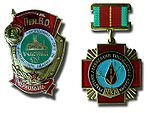
Susan Dorothea White
Susan Dorothea White , also called Sue White and Susan White, is an Australian painter, sculptor, and printmaker. She is a narrative artist and her work concerns the natural world and human situation, increasingly incorporating satire and irony to convey her concern for human rights and equality...
in the National Gallery of Australia
National Gallery of Australia
The National Gallery of Australia is the national art gallery of Australia, holding more than 120,000 works of art. It was established in 1967 by the Australian government as a national public art gallery.- Establishment :...
, exemplifies worldwide awareness of the event. Heavy Water: A film for Chernobyl was released by Seventh Art in 2006 to commemorate the disaster through poetry
Poetry
Poetry is a form of literary art in which language is used for its aesthetic and evocative qualities in addition to, or in lieu of, its apparent meaning...
and first-hand accounts. The film secured the Cinequest Award as well as the Rhode Island "best score" award along with a screening at Tate Modern.
Chernobyl Way
Chernobyl Way
Chernobyl Way is an annual rally run on April 26 by the opposition in Belarus as a remembrance of the Chernobyl disaster.The first time it was run in 1989 with demands of urgent efforts in eliminating the consequeces of the catastrophe....
is an annual rally run on 26 April by the opposition in Belarus as a remembrance of the Chernobyl disaster.
Chernobyl 20
This exhibit presents the stories of 20 people who have each been affected by the disaster, and each person's account is written on a panel. The 20 individuals whose stories are related in the exhibition are from Belarus, France, LatviaLatvia
Latvia , officially the Republic of Latvia , is a country in the Baltic region of Northern Europe. It is bordered to the north by Estonia , to the south by Lithuania , to the east by the Russian Federation , to the southeast by Belarus and shares maritime borders to the west with Sweden...
, Russia, Sweden, Ukraine, and the United Kingdom.
Developed by Danish photo-journalist Mads Eskesen, the exhibition is prepared in multiple languages including English, German
German language
German is a West Germanic language, related to and classified alongside English and Dutch. With an estimated 90 – 98 million native speakers, German is one of the world's major languages and is the most widely-spoken first language in the European Union....
, Danish
Danish language
Danish is a North Germanic language spoken by around six million people, principally in the country of Denmark. It is also spoken by 50,000 Germans of Danish ethnicity in the northern parts of Schleswig-Holstein, Germany, where it holds the status of minority language...
, Dutch
Dutch language
Dutch is a West Germanic language and the native language of the majority of the population of the Netherlands, Belgium, and Suriname, the three member states of the Dutch Language Union. Most speakers live in the European Union, where it is a first language for about 23 million and a second...
, Russian
Russian language
Russian is a Slavic language used primarily in Russia, Belarus, Uzbekistan, Kazakhstan, Tajikistan and Kyrgyzstan. It is an unofficial but widely spoken language in Ukraine, Moldova, Latvia, Turkmenistan and Estonia and, to a lesser extent, the other countries that were once constituent republics...
, and Ukrainian
Ukrainian language
Ukrainian is a language of the East Slavic subgroup of the Slavic languages. It is the official state language of Ukraine. Written Ukrainian uses a variant of the Cyrillic alphabet....
.
In Kiev
Kiev
Kiev or Kyiv is the capital and the largest city of Ukraine, located in the north central part of the country on the Dnieper River. The population as of the 2001 census was 2,611,300. However, higher numbers have been cited in the press....
, Ukraine, the exhibition was launched at the "Chernobyl 20 Remembrance for the Future" conference on 23 April 2006. It was then exhibited during 2006 in the United States
United States
The United States of America is a federal constitutional republic comprising fifty states and a federal district...
, Australia
Australia
Australia , officially the Commonwealth of Australia, is a country in the Southern Hemisphere comprising the mainland of the Australian continent, the island of Tasmania, and numerous smaller islands in the Indian and Pacific Oceans. It is the world's sixth-largest country by total area...
, Denmark
Denmark
Denmark is a Scandinavian country in Northern Europe. The countries of Denmark and Greenland, as well as the Faroe Islands, constitute the Kingdom of Denmark . It is the southernmost of the Nordic countries, southwest of Sweden and south of Norway, and bordered to the south by Germany. Denmark...
, the Netherlands
Netherlands
The Netherlands is a constituent country of the Kingdom of the Netherlands, located mainly in North-West Europe and with several islands in the Caribbean. Mainland Netherlands borders the North Sea to the north and west, Belgium to the south, and Germany to the east, and shares maritime borders...
, Switzerland
Switzerland
Switzerland name of one of the Swiss cantons. ; ; ; or ), in its full name the Swiss Confederation , is a federal republic consisting of 26 cantons, with Bern as the seat of the federal authorities. The country is situated in Western Europe,Or Central Europe depending on the definition....
, Ukraine
Ukraine
Ukraine is a country in Eastern Europe. It has an area of 603,628 km², making it the second largest contiguous country on the European continent, after Russia...
, and the United Kingdom
United Kingdom
The United Kingdom of Great Britain and Northern IrelandIn the United Kingdom and Dependencies, other languages have been officially recognised as legitimate autochthonous languages under the European Charter for Regional or Minority Languages...
.
See also
- Chernobyl compared to other radioactivity releasesChernobyl compared to other radioactivity releasesThis article compares the radioactivity release and decay from the Chernobyl disaster with various other events which involved a release of uncontrolled radioactivity.-Chernobyl compared to background radiation:...
- Chernobyl Nuclear Power Plant Exclusion Zone
- Chernobyl Shelter FundChernobyl Shelter FundThe Chernobyl Shelter Fund was set up in December 1997 with the purpose of funding the Shelter Implementation Plan . The main objective of the SIP, developed in a co-operative effort between the European Union, the United States and Ukraine, is to protect the personnel, population and environment...
- Children of Chernobyl Benefit Concert
- List of Chernobyl-related articles
- Nuclear energy policy of the United States#Public opinion after Chernobyl
- National Geographic Seconds From Disaster episodes
- Threat of the Dnieper reservoirsThreat of the Dnieper reservoirsThe water reservoirs of the Dnieper River in Ukraine pose a significant threat of a large-scale human-made disaster if their dams fail. Such a threat is typical for reservoir dams; however, the Dnieper reservoirs are especially dangerous because of the geographical conditions, as well as the...
- Zero Hour (TV series)Zero Hour (TV series)Zero Hour is a Canadian/British documentary-style television program, which airs on The History Channel in the United States, History Television in Canada and on the BBC in the United Kingdom...
episode, showing the inside of the power plant with remarkable accuracy
Documents
The source documents, which relate to the emergency, published in unofficial sources:- Technological Regulations on operation of 3 and 4 power units of Chernobyl NPP (in force at the moment of emergency)
- Tables and graphs of some parameters variation of the unit before the emergency
External links
- Official UN Chernobyl site
- International Chernobyl Portal chernobyl.info, UN Inter-Agency Project ICRIN
- Frequently Asked Chernobyl Questions, by the IAEA
- Chernobyl Recovery and Development Programme (United Nations Development Programme)
- Photographs from inside the zone of alienation and City of Prypyat (2010)
- Photographs from inside the Chernobyl Reactor and City of Prypyat
- Photographs of those affected by the Chernobyl Disaster
- Photographs from the City of Pripyat, and of those affected by the disaster
- EnglishRussia Photos of a RBMK-based power plant, showing details of the reactor hall, pumps, and the control room
- The Battle of Chernobyl (documentary)
- 25 years of satellite imagery over Chernobyl