


Nuclear chain reaction

Encyclopedia
Nuclear reaction
In nuclear physics and nuclear chemistry, a nuclear reaction is semantically considered to be the process in which two nuclei, or else a nucleus of an atom and a subatomic particle from outside the atom, collide to produce products different from the initial particles...
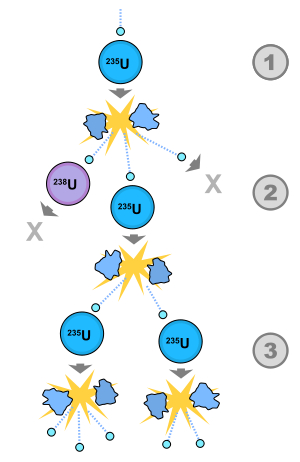
causes an average of one or more nuclear reactions, thus leading to a self-propagating number of these reactions. The specific nuclear reaction may be the fission of heavy isotopes (e.g. 235U) or the fusion of light isotopes (e.g. 2H and 3H). The nuclear chain reaction releases several million times more energy per reaction than any chemical reaction
Chemical reaction
A chemical reaction is a process that leads to the transformation of one set of chemical substances to another. Chemical reactions can be either spontaneous, requiring no input of energy, or non-spontaneous, typically following the input of some type of energy, such as heat, light or electricity...
.
History
Chemical chain reactionChain reaction
A chain reaction is a sequence of reactions where a reactive product or by-product causes additional reactions to take place. In a chain reaction, positive feedback leads to a self-amplifying chain of events....
s were first proposed by German chemist Max Bodenstein
Max Bodenstein
Max Ernst August Bodenstein was a German physical chemist known for his work in chemical kinetics...
in 1913, and reasonably well understood before nuclear chain reactions were proposed. It was understood that chemical chain reactions were responsible for exponentially increasing rates in reactions, such as produced chemical explosions.
The concept of a nuclear chain reaction was first hypothesized by Hungarian
Hungary
Hungary , officially the Republic of Hungary , is a landlocked country in Central Europe. It is situated in the Carpathian Basin and is bordered by Slovakia to the north, Ukraine and Romania to the east, Serbia and Croatia to the south, Slovenia to the southwest and Austria to the west. The...
scientist Leó Szilárd
Leó Szilárd
Leó Szilárd was an Austro-Hungarian physicist and inventor who conceived the nuclear chain reaction in 1933, patented the idea of a nuclear reactor with Enrico Fermi, and in late 1939 wrote the letter for Albert Einstein's signature that resulted in the Manhattan Project that built the atomic bomb...
on August 12, 1933. The neutron had been discovered in 1932, shortly before. Szilard realized that if a nuclear reaction produced neutrons, which then caused further nuclear reactions, the process might be self-perpetuating. Szilárd, however, did not propose fission as the mechanism for his chain reaction, since the fission reaction was not yet discovered or even suspected. Instead, Szilard proposed using mixtures of lighter known isotopes which produced neutrons in copious amounts. He filed a patent for his idea of a simple nuclear reactor the following year.
In 1936, Szilárd attempted to create a chain reaction using beryllium
Beryllium
Beryllium is the chemical element with the symbol Be and atomic number 4. It is a divalent element which occurs naturally only in combination with other elements in minerals. Notable gemstones which contain beryllium include beryl and chrysoberyl...
and indium
Indium
Indium is a chemical element with the symbol In and atomic number 49. This rare, very soft, malleable and easily fusible post-transition metal is chemically similar to gallium and thallium, and shows the intermediate properties between these two...
, but was unsuccessful. After nuclear fission
Nuclear fission
In nuclear physics and nuclear chemistry, nuclear fission is a nuclear reaction in which the nucleus of an atom splits into smaller parts , often producing free neutrons and photons , and releasing a tremendous amount of energy...
was discovered by others in 1938, Szilárd and Enrico Fermi
Enrico Fermi
Enrico Fermi was an Italian-born, naturalized American physicist particularly known for his work on the development of the first nuclear reactor, Chicago Pile-1, and for his contributions to the development of quantum theory, nuclear and particle physics, and statistical mechanics...
in 1939 searched for, and discovered, neutron multiplication in uranium, proving that a nuclear chain reaction by this mechanism was indeed possible. This discovery prompted the letter from Albert Einstein
Albert Einstein
Albert Einstein was a German-born theoretical physicist who developed the theory of general relativity, effecting a revolution in physics. For this achievement, Einstein is often regarded as the father of modern physics and one of the most prolific intellects in human history...
to President Franklin D. Roosevelt
Franklin D. Roosevelt
Franklin Delano Roosevelt , also known by his initials, FDR, was the 32nd President of the United States and a central figure in world events during the mid-20th century, leading the United States during a time of worldwide economic crisis and world war...
warning of the possibility that Nazi Germany
Nazi Germany
Nazi Germany , also known as the Third Reich , but officially called German Reich from 1933 to 1943 and Greater German Reich from 26 June 1943 onward, is the name commonly used to refer to the state of Germany from 1933 to 1945, when it was a totalitarian dictatorship ruled by...
might be attempting to build an atomic bomb.
Enrico Fermi created the first artificial self-sustaining nuclear chain reaction, called Chicago Pile-1
Chicago Pile-1
Chicago Pile-1 was the world's first man-made nuclear reactor. CP-1 was built on a rackets court, under the abandoned west stands of the original Alonzo Stagg Field stadium, at the University of Chicago. The first self-sustaining nuclear chain reaction was initiated in CP-1 on December 2, 1942...
(CP-1), in a racquets
Racquets (sport)
Rackets or Racquets is an indoor racket sport played in the United Kingdom, United States, and Canada...
court below the bleachers of Stagg Field
Stagg Field
Amos Alonzo Stagg Field is the name of two different football fields for the University of Chicago. The earliest Stagg Field is probably best remembered for its role in a landmark scientific achievement by Enrico Fermi during the Manhattan Project. The site of the first nuclear reaction received...
at the University of Chicago
University of Chicago
The University of Chicago is a private research university in Chicago, Illinois, USA. It was founded by the American Baptist Education Society with a donation from oil magnate and philanthropist John D. Rockefeller and incorporated in 1890...
on December 2, 1942. Fermi's experiments at the University of Chicago were part of Arthur H. Compton's Metallurgical Laboratory
Metallurgical Laboratory
The Metallurgical Laboratory or "Met Lab" at the University of Chicago was part of the World War II–era Manhattan Project, created by the United States to develop an atomic bomb...
facility, which was part of the Manhattan Project
Manhattan Project
The Manhattan Project was a research and development program, led by the United States with participation from the United Kingdom and Canada, that produced the first atomic bomb during World War II. From 1942 to 1946, the project was under the direction of Major General Leslie Groves of the US Army...
.
In 1956, Paul Kuroda of the University of Arkansas
University of Arkansas
The University of Arkansas is a public, co-educational, land-grant, space-grant, research university. It is classified by the Carnegie Foundation as a research university with very high research activity. It is the flagship campus of the University of Arkansas System and is located in...
postulated that a natural fission reactor may have once existed. Since nuclear chain reactions only require natural materials (such as water and uranium), it is possible to have these chain reactions occur where there is the right combination of materials within the Earth's crust. Kuroda's prediction was verified with the discovery of evidence of natural self-sustaining nuclear chain reactions
Natural nuclear fission reactor
A natural nuclear fission reactor is a uranium deposit where analysis of isotope ratios has shown that self-sustaining nuclear chain reactions have occurred. The existence of this phenomenon was discovered in 1972 at Oklo in Gabon, Africa, by French physicist Francis Perrin. The conditions under...
in the past at Oklo
Oklo
Oklo is a region near the town of Franceville, in the Haut-Ogooué province of the Central African state of Gabon. Several natural nuclear fission reactors were discovered in the uranium mines in the region in 1972.-History:...
in Gabon, Africa in September 1972.
Fission chain reaction
Fission chain reactions occur because of interactions between neutrons and fissileFissile
In nuclear engineering, a fissile material is one that is capable of sustaining a chain reaction of nuclear fission. By definition, fissile materials can sustain a chain reaction with neutrons of any energy. The predominant neutron energy may be typified by either slow neutrons or fast neutrons...
isotopes (such as 235U). The chain reaction requires both the release of neutrons from fissile isotopes undergoing nuclear fission
Nuclear fission
In nuclear physics and nuclear chemistry, nuclear fission is a nuclear reaction in which the nucleus of an atom splits into smaller parts , often producing free neutrons and photons , and releasing a tremendous amount of energy...
and the subsequent absorption of some of these neutrons in fissile isotopes. When an atom undergoes nuclear fission, a few neutrons (the exact number depends on several factors) are ejected from the reaction. These free neutrons will then interact with the surrounding medium, and if more fissile fuel is present, some may be absorbed and cause more fissions. Thus, the cycle repeats to give a reaction that is self-sustaining.
Nuclear power plants operate by precisely controlling the rate at which nuclear reactions occur, and that control is maintained through the use of several redundant layers of safety measures. Moreover, the materials in a nuclear reactor core and the uranium enrichment level make a nuclear explosion impossible, even if all safety measures failed. On the other hand, nuclear weapons are specifically engineered to produce a reaction that is so fast and intense it cannot be controlled after it has started. When properly designed, this uncontrolled reaction can lead to an explosive energy release.
Nuclear fission fuel
Nuclear fission weapons must use an extremely high quality, highly-enriched fuel exceeding the critical size and geometry (critical mass) in order to obtain an explosive chain reaction. The fuel for a nuclear fission reactor is very different, usually consisting of a low-enriched oxide material (e.g. UO2).Fission reaction products
When a heavy atom undergoes nuclear fission it breaks into two or more fission fragments. Also, several free neutrons, gamma rays, and neutrinos are emitted, and a large amount of energy is released. The sum of the rest masses of the fission fragments and ejected neutrons is less than the sum of the rest masses of the original atom and incident neutron (of course the fission fragments are not at rest). The mass difference is accounted for in the release of energy according to the equation E=Δmc²:mass of released energy =

Due to the extremely large value of the speed of light
Speed of light
The speed of light in vacuum, usually denoted by c, is a physical constant important in many areas of physics. Its value is 299,792,458 metres per second, a figure that is exact since the length of the metre is defined from this constant and the international standard for time...
, c, a small decrease in mass is associated with a tremendous release of active energy (for example, the kinetic energy of the fission fragments). This energy (in the form of radiation and heat) carries the missing mass, when it leaves the reaction system (total mass, like total energy, is always conserved
Conservation of mass
The law of conservation of mass, also known as the principle of mass/matter conservation, states that the mass of an isolated system will remain constant over time...
). While typical chemical reactions release energies on the order of a few eVs (e.g. the binding energy of the electron to hydrogen is 13.6 eV), nuclear fission reactions typically release energies on the order of hundreds of millions of eVs.
Two typical fission reactions are shown below with average values of energy released and number of neutrons ejected:


Note that these equations are for fissions caused by slow-moving (thermal) neutrons. The average energy released and number of neutrons ejected is a function of the incident neutron speed. Also, note that these equations exclude energy from neutrinos since these subatomic particles are extremely non-reactive and, therefore, rarely deposit their energy in the system.
Prompt neutron lifetime
The prompt neutron lifetime, l, is the average time between the emission of neutrons and either their absorption in the system or their escape from the system. The term lifetime is used because the emission of a neutron is often considered its "birth," and the subsequent absorption is considered its "death." For thermal (slow-neutron) fission reactors, the typical prompt neutron lifetime is on the order of 10−4 seconds, and for fast fission reactors, the prompt neutron lifetime is on the order of 10−7 seconds. These extremely short lifetimes mean that in 1 second, 10,000 to 10,000,000 neutron lifetimes can pass. The average (also referred to as the adjoint unweighted) prompt neutron lifetime takes into account all prompt neutrons regardless of their importance in the reactor core; the effective prompt neutron lifetime (referred to as the adjoint weighted over space, energy, and angle) refers to a neutron with average importance.Mean generation time
The mean generation time, Λ, is the average time from a neutron emission to a capture that results in fission. The mean generation time is different from the prompt neutron lifetime because the mean generation time only includes neutron absorptions that lead to fission reactions (not other absorption reactions). The two times are related by the following formula:
In this formula, k is the effective neutron multiplication factor, described below.
Effective neutron multiplication factor
The effective neutron multiplication factor, k, is the average number of neutrons from one fission that cause another fission. The remaining neutrons either are absorbed in non-fission reactions or leave the system without being absorbed. The value of k determines how a nuclear chain reaction proceeds:- k < 1 (subcriticality): The system cannot sustain a chain reaction, and any beginning of a chain reaction dies out over time. For every fission that is induced in the system, an average total of 1/(1 − k) fissions occur.
- k = 1 (criticalityCritical massA critical mass is the smallest amount of fissile material needed for a sustained nuclear chain reaction. The critical mass of a fissionable material depends upon its nuclear properties A critical mass is the smallest amount of fissile material needed for a sustained nuclear chain reaction. The...
): Every fission causes an average of one more fission, leading to a fission (and power) level that is constant. Nuclear power plants operate with k = 1 unless the power level is being increased or decreased.
- k > 1 (supercriticality): For every fission in the material, it is likely that there will be "k" fissions after the next mean generation time. The result is that the number of fission reactions increases exponentially, according to the equation
 , where t is the elapsed time. Nuclear weapons are designed to operate under this state. There are two subdivisions of supercriticality: prompt and delayed.
When describing kinetics and dynamics of nuclear reactors and also in the practice of reactor operation is used the concept of Reactivity (nuclear), which characterizes the deflection of reactor from the critical state. ρ=(k-1)/k.
In a nuclear reactor, k will actually oscillate from slightly less than 1 to slightly more than 1, due primarily to thermal effects (as more power is produced, the fuel rods warm and thus expand, lowering their capture ratio, and thus driving k lower). This leaves the average value of k at exactly 1. Delayed neutrons play an important role in the timing of these oscillations.
In an infinite medium, the multiplication factor may be described by the four factor formula; in a non-infinite medium, the multiplication factor may be described by the six factor formula.
Prompt and delayed supercriticality
Not all neutrons are emitted as a direct product of fission; some are instead due to the radioactive decayRadioactive decay
Radioactive decay is the process by which an atomic nucleus of an unstable atom loses energy by emitting ionizing particles . The emission is spontaneous, in that the atom decays without any physical interaction with another particle from outside the atom...
of some of the fission fragments. The neutrons that occur directly from fission are called "prompt neutron
Prompt neutron
In nuclear engineering, a prompt neutron is a neutron immediately emitted by a nuclear fission event, as opposed to a delayed neutron decay which can occur within the same context, emitted by one of the fission products anytime from a few milliseconds to a few minutes later.-Principle:Using U-235...
s," and the ones that are a result of radioactive decay of fission fragments are called "delayed neutrons." The fraction of neutrons that are delayed is called β, and this fraction is typically less than 1% of all the neutrons in the chain reaction.
The delayed neutrons allow a nuclear reactor to respond several orders of magnitude more slowly than just prompt neutrons would alone. Without delayed neutrons, changes in reaction rates in nuclear reactors would occur at speeds that are too fast for humans to control.
The region of supercriticality between k = 1 and k = 1/(1-β) is known as delayed supercriticality (or delayed criticality). It is in this region that all nuclear power reactors operate. The region of supercriticality for k > 1/(1-β) is known as prompt supercriticality (or prompt criticality), which is the region in which nuclear weapons operate.
The change in k needed to go from critical to prompt critical is defined as a dollar
Neutron multiplication in nuclear weapons
Nuclear fission weapons require a mass of fissile fuel that is prompt supercritical.For a given mass of fissile material the value of k can be increased by increasing the density. Since the probability per distance traveled for a neutron to collide with a nucleus is proportional to the material density, increasing the density of a fissile material can increase k. This concept is utilized in the implosion method for nuclear weapons. In these devices, the nuclear chain reaction begins after increasing the density of the fissile material with a conventional explosive.
In the gun-type fission weapon
Gun-type fission weapon
Gun-type fission weapons are fission-based nuclear weapons whose design assembles their fissile material into a supercritical mass by the use of the "gun" method: shooting one piece of sub-critical material into another...
two subcritical pieces of fuel are rapidly brought together. The value of k for a combination of two masses is always greater than that of its components. The magnitude of the difference depends on distance, as well as the physical orientation.
The value of k can also be increased by using a neutron reflector
Neutron reflector
A neutron reflector is any material that reflects neutrons. This refers to elastic scattering rather than to a specular reflection. The material may be graphite, beryllium, steel, and tungsten carbide, or other materials...
surrounding the fissile material
Once the mass of fuel is prompt supercritical, the power increases exponentially. However, the exponential power increase cannot continue for long since k decreases when the amount of fission material that is left decreases (i.e. it is consumed by fissions). Also, the geometry and density are expected to change during detonation since the remaining fission material is torn apart from the explosion.
Predetonation
Detonation of a nuclear weapon involves bringing fissile material into its optimal supercritical state very rapidly. During part of this process, the assembly is supercritical, but not yet in an optimal state for a chain reaction. Free neutrons, in particular from spontaneous fissionSpontaneous fission
Spontaneous fission is a form of radioactive decay characteristic of very heavy isotopes. Because the nuclear binding energy reaches a maximum at a nuclear mass greater than about 60 atomic mass units , spontaneous breakdown into smaller nuclei and single particles becomes possible at heavier masses...
s, can cause the device to undergo a preliminary chain reaction that destroys the fissile material before it is ready to produce a large explosion, which is known as predetonation. To keep the probability of predetonation low, the duration of the non-optimal assembly period is minimized and fissile and other materials are used which have low spontaneous fission rates. In fact, the combination of materials has to be such that it is unlikely that there is even a single spontaneous fission during the period of supercritical assembly. In particular, the gun method cannot be used with plutonium (see nuclear weapon design
Nuclear weapon design
Nuclear weapon designs are physical, chemical, and engineering arrangements that cause the physics package of a nuclear weapon to detonate. There are three basic design types...
).
Uncontrolled chain reactions and explosions in nuclear power plants
It is impossible for a nuclear power plant to undergo a nuclear chain reaction that results in an explosion of power comparable with a nuclear weaponNuclear weapon
A nuclear weapon is an explosive device that derives its destructive force from nuclear reactions, either fission or a combination of fission and fusion. Both reactions release vast quantities of energy from relatively small amounts of matter. The first fission bomb test released the same amount...
, but even low-powered explosions due to uncontrolled chain reactions, that would be considered "fizzles" in a bomb, may still cause considerable damage and meltdown in a reactor. For example, the Chernobyl disaster
Chernobyl disaster
The Chernobyl disaster was a nuclear accident that occurred on 26 April 1986 at the Chernobyl Nuclear Power Plant in Ukraine , which was under the direct jurisdiction of the central authorities in Moscow...
involved a runnaway chain reaction but the result was a low-powered steam explosion from the relatively small release of heat, as compared with a bomb. However, the reactor complex was destroyed by the heat, as well as by ordinary burning of the graphite exposed to air. Such steam explosions would be typical of the very diffuse assembly of materials in a nuclear reactor
Nuclear reactor
A nuclear reactor is a device to initiate and control a sustained nuclear chain reaction. Most commonly they are used for generating electricity and for the propulsion of ships. Usually heat from nuclear fission is passed to a working fluid , which runs through turbines that power either ship's...
, even under the worst conditions.
In addition, other steps can be taken for safety. For example, power plants licensed in the United States require a negative void coefficient
Void coefficient
In nuclear engineering, the void coefficient is a number that can be used to estimate how much the reactivity of a nuclear reactor changes as voids form in the reactor moderator or coolant...
of reactivity (this means that if water is removed from the reactor core, the nuclear reaction will tend to shut down, not increase). This eliminates the possibility of the type of accident that occurred at Chernobyl (which was due to a positive void coefficient). However, nuclear reactors are still capable of causing smaller explosions even after complete shutdown, such as was the case of the Fukushima Daiichi nuclear disaster
Fukushima Daiichi nuclear disaster
The is a series of equipment failures, nuclear meltdowns, and releases of radioactive materials at the Fukushima I Nuclear Power Plant, following the Tōhoku earthquake and tsunami on 11 March 2011. The plant comprises six separate boiling water reactors originally designed by General Electric ,...
. In such cases, residual decay heat
Decay heat
Decay heat is the heat released as a result of radioactive decay. This is when the radiation interacts with materials: the energy of the alpha, beta or gamma radiation is converted into the thermal movement of atoms.-Natural occurrence:...
from the core may cause high temperatures if there is loss of loss of coolant flow, even a day after the chain reaction has been shut down (see SCRAM
Scram
A scram or SCRAM is an emergency shutdown of a nuclear reactor – though the term has been extended to cover shutdowns of other complex operations, such as server farms and even large model railroads...
). This may cause a chemical reaction between water and fuel that produces hydrogen gas which can explode after mixing with air, with severe contamination consequences, since fuel rod material may still be exposed to the atmosphere from this process. However, such explosions do not happen during a chain reaction, but rather as a result of energy from radioactive beta decay
Beta decay
In nuclear physics, beta decay is a type of radioactive decay in which a beta particle is emitted from an atom. There are two types of beta decay: beta minus and beta plus. In the case of beta decay that produces an electron emission, it is referred to as beta minus , while in the case of a...
, after the fission chain reaction has been stopped.
Fusion chain reaction
In a more generalized sense, a nuclear fusionNuclear fusion
Nuclear fusion is the process by which two or more atomic nuclei join together, or "fuse", to form a single heavier nucleus. This is usually accompanied by the release or absorption of large quantities of energy...
reaction can be considered a nuclear chain reaction: it occurs under extreme pressure and temperature conditions, which are maintained by the energy released in the fusion process.
See also
- Chain reactionChain reactionA chain reaction is a sequence of reactions where a reactive product or by-product causes additional reactions to take place. In a chain reaction, positive feedback leads to a self-amplifying chain of events....
- Critical mass
- Criticality accidentCriticality accidentA criticality accident, sometimes referred to as an excursion or a power excursion, is an accidental increase of nuclear chain reactions in a fissile material, such as enriched uranium or plutonium...
- Four factor formula
- Nuclear criticality safetyNuclear Criticality SafetyNuclear criticality safety is a field of nuclear engineering dedicated to the prevention of nuclear and radiation accidents resulting from an inadvertent, self-sustaining nuclear chain reaction. Additionally, nuclear criticality safety is concerned with mitigating the consequences of a nuclear...
- Nuclear physicsNuclear physicsNuclear physics is the field of physics that studies the building blocks and interactions of atomic nuclei. The most commonly known applications of nuclear physics are nuclear power generation and nuclear weapons technology, but the research has provided application in many fields, including those...
- Nuclear reactionNuclear reactionIn nuclear physics and nuclear chemistry, a nuclear reaction is semantically considered to be the process in which two nuclei, or else a nucleus of an atom and a subatomic particle from outside the atom, collide to produce products different from the initial particles...
- Nuclear reactor physicsNuclear reactor physicsNuclear reactor physics is the branch of science that deals with the study and application of chain reaction to induce controlled rate of fission for energy in reactors....
- Nuclear weapon designNuclear weapon designNuclear weapon designs are physical, chemical, and engineering arrangements that cause the physics package of a nuclear weapon to detonate. There are three basic design types...