
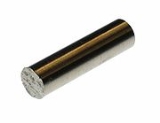
Zirconium is a
chemical elementA chemical element is a pure chemical substance consisting of one type of atom distinguished by its atomic number, which is the number of protons in its nucleus. Familiar examples of elements include carbon, oxygen, aluminum, iron, copper, gold, mercury, and lead.As of November 2011, 118 elements...
with the symbol
Zr and
atomic numberIn chemistry and physics, the atomic number is the number of protons found in the nucleus of an atom and therefore identical to the charge number of the nucleus. It is conventionally represented by the symbol Z. The atomic number uniquely identifies a chemical element...
40. The name of zirconium is taken from the mineral
zirconZircon is a mineral belonging to the group of nesosilicates. Its chemical name is zirconium silicate and its corresponding chemical formula is ZrSiO4. A common empirical formula showing some of the range of substitution in zircon is 1–x4x–y...
. Its atomic mass is 91.224. It is a lustrous, grey-white, strong
transition metalThe term transition metal has two possible meanings:*The IUPAC definition states that a transition metal is "an element whose atom has an incomplete d sub-shell, or which can give rise to cations with an incomplete d sub-shell." Group 12 elements are not transition metals in this definition.*Some...
that resembles
titaniumTitanium is a chemical element with the symbol Ti and atomic number 22. It has a low density and is a strong, lustrous, corrosion-resistant transition metal with a silver color....
. Zirconium is mainly used as a
refractoryA refractory material is one that retains its strength at high temperatures. ASTM C71 defines refractories as "non-metallic materials having those chemical and physical properties that make them applicable for structures, or as components of systems, that are exposed to environments above...
and
opacifierAn opacifier is a substance added to a material in order to make the ensuing system opaque. An example of a chemical opacifier is tin dioxide , which is used to opacify ceramic glazes and milk glass; bone ash is also used....
, although minor amounts are used as alloying agent for its strong resistance to corrosion. Zirconium is obtained mainly from the mineral
zirconZircon is a mineral belonging to the group of nesosilicates. Its chemical name is zirconium silicate and its corresponding chemical formula is ZrSiO4. A common empirical formula showing some of the range of substitution in zircon is 1–x4x–y...
, which is the most important form of zirconium in use.
Zirconium forms a variety of
inorganicInorganic chemistry is the branch of chemistry concerned with the properties and behavior of inorganic compounds. This field covers all chemical compounds except the myriad organic compounds , which are the subjects of organic chemistry...
and organometallic compounds such as
zirconium dioxideZirconium dioxide , sometimes known as zirconia , is a white crystalline oxide of zirconium. Its most naturally occurring form, with a monoclinic crystalline structure, is the rare mineral baddeleyite. The high temperature cubic crystalline form is rarely found in nature as mineral tazheranite O2...
and
zirconocene dichlorideZirconocene dichloride is an organozirconium compound composed of a zirconium central atom, with two cyclopentadienyl and two chloro ligands. It is a colourless diamagnetic solid that is somewhat stable in air.-Preparation:...
, respectively. Five
isotopeIsotopes are variants of atoms of a particular chemical element, which have differing numbers of neutrons. Atoms of a particular element by definition must contain the same number of protons but may have a distinct number of neutrons which differs from atom to atom, without changing the designation...
s occur naturally, three of which are stable. Zirconium compounds have no biological role.
Characteristics
Zirconium is a lustrous, grayish-white, soft, ductile, and malleable metal which is solid at room temperature, though it becomes hard and
brittleA material is brittle if, when subjected to stress, it breaks without significant deformation . Brittle materials absorb relatively little energy prior to fracture, even those of high strength. Breaking is often accompanied by a snapping sound. Brittle materials include most ceramics and glasses ...
at lower purities. In powder form, zirconium is highly flammable, but the solid form is far less prone to ignition. Zirconium is highly resistant to corrosion by alkalies, acids, salt water, and other agents. However, it will dissolve in
hydrochloricHydrochloric acid is a solution of hydrogen chloride in water, that is a highly corrosive, strong mineral acid with many industrial uses. It is found naturally in gastric acid....
and
sulfuric acidSulfuric acid is a strong mineral acid with the molecular formula . Its historical name is oil of vitriol. Pure sulfuric acid is a highly corrosive, colorless, viscous liquid. The salts of sulfuric acid are called sulfates...
, especially when
fluorineFluorine is the chemical element with atomic number 9, represented by the symbol F. It is the lightest element of the halogen column of the periodic table and has a single stable isotope, fluorine-19. At standard pressure and temperature, fluorine is a pale yellow gas composed of diatomic...
is present. Alloys with zinc become magnetic below 35 K.
Zirconium's melting point is 1855 °C (3371 °F), and its boiling point is 4371 °C (7900 °F). Zirconium has an
electronegativityElectronegativity, symbol χ , is a chemical property that describes the tendency of an atom or a functional group to attract electrons towards itself. An atom's electronegativity is affected by both its atomic number and the distance that its valence electrons reside from the charged nucleus...
of 1.33 on the Pauling scale. Of the elements within
d-blockThe d-block is the portion of the periodic table that contains the element groups 3-12. These groups correspond to the filling of the atomic d-orbital subshell, with electron configurations ranging from s2d1 to s2d10...
, zirconium has the fourth lowest electronegativity after
yttriumYttrium is a chemical element with symbol Y and atomic number 39. It is a silvery-metallic transition metal chemically similar to the lanthanides and it has often been classified as a "rare earth element". Yttrium is almost always found combined with the lanthanides in rare earth minerals and is...
,
lutetium, and
hafniumHafnium is a chemical element with the symbol Hf and atomic number 72. A lustrous, silvery gray, tetravalent transition metal, hafnium chemically resembles zirconium and is found in zirconium minerals. Its existence was predicted by Dmitri Mendeleev in 1869. Hafnium was the penultimate stable...
.
ZrZn
2 is one of only two substances to exhibit
superconductivitySuperconductivity is a phenomenon of exactly zero electrical resistance occurring in certain materials below a characteristic temperature. It was discovered by Heike Kamerlingh Onnes on April 8, 1911 in Leiden. Like ferromagnetism and atomic spectral lines, superconductivity is a quantum...
and
ferromagnetismFerromagnetism is the basic mechanism by which certain materials form permanent magnets, or are attracted to magnets. In physics, several different types of magnetism are distinguished...
simultaneously, with the other being UGe
2.
Isotopes
Naturally occurring zirconium is composed of five isotopes.
90Zr,
91Zr,
92Zr and
94Zr are stable.
94Zr can undergo double beta decay (not observed experimentally) with a half-life of more than 1.10×10
17 years.
96Zr has a half-life of 2.4×10
19 years, making it the longest-lived radioisotope of zirconium. Of these natural isotopes,
90Zr is the most common, making up 51.45% of all zirconium.
96Zr is the least common, comprising only 2.80% of zirconium.
Twenty-eight artificial isotopes of zirconium have been synthesized, ranging in atomic mass from 78 to 110.
93Zr is the longest-lived artificial isotope, with a half-life of 1.53×10
6 years.
110Zr, the heaviest isotope of zirconium, is also the shortest-lived, with an estimated half-life of only 30 milliseconds. Radioactive isotopes at or above mass number 93 decay by
β−In nuclear physics, beta decay is a type of radioactive decay in which a beta particle is emitted from an atom. There are two types of beta decay: beta minus and beta plus. In the case of beta decay that produces an electron emission, it is referred to as beta minus , while in the case of a...
, whereas those at or below 89 decay by
β+In nuclear physics, beta decay is a type of radioactive decay in which a beta particle is emitted from an atom. There are two types of beta decay: beta minus and beta plus. In the case of beta decay that produces an electron emission, it is referred to as beta minus , while in the case of a...
. The only exception is
88Zr, which decays by
εElectron capture is a process in which a proton-rich nuclide absorbs an inner atomic electron and simultaneously emits a neutrino...
.
Five isotopes of zirconium also exist as
metastable isomerA nuclear isomer is a metastable state of an atomic nucleus caused by the excitation of one or more of its nucleons . "Metastable" refers to the fact that these excited states have half-lives more than 100 to 1000 times the half-lives of the other possible excited nuclear states...
s:
83mZr,
85mZr,
89mZr,
90m1Zr,
90m2Zr, and
91mZr. Of these,
90m2Zr has the shortest half-life at 131 nanoseconds.
89mZr is the longest lived with a half-life of 4.161 minutes.
Occurrence
Zirconium has a concentration of about 130 mg/kg within the
earth's crustThe table shows the abundance of elements in Earth's crust. Numbers show percentage or parts per million in mass; 10,000 ppm = 1%.Note that numbers are estimates, and they will vary depending on source and method of estimation. Order of magnitude of data can roughly be relied upon.The table shows...
and about 0.026 μg/L in sea water. It is not found in nature as a
native metalA native metal is any metal that is found in its metallic form, either pure or as an alloy, in nature. Metals that can be found as native deposits singly and/or in alloys include aluminium, antimony, arsenic, bismuth, cadmium, chromium, cobalt, indium, iron, nickel, selenium, tantalum, tellurium,...
, reflecting its intrinsic instability with respect to water. The principal commercial source of zirconium is the silicate mineral,
zirconZircon is a mineral belonging to the group of nesosilicates. Its chemical name is zirconium silicate and its corresponding chemical formula is ZrSiO4. A common empirical formula showing some of the range of substitution in zircon is 1–x4x–y...
(ZrSiO
4), which is found primarily in Australia, Brazil, India, Russia, South Africa, and the United States, as well as in smaller deposits around the world. 80% of zircon mining occurs in Australia and South Africa.
ZirconZircon is a mineral belonging to the group of nesosilicates. Its chemical name is zirconium silicate and its corresponding chemical formula is ZrSiO4. A common empirical formula showing some of the range of substitution in zircon is 1–x4x–y...
resources exceed 60 million metric tons worldwide and annual worldwide zirconium production is approximately 900,000 metric tons. Zirconium also occurs in more than 140 other minerals, including the commercially useful ores
baddeleyiteBaddeleyite is a rare zirconium oxide mineral , occurring in a variety of monoclinic prismatic crystal forms. It is transparent to translucent, has high indices of refraction, and ranges from colorless to yellow, green, and dark brown. Baddeleyite is a refractory mineral, with a melting point of...
and kosnarite.
Zr is relatively abundant in S-type stars, and it has been detected in the sun and in meteorites. Lunar rock samples brought back from several Apollo program missions to the moon have a quite high zirconium oxide content relative to terrestrial rocks.
Production
Zircon is a by-product of the mining and processing of the
titaniumTitanium is a chemical element with the symbol Ti and atomic number 22. It has a low density and is a strong, lustrous, corrosion-resistant transition metal with a silver color....
minerals
ilmeniteIlmenite is a weakly magnetic titanium-iron oxide mineral which is iron-black or steel-gray. It is a crystalline iron titanium oxide . It crystallizes in the trigonal system, and it has the same crystal structure as corundum and hematite....
and
rutileRutile is a mineral composed primarily of titanium dioxide, TiO2.Rutile is the most common natural form of TiO2. Two rarer polymorphs of TiO2 are known:...
, as well as
tinTin is a chemical element with the symbol Sn and atomic number 50. It is a main group metal in group 14 of the periodic table. Tin shows chemical similarity to both neighboring group 14 elements, germanium and lead and has two possible oxidation states, +2 and the slightly more stable +4...
mining. From 2003 to 2007, zircon prices have steadily increased from $360 to $840 per metric ton.
Upon being collected from coastal waters, zircon-containing sand is purified by spiral concentrators to remove lighter materials, which are then placed back into the water safely, as they are all natural components of beach sand. Using magnetic separators, the titanium ores
ilmeniteIlmenite is a weakly magnetic titanium-iron oxide mineral which is iron-black or steel-gray. It is a crystalline iron titanium oxide . It crystallizes in the trigonal system, and it has the same crystal structure as corundum and hematite....
and
rutileRutile is a mineral composed primarily of titanium dioxide, TiO2.Rutile is the most common natural form of TiO2. Two rarer polymorphs of TiO2 are known:...
are removed.
Most zircon is used directly in commercial applications, but a few percent is converted to the metal. Most Zr metal is produced by the reduction of the
zirconium(IV) chlorideZirconium chloride, also known as zirconium tetrachloride, is an inorganic compound frequently used as a precursor to other compounds of zirconium. This white high-melting solid hydrolyzes rapidly in humid air.-Structure:...
with
magnesiumMagnesium is a chemical element with the symbol Mg, atomic number 12, and common oxidation number +2. It is an alkaline earth metal and the eighth most abundant element in the Earth's crust and ninth in the known universe as a whole...
metal in the
Kroll processKroll Process is a pyrometallurgical industrial process used to produce metallic titanium. It was invented by William J. Kroll in Luxembourg. After moving to the United States, Kroll further developed the method for the production of zirconium...
. Commercial-quality zirconium for most uses still has a content of 1% to 3% hafnium. This contaminant is unimportant except in nuclear applications. The resulting metal is sintered until sufficiently ductile for metalworking.
Separation of Zr and Hf
Commercial zirconium metal typically contains 1–2.5% of
hafniumHafnium is a chemical element with the symbol Hf and atomic number 72. A lustrous, silvery gray, tetravalent transition metal, hafnium chemically resembles zirconium and is found in zirconium minerals. Its existence was predicted by Dmitri Mendeleev in 1869. Hafnium was the penultimate stable...
, which is not problematic because the chemical properties of hafnium and zirconium are rather similar. Their neutron-absorbing properties differ strongly, however, necessitating the separation of hafnium from zirconium for applications involving nuclear reactors. Several separation schemes are in use. The
liquid-liquid extractionLiquid–liquid extraction, also known as solvent extraction and partitioning, is a method to separate compounds based on their relative solubilities in two different immiscible liquids, usually water and an organic solvent. It is an extraction of a substance from one liquid phase into another liquid...
of the
thiocyanateThiocyanate is the anion [SCN]−. It is the conjugate base of thiocyanic acid. Common derivatives include the colourless salts potassium thiocyanate and sodium thiocyanate. Organic compounds containing the functional group SCN are also called thiocyanates...
-oxide derivatives, exploits the slightly greater solubility of the hafnium derivative in
methyl isobutyl ketoneMethyl isobutyl ketone is the organic compound with the formula 2CHCH2CCH3. This colourless liquid, a ketone, is widely used as a solvent.-Production:...
vs water. This method is used mainly in United States. Zr and Hf can also be separated by
fractional crystallizationIn chemistry, fractional crystallization is a method of refining substances based on differences in solubility. If a mixture of two or more substances in solution is allowed to crystallize, for example by allowing the temperature of the solution to decrease, the precipitate will contain more of...
of potassium hexafluorozirconate (K
2ZrF
6), which is less soluble in water than the analogous hafnium derivative.
Fractional distillationFractional distillation is the separation of a mixture into its component parts, or fractions, such as in separating chemical compounds by their boiling point by heating them to a temperature at which several fractions of the compound will evaporate. It is a special type of distillation...
of the tetrachlorides, also called
extractive distillationExtractive distillation is defined as distillation in the presence of a miscible, high boiling, relatively non-volatile component, the solvent, that forms no azeotrope with the other components in the mixture. The method is used for mixtures having a low value of relative volatility, nearing unity...
, is used primarily in Europe. A quadruple VAM (vacuum arc melting) process, combined with hot extruding and different rolling applications is cured using high-pressure high-temperature gas
autoclavingAn autoclave is an instrument used to sterilize equipment and supplies by subjecting them to high pressure saturated steam at 121 °C for around 15–20 minutes depending on the size of the load and the contents. It was invented by Charles Chamberland in 1879, although a precursor known as the...
, resulting in reactor-grade zirconium that is about 10 times more expensive than the hafnium-contaminated commercial grade. The separated hafnium can be used for control rods of the reactor. The separation of hafnium is especially important for nuclear applications since Hf has very high neutron absorption cross-section, 600 times higher than zirconium, and therefore has to be removed for reactor applications.
Compounds
Like other
transition metalThe term transition metal has two possible meanings:*The IUPAC definition states that a transition metal is "an element whose atom has an incomplete d sub-shell, or which can give rise to cations with an incomplete d sub-shell." Group 12 elements are not transition metals in this definition.*Some...
s, zirconium forms a wide range of
inorganic compoundsInorganic chemistry is the branch of chemistry concerned with the properties and behavior of inorganic compounds. This field covers all chemical compounds except the myriad organic compounds , which are the subjects of organic chemistry...
and coordination complexes. In general, these compounds are colourless diamagnetic solids wherein Zr has the
oxidation stateIn chemistry, the oxidation state is an indicator of the degree of oxidation of an atom in a chemical compound. The formal oxidation state is the hypothetical charge that an atom would have if all bonds to atoms of different elements were 100% ionic. Oxidation states are typically represented by...
IV+. Far fewer Zr(III) compounds are known, and Zr(II) is very rare.
Oxides, nitrides, and carbides
The most common oxide is
zirconium dioxideZirconium dioxide , sometimes known as zirconia , is a white crystalline oxide of zirconium. Its most naturally occurring form, with a monoclinic crystalline structure, is the rare mineral baddeleyite. The high temperature cubic crystalline form is rarely found in nature as mineral tazheranite O2...
, ZrO
2, also referred to as
zirconia. This colourless solid has exceptional
fracture toughnessIn materials science, fracture toughness is a property which describes the ability of a material containing a crack to resist fracture, and is one of the most important properties of any material for virtually all design applications. The fracture toughness of a material is determined from the...
and chemical resistance, especially in its
cubicCubic zirconia is the cubic crystalline form of zirconium dioxide . The synthesized material is hard, optically flawless and usually colorless, but may be made in a variety of different colors. It should not be confused with zircon, which is a zirconium silicate...
form. These properties make zirconia useful as a thermal barrier coating, although it is also a common
diamondIn mineralogy, diamond is an allotrope of carbon, where the carbon atoms are arranged in a variation of the face-centered cubic crystal structure called a diamond lattice. Diamond is less stable than graphite, but the conversion rate from diamond to graphite is negligible at ambient conditions...
substitute.
Zirconium tungstateZirconium tungstate is a metal oxide with unusual properties. The phase formed at ambient pressure by reaction of ZrO2 and WO3 is a metastable cubic phase, which has negative thermal expansion characteristics, namely it shrinks over a wide range of temperatures when heated...
is an unusual substance in that it shrinks in all directions when heated, whereas most other substances expand when heated.
Zirconyl chlorideZirconyl chloride is the inorganic compound with the formula [Zr41216]Cl812. Zirconyl chloride is a misnomer because the compound contains no oxide groups, but the term is widely used. This salt, a white solid, is the most common water-soluble derivative of zirconium.-Production and structure:The...
is a rare water-soluble zirconium complex, it has the relatively complicated formula [Zr
4(OH)
12(H
2O)
16]Cl
8.
Zirconium carbideZirconium carbide is an extremely hard refractory ceramic material, commercially used in tool bits for cutting tools. It is usually processed by sintering. It has the appearance of a gray metallic powder with cubic crystal structure...
and
zirconium nitrideZirconium nitride is an inorganic compound found in a variety of uses.-Properties:ZrN applied by the physical vapor deposition coating process is a light gold color similar to elemental gold.ZrN superconducts below .-Uses:...
are refractory solids. The carbide is used to make drilling tools and cutting edges. Zirconium(II) hydride is also known.
Halides and pseudohalides
All four common halides are known, ZrF
4 ZrCl4Zirconium chloride, also known as zirconium tetrachloride, is an inorganic compound frequently used as a precursor to other compounds of zirconium. This white high-melting solid hydrolyzes rapidly in humid air.-Structure:...
, ZrBr
4, and ZrI
4. All have polymeric structures and are far less volatile than the corresponding monomeric titanium tetrahalides. All tend to hydrolyse to give the so-called oxyhalides and dioxides. The corresponding tetra
alkoxideAn alkoxide is the conjugate base of an alcohol and therefore consists of an organic group bonded to a negatively charged oxygen atom. They can be written as RO−, where R is the organic substituent. Alkoxides are strong bases and, when R is not bulky, good nucleophiles and good ligands...
s are also known. Unlike the halides, the alkoxides dissolve in nonpolar solvents.
Organic derivatives
Organozirconium chemistryOrganozirconium compounds are organometallic compounds containing a carbon to zirconium chemical bond. Organozirconium chemistry is the corresponding science exploring properties, structure and reactivity of these compounds. In general organozirconium compounds are stable and non-toxic...
is the study of compounds containing a
carbonCarbon is the chemical element with symbol C and atomic number 6. As a member of group 14 on the periodic table, it is nonmetallic and tetravalent—making four electrons available to form covalent chemical bonds...
-zirconium bond. The first such compound was zirconocene dibromide ((C
5H
5)
2ZrBr
2), reported in 1952 by Birmingham and
WilkinsonSir Geoffrey Wilkinson FRS was a Nobel laureate English chemist who pioneered inorganic chemistry and homogeneous transition metal catalysis.-Biography:...
.
Schwartz's reagentSchwartz's reagent is the common name for the chemical compound with the formula 2ZrHCl, sometimes described zirconocene hydrochloride or zirconocene chloride hydride and is named after Jeffrey Schwartz, who is currently a professor in Chemistry at Princeton University...
, prepared in 1970 by P. C. Wailes and H. Weigold, is a
metalloceneA metallocene is a compound typically consisting of two cyclopentadienyl anions bound to a metal center in the oxidation state II, with the resulting general formula 2M. Closely related to the metallocenes are the metallocene derivatives, e.g. titanocene dichloride, vanadocene dichloride...
used in
organic synthesisOrganic synthesis is a special branch of chemical synthesis and is concerned with the construction of organic compounds via organic reactions. Organic molecules can often contain a higher level of complexity compared to purely inorganic compounds, so the synthesis of organic compounds has...
for transformations of alkenes and alkynes. Zirconium is also a component of some
Ziegler-Natta catalystA Ziegler–Natta catalyst is a catalyst used in the synthesis of polymers of 1-alkenes . Three types of Ziegler–Natta catalysts are currently employed:* Solid and supported catalysts based on titanium compounds...
s, used to produce
polypropylenePolypropylene , also known as polypropene, is a thermoplastic polymer used in a wide variety of applications including packaging, textiles , stationery, plastic parts and reusable containers of various types, laboratory equipment, loudspeakers, automotive components, and polymer banknotes...
. This application exploits the ability of zirconium to reversibly form bonds to carbon. Most complexes of Zr(II) are derivatives of zirconacene, one example being (C
5Me
5)
2Zr(CO)
2.
History
The zirconium-containing mineral
zirconZircon is a mineral belonging to the group of nesosilicates. Its chemical name is zirconium silicate and its corresponding chemical formula is ZrSiO4. A common empirical formula showing some of the range of substitution in zircon is 1–x4x–y...
, and related minerals (
jargoonJargoon or jargon is name applied by gemologists to those zircons which are fine enough to be cut as gemstones, but are not of the red color which characterizes the hyacinth or jacinth. The word is related to Arab zargun...
, hyacinth,
jacinthJacinth is a red transparent variety of zircon used as a gemstone. Jacinth is also a flower of a reddish blue or deep purple , and hence a precious stone of that colour ....
, ligure), were mentioned in biblical writings. The mineral was not known to contain a new element until 1789, when
KlaprothMartin Heinrich Klaproth was a German chemist.Klaproth was born in Wernigerode. During a large portion of his life he followed the profession of an apothecary...
analyzed a
jargoonJargoon or jargon is name applied by gemologists to those zircons which are fine enough to be cut as gemstones, but are not of the red color which characterizes the hyacinth or jacinth. The word is related to Arab zargun...
from the island of Ceylon (now Sri Lanka). He named the new element Zirkonerde (zirconia).
Humphry DavySir Humphry Davy, 1st Baronet FRS MRIA was a British chemist and inventor. He is probably best remembered today for his discoveries of several alkali and alkaline earth metals, as well as contributions to the discoveries of the elemental nature of chlorine and iodine...
attempted to isolate this new element in 1808 through electrolysis, but failed. Zirconium metal was first obtained in an impure form in 1824 by
BerzeliusJöns Jacob Berzelius was a Swedish chemist. He worked out the modern technique of chemical formula notation, and is together with John Dalton, Antoine Lavoisier, and Robert Boyle considered a father of modern chemistry...
by heating a mixture of potassium and potassium zirconium fluoride in an iron tube.
The
crystal bar processThe crystal bar process was developed by Anton Eduard van Arkel and Jan Hendrik de Boer in 1925. This process was the first industrial process for the commercial production of pure ductile metallic zirconium. It is used in the production of small quantities of ultra-pure titanium and zirconium...
(also known as the
Iodide Process), discovered by
Anton Eduard van ArkelAnton Eduard van Arkel, was a Dutch chemist.-See also:*Crystal bar process*Hafnium*Jan Hendrik de Boer*Titanium*Van Arkel-Ketelaar triangle-References:...
and
Jan Hendrik de BoerJan Hendrik de Boer was a Dutch physicist and chemist.De Boer was born in Ruinen, now De Wolden, and died in 's-Gravenzande...
in 1925, was the first industrial process for the commercial production of metallic zirconium. The process involves the formation and subsequent thermal decomposition of zirconium tetraiodide. This method was superseded in 1945 by the much cheaper
Kroll processKroll Process is a pyrometallurgical industrial process used to produce metallic titanium. It was invented by William J. Kroll in Luxembourg. After moving to the United States, Kroll further developed the method for the production of zirconium...
developed by William Justin Kroll, in which zirconium tetrachloride is reduced by magnesium:
- ZrCl4 + 2 Mg → Zr + 2 MgCl2
Applications
Approximately 900,000 tons of Zr ores were produced commercially in 1995, mostly as zircon.
Zirconium compounds
The great majority of zircon is used directly in a variety of high temperature applications. This material is refractory and hard, as well as resistant to chemical attack. Because of these properties, zircon finds many applications, few of which are highly publicized. Its main use is as an opacifier, conferring a white, opaque appearance to decorative ceramic materials. Because of its chemical resistance, zircon is also used in aggressive environments, such as moulds for molten metals. Zirconium dioxide (ZrO
2) is used in laboratory crucibles, metallurgical furnaces, as a refractory material, and it can be sintered into a
ceramic knifeA ceramic knife is a knife made out of very hard and tough ceramic, often zirconium dioxide . These knives are usually produced by dry pressing zirconia powder and firing them through solid-state sintering. The resultant blade is sharpened by grinding the edges with a diamond-dust-coated grinding...
.
ZirconZircon is a mineral belonging to the group of nesosilicates. Its chemical name is zirconium silicate and its corresponding chemical formula is ZrSiO4. A common empirical formula showing some of the range of substitution in zircon is 1–x4x–y...
(ZrSiO
4) is cut into gemstones for use in jewelry.
Zirconium metal
A small fraction of the zircon is converted to the metal, which finds various niche applications. Because of zirconium's excellent resistance to corrosion, it is often used as an alloying agent in materials that are exposed to aggressive environments, such as surgical appliances and light filaments. The high reactivity of zirconium toward oxygen, apparent only at high temperatures, is the basis of some specialised applications as explosive primers and as
getterA getter is a deposit of reactive material that is deliberately placed inside a vacuum system, for the purpose of completing and maintaining the vacuum. When gas molecules strike the getter material, they combine with it chemically or by adsorption...
s in vacuum tubes. The same behavior is probably the basis of the use of Zr nano-particles as pyrophoric material in explosive weapons such as the
BLU-97/B Combined Effects BombThe BLU-97/B Combined Effects Bomb is the submunition used in several cluster bomb type weapon systems. When the bomblets fall, they separate from the main bomb and independently free fall to the ground. They contain an inflatable bag on the top of them, which slows them down and spreads them out....
for incendiary effect.
Nuclear applications
Consuming about 1% of the Zr supply, zirconium is used for cladding nuclear reactor fuels. For this purpose, it is mainly used in the form of
zircaloyZirconium alloys are solid solutions of zirconium or other metals, a common subgroup having the trade mark Zircaloy. Zirconium has very low absorption cross-section of thermal neutrons, high hardness, ductility and corrosion resistance...
s. The benefits of Zr alloys is their low neutron-capture
cross-sectionIn nuclear and particle physics, the concept of a neutron cross section is used to express the likelihood of interaction between an incident neutron and a target nucleus. In conjunction with the neutron flux, it enables the calculation of the reaction rate, for example to derive the thermal power...
and good resistance to corrosion under normal service conditions. The development of efficient methods for the separation of zirconium from hafnium was required for this application.
One disadvantage of zirconium alloys is their reactivity toward water at high temperatures leading to the formation of
hydrogenHydrogen is the chemical element with atomic number 1. It is represented by the symbol H. With an average atomic weight of , hydrogen is the lightest and most abundant chemical element, constituting roughly 75% of the Universe's chemical elemental mass. Stars in the main sequence are mainly...
gas and to the accelerated degradation of the fuel rod cladding:
- Zr + 2 H2O → ZrO2 + 2 H2
This
exothermicIn thermodynamics, the term exothermic describes a process or reaction that releases energy from the system, usually in the form of heat, but also in the form of light , electricity , or sound...
reaction is very slow below 100 °C, but at temperature above 900 °C the reaction becomes rapid and is proportional to the square of mass of metal available. Most metals undergo similar reactions, such as
e.g. ironIron is a chemical element with the symbol Fe and atomic number 26. It is a metal in the first transition series. It is the most common element forming the planet Earth as a whole, forming much of Earth's outer and inner core. It is the fourth most common element in the Earth's crust...
whose reaction with water steam inside an incandescent tube was used by
Antoine LavoisierAntoine-Laurent de Lavoisier , the "father of modern chemistry", was a French nobleman prominent in the histories of chemistry and biology...
to produce hydrogen. The redox reaction is relevant to the instability of
fuel assembliesNuclear fuel is a material that can be 'consumed' by fission or fusion to derive nuclear energy. Nuclear fuels are the most dense sources of energy available...
at high temperatures, This reaction was responsible for a small hydrogen explosion first observed inside the reactor building of
Three Mile IslandThe Three Mile Island accident was a core meltdown in Unit 2 of the Three Mile Island Nuclear Generating Station in Dauphin County, Pennsylvania near Harrisburg, United States in 1979....
accidented nuclear power plant in 1979, but then, the containment building was not damaged. The same reaction occurred in the reactors 1, 2 and 3 of the
Fukushima I Nuclear Power PlantThe , also known as Fukushima Dai-ichi , is a disabled nuclear power plant located on a site in the towns of Okuma and Futaba in the Futaba District of Fukushima Prefecture, Japan. First commissioned in 1971, the plant consists of six boiling water reactors...
(Japan) and in the
spent fuel poolSpent fuel pools are storage pools for spent fuel from nuclear reactors. They are typically 40 or more feet deep, with the bottom 14 feet equipped with storage racks designed to hold fuel assemblies removed from the reactor. A reactor's pool is specially designed for the reactor in which the...
of reactor 4 after the reactors cooling was interrupted by the
earthquake and tsunamiThe 2011 earthquake off the Pacific coast of Tohoku, also known as the 2011 Tohoku earthquake, or the Great East Japan Earthquake, was a magnitude 9.0 undersea megathrust earthquake off the coast of Japan that occurred at 14:46 JST on Friday, 11 March 2011, with the epicenter approximately east...
disaster of March 11, 2011 leading to the Fukushima I nuclear accidents. After venting of hydrogen in the maintenance hall of these three reactors, the explosive mixture of hydrogen with air
oxygenOxygen is the element with atomic number 8 and represented by the symbol O. Its name derives from the Greek roots ὀξύς and -γενής , because at the time of naming, it was mistakenly thought that all acids required oxygen in their composition...
detonated, severely damaging the installations and at least one of the containment buildings. To avoid explosion, the direct venting of hydrogen to the open atmosphere would have been a preferred design option. Now, to prevent the risk of explosion in many
pressurized water reactorPressurized water reactors constitute a large majority of all western nuclear power plants and are one of three types of light water reactor , the other types being boiling water reactors and supercritical water reactors...
(PWR) containment buildings, a catalyst-based recombinator is installed to rapidly convert hydrogen and oxygen into water at room temperature before explosivity limit is reached.
Space and aeronautic industries
Materials fabricated from zirconium metal and its oxide (ZrO
2) are used in space vehicle parts for their resistance to heat. Zirconia is also a component in some
abrasiveAn abrasive is a material, often a mineral, that is used to shape or finish a workpiece through rubbing which leads to part of the workpiece being worn away...
s, such as grinding wheels and
sandpaperSandpaper, also known as glasspaper, is a heavy paper with abrasive material attached to its surface.Sandpaper is part of the "coated abrasives" family of abrasive products. It is used to remove small amounts of material from surfaces, either to make them smoother , to remove a layer of material...
.
High temperature parts such as combustors, blades, and vanes in
jet engineA jet engine is a reaction engine that discharges a fast moving jet to generate thrust by jet propulsion and in accordance with Newton's laws of motion. This broad definition of jet engines includes turbojets, turbofans, rockets, ramjets, pulse jets...
s and stationary
gas turbineA gas turbine, also called a combustion turbine, is a type of internal combustion engine. It has an upstream rotating compressor coupled to a downstream turbine, and a combustion chamber in-between....
s are to an increasing extent being protected by thin
ceramicA ceramic is an inorganic, nonmetallic solid prepared by the action of heat and subsequent cooling. Ceramic materials may have a crystalline or partly crystalline structure, or may be amorphous...
layers. These ceramic layers are usually composed by a mixture of zirconia and yttria.
Zirconium in positron emission tomography (PET) cameras
A Zirconium Isotope (Zr
89) has been recently developed for use in the tracking and quantification of molecular antibodies with
positron emission tomographyPositron emission tomography is nuclear medicine imaging technique that produces a three-dimensional image or picture of functional processes in the body. The system detects pairs of gamma rays emitted indirectly by a positron-emitting radionuclide , which is introduced into the body on a...
(PET) cameras (a method called "immuno-PET"). Immuno-PET has reached maturity in terms of technical development and is now entering the phase of broad-scale clinical application. Preclinical trials show promising results in terms of resolution and image quality, as can be seen in the
Journal of Nuclear Medicine, which ran 3 research articles on Zr89 in one issue (October 2011).
Until recently, radiolabeling with 89Zr was a complicated procedure requiring multiple steps, and it proved challenging to remain cGMP compliant. The multistep procedure was developed between 2001 and 2003 by researchers at the VU University Medical Center (VUmc), Amsterdam. They used a succinyl- ated derivative of desferrioxamine B (N-sucDf) as a bifunctional chelate.
In 2009, however, a much better way of binding 89Zr to mAbs has been developed. The new method overcomes the main flaw of existing labeling procedures. It is a simple two-step process that is fast and easy to carry out. The two ingredients, 89Zr and the appropriate chelate, are widely available.
Defunct applications
Zirconium carbonate (3 ZrO
2·CO
2·H
2O) was used in lotions to treat poison ivy but was discontinued because it occasionally caused bad skin reactions.
Safety
Zirconium has no known biological role, and zirconium compounds are of low toxicity. The human body contains, on average, only 1 milligram of zirconium, and daily intake is approximately 50 μg per day. Zirconium content in human blood is as low as 10 parts per billion. Aquatic plants readily take up soluble zirconium, but it is rare in land plants. 70% of plants have no detectable zirconium content, and those that do have as little as 5 parts per billion.
Short-term exposure to zirconium powder can cause irritation, but only contact with the eyes requires medical attention. Inhalation of zirconium compounds can cause skin and lung
granulomaGranuloma is a medical term for a tiny collection of immune cells known as macrophages. Granulomas form when the immune system attempts to wall off substances that it perceives as foreign but is unable to eliminate. Such substances include infectious organisms such as bacteria and fungi as well as...
s. Zirconium aerosols can cause pulmonary granulomas. Persistent exposure to zirconium tetrachloride resulted in increased mortality in rats and guinea pigs and a decrease of blood
hemoglobinHemoglobin is the iron-containing oxygen-transport metalloprotein in the red blood cells of all vertebrates, with the exception of the fish family Channichthyidae, as well as the tissues of some invertebrates...
and
red blood cellRed blood cells are the most common type of blood cell and the vertebrate organism's principal means of delivering oxygen to the body tissues via the blood flow through the circulatory system...
in dogs. The U.S.
Occupational Safety and Health AdministrationThe United States Occupational Safety and Health Administration is an agency of the United States Department of Labor. It was created by Congress of the United States under the Occupational Safety and Health Act, signed by President Richard M. Nixon, on December 29, 1970...
recommends a 5 mg/m
3 time weighted averageThe permissible exposure limit is a legal limit in the United States for exposure of an employee to a chemical substance or physical agent. For chemicals, the chemical regulation is usually expressed in parts per million , or sometimes in milligrams per cubic metre . Units of measure for physical...
limit and a 10 mg/m
3 short-term exposure limit for air dust.
See also
External links
- WebElements.com: Zirconium
- Chemistry in its element podcast (MP3) from the Royal Society of Chemistry
The Royal Society of Chemistry is a learned society in the United Kingdom with the goal of "advancing the chemical sciences." It was formed in 1980 from the merger of the Chemical Society, the Royal Institute of Chemistry, the Faraday Society and the Society for Analytical Chemistry with a new...
's Chemistry WorldChemistry World is a monthly chemistry news magazine published by the Royal Society of Chemistry. The magazine addresses current events in world of chemistry including research, international business news and government policy as it affects the chemical science community, plus the best product...
: Zirconium