


Smoke

Encyclopedia
Smoke is a collection of airborne solid
and liquid
particulates
and gas
es emitted when a material undergoes combustion
or pyrolysis
, together with the quantity of air that is entrained
or otherwise mixed into the mass. It is commonly an unwanted by-product
of fires (including stove
s, candle
s, oil lamp
s, and fireplace
s), but may also be used for pest control
(cf. fumigation
), communication (smoke signal
s), defensive and offensive capabilities in the military (smoke-screen
), cooking (smoked salmon
), or smoking
(tobacco
, marijuana
, etc.). Smoke is used in rituals, when incense, sage, or resin is burned to produce a smell for spiritual purposes. Smoke is sometimes used as a flavoring agent, and preservative for various foodstuffs. Smoke is also a component of internal combustion engine
exhaust gas
, particularly diesel exhaust
.
Smoke inhalation
is the primary cause of death
in victims of indoor fire
s. The smoke kills by a combination of thermal damage, poison
ing and pulmonary
irritation caused by carbon monoxide
, hydrogen cyanide and other combustion products.
Smoke particles are an aerosol
(or mist
) of solid particles and liquid droplets that are close to the ideal range of sizes for Mie scattering
of visible light. This effect has been likened to three-dimensional textured privacy glass — a smoke cloud does not obstruct an image, but thoroughly scrambles it.
Fires with high availability of oxygen burn at high temperature and with small amount of smoke produced; the particles are mostly composed of ash, or with large temperature differences, of condensed aerosol of water. High temperature also leads to production of nitrogen oxide
s. Sulfur content yields sulfur dioxide
, or in case of incomplete combustion, hydrogen sulfide
. Carbon and hydrogen are almost completely oxidized to carbon dioxide
and water. Fires burning with lack of oxygen produce a significantly wider palette of compounds, many of them toxic. Partial oxidation
of carbon produces carbon monoxide
, nitrogen-containing materials can yield hydrogen cyanide, ammonia
, and nitrogen oxides. Hydrogen
gas can be produced instead of water. Content of halogens such as chlorine
(e.g. in polyvinyl chloride
or brominated flame retardants) may lead to production of e.g. hydrogen chloride
, phosgene
, dioxin, and chloromethane
, bromomethane and other halocarbon
s. Hydrogen fluoride
can be formed from fluorocarbon
s, whether fluoropolymer
s subjected to fire or halocarbon
fire suppression agents. Phosphorus
and antimony
oxides and their reaction products can be formed from some fire retardant
additives, increasing smoke toxicity and corrosivity. Pyrolysis
of polychlorinated biphenyl
s (PCB), e.g. from burning older transformer oil
, and to lower degree also of other chlorine-containing materials, can produce 2,3,7,8-tetrachlorodibenzodioxin
, a potent carcinogen
, and other polychlorinated dibenzodioxins. Pyrolysis of fluoropolymers, e.g. teflon, in presence of oxygen yields carbonyl fluoride
(which hydrolyzes readily to HF and CO2); other compounds may be formed as well, e.g. carbon tetrafluoride, hexafluoropropylene
, and highly toxic perfluoroisobutene
(PFIB).
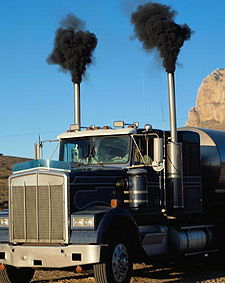 Pyrolysis
of burning material, especially incomplete combustion or smoldering without adequate oxygen supply, also results in production of a large amount of hydrocarbons, both aliphatic (methane
, ethane
, ethylene
, acetylene
) and aromatic
(benzene
and its derivates, polycyclic aromatic hydrocarbon
s; e.g. benzo[a]pyrene
, studied as a carcinogen
, or retene
), terpene
s. Heterocyclic compound
s may be also present. Heavier hydrocarbons may condense as tar
; smoke with significant tar content is yellow to brown. Presence of such smoke, soot, and/or brown oily deposits during a fire indicates a possible hazardous situation, as the atmosphere may be saturated with combustible pyrolysis products with concentration above the upper flammability limit
, and sudden inrush of air can cause flashover
or backdraft
.
Presence of sulfur can lead to formation of e.g. hydrogen sulfide
, carbonyl sulfide
, sulfur dioxide
, carbon disulfide
, and thiol
s; especially thiols tend to get adsorbed on surfaces and produce a lingering odor even long after the fire. Partial oxidation of the released hydrocarbons yields in a wide palette of other compounds: aldehyde
s (e.g. formaldehyde
, acrolein
, and furfural
), ketones, alcohols (often aromatic, e.g. phenol
, guaiacol
, syringol
, catechol, and cresol
s), carboxylic acid
s (formic acid
, acetic acid
, etc.).
The visible particulate matter in such smokes is most commonly composed of carbon
(soot
). Other particulates may be composed of drops of condensed tar
, or solid particles of ash. The presence of metals in the fuel yields particles of metal oxide
s. Particles of inorganic salts may also be formed, e.g. ammonium sulfate
, ammonium nitrate, or sodium chloride
. Inorganic salts present on the surface of the soot particles may make them hydrophilic. Many organic compounds, typically the aromatic hydrocarbon
s, may be also adsorbed on the surface of the solid particles. Metal oxides can be present when metal-containing fuels are burned, e.g. solid rocket
fuels containing aluminium
. Depleted uranium
projectiles after impacting the target ignite, producing particles of uranium oxide
s. Magnetic particles, spherules of magnetite
-like ferrous ferric oxide, are present in coal smoke; their increase in deposits after 1860 marks the beginning of the Industrial Revolution. (Magnetic iron oxide nanoparticles can be also produced in the smoke from meteorite
s burning in the atmosphere.) Magnetic remanence
, recorded
in the iron oxide particles, indicates the strength of Earth's magnetic field when they were cooled beyond their Curie temperature; this can be used to distinguish magnetic particles of terrestrial and meteoric origin. Fly ash
is composed mainly of silica and calcium oxide
. Cenosphere
s are present in smoke from liquid hydrocarbon fuels. Minute metal particles produced by abrasion
can be present in engine smokes. Amorphous silica particles are present in smokes from burning silicone
s; small proportion of silicon nitride
particles can be formed in fires with insufficient oxygen. The silica particles have about 10 nm size, clumped to 70-100 nm aggregates and further agglomerated to chains. Radioactive particles may be present due to traces of uranium
, thorium
, or other radionuclide
s in the fuel; hot particle
s can be present in case of fires during nuclear accidents (e.g. Chernobyl disaster
) or nuclear war.
Smoke particulates have three modes of particle size distribution:
Most of the smoke material is primarily in coarse particles. Those undergo rapid dry precipitation, and the smoke damage in more distant areas outside of the room where the fire occurs is therefore primarily mediated by the smaller particles.
Aerosol of particles beyond visible size is an early indicator of materials in a preignition stage of a fire.
Burning of hydrogen-rich fuel produces water; this results in smoke containing droplets of water vapor
. In absence of other color sources (nitrogen oxides, particulates...), such smoke is white and cloud
-like.
Smoke emissions may contain characteristic trace elements. Vanadium
is present in emissions from oil
fired power plants and refineries
; oil plants also emit some nickel
. Coal combustion produces emissions containing aluminium
, arsenic
, chromium
, cobalt
, copper
, iron
, mercury
, selenium
, and uranium
.
Traces of vanadium in high-temperature combustion products form droplets of molten vanadate
s. These attack the passivation layers on metals and cause high temperature corrosion
, which is a concern especially for internal combustion engine
s. Molten sulfate
and lead
particulates also have such effect.
Some components of smoke are characteristic of the combustion source. Guaiacol
and its derivatives are products of pyrolysis of lignin
and are characteristic of wood smoke; other markers are syringol
and derivates, and other methoxy
phenol
s. Retene
, a product of pyrolysis of conifer trees, is an indicator of forest fires. Levoglucosan
is a pyrolysis product of cellulose
. Hardwood
vs softwood
smokes differ in the ratio of guaiacols/syringols. Markers for vehicle exhaust include polycyclic aromatic hydrocarbon
s, hopane
s, sterane
s, and specific nitroarenes (e.g. 1-nitropyrene
). The ratio of hopanes and steranes to elemental carbon can be used to distinguish between emissions of gasoline and diesel engines.
Many compounds can be associated with particulates; whether by being adsorbed
on their surfaces, or by being dissolved in liquid droplets. Hydrogen chloride is well absorbed in the soot particles.
Inert particulate matter can be disturbed and entrained into the smoke. Of particular concern are particles of asbestos
.
Deposited hot particle
s of radioactive fallout and bioaccumulated radioisotopes can be reintroduced into the atmosphere by wildfire
s and forest fires; this is a concern in e.g. the Zone of alienation
containing contaminants from the Chernobyl disaster
.
Polymers are a significant source of smoke. Aromatic side groups, e.g. in polystyrene
, enhance generation of smoke. Aromatic groups integrated in the polymer backbone produce less smoke, likely due to significant charring
. Aliphatic polymers tend to generate the least smoke, and are non-self-extinguishing. However presence of additives can significantly increase smoke formation. Phosphorus
-based and halogen-based flame retardant
s decrease production of smoke. Higher presence of cross-linking between the polymer chains has such effect too.
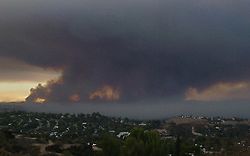 Depending on particle size, smoke can be visible
or invisible
to the naked eye
. This is best illustrated when toast
ing bread in a toaster. As the bread heats up, the products of combustion
increase in size. The particles produced initially are invisible but become visible if the toast is burned
.
Smoke from a typical house fire contains hundreds of different chemicals and fumes. As a result, the damage caused by the smoke can often exceed that caused by the actual heat of the fire. In addition to the physical damage caused by the smoke of a fire
– which manifests itself in the form of stains – is the often even harder to eliminate problem of a smoky odor. Just as there are contractors that specialize in rebuilding/repairing homes that have been damaged by fire and smoke, fabric restoration
companies specialize in restoring fabrics that have been damaged in a fire.
and flashover
. Smoke inhalation is also a danger of smoke that can cause serious injury and death.
Many compounds of smoke from fires are highly toxic and/or irritating. The most dangerous is carbon monoxide
leading to carbon monoxide poisoning
, sometimes with the additive effects of hydrogen cyanide and phosgene
. Smoke inhalation
can therefore quickly lead to incapacitation and loss of consciousness. Sulfur oxides, hydrogen chloride and hydrogen fluoride in contact with moisture form sulfuric
, hydrochloric
and hydrofluoric acid
, which are corrosive to both lungs and materials. When asleep the nose does not sense smoke nor does the brain, but the body will wake up if the lungs become enveloped in smoke and the brain will be stimulated and the person will be awoken. This does not work if the person is incapacitated or under the influence of Drugs and/or alcohol
Cigarette smoke is a major modifiable risk factor for lung disease, heart disease
, and many cancer
s.
Smoke can obscure visibility, impeding occupant exiting from fire areas. In fact, the poor visibility due to the smoke that was in the Worcester Cold Storage Warehouse fire
in Worcester, Massachusetts
was the exact reason why the trapped rescue firefighters couldn't evacuate the building in time. Because of the striking similarity that each floor shared, the dense smoke caused the firefighters to become disoriented.
and hydrobromic acid
, produced from halogen
-containing plastic
s and fire retardant
s, hydrofluoric acid
released by pyrolysis
of fluorocarbon
fire suppression agents, sulfuric acid
from burning of sulfur
-containing materials, nitric acid
from high-temperature fires where nitrous oxide
gets formed, phosphoric acid
and antimony
compounds from P and Sb based fire retardants, and many others. Such corrosion
is not significant for structural materials, but delicate structures, especially microelectronics
, are strongly affected. Corrosion of circuit board traces, penetration of aggressive chemicals through the casings of parts, and other effects can cause an immediate or gradual deterioration of parameters or even premature (and often delayed, as the corrosion can progress over long time) failure of equipment subjected to smoke. Many smoke components are also electrically conductive; deposition of a conductive layer on the circuits can cause crosstalks and other deteriorations of the operating parameters or even cause short circuits and total failures. Electrical contacts can be affected by corrosion of surfaces, and by deposition of soot
and other conductive particles or nonconductive layers on or across the contacts. Deposited particles may adversely affect the performance of optoelectronics
by absorbing or scattering the light beams.
Corrosivity of smoke produced by materials is characterized by the corrosion index (CI), defined as material loss rate (angstrom/minute) per amount of material gasified products (grams) per volume of air (m3). It is measured by exposing strips of metal to flow of combustion products in a test tunnel. Polymers containing halogen and hydrogen
(polyvinyl chloride
, polyolefin
s with halogenated additives, etc.) have the highest CI as the corrosive acids are formed directly with water produced by the combustion, polymers containing halogen only (e.g. polytetrafluoroethylene
) have lower CI as the formation of acid is limited to reactions with airborne humidity, and halogen-free materials (polyolefins, wood
) have the lowest CI. However, some halogen-free materials can also release significant amount of corrosive products.
Smoke damage to electronic equipment can be significantly more extensive than the fire itself. Cable
fires are of special concern; low smoke zero halogen
materials are preferable for cable insulation.
commented at length on the difficulty of assessing smoke, and distinguished between black smoke (carbonized particles) and white 'smoke' which is not a smoke at all but merely a suspension of harmless water droplets.
Smoke from heating appliances is commonly measured in one of the following ways:
In-line capture. A smoke sample is simply sucked through a filter which is weighed before and after the test and the mass of smoke found. This is the simplest and probably the most accurate method, but can only be used where the smoke concentration is slight, as the filter can quickly become blocked.
Filter/dilution tunnel. A smoke sample is drawn through a tube where it is diluted with air, the resulting smoke/air mixture is then pulled through a filter and weighed. This is the internationally recognized method of measuring smoke from combustion
.
Electrostatic precipitation. The smoke is passed through an array of metal tubes which contain suspended wires. A (huge) electrical potential is applied across the tubes and wires so that the smoke particles become charged and are attracted to the sides of the tubes. This method can over-read by capturing harmless condensates, or under-read due to the insulating effect of the smoke. However, it is the necessary method for assessing volumes of smoke too great to be forced through a filter, i.e., from bituminous coal
.
Ringelmann scale
. A measure of smoke color. Invented by Professor Maximilian Ringelmann in Paris in 1888, it is essentially a card with squares of black, white and shades of gray which is held up and the comparative grayness of the smoke judged. Highly dependent on light conditions and the skill of the observer it allocates a grayness number from 0 (white) to 5 (black) which has only a passing relationship to the actual quantity of smoke. Nonetheless, the simplicity of the Ringelmann scale means that it has been adopted as a standard in many countries.
Optical scattering. A light beam is passed through the smoke. A light detector is situated at an angle to the light source, typically at 90º, so that it receives only light reflected from passing particles. A measurement is made of the light received which will be lower as the concentration of smoke particles becomes higher.
Optical obscuration. A light beam is passed through the smoke and a detector opposite measures the light. The more smoke particles are present between the two, the less light will be measured.
Combined optical methods. There are various proprietary optical smoke measurement devices such as the 'nephelometer
' or the 'aethalometer' which use several different optical methods, including more than one wavelength of light, inside a single instrument and apply an algorithm to give a good estimate of smoke.
Inference from carbon monoxide
. Smoke is incompletely burned fuel
, carbon monoxide is incompletely burned carbon, therefore it has long been assumed that measurement of CO in flue gas
(a cheap, simple and very accurate procedure) will provide a good indication of the levels of smoke. Indeed, several jurisdictions use CO measurement as the basis of smoke control. However it is far from clear how accurate the correspondence is.
shows Darius the Great (522–486 BC), the king of Persia, with two censer
s in front of him for burning Peganum harmala and/or sandalwood
Santalum album
, which was believed to protect the king from evil and disease. More than 300 plant species in 5 continents are used in smoke form for different diseases. As a method of drug administration, smoking is important as it is a simple, inexpensive, but very effective method of extracting particles containing active agents. More importantly, generating smoke reduces the particle size to a microscopic scale thereby increasing the absorption of its active chemical principles. However, the hazards of inhaling a particulate are unacceptable to some people.
Solid
Solid is one of the three classical states of matter . It is characterized by structural rigidity and resistance to changes of shape or volume. Unlike a liquid, a solid object does not flow to take on the shape of its container, nor does it expand to fill the entire volume available to it like a...
and liquid
Liquid
Liquid is one of the three classical states of matter . Like a gas, a liquid is able to flow and take the shape of a container. Some liquids resist compression, while others can be compressed. Unlike a gas, a liquid does not disperse to fill every space of a container, and maintains a fairly...
particulates
Particulates
Particulates – also known as particulate matter , suspended particulate matter , fine particles, and soot – are tiny subdivisions of solid matter suspended in a gas or liquid. In contrast, aerosol refers to particles and/or liquid droplets and the gas together. Sources of particulate matter can be...
and gas
Gas
Gas is one of the three classical states of matter . Near absolute zero, a substance exists as a solid. As heat is added to this substance it melts into a liquid at its melting point , boils into a gas at its boiling point, and if heated high enough would enter a plasma state in which the electrons...
es emitted when a material undergoes combustion
Combustion
Combustion or burning is the sequence of exothermic chemical reactions between a fuel and an oxidant accompanied by the production of heat and conversion of chemical species. The release of heat can result in the production of light in the form of either glowing or a flame...
or pyrolysis
Pyrolysis
Pyrolysis is a thermochemical decomposition of organic material at elevated temperatures without the participation of oxygen. It involves the simultaneous change of chemical composition and physical phase, and is irreversible...
, together with the quantity of air that is entrained
Entrainment (engineering)
Entrainment as commonly used in various branches of engineering may be defined as the entrapment of one substance by another substance. For example:* The entrapment of liquid droplets or solid particulates in a flowing gas, as with smoke....
or otherwise mixed into the mass. It is commonly an unwanted by-product
By-product
A by-product is a secondary product derived from a manufacturing process or chemical reaction. It is not the primary product or service being produced.A by-product can be useful and marketable or it can be considered waste....
of fires (including stove
Stove
A stove is an enclosed heated space. The term is commonly taken to mean an enclosed space in which fuel is burned to provide heating, either to heat the space in which the stove is situated or to heat the stove itself, and items placed on it...
s, candle
Candle
A candle is a solid block or cylinder of wax with an embedded wick, which is lit to provide light, and sometimes heat.Today, most candles are made from paraffin. Candles can also be made from beeswax, soy, other plant waxes, and tallow...
s, oil lamp
Oil lamp
An oil lamp is an object used to produce light continuously for a period of time using an oil-based fuel source. The use of oil lamps began thousands of years ago and is continued to this day....
s, and fireplace
Fireplace
A fireplace is an architectural structure to contain a fire for heating and, especially historically, for cooking. A fire is contained in a firebox or firepit; a chimney or other flue allows gas and particulate exhaust to escape...
s), but may also be used for pest control
Pest control
Pest control refers to the regulation or management of a species defined as a pest, usually because it is perceived to be detrimental to a person's health, the ecology or the economy.-History:...
(cf. fumigation
Fumigation
Fumigation is a method of pest control that completely fills an area with gaseous pesticides—or fumigants—to suffocate or poison the pests within. It is utilized for control of pests in buildings , soil, grain, and produce, and is also used during processing of goods to be imported or...
), communication (smoke signal
Smoke signal
The smoke signal is one of the oldest forms of communication in recorded history. It is a form of visual communication used over long distance.-History and usage:...
s), defensive and offensive capabilities in the military (smoke-screen
Smoke-screen
thumb|right|205px|A [[U.S. Army]] [[Humvee]] laying a smoke screenA smoke screen is smoke released to mask the movement or location of military units such as infantry, tanks, aircraft or ships....
), cooking (smoked salmon
Smoked salmon
Smoked salmon is a preparation of salmon, typically a fillet that has been cured and then hot or cold smoked. Due to its moderately high price, smoked salmon is considered a delicacy.-Presentation:...
), or smoking
Smoking
Smoking is a practice in which a substance, most commonly tobacco or cannabis, is burned and the smoke is tasted or inhaled. This is primarily practised as a route of administration for recreational drug use, as combustion releases the active substances in drugs such as nicotine and makes them...
(tobacco
Tobacco smoking
Tobacco smoking is the practice where tobacco is burned and the resulting smoke is inhaled. The practice may have begun as early as 5000–3000 BCE. Tobacco was introduced to Eurasia in the late 16th century where it followed common trade routes...
, marijuana
Cannabis (drug)
Cannabis, also known as marijuana among many other names, refers to any number of preparations of the Cannabis plant intended for use as a psychoactive drug or for medicinal purposes. The English term marijuana comes from the Mexican Spanish word marihuana...
, etc.). Smoke is used in rituals, when incense, sage, or resin is burned to produce a smell for spiritual purposes. Smoke is sometimes used as a flavoring agent, and preservative for various foodstuffs. Smoke is also a component of internal combustion engine
Internal combustion engine
The internal combustion engine is an engine in which the combustion of a fuel occurs with an oxidizer in a combustion chamber. In an internal combustion engine, the expansion of the high-temperature and high -pressure gases produced by combustion apply direct force to some component of the engine...
exhaust gas
Exhaust gas
Exhaust gas or flue gas is emitted as a result of the combustion of fuels such as natural gas, gasoline/petrol, diesel fuel, fuel oil or coal. According to the type of engine, it is discharged into the atmosphere through an exhaust pipe, flue gas stack or propelling nozzle.It often disperses...
, particularly diesel exhaust
Diesel exhaust
Diesel exhaust is the exhaust gas of a diesel engine....
.
Smoke inhalation
Smoke inhalation
Smoke inhalation is the primary cause of death in victims of indoor fires.Smoke inhalation injury refers to injury due to inhalation or exposure to hot gaseous products of combustion. This can cause serious respiratory complications....
is the primary cause of death
Death
Death is the permanent termination of the biological functions that sustain a living organism. Phenomena which commonly bring about death include old age, predation, malnutrition, disease, and accidents or trauma resulting in terminal injury....
in victims of indoor fire
Fire
Fire is the rapid oxidation of a material in the chemical process of combustion, releasing heat, light, and various reaction products. Slower oxidative processes like rusting or digestion are not included by this definition....
s. The smoke kills by a combination of thermal damage, poison
Poison
In the context of biology, poisons are substances that can cause disturbances to organisms, usually by chemical reaction or other activity on the molecular scale, when a sufficient quantity is absorbed by an organism....
ing and pulmonary
Lung
The lung is the essential respiration organ in many air-breathing animals, including most tetrapods, a few fish and a few snails. In mammals and the more complex life forms, the two lungs are located near the backbone on either side of the heart...
irritation caused by carbon monoxide
Carbon monoxide
Carbon monoxide , also called carbonous oxide, is a colorless, odorless, and tasteless gas that is slightly lighter than air. It is highly toxic to humans and animals in higher quantities, although it is also produced in normal animal metabolism in low quantities, and is thought to have some normal...
, hydrogen cyanide and other combustion products.
Smoke particles are an aerosol
Aerosol
Technically, an aerosol is a suspension of fine solid particles or liquid droplets in a gas. Examples are clouds, and air pollution such as smog and smoke. In general conversation, aerosol usually refers to an aerosol spray can or the output of such a can...
(or mist
Mist
Mist is a phenomenon of small droplets suspended in air. It can occur as part of natural weather or volcanic activity, and is common in cold air above warmer water, in exhaled air in the cold, and in a steam room of a sauna. It can also be created artificially with aerosol canisters if the...
) of solid particles and liquid droplets that are close to the ideal range of sizes for Mie scattering
Mie theory
The Mie solution to Maxwell's equations describes the scattering of electromagnetic radiation by a sphere...
of visible light. This effect has been likened to three-dimensional textured privacy glass — a smoke cloud does not obstruct an image, but thoroughly scrambles it.
Chemical composition
The composition of smoke depends on the nature of the burning fuel and the conditions of combustion.Fires with high availability of oxygen burn at high temperature and with small amount of smoke produced; the particles are mostly composed of ash, or with large temperature differences, of condensed aerosol of water. High temperature also leads to production of nitrogen oxide
Nitrogen oxide
Nitrogen oxide can refer to a binary compound of oxygen and nitrogen, or a mixture of such compounds:* Nitric oxide, also known as nitrogen monoxide, , nitrogen oxide* Nitrogen dioxide , nitrogen oxide...
s. Sulfur content yields sulfur dioxide
Sulfur dioxide
Sulfur dioxide is the chemical compound with the formula . It is released by volcanoes and in various industrial processes. Since coal and petroleum often contain sulfur compounds, their combustion generates sulfur dioxide unless the sulfur compounds are removed before burning the fuel...
, or in case of incomplete combustion, hydrogen sulfide
Hydrogen sulfide
Hydrogen sulfide is the chemical compound with the formula . It is a colorless, very poisonous, flammable gas with the characteristic foul odor of expired eggs perceptible at concentrations as low as 0.00047 parts per million...
. Carbon and hydrogen are almost completely oxidized to carbon dioxide
Carbon dioxide
Carbon dioxide is a naturally occurring chemical compound composed of two oxygen atoms covalently bonded to a single carbon atom...
and water. Fires burning with lack of oxygen produce a significantly wider palette of compounds, many of them toxic. Partial oxidation
Partial oxidation
Partial oxidation is a type of chemical reaction. It occurs when a substoichiometric fuel-air mixture is partially combusted in a reformer, creating a hydrogen-rich syngas which can then be put to further use, for example in a fuel cell...
of carbon produces carbon monoxide
Carbon monoxide
Carbon monoxide , also called carbonous oxide, is a colorless, odorless, and tasteless gas that is slightly lighter than air. It is highly toxic to humans and animals in higher quantities, although it is also produced in normal animal metabolism in low quantities, and is thought to have some normal...
, nitrogen-containing materials can yield hydrogen cyanide, ammonia
Ammonia
Ammonia is a compound of nitrogen and hydrogen with the formula . It is a colourless gas with a characteristic pungent odour. Ammonia contributes significantly to the nutritional needs of terrestrial organisms by serving as a precursor to food and fertilizers. Ammonia, either directly or...
, and nitrogen oxides. Hydrogen
Hydrogen
Hydrogen is the chemical element with atomic number 1. It is represented by the symbol H. With an average atomic weight of , hydrogen is the lightest and most abundant chemical element, constituting roughly 75% of the Universe's chemical elemental mass. Stars in the main sequence are mainly...
gas can be produced instead of water. Content of halogens such as chlorine
Chlorine
Chlorine is the chemical element with atomic number 17 and symbol Cl. It is the second lightest halogen, found in the periodic table in group 17. The element forms diatomic molecules under standard conditions, called dichlorine...
(e.g. in polyvinyl chloride
Polyvinyl chloride
Polyvinyl chloride, commonly abbreviated PVC, is a thermoplastic polymer. It is a vinyl polymer constructed of repeating vinyl groups having one hydrogen replaced by chloride. Polyvinyl chloride is the third most widely produced plastic, after polyethylene and polypropylene. PVC is widely used in...
or brominated flame retardants) may lead to production of e.g. hydrogen chloride
Hydrogen chloride
The compound hydrogen chloride has the formula HCl. At room temperature, it is a colorless gas, which forms white fumes of hydrochloric acid upon contact with atmospheric humidity. Hydrogen chloride gas and hydrochloric acid are important in technology and industry...
, phosgene
Phosgene
Phosgene is the chemical compound with the formula COCl2. This colorless gas gained infamy as a chemical weapon during World War I. It is also a valued industrial reagent and building block in synthesis of pharmaceuticals and other organic compounds. In low concentrations, its odor resembles...
, dioxin, and chloromethane
Chloromethane
Chloromethane, also called methyl chloride, R-40 or HCC 40, is a chemical compound of the group of organic compounds called haloalkanes. It was once widely used as a refrigerant. It is a colorless extremely flammable gas with a minorly sweet odor, which is, however, detected at possibly toxic levels...
, bromomethane and other halocarbon
Halocarbon
Halocarbon compounds are chemicals in which one or more carbon atoms are linked by covalent bonds with one or more halogen atoms resulting in the formation of organofluorine compounds, organochlorine compounds, organobromine compounds, and organoiodine compounds...
s. Hydrogen fluoride
Hydrogen fluoride
Hydrogen fluoride is a chemical compound with the formula HF. This colorless gas is the principal industrial source of fluorine, often in the aqueous form as hydrofluoric acid, and thus is the precursor to many important compounds including pharmaceuticals and polymers . HF is widely used in the...
can be formed from fluorocarbon
Fluorocarbon
Fluorocarbons, sometimes referred to as perfluorocarbons or PFCs, are organofluorine compounds that contain only carbon and fluorine bonded together in strong carbon–fluorine bonds. Fluoroalkanes that contain only single bonds are more chemically and thermally stable than alkanes...
s, whether fluoropolymer
Fluoropolymer
A fluoropolymer is a fluorocarbon based polymer with multiple strong carbon–fluorine bonds. It is characterized by a high resistance to solvents, acids, and bases.-History:Fluoropolymers were accidentally discovered in 1938 by Dr. Roy J...
s subjected to fire or halocarbon
Halocarbon
Halocarbon compounds are chemicals in which one or more carbon atoms are linked by covalent bonds with one or more halogen atoms resulting in the formation of organofluorine compounds, organochlorine compounds, organobromine compounds, and organoiodine compounds...
fire suppression agents. Phosphorus
Phosphorus
Phosphorus is the chemical element that has the symbol P and atomic number 15. A multivalent nonmetal of the nitrogen group, phosphorus as a mineral is almost always present in its maximally oxidized state, as inorganic phosphate rocks...
and antimony
Antimony
Antimony is a toxic chemical element with the symbol Sb and an atomic number of 51. A lustrous grey metalloid, it is found in nature mainly as the sulfide mineral stibnite...
oxides and their reaction products can be formed from some fire retardant
Fire retardant
A fire retardant is a substance other than water that reduces flammability of fuels or delays their combustion. This typically refers to chemical retardants but may also include substances that work by physical action, such as cooling the fuels; examples of these include fire-fighting foams and...
additives, increasing smoke toxicity and corrosivity. Pyrolysis
Pyrolysis
Pyrolysis is a thermochemical decomposition of organic material at elevated temperatures without the participation of oxygen. It involves the simultaneous change of chemical composition and physical phase, and is irreversible...
of polychlorinated biphenyl
Polychlorinated biphenyl
Polychlorinated biphenyls are a class of organic compounds with 2 to 10 chlorine atoms attached to biphenyl, which is a molecule composed of two benzene rings. The chemical formula for PCBs is C12H10-xClx...
s (PCB), e.g. from burning older transformer oil
Transformer oil
Transformer oil or insulating oil is usually a highly-refined mineral oil that is stable at high temperatures and has excellent electrical insulating properties. It is used in oil-filled transformers, some types of high voltage capacitors, fluorescent lamp ballasts, and some types of high voltage...
, and to lower degree also of other chlorine-containing materials, can produce 2,3,7,8-tetrachlorodibenzodioxin
2,3,7,8-Tetrachlorodibenzodioxin
2,3,7,8-Tetrachlorodibenzo-p-dioxin is a polychlorinated dibenzo-p-dioxin . It is the most potent compound of the series and became known as a contaminant in Agent Orange, a herbicide used in the Vietnam War, as well as the Seveso disaster...
, a potent carcinogen
Carcinogen
A carcinogen is any substance, radionuclide, or radiation that is an agent directly involved in causing cancer. This may be due to the ability to damage the genome or to the disruption of cellular metabolic processes...
, and other polychlorinated dibenzodioxins. Pyrolysis of fluoropolymers, e.g. teflon, in presence of oxygen yields carbonyl fluoride
Carbonyl fluoride
Carbonyl fluoride is the chemical compound with the formula COF2. This gas, like its analog phosgene, is highly toxic. The molecule is planar with C2v symmetry.-Safety:...
(which hydrolyzes readily to HF and CO2); other compounds may be formed as well, e.g. carbon tetrafluoride, hexafluoropropylene
Hexafluoropropylene
Hexafluoropropylene is a compound with the formula C3F6. It is a fluorocarbon alkene in which all of the hydrogen atoms in propylene are replaced by fluorine atoms. It is used as a chemical intermediate....
, and highly toxic perfluoroisobutene
Perfluoroisobutene
Perfluoroisobutene , also known as 1,1,3,3,3-pentafluoro-2-prop-1-ene, is a fluorocarbon alkene. It is a hydrophobic reactive gas with boiling point at 7 °C. It is a strong electrophile....
(PFIB).
Pyrolysis
Pyrolysis is a thermochemical decomposition of organic material at elevated temperatures without the participation of oxygen. It involves the simultaneous change of chemical composition and physical phase, and is irreversible...
of burning material, especially incomplete combustion or smoldering without adequate oxygen supply, also results in production of a large amount of hydrocarbons, both aliphatic (methane
Methane
Methane is a chemical compound with the chemical formula . It is the simplest alkane, the principal component of natural gas, and probably the most abundant organic compound on earth. The relative abundance of methane makes it an attractive fuel...
, ethane
Ethane
Ethane is a chemical compound with chemical formula C2H6. It is the only two-carbon alkane that is an aliphatic hydrocarbon. At standard temperature and pressure, ethane is a colorless, odorless gas....
, ethylene
Ethylene
Ethylene is a gaseous organic compound with the formula . It is the simplest alkene . Because it contains a carbon-carbon double bond, ethylene is classified as an unsaturated hydrocarbon. Ethylene is widely used in industry and is also a plant hormone...
, acetylene
Acetylene
Acetylene is the chemical compound with the formula C2H2. It is a hydrocarbon and the simplest alkyne. This colorless gas is widely used as a fuel and a chemical building block. It is unstable in pure form and thus is usually handled as a solution.As an alkyne, acetylene is unsaturated because...
) and aromatic
Aromatic hydrocarbon
An aromatic hydrocarbon or arene is a hydrocarbon with alternating double and single bonds between carbon atoms. The term 'aromatic' was assigned before the physical mechanism determining aromaticity was discovered, and was derived from the fact that many of the compounds have a sweet scent...
(benzene
Benzene
Benzene is an organic chemical compound. It is composed of 6 carbon atoms in a ring, with 1 hydrogen atom attached to each carbon atom, with the molecular formula C6H6....
and its derivates, polycyclic aromatic hydrocarbon
Polycyclic aromatic hydrocarbon
Polycyclic aromatic hydrocarbons , also known as poly-aromatic hydrocarbons or polynuclear aromatic hydrocarbons, are potent atmospheric pollutants that consist of fused aromatic rings and do not contain heteroatoms or carry substituents. Naphthalene is the simplest example of a PAH...
s; e.g. benzo[a]pyrene
Benzopyrene
Benzo[a]pyrene, C20H12, is a five-ring polycyclic aromatic hydrocarbon whose metabolites are mutagenic and highly carcinogenic. Benzo[a]pyrene is listed as a Group 1 carcinogen by the IARC. It belongs to a class of polycyclic aromatic compounds known as benzopyrenes, which consist of a benzene...
, studied as a carcinogen
Carcinogen
A carcinogen is any substance, radionuclide, or radiation that is an agent directly involved in causing cancer. This may be due to the ability to damage the genome or to the disruption of cellular metabolic processes...
, or retene
Retene
Retene, methyl isopropyl phenanthrene or 1-methyl-7-isopropyl phenanthrene, C18H18, is a polycyclic aromatic hydrocarbon present in the coal tar fraction, boiling above 360 °C. It occurs naturally in the tars obtained by the distillation of resinous woods. It crystallizes in large plates, which...
), terpene
Terpene
Terpenes are a large and diverse class of organic compounds, produced by a variety of plants, particularly conifers, though also by some insects such as termites or swallowtail butterflies, which emit terpenes from their osmeterium. They are often strong smelling and thus may have had a protective...
s. Heterocyclic compound
Heterocyclic compound
A heterocyclic compound is a cyclic compound which has atoms of at least two different elements as members of its ring. The counterparts of heterocyclic compounds are homocyclic compounds, the rings of which are made of a single element....
s may be also present. Heavier hydrocarbons may condense as tar
Tar
Tar is modified pitch produced primarily from the wood and roots of pine by destructive distillation under pyrolysis. Production and trade in tar was a major contributor in the economies of Northern Europe and Colonial America. Its main use was in preserving wooden vessels against rot. The largest...
; smoke with significant tar content is yellow to brown. Presence of such smoke, soot, and/or brown oily deposits during a fire indicates a possible hazardous situation, as the atmosphere may be saturated with combustible pyrolysis products with concentration above the upper flammability limit
Flammability limit
Flammability limits, also called flammable limits, give the proportion of combustible gases in a mixture, between which limits this mixture is flammable. Gas mixtures consisting of combustible, oxidizing, and inert gases are only flammable under certain conditions. The lower flammable limit ...
, and sudden inrush of air can cause flashover
Flashover
A flashover is the near simultaneous ignition of most of the directly exposed combustible material in an enclosed area. When certain organic materials are heated they undergo thermal decomposition and release flammable gases...
or backdraft
Backdraft
A backdraft is an explosive event at a fire resulting from rapid re-introduction of oxygen to combustion in an oxygen-starved environment, for example, the breaking of a window or opening of a door to an enclosed space. Backdrafts present a serious threat to firefighters, even those with a high...
.
Presence of sulfur can lead to formation of e.g. hydrogen sulfide
Hydrogen sulfide
Hydrogen sulfide is the chemical compound with the formula . It is a colorless, very poisonous, flammable gas with the characteristic foul odor of expired eggs perceptible at concentrations as low as 0.00047 parts per million...
, carbonyl sulfide
Carbonyl sulfide
Carbonyl sulfide is the chemical compound with the formula OCS. Commonly written as COS, it is a colourless flammable gas with an unpleasant odor. It is a linear molecule consisting of a carbonyl group double bonded to a sulfur atom...
, sulfur dioxide
Sulfur dioxide
Sulfur dioxide is the chemical compound with the formula . It is released by volcanoes and in various industrial processes. Since coal and petroleum often contain sulfur compounds, their combustion generates sulfur dioxide unless the sulfur compounds are removed before burning the fuel...
, carbon disulfide
Carbon disulfide
Carbon disulfide is a colorless volatile liquid with the formula CS2. The compound is used frequently as a building block in organic chemistry as well as an industrial and chemical non-polar solvent...
, and thiol
Thiol
In organic chemistry, a thiol is an organosulfur compound that contains a carbon-bonded sulfhydryl group...
s; especially thiols tend to get adsorbed on surfaces and produce a lingering odor even long after the fire. Partial oxidation of the released hydrocarbons yields in a wide palette of other compounds: aldehyde
Aldehyde
An aldehyde is an organic compound containing a formyl group. This functional group, with the structure R-CHO, consists of a carbonyl center bonded to hydrogen and an R group....
s (e.g. formaldehyde
Formaldehyde
Formaldehyde is an organic compound with the formula CH2O. It is the simplest aldehyde, hence its systematic name methanal.Formaldehyde is a colorless gas with a characteristic pungent odor. It is an important precursor to many other chemical compounds, especially for polymers...
, acrolein
Acrolein
Acrolein is the simplest unsaturated aldehyde. It is produced widely but is most often immediately reacted with other products due to its instability and toxicity...
, and furfural
Furfural
Furfural is an organic compound derived from a variety of agricultural byproducts, including corncobs, oat, wheat bran, and sawdust. The name furfural comes from the Latin word , meaning bran, referring to its usual source....
), ketones, alcohols (often aromatic, e.g. phenol
Phenol
Phenol, also known as carbolic acid, phenic acid, is an organic compound with the chemical formula C6H5OH. It is a white crystalline solid. The molecule consists of a phenyl , bonded to a hydroxyl group. It is produced on a large scale as a precursor to many materials and useful compounds...
, guaiacol
Guaiacol
Guaiacol is a naturally occurring organic compound with the formula C6H4. Although it is biosynthesized by a variety of organisms, this colorless aromatic oil is usually derived from guaiacum or wood creosote. Samples darken upon exposure to air and light. Guaiacol is present in wood smoke,...
, syringol
Syringol
Syringol is a dimethyl ether of pyrogallol. It is slightly soluble in water. It is combustible, with flash point of 140 °C.Together with guaiacol, syringol and its derivates are characteristic products of pyrolysis of lignin. As such, syringol is an important component of wood smoke...
, catechol, and cresol
Cresol
Cresols are organic compounds which are methylphenols. They are a widely occurring natural and manufactured group of aromatic organic compounds which are categorized as phenols . Depending on the temperature, cresols can be solid or liquid because they have melting points not far from room...
s), carboxylic acid
Carboxylic acid
Carboxylic acids are organic acids characterized by the presence of at least one carboxyl group. The general formula of a carboxylic acid is R-COOH, where R is some monovalent functional group...
s (formic acid
Formic acid
Formic acid is the simplest carboxylic acid. Its chemical formula is HCOOH or HCO2H. It is an important intermediate in chemical synthesis and occurs naturally, most notably in the venom of bee and ant stings. In fact, its name comes from the Latin word for ant, formica, referring to its early...
, acetic acid
Acetic acid
Acetic acid is an organic compound with the chemical formula CH3CO2H . It is a colourless liquid that when undiluted is also called glacial acetic acid. Acetic acid is the main component of vinegar , and has a distinctive sour taste and pungent smell...
, etc.).
The visible particulate matter in such smokes is most commonly composed of carbon
Carbon
Carbon is the chemical element with symbol C and atomic number 6. As a member of group 14 on the periodic table, it is nonmetallic and tetravalent—making four electrons available to form covalent chemical bonds...
(soot
Soot
Soot is a general term that refers to impure carbon particles resulting from the incomplete combustion of a hydrocarbon. It is more properly restricted to the product of the gas-phase combustion process but is commonly extended to include the residual pyrolyzed fuel particles such as cenospheres,...
). Other particulates may be composed of drops of condensed tar
Tar
Tar is modified pitch produced primarily from the wood and roots of pine by destructive distillation under pyrolysis. Production and trade in tar was a major contributor in the economies of Northern Europe and Colonial America. Its main use was in preserving wooden vessels against rot. The largest...
, or solid particles of ash. The presence of metals in the fuel yields particles of metal oxide
Oxide
An oxide is a chemical compound that contains at least one oxygen atom in its chemical formula. Metal oxides typically contain an anion of oxygen in the oxidation state of −2....
s. Particles of inorganic salts may also be formed, e.g. ammonium sulfate
Ammonium sulfate
Ammonium sulfate , 2SO4, is an inorganic salt with a number of commercial uses. The most common use is as a soil fertilizer. It contains 21% nitrogen as ammonium cations, and 24% sulfur as sulfate anions...
, ammonium nitrate, or sodium chloride
Sodium chloride
Sodium chloride, also known as salt, common salt, table salt or halite, is an inorganic compound with the formula NaCl. Sodium chloride is the salt most responsible for the salinity of the ocean and of the extracellular fluid of many multicellular organisms...
. Inorganic salts present on the surface of the soot particles may make them hydrophilic. Many organic compounds, typically the aromatic hydrocarbon
Aromatic hydrocarbon
An aromatic hydrocarbon or arene is a hydrocarbon with alternating double and single bonds between carbon atoms. The term 'aromatic' was assigned before the physical mechanism determining aromaticity was discovered, and was derived from the fact that many of the compounds have a sweet scent...
s, may be also adsorbed on the surface of the solid particles. Metal oxides can be present when metal-containing fuels are burned, e.g. solid rocket
Solid rocket
A solid rocket or a solid-fuel rocket is a rocket engine that uses solid propellants . The earliest rockets were solid-fuel rockets powered by gunpowder; they were used by the Chinese in warfare as early as the 13th century and later by the Mongols, Arabs, and Indians.All rockets used some form of...
fuels containing aluminium
Aluminium
Aluminium or aluminum is a silvery white member of the boron group of chemical elements. It has the symbol Al, and its atomic number is 13. It is not soluble in water under normal circumstances....
. Depleted uranium
Depleted uranium
Depleted uranium is uranium with a lower content of the fissile isotope U-235 than natural uranium . Uses of DU take advantage of its very high density of 19.1 g/cm3...
projectiles after impacting the target ignite, producing particles of uranium oxide
Uranium oxide
Uranium oxide is an oxide of the element uranium.The metal uranium forms several oxides:* Uranium dioxide or uranium oxide * Uranium trioxide or uranium oxide...
s. Magnetic particles, spherules of magnetite
Magnetite
Magnetite is a ferrimagnetic mineral with chemical formula Fe3O4, one of several iron oxides and a member of the spinel group. The chemical IUPAC name is iron oxide and the common chemical name is ferrous-ferric oxide. The formula for magnetite may also be written as FeO·Fe2O3, which is one part...
-like ferrous ferric oxide, are present in coal smoke; their increase in deposits after 1860 marks the beginning of the Industrial Revolution. (Magnetic iron oxide nanoparticles can be also produced in the smoke from meteorite
Meteorite
A meteorite is a natural object originating in outer space that survives impact with the Earth's surface. Meteorites can be big or small. Most meteorites derive from small astronomical objects called meteoroids, but they are also sometimes produced by impacts of asteroids...
s burning in the atmosphere.) Magnetic remanence
Remanence
Remanence or remanent magnetization is the magnetization left behind in a ferromagnetic material after an external magnetic field is removed. It is also the measure of that magnetization. Colloquially, when a magnet is "magnetized" it has remanence...
, recorded
Paleomagnetism
Paleomagnetism is the study of the record of the Earth's magnetic field in rocks. Certain minerals in rocks lock-in a record of the direction and intensity of the magnetic field when they form. This record provides information on the past behavior of Earth's magnetic field and the past location of...
in the iron oxide particles, indicates the strength of Earth's magnetic field when they were cooled beyond their Curie temperature; this can be used to distinguish magnetic particles of terrestrial and meteoric origin. Fly ash
Fly ash
Fly ash is one of the residues generated in combustion, and comprises the fine particles that rise with the flue gases. Ash which does not rise is termed bottom ash. In an industrial context, fly ash usually refers to ash produced during combustion of coal...
is composed mainly of silica and calcium oxide
Calcium oxide
Calcium oxide , commonly known as quicklime or burnt lime, is a widely used chemical compound. It is a white, caustic, alkaline crystalline solid at room temperature....
. Cenosphere
Cenosphere
A cenosphere is a lightweight, inert, hollow sphere filled with inert air or gas, typically produced as a byproduct of coal combustion at thermal power plants. The color of cenospheres varies from gray to almost white and their density is about 0.4–0.8 g/cm³, which gives them a great buoyancy...
s are present in smoke from liquid hydrocarbon fuels. Minute metal particles produced by abrasion
Abrasion (mechanical)
Abrasion is the process of scuffing, scratching, wearing down, marring, or rubbing away. It can be intentionally imposed in a controlled process using an abrasive...
can be present in engine smokes. Amorphous silica particles are present in smokes from burning silicone
Silicone
Silicones are inert, synthetic compounds with a variety of forms and uses. Typically heat-resistant and rubber-like, they are used in sealants, adhesives, lubricants, medical applications , cookware, and insulation....
s; small proportion of silicon nitride
Silicon nitride
Silicon nitride is a chemical compound of silicon and nitrogen. If powdered silicon is heated between 1300° and 1400°C in an atmosphere of nitrogen, trisilicon tetranitride, Si3N4, is formed. The silicon sample weight increases progressively due to the chemical combination of silicon and nitrogen...
particles can be formed in fires with insufficient oxygen. The silica particles have about 10 nm size, clumped to 70-100 nm aggregates and further agglomerated to chains. Radioactive particles may be present due to traces of uranium
Uranium
Uranium is a silvery-white metallic chemical element in the actinide series of the periodic table, with atomic number 92. It is assigned the chemical symbol U. A uranium atom has 92 protons and 92 electrons, of which 6 are valence electrons...
, thorium
Thorium
Thorium is a natural radioactive chemical element with the symbol Th and atomic number 90. It was discovered in 1828 and named after Thor, the Norse god of thunder....
, or other radionuclide
Radionuclide
A radionuclide is an atom with an unstable nucleus, which is a nucleus characterized by excess energy available to be imparted either to a newly created radiation particle within the nucleus or to an atomic electron. The radionuclide, in this process, undergoes radioactive decay, and emits gamma...
s in the fuel; hot particle
Hot particle
A hot particle is a small, highly radioactive object, with significant content of radionuclides. Because radioactivity can be inherent to a substance or induced, and there are many initial sources of radioactivity, hot particles can originate from a multitude of sources.- Attributes :Hot particles...
s can be present in case of fires during nuclear accidents (e.g. Chernobyl disaster
Chernobyl disaster
The Chernobyl disaster was a nuclear accident that occurred on 26 April 1986 at the Chernobyl Nuclear Power Plant in Ukraine , which was under the direct jurisdiction of the central authorities in Moscow...
) or nuclear war.
Smoke particulates have three modes of particle size distribution:
- nuclei mode, with geometric meanGeometric meanThe geometric mean, in mathematics, is a type of mean or average, which indicates the central tendency or typical value of a set of numbers. It is similar to the arithmetic mean, except that the numbers are multiplied and then the nth root of the resulting product is taken.For instance, the...
radius between 2.5–20 nm, likely forming by condensation of carbon moieties. - accumulation mode, ranging between 75–250 nm and formed by coagulation of nuclei mode particles
- coarse mode, with particles in micrometer range
Most of the smoke material is primarily in coarse particles. Those undergo rapid dry precipitation, and the smoke damage in more distant areas outside of the room where the fire occurs is therefore primarily mediated by the smaller particles.
Aerosol of particles beyond visible size is an early indicator of materials in a preignition stage of a fire.
Burning of hydrogen-rich fuel produces water; this results in smoke containing droplets of water vapor
Water vapor
Water vapor or water vapour , also aqueous vapor, is the gas phase of water. It is one state of water within the hydrosphere. Water vapor can be produced from the evaporation or boiling of liquid water or from the sublimation of ice. Under typical atmospheric conditions, water vapor is continuously...
. In absence of other color sources (nitrogen oxides, particulates...), such smoke is white and cloud
Cloud
A cloud is a visible mass of liquid droplets or frozen crystals made of water and/or various chemicals suspended in the atmosphere above the surface of a planetary body. They are also known as aerosols. Clouds in Earth's atmosphere are studied in the cloud physics branch of meteorology...
-like.
Smoke emissions may contain characteristic trace elements. Vanadium
Vanadium
Vanadium is a chemical element with the symbol V and atomic number 23. It is a hard, silvery gray, ductile and malleable transition metal. The formation of an oxide layer stabilizes the metal against oxidation. The element is found only in chemically combined form in nature...
is present in emissions from oil
Oil
An oil is any substance that is liquid at ambient temperatures and does not mix with water but may mix with other oils and organic solvents. This general definition includes vegetable oils, volatile essential oils, petrochemical oils, and synthetic oils....
fired power plants and refineries
Refinery
A refinery is a production facility composed of a group of chemical engineering unit processes and unit operations refining certain materials or converting raw material into products of value.-Types of refineries:Different types of refineries are as follows:...
; oil plants also emit some nickel
Nickel
Nickel is a chemical element with the chemical symbol Ni and atomic number 28. It is a silvery-white lustrous metal with a slight golden tinge. Nickel belongs to the transition metals and is hard and ductile...
. Coal combustion produces emissions containing aluminium
Aluminium
Aluminium or aluminum is a silvery white member of the boron group of chemical elements. It has the symbol Al, and its atomic number is 13. It is not soluble in water under normal circumstances....
, arsenic
Arsenic
Arsenic is a chemical element with the symbol As, atomic number 33 and relative atomic mass 74.92. Arsenic occurs in many minerals, usually in conjunction with sulfur and metals, and also as a pure elemental crystal. It was first documented by Albertus Magnus in 1250.Arsenic is a metalloid...
, chromium
Chromium
Chromium is a chemical element which has the symbol Cr and atomic number 24. It is the first element in Group 6. It is a steely-gray, lustrous, hard metal that takes a high polish and has a high melting point. It is also odorless, tasteless, and malleable...
, cobalt
Cobalt
Cobalt is a chemical element with symbol Co and atomic number 27. It is found naturally only in chemically combined form. The free element, produced by reductive smelting, is a hard, lustrous, silver-gray metal....
, copper
Copper
Copper is a chemical element with the symbol Cu and atomic number 29. It is a ductile metal with very high thermal and electrical conductivity. Pure copper is soft and malleable; an exposed surface has a reddish-orange tarnish...
, iron
Iron
Iron is a chemical element with the symbol Fe and atomic number 26. It is a metal in the first transition series. It is the most common element forming the planet Earth as a whole, forming much of Earth's outer and inner core. It is the fourth most common element in the Earth's crust...
, mercury
Mercury (element)
Mercury is a chemical element with the symbol Hg and atomic number 80. It is also known as quicksilver or hydrargyrum...
, selenium
Selenium
Selenium is a chemical element with atomic number 34, chemical symbol Se, and an atomic mass of 78.96. It is a nonmetal, whose properties are intermediate between those of adjacent chalcogen elements sulfur and tellurium...
, and uranium
Uranium
Uranium is a silvery-white metallic chemical element in the actinide series of the periodic table, with atomic number 92. It is assigned the chemical symbol U. A uranium atom has 92 protons and 92 electrons, of which 6 are valence electrons...
.
Traces of vanadium in high-temperature combustion products form droplets of molten vanadate
Vanadate
In chemistry, a vanadate is a compound containing an oxoanion of vanadium generally in its highest oxidation state of +5. The simplest vanadate ion is the tetrahedral, orthovanadate, VO43− anion, which is present in e.g. sodium orthovanadate and in solutions of V2O5 in strong base...
s. These attack the passivation layers on metals and cause high temperature corrosion
High temperature corrosion
Hot corrosion is a mechanism of "high temperature corrosion", others include high temperature oxidation, sulfidation and carbonization.-Hot corrosion by sulfates:...
, which is a concern especially for internal combustion engine
Internal combustion engine
The internal combustion engine is an engine in which the combustion of a fuel occurs with an oxidizer in a combustion chamber. In an internal combustion engine, the expansion of the high-temperature and high -pressure gases produced by combustion apply direct force to some component of the engine...
s. Molten sulfate
Sulfate
In inorganic chemistry, a sulfate is a salt of sulfuric acid.-Chemical properties:...
and lead
Lead
Lead is a main-group element in the carbon group with the symbol Pb and atomic number 82. Lead is a soft, malleable poor metal. It is also counted as one of the heavy metals. Metallic lead has a bluish-white color after being freshly cut, but it soon tarnishes to a dull grayish color when exposed...
particulates also have such effect.
Some components of smoke are characteristic of the combustion source. Guaiacol
Guaiacol
Guaiacol is a naturally occurring organic compound with the formula C6H4. Although it is biosynthesized by a variety of organisms, this colorless aromatic oil is usually derived from guaiacum or wood creosote. Samples darken upon exposure to air and light. Guaiacol is present in wood smoke,...
and its derivatives are products of pyrolysis of lignin
Lignin
Lignin or lignen is a complex chemical compound most commonly derived from wood, and an integral part of the secondary cell walls of plants and some algae. The term was introduced in 1819 by de Candolle and is derived from the Latin word lignum, meaning wood...
and are characteristic of wood smoke; other markers are syringol
Syringol
Syringol is a dimethyl ether of pyrogallol. It is slightly soluble in water. It is combustible, with flash point of 140 °C.Together with guaiacol, syringol and its derivates are characteristic products of pyrolysis of lignin. As such, syringol is an important component of wood smoke...
and derivates, and other methoxy
Methoxy
In chemistry , methoxy refers to the functional group consisting of a methyl group bound to oxygen. This alkoxy group has the formula O–CH3.The word is used in organic nomenclature usually to describe an ether...
phenol
Phenol
Phenol, also known as carbolic acid, phenic acid, is an organic compound with the chemical formula C6H5OH. It is a white crystalline solid. The molecule consists of a phenyl , bonded to a hydroxyl group. It is produced on a large scale as a precursor to many materials and useful compounds...
s. Retene
Retene
Retene, methyl isopropyl phenanthrene or 1-methyl-7-isopropyl phenanthrene, C18H18, is a polycyclic aromatic hydrocarbon present in the coal tar fraction, boiling above 360 °C. It occurs naturally in the tars obtained by the distillation of resinous woods. It crystallizes in large plates, which...
, a product of pyrolysis of conifer trees, is an indicator of forest fires. Levoglucosan
Levoglucosan
Levoglucosan is an organic compound with six carbon ring structure formed from the pyrolysis of carbohydrates, such as starch and cellulose...
is a pyrolysis product of cellulose
Cellulose
Cellulose is an organic compound with the formula , a polysaccharide consisting of a linear chain of several hundred to over ten thousand β linked D-glucose units....
. Hardwood
Hardwood
Hardwood is wood from angiosperm trees . It may also be used for those trees themselves: these are usually broad-leaved; in temperate and boreal latitudes they are mostly deciduous, but in tropics and subtropics mostly evergreen.Hardwood contrasts with softwood...
vs softwood
Softwood
The term softwood is used to describe wood from trees that are known as gymnosperms.Conifers are an example. It may also be used to describe trees, which tend to be evergreen, notable exceptions being bald cypress and the larches....
smokes differ in the ratio of guaiacols/syringols. Markers for vehicle exhaust include polycyclic aromatic hydrocarbon
Polycyclic aromatic hydrocarbon
Polycyclic aromatic hydrocarbons , also known as poly-aromatic hydrocarbons or polynuclear aromatic hydrocarbons, are potent atmospheric pollutants that consist of fused aromatic rings and do not contain heteroatoms or carry substituents. Naphthalene is the simplest example of a PAH...
s, hopane
Hopane
Hopane is a natural chemical compound classified as a triterpene. It forms the central core of a variety of other chemical compounds which are collectively known as hopanoids....
s, sterane
Sterane
Steranes are a class of 4-cyclic compounds derived from steroids or sterols via diagenetic and catagenetic degradation and saturation. Steranes have an androstane skeleton with a side chain at carbon C-17. The sterane structure constitutes the core of all sterols. Steranes are sometimes used as...
s, and specific nitroarenes (e.g. 1-nitropyrene
1-Nitropyrene
1-Nitropyrene is a by-product of combustion and is the predominant nitrated polycyclic aromatic hydrocarbon emitted in a diesel engine. 1-Nitropyrene is listed as an IARC Group 2B carcinogen, indicating it is possibly carcinogenic to humans....
). The ratio of hopanes and steranes to elemental carbon can be used to distinguish between emissions of gasoline and diesel engines.
Many compounds can be associated with particulates; whether by being adsorbed
Adsorption
Adsorption is the adhesion of atoms, ions, biomolecules or molecules of gas, liquid, or dissolved solids to a surface. This process creates a film of the adsorbate on the surface of the adsorbent. It differs from absorption, in which a fluid permeates or is dissolved by a liquid or solid...
on their surfaces, or by being dissolved in liquid droplets. Hydrogen chloride is well absorbed in the soot particles.
Inert particulate matter can be disturbed and entrained into the smoke. Of particular concern are particles of asbestos
Asbestos
Asbestos is a set of six naturally occurring silicate minerals used commercially for their desirable physical properties. They all have in common their eponymous, asbestiform habit: long, thin fibrous crystals...
.
Deposited hot particle
Hot particle
A hot particle is a small, highly radioactive object, with significant content of radionuclides. Because radioactivity can be inherent to a substance or induced, and there are many initial sources of radioactivity, hot particles can originate from a multitude of sources.- Attributes :Hot particles...
s of radioactive fallout and bioaccumulated radioisotopes can be reintroduced into the atmosphere by wildfire
Wildfire
A wildfire is any uncontrolled fire in combustible vegetation that occurs in the countryside or a wilderness area. Other names such as brush fire, bushfire, forest fire, desert fire, grass fire, hill fire, squirrel fire, vegetation fire, veldfire, and wilkjjofire may be used to describe the same...
s and forest fires; this is a concern in e.g. the Zone of alienation
Zone of alienation
The Chernobyl Nuclear Power Plant Zone, which is sometimes referred to as The Chernobyl Zone, The 30 Kilometer Zone, The Zone of Alienation, or simply The Zone The Chernobyl Nuclear Power Plant Zone, which is sometimes referred to as The Chernobyl Zone, The 30 Kilometer Zone, The Zone of...
containing contaminants from the Chernobyl disaster
Chernobyl disaster
The Chernobyl disaster was a nuclear accident that occurred on 26 April 1986 at the Chernobyl Nuclear Power Plant in Ukraine , which was under the direct jurisdiction of the central authorities in Moscow...
.
Polymers are a significant source of smoke. Aromatic side groups, e.g. in polystyrene
Polystyrene
Polystyrene ) also known as Thermocole, abbreviated following ISO Standard PS, is an aromatic polymer made from the monomer styrene, a liquid hydrocarbon that is manufactured from petroleum by the chemical industry...
, enhance generation of smoke. Aromatic groups integrated in the polymer backbone produce less smoke, likely due to significant charring
Charring
Charring is a chemical process of incomplete combustion of certain solids when subjected to high heat. The resulting residue matter is called Char. By the action of heat, charring removes hydrogen and oxygen from the solid, so that the remaining char is composed primarily of carbon...
. Aliphatic polymers tend to generate the least smoke, and are non-self-extinguishing. However presence of additives can significantly increase smoke formation. Phosphorus
Phosphorus
Phosphorus is the chemical element that has the symbol P and atomic number 15. A multivalent nonmetal of the nitrogen group, phosphorus as a mineral is almost always present in its maximally oxidized state, as inorganic phosphate rocks...
-based and halogen-based flame retardant
Flame retardant
Flame retardants are chemicals used in thermoplastics, thermosets, textiles and coatings that inhibit or resist the spread of fire. These can be separated into several different classes of chemicals:...
s decrease production of smoke. Higher presence of cross-linking between the polymer chains has such effect too.
Visible and invisible particles of combustion
Visibility
In meteorology, visibility is a measure of the distance at which an object or light can be clearly discerned. It is reported within surface weather observations and METAR code either in meters or statute miles, depending upon the country. Visibility affects all forms of traffic: roads, sailing...
or invisible
Invisibility
Invisibility is the state of an object that cannot be seen. An object in this state is said to be invisible . The term is usually used as a fantasy/science fiction term, where objects are literally made unseeable by magical or technological means; however, its effects can also be seen in the real...
to the naked eye
Naked eye
The naked eye is a figure of speech referring to human visual perception unaided by a magnifying or light-collecting optical device, such as a telescope or microscope. Vision corrected to normal acuity using corrective lenses is considered "naked"...
. This is best illustrated when toast
Toast
Toast is bread that has been browned by exposure to radiant heat. This browning reaction is known as the Maillard reaction. Toasting warms the bread and makes it firmer, so it holds toppings more securely...
ing bread in a toaster. As the bread heats up, the products of combustion
Combustion
Combustion or burning is the sequence of exothermic chemical reactions between a fuel and an oxidant accompanied by the production of heat and conversion of chemical species. The release of heat can result in the production of light in the form of either glowing or a flame...
increase in size. The particles produced initially are invisible but become visible if the toast is burned
Combustion
Combustion or burning is the sequence of exothermic chemical reactions between a fuel and an oxidant accompanied by the production of heat and conversion of chemical species. The release of heat can result in the production of light in the form of either glowing or a flame...
.
Smoke from a typical house fire contains hundreds of different chemicals and fumes. As a result, the damage caused by the smoke can often exceed that caused by the actual heat of the fire. In addition to the physical damage caused by the smoke of a fire
Fire
Fire is the rapid oxidation of a material in the chemical process of combustion, releasing heat, light, and various reaction products. Slower oxidative processes like rusting or digestion are not included by this definition....
– which manifests itself in the form of stains – is the often even harder to eliminate problem of a smoky odor. Just as there are contractors that specialize in rebuilding/repairing homes that have been damaged by fire and smoke, fabric restoration
Fabric Restoration
Fabric restoration is the process of refurbishing fabric items after they have been affected by fire, smoke, water, or mold. Restoration specialists use technologies and procedures to restore fabric-related items to their pre-loss condition. These processes are specifically designed and tailored to...
companies specialize in restoring fabrics that have been damaged in a fire.
Dangers of smoke
Smoke from oxygen-deprived fires contains a significant concentration of compounds that are flammable. A cloud of smoke, in contact with atmospheric oxygen, therefore has the potential of being ignited – either by another open flame in the area, or by its own temperature. This leads to effects like backdraftBackdraft
A backdraft is an explosive event at a fire resulting from rapid re-introduction of oxygen to combustion in an oxygen-starved environment, for example, the breaking of a window or opening of a door to an enclosed space. Backdrafts present a serious threat to firefighters, even those with a high...
and flashover
Flashover
A flashover is the near simultaneous ignition of most of the directly exposed combustible material in an enclosed area. When certain organic materials are heated they undergo thermal decomposition and release flammable gases...
. Smoke inhalation is also a danger of smoke that can cause serious injury and death.
Many compounds of smoke from fires are highly toxic and/or irritating. The most dangerous is carbon monoxide
Carbon monoxide
Carbon monoxide , also called carbonous oxide, is a colorless, odorless, and tasteless gas that is slightly lighter than air. It is highly toxic to humans and animals in higher quantities, although it is also produced in normal animal metabolism in low quantities, and is thought to have some normal...
leading to carbon monoxide poisoning
Carbon monoxide poisoning
Carbon monoxide poisoning occurs after enough inhalation of carbon monoxide . Carbon monoxide is a toxic gas, but, being colorless, odorless, tasteless, and initially non-irritating, it is very difficult for people to detect...
, sometimes with the additive effects of hydrogen cyanide and phosgene
Phosgene
Phosgene is the chemical compound with the formula COCl2. This colorless gas gained infamy as a chemical weapon during World War I. It is also a valued industrial reagent and building block in synthesis of pharmaceuticals and other organic compounds. In low concentrations, its odor resembles...
. Smoke inhalation
Smoke inhalation
Smoke inhalation is the primary cause of death in victims of indoor fires.Smoke inhalation injury refers to injury due to inhalation or exposure to hot gaseous products of combustion. This can cause serious respiratory complications....
can therefore quickly lead to incapacitation and loss of consciousness. Sulfur oxides, hydrogen chloride and hydrogen fluoride in contact with moisture form sulfuric
Sulfuric acid
Sulfuric acid is a strong mineral acid with the molecular formula . Its historical name is oil of vitriol. Pure sulfuric acid is a highly corrosive, colorless, viscous liquid. The salts of sulfuric acid are called sulfates...
, hydrochloric
Hydrochloric acid
Hydrochloric acid is a solution of hydrogen chloride in water, that is a highly corrosive, strong mineral acid with many industrial uses. It is found naturally in gastric acid....
and hydrofluoric acid
Hydrofluoric acid
Hydrofluoric acid is a solution of hydrogen fluoride in water. It is a valued source of fluorine and is the precursor to numerous pharmaceuticals such as fluoxetine and diverse materials such as PTFE ....
, which are corrosive to both lungs and materials. When asleep the nose does not sense smoke nor does the brain, but the body will wake up if the lungs become enveloped in smoke and the brain will be stimulated and the person will be awoken. This does not work if the person is incapacitated or under the influence of Drugs and/or alcohol
Cigarette smoke is a major modifiable risk factor for lung disease, heart disease
Heart disease
Heart disease, cardiac disease or cardiopathy is an umbrella term for a variety of diseases affecting the heart. , it is the leading cause of death in the United States, England, Canada and Wales, accounting for 25.4% of the total deaths in the United States.-Types:-Coronary heart disease:Coronary...
, and many cancer
Cancer
Cancer , known medically as a malignant neoplasm, is a large group of different diseases, all involving unregulated cell growth. In cancer, cells divide and grow uncontrollably, forming malignant tumors, and invade nearby parts of the body. The cancer may also spread to more distant parts of the...
s.
Smoke can obscure visibility, impeding occupant exiting from fire areas. In fact, the poor visibility due to the smoke that was in the Worcester Cold Storage Warehouse fire
Worcester Cold Storage Warehouse fire
The Worcester Cold Storage Warehouse fire was a fire that began on December 3, 1999, in Worcester, Massachusetts. It started when two homeless and mentally disabled people, Thomas Levesque and Julie Ann Barnes, who were living inside the warehouse, knocked over a candle after an argument earlier in...
in Worcester, Massachusetts
Worcester, Massachusetts
Worcester is a city and the county seat of Worcester County, Massachusetts, United States. Named after Worcester, England, as of the 2010 Census the city's population is 181,045, making it the second largest city in New England after Boston....
was the exact reason why the trapped rescue firefighters couldn't evacuate the building in time. Because of the striking similarity that each floor shared, the dense smoke caused the firefighters to become disoriented.
Smoke corrosion
Smoke contains a wide variety of chemicals, many of them aggressive in nature. Examples are hydrochloric acidHydrochloric acid
Hydrochloric acid is a solution of hydrogen chloride in water, that is a highly corrosive, strong mineral acid with many industrial uses. It is found naturally in gastric acid....
and hydrobromic acid
Hydrobromic acid
Hydrobromic acid is a strong acid formed by dissolving the diatomic molecule hydrogen bromide in water. "Constant boiling" hydrobromic acid is an aqueous solution that distills at 124.3 °C and contains 47.6% HBr by weight, which is 8.89 mol/L. Hydrobromic acid has a pKa of −9, making it a...
, produced from halogen
Halogen
The halogens or halogen elements are a series of nonmetal elements from Group 17 IUPAC Style of the periodic table, comprising fluorine , chlorine , bromine , iodine , and astatine...
-containing plastic
Plastic
A plastic material is any of a wide range of synthetic or semi-synthetic organic solids used in the manufacture of industrial products. Plastics are typically polymers of high molecular mass, and may contain other substances to improve performance and/or reduce production costs...
s and fire retardant
Fire retardant
A fire retardant is a substance other than water that reduces flammability of fuels or delays their combustion. This typically refers to chemical retardants but may also include substances that work by physical action, such as cooling the fuels; examples of these include fire-fighting foams and...
s, hydrofluoric acid
Hydrofluoric acid
Hydrofluoric acid is a solution of hydrogen fluoride in water. It is a valued source of fluorine and is the precursor to numerous pharmaceuticals such as fluoxetine and diverse materials such as PTFE ....
released by pyrolysis
Pyrolysis
Pyrolysis is a thermochemical decomposition of organic material at elevated temperatures without the participation of oxygen. It involves the simultaneous change of chemical composition and physical phase, and is irreversible...
of fluorocarbon
Fluorocarbon
Fluorocarbons, sometimes referred to as perfluorocarbons or PFCs, are organofluorine compounds that contain only carbon and fluorine bonded together in strong carbon–fluorine bonds. Fluoroalkanes that contain only single bonds are more chemically and thermally stable than alkanes...
fire suppression agents, sulfuric acid
Sulfuric acid
Sulfuric acid is a strong mineral acid with the molecular formula . Its historical name is oil of vitriol. Pure sulfuric acid is a highly corrosive, colorless, viscous liquid. The salts of sulfuric acid are called sulfates...
from burning of sulfur
Sulfur
Sulfur or sulphur is the chemical element with atomic number 16. In the periodic table it is represented by the symbol S. It is an abundant, multivalent non-metal. Under normal conditions, sulfur atoms form cyclic octatomic molecules with chemical formula S8. Elemental sulfur is a bright yellow...
-containing materials, nitric acid
Nitric acid
Nitric acid , also known as aqua fortis and spirit of nitre, is a highly corrosive and toxic strong acid.Colorless when pure, older samples tend to acquire a yellow cast due to the accumulation of oxides of nitrogen. If the solution contains more than 86% nitric acid, it is referred to as fuming...
from high-temperature fires where nitrous oxide
Nitrous oxide
Nitrous oxide, commonly known as laughing gas or sweet air, is a chemical compound with the formula . It is an oxide of nitrogen. At room temperature, it is a colorless non-flammable gas, with a slightly sweet odor and taste. It is used in surgery and dentistry for its anesthetic and analgesic...
gets formed, phosphoric acid
Phosphoric acid
Phosphoric acid, also known as orthophosphoric acid or phosphoric acid, is a mineral acid having the chemical formula H3PO4. Orthophosphoric acid molecules can combine with themselves to form a variety of compounds which are also referred to as phosphoric acids, but in a more general way...
and antimony
Antimony
Antimony is a toxic chemical element with the symbol Sb and an atomic number of 51. A lustrous grey metalloid, it is found in nature mainly as the sulfide mineral stibnite...
compounds from P and Sb based fire retardants, and many others. Such corrosion
Corrosion
Corrosion is the disintegration of an engineered material into its constituent atoms due to chemical reactions with its surroundings. In the most common use of the word, this means electrochemical oxidation of metals in reaction with an oxidant such as oxygen...
is not significant for structural materials, but delicate structures, especially microelectronics
Microelectronics
Microelectronics is a subfield of electronics. As the name suggests, microelectronics relates to the study and manufacture of very small electronic components. Usually, but not always, this means micrometre-scale or smaller,. These devices are made from semiconductors...
, are strongly affected. Corrosion of circuit board traces, penetration of aggressive chemicals through the casings of parts, and other effects can cause an immediate or gradual deterioration of parameters or even premature (and often delayed, as the corrosion can progress over long time) failure of equipment subjected to smoke. Many smoke components are also electrically conductive; deposition of a conductive layer on the circuits can cause crosstalks and other deteriorations of the operating parameters or even cause short circuits and total failures. Electrical contacts can be affected by corrosion of surfaces, and by deposition of soot
Soot
Soot is a general term that refers to impure carbon particles resulting from the incomplete combustion of a hydrocarbon. It is more properly restricted to the product of the gas-phase combustion process but is commonly extended to include the residual pyrolyzed fuel particles such as cenospheres,...
and other conductive particles or nonconductive layers on or across the contacts. Deposited particles may adversely affect the performance of optoelectronics
Optoelectronics
Optoelectronics is the study and application of electronic devices that source, detect and control light, usually considered a sub-field of photonics. In this context, light often includes invisible forms of radiation such as gamma rays, X-rays, ultraviolet and infrared, in addition to visible light...
by absorbing or scattering the light beams.
Corrosivity of smoke produced by materials is characterized by the corrosion index (CI), defined as material loss rate (angstrom/minute) per amount of material gasified products (grams) per volume of air (m3). It is measured by exposing strips of metal to flow of combustion products in a test tunnel. Polymers containing halogen and hydrogen
Hydrogen
Hydrogen is the chemical element with atomic number 1. It is represented by the symbol H. With an average atomic weight of , hydrogen is the lightest and most abundant chemical element, constituting roughly 75% of the Universe's chemical elemental mass. Stars in the main sequence are mainly...
(polyvinyl chloride
Polyvinyl chloride
Polyvinyl chloride, commonly abbreviated PVC, is a thermoplastic polymer. It is a vinyl polymer constructed of repeating vinyl groups having one hydrogen replaced by chloride. Polyvinyl chloride is the third most widely produced plastic, after polyethylene and polypropylene. PVC is widely used in...
, polyolefin
Polyolefin
A polyolefin is a polymer produced from a simple olefin as a monomer. For example, polyethylene is the polyolefin produced by polymerizing the olefin ethylene. An equivalent term is polyalkene; this is a more modern term, although polyolefin is still used in the petrochemical industry...
s with halogenated additives, etc.) have the highest CI as the corrosive acids are formed directly with water produced by the combustion, polymers containing halogen only (e.g. polytetrafluoroethylene
Polytetrafluoroethylene
Polytetrafluoroethylene is a synthetic fluoropolymer of tetrafluoroethylene that finds numerous applications. PTFE is most well known by the DuPont brand name Teflon....
) have lower CI as the formation of acid is limited to reactions with airborne humidity, and halogen-free materials (polyolefins, wood
Wood
Wood is a hard, fibrous tissue found in many trees. It has been used for hundreds of thousands of years for both fuel and as a construction material. It is an organic material, a natural composite of cellulose fibers embedded in a matrix of lignin which resists compression...
) have the lowest CI. However, some halogen-free materials can also release significant amount of corrosive products.
Smoke damage to electronic equipment can be significantly more extensive than the fire itself. Cable
Cable
A cable is two or more wires running side by side and bonded, twisted or braided together to form a single assembly. In mechanics cables, otherwise known as wire ropes, are used for lifting, hauling and towing or conveying force through tension. In electrical engineering cables are used to carry...
fires are of special concern; low smoke zero halogen
Low Smoke Zero Halogen
Low smoke zero halogen or low smoke free of halogen is a material classification typically used for cable jacketing in the wire and cable industry. LSZH cable jacketing is composed of thermoplastic or thermoset compounds that emit limited smoke and no halogen when exposed to high sources of...
materials are preferable for cable insulation.
Secondhand Smoke Inhalation
Secondhand smoke is the combination of both sidestream and mainstream smoke emissions. These emissions contain more than 50 carcinogenic chemicals. According to the Surgeon General's latest report on the subject, "Short exposures to secondhand smoke can cause blood platelets to become stickier, damage the lining of blood vessels, decrease coronary flow velocity reserves, and reduce heart variability, potentially increasing the risk of a heart attack" The American Cancer Society lists "heart disease, lung infections, increased asthma attacks, middle ear infections, and low birth weight" as ramifications of smoker's emissionMeasurement of smoke
As early as the 15th Century Leonardo Da VinciLeonardo da Vinci
Leonardo di ser Piero da Vinci was an Italian Renaissance polymath: painter, sculptor, architect, musician, scientist, mathematician, engineer, inventor, anatomist, geologist, cartographer, botanist and writer whose genius, perhaps more than that of any other figure, epitomized the Renaissance...
commented at length on the difficulty of assessing smoke, and distinguished between black smoke (carbonized particles) and white 'smoke' which is not a smoke at all but merely a suspension of harmless water droplets.
Smoke from heating appliances is commonly measured in one of the following ways:
In-line capture. A smoke sample is simply sucked through a filter which is weighed before and after the test and the mass of smoke found. This is the simplest and probably the most accurate method, but can only be used where the smoke concentration is slight, as the filter can quickly become blocked.
Filter/dilution tunnel. A smoke sample is drawn through a tube where it is diluted with air, the resulting smoke/air mixture is then pulled through a filter and weighed. This is the internationally recognized method of measuring smoke from combustion
Combustion
Combustion or burning is the sequence of exothermic chemical reactions between a fuel and an oxidant accompanied by the production of heat and conversion of chemical species. The release of heat can result in the production of light in the form of either glowing or a flame...
.
Electrostatic precipitation. The smoke is passed through an array of metal tubes which contain suspended wires. A (huge) electrical potential is applied across the tubes and wires so that the smoke particles become charged and are attracted to the sides of the tubes. This method can over-read by capturing harmless condensates, or under-read due to the insulating effect of the smoke. However, it is the necessary method for assessing volumes of smoke too great to be forced through a filter, i.e., from bituminous coal
Bituminous coal
Bituminous coal or black coal is a relatively soft coal containing a tarlike substance called bitumen. It is of higher quality than lignite coal but of poorer quality than Anthracite...
.
Ringelmann scale
Ringelmann scale
The Ringelmann scale is a scale for measuring the apparent density of Smoke. It was developed by Maximilien Ringelmann of La Station d'Essais de Machines in Paris in 1888. It has a 5 levels of density inferred from a grid of black lines on a white surface which, if viewed from a distance, merge...
. A measure of smoke color. Invented by Professor Maximilian Ringelmann in Paris in 1888, it is essentially a card with squares of black, white and shades of gray which is held up and the comparative grayness of the smoke judged. Highly dependent on light conditions and the skill of the observer it allocates a grayness number from 0 (white) to 5 (black) which has only a passing relationship to the actual quantity of smoke. Nonetheless, the simplicity of the Ringelmann scale means that it has been adopted as a standard in many countries.
Optical scattering. A light beam is passed through the smoke. A light detector is situated at an angle to the light source, typically at 90º, so that it receives only light reflected from passing particles. A measurement is made of the light received which will be lower as the concentration of smoke particles becomes higher.
Optical obscuration. A light beam is passed through the smoke and a detector opposite measures the light. The more smoke particles are present between the two, the less light will be measured.
Combined optical methods. There are various proprietary optical smoke measurement devices such as the 'nephelometer
Nephelometer
A nephelometer is a stationary or portable instrument for measuring suspended particulates in a liquid or gas colloid. A nephelometer measures suspended particulates by employing a light beam and a light detector set to one side of the source beam. Particle density is then a function of the...
' or the 'aethalometer' which use several different optical methods, including more than one wavelength of light, inside a single instrument and apply an algorithm to give a good estimate of smoke.
Inference from carbon monoxide
Carbon monoxide
Carbon monoxide , also called carbonous oxide, is a colorless, odorless, and tasteless gas that is slightly lighter than air. It is highly toxic to humans and animals in higher quantities, although it is also produced in normal animal metabolism in low quantities, and is thought to have some normal...
. Smoke is incompletely burned fuel
Fuel
Fuel is any material that stores energy that can later be extracted to perform mechanical work in a controlled manner. Most fuels used by humans undergo combustion, a redox reaction in which a combustible substance releases energy after it ignites and reacts with the oxygen in the air...
, carbon monoxide is incompletely burned carbon, therefore it has long been assumed that measurement of CO in flue gas
Flue gas
Flue gas is the gas exiting to the atmosphere via a flue, which is a pipe or channel for conveying exhaust gases from a fireplace, oven, furnace, boiler or steam generator. Quite often, the flue gas refers to the combustion exhaust gas produced at power plants...
(a cheap, simple and very accurate procedure) will provide a good indication of the levels of smoke. Indeed, several jurisdictions use CO measurement as the basis of smoke control. However it is far from clear how accurate the correspondence is.
Medicinal smoke
Throughout recorded history, humans have used the smoke of medicinal plants to cure illness and to create magma. A sculpture from PersepolisPersepolis
Perspolis was the ceremonial capital of the Achaemenid Empire . Persepolis is situated northeast of the modern city of Shiraz in the Fars Province of modern Iran. In contemporary Persian, the site is known as Takht-e Jamshid...
shows Darius the Great (522–486 BC), the king of Persia, with two censer
Censer
Censers are any type of vessels made for burning incense. These vessels vary greatly in size, form, and material of construction. They may consist of simple earthenware bowls or fire pots to intricately carved silver or gold vessels, small table top objects a few centimetres tall to as many as...
s in front of him for burning Peganum harmala and/or sandalwood
Sandalwood
Sandalwood is the name of a class of fragrant woods from trees in the genus Santalum. The woods are heavy, yellow, and fine-grained, and unlike many other aromatic woods they retain their fragrance for decades. As well as using the harvested and cut wood in-situ, essential oils are also extracted...
Santalum album
Santalum album
Santalum album or Indian sandalwood is a small tropical tree, the most commonly known source of sandalwood. This species has been utilised, cultivated and traded for many years, some cultures placing great significance on its fragrant and medicinal qualities. For these reasons it has been...
, which was believed to protect the king from evil and disease. More than 300 plant species in 5 continents are used in smoke form for different diseases. As a method of drug administration, smoking is important as it is a simple, inexpensive, but very effective method of extracting particles containing active agents. More importantly, generating smoke reduces the particle size to a microscopic scale thereby increasing the absorption of its active chemical principles. However, the hazards of inhaling a particulate are unacceptable to some people.