
Fear is an
emotionAn emotion is a mental and physiological state associated with a wide variety of feelings, thoughts, and behavior. Emotions are subjective experiences, often associated with mood, temperament, personality, and disposition. The English word 'emotion' is derived from the French word émouvoir...
al response to a threat. It is a basic survival mechanism occurring in response to a specific
stimulusIn physiology, a stimulus is a detectable change in the internal or external environment. The ability of an organism or organ to respond to external stimuli is called sensitivity. When a stimulus is applied to a sensory receptor, it elicits or influences a reflex via stimulus transduction...
, such as
painPhysical Pain is the unpleasant feeling common to a headache and a stubbed toe. It typically consists of negative affect and aversion, and has location, duration, intensity and a distinctive quality...
or the threat of danger. Some
psychologistA psychologist is someone who studies the human mind and behavior. Research psychologists study human perception, cognition, attention, emotion, motivation, personality, behavior and interpersonal relationships...
s such as
John B. WatsonJohn Broadus Watson is an American psychologist who established the psychological school of behaviorism, after doing research on animal behavior. He also conducted the controversial "Little Albert" experiment...
,
Robert PlutchikRobert Plutchik is professor emeritus at the Albert Einstein College of Medicine and adjunct professor at the University of South Florida. He received his Ph.D. from Columbia University and he also a psychologist. He has authored or coauthored more than 260 articles, 45 chapters and eight books...
, and
Paul EkmanPaul Ekman is a psychologist who has been a pioneer in the study of emotions and their relation to facial expressions. He is considered one of the 100 most eminent psychologists of the twentieth century. The background of Ekman's research analyzes the development of human traits and states over time...
have suggested that fear is one of a small set of basic or innate
emotionAn emotion is a mental and physiological state associated with a wide variety of feelings, thoughts, and behavior. Emotions are subjective experiences, often associated with mood, temperament, personality, and disposition. The English word 'emotion' is derived from the French word émouvoir...
s. This set also includes such emotions as
joyHappiness is a state of mind or feeling characterized by contentment, love, satisfaction, pleasure, or joy. A variety of philosophical, religious, psychological and biological approaches have striven to define happiness and identify its sources....
,
sadnessFor the video game, see Sadness.Sadness is an emotion characterized by feelings of disadvantage, loss, and helplessness. When sad, people often become quiet, less energetic, and withdrawn....
, and
angerAnger is an emotion. The physical effects of anger include increased heart rate, blood pressure, and levels of adrenaline and noradrenaline. Some view anger as part of the fight or flight brain response to the perceived threat of harm...
. Fear should be distinguished from the related emotional state of
anxietyAnxiety is a psychological and physiological state characterized by cognitive, somatic, emotional, and behavioral components. These components combine to create an unpleasant feeling that is typically associated with uneasiness, fear, or worry....
, which typically occurs without any external threat.
Fear is an
emotionAn emotion is a mental and physiological state associated with a wide variety of feelings, thoughts, and behavior. Emotions are subjective experiences, often associated with mood, temperament, personality, and disposition. The English word 'emotion' is derived from the French word émouvoir...
al response to a threat. It is a basic survival mechanism occurring in response to a specific
stimulusIn physiology, a stimulus is a detectable change in the internal or external environment. The ability of an organism or organ to respond to external stimuli is called sensitivity. When a stimulus is applied to a sensory receptor, it elicits or influences a reflex via stimulus transduction...
, such as
painPhysical Pain is the unpleasant feeling common to a headache and a stubbed toe. It typically consists of negative affect and aversion, and has location, duration, intensity and a distinctive quality...
or the threat of danger. Some
psychologistA psychologist is someone who studies the human mind and behavior. Research psychologists study human perception, cognition, attention, emotion, motivation, personality, behavior and interpersonal relationships...
s such as
John B. WatsonJohn Broadus Watson is an American psychologist who established the psychological school of behaviorism, after doing research on animal behavior. He also conducted the controversial "Little Albert" experiment...
,
Robert PlutchikRobert Plutchik is professor emeritus at the Albert Einstein College of Medicine and adjunct professor at the University of South Florida. He received his Ph.D. from Columbia University and he also a psychologist. He has authored or coauthored more than 260 articles, 45 chapters and eight books...
, and
Paul EkmanPaul Ekman is a psychologist who has been a pioneer in the study of emotions and their relation to facial expressions. He is considered one of the 100 most eminent psychologists of the twentieth century. The background of Ekman's research analyzes the development of human traits and states over time...
have suggested that fear is one of a small set of basic or innate
emotionAn emotion is a mental and physiological state associated with a wide variety of feelings, thoughts, and behavior. Emotions are subjective experiences, often associated with mood, temperament, personality, and disposition. The English word 'emotion' is derived from the French word émouvoir...
s. This set also includes such emotions as
joyHappiness is a state of mind or feeling characterized by contentment, love, satisfaction, pleasure, or joy. A variety of philosophical, religious, psychological and biological approaches have striven to define happiness and identify its sources....
,
sadnessFor the video game, see Sadness.Sadness is an emotion characterized by feelings of disadvantage, loss, and helplessness. When sad, people often become quiet, less energetic, and withdrawn....
, and
angerAnger is an emotion. The physical effects of anger include increased heart rate, blood pressure, and levels of adrenaline and noradrenaline. Some view anger as part of the fight or flight brain response to the perceived threat of harm...
. Fear should be distinguished from the related emotional state of
anxietyAnxiety is a psychological and physiological state characterized by cognitive, somatic, emotional, and behavioral components. These components combine to create an unpleasant feeling that is typically associated with uneasiness, fear, or worry....
, which typically occurs without any external threat. Additionally, fear is related to the specific behaviors of escape and avoidance, whereas anxiety is the result of threats which are perceived to be uncontrollable or unavoidable. Worth noting is that fear always relates to future events, such as worsening of a situation, or continuation of a situation that is unacceptable.
Etymology
The Old English term
fear meant not the
emotion engendered by a calamity or disaster, but rather the event itself. The first recorded usage of the term "fear" with the sense of the “emotion of fear” is found in a medieval work written in Middle English, composed
circa 1290. The most probable explanation for the change in the meaning of the word "fear" is the existence in Old English of the related verb frighten, which meant “to terrify, take by surprise”.
Description
A vivid description of fear was provided by
Charles DarwinCharles Robert Darwin FRS was an English naturalist who realised and presented compelling evidence that all species of life have evolved over time from common ancestors, through the process he called natural selection...
in his book,
The Expression of the Emotions in Man and Animals:
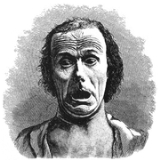
The facial expression of fear includes the widening of the eyes (out of anticipation for what will happen next); the pupils dilate (to take in more light); the upper lip rises, the brows draw together, and the lips stretch horizontally. The physiological effects of fear can be better understood from the perspective of the sympathetic nervous responses (fight-or-flight), as compared to the parasympathetic response, which is a more relaxed state. Muscles used for physical movement are tightened and primed with oxygen, in preparation for a physical fight-or-flight response. Perspiration occurs due to blood being shunted from body's viscera to the peripheral parts of the body. Blood that is shunted from the viscera to the rest of the body will transfer, along with oxygen and nutrients, heat, prompting perspiration to cool the body. When the stimulus is shocking or abrupt, a common reaction is to cover (or otherwise protect) vulnerable parts of the anatomy, particularly the face and head. When a fear stimulus occurs unexpectedly, the victim of the fear response could possibly jump or give a small start. The person's heart-rate and heartbeat may quicken.
Varieties
Fear can be described with different terms in relation to the degree of fear that is experienced. It varies from mild caution to extreme
phobiaA phobia , is an irrational, intense, persistent fear of certain situations, activities, things, or people. The main symptom of this disorder is the excessive, unreasonable desire to avoid the feared subject...
and
paranoiaParanoia is a thought process heavily influenced by excessive anxiety or fear, often to the point of irrationality and delusion. Paranoid thinking typically includes persecutory beliefs concerning a perceived threat towards oneself. In the original Greek, παράνοια simply means madness...
. Fear is related to a number of additional cognitive and emotional states including
worryWorry is an emotion in which a person feels anxious or concerned about a real or imagined issue, ranging from personal issues such as health or finances to broader issues such as environmental pollution and social or technological change...
,
anxietyAnxiety is a psychological and physiological state characterized by cognitive, somatic, emotional, and behavioral components. These components combine to create an unpleasant feeling that is typically associated with uneasiness, fear, or worry....
, terror, horror,
panicPanic is a sudden fear which dominates or replaces thinking and often affects groups of people or animals. Panics typically occur in disaster situations, or violent situations which may endanger the overall health of the affected group...
, and dread. Experiences of fear are, by their very nature, impacting and, in this way, can remain in the
unconscious mindThe unconscious mind is a term invented by the 18th century German romantic philosopher Ser Christopher Riegel and later introduced into English by the poet and essayist Samuel Taylor Coleridge...
long after exposure; where they may then manifest as
nightmareA nightmare is an unpleasant dream. Nightmares cause a strong unpleasant emotional response from the sleeper, typically fear or horror. The dream may contain a situation of extreme danger, or sensations of pain, bad events, falling, drowning, being raped, becoming disabled, losing loved ones,...
s. Fear may also be experienced within a larger group or
social networkA social network is a social structure made of individuals called "nodes," which are tied by one or more specific types of interdependency, such as friendship, kinship, financial exchange, dislike, sexual relationships, or relationships of beliefs, knowledge or prestige.Social network analysis...
. In this way, personal fears are compounded by social influence to become mass hysteria.
The experience of
distrustDistrust is a formal way of not trusting any one party too much in a situation of grave risk or deep doubt. It is commonly expressed in civics as a division or balance of powers, or in politics as means of validating treaty terms. Systems based on distrust simply divide the responsibility so that...
can be explained as a feeling of EXTREME fear or caution, usually in response to an unfamiliar or potentially dangerous person. Distrust may occur as a feeling of warning towards someone or something that is questionable or unknown. For example, one may distrust a stranger who acts in a way that is perceived as odd or unusual. Likewise, one may distrust the
safetySafety is the state of being "safe" , the condition of being protected against physical, social, spiritual, financial, political, emotional, occupational, psychological, educational or other types or consequences of failure, damage, error, accidents, harm or any other event which could be...
of a rusty old bridge across a 100-foot drop. Distrust may serve as an adaptive, early warning signal for situations that could lead to greater fear and danger.
Terror is an acute and pronounced form of fear. It is an overwhelming sense of immediate personal danger. It can also be caused by perceiving the object of a
phobiaA phobia , is an irrational, intense, persistent fear of certain situations, activities, things, or people. The main symptom of this disorder is the excessive, unreasonable desire to avoid the feared subject...
. Terror may overwhelm a person to the point of making
irrationalIrrationality is cognition, thinking, talking or acting without inclusion of rationality. The term is used, usually pejoratively, to describe thinking and actions that are, or appear to be, less useful or illogical than other more rational alternatives....
choices and atypical behavior.
ParanoiaParanoia is a thought process heavily influenced by excessive anxiety or fear, often to the point of irrationality and delusion. Paranoid thinking typically includes persecutory beliefs concerning a perceived threat towards oneself. In the original Greek, παράνοια simply means madness...
is a term used to describe a
psychosisPsychosis literally means abnormal condition of the mind, and is a generic psychiatric term for a mental state often described as involving a "loss of contact with reality"...
of fear. It is experienced as longstanding feelings and perceptions of being persecuted. Paranoia is an extreme emotional state combined with cognitions, or more specifically,
delusionA delusion, in everyday language, is a fixed belief that is either false, fanciful, or derived from deception. Psychiatry defines the term more specifically as a belief that is pathological...
s that one is in danger. This degree of fear may indicate that one has changed his or her normal behavior in extreme or maladaptive ways.
Common fears
According to surveys, some of the most commonly feared objects are spiders, snakes, heights, water, enclosed spaces, tunnels and bridges, social rejection, failure, and public speaking. In an innovative test of what people fear the most, Bill Tancer analyzed the most frequent online search queries that involved the phrase, "fear of...". This follows the assumption that people tend to seek information on the issues that concern them the most. His top ten list of fears consisted of flying, heights, clowns, intimacy, death, rejection, people, snakes, success, and driving.
In a 2005 Gallup poll (U.S.A.), a national sample of adolescents between the ages of 13 and 15 were asked what they feared the most. The question was open ended and participants were able to say whatever they wanted. The most frequently cited fear (mentioned by 8% of the teens) was terrorism. The top ten fears were, in order: terrorist attacks, spiders, death, being a failure, war, heights, criminal or gang violence, being alone, the future, and nuclear war.
Causes
People develop specific fears as a result of learning. This has been studied in psychology as
fear conditioningFear conditioning is the method by which organisms learn to fear new stimuli. It is a form of learning in which fear is associated with a particular neutral context or neutral stimulus . This can be done by pairing the neutral stimulus with an aversive stimulus...
, beginning with John B. Watson's
Little Albert experimentThe Little Albert experiment was an experiment showing empirical evidence of classical conditioning in humans. This study was also an example of stimulus generalization. It was conducted in 1920 by John B. Watson along with his assistant Rosalie Rayner. The study was done at Johns Hopkins...
in 1920. In this study, an 11-month-old boy was conditioned to fear a white rat in the laboratory. The fear became generalized to include other white, furry objects. In the real world, fear can be acquired by a frightening traumatic accident. For example, if a child falls into a well and struggles to get out, he or she may develop a fear of wells, heights (
acrophobiaAcrophobia is an extreme or irrational fear of heights. It belongs to a category of specific phobias, called space and motion discomfort that share both similar etiology and options for treatment.Acrophobia can be dangerous, as sufferers can experience a panic attack in a high place and become too...
), enclosed spaces (
claustrophobiaClaustrophobia is the fear of having no escape, and being closed in. It is typically classified as an anxiety disorder and often results in panic attack...
), or water (
aquaphobiaNot to be confused with HydrophobiaAquaphobia is an abnormal and persistent fear of water. Aquaphobia is a specific phobia that involves a level of fear that is beyond the patient's control or that may interfere with daily life...
).
Although fear is learned, the capacity to fear is part of
human natureHuman nature is the concept that there are a set of characteristics, including ways of thinking, feeling and acting, that all 'normal' humans have in common. The branches of science associated with the study of human nature include sociology, sociobiology and psychology, particularly...
. Many studies have found that certain fears (e.g. animals, heights) are much more common than others (e.g. flowers, clouds). These fears are also easier to induce in the laboratory. This phenomenon is known as
preparednessIn psychology, preparedness is a concept developed to explain why certain associations are learned more readily than others. For example, phobias related to survival, such as snakes, spiders, and heights, are much more common and much easier to induce in the laboratory than other kinds of fears....
. Because early humans that were quick to fear dangerous situations were more likely to survive and reproduce, preparedness is theorized to be a genetic effect that is the result of
natural selectionNatural selection is the process by which heritable traits that make it more likely for an organism to survive and successfully reproduce become more common in a population over successive generations...
.
The experience of fear is affected by historical and cultural influences. For example, in the early 20th Century, many Americans feared polio, a disease that cripples the body part it affects, leaving that body part immobilized for the rest of one's life. There are also consistent cross-cultural differences in how people respond to fear.
Display rulesDisplay rules are a social group's informal norms about when, where, and how one should express emotions.Expressions of emotions vary to a great degree and hold significant meaning with great value of determining ones cultural and social identity. Display rules identify these expressions to a...
affect how likely people are to show the facial expression of fear and other emotions.
Neurobiology
The
amygdalaThe ' are almond-shaped groups of nuclei located deep within the medial temporal lobes of the brain in complex vertebrates, including humans...
is a key
brainThe brain is the center of the nervous system in all vertebrate, and most invertebrate, animals. Some primitive animals such as jellyfish and starfish have a decentralized nervous system without a brain, while sponges lack any nervous system at all...
structure in the neurobiology of fear. It is involved in the processing of negative emotions (such as fear and anger). Researchers have observed hyperactivity in the amygdala when patients who were shown threatening faces or confronted with frightening situations. Patients with a more severe social phobia showed a correlation with increased response in the amygdala. Studies have also shown that subjects exposed to images of frightened faces, or faces of people from another race, exhibit increased activity in the amygdala.
The fear response generated by the amygdala can be mitigated by another brain region known as the rostral anterior cingulate cortex, located in the
frontal lobeThe frontal lobe is an area in the brain of mammals. It is located at the front of each cerebral hemisphere and positioned anterior to the parietal lobes and above and anterior to the temporal lobes...
. In a 2006 study at Columbia University, researchers observed that test subjects experienced less activity in the amygdala when they
consciously perceived fearful stimuli than when they
unconsciously perceived fearful stimuli. In the former case, they discovered the rostral anterior cingulate cortex activates to dampen activity in amygdala, granting the subjects a degree of emotional control.
The role of the amygdala in the processing of fear-related stimuli has been questioned by research upon those in which it is bilateral damaged. Even in the absence of their amygdala, they still react rapidly to fearful faces.
Suppression of amygdala activity can also be achieved by pathogens. Rats infected with the
toxoplasmosisToxoplasmosis is a parasitic disease caused by the protozoan Toxoplasma gondii. The parasite infects most genera of warm-blooded animals, including humans, but the primary host is the felid family. Animals are infected by eating infected meat, by ingestion of faeces of a cat that has itself...
parasite become less fearful of cats, sometimes even seeking out their urine-marked areas. This behavior often leads to them being eaten by cats. The parasite then reproduces within the body of the cat. There is evidence that the parasite concentrates itself in the amygdala of infected rats.
Fear and death
Psychologists have addressed the hypothesis that fear of death motivates religious commitment, and that it may be alleviated by assurances about an afterlife. Empirical research on this topic has been equivocal. According to Kahoe and Dunn, people who are most firm in their faith and attend religious services weekly are the least afraid of dying. People who hold a loose religious faith are the most anxious, and people who are not religious are intermediate in their fear of death. A survey of people in various Christian denominations showed a positive correlation between fear of death and dogmatic adherence to religious doctrine. In other words, Christian fundamentalism and other strict interpretations of the Bible are associated with greater fear of death. Furthermore, some religious orientations were more effective than others in allaying that fear.
In another study, data from a sample of white, Christian men and women were used to test the hypothesis that traditional, church-centered religiousness and de-institutionalized spiritual seeking are distinct ways of approaching fear of death in old age. Both religiousness and spirituality were related to positive psychosocial functioning, but only church-centered religiousness protected subjects against the fear of death.
Fear of death is also known as
death anxiety. This may be a more accurate label because, like other anxieties, the emotional state in question is long lasting and not typically linked to a specific stimulus. The analysis of fear of death, death anxiety, and concerns over mortality is an important feature of
existentialismLike “rationalism” and “empiricism,” “existentialism” is a term that belongs to intellectual history. Its definition is thus to some extent one of historical convenience...
and
terror management theoryTerror management theory is a developing area of study within the academic study of psychology. It looks at what researchers claim to be the implicit emotional reactions of people when confronted with the psychological terror of knowing we will eventually die...
.
Another common theory that is sometimes recognized is that people fear death because they do not know what happens afterwards.Though some people have a religion or a preconceived cognation of what will happen after death. They fear death because they cling to life and enjoy too much to let it go.
See also
- Angst
Angst is a German, Danish, Norwegian and Dutch word for fear or anxiety. It is used in English to describe an intense feeling of strife...
- Anxiety
Anxiety is a psychological and physiological state characterized by cognitive, somatic, emotional, and behavioral components. These components combine to create an unpleasant feeling that is typically associated with uneasiness, fear, or worry....
- Appeal to fear
An appeal to fear is a fallacy in which a person attempts to create support for his or her idea by using deception and propaganda in attempts to increase fear and prejudice toward a competitor...
- Culture of fear
Culture of fear is a term that refers to a perceived prevalence of fear and anxiety in public discourse and relationships, and how this may affect the way people interact with one another as individuals and as democratic agents...
- Horror and terror
- Nightmare
A nightmare is an unpleasant dream. Nightmares cause a strong unpleasant emotional response from the sleeper, typically fear or horror. The dream may contain a situation of extreme danger, or sensations of pain, bad events, falling, drowning, being raped, becoming disabled, losing loved ones,...
- Night terror
A night terror, also known as a sleep terror or pavor nocturnus, is a parasomnia disorder characterized by extreme terror and a temporary inability to regain full consciousness. The subject wakes abruptly from slow-wave sleep, with waking usually accompanied by gasping, moaning, or screaming...
- Ontogenetic parade
In developmental psychology, the ontogenetic parade is the term introduced by Isaac Marks for the predictable pattern of the development of normal childhood fears: emergence, plateau, and decline....
- Panic
Panic is a sudden fear which dominates or replaces thinking and often affects groups of people or animals. Panics typically occur in disaster situations, or violent situations which may endanger the overall health of the affected group...
- Phobia
A phobia , is an irrational, intense, persistent fear of certain situations, activities, things, or people. The main symptom of this disorder is the excessive, unreasonable desire to avoid the feared subject...
- Psychological trauma
Psychological trauma is a type of damage to the psyche that occurs as a result of a traumatic event. When that trauma leads to posttraumatic stress disorder, damage may involve physical changes inside the brain and to brain chemistry, which damage the person's ability to adequately cope with...
- Social phobia
Social phobia may refer to any of the following conditions:* Social anxiety - the experience of anxiety regarding social situations, interactions with others or being evaluated or scrutinized by other people* Social anxiety disorder - a diagnosis within the mental health professions referring to...
- Shock
Acute stress over reaction is a psychological condition arising in response to a terrifying event...
Further reading
- Bourke, Joanna
Joanna Bourke is an historian and professor of history at Birkbeck, University of London.-Biography:Born to Christian missionary parents, Bourke was brought up in Zambia, Solomon Islands and Haiti. After home education with her siblings she attended Auckland University, gaining a BA and masters in...
, Fear: a cultural history, Virago (2005)
- Robin, Corey
Corey Robin is an American liberal political theorist, journalist and professor of Political Science at Brooklyn College and the Graduate Center of the City University of New York...
, Fear: the history of a political idea, Oxford University Press (2004)
- Duenwald, Mary. The Physiology of ... Facial Expressions, Discover magazine
Discover is a science magazine that publishes articles about science for a general audience. The monthly magazine was launched in October 1980 by Time Inc. It was sold to Family Media, the owners of Health, in 1987. Walt Disney Company bought the magazine when Family Media went out of business in...
, v.26, n.1, January 2005
- Gardner, Dan, Risk: The Science and Politics of Fear, Random House, Inc., 2008. ISBN 0771032994
- Krishnamurti, Jiddu
Jiddu Krishnamurti or J. Krishnamurti or , was a renowned writer and speaker on philosophical and spiritual subjects. His subject matter included: psychological revolution, the nature of the mind, meditation, human relationships, and bringing about positive change in society...
, On Fear, Harper Collins, ISBN 0-06-251014-2 (1995)
External links