
All Topics  
Respirator


   Email Print
   Bookmark   Link


Respirator


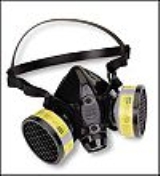
A respirator is a device designed to protect the wearer from inhaling harmful dust
Dust

Dust is a general name for minute solid particles with diameters less than 20 Thou . Particles in the Earth's atmosphere arise from various sources such as soil dust lifted up by wind, volcanic eruptions, and pollution....
s, fumes, vapors, and/or gas
Gas

In physics, a gas is a state of matter, consisting of a collection of particles without a definite shape or volume that are in more or less random motion....
es. Respirators come in a wide range of types and sizes used by the military, private industry, and the public. Respirators range from cheaper, single-use, disposable mask
Mask

A mask is an article normally worn on the face, typically for protection, concealment, performance, or amusement. Masks have been used since antiquity for both ceremonial and practical purposes....
s to reusable models with replaceable cartridges.

There are two main categories: the air-purifying respirator, which forces contaminated air through a filtering element, and the air-supplied respirator, in which an alternate supply of fresh air is delivered.


Discussion
Ask a question about 'Respirator'
Start a new discussion about 'Respirator'
Answer questions from other users
Full Discussion Forum


Encyclopedia


A respirator is a device designed to protect the wearer from inhaling harmful dust
Dust

Dust is a general name for minute solid particles with diameters less than 20 Thou . Particles in the Earth's atmosphere arise from various sources such as soil dust lifted up by wind, volcanic eruptions, and pollution....
s, fumes, vapors, and/or gas
Gas

In physics, a gas is a state of matter, consisting of a collection of particles without a definite shape or volume that are in more or less random motion....
es. Respirators come in a wide range of types and sizes used by the military, private industry, and the public. Respirators range from cheaper, single-use, disposable mask
Mask

A mask is an article normally worn on the face, typically for protection, concealment, performance, or amusement. Masks have been used since antiquity for both ceremonial and practical purposes....
s to reusable models with replaceable cartridges.

There are two main categories: the air-purifying respirator, which forces contaminated air through a filtering element, and the air-supplied respirator, in which an alternate supply of fresh air is delivered. Within each category, different techniques are employed to reduce or eliminate noxious airborne contents.

Early development of respirators


The history of protective respiratory equipment can be traced back as far as the 16th century, when Leonardo da Vinci
Leonardo da Vinci

Leonardo di ser Piero da Vinci was an Italy polymath, being a scientist, mathematician, engineer, inventor, anatomist, Painting, sculptor, architect, botanist, musician and writer....
 suggested that a finely-woven cloth dipped in water could protect sailors from a toxic weapon made of powder that he had designed. Alexander von Humboldt
Alexander von Humboldt

was a German people natural scientist and List of explorers, and the younger brother of the Prussian minister, philosopher, and linguistics, Wilhelm von Humboldt ....
 introduced a primitive respirator in 1799 when he was working in Prussia as a mining engineer.

Practically all the early respirators consisted of a bag placed completely over the head, fastened around the throat with windows through which the wearer could see. Some were rubber
Rubber

Natural rubber is an elastomer?an Elasticity_ hydrocarbon polymer?that was originally derived from a milky colloidal suspension, or latex , found in the sap of some plants....
, some were made of rubberized fabric, and still others of impregnated fabric, but in most cases a tank of compressed air or a reservoir of air under slight pressure was carried by the wearer to supply the necessary breathing air. In some devices certain means were provided for the adsorption of carbon dioxide
Carbon dioxide

Carbon dioxide is a chemical compound composed of two oxygen atoms covalent bond to a single carbon atom. It is a gas at standard temperature and pressure and exists in Earth's atmosphere in this state....
 in exhaled air and the rebreathing of the same air many times; in other cases valves were provided for exhalation of used air.

John Stenhouse's Mask
The first US patent for an air purifying respirator was granted to Lewis P. Haslett in 1848 for his 'Haslett's Lung Protector,' which filtered dust from the air using one-way clapper valves and a filter made of moistened wool
Wool

Wool is the fiber derived from the specialized skin cells, called follicles, of animals in the Caprinae family, principally domestic sheep, but the hair of certain species of other Mammalia such as cashmere goat, llamas, rabbits and keeshonds may also be called wool....
 or a similar porous
Pore

Pore may refer to:In animal biology and microbiology:* Sweat pore, an anatomical structure of the skin of humans used for secretion of sweat...
 substance. Following Haslett, a long string of patents were issued for air purifying devices, including patents for the use of cotton fibers as a filtering medium, for charcoal and lime absorption of poisonous vapors, and for improvements on the eyepiece and eyepiece assembly. Hutson Hurd patented a cup-shaped mask in 1879 that became widespread in industrial use, and Hurd's H.S. Cover Company was still in business in the 1970s.

Inventors were also developing air purifying devices across the Atlantic. John Stenhouse
John Stenhouse

John Stenhouse was a Scottish chemist. In 1854, he invented one of the first practical respirators....
, a Scottish chemist, was investigating the power of charcoal, in its various forms, to capture and hold large volumes of gas. He put his science to work in building one of the first respirators able to remove toxic gases from the air, paving the way for activated charcoal
Activated carbon

Activated carbon, also called activated charcoal or activated coal, is a form of carbon that has been processed to make it extremely porous and thus to have a very large surface area available for adsorption or chemical reactions....
 to become the most widely used filter for respirators. British physicist John Tyndall
John Tyndall

John Tyndall Fellow of the Royal Society was a prominent 19th century physicist. His initial scientific fame arose in the 1850s from his study of diamagnetism....
 took Stenhouse's mask, added a filter of cotton wool saturated with lime
Calcium hydroxide

Calcium hydroxide, traditionally called slaked lime, hydrated lime, or pickling lime, is a chemical compound with the chemical formula Calcium2....
, glycerin, and charcoal, and invented a 'fireman's respirator,' a hood that filtered smoke and gas from air, in 1871; Tyndall exhibited this respirator at a meeting of the Royal Society
Royal Society

The Royal Society of London for the Improvement of Natural Knowledge, known simply as the Royal Society, or even the Royal, is a learned society for science that was founded in 1660 and is considered by most to be the oldest such society still in existence....
 in London in 1874. Also in 1874, Samuel Barton patented a device that 'permitted respiration in places where the atmosphere is charged with noxious gases, or vapors, smoke, or other impurities.' German Bernhard Loeb patented several inventions to 'purify foul or vitiated air,' and counted among his customers the Brooklyn Fire Department.

Chemical Warfare


The Second Battle of Ypres
Second Battle of Ypres

The Second Battle of Ypres was the first time Germany used chemical weapons on a large scale on the Western Front in World War I and the first time a former colonial force pushed back a major European power on European soil, which occurred in the battle of St....
 was the first time Germany
Germany

Germany , officially the Federal Republic of Germany , is a country in Central Europe. It is bordered to the north by the North Sea, Denmark, and the Baltic Sea; to the east by Poland and the Czech Republic; to the south by Austria and Switzerland; and to the west by France, Luxembourg, Belgium, and the Netherlands....
 used chemical weapons on a large scale on the Western Front in World War I
World War I

World War I, or the First World War , was a global military conflict which involved the Great powers, organized into two opposing military alliances: the Allies of World War I and the Central Powers....
 and the first time a colonial force (Canadians
Canada

Canada is a country occupying most of northern North America, extending from the Atlantic Ocean in the east to the Pacific Ocean in the west and northward into the Arctic Ocean....
) pushed back a major European power (Germans) on European soil, which occurred in the battle of St. Juliaan-Kitcheners' Wood. 168 tons of chlorine gas were released on 22 April over a four mile (6 km) front. Around 6,000 troops died within ten minutes from asphyxiation. The gas affects the lungs and the eyes causing respiration problems and blindness. Being denser than air it flowed downwards forcing the troops to climb out of trenches.

Eventually reserve Canadian troops held the front, being away from the attack, using urine
Urine

Urine is a liquid waste product of the body secreted by the kidneys by a process of filtration from blood called urination and excreted through the urethra....
-soaked cloths as primitive respirators. A Canadian soldier had discovered that the ammonia
Ammonia

Ammonia is a chemical compound with the chemical formula nitrogenhydrogen. It is normally encountered as a gas with a characteristic pungent odor....
 in urine would react with the chlorine, neutralizing it, and that the water would dissolve the chlorine, allowing the soldiers to breathe through the gas. This is the first recorded response and defense against chemical attacks using respirators.

Modern respirator technology

All respirators have some type of facepiece held to the wearer's head with straps, a cloth harness, or some other method. The facepiece of the respirator covers either the entire face or the bottom half of the face including the nose and mouth. Half-face respirators can only be worn in environments where the contaminants are not toxic to the eyes or facial area. For example, someone who is painting an object with spray paint could wear a half-face respirator, but someone who works with chlorine
Chlorine

Chlorine...
 gas would have to wear a full-face respirator. Facepieces come in many different styles and sizes, to accommodate all types of face shapes, and there are many books and references available for determining which kind of hazard requires what type of respirator.

Air-purifying respirators

Air-purifying respirators are used against particulates (such as smoke or fumes), gases, and vapors that are at atmospheric concentrations less than immediately dangerous to life and health. The air-purifying respirator class includes:

  • negative-pressure
    Negative pressure

    Negative pressure may refer to:*vacuum*negative gauge pressure, a way of expressing pressure measurements below atmospheric pressure*suction...
     respirators, using mechanical filters and chemical media
  • positive-pressure
    Positive pressure

    Positive pressure is a pressure within a system that is greater than the environment that surrounds that system. Consequently if there is any leak from the positively pressured system it will ingress into the surrounding environment....
     units such as powered air-purifying respirators (PAPRs)
  • Escape Only respirators such as Air-Purifying Escape Respirators (APER) for use by the general public for Chemical, Biological, Radiological, and Nuclear (CBRN)
    CBRN

    CBRN is an acronym for chemical, biological, radiological, and nuclear. It is in common use worldwide, to refer to incidents or weapons in which any of these four hazards have presented themselves....
     terrorism incidents.


Half- or full-facepiece designs of this type are marketed in many varieties depending on the hazard of concern. They use a filter which acts passively on air inhaled by the wearer. Some common examples of this type of respirator are single-use escape hoods and filter masks. The latter are typically simple, light, single-piece, half-face masks and employ the first three mechanical mechanisms in the list below to remove particulates from the air stream. The most common of these is the disposable white N95 variety. The entire unit is discarded after some extended period or a single use, depending on the contaminant. Filter masks also come in replaceable-cartridge, multiple-use models. Typically one or two cartridges attach securely to a mask which has built into it a corresponding number of valves for inhalation and one for exhalation.

Mechanical filter respirators
Mechanical filter respirators retain particulate matter when contaminated air is passed through the filter material. This was the method used by early inventors such as Haslett and Tyndall. Wool is still used today as a filter, along with other substances such as plastic, glass, cellulose, and combinations of two or more of these materials. Since the filters cannot be cleaned and reused and therefore have a limited lifespan, cost and disposability are key factors. Single-use, disposable as well as replaceable cartridge models are common. Mechanical filters remove contaminants from air in the following ways:
  1. by particles which are following a line of flow in the airstream coming within one radius of a fiber and adhering to it, called interception;
  2. by larger particles unable to follow the curving contours of the airstream being forced to embed in one of the fibers directly, called impaction; this increases with diminishing fiber separation and higher air flow velocity
  3. by an enhancing mechanism called diffusion, which is a result of the collision with gas molecules by the smallest particles, especially those below 100 nm in diameter, which are thereby impeded and delayed in their path through the filter; this effect is similar to Brownian motion
    Brownian motion

    Brownian motion is the seemingly random movement of particles suspended in a liquid or gas or the mathematical model used to describe such random movements, often called a particle theory....
     and raises the probability that particles will be stopped by either of the two mechanisms above; it becomes dominant at lower air flow velocities
  4. by using certain resins, waxes, and plastics as coatings on the filter material to attract particles with an electrostatic charge that holds them on the surface of the filter material;
  5. by using gravity and allowing particles to settle into the filter material (this effect is typically negligible); and
  6. by using the particles themselves, after the filter has been used, to act as a filter medium for other particles.
Considering only particulates carried on an air stream and a fiber mesh filter, diffusion predominates below the 0.1 µm diameter particle size. Impaction and interception predominate above 0.4 µm. In between, near the 0.3 µm most penetrating particle size (MPPS), diffusion and interception predominate.

For maximum efficiency of particle removal and to decrease resistance to airflow through the filter, particulate filters are designed to keep the velocity of air passing through the filter medium as low as possible. This is achieved by manipulating the slope and shape of the filter to provide larger surface area.

A substantial advance in mechanical filter technology was the HEPA
HEPA

File:HEPA_Filter_diagram_en.svgA high efficiency particulate air or HEPA filter is a type of high-efficiency air filter....
 filter, invented during the Manhattan Project
Manhattan Project

The Manhattan Project was the project to develop the first atomic weapon during World War II; involving the United States, the United Kingdom, and Canada....
 for protection from radioactive particles and later adapted to additional uses. A HEPA filter can remove as much as 99.97% of all airborne particulates with aerodynamic diameter of 0.3 micrometres or greater. In the United States
United States

The United States of America is a Federal government constitutional republic comprising U.S. state and a federal district. The country is situated mostly in central North America, where its Contiguous United States and Washington, D.C., the Capital districts and territories, lie between the Pacific Ocean and Atlantic Oceans, Borders of the U...
, the categories below were established by NIOSH to describe particulate filters.

Chemical cartridge respirators
Chemical cartridge respirators use a cartridge to remove gas
Gas

In physics, a gas is a state of matter, consisting of a collection of particles without a definite shape or volume that are in more or less random motion....
es, volatile organic compound
Volatile organic compound

Volatile organic compounds are organic chemical compounds that have high enough vapor pressures under normal conditions to significantly vaporize and enter the atmosphere....
s (VOCs), and other vapors from breathing air
AIR

Air is the part of Earth's atmosphere that humans breath and as such Air .Air may also refer to:...
 by adsorption
Adsorption

Adsorption is a process that occurs when a gas or liquid solute accumulates on the surface of a solid or a liquid , forming a film of molecules or atoms ....
, absorption
Absorption (chemistry)

File:Absorber.svgAbsorption, in chemistry, is a physical or chemical phenomenon or a Process in which atoms, molecules, or ions enter some bulk phase - gas, liquid or solid material....
, or chemisorption
Chemisorption

Chemisorption is a classification of adsorption characterized by a strong interaction between an adsorbate and a Substrate surface, as opposed to physisorption which is characterized by a weak Van der Waals force....
. A typical organic
Organic compound

An organic compound is any member of a large class of chemical compounds whose molecules contain carbon. For historical reasons discussed below, a few types of compounds such as carbonates, simple oxides of carbon and cyanides, as well as the allotropes of carbon, are considered Inorganic compound....
 vapor respirator cartridge is a metal
Metal

In chemistry, a metal is a chemical element whose atoms readily lose electrons to form positive ions , and form metallic bonds between other metal atoms and ionic bonds between nonmetal atoms....
 or plastic
Plastic

Plastic is the general common term for a wide range of synthetic or semisynthetic organic chemistry solid materials suitable for the manufacture of industrial products....
 case containing from 25 to 40 grams of sorption media such as activated charcoal or certain resin
Resin

Resin is a hydrocarbon secretion of many plants, particularly Pinophyta. It is valued for its chemical constituents and uses, such as varnishes and adhesives, as an important source of raw materials for organic synthesis, or for incense and perfume....
s. The service life of the cartridge varies based, among other variables, on the carbon weight and molecular weight of the vapor and the cartridge media, the concentration of vapor in the atmosphere, the relative humidity of the atmosphere, and the breathing rate of the respirator wearer. When filter cartridges become saturated
Saturation (chemistry)

In chemistry, saturation has five different meanings:#In physical chemistry, saturation is the point at which a solution of a substance can dissolve no more of that substance and additional amounts of it will appear as a Precipitation ....
 or particulate accumulation within them begins to restrict air flow, they must be changed.

Powered air-purifying respirators
The purpose of this type of respirator is to take air
AIR

Air is the part of Earth's atmosphere that humans breath and as such Air .Air may also refer to:...
 that is contaminated with one or more types of pollutant
Pollutant

A pollutant is a waste material that pollutes air, water or soil.Three factors determine the severity of a pollutant: its chemical nature, the concentration and the persistence....
s, remove a sufficient quantity of those pollutant
Pollutant

A pollutant is a waste material that pollutes air, water or soil.Three factors determine the severity of a pollutant: its chemical nature, the concentration and the persistence....
s and then supply
Supply

supply is the amount of good or services a business providesSupply may refer to:*Supply and demand theory*Confidence and supply#Supply for a Government budget, in the Westminster System...
 the air to the user. There are different units for different environments. The units consist of a powered fan
Fan (mechanical)

A mechanical fan is an electricity powered device used to produce an airflow for the purpose of creature comfort , Ventilation , exhaust, or any other gaseous transport....
 which forces incoming air through one or more filters for delivery to the user for breathing. The fan and filters may be carried by the user or with some units the air is fed to the user via tubing while the fan and filters are remotely mounted.

The type of filtering must be matched to the contaminants that need to be removed. Some respirators are designed to remove fine particulate matter
Matter

In common usage, matter is anything that has both mass and volume . A more rigorous definition is used in science: matter is what atoms and molecules are made of....
 such as the dust
Dust

Dust is a general name for minute solid particles with diameters less than 20 Thou . Particles in the Earth's atmosphere arise from various sources such as soil dust lifted up by wind, volcanic eruptions, and pollution....
 created during various woodworking processes. They are not suitable when working with volatile organic compound
Organic compound

An organic compound is any member of a large class of chemical compounds whose molecules contain carbon. For historical reasons discussed below, a few types of compounds such as carbonates, simple oxides of carbon and cyanides, as well as the allotropes of carbon, are considered Inorganic compound....
s such as those used in many spray paints. At the same time filters that are suitable for volatile substances must typically have their filter elements replaced more often than a particulate filter. In addition there is some confusion over terminology. Some literature and users will refer to a particulate filtering unit as a dust mask or filter and then use the term respirator to mean a unit that can handle organic solvent
Solvent

A solvent is a liquid or gas that dissolves a solid, liquid, or gaseous solute, resulting in a solution.The most common solvent in everyday life is water....
s.

Self-contained breathing apparatus
An SCBA typically has three main components: a high-pressure tank (e.g., 2200 psi to 4500 psi), a pressure regulator, and an inhalation connection (mouthpiece, mouth mask or face mask), connected together and mounted to a carrying frame. There are two kinds of SCBA: open circuit and closed circuit.

Open-circuit industrial breathing sets are filled with filtered, compressed air, the same air we breathe normally. The compressed air passes through a regulator, is inhaled by the user, then exhaled out of the system, quickly depleting the supply of air. Most modern SCBAs are open-circuit. An open-circuit SCBA has a full-face mask, regulator, air cylinder, cylinder pressure gauge, and a harness with adjustable shoulder straps and belt which lets it be worn on the back. Air cylinders are made of aluminum, steel, or of a composite construction (usually fiberglass-wrapped aluminum.) Commonly an SCBA will be of the "positive pressure" type, which supplies a slight steady stream of air to stop toxic fumes or smoke from leaking into the mask. Not all SCBAs are positive pressure; others are of the "demand" type, which only supply air on demand (i.e., when the regulator senses the user inhaling). All fire departments and those working in toxic environments need to use the positive pressure SCBA for safety reasons.

The closed-circuit type filters, supplements, and recirculates exhaled gas: see rebreather
Rebreather

A rebreather is a type of breathing set that provides a breathing gas containing oxygen and recycled exhaled gas. This recycling reduces the volume of breathing gas used, making a rebreather lighter and more compact than an open-circuit breathing set for the same duration in environments where humans cannot safely breathe from the atmosphere....
 for more information. It is used when a longer-duration supply of breathing gas is needed, such as in mine rescue and in long tunnels, and going through passages too narrow for a big open-circuit air cylinder.

See also

  • Air filter
    Air filter

    An air filter is a device which removes solid particulates such as dust, pollen, mold, and bacterium from the air. Air filters are used in applications where air quality is important, notably in building ventilation systems and in engines, such as internal combustion engines, gas compressors, diving air compressors, gas turbines and oth...
  • Gas mask
    Gas mask

    A gas mask is a mask worn over the face to protect the wearer from inhaling "airborne pollutants" and toxic gasses. The mask forms a sealed cover over the nose and mouth, but may also cover the eyes and other vulnerable soft tissues of the face....
  • HEPA
    HEPA

    File:HEPA_Filter_diagram_en.svgA high efficiency particulate air or HEPA filter is a type of high-efficiency air filter....
  • Pocket mask
    Pocket mask

    A pocket mask, or pocket face mask or CPR mask, is a device used to safely deliver artificial respiration during a cardiac arrest or respiratory arrest....
  • Poison gas in World War I
    Poison gas in World War I

    The use of poison gas in World War I was a major military innovation. The gases ranged from disabling chemicals, such as tear gas and the severe mustard gas, to lethal agents like phosgene and chlorine....
  • Particulate matter
  • Surgical mask
    Surgical mask

    A surgical mask is intended to be worn by health professionals during surgery and at other times to catch the bacteria shed in liquid droplets and aerosols from the wearer's mouth and nose....


External links

  • For CBRN defense responders: The following links are ideal respirator selection logic and competitive bid research information pages for use by all end-users, especially respiratory protection program managers, safety officers, industrial hygienists, CBRN defense specialists, and grant writers seeking funding from the United States Department of Homeland Security (DHS) or other public safety sources:
  • : Respirator manufacturer approvals for NIOSH-certified air-purifying respirator with CBRN Protections (CBRN APR). This link covers APR and Air-Purifying Escape Respirators (APER) certified by the NIOSH's National Personal Protective Technology Laboratory (NPPTL), Pittsburgh, PA, to Chemical, Biological, Radiological, and Nuclear (CBRN) protection NIOSH standards. CBRN APR are tight-fitting, full-face respirators with approved accessories and protect the user breathing zone by relying on user negative pressure, fit testing and user seal checks to filter less than Immediately Dangerous to Life and Health (IDLH)
    IDLH

    IDLH is an initialism for Immediately Dangerous to Life and Health, and is defined by the US National Institute for Occupational Safety and Health as exposure to airborne contaminants that is "likely to cause death or immediate or delayed permanent adverse health effects or prevent escape from such an environment." Examples include sm...
     concentrations of hazardous respiratory compounds and particulates through NIOSH CBRN Cap 1, Cap 2 or Cap 3 canisters for CBRN APR- or CBRN 15- or CBRN 30-rated APER.
  • : Respirator manufacturer approvals for NIOSH-certified powered air-purifying respirator with CBRN Protections (CBRN PAPR-loose fitting or tight fitting)