
All Topics  
Boiling point


   Email Print
   Bookmark   Link


Boiling point


The boiling point of a liquid is the temperature at which the vapor pressure
Vapor pressure

Vapor pressure , is the pressure of a vapor in Thermodynamic equilibrium with its non-vapor Phase s. All liquids and solids have a tendency to evaporate to a gaseous form, and all gases have a tendency to Condensation back into their original form ....
 of the liquid equals the environmental pressure surrounding the liquid. A liquid in a vacuum environment has a lower boiling point than when the liquid is at atmospheric pressure
Atmospheric pressure

Atmospheric pressure is sometimes defined as the force per unit area exerted against a surface by the weight of air above that surface at any given point in the Earth's atmosphere....
. A liquid in a high pressure environment has a higher boiling point than when the liquid is at atmospheric pressure. In other words, the boiling point of liquids varies with and depends upon the surrounding environmental pressure.

The normal boiling point (also called the atmospheric boiling point or the atmospheric pressure boiling point) of a liquid is the special case in which the vapor pressure of the liquid equals the defined atmospheric pressure at sea level, 1 atmosphere.


Discussion
Ask a question about 'Boiling point'
Start a new discussion about 'Boiling point'
Answer questions from other users
Full Discussion Forum


Encyclopedia


The boiling point of a liquid is the temperature at which the vapor pressure
Vapor pressure

Vapor pressure , is the pressure of a vapor in Thermodynamic equilibrium with its non-vapor Phase s. All liquids and solids have a tendency to evaporate to a gaseous form, and all gases have a tendency to Condensation back into their original form ....
 of the liquid equals the environmental pressure surrounding the liquid. A liquid in a vacuum environment has a lower boiling point than when the liquid is at atmospheric pressure
Atmospheric pressure

Atmospheric pressure is sometimes defined as the force per unit area exerted against a surface by the weight of air above that surface at any given point in the Earth's atmosphere....
. A liquid in a high pressure environment has a higher boiling point than when the liquid is at atmospheric pressure. In other words, the boiling point of liquids varies with and depends upon the surrounding environmental pressure.

The normal boiling point (also called the atmospheric boiling point or the atmospheric pressure boiling point) of a liquid is the special case in which the vapor pressure of the liquid equals the defined atmospheric pressure at sea level, 1 atmosphere. At that temperature, the vapor pressure of the liquid becomes sufficient to overcome atmospheric pressure and lift the liquid to form bubbles inside the bulk of the liquid. The standard boiling point is now (as of 1982) defined by IUPAC as the temperature at which boiling occurs under a pressure of 1 bar.

The heat of vaporization is the amount of energy required to convert or vaporize a saturated liquid (i.e., a liquid at its boiling point) into a vapor.

Liquids may change to a vapor at temperatures below their boiling points through the process of evaporation
Evaporation

Evaporation is the slow vaporization of a liquid and the reverse of condensation. A type of phase transition, it is the process by which molecules in a liquid State of matter spontaneously become gaseous ....
. Evaporation is a surface phenomenon in which molecules located near the vapor/liquid surface escape into the vapor phase. On the other hand, boiling is a process in which molecules anywhere in the liquid escape, resulting in the formation of vapor bubbles within the liquid.

Saturation temperature and pressure


A saturated liquid contains as much thermal energy as it can without boiling (or conversely a saturated vapor contains as little thermal energy as it can without condensing
Condensation

Condensation is the change of the physical state of aggregation of matter from gaseous phase into liquid phase. When the transition happens from the gaseous phase into the solid phase directly, bypassing the liquid phase the change is called Deposition , which is the opposite of sublimation....
).

Saturation temperature means boiling point. The saturation temperature is the temperature for a corresponding saturation pressure at which a liquid boils into its vapor phase
Gas

In physics, a gas is a state of matter, consisting of a collection of particles without a definite shape or volume that are in more or less random motion....
. The liquid can be said to be saturated with thermal energy
Thermal energy

Thermal energy is a form of energy that manifests itself as an increase of temperature. It is also the sum of sensible heat and latent heat....
. Any addition of thermal energy results in a phase transition
Phase transition

In thermodynamics, a phase transition is the transformation of a thermodynamic system from one phase to another.At phase-transition point, physical properties may undergo abrupt change- for instance, volume of the two phases may be vastly different....
.

If the pressure
Pressure

Pressure is the force per unit area applied to an object in a direction surface normal to the surface. Gauge pressure is the pressure relative to the local atmospheric or ambient pressure....
 in a system remains constant (isobaric
Isobaric process

An isobaric process is a thermodynamic process in which the pressure stays constant: The term derives from the Greek isos, "equal," and barus, "heavy." The heat transferred to the system does work but also changes the internal energy of the system:...
), a vapor at saturation temperature will begin to condense into its liquid phase as thermal energy (heat
Heat

In physics and thermodynamics, heat is any transfer of energy from one body or thermodynamic system to another due to a difference in temperature....
) is removed. Similarly, a liquid at saturation temperature and pressure will boil into its vapor phase as additional thermal energy is applied.

The boiling point corresponds to the temperature at which the vapor pressure of the liquid equals the surrounding environmental pressure. Thus, the boiling point is dependent on the pressure. Usually, boiling points are published with respect to atmospheric pressure (101.325 kilopascals or 1 atm
Atmospheric pressure

Atmospheric pressure is sometimes defined as the force per unit area exerted against a surface by the weight of air above that surface at any given point in the Earth's atmosphere....
). At higher elevations, where the atmospheric pressure is much lower, the boiling point is also lower. The boiling point increases with increased pressure up to the critical point
Critical point (thermodynamics)

In physical chemistry, thermodynamics, chemistry and condensed matter physics, a critical point, also called a critical state, specifies the conditions at which a phase boundary ceases to exist....
, where the gas and liquid properties become identical. The boiling point cannot be increased beyond the critical point. Likewise, the boiling point decreases with decreasing pressure until the triple point
Triple point

In thermodynamics, the triple point of a substance is the temperature and pressure at which three Phase of that substance coexist in thermodynamic equilibrium....
 is reached. The boiling point cannot be reduced below the triple point.

If the heat of vaporization and the vapor pressure of a liquid at a certain temperature is known, the normal boiling point can be calculated by using the Clausius-Clapeyron equation thus:

Saturation pressure is the pressure for a corresponding saturation temperature at which a liquid boils into its vapor phase. Saturation pressure and saturation temperature have a direct relationship: as saturation pressure is increased so is saturation temperature.

If the temperature in a system
System

System is a set of interacting or interdependent entities, real or abstract, forming an integrated whole.The concept of an "integrated whole" can also be stated in terms of a system embodying a set of relationships which are differentiated from relationships of the set to other elements, and from relationships between an element of the se...
 remains constant (an isothermal system), vapor at saturation pressure and temperature will begin to condense
Condensation

Condensation is the change of the physical state of aggregation of matter from gaseous phase into liquid phase. When the transition happens from the gaseous phase into the solid phase directly, bypassing the liquid phase the change is called Deposition , which is the opposite of sublimation....
 into its liquid phase as the system pressure is increased. Similarly, a liquid at saturation pressure and temperature will tend to flash
Flash evaporation

Flash evaporation is the partial vaporization that occurs when a Boiling point stream undergoes a reduction in pressure by passing through a thermal expansion valve or other throttling device....
 into its vapor phase as system pressure is decreased.

The boiling point of water
Water

Water is a common chemical substance that is essential for the survival of all known forms of life. In typical usage, water refers only to its liquid form or States of matter, but the substance also has a solid state, ice, and a gaseous state, water vapor or steam....
 is 100 °C
Celsius

Celsius is a temperature scale that is named after the Swedish astronomer Anders Celsius , who developed a similar temperature scale two years before his death....
 (212 °F
Fahrenheit

Fahrenheit is a temperature scale named after the physicist Daniel Gabriel Fahrenheit , who proposed it in 1724. Today, the scale has largely been replaced by the Celsius scale; it is still in use for non-scientific purposes in the United States and a few other countries such as Belize....
) at standard pressure. On top of Mount Everest
Mount Everest

Mount Everest, also called Sagarmatha or Chomolungma, Qomolangma or Zhumulangma is the List of highest mountains on Earth, as measured by the height of its Topographical summit above sea level, which is ....
 the pressure is about 260 mbar (26.39 kPa) so the boiling point of water is 69 °C
Celsius

Celsius is a temperature scale that is named after the Swedish astronomer Anders Celsius , who developed a similar temperature scale two years before his death....
. (156.2 °F
Fahrenheit

Fahrenheit is a temperature scale named after the physicist Daniel Gabriel Fahrenheit , who proposed it in 1724. Today, the scale has largely been replaced by the Celsius scale; it is still in use for non-scientific purposes in the United States and a few other countries such as Belize....
).

For purists, the normal boiling point of water is 99.97 degrees Celsius at a pressure of 1 atm (i.e., 101.325 kPa). Until 1982 this was also the standard boiling point of water, but the IUPAC now recommends a standard pressure of 1 bar (100 kPa). At this slightly reduced pressure, the standard boiling point of water is 99.61 degrees Celsius.

Relation between the normal boiling point and the vapor pressure of liquids


The higher the vapor pressure of a liquid at a given temperature, the lower the normal boiling point (i.e., the boiling point at atmospheric pressure) of the liquid.

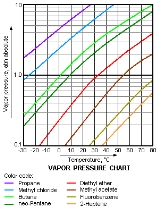
The vapor pressure chart to the right has graphs of the vapor pressures versus temperatures for a variety of liquids. As can be seen in the chart, the liquids with the highest vapor pressures have the lowest normal boiling points.

For example, at any given temperature, propane
Propane

Propane is a three-carbon alkane, normally a gas, but compressible to a transportable liquid. It is derived from other petroleum products during oil or natural gas processing....
 has the highest vapor pressure of any of the liquids in the chart. It also has the lowest normal boiling point(-42.1 °C), which is where the vapor pressure curve of propane (the purple line) intersects the horizontal pressure line of one atmosphere (atm
Atmosphere (unit)

The standard atmosphere is an international reference pressure defined as 101,325 Pascal and formerly used as unit of pressure . For practical purposes it has been replaced by the Bar which is 100,000 Pa....
) of absolute vapor pressure.

In terms of intermolecular interactions, the boiling point represents the point at which the liquid molecules possess enough thermal energy
Thermal energy

Thermal energy is a form of energy that manifests itself as an increase of temperature. It is also the sum of sensible heat and latent heat....
 to overcome the various intermolecular attractions binding the molecules as liquid (eg. dipole-dipole attraction, instantaneous-dipole induced-dipole attractions, and hydrogen bond
Hydrogen bond

A hydrogen bond is the attractive force between one electronegative atom and a hydrogen covalently bonded to another electronegative atom. It results from a dipole-dipole force with a hydrogen atom bonded to nitrogen, oxygen or fluorine ....
s) and therefore incur a phase change into the next phase (gas
Gas

In physics, a gas is a state of matter, consisting of a collection of particles without a definite shape or volume that are in more or less random motion....
). Therefore the boiling point of a liquid is also an indicator of the strength of weak attractive forces between the liquid's molecules.

Properties of the elements

The element with the lowest boiling point is helium
Helium

Helium is a colorless, odorless, tasteless, non-toxic, inert monatomic chemical element that heads the noble gas group in the periodic table and whose atomic number is 2....
. Both the boiling points of rhenium
Rhenium

Rhenium is a chemical element with the symbol Re and atomic number 75. A rare silvery-white, heavy, polyvalent transition metal, rhenium resembles manganese chemically, and is used in some alloys....
 and tungsten
Tungsten

Tungsten , also known as wolfram , is a chemical element that has the symbol W and atomic number 74.A steel-gray metal, tungsten is found in several ores, including wolframite and scheelite....
 exceed 5000 K
Kelvin

The kelvin is a Units of measurement of temperature and is one of the seven SI base units. The Kelvin scale is a Thermodynamic temperature scale where absolute zero, the theoretical absence of all thermal energy, is zero ....
 at standard pressure. Due to the experimental difficulty of precisely measuring extreme temperatures without bias, there is some discrepancy in the literature as to whether tungsten
Tungsten

Tungsten , also known as wolfram , is a chemical element that has the symbol W and atomic number 74.A steel-gray metal, tungsten is found in several ores, including wolframite and scheelite....
 or rhenium
Rhenium

Rhenium is a chemical element with the symbol Re and atomic number 75. A rare silvery-white, heavy, polyvalent transition metal, rhenium resembles manganese chemically, and is used in some alloys....
 has the higher boiling point.

See also

  • Boiling delay
  • Boiling-point elevation
    Boiling-point elevation

    Boiling-point elevation describes the phenomenon that the boiling point of a liquid will be higher when another compound is added, meaning that a solution has a higher boiling point than a pure solvent....
  • Critical temperature
    Critical temperature

    The critical temperature, Tc, of a material is the temperature above which distinct liquid and gas phases of matter do not exist. As the critical temperature is approached, the properties of the gas and liquid phases become the same resulting in only one phase: the supercritical fluid....
  • Joback method
    Joback method

    The Joback method Prediction eleven important and commonly used pure component thermodynamic properties from molecular structure only....
     (Estimation of normal boiling points from molecular structure)


External links

  • Quickly and easily estimate boiling points at various pressures.