
All Topics  
Momentum


   Email Print
   Bookmark   Link


Momentum


In classical mechanics
Classical mechanics

Classical mechanics is used for describing the motion of macroscopic objects, from projectiles to parts of machinery, as well as astronomical objects, such as spacecraft, planets, stars, and galaxies....
, momentum (pl.
Plural

Plural is a grammatical number, typically referring to more than one of the referent in the real world. In the English language, singular and plural are the only grammatical numbers....
 momenta; SI
Si

Si, si, or SI may refer to :...
 unit kg
Kilogram

The kilogram or kilogrammeThe spelling kilogram is used by the International Committee for Weights and Measures and the U.S....
·m/s, or, equivalently, N
Newton

The newton is the International System of Units SI derived unit of force, named after Isaac Newton in recognition of his work on classical mechanics....
·s
Second

The second , sometimes abbreviated sec., is the name of a units of measurement of time, and is the International System of Units SI base unit of time....
) is the product of the mass
Mass

In physical science, mass refers to the degree of acceleration a body acquires when subject to a force: bodies with greater mass are accelerated less by the same force....
 and velocity
Velocity

In physics, velocity is defined as the Derivative of Position vector. It is a vector physical quantity; both speed and direction are required to define it....
 of an object (p = mv). For more accurate measures of momentum, see the section "modern definitions of momentum"
Momentum

In classical mechanics, momentum is the product of the mass and velocity of an object . For more accurate measures of momentum, see the section Momentum#Modern definitions of momentum on this page....
 on this page. It is sometimes referred to as
line momentum to distinguish it from the related subject of angular momentum
Angular momentum

In physics, the angular momentum of a particle about an origin is a vector quantity related to rotation, equal to the mass of the particle multiplied by the cross product of the position vector of the particle with its velocity vector....
. Linear momentum is a vector
Vector

Vector may refer to:...
 quantity, since it has a direction as well as a magnitude.


Discussion
Ask a question about 'Momentum'
Start a new discussion about 'Momentum'
Answer questions from other users
Full Discussion Forum


Encyclopedia


In classical mechanics
Classical mechanics

Classical mechanics is used for describing the motion of macroscopic objects, from projectiles to parts of machinery, as well as astronomical objects, such as spacecraft, planets, stars, and galaxies....
, momentum (pl.
Plural

Plural is a grammatical number, typically referring to more than one of the referent in the real world. In the English language, singular and plural are the only grammatical numbers....
 momenta; SI
Si

Si, si, or SI may refer to :...
 unit kg
Kilogram

The kilogram or kilogrammeThe spelling kilogram is used by the International Committee for Weights and Measures and the U.S....
·m/s, or, equivalently, N
Newton

The newton is the International System of Units SI derived unit of force, named after Isaac Newton in recognition of his work on classical mechanics....
·s
Second

The second , sometimes abbreviated sec., is the name of a units of measurement of time, and is the International System of Units SI base unit of time....
) is the product of the mass
Mass

In physical science, mass refers to the degree of acceleration a body acquires when subject to a force: bodies with greater mass are accelerated less by the same force....
 and velocity
Velocity

In physics, velocity is defined as the Derivative of Position vector. It is a vector physical quantity; both speed and direction are required to define it....
 of an object (p = mv). For more accurate measures of momentum, see the section "modern definitions of momentum"
Momentum

In classical mechanics, momentum is the product of the mass and velocity of an object . For more accurate measures of momentum, see the section Momentum#Modern definitions of momentum on this page....
 on this page. It is sometimes referred to as
line momentum to distinguish it from the related subject of angular momentum
Angular momentum

In physics, the angular momentum of a particle about an origin is a vector quantity related to rotation, equal to the mass of the particle multiplied by the cross product of the position vector of the particle with its velocity vector....
. Linear momentum is a vector
Vector

Vector may refer to:...
 quantity, since it has a direction as well as a magnitude. Angular momentum is a pseudovector
Pseudovector

In physics and mathematics, a pseudovector is a quantity that transforms like a vector under a proper Rotation , i.e. a transformation that rotates vectors and pseudovectors by an arbitrary angle about an arbitrary axis, but gains an additional sign flip under an improper rotation: a transformation that can be expressed as a proper rotation...
 quantity because it gains an additional sign flip under an improper rotation
Improper rotation

In 3D geometry, an improper rotation, also called rotoreflection or rotary reflection is, depending on context, a linear transformation or affine transformation which is the combination of a rotation about an axis and a reflection in a plane perpendicular to the axis....
. The total momentum of any group of objects remains the same unless outside forces act on the objects (law of conservation of momentum).

Momentum is a conserved
Conservation law

In physics, a conservation law states that a particular measurable property of an isolated physical system does not change as the system evolves....
 quantity, meaning that the total momentum of any closed system
Closed system

A closed system is a system in the state of being isolated from its surrounding. It is often used to refer to a theoretical system where perfect closure is an assumption, however in practice no system can be completely closed; there are only varying degrees of closure....
 (one not affected by external forces) cannot change. This law is also true in special relativity
Special relativity

Special relativity is the physical theory of measurement in inertial frames of reference proposed in 1905 by Albert Einstein in the paper "Annus Mirabilis Papers#Special relativity"....
.

History of the concept

momentum was not merely the motion, which was motus, but was the power residing in a moving object, captured by today's mathematical definitions. A motus, "movement", was a stage in any sort of change, while velocitas, "swiftness", captured only speed
Speed

Speed is the rate of Motion , or equivalently the rate of change of distance.Speed is a Scalar quantity with dimensions length/time; the equivalent Vector quantity to speed is velocity....
. The Romans, due to limitations inherent in the Roman numeral system, were unable to go further with the perception.

The concept of momentum in classical mechanics was originated by a number of great thinkers and experimentalists. The first of these was Ibn Sina
Avicenna

, known as Abu Ali Sina Balkhi or Ibn Sina and commonly known in English by his Latinized name Avicenna , was a Persian people polymath and the foremost Islamic medicine and Early Islamic philosophy of his time....
 (Avicenna)
circa 1000, during the Islamic Renaissance
Islamic Golden Age

The Islamic Golden Age, also sometimes known as the Islamic Renaissance, was traditionally dated from the 700 A.D. to 1200 A.D.Common Era, but has been extended to the 15th and 16th centuries by some scholars....
 who referred to impetus
Theory of impetus

The theory of impetus was an antiquated auxiliary or secondary theory of Aristotelian physics, put forth initially to explain projectile motion against gravity....
 as proportional to weight
Weight

In the physical sciences, weight is a measurement of the gravitational force acting on an object. Near the surface of the Earth, the Earth's gravity is approximately constant; this means that an object's weight is roughly proportional to its mass....
 times velocity
Velocity

In physics, velocity is defined as the Derivative of Position vector. It is a vector physical quantity; both speed and direction are required to define it....
. René Descartes
René Descartes

Ren? Descartes , , also known as Renatus Cartesius , was a French philosophy, mathematician, scientist, and writer who spent most of his adult life in the Dutch Republic....
 later referred to
mass times velocity as the fundamental force of motion. Galileo in his Two New Sciences
Two New Sciences

The Discourses and Mathematical Demonstrations Relating to Two New Sciences was Galileo Galilei final book and a sort of scientific testament covering much of his work in physics over the preceding thirty years....
 used the Italian
Italian language

Italian is a Romance languages spoken by about 63 million people as a first language, primarily in Italy. In Switzerland, Italian is one of four Linguistic geography of Switzerlands....
 word "impeto."

The question has been much debated as to what Isaac Newton
Isaac Newton

Sir Isaac Newton, Fellow of the Royal Society was an English people physicist, mathematician, Astronomy, Natural philosophy, Alchemy, and Theology and one of the the 100 in human history....
's contribution to the concept was. The answer is apparently nothing, except to state more fully and with better mathematics what was already known. The first and second of Newton's Laws of Motion
Newton's laws of motion

Newton's laws of motion are three physical laws that form the basis for classical mechanics, Direct relationship the forces acting on a Physical body to the motion of the body....
 had already been stated by John Wallis
John Wallis

John Wallis was an England Mathematics who is given partial credit for the development of modern calculus. Between 1643 and 1689 he served as chief cryptographer for Parliament of the United Kingdom and, later, the royal court....
 in his 1670 work,
Mechanica slive De Motu, Tractatus Geometricus: "the initial state of the body, either of rest or of motion, will persist" and "If the force is greater than the resistance, motion will result". Wallis uses momentum and vis for force.

Newton's
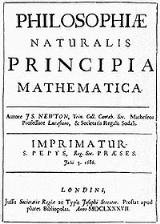
Philosophiĉ Naturalis Principia Mathematica, when it was first published in 1686, showed a similar casting around for words to use for the mathematical momentum. His Definition II defines quantitas motus, "quantity of motion", as "arising from the velocity and quantity of matter conjointly", which identifies it as momentum. Thus when in Law II he refers to mutatio motus, "change of motion", being proportional to the force impressed, he is generally taken to mean momentum and not motion.

It remained only to assign a standard term to the quantity of motion. The first use of "momentum" in its proper mathematical sense is not clear but by the time of Jenning's
Miscellanea in 1721, four years before the final edition of Newton's Principia Mathematica, momentum M or "quantity of motion" was being defined for students as "a rectangle", the product of Q and V where Q is "quantity of material" and V is "velocity", s/t.

Some languages, such as Italian
Italian language

Italian is a Romance languages spoken by about 63 million people as a first language, primarily in Italy. In Switzerland, Italian is one of four Linguistic geography of Switzerlands....
, still lack a single term for momentum, and use a phrase such as the literal translation of "quantity of motion".

Linear momentum of a particle

If an object is moving in any reference frame
Frame of reference

A frame of reference in physics, may refer to a coordinate system or Cartesian coordinate system within which to measure the position, orientation , and other properties of objects in it, or it may refer to an observational reference frame tied to the state of motion of an Observer ....
, then it has momentum in that frame. It is important to note that momentum is frame dependent. That is, the same object may have a certain momentum in one frame of reference, but a different amount in another frame. For example, a moving object has momentum in a reference frame fixed to a spot on the ground, while at the same time having 0 momentum in a reference frame attached to the object's center of mass
Center of mass

The center of mass of a system of wiktionary:Particles is a specific point at which, for many purposes, the system's mass behaves as if it were concentrated....
.

The amount of momentum that an object has depends on two physical quantities: the mass
Mass

In physical science, mass refers to the degree of acceleration a body acquires when subject to a force: bodies with greater mass are accelerated less by the same force....
 and the velocity
Velocity

In physics, velocity is defined as the Derivative of Position vector. It is a vector physical quantity; both speed and direction are required to define it....
 of the moving object in the frame of reference
Frame of reference

A frame of reference in physics, may refer to a coordinate system or Cartesian coordinate system within which to measure the position, orientation , and other properties of objects in it, or it may refer to an observational reference frame tied to the state of motion of an Observer ....
. In physics, the usual symbol for momentum is a small bold
p (bold because it is a vector); so this can be written where p is the momentum, m is the mass and v is the velocity.

Example: a model airplane of 1 kg travelling due north at 1 m/s in straight and level flight has a momentum of 1 kg m/s due north measured from the ground. To the dummy pilot in the cockpit it has a velocity and momentum of zero.

According to Newton's second law, the rate of change of the momentum of a particle is proportional to the resultant force acting on the particle and is in the direction of that force. In the case of constant mass, and velocities much less than the speed of light, this definition results in the equation

or just simply where
F is understood to be the resultant.

Example: a model airplane of 1 kg accelerates from rest to a velocity of 1 m/s due north in 1 s. The thrust required to produce this acceleration is 1 newton
Newton

The newton is the International System of Units SI derived unit of force, named after Isaac Newton in recognition of his work on classical mechanics....
. The change in momentum is 1 kg m/s. To the dummy pilot in the cockpit there is no change of momentum. Its pressing backward in the seat is a reaction to the unbalanced thrust, shortly to be balanced by the drag.

Linear momentum of a system of particles


Relating to mass and velocity

The linear momentum of a system of particles is the vector sum of the momenta of all the individual objects in the system: where
P is the total momentum of the particle system,
mi and vi are the mass and the velocity vector of the i-th object, and n is the number of objects in the system.

It can be shown that, in the center of mass frame the momentum of a system is zero. Additionally, the momentum in a frame of reference that is moving at a velocity
vcm with respect to that frame is simply:

where: .

Relating to force - General equations of motion


The linear momentum of a system of particles can also be defined as the product of the total mass of the system times the velocity of the center of mass

This is commonly known as Newton's second law.

For a more general derivation using tensors, we consider a moving body (see Figure), assumed as a continuum
Continuum mechanics

Continuum mechanics is a branch of mechanics that deals with the analysis of the kinematics and mechanical behavior of materials modeled as a continuum, e.g., solids and fluids ....
, occupying a volume at a time , having a surface area , with defined traction or surface forces acting on every point of the body surface, body forces per unit of volume on every point within the volume , and a velocity field prescribed throughout the body. Following the previous equation, The linear momentum of the system is:

By definition the stress
Stress (physics)

In continuum mechanics, stress is a measure of the average amount of force exerted per unit area. It is a measure of the intensity of the total internal forces acting within a body across imaginary internal surfaces, as a reaction to external applied forces and body forces....
 vector is , then

Using the Gauss's divergence theorem
Divergence theorem

In vector calculus, the divergence theorem, also known as Gauss?s theorem , Ostrogradsky?s theorem , or Gauss-Ostrogradsky theorem is a result that relates the flow of a vector field through a surface to the behavior of the vector field inside the surface....
 to convert a surface integral to a volume integral gives (we denote as the differential operator):

Now we only need to take care of the right side of the equation. We have to be careful, since we cannot just take the differential operator under the integral. This is because while the motion of the continuum body is taking place (the body is not necessarily solid), the volume we are integrating on can change with time too. So the above integral will be:

Performing the differentiation in the first part, and applying the divergence theorem on the second part we obtain:

Now the second term inside the integral is: . Plugging this into the previous equation, and rearranging the terms, we get:

We can easily recognize the two integral terms in the above equation. The first integral contains the Convective derivative
Convective derivative

In mathematics, the material derivative is a derivative taken along a path moving with velocity v, and is often used in fluid mechanics and classical mechanics....
 of the velocity vector, and the second integral contains the change and flow of mass in time. Now lets assume that there are no sinks and sources in the system, that is mass is conserved, so this term is zero. Hence we obtain:

putting this back into the original equation:

For an arbitrary volume the integrand itself must be zero, and we have the Cauchy's equation of motion
Cauchy momentum equation

The Cauchy momentum equation is a vector partial differential equation put forth by Cauchy that describes the non-relativistic momentum transport in any continuum:...


As we see the only extra assumption we made is that the system doesn't contain any mass sources or sinks, which means that mass is conserved. So this equation is valid for the motion of any continuum, even for that of fluids. If we are examining elastic continuums only then the second term of the convective derivative operator can be neglected, and we are left with the usual time derivative, of the velocity field.

If a system is in equilibrium, the change in momentum with respect to time is equal to 0, as there is no acceleration.

or using tensors,

These are the equilibrium equations which are used in solid mechanics
Solid mechanics

Solid mechanics is the branch of mechanics, physics, and mathematics that concerns the behavior of solid matter under external actions . It is part of a broader study known as continuum mechanics....
 for solving problems of linear elasticity
Linear elasticity

Linear elasticity is the mathematical study of how solid objects deform and become internally stressed due to prescribed loading conditions. Linear elasticity relies upon the Continuum mechanics hypothesis and is applicable at macroscopic length scales....
. In engineering notation, the equilibrium equations are expressed in Cartesian coordinates as


Conservation of linear momentum

The law of
conservation of linear momentum is a fundamental law of nature, and it states that the total momentum of a closed system of objects (which has no interactions with external agents) is constant. One of the consequences of this is that the center of mass
Center of mass

The center of mass of a system of wiktionary:Particles is a specific point at which, for many purposes, the system's mass behaves as if it were concentrated....
 of any system
Physical system

In physics the word system has a technical meaning, namely, it is the portion of the physical universe chosen for analysis. Everything outside the system is known as the environment, which in analysis is ignored except for its effects on the system....
 of objects
Physical body

In physics, a physical body is a collection of masses, taken to be one. For example, a cricket ball can be considered an object but the ball also consists of many particles ....
 will always continue with the same velocity unless acted on by a force from outside the system.

Conservation of momentum is a mathematical consequence of the homogeneity
Homogeneity (physics)

In physics, homogeneous mixtures are mixtures that have definite, consistent composition and properties. Particles are uniformly spread. For example, any amount of a given mixture has the same composition and properties....
 (shift symmetry
Symmetry

Symmetry generally conveys two primary meanings. The first is an imprecise sense of harmonious or aesthetically-pleasing proportionality and balance; such that it reflects beauty or perfection....
) of space (position in space is the canonical conjugate quantity to momentum). So, momentum conservation can be philosophically stated as "nothing depends on location per se".

In analytical mechanics
Analytical mechanics

Analytical mechanics is a term used for a refined, highly mathematical form of classical mechanics, constructed from the eighteenth century onwards as a formulation of the subject as founded by Isaac Newton....
 the conservation of momentum is a consequence of translational invariance of Lagrangian
Lagrangian

The Lagrangian, , of a dynamical system is a function that summarizes the dynamics of the system. It is named after Joseph Louis Lagrange. The concept of a Lagrangian was originally introduced in a reformulation of classical mechanics known as Lagrangian mechanics....
 in the absence of external forces. It can be proven that the total momentum is a constant of motion
Constant of motion

In mechanics, a constant of motion is a conservation law throughout the motion, imposing in effect a constraint on the motion. However, it is a mathematical constraint, the natural consequence of the Equation of motion, rather than a physical Constraint ....
 by making an infinitesmial translation of Lagrangian and then equating it with non translated Lagrangian. This is a special case of Noether's theorem
Noether's theorem

Noether's theorem states that any derivative Symmetry in physics of the action of a physical system has a corresponding conservation law. The action of a physical system is an integral of a so-called Lagrangian function, from which the system's behavior can be determined by the principle of least action....
.

In an isolated system (one where external forces are absent) the total momentum will be constant: this is implied by Newton's first law of motion
Inertia

File:192447main 017 law of inertia.oggInertia is the resistance of an object to a change in its state of motion. The principle of inertia is one of the fundamental principles of classical physics which are used to describe the Motion of matter and how it is affected by applied forces....
. Newton's third law of motion, the law of reciprocal actions
Newton's laws of motion

Newton's laws of motion are three physical laws that form the basis for classical mechanics, Direct relationship the forces acting on a Physical body to the motion of the body....
, which dictates that the forces acting between systems are equal in magnitude, but opposite in sign, is due to the conservation of momentum.

Since position in space is a vector quantity, momentum (being the canonical conjugate of position) is a vector quantity as well - it has direction. Thus, when a gun is fired, the final total momentum of the system (the gun and the bullet) is the vector sum of the momenta of these two objects. Assuming that the gun and bullet were at rest prior to firing (meaning the initial momentum of the system was zero), the final total momentum must also equal 0.

In an isolated system with only two objects, the change in momentum of one object must be equal and opposite to the change in momentum of the other object. Mathematically,

Momentum has the special property that, in a closed system
Closed system

A closed system is a system in the state of being isolated from its surrounding. It is often used to refer to a theoretical system where perfect closure is an assumption, however in practice no system can be completely closed; there are only varying degrees of closure....
, it is always conserved, even in collision
Collision

A collision is an isolated event in which two or more bodies exert relatively strong forces on each other for a relatively short time....
s and separations caused by explosive forces. Kinetic energy
Kinetic energy

The kinetic energy of an object is the extra energy which it possesses due to its motion. It is defined as the mechanical work needed to accelerate a body of a given mass from rest to its current velocity....
, on the other hand, is not conserved in collisions if they are inelastic. Since momentum is conserved it can be used to calculate an unknown velocity following a collision or a separation if all the other masses and velocities are known.

A common problem in physics that requires the use of this fact is the collision of two particles. Since momentum is always conserved, the sum of the momenta before the collision must equal the sum of the momenta after the collision: where:
u signifies vector velocity before the collision.
v signifies vector velocity after the collision.


Usually, we either only know the velocities before or after a collision and would like to also find out the opposite. Correctly solving this problem means you have to know what kind of collision took place. There are two basic kinds of collisions, both of which conserve momentum:
  • Elastic collision
    Elastic collision

    An elastic collision is a collision in which the total kinetic energy of the colliding bodies after collision is equal to their total kinetic energy before collision....
    s conserve kinetic energy as well as total momentum before and after collision.
  • Inelastic collision
    Inelastic collision

    An inelastic collision is a collision in which kinetic energy is not conserved .In collisions of macroscopic bodies, some kinetic energy is turned into vibrational energy of the atoms, causing a heating effect, and the bodies are deformed....
    s don't conserve kinetic energy, but total momentum before and after collision is conserved.


Elastic collisions
A collision between two pool balls is a good example of an
almost totally elastic collision; a totally elastic collision exists only in theory. In addition to momentum being conserved when the two balls collide, the sum of kinetic energy before a collision must equal the sum of kinetic energy after:


Since the 1/2 factor is common to all the terms, it can be taken out right away.

Head-on collision (1 dimensional)
In the case of two objects colliding head on we find that the final velocity


Special case: m1>>m2

Now consider the case when the mass of one body, say m1, is far greater than that of the other, m2 (m1>>m2). In that case, both m1+m2 and m1-m2 are approximately equal to m1.

Using these approximations, the above formula for reduces to . Its physical interpretation is that in the case of a collision between two bodies, one of which is much more massive than the other, the lighter body ends up moving in the opposite direction with twice the original speed of the more massive body.

Special case: m1=m2

Another special case is when the collision is between two bodies of equal mass.

Say body m1 moving at velocity v1 strikes body m2. Putting this case in the equation derived above we will see that after the collision, the body that was moving (m1) will start moving with velocity v2 and the mass m2 will start moving with velocity v1. So there will be an exchange of velocities.

Now suppose one of the masses, say m2, was at rest. In that case after the collision the moving body, m1, will come to rest and the body that was at rest, m2, will start moving with the velocity that m1 had before the collision.

Note that all of these observations are for an elastic collision
Elastic collision

An elastic collision is a collision in which the total kinetic energy of the colliding bodies after collision is equal to their total kinetic energy before collision....
.

This phenomenon is demonstrated by Newton's cradle
Newton's cradle

Newton's cradle, named after Sir Isaac Newton, is a device that demonstrates conservation of momentum and conservation of energy....
, one of the best known examples of conservation of momentum, a real life example of this special case.

Multi-dimensional collisions
In the case of objects colliding in more than one dimension, as in oblique collisions, the velocity is resolved into orthogonal components with one component perpendicular to the plane of collision and the other component or components in the plane of collision. The velocity components in the plane of collision remain unchanged, while the velocity perpendicular to the plane of collision is calculated in the same way as the one-dimensional case.

For example, in a two-dimensional collision, the momenta can be resolved into
x and y components. We can then calculate each component separately, and combine them to produce a vector result. The magnitude of this vector is the final momentum of the isolated system.

Inelastic collisions
A common example of a perfectly inelastic collision is when two snowballs collide and then
stick together afterwards. This equation describes the conservation of momentum:
It can be shown that a perfectly inelastic collision is one in which the maximum amount of kinetic energy
Kinetic energy

The kinetic energy of an object is the extra energy which it possesses due to its motion. It is defined as the mechanical work needed to accelerate a body of a given mass from rest to its current velocity....
 is converted into other forms. For instance, if both objects stick together after the collision and move with a final common velocity, one can always find a reference frame in which the objects are brought to rest by the collision and 100% of the kinetic energy is converted. This is true even in the relativistic case and utilized in particle accelerators to efficiently convert kinetic energy into new forms of mass-energy (i.e. to create massive particles).

In case of inelastic collision, there is a parameter attached called coefficient of restitution (denoted by small 'e' or 'c' in many text books). It is defined as the ratio of relative velocity of separation to relative velocity of approach. It is a ratio hence it is a dimensionless quantity.

When we have an elastic collision the value of e (= coefficient of restitution) is 1, i.e. the relative velocity of approach is same as the relative velocity of separation of the colliding bodies. In an elastic collision the Kinetic energy of the system is conserved.

When a collision is not elastic (e<1) it is an inelastic collision. In case of a perfectly inelastic collision the relative velocity of separation of the centre of masses of the colliding bodies is 0. Hence after collision the bodies stick together after collision. In case of an inelastic collision the loss of Kinetic energy is maximum as stated above.

In all types of collision if no external force is acting on the system of colliding bodies, the momentum will always be preserved.

Explosions
An explosion occurs when an object is divided into two or more fragments due to a release of energy. Note that kinetic energy in a system of explosion is not conserved because it involves energy transformation (i.e. kinetic energy changes into heat and sound energy).

See the inelastic collision
Inelastic collision

An inelastic collision is a collision in which kinetic energy is not conserved .In collisions of macroscopic bodies, some kinetic energy is turned into vibrational energy of the atoms, causing a heating effect, and the bodies are deformed....
 page for more details.

Modern definitions of momentum


Momentum in relativistic mechanics

In relativistic mechanics, in order to be conserved, momentum must be defined as:

where is the invariant mass
Invariant mass

The invariant mass, intrinsic mass, proper mass or just mass is a characteristic of the total energy and momentum of an object or a system of objects that is the Invariant ....
 of the object moving, is the Lorentz factor
Lorentz factor

The Lorentz factor or Lorentz term appears in several equations in special relativity, including time dilation, length contraction, and the relativistic mass formula....
is the relative velocity between an object and an observer is the speed of light
Speed of light

The speed of light in an free space is an important physical constant usually written as c, with a value of 299,792,458 metres per second....
.

Relativistic momentum can also be written as invariant mass times the object's proper velocity
Proper velocity

Proper-velocity, the distance traveled per unit time elapsed on the clocks of a traveling object, equals velocity at low speeds. At any speed it equals momentum per unit mass, and it therefore has no upper limit....
, defined as the rate of change of object position in the observer frame with respect to time elapsed on object clocks (i.e. object proper time
Proper time

In theory of relativity, proper time is time measured by a single clock between events that occur at the same place as the clock. It depends not only on the events but also on the motion of the clock between the events....
). Relativistic momentum closely approximates Newtonian momentum: at low speed .

Relativistic four-momentum
Four-momentum

In special relativity, four-momentum is the generalization of the classical three-dimensional momentum to four-dimensional spacetime. Momentum is a vector in three dimensions; similarly four-momentum is a four-vector in spacetime....
 as proposed by Albert Einstein
Albert Einstein

Albert Einstein was a Germany-born theoretical physics. He is best known for his theory of relativity and specifically mass?energy equivalence, expressed by the equation E = mc2....
 arises from the invariance of four-vector
Four-vector

In the theory of relativity, a four-vector is a vector in a four-dimensional real vector space, called Minkowski space. It differs from a vector in that it can be transformed by Lorentz transformations....
s under Lorentzian translation. The four-momentum is defined as:

where is the component of the
relativistic momentum, is the total energy of the system:

The "length" of the vector is the mass times the speed of light, which is invariant across all reference frames:

Momentum of massless objects

Objects without a rest mass, such as photon
Photon

In physics, the photon is an elementary particle, the quantum of the electromagnetic field and the basic unit of light and all other forms of electromagnetic radiation....
s, also carry momentum. The formula is: where is Planck's constant, is the wavelength
Wavelength

In physics, wavelength is the distance between repeating units of a propagating wave of a given frequency. It is commonly designated by the Greek language letter lambda ....
 of the photon, is the energy
Energy

In physics, energy is a scalar physical quantity that describes the amount of Work_ that can be performed by a force. Energy is an attribute of objects and systems that is subject to a conservation law....
 the photon carries and is the speed of light
Speed of light

The speed of light in an free space is an important physical constant usually written as c, with a value of 299,792,458 metres per second....
.

Generalization of momentum

Momentum is the Noether charge of translational invariance. As such, even fields as well as other things can have momentum, not just particles. However, in curved space-time which is not asymptotically Minkowski
Minkowski space

In physics and mathematics, Minkowski space is the mathematical setting in which Albert Einstein theory of special relativity is most conveniently formulated....
, momentum isn't defined at all.

Momentum in quantum mechanics

In quantum mechanics
Quantum mechanics

Quantum mechanics is a set of principles underlying the most fundamental known description of all physical systems at the microscopic scale . Notable amongst these principles are both a dual wave-like and particle-like behavior of matter and radiation, and prediction of probabilities in situations where classical physics predicts certaintie...
, momentum is defined as an operator
Operator (physics)

In physics, an operator is a Function acting on the space of physical states. As a resultof its application on a physical state, another physical state is obtained, very often along with...
 on the wave function. The Heisenberg
Werner Heisenberg

Werner Heisenberg was a German Theoretical physics who made foundational contributions to quantum mechanics and is best known for asserting the uncertainty principle of quantum theory....
 uncertainty principle
Uncertainty principle

In quantum physics, the Werner Heisenberg uncertainty principle states that certain physical quantities, like the position and momentum, cannot both have precise values at the same time....
 defines limits on how accurately the momentum and position of a single observable system can be known at once. In quantum mechanics, position and momentum are conjugate variables.

For a single particle with no electric charge
Electric charge

Electric charge is a fundamental conserved property of some subatomic particles, which determines their electromagnetic interaction. Electrically charged matter is influenced by, and produces, electromagnetic fields....
 and no spin
Spin (physics)

In quantum mechanics, spin is a fundamental property of atomic nucleus, hadrons, and elementary particles. For particles with non-zero spin, spin direction is an important intrinsic degrees of freedom ....
, the momentum operator can be written in the position basis as

where:
  • is the gradient
    Gradient

    In vector calculus, the gradient of a scalar field is a vector field which points in the direction of the greatest rate of increase of the scalar field, and whose magnitude is the greatest rate of change....
     operator;
  • is the reduced Planck constant;
  • , defined as , is the imaginary unit
    Imaginary unit

    In mathematics, physics, and engineering, the imaginary unit is denoted by  or the Latin   or the Greek iota . It allows the real number system, to be extended to the complex number system,   Its precise definition is dependent upon the particular method of extension....
    .


This is a commonly encountered form of the momentum operator, though not the most general one.

Momentum in electromagnetism

Electric and magnetic fields possess momentum regardless of whether they are static or they change in time. It is a great surprise for freshmen who are introduced to the well known fact of the pressure of an electrostatic (magnetostatic) field upon a metal sphere, cylindrical capacitor or ferromagnetic bar: where , , , are the electromagnetic energy density , electric field, and magnetic field respectively. The electromagnetic pressure may be sufficiently high to explode the capacitor. Thus electric and magnetic fields do carry momentum.

Light (visible, UV, radio) is an electromagnetic wave and also has momentum. Even though photons (the particle aspect of light) have no mass, they still carry momentum. This leads to applications such as the solar sail
Solar sail

Solar sails are a proposed form of spacecraft propulsion using large membrane mirrors. Radiation pressure is about 10-5 pascal at Earth's distance from the Sun and decreases by the square of the distance from the light source , but unlike rockets, solar sails require no reaction mass....
.

Momentum is conserved in an electrodynamic system (it may change from momentum in the fields to mechanical momentum of moving parts). The treatment of the momentum of a field is usually accomplished by considering the so-called energy-momentum tensor and the change in time of the Poynting vector
Poynting vector

In physics, the Poynting vector can be thought of as representing the energy flux of an electromagnetic field. It is named after its inventor John Henry Poynting....
 integrated over some volume. This is a tensor field which has components related to the energy density and the momentum density.

The definition canonical momentum corresponding to the momentum operator of quantum mechanics when it interacts with the electromagnetic field is, using the principle of least coupling: , instead of the customary , where: is the electromagnetic vector potential the charged particle's invariant mass its velocity its charge.

See also


  • Conservation law
    Conservation law

    In physics, a conservation law states that a particular measurable property of an isolated physical system does not change as the system evolves....
  • Force
    Force

    In physics, a force is that which can cause an object with mass to change its velocity. Force has both Euclidean_vector#Length of a vector and Direction , making it a Vector quantity....
  • Impulse
    Impulse

    In classical mechanics, an impulse is defined as the integral of a force with respect to time. When a force is applied to a rigid body it changes the momentum of that body....
  • Kinetic energy
    Kinetic energy

    The kinetic energy of an object is the extra energy which it possesses due to its motion. It is defined as the mechanical work needed to accelerate a body of a given mass from rest to its current velocity....
  • Moment map
    Moment map

    In mathematics, specifically in symplectic geometry, the moment map is a tool associated with a Hamiltonian group action of a Lie group on a symplectic manifold, used to construct conserved quantities for the action....
  • Noether's theorem
    Noether's theorem

    Noether's theorem states that any derivative Symmetry in physics of the action of a physical system has a corresponding conservation law. The action of a physical system is an integral of a so-called Lagrangian function, from which the system's behavior can be determined by the principle of least action....
  • Velocity
    Velocity

    In physics, velocity is defined as the Derivative of Position vector. It is a vector physical quantity; both speed and direction are required to define it....
  • Planck momentum
    Planck momentum

    Planck Momentum is the unit of momentum, denoted by , in the system of natural units known as Planck units. 6.52485 kg m/swhere* is the Planck length...


External links

  • - A chapter from an online textbook