
Home      Discussion      Topics      Dictionary      Almanac
Signup       Login
Diesel generator

Diesel generator

Overview

Discussion
Ask a question about 'Diesel generator'
Start a new discussion about 'Diesel generator'
Answer questions from other users
Full Discussion Forum
 
Unanswered Questions
Recent Discussions
Encyclopedia

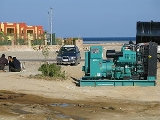
A diesel generator is the combination of a diesel engine
Diesel engine
A diesel engine is an internal combustion engine that uses the heat of compression to initiate ignition to burn the fuel, which is injected into the combustion chamber...

 with an electrical generator
Electrical generator
In electricity generation, an electric generator is a device that converts mechanical energy to electrical energy. A generator forces electric charge to flow through an external electrical circuit. It is analogous to a water pump, which causes water to flow...

 (often called an alternator
Alternator
An alternator is an electromechanical device that converts mechanical energy to electrical energy in the form of alternating current.Most alternators use a rotating magnetic field but linear alternators are occasionally used...

) to generate electrical energy.
Diesel generating sets are used in places without connection to the power grid
Electric power transmission
Electric-power transmission is the bulk transfer of electrical energy, from generating power plants to Electrical substations located near demand centers...

, as emergency power-supply if the grid fails, as well as for more complex applications such as peak-lopping, Grid Support and export to the power grid.
Sizing of diesel generators is critical to avoid low-load or a shortage of power and is complicated by modern electronics, specifically non-linear loads.

Diesel generator set


The packaged combination of a diesel engine, a generator and various ancillary devices (such as base, canopy, sound attenuation, control systems, circuit breakers, jacket water heaters and starting system) is referred to as a "generating set" or a "genset" for short.

Set sizes range from 8 to 30 kW (also 8 to 30 kVA single phase) for homes, small shops & offices with the larger industrial generators from 8 kW (11 kVA) up to 2,000 kW (2500 kVA three phase) used for large office complexes, factories. A 2,000 kW set can be housed in a 40 ft ISO container with fuel tank, controls, power distribution equipment and all other equipment needed to operate as a standalone power station or as a standby backup to grid power. These units, referred to as power modules are gensets on large triple axle trailers weighing 85000 pounds (38,555 kg) or more. A combination of these modules are used for small power stations and these may use from one to 20 units per power section and these sections can be combined to involve hundreds of power modules. In these larger sizes the power module (engine and generator) are brought to site on trailers separately and are connected together with large cables and a control cable to form a complete synchronized power plant.

Diesel generators, sometimes as small as 200 kW (250 kVA) are widely used not only for emergency power, but also many have a secondary function of feeding power to utility grids either during peak periods, or periods when there is a shortage of large power generators.

Ships often also employ diesel generators, sometimes not only to provide auxiliary power for lights, fans, and winches, etc. but also indirectly for main propulsion. With electric propulsion the generators can be placed in a convenient position, to allow more cargo to be carried. Electric drives for ships were developed prior to WW I. Electric drives were specified in many warships built during WW II because manufacturing capacity for large reduction gears was in short supply, compared to capacity for manufacture of electrical equipment. Such a diesel-electric arrangement is also used in some very large land vehicles such as railroad
Rail transport
Rail transport is a means of conveyance of passengers and goods by way of wheeled vehicles running on rail tracks. In contrast to road transport, where vehicles merely run on a prepared surface, rail vehicles are also directionally guided by the tracks they run on...

 locomotive
Locomotive
A locomotive is a railway vehicle that provides the motive power for a train. The word originates from the Latin loco – "from a place", ablative of locus, "place" + Medieval Latin motivus, "causing motion", and is a shortened form of the term locomotive engine, first used in the early 19th...

s.

Generator Size


Generating sets are selected based on the Electrical load they are intended to supply, the electrical loads total characteristics (kWe, kVA
Volt-ampere
A volt-ampere is the unit used for the apparent power in an electrical circuit, equal to the product of root-mean-square voltage and RMS current. In direct current circuits, this product is equal to the real power in watts...

, var's and Harmonic Content
Harmonics (electrical power)
Harmonics are electric voltages and currents that appear on the electric power system as a result of certain kinds of electric loads. Harmonic frequencies in the power grid are a frequent cause of power quality problems.-Causes:...

 including starting currents (normally from motors) and non-linear loads. The expected duty, for example, emergency, prime or continuous power as well as environmental conditions such as altitude, temperature and emissions regulations must be taken into account as well.

Most of the larger generator set manufacturers offer software that will perform the complicated sizing calculations by simply inputting site conditions and connected electrical load characteristics.

Power plants – electrical "island" mode


One or more diesel generators operating without a connection to an electrical grid are referred to as operating in "Island Mode". In island mode, several parallel generators provide the advantages of redundancy and better efficiency at partial loads. The plant brings generator sets online and takes them off line depending on the demands of the system at a given time. An islanded power plant intended for primary power source of an isolated community ("Prime Power") will often have at least three diesel generators, any two of which are rated to carry the required load. Groups of up to 20 are not uncommon.

Generators can be electrically connected together through the process of synchronization. Synchronization involves matching voltage, frequency, and phase before connecting the generator to the system. Failure to synchronize before connection could cause a high current short-circuit or wear and tear on the generator and/or its switchgear. The synchronization process can be done automatically by an auto-synchronizer module. The auto-synchronizer will read the voltage, frequency and phase parameters from the generator and bus-bar voltages, while regulating the speed through the engine governor or ECM (Engine Control Module).

Load can be shared among parallel running generators through load sharing. Load sharing can be achieved by using droop speed control
Droop speed control
In electricity generation, droop speed control is the primary instantaneous system using net frequency deviations to distribute with stability load changes over generating plants....

 controlled by the frequency at the generator, while it constantly adjusts the engine fuel control to shift load to and from the remaining power sources. A diesel generator will take more load when the fuel supply to its combustion system is increased, while load is released if fuel supply is decreased.

Supporting main utility grids


In addition to their well known role as power supplies during power failures, diesel generator sets also routinely support main power grids worldwide in two distinct ways:

Peak lopping


Maximum demand tariffs in many areas encourage the use of diesels to come on at times of maximum demand. In Europe this is typically on winter weekdays early evening peak when cooking and lights are on as people come home—around 5:30–7:00 PM, whereas in the United States this is often in the summer to meet the air conditioning load.

Grid support


Emergency standby diesel generators, for example such as those used in hospitals, water plant, are, as a secondary function, widely used in the US and the UK (Short Term Operating Reserve) to support the respective national grids at times for a variety of reasons. In the UK for example, some 0.5 GWe of diesels are routinely used to support the National Grid, whose peak load is about 60 GW. These are sets in the size range 200 kW to 2 MW. This usually occurs during, for example, the sudden loss of a large conventional 660 MW plant, or a sudden unexpected rise in power demand eroding the normal spinning reserve available.

This is extremely beneficial for both parties - the diesels have already been purchased for other reasons; but to be reliable need to be fully load tested. Grid paralleling is a convenient way of doing this. This method of operation is normally undertaken by a third party aggregator who manages the operation of the generators and the interaction with the system operator.

In this way the UK National Grid can call on about 2 GW of plant which is up and running in parallel as quickly as two minutes in some cases. This is far quicker than a base load power station which can take 12 hours from cold, and faster than a gas turbine, which can take several minutes. Whilst diesels are very expensive in fuel terms, they are only used a few hundred hours per year in this duty, and their availability can prevent the need for base load station running inefficiently at part load continuously. The diesel fuel used is fuel that would have been used in testing anyway. See Control of the National Grid, National Grid Reserve Service

A similar system operates in France known as EJP, where at times of grid extrema special tariffs can mobilize at least 5 GW of diesel generating sets to become available.In this case, the diesels prime function is to feed power into the grid.

During normal operation in synchronization with the electricity net powerplants are governed with a five percent droop speed control
Droop speed control
In electricity generation, droop speed control is the primary instantaneous system using net frequency deviations to distribute with stability load changes over generating plants....

. This means the full load speed is 100% and the no load speed is 105%. This is required for the stable operation of the net without hunting and dropouts of power plants. Normally the changes in speed are minor. Adjustments in power output are made by slowly raising the droop curve by increasing the spring pressure on a centrifugal governor
Centrifugal governor
A centrifugal governor is a specific type of governor that controls the speed of an engine by regulating the amount of fuel admitted, so as to maintain a near constant speed whatever the load or fuel supply conditions...

. Generally this is a basic system requirement for all powerplants because the older and newer plants have to be compatible in response to the instantaneous changes in frequency without depending on outside communication.

Cost of generating electricity


See: Relative cost of electricity generated by different sources

Typical operating costs


Fuel consumption is the major portion of diesel plant owning and operating cost for power applications, whereas capital cost is the primary concern for backup generators. Specific consumption varies, but a modern diesel plant will consume between 0.28 and 0.4 litres of fuel per kilowatt hour at the generator terminals.

However diesel engines can operate on a variety of different fuels, depending on configuration, though the eponymous diesel fuel derived from crude oil is most common. The engines can work with the full spectrum of crude oil distillates, from natural gas, alcohols, gasoline, wood gas
Wood gas
Wood gas is a syngas fuel which can be used as a fuel for furnaces, stoves and vehicles in place of petrol, diesel or other fuels. During the production process biomass or other carbon-containing materials is gasified within the oxygen-limited environment of a wood gas generator to produce hydrogen...

 to the fuel oils from diesel oil to residual fuels. This is implemented by introducing gas with the intake air and using a small amount of diesel fuel for ignition. Conversion to 100% diesel fuel operation can be achieved instantaneously.
  • Fuel cost 11p - 16p/kWh (using red diesel at 40p/litre)
  • lifetime engine maintenance about is 0.5p/kWh - 1.0p/kWh

Typical costs of conversion to paralleling for grid operation


To be able to operate in parallel with the mains certain modifications are necessary which include the following:
  • Approx. £3k to fit a PLC / Genest Controller to the set
  • Paralleling and synchronising gear and G59 equipment including switchgear modifications (this allows grid connection) Approx £10k
  • Tidying up set (noise, larger fuel tank) Approx another £5k
  • So for a 1MW set…£13/kW
  • 50 kW…maybe £260/kW


This capital cost of £13/kW - £260/kW is low compared to combined cycle gas turbines that cost £350/kW.

Rating


Generators must be capable of delivering the power required for the hours per year anticipated by the designer to allow reliable operation and prevent damage. Typically a given set can deliver more power for fewer hours per year, or less power continuously. That is a standby set is only expected to give its peak output for a few hours per year, whereas a continuously running set, would be expected to give a somewhat lower output, but literally continuously, and both to have reasonable maintenance and reliability.

To meet the above criteria manufactures give each set a rating based on internationally agreed definitions.

These standard rating definitions are designed to allow correct machine selection and valid comparisons between manufacturers to prevent them from misstating the performance of their machines, and to guide designers.

Generator Rating Definitions

Standby Rating based on Applicable for supplying emergency power for the duration of normal power interruption. No sustained overload capability is available for this rating. (Equivalent to Fuel Stop Power in accordance with ISO3046, AS2789, DIN6271 and BS5514). Nominally rated.

Typical application - emergency power plant in hospitals, offices, factories etc. Not connected to grid.

Prime (Unlimited Running Time) Rating: Should not be used for Construction Power applications. Output available with varying load for an unlimited time. Average power output is 70% of the prime rating. Typical peak demand 100% of prime-rated ekW with 10% of overload capability for emergency use for a maximum of 1 hour in 12. A 10% overload capability is available for limited time. (Equivalent to Prime Power in accordance with ISO8528 and Overload Power in accordance with ISO3046, AS2789, DIN6271, and BS5514). This rating is not applicable to all generator set models.

Typical application - where the generator is the sole source of power for say a remote mining or construction site, fairground, festival etc.

Base Load (Continuous) Rating based on: Applicable for supplying power continuously to a constant load up to the full output rating for unlimited hours. No sustained overload capability is available for this rating. Consult authorized distributor for rating. (Equivalent to Continuous Power in accordance with ISO8528, ISO3046, AS2789, DIN6271, and BS5514). This rating is not applicable to all generator set models

Typical application - a generator running a continuous unvarying load, or paralleled with the mains and continuously feeding power at the maximum permissible level 8760 hours per year. This also applies to sets used for peak shaving /grid support even though this may only occur for say 200 hour per year.

As an example if in a particular set the Standby Rating were 1000 kW, then a Prime Power rating might be 850 kW, and the Continuous Rating 800 kW. However these ratings vary according to manufacturer and should be taken from the manufacturer's data sheet.

Often a set might be given all three ratings stamped on the data plate, but sometimes it may have only a standby rating, or only a prime rating.

Sizing


Typically however it is the size of the maximum load that has to be connected and the acceptable maximum voltage drop which determines the set size, not the ratings themselves. If the set is required to start motors, then the set will have to be at least 3 times the largest motor, which is normally started first. This means it will be unlikely to operate at anywhere near the ratings of the chosen set.

Many gen-set manufacturers have software programs that enable the correct choice of set for any given load combination. Sizing is based on site conditions and the type of appliances, equipment, and devices that will be powered by the generator set.

Correct Generator Installation


To ensure correct functioning, reliability and low maintenance costs generators must be installed correctly. To this end manufacturers provide detailed installation guidelines covering such things as:
  • Sizing and selection

  • Electrical factors

  • Cooling
Types of cooling
  1. air cooling
  2. water cooling

  • Ventilation

  • Fuel storage

  • Noise

  • Exhaust

  • Starting systems


These are frequently ignored causing problems for users

Diesel engine damage due to misapplication or misuse of generating set


Diesel engines can suffer damage as a result of misapplication or misuse - namely internal glazing (occasionally referred to as bore glazing or piling) and carbon
Carbon
Carbon is the chemical element with symbol C and atomic number 6. As a member of group 14 on the periodic table, it is nonmetallic and tetravalent—making four electrons available to form covalent chemical bonds...

 buildup. This is a common problem in generator sets caused by failure to follow application and operating guidelines. Ideally, diesel engines should be run at least 60-75% of their maximum rated load. Short periods of low load running are permissible providing the set is brought up to full load, or close to full load on a regular basis.

Internal glazing and carbon
Carbon
Carbon is the chemical element with symbol C and atomic number 6. As a member of group 14 on the periodic table, it is nonmetallic and tetravalent—making four electrons available to form covalent chemical bonds...

 buildup is due to prolonged periods of running at low speeds and/or low loads. Such conditions may occur when an engine is left idling as a 'standby' generating unit, ready to run up when needed, (misuse); if the engine powering the set is over-powered (misapplication) for the load applied to it, causing the diesel unit to be under-loaded, or as is very often the case, when sets are started and run off load as a test (misuse).

Running an engine under low loads causes low cylinder pressures and consequent poor piston ring sealing since this relies on the gas pressure to force them against the oil film on the bores to form the seal. Low cylinder pressures causes poor combustion and resultant low combustion pressures and temperatures.

This poor combustion leads to soot formation and unburnt fuel residues which clogs and gums piston rings, which causes a further drop in sealing efficiency and exacerbates the initial low pressure. Glazing occurs when hot combustion gases blow past the now poorly-sealing piston rings, causing the lubricating oil on the cylinder walls to 'flash burn', creating an enamel
Enamel paint
Enamel paint is paint that air dries to a hard, usually glossy, finish, used for coating surfaces that are outdoors or otherwise subject to hard wear or variations in temperature; it should not be confused with decorated objects in "painted enamel", where vitreous enamel is applied with brushes and...

-like glaze which smooths the bore and removes the effect of the intricate pattern of honing marks machined into the bore surface which are there to hold oil and return it to the crankcase via the scraper ring.

Hard carbon also forms from poor combustion and this is highly abrasive and scrapes the honing marks on the bores leading to bore polishing, which then leads to increased oil consumption (blue smoking) and yet further loss of pressure, since the oil film trapped in the honing marks is intended to maintain the piston seal and pressures.

Unburnt fuel then leaks past the piston rings and contaminates the lubricating oil. Poor combustion causes the injectors to become clogged with soot, causing further deterioration in combustion and black smoking.

The problem is increased further with the formation of acids in the engine oil caused by condensed water and combustion by-products which would normally boil off at higher temperatures. This acidic build-up in the lubricating oil causes slow but ultimately damaging wear to bearing surfaces.

This cycle of degradation means that the engine soon becomes irreversibly damaged and may not start at all and will no longer be able to reach full power when required.

Under-loaded running inevitably causes not only white smoke from unburnt fuel but over time will be joined by blue smoke of burnt lubricating oil leaking past the damaged piston rings, and black smoke caused by damaged injectors. This pollution is unacceptable to the authorities and neighbors.

Once glazing or carbon build up has occurred, it can only be cured by stripping down the engine and re-boring the cylinder bores, machining new honing marks and stripping, cleaning and de-coking combustion chambers, fuel injector nozzles and valves. If detected in the early stages, running an engine at maximum load to raise the internal pressures and temperatures allows the piston rings to scrape glaze off the bores and allows carbon buildup to be burnt off. However, if glazing has progressed to the stage where the piston rings have seized into their grooves, this will not have any effect.

The situation can be prevented by carefully selecting the generator set in accordance with manufacturers printed guidelines.

For emergency only sets which are islanded, the emergency load is often only about 1/4 of the sets standby rating, this apparent over size being necessitated to be able to meet starting loads and minimizing starting voltage drop. Hence the available load is not usually enough for load testing and again engine damage will result if this us used as the weekly or monthly load test. This situation can be dealt with by hiring in a load bank
Load bank
A load bank is a device which develops an electrical load, applies the load to an electrical power source and converts or dissipates the resultant power output of the source....

 for regular testing, or installing a permanent load bank. Both these options cost money in terms of engine wear and fuel use but are better than the alternative of under loading the engine. For remote locations a Salt water rheostat
Salt water rheostat
A liquid rheostat or salt water rheostat is a type of variable resistor. It consists of a tank containing brine in which electrodes are submerged to create an electrical load. The electrodes may be raised or lowered into the liquid to respectively decrease or increase the electrical resistance of...

 can be readily constructed.

Often the best solution in these cases will be to convert the set to parallel running and feed power into the grid, if available, once a month on load test, and or enrolling the set in utility Reserve Service type schemes, thereby gaining revenue from the fuel burnt.

See also

  • Calculating the cost of the UK Transmission network: cost per kWh of transmission
  • Calculating the cost of back up: See spark spread
    Spark spread
    The spark spread is the theoretical gross margin of a gas-fired power plant from selling a unit of electricity, having bought the fuel required to produce this unit of electricity...

  • Energy use and conservation in the United Kingdom
    Energy use and conservation in the United Kingdom
    Energy use in the United Kingdom stood at 3,894.6 kilogrammes of oil equivalent per capita in 2005 compared to a world average of 1,778.0. In 2008, total energy consumed was 9.85 exajoules - around 2% of the estimated 474 EJ worldwide total...

  • Load management
    Load management
    Load management is the process of balancing the supply of electricity on the network with the electrical load by adjusting or controlling the load rather than the power station output...

  • Motor-generator
    Motor-generator
    A motor-generator is a device for converting electrical power to another form. Motor-generator sets are used to convert frequency, voltage, or phase of power. They may also be used to isolate electrical loads from the electrical power supply line...

  • Three-phase electric power
    Three-phase electric power
    Three-phase electric power is a common method of alternating-current electric power generation, transmission, and distribution. It is a type of polyphase system and is the most common method used by grids worldwide to transfer power. It is also used to power large motors and other heavy loads...

  • Wet stacking
    Wet stacking
    Wet stacking is a condition in diesel engines in which not all the fuel is burned and passes on into the exhaust side of the turbocharger and on into the exhaust system. The word "stacking" comes from the term "stack" for exhaust pipe or chimney stack...


External links


http://www.gensetcentral.com/Installation%20guidelines.pdf