
All Topics  
Magnetic field


Magnetic field


In physicsFacts About Physics

Physics , the most fundamental physical science, is concerned with the underlying principles of the natural world....
, a magneticMagnetism

In physics, magnetism is one of the phenomena by which materials exert an attractive or repulsive force on other materials....
 field
is a vector fieldVector field

In mathematics a vector field is a construction in vector calculus which associates a vector to every point in a Euclidean s...
 that permeates space and which can exert a magnetic force on moving electric chargeElectric charge Overview

Electric charge is a fundamental conserved property of some subatomic particles, which determines their electromagnetic inte...
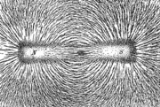
s and on magnetic dipoles (such as permanent magnets). When placed in a magnetic field, magnetic dipoles tend to align their axes to be parallel with the magnetic field, as can be seen when iron filings are in the presence of a magnetMagnet

A magnet is an object that has a magnetic field....
 (see picture at right). In addition, a changing magnetic field can induce an electric fieldElectric field Overview

In physics, the properties of space that surrounds an electric charge can be described using an electric field or E-field...
. Magnetic fields surround and are created by electric currentElectric current

Electric current is by definition the flow of electric charge....
s, magnetic dipoles, and changing electric fieldElectric field

In physics, the properties of space that surrounds an electric charge can be described using an electric field or E-field...
s. Magnetic fields also have their own energyEnergy

In general, the concept of energy refers to "the potential for causing changes." The word is used in several different conte...
, with an energy density proportional to the square of the field intensity.

There are some notable specific instances of the magnetic field.


Discussion
Ask a question about 'Magnetic field'
Start a new discussion about 'Magnetic field'
Answer questions from other users
Full Discussion Forum


Timeline

1600   William Gilbert publishes De Magnete which describes the Earth's magnetic field and is the beginning of modern Geomagnetism.


Encyclopedia


In physicsFacts About Physics

Physics , the most fundamental physical science, is concerned with the underlying principles of the natural world....
, a magneticMagnetism

In physics, magnetism is one of the phenomena by which materials exert an attractive or repulsive force on other materials....
 field
is a vector fieldVector field

In mathematics a vector field is a construction in vector calculus which associates a vector to every point in a Euclidean s...
 that permeates space and which can exert a magnetic force on moving electric chargeElectric charge Overview

Electric charge is a fundamental conserved property of some subatomic particles, which determines their electromagnetic inte...
s and on magnetic dipoles (such as permanent magnets). When placed in a magnetic field, magnetic dipoles tend to align their axes to be parallel with the magnetic field, as can be seen when iron filings are in the presence of a magnetMagnet

A magnet is an object that has a magnetic field....
 (see picture at right). In addition, a changing magnetic field can induce an electric fieldElectric field Overview

In physics, the properties of space that surrounds an electric charge can be described using an electric field or E-field...
. Magnetic fields surround and are created by electric currentElectric current

Electric current is by definition the flow of electric charge....
s, magnetic dipoles, and changing electric fieldElectric field

In physics, the properties of space that surrounds an electric charge can be described using an electric field or E-field...
s. Magnetic fields also have their own energyEnergy

In general, the concept of energy refers to "the potential for causing changes." The word is used in several different conte...
, with an energy density proportional to the square of the field intensity.

There are some notable specific instances of the magnetic field. For the physics of magnetic materials, see magnetismMagnetism

In physics, magnetism is one of the phenomena by which materials exert an attractive or repulsive force on other materials....
 and magnetMagnet

A magnet is an object that has a magnetic field....
, and more specifically ferromagnetismFerromagnetism

Ferromagnetism is the "normal" form of magnetism which most people are familiar with, as exhibited in horseshoe magnets and ...
, paramagnetismParamagnetism

Paramagnetism is a form of magnetism which only occurs in the presence of an externally applied magnetic field....
, and diamagnetismDiamagnetism

Diamagnetism is a form of magnetism which is only exhibited by a substance in the presence of an externally applied magneti...
. For constant magnetic fields, such as are generated by stationary dipoles and steady currentCurrent

Current may refer to:* Current affairs...
s, see magnetostaticsMagnetostatics

Magnetostatics is the study of static magnetic fields....
. For magnetic fields created by changing electric fields, see electromagnetismElectromagnetism

Electromagnetism is the physics of the electromagnetic field; a field encompassing all of space which exerts a force on part...
.

The electric fieldElectric field

In physics, the properties of space that surrounds an electric charge can be described using an electric field or E-field...
 and the magnetic field are tightly interlinked, in two senses. First, changes in either of these fields can cause ("induce") changes in the other, according to Maxwell's equationsMaxwell's equations

In electromagnetics, Maxwell's equations are a set of four equations, developed by James Clerk Maxwell, that describe the be...
. Second, according to Einstein's theory of special relativitySpecial relativity

The special theory of relativity was proposed in 1905 by Albert Einstein in his article "On the Electrodynamics of Moving Bo...
, a magnetic force in one inertial frame of referenceInertial frame of reference

An inertial reference frame is a coordinate system in which Newton's first and second laws of motion are valid —ie....
 may be an electric force in another, or vice-versa (see relativistic electromagnetismRelativistic electromagnetism

First to successfully explain origin of electromagnetism using relativity was Albert Einstein in 1905....
 for examples). Together, these two fields make up the electromagnetic fieldElectromagnetic field

Classically, the electromagnetic field is a physical influence that permeates through all of space, and which arises from e...
, which is best known for underlying lightLight Summary

Light is electromagnetic radiation with a wavelength that is visible to the eye or, in a technical or scientific context, e...
 and other electromagnetic waves.

B and H


There are two quantities that physicists may refer to as the magnetic field, notated and . Although the term "magnetic field" was historically reserved for , with being termed the "magnetic induction", is now understood to be the more fundamental entity. Most modern writers refer to as the magnetic field. See: This article will follow that convention and will discuss the more fundamental magnetic field, before treating the field.

See History of B and H below for further discussion.

Alternative names for B and H


The vector field is known among electrical engineers as the magnetic field intensity or magnetic field strength and is also known among physicistPhysicist

A physicist is a scientist who studies or practices physics....
s as auxiliary magnetic field or magnetizing field. The vector field is known among electrical engineers as magnetic flux density or magnetic induction or simply magnetic field, as used by physicists.

Units


The magnetic field has the SISi Summary

Si, si, or SI may stand for:...
 units of teslasTesla (unit)

The tesla is the SI derived unit of magnetic flux density....
 (T), equivalent to webersWeber (unit)

In physics, the weber is the SI unit of magnetic flux....
 per square meter (Wb/m²) or voltFacts About Volt

The volt is the SI derived unit of electric potential difference or electromotive force ....
 secondFacts About Second

The second is the name of a unit of time, and today refers to the International System of Units base unit of time....
s per square meter (V s/m²). In cgs units, has units of gaussGauss (unit) Summary

The gauss, abbreviated as G, is the cgs unit of magnetic flux density or magnetic induction , named after the German mathema...
 (G). The vector field is measured in Amperes/meter (A/m) in SISi

Si, si, or SI may stand for:...
 or oerstedOersted Overview

Oersted The unit of magnetizing force in the CGS electromagnetic system....
 (Oe) in cgs units.

Permanent magnets and magnetic poles


Permanent magnets are objects that produce their own persistent magnetic fields. All permanent magnets have both a north and a south pole. (Magnetic poles always come in north-south pairs.) Like poles repel and opposite poles attract. (See Force on a magnetic dipole due to a non-uniform B below.) The magnetism in a permanent magnet arises from properties of the atomFacts About Atom

In chemistry and physics, an atom is the smallest possible particle of a chemical element that retains its chemical propert...
s (in particular the electronElectron

The electron is a fundamental subatomic particle that carries an electric charge....
s) that compose it. Each atom acts like a little individual magnet. If these magnets line up, they combine to create a macroscopic magnetic effect. For more details about what happens both microscopically and macroscopically, see the article ferromagnetismFerromagnetism

Ferromagnetism is the "normal" form of magnetism which most people are familiar with, as exhibited in horseshoe magnets and ...
.

If allowed to twist freely, a magnet will turn to point in the direction of the magnetic field at its location. (See Torque on a magnetic dipole below.) A compassCompass Overview

A compass is a navigational instrument for finding directions on the earth....
 is a small magnet that uses this effect to point in the direction the local magnetic field. By definition, the direction of the magnetic field at a point is the direction that the north pole of a magnet would want to point.

If a compass is placed near the north pole of a magnet then it will point away from that pole---like poles repel. In other words, the magnetic field points away from a magnet near its north pole. The opposite occurs if we place the compass near a magnet's south pole; the magnetic field points towards the magnet near its south pole. Not all magnetic fields are describable in terms of poles, though. A straight currentElectric current Summary

Electric current is by definition the flow of electric charge....
-carrying wireWire

A wire is a single, usually cylindrical, elongated strand of drawn metal....
, for instance, produces a magnetic field that points neither towards nor away from the wire, but encircles it instead.

Visualizing the magnetic field


The strength and direction of the magnetic field due to an object varies from position to position. Mapping out this magnetic field is simple in principle. First, measure the strength and direction of the magnetic field at a large number of points. Then mark each location with an arrow (called a vectorVector (spatial)

In physics and in vector calculus, a spatial vector, or simply vector, is a concept characterized by a magnitude and a...
) pointing in the direction of the magnetic field with a length proportional to the strength of the magnetic field. This is a valid and useful way of marking out and visualizing the magnetic field of an object. It has the unfortunate consequence, though, of cluttering up a graph even when using a small number of points. An alternative method of visualizing the magnetic field is to use "magnetic field lineField line

A field line is a locus that is defined by a vector field and a starting location within the field....
s".

Magnetic B field lines


Various physical phenomena have the effect of displaying magnetic field lines. For example, iron filings placed in a magnetic field will line up in such a way as to visually show the orientation of the magnetic field (see figure at top). Another place where magnetic fields are visually displayed is in the polar aurorasAurora (astronomy)

The aurora is a bright glow observed in the night sky, usually in the polar zone....
, in which visible streaks of light line up with the local direction of Earth's magnetic field (due to plasma particle dipole interactions). In these phenomena, lines or curves appear that follow along the direction of the local magnetic field.

These field lineField line

A field line is a locus that is defined by a vector field and a starting location within the field....
s provide us with a way to depict or draw the magnetic field (or any other vector fieldVector field

In mathematics a vector field is a construction in vector calculus which associates a vector to every point in a Euclidean s...
). Technically, field lines are a set of lines through space whose direction at any point is the direction of the local magnetic field, and whose density is proportional to the magnitude of the local magnetic field. Note that when a magnetic field is depicted with field lines, it is not meant to imply that the field is only nonzero along the drawn-in field lines. Rather, the field is typically smooth and continuous everywhere, and can be estimated at any point (whether on a field line or not) by looking at the direction and density of the field lines nearby. The choice of which field lines to draw in such a depiction is arbitrary, apart from the requirement that they be spaced out so that their density approximates the magnitude of the local field. The level of detail at which the magnetic field is depicted can be increased by increasing the number of lines.

Field lines are a useful way to represent any vector fieldVector field

In mathematics a vector field is a construction in vector calculus which associates a vector to every point in a Euclidean s...
 and can often be used to reveal sophisticated properties of that field quite simply. One important property of the magnetic field that can be verified with field lines is that it always makes complete loops. Magnetic field lines neither start nor end (although they can extend to or from infinity). To date no exception to this rule has been found. (See magnetic monopole below.)

Even when it appears that a magnetic field has an end (such as when it leaves near a north pole or enters near a south pole of a magnet) in reality it does not. In the case of the permanent magnet the field lines complete the loop inside of the magnet traveling from the south to the north pole. (To see that this must be true imagine placing a compass inside of the magnet. The north pole of the compass will point toward the north pole of the magnet since magnets stacked on each other point in the same direction.)

Since magnetic field lines always come in loops, magnetic poles always come in N and S pairs. If a magnetic field line enters a magnet somewhere it has to leave the magnet somewhere else; it is not allowed to have an end point. For this reason as well, cutting a magnet in half will result in two separate magnets each with both a north and a south pole.

Earth's magnetic field


Because of Earth's magnetic fieldEarth's magnetic field

Earth's magnetic field is approximately a magnetic dipole, with one pole near the north pole and the other near the geograph...
, a compassFacts About Compass

A compass is a navigational instrument for finding directions on the earth....
 placed anywhere on Earth will turn so that the "north pole" of the magnetMagnet

A magnet is an object that has a magnetic field....
 inside the compass points roughly northNorth

North is one of the four cardinal directions, specifically the direction that, in Western culture, is treated as the pri...
, toward Earth's north magnetic poleNorth Magnetic Pole

The Earth's North Magnetic Pole is the wandering point on the Earth's surface at which the Earth's magnetic field points ver...
 in northern CanadaCanada

Canada is the world's second-largest country by total area, occupying most of northern North America....
. This is the traditional definition of the "north pole" of a magnet, although other equivalent definitions are also possible. One confusion that arises from this definition is that if Earth itself is considered as a magnet, the south pole of that magnet would be the one nearer the north magnetic pole, and vice-versa. (Opposite poles attract and the north pole of the compass magnet is attracted to the north magnetic pole.) The north magnetic pole is so named not because of the polarity of the field there but because of its geographical location.

The figure to the right is a sketch of Earth's magnetic field represented by field lines. The magnetic field at any given point does not point straight toward (or away) from the poles and has a significant up/down component for most locations. (In addition, there is an East/West component as Earth's magnetic poles do not coincide exactly with Earth's geological pole.) The magnetic field is as if there were a magnetMagnet

A magnet is an object that has a magnetic field....
 deep in Earth's interior.

Earth's magnetic fieldEarth's magnetic field

Earth's magnetic field is approximately a magnetic dipole, with one pole near the north pole and the other near the geograph...
 is probably due to a dynamoDynamo

Dynamo, or Dinamo, may refer to:...
 that produces electric currentElectric current Summary

Electric current is by definition the flow of electric charge....
s in the outer liquid part of its core. Earth's magnetic field is not constant: Its strength and the location of its poles vary. The poles even periodically reverse direction, in a process called geomagnetic reversalGeomagnetic reversal

A geomagnetic reversal is a change in the orientation of Earth's magnetic field such that the positions of magnetic north an...
.

Effects of the magnetic field, B


A magnetic field has many effects on materials and on individual particles. All of these effects can be expressed due to its affects on elementary chargeCharge Overview

Charge may refer to:*Charge , the susceptibility of a body to one of the fundamental forces, particularly as in the electri...
s and magnetic dipoles. There are four elementary ways that a magnetic field can affect a chargeCharge

Charge may refer to:*Charge , the susceptibility of a body to one of the fundamental forces, particularly as in the electri...
 or a magnetic dipole.

  1. Sideways force on a moving charge or current
  2. Torque on a magnetic dipole
  3. Force on a magnetic dipole due to a non-uniform B
  4. Force on a charge due to a changing B


Force due to a magnetic field on a moving charge


Force on a charged particle

A charged particle moving in a magnetic field will feel a sideways force that is proportional to the strength of the magnetic field, the component of the velocity that is perpendicular to the magnetic field and the charge of the particle. This force is known as the Lorentz ForceLorentz force

In physics, the Lorentz force is the force exerted on a charged particle in an electromagnetic field....
. The force is always perpendicular to both the velocity of the particle and the magnetic field that created it. Neither a stationary particle nor one moving in the direction of the magnetic field lines will experience a force. For that reason, charged particles move in a circle (or more generally, helixHelix

A helix, from the Greek word ????a?/????, is a twisted shape like a spring, screw or a spiral staircase....
) around magnetic field lines; this is called cyclotron motionCyclotron

A cyclotron is a type of particle accelerator....
. Because the magnetic field is always perpendicular to the motion, the magnetic fields can do no workMechanical work

Mechanical work is a force applied through a distance, defined mathmatically as the line integral of a scalar product of for...
 on a charged particle; a magnetic field alone cannot speed up or slow down a charged particle. It can and does, however, change the particle's direction, even to the extent that a force applied in one direction can cause the particle to drift in a perpendicular direction. (See above figure.)
Force on current-carrying wire

The force on a current carrying wire is similar to that of a moving charge as expected since a charge carrying wire is a collection of moving charges. A current carrying wire will feel a sideways force in the presence of a magnetic field. The Lorentz force on a macroscopic current is often referred to as the Laplace force.


Direction of force

The direction of force on a positive charge or a current is determined by the right-hand ruleRight-hand rule

In mathematics and physics, the right-hand rule is a convention for determining relative directions of certain vectors....
. See the figure on the right. Using the right hand and pointing the thumb in the direction of the moving positive charge or positive current and the fingers in the direction of the magnetic field the resulting force on the charge will point outwards from the palm. The force on a negative charged particle is in the opposite direction. If both the speed and the charge are reversed then the direction of the force remains the same. For that reason a magnetic field measurement (by itself) cannot distinguish whether there is a positive charge moving to the right or a negative charge moving to the left. (Both of these will produce the same currentCurrent

Current may refer to:* Current affairs...
.) On the other hand, a magnetic field combined with an electric field can distinguish between these, see Hall effect below.

An alternative, similar trick to the right hand rule is Fleming's left hand ruleFleming's left hand rule

Fleming's left hand rule shows the direction of the thrust on a conductor carrying a current in a magnetic field....
.

Torque on a magnetic dipole


A magnet placed in a magnetic field will feel a torqueTorque

In physics, torque can informally be thought of as "rotational force"....
 that will try to align the magnet with the magnetic field. The torque on a magnetMagnetic moment

In physics, the magnetic moment or magnetic dipole moment is a measure of the strength of a magnetic source....
 due to an external magnetic field is easy to observe by placing two magnets near each other while allowing one to rotate. This magnetic torque is the basis for how compassCompass

A compass is a navigational instrument for finding directions on the earth....
es work. It is used to define the direction of the magnetic field (see above).

The magnetic torque also provides the driving torque for simple electric motorElectric motor

An electric motor converts electrical energy into kinetic energy....
s. A magnet (called a rotorRotor

Rotor usually refers to the rotating part of a machine such as a motor, generator, alternator, pump, or helicopter....
) placed on a rotating shaft will feel a strong torque if like poles are placed near its own poles. If the magnet that caused the rotation—called the statorStator

The stator is the stationary part of an electric motor or alternator....
—is constantly being flipped such that it always has like poles close to the rotorRotor

Rotor usually refers to the rotating part of a machine such as a motor, generator, alternator, pump, or helicopter....
 then the rotor will generate a torque that is transferred to the shaft. The polarity of the rotor can easily be flipped if it is an electromagnetElectromagnet

An electromagnet is a type of magnet in which the magnetic field is produced by a flow of electric current....
 by flipping the direction of the current through its coils.

See Rotating magnetic fields below for an example using this effect with electromagnets.

Force on a magnetic dipole due to a non-uniform B


The most commonly experienced effect of the magnetic field is the force between two magnets: Like poles repel and opposites attract. One can, in fact, express this force in terms of the pole locations and strengths (or more generally, pole distributions) in the two magnets attracting and repulsing each other. This model is called the "Gilbert model" and produces both the correct force between two magnets, and the correct field outside of the magnets, but the wrong magnetic field inside the magnets. (Although the Gilbert model is useful in certain contexts as a mathematical model, the idea of "poles" does not accurately reflect what physically happens inside a magnet; see ferromagnetismFerromagnetism

Ferromagnetism is the "normal" form of magnetism which most people are familiar with, as exhibited in horseshoe magnets and ...
.)

A more physically accurate picture would be based on the fundamental fact that a magnetic dipole experiences a forceFacts About Force

In physics, force is that which changes or tends to change the state of rest or motion of a body....
, when placed in a non-uniform external magnetic field. (In a uniform field, it will experience a torque but no force.) The south pole of one magnet is attracted to the north pole of another magnet because of the specific way in which each of the microscopic dipoles in either magnet responds to the non-uniform field of the other magnet.

The force on a magnetic dipole does not depend directly on the strength or direction of the magnetic field, but only on how these vary with location. A magnet will move to maximize the magnetic field in the direction of its magnetic momentMagnetic moment

In physics, the magnetic moment or magnetic dipole moment is a measure of the strength of a magnetic source....
.

Care should be taken to distinguish the magnetic force on a magnetic dipole from the magnetic force on a moving charge. The magnetic force on a charge only occurs when the charge is moving and is in a sideways direction. It is felt for both uniform and non-uniform magnetic fields. The magnetic force on a dipole, on the other hand, is present only in non-uniform (in space) fields and is in the direction that increases the component of the magnetic field in the direction parallel to the dipole's magnetic momentMagnetic moment

In physics, the magnetic moment or magnetic dipole moment is a measure of the strength of a magnetic source....
. Neither does the force on a magnetic dipole depend on its speed (except at velocities approaching the speed of lightSpeed of light

The speed of light in a vacuum is an important physical constant denoted by the letter c for constant or the Latin w...
).

Electric force due to a changing B


If the magnetic field in an area is varying with time it generates an electric field that forms closed loops around that area. A conducting wire that forms a closed loop around the area will have an induced voltage generated by this changing magnetic field. This effect is represented mathematically as Faraday's LawFaraday's law of induction

Faraday's law of induction states that a magnetic field changing in time creates a proportional electromotive force....
 and forms the basis of many generators. Care must be taken to understand that the changing magnetic field is a source for an extended electric field. The changing magnetic field does not only create an electric field at that location; rather it generates an electric field that forms closed loops around the location where the magnetic field is changing.

Mathematically, Faraday's law is most often represented in terms of the change of magnetic fluxMagnetic flux

Magnetic flux, represented by the greek letter phi, is a measure of quantity of magnetism, taking account of the strength an...
 with time. The magnetic flux is the property of a closed loop (say of a coil of wire) and is the product of the area times the magnetic field that is normal to that area. Engineers and physicists often use magnetic flux as a convenient physical property of a loop(s). They then express the magnetic field as the magnetic flux per unit area. It is for this reason that the field is often referred to as the "magnetic flux density". This approach has the benefit of making certain calculations easier such as in magnetic circuits. It is typically not used outside of electrical circuits, though, because the magnetic field truly is the more 'fundamental' quantity in that it directly connects all of electrodynamics in the simplest manner.

Sources of magnetic fields


Magnetic fields can be created in a number of different ways. All of these ways are based on three elementary ways to create a magnetic field.

  1. Electrical currents (moving charges)
  2. Magnetic dipoles
  3. Changing electric field


These sources are thought to affect the virtual particles that compose the field.

Electrical currents (moving charges)


All moving charges produce a magnetic field. The magnetic field of a moving charge is very complicated but is well known. (See Jefimenko's equationsJefimenko's equations Summary

Jefimenko's equations describe the behavior of the electric and magnetic fields in terms of the sources at retarded times....
.) It forms closed loops around a line that is pointing in the direction the charge is moving. The magnetic field of a current on the other hand is much easier to calculate.
Magnetic field of a steady current


The magnetic field generated by a steady currentFacts About Electric current

Electric current is by definition the flow of electric charge....
(a continual flow of chargesElectric charge

Electric charge is a fundamental conserved property of some subatomic particles, which determines their electromagnetic inte...
, for example through a wire, which is constant in time and in which charge is neither building up nor depleting at any point), is described by the Biot-Savart lawBiot-Savart law Overview

The Biot-Savart law is a physical law with applications in electromagnetics and, more generally, it is also useful in numero...
. This is a consequence of Ampere's lawAmpère's law

In physics, Ampre's law, discovered by Andr-Marie Ampre, relates the circulating magnetic field in a closed loop to the elec...
, one of the four Maxwell's equationsMaxwell's equations

In electromagnetics, Maxwell's equations are a set of four equations, developed by James Clerk Maxwell, that describe the be...
 that describe electricity and magnetism. The magnetic field lines generated by a current carrying wire form concentric circles around the wire. The direction of the magnetic field of the loops is determined by the right hand grip ruleRight hand grip rule

The right hand rule is a physics principle applied to electricity passing through a solenoid, resulting in a magnetic field....
. (See figure to the right.) The strength of the magnetic field decreases with distance from the wire.

A current carrying wire can be bent in a loop such that the field is concentrated (and in the same direction) inside of the loop. The field will be weaker outside of the loop. Stacking many such loops to form a solenoid (or long coil) can greatly increase the magnetic field in the center and decrease the magnetic field outside of the solenoid. Such devices are called electromagnets and are extremely important in generating strong and well controlled magnetic fields. An infinitely long solenoid will have a uniform magnetic field inside of the loops and no magnetic field outside. A finite length electromagnet will produce essentially the same magnetic field as a uniform permanent magnet of the same shape and size. An electromagnet has the advantage, though, that you can easily vary the strength (even creating a field in the opposite direction) simply by controlling the input current. One important use is to continually switch the polarity of a stationary electromagnet to force a rotating permanent magnet to continually rotate using the fact that opposite poles attract and like poles repel. This can be used to create an important type of electrical motor.

Magnetic dipoles


The magnetic field due to a permanent magnet is well known. (See the first figure of article.) But, what causes the magnetic field of a permanent magnet? The answer again is that the magnetic field is essentially created due to currents. But this time it is due to the cumulative effect of many small 'currents' of electronElectron

The electron is a fundamental subatomic particle that carries an electric charge....
s 'orbitingOrbital motion (quantum)

The article on magnetism states that the physical cause of an atomic magnetic dipole is two kinds of movement of electrons....
' the nucleiAtomic nucleus

The nucleus of an atom is the very dense region in its center consisting of protons and neutrons....
 of the magnetic material. Alternatively it is due to the structure of the electron itself which, in some sense, can be thought of as forming a tiny loop of current. (The true nature of the electron's magnetic field is relativisticSpecial relativity

The special theory of relativity was proposed in 1905 by Albert Einstein in his article "On the Electrodynamics of Moving Bo...
 in nature, but this model often works.) Both of these tiny loops are modeled in terms of what is called the magnetic dipole. The dipole momentDipole moment

Dipole moment refers to the quality of a system to behave like a dipole....
 of that dipole can be defined as the current times the area of the loop, then an equation for the magnetic field due to that magnetic dipole can be derived. (See the above image for what that magnetic field looks like.) Magnetic field of a larger magnet can be calculated by adding up the magnetic fields of many magnetic dipoles.

Changing electric field


The final known source of magnetic fields is a changing electric field. Just as a changing magnetic field generates an electric field so does a changing electric field generate a magnetic field. (These two effects bootstrap together to form electromagnetic waves, such as light.) Similar to the way magnetic field lines form close loops around a current a time varying electric field generates a magnetic field that forms closed loops around the region where the electric field is changing. The strength of this magnetic field is proportional to the time rate of the change of the electric field (which is called the displacement currentDisplacement current

Displacement current is a quantity related to a changing electric field....
). The fact that a changing electric field creates a magnetic field is known as Maxwell's correction to Ampere's LawAmpère's law

In physics, Ampre's law, discovered by Andr-Marie Ampre, relates the circulating magnetic field in a closed loop to the elec...
.

Definition and mathematical properties of B


There are several different but physically equivalent ways to define the magnetic field. In principle any of the above effects due to the magnetic field or any of the sources of the magnetic field can be used to define its magnitude and the direction. Its direction at a given point can be thought of as being the direction that a hypothetical freely rotating small test dipole would rotate to point if it were placed at that point. Its magnitude is defined (in SISi

Si, si, or SI may stand for:...
 units) in terms of the voltageVoltage

Voltage is the difference of electrical potential between two points of an electrical network, expressed in volts ....
 induced per unit area on a current carrying loop in a uniform magnetic field normal to the loop when the magnetic field is reduced to zero in a unit amount of time. The SISi

Si, si, or SI may stand for:...
 unit of magnetic field is the Tesla.

The magnetic field vector is a pseudovectorPseudovector

In physics and mathematics, a pseudovector is a quantity that transforms like a vector under a proper rotation, but gains an...
 (also called an axial vector). (This is a technical statement about how the magnetic field behaves when you reflect the world in a mirror.) This fact is apparent from many of the definitions and properties of the field; for example, the magnitude of the field is proportional to the torqueTorque

In physics, torque can informally be thought of as "rotational force"....
 on a dipole, and torque is a well-known pseudovector.

Maxwell's equations


As discussed above, the magnetic field is a vector fieldVector field

In mathematics a vector field is a construction in vector calculus which associates a vector to every point in a Euclidean s...
. (The magnetic field at each point in space and time is represented by its own vector.) As a vector field, the magnetic field has two important mathematical properties. These properties, along with the corresponding properties of the electric field, make up Maxwell's EquationsMaxwell's equations

In electromagnetics, Maxwell's equations are a set of four equations, developed by James Clerk Maxwell, that describe the be...
.

The first is that the magnetic field never starts nor ends at a point. Whatever magnetic field lines enter a region has to eventually leave that region. This is mathematically equivalent to saying that the divergenceDivergence

In vector calculus, the divergence is an operator that measures a vector field's tendency to originate from or converge upo...
 of the magnetic is zero. (Such vector fields are called solenoidal vector fieldSolenoidal vector field

In vector calculus a solenoidal vector field is a vector field v with divergence zero:...
s.) This property is called Gauss' law for magnetismGauss' law for magnetism

In physics, Gauss' law for magnetism is one of the four Maxwell's equations which underlie classical electrodynamics....
 and is one of Maxwell's EquationsMaxwell's equations

In electromagnetics, Maxwell's equations are a set of four equations, developed by James Clerk Maxwell, that describe the be...
. It is also equivalent to the statement that there are no magnetic monopoleMagnetic monopole

In physics, a magnetic monopole is a hypothetical particle that may be loosely described as "a magnet with only one pole"....
s (see above).

The second mathematical property of the magnetic field is that it always loops around the source that creates it. This source could be a current, a magnet, or a changing electric field, but it is always within the loops of magnetic field they create. Mathematically, this fact is described by the Ampère-Maxwell equation.

Measuring the magnetic B field


There are many ways of measuring the magnetic field, many of which use the effects described above. Devices used to measure the local magnetic field are called magnetometerMagnetometer

A magnetometer is a scientific instrument used to measure the strength of magnetic fields....
s. Important magnetometers include using a rotating coilCoil

A coil is a series of loops. ...
, Hall effectHall effect

The Hall effect refers to the potential difference on opposite sides of a thin sheet of conducting or semiconducting materi...
 magnetometers, NMRNMR

NMR may be an acronym for:* Net migration rate, a measure of migration....
 magnetometerProton magnetometer

A proton magnetometer measures very small variations in the earth's magnetic field allowing ferrous objects on land and at s...
, SQUID magnetometerSquid

Squids are a large, diverse group of marine cephalopods....
, and a fluxgate magnetometerFluxgate compass

The basic fluxgate compass is a simple electromagnetic device that employs two or more small coils of wire around a core of ...
. The magnetic fields of distant astronomical objects can be determined by noting their effects on local charged particles. For instance, electrons spiraling around a field line will produce synchotron radiation which is detectable in radio wavesRadio waves

Radio waves are electromagnetic waves occurring on the radio frequency portion of the electromagnetic spectrum....
.

Hall effect


Because the Lorentz forceFacts About Lorentz force

In physics, the Lorentz force is the force exerted on a charged particle in an electromagnetic field....
 is charge-sign-dependent (see above), it results in charge separation when a conductor with current is placed in a transverse magnetic field, with a buildup of opposite charges on two opposite sides of conductor in the direction normal to the magnetic field, and the potential difference between these sides can be measured.

The Hall effectHall effect

The Hall effect refers to the potential difference on opposite sides of a thin sheet of conducting or semiconducting materi...
 is often used to measure the magnitude of a magnetic field as well as to find the sign of the dominant charge carriers in semiconductors (negative electrons or positive holes).

SQUID magnetometer


Superconductors are materials with both distinctive electric properties (perfect conductivity) and magnetic properties (such as the Meissner effectMeissner effect

The Meissner effect is the effect by which a weak magnetic field decays rapidly to zero in the interior of a superconductor...
, in which many superconductors can perfectly expel magnetic fields). Due to these properties, it turns out that loops that incorporate superconducting material and their Josephson junctions can function as very sensitive magnetometers, called SQUIDSquid

Squids are a large, diverse group of marine cephalopods....
s.

The H field


The term 'magnetic field' can also be used to describe the magnetic field. The magnetic field is similar to in that it is a vector field, but its units are often different. In SI units, and are measured in teslas (T) and amperes per meter (A/m), respectively; or, in cgs units, in gauss (G) and oerstedOersted

Oersted The unit of magnetizing force in the CGS electromagnetic system....
s (Oe), respectively. Outside of magnetizable materialsMagnetization

Magnetization is a property of some materials that describes to what extent they are affected by magnetic fields, and also d...
, the two fields are identical (apart from possibly a constant conversion factor), but inside a magnetic material they can differ substantially. Quantitatively, the fields are related by the following equations:

,

where is magnetization densityMagnetization

Magnetization is a property of some materials that describes to what extent they are affected by magnetic fields, and also d...
 of any magnetic material.

Physical interpretation of the H field


It is often important to distinguish between two different types of currents: free current and bound current. Free currents are currents that can be directly controlled and easily measured, for instance by changing the voltage applied to the wire. Bound currents are, as their name implies, bound to magnetic materials. As an example of bound current consider a uniform permanent bar magnet. A bar magnet is formed by many tiny magnets called magnetic dipoles each of which is essentially a tiny loop of current. By lining up a huge number of these dipoles we can create a large magnetic field. If we add up the currents of all these tiny loops we will find that the currents cancel in the interior of the bar magnet but add up along the outside edge of the bar magnet. (This current loops around the sides and not at the poles.) No one charge makes the complete trip around the magnet (each charge is bound to its tiny loop) but the net effect is a real current that flows on the outside of the magnet. (If the magnetization is not uniform then a bound current will flow through the bulk of the magnetic material as well.)

The magnetic is useful because it treats these two types of currents differently. The free currents it treats in the normal fashion and therefore has the same form as the magnetic field it would generate. The magnetic fields treats the field inside of a magnetic material (due to that magnetic material) in a manner similar to the Gilbert model. (By subtracting the magnetization from the B field we are essentially converting the bound current sources to Gilbert-like magnetic charges at the poles.) Unlike the magnetic which always forms closed loops the field due to the magnetic charges flow outward (or inward depending on the sign of the magnetic charge) in both directions from the poles. And while the magnetic field is exactly the same on the outside of the magnetic material for both models the magnetic fields inside are quite different.

Putting both sources together we see that the magnetic field is the same as the magnetic field to a multiplicative constant outside of magnetic materials, but is completely different from the magnetic field inside a magnetic material. The advantage of this hybrid field is that these sources are treated so differently that we can often pick out one source from the other. For example a line integral of the magnetic field in a closed loop will yield the total free current in the loop (and not the bound current). This is unlike the magnetic field where a similar integral will yield the sum of both the free and the bound current. If one wants to isolate the contribution due to the bound currents then a surface integral of over any closed surface will pick out the 'magnetic charges' at the poles.

Sources of the H field


Unlike the magnetic field that only has a current source such that the magnetic field loops around currents, the magnetic field has two types of sources. The first source of magnetic field are the free currents for which loop around similar to the way field loops around the total current. The second source of the magnetic field are 'magnetic charges' near the poles of the magnetic material. More precisely, these 'magnetic charges' are calculated as .

Uses of the H field


Energy stored in magnetic fields

In order to create a magnetic field we need to do work to establish a free current. If we are to ask how much energy does it take to create a specific magnetic field using a particular free current then we need to distinguish between the free and the bound currents. It is the free current that we are 'pushing' on. The bound currents are freeloaders. They create a magnetic field that the free current has to work against without doing any of the work. If we are to calculate the energy of creating a magnetic field we need to have a way of separating out the free current. The magnetic cannot be used to determine this free current since does not distinguish between bound and free current.

The magnetic field does treat the two sources differently. Therefore it is useful in calculating the energy needed to create a magnetic field with a free current in the presence of magnetic materials. In this case the energy density needed, assuming a linear relationship between and , has the form of:

If there are no magnetic materials around then we can replace with ,
Magnetic circuits


A second use for is in magnetic circuits where inside a linear material . Here, is the permeability of the material. This is similar in form to Ohm's LawOhm's law

Ohm's law states that, in an electrical circuit, the current passing through most materials is directly proportional to the ...
 , where is the current density, is the conductance and is the Electric field. Extending this analogy we derive the counterpoint to the macroscopic Ohm's law () as:

where is the magnetic flux in the circuit, is the magnetomotive forceMagnetomotive force

Magnetomotive force is any physical cause that produces magnetic flux....
  applied to the circuit, and is the reluctanceReluctance

Magnetic reluctance is the resistance of a material to a magnetic field....
 of the circuit. Here the reluctance is a quantity similar in nature to resistanceElectrical resistance

Electrical resistance is a measure of the degree to which an object opposes the passage of an electric current....
 for the flux.

Using this analogy it is straight-forward to calculate the magnetic flux of complicated magnetic field geometries, by using all the available techniques of circuit theoryCircuit theory

Circuit theory is the theory of accomplishing work by means of routing matter through a loop....
.

History of B and H


The difference between the and the vectors can be traced back to Maxwell's 1855 paper entitled On Faraday's Lines of Force. It is later clarified in his concept of a sea of molecular vortices that appears in his 1861 paper . Within that context, represented pure vorticity (spin), whereas was a weighted vorticity that was weighted for the density of the vortex sea. Maxwell considered magnetic permeability µ to be a measure of the density of the vortex sea. Hence the relationship,

(1) Magnetic induction current causes a magnetic current density

was essentially a rotational analogy to the linear electric current relationship,

(2) Electric convection current

where is electric charge density. was seen as a kind of magnetic current of vortices aligned in their axial planes, with being the circumferential velocity of the vortices. With µ representing vortex density, we can now see how the product of µ with vorticity leads to the term magnetic flux density which we denote as .

The electric current equation can be viewed as a convective current of electric chargeFacts About Electric charge

Electric charge is a fundamental conserved property of some subatomic particles, which determines their electromagnetic inte...
 that involves linear motion. By analogy, the magnetic equation is an inductive current involving spin. There is no linear motion in the inductive current along the direction of the vector. The magnetic inductive current represents lines of force. In particular, it represents lines of inverse square law force.

The extension of the above considerations confirms that where is to , and where is to ?, then it necessarily follows from Gauss's law and from the equation of continuity of charge that is to . ie. parallels with , whereas parallels with .

Rotating magnetic fields


The rotating magnetic field is a key principle in the operation of alternating-current motorElectric motor

An electric motor converts electrical energy into kinetic energy....
s. A permanent magnet in such a field will rotate so as to maintain its alignment with the external field. This effect was conceptualized by Nikola TeslaNikola Tesla

Nikola Tesla he United States, Tesla's fame rivaled that of any other inventor or scientist in history or popular culture....
, and later utilised in his, and others', early AC (alternating-current) electric motors. A rotating magnetic field can be constructed using two orthogonal coils with 90 degrees phase difference in their AC currents. However, in practice such a system would be supplied through a three-wire arrangement with unequal currents. This inequality would cause serious problems in standardization of the conductor size and so, in order to overcome it, three-phase systems are used where the three currents are equal in magnitude and have 120 degrees phase difference. Three similar coils having mutual geometrical angles of 120 degrees will create the rotating magnetic field in this case. The ability of the three-phase system to create a rotating field, utilized in electric motors, is one of the main reasons why three-phase systems dominate the world's electrical power supply systems.

Because magnets degrade with time, synchronous motorSynchronous motor

A synchronous electric motor is an AC motor distinguished by a rotor spinning with coils passing magnets at the same rate as...
s and induction motorInduction motor

An induction motor is a type of asynchronous AC motor where power is supplied to the rotating device by means of electromag...
s use short-circuited rotorRotor (electric)

The rotor is the non-stationary part of a rotary electric motor or alternator, which rotates because the wires and magnetic ...
s (instead of a magnet) following the rotating magnetic field of a multicoiled statorStator

The stator is the stationary part of an electric motor or alternator....
. The short-circuited turns of the rotor develop eddy currentEddy current

An eddy current phenomenon discovered by a French physicist Lon Foucault in 1851, is caused by a moving magnetic field inte...
s in the rotating field of the stator, and these currents in turn move the rotor by the Lorentz force.

In 1882, Nikola Tesla identified the concept of the rotating magnetic field. In 1885, Galileo FerrarisGalileo Ferraris

Galileo Ferraris was an Italian physicist and electrical engineer, noted mostly for his studies on alternating current....
 independently researched the concept. In 1888, Tesla gained

Special relativity and electromagnetism


Magnetic fields played an important role in helping to develop the theory of special relativity.

Moving magnet and conductor problem


Imagine a moving conducting loop that passing by a stationary magnet. Such a conducting loop will have a current generated in it as it passes through the magnetic field. But why? It is answering this seemingly innocent question that led Albert EinsteinAlbert Einstein

Albert Einstein was a German-born theoretical physicist....
 to develop his theory of special relativitySpecial relativity

The special theory of relativity was proposed in 1905 by Albert Einstein in his article "On the Electrodynamics of Moving Bo...
.

A stationary observer would see an unchanging magnetic field and a moving conducting loop. Since the loop is moving all of the charges that make up the loop are also moving. Each of these charges will have a sideways, Lorentz force, acting on it which generates the current. Meanwhile, an observer on the moving reference frame would see a changing magnetic field and stationary charges. (The loop is not moving in this observers reference frame. The magnet is.) This changing magnetic field generates an electric field.

The stationary observer claims there is only a magnetic field that creates a magnetic force on a moving charge. The moving observer claims that there is both a magnetic and an electric field but all of the force is due to the electric field. Which is true? Does the electric field exist or not? The answer, according to special relativity, is that both observers are right from their reference frame. A pure magnetic field in one reference can be a mixture of magnetic and electric field in another reference frame.

Electric and magnetic fields different aspects of the same phenomenon


According to special relativitySpecial relativity

The special theory of relativity was proposed in 1905 by Albert Einstein in his article "On the Electrodynamics of Moving Bo...
, electric and magnetic forces are part of a single physical phenomenon, electromagnetismElectromagnetism

Electromagnetism is the physics of the electromagnetic field; a field encompassing all of space which exerts a force on part...
; an electric force perceived by one observer will be perceived by another observer in a different frame of reference as a mixture of electric and magnetic forces. A magnetic force can be considered as simply the relativistic part of an electric force when the latter is seen by a moving observer.

More specifically, rather than treating the electric and magnetic fields as separate fields, special relativity shows that they naturally mix together into a rank-2 tensorTensor

In mathematics, a tensor is a generalized linear 'quantity' or 'geometrical entity' that can be expressed as a multi-dimen...
, called the electromagnetic tensorElectromagnetic tensor

The electromagnetic tensor or electromagnetic field tensor is a mathematical object that describes the electromagnetic...
. This is analogous to the way that special relativity "mixes" space and time into spacetimeSpacetime

In physics, spacetime is a mathematical model that combines three-dimensional space and one-dimensional time into a single c...
, and mass, momentum and energy into four-momentumFour-momentum

In special relativity, four-momentum is a four-vector that replaces classical momentum; the four-momentum of a particle is d...
.

Magnetic field shape descriptions


  • An azimuthal magnetic field is one that runs east-west.


  • A meridional magnetic field is one that runs north-south. In the solar dynamoSolar dynamo

    The solar dynamo is the physical process that generates the Sun's magnetic field....
     model of the Sun, differential rotation of the solar plasma causes the meridional magnetic field to stretch into an azimuthal magnetic field, a process called the omega-effect. The reverse process is called the alpha-effect.


  • A dipole magnetic field is one seen around a bar magnet or around a chargedElectric charge

    Electric charge is a fundamental conserved property of some subatomic particles, which determines their electromagnetic inte...
     elementary particle with nonzero spinSpin (physics)

    In physics, spin refers to the angular momentum intrinsic to a body, as opposed to orbital angular momentum, which is the mo...
    .


  • A quadrupole magnetic fieldQuadrupole magnet

    Quadrupole magnets are designed to create a magnetic field whose magnitude grows linearly with the radial distance from its ...
     is one seen, for example, between the poles of four bar magnets. The field strength grows linearly with the radial distance from its longitudinal axis.


  • A solenoidal magnetic field is similar to a dipole magnetic field, except that a solid bar magnet is replaced by a hollow electromagnetic coil magnet.


  • A toroidal magnetic field occurs in a doughnut-shaped coil, the electric current spiraling around the tube-like surface, and is found, for example, in a tokamakTokamak Summary

    A tokamak is a machine producing a toroidal magnetic field for confining a plasma....
    .


  • A poloidal magnetic field is generated by a current flowing in a ring, and is found, for example, in a tokamakTokamak

    A tokamak is a machine producing a toroidal magnetic field for confining a plasma....
    .

See also


General

  • Electric fieldElectric field

    In physics, the properties of space that surrounds an electric charge can be described using an electric field or E-field...
    — effect produced by an electric charge that exerts a force on charged objects in its vicinity.


  • Electromagnetic fieldElectromagnetic field

    Classically, the electromagnetic field is a physical influence that permeates through all of space, and which arises from e...
    — a field composed of two related vector fields, the electric field and the magnetic field.


  • ElectromagnetismElectromagnetism

    Electromagnetism is the physics of the electromagnetic field; a field encompassing all of space which exerts a force on part...
    — the physics of the electromagnetic field: a field, encompassing all of space, composed of the electric field and the magnetic field.


  • MagnetismMagnetism

    In physics, magnetism is one of the phenomena by which materials exert an attractive or repulsive force on other materials....
    — phenomenon by which materials exert an attractive or repulsive force on other materials.


  • MagnetohydrodynamicsMagnetohydrodynamics Summary

    Magnetohydrodynamics is the academic discipline which studies the dynamics of electrically conducting fluids....
    — the academic discipline which studies the dynamics of electrically conducting fluids.


  • Magnetic fluxMagnetic flux

    Magnetic flux, represented by the greek letter phi, is a measure of quantity of magnetism, taking account of the strength an...


  • Magnetic monopoleMagnetic monopole

    In physics, a magnetic monopole is a hypothetical particle that may be loosely described as "a magnet with only one pole"....
    — hypothetical physical quantity which would cause nonzero divergence of magnetic field.


  • Magnetic nanoparticlesMagnetic nanoparticles

    Magnetic nanoparticles are a class of nanoparticle which can be manipulated under the influence of a magnetic field....


  • Magnetic reconnectionMagnetic reconnection Summary

    Magnetic reconnection is the process whereby magnetic field lines from different magnetic domains are spliced to one another...
    - an effect which causes solar flares and auroras.


  • Magnetic potentialMagnetic potential Summary

    In physics, the magnetic potential is a method of representing the magnetic field by using a potential value instead of the ...


Mathematics

  • Ampère's lawAmpère's law

    In physics, Ampre's law, discovered by Andr-Marie Ampre, relates the circulating magnetic field in a closed loop to the elec...
    — magnetic equivalent of Gauss's law.


  • Biot-Savart lawBiot-Savart law

    The Biot-Savart law is a physical law with applications in electromagnetics and, more generally, it is also useful in numero...
    — the magnetic field set up by a steadily flowing line current.


  • Magnetic helicityMagnetic helicity

    In plasma physics, magnetic helicity is the extent to which a magnetic field "wraps around itself"....
    — extent to which a magnetic field "wraps around itself".


  • Maxwell's equationsMaxwell's equations Summary

    In electromagnetics, Maxwell's equations are a set of four equations, developed by James Clerk Maxwell, that describe the be...
    — four equations describing the behavior of the electric and magnetic fields, and their interaction with matter.


Applications

  • Helmholtz coilHelmholtz coil

    The term Helmholtz coils refers to a device for producing a region of nearly uniform magnetic field....
    — a device for producing a region of nearly uniform magnetic field.


  • Maxwell coilMaxwell coil

    A Maxwell coil is a device for producing a large volume of almost constant magnetic field....
    — a device for producing a large volume of almost constant magnetic field.


  • Earth's magnetic fieldEarth's magnetic field

    Earth's magnetic field is approximately a magnetic dipole, with one pole near the north pole and the other near the geograph...
    — a discussion of the magnetic field of the Earth.


  • Dynamo theoryDynamo theory

    The Dynamo theory proposes a mechanism by which a celestial body such as the Earth generates a magnetic field....
    — a proposed mechanism for the creation of the Earth's magnetic field.


  • Electric motorFacts About Electric motor

    An electric motor converts electrical energy into kinetic energy....
    — AC motors used magnetic fields.


  • Rapid-decay theory - a creationist theory.


  • Stellar magnetic fieldStellar magnetic field Overview

    A stellar magnetic field is a magnetic field generated by the motion of conductive plasma inside a main sequence star....
    — a discussion of the magnetic field of stars.


  • Teltron TubeTeltron Tube

    A teltron tube is used to fire electrons....


External links


Information

  • Crowell, B., "".


  • Nave, R., "". HyperPhysics.


  • "Magnetism", . theory.uwinnipeg.ca.


  • Hoadley, Rick, "?" 17 July 2005.


Field density

  • Jiles, David (1994). Introduction to Electronic Properties of Materials (1st ed.). Springer. ISBN 0-412-49580-5.


Rotating magnetic fields

  • "". Integrated Publishing.


  • "Introduction to Generators and Motors", . Integrated Publishing.


  • "".


Diagrams

  • McCulloch, Malcolm,"A2: Electrical Power and Machines", . eng.ox.ac.uk.


  • "AC Motor Theory" . Integrated Publishing.


Journal Articles

  • Yaakov Kraftmakher, "". 2001 Eur. J. Phys. 22 477-482.


  • Bogdan Mielnik and David J. Fernández C., "". Journal of Mathematical Physics, February 1989, Volume 30, Issue 2, pp. 537-549.


  • Sonia Melle, Miguel A. Rubio and Gerald G. Fuller "". Phys. Rev. E 61, 4111 – 4117 (2000).