
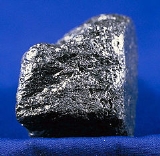
Graphite
Graphite is one of the
allotropes of carbon. Unlike
diamond, graphite is an electrical conductor, and can be used, for instance, as the material in the electrodes of an electrical
arc lamp. Graphite holds the distinction of being the most stable form of solid carbon ever discovered. It may be considered to be the highest grade of
coal, just above
anthracite, although it is not normally used as fuel because it is hard to ignite.
Encyclopedia
| Graphite | | General | Category | Native mineral | Chemical formula | Carbon, C | Identification | Color | Steel black, to gray. | Crystal habit | Tabular, six-sided foliated masses, granular to compacted masses. | Crystal system | Hexagonal | Cleavage | Perfect in one direction. | Fracture | Flaky, otherwise rough when not on cleavage | Mohs Scale hardness | 1 - 2 | Lustre | Dull metallic, earthy | Refractive index | Opaque | Pleochroism | None | Streak | Black | Density | 2.09–2.23 g/cm³ | Fusibility | ? | Solubility | Molten Ni |
Graphite is one of the
allotropes of carbon. Unlike
diamond, graphite is an electrical conductor, and can be used, for instance, as the material in the electrodes of an electrical
arc lamp. Graphite holds the distinction of being the most stable form of solid carbon ever discovered. It may be considered to be the highest grade of
coal, just above
anthracite, although it is not normally used as fuel because it is hard to ignite.
Occurrence
Associated minerals include:
quartz,
calcite,
micas,
iron meteorites, and
tourmalines. Notable occurrences include
New York and
Texas in the USA,
Russia,
Mexico,
Greenland, and
India.
Other characteristics: thin flakes are flexible but inelastic, mineral can leave black marks on hands and paper, conducts electricity, and displays superlubricity. Best field indicators are softness, luster, density and streak.
Structure
Each
carbon atom is
covalently bonded to three other surrounding carbon atoms. The flat sheets of carbon atoms are bonded into hexagonal structures. These exist in layers, which are not covalently connected to the surrounding layers. Instead, different layers are connected together by weak forces called the
van der Waals forces.
The
unit cell dimensions are
a =
b = 245.6 picometres,
c = 669.4 pm. The carbon-carbon
bond length in the bulk form is 141.8 pm, and the interlayer spacing is
c/2 = 334.7 pm.
Each carbon atom possesses an sp
2 orbital hybridisation. The
pi orbital electrons delocalized across the hexagonal atomic sheets of carbon contribute to graphite's conductivity. In an oriented piece of graphite, conductivity parallel to these sheets is greater than that perpendicular to these sheets.
The bond between the atoms within a layer is strong but the force between two layers of graphite is weak. Therefore, layers of it can slip over each other making it soft.
Detailed properties and uses
The acoustic and
thermal properties of graphite are highly
anisotropic, since
phonons propagate very quickly along the tightly-bound planes, but are slower to travel from one plane to another.
Graphite can conduct electricity due to the vast electron delocalization within the carbon layers. These electrons are free to move, so are able to conduct electricity. However, the electricity is only conducted within the plane of the layers.
Graphite powder is used as a dry lubricant, although it might be thought that this industrially important property is due entirely to the loose interlamellar coupling between sheets in the structure, in fact in a
vacuum environment , graphite was found to be a very poor lubricant, leading to the discovery that in fact lubrication is due to
adsorbed air and water between the layers, unlike other layered dry lubricants such as
molybdenum disulfide. Recent studies suggest that an effect called superlubricity can also account for this effect. The use of graphite is also limited by its tendency to facilitate pitting corrosion in some
stainless steels, and to promote galvanic
corrosion between dissimiilar metals. It is also corrosive to aluminium in presence of moisture. The
US Air Force banned its use as a lubricant in aircraft and its use for aluminium-containing automatic weapons is discouraged as well. Even graphite
pencil marks on aluminium parts may facilitate corrosion. A structural analog of graphite, hexagonal boron nitride, is used as a high-temperature lubricant as well, and due to its similarity to graphite is sometimes called
white graphite.
When a large number of crystallographic defects bind these planes together, graphite loses its lubrication properties and becomes what is known as
pyrolytic carbon, a useful material in blood-contacting implants such as
prosthetic heart valves.
Natural and crystalline graphites are not often used in pure form as structural materials due to their shear-planes, brittleness and inconsistent mechanical properties.
In its pure glassy synthetic forms,
pyrolytic graphite and
carbon fiber graphite is an extremely strong, heat-resistant material, used in reentry shields for missile nosecones,
solid rocket engines, high temperature reactors,
brake shoes,
electric motor brushes and as electrodes in EDM electrical discharge machines.
Intumescent or expandable graphites are used in
firestops, particularly
plastic pipe devices, as well as
gaskets, fitted around the perimeter of a
fire door. During a
fire, the graphite intumesces to resist
fire penetration and reduce the likelihood of the spread of fire and fumes. A typical start expansion temperature is between 150 and 300 degrees Celsius.
Carbon fiber and
carbon nanotubes are also used in graphite reinforced plastics, and in heat-resistant composites such as
reinforced carbon-carbon ). Products made from carbon-fiber graphite composites include fishing rods, golf clubs, and bicycle frames, and have been successfully employed in
reinforced concrete. The mechanical properties of carbon fiber graphite-reinforced plastic composites and grey
cast iron are strongly influenced by the role of graphite in these materials.
Graphite also finds use as a matrix and moderator within
nuclear reactors. Its low
neutron cross section also recommends it for use in proposed
fusion reactors. Care must be taken that reactor-grade graphite is free of neutron absorbing materials such as
boron, widely used as the seed electrode in commercial graphite deposition systems-- this caused the failure of the Germans'
World War II graphite-based nuclear reactors. Since they could not isolate the difficulty they were forced to use far more expensive heavy water moderators. Graphite used for nuclear reactors is often referred to as Nuclear Graphite.
Media
See also
Reference
- Klein, Cornelis and Cornelius S. Hurlbut, Jr. Manual of Mineralogy: after Dana 20th ed. ISBN 0-471-80580-7
External links