
All Topics  
Nuclear fallout

 
Nuclear Fallout

   Email Print
   Bookmark   Link


Nuclear fallout


Fallout is the residual radiation hazard from a nuclear explosion
Nuclear explosion

A nuclear explosion occurs as a result of the rapid release of energy from an intentionally high-speed nuclear reaction. The driving reaction may be nuclear fission, nuclear fusion or a multistage cascading combination of the two, though to date all fusion based weapons have used a fission device to initiate fusion, and a pure fusion weapon...
, so named because it "falls out" of the atmosphere into which it is spread during the explosion. It commonly refers to the radioactive dust created when a nuclear weapon
Nuclear weapon

A nuclear weapon is an explosive device that derives its destructive force from nuclear reactions, either nuclear fission or a combination of fission and nuclear fusion....
 explodes. This radioactive dust, consisting of hot particle
Hot particle

A hot particle is a small, highly radioactive object, with significant content of radionuclides. Most hot particles released into the environment originate in nuclear reactors....
s, is a kind of radioactive contamination
Radioactive contamination

Radioactive contamination is the uncontrolled distribution of radioactive decay material in a given environment. The amount of radioactive material released in an accident is called the source term....
. It can lead to contamination of the food chain
Food chain

Food chains, also called, food networks and/or trophic social networks, describe the eating relationships between species within an ecosystem....
.
e are many types of fallout, ranging from the global type to the more area-restricted types of fallout.

r an air burst
Air burst

An air burst is the detonation of an explosive device such as an anti-personnel artillery shell or a nuclear weapon in the air instead of on contact with the ground or target or a delayed armor piercing explosion....
, the fission products, unfissioned nuclear material, and weapon residues which have been vaporized by the heat of the fireball will condense into a fine suspension of very small particles 10 nm
Nanometre

A nanometre is a Units of measurement of length in the metric system, equal to one billionth of a metre .It is one of the more often used units for very small lengths, and equals ten ?ngstr?m, an internationally recognized non-International System of Units of length....
 to 20 µm
Micrometre

A micrometre or micron is one Micro- of a metre, or equivalently one thousandth of a millimetre. It is also commonly known as a micron....
 in diameter.


Discussion
Ask a question about 'Nuclear fallout'
Start a new discussion about 'Nuclear fallout'
Answer questions from other users
Full Discussion Forum


Encyclopedia


Fallout is the residual radiation hazard from a nuclear explosion
Nuclear explosion

A nuclear explosion occurs as a result of the rapid release of energy from an intentionally high-speed nuclear reaction. The driving reaction may be nuclear fission, nuclear fusion or a multistage cascading combination of the two, though to date all fusion based weapons have used a fission device to initiate fusion, and a pure fusion weapon...
, so named because it "falls out" of the atmosphere into which it is spread during the explosion. It commonly refers to the radioactive dust created when a nuclear weapon
Nuclear weapon

A nuclear weapon is an explosive device that derives its destructive force from nuclear reactions, either nuclear fission or a combination of fission and nuclear fusion....
 explodes. This radioactive dust, consisting of hot particle
Hot particle

A hot particle is a small, highly radioactive object, with significant content of radionuclides. Most hot particles released into the environment originate in nuclear reactors....
s, is a kind of radioactive contamination
Radioactive contamination

Radioactive contamination is the uncontrolled distribution of radioactive decay material in a given environment. The amount of radioactive material released in an accident is called the source term....
. It can lead to contamination of the food chain
Food chain

Food chains, also called, food networks and/or trophic social networks, describe the eating relationships between species within an ecosystem....
.

Types

There are many types of fallout, ranging from the global type to the more area-restricted types of fallout.

Worldwide

After an air burst
Air burst

An air burst is the detonation of an explosive device such as an anti-personnel artillery shell or a nuclear weapon in the air instead of on contact with the ground or target or a delayed armor piercing explosion....
, the fission products, unfissioned nuclear material, and weapon residues which have been vaporized by the heat of the fireball will condense into a fine suspension of very small particles 10 nm
Nanometre

A nanometre is a Units of measurement of length in the metric system, equal to one billionth of a metre .It is one of the more often used units for very small lengths, and equals ten ?ngstr?m, an internationally recognized non-International System of Units of length....
 to 20 µm
Micrometre

A micrometre or micron is one Micro- of a metre, or equivalently one thousandth of a millimetre. It is also commonly known as a micron....
 in diameter. These particles may be quickly drawn up into the stratosphere
Stratosphere

The stratosphere is the second major layer of Earth's atmosphere, just above the troposphere, and below the mesosphere. It is stratified in temperature, with warmer layers higher up and cooler layers farther down....
, particularly if the explosive yield exceeds 10 kt.

Radiocarbon Bomb Spike
Initially little was known about the dispersion of nuclear fallout on a global scale. The AEC
United States Atomic Energy Commission

The United States Atomic Energy Commission was an agency of the United States government established after World War II by United States Congress to foster and control the peace time development of atomic science and technology....
 assumed that fallout would be dispersed evenly across the globe, dispersed by atmospheric winds and will gradually settle to the Earth's surface after weeks, months, and even years as worldwide fallout. Nuclear products were deposited in the Northern Hemisphere becoming "far more dangerous than they had originally been estimated."

The radio-biological hazard of worldwide fallout is essentially a long-term one because of the potential accumulation of long-lived radioisotopes
Radionuclide

A radionuclide is an atom with an unstable Atomic nucleus, which is a nucleus characterized by excess energy which is available to be imparted either to a newly-created radiation particle within the nucleus, or else to an atomic electron ....
 (such as strontium
Strontium

Strontium is a chemical element with the symbol Sr and the atomic number 38. An alkaline earth metal, strontium is a soft silver-white or yellowish metallic element that is highly reactive chemically....
-90 and caesium
Caesium

Caesium or cesium is the chemical element with the symbol Cs and atomic number 55. It is a soft, silvery-gold alkali metal with a melting point of , which makes it one of only liquid metal that are liquid at or near room temperature....
-137) in the body as a result of ingestion of foods containing the radioactive materials. This hazard is much less serious than those which are associated with local fallout, which is of much greater immediate operational concern.

Local

In a land or water surface burst, large amounts of earth or water will be vapor
Vapor

A vapor or vapour is a substance in the gas phase at a temperature lower than its critical temperature.This means that the vapor can be condensation to a liquid or to a solid by increasing its pressure, without reducing the temperature....
ized by the heat of the fireball and drawn up into the radioactive cloud. This material will become radioactive when it condenses with fission products and other radiocontaminants that have become neutron-activated. Many of the isotopes in the table below will decay into the isotopes that many people are more familiar with.

Bravo Fallout2


Us Fallout Exposure
There will be large amounts of particles of less than 100 nm
Nanometre

A nanometre is a Units of measurement of length in the metric system, equal to one billionth of a metre .It is one of the more often used units for very small lengths, and equals ten ?ngstr?m, an internationally recognized non-International System of Units of length....
 to several millimeters in diameter generated in a surface burst in addition to the very fine particles which contribute to worldwide fallout. The larger particles spill out of the stem and cascade down the outside of the fireball in a downdraft even while the cloud rises, so fallout begins to arrive near ground zero within an hour, and more than half the total bomb debris is deposited on the ground within about 24 hours as local fallout.

The chemical properties of the different elements in the fallout will control the rate at which they are deposited on the ground. The less volatile elements will deposit first.

Severe local fallout contamination can extend far beyond the blast and thermal effects, particularly in the case of high yield surface detonations. The ground track of fallout from an explosion depends on the weather situation from the time of detonation onwards. In stronger winds, fallout travels faster but takes the same time to descend, so although it covers a larger path, it is more spread out or diluted. So the width of the fallout pattern for any given dose rate is reduced where the downwind distance is increased by higher winds. The total amount of activity deposited up to any given time is the same irrespective of the wind pattern, so the overall casualty figures from fallout will generally be independent of the winds. But thunderstorms can bring down activity as rain more rapidly than dry fallout, particularly if the mushroom cloud
Mushroom cloud

A mushroom cloud is a distinctive mushroom-shaped cloud of condensed water vapor or debris resulting from a very large explosion. They are most commonly associated with nuclear explosions, but any sufficiently large blast will produce the same sort of effect....
 is low enough to be below, or mixed with, the thunderstorm.

Whenever individuals remain in a radiologically contaminated
Radioactive contamination

Radioactive contamination is the uncontrolled distribution of radioactive decay material in a given environment. The amount of radioactive material released in an accident is called the source term....
 area, such contamination will lead to an immediate external radiation exposure as well as a possible later internal hazard from inhalation and ingestion of radiocontaminants, such as the rather short-lived iodine-131
Iodine-131

Iodine-131 , also called radioiodine, is a radioisotope of iodine which has medical and pharmaceutical uses....
, which is accumulated in the thyroid
Thyroid

The thyroid is one of the largest endocrine glands in the body. This gland is found in the neck inferior to the thyroid cartilage and at approximately the same level as the cricoid cartilage....
.

Factors affecting fallout

1957

Location


There are two main considerations for the location of an explosion: height and surface composition. A nuclear weapon detonated in the air, called an air burst
Air burst

An air burst is the detonation of an explosive device such as an anti-personnel artillery shell or a nuclear weapon in the air instead of on contact with the ground or target or a delayed armor piercing explosion....
, will produce less fallout than a comparable explosion near the ground. Less particulate matter will be contaminated by an air burst. Detonations at the surface (surface bursts) will tend to produce more fallout material.

In case of water surface bursts, the particles tend to be rather lighter and smaller, producing less local fallout but extending over a greater area. The particles contain mostly sea salts with some water; these can have a cloud seeding
Cloud seeding

Cloud seeding, a form of weather control, is the attempt to change the amount or type of Precipitation that falls from clouds, by dispersing substances into the air that serve as Cloud condensation nuclei or ice nucleus, which alter the microphysical processes within the cloud....
 effect causing local rainout
Rainout

A Rainout is the process of precipitation causing the removal of radioactive particles from the atmosphere onto the ground, creating nuclear fallout by rain....
 and areas of high local fallout. Fallout from a seawater
Seawater

Seawater is water from a sea or ocean. On average, seawater in the world's oceans has a salinity of about 3.5%, or 35 parts per thousand . This means that every 1 kg of seawater has approximately 35 grams of sea salt ....
 burst is difficult to remove once it has soaked into porous surfaces because the fission products are present as metallic ions which become chemically bonded to many surfaces. Water and detergent washing is effective on removing less than about 50% of this chemically bonded activity from concrete or steel (complete decontamination requires aggressive treatment like sandblasting, or acidic treatment). After the Crossroads underwater test, it was found that wet fallout needs to be immediately removed from ships by continuous water washdown (such as from the fire sprinkler system on the decks).

For subsurface bursts, there is an additional phenomenon present called "base surge". The base surge is a cloud that rolls outward from the bottom of the subsiding column, which is caused by an excessive density of dust or water droplets in the air. For underwater bursts, the visible surge is, in effect, a cloud of liquid (usually water) droplets with the property of flowing almost as if it were a homogeneous fluid. After the water evaporates, an invisible base surge of small radioactive particles may persist.

For subsurface land bursts, the surge is made up of small solid particles, but it still behaves like a fluid
Fluid

A fluid is defined as a substance that continually deforms under an applied shear stress. All liquids and all gases are fluids. Fluids are a subset of the Phase and include liquids, gas, Plasma physics and, to some extent, plasticity ....
. A soil earth medium favors base surge formation in an underground burst. Although the base surge typically contains only about 10% of the total bomb debris in a subsurface burst, it can create larger radiation doses than fallout near the detonation, because it arrives sooner than fallout, before much radioactive decay has occurred.

Meteorological

Fallout G&d77
Meteorological
Meteorology

Meteorology is the interdisciplinary scientific study of the Earth's atmosphere that focuses on weather processes and forecasting . Studies in the field stretch back millennia, though significant progress in meteorology did not occur until the eighteenth century....
 conditions will greatly influence fallout, particularly local fallout. Atmospheric winds are able to bring fallout over large areas. For example, as a result of a Castle Bravo
Castle Bravo

Castle Bravo was the code name given to the first U.S. test of a so-called dry fuel Nuclear fusion hydrogen bomb device, detonated on March 1, 1954, at Bikini Atoll, Marshall Islands, by the United States, as the first test of Operation Castle ....
 surface burst of a 15 Mt thermonuclear device at Bikini Atoll
Bikini Atoll

Bikini Atoll is an atoll in one of the Micronesian Islands in the Pacific Ocean, part of Marshall Islands. It consists of 36 islands surrounding a lagoon....
 on March 1, 1954, a roughly cigar-shaped area of the Pacific extending over 500 km downwind and varying in width to a maximum of 100 km was severely contaminated. There are three very different versions of the fallout pattern from this test, because the fallout was only measured on a small number of widely spaced Pacific Atolls. The two alternative versions both ascribe the high radiation levels at north Rongelap to a downwind hotspot caused by the large amount of radioactivity carried on fallout particles of about 50-100 micrometres size .

After Bravo, it was discovered that fallout landing on the ocean disperses in the top water layer (above the thermocline at 100 m depth), and the land equivalent dose rate can be calculated by multiplying the ocean dose rate at two days after burst by a factor of about 530. In other 1954 tests, including Yankee and Nectar, hotspots were mapped out by ships with submersible probes, and similar hotspots occurred in 1956 tests such as Zuni and Tewa However, the major U.S. 'DELFIC' (Defence Land Fallout Interpretive Code) computer calculations use the natural size distributions of particles in soil instead of the afterwind sweep-up spectrum, and this results in more straightforward fallout patterns lacking the downwind hotspot.

Snow and rain, especially if they come from considerable heights, will accelerate local fallout. Under special meteorological conditions, such as a local rain shower that originates above the radio-active cloud, limited areas of heavy contamination just downwind of a nuclear blast may be formed.

Effects

A wide range of biological
Biological process

A biological process is a process of a living organism. Biological processes are made up of any number of chemical reactions or other events that results in a Chemical transformation....
 changes may follow the irradiation of animals. These vary from rapid death following high doses of penetrating whole-body radiation, to essentially normal lives for a variable period of time until the development of delayed radiation effects, in a portion of the exposed population, following low dose exposures.

The unit of actual exposure is the Röntgen
Röntgen

The r?ntgen or roentgen is a unit of measurement for ionizing radiation , and is named after the Germany physicist Wilhelm R?ntgen. Adopted in 1928, 1 R is the amount of radiation required to liberate positive and negative charges of one Statcoulomb of electric charge in 1 cubic centimeter of dry air at standard temperature and pressu...
 which is defined in ionisations per unit volume of air, and all ionisation based instruments (including geiger counter
Geiger counter

A Geiger counter, also called a Geiger-M?ller counter, is a type of particle detector that measures ionizing radiation....
s and ionisation chambers) measure exposure. However, effects depend on the energy per unit mass, not the exposure measured in air. A deposit of 1 joule per kilogram has the unit of 1 gray
Gray (unit)

The gray is the SI unit of absorbed dose due to ionizing radiation ....
. For 1 MeV energy gamma rays, an exposure of 1 röntgen in air will produce a dose of about 0.01 gray (1 centigray, cGy) in water or surface tissue. Because of shielding by the tissue surrounding the bones, the bone marrow will only receive about 0.67 cGy when the air exposure is 1 röntgen and the surface skin dose is 1 cGy. Some of the lower values reported for the amount of radiation which would kill 50% of personnel (the 'LD50') refer to bone marrow dose, which is only 67% of the air dose.

Short term


When comparing the effects of various types or circumstances, the dose which is lethal to 50% of a given population is a common parameter. The term is usually defined for a specific time, which is generally limited to studies of acute lethality. The common time periods used are 30 days or less for most small laboratory animals and to 60 days for large animals and humans. The LD50 figure assumes that the individuals did not receive other injuries or medical treatment.

In the 1950s, the LD50 for gamma rays was set at 3.5 Gy, while under more dire conditions of war (a bad diet, little medical care, poor nursing) the LD50 was 2.5 Gy (250 rad). There have been few documented cases of survival beyond 6 Gy. One person at Chernobyl
Chernobyl

Chernobyl , or Chornobyl , was a city in northern Ukraine, in the Kyiv Oblast near the border with Belarus.The city was evacuated in 1986 due to the Chernobyl disaster at the Chernobyl Nuclear Power Plant, which is located 14.5 kilometers north-northwest....
 survived a dose of more than 10 Gy, but many of the persons exposed there were not uniformly exposed over their entire body. If a person is exposed in a non-homogeneous manner then a given dose (averaged over the entire body) is less likely to be of a lethal dose. For instance if a person gets a hand/low arm dose of 100 Gy which gives them an overall dose of 4 Gy then they are more likely to survive than a person who gets a 4 Gy dose uniformly over their entire body. A hand dose of 10 Gy or more will likely result in loss of the hand; a British
United Kingdom

The United Kingdom of Great Britain and Northern Ireland, commonly known as the United Kingdom , the UK or Britain,is a sovereign state located off the northwestern coast of continental Europe....
 industrial radiographer who got a lifetime hand dose of 100 Gy lost his hand because of radiation dermatitis
Dermatitis

Dermatitis is a blanket term meaning any "inflammation of the skin" . There are several different types of dermatitis. The different kinds usually have in common an allergic reaction to specific allergens....
. Most people become ill after an exposure to 1 Gy or more. The fetuses of pregnant women are often more vulnerable than the host body and may miscarry
Miscarriage

Miscarriage or spontaneous abortion is the spontaneous end of a pregnancy at a stage where the embryo or fetus is incapable of surviving, generally defined in humans at prior to 20 weeks of gestation....
, especially in the first trimester
Trimester

Trimester means a period of three months. It is most commonly used in physiology related to pregnancy and at some universities to describe an academic term....
.

One hour after a surface burst, the radiation from fallout in the crater region is 30 grays per hour (Gy/h). Civilian dose rates in peacetime range from 30 to 100 µGy per year.

Fallout radiation decays exponentially
Exponential decay

A quantity is said to be subject to exponential decay if it decreases at a rate proportional to its value. Symbolically, this can be expressed as the following differential equation, where N is the quantity and ? is a negative and non-negative numbers called the decay constant....
 relatively quickly with time. Most areas become fairly safe for travel and decontamination after three to five weeks.

For yields of up to 10 kt, prompt radiation is the dominant producer of casualties on the battlefield. Humans receiving an acute incapacitating dose (30 Gy) will have their performance degraded almost immediately and become ineffective within several hours. However, they will not die until 5 to 6 days after exposure assuming they do not receive any other injuries.

Individuals receiving less than a total of 1.5 Gy will not be incapacitated. People receiving doses greater than 1.5 Gy will become disabled; some will eventually die.

A dose of 5.3 Gy to 8.3 Gy is considered lethal but not immediately incapacitating. Personnel exposed to this amount of radiation will have their performance degraded within 2 to 3 hours, depending on how physically demanding the tasks they must perform are, and will remain in this disabled state at least 2 days. However, at that point they will experience a recovery period and be effective at performing non-demanding tasks for about 6 days, after which they will relapse for about 4 weeks. At this time they will begin exhibiting symptoms of radiation poisoning
Radiation poisoning

Radiation poisoning, also called "radiation sickness" or a "creeping dose", is a form of damage to organ tissue due to excessive exposure to ionizing radiation....
 of sufficient severity to render them totally ineffective. Death follows at approximately 6 weeks after exposure, although results may vary.

Long term

Late or delayed effects of radiation occur following a wide range of doses and dose rates. Delayed effects may appear months to years after irradiation
Irradiation

Irradiation is the process by which an item is exposed to radiation. The exposure can be intentional, sometimes to serve a specific purpose, or it can be accidental....
 and include a wide variety of effects involving almost all tissues or organs. Some of the possible delayed consequences of radiation injury are life shortening, carcinogenesis
Carcinogenesis

'Carcinogenesis' , is the process by which normal cell are transformed into cancer cells.Cell division is a physiological process that occurs in almost all tissues and under many circumstances....
, cataract
Cataract

A cataract is a clouding that develops in the lens of the eye or in its envelope, varying in degree from slight to complete Opacity and obstructing the passage of light....
 formation, chronic radiodermatitis, decreased fertility, and genetic mutations.

Tactical military considerations

Zuni
Blast injuries
Blast injury

A blast injury is the result of physical trauma sustained in an explosion. Blast injuries occur with the detonation of high explosives, explosives that produce a supersonic over-pressurization shock wave, as well as Explosive materials which produce a subsonic explosion with no over-pressurization wave....
 and thermal burns
Burn (injury)

A burn is a type of injury that may be caused by heat, Temperature, electricity, chemicals, light, radiation, or friction. Burns can be highly variable in terms of the tissue affected, the severity, and resultant complications....
 from the use of nuclear weapons for military action in many cases will far outnumber radiation injuries. However, radiation effects are considerably more complex and varied than are blast or thermal effects and are subject to considerable misunderstanding.

The closer to ground an atomic bomb is detonated, the more dust and debris is thrown into the air, resulting in greater amounts of local fallout. From a tactical standpoint, this has the disadvantage of hindering any occupation/invading efforts until the fallout clears, but more directly, the impact with the ground severely limits the destructive force of the bomb. For these reasons, ground bursts are not usually considered tactically advantageous, with the exception of hardened underground targets such as missile silo
Missile silo

A missile silo is an underground, vertical cylindrical container for the storage and launching of intercontinental ballistic missiles . They typically have the missile some distance under the surface, protected by a large "blast shelter" on top....
s or command center
Command center

A command center is any place that is used to provide centralised command for some purpose. While frequently considered to be a military facility, these can be used in many other cases by governments or businesses....
s, however "salting
Salting the earth

Salting the earth refers to the practice of spreading Sodium chloride on fields to make them incapable of being used for crop-growing. This was done in ancient times at the end of some wars as an extremely punitive scorched earth tactic....
" enemy territory with a fallout-heavy atomic burst can be used to deny ill-equipped civilians/military personnel access to a contaminated area.

Fallout protection

During the Cold War
Cold War

The Cold War was the continuing state of conflict, tension and competition that existed between a number of world powers, including the United States, the Soviet Union, People's Republic of China, France, United Kingdom and those countries' respective allies from the mid-1940s to the early 1990s....
, the governments of the U.S. and USSR attempted to educate their citizens about surviving a nuclear attack. In the U.S., this effort became known as Civil Defense
Civil defense

Civil defense, civil defence or civil protection is an effort to prepare civilians for military attack. It uses the principles of emergency operations: prevention, mitigation, preparation, response, or emergency evacuation, and recovery....
. The government provided procedures on minimizing short-term exposure to fallout, but currently, the popular attitude towards fallout protection is that short-term survival in a global thermonuclear war would be futile, and fallout shelters are no longer maintained.

Nuclear reactor accident

Fallout can also refer to nuclear accidents, although a nuclear reactor
Nuclear reactor

A nuclear reactor is a device in which nuclear chain reactions are initiated, controlled, and sustained at a steady rate, as opposed to a nuclear bomb, in which the chain reaction occurs in a fraction of a second and is uncontrolled causing an explosion....
 does not explode like a nuclear weapon. The isotopic
Isotope

Isotopes are any of the different types of atoms of the same chemical element, each having a different atomic mass . Isotopes of an element have atomic nucleus with the same number of protons but different numbers of neutron....
 signature of bomb fallout is very different from the fallout from a serious power reactor accident (such as Chernobyl
Chernobyl disaster

The Chernobyl disaster was a nuclear reactor accident in the Chernobyl Nuclear Power Plant in Ukraine, then part of the Soviet Union. It is considered to be the worst nuclear power plant disaster in history and the only level 7 instance on the International Nuclear Event Scale....
). The key differences are in volatility
Volatility (chemistry)

Volatility in the context of chemistry, physics and thermodynamics is a measure of the tendency of a substance to vaporize. It has also been defined as a measure of how readily a substance vaporizes....
 and half-life
Half-life

The half-life of a quantity whose value decreases with time is the interval required for the quantity to decay to half of its initial value. The concept originated in describing how long it takes atoms to undergo radioactive decay but also applies in a wide variety of other situations....
.

Volatility

The boiling point
Boiling point

The boiling point of a liquid is the temperature at which the vapor pressure of the liquid equals the environmental pressure surrounding the liquid....
 of an element
Chemical element

A chemical element is a type of atom that is distinguished by its atomic number; that is, by the number of protons in its atomic nucleus. The term is also used to refer to a pure chemical Chemical substance composed of atoms with the same number of protons....
 (or its compound
Chemical compound

A chemical compound is a Chemical substance consisting of two or more different chemical element Chemical bond together in a fixed mass ratio that can be split into simpler substances....
s) is able to control the percentage of that element which is released by a power reactor accident. In addition the ability of an element to form a solid controls the rate at which it is deposited on the ground after it has been injected into the atmosphere by a nuclear detonation.

Half-life

In bomb fallout, a large amount of short-lived isotopes such as 97Zr are present. This isotope and the other short-lived isotopes are being constantly generated in a power reactor, but because the criticality occurs over a long length of time the majority of these short lived isotopes decay before they can be released.

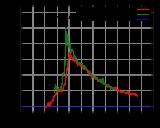
Below is shown a comparison of the calculated gamma dose rates in open air from the fallout of a fission bomb and of the Chernobyl release. It is clear that average half-life of the Chernobyl release is longer than that for the bomb fallout.

See also

  • Atomic Cafe - Documentary film about nuclear civil defense
    Civil defense

    Civil defense, civil defence or civil protection is an effort to prepare civilians for military attack. It uses the principles of emergency operations: prevention, mitigation, preparation, response, or emergency evacuation, and recovery....
     films.
  • Castle Bravo
    Castle Bravo

    Castle Bravo was the code name given to the first U.S. test of a so-called dry fuel Nuclear fusion hydrogen bomb device, detonated on March 1, 1954, at Bikini Atoll, Marshall Islands, by the United States, as the first test of Operation Castle ....
     - largest nuclear fallout accident by United States,
  • Dirty bomb
    Dirty bomb

    The term dirty bomb is primarily used to refer to a radiological dispersal device , a speculative radiological weapon which combines radioactive material with conventional explosive material....
  • Fallout Protection
    Fallout Protection

    Fallout Protection: What To Know And Do About Nuclear Attack, was an official United States federal government booklet released in December 1961 by the United States Department of Defense and United States Civil Defense....
     - U.S. Government booklet
  • Fallout shelter
    Fallout shelter

    A fallout shelter is an enclosed space specially designed to protect occupants from radioactive debris or nuclear fallout resulting from a nuclear explosion....
  • Fallout (RTÉ drama)
    Fallout (RTÉ drama)

    Fallout is a RT? two-part fictional drama, made in the style of a documentary film. It deals with the nuclear fallout following a hypothetical disaster in the Sellafield in Cumbria on the United Kingdom coast of the Irish Sea....
     - Irish drama exploring some of the possible scenarios following a nuclear accident at Sellafield
    Sellafield

    Sellafield is a nuclear processing and former electricity generating site, close to the village of Seascale on the coast of the Irish Sea in Cumbria, England....
    .
  • Fission product
    Fission product

    Fission products are the atomic fragments left after a large nucleus Nuclear fission. Typically, a large nucleus like Uranium fissions by splitting into two smaller nuclei, along with a few neutrons and a large release of energy in the form of heat , gamma rays and neutrinos....
  • Hot Particle
    Hot particle

    A hot particle is a small, highly radioactive object, with significant content of radionuclides. Most hot particles released into the environment originate in nuclear reactors....
  • Human radiation experiments
    Human radiation experiments

    Since the discovery of ionizing radiation, a number of human radiation experiments have been performed to understand the effects of ionizing radiation and radioactive contamination on the human body....
  • List of nuclear accidents
  • Neutron bomb
    Neutron bomb

    A neutron bomb, technically referred to as an enhanced radiation weapon , is a type of tactical nuclear weapon formerly built mainly by the United States specifically to release a large portion of its energy as energetic neutron radiation....
  • Nuclear war survival skills
    Nuclear war survival skills

    Nuclear War Survival Skills or NWSS by Cresson Kearny is a civil defense manual. It contains information gleaned from research performed at Oak Ridge National Laboratory during the Cold War, as well as from Kearny's extensive jungle living and international travels....
     by Cresson Kearny
    Cresson Kearny

    Cresson Henry Kearny wrote several Survival skills related books based primarily on research performed at Oak Ridge National Laboratory....
  • Nuclear weapon design
    Nuclear weapon design

    Nuclear weapon designs are physical, chemical, and engineering arrangements that cause the physics package of a Nuclear weapons to detonate. There are three basic design types....
  • Nuclear terrorism
    Nuclear terrorism

    Nuclear terrorism denotes the use, or threat of the use, of nuclear weapons or radiological weapons in acts of terrorism, includingattacks against facilities where radioactive materials are present....
  • Potassium iodide
    Potassium iodide

    Potassium iodide is an inorganic compound with chemical formula potassiumiodide. This colorless salt is the most commercially significant iodide compound, with approximately 37,000 tons produced in 1985....
  • Protect and Survive
    Protect and Survive

    Protect and Survive was a public information series on civil defence produced by the United Kingdom government during the early 1980s. It was intended to inform British citizens on how to protect themselves during a nuclear attack, and consisted of a mixture of pamphlets, radio broadcasts, and public information films....
    , a series of booklets and a public information film
    Public information film

    Public Information Films are a series of government commissioned short films, shown during television advertising breaks in the United Kingdom....
     series produced for the British government in the 1970s and 1980s.
  • Radioactive contamination
    Radioactive contamination

    Radioactive contamination is the uncontrolled distribution of radioactive decay material in a given environment. The amount of radioactive material released in an accident is called the source term....
  • Radiological weapon
    Radiological weapon

    A 'radiological weapon' or 'radiological dispersion device' is any weapon that is designed to spread radioactive material with the intent to kill, and cause disruption upon a city or nation....
  • Radiation poisoning
    Radiation poisoning

    Radiation poisoning, also called "radiation sickness" or a "creeping dose", is a form of damage to organ tissue due to excessive exposure to ionizing radiation....
  • Radiation biology
  • Radioactive waste
    Radioactive waste

    Radioactive wastes are waste types containing radioactive decay chemical elements that do not have a practical purpose. They are usually the products of nuclear processes, such as nuclear fission....
  • Survival Under Atomic Attack
    Survival Under Atomic Attack

    Survival Under Atomic Attack was the title of an official United States government booklet released by the Executive Office of the President, the National Security Resources Board , and the United States Civil Defense....
    , an official U.S. Government booklet regarding the effects of a nuclear attack.


Footnotes


General references

  • Glasstone, Samuel and Dolan, Philip J., The Effects of Nuclear Weapons (third edition), U.S. Government Printing Office, 1977. ()
  • NATO Handbook on the Medical Aspects of NBC Defensive Operations (Part I - Nuclear), Departments of the Army, Navy, and Air Force, Washington, D.C., 1996, ()
  • Smyth, H. DeW., Atomic Energy for Military Purposes, Princeton University Press, 1945. (Smyth Report
    Smyth Report

    The Smyth Report was the common name given to an administrative history written by physics Henry DeWolf Smyth about the Allies World War II effort to develop the atomic bomb, the Manhattan Project....
    )
  • The Effects of Nuclear War in America, Office of Technology Assessment (May 1979) ()
  • T. Imanaka, S. Fukutani, M. Yamamoto, A. Sakaguchi and M. Hoshi, J. Radiation Research, 2006, 47, Suppl A121-A127.
  • Sheldon Novick, The Careless Atom, (Boston MA: Houghton Mifflin Co., 1969), p. 98
  • Fallout game


External links

  • We're all Downwinders Now