

Criticality accident

Encyclopedia
A criticality accident, sometimes referred to as an excursion or a power excursion, is an accidental increase of nuclear chain reaction
s in a fissile
material, such as enriched uranium
or plutonium
. This releases a surge of neutron radiation
which is highly dangerous to humans and causes induced radioactivity
in the surroundings.
Critical or supercritical nuclear fission
(one that is sustained in power or increasing in power) generally occurs inside reactor cores
and occasionally within test environments. A criticality accident occurs when a critical reaction is achieved unintentionally. Although dangerous, typical criticality accidents cannot reproduce the design conditions of a fission bomb, so nuclear explosions do not occur. The heat released by the nuclear reaction will typically cause the fissile material to expand, so that the nuclear reaction becomes subcritical again within a few seconds.
In the history of atomic power development, sixty criticality accidents have occurred in collections of fissile materials outside nuclear reactors and some of these have resulted in death, by radiation exposure, of the nearest person(s) to the event. However, none has resulted in explosions.
 Criticality occurs when too much fissile material is in one place. Criticality can be achieved by using metallic uranium or plutonium or by mixing compounds or liquid solutions of these elements. The isotopic
mix, the shape of the material, the chemical composition of solutions, compounds, alloys, composite materials, and the surrounding materials all influence whether the material will go critical, i.e., sustain a chain reaction.
The calculations that predict the likelihood of a material going into a critical state can be complex, so both civil and military installations that handle fissile materials employ specially trained personnel to monitor operations and prevent criticality accidents.
and
 Since 1945 there have been at least 60 criticality accidents. These have caused at least 21 deaths: seven in the United States
, ten in the Soviet Union
, two in Japan
, one in Argentina
, and one in Yugoslavia
. Nine have been due to process accidents, with the remaining from research reactor accidents.
Criticality accidents have occurred both in the context of nuclear weapon
s and nuclear reactor
s.
, most likely due to the very similar color of the light emitted by both of these phenomena. This is merely a coincidence.
A criticality accident, sometimes referred to as an excursion or a power excursion, is an accidental increase of nuclear chain reaction
s in a fissile
material, such as enriched uranium
or plutonium
. This releases a surge of neutron radiation
which is highly dangerous to humans and causes induced radioactivity
in the surroundings.
Critical or supercritical nuclear fission
(one that is sustained in power or increasing in power) generally occurs inside reactor cores
and occasionally within test environments. A criticality accident occurs when a critical reaction is achieved unintentionally. Although dangerous, typical criticality accidents cannot reproduce the design conditions of a fission bomb, so nuclear explosions do not occur. The heat released by the nuclear reaction will typically cause the fissile material to expand, so that the nuclear reaction becomes subcritical again within a few seconds.
In the history of atomic power development, sixty criticality accidents have occurred in collections of fissile materials outside nuclear reactors and some of these have resulted in death, by radiation exposure, of the nearest person(s) to the event. However, none has resulted in explosions.
Criticality occurs when too much fissile material is in one place. Criticality can be achieved by using metallic uranium or plutonium or by mixing compounds or liquid solutions of these elements. The isotopic
mix, the shape of the material, the chemical composition of solutions, compounds, alloys, composite materials, and the surrounding materials all influence whether the material will go critical, i.e., sustain a chain reaction.
The calculations that predict the likelihood of a material going into a critical state can be complex, so both civil and military installations that handle fissile materials employ specially trained personnel to monitor operations and prevent criticality accidents.
and
Since 1945 there have been at least 60 criticality accidents. These have caused at least 21 deaths: seven in the United States
, ten in the Soviet Union
, two in Japan
, one in Argentina
, and one in Yugoslavia
. Nine have been due to process accidents, with the remaining from research reactor accidents.
Criticality accidents have occurred both in the context of nuclear weapon
s and nuclear reactor
s.
, most likely due to the very similar color of the light emitted by both of these phenomena. This is merely a coincidence.
A criticality accident, sometimes referred to as an excursion or a power excursion, is an accidental increase of nuclear chain reaction
s in a fissile
material, such as enriched uranium
or plutonium
. This releases a surge of neutron radiation
which is highly dangerous to humans and causes induced radioactivity
in the surroundings.
Critical or supercritical nuclear fission
(one that is sustained in power or increasing in power) generally occurs inside reactor cores
and occasionally within test environments. A criticality accident occurs when a critical reaction is achieved unintentionally. Although dangerous, typical criticality accidents cannot reproduce the design conditions of a fission bomb, so nuclear explosions do not occur. The heat released by the nuclear reaction will typically cause the fissile material to expand, so that the nuclear reaction becomes subcritical again within a few seconds.
In the history of atomic power development, sixty criticality accidents have occurred in collections of fissile materials outside nuclear reactors and some of these have resulted in death, by radiation exposure, of the nearest person(s) to the event. However, none has resulted in explosions.
Criticality occurs when too much fissile material is in one place. Criticality can be achieved by using metallic uranium or plutonium or by mixing compounds or liquid solutions of these elements. The isotopic
mix, the shape of the material, the chemical composition of solutions, compounds, alloys, composite materials, and the surrounding materials all influence whether the material will go critical, i.e., sustain a chain reaction.
The calculations that predict the likelihood of a material going into a critical state can be complex, so both civil and military installations that handle fissile materials employ specially trained personnel to monitor operations and prevent criticality accidents.
and
Since 1945 there have been at least 60 criticality accidents. These have caused at least 21 deaths: seven in the United States
, ten in the Soviet Union
, two in Japan
, one in Argentina
, and one in Yugoslavia
. Nine have been due to process accidents, with the remaining from research reactor accidents.
Criticality accidents have occurred both in the context of nuclear weapon
s and nuclear reactor
s.
, most likely due to the very similar color of the light emitted by both of these phenomena. This is merely a coincidence.
The blue glow
of a criticality accident results from the spectral emission of the excited
ionized atoms (or excited molecules) of air (mostly oxygen
and nitrogen
) falling back to unexcited states, which happens to produce an abundance of blue
light. This is also the reason electrical sparks
in air, including lightning
, appear electric blue
. It is a coincidence that the color of Cherenkov light and light emitted by ionized air are a very similar blue despite their very different methods of production. It is worth remarking that the ozone
smell was said to be a sign of high radioactivity field through Chernobyl liquidators.
The only situation where Cherenkov light may contribute a significant amount of light to the blue flash is where the criticality occurs underwater or in solution
(such as uranyl nitrate
in a reprocessing plant) and this would be visible only if the container were open or transparent.
(a yield excursion of around 3×10¹⁵ fissions) would have only deposited enough energy in the skin to raise its temperature by fractions of a degree, the energy instantly deposited in the plutonium
sphere would have been around 80 kJ; sufficient to raise a 6.2 kg sphere of plutonium by around 100°C (specific heat of Pu being 0.13 J·g−1·K−1). The metal would therefore have reached sufficient temperature to have been detected a very short distance away by its emitted thermal radiation
. This explanation thus appears inadequate as an explanation for the thermal effects described by victims of criticality accidents, since people standing several feet away from the sphere also reported feeling the heat. It is also possible that the sensation of heat is simply caused by the nonthermal damage done to tissue on the cellular level by the ionization and production of free radicals
caused by exposure to intense ionizing radiation.
An alternative explanation of the heat wave observations can be derived from the discussions above regarding the blue glow phenomenon. A review of all of the criticality accidents with eyewitness accounts indicates that the heat waves were only observed when the fluorescent blue glow (the non-Cherenkov light, see above) was also observed. This would suggest a possible relationship between the two, and indeed, one can be readily identified. When all of the emission lines from nitrogen and oxygen are tabulated and corrected for relative yield in dense air, one finds that over 30% of the emissions are in the ultraviolet
range, and about 45% are in the infrared
range. Only about 25% are in the visible range. Since the skin feels infrared light directly as heat, and ultraviolet light is a cause of sunburn, it is likely that this phenomenon can explain the heat wave observations.
Nuclear chain reaction
A nuclear chain reaction occurs when one nuclear reaction causes an average of one or more nuclear reactions, thus leading to a self-propagating number of these reactions. The specific nuclear reaction may be the fission of heavy isotopes or the fusion of light isotopes...
s in a fissile
Fissile
In nuclear engineering, a fissile material is one that is capable of sustaining a chain reaction of nuclear fission. By definition, fissile materials can sustain a chain reaction with neutrons of any energy. The predominant neutron energy may be typified by either slow neutrons or fast neutrons...
material, such as enriched uranium
Enriched uranium
Enriched uranium is a kind of uranium in which the percent composition of uranium-235 has been increased through the process of isotope separation. Natural uranium is 99.284% 238U isotope, with 235U only constituting about 0.711% of its weight...
or plutonium
Plutonium
Plutonium is a transuranic radioactive chemical element with the chemical symbol Pu and atomic number 94. It is an actinide metal of silvery-gray appearance that tarnishes when exposed to air, forming a dull coating when oxidized. The element normally exhibits six allotropes and four oxidation...
. This releases a surge of neutron radiation
Neutron radiation
Neutron radiation is a kind of ionizing radiation which consists of free neutrons. A result of nuclear fission or nuclear fusion, it consists of the release of free neutrons from atoms, and these free neutrons react with nuclei of other atoms to form new isotopes, which, in turn, may produce...
which is highly dangerous to humans and causes induced radioactivity
Induced radioactivity
Induced radioactivity occurs when a previously stable material has been made radioactive by exposure to specific radiation. Most radioactivity does not induce other material to become radioactive....
in the surroundings.
Critical or supercritical nuclear fission
Nuclear fission
In nuclear physics and nuclear chemistry, nuclear fission is a nuclear reaction in which the nucleus of an atom splits into smaller parts , often producing free neutrons and photons , and releasing a tremendous amount of energy...
(one that is sustained in power or increasing in power) generally occurs inside reactor cores
Nuclear reactor core
A nuclear reactor core is the portion of a nuclear reactor containing the nuclear fuel components where the nuclear reactions take place.- Description :...
and occasionally within test environments. A criticality accident occurs when a critical reaction is achieved unintentionally. Although dangerous, typical criticality accidents cannot reproduce the design conditions of a fission bomb, so nuclear explosions do not occur. The heat released by the nuclear reaction will typically cause the fissile material to expand, so that the nuclear reaction becomes subcritical again within a few seconds.
In the history of atomic power development, sixty criticality accidents have occurred in collections of fissile materials outside nuclear reactors and some of these have resulted in death, by radiation exposure, of the nearest person(s) to the event. However, none has resulted in explosions.
Cause
Isotope
Isotopes are variants of atoms of a particular chemical element, which have differing numbers of neutrons. Atoms of a particular element by definition must contain the same number of protons but may have a distinct number of neutrons which differs from atom to atom, without changing the designation...
mix, the shape of the material, the chemical composition of solutions, compounds, alloys, composite materials, and the surrounding materials all influence whether the material will go critical, i.e., sustain a chain reaction.
The calculations that predict the likelihood of a material going into a critical state can be complex, so both civil and military installations that handle fissile materials employ specially trained personnel to monitor operations and prevent criticality accidents.
Accident types
Criticality accidents are divided into one of two categories:- Process accidents, where controls in place to prevent any criticality are breached,
and
- Reactor accidents, where deliberately achieved criticality in a nuclear reactorNuclear reactorA nuclear reactor is a device to initiate and control a sustained nuclear chain reaction. Most commonly they are used for generating electricity and for the propulsion of ships. Usually heat from nuclear fission is passed to a working fluid , which runs through turbines that power either ship's...
becomes uncontrollable. Excursion types can be classified into four categories depicting the nature of the evolution over time:
- Prompt Criticality Excursion
- Transient Criticality Excursion
- Exponential Excursion
- Steady State Excursion
Incidents
United States
The United States of America is a federal constitutional republic comprising fifty states and a federal district...
, ten in the Soviet Union
Soviet Union
The Soviet Union , officially the Union of Soviet Socialist Republics , was a constitutionally socialist state that existed in Eurasia between 1922 and 1991....
, two in Japan
Japan
Japan is an island nation in East Asia. Located in the Pacific Ocean, it lies to the east of the Sea of Japan, China, North Korea, South Korea and Russia, stretching from the Sea of Okhotsk in the north to the East China Sea and Taiwan in the south...
, one in Argentina
Argentina
Argentina , officially the Argentine Republic , is the second largest country in South America by land area, after Brazil. It is constituted as a federation of 23 provinces and an autonomous city, Buenos Aires...
, and one in Yugoslavia
Yugoslavia
Yugoslavia refers to three political entities that existed successively on the western part of the Balkans during most of the 20th century....
. Nine have been due to process accidents, with the remaining from research reactor accidents.
Criticality accidents have occurred both in the context of nuclear weapon
Nuclear weapon
A nuclear weapon is an explosive device that derives its destructive force from nuclear reactions, either fission or a combination of fission and fusion. Both reactions release vast quantities of energy from relatively small amounts of matter. The first fission bomb test released the same amount...
s and nuclear reactor
Nuclear reactor
A nuclear reactor is a device to initiate and control a sustained nuclear chain reaction. Most commonly they are used for generating electricity and for the propulsion of ships. Usually heat from nuclear fission is passed to a working fluid , which runs through turbines that power either ship's...
s.
- On 4 June 1945, Los AlamosLos Alamos National LaboratoryLos Alamos National Laboratory is a United States Department of Energy national laboratory, managed and operated by Los Alamos National Security , located in Los Alamos, New Mexico...
scientist John Bistline was conducting an experiment to determine the effect of surrounding a sub-critical mass of enriched uranium with a water reflector. The experiment unexpectedly became critical when water leaked into the polyethylenePolyethylenePolyethylene or polythene is the most widely used plastic, with an annual production of approximately 80 million metric tons...
box holding the metal. Three people received non-fatal doses of radiation.
- On 21 August 1945, Los AlamosLos Alamos National LaboratoryLos Alamos National Laboratory is a United States Department of Energy national laboratory, managed and operated by Los Alamos National Security , located in Los Alamos, New Mexico...
scientist Harry K. Daghlian, Jr.Harry K. Daghlian, Jr.Haroutune Krikor Daghlian, Jr. was an Armenian-American physicist with the Manhattan Project who accidentally irradiated himself on August 21, 1945, during a critical mass experiment at the remote Omega Site facility at Los Alamos National Laboratory in New Mexico, resulting in his death 25 days...
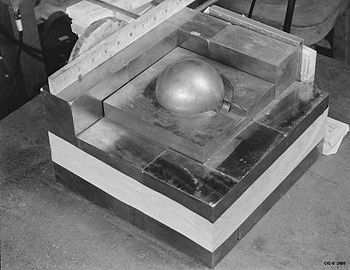
suffered fatal radiation poisoning after dropping a tungsten carbideTungsten carbideTungsten carbide is an inorganic chemical compound containing equal parts of tungsten and carbon atoms. Colloquially, tungsten carbide is often simply called carbide. In its most basic form, it is a fine gray powder, but it can be pressed and formed into shapes for use in industrial machinery,...
brick onto a sphere of plutonium, which was later nicknamed the demon coreDemon coreThe Demon core was the nickname given to a subcritical mass of plutonium that accidentally went briefly critical in two separate accidents at the Los Alamos laboratory in 1945 and 1946. Each incident resulted in the acute radiation poisoning and subsequent death of a scientist...
. The brick acted as a neutron reflectorNeutron reflectorA neutron reflector is any material that reflects neutrons. This refers to elastic scattering rather than to a specular reflection. The material may be graphite, beryllium, steel, and tungsten carbide, or other materials...
, bringing the mass to criticality. This was the first known criticality accident causing a fatality.
- On 21 May 1946, another Los Alamos scientist, Louis SlotinLouis SlotinLouis Alexander Slotin was a Canadian physicist and chemist who took part in the Manhattan Project, the secret US program during World War II that developed the atomic bomb....
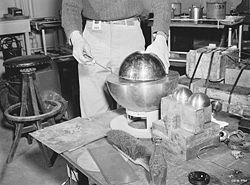
, accidentally irradiated himself during a similar incident using the very same sphere of plutonium responsible for the Daghlian accident. Slotin surrounded the plutonium sphere with two hemispherical cups of neutron reflecting material; one above and a larger one below. He was using a screwdriver to keep the cups slightly apart which kept the assembly subcritical. When the screwdriver accidentally slipped, the cups closed completely around the plutonium sending the assembly supercritical. Immediately realizing what had happened, he quickly disassembled the device, likely saving the lives of seven fellow scientists nearby. Slotin succumbed to radiation poisoningRadiation poisoningAcute radiation syndrome also known as radiation poisoning, radiation sickness or radiation toxicity, is a constellation of health effects which occur within several months of exposure to high amounts of ionizing radiation...
nine days later.
- On 16 June 1958, the first recorded uranium processing related criticality occurred at the Y-12 Plant in Oak Ridge, TennesseeOak Ridge, TennesseeOak Ridge is a city in Anderson and Roane counties in the eastern part of the U.S. state of Tennessee, about west of Knoxville. Oak Ridge's population was 27,387 at the 2000 census...
. During a routine leak test a fissile solution was unknowingly allowed to collect in a 55 gallon drum. The excursion lasted for approximately 20 minutes and resulted in eight workers receiving significant exposure. There were no fatalities, though five were hospitalized for forty-four days. All eight workers eventually returned to work.
- On 15 October 1958, a criticality excursion in the heavy water RB reactor at the Vinca Nuclear InstituteVinča Nuclear InstituteVinča Nuclear Institute is a nuclear physics research institution near Belgrade, in Serbia.-History:The Institute was originally established in 1948 as the Institute for Physics. In 1953 it was renamed in favour of Boris Kidrič. Several different research groups started in the 1950s, and two...
in VinčaVincaVinca is a genus of six species in the family Apocynaceae, native to Europe, northwest Africa and southwest Asia. The English name periwinkle is shared with the related genus Catharanthus .-Description:Vinca plants are subshrubs or herbaceous, and have slender trailing stems 1–2 m long...
, YugoslaviaYugoslaviaYugoslavia refers to three political entities that existed successively on the western part of the Balkans during most of the 20th century....
, killed one and led to the deaths of an additional five. The initial survivors received the first ever bone marrow transplantBone marrow transplantHematopoietic stem cell transplantation is the transplantation of multipotent hematopoietic stem cell or blood, usually derived from bone marrow, peripheral blood stem cells, or umbilical cord blood...
in Europe, but they all died because of incompatibility rejection.
- On 30 December 1958, the Cecil Kelley criticality accidentCecil Kelley criticality accidentThe Cecil Kelley criticality accident was a nuclear accident that took place on December 30, 1958, at the Los Alamos National Laboratory in Los Alamos, New Mexico, in the United States...
took place at the Los Alamos National Laboratory. Cecil Kelley, a chemical operator working on plutonium purification, switched on a stirrer on a large mixing tank which created a vortexVortexA vortex is a spinning, often turbulent,flow of fluid. Any spiral motion with closed streamlines is vortex flow. The motion of the fluid swirling rapidly around a center is called a vortex...
in the tank. The plutonium, dissolved in an organic solvent, flowed into the center of the vortex. Due to a procedural error, the mixture contained 3.27 kg of plutonium, which reached criticality for about 200 microseconds. Kelley received 3,900 to 4,900 radRad (unit)The rad is a unit of absorbed radiation dose. The rad was first proposed in 1918 as "that quantity of X rays which when absorbed will cause the destruction of the malignant mammalian cells in question..." It was defined in CGS units in 1953 as the dose causing 100 ergs of energy to be absorbed by...
s according to later estimates. The other operators reported seeing a flash of light and found Kelley outside, saying "I'm burning up! I'm burning up!" He died 35 hours later.
- On 23 July 1964, a criticality accident occurred at the Wood River Junction facility in Charlestown, Rhode IslandCharlestown, Rhode IslandCharlestown is a town in Washington County, Rhode Island, United States. The population was 7,827 at the 2010 census.-History:Charlestown is named after King Charles II, and was incorporated in 1738. The area was formerly part of the town of Westerly...
. The plant was designed to recover uranium from scrap material left over from fuel element production. An operator accidentally dropped a concentrated uranium solution into an agitated tank containing sodium carbonate, resulting in a critical nuclear reaction. This criticality exposed the operator to a fatal radiation dose of 10,000 rad (100 GyGray (unit)The gray is the SI unit of absorbed radiation dose of ionizing radiation , and is defined as the absorption of one joule of ionizing radiation by one kilogram of matter ....
). Ninety minutes later a second excursion happened when a plant manager returned to the building and turned off the agitator, exposing himself and another administrator to doses of up to 100 rad (1 Gy) without ill effect.
- On 10 December 1968, MayakMayakMayak Production Association refers to an industrial complex that is one of the biggest nuclear facilities in the Russian Federation. It housed plutonium production reactors and a reprocessing plant...
, a nuclear fuel processing center in central Russia, was experimenting with plutonium purification techniques. Two operators were using an "unfavorable geometry vessel in an improvised and unapproved operation as a temporary vessel for storing plutonium organic solution"; in other words, the operators were decantingDecantationDecantation is a process for the separation of mixtures. This is achieved by carefully pouring a solution from a container in order to leave the precipitate in the bottom of the original container...
plutonium solutions into the wrong type of container. After most of the solution had been poured out, there was a flash of light and heat. "Startled, the operator dropped the bottle, ran down the stairs, and from the room." After the complex had been evacuated, the shift supervisor and radiation control supervisor re-entered the building. The shift supervisor then deceived the radiation control supervisor and entered the room of the incident and possibly attempted to pour the solution down a floor drain, causing a large nuclear reaction that irradiated the shift supervisor with a fatal dose of radiation.
- On 23 September 1983, an operator at the RA-2 research reactor in Centro Atomico Constituyentes, Buenos AiresBuenos AiresBuenos Aires is the capital and largest city of Argentina, and the second-largest metropolitan area in South America, after São Paulo. It is located on the western shore of the estuary of the Río de la Plata, on the southeastern coast of the South American continent...
, ArgentinaArgentinaArgentina , officially the Argentine Republic , is the second largest country in South America by land area, after Brazil. It is constituted as a federation of 23 provinces and an autonomous city, Buenos Aires...
received a fatal radiation dose of 3700 radsRad (unit)The rad is a unit of absorbed radiation dose. The rad was first proposed in 1918 as "that quantity of X rays which when absorbed will cause the destruction of the malignant mammalian cells in question..." It was defined in CGS units in 1953 as the dose causing 100 ergs of energy to be absorbed by...
(37 GyGray (unit)The gray is the SI unit of absorbed radiation dose of ionizing radiation , and is defined as the absorption of one joule of ionizing radiation by one kilogram of matter ....
) while changing the fuel rod configuration with moderating water in the reactor. Two others were injured.
- On 30 September 1999, at a JapanJapanJapan is an island nation in East Asia. Located in the Pacific Ocean, it lies to the east of the Sea of Japan, China, North Korea, South Korea and Russia, stretching from the Sea of Okhotsk in the north to the East China Sea and Taiwan in the south...
ese uranium reprocessing facility in Tokai, IbarakiTokai, Ibarakiis a village located in Naka District, Ibaraki, Japan. It is approximately 120 km north of Tokyo, Japan on the Pacific coast.As of 1 January 2005, the village has an estimated population of 35,467 and a population density of 946.29 persons per km²...
, workers put a mixture of uranyl nitrateUranyl nitrateUranyl nitrate is a water soluble yellow uranium salt. The yellow-green crystals of uranium nitrate hexahydrate are triboluminescent.Uranyl nitrate can be prepared by reaction of uranium salts with nitric acid...
solution into a precipitation tank which was not designed to dissolve this type of solution and caused an eventual critical mass to be formed, and resulted in the death of two workersTokaimura nuclear accidentThe Tokaimura nuclear accident , which occurred on 30 September 1999, resulted in two deaths. At that time, it was Japan's worst civilian nuclear radiation accident. The criticality accident occurred in a uranium reprocessing facility operated by JCO , a subsidiary of Sumitomo Metal Mining Co...
from radiation poisoning.
- Based on incomplete information about the 2011 Fukushima I nuclear accidents, Dr. Ferenc Dalnoki-Veress speculates that transient criticalities may have occurred there. Noting that limited, uncontrolled chain reactions might occur at Fukushima I, a spokesman for the International Atomic Energy Agency (IAEA) “emphasized that the nuclear reactors won’t explode.” By March 23, 2011, neutron beams had already been observed 13 times at the crippled Fukushima nuclear power plant. While a criticality accident was not believed to account for these beams, the beams could indicate nuclear fission is occurring. Additionally, on April 15, TEPCO reported that nuclear fuel had melted and fallen to the lower containment sections of three of the Fukushima I reactors, including reactor three. The melted material was not expected to breach one of the lower containers, which could cause a massive radiation release. Instead, the melted fuel is thought to have dispersed uniformly across the lower portions of the containers of reactors No. 1, No. 2 and No. 3, making the resumption of the fission process, known as a "recriticality" most unlikely.
Blue glow
Many criticality accidents have been observed to emit a blue flash of light and to heat the material substantially. This blue flash or "blue glow" is often incorrectly attributed to Cherenkov radiationCherenkov radiation
Cherenkov radiation is electromagnetic radiation emitted when a charged particle passes through a dielectric medium at a speed greater than the phase velocity of light in that medium...
, most likely due to the very similar color of the light emitted by both of these phenomena. This is merely a coincidence.
A criticality accident, sometimes referred to as an excursion or a power excursion, is an accidental increase of nuclear chain reaction
Nuclear chain reaction
A nuclear chain reaction occurs when one nuclear reaction causes an average of one or more nuclear reactions, thus leading to a self-propagating number of these reactions. The specific nuclear reaction may be the fission of heavy isotopes or the fusion of light isotopes...
s in a fissile
Fissile
In nuclear engineering, a fissile material is one that is capable of sustaining a chain reaction of nuclear fission. By definition, fissile materials can sustain a chain reaction with neutrons of any energy. The predominant neutron energy may be typified by either slow neutrons or fast neutrons...
material, such as enriched uranium
Enriched uranium
Enriched uranium is a kind of uranium in which the percent composition of uranium-235 has been increased through the process of isotope separation. Natural uranium is 99.284% 238U isotope, with 235U only constituting about 0.711% of its weight...
or plutonium
Plutonium
Plutonium is a transuranic radioactive chemical element with the chemical symbol Pu and atomic number 94. It is an actinide metal of silvery-gray appearance that tarnishes when exposed to air, forming a dull coating when oxidized. The element normally exhibits six allotropes and four oxidation...
. This releases a surge of neutron radiation
Neutron radiation
Neutron radiation is a kind of ionizing radiation which consists of free neutrons. A result of nuclear fission or nuclear fusion, it consists of the release of free neutrons from atoms, and these free neutrons react with nuclei of other atoms to form new isotopes, which, in turn, may produce...
which is highly dangerous to humans and causes induced radioactivity
Induced radioactivity
Induced radioactivity occurs when a previously stable material has been made radioactive by exposure to specific radiation. Most radioactivity does not induce other material to become radioactive....
in the surroundings.
Critical or supercritical nuclear fission
Nuclear fission
In nuclear physics and nuclear chemistry, nuclear fission is a nuclear reaction in which the nucleus of an atom splits into smaller parts , often producing free neutrons and photons , and releasing a tremendous amount of energy...
(one that is sustained in power or increasing in power) generally occurs inside reactor cores
Nuclear reactor core
A nuclear reactor core is the portion of a nuclear reactor containing the nuclear fuel components where the nuclear reactions take place.- Description :...
and occasionally within test environments. A criticality accident occurs when a critical reaction is achieved unintentionally. Although dangerous, typical criticality accidents cannot reproduce the design conditions of a fission bomb, so nuclear explosions do not occur. The heat released by the nuclear reaction will typically cause the fissile material to expand, so that the nuclear reaction becomes subcritical again within a few seconds.
In the history of atomic power development, sixty criticality accidents have occurred in collections of fissile materials outside nuclear reactors and some of these have resulted in death, by radiation exposure, of the nearest person(s) to the event. However, none has resulted in explosions.
Cause
Isotope
Isotopes are variants of atoms of a particular chemical element, which have differing numbers of neutrons. Atoms of a particular element by definition must contain the same number of protons but may have a distinct number of neutrons which differs from atom to atom, without changing the designation...
mix, the shape of the material, the chemical composition of solutions, compounds, alloys, composite materials, and the surrounding materials all influence whether the material will go critical, i.e., sustain a chain reaction.
The calculations that predict the likelihood of a material going into a critical state can be complex, so both civil and military installations that handle fissile materials employ specially trained personnel to monitor operations and prevent criticality accidents.
Accident types
Criticality accidents are divided into one of two categories:- Process accidents, where controls in place to prevent any criticality are breached,
and
- Reactor accidents, where deliberately achieved criticality in a nuclear reactorNuclear reactorA nuclear reactor is a device to initiate and control a sustained nuclear chain reaction. Most commonly they are used for generating electricity and for the propulsion of ships. Usually heat from nuclear fission is passed to a working fluid , which runs through turbines that power either ship's...
becomes uncontrollable. Excursion types can be classified into four categories depicting the nature of the evolution over time:
- Prompt Criticality Excursion
- Transient Criticality Excursion
- Exponential Excursion
- Steady State Excursion
Incidents
United States
The United States of America is a federal constitutional republic comprising fifty states and a federal district...
, ten in the Soviet Union
Soviet Union
The Soviet Union , officially the Union of Soviet Socialist Republics , was a constitutionally socialist state that existed in Eurasia between 1922 and 1991....
, two in Japan
Japan
Japan is an island nation in East Asia. Located in the Pacific Ocean, it lies to the east of the Sea of Japan, China, North Korea, South Korea and Russia, stretching from the Sea of Okhotsk in the north to the East China Sea and Taiwan in the south...
, one in Argentina
Argentina
Argentina , officially the Argentine Republic , is the second largest country in South America by land area, after Brazil. It is constituted as a federation of 23 provinces and an autonomous city, Buenos Aires...
, and one in Yugoslavia
Yugoslavia
Yugoslavia refers to three political entities that existed successively on the western part of the Balkans during most of the 20th century....
. Nine have been due to process accidents, with the remaining from research reactor accidents.
Criticality accidents have occurred both in the context of nuclear weapon
Nuclear weapon
A nuclear weapon is an explosive device that derives its destructive force from nuclear reactions, either fission or a combination of fission and fusion. Both reactions release vast quantities of energy from relatively small amounts of matter. The first fission bomb test released the same amount...
s and nuclear reactor
Nuclear reactor
A nuclear reactor is a device to initiate and control a sustained nuclear chain reaction. Most commonly they are used for generating electricity and for the propulsion of ships. Usually heat from nuclear fission is passed to a working fluid , which runs through turbines that power either ship's...
s.
- On 4 June 1945, Los AlamosLos Alamos National LaboratoryLos Alamos National Laboratory is a United States Department of Energy national laboratory, managed and operated by Los Alamos National Security , located in Los Alamos, New Mexico...
scientist John Bistline was conducting an experiment to determine the effect of surrounding a sub-critical mass of enriched uranium with a water reflector. The experiment unexpectedly became critical when water leaked into the polyethylenePolyethylenePolyethylene or polythene is the most widely used plastic, with an annual production of approximately 80 million metric tons...
box holding the metal. Three people received non-fatal doses of radiation.
- On 21 August 1945, Los AlamosLos Alamos National LaboratoryLos Alamos National Laboratory is a United States Department of Energy national laboratory, managed and operated by Los Alamos National Security , located in Los Alamos, New Mexico...
scientist Harry K. Daghlian, Jr.Harry K. Daghlian, Jr.Haroutune Krikor Daghlian, Jr. was an Armenian-American physicist with the Manhattan Project who accidentally irradiated himself on August 21, 1945, during a critical mass experiment at the remote Omega Site facility at Los Alamos National Laboratory in New Mexico, resulting in his death 25 days...
suffered fatal radiation poisoning after dropping a tungsten carbideTungsten carbideTungsten carbide is an inorganic chemical compound containing equal parts of tungsten and carbon atoms. Colloquially, tungsten carbide is often simply called carbide. In its most basic form, it is a fine gray powder, but it can be pressed and formed into shapes for use in industrial machinery,...
brick onto a sphere of plutonium, which was later nicknamed the demon coreDemon coreThe Demon core was the nickname given to a subcritical mass of plutonium that accidentally went briefly critical in two separate accidents at the Los Alamos laboratory in 1945 and 1946. Each incident resulted in the acute radiation poisoning and subsequent death of a scientist...
. The brick acted as a neutron reflectorNeutron reflectorA neutron reflector is any material that reflects neutrons. This refers to elastic scattering rather than to a specular reflection. The material may be graphite, beryllium, steel, and tungsten carbide, or other materials...
, bringing the mass to criticality. This was the first known criticality accident causing a fatality.
- On 21 May 1946, another Los Alamos scientist, Louis SlotinLouis SlotinLouis Alexander Slotin was a Canadian physicist and chemist who took part in the Manhattan Project, the secret US program during World War II that developed the atomic bomb....
, accidentally irradiated himself during a similar incident using the very same sphere of plutonium responsible for the Daghlian accident. Slotin surrounded the plutonium sphere with two hemispherical cups of neutron reflecting material; one above and a larger one below. He was using a screwdriver to keep the cups slightly apart which kept the assembly subcritical. When the screwdriver accidentally slipped, the cups closed completely around the plutonium sending the assembly supercritical. Immediately realizing what had happened, he quickly disassembled the device, likely saving the lives of seven fellow scientists nearby. Slotin succumbed to radiation poisoningRadiation poisoningAcute radiation syndrome also known as radiation poisoning, radiation sickness or radiation toxicity, is a constellation of health effects which occur within several months of exposure to high amounts of ionizing radiation...
nine days later.
- On 16 June 1958, the first recorded uranium processing related criticality occurred at the Y-12 Plant in Oak Ridge, TennesseeOak Ridge, TennesseeOak Ridge is a city in Anderson and Roane counties in the eastern part of the U.S. state of Tennessee, about west of Knoxville. Oak Ridge's population was 27,387 at the 2000 census...
. During a routine leak test a fissile solution was unknowingly allowed to collect in a 55 gallon drum. The excursion lasted for approximately 20 minutes and resulted in eight workers receiving significant exposure. There were no fatalities, though five were hospitalized for forty-four days. All eight workers eventually returned to work.
- On 15 October 1958, a criticality excursion in the heavy water RB reactor at the Vinca Nuclear InstituteVinča Nuclear InstituteVinča Nuclear Institute is a nuclear physics research institution near Belgrade, in Serbia.-History:The Institute was originally established in 1948 as the Institute for Physics. In 1953 it was renamed in favour of Boris Kidrič. Several different research groups started in the 1950s, and two...
in VinčaVincaVinca is a genus of six species in the family Apocynaceae, native to Europe, northwest Africa and southwest Asia. The English name periwinkle is shared with the related genus Catharanthus .-Description:Vinca plants are subshrubs or herbaceous, and have slender trailing stems 1–2 m long...
, YugoslaviaYugoslaviaYugoslavia refers to three political entities that existed successively on the western part of the Balkans during most of the 20th century....
, killed one and led to the deaths of an additional five. The initial survivors received the first ever bone marrow transplantBone marrow transplantHematopoietic stem cell transplantation is the transplantation of multipotent hematopoietic stem cell or blood, usually derived from bone marrow, peripheral blood stem cells, or umbilical cord blood...
in Europe, but they all died because of incompatibility rejection.
- On 30 December 1958, the Cecil Kelley criticality accidentCecil Kelley criticality accidentThe Cecil Kelley criticality accident was a nuclear accident that took place on December 30, 1958, at the Los Alamos National Laboratory in Los Alamos, New Mexico, in the United States...
took place at the Los Alamos National Laboratory. Cecil Kelley, a chemical operator working on plutonium purification, switched on a stirrer on a large mixing tank which created a vortexVortexA vortex is a spinning, often turbulent,flow of fluid. Any spiral motion with closed streamlines is vortex flow. The motion of the fluid swirling rapidly around a center is called a vortex...
in the tank. The plutonium, dissolved in an organic solvent, flowed into the center of the vortex. Due to a procedural error, the mixture contained 3.27 kg of plutonium, which reached criticality for about 200 microseconds. Kelley received 3,900 to 4,900 radRad (unit)The rad is a unit of absorbed radiation dose. The rad was first proposed in 1918 as "that quantity of X rays which when absorbed will cause the destruction of the malignant mammalian cells in question..." It was defined in CGS units in 1953 as the dose causing 100 ergs of energy to be absorbed by...
s according to later estimates. The other operators reported seeing a flash of light and found Kelley outside, saying "I'm burning up! I'm burning up!" He died 35 hours later.
- On 23 July 1964, a criticality accident occurred at the Wood River Junction facility in Charlestown, Rhode IslandCharlestown, Rhode IslandCharlestown is a town in Washington County, Rhode Island, United States. The population was 7,827 at the 2010 census.-History:Charlestown is named after King Charles II, and was incorporated in 1738. The area was formerly part of the town of Westerly...
. The plant was designed to recover uranium from scrap material left over from fuel element production. An operator accidentally dropped a concentrated uranium solution into an agitated tank containing sodium carbonate, resulting in a critical nuclear reaction. This criticality exposed the operator to a fatal radiation dose of 10,000 rad (100 GyGray (unit)The gray is the SI unit of absorbed radiation dose of ionizing radiation , and is defined as the absorption of one joule of ionizing radiation by one kilogram of matter ....
). Ninety minutes later a second excursion happened when a plant manager returned to the building and turned off the agitator, exposing himself and another administrator to doses of up to 100 rad (1 Gy) without ill effect.
- On 10 December 1968, MayakMayakMayak Production Association refers to an industrial complex that is one of the biggest nuclear facilities in the Russian Federation. It housed plutonium production reactors and a reprocessing plant...
, a nuclear fuel processing center in central Russia, was experimenting with plutonium purification techniques. Two operators were using an "unfavorable geometry vessel in an improvised and unapproved operation as a temporary vessel for storing plutonium organic solution"; in other words, the operators were decantingDecantationDecantation is a process for the separation of mixtures. This is achieved by carefully pouring a solution from a container in order to leave the precipitate in the bottom of the original container...
plutonium solutions into the wrong type of container. After most of the solution had been poured out, there was a flash of light and heat. "Startled, the operator dropped the bottle, ran down the stairs, and from the room." After the complex had been evacuated, the shift supervisor and radiation control supervisor re-entered the building. The shift supervisor then deceived the radiation control supervisor and entered the room of the incident and possibly attempted to pour the solution down a floor drain, causing a large nuclear reaction that irradiated the shift supervisor with a fatal dose of radiation.
- On 23 September 1983, an operator at the RA-2 research reactor in Centro Atomico Constituyentes, Buenos AiresBuenos AiresBuenos Aires is the capital and largest city of Argentina, and the second-largest metropolitan area in South America, after São Paulo. It is located on the western shore of the estuary of the Río de la Plata, on the southeastern coast of the South American continent...
, ArgentinaArgentinaArgentina , officially the Argentine Republic , is the second largest country in South America by land area, after Brazil. It is constituted as a federation of 23 provinces and an autonomous city, Buenos Aires...
received a fatal radiation dose of 3700 radsRad (unit)The rad is a unit of absorbed radiation dose. The rad was first proposed in 1918 as "that quantity of X rays which when absorbed will cause the destruction of the malignant mammalian cells in question..." It was defined in CGS units in 1953 as the dose causing 100 ergs of energy to be absorbed by...
(37 GyGray (unit)The gray is the SI unit of absorbed radiation dose of ionizing radiation , and is defined as the absorption of one joule of ionizing radiation by one kilogram of matter ....
) while changing the fuel rod configuration with moderating water in the reactor. Two others were injured.
- On 30 September 1999, at a JapanJapanJapan is an island nation in East Asia. Located in the Pacific Ocean, it lies to the east of the Sea of Japan, China, North Korea, South Korea and Russia, stretching from the Sea of Okhotsk in the north to the East China Sea and Taiwan in the south...
ese uranium reprocessing facility in Tokai, IbarakiTokai, Ibarakiis a village located in Naka District, Ibaraki, Japan. It is approximately 120 km north of Tokyo, Japan on the Pacific coast.As of 1 January 2005, the village has an estimated population of 35,467 and a population density of 946.29 persons per km²...
, workers put a mixture of uranyl nitrateUranyl nitrateUranyl nitrate is a water soluble yellow uranium salt. The yellow-green crystals of uranium nitrate hexahydrate are triboluminescent.Uranyl nitrate can be prepared by reaction of uranium salts with nitric acid...
solution into a precipitation tank which was not designed to dissolve this type of solution and caused an eventual critical mass to be formed, and resulted in the death of two workersTokaimura nuclear accidentThe Tokaimura nuclear accident , which occurred on 30 September 1999, resulted in two deaths. At that time, it was Japan's worst civilian nuclear radiation accident. The criticality accident occurred in a uranium reprocessing facility operated by JCO , a subsidiary of Sumitomo Metal Mining Co...
from radiation poisoning.
- Based on incomplete information about the 2011 Fukushima I nuclear accidents, Dr. Ferenc Dalnoki-Veress speculates that transient criticalities may have occurred there. Noting that limited, uncontrolled chain reactions might occur at Fukushima I, a spokesman for the International Atomic Energy Agency (IAEA) “emphasized that the nuclear reactors won’t explode.” By March 23, 2011, neutron beams had already been observed 13 times at the crippled Fukushima nuclear power plant. While a criticality accident was not believed to account for these beams, the beams could indicate nuclear fission is occurring. Additionally, on April 15, TEPCO reported that nuclear fuel had melted and fallen to the lower containment sections of three of the Fukushima I reactors, including reactor three. The melted material was not expected to breach one of the lower containers, which could cause a massive radiation release. Instead, the melted fuel is thought to have dispersed uniformly across the lower portions of the containers of reactors No. 1, No. 2 and No. 3, making the resumption of the fission process, known as a "recriticality" most unlikely.
Blue glow
Many criticality accidents have been observed to emit a blue flash of light and to heat the material substantially. This blue flash or "blue glow" is often incorrectly attributed to Cherenkov radiationCherenkov radiation
Cherenkov radiation is electromagnetic radiation emitted when a charged particle passes through a dielectric medium at a speed greater than the phase velocity of light in that medium...
, most likely due to the very similar color of the light emitted by both of these phenomena. This is merely a coincidence.
A criticality accident, sometimes referred to as an excursion or a power excursion, is an accidental increase of nuclear chain reaction
Nuclear chain reaction
A nuclear chain reaction occurs when one nuclear reaction causes an average of one or more nuclear reactions, thus leading to a self-propagating number of these reactions. The specific nuclear reaction may be the fission of heavy isotopes or the fusion of light isotopes...
s in a fissile
Fissile
In nuclear engineering, a fissile material is one that is capable of sustaining a chain reaction of nuclear fission. By definition, fissile materials can sustain a chain reaction with neutrons of any energy. The predominant neutron energy may be typified by either slow neutrons or fast neutrons...
material, such as enriched uranium
Enriched uranium
Enriched uranium is a kind of uranium in which the percent composition of uranium-235 has been increased through the process of isotope separation. Natural uranium is 99.284% 238U isotope, with 235U only constituting about 0.711% of its weight...
or plutonium
Plutonium
Plutonium is a transuranic radioactive chemical element with the chemical symbol Pu and atomic number 94. It is an actinide metal of silvery-gray appearance that tarnishes when exposed to air, forming a dull coating when oxidized. The element normally exhibits six allotropes and four oxidation...
. This releases a surge of neutron radiation
Neutron radiation
Neutron radiation is a kind of ionizing radiation which consists of free neutrons. A result of nuclear fission or nuclear fusion, it consists of the release of free neutrons from atoms, and these free neutrons react with nuclei of other atoms to form new isotopes, which, in turn, may produce...
which is highly dangerous to humans and causes induced radioactivity
Induced radioactivity
Induced radioactivity occurs when a previously stable material has been made radioactive by exposure to specific radiation. Most radioactivity does not induce other material to become radioactive....
in the surroundings.
Critical or supercritical nuclear fission
Nuclear fission
In nuclear physics and nuclear chemistry, nuclear fission is a nuclear reaction in which the nucleus of an atom splits into smaller parts , often producing free neutrons and photons , and releasing a tremendous amount of energy...
(one that is sustained in power or increasing in power) generally occurs inside reactor cores
Nuclear reactor core
A nuclear reactor core is the portion of a nuclear reactor containing the nuclear fuel components where the nuclear reactions take place.- Description :...
and occasionally within test environments. A criticality accident occurs when a critical reaction is achieved unintentionally. Although dangerous, typical criticality accidents cannot reproduce the design conditions of a fission bomb, so nuclear explosions do not occur. The heat released by the nuclear reaction will typically cause the fissile material to expand, so that the nuclear reaction becomes subcritical again within a few seconds.
In the history of atomic power development, sixty criticality accidents have occurred in collections of fissile materials outside nuclear reactors and some of these have resulted in death, by radiation exposure, of the nearest person(s) to the event. However, none has resulted in explosions.
Cause
Isotope
Isotopes are variants of atoms of a particular chemical element, which have differing numbers of neutrons. Atoms of a particular element by definition must contain the same number of protons but may have a distinct number of neutrons which differs from atom to atom, without changing the designation...
mix, the shape of the material, the chemical composition of solutions, compounds, alloys, composite materials, and the surrounding materials all influence whether the material will go critical, i.e., sustain a chain reaction.
The calculations that predict the likelihood of a material going into a critical state can be complex, so both civil and military installations that handle fissile materials employ specially trained personnel to monitor operations and prevent criticality accidents.
Accident types
Criticality accidents are divided into one of two categories:- Process accidents, where controls in place to prevent any criticality are breached,
and
- Reactor accidents, where deliberately achieved criticality in a nuclear reactorNuclear reactorA nuclear reactor is a device to initiate and control a sustained nuclear chain reaction. Most commonly they are used for generating electricity and for the propulsion of ships. Usually heat from nuclear fission is passed to a working fluid , which runs through turbines that power either ship's...
becomes uncontrollable. Excursion types can be classified into four categories depicting the nature of the evolution over time:
- Prompt Criticality Excursion
- Transient Criticality Excursion
- Exponential Excursion
- Steady State Excursion
Incidents
United States
The United States of America is a federal constitutional republic comprising fifty states and a federal district...
, ten in the Soviet Union
Soviet Union
The Soviet Union , officially the Union of Soviet Socialist Republics , was a constitutionally socialist state that existed in Eurasia between 1922 and 1991....
, two in Japan
Japan
Japan is an island nation in East Asia. Located in the Pacific Ocean, it lies to the east of the Sea of Japan, China, North Korea, South Korea and Russia, stretching from the Sea of Okhotsk in the north to the East China Sea and Taiwan in the south...
, one in Argentina
Argentina
Argentina , officially the Argentine Republic , is the second largest country in South America by land area, after Brazil. It is constituted as a federation of 23 provinces and an autonomous city, Buenos Aires...
, and one in Yugoslavia
Yugoslavia
Yugoslavia refers to three political entities that existed successively on the western part of the Balkans during most of the 20th century....
. Nine have been due to process accidents, with the remaining from research reactor accidents.
Criticality accidents have occurred both in the context of nuclear weapon
Nuclear weapon
A nuclear weapon is an explosive device that derives its destructive force from nuclear reactions, either fission or a combination of fission and fusion. Both reactions release vast quantities of energy from relatively small amounts of matter. The first fission bomb test released the same amount...
s and nuclear reactor
Nuclear reactor
A nuclear reactor is a device to initiate and control a sustained nuclear chain reaction. Most commonly they are used for generating electricity and for the propulsion of ships. Usually heat from nuclear fission is passed to a working fluid , which runs through turbines that power either ship's...
s.
- On 4 June 1945, Los AlamosLos Alamos National LaboratoryLos Alamos National Laboratory is a United States Department of Energy national laboratory, managed and operated by Los Alamos National Security , located in Los Alamos, New Mexico...
scientist John Bistline was conducting an experiment to determine the effect of surrounding a sub-critical mass of enriched uranium with a water reflector. The experiment unexpectedly became critical when water leaked into the polyethylenePolyethylenePolyethylene or polythene is the most widely used plastic, with an annual production of approximately 80 million metric tons...
box holding the metal. Three people received non-fatal doses of radiation.
- On 21 August 1945, Los AlamosLos Alamos National LaboratoryLos Alamos National Laboratory is a United States Department of Energy national laboratory, managed and operated by Los Alamos National Security , located in Los Alamos, New Mexico...
scientist Harry K. Daghlian, Jr.Harry K. Daghlian, Jr.Haroutune Krikor Daghlian, Jr. was an Armenian-American physicist with the Manhattan Project who accidentally irradiated himself on August 21, 1945, during a critical mass experiment at the remote Omega Site facility at Los Alamos National Laboratory in New Mexico, resulting in his death 25 days...
suffered fatal radiation poisoning after dropping a tungsten carbideTungsten carbideTungsten carbide is an inorganic chemical compound containing equal parts of tungsten and carbon atoms. Colloquially, tungsten carbide is often simply called carbide. In its most basic form, it is a fine gray powder, but it can be pressed and formed into shapes for use in industrial machinery,...
brick onto a sphere of plutonium, which was later nicknamed the demon coreDemon coreThe Demon core was the nickname given to a subcritical mass of plutonium that accidentally went briefly critical in two separate accidents at the Los Alamos laboratory in 1945 and 1946. Each incident resulted in the acute radiation poisoning and subsequent death of a scientist...
. The brick acted as a neutron reflectorNeutron reflectorA neutron reflector is any material that reflects neutrons. This refers to elastic scattering rather than to a specular reflection. The material may be graphite, beryllium, steel, and tungsten carbide, or other materials...
, bringing the mass to criticality. This was the first known criticality accident causing a fatality.
- On 21 May 1946, another Los Alamos scientist, Louis SlotinLouis SlotinLouis Alexander Slotin was a Canadian physicist and chemist who took part in the Manhattan Project, the secret US program during World War II that developed the atomic bomb....
, accidentally irradiated himself during a similar incident using the very same sphere of plutonium responsible for the Daghlian accident. Slotin surrounded the plutonium sphere with two hemispherical cups of neutron reflecting material; one above and a larger one below. He was using a screwdriver to keep the cups slightly apart which kept the assembly subcritical. When the screwdriver accidentally slipped, the cups closed completely around the plutonium sending the assembly supercritical. Immediately realizing what had happened, he quickly disassembled the device, likely saving the lives of seven fellow scientists nearby. Slotin succumbed to radiation poisoningRadiation poisoningAcute radiation syndrome also known as radiation poisoning, radiation sickness or radiation toxicity, is a constellation of health effects which occur within several months of exposure to high amounts of ionizing radiation...
nine days later.
- On 16 June 1958, the first recorded uranium processing related criticality occurred at the Y-12 Plant in Oak Ridge, TennesseeOak Ridge, TennesseeOak Ridge is a city in Anderson and Roane counties in the eastern part of the U.S. state of Tennessee, about west of Knoxville. Oak Ridge's population was 27,387 at the 2000 census...
. During a routine leak test a fissile solution was unknowingly allowed to collect in a 55 gallon drum. The excursion lasted for approximately 20 minutes and resulted in eight workers receiving significant exposure. There were no fatalities, though five were hospitalized for forty-four days. All eight workers eventually returned to work.
- On 15 October 1958, a criticality excursion in the heavy water RB reactor at the Vinca Nuclear InstituteVinča Nuclear InstituteVinča Nuclear Institute is a nuclear physics research institution near Belgrade, in Serbia.-History:The Institute was originally established in 1948 as the Institute for Physics. In 1953 it was renamed in favour of Boris Kidrič. Several different research groups started in the 1950s, and two...
in VinčaVincaVinca is a genus of six species in the family Apocynaceae, native to Europe, northwest Africa and southwest Asia. The English name periwinkle is shared with the related genus Catharanthus .-Description:Vinca plants are subshrubs or herbaceous, and have slender trailing stems 1–2 m long...
, YugoslaviaYugoslaviaYugoslavia refers to three political entities that existed successively on the western part of the Balkans during most of the 20th century....
, killed one and led to the deaths of an additional five. The initial survivors received the first ever bone marrow transplantBone marrow transplantHematopoietic stem cell transplantation is the transplantation of multipotent hematopoietic stem cell or blood, usually derived from bone marrow, peripheral blood stem cells, or umbilical cord blood...
in Europe, but they all died because of incompatibility rejection.
- On 30 December 1958, the Cecil Kelley criticality accidentCecil Kelley criticality accidentThe Cecil Kelley criticality accident was a nuclear accident that took place on December 30, 1958, at the Los Alamos National Laboratory in Los Alamos, New Mexico, in the United States...
took place at the Los Alamos National Laboratory. Cecil Kelley, a chemical operator working on plutonium purification, switched on a stirrer on a large mixing tank which created a vortexVortexA vortex is a spinning, often turbulent,flow of fluid. Any spiral motion with closed streamlines is vortex flow. The motion of the fluid swirling rapidly around a center is called a vortex...
in the tank. The plutonium, dissolved in an organic solvent, flowed into the center of the vortex. Due to a procedural error, the mixture contained 3.27 kg of plutonium, which reached criticality for about 200 microseconds. Kelley received 3,900 to 4,900 radRad (unit)The rad is a unit of absorbed radiation dose. The rad was first proposed in 1918 as "that quantity of X rays which when absorbed will cause the destruction of the malignant mammalian cells in question..." It was defined in CGS units in 1953 as the dose causing 100 ergs of energy to be absorbed by...
s according to later estimates. The other operators reported seeing a flash of light and found Kelley outside, saying "I'm burning up! I'm burning up!" He died 35 hours later.
- On 23 July 1964, a criticality accident occurred at the Wood River Junction facility in Charlestown, Rhode IslandCharlestown, Rhode IslandCharlestown is a town in Washington County, Rhode Island, United States. The population was 7,827 at the 2010 census.-History:Charlestown is named after King Charles II, and was incorporated in 1738. The area was formerly part of the town of Westerly...
. The plant was designed to recover uranium from scrap material left over from fuel element production. An operator accidentally dropped a concentrated uranium solution into an agitated tank containing sodium carbonate, resulting in a critical nuclear reaction. This criticality exposed the operator to a fatal radiation dose of 10,000 rad (100 GyGray (unit)The gray is the SI unit of absorbed radiation dose of ionizing radiation , and is defined as the absorption of one joule of ionizing radiation by one kilogram of matter ....
). Ninety minutes later a second excursion happened when a plant manager returned to the building and turned off the agitator, exposing himself and another administrator to doses of up to 100 rad (1 Gy) without ill effect.
- On 10 December 1968, MayakMayakMayak Production Association refers to an industrial complex that is one of the biggest nuclear facilities in the Russian Federation. It housed plutonium production reactors and a reprocessing plant...
, a nuclear fuel processing center in central Russia, was experimenting with plutonium purification techniques. Two operators were using an "unfavorable geometry vessel in an improvised and unapproved operation as a temporary vessel for storing plutonium organic solution"; in other words, the operators were decantingDecantationDecantation is a process for the separation of mixtures. This is achieved by carefully pouring a solution from a container in order to leave the precipitate in the bottom of the original container...
plutonium solutions into the wrong type of container. After most of the solution had been poured out, there was a flash of light and heat. "Startled, the operator dropped the bottle, ran down the stairs, and from the room." After the complex had been evacuated, the shift supervisor and radiation control supervisor re-entered the building. The shift supervisor then deceived the radiation control supervisor and entered the room of the incident and possibly attempted to pour the solution down a floor drain, causing a large nuclear reaction that irradiated the shift supervisor with a fatal dose of radiation.
- On 23 September 1983, an operator at the RA-2 research reactor in Centro Atomico Constituyentes, Buenos AiresBuenos AiresBuenos Aires is the capital and largest city of Argentina, and the second-largest metropolitan area in South America, after São Paulo. It is located on the western shore of the estuary of the Río de la Plata, on the southeastern coast of the South American continent...
, ArgentinaArgentinaArgentina , officially the Argentine Republic , is the second largest country in South America by land area, after Brazil. It is constituted as a federation of 23 provinces and an autonomous city, Buenos Aires...
received a fatal radiation dose of 3700 radsRad (unit)The rad is a unit of absorbed radiation dose. The rad was first proposed in 1918 as "that quantity of X rays which when absorbed will cause the destruction of the malignant mammalian cells in question..." It was defined in CGS units in 1953 as the dose causing 100 ergs of energy to be absorbed by...
(37 GyGray (unit)The gray is the SI unit of absorbed radiation dose of ionizing radiation , and is defined as the absorption of one joule of ionizing radiation by one kilogram of matter ....
) while changing the fuel rod configuration with moderating water in the reactor. Two others were injured.
- On 30 September 1999, at a JapanJapanJapan is an island nation in East Asia. Located in the Pacific Ocean, it lies to the east of the Sea of Japan, China, North Korea, South Korea and Russia, stretching from the Sea of Okhotsk in the north to the East China Sea and Taiwan in the south...
ese uranium reprocessing facility in Tokai, IbarakiTokai, Ibarakiis a village located in Naka District, Ibaraki, Japan. It is approximately 120 km north of Tokyo, Japan on the Pacific coast.As of 1 January 2005, the village has an estimated population of 35,467 and a population density of 946.29 persons per km²...
, workers put a mixture of uranyl nitrateUranyl nitrateUranyl nitrate is a water soluble yellow uranium salt. The yellow-green crystals of uranium nitrate hexahydrate are triboluminescent.Uranyl nitrate can be prepared by reaction of uranium salts with nitric acid...
solution into a precipitation tank which was not designed to dissolve this type of solution and caused an eventual critical mass to be formed, and resulted in the death of two workersTokaimura nuclear accidentThe Tokaimura nuclear accident , which occurred on 30 September 1999, resulted in two deaths. At that time, it was Japan's worst civilian nuclear radiation accident. The criticality accident occurred in a uranium reprocessing facility operated by JCO , a subsidiary of Sumitomo Metal Mining Co...
from radiation poisoning.
- Based on incomplete information about the 2011 Fukushima I nuclear accidents, Dr. Ferenc Dalnoki-Veress speculates that transient criticalities may have occurred there. Noting that limited, uncontrolled chain reactions might occur at Fukushima I, a spokesman for the International Atomic Energy Agency (IAEA) “emphasized that the nuclear reactors won’t explode.” By March 23, 2011, neutron beams had already been observed 13 times at the crippled Fukushima nuclear power plant. While a criticality accident was not believed to account for these beams, the beams could indicate nuclear fission is occurring. Additionally, on April 15, TEPCO reported that nuclear fuel had melted and fallen to the lower containment sections of three of the Fukushima I reactors, including reactor three. The melted material was not expected to breach one of the lower containers, which could cause a massive radiation release. Instead, the melted fuel is thought to have dispersed uniformly across the lower portions of the containers of reactors No. 1, No. 2 and No. 3, making the resumption of the fission process, known as a "recriticality" most unlikely.
Blue glow
Many criticality accidents have been observed to emit a blue flash of light and to heat the material substantially. This blue flash or "blue glow" is often incorrectly attributed to Cherenkov radiationCherenkov radiation
Cherenkov radiation is electromagnetic radiation emitted when a charged particle passes through a dielectric medium at a speed greater than the phase velocity of light in that medium...
, most likely due to the very similar color of the light emitted by both of these phenomena. This is merely a coincidence.
The blue glow
Ionized air glow
The ionized-air glow is the emission of characteristic blue–purple–violet light, of color called electric blue, by air subjected to an energy flux. -Processes:...
of a criticality accident results from the spectral emission of the excited
Excited state
Excitation is an elevation in energy level above an arbitrary baseline energy state. In physics there is a specific technical definition for energy level which is often associated with an atom being excited to an excited state....
ionized atoms (or excited molecules) of air (mostly oxygen
Oxygen
Oxygen is the element with atomic number 8 and represented by the symbol O. Its name derives from the Greek roots ὀξύς and -γενής , because at the time of naming, it was mistakenly thought that all acids required oxygen in their composition...
and nitrogen
Nitrogen
Nitrogen is a chemical element that has the symbol N, atomic number of 7 and atomic mass 14.00674 u. Elemental nitrogen is a colorless, odorless, tasteless, and mostly inert diatomic gas at standard conditions, constituting 78.08% by volume of Earth's atmosphere...
) falling back to unexcited states, which happens to produce an abundance of blue
Blue
Blue is a colour, the perception of which is evoked by light having a spectrum dominated by energy with a wavelength of roughly 440–490 nm. It is considered one of the additive primary colours. On the HSV Colour Wheel, the complement of blue is yellow; that is, a colour corresponding to an equal...
light. This is also the reason electrical sparks
Electric spark
An electric spark is a type of electrostatic discharge that occurs when an electric field creates an ionized electrically conductive channel in air producing a brief emission of light and sound. A spark is formed when the electric field strength exceeds the dielectric field strength of air...
in air, including lightning
Lightning
Lightning is an atmospheric electrostatic discharge accompanied by thunder, which typically occurs during thunderstorms, and sometimes during volcanic eruptions or dust storms...
, appear electric blue
Electric blue (color)
Electric blue is a color close to cyan that is a representation of the color of lightning, an electric spark, and argon signs; it is named after the ionized air glow produced during electrical discharges....
. It is a coincidence that the color of Cherenkov light and light emitted by ionized air are a very similar blue despite their very different methods of production. It is worth remarking that the ozone
Ozone
Ozone , or trioxygen, is a triatomic molecule, consisting of three oxygen atoms. It is an allotrope of oxygen that is much less stable than the diatomic allotrope...
smell was said to be a sign of high radioactivity field through Chernobyl liquidators.
The only situation where Cherenkov light may contribute a significant amount of light to the blue flash is where the criticality occurs underwater or in solution
Solution
In chemistry, a solution is a homogeneous mixture composed of only one phase. In such a mixture, a solute is dissolved in another substance, known as a solvent. The solvent does the dissolving.- Types of solutions :...
(such as uranyl nitrate
Uranyl nitrate
Uranyl nitrate is a water soluble yellow uranium salt. The yellow-green crystals of uranium nitrate hexahydrate are triboluminescent.Uranyl nitrate can be prepared by reaction of uranium salts with nitric acid...
in a reprocessing plant) and this would be visible only if the container were open or transparent.
Heat effects
Some people reported feeling a "heat wave" during a criticality event. It is not known, however, whether this may be a psychosomatic reaction to the terrifying realization of what has just occurred, or if it is actually a physical effect of heating (or nonthermal stimulation of heat sensing nerves in the skin) due to energy emitted by the criticality event. For instance, while the accident which occurred to Louis SlotinLouis Slotin
Louis Alexander Slotin was a Canadian physicist and chemist who took part in the Manhattan Project, the secret US program during World War II that developed the atomic bomb....
(a yield excursion of around 3×10¹⁵ fissions) would have only deposited enough energy in the skin to raise its temperature by fractions of a degree, the energy instantly deposited in the plutonium
Plutonium
Plutonium is a transuranic radioactive chemical element with the chemical symbol Pu and atomic number 94. It is an actinide metal of silvery-gray appearance that tarnishes when exposed to air, forming a dull coating when oxidized. The element normally exhibits six allotropes and four oxidation...
sphere would have been around 80 kJ; sufficient to raise a 6.2 kg sphere of plutonium by around 100°C (specific heat of Pu being 0.13 J·g−1·K−1). The metal would therefore have reached sufficient temperature to have been detected a very short distance away by its emitted thermal radiation
Thermal radiation
Thermal radiation is electromagnetic radiation generated by the thermal motion of charged particles in matter. All matter with a temperature greater than absolute zero emits thermal radiation....
. This explanation thus appears inadequate as an explanation for the thermal effects described by victims of criticality accidents, since people standing several feet away from the sphere also reported feeling the heat. It is also possible that the sensation of heat is simply caused by the nonthermal damage done to tissue on the cellular level by the ionization and production of free radicals
Radical (chemistry)
Radicals are atoms, molecules, or ions with unpaired electrons on an open shell configuration. Free radicals may have positive, negative, or zero charge...
caused by exposure to intense ionizing radiation.
An alternative explanation of the heat wave observations can be derived from the discussions above regarding the blue glow phenomenon. A review of all of the criticality accidents with eyewitness accounts indicates that the heat waves were only observed when the fluorescent blue glow (the non-Cherenkov light, see above) was also observed. This would suggest a possible relationship between the two, and indeed, one can be readily identified. When all of the emission lines from nitrogen and oxygen are tabulated and corrected for relative yield in dense air, one finds that over 30% of the emissions are in the ultraviolet
Ultraviolet
Ultraviolet light is electromagnetic radiation with a wavelength shorter than that of visible light, but longer than X-rays, in the range 10 nm to 400 nm, and energies from 3 eV to 124 eV...
range, and about 45% are in the infrared
Infrared
Infrared light is electromagnetic radiation with a wavelength longer than that of visible light, measured from the nominal edge of visible red light at 0.74 micrometres , and extending conventionally to 300 µm...
range. Only about 25% are in the visible range. Since the skin feels infrared light directly as heat, and ultraviolet light is a cause of sunburn, it is likely that this phenomenon can explain the heat wave observations.
Motion pictures and television
- The Beginning or the EndThe Beginning or the EndThe Beginning or the End is a 1947 film about the development of the atomic bomb in World War II.It was directed by Norman Taurog and starred Brian Donlevy and Hume Cronyn...
, a 1947 MGM movie that was the first Hollywood film to depict a person (played by actor Robert Walker) killed in an accident similar to the real-life Slotin criticality event. - Edge of DarknessEdge of DarknessEdge of Darkness is a British television drama serial, produced by BBC Television in association with Lionheart Television International and originally broadcast in six fifty-five minute episodes in late 1985...
, a 1985 British television drama where a character deliberately induces a criticality event as proof that he is in possession of plutonium. - Fat Man and Little BoyFat Man and Little BoyFat Man and Little Boy is a 1989 film that reenacts the Manhattan Project, the secret Allied endeavor to develop the first nuclear weapons during World War II. The film is named after the nuclear weapons known by the code names "Fat Man" and "Little Boy". The code names can be taken for joking...
, a 1989 Paramount picture, portrays a fictional composite of Harry K. Daghlian and Louis Slotin who dies of exposure when two hemispheres, which are separated by a wedge, connect accidentally. - "Meridian," an episode of Stargate SG-1Stargate SG-1Stargate SG-1 is a Canadian-American adventure and military science fiction television series and part of Metro-Goldwyn-Mayer's Stargate franchise. The show, created by Brad Wright and Jonathan Glassner, is based on the 1994 feature film Stargate by Dean Devlin and Roland Emmerich...
, where a criticality accident similar to the Slotin incident occurs. - InfinityInfinity (film)Infinity is a 1996 American biographical drama film about the early life of physicist Richard Feynman. Feynman was played by Matthew Broderick, who also directed and produced the film. Broderick's mother, Patricia Broderick, wrote the screenplay, which was based on the books Surely You're Joking, Mr...
, a 1996 story of Richard Feynman played and directed by Matthew Broderick. There was a sub story of a death due to a criticality accident. - Day OneDay One (film)Day One is a made-for-TV documentary-drama movie about The Manhattan Project, the research and development of the atomic bomb during World War II. It is based on the book by Peter Wyden. The movie was written by David W. Rintels and directed by Joseph Sargent. It starred Brian Dennehy as General...
, (TV 1989) A history of the A-bomb development. - List of films about nuclear issues
External links
- Press release on a report on criticality accidents from Los Alamos National Laboratory
- U.S. report from 1971 on criticality accidents to date
- The criticality accident in Sarov, IAEA, 2001 — well documented account of a criticality accident