

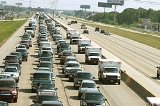
Emergency evacuation

Encyclopedia
Contamination
Contamination is the presence of a minor and unwanted constituent in material, physical body, natural environment, at a workplace, etc.-Specifics:"Contamination" also has more specific meanings in science:...
, evacuees may be decontaminated
Decontamination
Decontamination is the process of cleansing the human body to remove contamination by hazardous materials including chemicals, radioactive substances, and infectious material...
prior to being transported out of the contaminated area.
Reasons for evacuation
Evacuations may be carried out before, during or after natural disasters such as:- eruptions of volcanoes,
- cyclones
- floods,
- hurricanes,
- earthquakes or
- tsunamis.
Other reasons include:
- military attacksOffensive (military)An offensive is a military operation that seeks through aggressive projection of armed force to occupy territory, gain an objective or achieve some larger strategic, operational or tactical goal...
, - industrial accidents,
- chemical spill
- nuclear accident
- traffic accidents, including trainTrain wreckA train wreck or train crash is a type of disaster involving one or more trains. Train wrecks often occur as a result of miscommunication, as when a moving train meets another train on the same track; or an accident, such as when a train wheel jumps off a track in a derailment; or when a boiler...
or aviation accidentsAviation accidents and incidentsAn aviation accident is defined in the Convention on International Civil Aviation Annex 13 as an occurrence associated with the operation of an aircraft which takes place between the time any person boards the aircraft with the intention of flight and all such persons have disembarked, in which a...
, - fireFireFire is the rapid oxidation of a material in the chemical process of combustion, releasing heat, light, and various reaction products. Slower oxidative processes like rusting or digestion are not included by this definition....
, - bombings,
- terrorist attacks
- military battleBattleGenerally, a battle is a conceptual component in the hierarchy of combat in warfare between two or more armed forces, or combatants. In a battle, each combatant will seek to defeat the others, with defeat determined by the conditions of a military campaign...
s - structural failureStructural failureStructural failure refers to loss of the load-carrying capacity of a component or member within a structure or of the structure itself. Structural failure is initiated when the material is stressed to its strength limit, thus causing fracture or excessive deformations...
- viral outbreakPandemicA pandemic is an epidemic of infectious disease that is spreading through human populations across a large region; for instance multiple continents, or even worldwide. A widespread endemic disease that is stable in terms of how many people are getting sick from it is not a pandemic...
Planning
Emergency evacuation plans are developed to ensure the safest and most efficient evacuation time of all expected residents of a structure, city, or region. A benchmark "evacuation time" for different hazards and conditions is established. These benchmarks can be established through using best practices, regulations, or using simulationsEvacuation process simulation
Evacuation simulation is a method to determine evacuation times for areas, buildings, or vessels. It is based on the simulation of crowd dynamics and pedestrian motion....
, such as modeling the flow of people in a building, to determine the benchmark. Proper planning will use multiple exits, contra-flow lanes, and special technologies to ensure full, fast and complete evacuation. Consideration for personal situations which may affect an individual's ability to evacuate. These may include alarm signals that use both aural and visual alerts. Regulations such as building codes can be used to reduce the possibility of panic
Panic
Panic is a sudden sensation of fear which is so strong as to dominate or prevent reason and logical thinking, replacing it with overwhelming feelings of anxiety and frantic agitation consistent with an animalistic fight-or-flight reaction...
by allowing individuals to process the need to self-evacuate without causing alarm. Proper planning will implement an all-hazards approach so that plans can be reused for multiple hazards that could exist.
Evacuation sequence
The sequence of an evacuation can be divided into the following phases:- detection
- decision
- alarm
- reaction
- movement to an area of refuge or an assembly station
- transportation
The time for the first four phases is usually called pre-movement time
Pre-movement time
Pre-movement time is the time before, and the concomitant events and situational analyses prior to, an evacuation of an area. The term is generally used in referring to large-scale evacuations where the necessity thereof is foreseen...
.
The particular phases are different for different objects, e.g., for ships a distinction between assembly and embarkation (to boats or rafts) is made. These are separate from each other. The decision whether to enter the boats or rafts is thus usually made after assembly is completed.
Small scale evacuations
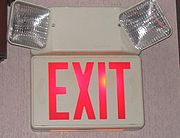
The most common equipment in buildings to facilitate emergency evacuations are fire alarms, exit sign
Exit sign
An exit sign is a device in a public facility denoting the location of the emergency exit , guiding people to the closest exit in case of fire or other emergency. Most relevant codes require exit signs to be permanently lit...
s, and emergency light
Emergency light
An emergency light is a battery-backed lighting device that comes on automatically when a building experiences a power outage. Emergency lights are standard in new commercial and high occupancy residential buildings, such as college dormitories...
s. Some structures need special emergency exit
Emergency exit
An emergency exit in a structure is a special exit for emergencies such as a fire: the combined use of regular and special exits allows for faster evacuation, while it also provides an alternative if the route to the regular exit is blocked by fire, etc....
or fire escape
Fire escape
A fire escape is a special kind of emergency exit, usually mounted to the outside of a building or occasionally inside but separate from the main areas of the building. It provides a method of escape in the event of a fire or other emergency that makes the stairwells inside a building inaccessible...
s to ensure the availability of alternative escape paths. Commercial passenger vehicles such as buses, boats, and aircraft also often have evacuation lighting and signage, and in some cases window
Window
A window is a transparent or translucent opening in a wall or door that allows the passage of light and, if not closed or sealed, air and sound. Windows are usually glazed or covered in some other transparent or translucent material like float glass. Windows are held in place by frames, which...
s or extra doors that function as emergency exits. Commercial emergency aircraft evacuation
Emergency aircraft evacuation
Emergency aircraft evacuation refers to emergency evacuation from an aircraft which may take place on the ground, in water, or mid-flight. There are standard evacuation procedures and special evacuation equipment.-Commercial airplanes:...
is also facilitated by evacuation slide
Evacuation slide
An evacuation slide is an inflatable slide used to evacuate an aircraft quickly. An escape slide is required on all commercial aircraft where the door sill height is such that, in the event of an evacuation, passengers would be unable to "step down" from the door uninjured An evacuation slide is...
s and pre-flight safety briefings. Military aircraft are often equipped with ejection seats or parachutes
Parachutes
Parachutes is the debut album by English alternative rock band Coldplay, released by the record label Parlophone on 10 July 2000 in the United Kingdom. The album was produced by the band and British record producer Ken Nelson, excluding one track which was produced by Chris Allison...
. Water vessels and commercial aircraft that fly over water are often equipped with personal flotation device
Personal flotation device
A personal flotation device is a device designed to assist a wearer, either conscious or unconscious, to keep afloat.Devices designed and approved by authorities for use by...
s and possibly life raft
Lifeboat (shipboard)
A lifeboat is a small, rigid or inflatable watercraft carried for emergency evacuation in the event of a disaster aboard ship. In the military, a lifeboat may be referred to as a whaleboat, dinghy, or gig. The ship's tenders of cruise ships often double as lifeboats. Recreational sailors sometimes...
s.
Large scale evacuations
The evacuation of districts is part of disaster management. Many of the largest evacuationsHistorical examples of large/mass evacuations of areas
The list of mass evacuations includes emergency evacuations of a large number of people in a short period of time. An emergency evacuation is the movement of persons from a dangerous place due to the threat or occurrence of a disastrous event whether from natural or man made causes or as the result...
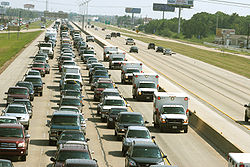
have been in the face of war-time military attacks. Modern large scale evacuations are usually the result of natural disasters. The largest peace-time evacuations in the United States to date occurred during Hurricane Gustav
Hurricane Gustav
The name Gustav has been used for five tropical cyclones in the Atlantic Ocean:* 1984's Tropical Storm Gustav - Spent most of its existence as a tropical depression hovering over Bermuda, no major damage was reported....
and the category-5
Tropical cyclone scales
Tropical systems are officially ranked on one of several tropical cyclone scales according to their maximum sustained winds and in what oceanic basin they are located...
Hurricane Rita
Hurricane Rita
Hurricane Rita was the fourth-most intense Atlantic hurricane ever recorded and the most intense tropical cyclone ever observed in the Gulf of Mexico. Rita caused $11.3 billion in damage on the U.S. Gulf Coast in September 2005...
(2005) in a scare one month after the flood-deaths of Hurricane Katrina
Hurricane Katrina
Hurricane Katrina of the 2005 Atlantic hurricane season was a powerful Atlantic hurricane. It is the costliest natural disaster, as well as one of the five deadliest hurricanes, in the history of the United States. Among recorded Atlantic hurricanes, it was the sixth strongest overall...
.
Hurricane evacuations

United States
The United States of America is a federal constitutional republic comprising fifty states and a federal district...
, as Hurricane Katrina
Hurricane Katrina
Hurricane Katrina of the 2005 Atlantic hurricane season was a powerful Atlantic hurricane. It is the costliest natural disaster, as well as one of the five deadliest hurricanes, in the history of the United States. Among recorded Atlantic hurricanes, it was the sixth strongest overall...
approached. Even after the city was flooded and uninhabitable, some people still refused to leave their homes.
The longer a person has lived in a coastal area, the less likely they are to evacuate. A hurricane's path is difficult to predict. Forecasters know about hurricanes days in advance, but their forecasts of where the storm will hit are only educated guesses. Hurricanes give a lot of warning time compared to most disasters humans experience. However, this allows forecasters and officials to "cry wolf," making people take evacuation orders less seriously. Hurricanes can be predicted to hit a coastal town many times without the town ever actually experiencing the brunt of a storm. If evacuation orders are given too early, the hurricane can change course and leave the evacuated area unscathed. People may think they have weathered hurricanes before, when in reality the hurricane didn't hit them directly, giving them false confidence. Those who have lived on the coast for ten or more years are the most resistant to evacuating. http://64.233.161.104/search?q=cache:dmakGqrXA9sJ:www.scseagrant.org/pdf_files/ch_summer_02.pdf+hurricane+evacuation+refuse+old-timers&hl=en&client=firefox-a
Public transportation
Since Hurricane Katrina, there has been an increase in evacuation planning. Current best practices include the need to use multi-modal transportation networks. Hurricane GustavHurricane Gustav
The name Gustav has been used for five tropical cyclones in the Atlantic Ocean:* 1984's Tropical Storm Gustav - Spent most of its existence as a tropical depression hovering over Bermuda, no major damage was reported....
used military airlift resources to facilitate evacuating people out of the affected area. More complex evacuation planning is now being considered, such as using elementary schools as rally points for evacuation. In the United States, elementary schools are usually more numerous in a community than other public structures. Their locations and inherent design to accommodate bus transportation makes it an ideal evacuation point.
Registries
Most local communities maintain registries for special needs individuals. These opt-in registries help with planning, as those that need government evacuation assistance are identified before the disaster. Registries used after a disaster are being used to help reunite families that have become separated after a disaster.Enforcing evacuation orders
In the United States a person cannot be forced to evacuate under most conditions. To facilitate voluntary compliance with mandatory evacuation orders first responders and disaster management officials have used creative techniques such as asking people for the names and contact of their next of kin, writing their Social Security Numbers on their limbs and torso so that their remains can be identified, and refusing to provide government services in the affected area, including emergency services.Personal Evacuation Kits
In case of an emergency evacuation situation, it is important to have an individual emergency evacuation kit prepared and on hand prior to the emergency. An emergency evacuation kit is a container of food, clothing, water, and other supplies that can be used to sustain an individual during lag time. Lag time is the period between the actual occurrence of an emergency and when organized help becomes available, generally 72 hours, though this can vary from a few hours to several days. It may take this long for authorities to get evacuation shelters fully up and functional. During this time, evacuees may suffer fairly primitive conditions; no clean water, heat, lights, toilet facilities, or shelter. An emergency evacuation kit, or 72-hour kit, can help evacuees to endure the evacuation experience with dignity and a degree of comfort.See also
- Civil defenseCivil defenseCivil defense, civil defence or civil protection is an effort to protect the citizens of a state from military attack. It uses the principles of emergency operations: prevention, mitigation, preparation, response, or emergency evacuation, and recovery...
- Emergency ManagementEmergency managementEmergency management is the generic name of an interdisciplinary field dealing with the strategic organizational management processes used to protect critical assets of an organization from hazard risks that can cause events like disasters or catastrophes and to ensure the continuance of the...
- Evacuation process simulationEvacuation process simulationEvacuation simulation is a method to determine evacuation times for areas, buildings, or vessels. It is based on the simulation of crowd dynamics and pedestrian motion....
- List of mass evacuations
- Air safety#Emergency airplane evacuations
- Shelter in placeShelter in PlaceShelter in place is a process for taking immediate shelter in a location readily accessible to the affected individual by sealing a single area from outside contaminants and shutting off all HVAC systems. These actions would generally be taken after a chemical accident or terrorist attack...
External links
- The International Emergency Management Society
- A bibliography for pedestrian simulation and evacuation dynamics
- Fire Safety Engineering Group at the University of Greenwich
- PESOS and BYPASS, research projects concerning the "Evacuation of Passenger Ships" (University Duisburg-Essen, Germany)
- Panic Simulation (Budapest University)
- Dirk Helbing's homepage
- City evacuation study, Tokyo Institute of Technology
- Decontamination - prior to evacuation where possible.
- Evacuation routes for the US by state.