


Epistle to the Romans

Encyclopedia
The Epistle of Paul to the Romans, often shortened to Romans, is the sixth book in the New Testament
. Biblical scholars agree that it was composed by the Apostle Paul to explain that Salvation
is offered through the Gospel of Jesus Christ. It is by far the longest of the Pauline epistles
, and is considered his "most important theological legacy".
scholar Joseph Fitzmyer
, "overwhelms the reader by the density and sublimity of the topic with which it deals, the gospel of the justification and salvation of Jew and Greek alike by the grace of God through faith in Jesus Christ, revealing the uprightness and love of God the father
." N. T. Wright notes that Romans is
Paul addresses the faithfulness of God
to Israel
, where he says that God has been faithful to His promise. Paul hopes that all of Israel will come to realize the truth since he himself was also an Israelite and had in the past been a persecutor of Early Christians. These verses could also be indicating that, even though Jews do not believe that Jesus is the Messiah, since they still believe in God, they will be saved (see dual-covenant theology
). In , Paul talks about how the nation of Israel has been cast away
, and the conditions under which Israel will be God's chosen nation again: when the Israel returns to its faith, sets aside its unbelief.
The main theme of this letter is the Salvation offered through the Gospel of Jesus Christ. Paul argues that all persons are guilty of sin
and therefore accountable to God. It is only through the death and resurrection of Jesus Christ that sinners can attain salvation. Therefore, God is both just and the one who justifies. In response to God's free, sovereign and graceful action of salvation, humanity can be justified by faith. Paul uses the example of Abraham
to demonstrate that it is by faith that humanity can be seen as righteous before God.
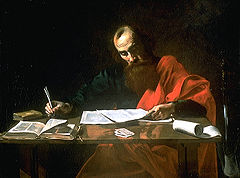
The letter was most probably written while Paul was in Corinth, and probably while he was staying in the house of Gaius and transcribed by Tertius
his amanuensis
. There are a number of reasons Corinth is most plausible. Paul was about to travel to Jerusalem
on writing the letter, which matches Acts where it is reported that Paul stayed for three months in Greece. This probably implies Corinth as it was the location of Paul’s greatest missionary success in Greece. Additionally Phoebe
was a deacon of the church in Cenchreae, a port to the east of Corinth, and would have been able to convey the letter to Rome after passing through Corinth and taking a ship from Corinth’s west port. Erastus, mentioned in , also lived in Corinth being the city's commissioner for public works and city treasurer at various times, again indicating that the letter was written in Corinth.
The precise time at which it was written is not mentioned in the epistle, but it was obviously written when the collection for Jerusalem had been assembled and Paul was about to "go unto Jerusalem to minister unto the saints", that is, at the close of his second visit to Greece
, during the winter preceding his last visit to that city. The majority of scholars writing on Romans propose the letter was written in late 55/early 56 or late 56/early 57. Early 58 and early 55 both have some support, while German New Testament scholar Gerd Lüdemann
argues for a date as early as 51/52 (or 54/55) following on from Knox who proposed 53/54. Lüdemann is the only serious challenge to the consensus of mid to late 50s.
evangelising. Churches had been planted in the Roman provinces of Galatia
, Macedonia
, Achaia
and Asia. Paul, considering his task complete, wanted to preach the gospel in Spain, where he would not "build upon another man’s foundation". This allowed him to visit Rome on the way, a long time ambition of his. The letter to the Romans, in part, prepares them and gives reasons for his visit.
In addition to Paul’s geographic location, his religious views are important. First, Paul was a Hellenistic Jew with a Pharisaic background (see Gamaliel
), integral to his identity, see Paul of Tarsus and Judaism
for details. His concern for his people is one part of the dialogue and runs throughout the letter. Second, the other side of the dialogue is Paul’s conversion and calling to follow Christ in the early 30s.
’:
From Adam Clarke:
At this time, the Jews made up a substantial number in Rome, and their synagogue
s, frequented by many, enabled the Gentiles to become acquainted with the story of Jesus of Nazareth
. Consequently, a church composed of both Jews and Gentile
s was formed at Rome. According to Irenaeus
, a 2nd century Church Father, the church at Rome was founded directly by the apostles Peter and Paul
. However, many modern scholars disagree with Irenaeus, holding that while little is known of the circumstances of the church's founding, it was not founded by Paul.
Many of the brethren went out to meet Paul on his approach to Rome. There is evidence that Christians were then in Rome in considerable numbers and probably had more than one place of meeting.
Jews were expelled from Rome because of Christian disturbances around AD 49 by the edict
of Claudius
. The conflict developed because Jewish Christians
and Jews argued with one another over the validity of Jesus as the Messiah, see also Rejection of Jesus
. Both Jews and Jewish Christians were expelled as a result of their infighting. The majority of people left in the Christian church at Rome would have been Gentile Christians. These gentile churches developed along a different trajectory from the Christian circles that grew out of Jewish synagogues.
Claudius
died around the year AD 54, and his successor, Emperor Nero, allowed the Jews back into Rome, but then, after the Great Fire of Rome
of 64, persecuted the Christians. Gentile Christians may have developed a dislike of or looked down on Jews (see also Antisemitism and Responsibility for the death of Jesus), because they theologically rationalized that Jews were no longer God's people
. Fitzmyer argues that with the return of the Jews to Rome in 54 new conflict arose between the Gentile Christians and the Jewish Christians who had formerly been expelled. Historians question whether the Roman government distinguished between Christians and Jews prior to Nerva's modification of the Fiscus Judaicus
in 96 (Jews paid the tax, Christians did not).
The Roman church would have to accept that the gospel
was for the "Jew first and also to the Greek."
:
However, the Apostle himself would disdain any such disputing about words or terminology, which serves only to turn us away from the important doctrine that really matters. In his first letter/epistle to the young believer Timothy, Paul warned:
William Tyndale
, the Lollard reformer who translated the Greek scriptures into English in the 16th century and whose translation formed the basis for the Geneva Bible
and the King James Version, explained in his prologue to Paul's letter to Timothy that people should avoid "vain questions":
Joseph Fitzmyer argues, from evidence put forth by Stirewalt, that the style of Romans is an "essay-letter." Philip Melanchthon, a writer during the Reformation
, suggested that Romans was caput et summa universae doctrinae christianae ("a summary of all Christian doctrine"). While some scholars attempt to suggest, like Melanchthon, that it is a type of theological treatise, this view largely ignores chapters 14 and 15 of Romans. There are also many "noteworthy elements" missing from Romans that are included in other areas of the Pauline corpus. The breakdown of Romans as a treatise began with F.C. Baur in 1836 when he suggested "this letter had to be interpreted according to the historical circumstances in which Paul wrote it."
Paul sometimes uses a style of writing common in his time called a "diatribe". He appears to be responding to a "heckler", and the letter is structured as a series of arguments. In the flow of the letter, Paul shifts his arguments, sometimes addressing the Jewish members of the church, sometimes the Gentile membership and sometimes the church as a whole.
The purposes of the apostle in dictating this letter to his Amanuensis
Tertius is also articulated in the second half of :
To review the current scholarly viewpoints on the purpose of Romans, along with a bibliography, see Dictionary of Paul and His Letters. For a 16th century "Lollard" reformer view, reference can be made to the work of
William Tyndale
. In his prologue to his translation of the book of Romans, which was largely taken from the prologue of German Reformer Martin Luther
, Tyndale writes that:
. Paul, however, does not limit his ministry to Jews. Paul's goal is that the gentiles would also hear the gospel
. He commends the Romans for their faith
. Paul also speaks of the past obstacles that have blocked his coming to Rome earlier.
is still debated. We are hard-pressed to find an answer to such a question without knowing more about the audience in question. Wayne Brindle argues, based on Paul's former writings against the Judaizers
in Galatians
and 2 Corinthians, that rumors had probably spread about Paul totally negating the Jewish existence in a Christian world, see also Antinomianism in the New Testament and Supersessionism
. Paul may have used the "Jew first" approach to counter such a view.
. People have taken God's invisible image and made him into an idol. Paul draws heavily here from the Wisdom of Solomon. He condemns unnatural sexual behavior and warns that such behavior will result in a depraved body and mind and says that people who do such things (including murder and wickedness ) are worthy of death. Paul stands firmly against the idol worship system which was common in Rome
. He also goes on to say that a righteousness from God has made itself known apart from the law, to which the law
and prophets testify, and this righteousness from God comes through faith in Jesus to all whom believe.
would have identified ho alazon with Judaism. That popular interpretation depends upon anachronistically reading later Christian characterizations of Jews as 'hypocritical Pharisees
'". See also Anti-Judaism
.
of their hope
in salvation
, having been freed from the bondage of sin. Paul teaches that through faith
, the faithful have been joined with Jesus and freed from sin. Believers should celebrate in the assurance of salvation. This promise is open to everyone since everyone has sinned, save the one who paid for all of them.
In Paul addresses the faithfulness of God
to Israel
, where he says that God has been faithful to His promise. Paul hopes that all of Israel will come to realize the truth since he himself was also an Israelite, and had in the past been a persecutor of Early Christians. These verses could also be saying that even though Jews do not believe that Jesus is the Messiah
, since they still believe in God, they will be saved (see also Dual-covenant theology
). In Paul talks about how the nation of Israel has been cast away, and the conditions under which Israel will be God's chosen nation again: when Israel returns to its faith, sets aside its unbelief.
"), according to an antinomistic interpretation.
From chapter 12 through the first part of chapter 15, Paul outlines how the Gospel
transforms believers and the behaviour that results from such a transformation. He goes on to describe how believers should live: not under the law, but under the grace of God, see Law and grace. If believers live in obedience
to God, study the scriptures, (and share them with others) and love everybody
, believers are not going to need to sin
. As Paul
says in , "love (ἀγάπη
) worketh no ill to his neighbor: therefore love is the fulfilling of law". The fragment in dealing with obedience to earthly powers is considered by some to be a gloss incorporated later. See also the Great Commandment
and Christianity and politics
.
, some of whom played an important role in the early church at Rome.
Additionally, none of these Christians answer to the name Peter
, although according to the Catholic storyline, he had been ruling as Pope
in Rome for about 25 years. Possibly related was the Incident at Antioch between Paul and Peter.
as well:
Throughout his writings, St. Augustine strongly affirms the Catholic understanding of this and other such Scriptural admonitions. In his sermons to his Catholic congregations, he is especially careful to warn them against an inordinate desire for a complete assurance of salvation. In his Exposition of Psalm 147 for example, he states:
Again, in his Exposition of Psalm 85, Augustine is perhaps even more specific:
They also point out that in , Paul says that God will reward those who follow the law and then goes on to say that no one follows the law perfectly (see also Sermon on the Mount: Interpretation)
Martin Luther
described Paul's letter to the Romans as the "most important piece in the New Testament. It is purest Gospel. It is well worth a Christian's while not only to memorize it word for word but also to occupy himself with it daily, as though it were the daily bread of the soul".
Luther controversially added the word "alone" (allein in German) to so that it read: "thus, we hold, then, that man is justified without doing the works of the law, alone through faith". The word "alone" does not appear in the original Greek text
, but Luther defended his translation by maintaining that the adverb "alone" was required both by idiomatic German and Paul's intended meaning. This is a "literalist view" rather than an literal view
of the Bible.
The Romans Road refers to a set of scriptures from Romans that Christian evangelists use to present a clear and simple case for personal salvation for each person.
Romans has been at the forefront of several major movements in Protestantism. Martin Luther
's lectures on Romans in 1515–1516 probably coincided with the development of his criticism of Roman Catholicism
which led to the 95 Theses
of 1517. In 1738, while hearing Luther's Preface to the Epistle to the Romans read at St. Botolph Church on Aldersgate Street in London, John Wesley
famously felt his heart "strangely warmed", a conversion experience which is often seen as the beginning of Methodism
. In 1919 Karl Barth
's commentary on Romans, The Epistle to the Romans
, was the publication which is widely seen as the beginning of neo-orthodoxy
.
Other
New Testament
The New Testament is the second major division of the Christian biblical canon, the first such division being the much longer Old Testament....
. Biblical scholars agree that it was composed by the Apostle Paul to explain that Salvation
Salvation
Within religion salvation is the phenomenon of being saved from the undesirable condition of bondage or suffering experienced by the psyche or soul that has arisen as a result of unskillful or immoral actions generically referred to as sins. Salvation may also be called "deliverance" or...
is offered through the Gospel of Jesus Christ. It is by far the longest of the Pauline epistles
Pauline epistles
The Pauline epistles, Epistles of Paul, or Letters of Paul, are the thirteen New Testament books which have the name Paul as the first word, hence claiming authorship by Paul the Apostle. Among these letters are some of the earliest extant Christian documents...
, and is considered his "most important theological legacy".
General presentation
The book, according to JesuitSociety of Jesus
The Society of Jesus is a Catholic male religious order that follows the teachings of the Catholic Church. The members are called Jesuits, and are also known colloquially as "God's Army" and as "The Company," these being references to founder Ignatius of Loyola's military background and a...
scholar Joseph Fitzmyer
Joseph Fitzmyer
Rev. Joseph Augustine Fitzmyer, S.J., is a priest of the Society of Jesus and a New Testament scholar.He entered the Maryland Province, made his novitiate in Wernersville, PA, and was ordained on July 30, 1938. His academic studies were done at Loyola University of Chicago; Facultes St-Albert de...
, "overwhelms the reader by the density and sublimity of the topic with which it deals, the gospel of the justification and salvation of Jew and Greek alike by the grace of God through faith in Jesus Christ, revealing the uprightness and love of God the father
God the Father
God the Father is a gendered title given to God in many monotheistic religions, particularly patriarchal, Abrahamic ones. In Judaism, God is called Father because he is the creator, life-giver, law-giver, and protector...
." N. T. Wright notes that Romans is
Paul addresses the faithfulness of God
God
God is the English name given to a singular being in theistic and deistic religions who is either the sole deity in monotheism, or a single deity in polytheism....
to Israel
Israel
The State of Israel is a parliamentary republic located in the Middle East, along the eastern shore of the Mediterranean Sea...
, where he says that God has been faithful to His promise. Paul hopes that all of Israel will come to realize the truth since he himself was also an Israelite and had in the past been a persecutor of Early Christians. These verses could also be indicating that, even though Jews do not believe that Jesus is the Messiah, since they still believe in God, they will be saved (see dual-covenant theology
Dual-covenant theology
Dual-covenant theology is a Liberal Christian view that holds that Jews may simply keep the Law of Moses, because of the "everlasting covenant" between Abraham and God expressed in the Hebrew Bible, whereas Gentiles must convert to Christianity or alternatively accept the Seven Laws of Noah...
). In , Paul talks about how the nation of Israel has been cast away
Supersessionism
Supersessionism is a term for the dominant Christian view of the Old Covenant, also called fulfillment theology and replacement theology, though the latter term is disputed...
, and the conditions under which Israel will be God's chosen nation again: when the Israel returns to its faith, sets aside its unbelief.
The main theme of this letter is the Salvation offered through the Gospel of Jesus Christ. Paul argues that all persons are guilty of sin
Sin
In religion, sin is the violation or deviation of an eternal divine law or standard. The term sin may also refer to the state of having committed such a violation. Christians believe the moral code of conduct is decreed by God In religion, sin (also called peccancy) is the violation or deviation...
and therefore accountable to God. It is only through the death and resurrection of Jesus Christ that sinners can attain salvation. Therefore, God is both just and the one who justifies. In response to God's free, sovereign and graceful action of salvation, humanity can be justified by faith. Paul uses the example of Abraham
Abraham
Abraham , whose birth name was Abram, is the eponym of the Abrahamic religions, among which are Judaism, Christianity and Islam...
to demonstrate that it is by faith that humanity can be seen as righteous before God.
Dating
The letter was most probably written while Paul was in Corinth, and probably while he was staying in the house of Gaius and transcribed by Tertius
Tertius
Tertius is Latin word for "third", or "concerning the third".-In law:The term is used in contract law to refer to an interested third party not privy to a contract...
his amanuensis
Amanuensis
Amanuensis is a Latin word adopted in various languages, including English, for certain persons performing a function by hand, either writing down the words of another or performing manual labour...
. There are a number of reasons Corinth is most plausible. Paul was about to travel to Jerusalem
Jerusalem in Christianity
For Christians, Jerusalem's place in the ministry of Jesus and the Apostolic Age gives it great importance, in addition to its place in the Old Testament, the Hebrew Bible.-Jerusalem in the New Testament and early Christianity:...
on writing the letter, which matches Acts where it is reported that Paul stayed for three months in Greece. This probably implies Corinth as it was the location of Paul’s greatest missionary success in Greece. Additionally Phoebe
Phoebe (Christian woman)
Phoebe was a Christian woman mentioned by the Apostle Paul in Romans 16:1.Some have interpreted the Greek "diakonos" to relate Phoebe as a deacon, the most literal interpretation of the word is as a servant which is what all deacons...
was a deacon of the church in Cenchreae, a port to the east of Corinth, and would have been able to convey the letter to Rome after passing through Corinth and taking a ship from Corinth’s west port. Erastus, mentioned in , also lived in Corinth being the city's commissioner for public works and city treasurer at various times, again indicating that the letter was written in Corinth.
The precise time at which it was written is not mentioned in the epistle, but it was obviously written when the collection for Jerusalem had been assembled and Paul was about to "go unto Jerusalem to minister unto the saints", that is, at the close of his second visit to Greece
Greece
Greece , officially the Hellenic Republic , and historically Hellas or the Republic of Greece in English, is a country in southeastern Europe....
, during the winter preceding his last visit to that city. The majority of scholars writing on Romans propose the letter was written in late 55/early 56 or late 56/early 57. Early 58 and early 55 both have some support, while German New Testament scholar Gerd Lüdemann
Gerd Lüdemann
Gerd Lüdemann , is a German New Testament scholar. He taught this subject from 1983 to 1999 at the Faculty of Theology of the University of Göttingen. Since 1999 he has taught there with a special status as Chair of History and Literature of Early Christianity...
argues for a date as early as 51/52 (or 54/55) following on from Knox who proposed 53/54. Lüdemann is the only serious challenge to the consensus of mid to late 50s.
Subscriptions
Some manuscripts have a subscription at the end of the Epistle:- προς Ρωμαιους ("to the Romans") is found in these manuscripts: Codex SinaiticusCodex SinaiticusCodex Sinaiticus is one of the four great uncial codices, an ancient, handwritten copy of the Greek Bible. It is an Alexandrian text-type manuscript written in the 4th century in uncial letters on parchment. Current scholarship considers the Codex Sinaiticus to be one of the best Greek texts of...
, Codex AlexandrinusCodex AlexandrinusThe Codex Alexandrinus is a 5th century manuscript of the Greek Bible,The Greek Bible in this context refers to the Bible used by Greek-speaking Christians who lived in Egypt and elsewhere during the early history of Christianity...
, Codex VaticanusCodex VaticanusThe Codex Vaticanus , is one of the oldest extant manuscripts of the Greek Bible , one of the four great uncial codices. The Codex is named for the residence in the Vatican Library, where it has been stored since at least the 15th century...
, Codex Ephraemi RescriptusCodex Ephraemi RescriptusCodex Ephraemi Rescriptus is an early 5th century Greek manuscript of the Bible, the last in the group of the four great uncial manuscripts...
, Codex BezaeCodex BezaeThe Codex Bezae Cantabrigensis, designated by siglum Dea or 05 , δ 5 , is a codex of the New Testament dating from the 5th century written in an uncial hand on vellum. It contains, in both Greek and Latin, most of the four Gospels and Acts, with a small fragment of the 3 John...
; - προς Ρωμαιους εγραφη απο Κορινθου ("to the Romans it was written from Corinth"): B2, D2 (P);
- προς Ρωμαιους εγραφη απο Κορινθου δια Φοιβης της διακονου ("to the Romans it was written from Corinth by Phoebus the deacon"): 42Minuscule 42Minuscule 42 , α107 , known as Codex Maedicaeus is a Greek minuscule manuscript of the New Testament on parchment...
, 90Minuscule 90Minuscule 90 , δ 652 , known as Codex Jo. Fabri, is a Greek minuscule manuscript of the New Testament, on paper leaves. Palaeographically it has been assigned to the 16th century. It has full marginalia....
, 216Minuscule 216Minuscule 216 , α 469 , is a Greek minuscule manuscript of the New Testament, on paper. It is dated by a colophon to the year 1358. It has marginalia.- Description :...
, 339Minuscule 339Minuscule 339 , δ 303 , is a Greek minuscule manuscript of the New Testament, on parchment. Paleographically it has been assigned to the 13th century.It has marginalia.- Description :...
, 462Minuscule 462Minuscule 462 , α 359 , is a Greek minuscule manuscript of the New Testament, on a paper...
, 466*Minuscule 466Minuscule 466 , α 167 , is a Greek minuscule manuscript of the New Testament, on parchment. Palaeographically it has been assigned to the 11th century...
, 642Minuscule 642Minuscule 642 , α 552 , is a Greek minuscule manuscript of the New Testament, on paper. Palaeographically it has been assigned to the 14th century. The manuscript is lacunose...
; - εγραφη η προς Ρωμαιους επιστολη δια Τερτιου επεμφτη δε δια Φοιβης απο Κορινθιων της εν Κεγχρεαις εκκλησιας ("the epistle to the Romans was written by Tertius and was sent by Phoebus from the Corinthians of the church in CenchreaeKechriesKechries is a village in the municipality of Corinth in Corinthia in Greece. It is part of the community of Xylokeriza...
"): only in 337Minuscule 337Minuscule 337 , ε 205 , is a Greek minuscule manuscript of the New Testament, on parchment. Paleographically it has been assigned to the 12th century.Formerly it was labelled by 51a, 133p, and 52r.It has marginalia....
; - προς Ρωμαιους εγραφη απο Κορινθου δια Φοιβης της διακονου της εν Κεγχρεαις εκκλησιας ("to the Romans it was written from Corinth by Phoebus the deacon of the church in Cenchreae"): 101Minuscule 101Minuscule 101 , O17 , is a Greek minuscule manuscript of the New Testament, on parchment leaves. Palaeographically it has been assigned to the 11th century. Former Codex Uffenbachianum 3...
, 241Minuscule 241Minuscule 241 , δ 507 , is a Greek minuscule manuscript of the New Testament, on parchment. Palaeographically it has been assigned to the 11th century. Formerly it was labelled by 241e, 104a, 120p, and 47r....
, 460Minuscule 460Minuscule 460 , α 397 , is a Greek-Latin-Arabic minuscule manuscript of the New Testament, on parchment. The manuscript is lacunose...
, 466Minuscule 466Minuscule 466 , α 167 , is a Greek minuscule manuscript of the New Testament, on parchment. Palaeographically it has been assigned to the 11th century...
, 469Minuscule 469Minuscule 469 , α 306 , is a Greek minuscule manuscript of the New Testament, on parchment. Palaeographically it has been assigned to the 13th century.It was adapted for liturgical use...
, 602Minuscule 602Minuscule 602 , α 61 , is a Greek minuscule manuscript of the New Testament, on parchment. Palaeographically it has been assigned to the 10th century. The manuscript is very lacunose...
, 603Minuscule 603Minuscule 603 , α 61 , is a Greek minuscule manuscript of the New Testament, on paper. Palaeographically it has been assigned to the 14th century. The manuscript is lacunose...
, 605Minuscule 605Minuscule 605 , O 5 , is a Greek minuscule manuscript of the New Testament, on parchment. Palaeographically it has been assigned to the 10th century. The manuscript has complex contents...
, 618Minuscule 618Minuscule 618 , α 261 , is a Greek minuscule manuscript of the New Testament, on parchment. Palaeographically it has been assigned to the 12th century. The manuscript is lacunose...
, 1923, 1924, 1927, 1932, followed by Textus ReceptusTextus ReceptusTextus Receptus is the name subsequently given to the succession of printed Greek texts of the New Testament which constituted the translation base for the original German Luther Bible, the translation of the New Testament into English by William Tyndale, the King James Version, and for most other...
.
Context of Romans in Paul's life
For ten years before writing the letter (approx. 47-57), Paul had traveled around the territories bordering the Aegean SeaAegean Sea
The Aegean Sea[p] is an elongated embayment of the Mediterranean Sea located between the southern Balkan and Anatolian peninsulas, i.e., between the mainlands of Greece and Turkey. In the north, it is connected to the Marmara Sea and Black Sea by the Dardanelles and Bosporus...
evangelising. Churches had been planted in the Roman provinces of Galatia
Galatia
Ancient Galatia was an area in the highlands of central Anatolia in modern Turkey. Galatia was named for the immigrant Gauls from Thrace , who settled here and became its ruling caste in the 3rd century BC, following the Gallic invasion of the Balkans in 279 BC. It has been called the "Gallia" of...
, Macedonia
Macedonia (Roman province)
The Roman province of Macedonia was officially established in 146 BC, after the Roman general Quintus Caecilius Metellus defeated Andriscus of Macedon, the last Ancient King of Macedon in 148 BC, and after the four client republics established by Rome in the region were dissolved...
, Achaia
Achaea (Roman province)
Achaea, or Achaia, was a province of the Roman Empire, consisting of the Peloponnese, eastern Central Greece and parts of Thessaly. It bordered on the north by the provinces of Epirus vetus and Macedonia...
and Asia. Paul, considering his task complete, wanted to preach the gospel in Spain, where he would not "build upon another man’s foundation". This allowed him to visit Rome on the way, a long time ambition of his. The letter to the Romans, in part, prepares them and gives reasons for his visit.
In addition to Paul’s geographic location, his religious views are important. First, Paul was a Hellenistic Jew with a Pharisaic background (see Gamaliel
Gamaliel
Gamaliel the Elder , or Rabban Gamaliel I , was a leading authority in the Sanhedrin in the mid 1st century CE. He was the grandson of the great Jewish teacher Hillel the Elder, and died twenty years before the destruction of the Second Temple in Jerusalem...
), integral to his identity, see Paul of Tarsus and Judaism
Paul of Tarsus and Judaism
The relationship between Paul of Tarsus and Second Temple Judaism continues to be the subject of much scholarly research, as it is thought that Paul played an important role in the relationship between Christianity and Judaism as a whole...
for details. His concern for his people is one part of the dialogue and runs throughout the letter. Second, the other side of the dialogue is Paul’s conversion and calling to follow Christ in the early 30s.
The Church in Rome
The most probable ancient account of the beginning of Christianity in Rome is given by a 4th century writer known as ‘AmbrosiasterAmbrosiaster
Ambrosiaster is the name given to the writer of a commentary on St Paul's epistles, "brief in words but weighty in matter," and valuable for the criticism of the Latin text of the New Testament...
’:
It is established that there were Jews living in Rome in the times of the ApostlesApostolic AgeThe Apostolic Age of the history of Christianity is traditionally the period of the Twelve Apostles, dating from the Crucifixion of Jesus and the Great Commission in Jerusalem until the death of John the Apostle in Anatolia...
, and that those Jews who had believed [in Christ] passed on to the Romans the tradition that they ought to profess Christ but keep the law [Torah] … One ought not to condemn the Romans, but to praise their faith, because without seeing any signs or miracles and without seeing any of the apostles, they nevertheless accepted faith in Christ, although according to a Jewish riteJudaizersJudaizers is predominantly a Christian term, derived from the Greek verb ioudaïzō . This term is most widely known from the single use in the New Testament where Paul publicly challenges Peter for compelling Gentile believers to "judaize", also known as the Incident at Antioch.According to the...
.
From Adam Clarke:
The occasion of writing the epistle: … Paul had made acquaintance with all circumstances of the Christians at Rome … and finding that it was … partly of heathens converted to Christianity, and partly of JewsJewish ChristiansJewish Christians is a term which appears in historical texts contrasting Christians of Jewish origin with Gentile Christians, both in discussion of the New Testament church and the second and following centuries....
, who had, with many remaining prejudicesJudaizersJudaizers is predominantly a Christian term, derived from the Greek verb ioudaïzō . This term is most widely known from the single use in the New Testament where Paul publicly challenges Peter for compelling Gentile believers to "judaize", also known as the Incident at Antioch.According to the...
, believed in Jesus as the true Messiah, and that many contentions arose from the claims of the Gentiles to equal privileges with the Jews, and from absolute refusal of the Jews to admit these claims, unless the Gentile converts become circumcisedCircumcision controversy in early ChristianityThere is evidence of a controversy over religious male circumcision in Early Christianity. A Council of Jerusalem, possibly held in approximately 50 AD, decreed that male circumcision was not a requirement for Gentile converts. This became known as the "Apostolic Decree" and may be one of the...
; he wrote this epistle to adjust and settle these differences.
At this time, the Jews made up a substantial number in Rome, and their synagogue
Synagogue
A synagogue is a Jewish house of prayer. This use of the Greek term synagogue originates in the Septuagint where it sometimes translates the Hebrew word for assembly, kahal...
s, frequented by many, enabled the Gentiles to become acquainted with the story of Jesus of Nazareth
Jesus
Jesus of Nazareth , commonly referred to as Jesus Christ or simply as Jesus or Christ, is the central figure of Christianity...
. Consequently, a church composed of both Jews and Gentile
Gentile
The term Gentile refers to non-Israelite peoples or nations in English translations of the Bible....
s was formed at Rome. According to Irenaeus
Irenaeus
Saint Irenaeus , was Bishop of Lugdunum in Gaul, then a part of the Roman Empire . He was an early church father and apologist, and his writings were formative in the early development of Christian theology...
, a 2nd century Church Father, the church at Rome was founded directly by the apostles Peter and Paul
Paul of Tarsus
Paul the Apostle , also known as Saul of Tarsus, is described in the Christian New Testament as one of the most influential early Christian missionaries, with the writings ascribed to him by the church forming a considerable portion of the New Testament...
. However, many modern scholars disagree with Irenaeus, holding that while little is known of the circumstances of the church's founding, it was not founded by Paul.
Many of the brethren went out to meet Paul on his approach to Rome. There is evidence that Christians were then in Rome in considerable numbers and probably had more than one place of meeting.
Jews were expelled from Rome because of Christian disturbances around AD 49 by the edict
Edict
An edict is an announcement of a law, often associated with monarchism. The Pope and various micronational leaders are currently the only persons who still issue edicts.-Notable edicts:...
of Claudius
Claudius
Claudius , was Roman Emperor from 41 to 54. A member of the Julio-Claudian dynasty, he was the son of Drusus and Antonia Minor. He was born at Lugdunum in Gaul and was the first Roman Emperor to be born outside Italy...
. The conflict developed because Jewish Christians
Jewish Christians
Jewish Christians is a term which appears in historical texts contrasting Christians of Jewish origin with Gentile Christians, both in discussion of the New Testament church and the second and following centuries....
and Jews argued with one another over the validity of Jesus as the Messiah, see also Rejection of Jesus
Rejection of Jesus
The Canonical Gospels of the New Testament include some accounts of the rejection of Jesus in the course of his ministry. Judaism's view of Jesus, Jesus in Islam, and the view of the Historical Jesus all differ from Christian views of Jesus.-Hometown rejection:...
. Both Jews and Jewish Christians were expelled as a result of their infighting. The majority of people left in the Christian church at Rome would have been Gentile Christians. These gentile churches developed along a different trajectory from the Christian circles that grew out of Jewish synagogues.
Claudius
Claudius
Claudius , was Roman Emperor from 41 to 54. A member of the Julio-Claudian dynasty, he was the son of Drusus and Antonia Minor. He was born at Lugdunum in Gaul and was the first Roman Emperor to be born outside Italy...
died around the year AD 54, and his successor, Emperor Nero, allowed the Jews back into Rome, but then, after the Great Fire of Rome
Great Fire of Rome
The Great Fire of Rome was an urban fire that occurred beginning July 19, AD 64.-Background:According to Tacitus, the fire spread quickly and burned for six days. Only four of the fourteen districts of Rome escaped the fire; three districts were completely destroyed and the other seven suffered...
of 64, persecuted the Christians. Gentile Christians may have developed a dislike of or looked down on Jews (see also Antisemitism and Responsibility for the death of Jesus), because they theologically rationalized that Jews were no longer God's people
Supersessionism
Supersessionism is a term for the dominant Christian view of the Old Covenant, also called fulfillment theology and replacement theology, though the latter term is disputed...
. Fitzmyer argues that with the return of the Jews to Rome in 54 new conflict arose between the Gentile Christians and the Jewish Christians who had formerly been expelled. Historians question whether the Roman government distinguished between Christians and Jews prior to Nerva's modification of the Fiscus Judaicus
Fiscus Judaicus
The Fiscus Iudaicus or Fiscus Judaicus was a tax collecting agency instituted to collect the tax imposed on Jews in the Roman Empire after the destruction of the Temple of Jerusalem in 70 CE in favor of the temple of Jupiter Capitolinus in Rome.-Imposition:The tax was initially imposed by Roman...
in 96 (Jews paid the tax, Christians did not).
The Roman church would have to accept that the gospel
Gospel
A gospel is an account, often written, that describes the life of Jesus of Nazareth. In a more general sense the term "gospel" may refer to the good news message of the New Testament. It is primarily used in reference to the four canonical gospels of Matthew, Mark, Luke, and John...
was for the "Jew first and also to the Greek."
Style
While scholars are often able to determine aspects of the context of NT writers from their letters, it is much more difficult to understand Paul's letter to the Romans. Scholars often have difficulty assessing whether Romans is a letter or an epistleEpistle
An epistle is a writing directed or sent to a person or group of people, usually an elegant and formal didactic letter. The epistle genre of letter-writing was common in ancient Egypt as part of the scribal-school writing curriculum. The letters in the New Testament from Apostles to Christians...
:
A letter is something non-literary, a means of communication between persons who are separated from each other. Confidential and personal in nature, it is intended only for the person or persons to whom it is addressed, and not at all for the public or any kind of publicity...An Epistle is an artistic literary form, just like the dialogue, the oration, or the drama. It has nothing in common with the letter except its form: apart from that one might venture the paradox that the epistle is the opposite of a real letter. The contents of the epistle are intended for publicity—they aim at interesting "the public."
However, the Apostle himself would disdain any such disputing about words or terminology, which serves only to turn us away from the important doctrine that really matters. In his first letter/epistle to the young believer Timothy, Paul warned:
These things [i.e., doctrines and truths] teach and exhort. If any man teach otherwise, and is not content with the wholesome words of our Lord Jesus Christ, and with the doctrine of godliness, he is puffed up and knoweth nothing: but wasteth his brains about questions and strife of words...
William Tyndale
William Tyndale
William Tyndale was an English scholar and translator who became a leading figure in Protestant reformism towards the end of his life. He was influenced by the work of Desiderius Erasmus, who made the Greek New Testament available in Europe, and by Martin Luther...
, the Lollard reformer who translated the Greek scriptures into English in the 16th century and whose translation formed the basis for the Geneva Bible
Geneva Bible
The Geneva Bible is one of the most historically significant translations of the Bible into the English language, preceding the King James translation by 51 years. It was the primary Bible of the 16th century Protestant movement and was the Bible used by William Shakespeare, Oliver Cromwell, John...
and the King James Version, explained in his prologue to Paul's letter to Timothy that people should avoid "vain questions":
In the sixth [chapter] he exhorteth the bishop to cleave to the gospel of Christ and true doctrine, and to avoid vain questions and superfluous disputings which gender strife and quench truth, and by which also the false prophets get them authority ...
Joseph Fitzmyer argues, from evidence put forth by Stirewalt, that the style of Romans is an "essay-letter." Philip Melanchthon, a writer during the Reformation
Protestant Reformation
The Protestant Reformation was a 16th-century split within Western Christianity initiated by Martin Luther, John Calvin and other early Protestants. The efforts of the self-described "reformers", who objected to the doctrines, rituals and ecclesiastical structure of the Roman Catholic Church, led...
, suggested that Romans was caput et summa universae doctrinae christianae ("a summary of all Christian doctrine"). While some scholars attempt to suggest, like Melanchthon, that it is a type of theological treatise, this view largely ignores chapters 14 and 15 of Romans. There are also many "noteworthy elements" missing from Romans that are included in other areas of the Pauline corpus. The breakdown of Romans as a treatise began with F.C. Baur in 1836 when he suggested "this letter had to be interpreted according to the historical circumstances in which Paul wrote it."
Paul sometimes uses a style of writing common in his time called a "diatribe". He appears to be responding to a "heckler", and the letter is structured as a series of arguments. In the flow of the letter, Paul shifts his arguments, sometimes addressing the Jewish members of the church, sometimes the Gentile membership and sometimes the church as a whole.
Purposes of writing
The main purpose of the epistle to the Romans is given by Paul in , where he reveals that he is set apart by God for the purpose of preaching the Gospel, which he explains. He wishes to impart to the Roman readers a gift of encouragement and assurance in all that God has freely given them (see ; ).The purposes of the apostle in dictating this letter to his Amanuensis
Amanuensis
Amanuensis is a Latin word adopted in various languages, including English, for certain persons performing a function by hand, either writing down the words of another or performing manual labour...
Tertius is also articulated in the second half of :
- Paul asks for prayers for his upcoming journey to Jerusalem; he hopes that the offering collected from the Gentile churches will be accepted there.
- Paul is planning to travel to RomeAncient RomeAncient Rome was a thriving civilization that grew on the Italian Peninsula as early as the 8th century BC. Located along the Mediterranean Sea and centered on the city of Rome, it expanded to one of the largest empires in the ancient world....
from Jerusalem and to spend some time there before moving on to Spain; he hopes the Roman church will support his mission to Spain. - Since Paul has never been to RomeAncient RomeAncient Rome was a thriving civilization that grew on the Italian Peninsula as early as the 8th century BC. Located along the Mediterranean Sea and centered on the city of Rome, it expanded to one of the largest empires in the ancient world....
, he outlines his gospel so that his teaching will not be confused by that of "false teachers". - Paul is aware that there is some conflict between Gentile and Jewish ChristiansJewish ChristiansJewish Christians is a term which appears in historical texts contrasting Christians of Jewish origin with Gentile Christians, both in discussion of the New Testament church and the second and following centuries....
in the Roman church, and he addressed those concerns (chapters thirteen and the first half of fourteen). While the Roman church was presumably founded by Jewish Christians, the exile of Jews from Rome in AD 49 by ClaudiusClaudiusClaudius , was Roman Emperor from 41 to 54. A member of the Julio-Claudian dynasty, he was the son of Drusus and Antonia Minor. He was born at Lugdunum in Gaul and was the first Roman Emperor to be born outside Italy...
resulted in Gentile Christians taking leadership positions.
To review the current scholarly viewpoints on the purpose of Romans, along with a bibliography, see Dictionary of Paul and His Letters. For a 16th century "Lollard" reformer view, reference can be made to the work of
William Tyndale
William Tyndale
William Tyndale was an English scholar and translator who became a leading figure in Protestant reformism towards the end of his life. He was influenced by the work of Desiderius Erasmus, who made the Greek New Testament available in Europe, and by Martin Luther...
. In his prologue to his translation of the book of Romans, which was largely taken from the prologue of German Reformer Martin Luther
Martin Luther
Martin Luther was a German priest, professor of theology and iconic figure of the Protestant Reformation. He strongly disputed the claim that freedom from God's punishment for sin could be purchased with money. He confronted indulgence salesman Johann Tetzel with his Ninety-Five Theses in 1517...
, Tyndale writes that:
... this epistle is the principal and most excellent part of the new testament, and most pure evangelion, that is to say glad tidings and what we call the gospel, and also a light and a way in unto the whole scripture ... The sum and whole cause of the writings of this epistle, is, to prove that a man is justified by faith only: which proposition whoso denieth, to him is not only this epistle and all that Paul writeth, but also the whole scripture, so locked up that he shall never understand it to his soul's health. And to bring a man to the understanding and feeling that faith only justifieth, Paul proveth that the whole nature of man is so poisoned and so corrupt, yea and so dead concerning godly living or godly thinking, that it is impossible for her to keep the law in the sight of God.
Content
This essay-letter composed by Paul was written to a specific audience at a specific time; to understand it, the situations of both Paul and the recipients must be understood.Introduction (1:1-15)
The introduction provides some general notes about Paul. He introduces his apostleship here and introductory notes about the gospel he wishes to preach to the church at Rome. Jesus' human line stems from DavidDavid
David was the second king of the united Kingdom of Israel according to the Hebrew Bible and, according to the Gospels of Matthew and Luke, an ancestor of Jesus Christ through both Saint Joseph and Mary...
. Paul, however, does not limit his ministry to Jews. Paul's goal is that the gentiles would also hear the gospel
Gospel
A gospel is an account, often written, that describes the life of Jesus of Nazareth. In a more general sense the term "gospel" may refer to the good news message of the New Testament. It is primarily used in reference to the four canonical gospels of Matthew, Mark, Luke, and John...
. He commends the Romans for their faith
Faith
Faith is confidence or trust in a person or thing, or a belief that is not based on proof. In religion, faith is a belief in a transcendent reality, a religious teacher, a set of teachings or a Supreme Being. Generally speaking, it is offered as a means by which the truth of the proposition,...
. Paul also speaks of the past obstacles that have blocked his coming to Rome earlier.
Unashamed (1:16-17)
Paul's announcement that he is not "ashamed" (epaiscúnomai) of his gospel because it holds power (dúnamis). These two verses form a backdrop for the rest of the book. First, we note that Paul is unashamed of his love for this gospel that he preaches about Jesus Christ. He also notes that he is speaking to the "Jew first." There is significance to this, but much of it is scholarly conjecture as the relationship of Paul of Tarsus and JudaismPaul of Tarsus and Judaism
The relationship between Paul of Tarsus and Second Temple Judaism continues to be the subject of much scholarly research, as it is thought that Paul played an important role in the relationship between Christianity and Judaism as a whole...
is still debated. We are hard-pressed to find an answer to such a question without knowing more about the audience in question. Wayne Brindle argues, based on Paul's former writings against the Judaizers
Judaizers
Judaizers is predominantly a Christian term, derived from the Greek verb ioudaïzō . This term is most widely known from the single use in the New Testament where Paul publicly challenges Peter for compelling Gentile believers to "judaize", also known as the Incident at Antioch.According to the...
in Galatians
Epistle to the Galatians
The Epistle of Paul to the Galatians, often shortened to Galatians, is the ninth book of the New Testament. It is a letter from Paul of Tarsus to a number of Early Christian communities in the Roman province of Galatia in central Anatolia...
and 2 Corinthians, that rumors had probably spread about Paul totally negating the Jewish existence in a Christian world, see also Antinomianism in the New Testament and Supersessionism
Supersessionism
Supersessionism is a term for the dominant Christian view of the Old Covenant, also called fulfillment theology and replacement theology, though the latter term is disputed...
. Paul may have used the "Jew first" approach to counter such a view.
The judgment of God (1:18-32)
Paul now begins into the main thrust of his letter. He begins by suggesting that humans have taken up ungodliness and wickedness for which there will be wrath from GodDivine retribution
Divine retribution is supernatural punishment of a person, a group of people, or all humanity by a deity in response to some human action.Many cultures have a story about how a deity exacted punishment on previous inhabitants of their land, causing their doom.An example of divine retribution is the...
. People have taken God's invisible image and made him into an idol. Paul draws heavily here from the Wisdom of Solomon. He condemns unnatural sexual behavior and warns that such behavior will result in a depraved body and mind and says that people who do such things (including murder and wickedness ) are worthy of death. Paul stands firmly against the idol worship system which was common in Rome
Imperial cult (ancient Rome)
The Imperial cult of ancient Rome identified emperors and some members of their families with the divinely sanctioned authority of the Roman State...
. He also goes on to say that a righteousness from God has made itself known apart from the law, to which the law
Torah
Torah- A scroll containing the first five books of the BibleThe Torah , is name given by Jews to the first five books of the bible—Genesis , Exodus , Leviticus , Numbers and Deuteronomy Torah- A scroll containing the first five books of the BibleThe Torah , is name given by Jews to the first five...
and prophets testify, and this righteousness from God comes through faith in Jesus to all whom believe.
Paul's warning of hypocrites (2:1-4)
On the traditional Protestant interpretation, Paul here calls out Jews who are condemning others for not following the law when they themselves are also not following the law. Stanley Stowers, however, has argued on rhetorical grounds that Paul is in these verses not addressing a Jew at all but rather an easily recognizable caricature of the typical boastful person (ὁ ἀλαζων). Stowers writes, "There is absolutely no justification for reading as Paul's attack on 'the hypocrisy of the Jew.' No one in the first centuryChristianity in the 1st century
The earliest followers of Jesus composed an apocalyptic, Jewish sect, which historians refer to as Jewish Christianity. The Apostles and others following the Great Commission's decree to spread the teachings of Jesus to "all nations," had great success spreading the religion to gentiles. Peter,...
would have identified ho alazon with Judaism. That popular interpretation depends upon anachronistically reading later Christian characterizations of Jews as 'hypocritical Pharisees
Pharisees
The Pharisees were at various times a political party, a social movement, and a school of thought among Jews during the Second Temple period beginning under the Hasmonean dynasty in the wake of...
'". See also Anti-Judaism
Anti-Judaism
Religious antisemitism is a form of antisemitism, which is the prejudice against, or hostility toward, the Jewish people based on hostility to Judaism and to Jews as a religious group...
.
Assurance of salvation (5-11)
In chapters five through eight, Paul argues that believers can be assuredAssurance (theology)
Assurance is a Protestant Christian doctrine that states that the inner witness of the Holy Spirit allows the justified disciple to know they are saved. Based on the writings of St...
of their hope
Hope
Hope is the emotional state which promotes the belief in a positive outcome related to events and circumstances in one's life. It is the "feeling that what is wanted can be had or that events will turn out for the best" or the act of "look[ing] forward to with desire and reasonable confidence" or...
in salvation
Salvation
Within religion salvation is the phenomenon of being saved from the undesirable condition of bondage or suffering experienced by the psyche or soul that has arisen as a result of unskillful or immoral actions generically referred to as sins. Salvation may also be called "deliverance" or...
, having been freed from the bondage of sin. Paul teaches that through faith
Faith
Faith is confidence or trust in a person or thing, or a belief that is not based on proof. In religion, faith is a belief in a transcendent reality, a religious teacher, a set of teachings or a Supreme Being. Generally speaking, it is offered as a means by which the truth of the proposition,...
, the faithful have been joined with Jesus and freed from sin. Believers should celebrate in the assurance of salvation. This promise is open to everyone since everyone has sinned, save the one who paid for all of them.
In Paul addresses the faithfulness of God
God
God is the English name given to a singular being in theistic and deistic religions who is either the sole deity in monotheism, or a single deity in polytheism....
to Israel
Israel
The State of Israel is a parliamentary republic located in the Middle East, along the eastern shore of the Mediterranean Sea...
, where he says that God has been faithful to His promise. Paul hopes that all of Israel will come to realize the truth since he himself was also an Israelite, and had in the past been a persecutor of Early Christians. These verses could also be saying that even though Jews do not believe that Jesus is the Messiah
Rejection of Jesus
The Canonical Gospels of the New Testament include some accounts of the rejection of Jesus in the course of his ministry. Judaism's view of Jesus, Jesus in Islam, and the view of the Historical Jesus all differ from Christian views of Jesus.-Hometown rejection:...
, since they still believe in God, they will be saved (see also Dual-covenant theology
Dual-covenant theology
Dual-covenant theology is a Liberal Christian view that holds that Jews may simply keep the Law of Moses, because of the "everlasting covenant" between Abraham and God expressed in the Hebrew Bible, whereas Gentiles must convert to Christianity or alternatively accept the Seven Laws of Noah...
). In Paul talks about how the nation of Israel has been cast away, and the conditions under which Israel will be God's chosen nation again: when Israel returns to its faith, sets aside its unbelief.
Transformation of believers (12–15:13)
In , Paul says that humans are under the law while we live: "Know ye not…that the law hath dominion over a man as long as he liveth?" However, Jesus' death on the cross makes believers dead to the law ' onMouseout='HidePop("20110")' href="/topics/Body_of_Christ">body of ChristBody of Christ
In Christian theology, the term Body of Christ has two separate connotations: it may refer to Jesus's statement about the Eucharist at the Last Supper that "This is my body" in , or the explicit usage of the term by the Apostle Paul in to refer to the Christian Church.Although in general usage the...
"), according to an antinomistic interpretation.
From chapter 12 through the first part of chapter 15, Paul outlines how the Gospel
Gospel
A gospel is an account, often written, that describes the life of Jesus of Nazareth. In a more general sense the term "gospel" may refer to the good news message of the New Testament. It is primarily used in reference to the four canonical gospels of Matthew, Mark, Luke, and John...
transforms believers and the behaviour that results from such a transformation. He goes on to describe how believers should live: not under the law, but under the grace of God, see Law and grace. If believers live in obedience
Obedience (human behavior)
In human behavior, obedience is the quality of being obedient, which describes the act of carrying-out commands or being actuated. Obedience differs from compliance, which is behavior influenced by peers, and from conformity, which is behavior intended to match that of the majority. Obedience can...
to God, study the scriptures, (and share them with others) and love everybody
The New Commandment
The New Commandment refers to the admonition given by Jesus to His Twelve Apostles at the Last Supper, as recorded in the Gospel of John :According to the Synoptic Gospels, a similar thought was expressed by Jesus two days previously when He spoke at the Temple in Jerusalem and quoted what is...
, believers are not going to need to sin
Sin
In religion, sin is the violation or deviation of an eternal divine law or standard. The term sin may also refer to the state of having committed such a violation. Christians believe the moral code of conduct is decreed by God In religion, sin (also called peccancy) is the violation or deviation...
. As Paul
Paul of Tarsus
Paul the Apostle , also known as Saul of Tarsus, is described in the Christian New Testament as one of the most influential early Christian missionaries, with the writings ascribed to him by the church forming a considerable portion of the New Testament...
says in , "love (ἀγάπη
Greek words for love
There are several Greek words for love, as the Greek language distinguishes how the word is used. Ancient Greek has four distinct words for love: agápe, éros, philía, and storgē. However, as with other languages, it has been historically difficult to separate the meanings of these words...
) worketh no ill to his neighbor: therefore love is the fulfilling of law". The fragment in dealing with obedience to earthly powers is considered by some to be a gloss incorporated later. See also the Great Commandment
Great Commandment
The Great Commandment, or Greatest Commandment, is an appellation applied to either the first, or both, of two commandments which appear in , and...
and Christianity and politics
Christianity and politics
The relationship between Christianity and politics is a historically complex subject and a frequent source of disagreement throughout Church history, and in modern politics between the Christian right and Christian left.-Foundations:...
.
Concluding verses (15:14–16:27)
The concluding verses contain a description of his travel plans, personal greetings and salutations. One-third of the twenty-one Christians identified in the greetings are womenPaul of Tarsus and women
The relationship between Paul the Apostle and women is an important element in the theological debate about Christianity and women because Paul was the first writer to give ecclesiastical directives about the role of women in the Church...
, some of whom played an important role in the early church at Rome.
Additionally, none of these Christians answer to the name Peter
Saint Peter
Saint Peter or Simon Peter was an early Christian leader, who is featured prominently in the New Testament Gospels and the Acts of the Apostles. The son of John or of Jonah and from the village of Bethsaida in the province of Galilee, his brother Andrew was also an apostle...
, although according to the Catholic storyline, he had been ruling as Pope
Pope
The Pope is the Bishop of Rome, a position that makes him the leader of the worldwide Catholic Church . In the Catholic Church, the Pope is regarded as the successor of Saint Peter, the Apostle...
in Rome for about 25 years. Possibly related was the Incident at Antioch between Paul and Peter.
Catholic interpretation
Catholics accept the necessity of faith for salvation but point to for the necessity of living a virtuous lifeGood works
Good works, or simply works, within Christian theology are a person's actions or deeds, contrasting with interior qualities such as grace or faith.The New Testament exhibits a tension between two aspects of grace:...
as well:
But by your hard and impenitent heart you are storing up wrath for yourself on the day of wrath when God's righteous judgment will be revealed. For he will render to every man according to his works: to those who by patience in well-doing seek for glory and honor and immortality, he will give eternal life; but for those who are factious and do not obey the truth, but obey wickedness, there will be wrath and fury. There will be tribulation and distress for every human being who does evil, the Jew first and also the Greek, but glory and honor and peace for every one who does good, the Jew first and also the Greek. For God shows no partiality.
Throughout his writings, St. Augustine strongly affirms the Catholic understanding of this and other such Scriptural admonitions. In his sermons to his Catholic congregations, he is especially careful to warn them against an inordinate desire for a complete assurance of salvation. In his Exposition of Psalm 147 for example, he states:
The gospel warned us, "Be on the watch for the last day, the day when the Son of Man will come," because it will spell disaster for those it finds secure as they are now – secure for the wrong reasons, I mean, secure in the pleasures of this world, when they ought to be secure only when they have dominated this world's lusts. The apostle certainly prepares us for that future life in words of which I also reminded you on that occasion.
Again, in his Exposition of Psalm 85, Augustine is perhaps even more specific:
Let us not expect security while we are on pilgrimage. When we do find ourselves wanting it, what we are looking for is bodily sluggishness rather than personal security.
Protestant interpretation
The Protestants think that Romans, as well as other New Testament epistles, emphasizes that people are saved by their faith and not by their own righteous actions. One of these is (emphasis added):- "For if Abraham were justified by works, he hath whereof to glory; but not before God. For what saith the scripture? Abraham believed God, and it was counted unto him for righteousness. Now to him that worketh is the reward not reckoned of grace, but of debt. But to him that worketh not, but believeth on him that justifieth the ungodly, his faith is counted unto him for righteousness".
They also point out that in , Paul says that God will reward those who follow the law and then goes on to say that no one follows the law perfectly (see also Sermon on the Mount: Interpretation)
- Thou therefore which teachest another, teachest thou not thyself? thou that preachest a man should not steal, dost thou steal? Thou that sayest a man should not commit adultery, dost thou commit adultery? thou that abhorrest idols, dost thou commit sacrilege? Thou that makest thy boast of the law, through breaking the law dishonourest thou God? For the name of God is blasphemed among the Gentiles through you, as it is written. For circumcisionCircumcision in the BibleReligious male circumcision generally occurs shortly after birth, during childhood or around puberty as part of a rite of passage. Circumcision is most prevalent in Muslim countries and Israel, and is most prevalent in the Jewish and Muslim faiths, although also common in the United States, the...
verily profiteth, if thou keep the law: but if thou be a breaker of the law, thy circumcision is made uncircumcision.
Martin Luther
Martin Luther
Martin Luther was a German priest, professor of theology and iconic figure of the Protestant Reformation. He strongly disputed the claim that freedom from God's punishment for sin could be purchased with money. He confronted indulgence salesman Johann Tetzel with his Ninety-Five Theses in 1517...
described Paul's letter to the Romans as the "most important piece in the New Testament. It is purest Gospel. It is well worth a Christian's while not only to memorize it word for word but also to occupy himself with it daily, as though it were the daily bread of the soul".
Luther controversially added the word "alone" (allein in German) to so that it read: "thus, we hold, then, that man is justified without doing the works of the law, alone through faith". The word "alone" does not appear in the original Greek text
Biblical manuscript
A biblical manuscript is any handwritten copy of a portion of the text of the Bible. The word Bible comes from the Greek biblia ; manuscript comes from Latin manu and scriptum...
, but Luther defended his translation by maintaining that the adverb "alone" was required both by idiomatic German and Paul's intended meaning. This is a "literalist view" rather than an literal view
Literal translation
Literal translation, or direct translation, is the rendering of text from one language to another "word-for-word" rather than conveying the sense of the original...
of the Bible.
The Romans Road refers to a set of scriptures from Romans that Christian evangelists use to present a clear and simple case for personal salvation for each person.
Romans has been at the forefront of several major movements in Protestantism. Martin Luther
Martin Luther
Martin Luther was a German priest, professor of theology and iconic figure of the Protestant Reformation. He strongly disputed the claim that freedom from God's punishment for sin could be purchased with money. He confronted indulgence salesman Johann Tetzel with his Ninety-Five Theses in 1517...
's lectures on Romans in 1515–1516 probably coincided with the development of his criticism of Roman Catholicism
Roman Catholic Church
The Catholic Church, also known as the Roman Catholic Church, is the world's largest Christian church, with over a billion members. Led by the Pope, it defines its mission as spreading the gospel of Jesus Christ, administering the sacraments and exercising charity...
which led to the 95 Theses
95 Theses
The Ninety-Five Theses on the Power and Efficacy of Indulgences , commonly known as , was written by Martin Luther, 1517 and is widely regarded as the primary catalyst for the Protestant Reformation...
of 1517. In 1738, while hearing Luther's Preface to the Epistle to the Romans read at St. Botolph Church on Aldersgate Street in London, John Wesley
John Wesley
John Wesley was a Church of England cleric and Christian theologian. Wesley is largely credited, along with his brother Charles Wesley, as founding the Methodist movement which began when he took to open-air preaching in a similar manner to George Whitefield...
famously felt his heart "strangely warmed", a conversion experience which is often seen as the beginning of Methodism
Methodism
Methodism is a movement of Protestant Christianity represented by a number of denominations and organizations, claiming a total of approximately seventy million adherents worldwide. The movement traces its roots to John Wesley's evangelistic revival movement within Anglicanism. His younger brother...
. In 1919 Karl Barth
Karl Barth
Karl Barth was a Swiss Reformed theologian whom critics hold to be among the most important Christian thinkers of the 20th century; Pope Pius XII described him as the most important theologian since Thomas Aquinas...
's commentary on Romans, The Epistle to the Romans
The Epistle to the Romans
The Epistle to the Romans is a commentary by Swiss theologian Karl Barth on the New Testament Epistle to the Romans.First written in 1919, and later modified in 1922, Epistle to the Romans is significant as Barth's first major work, defined by his reaction against German Protestant Liberalism...
, was the publication which is widely seen as the beginning of neo-orthodoxy
Neo-orthodoxy
Neo-orthodoxy, in Europe also known as theology of crisis and dialectical theology,is an approach to theology in Protestantism that was developed in the aftermath of the First World War...
.
See also
- Loci CommunesLoci CommunesLoci Communes or Loci communes rerum theologicarum seu hypotyposes theologicae was a work by the Lutheran theologian Philipp Melancthon published in 1521...
- New Perspective on PaulNew Perspective on PaulThe "New Perspective on Paul" is a significant shift in the way some scholars, especially Protestant scholars, interpret the writings of the Apostle Paul.-Description:Since the Protestant Reformation The "New Perspective on Paul" is a significant shift in the way some scholars, especially...
- Paul of Tarsus and JudaismPaul of Tarsus and JudaismThe relationship between Paul of Tarsus and Second Temple Judaism continues to be the subject of much scholarly research, as it is thought that Paul played an important role in the relationship between Christianity and Judaism as a whole...
- The Justice of God in the Damnation of SinnersThe Justice of God in the Damnation of SinnersThe Justice of God in the Damnation of Sinners is a sermon by American Christian theologian, reformer, author, and pastor, Jonathan Edwards, originally published in 1734, that uses the text of Romans 3:19 as its basis.-Synopsis:...
, sermon on Romans 3:19 - Textual variants in the Epistle to the Romans
External links
Translations- "Bible Gateway 35 languages/50 versions" – GospelCom.net
- "Epistle to the Romans" – Early Christian Writings
- "Online Bible" – gospelhall.org
- oremus Bible Browser (New Revised Standard Version)
- oremus Bible Browser (New Revised Standard Version - "Anglicized Edition")
- "Romans, Online Bible" - ChristNotes.org
- "Unbound Bible 100 + languages/versions" - Biola University
- "RSV - Catholic Edition"
Other
- A Wesleyan Interpretation of Romans 5-8 - Jerry McCant
- Epistle to the Romans - Catholic Encyclopedia
- John Calvin on Romans
- Easton's Bible Dictionary on Romans, Epistle to the on BibleStudyTools.com
- Matthew Henry on Romans
- Romans Overview by Mark Dever
- Romans the Greatest Letter Ever Written: John Piper