
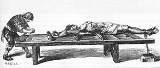
In Depth
See Also

Torture

Torture is any act by which severe pain, whether physical or psychological Psychology

Psychology is an academic [i] and applied [i] field involving the study [i] of the human ... 

, is intentionally inflicted on a person as a means of intimidation, deterrence, revenge, punishment, sadism, or information gathering. It can be used as an interrogation tactic to extract confessions. Torture is also used as a method of coercion or as a tool to control groups seen as a threat by governments. Throughout history, it has often been used as a method of effecting religious conversion or political re-education. Torture is almost universally considered to be an extreme violation of human rights Human rights

Human rights refers to the concept of human beings [i] as having universal rights [i], or status, regard ... 

, as stated by the Universal Declaration of Human Rights.

Discussions

  Discussion Features

   Ask a question about 'Torture'

   Start a new discussion about 'Torture'

   Answer questions about 'Torture'

   'Torture' discussion forum

Timeline

866   Pope Nicholas I Pope Nicholas I

Pope Nicholas I,, or Nicholas the Great, was a Pope [i] who reigned from April 24 [i], 858 [i] unt ... 

 forbids the use of torture in prosecutions for witchcraft Witchcraft

Witchcraft, in various historical, religious and mythical contexts, is the use of certain kinds of alleg... 

.

1252   Pope Innocent IV Pope Innocent IV

Pope Innocent IV , born Sinibaldo de Fieschi, Pope [i] from 1243 [i] to 1254 [i], belonged to the ... 

 issues the papal bull Papal bull

A Papal bull is a special kind of patent [i] or charter issued by a pope [i] and named fo ... 

 ''Ad exstirpanda'', which authorizes the torture of heretics in the Medieval Inquisition Medieval Inquisition

The Medieval Inquisition is a term historians use to describe the various inquisitions that started ... 

. Torture quickly gains widespread usage across Catholic Europe Europe

Europe is one of the seven traditional continent [i]s of the Earth [i]. ... 

.

1734   In Montreal Montreal

Montreal, or Montral in French [i], is the second largest city [i] ... 

 in New France New France

New France describes the area colonized [i] by France [i] in North America [i] during a period extending ... 

, a black slave known by the French name of Marie-Joseph Angélique, was tortured Torture

Torture is any act by which severe pain, whether physical or psychological [i], is intentiona ... 

 then hanged Hanging

Hanging is a form of execution [i] or a method of committing suicide [i]. ... 

 by the French France

France, officially the French Republic, is a country [i] whose metropolitan territory [i] ... 

 authorities in a public ceremony that involved her disgrace and the amputation of a hand.

1776   Austria Austria

Austria is a landlocked [i] country in central Europe [i]. ... 

 abolishes death penalty Capital punishment

Capital punishment, or the death penalty, is the execution [i] of a convicted criminal by the ... 

 and torture and decriminalizes witchcraft Witchcraft

Witchcraft, in various historical, religious and mythical contexts, is the use of certain kinds of alleg... 

1978   The European Court of Human Rights European Court of Human Rights

The European Court of Human Rights , often referred to informally as the "Strasbourg Court", was created... 

 finds the United Kingdom United Kingdom

The United Kingdom of Great Britain and Northern Ireland is a country and sovereign state [i] tha ... 

 government guilty of mistreating prisoners in Northern Ireland Northern Ireland

Northern Ireland is part of the United Kingdom [i] and covers 5,459 square miles [i] in the north ... 

, but not guilty of torture.


Encyclopedia

Torture is any act by which severe pain, whether physical or psychological Psychology

Psychology is an academic [i] and applied [i] field involving the study [i] of the human... 

, is intentionally inflicted on a person as a means of intimidation, deterrence, revenge, punishment, sadism, or information gathering. It can be used as an interrogation tactic to extract confessions. Torture is also used as a method of coercion or as a tool to control groups seen as a threat by governments. Throughout history, it has often been used as a method of effecting religious conversion or political “re-education.”
Torture is almost universally considered to be an extreme violation of human rights Human rights

Human rights refers to the concept of human beings [i] as having universal rights [i], or status, regard ... 

, as stated by the Universal Declaration of Human Rights. Signatories of the Third Geneva Convention and Fourth Geneva Convention agree not to torture protected persons in armed conflicts, and signatories of the UN Convention Against Torture United Nations Convention Against Torture

The United Nations Convention against Torture and Other Cruel, Inhuman or Degrading Treatment or Punishment... 

 agree not to intentionally inflict severe pain or suffering on anyone, to obtain information or a confession, to punish them, or to coerce them or a third person. These conventions and agreements notwithstanding, it is estimated by organizations such as Amnesty International Amnesty International

Amnesty International is an international [i] non-governmental organization [i] with the stated purpose ... 

 that around two out of three countries do not consistently abide by the spirit of such treaties.

Current legal status of torture

On December 10, 1948, the Universal Declaration of Human Rights was adopted by the United Nations General Assembly United Nations General Assembly

The United Nations General Assembly is one of the five principal organs of the United Nations [i] ... 

. Article 5 states "No one shall be subjected to torture or to cruel, inhuman or degrading treatment or punishment".

Since that time the use of torture has been regulated by a number of international treaties, of which the two major ones are the United Nations Convention Against Torture United Nations Convention Against Torture

The United Nations Convention against Torture and Other Cruel, Inhuman or Degrading Treatment or Punishment... 

 and the Geneva Conventions Geneva Conventions

The Geneva Conventions consist of four treaties [i] formulated in Geneva [i], Switzerland [i], that set ... 

.

United Nations Convention Against Torture

The "United Nations Convention against Torture and Other Cruel, Inhuman or Degrading Treatment or Punishment" United Nations Convention Against Torture

The United Nations Convention against Torture and Other Cruel, Inhuman or Degrading Treatment or Punishment... 

 came into force in June 1987. The most relevant articles are articles 1, 2, 3 and the first paragraph of article 16

Article 1
1. Any act by which severe pain or suffering, whether physical or mental, is intentionally inflicted on a person for such purposes as obtaining from him or a third person information or a confession, punishing him for an act he or a third person has committed or is suspected of having committed, or intimidating or coercing him or a third person, or for any reason based on discrimination of any kind, when such pain or suffering is inflicted by or at the instigation of or with the consent or acquiescence of a public official or other person acting in an official capacity. It does not include pain or suffering arising only from, inherent in or incidental to lawful sanctions.
2. This article is without prejudice to any international instrument or national legislation which does or may contain provisions of wider application.


Article 2
1. Each State Party shall take effective legislative, administrative, judicial or other measures to prevent acts of torture in any territory under its jurisdiction.
2. No exceptional circumstances whatsoever, whether a state of war or a threat of war, internal political instability or any other public emergency, may be invoked as a justification of torture.
3. An order from a superior officer or a public authority may not be invoked as a justification of torture.


Article 3
1. No State Party shall expel, return or extradite a person to another State where there are substantial grounds for believing that he would be in danger of being subjected to torture.


2. For the purpose of determining whether there are such grounds, the competent authorities shall take into account all relevant considerations including, where applicable, the existence in the State concerned of a consistent pattern of gross, flagrant or mass violations of human rights.


Article 16
1. Each State Party shall undertake to prevent in any territory under its jurisdiction other acts of cruel, inhuman or degrading treatment or punishment which do not amount to torture as defined in article I, when such acts are committed by or at the instigation of or with the consent or acquiescence of a public official or other person acting in an official capacity. In particular, the obligations contained in articles 10, 11, 12 and 13 shall apply with the substitution for references to torture of references to other forms of cruel, inhuman or degrading treatment or punishment.


There are several points which should be noted:

  • Section 1: torture is defined as severe pain or suffering, which means there exist levels of pain and suffering which are not severe enough to be called torture. Discussions on this area of international law are influenced by a ruling of the European Court of Human Rights European Court of Human Rights

    The European Court of Human Rights , often referred to informally as the "Strasbourg Court", was created... 

    . See the section Other conventions for more details on the ECHR ruling.
  • Section 2: If a state has signed the treaty without reservations, then there are no exceptional circumstances whatsoever where a state can use torture and not break its treaty obligations. However the worst sanction which can be applied to a powerful country is a public record that they have broken their treaty obligations. In certain exceptional cases the authorities in those countries may consider that, with plausible deniability, this is an acceptable risk to take as the definition of severe is open to interpretation.
  • Section 16: contains the obligation to prevent "acts of cruel, inhuman or degrading treatment or punishment", but only in "any territory under its jurisdiction". So a state is not prohibited from allowing coercive techniques short of torture conducted in a territory not under its jurisdiction.


At the moment this treaty has been signed by about half the countries in the world.

Geneva Conventions

The four Geneva Conventions Geneva Conventions

The Geneva Conventions consist of four treaties [i] formulated in Geneva [i], Switzerland [i], that set ... 

 provide protection for people who fall into enemy hands. They envisage war in its traditional form, whereby people in uniforms fight clearly defined enemies in uniform, within a clearly defined arena. It therefore divides people into two explicit groups: combatants and non-combatants . There is a third group whose existence is implied in legal discourse, but whose existence and treatment are not covered in treaties. These are unlawful combatants, such as spies, mercenaries Mercenary

A mercenary is a soldier [i] who fights, or engages in warfare primarily for private gain, usually with ... 

 and other combatants who have broken the laws of war, for example by firing on an enemy while flying a white flag. Whilst combatants and non-combatants are provided substantial protection, a lesser level of protection is afforded to unlawful combatants.

The third and fourth Geneva Conventions are the two most relevant for the treatment of the victims of conflicts. Both treaties state in their similarly worded article 3 that in a non-international armed conflict that "Persons taking no active part in the hostilities, including members of armed forces who have laid down their arms... shall in all circumstances be treated humanely and that there must not be any "violence to life and person, in particular murder of all kinds, mutilation, cruel treatment and torture." or "outrages upon personal dignity, in particular humiliating and degrading treatment".

GCIV covers most civilians in an international armed conflict, and states they are usually "Protected Persons" . Under article 32, protected persons have the right to protection from "murder, torture, corporal punishments, mutilation and medical or scientific experiments...but also to any other measures of brutality whether applied by non-combatant or military agents."

GCIII covers the treatment of prisoners of war Prisoner of war

A prisoner of war is a combatant [i] who is imprisoned by an enemy power during or immediately after an ... 

 
in an international armed conflict. In particular article 17 states that "No physical or mental torture, nor any other form of coercion, may be inflicted on prisoners of war to secure from them information of any kind whatever. Prisoners of war who refuse to answer may not be threatened, insulted or exposed to unpleasant or disadvantageous treatment of any kind.". POW status under GCIII has far fewer exemptions than "Protected Person" status under GCIV. If a person is an enemy combatant in an international armed conflict, then they will automatically have the protection of GCIII and be entitled to be regarded as POWs under GCIII unless they are an unlawful combatant.

As discussed, unlawful combatants have fewer protections under GC. If there is a question of whether a person is an unlawful combatant, they must be treated as POW's "until their status has been determined by a competent tribunal" . Note that the term competent tribunal is not defined and no requirement for neutrality is imposed. If the tribunal decides that they are an unlawful combatant, they are not considered a Protected Person under GCIV. However, even so they still have some protection under GCIV, and must be "treated with humanity and, in case of trial [for war crimes War crime

In the context of war [i], a war crime is a punishable offense under International Law [i], for violatio ... 

], shall not be deprived of the rights of fair and regular trial prescribed by the present Convention
" .
Geneva Convention IV exemptions
GCIV provides an important exemption:
"Where in the territory of a Party to the conflict, the latter is satisfied that an individual protected person is definitely suspected of or engaged in activities hostile to the security of the State, such individual person shall not be entitled to claim such rights and privileges under the present Convention [ie GCIV] as would ... be prejudicial to the security of such State ... In each case, such persons shall nevertheless be treated with humanity"


There are two further groups who are not protected by GCIV:
  1. Nationals of a State which is not bound by the Convention are not protected by it.
  2. Nationals of a neutral State in the territory of a combatant State, and nationals of a co-belligerent State, cannot claim the protection of GCIV if their home state has normal diplomatic representation in the State that holds them . Since nearly every state has diplomatic recognition of every other state, most citizens of neutral countries in a war zone are not able to claim any protection from GCIV.


In a conflict like the U.S. War on Terrorism War on Terrorism

The War on Terrorism or War on Terror is the name used by the United States [i], enlisting the sup ... 

 many unlawful combatants have been denied protection under the Geneva Conventions, because they are either excluded by their nationality , or they are deemed to be so dangerous that Article 5 can be invoked, or because they do not fit the textual description of a lawful combatant .
Geneva Conventions' Additional Protocols
In addition, there are two additional protocols to the Geneva Convention: Protocol I , relating to the protection of victims of international armed conflicts and Protocol II , relating to the protection of victims of non-international armed conflicts. These clarify and extend the definitions in some areas, but to date many countries, including the United States United States

The United States of America, also known as the United States, the U.S., the U.S.A., a... 

, have either not signed them or have not ratified them.

Protocol I does not explicitly mention torture but it does clarify one or two points which effect the treatment of POWs and Protected Persons. The first is that it explicitly involves "the appointment of Protecting Powers and of their substitute" to monitor that the Conventions are being enforced by the Parties to the conflict. It also broadens the definition of a lawful combatant in occupied territory to include those who carry arms openly but are not wearing uniforms, so that they are now lawful combatants and protected by the Geneva Conventions. It also defines who is a mercenary, and implicitly an unlawful combatant, and not protected by the same conventions.

Protocol II "develops and supplements Article 3 [relating to the protection of victims of non-international armed conflicts] common to the Geneva Conventions of 12 August 1949 without modifying its existing conditions of application" . It states in Article 4.a "Violence to the life, health and physical or mental well-being of persons, in particular murder as well as cruel treatment such as torture, mutilation or any form of corporal punishment;", Article 4.b "Outrages upon personal dignity, in particular humiliating and degrading treatment, rape, enforced prostitution and any form of indecent assault;" and Article 4.h "Threats to commit any of the foregoing acts". There are other clauses in other articles which entreat humane treatment of enemy personnel in an internal conflict, which have a bearing on the use of torture, but there are no other clauses which explicitly mentions torture.

Other conventions

During the Cold War Cold War

The Cold War was the protracted geopolitical [i], ideological [i], and economic [i]... 

, in Europe a treaty called European Convention on Human Rights was signed. The treaty was based on the UDHR. It included the provision for a court to interpret the treaty and Article 3 "Prohibition of torture" stated "No one shall be subjected to torture or to inhuman or degrading treatment or punishment".

In 1978 the European Court of Human Rights European Court of Human Rights

The European Court of Human Rights , often referred to informally as the "Strasbourg Court", was created... 

 ruled that the five techniques of "sensory deprivation Sensory deprivation

Sensory deprivation is the deliberate reduction or removal of stimuli [i] from one or more of ... 

" were not torture but were "inhuman or degrading treatment". See Accusations of use of torture by United Kingdom for details. This case was 9 years before the UNCAT came into force and had an influence on States thinking about what constitutes torture ever since.

The also explicitly prohibits torture and "cruel, inhuman or degrading treatment or punishment".

The states "corporal punishment, punishment by placing in a dark cell, and all cruel, inhuman or degrading punishments shall be completely prohibited as punishments for disciplinary offences."

Supervision of anti-torture treaties


In times of armed conflict between a signatory of the Geneva conventions and another party, delegates of the International Committee of the Red Cross International Committee of the Red Cross

The International Committee of the Red Cross is a private humanitarian [i] institution b ... 

  monitor the compliance of signatory to the Geneva Conventions, which includes monitoring the use of torture.

The Istanbul Protocol, an official UN document, is the first set of international guidelines for documentation of torture and its consequences. It became a United Nations official document in 1999.

The European Committee for the Prevention of Torture and Inhuman or Degrading Treatment or Punishment "shall, by means of visits, examine the treatment of persons deprived of their liberty with a view to strengthening, if necessary, the protection of such persons from torture and from inhuman or degrading treatment or punishment." as stipulated in Article 1 of the European Convention for the Prevention of Torture and Inhuman or Degrading Treatment or Punishment

Human rights organizations, such as Amnesty International Amnesty International

Amnesty International is an international [i] non-governmental organization [i] with the stated purpose ... 

, the Association for the Prevention of Torture are actively involved in working to stop the use of torture throughout the world and publish reports on any activities they consider to be torture.

National law

Countries which have signed the "United Nations Convention Against Torture", have a treaty obligation to include the provisions into domestic law. The laws of many countries therefore formally prohibit torture. However, such de jure legal provisions are by no means a proof that, de facto, the signatory country does not use torture.

To prevent torture, many legal systems have a right against self-incrimination or explicitly prohibit undue force when dealing with suspects.

Torture was abolished in England England

England is the largest and most populous constituent country [i] of the United Kingdom [i]. ... 

 about 1640 , in Scotland Scotland

Scotland is a nation [i] in northwest Europe [i] and one of the constituent [i] countries [i] ... 

 in 1708, in Prussia Prussia

Prussia was, most recently, a historic state originating in Brandenburg [i], an area which for centuries ... 

 in 1740, in Denmark Denmark

The Kingdom of Denmark is the smallest and southernmost of the Nordic countries [i].... 

 around 1770, in Russia Russia

Russia , also the Russian Federation , is a country [i] that stretches over a vast expanse of Eurasia [i] ... 

 in 1801.

The French France

France, officially the French Republic, is a country [i] whose metropolitan territory [i] ... 

 1789 Declaration of the Rights of Man and of the Citizen Declaration of the Rights of Man and of the Citizen

The Declaration of the Rights of Man and of the Citizen is one of the fundamental documents of the French Revolution [i] ... 

, of constitutional value, prohibits submitting suspects to any hardship not necessary to secure his person. Statute law explicitly makes torture a crime. In addition, statute law prohibits the police or justice from interrogating suspects under oath.

The United States includes this protection in the fifth amendment to its constitution, which in turn serves as the basis of the Miranda warning that is issued to individuals upon their arrest. Additionally, the US Constitution's eighth amendment expressly forbids the use of "cruel and unusual punishments", which is widely interpreted as a prohibition of the use of torture.

Use of torture

Recent times in the context of this article is from December 10, 1948 when the Universal Declaration of Human Rights was adopted by the United Nations General Assembly United Nations General Assembly

The United Nations General Assembly is one of the five principal organs of the United Nations [i] ... 

.

Torture in the past


Torture was used by many governments and countries in the past. In the Roman Republic, for example, a slave's testimony was admissible only if it was extracted by torture, on the assumption that slaves could not be trusted to reveal the truth voluntarily.

Ancient and medieval philosophers–notably, Aristotle Aristotle

Aristotle was an ancient Greek [i] philosopher [i], a student of Plato [i] ... 

 and Francis Bacon Francis Bacon

Francis Bacon, 1st Viscount St Alban, KC [i] was an English [i] philosopher [i], ... 

–were staunch champions of the utility of carefully monitored torture to the justice system.

In much of Europe, medieval and early modern courts freely inflicted torture, depending on the accused's crime and the social status of the suspect. Torture was seen as a legitimate means for justice to extract confessions, or obtain the names of accomplices or other information about the crime. Often, defendants sentenced to death would be tortured prior to execution, so as to have a last chance that they disclose the names of their accomplices. Torture in the Medieval Inquisition Medieval Inquisition


The Medieval Inquisition is a term historians use to describe the various inquisitions that started ... 

 was used starting in 1252 although its use in Catholic countries was putatively forbidden by papal bull in 1816. Within that time frame, men of considerable means delighted in building their own torture chambers, quite literally kidnapping innocent citizens of low birth off the streets and subjecting them to procedures of their own invention, taking careful notes as to what techniques were more or less effective, and which body parts more or less receptive thereto.

In the Middle Ages Middle Ages

The Middle Ages formed the middle period in a traditional schematic division of European history [i] ... 

 especially and up into the 18th century 18th century

As a means of recording the passage of time [i], the 18th century refers to the century [i] that las ... 

, torture was considered a legitimate way to obtain testimonies and confessions from suspects for use in judicial inquiries and trials. While, in some instances, the secular courts were known for rather more ferocious treatment than the religious, Will Will Durant

William James Durant was an American [i] philosopher [i], historian [i], and writer [i]. ... 

 and Ariel Durant argued in The Age of Faith that many of the most vicious procedures were inflicted, not upon stubborn prisoners by governments, but upon pious heretics by even more pious friars. For example, the Dominicans Dominican Order

The Order of Preachers , more commonly known as the Dominican Order [i], or Dominicans ... 

 gained a reputation as some of the most fearsomely creative torturers in medieval Spain. Many of the victims of the Spanish Inquisition Spanish Inquisition

The Spanish Inquisition was established, in 1478, by Ferdinand and Isabella [i] to maintain Catholic [i] ... 

 did not know that, had they just confessed as required, they might have faced penalties no more severe than mild penance; confiscation of property; even, perhaps, a few strokes of the whip. They thus ended up exposing themselves to torture. Many were perhaps clinging to "the principle of the thing", however noble that may be when faced with torture.

One of the most common forms of medieval inquisition torture was known as strappado. The hands were bound behind the back with a rope, and the accused was suspended this way, dislocating the joints painfully in both arms. Weights could be added to the legs dislocating those joints as well. Other torture methods could include the rack Rack (torture)

The rack is a term for certain physical punishment devices.... 

 , the thumbscrew Thumbscrew

The thumbscrew or pilliwinks is an instrument of torture [i] which was used in medieval [i] Europe [i] ... 

, the boot Boot

A boot is a type of footwear [i] which covers at least the foot [i] and usually the ankle [i], and somet ... 

 , water , and red-hot pincers , although it was technically against church policy to mutilate a person's body. If stronger methods were needed, or death, the person was handed over to the secular authorities who were not bound by any restrictions.

In 1613 Anton Praetorius Anton Praetorius

Anton Praetorius, Protestant pastor and fighter against the persecution of witches and against torture [i] ... 

 described the situation of the prisoners in the dungeons in his book "Gründlicher Bericht über Zauberei und Zauberer" . He was one of the first to protest against all means of torture.

Torture in recent times

Many countries find it expedient from time to time to use techniques of a kind used in torture; at the same time few wish to be described as doing so, either to their own citizens or international bodies. So a variety of devices are used to bridge this gap, including state denial, "secret police", "need to know", denial that given treatments are tortuous in nature, appeal to various laws , use of jurisdictional argument Judicial Jurisdiction

Sorry, no overview for this topic 

, claim of "overriding need", and so on. Torture has been a tool of many states throughout history and for many states it remains so today. As a result, and despite worldwide condemnation and the existence of treaty provisions that forbid it, torture is still practiced in two thirds of the world's nations. .

Torture remains a frequent method of repression in totalitarian regimes, terrorist organizations Terrorism

Terrorism is the systematic use, or threatened use, of violence [i] to intimidate a population or govern ... 

, and organized crime. In authoritarian regimes, torture is often used to extract confessions from political dissenters, so that they admit to being spies or conspirators, probably manipulated by some foreign country. Most notably, such a dynamic of forced confessions marked the justice system of the Soviet Union Soviet Union

The Union of Soviet Socialist Republics , more commonly known as the Soviet Union, was a Communist state [i] ... 

 .

Some Western democratic governments have resorted to torture, or acts of cruel, inhuman or degrading treatment, of people thought to possess information perceived to be vital for national security which can not be obtained quickly by other methods. A recent example is Guantanamo Bay detainment camp Guantanamo Bay detainment camp

Guantánamo Bay detainment camp, serving as a joint military prison [i] and interrogation center under th ... 

 of the US government where detainees are under extreme coercive methods . The U.S. interrogation practices at Guantanamo have been identified as "torture" by the International Committee of the Red Cross , the U.N. Commission on Human Rights , and by nongovernmental organizations such as Amnesty International and Human Rights Watch.

Images of the body of Muzafar Avazov, an Uzbekistan Uzbekistan

Uzbekistan, officially the Republic of Uzbekistan , is a doubly landlocked [i] ... 

 man apparently killed by torture in 2002, as an example of the effect of torture on a human body, can be found in that article.

Some medieval techniques of torture remain in wide use today. For example, tearing out the nails of the fingers and toes with pliers — sometimes after first driving sharp needles into the extremely tender flesh underneath — is still in common use. Slowly roasting the soles of the bare feet over hot coals was updated by the Russian KGB by using the flat, hot surface of an everyday clothes iron. Methods of confinement that take advantage of modern medical knowledge are also quite common. The prisoner—suitably bound to deter the expected range of reactive motion—may be connected to an electrical apparatus, where wires are wound around his fingers and toes and an electric probe is used to deliver current to his genitals. A signal generator and attached voltmeter precisely control the intensity of the pain so inflicted. Modern torturers also avail themselves of pharmacological techniques that were unavailable in the past: an example is the injection of drugs that heighten the human brain's perception of, and reaction to, pain before any physical torture is actually employed.
Torture by proxy
In 2003, Britain's Ambassador to Uzbekistan Uzbekistan

Uzbekistan, officially the Republic of Uzbekistan , is a doubly landlocked [i] ... 

, Craig Murray, made accusations that information was being extracted under extreme torture from dissidents in that country, and that the information was subsequently being used by Western, democratic countries which officially disapproved of torture .

The accusations did not lead to any investigation by his employer, the Foreign and Commonwealth Office Foreign and Commonwealth Office

The Foreign and Commonwealth Office, more commonly known as the Foreign Office or the FCO, i... 

, and he resigned after disciplinary action was taken against him in 2004. No misconduct by him was proven. The Foreign and Commonwealth Office itself is being investigated by the National Audit Office because of accusations of victimisation, bullying and intimidating its own staff .

Murray later stated that he felt that he had unwittingly stumbled upon what has elsewhere been called "torture by proxy Extraordinary rendition

Extraordinary rendition is an American [i] extra-judicial procedure which involves the sen... 

" and with the euphemism of "extraordinary rendition Extraordinary rendition

Extraordinary rendition is an American [i] extra-judicial procedure which involves the sen... 

". He thought that Western countries moved people to regimes and nations where it was known that information would be extracted by torture, and made available to them. This he alleged was a circumvention and violation of any agreement to abide by international treaties against torture. If it was true that a country was doing this and it had signed the UN Convention Against Torture then that country would be in specific breach of Article 3 of that convention.

The term "torture by proxy" can, by logical extension, refer to the application of torture to persons other than the one from whom information or compliance is demanded. The ancient Assyrians, for example, specialized in brutally torturing children—flaying or roasting them alive, perhaps—in front of their parents, to coercively obtain cooperation from the parents.

Aspects of torture

The use of torture has been criticized not only on humanitarian and moral grounds, but on the grounds that evidence extracted by torture tends to be extremely unreliable and that the use of torture corrupts institutions which tolerate it.

The purpose of torture is often as much to force acquiescence on an enemy, or destroy a person psychologically from within, as it is to gain information, and its effects endure long after the torture itself has ended. In this sense torture is often described by survivors as "never ending". See Psychology of torture to study the psychological effects associated with torture.

Incrimination of innocent people

One well documented effect of torture is that with rare exceptions people will say or do anything to escape the situation, including untrue "confessions" and implication of others without genuine knowledge, who may well then be tortured in turn.The cases of the Guildford Four,Birmingham Six and Maguire Seven are notorious examples of the dangers of extracting confessions and information using duress and coercion.There are rare exceptions, such as Admiral James Stockdale James Stockdale

Vice Admiral [i] James Bond Stockdale was one of the most highly decorated officers [i]... 

, Medal of Honor Medal of Honor

The Medal of Honor is the highest military decoration [i] ... 

 winner, F. F. E. Yeo-Thomas, G.C. George Cross

The George Cross is the highest Commonwealth [i] decoration awarded for acts of ... 

, or Jean Moulin Jean Moulin

Jean Moulin was a high-profile member of the French [i] Resistance [i] during ... 

, who refused to provide information under torture.

Secrecy/publicity

Depending on the culture, torture has at times been carried on in silence , semi-silence or openly acknowledged in public .

Since torture is in general not accepted in modern times, professional torturers in some countries tend to use techniques such as electrical shock, asphyxiation, heat, cold, noise, and sleep deprivation which leave little evidence, although in other contexts torture frequently results in horrific mutilation or death. Evidence of torture also comes from the testimony of witnesses.

Motivation to torture

It was long thought that "good" people would not torture and only "bad" ones would, under normal circumstances. Research over the past 50 years suggests a disquieting alternative view, that under the right circumstances and with the appropriate encouragement and setting, most people can be encouraged to actively torture others. Stages of torture mentality include:

  • Reluctant or peripheral participation
  • Official encouragement: As the Stanford prison experiment Stanford prison experiment

    The Stanford prison experiment was a landmark psychological [i] study of the human response t ... 

     and Milgram experiment Milgram experiment

    The Milgram experiment was a famous scientific experiment [i] of social psychology [i] ... 

     show, many people will follow the direction of an authority figure in an official setting , even if they have personal uncertainty. The main motivations for this appear to be fear of loss of status or respect, and the desire to be seen as a "good citizen" or "good subordinate".
  • Peer encouragement: to accept torture as necessary, acceptable or deserved, or to comply from a wish to not reject peer group beliefs. This may potentially lead to torture gangs roaming the streets seeking dominant torture status.
  • Dehumanization: seeing victims as objects of curiosity and experimentation, where pain becomes just another test to see how it affects the victim.
  • Disinhibition: socio-cultural and situational pressures may cause torturers to undergo a lessening of moral inhibitions and as a result act in ways not normally countenanced by law, custom and conscience.
  • Organisationally, like many other procedures, once torture becomes established as part of internally acceptable norms under certain circumstances, its use often becomes institutionalised and self-perpetuating over time, as what was once used exceptionally for perceived necessity finds more reasons claimed to justify wider use.

One of the apparent ringleaders of the Abu Ghraib Abu Ghraib

[i]
... 

 prison torture incident, Charles Graner Charles Graner

Charles A. Graner, Jr., is a former U.S. Army [i] reservist and one of several soldier [i] ... 

 Jr., exemplified some of these when he was to have said, "The Christian in me says it's wrong, but the corrections officer in me says, 'I love to make a grown man piss himself.'"

Medical torture

Main article: Medical torture

At times, medicine and medical practitioners have been drawn into the ranks of torturers, either to judge what victims can endure, to apply treatments which will enhance torture, or as torturers in their own right. An infamous example of the latter is Dr. Josef Mengele Josef Mengele

Josef Mengele was a Nazi [i] German [i] SS officer [i] and a physician [i] ... 

, known then by inmates of Auschwitz as the "Angel of Death".

Torture murder

Main article: Torture murder

Torture murder is a term given to the commission of torture by an individual or small group, as part of a sadistic Sadism and masochism

This article is about sadism and masochism as aspects of BDSM [i]. ... 

 or murderous agenda. Such murderers are often serial killers Serial killer

Serial killers are people who kill on at least three occasions with a break in between each murder.... 

, who kill their victims by slowly torturing them to death over a prolonged period of time, and is usually preceded by a kidnapping where the killer will take the victim hostage, and take him/her to a secluded or isolated location.

Subjugation of civilian populations

Although information gathered by torture is often worthless, torture has been used to terrorize and subdue populations to enforce state control. cf: Gulag Gulag

Gulag is an acronym for ??????? ?????????? ????????????????????? ??????? ? ???????... 


Effects of torture

Organizations like the Medical Foundation for Care of Victims of Torture try to help survivors of torture obtain medical treatment and to gain forensic medical evidence to obtain political asylum Refugee

A refugee is a person seeking asylum in a foreign country in order to escape persecution [i], war [i], terrorism [i] ... 

 in a safe country and/or to prosecute the perpetrators.

Torture is often difficult to prove, particularly when some time has passed between the event and a medical examination. Many torturers around the world use methods designed to have a maximum psychological impact while leaving only minimal physical traces. Medical and Human Rights Organizations worldwide have collaborated to produce the Istanbul Protocol, a document designed to outline common torture methods, consequences of torture and medico-legal examination techniques. Typically deaths due to torture are shown in autopsy as being due to "natural causes" like heart attack, inflammation or embolism due to extreme stress.

For survivors, torture often leads to lasting mental and physical health problems.

Physical problems can be wide-ranging, e.g. sexually transmitted diseases Sexually transmitted disease

Sexually transmitted diseases also known as sexually transmissible diseases, sexually transmi... 

, musculo-skeletal problems, brain injury Traumatic brain injury

Traumatic brain injury, traumatic injuries to the brain [i], also called intracranial injury, or simply ... 

, post-traumatic epilepsy Epilepsy

Epilepsy is a common chronic [i] neurological [i] condition that is characterized by ... 

 and dementia or chronic pain syndromes.

Mental health problems are equally wide-ranging; common are post-traumatic stress disorder, depression Clinical depression

Clinical depression is a state of sadness [i], melancholia [i] or despair that has advanced to the point ... 

 and anxiety disorder.

Treatment of torture-related medical problems might require a wide range of expertise and often specialized experience. Common treatments are psychotropic Psychoactive drug

A psychoactive drug or psychotropic substance is a chemical substance [i] that acts primarily upon ... 

 medication Medication

A medication is a licenced drug [i] taken to cure or reduce symptoms of an illness [i] or medical condit ... 

, e.g. SSRI antidepressants, counseling, Cognitive Behavioural Therapy, family systems therapy and physiotherapy.

See Psychology of torture for psychological impact, and aftermath, of torture.

Torture devices and methods

It is plainly evident that, since the earliest times, tremendous ingenuity has been devoted to devising ever more effective and mechanically simpler instruments and techniques of torture. That those capable of applying such genius to the science of pain could in future employ their capabilities in other directions was not lost on the authorities: for example, after Perillos of Athens demonstrated his newly invented brazen bull to Phalaris, Tyrant of Agrigentum, Perillos himself was immediately put inside to test it, but he was removed before he died.

Torture does not require complex equipment. Several methods need little or no equipment and can even be improvised from innocuous household or kitchen equipment. Methods such as consumption by wild animals , impalement Impalement

Impalement is an act of torture [i] and/or execution [i] whereby the victim is pierced by a lo ... 

  or confinement in iron boxes in the tropical sun , are examples of other methods which required little more than readily available items.

Types of torture


  • Physical torture uses physical pain to inflict torment and is the most well known form of torture.


  • Psychological torture uses psychological pain to inflict torment and is less well known because its effects are often invisible to others. It uses non-physical methods to induce pain in the subject's mental, emotional, and psychological states. Since there is no international political consensus on what constitutes psychological torture, it is often overlooked, denied and called other things. Despite this, some of its most prominent victims such as United States Senator John McCain John McCain

    John Sidney McCain III is the senior U.S. Senator [i] from Arizona [i], having ser ... 

     have stated that it is the ultimate form of torture.


  • Psychiatric torture uses psychiatric diagnoses and their associated psychiatric treatments to torture sane people for political, religious, or familial reasons. It was a common form of torture against political prisoners in the former Soviet Union. Mild forms of psychiatric torture have been used in the United States military against otherwise sane dissenting officers. Some religious groups who shun dissenting members, a form of psychological torture, also attempt to use psychiatric torture to falsely diagnosis mental disorders so that ongoing shaming is possible.


  • Pharmacological torture uses psychotropic and/or other chemicals to induce pain and cause compliance with torturer's goals.


  • Porno-torture may be defined as the intentional infliction of severe physical or mental pain for interrogative, punitive, or abusive purposes by forcing a person to engage in sexually explicit behaviour, which is recorded, or staged before a live audience.

Some Psychological torture methods

any process to obtain mental and moral degradation without the use of violence, and often as quickly as practicable

  • Blackmail
  • Harm to friends or strangers, threatened, or carried out, and blamed on the victim
  • Being forced to witness atrocities, perhaps against family or persons with whom the victim identifies
  • Being forced to commit atrocities, perhaps against family, friends or allies
  • Forced witnessing or of participation in sexual activity
  • Being forced to watch acts of sexual abuse
  • Covert or other forced incest Incest

    Incest is sexual activity [i] between close family [i] members.

... 


  • Shaming and public humiliation, being stripped or displayed naked, public condemnation
  • Shunning
  • Being dirty, self-fouled, urinated on, or covered with fecal matter
  • Headshaving


  • Racial, sexual, religious or other verbal abuse against any characteristic of the victim
  • Being tricked into lying, or statements conflicting with past statements during interrogation.
  • Being forced to renounce or betray political, national, other strong affiliations or loyalties
  • Being coerced into denying one’s religion or morals, blasphemy Blasphemy

    Blasphemy is the defamation [i] of the name of a God [i]. ... 

    , or religious degradation


  • Conditions of detention
  • Being subjected to nonstop interrogation for long periods
  • Shouting and taunting Taunt

    A taunt is a sarcastic remark, challenge, or insult intended to provoke a response of some kind from the... 

  • Mock execution and horrific experiences
  • Starvation, cold and damp
  • Extended solitary confinement
  • Partial or total sensory deprivation Sensory deprivation

    Sensory deprivation is the deliberate reduction or removal of stimuli [i] from one or more of ... 

  • Continual or unpredictable noise
  • Alterations to room temperature
  • Cramping, confinement,Ball and chain, shackling Fetters

    [i] used on the [[foot|feet]... 

  • Being held incommunicado
  • Being kept in confined spaces
  • Extended sleep deprivation
  • Being forced to sleep on hard surfaces
  • Exploitation of phobias, e.g. leaving arachnophobes in a room full of spiders Spider

    Spiders are predator [i]y invertebrate [i] animal [i]s with two body segments [i], eight legs, no ... 


  • Forced labor, other coercion into excessive physical activity

Torture using chemicals

Torture victims may be forced to ingest chemicals or other products that cause pain and internal damage.

Irritating chemicals or products may be inserted into the rectum or vagina Vagina

The vagina, is the tubular [i] tract leading from the uterus [i] to the exterior of the body ... 

, or applied on the external genitalia. Cases of women being punished for adultery Adultery

Adultery is generally defined as consensual sexual intercourse [i] by a married [i] person with ... 

 by having hot pepper Chili pepper

The chili pepper, chile pepper, or chilli pepper, or simply chilli, 'chili or ... 

s inserted into their vaginas were reported in India India

India , officially the Republic of India, is a country in South Asia [i]. ... 

. Similar means were used in many instances in Africa Africa

Africa is one of the greatest sized continents of the Earth.... 

n strife.

Pharmacological torture methods

  • Forced ingestion or injection of psychotropic drugs

Physical torture methods

Though it may seem peculiar, perhaps even fetishistic, that so very many torture devices are intended for application to the foot, this is actually quite a logical development. One of the key characteristics of a successful torture is that it can be prolonged almost indefinitely without endangering life, and this can best be achieved by directing the pain as far as physically possible from the brain and vital organs. The only part of the body that satisfies these twin criteria is the foot.

  • Abacination
  • The Algerian hook
  • Aggravated, forcible tooth extraction Extraction (dental)

    A dental extraction is the removal of a tooth [i] from the mouth [i]. ... 

  • Bastinado
  • Beatings and physical violence
  • Being forced to listen to music that heightens anxiety
  • Binding / contortion Contortion

    Contortion is an unusual form of acrobatic [i] display which involves the dramatic bending an ... 

  • Blinding with light
  • Boiling
  • Bone breaking Bone fracture

    A bone fracture is a medical condition in which a bone [i] becomes cracked, splintered, or bisected as a ... 

  • Branding Human branding

    Branding persons refers to the use of the same physical techniques as in livestock branding [i] on a hum ... 

  • Burning/Cigar torture
  • Castration Castration

    Castration is any action, surgical [i], chemical [i], or otherwise, by which... 

  • Child abuse
  • Choking
  • Cutting
  • Denailing
  • Disfigurement
  • Drowning Drowning

    [i]

[i]
... 

 or Water cure Water cure

Water cure is a form of torture [i] which is intended to make the subject feel the sensation of drowning ... 


    • Also Dry drowning
  • Dunking Dunking

    Dunking is a form torture [i] and punishment that was applied to scold [i]s and supposed witch [i]es.

... 


  • Elder Abuse
  • Flagellation Flagellation

    Flagellation is the act of whipping the human body.... 

  • Flaying Flaying

    Flaying is the removal of skin [i] from the body [i]. ... 

  • Foot roasting
  • Foot whipping
  • Force-feeding
  • Garrotting Garrote

    A garrote is a handheld weapon [i], most often referring to a ligature [i] of chain [i], rope [i] ... 

  • Genital mutilation/forced circumcision Circumcision

    Circumcision is the removal of some or all of the foreskin [i] from the penis [i]. ... 

  • Goat tongue
  • Hair burning
  • Kneecapping
  • Limb/finger Finger

    The finger is any of the digit [i]s of the hand [i] in human [i]s and other species [i] such as the great ape [i] ... 

     removal
  • Mancuerda
  • Oxygen deprivation Asphyxia

    Asphyxia is a condition of severely deficient supply of oxygen [i] to the body that arises from being un ... 

  • Peine forte et dure Peine Forte Et Dure

    Sorry, no overview for this topic 

  • Picquet
  • Pistol-whipping, or beating with rifle butt
  • Pitchcapping Pitchcapping

    Pitchcapping refers to a form of torture [i] devised by British [i] forces in 18th century ... 

  • Rape Rape

    Rape is the act of forcing penetrative [i] sexual act [i]s, against another's will th ... 

    , Incest Incest

    Incest is sexual activity [i] between close family [i] members.

... 

 and other forms of sexual assault
  • Scalping Scalping

    Scalping is the act of removing the scalp [i], usually with the hair, as a portable proof or trophy of p ... 

  • Scaphism
  • Sensory deprivation Sensory deprivation

    Sensory deprivation is the deliberate reduction or removal of stimuli [i] from one or more of ... 

  • Shabach technique
  • Sleep deprivation
  • Sound Sound

    Sound is a disturbance of mechanical energy [i] that propagates through matter [i] as a wave [i]. ... 

     .
  • Squassation
  • Starvation Starvation

    Symptoms

Starved individuals lose substantial fat [i] and muscle [i] mass as the body breaks down these tissu ... 


  • Strappado
  • Ta'liq hanging from a metal bar. "Kentucky Chicken"
  • Tarring and feathering Tarring and feathering

    Tarring and feathering is a physical punishment [i], at least as old as the Crusades, used to enforce fo... 

  • Tickling
  • Tongue Tongue

    The tongue is the large bundle of skeletal muscle [i]s on the floor of the mouth [i] that manipulates fo ... 

     removal
  • Water boarding Waterboarding

    Waterboarding is a torture [i] technique that is used in coerced interrogations or for punishment. ... 

  • Water torture
  • Whipping Flagellation

    Flagellation is the act of whipping the human body.... 


Torture devices

Note that the line between "torture method" and "torture device" is often blurred, particularly when a specifically-named implement is but one component of a method.

  • Boot Boot

    A boot is a type of footwear [i] which covers at least the foot [i] and usually the ankle [i], and somet ... 

  • Brank Scold's bridle

    A scold's bridle was a torture [i] device for women, resembling an iron muzzle or cage for the head with ... 

  • Brazen bull
  • Breaking wheel Breaking wheel

    The breaking wheel was a torturous capital punishment [i] device used in the Middle Ages [i] and early m ... 

  • Crocodile shears
  • Foot press
  • Foot screw
  • Heretic's fork Heretic's fork

    The Heretic's Fork was a torture [i] device, loosely consisting of a length of metal with two opposed bi ... 

  • Instep borer
  • Iron Maiden Iron Maiden

    band_name= | image = | caption = From left to right : Adrian Smith, Steve Harris, Bruce Dic... 

  • Jiá gùn
  • Kneeling, i.e. on uncooked rice, pebbles, or other rough surface
  • Judas Chair Judas Chair

    The Judas Chair, also known as the Judas Cradle, was allegedly a torture [i] device used by the Spanish Inquisition [i] ... 

  • Kia quen
  • Mancuerda
  • Pau de Arara Pau de Arara

    Pau-de-Arara (Parrot's Perch)

... 


  • Peace breaker's muzzle
  • Pear Pear of Anguish

    The Pear of Anguish is an alleged torture [i] instrument shaped like a pear [i] with several lobes, whic ... 

  • Pear of Anguish Pear of Anguish

    The Pear of Anguish is an alleged torture [i] instrument shaped like a pear [i] with several lobes, whic ... 

  • Pillory Pillory

    The pillory was a device used in punishment [i] by public humiliation [i] and often additional, sometime... 

  • Rack
  • Scarpines
  • Scavenger's daughter Scavenger’s daughter

    ... 

  • Scold's bridle Scold's bridle

    A scold's bridle was a torture [i] device for women, resembling an iron muzzle or cage for the head with ... 

  • Spanish boot
  • Severe Spanking
  • Stocks Stocks

    [i], [[corporal punishment]... 

  • Tablillas
  • Tean zu
  • Thumbscrew Thumbscrew

    The thumbscrew or pilliwinks is an instrument of torture [i] which was used in medieval [i] Europe [i] ... 

  • Toe breaker
  • Tucker telephone
  • Zánzhi
  • Wooden Pony

Methods of execution and capital punishment

Any method of execution which involves, or has the potential to involve, a great deal of pain or mutilation is considered to be torture and unacceptable to many who support capital punishment Capital punishment

Capital punishment, or the death penalty, is the execution [i] of a convicted criminal by the ... 

. Some of these, if halted soon enough, may not have fatal effects.

  • Execution by burning Execution by burning

    Execution [i] by burning [i] has a long history as a method of punishment [i] fo ... 

  • Beating
  • Decapitation Decapitation

    Decapitation, or beheading, is the removal of a living organism's head [i]. ... 

  • Bleeding Bleeding

    Bleeding is the loss of blood [i] from the body [i]. ... 

  • Boiling to death
  • Burial alive
  • Roasting in the brazen bull
  • Crucifixion Crucifixion

    Crucifixion is an ancient method of execution [i], where the victim was tied or nailed to a l ... 

  • Crushing Crushing

    Death by crushing or pressing, as a method of execution [i], has a long history ... 

  • Deliberate infection with disease
  • Disembowelment
  • Drawing and quartering Hanging, drawing and quartering

    * Jacques Clment [i], the murderer of Henri III [i]

... 


[i]
...