

Breaking wheel

Encyclopedia
Capital punishment
Capital punishment, the death penalty, or execution is the sentence of death upon a person by the state as a punishment for an offence. Crimes that can result in a death penalty are known as capital crimes or capital offences. The term capital originates from the Latin capitalis, literally...
in the Middle Ages
Middle Ages
The Middle Ages is a periodization of European history from the 5th century to the 15th century. The Middle Ages follows the fall of the Western Roman Empire in 476 and precedes the Early Modern Era. It is the middle period of a three-period division of Western history: Classic, Medieval and Modern...
and early modern times for public execution by bludgeoning
Club (weapon)
A club is among the simplest of all weapons. A club is essentially a short staff, or stick, usually made of wood, and wielded as a weapon since prehistoric times....
to death. It was used during the Middle Ages and was still in use into the 19th century.
Description and uses
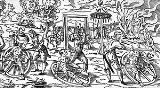
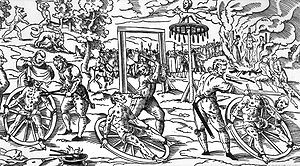
The wheel was typically a large wooden wagon wheelWheel
A wheel is a device that allows heavy objects to be moved easily through rotating on an axle through its center, facilitating movement or transportation while supporting a load, or performing labor in machines. Common examples found in transport applications. A wheel, together with an axle,...
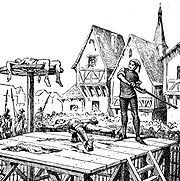
with many radial spokes, but a wheel was not always used. In some cases the condemned were lashed to the wheel and beaten with a club or iron cudgel, with the gaps in the wheel allowing the cudgel to break through. Alternatively, the condemned were spreadeagled and broken on a St Andrew's cross
Saltire
A saltire, or Saint Andrew's Cross, is a heraldic symbol in the form of a diagonal cross or letter ex . Saint Andrew is said to have been martyred on such a cross....
consisting of two wooden beams nailed in an "X" shape, after which the victim's mangled body might be displayed on the wheel. During the execution for parricide
Parricide
Parricide is defined as:*the act of murdering one's father , mother or other close relative, but usually not children ....
of Franz Seuboldt in Nuremberg
Nuremberg
Nuremberg[p] is a city in the German state of Bavaria, in the administrative region of Middle Franconia. Situated on the Pegnitz river and the Rhine–Main–Danube Canal, it is located about north of Munich and is Franconia's largest city. The population is 505,664...
on 22 September 1589, a wheel was used as a cudgel: the executioner used wooden blocks to raise Seuboldt's limbs, then broke them by slamming a wagon wheel down onto the limb.
In France, the condemned were placed on a cartwheel with their limbs stretched out along the spokes over two sturdy wooden beams. The wheel was made to revolve slowly, and a large hammer
Hammer
A hammer is a tool meant to deliver an impact to an object. The most common uses are for driving nails, fitting parts, forging metal and breaking up objects. Hammers are often designed for a specific purpose, and vary widely in their shape and structure. The usual features are a handle and a head,...
or an iron bar was then applied to the limb over the gap between the beams, breaking the bone
Bone
Bones are rigid organs that constitute part of the endoskeleton of vertebrates. They support, and protect the various organs of the body, produce red and white blood cells and store minerals. Bone tissue is a type of dense connective tissue...
s. This process was repeated several times per limb. Sometimes it was 'mercifully' ordered that the executioner should strike the condemned on the chest and stomach, blows known as (French
French language
French is a Romance language spoken as a first language in France, the Romandy region in Switzerland, Wallonia and Brussels in Belgium, Monaco, the regions of Quebec and Acadia in Canada, and by various communities elsewhere. Second-language speakers of French are distributed throughout many parts...
: "blows of mercy"), which caused fatal injuries. Without those, the broken man could last hours and even days, before shock and dehydration
Dehydration
In physiology and medicine, dehydration is defined as the excessive loss of body fluid. It is literally the removal of water from an object; however, in physiological terms, it entails a deficiency of fluid within an organism...
caused death. In France, a special grace, the retentum, could be granted, by which the condemned was strangled after the second or third blow, or in special cases, even before the breaking began.
In the Holy Roman Empire
Holy Roman Empire
The Holy Roman Empire was a realm that existed from 962 to 1806 in Central Europe.It was ruled by the Holy Roman Emperor. Its character changed during the Middle Ages and the Early Modern period, when the power of the emperor gradually weakened in favour of the princes...
, the wheel was punishment reserved primarily for men convicted of aggravated murder (murder committed during another crime, or against a family member). Less severe offenders would be cudgelled 'top down', with a lethal first blow to the neck. More heinous criminals were punished 'bottom up', starting with the legs, and sometimes being beaten for hours. The number and sequence of blows was specified in the court's sentence. Corpses were left for carrion-eaters, and the criminals' heads often placed on a spike.
Legend has it that St. Catherine of Alexandria
Catherine of Alexandria
Saint Catherine of Alexandria, also known as Saint Catherine of the Wheel and The Great Martyr Saint Catherine is, according to tradition, a Christian saint and virgin, who was martyred in the early 4th century at the hands of the pagan emperor Maxentius...
was sentenced to be executed on one of these devices, which thereafter became known as the Catherine wheel, also used as an iconographic attribute. The wheel miraculously broke when she touched it; she was then beheaded
Decapitation
Decapitation is the separation of the head from the body. Beheading typically refers to the act of intentional decapitation, e.g., as a means of murder or execution; it may be accomplished, for example, with an axe, sword, knife, wire, or by other more sophisticated means such as a guillotine...
.
In Scotland
Scotland
Scotland is a country that is part of the United Kingdom. Occupying the northern third of the island of Great Britain, it shares a border with England to the south and is bounded by the North Sea to the east, the Atlantic Ocean to the north and west, and the North Channel and Irish Sea to the...
, a servant named Robert Weir was broken on the wheel at Edinburgh
Edinburgh
Edinburgh is the capital city of Scotland, the second largest city in Scotland, and the eighth most populous in the United Kingdom. The City of Edinburgh Council governs one of Scotland's 32 local government council areas. The council area includes urban Edinburgh and a rural area...
in 1603 or 1604 (sources disagree). This punishment had been used infrequently there. The crime had been the murder of John Kincaid
Clan Kincaid
Clan Kincaid is a modern Scottish clan.-Origins of the surname:The Kincaid surname is of territorial origin being taken from the former lands of Kincaid in the Parish of Campsie, Stirlingshire, Scotland. The lands are located just north of Kirkintilloch, in the north-west angle formed by the River...
, Lord of Warriston
Warriston
Warriston is a suburb of Edinburgh, the capital of Scotland. It is north-east of the Royal Botanic Garden. The name derives from Warriston House a local mansion house, now demolished....
, on behalf of his wife. Weir was secured to a cart wheel and was struck and broken with the coulter of a plough
Plough
The plough or plow is a tool used in farming for initial cultivation of soil in preparation for sowing seed or planting. It has been a basic instrument for most of recorded history, and represents one of the major advances in agriculture...
. Lady Warriston was later beheaded.
The breaking wheel was frequently used in the Great Northern War
Great Northern War
The Great Northern War was a conflict in which a coalition led by the Tsardom of Russia successfully contested the supremacy of the Swedish Empire in northern Central Europe and Eastern Europe. The initial leaders of the anti-Swedish alliance were Peter I the Great of Russia, Frederick IV of...
in the early 1700s when the Tsardom of Russia
Tsardom of Russia
The Tsardom of Russia was the name of the centralized Russian state from Ivan IV's assumption of the title of Tsar in 1547 till Peter the Great's foundation of the Russian Empire in 1721.From 1550 to 1700, Russia grew 35,000 km2 a year...
challenged the supremacy of the Swedish Empire
Swedish Empire
The Swedish Empire refers to the Kingdom of Sweden between 1561 and 1721 . During this time, Sweden was one of the great European powers. In Swedish, the period is called Stormaktstiden, literally meaning "the Great Power Era"...
in northern Central Europe
Central Europe
Central Europe or alternatively Middle Europe is a region of the European continent lying between the variously defined areas of Eastern and Western Europe...
and Eastern Europe
Eastern Europe
Eastern Europe is the eastern part of Europe. The term has widely disparate geopolitical, geographical, cultural and socioeconomic readings, which makes it highly context-dependent and even volatile, and there are "almost as many definitions of Eastern Europe as there are scholars of the region"...
. Russian forces used this method to execute Cossacks and during the massacres of civilians at Baturyn
Baturyn
Baturyn , is a historic town in the Chernihiv Oblast of northern Ukraine. It is located in the Bakhmatskyi Raion of the oblast, on the banks of the Seym River...
and Lebedyn
Lebedyn
Lebedyn is a city in Sumy Oblast, Ukraine. Population is 28,948 . An air base is located nearby.In 1708 the city was a site of ethnic cleansing against Ukrainians during the Executions of Cossacks in Lebedin by the Russian Empire.-See also:...
. The Swedish king, Charles XII
Charles XII of Sweden
Charles XII also Carl of Sweden, , Latinized to Carolus Rex, Turkish: Demirbaş Şarl, also known as Charles the Habitué was the King of the Swedish Empire from 1697 to 1718...
also ordered the Livonia
Livonia
Livonia is a historic region along the eastern shores of the Baltic Sea. It was once the land of the Finnic Livonians inhabiting the principal ancient Livonian County Metsepole with its center at Turaida...
n nobleman Johann Patkul
Johann Patkul
Johann Reinhold Patkul was a Livonian politician and agitator of Baltic German extraction.Patkul was born in prison at Stockholm, where his father had been imprisoned under suspicion of treason...
to be broken alive on the wheel for high treason
High treason
High treason is criminal disloyalty to one's government. Participating in a war against one's native country, attempting to overthrow its government, spying on its military, its diplomats, or its secret services for a hostile and foreign power, or attempting to kill its head of state are perhaps...
.
This method of execution has been used in 18th-century America following slave revolts. It was once used in New York after several whites were killed during a slave rebellion in 1712. Between 1730 and 1754 prior to the Louisiana Purchase
Louisiana Purchase
The Louisiana Purchase was the acquisition by the United States of America of of France's claim to the territory of Louisiana in 1803. The U.S...
, 11 slaves in French-controlled Louisiana
Louisiana
Louisiana is a state located in the southern region of the United States of America. Its capital is Baton Rouge and largest city is New Orleans. Louisiana is the only state in the U.S. with political subdivisions termed parishes, which are local governments equivalent to counties...
, who had revolted against their masters, were killed on the wheel.
The breaking wheel was used in Germany as recently as the early 19th century for the crime of parricide
Parricide
Parricide is defined as:*the act of murdering one's father , mother or other close relative, but usually not children ....
, and the last known use occurred in 1841 when the assassin of the Bishop of Ermeland in Prussia
Prussia
Prussia was a German kingdom and historic state originating out of the Duchy of Prussia and the Margraviate of Brandenburg. For centuries, the House of Hohenzollern ruled Prussia, successfully expanding its size by way of an unusually well-organized and effective army. Prussia shaped the history...
was executed in this manner.
Metaphorical uses
Dutch language
Dutch is a West Germanic language and the native language of the majority of the population of the Netherlands, Belgium, and Suriname, the three member states of the Dutch Language Union. Most speakers live in the European Union, where it is a first language for about 23 million and a second...
, there is the expression opgroeien voor galg en rad, "to grow up for the gallows and wheel," meaning to come to no good. It is also mentioned in the Chilean expression morir en la rueda, "to die at the wheel," meaning to keep silent about something. The Dutch phrases ik ben geradbraakt, literally "I have been broken on the wheel," the German
German language
German is a West Germanic language, related to and classified alongside English and Dutch. With an estimated 90 – 98 million native speakers, German is one of the world's major languages and is the most widely-spoken first language in the European Union....
expression sich gerädert fühlen, "to feel wheeled," and the Swedish
Swedish language
Swedish is a North Germanic language, spoken by approximately 10 million people, predominantly in Sweden and parts of Finland, especially along its coast and on the Åland islands. It is largely mutually intelligible with Norwegian and Danish...
verb rådbråka (from German radbrechen), "to break on the wheel," are sometimes used and carries a meaning of mental exhaustion or trying to go through one's mind to remember. In Danish
Danish language
Danish is a North Germanic language spoken by around six million people, principally in the country of Denmark. It is also spoken by 50,000 Germans of Danish ethnicity in the northern parts of Schleswig-Holstein, Germany, where it holds the status of minority language...
, however, the similar word "radbrækket" refers almost exclusively to physical exhaustion. In Finnish teilata, "to execute by the wheel," refers to forceful and violent critique or rejection of performance, ideas or innovations. In Norwegian
Norwegian language
Norwegian is a North Germanic language spoken primarily in Norway, where it is the official language. Together with Swedish and Danish, Norwegian forms a continuum of more or less mutually intelligible local and regional variants .These Scandinavian languages together with the Faroese language...
, the verb radbrekke is generally applied to art and language, and refers to use thereof which is seen as despoiling tradition and courtesy, with connotations of willful ignorance and/or malice. The German verb radebrechen has acquired a somewhat different meaning, "to speak in the manner of one who has poor command of the language," i.e. haltingly, using incorrect words, with a strong foreign accent etc.
The word , "dissipated debauchee," is French, and its original meaning was "broken on the wheel." As execution by breaking on the wheel in France and some other countries was reserved for crimes of peculiar atrocity, roué came by a natural process to be understood to mean a man morally worse than a "gallows-bird," a criminal who only deserved hanging for common crimes. He was also a leader in wickedness, since the chief of a gang of brigands (for instance) would be broken on the wheel, while his obscure followers were merely hanged. Philip, Duke of Orléans, who was regent of France from 1715 to 1723, gave the term the sense of impious and callous debauchee, which it has borne since his time, by habitually applying it to the very bad male company who amused his privacy and his leisure. The locus classicus for the origin of this use of the epithet is in the Memoirs of Saint-Simon
Louis de Rouvroy, duc de Saint-Simon
Louis de Rouvroy commonly known as Saint-Simon was a French soldier, diplomatist and writer of memoirs, was born in Paris...
.
In English, the quotation "Who breaks a butterfly upon a wheel?
Who breaks a butterfly upon a wheel?
"Who breaks a butterfly upon a wheel?" is a quotation – sometimes misquoted with "on" in place of "upon" – from Alexander Pope's "Epistle to Dr Arbuthnot" of January 1735...
" from Alexander Pope
Alexander Pope
Alexander Pope was an 18th-century English poet, best known for his satirical verse and for his translation of Homer. He is the third-most frequently quoted writer in The Oxford Dictionary of Quotations, after Shakespeare and Tennyson...
's "Epistle to Dr Arbuthnot
Epistle to Dr Arbuthnot
The Epistle to Dr. Arbuthnot is a satire in poetic form written by Alexander Pope and addressed to his friend John Arbuthnot, a physician. It was first published in 1735 and composed in 1734, when Pope learned that Arbuthnot was dying. Pope described it as a memorial of their friendship...
" has entered common use as referring to putting great effort into achieving something minor or unimportant.
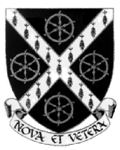
Coats of Arms with Catherine Wheels
- AltenaAltenaAltena is a town in the district of Märkischer Kreis, North Rhine-Westphalia, Germany. The town's castle is the origin for the later Dukes of Berg. Altena is situated on the Lenne river valley, in the northern streches of the Sauerland.-History:...
, Germany - HjørringHjørringHjørring Municipality is a municipality in North Denmark Region on the west coast of the island of Vendsyssel-Thy at the top of the Jutland peninsula in northern Denmark. The municipality covers an area of 929,58 km², making it the largest in Vendsyssel, and it has a total population of 67,121...
, Denmark, where Saint Catherine is the patron-saint of the Town. - KaarinaKaarinaKaarina is a small city and municipality of Finland.It is located in the Finland Proper region and is a neighbouring town of Turku, which is the capital of Finland Proper, therefore Kaarina is a part of the Greater Turku region. The municipality has a population of and covers an area of of...
, Finland, until 2009 and Piikkiö's union with Kaarina - Sinaai, Belgium
- GoaGoaGoa , a former Portuguese colony, is India's smallest state by area and the fourth smallest by population. Located in South West India in the region known as the Konkan, it is bounded by the state of Maharashtra to the north, and by Karnataka to the east and south, while the Arabian Sea forms its...
, India, when it was in Portuguese possession - Prien am ChiemseePrien am ChiemseePrien am Chiemsee is a municipality in the district of Rosenheim, in Bavaria, Germany.-Geography:It is situated on the western shore of the Chiemsee lake, 16 km east of Rosenheim.-Famous resident:...
, Germany, where Saint Catherine is the patron-saint of the Town. - NiedererbachNiedererbachNiedererbach is an Ortsgemeinde – a community belonging to a Verbandsgemeinde – in the Westerwaldkreis in Rhineland-Palatinate, Germany.-Location:...
, Germany - KremnicaKremnicaKremnica is a town in central Slovakia. It has some 5,700 inhabitants. The well-preserved medieval town built above important gold mines is the site of the oldest still-working mint in the world.-History:...
, Slovakia - Katherine SwynfordKatherine SwynfordKatherine Swynford, Duchess of Lancaster , née Roet , was the daughter of Sir Payne Roet , originally a Flemish herald from County of Hainaut, later...
, England - KuldīgaKuldigaKuldīga is a town in western Latvia. It is the center of Kuldīga municipality with a population of approximately 13,500.Kuldīga was first mentioned in 1242. It joined the Hanseatic League in 1368...
, Latvia - Thomas de BrantinghamThomas de BrantinghamThomas de Brantingham was an English clergyman who served as Lord Treasurer to Edward III and on two occasions to Richard II, and as bishop of Exeter from 1370 until his death...
See also
- FustuariumFustuariumIn the military of ancient Rome, fustuarium or fustuarium supplicium was a severe form of military discipline in which a soldier was cudgeled to death...
- The Catherine wheel fireworkCatherine wheel (firework)The Catherine wheel is a type of firework consisting of a powder-filled spiral tube, or an angled rocket mounted with a pin through its centre...
named after it - Catherine wheel (disambiguation)
- Revolt of Horea, Cloșca and CrișanRevolt of Horea, Closca and CrisanThe Revolt of Horea, Cloșca and Crișan began in Zarand County, Transylvania, but it soon spread all throughout the Apuseni Mountains...
External links
- Probertenencyclopaedia - illustrated
- Greenblatt, Miriam Rulers and Their Times: Peter the Great and Tsarist Russia, Benchmark Books, ISBN 0-7614-0914-9