
All Topics  
Murder


   Email Print
   Bookmark   Link


Murder


Murder as defined in common law
Common law

Common law refers to law and the corresponding Legal systems of the world developed through legal opinion of courts and similar tribunals , rather than through statute law or Executive ....
 countries, is the unlawful killing of another human being with intent
Intent

Intent in law is the planning and desire to perform an Criminal act, to fail to do so or to achieve a state of affairs in psychological view it may mean a different thing....
 (or malice aforethought
Malice Aforethought

Malice Aforethought is a murder mystery novel written by Anthony Berkeley Cox, using the pen name Francis Iles. It involves a Devon physician who slowly poisons his domineering wife so that he may be with the woman he loves....
), and generally this state of mind distinguishes murder from other forms of unlawful homicide
Homicide

Homicide refers to the act of killing another human being. It can also describe a person who has committed such an act, though this use is rare in modern English....
. All jurisdictions, ancient and modern, consider it a most serious crime and therefore impose severe penalty on its commission. The word murder is related, in old English, to the French word mordre (bite) in reference to the heavy compensation one must pay for causing an unjust death.

on law murder is defined as the:
  1. unlawful
  2. killing
  3. of another human being
  4. with a state of mind known as "malice aforethought".


The first three elements are relatively straightforward; however, the concept of "malice aforethought" is a complex one that does not necessarily mean premeditation.


Discussion
Ask a question about 'Murder'
Start a new discussion about 'Murder'
Answer questions from other users
Full Discussion Forum


Recent Posts


Timeline

1861   In Britain, the death penalty is limited to murder, embezzlement, piracy and to acts of arson perpetrated upon docks or ammunition depots.

1862   Indian Wars: In Minnesota, more than 300 Santee Sioux are found guilty of rape and murder of white settlers and are sentenced to hang.

1887   Portugal abolishes death penalty for murder

1948   The murder of a three-year-old girl in Blackburn, England leads to the fingerprinting of more than 40,000 men in the city in an attempt to find the murderer.

1958   Charles Starkweather and Caril Ann Fugate begin their murder spree with the killings of her parents and infant sister.

1971   Charles Manson and three female "family members" are found guilty of the 1969 murder of Sharon Tate and others at her house.

1978   British Police launch a massive murder hunt, when newspaper boy Carl Bridgewater is shot dead after disturbing a burglary.

1980   Paul Geidel, convicted of second-degree murder in 1911, is released from prison in Beacon, New York, after 68 years and 245 days - the longest-ever time served by an inmate.

1986   Jeremy Bamber is found guilty of the murder of his parents, sister and twin nephews and sentenced to life imprisonment with a recommendation by the trial judge that he should serve at least 25 years before being considered for parole.

1992   In New York, Mafia boss John Gotti is convicted of the murder of mob boss Paul Castellano and racketeering, and is later sentenced to life in prison.


Encyclopedia


Murder as defined in common law
Common law

Common law refers to law and the corresponding Legal systems of the world developed through legal opinion of courts and similar tribunals , rather than through statute law or Executive ....
 countries, is the unlawful killing of another human being with intent
Intent

Intent in law is the planning and desire to perform an Criminal act, to fail to do so or to achieve a state of affairs in psychological view it may mean a different thing....
 (or malice aforethought
Malice Aforethought

Malice Aforethought is a murder mystery novel written by Anthony Berkeley Cox, using the pen name Francis Iles. It involves a Devon physician who slowly poisons his domineering wife so that he may be with the woman he loves....
), and generally this state of mind distinguishes murder from other forms of unlawful homicide
Homicide

Homicide refers to the act of killing another human being. It can also describe a person who has committed such an act, though this use is rare in modern English....
. All jurisdictions, ancient and modern, consider it a most serious crime and therefore impose severe penalty on its commission. The word murder is related, in old English, to the French word mordre (bite) in reference to the heavy compensation one must pay for causing an unjust death.

Legal analysis of murder

Common law murder is defined as the:
  1. unlawful
  2. killing
  3. of another human being
  4. with a state of mind known as "malice aforethought".


The first three elements are relatively straightforward; however, the concept of "malice aforethought" is a complex one that does not necessarily mean premeditation. The following states of mind are recognized as constituting the various forms of "malice aforethought":

  1. Intent to kill,
  2. Intent to inflict grievous bodily harm
    Grievous bodily harm

    Grievous bodily harm is a term of art used in English law criminal law which has become synonymous with the offences that are created by sections 18 and 20 of the Offences Against The Person Act 1861....
     short of death,
  3. Reckless indifference to an unjustifiably high risk to human life (sometimes described as an "abandoned and malignant heart"), or
  4. Intent to commit a dangerous felony (the "felony-murder" doctrine).


Under state of mind (i), intent to kill, the deadly weapon rule applies. Thus, if the defendant intentionally uses a deadly weapon or instrument against the victim, such use authorizes a permissive inference of intent to kill. An example of a deadly weapon or instrument is a gun, a knife, or even a car when intentionally used to strike the victim.

Under state of mind (iii), an "abandoned and malignant heart", the killing must result from defendant's conduct involving a reckless indifference to human life and a conscious disregard of an unreasonable risk of death or serious bodily injury. An example of this is a 2007 law in California
California

California is a U.S. state on the West Coast of the United States of the United States, along the Pacific Ocean. It is bordered by Oregon to the north, Nevada to the east, Arizona to the southeast, and to the south the Mexico state of Baja California....
 where an individual could be convicted of third-degree murder if he or she kills another person while operating a motor vehicle while being under the influence
Driving under the influence

Driving under the influence of alcohol or other Psychoactive drugs, is the act of operating a vehicle after consuming alcoholic beverage or using Psychoactive drugs....
 of alcohol, drugs, or controlled substances.

Under state of mind (iv), the felony-murder doctrine, the felony committed must be an inherently dangerous felony, such as burglary, arson, rape, robbery or kidnapping. Importantly, the underlying felony cannot be a lesser included offense
Lesser included offense

A lesser included offense, in criminal law, is a crime for which all of the elements necessary to impose liability are also elements found in a more serious crime....
 such as assault, otherwise all criminal homicides would be murder as all are felonies.

Origins


Murder in religion


One of the oldest known prohibitions against murder appears in the Sumerian
Sumerian

Sumerian may refer to:*Sumerian language*Cuneiform script*Sumer, including**History of Sumer**Sumerian architecture**Mesopotamian mythology...
 Code of Ur-Nammu
Code of Ur-Nammu

The Code of Ur-Nammu is the oldest known tablet containing a law code surviving today. It was written in the Sumerian language ca. 2100-2050 BC....
 written sometime between 2100 and 2050 BC. The code states, "If a man commits a murder, that man must be killed."

In Abrahamic religions, the prohibition against murder is one of the Ten Commandments
Ten Commandments

The Ten Commandments, or Decalogue, are a list of religious and moral imperatives that, according to Judeo-Christian tradition, were authored by God and given to Moses on the mountain referred to as "Biblical Mount Sinai" or "Mount Horeb" in the form of two stone tablets....
 given by God to Moses in (Exodus: 20v13) and (Deuteronomy 5v17) (See Murder in the Bible
Murder in the Bible

The concept of murder is referred to in various passages in the Bible. In general, the ethic of reciprocity and the Ten Commandments are referenced as the controlling relevant concepts....
). The Vulgate
Vulgate

The Vulgate is an early Fifth Century version of the Bible in Latin, and largely the result of the labors of Jerome, who was commissioned by Pope Damasus I in 382 to make a revision of Vetus Latina....
 and subsequent early English translations of the Bible used the term secretly killeth his neighbor or smiteth his neighbour secretly rather than murder for the Latin clam percusserit proximum.

Later editions such as Young's Literal Translation
Young's Literal Translation

Young's Literal Translation is a translation of the Bible into English language, published in 1862. The translation was made by Robert Young , compiler of Young's Analytical Concordance to the Bible and Concise Critical Comments on the New Testament....
 and the World English Bible
World English Bible

The World English Bible is a public domain translation of the Bible that is currently in draft form. Work on the World English language Bible began in 1997 and was known as the American Standard Version 1997....
 have translated the Latin occides simply as murder rather than the alternatives of kill, assassinate, fall upon or slay. Christian churches have some doctrinal differences about what forms of homicide are prohibited biblically, though all agree murder is.

The term 'Assassin' derives from Hashshashin
Hashshashin

The Hashshashin from which the word Assassinations is thought to originate, was the Persian Empire derived designation of the Nizari branch of the Ismailism Shia Islam during the Middle Ages....
, a militant Ismaili
Ismaili

Ismailism is a branch of the Islam, and is the second largest part of the Shia Islam community, after the mainstream Twelvers . The Ismaili get their name from their acceptance of Ismail bin Jafar as the divinely appointed spiritual successor to Jafar al-Sadiq, wherein they differ from the Twelvers, who accept Musa al-Kazim, younger bro...
 Muslim sect, active from the eighth to the fourteenth centuries. This mystic secret society
Secret society

Secret society is a term used to describe a variety of organizations. Although the exact meaning of the term is disputed, several of the definitions advanced indicate a degree of secrecy and secret knowledge, which might include denying membership or knowledge of the group, negative consequences for acknowledging one's membership, strong ties...
 killed members of the Abbasid
Abbasid

The Abbasid Caliphate was the third of the Islamic Caliphates of the Islamic Empire. The Caliphate is one of the high points of Islam, and at the time Muslim civilization, together with that of Byzantium, China and India, was the most developed part of the world....
, Fatimid
Fatimid

The Fatimid Caliphate or al-Fatimiyyun was an Arab Shi'a dynasty that ruled over varying areas of the Maghreb, Egypt, Sicily, Malta and the Levant from 5 January 909 to 1171....
, Seljuq
Seljuq dynasty

The Seljuq were a Turco-Persian Sunni Muslim dynasty that ruled parts of Central Asia and the Middle East from the 11th to 14th centuries. They set up an empire known as Great Seljuq Empire that stretched from Anatolia through Persia and was the target of the First Crusade....
 and Crusader élite for political and religious reasons.

The Thuggee
Thuggee

Thuggee is the term for a particular format for the murder and robbery of travellers in History of India.The modern word "wikt:thug" derives from this term....
 cult that plagued India
India

India, officially the Republic of India , is a country in South Asia. It is the List of countries and outlying territories by total area country by geographical area, the List of countries by population country, and the most populous liberal democracy in the world....
 was devoted to Kali
KALI

KALI may refer to:* KALI , a radio station licensed to West Covina, California, United States* KALI-FM, a radio station licensed to Santa Ana, California, United States...
, the goddess of death and destruction. According to the Guinness Book of Records the Thuggee cult was responsible for approximately 2 million deaths.

According to Ross Hassig
Ross Hassig

Ross Hassig   is an United States historical anthropologist specialising in Mesoamerican studies, particularly the Aztec culture. His focus is often on the description of practical infrastructure in Mesoamerican societies....
, author of Aztec Warfare, "between 10,000 and 80,400 persons" were sacrificed
Human sacrifice

Human sacrifice is the act of killing human beings as part of a religious ritual . Its typology closely parallels the various practices of ritual slaughter of animals and of religious sacrifice in general....
 in the 1487 re-consecration of the Great Pyramid of Tenochtitlan
Great Pyramid of Tenochtitlan

The was the one of the main temples of the Aztecs in their capital city of Tenochtitlan, which is now Mexico City. Its architectural style belongs to the late Mesoamerican chronology....
.

Codification

The crime of murder was often formally codified after democratic reform in various jurisdictions, legislature
Legislature

Legislature is a type of representative deliberative assembly with the power to create and change laws. The law created by a legislature is called legislation or statutory law....
s began passing statutes
Legislation

Legislation is law which has been promulgation by a legislature or other governing body. The term may refer to a single law, or the collective body of enacted law, while "statute" is also used to refer to a single law....
.

Legal definition

As with most legal terms, the precise definition of murder varies between jurisdictions and is usually codified in some form of legislation.

At Common law

According to Blackstone, English common law
Common law

Common law refers to law and the corresponding Legal systems of the world developed through legal opinion of courts and similar tribunals , rather than through statute law or Executive ....
 identified murder as a Public Wrong. At Common Law, murder is consider to be Malum in se
Malum in se

Malum in se is a list of Latin phrases meaning wrong or evil in itself. This concept is a part of the value consensus model explanation of the origins of the criminal law....
, that is an act which is evil within itself. An act such as murder is wrong/evil by its very nature. And it is the very nature of the act which does not require any specific detailing or definition in the law to consider murder a crime.

Some jurisdictions still take a common law
Common law

Common law refers to law and the corresponding Legal systems of the world developed through legal opinion of courts and similar tribunals , rather than through statute law or Executive ....
 view of murder. In such jurisdictions, precedent
Precedent

In common law Legal systems of the world, a precedent or authority is a legal case establishing a principle or rule that a court or other judicial body adopts when deciding subsequent cases with similar issues or facts....
 Case law or previous decisions of the Courts of Law defines what is considered murder. However, it tends to be rare and the majority of jurisdictions have some statutory prohibition against murder.

Basic elements

In common law
Common law

Common law refers to law and the corresponding Legal systems of the world developed through legal opinion of courts and similar tribunals , rather than through statute law or Executive ....
 jurisdictions, murder has two elements or parts:
  1. the act (actus reus
    Actus reus

    Actus reus, sometimes called the Element or the objective element of a crime, is the Latin term for the "guilty act" which, when proved beyond a reasonable doubt in combination with the mens rea, "guilty mind", produces criminal liability in the common law-based criminal law jurisdictions of Canada, Australia, New Zealand, England, I...
    ) of killing a person
  2. the state of mind (mens rea
    Mens rea

    In criminal law, mens rea the Latin term for "guilty mind" is usually one of the necessary Element of a crime. The standard common law test of criminal liability is usually expressed in the Latin phrase, actus non facit reum nisi mens sit rea, which means that "the act does not make a person guilty unless the mind is also guilty"....
    ) of intentional, purposeful, malicious, premeditated, and/or wanton.


While murder is often expressed as the unlawful killing of another human being with "malice aforethought
Malice Aforethought

Malice Aforethought is a murder mystery novel written by Anthony Berkeley Cox, using the pen name Francis Iles. It involves a Devon physician who slowly poisons his domineering wife so that he may be with the woman he loves....
", this element of malice may not be required in every jurisdiction (for example, see the French definition of murder below).
  • The element of malice aforethought can be satisfied by an intentional killing, which is considered express malice.
  • Malice can also be implied: deaths that occur by any recklessness or during certain serious crimes are considered to be implied malice murders.


Exclusions

  • Unlawful killings without malice or intent are considered manslaughter
    Manslaughter

    Manslaughter is a legal term for the killing of a human being, in a manner considered by law as less culpable than murder.The law generally differentiates between levels of criminal culpability based on the mens rea, or state of mind....
    .
  • Justified or accidental killings are considered homicide
    Homicide

    Homicide refers to the act of killing another human being. It can also describe a person who has committed such an act, though this use is rare in modern English....
    s. Depending on the circumstances, these may or may not be considered criminal offenses.
  • Suicide
    Suicide

    Suicide is the intentional taking of one's own life. Many dictionaries also note the metaphorical sense of "willful destruction of one's self-interest"....
     is not considered murder in most societies. Assisting a suicide, however, may be considered murder in some circumstances.
  • Capital punishment
    Capital punishment

    Capital punishment, the death penalty or execution, is the killing of a person by procedural law for Punishment#Retribution and Punishment#Incapacitation....
     ordered by a legitimate court of law as the result of a conviction in a criminal trial with due process
    Due process

    Due process is the principle that the government must respect all of the legal rights that are owed to a person according to the law of the land, instead of respecting merely some or most of those legal rights....
     for a serious crime.
  • Killing of enemy combatants by lawful combatants in accordance with lawful orders in war
    War

    ...
    , although illicit killings within a war may constitute murder or homicidal war crime
    War crime

    War crimes are "violations of the laws or customs of war"; including but not limited to "murder, the ill-treatment or deportation of civilian residents of an occupied territory to slave labor camps", "the murder or ill-treatment of prisoner of war", the killing of hostages, "the wanton destruction of cities, towns and villages, and any devast...
    s. (see the Laws of war
    Laws of war

    The law of war is law concerning acceptable practices relating to war. In cases other than civil wars, it is considered an aspect of public international law ....
     article)
  • The administration of lethal drugs by a doctor to a terminally ill patient, if the intention is solely to alleviate pain, is seen in many jurisdictions as a special case (see the doctrine of double effect and the case of Dr John Bodkin Adams
    John Bodkin Adams

    John Bodkin Adams was a British general practitioner, convicted fraudster and suspected serial killer.. Between the years 1946-1956, more than 160 of his patients died under suspicious circumstances....
    ).


Victim

All jurisdictions require that the victim be a natural person; that is a human being who was still alive at the time of being murdered. Most jurisdictions legally distinguish killing a fetus
Fetus

A fetus is a developing mammal or other viviparous vertebrate, after the embryonic stage and before childbirth. The plural is fetuses, or sometimes feti....
 or unborn child as a different crime, such as illegal abortion
Abortion

An abortion is the termination of a pregnancy by the removal or expulsion of an embryo or fetus from the uterus, resulting in or caused by its death....
 of a fetus
or the unlawful killing of an unborn child. The distinction between a fetus and an unborn child in these jurisdictions is that a child could survive if it had been born, while a fetus could not.

Mitigating circumstances

Some countries allow conditions that "affect the balance of the mind" to be regarded as mitigating circumstances
Mitigating factor

A mitigating factor, in law, is any information or evidence presented to the court regarding the defendant or the circumstances of the crime that might result in reduced charges or a lesser sentence....
. This means that a person may be found guilty of "manslaughter" on the basis of "diminished responsibility" rather than murder, if it can be proved that the killer was suffering from a condition that affected their judgment at the time. Depression
Clinical depression

Major depressive disorder is a mental disorder characterized by a pervasive depression , low self-esteem, and anhedonia in normally enjoyable activities....
, post-traumatic stress disorder
Post-traumatic stress disorder

Posttraumatic stress disorder is an anxiety disorder that can develop after exposure to one or more traumatic events that threatened or caused grave physical harm....
 and medication side-effect
Adverse effect (medicine)

In medicine, an adverse effect is a harmful and undesired effect resulting from a medication or other intervention such as chemotherapy or surgery....
s are examples of conditions that may be taken into account when assessing responsibility.

Insanity
Mental disorder
Mental disorder defence

In the criminal laws of Australia and Canada, the defence of mental disorder is a legal defence by excuse, by which a defendant may argue they should not be held criminally liable for breaking the law because they were mentally ill at the time of the alleged criminal actions....
 may apply to a wide range of disorders including psychosis
Psychosis

Psychosis , with adjective psychotic, literally means abnormal condition of the mind, and is a generic psychiatry term for a mental state often described as involving a "loss of contact with reality"....
 caused by schizophrenia
Schizophrenia

Schizophrenia , from the Ancient Greek Root schizein and phren, phren- is a psychiatry diagnosis that describes a mental disorder characterized by abnormalities in the perception or expression of reality....
 and dementia
Dementia

Dementia is the progressive decline in cognition due to damage or disease in the body beyond what might be expected from normal aging. Although dementia is far more common in the geriatric population, it may occur in any stage of adulthood....
, and excuse the person from the need to undergo the stress of a trial as to liability. In some jurisdictions, following the pre-trial hearing to determine the extent of the disorder, the defense of "not guilty by reason of insanity" may be used to get a not guilty verdict. This defense has two elements:
  1. That the defendant
    Defendant

    A defendant or defender is any party who is required to answer the complaint of a plaintiff or pursuer in a civil lawsuit before a court, or any party who has been formally indictment or accused of violating a crime statute....
     had a serious mental illness, disease, or defect.
  2. That the defendant's mental condition, at the time of the killing, rendered the perpetrator unable to determine right from wrong, or that what he or she was doing was wrong. ..


Under New York
New York

The State of New York is a U.S. state in the Mid-Atlantic States and Northeastern United States regions of the United States and is the nation's List of U.S....
 law, for example:

Under the French Penal Code:

Those who successfully argue a defense based on a mental disorder are usually referred to mandatory clinical treatment until they are certified safe to be released back into the community, rather than prison.

Post-partum depression
Some countries, such as Canada
Canada

Canada is a country occupying most of northern North America, extending from the Atlantic Ocean in the east to the Pacific Ocean in the west and northward into the Arctic Ocean....
, Italy
Italy

Italy , officially the Italian Republic , is a country located on the Italian Peninsula in Southern Europe and on the two largest islands in the Mediterranean Sea, Sicily and Sardinia....
, the United Kingdom
United Kingdom

The United Kingdom of Great Britain and Northern Ireland, commonly known as the United Kingdom , the UK or Britain,is a sovereign state located off the northwestern coast of continental Europe....
, New Zealand
New Zealand

New Zealand is an island country in the south-western Pacific Ocean comprising two main landmasses , and numerous Islands of New Zealand, most notably Stewart Island/Rakiura and the Chatham Islands....
 and Australia
Australia

Australia, officially the Commonwealth of Australia, is a country in the southern hemisphere comprising the Australia of the world's smallest continent, the major island of Tasmania, and numerous list of islands of Australia in the Indian Ocean and Pacific Oceans....
, allow post-partum depression (also known as post-natal depression) as a defense against murder of a child by a mother, provided that a child is less than a year old (this may be the specific offense of infanticide
Infanticide

Infanticide is the practice of someone intentionally causing the death of an infant. Often it is the mother who commits the act, but criminology recognizes various forms of non-maternal child murder....
 rather than murder and include the effects of lactation and other aspects of post-natal care).

Self-defense
Acting in self-defense
Self-defense (theory)

The right of self-defense is the right for civilians acting on their own behalf to engage in violence for the sake of defending one's own life or the lives of others, including the use of deadly force....
 or in defense of another person is generally accepted as legal justifications for killing a person in situations that would otherwise have been murder. However, a self-defense killing might be considered manslaughter if the killer established control of the situation before the killing took place. In the case of self-defense it is called a justifiable homicide.

Unintentional
For a killing to be considered murder, there normally needs to be an element of intent. For this argument to be successful the killer generally needs to demonstrate that they took precautions not to kill and that the death could not have been anticipated or was unavoidable, whatever action they took. As a general rule, manslaughter
Manslaughter

Manslaughter is a legal term for the killing of a human being, in a manner considered by law as less culpable than murder.The law generally differentiates between levels of criminal culpability based on the mens rea, or state of mind....
 constitutes reckless
Reckless

Reckless may refer to:In fiction:* Reckless , directed by Victor Fleming* Reckless , a 1951 Spanish film* Reckless , starring Aidan Quinn and Daryl Hannah...
 killing, while criminally negligent homicide is a grossly negligent killing.

Diminished capacity
In those jurisdictions using the Uniform Penal Code, such as California
California

California is a U.S. state on the West Coast of the United States of the United States, along the Pacific Ocean. It is bordered by Oregon to the north, Nevada to the east, Arizona to the southeast, and to the south the Mexico state of Baja California....
, diminished capacity
Diminished Capacity

Diminished Capacity is a comedy film directed by Terry Kinney and starring Matthew Broderick, Virginia Madsen, and Alan Alda. It was released at the 2008 Sundance Film Festival and opened in theaters in July 2008....
 may be a defense. For example, Dan White
Dan White

Daniel James "Dan" White was a San Francisco Board of Supervisors who assassinated San Francisco Mayor George Moscone and Supervisor Harvey Milk, on November 27, 1978, at San Francisco City Hall....
 used this defense to obtain a manslaughter conviction, instead of murder, in the assassination
Assassination

Assassination is the targeted killing of a public figure. Assassinations may be prompted by ideology, politics, or military reasons. Additionally, assassins may be motivated by contract killing, revenge, or celebrity or may be mental disorder....
 of Mayor George Moscone
George Moscone

George Richard Moscone was an United States Lawyer and Democratic Party politicsian. He was the List of Mayors of San Francisco, California of San Francisco, California, California, United States from January 1976 until his Moscone-Milk assassinations in November 1978....
 and Supervisor Harvey Milk
Harvey Milk

Harvey Bernard Milk was an American politician and List of gay, lesbian or bisexual firsts openly homosexual orientation man to be elected to public office in California, as a member of the San Francisco Board of Supervisors....
.

Year-and-a-day rule

In some common law
Common law

Common law refers to law and the corresponding Legal systems of the world developed through legal opinion of courts and similar tribunals , rather than through statute law or Executive ....
 jurisdictions, a defendant
Defendant

A defendant or defender is any party who is required to answer the complaint of a plaintiff or pursuer in a civil lawsuit before a court, or any party who has been formally indictment or accused of violating a crime statute....
 accused of murder is not guilty if the victim survives for longer than one year and one day
Year and a day rule

The year and a day rule was a principle of England law holding that a death was conclusive presumption not to be murder if it occurred more than a year and one day since the act that was alleged to have been its cause....
 after the attack. This reflects the likelihood that if the victim dies, other factors will have contributed to the cause of death, breaking the chain of causation
Causation (law)

Causation is the "causal relationship between conduct and result." That is to say that causation provides a means of connecting conduct, complete with actus reus, with the resulting harm or result element....
. Subject to any statute of limitations
Statute of limitations

A statute of limitations is a statute in a common law legal system that sets forth the maximum period of time, after certain events, that legal proceedings based on those events may be initiated....
, the accused could still be charged with an offence representing the seriousness of the initial assault
Assault

Assault is a crime of violence against another human. In some jurisdictions, including Australia and New Zealand, assault refers to an act that causes another to apprehend immediate and personal violence, while in other jurisdictions, such as the United States, assault may refer only to the threat of violence caused by an immediate show of fo...
.

Abolition of the rule
With advances in modern medicine, most countries have abandoned a fixed time period and test causation on the facts of the case.

In the UK, due to medical advancements, the "year-and-a-day-rule" is no longer in use. However, if death occurs three years or more after the original attack then prosecution can take place only with the Attorney-General's approval.

In the United States, many jurisdictions have abolished the rule as well. Abolition of the rule has been accomplished by enactment of statutory criminal codes, which had the effect of displacing the common-law definitions of crimes and corresponding defenses. In 2001, the Supreme Court of the United States
Supreme Court of the United States

The Supreme Court of the United States is the highest judicial body in the United States, and leads the federal United States federal courts. It consists of the Chief Justice of the United States and eight Associate Justice of the Supreme Court of the United States, who are nominated by the President of the United States and confirmed with th...
 held that retroactive application of a state supreme court decision abolishing the year-and-a-day rule did not violate the Ex Post Facto
Ex post facto law

An ex post facto law or retroactive law, is a law that retroactively changes the legal consequences of acts committed or the legal status of facts and relationships that existed prior to the enactment of the law....
 Clause of Article I of the United States Constitution
Article One of the United States Constitution

Article One of the United States Constitution describes the powers of the legislature of the Federal government of the United States, known as United States Congress, which includes the United States House of Representatives and the United States Senate....
.

Demographics

An estimated 520,000 people were murdered in 2000 around the globe. Two-fifths of them were young people between the ages of 10 and 29 who were killed by other young people.

Murder rates vary greatly among countries and societies around the world. In the Western world
Western world

The term Western world, the West or the Occident can have multiple meanings dependent on its context . Accordingly, the basic definition of what constitutes "the West" varies, expanding and contracting over time, in relation to various historical circumstances....
, murder rates in most countries have declined significantly during the 20th century and are now between 1-4 cases per 100,000 people per year. Murder rates in Japan
Japan

Japan is an island country in East Asia. Located in the Pacific Ocean, it lies to the east of the Sea of Japan, People's Republic of China, North Korea, South Korea and Russia, stretching from the Sea of Okhotsk in the north to the East China Sea and Taiwan in the south....
, Ireland
Ireland

Ireland is the List of islands by area in Europe, and the twentieth-largest island in the world. It lies to the north-west of continental Europe and is surrounded by hundreds of islands and islet....
 and Iceland
Iceland

Iceland, officially the Republic of Iceland , is an island country located in the North Atlantic Ocean between mainland Europe and Greenland....
 are among the lowest in the world, around 0.5; the rate of the United States
United States

The United States of America is a Federal government constitutional republic comprising U.S. state and a federal district. The country is situated mostly in central North America, where its Contiguous United States and Washington, D.C., the Capital districts and territories, lie between the Pacific Ocean and Atlantic Oceans, Borders of the U...
 is among the highest of developed countries, around 5.5 in 2004, with rates in larger cities sometimes over 40 per 100,000.

Within the Western world, nearly 90% of all murders are committed by males, with males also being the victims of 74.6% of murders (according the US Department of Justice). There is a sharp peak in the age distribution of murderers between the ages of 17 and 30. People become decreasingly likely to commit a murder as they age. Incidents of children and adolescents committing murders are also extremely rare, notwithstanding the strong media coverage such cases receive.

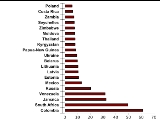
The following absolute murder counts per-country are not comparable because they are not adjusted by each country's total population. Nonetheless, they are included here for reference. There are an estimated 55,000 murders in Brazil
Brazil

Brazil , officially the Federative Republic of Brazil , is a country in South America. It is the List of countries and outlying territories by total area country by geographical area, occupying nearly half of South America, the List of countries by population country, and the fourth most populous democracy in the world....
 every year, about 30,000 murders committed annually in Russia
Russia

Russia , or the Russian Federation , is a list of countries spanning more than one continent country extending over much of northern Eurasia....
, approximately 25,000 murders in Colombia
Colombia

Colombia , officially the Republic of Colombia , is a country in north-western South America. Colombia is bordered to the east by Venezuela and Brazil; to the south by Ecuador and Peru; to the north by the Caribbean Sea; to the north west by Panama; and to the west by the Pacific Ocean....
 (in 2005, murders went down to 15,000), approximately 20,000 murders each year in South Africa
South Africa

The Republic of South Africa, also known by Official names of South Africa, is a country located at the southern tip of the continent of Africa....
, approximately 17,000 murders in the United States
United States

The United States of America is a Federal government constitutional republic comprising U.S. state and a federal district. The country is situated mostly in central North America, where its Contiguous United States and Washington, D.C., the Capital districts and territories, lie between the Pacific Ocean and Atlantic Oceans, Borders of the U...
 (666,160 murders from 1960 to 1996), approximately 15,000 murders in Mexico
Mexico

The United Mexican States , commonly known as Mexico , is a federalism constitutionalism republic in North America. It is bordered on the north by the United States; on the south and west by the Pacific Ocean; on the southeast by Guatemala, Belize, and the Caribbean Sea; and on the east by the Gulf of Mexico....
, approximately 11,000 murders in Venezuela
Venezuela

Venezuela , officially the Bolivarian Republic of Venezuela , is a country on the northern coast of South America.The country comprises a continental mainland and numerous islands located off the Venezuelan coastline in the Caribbean Sea....
, approximately 6,000 murders in El Salvador
El Salvador

El Salvador is the smallest country in the Americas and Central America by size, and the most densely populated nation in Central America. It borders on the Pacific Ocean between Guatemala and Honduras....
, approximately 1,600 murders in Jamaica
Jamaica

Jamaica is an island nation of the Greater Antilles, in length and as much as in width situated in the Caribbean Sea. It is about south of Cuba, and west of the island of Hispaniola, on which Haiti and the Dominican Republic are situated....
, approximately 1000 murders in France
France

France , officially the French Republic , is a country whose Metropolitan France is located in Western Europe and that also comprises various Overseas departments and territories of France....
, approximately 580 murders per year in Canada
Canada

Canada is a country occupying most of northern North America, extending from the Atlantic Ocean in the east to the Pacific Ocean in the west and northward into the Arctic Ocean....
, and approximately 200 murders in Chile
Chile

Chile, officially the Republic of Chile , is a country in South America occupying a long and narrow coastal strip wedged between the Andes mountains and the Pacific Ocean....
. The murder rate in Port Moresby
Port Moresby

||-||-||-||-||-||}Port Moresby , or Pot Mosbi in Tok Pisin, population 255,000 , is the Capital and largest city of Papua New Guinea ....
, Papua New Guinea
Papua New Guinea

Papua New Guinea , officially the Independent State of Papua New Guinea, is a country in Oceania, occupying the eastern half of the island of New Guinea and numerous offshore islands ....
 is 23 times that of London
London

London is the capital of both England and the United Kingdom, and the most populous municipality in the European Union. An important settlement for two millennia, History of London goes back to its founding by the Roman Empire....
. 32,719 murder cases were registered across India
India

India, officially the Republic of India , is a country in South Asia. It is the List of countries and outlying territories by total area country by geographical area, the List of countries by population country, and the most populous liberal democracy in the world....
 in 2007. The Pakistan
Pakistan

Pakistan , officially the Islamic Republic of Pakistan, is a country located in South Asia and borders Central Asia and the Middle East. It has a 1,046 kilometre coastline along the Arabian Sea and Gulf of Oman in the south, and is bordered by Afghanistan and Iran in the west, India in the east and People's Republic of China in th...
 reported 9,631 murders. UNICEF has reported that in India, more than 5,000 brides are killed annually because their dowries
Dowry

A dowry is the money, goods, or estate that a woman brings to her new husband. Compare bride price, which is paid to the bride's parents, and dower, which is property settled on the bride herself by the groom at the time of marriage....
 are considered insufficient.

Murder is the leading cause of death for African American
African American

African Americans or Black Americans are citizens or residents of the United States who have origins in any of the Black people populations of Africa....
 males aged 15 - 34. In the year 2005 the Black homicide victimization rate was 6 times higher than the rate for Whites at 20.6 per 100,000, with 94% of Black homicide victims being killed by a Black offender. In London in 2006, 75% of the victims of gun crime and 79% of the suspects were "from the African/Caribbean community."

Murder demographics are affected by the improvement of trauma care, leading to reduced lethality of violent assaults - thus the murder rate may not necessarily indicate the overall level of social violence.

Development of murder rates over time in different countries is often used by both supporters and opponents of capital punishment
Capital punishment

Capital punishment, the death penalty or execution, is the killing of a person by procedural law for Punishment#Retribution and Punishment#Incapacitation....
 and gun control. Using properly filtered data, it is possible to make the case for or against either of these issues. For example, one could look at murder rates in the United States from 1950 to 2000, and notice that those rates went up sharply shortly after a moratorium on death sentences
Capital punishment in the United States

Capital punishment of a felon in the United States, in modern times, is employed rarely and, in practice, only in cases involving murder. The history of U.S....
 was effectively imposed in the late 1960s. This fact has been used to argue that capital punishment serves as a deterrent and, as such, it is morally justified. Capital punishment opponents frequently counter that the United States has much higher murder rates than Canada
Canada

Canada is a country occupying most of northern North America, extending from the Atlantic Ocean in the east to the Pacific Ocean in the west and northward into the Arctic Ocean....
 and most European Union
European Union

The European Union is an economic and political union of 27 European Union member state, located primarily in Europe. It was established by the Treaty of Maastricht on 1 November 1993 upon the foundations of the pre-existing European Economic Community....
 countries, although all those countries have abolished the death penalty. Gun control advocates further point out that, unlike the United States, many European countries disallow gun ownership by private citizens but Switzerland
Switzerland

Switzerland is a landlocked Swiss Alps country of roughly 7.7 million people in Western Europe with an area of 41,285 km?. Switzerland is a federal republic consisting of 26 states called Cantons of Switzerland....
 has the least restrictive firearm laws and corresponding higher gun murder deaths. Canada
Canada

Canada is a country occupying most of northern North America, extending from the Atlantic Ocean in the east to the Pacific Ocean in the west and northward into the Arctic Ocean....
 introduced a comprehensive Firearms Certificate program in 1977, which was followed by a sharp decline in its homicide rate (and its firearm homicide rate) however firearm homicide rates have crept back up to pre-1977 levels by 2005 even though the overall rate remains less. Overall, the global pattern is too complex and, on average, the influence of both these factors may not be significant and could be more social, economic and cultural.

Country-specific murder law


Australia

Murder is defined in the New South Wales
New South Wales

New South Wales is Australia's oldest and most populous States and territories of Australia, located in the south-east of the country, north of Victoria and south of Queensland....
 (NSW) Crimes Act 1900
Crimes Act 1900

The Crimes Act 1900 is a New South Wales statute that codifies the common law crimes for the state of New South Wales in Australia. Along with the Federal Crimes Act 1914, these two pieces of legislation form the majority of criminal law for New South Wales....
 as follows:

Under NSW law, the maximum penalty for murder is life imprisonment with a standard non-parole period of 20 years. Attempted murder carries a maximum penalty of 25 years imprisonment. Note that in order to be guilty of murder under the NSW Crimes Act, intent to cause grievous bodily harm is enough to secure a conviction for murder, as is felony murder (constructive murder in Australia).

There is a statutory defence of provocation in NSW law, if provocation is proven and the person would have otherwise been convicted of murder, directs the jury to find the defendant not guilty of murder but guilty of manslaughter.

However, this is not the case in Victoria - the Crimes Act 1958 (VIC), in Section 3B, states:
The rule of law that provocation reduces the crime of murder to manslaughter is abolished.


Under Victorian law, it is illegal to kill, by unlawful means, an unborn child that is capable of being born alive. This offence is termed child destruction in the Act. For example, if Person A assaulted Person B with intent to kill B's unborn child, Person A is guilty of child destruction and assault, and thus would be liable, under Victorian law, to 20 years imprisonment - 15 years for child destruction plus 5 years for assault.

In any jurisdiction within Australia, the maximum penalty for murder is life imprisonment. NSW law follows the life means life construction; therefore the maximum sentence is life without possibility of parole.

Canada

As defined in the Criminal Code of Canada
Criminal Code of Canada

The Criminal Code of Canada is the codification of most of the criminal offences and procedure in Canada. Section 91 of the Canadian constitution establishes criminal law as under the sole jurisdiction of the federal Parliament....
, murder is considered one type of culpable homicide, distinguished from the offences of manslaughter
Manslaughter

Manslaughter is a legal term for the killing of a human being, in a manner considered by law as less culpable than murder.The law generally differentiates between levels of criminal culpability based on the mens rea, or state of mind....
 or infanticide
Infanticide

Infanticide is the practice of someone intentionally causing the death of an infant. Often it is the mother who commits the act, but criminology recognizes various forms of non-maternal child murder....
.

First and second degree
In Canada, murder is classified as either first or second degree.
  1. First degree murder is a murder which is (1) planned and deliberate, (2) contracted, (3) committed against an identified peace officer
    Peace officer

    A law enforcement officer , in North America, is any Public sector person charged with upholding the Breach of the peace, mainly police officers, customs officer, correctional officers, probation officers, parole officers, Auxiliary Police, and sheriffs or marshals and their deputies....
    , (4) while committing or attempting to commit one of the following offences (hijacking an aircraft, sexual assault, sexual assault with a weapon, aggravated sexual assault, kidnapping and forcible confinement or hostage taking), (5) while committing criminal harassment, (6) committed during terrorist activity, (7) while using explosives in association with a criminal organization, or (8) while committing intimidation.
  2. Second degree murder is all murder which is not first degree murder. It could be "spur of the moment".


Manslaughter and infanticide
  1. Manslaughter is any culpable homicide which is not murder or infanticide.
  2. Infanticide is the killing of a newly-born child by its mother where the mother's mind was disturbed as a result of giving birth or of consequent lactation. It is a type of homicide but is excluded from murder.


Penalties
The mandatory penalties for murder are :
  1. First degree murder - mandatory life imprisonment without the possibility of parole for 25 years (but someone guilty of a single murder could be have his non-parole period reduced to no less than 15 years (see Faint hope clause
    Faint hope clause

    The "Faint Hope Clause", the popular name for Section 745.6 of the Criminal Code of Canada, is a statutory provision that allows Canadian prisoners who have been sentenced to life in prison, without the possibility of parole for a period greater than 15 years, to apply for early parole after he or she has served 15 years....
    ).
  2. Second degree murder - mandatory life imprisonment without the possibility of parole for 10-25 years (parole eligibility determined by the judge at sentencing, but if the person has a prior conviction for murder, parole eligibility is 25 years)


There is a clause under which a person convicted of any "personal injury offence" meeting the statutory criteria may be declared a "dangerous offender". A dangerous offender is sentenced for an indeterminate period of imprisonment and is eligible for parole after serving at least 7 years. An offender convicted of 1st or 2nd degree murder is ineligible to be declared a dangerous offender. However, an offender convicted of manslaughter can be declared a dangerous offender.

Any sentence imposed in addition to a life sentence must be concurrent.

Denmark

In Denmark manddrab (manslaughter) is the term used by the Danish penalty law
Danish penalty law

Danish penalty law is the codification of the central legal text and constitutes the foundation of the Kingdom of Denmark's criminal law.The Danish penalty law is law number 126 of April 15, 1930....
 to describe the act of intentionally killing another person. No distinction between manslaughter and murder exists. The penalty goes from a minimum of five years (six years in the case of regicide
Regicide

The broad definition of regicide is the deliberate killing of a monarch, or the person responsible for the killing of a monarch. In a narrower sense, in the United Kingdom tradition, it refers to the judicial execution of a king after alleged due process of law....
) to imprisonment for life.

Besides the general offence described above there are more specific homicide offences in Danish law that are not considered as grave as manslaughter. Infanticide
Infanticide

Infanticide is the practice of someone intentionally causing the death of an infant. Often it is the mother who commits the act, but criminology recognizes various forms of non-maternal child murder....
 is defined as a mother who kills her child during or immediately after childbirth due to distress, fear of infamy or under the influence of a debilitation, bewilderment or perplexity caused by giving birth and is punished with imprisonment for up to four years. Euthanasia
Euthanasia

Euthanasia refers to the practice of ending a life in a painless manner. Many different forms of euthanasia can be distinguished, including euthanasia and human euthanasia, and within the latter, voluntary and involuntary euthanasia....
 is defined as killing somebody on their definite request and is punished with imprisonment for up to three years. While attempting suicide is not considered criminal in Danish law, assisting somebody in committing suicide is punishable by imprisonment for up to three years.

Besides deliberate killing two offences regarding the unintentional killing of someone exist in Danish law. Negligent homicide
Negligent homicide

Negligent homicide is a criminal charge brought against people who, through criminal negligence, allow others to die.Negligent Homicide is a lesser included offense to First degree murder and second degree murder, in the sense that someone guilty of this offense can expect a more lenient sentence, often with imprisonment time comparable to...
 is defined as negligently causing the death of another person. The penalty is a fine or imprisonment for up to four years, under aggravating circumstances imprisonment for up to eight years. Death caused by aggravated battery describes the situation where the perpetrator has the intention to commit an aggravated battery but where the battery leads to the unintentional death of the victim. The punishment is imprisonment for up to ten years.

England and Wales


In English law
English law

English law is the Legal systems of the world of England and Wales, and is the basis of common law legal systems used in most Commonwealth of Nations countriesand the United States ....
, the definition of murder is:
The unlawful killing of a human being, under the Queen's Peace
Queen's peace

The Queen's peace is the term used in the Commonwealth realms to describe the protection the monarch, in right of each state, provides to his or her subjects....
, with "malice aforethought
Malice Aforethought

Malice Aforethought is a murder mystery novel written by Anthony Berkeley Cox, using the pen name Francis Iles. It involves a Devon physician who slowly poisons his domineering wife so that he may be with the woman he loves....
").


Contrast this with the original definition by Sir Edward Coke CJ in 1597 of:

Note that it is no longer necessary for the victim to die within a year and a day of the offence, nor for the victim to be a reasonable creature.

Specific statutory instances of situations where death is caused are:
  • Infanticide
    Infanticide

    Infanticide is the practice of someone intentionally causing the death of an infant. Often it is the mother who commits the act, but criminology recognizes various forms of non-maternal child murder....
     - Under s1 Infanticide Act 1938, the intentional killing of an infant under 1-year-old by a mother suffering from post-natal depression or other post-natal disturbance represents an early form of diminished responsibility
    Diminished responsibility in English law

    In English law, diminished responsibility operates only as a mitigatory defence to reduce what would otherwise have been murder in English law to manslaughter in English law ....
     defence and
  • Causing death by dangerous driving
    Death by dangerous driving

    In English law criminal law, the offence of causing death by dangerous driving is currently defined by the Road Traffic Act 1991 but, following Adomako 1 AC 171, the offence of Manslaughter in English law#Motor manslaughter may now be the preferred charge....
     (of a motor vehicle) was introduced because jurors
    Jury

    A jury is a sworn body of people convened to render a rationalism, impartiality verdict officially submitted to them by a court, or to set a sentence or judgment....
    , many of whom were drivers, thought the charge of manslaughter to carry too great a level of stigma for the degree of fault actually shown by some drivers and refused to convict when the charge was manslaughter. Now motor manslaughter is considered an acceptable charge for the more seriously dangerous examples of driving resulting in death, with aggravated TWOC
    TWOC

    A TWOC can also be a medical procedure - a trial without catheterTWOC is an acronym standing for Taking Without Owner's Consent. Synonyms used by police in the UK include UTMV: Unauthorised Taking of a Motor Vehicle, and TADA or TDA: Taken and Driven Away....
     for the least seriously dangerous driving resulting in death.
The aggravated form of criminal damage, including arson
Arson

Arson is the crime of deliberately and maliciously setting fire to structures or wildland areas. It may be distinguished from other causes such as spontaneous combustion and natural wildfires caused by lightning for example....
, under s1(2) Criminal Damage Act 1971 could be the anticipatory offence rather than a charge of attempt
Attempt

Attempt crimes are crimes where the defendant's actions have the form of the actual enaction of the crime itself: the actions must go beyond mere preparation....
ed murder.

Any other killing would be considered either manslaughter in English law
Manslaughter in English law

In the English law of homicide, manslaughter is a less serious offence than murder in English law, the differential being between levels of fault based on the mens rea ....
 or an accident.
  • Voluntary manslaughter is murder mitigated to manslaughter by virtue of the statutory defences under the Homicide Act 1957
    Homicide Act 1957

    The Homicide Act 1957 is an Act of Parliament of the Parliament of the United Kingdom.It was enacted as a partial reform of the common law offence of murder in English law by abolishing the doctrine of constructive malice , reforming the partial defence of provocation in English law, and by introducing the partial defences of diminished re...
    , namely provocation
    Provocation in English law

    In English law, provocation is a mitigatory defense alleging a total loss of control as a response to another's provocative conduct sufficient to convert what would otherwise have been murder in English law into manslaughter in English law....
    , diminished responsibility
    Diminished responsibility in English law

    In English law, diminished responsibility operates only as a mitigatory defence to reduce what would otherwise have been murder in English law to manslaughter in English law ....
     or suicide pact
    Suicide pact

    A suicide pact describes the suicides of two or more individuals in an agreed-upon plan. The plan may be to die together, or separately and closely timed....
    .
  • Involuntary manslaughter is the killing of another person whether by act or omission either while committing an unlawful act (known as constructive manslaughter) or by gross negligence.


English Law
English law

English law is the Legal systems of the world of England and Wales, and is the basis of common law legal systems used in most Commonwealth of Nations countriesand the United States ....
 also allows for transferred malice
Transferred intent

Transferred intent is a doctrine used in both criminal law and tort law when the intention to harm one individual inadvertently causes a second person to be hurt instead....
. For example, where a man fires a gun with the intent to kill person A but the shot misses and kills an otherwise unconnected person B, the intent to kill transfers from person A to person B and a charge of murder would stand. The accused could also be charged with the attempted murder
Attempted murder

In English criminal law, attempted murder is the crime of more than merely preparing to commit unlawful homicide and at the same time having a intention to cause the death of human being under the Queen's Peace....
 of A.

As to mens rea
Mens rea

In criminal law, mens rea the Latin term for "guilty mind" is usually one of the necessary Element of a crime. The standard common law test of criminal liability is usually expressed in the Latin phrase, actus non facit reum nisi mens sit rea, which means that "the act does not make a person guilty unless the mind is also guilty"....
, the model direction to be given to juries for Intention in English law
Intention in English law

In English law criminal law, intention is one of the types of mens rea that, when accompanied by an actus reus , constitutes a crime....
 following R v. Woollin, is a modified version of that proposed by Lord Lane, C.J. in R v Nedrick [1986] 1 WLR 1025, namely:
Where the charge is murder and in the rare cases where the simple direction is not enough, the jury should be directed that they are not entitled to infer the necessary intention, unless they feel sure that death or serious bodily harm was a virtual certainty (barring some unforeseen intervention) as a result of the defendant's actions and that the defendant
Defendant

A defendant or defender is any party who is required to answer the complaint of a plaintiff or pursuer in a civil lawsuit before a court, or any party who has been formally indictment or accused of violating a crime statute....
 appreciated that such was the case, the decision being for the jury to decide on a consideration of all the evidence.


The defences of duress
Duress in English law

Duress in English criminal law is a complete common law defence, operating in favour of those who commit crimes because they are forced or compelled to do so by the circumstances, or the threats of another....
 and necessity in English law
Necessity in English law

In English law, the defence of necessity recognises that there may be situations of such overwhelming urgency that a person must be allowed to respond by breaking the law....
 are excluded from murder cases. An exception is Re A [2000], a case involving a pair of conjoined twins. However, the judge noted the legal adage that "hard cases make bad law" and recommended that the precedent should not be followed. Another defence is that of double effect. As established in the 1957 trial of Dr John Bodkin Adams
John Bodkin Adams

John Bodkin Adams was a British general practitioner, convicted fraudster and suspected serial killer.. Between the years 1946-1956, more than 160 of his patients died under suspicious circumstances....
, causing death through the administration of lethal drugs to a patient, if the intention is solely to alleviate pain, is not considered murder.

Comparatively recent adaptations to the English law of murder include the abolition of the "year and a day rule", and the proposed introduction of a less restrictive regime for corporate manslaughter
Corporate manslaughter

Corporate manslaughter is a criminal offence in English law, being an act of homicide committed by a company . In general, in English criminal law, a juristic person is in the same position as a natural person, and may be convicted for committing many offences....
. The Law Commission Consultation Paper No. 177 also advocates a redefinition of murder and a limitation of the scope of manslaughter.

Finland

In Finland, murder is defined as homicide with at least one of four aggravating factors:

  1. Deliberate intent
  2. Exceptional brutality or cruelty
  3. Significantly endangering public safety
  4. Committed against a public official engaged in enforcing the law.


Further, the offense considered as a whole must be aggravated. A murder doesn't expire.

The only possible punishment for murder is life imprisonment. Typically, the prisoner will be pardoned by the Helsinki Court of Appeals after serving 12 to 14 years of his sentence, but this is not automatic. The President
President of Finland

The President of Finland is the Head of State of Finland. Under the Constitution of Finland, executive power is vested in the President and the government, with the President possessing extensive powers....
 can also give pardon, and previously this used to be the only possibility.

In jurisprudence, the comparison of an actual crime against "especially brutal or cruel way"-standard has been understood to mean comparison to "usual" homicide cases. In recent cases, the Finnish Supreme Court has not considered a single axe stroke on the head, or strangulation to be "especially brutal or cruel". On the other hand, causing death by jumping on a person's chest and head and firing over 10 times upon a person's torso have been considered to fulfill the standard.

The only sentence for murder is life in prison. Until 2006, this meant an actual life sentence which could be pardoned only by the president. However, since the 1960s presidents have regularly given pardons to practically all offenders after a period of 12-15 years. In 2006, the legislation was changed so that all life sentences are reviewed by an appellate court after they have been executed for 12 years. If the convict is still deemed a danger to society, his case will be reviewed every two years after this. Involuntary confinement to a psychiatric institution may also result, sometimes after the sentence is served. The involuntary treatment ends when the psychiatrist decides so, or when a court decrees it no longer necessary in a periodical review.

If the prerequisites are not fulfilled, but the homicide has been deliberate and premeditated, the convict is sentenced for second degree murder (tappo) to a minimum of eight years in prison. There is also the crime of voluntary manslaughter
Voluntary Manslaughter

Voluntary manslaughter is the killing of a human being in which the offender had no prior intent to kill and acted during "the heat of passion", under circumstances that would cause a reasonable person to become emotionally or mentally disturbed....
 (surma), which is a homicide under mitigating/extenuating circumstances, with the punishment of four to ten years. Involuntary manslaughter (kuolemantuottamus) has a maximum punishment of two years of imprisonment or fine (see day fine). Infanticide carries a punishment of at least four months and at most four years in prison.

France

In the French
France

France , officially the French Republic , is a country whose Metropolitan France is located in Western Europe and that also comprises various Overseas departments and territories of France....
 Penal Code
Penal code

A penal code is a portion of a state's laws defining crimes and specifying the punishment. Other parts of the laws of a given state can define crimes and punishments, such as a traffic code or a Building code, or laws addressing natural environmental resources by regulating hunting, fishing, or forestry....
 murder is defined by the intentional killing of another person. Murder is punishable by a maximum of 30 years of criminal imprisonment (no more 20 years if the defendant aren't sentenced to 30 years). Assassination
Assassination

Assassination is the targeted killing of a public figure. Assassinations may be prompted by ideology, politics, or military reasons. Additionally, assassins may be motivated by contract killing, revenge, or celebrity or may be mental disorder....
 (murder with premeditation) and murder in some special case (if the victim is under 15, parents, child, people with disabilities, police officer etc.) are punished by a jail time up to life imprisonment (no more 30 years if the defendant aren't sentenced to life). In France except for recidivist the minimum sentence in criminal prosecution is one or two year of imprisonment, imprisonment which may be suspended if the term of the sentence is under 5 years. Manslaughter is punishable by 15 years of criminal imprisonment, and 20 years with aggraving circumstances (the same who make a murder eligible for life in jail).

Germany

In Germany
Germany

Germany , officially the Federal Republic of Germany , is a country in Central Europe. It is bordered to the north by the North Sea, Denmark, and the Baltic Sea; to the east by Poland and the Czech Republic; to the south by Austria and Switzerland; and to the west by France, Luxembourg, Belgium, and the Netherlands....
 the term Mord (murder) is officially used for the intentional killing of another person, but only if the case is especially severe. The requirements can be read in § 211 of the German Criminal Code, Strafgesetzbuch
Strafgesetzbuch

The Strafgesetzbuch is the name of the Germany, Switzerland, Liechtenstein and Austrian criminal law. It is often abbreviated to StGB....
 (StGB).

Those qualifying circumstances are categorized into three groups:
  1. detestable motive
  2. detestable way of committing the crime
  3. detestable purpose/aim of the criminal.


Intentional killing that isn't murder usually fulfills § 212 (Totschlag = killing: similar to second-degree murder, however actually any case of killing that is not fulfilling the qualifications of murder as seen above - actually the same as Tötung (killing) in Swiss law).

The current form of § 211 StGB was created in the year 1941. Before that the differentiation between Mord (murder) and Totschlag (killing) was, that Mord was killing "with premeditation" ("mit Überlegung" - directly translated: with consideration, however that is just another legal word for the same concept) and Totschlag without (1871-1941). However this differentiation was considered too vague. The reform was orientated on discussions for the reform of the Swiss StGB, which also had the same differentiation. It took over the idea and mainly also the wording of the reform commission for the Swiss StGB headed by Stoss in 1896. With this version, the differentiation between Mord and Totschlag contains problems. This led to ongoing discussions in the legal community about the wording, the interpretation and also about a reform of the law.

If the victim of a killing earnestly wanted to be killed (for example, when suffering an incurable disease) the crime would be Tötung auf Verlangen (killing on demand, § 216 StGB) which would result in 6 months to 5 years in prison (usually suspended) – basically, mercy killing. In 2002, there was a cannibal case in which the offender, Armin Meiwes
Armin Meiwes

Armin Meiwes is a Germany man who achieved international notoriety for killing and eating a voluntary victim he had found via the Internet. After Meiwes and the victim jointly attempted to eat the victim's severed penis, Meiwes killed his victim and proceeded to eat a large amount of his flesh....
, claimed that the victim wanted to be killed. The court convicted him of "Totschlag", since they didn't see the qualifications of a murder. Both prosecution and defense appealed, the prosecution in order to reach a guilty of murder verdict, the defense in order to reduce the charge to killing on demand. The German "Bundesgerichtshof", the highest German court of appeal, eventually convicted him of murder.

If the killing was due to negligence it is punished according to § 222 StGB as fahrlässige Tötung (negligent homicide or manslaughter). Many cases in this field are car accidents due to negligence that result in the death of a person.

If the death is a negligent consequence of an intended act of violence, it is classified as Körperverletzung mit Todesfolge (injury resulting in death).

Penalties
The penalty
Sentence (law)

In law, a sentence forms the final act of a judge-ruled process, and also the symbolic principal act connected to his function. The sentence generally involves a decree of prison, a Fine and/or other punishments against a defendant conviction of a crime....
 for Mord is lifelong imprisonment, which is usually suspended after 17-18 years (15 years minimum) on a probation of 5 years or if the court decided on a special gravity (Feststellung der besonderen Schwere der Schuld), the sentence can only be suspended much later, earliest after 18 years but usually after 22-23 years (the law states that a suspension after 15 years is not possible for "special gravity" crimes, but provides no explicit minimum served time).

The penalty for Totschlag is five to fifteen years in prison and in especially grave cases life time imprisonment (minimum sentence 15 years). Especially grave cases are very rare, because usually such case already fall under Mord (§ 211).

In lesser cases (minderschwerer Fall, § 213) the prison sentence is one to ten years.

The law itself gives one example for a minor case: the killing due to the provocation of the killed person, e.g. if the killed person has beaten him or one of his relatives or has severely insulted them and the killer acted under the influence of great anger.

The lesser case of Totschlag is similar.

Felony murder
German criminal law also knows the institute of the felony murder which also carries a life-long sentence, however only if a person is intentionally or negligently killed in the course of a robbery, a kidnapping or a sexual assault. Actually only if the killing was intended by the criminal it is called murder. Intention also includes cases where the criminal knows that the victim could die and simply takes that into account for other causas

Robbery with deadly outcome
If the killing was due to gross negligence the criminal can be punished for robbery with deadly outcome (Raub mit Todesfolge) according to § 251. The punishment is a lifetime prison sentence or a prison sentence not below 10 years. The same applies for rape with deadly outcome (§ 178: Vergewaltigung mit Todesfolge) and other crimes.

Attempted suicide
Attempted suicide and aiding (Beihilfe zur Selbsttötung) and abetting a person intent on killing himself are not punishable by German criminal law.

Capital Punishment
Before 1949 the usual punishment for Mord (§ 211) in Germany was capital punishment
Capital punishment

Capital punishment, the death penalty or execution, is the killing of a person by procedural law for Punishment#Retribution and Punishment#Incapacitation....
, except in less severe cases. In 1949 death penalty was abolished by the Grundgesetz in West Germany. In East Germany the death penalty was abolished in 1987. After the 1950s it was very rarely used.

Hong Kong

There is one ordinance that governs all the crimes against persons, termed as Offences Against the Person Ordinance, HK Laws. Chap 212.

Attempted Murder
  • Attempted murder using poison, wounding another (§ 10), by destroying or damaging building (§ 11), setting fire to or casting away ship (§ 12) and attempting to shoot or drown (§ 13), all have a penalty of life imprisonment.
  • Attempted murder by other means not specified above (§ 14) shall be liable to imprisonment for life.


Manslaughter

Act against infant

  • Child is not born


  • Child is born
If a woman does or does not do something for her baby's death,

Suicide
  • Suicide used to be a crime, as with the UK.

Israel

Israel
Israel

Israel officially the State of Israel , is a country in the Middle East located on the eastern shore of the Mediterranean Sea. It borders Lebanon in the north, Syria in the northeast, Jordan in the east, and Egypt on the southwest, and contains geographically diverse features within its relatively small area....
 had 173 murders in 2004, compared to 147 murders in 2000. Two particular characteristics of homicide in Israel are the terrorist attacks and (so called) honour killings.

There are five types of homicide in Israel:
  1. Murder - The premeditated killing of a person, or the intentional killing of a person whilst committing, preparing for, or escaping from any crime, is murder. The mandatory punishment for this crime is life imprisonment. Life is usually commuted (clemency from the President) to 30 years from which a third can be deducted by the parole board for good behaviour. Arab terrorists are not usually granted pardons or parole other than as part of deals struck with Arab terrorist organisations or foreign governments and in exchange for captured Israelis or their corpses.
  2. Reduced sentence murder - If the murderer did not fully understand his actions because of mental defect (but not legal insanity or imbecility), or in circumstances close to self-defence, necessity or duress or where the murderer suffered from serious mental distress because of long-term abuse, the court can give a sentence of less than life. This is a new addition to the Israeli penal code and has been rarely used.
  3. Manslaughter - The deliberate killing of a person without premeditation (or the other circumstances of murder) is manslaughter for which the maximum sentence is 20 years. The sentence depends on the particular circumstances of the crime and its perpetrator.
  4. Negligent killing or vehicular killing - Maximum sentence is 3 years (minimum of 11 months for the driver). The perpetrator in this situation can expect to receive some jail time of about 6 - 12 months.
  5. Infanticide - The killing of a baby less than 12 months old by its mother where she can show that she was suffering from the effects of the birth or breast-feeding. Maximum sentence is 5 years.


Italy

By Italian
Italy

Italy , officially the Italian Republic , is a country located on the Italian Peninsula in Southern Europe and on the two largest islands in the Mediterranean Sea, Sicily and Sardinia....
 law, murder (omicidio) is regulated by articles 575-582, 584-585, and 589 of the Penal Code (Codice Penale).

In general, according to Art.575, "whoever causes the death of a human being is punishable by no less than 21 years in prison"; nevertheless, the law indicates a series of circumstances under which murder has to be punished with life in prison.

It must also be noted that, according to Italian law, any sentence of more than 5 years perpetually deprives (Interdizione perpetua dai Pubblici Uffici) the condemned person of: the voting rights; the ability to exercise any public office; the ability to be employed in any governmental or para-statal position (articles 19, 28, 29). The convict for life is also deprived of his/her quality of parent: the children are either given in custody to the other parent or hosted in a public structure (art.32).

In detail, according to articles 576 and 577 is punishable with life imprisonment
Life imprisonment

Life imprisonment or life incarceration is a sentence of prison for a serious crime, often for most or even all of the criminal's remaining life, but in fact for a period which varies between jurisdictions: many countries have a maximum possible period of time a prisoner may be incarcerated, or require the possibility of parole after...
 murder committed:
  1. In order to commit another crime, or in order to escape, of favor, or take advantage from another crime (art.61, sect.2);
  2. Against a next of kin (parent or child) and either through insidious means, with premeditation, cruelly, of for futile motives;
  3. By a fugitive in order to escape capture, or in order to acquire means of subsistence;
  4. While raping
    Rape

    Rape, also referred to as sexual assault, is an assault by a person involving sexual intercourse with or sexual penetration of another person without that person's consent....
     or sexually assaulting a person (articles 519, 520, 521).
  5. In a cruel way and/or through the use of torture (art.61, sect.1);
  6. For abject and/or futile motives (art.61, sect.4);
  7. Against a next of kin (parent or child);
  8. Through insidious means;
  9. With premeditation.
Cases 1 through 4 (art.576) used to be considered capital murder, and therefore punishable by death by firing squad
Execution by firing squad

Execution by firing squad is a method of capital punishment, particularly common in times of war. The firing squad is generally composed of several soldiers or peace officers....
. Since 1946, though, death penalty was discontinued in Italy, and death was substituted with life imprisonment. Sentences for murder under cases 5 through 9 (art.577). instead, are subject to parole or probation.A person that is serving a life sentence can reach libertà condizionata
Libertà condizionata

Article 176 of the Italian Penal Code concerns libert? condizionata According to the provisions of Article 176, an incarcerated person becomes eligible for a grant of libert? condizionata if he or she satisfies at least the following conditions:...


Besides the criminal murder detailed above, in Italian law the following cases also exist:

  1. Infanticide - (Infanticidio in condizioni di abbandono materiale e morale), murder of the infant immediately following the birth committed by the mother who is in conditions of material or moral disorder, is punishable with a sentence between 4 and 12 years (art. 578).
  2. Killing on demand - (Omicidio del consenziente), the action to kill someone with his/her consent, is punishable with a sentence between 6 and 15 years. This, however, is considered murder if the victim, when giving his/her consent, was under the age of 18, intoxicated, mentally disable, or if the consent was obtained through violence, menace, or deception (art.579).
  3. Assistance or instigation of suicide - (Istigazione o aiuto al suicidio), the action to help someone to commit suicide, or to convince someone to commit suicide, is punishable with a sentence between 5 and 12 years if the suicide succeeds, or between 1 and 5 years if it does not succeed but a body injury has been made. This, however, is considered murder if the suicide is under the age of 14 (art.580).
  4. Injury resulting in death - (Omicidio preterintenzionale) occurs when, as a result of a deliberated act of violence not meant to kill (articles 581,582), the death of a person occurs. This crime is punishable with a sentence between 10 and 18 years (art.584). This sentence can be increased from one third to one half (up to 27 years) if a circumstance stated by articles 576 and 577 occurs, or if a weapon is used (art.585).
  5. Manslaughter - (Omicidio colposo), the action of causing the death of a person without intention, is punished with a sentence between 6 months and 5 years. If the victims are more than one as a consequence of the same act, multiple counts can be added up to 12 years in prison (art.589).


The Netherlands

By Dutch
Netherlands

The Netherlands is a country that is part of the Kingdom of the Netherlands. It is a parliamentary democratic constitutional monarchy. The Netherlands is located in North-West Europe, and bordered by the North Sea to the north and west, Belgium to the south, and Germany to the east....
 law, murder (moord) is punishable by a maximum sentence of life imprisonment
Life imprisonment

Life imprisonment or life incarceration is a sentence of prison for a serious crime, often for most or even all of the criminal's remaining life, but in fact for a period which varies between jurisdictions: many countries have a maximum possible period of time a prisoner may be incarcerated, or require the possibility of parole after...
, which is the longest prison sentence the law allows. A common misconception is that the maximum sentence is 30 years (20 until 2006): this is the longest sentence that can be imposed other than life imprisonment. A life sentence is given 4 to 5 times a year on average and currently over 30 people are serving a life sentence in the Netherlands. They will all die in prison unless given parole by either Queen Beatrix or her successor. The average sentence is 12 to 15 years. In addition to a prison sentence, the judge may sentence the suspect to TBS, or 'terbeschikkingstelling', meaning detention
Detention (imprisonment)

Detention generally refers to a state or government holding a person in a particular area , either for interrogation, as punishment for a wrong, or as a precautionary measure while that person is suspected of posing a potential threat....
 in a psychiatric institution, sometimes including forced treatment. TBS is imposed for a number of years (most often in relation to the severity of the crime) and thereafter prolonged if deemed necessary by a committee of psychiatrists. This can be done indefinitely, and has therefore been criticized as being a life sentence in disguise. Voluntary manslaughter (doodslag) is punishable by a prison sentence of up to 15 years, or life imprisonment when committed during the commission of a crime or as an act of terrorism. Involuntary manslaughter (dood door schuld) is punishable by a prison sentence of up to two years. If involuntary manslaughter is caused by recklessness, the maximum sentence that can be imposed is four years.

Norway

In Norway
Norway

Norway , officially the Kingdom of Norway, is a constitutional monarchy in Northern Europe that occupies the western portion of the Scandinavian Peninsula....
 any act of murder (mord or drap) is generally split into three categories; planned murder, intentional murder or murder as a result of neglect.

Categories of murder
  1. Planned murder or First Degree Murder - (overlagt drap) is a murder committed with the intention of taking the life of another, by a person fully sane and aware of what he or she is doing, and having planned the act of murder ahead. Planned murder is punished with up to 21 years of imprisonment. Under special circumstances, like a murder of severe cruelty, or if there is reason to believe the offender may commit murder again, additional years of imprisonment can be given. This usually takes place at a court hearing near the end of the sentence.
  2. Intentional murder or Second Degree Murder -(forsettlig drap) is a murder committed with the intention of taking the life of another, by a person fully sane and aware of what he or she is doing, without the act of murder having been planned ahead. Murder of passion usually falls into this category. Intentional murder is punished by 6 to 12 years of imprisonment.
  3. Murder as a result of neglect or manslaughter - (uaktsomt drap) is defined as a case where someone has been killed as a result of the offenders neglect. For example, a car driver may be convicted for murder if someone is killed as a result of his or her careless driving. Murder as a result of neglect is punishable by 3 to 6 years, depending on the circumstances.


Other forms of murder
Assisted suicide is generally illegal in Norway, and will in most cases be treated as planned murder, although the punishment may be milder depending on the circumstances.

Euthanasia
Euthanasia

Euthanasia refers to the practice of ending a life in a painless manner. Many different forms of euthanasia can be distinguished, including euthanasia and human euthanasia, and within the latter, voluntary and involuntary euthanasia....
 (aktiv dødshjelp) has been much debated in Norway. Some groups have expressed that it should be legal in cases where the victim is sane and fully aware of what he or she is asking for. Acts of euthanasia, however, are illegal, and are treated as any other form of assisted suicide.

Portugal


Overview
The Portuguese Penal Code was adopted in 1982 and has been revised on several occasions, most recently in 2007. It devotes a whole chapter on "crimes against human life". In fact, the very first crime addressed on that code is murder.

The Portuguese Constitution (adopted in 1976) expressly forbids the death penalty (art. 24, § 2) and life imprisonment
Life imprisonment

Life imprisonment or life incarceration is a sentence of prison for a serious crime, often for most or even all of the criminal's remaining life, but in fact for a period which varies between jurisdictions: many countries have a maximum possible period of time a prisoner may be incarcerated, or require the possibility of parole after...
 (art. 30, § 1). Additionally, since 1997, the Constitution does not allow the extradition
Extradition

Extradition is the official process by which one nation or state requests and obtains from another nation or state the surrender of a suspected or convicted criminal....
 of anyone who would be subject to any of those two forms of punishment at the requesting country. Unless binding assurances are given that the suspect will not be sentenced to either death penalty or life imprisonment
Life imprisonment

Life imprisonment or life incarceration is a sentence of prison for a serious crime, often for most or even all of the criminal's remaining life, but in fact for a period which varies between jurisdictions: many countries have a maximum possible period of time a prisoner may be incarcerated, or require the possibility of parole after...
, the extradition must be rejected.

Additionally, the Penal Code states that no person may be sentenced to a prison term longer than 25 years, whichever crimes he or she has been found guilty of committing. Therefore, a multiple murderer - no matter how many actual homicides - will not serve more than 25 years in prison. Likewise, in the case murder is committed in addition to other felonies, the defendant will be sentenced to a single prison term, for a period no longer than 25 years, encompassing the applicable terms for each crime committed.

It should also be mentioned that, according the Portuguese Penal Code, only very rarely will a sentence of less than 5-years imprisonment be enforced. In fact, article 75, § 1, states that if an offence is punishable by a prison term or another non-detentive form of punishment, the court should opt for the non-detentive punishment "if this punishment will satisfy adequately the objectives of the criminal law."

Therefore, someone convicted to up to 5 years in prison will be put on probation or (if the sentence if for less than 3 years) will simply have the prison sentence suspended. If the convicted felon commits another intentional crime during the period of suspension or probation, he or she will serve fully the prison term. Probation or term-suspension usually will only be denied in the case of criminals with very long criminal records.

Homicide
Intentional murder, or homicide
Homicide

Homicide refers to the act of killing another human being. It can also describe a person who has committed such an act, though this use is rare in modern English....
, is split into two categories, much like the American classification of murder in the first degree and murder in the second degree discussed above.

Homicide, or wilful and intentional murder (art. 131 of the Penal Code), is punishable with a prison sentence of no less than 8 years and no longer than 16 years.

Aggravated homicide(art. 132 of the Penal Code) is considered any wilful and intentional act in which death is provoked under particularly censurable or malicious circumstances, and is punishable with a prison term of no less than 12 and no longer than 25 years.

The following circumstances are adequate to constitute a case of aggravated homicide:
a) When the murderer is a descendant or an ascendant, either by blood or adoption, of the victim.
b) When the victim is the spouse, former spouse, or person of the same or different with sex with whom the felon had a marital relationship, even if not a member of the same household, or the other parent of the son or daughter of the felon.
c) When the victim is especially defenceless, due to his/her age, handicap, illness or pregnancy.
d) When the murder employs torture or other act of cruelty to enhance the victim's sufferance.
e) When the murder is determined by greed, by the pleasure of causing death or suffering, for personal enjoyment or sexual gratification or any other futile motive.
f) When the murder is determined by racial, religious or political hatred or motivated by the colour, ethnical or national origin, sex or the sexual orientation of the victim.
g) When the murder takes place in order to prepare, facilitate, execute or dissimulate another crime, or to facilitate the escape from the authorities.
h) When the act is carried out in conjunction with, at least, another two people or when an especially dangerous mean is used to cause death.
i) When poison or any other insidious mean is used to cause death.
j) When the intent to commit murder has persisted for longer than 24 hours.
l) When the victim is the holder of public office, a docent, a minister of any religious cult, a judge or referee of any federated sport, and the act is related and caused by the exercise of said functions.
m) When the murderer is a public servant (e.g. a police officer) and the act takes place with serious abuse of authority.


Other than homicide and aggravated homicide, the Penal Code also has provisions for other forms of intentionally and unlawfully causing someone's death:
  • Privileged homicide (art. 133) - when the murder takes place under an understandable violent emotion, compassion, despair or other socially or morally relevant motive, such as to significantly diminish the murderer's degree of guilt. Punishment in this case is prison for 1 to 5 years.
  • Homicide by request (art. 134) - when the murder is carried out at the serious, constant and explicit request of the victim. Punishment is prison for 6 months to 3 years.
  • Inciting or assisting suicide (art. 135) - if someone incites or assists another person to commit suicide, he or she is sentenced to prison for 6 months to 3 years. The punishment is increased to a prison term of 1 to 5 year, in the case the victim is under 16 years old or has, in any way, his or her capacity impaired.
  • Infanticide (art. 136) - when the mother, under the disturbing influence of delivering the baby, commits murder while delivering it, or immediately afterwards. Punishment is 1 to 5 years imprisonment.
  • Abortion (art. 140) - abortion carried out without the consent of the pregnant woman is punishable with imprisonment for 2 to 8 years. Abortion with the consent of the pregnant woman carries a prison term of 6 months to 3 years; the same penalty applying to the woman consenting to the abortion. However, abortion is not punishable if carried out at a registered clinic or hospital, at the request of the pregnant woman, until the tenth week of pregnancy (or later, in some circumstances).


Manslaughter
Manslaughter, which art. 136 of the Penal Code refers to as homicide caused by negligence, is punishable with a prison term of no less than 6 months and no longer than 3 years, or a fine. If the death is caused by gross negligence the penalty the prison term is of 6 months to 5 years.

Additionally, unintentionally causing someone's death while committing a crime other than homicide is an aggravating factor in the determination of the punishment applicable to that specific crime. For example, if the crime of abandonment (exposing a defenceless person to a situation in which he or she will not to be able to cope with, therefore causing harm to the victim) results in the victim's death, the punishment is 3 to 10 years imprisonment, whereas the normal penalty would be 1 to 5 years. In another example, aggravated assault resulting in the death of the victim is punishable with 3 to 13 years imprisonment, whereas the usual penalty would be 2 to 10 years.

Conditional liberty
Inmates are usually not required to serve fully their prison terms. The Penal Code allows for the possibility of releasing them on conditional liberty ("liberdade condicional"), or parole
Parole

Parole may have different meanings depending on the field and judiciary system. All of the meanings originated from the French language parole, meaning " word." Following its use in late-medieval Anglo-French chivalric practice, the term became associated with the release of prisoners based on prisoners giving their word of honor to abide...
.

Parole is granted once one-half of the term has been served if both the following requirements are met:
  • One would reasonably expect the inmate, given the circumstances of his or her life, previous conduct, personality and evolution during incarceration, to behave in a socially responsible way without committing crimes, if released.
  • The release of the convict will not endanger the public order nor aggravate the community.


If the second requirement is not met (which would be the case when the particular crime has cause huge uproar in the community), the inmate will be released once two-thirds of the prison term have been served, as long as the inmate is reasonably expected to behave in a socially responsible way without committing crimes, if released.

Even if the inmate is not expected to behave in a socially responsible way, he or she is released once five sixths of the prison terms have been served, unless the inmate refuses to be released.

Parole last for the remaining period of the unserved prison term, but no longer than 5 years. Once the period of parole is fully served in a satisfactory manner, the remaining unserved prison sentence is declared void.

Status of convicts and felons
Convicts and felons may not suffer any effect from their criminal conviction other than deprivation of liberty for the period of incarceration, unless the sentence specifically establishes other effects in a direct and reasonable relationship with the offence committed. Convicts do not lose any right or entitlement due to their conviction, namely political rights. In fact, on election day polling stations are set up at the major prison establishments so that inmates may exercise their right to vote, if they so wish.

Any criminal conviction registered on the felon’s criminal record is stricken after a certain period of time, depending on the gravity of the offence. In the case of murder, this fact would be stricken from the murderer's criminal record once 15 years have elapsed from fully serving his or hers sentence without committing any other offence.

Romania

According to the Romania
Romania

Romania is a country located in Southeastern Europe Central Europe, North of the Balkan Peninsula, on the Lower Danube, within and outside the Carpathian Mountains, bordering on the Black Sea....
n Penal Code, a person can face a penalty ranging from 10 to 25 years or life imprisonment for murder. (There are also mandatory restrictions of some constitutional rights for all types of murder.)

Degrees of murder
  • Murder - (10 to 20 years) Killing a person when no aggravating circumstances apply.
  • Qualified murder (15 to 25 years). Aggravating circumstances:
a) with premeditation
b) concerning a material interest
c) against spouse or close relative
d) taking advantage of victim's impossibility of self-defence
e) when putting in danger the lives of multiple persons
f) concerning job attributions of the victim
g) for facilitating or hiding another crime
h) in public
  • Extremely grave murder (15 to 25 years or life imprisonment
    Life imprisonment

    Life imprisonment or life incarceration is a sentence of prison for a serious crime, often for most or even all of the criminal's remaining life, but in fact for a period which varies between jurisdictions: many countries have a maximum possible period of time a prisoner may be incarcerated, or require the possibility of parole after...
    ). Aggravating circumstances:
a) committed in a cruel way
b) against two or more persons
c) by a person who had already committed a murder
d) in order to hide a robbery
e) against a pregnant woman
f) against a policeman, gendarme, magistrate or soldier (in connection with their public duties)
  • Negligent or accidental murder (1 to 5 years in simple form). Aggravating circumstances:
a) Caused by a professional in connection with his job for not respecting the legal dispositions (2 to 7 years)
b) By a vehicle driver with blood alcohol concentration (BAC) above legal limits or in a drunk state (5 to 15 years)
c) By a professional in a drunk state - in connection with his job duties (5 to 15 years)
d) When causing the death of two or more persons (5 to 15 years)
  • Infanticide (2 to 7 years).


Switzerland

In Switzerland
Switzerland

Switzerland is a landlocked Swiss Alps country of roughly 7.7 million people in Western Europe with an area of 41,285 km?. Switzerland is a federal republic consisting of 26 states called Cantons of Switzerland....
 murder (
Mord, Assassinat or Assassinio respectively in German, French or Italian) is also used for the premeditated killing of another person, but only if the motives are cruel, disgusting or show an overall disrespect of human life. Penalty ranges from ten years to life in prison.

Furthermore, homicide is considered murder if it is cruel (e.g. inflicts great pain on the victim) and/or unusual, done so using explosives or arson, or if it is done to satisfy perverse lusts.

Any homicide not meeting these standards is considered to be a killing (
Tötung, Meurtre or Omicidio), and the penalty is not as heavy. Most homicides in Switzerland are considered killings, with the penalty ranging from 5 to 20 years.

The Swiss equivalent for manslaughter is
Totschlag, Meurtre passionel or Omicidio passionale. Killers are sentenced for Totschlag when they committed the crime in a very, and especially excusable, state of excitement (a "Crime of passion"). For example, a wife who's been mistreated by her husband for years, and kills him in a fit of rage, would be sentenced for Totschlag. The penalty is one to ten years in prison.

There are many other privileged variants of killing, similar to manslaughter, such as killing on demand of the "victim"; or assisted suicide, in which case the punishment is considerably lower; this latter is only punishable if there are selfish motives. The "assisted suicide" in general is not punishable.

The relevant articles of the Swiss Penal Code (Strafgesetzbuch
Strafgesetzbuch

The Strafgesetzbuch is the name of the Germany, Switzerland, Liechtenstein and Austrian criminal law. It is often abbreviated to StGB....
) are 111 to 117 (and in a certain measure, 118 to 120), which can be read in the Swiss Penal Code, second book, in French, Italian, or German.

Sweden


In Sweden
Sweden

Sweden , officially the Kingdom of Sweden , is a Nordic countries on the Scandinavian Peninsula in Northern Europe. Sweden has land borders with Norway to the west and Finland to the northeast, and it is connected to Denmark by the ?resund Bridge in the south....
, the following degrees of murder apply:

  • Murder (Mord) is defined as "taking the life of another", and punishable with imprisonment for 10 years or for life
    Life imprisonment

    Life imprisonment or life incarceration is a sentence of prison for a serious crime, often for most or even all of the criminal's remaining life, but in fact for a period which varies between jurisdictions: many countries have a maximum possible period of time a prisoner may be incarcerated, or require the possibility of parole after...
    . (3-1 § of the Penal Code)


  • Manslaughter
    Manslaughter

    Manslaughter is a legal term for the killing of a human being, in a manner considered by law as less culpable than murder.The law generally differentiates between levels of criminal culpability based on the mens rea, or state of mind....
     (
    Dråp) is murder that is considered less serious, either due to the circumstances or the crime itself, punishable with a fixed prison term between 6 and 10 years. (3-2 §)


  • Infanticide
    Infanticide

    Infanticide is the practice of someone intentionally causing the death of an infant. Often it is the mother who commits the act, but criminology recognizes various forms of non-maternal child murder....
     (
    Barnadråp) is murder committed by a mother on her child "when, owing to her confinement, she is in a disturbed mental state or in grave distress", punishable with any prison term up to 6 years. (3-3 §)


  • Negligent homicide
    Negligent homicide

    Negligent homicide is a criminal charge brought against people who, through criminal negligence, allow others to die.Negligent Homicide is a lesser included offense to First degree murder and second degree murder, in the sense that someone guilty of this offense can expect a more lenient sentence, often with imprisonment time comparable to...
     (
    Vållande till annans död, literally causing another's death) is murder committed due to carelessness. For negligent homicide, there are three types of punishments:
1) A fine (day-fine
Day-fine

A day-fine or day fine or unit fine is a unit of Fine payment that, above a minimum fine, is based on the offender's daily personal income....
s) if the crime is petty,
2) Any prison term up to 2 years, or
3) Any prison term between 6 months and 6 years if the crime is gross. Gross negligence is distinguished by "the taking of a considerable risk leading to the death, or driving a motor vehicle under influence leading to the death". (3-7 §)


The Swedish Minister of Justice
Minister for Justice (Sweden)

The Minister for Justice is the justice minister of Sweden and head of the Ministry of Justice . The current Minister for Justice is Beatrice Ask of the Moderate Party....
, Beatrice Ask
Beatrice Ask

Eva Carin Beatrice Ask is a Sweden Moderate Party politician, currently serving as Minister for Justice in the Government of Sweden....
, has recently criticized the current system of punishment for murder, as "persons eligible for sentences higher than 10 years instead are sentenced to that term rather than life imprisonment". Instead, a term of 18 years imprisonment are considered to be inserted. Currently, the murder and infanticide laws originate from 1962, while the law of negligent homicide was altered in 1993.


United States

In the United States
United States

The United States of America is a Federal government constitutional republic comprising U.S. state and a federal district. The country is situated mostly in central North America, where its Contiguous United States and Washington, D.C., the Capital districts and territories, lie between the Pacific Ocean and Atlantic Oceans, Borders of the U...
, the principle of dual sovereignty
Federalism

Federalism is a political philosophy in which a group of members are bound together with a governing representative head. The term federalism is also used to describe a system of the government in which sovereignty is constitutionally divided between a central governing authority and constituent political units ....
 applies to homicide, as to other crimes. If murder is committed within the borders of a state
State

A state is a political Social contract with effective sovereignty over a geographic area and representing a population. These may be nation states, State or multinational states....
, that state has jurisdiction. If the victim is a federal
Federal government of the United States

The Federal Government of the United States is the central current reigning United States governmental body, established by the United States Constitution....
 official, an ambassador
Ambassador

An ambassador is the highest ranking diplomat who represents their country. They are usually accredited to a Sovereignty or government, or to an international organization, to serve as the official representative of their country....
, consul
Consul

Consul was the highest elected office of the Roman Republic and an appointive office under the Roman Empire. The title was also used in other city states, and revived in modern states, notably French Republic before the Napoleon I of Franceic counter-revolution....
 or other foreign official under the protection of the United States, or if the crime took place on federal property or involved crossing state borders, or in a manner that substantially affects interstate commerce or national security
National security

The late political scientist Hans Morgenthau, author of Politics Among Nations, defines national security as the integrity of the national territory and its institutions....
, then the Federal Government also has jurisdiction. If a crime is not committed within any state, then Federal jurisdiction is exclusive: examples include the District of Columbia, naval or U.S.-flagged merchant vessels
United States Merchant Marine

The United States Merchant Marine refers to the fleet of United States of America civilian-owned merchant ships, operated by either the government or the private sector, that are engaged in commerce or transportation of goods and services in and out of the navigable waters of the United States....
 in international waters
International waters

The terms international waters or trans-boundary waters apply where any of the following types of Body of water transcend international boundaries: oceans, large marine ecosystems, enclosed or semi-enclosed regional seas and estuaries, rivers, lakes, groundwater systems , and wetlands....
, or a U.S. military base. In cases where a murder involves both state and federal jurisdiction, the offender can be tried and punished separately for each crime without raising issues of double jeopardy
Double jeopardy

Double jeopardy is a procedural defense that forbids a defendant from being trial twice for the same crime on the same set of facts. At common law a defendant may plead autrefois acquit or autrefois convict , meaning the defendant has been acquitted or convicted of the same offense....
.

Modern codifications tend to create a genus of offenses, known collectively as homicide
Homicide

Homicide refers to the act of killing another human being. It can also describe a person who has committed such an act, though this use is rare in modern English....
, of which murder is the most serious species, followed by manslaughter which is less serious, and ending finally in justifiable homicide
Justifiable homicide

The United States' concept of justifiable homicide in criminal law stands on the dividing line between an excuse, Justification and an exculpation....
, which is not a crime at all. Because there are 51 jurisdictions, each with its own criminal code, this section treats only the crime of murder, and does not deal with state-by-state specifics.

At base, murder consists of an intentional unlawful act with a design to kill and fatal consequences. Generally, an intention to cause great bodily harm is considered indistinguishable from an intention to kill, as is an act so inherently dangerous that any reasonable person
Reasonable person

The reasonable person is a legal fiction of the common law representing an objective standard against which any individual's conduct can be measured....
 would realize the likelihood of fatality. Thus, if the defendant hurled the victim from a bridge, it is no defense to argue that harm was not contemplated, or that the defendant hoped only to break bones.

Murder is the unlawful killing of human being with malice aforethought
Malice Aforethought

Malice Aforethought is a murder mystery novel written by Anthony Berkeley Cox, using the pen name Francis Iles. It involves a Devon physician who slowly poisons his domineering wife so that he may be with the woman he loves....
. Malice can be expressed (intent to kill) or implied. Implied malice is proven by acts that involve reckless indifference to human life or in a death that occurs during the commission of certain felonies (the felony murder rule). The exact terms of the felony murder vary tremendously from jurisdiction to jurisdiction. Sentencing for murder in the United States has a mean of 349 months and a median of 480 months.

Degrees of murder in the United States
Before the famous case of
Furman v. Georgia
Furman v. Georgia

Furman v. Georgia, was a Supreme Court of the United States decision that ruled on the requirement for a degree of consistency in the application of the capital punishment....
in 1972, most states distinguished two degrees of murder. While the rules differed by state, a reasonably common scheme was that of Pennsylvania
Pennsylvania

The Commonwealth of Pennsylvania , often colloquially referred to as PA by natives and Northeasterners, is a U.S. state located in the Northeastern United States and Mid-Atlantic States regions of the United States....
, passed in 1794: "Murder which shall be perpetrated by means of poison
Poison

In the context of biology, poisons are Chemical substance that can cause disturbances to organisms, usually by chemical reaction or other activity on the molecular scale, when a sufficient quantity is absorbed by an organism....
, or by lying in wait, or by any other kind of willful, deliberate, and premeditated killing, or which shall be committed in the perpetration or attempt to perpetrate, any arson
Arson

Arson is the crime of deliberately and maliciously setting fire to structures or wildland areas. It may be distinguished from other causes such as spontaneous combustion and natural wildfires caused by lightning for example....
, rape
Rape

Rape, also referred to as sexual assault, is an assault by a person involving sexual intercourse with or sexual penetration of another person without that person's consent....
, robbery
Robbery

Robbery is the crime of seizing property through violence or intimidation. At common law, robbery is defined as taking the property of another, with the intent to permanently deprive the person of that property, by means of force or fear....
, or burglary
Burglary

Burglary is a crime the essence of which is entry into a building for the purposes of committing an offence. Usually that offence will be theft, but most jurisdictions specify others which fall within the ambit of burglary....
, shall be deemed murder of the first degree (or capital murder in some states that carry the death penalty); and all other kinds of murder shall be deemed murder of the second degree." "Murder one", as the term was popularized by novel
Novel

File:2009 stapelweise Neuerscheinungen im Buchladen.JPGA novel is today a long narrative in literary prose. The genre has historical roots both in the fields of the medieval and early modern Romance and in the tradition of the novella....
s and television
Television

Television is a widely used telecommunication mass-media for transmitting and receiving moving , either monochrome or color, usually accompanied by sound....
, carried a penalty of death, or life in prison, while the penalty for "murder two" was generally around 80 years in prison. After the Supreme Court placed new requirements on the imposition of the death penalty, most states adopted one of two schemes. In both, third degree murder became the catch-all, while first degree murder was split. The difference was whether some or all first degree murders should be eligible for the most serious penalty (generally death, but sometimes life in prison without the possibility of parole
Parole

Parole may have different meanings depending on the field and judiciary system. All of the meanings originated from the French language parole, meaning " word." Following its use in late-medieval Anglo-French chivalric practice, the term became associated with the release of prisoners based on prisoners giving their word of honor to abide...
.).
  • The first scheme, used by Pennsylvania
    Pennsylvania

    The Commonwealth of Pennsylvania , often colloquially referred to as PA by natives and Northeasterners, is a U.S. state located in the Northeastern United States and Mid-Atlantic States regions of the United States....
     among other states:
  1. First Degree Murder: An intentional killing by means of poison, or by lying in wait, or by any other kind of willful, deliberate and premeditated action.
  2. Second Degree Murder: Homicide committed by an individual engaged as a principal or an accomplice in the perpetration of a felony.
  3. Third Degree Murder: Any other murder (e.g. when the intent was not to kill, but to harm the victim)


  • The second scheme, used by New York
    New York

    The State of New York is a U.S. state in the Mid-Atlantic States and Northeastern United States regions of the United States and is the nation's List of U.S....
     among other states, as well as the Model Penal Code
    Model Penal Code

    The Model Penal Code is a statutory text which was developed by the American Law Institute in 1962. The Chief Reporter on the project was Herbert Wechsler....
    :
  1. First Degree Murder: Murder involving special circumstances, such as murder of a police officer, judge, fireman or witness to a crime; multiple murders; and torture or especially heinous murders. Note that a "regular" premeditated murder, absent such special circumstances, is not a first-degree murder; murders by poison or "lying in wait" are not per se first-degree murders. First degree murder is pre-meditated. However, the New York Court of Appeals
    New York Court of Appeals

    The New York Court of Appeals is the supreme court in the U.S. state of New York. The Court of Appeals consists of seven judges: the Chief Judge and six associate judges which are appointed by the Governor to 14-year terms....
     struck down the death penalty as unconstitutional in the case of
    People v. LaValle
    People v. LaValle

    People v. LaValle, Case citation, was a landmark decision by the New York Court of Appeals, the highest court in New York State, in which the court ruled that the state's death penalty statute was unconstitutional because of the statute's direction on how the jury was to be instructed in case of deadlock....
    , because of the statute's direction on how the jury was to be instructed in case of deadlock in the penalty phase.
  2. Second Degree Murder: Any premeditated murder or felony murder that does not involve special circumstances.


Some states, such as California
California

California is a U.S. state on the West Coast of the United States of the United States, along the Pacific Ocean. It is bordered by Oregon to the north, Nevada to the east, Arizona to the southeast, and to the south the Mexico state of Baja California....
, simply preserved the old distinction between two degrees and have no offense called third degree murder. They simply have "first-degree murder" (leading to life in prison with a possibility of parole) and "first-degree murder with special circumstances" (leading to death or life without the possibility of parole), while second-degree murder continues to be the default category (punished by life in prison with a shorter term until parole eligibility).

Other states use the term "capital murder" for those offenses that merit death, and the term is often used even in states whose statutes do not include the term. As of 2006, 38 states and the federal government have laws allowing capital punishment for certain murders and related crimes (such as treason
Treason

In law, treason is the crime that covers some of the more serious acts of loyalty to one's sovereignty or nation. Historically, treason also covered the murder of specific social superiors, such as the murder of a husband by his wife ....
, terrorism
Terrorism

Terrorism, according to the Merriam-Webster online dictionary, is the systematic use of terror, "violent or destructive acts committed by groups in order to intimidate a population or government into granting their demands." At present, there is no internationally agreed upon definition of terrorism....
, and espionage
Espionage

Espionage or spying involves an individual obtaining information that is considered secrecy or confidential without the permission of the holder of the information....
). The penalty is rarely asked for and more rarely imposed, but it has generated tremendous public debate. See also capital punishment
Capital punishment

Capital punishment, the death penalty or execution, is the killing of a person by procedural law for Punishment#Retribution and Punishment#Incapacitation....
 and capital punishment in the United States
Capital punishment in the United States

Capital punishment of a felon in the United States, in modern times, is employed rarely and, in practice, only in cases involving murder. The history of U.S....
.

Fetal homicide in the United States
Under the common law
Common law

Common law refers to law and the corresponding Legal systems of the world developed through legal opinion of courts and similar tribunals , rather than through statute law or Executive ....
, an assault on a pregnant woman resulting in a stillbirth
Stillbirth

A stillbirth occurs when a fetus which has death in the uterus or during labor or childbirth, while exiting a woman's human body. The term is often used in distinction to live birth or miscarriage....
 was not considered murder; the child had to have breathed at least once to be a
human being. Remedies were limited to criminal penalties for the assault on the mother and tort
Tort

Tort law is the name given to a body of law that addresses, and provides remedies for, civil wrongs not arising out of contractual obligations. A person who suffers legal damages may be able to use tort law to receive compensation from someone who is liability, or "liable," for those injuries....
 action for loss of the anticipated economic services of the lost child and/or for emotional pain and suffering. With the widespread adoption of laws against abortion
Abortion

An abortion is the termination of a pregnancy by the removal or expulsion of an embryo or fetus from the uterus, resulting in or caused by its death....
, the assailant could be charged with that offense, but the penalty was often only a fine and a few days in jail.

When the Supreme Court
Supreme Court of the United States

The Supreme Court of the United States is the highest judicial body in the United States, and leads the federal United States federal courts. It consists of the Chief Justice of the United States and eight Associate Justice of the Supreme Court of the United States, who are nominated by the President of the United States and confirmed with th...
 greatly reduced laws prohibiting abortions in Roe v. Wade
Roe v. Wade

Roe v. Wade, Case citation , is a Supreme Court of the United States case that resulted in a landmark decision regarding abortion. According to the Roe decision, most laws against abortion in the United States violated a United States Constitution to privacy under the Due Process Clause of the Fourteenth Amendment to the United Stat...
 (1973) those sanctions became harder to use. This meant that an assault which ensured that the baby never breathed would result in a lesser charge. Various states passed "fetal homicide" laws, making killing of an unborn child murder; the laws differ about the stage of development at which the child is protected. After several well-publicized cases, Congress passed the Unborn Victims of Violence Act
Unborn Victims of Violence Act

The Unborn Victims of Violence Act of 2004 is a United States law which recognizes a "child in utero" as a legal victim, if he or she is injured or killed during the commission of any of over 60 listed federal crimes of violence....
, which specifically criminalizes harming a fetus, with the same penalties as for a similar attack upon a person, when the attack would be a federal offense. Most such attacks fall under state laws; for instance, Scott Peterson
Scott Peterson

Scott Lee Peterson is an United States who was convicted of the murder of his wife, Laci Peterson, who was eight months pregnant at the time, and their unborn son, Conner....
 was convicted of killing his unborn son as well as his wife under California's pre-existing fetal homicide law.

Vikings (8th to 11th centuries)

The Viking
Viking

A Viking is one of the Norsemen explorers, warriors, merchants, and Piracy who raided and colonized wide areas of Europe from the late eighth to the early eleventh century....
 culture had a very different concept of murder. If a person killed someone, then it was up to the murderer to pay the family fair compensation (weregild
Weregild

Weregild was a reparational payment usually demanded of a person guilty of homicide or other wrongful death claim, although it could also be demanded in other cases of serious crime....
) for the labor lost by the member's death. If the perpetrator refused to pay weregild, it was up to the family of the slain to extract it from the perpetrator, or take his life. In Nordic countries
Nordic countries

File:Location Nordic Council.svgThe Nordic countries make up a region in Northern Europe and far northeastern North America, called the Nordic region, consisting of Denmark, Finland, Iceland, Norway and Sweden and their associated territories which include the Faroe Islands, Greenland and ?land....
, the payment of weregild was used in homicide cases until the 16th century.

The only other type of killing with consequences in Viking culture was "unjust killing", i.e. killing someone while they were sleeping or had their back to the killer. While the financial implications of unjust killing were no more severe, the killer in question suffered from a tremendous loss of trust and could be declared an outlaw
Outlaw

An outlaw or bandit is a person living the lifestyle of outlawry; the word literally means "outside the law", by folk-etymology from the original meaning "laid outside" of the Old Norse word ?tlagi, from which the word outlaw was borrowed into English....
.

See also

  • -cide
    -cide

    The English language affix -cide denotes an act related to killing. From Latin Latin verbs "to cut, kill, hack , strike". In its wider meaning, it may also signify the destruction or dismantling of an object or concept....
  • 187
    187 (murder)

    187 is a numeric code for the crime of murder. It is primarily used by Law enforcement agency officials in the U.S. state of California?especially police, prosecutors, and judges?because Section 187 of the California Penal Code defines the crime of murder....
    , a slang term from California
    California

    California is a U.S. state on the West Coast of the United States of the United States, along the Pacific Ocean. It is bordered by Oregon to the north, Nevada to the east, Arizona to the southeast, and to the south the Mexico state of Baja California....
  • Cult homicides
  • Deicide
    Deicide

    The responsibility for the Death and resurrection of Jesus has, in Christianity, both historical and theological aspects. In addition, the deicide charge against Jews is among the cornerstones of antisemitism....
  • Double murder
    Double murder

    Double murder is a term used to describe the act of unlawfully killing two people. This is commonly punished by back-to-back life sentences. It is not uncommon for a double-murder charge to be enforced in cases of Murder#Murder of a fetus or when a pregnant woman is murdered, thereby killing her unborn baby, such as in the Laci Peterson cas...
  • Execution-style murder
    Execution-style murder

    Execution-style murder and execution-style killing are news media buzzwords applied to various acts of criminal murder where the perpetrator kills at close range a conscious victim who is under the complete physical control of the assailant and who has been left with no course of resistance or escape....
  • Felony murder
    Felony murder

    The rule of felony murder is a legal doctrine in some common law jurisdictions that broadens the crime of murder in two ways. First, when an offender kills accidentally or without specific intent to kill in the course of an applicable felony, what might have been manslaughter is escalated to murder....
  • Femicide
  • Homicide
    Homicide

    Homicide refers to the act of killing another human being. It can also describe a person who has committed such an act, though this use is rare in modern English....
  • Killology
    Killology

    Killology is a neologism which attempts to define the study of the psychological and physiological effects of combat on humans. The term was invented by Lieutenant Colonel Dave Grossman ret....
  • List of countries by murder rate
  • List of events named massacres
  • List of unsolved murders and deaths
    List of unsolved murders and deaths

    This list of unsolved murders and deaths covers notable cases where people have been murdered or have death under unsolved circumstances, including murders committed by unknown serial killers....
  • Thrill killing
    Thrill killing

    A thrill killing is a term used to describe a premeditation murder committed by a sane criminal who is Motive by the sheer excitement of the act....
  • Capital punishment
    Capital punishment

    Capital punishment, the death penalty or execution, is the killing of a person by procedural law for Punishment#Retribution and Punishment#Incapacitation....
  • Life imprisonment
    Life imprisonment

    Life imprisonment or life incarceration is a sentence of prison for a serious crime, often for most or even all of the criminal's remaining life, but in fact for a period which varies between jurisdictions: many countries have a maximum possible period of time a prisoner may be incarcerated, or require the possibility of parole after...
  • Crime of passion
    Crime of passion

    A crime of passion, in popular usage, refers to a crime in which the perpetrator commits a crime, especially assault or murder, against a spouse or other loved one because of sudden strong impulse such as a jealous Rage or heartbreak rather than as a premeditated crime....
  • Misdemeanor murder
    Misdemeanor murder

    Misdemeanor murder is a slang term used to describe a situation in which a person is suspected of murder but there is not enough evidence to convicted the suspect of murder in court....
  • Depraved heart murder
    Depraved heart murder

    Depraved heart murder is an Law of the United States for an action that demonstrates a "callous disregard for human life" and results in death. In most states, depraved heart killings constitute either second-degree murder or first-degree manslaughter....
  • Murder conviction without a body
    Murder conviction without a body

    Conviction for murder in the absence of a body is possible; although historically, cases of this type have been hard to prove, the prosecution must rely on other evidence, usually Circumstantial evidence....


Bibliography

  • Sir Edward Coke Co. Inst., Pt. III, ch.7, p. 50


External links