


Ahnenerbe

Encyclopedia
The Ahnenerbe was a Nazi German
think tank
that promoted itself as a "study society for Intellectual Ancient History." Founded on July 1, 1935, by Heinrich Himmler
, Herman Wirth, and Richard Walther Darré, the Ahnenerbe's goal was to research the anthropological and cultural history of the Aryan race
, and later to experiment and launch voyages with the intent of proving that prehistoric and mythological Nordic populations had once ruled the world. Heinrich Himmler
claimed and promoted that the Aryans originally came from Atlantis
and were beings directly from heaven. They did not evolve as did other humanoids.
Formally, the group was called Studiengesellschaft für Geistesurgeschichte‚ Deutsches Ahnenerbe e.V. ("Study society for primordial intellectual history, German Ancestral Heritage, registered society"), and was renamed in 1937, as Forschungs- und Lehrgemeinschaft das Ahnenerbe e.V. ("Research and Teaching Community the Ancestral Heritage, registered society").
 In January 1929, Heinrich Himmler
was appointed the leader of the fledgling Schutzstaffel
(SS). He launched a massive recruitment campaign that took the SS from fewer than than three hundred members in 1929 to ten thousand in 1931. Once the SS had grown, Himmler began its transformation into a "racial elite" of young Nordic males. This was to be accomplished by a new bureaucracy in the SS, the Race and Settlement Office of the SS (Rasse- und Siedlungshauptamt-SS) known as RuSHA
. Himmler named SS-Obergruppenführer
Richard Walther Darré to lead the organisation, which determined if applicants were racially fit to be in the SS. This brought about a campaign meant to educate the new applicants about their Nordic past through weekly classes taught by senior RuSHA graduates using the periodical SS-Leitheft
.
On July 1, 1935 at Berlin
’s SS headquarters, Himmler met with five racial experts representing Darré and with Dr. Herman Wirth, one of Germany’s most famous pre-historians. Together they came up with an organization called “Deutsches Ahnenerbe—Studiengesellschaft für Geistesurgeschichte” ("German Ancestral Heritage—Society for the Study of the History of Primeval Ideas")—later shortened to its better-known form in 1937. At the meeting they designated the official goal “to promote the science of ancient intellectual history” and appointed Himmler as the superintendent with Wirth serving as the president. Himmler appointed Wolfram Sievers
Reichsgeschäftsführer (General Secretary) of the Ahnenerbe.
Wirth left the project at the beginning of 1937. On February 1, Dr. Walther Wüst
was appointed the new president of the Ahnenerbe. Wüst was an expert on India and a dean at Ludwig Maximilians University of Munich
, working on the side as a Vertrauensmann
for the Sicherheitsdienst
(SS Security Service). Referred to as “The Orientalist” by Sievers, Wüst had been recruited by him in May 1936 because of his ability to simplify science for the common man. After being appointed president, Wüst began improving the Ahnenerbe: moving the office to a new headquarters that cost 300,000 Reichsmark
, in the Dahlem neighborhood
of Berlin. He also worked to limit the influence of “those he deemed scholarly upstarts,” which included cutting communication with the RuSHA office of Karl Maria Wiligut
. The organization was incorporated into the Allgemeine SS
(General SS) in January 1939.
, founded on the basis that Hans Hörbiger
's "Welteislehre
" could be used to provide accurate long-range weather forecasts, and a section devoted to musicology
, whose aim was to determine "the essence" of German music. It recorded folk music in expeditions to Finland and the Faroe Islands, from ethnic Germans of the occupied territories, and in South Tyrol. The section made sound recordings, transcribed manuscripts and songbooks, and photographed and filmed instrument use and folk dances. The lur
, a Bronze Age musical instrument, became central to this research, which concluded that Germanic consonance
was in direct conflict to Jewish atonalism.
folklore, published in a Frankfurt newspaper. Grönhagen agreed to lead a voyage through the Karelia
region of Finland
, to record pagan sorcerers and witches. Because there was uncertainty about whether the Karelians would allow photography, Finnish illustrator Ola Forsell also accompanied the team. Musicologist Fritz Bose brought along a magnetophon
hoping to record the pagan chants.
The team departed for their expedition in June 1936. The team’s first success was with a traditional singer, Timo Lipitsä, who knew a song closely resembling one in the Kalevala
although he was unaware of the book. Later, in Tolvajärvi, the team photographed and recorded Hannes Vornanen playing a traditional Finnish kantele
.
One of the trip’s final successes was in finding Miron-Aku, a soothsayer
believed to be a witch by locals. Upon meeting the group, she claimed to have foreseen their arrival. The team persuaded her to perform a ritual for the camera and tape recorder in which she could summon the spirits of ancestors and “divine future events.”
The team also recorded information on Finnish sauna
s.
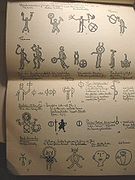 After a slide show on February 19, 1936 of his trip to Bohuslän
, a region in southwestern Sweden, Wirth convinced Himmler to launch an expedition to the region, the first official expedition financed by the Ahnenerbe. Bohuslän was known for its massive quantity of petroglyph
rock carvings, which Wirth believed were part of an ancient writing system, predating all other known systems. Himmler appointed Wolfram Sievers
to be the managing director of the expedition, likely because of Wirth’s earlier troubles balancing finances.
On August 4, 1936 the expedition set off on a three month trip starting with the German island of Rügen
then continuing to Backa, Sweden
, the first recorded rock-art site in Sweden. Despite scenes showing warriors, animals and ships, Wirth focused on the lines and circles he thought made up a prehistoric alphabet.
While his studies were largely based on personal belief, rather than objective scientific research, Wirth made interpretations about the meaning of ideograms carved in the rock, such as a circle bisected by a vertical line representing a year and a man standing with raised arms representing what Wirth called “the Son of God.” His team proceeded to make casts of what Wirth deemed the most important carvings and then carried the casts to camp where they were crated and sent back to Germany. Once satisfied with their work in Sweden, the team set out on a trek through Sweden, eventually reaching the Norwegian island of Lauvøylandet
.
the archaeologist Franz Altheim
and his wife photographer Erika Trautnann to study prehistoric rock inscriptions
. The two returned to Germany claiming they found traces of Nordic runes on the rocks supposedly confirming that ancient Rome was originally of Nordic descent.
Also an expedition of SS-Ahnenerbe was planned in Sardinia
, in the 30s, and in the arbëreshë
village of Santa Sofia d'Epiro
, interested in the family vaults of the Baffa Trasci, Miracco and Masci families, but the reasons of it are still unknown.
and his research partner Erika Trautmann requested the Ahnenerbe sponsor their Middle East
trek to study an internal power struggle of the Roman Empire, which they believed was fought between the Nordic and Semitic peoples. Eager to credit the vast success of the Roman Empire to a Nordic background, the Ahnenerbe agreed to match the 4,000RM put forward by Hermann Göring
, an old friend of Trautmann who led the Reich’s Four-Year Plan
.
In August 1938, after spending a few days traveling through remote hills searching for ruins of Dacian
kingdoms, the two researchers arrived at their first major stop in Bucharest
, the capital of Romania
. Here Grigore Florescu, the director of the Municipal Museum, met with them and discussed both history and the politics of the day, including the activity of the Iron Guard
, a fascist and anti-Semitic group.
After traveling through Istanbul
, Athens
and Lebanon
, the researchers went to Damascus
. Here they were not welcomed by the French
(who ruled over Syria
as a colony at the time). The newly-sovereign Kingdom of Iraq
was being courted for an alliance with Germany, and Dr. Fritz Grobba
, the German envoy to Baghdad, arranged for Altheim and Trautmann to meet with local researchers and be driven to Parthia
n and Persian ruins in southern Iraq, as well as Babylon
.
Through Baghdad the team went north to Assur
where they met Sheikh Adjil el Yawar, a leader of the Shammar
Bedouin
tribe, and commander of the northern Camel Corps. He discussed German politics and his desire to duplicate the success of Abd al-Aziz ibn Saud
who had recently ascended to power in Saudi Arabia. With his support, the team traveled to their final major stop—the ruins of Hatra
on the border of the Roman and Persian empires.

The third German Antarctic Expedition took place between 1938 and 1939. It was led by Capt. Alfred Ritscher
(1879–1963).
led an excavation of the Grosse Heuneberg, where an ancient fortress had been discovered much earlier. They also studied the nearby Tumulus burial mounds, which continue to be excavated today. A private expedition of Richard Anders and Wiligut into the Murg Valley had nothing to do with the Ahnenerbe.
of Bavaria. During an excavation of the Mauern caves, R.R. Schmidt had discovered red ochre, a common pigment for cave paintings made by the Cro-Magnon.
In fall 1937, Dr. Assien Bohmers, a Frisia
n nationalist who applied to the SS Excavations Department earlier that year, took over the excavation. His team proceeded to find artifacts such as burin
s, ivory pendants, and a woolly mammoth
skeleton. They also discovered Neandertal remains buried with what appeared to be throwing spears and javelins, a technology thought to have been developed by the Cro-Magnons.
Bohmers interpreted this to mean Cro-Magnons had left these stones in the caves over seventy thousand years before and this was therefore the oldest Cro-Magnon site in the world. To validate his claims, Bohmers travelled Europe speaking with colleagues and visiting exhibitions through the Netherlands
, Belgium
and France
.
, an expert on cave art
. Breuil arranged for Bohmers to visit Les Trois-Frères, a site whose owners only allowed a small number of people to visit. First, however, Bohmers took a quick trip to London
, followed by a tour of several other French points of interest: La Fond de Gaume (a site featuring Cro-Magnon cave paintings), Teyat, La Mouthe and the caves of Dordogne. Then Bohmers moved on to Les Trois-Frères, “where Himmler and where so many other Nazis had long dreamed of standing—in the shrine of the ancient dead, in the dark embrace of the ancestors.”
, reportedly since it contained images of the Germanic Franks
solidly defeating their enemies. In June 1941, they oversaw the transport of the tapestry from its home in the Bayeux Cathedral, to an abbey at Juaye-Mondaye
, and finally to the Chateau de Sourches. In August 1944, after Paris was liberated by the Allies
, two members of the SS were dispatched to Paris to retrieve the tapestry which had been moved into the basement of the Louvre
. Contrary to Himmler’s orders, however, they chose not to attempt to enter the Louvre, most likely because of the strong presence of the French Resistance
in the historic area.
and Japan
in approximately 2000 BC, and that Gautama Buddha
was himself an Aryan offspring of the Nordic race. Walther Wüst would later expand upon this, stating in a public speech that Adolf Hitler’s ideologies corresponded with those of Buddha, since the two shared a common heritage.
 After the invasion of Poland
, Sievers wrote to Himmler about the need to appropriate exhibits from numerous museums.
The Reich Main Security Administration
’s Standartenführer Franz Six
oversaw SS-Untersturmführer Peter Paulsen, who was commanding a small team’s foray into Kraków
, with the intent of obtaining the 15th century Veit Stoss altar.
Because the Poles had foreseen the German interest in the altar, they had disassembled it into 32 pieces which were shipped to different locations—however Paulsen was able to locate each piece, and on October 14, 1939, he returned to Berlin with the altar in three small trucks, and had it stored in the locked treasury of the Reichsbank
. After conferring with Hitler, who had not initially been told of the operation to capture it, it was decided to send the altar to an underground vault in Nuremberg, for safety.
Reinhard Heydrich
, then head of RSHA, sent Paulsen back to Kraków in order to seize additional museum collections. But Göring had already sent a team of his own men, commanded by SS-Sturmbannführer Kajetan Mühlmann, to loot the museums. Mühlmann agreed to let Paulsen take the scientific items back to the Ahnenerbe, while keeping the artwork for Göring.
During the looting however, Hans Frank
—leader of the German-controlled Polish General Government
—issued a November 22, 1939 order prohibiting the “unapproved export” of Polish items. Paulsen obeyed the order, but his colleague Hans Schleif arranged for five freightcars of loot from the Warsaw Archaeological Museum to be shipped to Poznań
, which was outside Frank’s control. In return, Schleif was appointed as a trustee for Wartheland
. Paulsen later tried to take credit for the freightcars' contents in his report to RSHA, but was reassigned.
The State Zoological Museum in Warsaw
also saw a number of its exhibits taken by the Ahnenerbe's Eduard Paul Tratz
, who removed them to the Haus der Natur, the museum of which he was founder and director in Salzburg
.
in early July 1942, Himmler sent Dr. Herbert Jankuhn
, as well as Karl Kersten and Baron Wolf von Seefeld, to the region in search of artifacts to follow up the recent displaying of the Kerch
“Gothic crown of the Crimea” in Berlin.
Jankuhn met with senior officers of Einsatzkommando 11, part of Einsatzgruppe D, while waiting at the field headquarters of the 5th SS Panzer Division. Commander Otto Ohlendorf
gave Jankuhn information about the Crimean museums.
Traveling with the 5th SS Panzer, Jankuhn’s team eventually reached Maikop
, where they received a message from Sievers that Himmler wanted an investigation of Manhup-Kale, an ancient mountain fortress. Jankuhn sent Kersten to follow up on Manhup-Kale, while the rest of the team continued trying to secure artifacts that had not already been taken by the Red Army. Einsatzkommando 11b’s commander Werner Braune
aided the team in their efforts.
Jankuhn was ultimately unable to find Gothic artifacts denoting a German ancestry, even after receiving intelligence about a shipment of seventy-two crates or artifacts shipped to a medical warehouse. Unfortunately, the area had been ravaged by the time the team arrived, and only twenty crates remained—but they contained Greek and stone-age artifacts, rather than Gothic.
, who held a PhD
from Tübingen in botany
, was tasked with an expedition to the Ukraine and Crimea. Hauptsturmführer
Konrad von Rauch and an interpreter identified as “Steinbrecher” were also involved in the expedition.
In February 1945, Brücher was ordered to destroy the 18 research facilities that were being studied, to avoid their capture by advancing Soviet forces. He refused, and after the war continued his work as a botanist in Argentina
and Trinidad
.
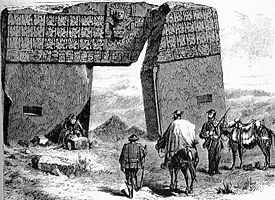 After winning 20,000 Reichsmark
in a writing contest, Edmund Kiss
traveled to Bolivia in 1928 to study the ruins of temples in the Andes mountains
. He claimed their similarity to ancient European construction indicated they were designed by Nordic migrants, millions of years earlier.
He also claimed that his findings supported the World Ice Theory
, which claimed the universe originated from a cataclysmic clash between gigantic balls of ice and glowing mass. Arthur Posnansky
had been studying a local site called Tiwanaku
, which he also believed supported the theory.
After contacting Posnansky, Kiss approached Wüst for help planning an expedition to excavate Tiwanaku and a nearby site, Siminake. The team would consist of twenty scientists and would excavate for a year as well as explore Lake Titicaca
, take aerial photographs of ancient Incan roads they believed had Nordic roots. By late August 1939, the expedition was nearly set to embark, however the September first invasion
of Poland
saw the trip postponed indefinitely.
to study the Behistun Inscription
, which had been created by order of the Achaemenid Shah
Darius I
—who had declared himself to have been of Aryan origin
in his inscriptions. The inscriptions were recorded atop steep cliffs using scaffolding
that was removed after the inscriptions were made. Unable to afford the cost of erecting new scaffolds, Wüst proposed that he, his wife, an amanuensis
, an Iranian student, a photographer, and an experienced mountaineer
be sent with a balloon-mounted camera. The onset of the war however, saw the trip postponed indefinitely.
had described the Guanche
natives as having golden-blond hair and white skin, and mummies had been found with blond tresses—facts which Wirth believed indicated that the islands had once been inhabited by Nordics
. His colleague Dr. Otto Huth
proposed a Fall 1939 expedition to study the ancient islanders’ racial origins, artifacts and religious rites. At the time, the Canary Islands were part of Francisco Franco
’s Spanish State
(Estado Español). Because Franco refused to side with the Axis when the war started however, the trip was cancelled.
had already traveled to Iceland
three times in 1938 when he proposed an Ahnenerbe expedition with seven others to the country in order to learn about their ancient farming practices and architecture, record folksongs and dances, and also collect soil samples for pollen analysis.
The first setback for the expedition was the ridicule of the Scandinavian press, publishing stories in February 1939 claiming the expedition was based on false ideas about Icelandic heritage and sought old church records which did not even exist. An enraged Himmler publicly shut down the trip completely, but after calming down he allowed the planning of the trip to be secretly continued. The final setback occurred when Himmler’s personal staff was unable to get enough Icelandic crowns
—Iceland’s currency. Not being able to quickly solve this problem, the trip was rescheduled for the summer of 1940. In May 1940, the British invaded neutral Iceland, but when the war had started the expedition had already been shelved.
In 1940, following the British occupation of Iceland, the Ahnenerbe-funded Dr. Bruno Kress, a German researcher who was in the country at the time, was rounded up along with other German nationals present on the island. Kress was interned in Ramsey
on the Isle of Man
, but was allowed to correspond with Sievers through letters.http://www.george-broderick.de/ns_docs/ns-kress_letters.doc Kress’s Grammar of Icelandic was eventually published in East Germany in 1955. Kress also later worked for the East German Staatssicherheit (Stasi).
 After being appointed Commissioner for the Strengthening of the German Race, Himmler set to work with Konrad Meyer on developing a plan for three large German colonies in the eastern occupied territories. Leningrad
, northern Poland and the Crimea
would be the focal points of these colonies intended to spread the Aryan race. The Crimean colony was called Gotengau, or “Goth district” in honor of the Crimean Goths
who had settled there and were believed to be Aryan ancestors of the Germans.
Himmler estimated Aryanization of the region would take twenty years, first expelling all the undesirable populations, then re-distributing the territory to appropriate Aryan populations. In addition to changing the demographics of the region, Himmler also intended to plant oak
and beech
trees to replicate traditional German forests, as well as plant new crops brought back from Tibet. To achieve the latter end, Himmler ordered a new institution set up by the Ahnenerbe and headed by Schäfer. A station was then set up near the Austrian town of Graz
where Schäfer set to work with seven other scientists to develop new crops for the Reich.
The final piece of the puzzle fell in place after Hitler read a work by Alfred Frauenfeld
which suggested resettling inhabitants of South Tyrol
, believed by some to be descendants of the Goths, to the Crimea. In 1939 the South Tyrolean were ordered by Hitler and Benito Mussolini
to vote on whether they wanted to remain in Italy and accept assimilation or alternatively emigrate to Germany. Over 80% chose the latter (for details see: South Tyrol Option Agreement
). Himmler presented Master Plan East to Hitler and received approval in July, 1942.
Full implementation of the plan was not feasible because of the ongoing war, but a small colony was in fact founded around Himmler’s field headquarters at Hegewald
, near Kiev
. Starting on October 10, 1942, Himmler’s troops deported 10,623 Ukrainians from the area in cattle cars before bringing in trains of ethnic Germans (volksdeutsche
) from northern Ukraine. The SS authorities gave families needed supplies as well as land of their own, but also informed them of quota
s of food they needed to produce for the SS.
' Germania
, since it was an early description of the German people, and favourably described them as a modern and moral society. Although Mussolini
had originally promised it as a gift in 1936, it remained in an aristocratic library outside Ancona
, where the Ahnenerbe tried to obtain it after Mussolini was deposed.
's firebombing of Hamburg led Himmler to order the immediate evacuation of the main Ahnenerbe headquarters in Berlin. The extensive library was moved to a castle in Ulm
while the staff was moved to the tiny village of Waischenfeld near Bayreuth, Bavaria
. The building selected was the 17th century Steinhaus. While much of the staff was not ecstatic about the primitive conditions, Sievers seems to have embraced the isolation.
, came from Deutsche Bank
boardmember Emil Georg von Strauss’ associates, including BMW
and Daimler-Benz
.
In 1936, the SS formed a joint company with Anton Loibl, a machinist and driving instructor. The SS had heard about reflector pedals for bicycles, that Loibl and others had been developing. Assuring that Loibl got the patent himself, Himmler then used his political weight to ensure the passing of a 1939 law requiring the use of the new reflective pedals—of which the Ahnenerbe received a share of the profits, 77,740 Reichsmark in 1938.
. Sievers had founded the organization on the orders of Himmler, who appointed him director with two divisions headed by Sigmund Rascher
and August Hirt
, and funded by the Waffen-SS
.
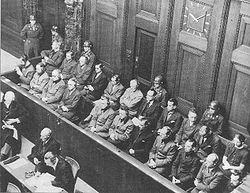
determine what was safe for their pilots—because aircraft were being built to fly higher than ever before. He applied for and received permission from Himmler to requisition camp prisoners to place in vacuum chambers to simulate the high altitude conditions that pilots might face.
Rascher was also tasked with discovering how long German airmen would be able to survive if shot down above freezing water. His victims were forced to remain out of doors naked in freezing weather for up to 14 hours, or kept in a tank of icewater for 3 hours, their pulse and internal temperature measured through a series of electrodes. Warming of the victims was then attempted by different methods, most usually and successfully by immersion in very hot water, and also less conventional methods such as placing the subject in bed with women who would try to sexually stimulate him, a method suggested by Himmler.
Rascher also experimented with the effects of Polygal, a substance made from beet
s and apple pectin
, on coagulating blood flow to help with gunshot wounds
. Subjects were given a Polygal tablet, and shot through the neck or chest, or their limbs amputated without anaesthesia. Rascher published an article on his experience of using Polygal, without detailing the nature of the human trials and also set up a company to manufacture the substance, staffed by prisoners.
Similar experiments were conducted from July to September 1944, as the Ahnenerbe provided space and materials to doctors at Dachau to undertake “seawater experiments”, chiefly through Sievers. Sievers is known to have visited Dachau on July 20, to speak with Ploetner and the non-Ahnenerbe Wilhelm Beiglboeck, who ultimately carried out the experiments.
, Dr. Friedrich Hielscher
testified that Sievers had initially been repulsed at the idea of expanding the Ahnenerbe to human experimentation, and that he had “no desire whatsoever to participate in these.” (v:II pg:37)
, or the historically unverified Vril society
.
One of the most in-depth analyses of Ahnenerbe was historian Michael Wood's Channel 4
(UK) documentary Hitler's Search for the Holy Grail, part of its Secret History series, broadcast in August 1999.
Nazi Germany
Nazi Germany , also known as the Third Reich , but officially called German Reich from 1933 to 1943 and Greater German Reich from 26 June 1943 onward, is the name commonly used to refer to the state of Germany from 1933 to 1945, when it was a totalitarian dictatorship ruled by...
think tank
Think tank
A think tank is an organization that conducts research and engages in advocacy in areas such as social policy, political strategy, economics, military, and technology issues. Most think tanks are non-profit organizations, which some countries such as the United States and Canada provide with tax...
that promoted itself as a "study society for Intellectual Ancient History." Founded on July 1, 1935, by Heinrich Himmler
Heinrich Himmler
Heinrich Luitpold Himmler was Reichsführer of the SS, a military commander, and a leading member of the Nazi Party. As Chief of the German Police and the Minister of the Interior from 1943, Himmler oversaw all internal and external police and security forces, including the Gestapo...
, Herman Wirth, and Richard Walther Darré, the Ahnenerbe's goal was to research the anthropological and cultural history of the Aryan race
Aryan race
The Aryan race is a concept historically influential in Western culture in the period of the late 19th century and early 20th century. It derives from the idea that the original speakers of the Indo-European languages and their descendants up to the present day constitute a distinctive race or...
, and later to experiment and launch voyages with the intent of proving that prehistoric and mythological Nordic populations had once ruled the world. Heinrich Himmler
Heinrich Himmler
Heinrich Luitpold Himmler was Reichsführer of the SS, a military commander, and a leading member of the Nazi Party. As Chief of the German Police and the Minister of the Interior from 1943, Himmler oversaw all internal and external police and security forces, including the Gestapo...
claimed and promoted that the Aryans originally came from Atlantis
Atlantis
Atlantis is a legendary island first mentioned in Plato's dialogues Timaeus and Critias, written about 360 BC....
and were beings directly from heaven. They did not evolve as did other humanoids.
Formally, the group was called Studiengesellschaft für Geistesurgeschichte‚ Deutsches Ahnenerbe e.V. ("Study society for primordial intellectual history, German Ancestral Heritage, registered society"), and was renamed in 1937, as Forschungs- und Lehrgemeinschaft das Ahnenerbe e.V. ("Research and Teaching Community the Ancestral Heritage, registered society").
History and development
Heinrich Himmler
Heinrich Luitpold Himmler was Reichsführer of the SS, a military commander, and a leading member of the Nazi Party. As Chief of the German Police and the Minister of the Interior from 1943, Himmler oversaw all internal and external police and security forces, including the Gestapo...
was appointed the leader of the fledgling Schutzstaffel
Schutzstaffel
The Schutzstaffel |Sig runes]]) was a major paramilitary organization under Adolf Hitler and the Nazi Party. Built upon the Nazi ideology, the SS under Heinrich Himmler's command was responsible for many of the crimes against humanity during World War II...
(SS). He launched a massive recruitment campaign that took the SS from fewer than than three hundred members in 1929 to ten thousand in 1931. Once the SS had grown, Himmler began its transformation into a "racial elite" of young Nordic males. This was to be accomplished by a new bureaucracy in the SS, the Race and Settlement Office of the SS (Rasse- und Siedlungshauptamt-SS) known as RuSHA
RuSHA
The Rasse- und Siedlungshauptamt-SS , , was the organization responsible for "safeguarding the racial 'purity' of the SS" within Nazi Germany....
. Himmler named SS-Obergruppenführer
Obergruppenführer
Obergruppenführer was a Nazi Party paramilitary rank that was first created in 1932 as a rank of the SA and until 1942 it was the highest SS rank inferior only to Reichsführer-SS...
Richard Walther Darré to lead the organisation, which determined if applicants were racially fit to be in the SS. This brought about a campaign meant to educate the new applicants about their Nordic past through weekly classes taught by senior RuSHA graduates using the periodical SS-Leitheft
SS-Leitheft
SS-Leitheft was a Nazi periodical from 1934 to 1945.This "SS-leadership magazine", as it is often called, was published in German in Berlin from 1934 onward, and in the beginning mostly circulated among professional officers in the SS. The publisher was the SS-Hauptamt, the Main Office of the...
.
On July 1, 1935 at Berlin
Berlin
Berlin is the capital city of Germany and is one of the 16 states of Germany. With a population of 3.45 million people, Berlin is Germany's largest city. It is the second most populous city proper and the seventh most populous urban area in the European Union...
’s SS headquarters, Himmler met with five racial experts representing Darré and with Dr. Herman Wirth, one of Germany’s most famous pre-historians. Together they came up with an organization called “Deutsches Ahnenerbe—Studiengesellschaft für Geistesurgeschichte” ("German Ancestral Heritage—Society for the Study of the History of Primeval Ideas")—later shortened to its better-known form in 1937. At the meeting they designated the official goal “to promote the science of ancient intellectual history” and appointed Himmler as the superintendent with Wirth serving as the president. Himmler appointed Wolfram Sievers
Wolfram Sievers
Wolfram Sievers was Reichsgeschäftsführer, or managing director, of the Ahnenerbe from 1935 to 1945.-Early life:...
Reichsgeschäftsführer (General Secretary) of the Ahnenerbe.
Wirth left the project at the beginning of 1937. On February 1, Dr. Walther Wüst
Walther Wüst
Walther Wüst was a prominent German Orientalist in the first half of the 20th century who became Rector of the University of Munich from 1941 to 1945. He was also a leading Nazi intellectual, and from 1937 the President of the Research Institute of the Ahnenerbe SS...
was appointed the new president of the Ahnenerbe. Wüst was an expert on India and a dean at Ludwig Maximilians University of Munich
Ludwig Maximilians University of Munich
The Ludwig Maximilian University of Munich , commonly known as the University of Munich or LMU, is a university in Munich, Germany...
, working on the side as a Vertrauensmann
Glossary of the Weimar Republic
These are terms, concepts and ideas that are useful to understanding the political situation in the Weimar Republic. Some are particular to the period and government, while others were just in common usage but have a bearing on the Weimar milieu and political maneuvering.*Agrarian Bolshevism...
for the Sicherheitsdienst
Sicherheitsdienst
Sicherheitsdienst , full title Sicherheitsdienst des Reichsführers-SS, or SD, was the intelligence agency of the SS and the Nazi Party in Nazi Germany. The organization was the first Nazi Party intelligence organization to be established and was often considered a "sister organization" with the...
(SS Security Service). Referred to as “The Orientalist” by Sievers, Wüst had been recruited by him in May 1936 because of his ability to simplify science for the common man. After being appointed president, Wüst began improving the Ahnenerbe: moving the office to a new headquarters that cost 300,000 Reichsmark
German reichsmark
The Reichsmark was the currency in Germany from 1924 until June 20, 1948. The Reichsmark was subdivided into 100 Reichspfennig.-History:...
, in the Dahlem neighborhood
Steglitz-Zehlendorf
Steglitz-Zehlendorf is the sixth borough of Berlin, formed in Berlin's 2001 administrative reform by merging the former boroughs of Steglitz and Zehlendorf.-Demographics:...
of Berlin. He also worked to limit the influence of “those he deemed scholarly upstarts,” which included cutting communication with the RuSHA office of Karl Maria Wiligut
Karl Maria Wiligut
Karl Maria Wiligut was an Austrian Ariosophist- Biography :...
. The organization was incorporated into the Allgemeine SS
Allgemeine SS
The Allgemeine SS was the most numerous branch of the Schutzstaffel paramilitary forces of Nazi Germany. It was managed by the SS-Hauptamt...
(General SS) in January 1939.
Institutions
The Ahnenerbe had several different institutions or sections for its departments of research. Most of these were archeological but others included the Pflegestätte für Wetterkunde (Meteorology Section) headed by Obersturmführer Dr. Hans Robert ScultetusHans Robert Scultetus
Hans Robert Scultetus was a German meteorologist, who headed the Pflegestätte für Wetterkunde of the Nazi Ahnenerbe think tank....
, founded on the basis that Hans Hörbiger
Hans Hörbiger
Hanns Hörbiger was an Austrian engineer from Vienna with roots in Tyrol. He took part in the construction of the Budapest subway and in 1894 invented a new type of valve essential for compressors still in widespread use today.He is also remembered today for his pseudoscientific Welteislehre ...
's "Welteislehre
Welteislehre
Welteislehre , also known as Glazial-Kosmogonie is a pseudoscientific cosmological theory proposed by Hans Hörbiger, an Austrian engineer and inventor and respected steam engine designer, whose invention of the Hörbiger valve made him a wealthy man.Hörbiger did not arrive at his theory through...
" could be used to provide accurate long-range weather forecasts, and a section devoted to musicology
Musicology
Musicology is the scholarly study of music. The word is used in narrow, broad and intermediate senses. In the narrow sense, musicology is confined to the music history of Western culture...
, whose aim was to determine "the essence" of German music. It recorded folk music in expeditions to Finland and the Faroe Islands, from ethnic Germans of the occupied territories, and in South Tyrol. The section made sound recordings, transcribed manuscripts and songbooks, and photographed and filmed instrument use and folk dances. The lur
Lur
A lur is a long natural blowing horn without finger holes that is played by embouchure. Lurs can be straight or curved in various shapes. The purpose of the curves was to make long instruments easier to carry A lur is a long natural blowing horn without finger holes that is played by embouchure....
, a Bronze Age musical instrument, became central to this research, which concluded that Germanic consonance
Consonance
Consonance is a stylistic device, most commonly used in poetry and songs, characterized by the repetition of the same consonant two or more times in short succession, as in "pitter patter" or in "all mammals named Sam are clammy".Consonance should not be confused with assonance, which is the...
was in direct conflict to Jewish atonalism.
Karelia
In 1935, Himmler contacted author Yrjö von Grönhagen, after seeing one of his articles about the KalevalaKalevala
The Kalevala is a 19th century work of epic poetry compiled by Elias Lönnrot from Finnish and Karelian oral folklore and mythology.It is regarded as the national epic of Finland and is one of the most significant works of Finnish literature...
folklore, published in a Frankfurt newspaper. Grönhagen agreed to lead a voyage through the Karelia
Karelia
Karelia , the land of the Karelian peoples, is an area in Northern Europe of historical significance for Finland, Russia, and Sweden...
region of Finland
Finland
Finland , officially the Republic of Finland, is a Nordic country situated in the Fennoscandian region of Northern Europe. It is bordered by Sweden in the west, Norway in the north and Russia in the east, while Estonia lies to its south across the Gulf of Finland.Around 5.4 million people reside...
, to record pagan sorcerers and witches. Because there was uncertainty about whether the Karelians would allow photography, Finnish illustrator Ola Forsell also accompanied the team. Musicologist Fritz Bose brought along a magnetophon
Magnetophon
Magnetophon was the brand or model name of the pioneering reel-to-reel tape recorder developed by engineers of the German electronics company AEG in the 1930s, based on the magnetic tape invention by Fritz Pfleumer...
hoping to record the pagan chants.
The team departed for their expedition in June 1936. The team’s first success was with a traditional singer, Timo Lipitsä, who knew a song closely resembling one in the Kalevala
Kalevala
The Kalevala is a 19th century work of epic poetry compiled by Elias Lönnrot from Finnish and Karelian oral folklore and mythology.It is regarded as the national epic of Finland and is one of the most significant works of Finnish literature...
although he was unaware of the book. Later, in Tolvajärvi, the team photographed and recorded Hannes Vornanen playing a traditional Finnish kantele
Kantele
A kantele or kannel is a traditional plucked string instrument of the zither family native to Finland, Estonia, and Karelia. It is related to the Russian gusli, the Latvian kokle and the Lithuanian kanklės. Together these instruments make up the family known as Baltic psalteries...
.
One of the trip’s final successes was in finding Miron-Aku, a soothsayer
Psychic
A psychic is a person who professes an ability to perceive information hidden from the normal senses through extrasensory perception , or is said by others to have such abilities. It is also used to describe theatrical performers who use techniques such as prestidigitation, cold reading, and hot...
believed to be a witch by locals. Upon meeting the group, she claimed to have foreseen their arrival. The team persuaded her to perform a ritual for the camera and tape recorder in which she could summon the spirits of ancestors and “divine future events.”
The team also recorded information on Finnish sauna
Finnish sauna
The Finnish sauna is a substantial part of Finnish culture. There are five million inhabitants and over two million saunas in Finland - an average of one per household. For Finnish people the sauna is a place to relax in with friends and family, and a place for physical and mental relaxation as...
s.
Bohuslän
Bohuslän
' is a Swedish traditional province, or landskap, situated in Götaland on the northernmost part of the country's west coast. It is bordered by Dalsland to the northeast, Västergötland to the southeast, the Skagerrak arm of the North Sea to the west, and the county of Østfold in Norway to the north...
, a region in southwestern Sweden, Wirth convinced Himmler to launch an expedition to the region, the first official expedition financed by the Ahnenerbe. Bohuslän was known for its massive quantity of petroglyph
Petroglyph
Petroglyphs are pictogram and logogram images created by removing part of a rock surface by incising, picking, carving, and abrading. Outside North America, scholars often use terms such as "carving", "engraving", or other descriptions of the technique to refer to such images...
rock carvings, which Wirth believed were part of an ancient writing system, predating all other known systems. Himmler appointed Wolfram Sievers
Wolfram Sievers
Wolfram Sievers was Reichsgeschäftsführer, or managing director, of the Ahnenerbe from 1935 to 1945.-Early life:...
to be the managing director of the expedition, likely because of Wirth’s earlier troubles balancing finances.
On August 4, 1936 the expedition set off on a three month trip starting with the German island of Rügen
Rügen
Rügen is Germany's largest island. Located in the Baltic Sea, it is part of the Vorpommern-Rügen district of Mecklenburg-Vorpommern.- Geography :Rügen is located off the north-eastern coast of Germany in the Baltic Sea...
then continuing to Backa, Sweden
Backa, Sweden
Backa was one of Gothenburg’s 20 districts, and one of the seven parts of the island Hisingen, but from January 1, 2011 Backa merged with two other districts of Gothenburg, Kärra-Rödbo and Tuve-Säve to form Norra Hisingen...
, the first recorded rock-art site in Sweden. Despite scenes showing warriors, animals and ships, Wirth focused on the lines and circles he thought made up a prehistoric alphabet.
While his studies were largely based on personal belief, rather than objective scientific research, Wirth made interpretations about the meaning of ideograms carved in the rock, such as a circle bisected by a vertical line representing a year and a man standing with raised arms representing what Wirth called “the Son of God.” His team proceeded to make casts of what Wirth deemed the most important carvings and then carried the casts to camp where they were crated and sent back to Germany. Once satisfied with their work in Sweden, the team set out on a trek through Sweden, eventually reaching the Norwegian island of Lauvøylandet
Lauvøylandet
Lauvøylandet is a small island outside Sandnessjøen in northern Norway. The island is often called called Rødøya, but that is not correct. Rødyøa is an island much further north...
.
Italy
In 1937, the Ahnenerbe sent to Val CamonicaVal Camonica
Val Camonica is one of the largest valleys of the central Alps, in eastern Lombardy, about 90 km long. It starts from the Tonale Pass, at 1883 metres above sea level and ends at Corna Trentapassi, in the comune of Pisogne, near Lake Iseo...
the archaeologist Franz Altheim
Franz Altheim
Franz Altheim was a German historian, best known for his trip with Erika Trautmann funded by the Ahnenerbe and Hermann Göring.-Early life:...
and his wife photographer Erika Trautnann to study prehistoric rock inscriptions
Rock Drawings in Valcamonica
The stone carvings of Val Camonica constitute one of the largest collections of prehistoric petroglyphs in the world. The collection was recognized by Unesco in 1979 and was Italy's first recognized World Heritage Site...
. The two returned to Germany claiming they found traces of Nordic runes on the rocks supposedly confirming that ancient Rome was originally of Nordic descent.
Also an expedition of SS-Ahnenerbe was planned in Sardinia
Sardinia
Sardinia is the second-largest island in the Mediterranean Sea . It is an autonomous region of Italy, and the nearest land masses are the French island of Corsica, the Italian Peninsula, Sicily, Tunisia and the Spanish Balearic Islands.The name Sardinia is from the pre-Roman noun *sard[],...
, in the 30s, and in the arbëreshë
Arbëreshë
The Arbëreshë are a linguistic and ethnic Albanian minority community living in southern Italy, especially the regions of Apulia, Basilicata, Molise, Calabria and Sicily...
village of Santa Sofia d'Epiro
Santa Sofia d'Epiro
Santa Sofia d'Epiro is an Arberesh town and comune in the province of Cosenza in the Calabria region of southern Italy.The town is bordered by Acri, Bisignano, San Demetrio Corone and Tarsia.-People:*Ferruccio Baffa Trasci Bishop...
, interested in the family vaults of the Baffa Trasci, Miracco and Masci families, but the reasons of it are still unknown.
Middle East
In 1938, Dr. Franz AltheimFranz Altheim
Franz Altheim was a German historian, best known for his trip with Erika Trautmann funded by the Ahnenerbe and Hermann Göring.-Early life:...
and his research partner Erika Trautmann requested the Ahnenerbe sponsor their Middle East
Middle East
The Middle East is a region that encompasses Western Asia and Northern Africa. It is often used as a synonym for Near East, in opposition to Far East...
trek to study an internal power struggle of the Roman Empire, which they believed was fought between the Nordic and Semitic peoples. Eager to credit the vast success of the Roman Empire to a Nordic background, the Ahnenerbe agreed to match the 4,000RM put forward by Hermann Göring
Hermann Göring
Hermann Wilhelm Göring, was a German politician, military leader, and a leading member of the Nazi Party. He was a veteran of World War I as an ace fighter pilot, and a recipient of the coveted Pour le Mérite, also known as "The Blue Max"...
, an old friend of Trautmann who led the Reich’s Four-Year Plan
Four year plan
The Four Year Plan was a series of economic reforms created by the Nazi Party. The main aim of the four year plan was to prepare Germany for war in four years...
.
In August 1938, after spending a few days traveling through remote hills searching for ruins of Dacian
Dacians
The Dacians were an Indo-European people, very close or part of the Thracians. Dacians were the ancient inhabitants of Dacia...
kingdoms, the two researchers arrived at their first major stop in Bucharest
Bucharest
Bucharest is the capital municipality, cultural, industrial, and financial centre of Romania. It is the largest city in Romania, located in the southeast of the country, at , and lies on the banks of the Dâmbovița River....
, the capital of Romania
Romania
Romania is a country located at the crossroads of Central and Southeastern Europe, on the Lower Danube, within and outside the Carpathian arch, bordering on the Black Sea...
. Here Grigore Florescu, the director of the Municipal Museum, met with them and discussed both history and the politics of the day, including the activity of the Iron Guard
Iron Guard
The Iron Guard is the name most commonly given to a far-right movement and political party in Romania in the period from 1927 into the early part of World War II. The Iron Guard was ultra-nationalist, fascist, anti-communist, and promoted the Orthodox Christian faith...
, a fascist and anti-Semitic group.
After traveling through Istanbul
Istanbul
Istanbul , historically known as Byzantium and Constantinople , is the largest city of Turkey. Istanbul metropolitan province had 13.26 million people living in it as of December, 2010, which is 18% of Turkey's population and the 3rd largest metropolitan area in Europe after London and...
, Athens
Athens
Athens , is the capital and largest city of Greece. Athens dominates the Attica region and is one of the world's oldest cities, as its recorded history spans around 3,400 years. Classical Athens was a powerful city-state...
and Lebanon
Lebanon
Lebanon , officially the Republic of LebanonRepublic of Lebanon is the most common term used by Lebanese government agencies. The term Lebanese Republic, a literal translation of the official Arabic and French names that is not used in today's world. Arabic is the most common language spoken among...
, the researchers went to Damascus
Damascus
Damascus , commonly known in Syria as Al Sham , and as the City of Jasmine , is the capital and the second largest city of Syria after Aleppo, both are part of the country's 14 governorates. In addition to being one of the oldest continuously inhabited cities in the world, Damascus is a major...
. Here they were not welcomed by the French
France
The French Republic , The French Republic , The French Republic , (commonly known as France , is a unitary semi-presidential republic in Western Europe with several overseas territories and islands located on other continents and in the Indian, Pacific, and Atlantic oceans. Metropolitan France...
(who ruled over Syria
French Mandate of Syria
Officially the French Mandate for Syria and the Lebanon was a League of Nations mandate founded after the First World War and the partitioning of the Ottoman Empire...
as a colony at the time). The newly-sovereign Kingdom of Iraq
Kingdom of Iraq
The Kingdom of Iraq was the sovereign state of Iraq during and after the British Mandate of Mesopotamia. The League of Nations mandate started in 1920. The kingdom began in August 1921 with the coronation of Faisal bin al-Hussein bin Ali al-Hashemi as King Faisal I...
was being courted for an alliance with Germany, and Dr. Fritz Grobba
Fritz Grobba
Fritz Konrad Ferdinand Grobba is best remembered for being a German diplomat during the interwar period and World War II.-Biography:...
, the German envoy to Baghdad, arranged for Altheim and Trautmann to meet with local researchers and be driven to Parthia
Parthia
Parthia is a region of north-eastern Iran, best known for having been the political and cultural base of the Arsacid dynasty, rulers of the Parthian Empire....
n and Persian ruins in southern Iraq, as well as Babylon
Babylon
Babylon was an Akkadian city-state of ancient Mesopotamia, the remains of which are found in present-day Al Hillah, Babil Province, Iraq, about 85 kilometers south of Baghdad...
.
Through Baghdad the team went north to Assur
Assur
Assur , was one of the capitals of ancient Assyria. The remains of the city are situated on the western bank of river Tigris, north of the confluence with the tributary Little Zab river, in modern day Iraq, more precisely in the Al-Shirqat District .Assur is also...
where they met Sheikh Adjil el Yawar, a leader of the Shammar
Shammar
The tribe of Shammar is one of the largest tribes of Nejd-Saudi Arabia, with an estimated 1 million in Iraq, over 2.5 million in Saudi Arabia , a Kuwaiti population of around 100,000, a Syrian population is thought to exceed 1 million and with an unknown number in Jordan...
Bedouin
Bedouin
The Bedouin are a part of a predominantly desert-dwelling Arab ethnic group traditionally divided into tribes or clans, known in Arabic as ..-Etymology:...
tribe, and commander of the northern Camel Corps. He discussed German politics and his desire to duplicate the success of Abd al-Aziz ibn Saud
Ibn Saud of Saudi Arabia
King Abdul-Aziz of Saudi Arabia was the first monarch of the Third Saudi State known as Saudi Arabia. He was commonly referred to as Ibn Saud....
who had recently ascended to power in Saudi Arabia. With his support, the team traveled to their final major stop—the ruins of Hatra
Hatra
Hatra is an ancient city in the Ninawa Governorate and al-Jazira region of Iraq. It is currently known as al-Hadr, a name which appears once in ancient inscriptions, and it was in the ancient Iranian province of Khvarvaran. The city lies northwest of Baghdad and southwest of Mosul.-History:Hatra...
on the border of the Roman and Persian empires.
New Swabia
See 1938 New Swabia expedition for full articleThe third German Antarctic Expedition took place between 1938 and 1939. It was led by Capt. Alfred Ritscher
Alfred Ritscher
Alfred Ritscher was a German polar explorer. A captain in the German Navy, he led the third German Antarctic Expedition in 1938-39, which mapped the New Swabia area of Queen Maud Land. Ritscher Peak and Ritscher Upland there are named for him.-External links:*...
(1879–1963).
Murg Valley
In 1937 and 1938, Gustav RiekGustav Riek
Born in Stuttgart in 1900, Gustav Riek was an archaeologist from the University of Tübingen who worked with the SS Ahnenerbe in their excavactions, and led the team that excavated the Heuneburg Tumulus burial mounds in 1937.- Works :YearTitle...
led an excavation of the Grosse Heuneberg, where an ancient fortress had been discovered much earlier. They also studied the nearby Tumulus burial mounds, which continue to be excavated today. A private expedition of Richard Anders and Wiligut into the Murg Valley had nothing to do with the Ahnenerbe.
Mauern
Quite likely the Ahnenerbe’s greatest discovery in Germany was in the southern Jura mountainsJura mountains
The Jura Mountains are a small mountain range located north of the Alps, separating the Rhine and Rhone rivers and forming part of the watershed of each...
of Bavaria. During an excavation of the Mauern caves, R.R. Schmidt had discovered red ochre, a common pigment for cave paintings made by the Cro-Magnon.
In fall 1937, Dr. Assien Bohmers, a Frisia
Frisia
Frisia is a coastal region along the southeastern corner of the North Sea, i.e. the German Bight. Frisia is the traditional homeland of the Frisians, a Germanic people who speak Frisian, a language group closely related to the English language...
n nationalist who applied to the SS Excavations Department earlier that year, took over the excavation. His team proceeded to find artifacts such as burin
Burin
Burin from the French burin meaning "cold chisel" has two specialised meanings for types of tools in English, one meaning a steel cutting tool which is the essential tool of engraving, and the other, in archaeology, meaning a special type of lithic flake with a chisel-like edge which was probably...
s, ivory pendants, and a woolly mammoth
Woolly mammoth
The woolly mammoth , also called the tundra mammoth, is a species of mammoth. This animal is known from bones and frozen carcasses from northern North America and northern Eurasia with the best preserved carcasses in Siberia...
skeleton. They also discovered Neandertal remains buried with what appeared to be throwing spears and javelins, a technology thought to have been developed by the Cro-Magnons.
Bohmers interpreted this to mean Cro-Magnons had left these stones in the caves over seventy thousand years before and this was therefore the oldest Cro-Magnon site in the world. To validate his claims, Bohmers travelled Europe speaking with colleagues and visiting exhibitions through the Netherlands
Netherlands
The Netherlands is a constituent country of the Kingdom of the Netherlands, located mainly in North-West Europe and with several islands in the Caribbean. Mainland Netherlands borders the North Sea to the north and west, Belgium to the south, and Germany to the east, and shares maritime borders...
, Belgium
Belgium
Belgium , officially the Kingdom of Belgium, is a federal state in Western Europe. It is a founding member of the European Union and hosts the EU's headquarters, and those of several other major international organisations such as NATO.Belgium is also a member of, or affiliated to, many...
and France
France
The French Republic , The French Republic , The French Republic , (commonly known as France , is a unitary semi-presidential republic in Western Europe with several overseas territories and islands located on other continents and in the Indian, Pacific, and Atlantic oceans. Metropolitan France...
.
France
At the Parisian Institute for Human Paleontology, Bohmers met with Abbé Henri BreuilHenri Breuil
Henri Édouard Prosper Breuil , often referred to as Abbé Breuil, was a French Catholic priest, archaeologist, anthropologist, ethnologist and geologist...
, an expert on cave art
Cave painting
Cave paintings are paintings on cave walls and ceilings, and the term is used especially for those dating to prehistoric times. The earliest European cave paintings date to the Aurignacian, some 32,000 years ago. The purpose of the paleolithic cave paintings is not known...
. Breuil arranged for Bohmers to visit Les Trois-Frères, a site whose owners only allowed a small number of people to visit. First, however, Bohmers took a quick trip to London
London
London is the capital city of :England and the :United Kingdom, the largest metropolitan area in the United Kingdom, and the largest urban zone in the European Union by most measures. Located on the River Thames, London has been a major settlement for two millennia, its history going back to its...
, followed by a tour of several other French points of interest: La Fond de Gaume (a site featuring Cro-Magnon cave paintings), Teyat, La Mouthe and the caves of Dordogne. Then Bohmers moved on to Les Trois-Frères, “where Himmler and where so many other Nazis had long dreamed of standing—in the shrine of the ancient dead, in the dark embrace of the ancestors.”
Bayeux Tapestry
The Ahnenerbe took great interest in the 900-year-old Bayeux TapestryBayeux Tapestry
The Bayeux Tapestry is an embroidered cloth—not an actual tapestry—nearly long, which depicts the events leading up to the Norman conquest of England concerning William, Duke of Normandy and Harold, Earl of Wessex, later King of England, and culminating in the Battle of Hastings...
, reportedly since it contained images of the Germanic Franks
Franks
The Franks were a confederation of Germanic tribes first attested in the third century AD as living north and east of the Lower Rhine River. From the third to fifth centuries some Franks raided Roman territory while other Franks joined the Roman troops in Gaul. Only the Salian Franks formed a...
solidly defeating their enemies. In June 1941, they oversaw the transport of the tapestry from its home in the Bayeux Cathedral, to an abbey at Juaye-Mondaye
Juaye-Mondaye
-References:*...
, and finally to the Chateau de Sourches. In August 1944, after Paris was liberated by the Allies
Allies of World War II
The Allies of World War II were the countries that opposed the Axis powers during the Second World War . Former Axis states contributing to the Allied victory are not considered Allied states...
, two members of the SS were dispatched to Paris to retrieve the tapestry which had been moved into the basement of the Louvre
Louvre
The Musée du Louvre – in English, the Louvre Museum or simply the Louvre – is one of the world's largest museums, the most visited art museum in the world and a historic monument. A central landmark of Paris, it is located on the Right Bank of the Seine in the 1st arrondissement...
. Contrary to Himmler’s orders, however, they chose not to attempt to enter the Louvre, most likely because of the strong presence of the French Resistance
French Resistance
The French Resistance is the name used to denote the collection of French resistance movements that fought against the Nazi German occupation of France and against the collaborationist Vichy régime during World War II...
in the historic area.
Tibet
In 1937, Himmler decided he could increase the Ahnenerbe’s visibility by investigating Hans F. K. Günther’s claims that early Aryans had conquered much of Asia, including attacks against ChinaChina
Chinese civilization may refer to:* China for more general discussion of the country.* Chinese culture* Greater China, the transnational community of ethnic Chinese.* History of China* Sinosphere, the area historically affected by Chinese culture...
and Japan
Japan
Japan is an island nation in East Asia. Located in the Pacific Ocean, it lies to the east of the Sea of Japan, China, North Korea, South Korea and Russia, stretching from the Sea of Okhotsk in the north to the East China Sea and Taiwan in the south...
in approximately 2000 BC, and that Gautama Buddha
Gautama Buddha
Siddhārtha Gautama was a spiritual teacher from the Indian subcontinent, on whose teachings Buddhism was founded. In most Buddhist traditions, he is regarded as the Supreme Buddha Siddhārtha Gautama (Sanskrit: सिद्धार्थ गौतम; Pali: Siddhattha Gotama) was a spiritual teacher from the Indian...
was himself an Aryan offspring of the Nordic race. Walther Wüst would later expand upon this, stating in a public speech that Adolf Hitler’s ideologies corresponded with those of Buddha, since the two shared a common heritage.
Poland
Invasion of Poland (1939)
The Invasion of Poland, also known as the September Campaign or 1939 Defensive War in Poland and the Poland Campaign in Germany, was an invasion of Poland by Germany, the Soviet Union, and a small Slovak contingent that marked the start of World War II in Europe...
, Sievers wrote to Himmler about the need to appropriate exhibits from numerous museums.
The Reich Main Security Administration
RSHA
The RSHA, or Reichssicherheitshauptamt was an organization subordinate to Heinrich Himmler in his dual capacities as Chef der Deutschen Polizei and Reichsführer-SS...
’s Standartenführer Franz Six
Franz Six
Dr. Franz Alfred Six was a Nazi official who rose to the rank of SS-Brigadeführer. He was appointed by Reinhard Heydrich to head department Amt VII, Written Records of the Reichssicherheitshauptamt...
oversaw SS-Untersturmführer Peter Paulsen, who was commanding a small team’s foray into Kraków
Kraków
Kraków also Krakow, or Cracow , is the second largest and one of the oldest cities in Poland. Situated on the Vistula River in the Lesser Poland region, the city dates back to the 7th century. Kraków has traditionally been one of the leading centres of Polish academic, cultural, and artistic life...
, with the intent of obtaining the 15th century Veit Stoss altar.
Because the Poles had foreseen the German interest in the altar, they had disassembled it into 32 pieces which were shipped to different locations—however Paulsen was able to locate each piece, and on October 14, 1939, he returned to Berlin with the altar in three small trucks, and had it stored in the locked treasury of the Reichsbank
Reichsbank
The Reichsbank was the central bank of Germany from 1876 until 1945. It was founded on 1 January 1876 . The Reichsbank was a privately owned central bank of Prussia, under close control by the Reich government. Its first president was Hermann von Dechend...
. After conferring with Hitler, who had not initially been told of the operation to capture it, it was decided to send the altar to an underground vault in Nuremberg, for safety.
Reinhard Heydrich
Reinhard Heydrich
Reinhard Tristan Eugen Heydrich , also known as The Hangman, was a high-ranking German Nazi official.He was SS-Obergruppenführer and General der Polizei, chief of the Reich Main Security Office and Stellvertretender Reichsprotektor of Bohemia and Moravia...
, then head of RSHA, sent Paulsen back to Kraków in order to seize additional museum collections. But Göring had already sent a team of his own men, commanded by SS-Sturmbannführer Kajetan Mühlmann, to loot the museums. Mühlmann agreed to let Paulsen take the scientific items back to the Ahnenerbe, while keeping the artwork for Göring.
During the looting however, Hans Frank
Hans Frank
Hans Michael Frank was a German lawyer who worked for the Nazi party during the 1920s and 1930s and later became a high-ranking official in Nazi Germany...
—leader of the German-controlled Polish General Government
General Government
The General Government was an area of Second Republic of Poland under Nazi German rule during World War II; designated as a separate region of the Third Reich between 1939–1945...
—issued a November 22, 1939 order prohibiting the “unapproved export” of Polish items. Paulsen obeyed the order, but his colleague Hans Schleif arranged for five freightcars of loot from the Warsaw Archaeological Museum to be shipped to Poznań
Poznan
Poznań is a city on the Warta river in west-central Poland, with a population of 556,022 in June 2009. It is among the oldest cities in Poland, and was one of the most important centres in the early Polish state, whose first rulers were buried at Poznań's cathedral. It is sometimes claimed to be...
, which was outside Frank’s control. In return, Schleif was appointed as a trustee for Wartheland
Reichsgau Wartheland
Reichsgau Wartheland was a Nazi German Reichsgau formed from Polish territory annexed in 1939. It comprised the Greater Poland and adjacent areas, and only in part matched the area of the similarly named pre-Versailles Prussian province of Posen...
. Paulsen later tried to take credit for the freightcars' contents in his report to RSHA, but was reassigned.
The State Zoological Museum in Warsaw
Warsaw
Warsaw is the capital and largest city of Poland. It is located on the Vistula River, roughly from the Baltic Sea and from the Carpathian Mountains. Its population in 2010 was estimated at 1,716,855 residents with a greater metropolitan area of 2,631,902 residents, making Warsaw the 10th most...
also saw a number of its exhibits taken by the Ahnenerbe's Eduard Paul Tratz
Eduard Paul Tratz
Eduard Paul Tratz was an Austrian zoologist.-Ahnenerbe:Tratz was the founder of Salzburg's Haus der Natur, one of the leading museums of natural history in Austria, in 1924...
, who removed them to the Haus der Natur, the museum of which he was founder and director in Salzburg
Salzburg
-Population development:In 1935, the population significantly increased when Salzburg absorbed adjacent municipalities. After World War II, numerous refugees found a new home in the city. New residential space was created for American soldiers of the postwar Occupation, and could be used for...
.
Crimea
After the German army conquered the CrimeaCrimea
Crimea , or the Autonomous Republic of Crimea , is a sub-national unit, an autonomous republic, of Ukraine. It is located on the northern coast of the Black Sea, occupying a peninsula of the same name...
in early July 1942, Himmler sent Dr. Herbert Jankuhn
Herbert Jankuhn
Herbert Jankuhn was a German archaeologist and supporter of the Nazi Party...
, as well as Karl Kersten and Baron Wolf von Seefeld, to the region in search of artifacts to follow up the recent displaying of the Kerch
Kerch
Kerch is a city on the Kerch Peninsula of eastern Crimea, an important industrial, transport and tourist centre of Ukraine. Kerch, founded 2600 years ago, is considered as one of the most ancient cities in Ukraine.-Ancient times:...
“Gothic crown of the Crimea” in Berlin.
Jankuhn met with senior officers of Einsatzkommando 11, part of Einsatzgruppe D, while waiting at the field headquarters of the 5th SS Panzer Division. Commander Otto Ohlendorf
Otto Ohlendorf
Otto Ohlendorf was a German SS-Gruppenführer and head of the Inland-SD , a section of the SD. Ohlendorf was the commanding officer of Einsatzgruppe D, which conducted mass murder in Moldova, south Ukraine, the Crimea, and, during 1942, the north Caucasus...
gave Jankuhn information about the Crimean museums.
Traveling with the 5th SS Panzer, Jankuhn’s team eventually reached Maikop
Maikop
Maykop or Maikop may refer to:*Maykop, capital of the Republic of Adygea, Russia*Maykop culture, prehistoric culture of the northern Caucasus, ca. 3500 BCE–2500 BCE...
, where they received a message from Sievers that Himmler wanted an investigation of Manhup-Kale, an ancient mountain fortress. Jankuhn sent Kersten to follow up on Manhup-Kale, while the rest of the team continued trying to secure artifacts that had not already been taken by the Red Army. Einsatzkommando 11b’s commander Werner Braune
Werner Braune
Karl Rudolf Werner Braune was a German member of the Nazi police and military organization known as the Schutzstaffel, or, more commonly, by its German initials, SS. He held the rank of Obersturmbannführer...
aided the team in their efforts.
Jankuhn was ultimately unable to find Gothic artifacts denoting a German ancestry, even after receiving intelligence about a shipment of seventy-two crates or artifacts shipped to a medical warehouse. Unfortunately, the area had been ravaged by the time the team arrived, and only twenty crates remained—but they contained Greek and stone-age artifacts, rather than Gothic.
Ukraine
In June 1943, 27-year-old Untersturmführer Heinz BrücherHeinz Brücher
Heinz Brücher was a member of special science unit SS Ahnenerbe , PhD in botany....
, who held a PhD
PHD
PHD may refer to:*Ph.D., a doctorate of philosophy*Ph.D. , a 1980s British group*PHD finger, a protein sequence*PHD Mountain Software, an outdoor clothing and equipment company*PhD Docbook renderer, an XML renderer...
from Tübingen in botany
Botany
Botany, plant science, or plant biology is a branch of biology that involves the scientific study of plant life. Traditionally, botany also included the study of fungi, algae and viruses...
, was tasked with an expedition to the Ukraine and Crimea. Hauptsturmführer
Hauptsturmführer
Hauptsturmführer was a Nazi rank of the SS which was used between the years of 1934 and 1945. The rank of Hauptsturmführer was a mid-grade company level officer and was the equivalent of a Captain in the German Army and also the equivalent of captain in foreign armies...
Konrad von Rauch and an interpreter identified as “Steinbrecher” were also involved in the expedition.
In February 1945, Brücher was ordered to destroy the 18 research facilities that were being studied, to avoid their capture by advancing Soviet forces. He refused, and after the war continued his work as a botanist in Argentina
Argentina
Argentina , officially the Argentine Republic , is the second largest country in South America by land area, after Brazil. It is constituted as a federation of 23 provinces and an autonomous city, Buenos Aires...
and Trinidad
Trinidad
Trinidad is the larger and more populous of the two major islands and numerous landforms which make up the island nation of Trinidad and Tobago. It is the southernmost island in the Caribbean and lies just off the northeastern coast of Venezuela. With an area of it is also the fifth largest in...
.
Bolivia
German reichsmark
The Reichsmark was the currency in Germany from 1924 until June 20, 1948. The Reichsmark was subdivided into 100 Reichspfennig.-History:...
in a writing contest, Edmund Kiss
Edmund Kiss
Edmund Kiss was a German archaeologist and writer best known for his writings on Tiwanaku in Bolivia.-Early life and writings:...
traveled to Bolivia in 1928 to study the ruins of temples in the Andes mountains
Andes
The Andes is the world's longest continental mountain range. It is a continual range of highlands along the western coast of South America. This range is about long, about to wide , and of an average height of about .Along its length, the Andes is split into several ranges, which are separated...
. He claimed their similarity to ancient European construction indicated they were designed by Nordic migrants, millions of years earlier.
He also claimed that his findings supported the World Ice Theory
Welteislehre
Welteislehre , also known as Glazial-Kosmogonie is a pseudoscientific cosmological theory proposed by Hans Hörbiger, an Austrian engineer and inventor and respected steam engine designer, whose invention of the Hörbiger valve made him a wealthy man.Hörbiger did not arrive at his theory through...
, which claimed the universe originated from a cataclysmic clash between gigantic balls of ice and glowing mass. Arthur Posnansky
Arthur Posnansky
Arthur Posnansky , often called "Arturo", was at various times in his life an engineer, explorer, ship’s navigator, director of a river navigation company, entrepreneur, La Paz city council member, and well known and well respected avocational archaeologist...
had been studying a local site called Tiwanaku
Tiwanaku
Tiwanaku, is an important Pre-Columbian archaeological site in western Bolivia, South America. Tiwanaku is recognized by Andean scholars as one of the most important precursors to the Inca Empire, flourishing as the ritual and administrative capital of a major state power for approximately five...
, which he also believed supported the theory.
After contacting Posnansky, Kiss approached Wüst for help planning an expedition to excavate Tiwanaku and a nearby site, Siminake. The team would consist of twenty scientists and would excavate for a year as well as explore Lake Titicaca
Lake Titicaca
Lake Titicaca is a lake located on the border of Peru and Bolivia. It sits 3,811 m above sea level, making it the highest commercially navigable lake in the world...
, take aerial photographs of ancient Incan roads they believed had Nordic roots. By late August 1939, the expedition was nearly set to embark, however the September first invasion
Fall Weiß (1939)
Fall Weiss was the Nazi strategic plan for the invasion of Poland. The German military High Command finalized its operational orders on 15 June 1939 and the invasion commenced on 1 September, precipitating World War II.- Plan details :The origins of the plan went back to 1928 when Werner von...
of Poland
Poland
Poland , officially the Republic of Poland , is a country in Central Europe bordered by Germany to the west; the Czech Republic and Slovakia to the south; Ukraine, Belarus and Lithuania to the east; and the Baltic Sea and Kaliningrad Oblast, a Russian exclave, to the north...
saw the trip postponed indefinitely.
Behistun
In 1938, Ahnenerbe president Walther Wüst proposed a trip to IranIran
Iran , officially the Islamic Republic of Iran , is a country in Southern and Western Asia. The name "Iran" has been in use natively since the Sassanian era and came into use internationally in 1935, before which the country was known to the Western world as Persia...
to study the Behistun Inscription
Behistun Inscription
The Behistun Inscription The Behistun Inscription The Behistun Inscription (also Bistun or Bisutun, Modern Persian: بیستون The Behistun Inscription (also Bistun or Bisutun, Modern Persian: بیستون...
, which had been created by order of the Achaemenid Shah
Shah
Shāh is the title of the ruler of certain Southwest Asian and Central Asian countries, especially Persia , and derives from the Persian word shah, meaning "king".-History:...
Darius I
Darius I of Persia
Darius I , also known as Darius the Great, was the third king of kings of the Achaemenid Empire...
—who had declared himself to have been of Aryan origin
Aryan
Aryan is an English language loanword derived from Sanskrit ārya and denoting variously*In scholarly usage:**Indo-Iranian languages *in dated usage:**the Indo-European languages more generally and their speakers...
in his inscriptions. The inscriptions were recorded atop steep cliffs using scaffolding
Scaffolding
Scaffolding is a temporary structure used to support people and material in the construction or repair of buildings and other large structures. It is usually a modular system of metal pipes or tubes, although it can be from other materials...
that was removed after the inscriptions were made. Unable to afford the cost of erecting new scaffolds, Wüst proposed that he, his wife, an amanuensis
Amanuensis
Amanuensis is a Latin word adopted in various languages, including English, for certain persons performing a function by hand, either writing down the words of another or performing manual labour...
, an Iranian student, a photographer, and an experienced mountaineer
Mountaineering
Mountaineering or mountain climbing is the sport, hobby or profession of hiking, skiing, and climbing mountains. While mountaineering began as attempts to reach the highest point of unclimbed mountains it has branched into specialisations that address different aspects of the mountain and consists...
be sent with a balloon-mounted camera. The onset of the war however, saw the trip postponed indefinitely.
Canary Islands
Early travelers to the Canary IslandsCanary Islands
The Canary Islands , also known as the Canaries , is a Spanish archipelago located just off the northwest coast of mainland Africa, 100 km west of the border between Morocco and the Western Sahara. The Canaries are a Spanish autonomous community and an outermost region of the European Union...
had described the Guanche
Guanches
Guanches is the name given to the aboriginal Berber inhabitants of the Canary Islands. It is believed that they migrated to the archipelago sometime between 1000 BCE and 100 BCE or perhaps earlier...
natives as having golden-blond hair and white skin, and mummies had been found with blond tresses—facts which Wirth believed indicated that the islands had once been inhabited by Nordics
Nordic theory
The Nordic race is one of the racial subcategories into which the Caucasian race was divided by anthropologists in the first half of the 20th century...
. His colleague Dr. Otto Huth
Otto Huth
Otto Huth was a German theologian, ethnologist, archeologist and an expert on folklore, who taught at the University of Tübingen....
proposed a Fall 1939 expedition to study the ancient islanders’ racial origins, artifacts and religious rites. At the time, the Canary Islands were part of Francisco Franco
Francisco Franco
Francisco Franco y Bahamonde was a Spanish general, dictator and head of state of Spain from October 1936 , and de facto regent of the nominally restored Kingdom of Spain from 1947 until his death in November, 1975...
’s Spanish State
Spanish State
Francoist Spain refers to a period of Spanish history between 1936 and 1975 when Spain was under the authoritarian dictatorship of Francisco Franco....
(Estado Español). Because Franco refused to side with the Axis when the war started however, the trip was cancelled.
Iceland
Dr. Bruno SchweizerBruno Schweizer
Bruno Schweizer was a German linguist, best known for his work with the Nazi Ahnenerbe division.Schweizer was a personal believer in the theory that a Germanic Langobard stronghold in northeastern Italy gave rise to the Cimbrians, during the Middle Ages before and after its alleged end in 774.On...
had already traveled to Iceland
Iceland
Iceland , described as the Republic of Iceland, is a Nordic and European island country in the North Atlantic Ocean, on the Mid-Atlantic Ridge. Iceland also refers to the main island of the country, which contains almost all the population and almost all the land area. The country has a population...
three times in 1938 when he proposed an Ahnenerbe expedition with seven others to the country in order to learn about their ancient farming practices and architecture, record folksongs and dances, and also collect soil samples for pollen analysis.
The first setback for the expedition was the ridicule of the Scandinavian press, publishing stories in February 1939 claiming the expedition was based on false ideas about Icelandic heritage and sought old church records which did not even exist. An enraged Himmler publicly shut down the trip completely, but after calming down he allowed the planning of the trip to be secretly continued. The final setback occurred when Himmler’s personal staff was unable to get enough Icelandic crowns
Icelandic króna
The króna is the currency of Iceland. The króna is technically subdivided into 100 aurar , but in practice this subdivision is no longer used....
—Iceland’s currency. Not being able to quickly solve this problem, the trip was rescheduled for the summer of 1940. In May 1940, the British invaded neutral Iceland, but when the war had started the expedition had already been shelved.
In 1940, following the British occupation of Iceland, the Ahnenerbe-funded Dr. Bruno Kress, a German researcher who was in the country at the time, was rounded up along with other German nationals present on the island. Kress was interned in Ramsey
Ramsey, Isle of Man
Ramsey is a town in the north of the Isle of Man. It is the second largest town on the island after Douglas. Its population is 7,309 according to the 2006 census . It has one of the biggest harbours on the island, and has a prominent derelict pier, called the Queen's Pier. It was formerly one of...
on the Isle of Man
Isle of Man
The Isle of Man , otherwise known simply as Mann , is a self-governing British Crown Dependency, located in the Irish Sea between the islands of Great Britain and Ireland, within the British Isles. The head of state is Queen Elizabeth II, who holds the title of Lord of Mann. The Lord of Mann is...
, but was allowed to correspond with Sievers through letters.http://www.george-broderick.de/ns_docs/ns-kress_letters.doc Kress’s Grammar of Icelandic was eventually published in East Germany in 1955. Kress also later worked for the East German Staatssicherheit (Stasi).
Master Plan East
Saint Petersburg
Saint Petersburg is a city and a federal subject of Russia located on the Neva River at the head of the Gulf of Finland on the Baltic Sea...
, northern Poland and the Crimea
Crimea
Crimea , or the Autonomous Republic of Crimea , is a sub-national unit, an autonomous republic, of Ukraine. It is located on the northern coast of the Black Sea, occupying a peninsula of the same name...
would be the focal points of these colonies intended to spread the Aryan race. The Crimean colony was called Gotengau, or “Goth district” in honor of the Crimean Goths
Crimean Goths
Crimean Goths were those Gothic tribes who remained in the lands around the Black Sea, especially in Crimea. They were the least-powerful, least-known, and almost paradoxically, the longest-lasting of the Gothic communities...
who had settled there and were believed to be Aryan ancestors of the Germans.
Himmler estimated Aryanization of the region would take twenty years, first expelling all the undesirable populations, then re-distributing the territory to appropriate Aryan populations. In addition to changing the demographics of the region, Himmler also intended to plant oak
Oak
An oak is a tree or shrub in the genus Quercus , of which about 600 species exist. "Oak" may also appear in the names of species in related genera, notably Lithocarpus...
and beech
Beech
Beech is a genus of ten species of deciduous trees in the family Fagaceae, native to temperate Europe, Asia and North America.-Habit:...
trees to replicate traditional German forests, as well as plant new crops brought back from Tibet. To achieve the latter end, Himmler ordered a new institution set up by the Ahnenerbe and headed by Schäfer. A station was then set up near the Austrian town of Graz
Graz
The more recent population figures do not give the whole picture as only people with principal residence status are counted and people with secondary residence status are not. Most of the people with secondary residence status in Graz are students...
where Schäfer set to work with seven other scientists to develop new crops for the Reich.
The final piece of the puzzle fell in place after Hitler read a work by Alfred Frauenfeld
Alfred Frauenfeld
Alfred Eduard Frauenfeld was an Austrian Nazi leader. An engineer by occupation, he was associated with the pro-Nazi Germany wing of Austrian Nazism.-Activism in Austria:...
which suggested resettling inhabitants of South Tyrol
South Tyrol
South Tyrol , also known by its Italian name Alto Adige, is an autonomous province in northern Italy. It is one of the two autonomous provinces that make up the autonomous region of Trentino-Alto Adige/Südtirol. The province has an area of and a total population of more than 500,000 inhabitants...
, believed by some to be descendants of the Goths, to the Crimea. In 1939 the South Tyrolean were ordered by Hitler and Benito Mussolini
Benito Mussolini
Benito Amilcare Andrea Mussolini was an Italian politician who led the National Fascist Party and is credited with being one of the key figures in the creation of Fascism....
to vote on whether they wanted to remain in Italy and accept assimilation or alternatively emigrate to Germany. Over 80% chose the latter (for details see: South Tyrol Option Agreement
South Tyrol Option Agreement
The South Tyrol Option Agreement refers to the period between 1939 and 1943, when the native German and Ladin speaking people in South Tyrol and three communes in the province of Belluno were given the "option" of either emigrating to neighboring Nazi Germany or remaining in Fascist Italy and...
). Himmler presented Master Plan East to Hitler and received approval in July, 1942.
Full implementation of the plan was not feasible because of the ongoing war, but a small colony was in fact founded around Himmler’s field headquarters at Hegewald
Hegewald (colony)
Hegewald was a short-lived German colony in Reichskommissariat Ukraine near Zhitomir during World War II. Its purpose was to hold Poles and Ukrainian settlers who had been classified as Volksdeutsche for Germanization...
, near Kiev
Kiev
Kiev or Kyiv is the capital and the largest city of Ukraine, located in the north central part of the country on the Dnieper River. The population as of the 2001 census was 2,611,300. However, higher numbers have been cited in the press....
. Starting on October 10, 1942, Himmler’s troops deported 10,623 Ukrainians from the area in cattle cars before bringing in trains of ethnic Germans (volksdeutsche
Volksdeutsche
Volksdeutsche - "German in terms of people/folk" -, defined ethnically, is a historical term from the 20th century. The words volk and volkische conveyed in Nazi thinking the meanings of "folk" and "race" while adding the sense of superior civilization and blood...
) from northern Ukraine. The SS authorities gave families needed supplies as well as land of their own, but also informed them of quota
Quota
-Commerce:* Import quota, a type of trade restriction* Production quota* Sales quota, a minimum sales goal for a set time span* Tariff-rate quota, a type of trade restriction-Electoral systems:* Droop quota* Election threshold* Hagenbach-Bischoff quota...
s of food they needed to produce for the SS.
Failed seizure of Tacitus' writings
The Ahnenerbe had tried to gain possession of one of the best-known copies of TacitusTacitus
Publius Cornelius Tacitus was a senator and a historian of the Roman Empire. The surviving portions of his two major works—the Annals and the Histories—examine the reigns of the Roman Emperors Tiberius, Claudius, Nero and those who reigned in the Year of the Four Emperors...
' Germania
Germania (book)
The Germania , written by Gaius Cornelius Tacitus around 98, is an ethnographic work on the Germanic tribes outside the Roman Empire.-Contents:...
, since it was an early description of the German people, and favourably described them as a modern and moral society. Although Mussolini
Benito Mussolini
Benito Amilcare Andrea Mussolini was an Italian politician who led the National Fascist Party and is credited with being one of the key figures in the creation of Fascism....
had originally promised it as a gift in 1936, it remained in an aristocratic library outside Ancona
Ancona
Ancona is a city and a seaport in the Marche region, in central Italy, with a population of 101,909 . Ancona is the capital of the province of Ancona and of the region....
, where the Ahnenerbe tried to obtain it after Mussolini was deposed.
Headquarters relocation
On July 29, 1943, the Royal Air ForceRoyal Air Force
The Royal Air Force is the aerial warfare service branch of the British Armed Forces. Formed on 1 April 1918, it is the oldest independent air force in the world...
's firebombing of Hamburg led Himmler to order the immediate evacuation of the main Ahnenerbe headquarters in Berlin. The extensive library was moved to a castle in Ulm
Ulm
Ulm is a city in the federal German state of Baden-Württemberg, situated on the River Danube. The city, whose population is estimated at 120,000 , forms an urban district of its own and is the administrative seat of the Alb-Donau district. Ulm, founded around 850, is rich in history and...
while the staff was moved to the tiny village of Waischenfeld near Bayreuth, Bavaria
Bavaria
Bavaria, formally the Free State of Bavaria is a state of Germany, located in the southeast of Germany. With an area of , it is the largest state by area, forming almost 20% of the total land area of Germany...
. The building selected was the 17th century Steinhaus. While much of the staff was not ecstatic about the primitive conditions, Sievers seems to have embraced the isolation.
Financing
Originally funded with modest grants from the German Research Foundation and the Reich Agricultural Organization, the Ahnenerbe began needing more resources. To meet this end, they created the Ahnenerbe Foundation, which sought out private donations to help fund the research. One of the largest donations, approximately 50,000 ReichsmarkGerman reichsmark
The Reichsmark was the currency in Germany from 1924 until June 20, 1948. The Reichsmark was subdivided into 100 Reichspfennig.-History:...
, came from Deutsche Bank
Deutsche Bank
Deutsche Bank AG is a global financial service company with its headquarters in Frankfurt, Germany. It employs more than 100,000 people in over 70 countries, and has a large presence in Europe, the Americas, Asia Pacific and the emerging markets...
boardmember Emil Georg von Strauss’ associates, including BMW
BMW
Bayerische Motoren Werke AG is a German automobile, motorcycle and engine manufacturing company founded in 1916. It also owns and produces the Mini marque, and is the parent company of Rolls-Royce Motor Cars. BMW produces motorcycles under BMW Motorrad and Husqvarna brands...
and Daimler-Benz
Daimler-Benz
Daimler-Benz AG was a German manufacturer of automobiles, motor vehicles, and internal combustion engines; founded in 1926. An Agreement of Mutual Interest - which was valid until year 2000 - was signed on 1 May 1924 between Karl Benz's Benz & Cie., and Daimler Motoren Gesellschaft, which had...
.
In 1936, the SS formed a joint company with Anton Loibl, a machinist and driving instructor. The SS had heard about reflector pedals for bicycles, that Loibl and others had been developing. Assuring that Loibl got the patent himself, Himmler then used his political weight to ensure the passing of a 1939 law requiring the use of the new reflective pedals—of which the Ahnenerbe received a share of the profits, 77,740 Reichsmark in 1938.
Medical experiments
The Institut für Wehrwissenschaftliche Zweckforschung ("Institute for Military Scientific Research"), which conducted extensive medical experiments using human subjects, became attached to the Ahnenerbe during World War II. It was managed by Wolfram SieversWolfram Sievers
Wolfram Sievers was Reichsgeschäftsführer, or managing director, of the Ahnenerbe from 1935 to 1945.-Early life:...
. Sievers had founded the organization on the orders of Himmler, who appointed him director with two divisions headed by Sigmund Rascher
Sigmund Rascher
Sigmund Rascher was a German SS doctor.His deadly experiments on humans, planned and executed in the Nazi concentration camp of Dachau, were judged inhumane and criminal during the Nuremberg Trials.-Early life and career:Rascher was born the third child of Hanns-August Rascher , a...
and August Hirt
August Hirt
August Hirt , an SS-Hauptsturmführer , served as a chairman at the Reich University in Strasbourg during World War II....
, and funded by the Waffen-SS
Waffen-SS
The Waffen-SS was a multi-ethnic and multi-national military force of the Third Reich. It constituted the armed wing of the Schutzstaffel or SS, an organ of the Nazi Party. The Waffen-SS saw action throughout World War II and grew from three regiments to over 38 divisions, and served alongside...
.
Dachau
Dr. Sigmund Rascher was tasked with helping the LuftwaffeLuftwaffe
Luftwaffe is a generic German term for an air force. It is also the official name for two of the four historic German air forces, the Wehrmacht air arm founded in 1935 and disbanded in 1946; and the current Bundeswehr air arm founded in 1956....
determine what was safe for their pilots—because aircraft were being built to fly higher than ever before. He applied for and received permission from Himmler to requisition camp prisoners to place in vacuum chambers to simulate the high altitude conditions that pilots might face.
Rascher was also tasked with discovering how long German airmen would be able to survive if shot down above freezing water. His victims were forced to remain out of doors naked in freezing weather for up to 14 hours, or kept in a tank of icewater for 3 hours, their pulse and internal temperature measured through a series of electrodes. Warming of the victims was then attempted by different methods, most usually and successfully by immersion in very hot water, and also less conventional methods such as placing the subject in bed with women who would try to sexually stimulate him, a method suggested by Himmler.
Rascher also experimented with the effects of Polygal, a substance made from beet
Beet
The beet is a plant in the Chenopodiaceae family which is now included in Amaranthaceae family. It is best known in its numerous cultivated varieties, the most well known of which is the purple root vegetable known as the beetroot or garden beet...
s and apple pectin
Pectin
Pectin is a structural heteropolysaccharide contained in the primary cell walls of terrestrial plants. It was first isolated and described in 1825 by Henri Braconnot...
, on coagulating blood flow to help with gunshot wounds
Wound ballistics
The field of wound ballistics largely comprises the study of the physiology and medical effects of projectile weapons on humans or animals...
. Subjects were given a Polygal tablet, and shot through the neck or chest, or their limbs amputated without anaesthesia. Rascher published an article on his experience of using Polygal, without detailing the nature of the human trials and also set up a company to manufacture the substance, staffed by prisoners.
Similar experiments were conducted from July to September 1944, as the Ahnenerbe provided space and materials to doctors at Dachau to undertake “seawater experiments”, chiefly through Sievers. Sievers is known to have visited Dachau on July 20, to speak with Ploetner and the non-Ahnenerbe Wilhelm Beiglboeck, who ultimately carried out the experiments.
Skulls
Walter Greite rose to leadership of the Ahnenerbe’s Applied Nature Studies division in January 1939, and began taking detailed measurements of 2,000 Jews at the Vienna emigration office—but scientists were unable to use the data. On December 10, 1941, Beger met with Sievers and convinced him of the need for 120 Jewish skulls. During the later Nuremberg TrialsNuremberg Trials
The Nuremberg Trials were a series of military tribunals, held by the victorious Allied forces of World War II, most notable for the prosecution of prominent members of the political, military, and economic leadership of the defeated Nazi Germany....
, Dr. Friedrich Hielscher
Friedrich Hielscher
Friedrich Hielscher was a German intellectual involved in the Conservative Revolutionary movement during the Weimar Republic and in the German resistance during the Nazi era....
testified that Sievers had initially been repulsed at the idea of expanding the Ahnenerbe to human experimentation, and that he had “no desire whatsoever to participate in these.” (v:II pg:37)
- Jewish skeleton collectionJewish skeleton collectionThe Jewish skeleton collection was an attempt by the Nazis to create an anthropological display to showcase the alleged racial inferiority of the "Jewish race" and to emphasize the Jews status as untermenschen as opposed to the German race which the Nazis considered to be Aryan ubermenschen...
: Beger collaborated with Dr. August HirtAugust HirtAugust Hirt , an SS-Hauptsturmführer , served as a chairman at the Reich University in Strasbourg during World War II....
, of the Reich University of Strassburg, in creating a Jewish skeleton collection for research. The bodies of 86 Jewish men and women, were ultimately collected and maceratedMaceration (bone)Maceration is a bone preparation technique whereby a clean skeleton is obtained from a vertebrate carcass by leaving it to decompose inside a closed container at near-constant temperature...
.
Trials
- Wolfram SieversWolfram SieversWolfram Sievers was Reichsgeschäftsführer, or managing director, of the Ahnenerbe from 1935 to 1945.-Early life:...
: In Waischenfeld American troops captured a slew of documents that would be used in the case against Sievers which would be a part of the Doctors' TrialDoctors' TrialThe Doctors' Trial was the first of 12 trials for war crimes that the United States authorities held in their occupation zone in Nuremberg, Germany after the end of World War II. These trials were held before U.S...
. Sievers was charged for aiding in the skeleton collection and human medical experiments at Dachau and Natzweiler. In his defense, Sievers claimed he had helped a resistance group since 1929, which was supported by testimony from Dr. Friedrich HielscherFriedrich HielscherFriedrich Hielscher was a German intellectual involved in the Conservative Revolutionary movement during the Weimar Republic and in the German resistance during the Nazi era....
on April 15, 1947. Sievers was nevertheless found guilty on all four counts on August 21, 1947 and sentenced to death. He was hanged on June 2, 1948 at Landsberg PrisonLandsberg PrisonLandsberg Prison is a penal facility located in the town of Landsberg am Lech in the southwest of the German state of Bavaria, about west of Munich and south of Augsburg....
. A Tibetan chant was performed upon his corpse. - Richard Walther Darré: An Ahnenerbe founder, Darré was tried in the Ministries TrialMinistries TrialThe Ministries Trial was the eleventh of the twelve trials for war crimes the U.S. authorities held in their occupation zone in Germany in Nuremberg after the end of World War II. These twelve trials were all held before U.S...
. He received seven years imprisonment after being found not guilty on more serious charges. - Edmund Kiss: His Bolivia trip having been cancelled, Kiss would serve in the armed forces the rest of the war, taking command of SS men at Wolfschanze near the end. While interned in the DarmstadtDarmstadtDarmstadt is a city in the Bundesland of Hesse in Germany, located in the southern part of the Rhine Main Area.The sandy soils in the Darmstadt area, ill-suited for agriculture in times before industrial fertilisation, prevented any larger settlement from developing, until the city became the seat...
camp after the war, he was released in June 1947 due to severe diabetes but classified as a “major offender”—a classification which allowed him to only take a manual labor job. Following this decision, Kiss hired a lawyer to protest this decision, a major component of his case being he had never been a member of the Nazi party. After somewhat renouncing his past, Kiss was reclassified as a “fellow traveler” in 1948 and fined 501 DM. - Walther Wüst: Although the president of the Ahnenerbe from 1937 until the end of the war, Wüst’s claims that he was unaware of any medical experiments were acknowledged, and in 1950 he was classified as a “fellow traveler” and released, returning to the University of Munich as a professor-in-reserve.
- Bruno Beger: In February 1948, Beger was classified as “exonerated” by a denazificationDenazificationDenazification was an Allied initiative to rid German and Austrian society, culture, press, economy, judiciary, and politics of any remnants of the National Socialist ideology. It was carried out specifically by removing those involved from positions of influence and by disbanding or rendering...
tribunal unaware of his role in the skeleton collection. In 1960, an investigation in LudwigsburgLudwigsburgLudwigsburg is a city in Baden-Württemberg, Germany, about north of Stuttgart city centre, near the river Neckar. It is the largest and primary city of the Ludwigsburg urban district with about 87,000 inhabitants...
began investigating the collection, and Beger was taken into custody on March 30, 1960. He was released four months later, but the investigation continued until coming to trial on October 27, 1970. Beger claimed that he was unaware the Auschwitz prisoners he measured were to be killed. While two others indicted in the trial were released, Beger was convicted on April 6, 1971, and sentenced to three years in prison for being an accomplice in the murder of 86 Jews. Upon appeal however, his sentence was reduced to three years of probation. Neither of his colleagues with whom he was tried, Hans FleischhackerHans FleischhackerHans Fleischhacker was a German anthropologist with the Ahnenerbe and a Schutzstaffel Obersturmführer....
and Wolf-Dietrich Wolff, were convicted.
Fantasy vs. reality
Much misinformation about the Ahnenerbe has circulated, due in part to adaptations of the group in fiction, and historically dubious conspiracy theories which sometimes confuse the Ahnenerbe with the roughly contemporaneous Thule SocietyThule Society
The Thule Society , originally the Studiengruppe für germanisches Altertum , was a German occultist and völkisch group in Munich, named after a mythical northern country from Greek legend...
, or the historically unverified Vril society
Vril
Vril, the Power of the Coming Race is a 1871 science fiction novel by Edward Bulwer-Lytton, originally printed as The Coming Race. Many early readers believed that its account of a superior subterranean master race and the energy-form called "Vril" was accurate, to the extent that some theosophists...
.
One of the most in-depth analyses of Ahnenerbe was historian Michael Wood's Channel 4
Channel 4
Channel 4 is a British public-service television broadcaster which began working on 2 November 1982. Although largely commercially self-funded, it is ultimately publicly owned; originally a subsidiary of the Independent Broadcasting Authority , the station is now owned and operated by the Channel...
(UK) documentary Hitler's Search for the Holy Grail, part of its Secret History series, broadcast in August 1999.
Ahnenerbe in fiction
- The Ahnenerbe organization was the basis for the Nazi archaeologist villains in Steven Spielberg’s "Indiana JonesIndiana JonesColonel Henry Walton "Indiana" Jones, Jr., Ph.D. is a fictional character and the protagonist of the Indiana Jones franchise. George Lucas and Steven Spielberg created the character in homage to the action heroes of 1930s film serials...
" films. - The HellboyHellboyHellboy is a comic book superhero created by writer-artist Mike Mignola. The character first appeared in San Diego Comic-Con Comics #2 , and has since appeared in various eponymous miniseries, one-shots and intercompany crossovers...
series of comics’ main antagonists are Project Ragna RokProject Ragna RokProject Ragna Rok is a fictional plan from Mike Mignola's Hellboy comics.It involved a secret team of Nazi scientists and occultists, headed by Rasputin, aiming at creating a doomsday weapon which could end World War II and bring about a victory for the Third Reich.It was named after the apocalypse...
, a fictionalized version of Ahnererbe who were focused on summoning supernatural aid to change the course of World War II. - The Delta GreenDelta GreenDelta Green is a setting for the Call of Cthulhu role-playing game created by Adam Scott Glancy, Dennis Detwiller, and John Tynes, aka the Delta Green Partnership, of the Seattle gaming house Pagan Publishing...
sourcebook for the Call of CthulhuCall of Cthulhu (role-playing game)Call of Cthulhu is a horror fiction role-playing game based on H. P. Lovecraft's story of the same name and the associated Cthulhu Mythos.The game, often abbreviated as CoC, is published by Chaosium.-Setting:...
role-playing game claims the Ahnenerbe spawned another organization, “Karotechia,” which practiced ritual magic. - The video game Return to Castle WolfensteinReturn to Castle WolfensteinReturn to Castle Wolfenstein is a first person shooter video game published by Activision and originally released on November 19, 2001 for Microsoft Windows. It was made available on Steam on August 3, 2007. The single player game was developed by Gray Matter Interactive and Nerve Software...
portrays an organization (SS Paranormal Division) based on the Ahnenerbe practicing occult rituals and magic. - Charles StrossCharles StrossCharles David George "Charlie" Stross is a British writer of science fiction, Lovecraftian horror and fantasy. He was born in Leeds.Stross specialises in hard science fiction and space opera...
features fictional Ahnenerbe activities in his novel The Atrocity ArchivesThe Atrocity ArchivesThe Atrocity Archives contains two stories by British author Charles Stross, consisting of the short novel The Atrocity Archive and The Concrete Jungle, which won the 2005 Hugo Award for Best Novella.The stories are Lovecraftian spy thrillers involving a secret history of the 20th century,...
. - The Ahnenerbe, led by Sievers, and former Grand Master of the Thule Society, Rudolf von SebottendorfRudolf von SebottendorfRudolf Freiherr von Sebottendorff was the alias of Adam Alfred Rudolf Glauer , who also occasionally used another alias, Erwin Torre. He was an important figure in the activities of the Thule Society, a post-World War I German occultist organization that influenced many members of the NSDAP...
, are portrayed as the driving force behind a secret holocaust of vampires in Nazi death camps in Juan Miguel de la Torre's novel Las Increíbles Aventuras de Rex Stark y el Holocausto Secreto. - The Ahnenerbe was portrayed as the Nazi organization behind the development of the "1st SS Nazi Vampire Brigade Ostmark" in the Fantasy/Horror Short The Golden Nazi Vampire Of Absam 2.
- The video game Uncharted 2: Among ThievesUncharted 2: Among ThievesUncharted 2: Among Thieves is an action-adventure platform third-person shooter video game developed by Naughty Dog and published by Sony Computer Entertainment for the PlayStation 3. It is the sequel to the 2007 game Uncharted: Drake's Fortune. It was first shown and announced on December 1, 2008...
features a Ahnenerbe expedition in Tibet, led by Karl Schäfer. - Kinoko NasuKinoko Nasuis a Japanese author, best known for writing the novel Kara no Kyoukai and visual novels Tsukihime and Fate/stay night. Renowned for a unique style of storytelling and prose, Nasu is amongst the most prominent visual novelists in Japan.-Biography:...
's universe of fiction features a café called "Ahnenerbe" which can be accessed from either subverse.
See also
- List of Ahnenerbe institutes
- Nazi mysticismNazi mysticismSpeculation about Nazism and occultism has become part of popular culture since 1959. Aside from several popular documentaries, there are numerous books on the topic, most notably The Morning of the Magicians and The Spear of Destiny ....
- Reich Research Council
- Thule SocietyThule SocietyThe Thule Society , originally the Studiengruppe für germanisches Altertum , was a German occultist and völkisch group in Munich, named after a mythical northern country from Greek legend...
External links
- "Das Ahnenerbe" at Deutsches Historisches Museum, Lebendiges Museum Online (LeMO) (in German)
- Das Ahnenerbe in Greece Article on the Ahnenerbe activities in Greece
- Article on the Ahnenerbe from Archaologist
- Ahnenerbe.net The Ahnenerbe expeditions on Google Maps
- The Nazi Connection with Shambhala and Tibet Article on Nazi researchers went to Tibet for finding connection with Aryan roots and culture