

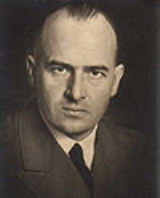
Hans Frank

Encyclopedia
Hans Michael Frank was a German
lawyer
who worked for the Nazi party during the 1920s and 1930s and later became a high-ranking official in Nazi Germany
. He was prosecuted during the Nuremberg trials
for his role in perpetrating the Holocaust during his tenure as the Governor-General of that portion of occupied Poland that was not directly incorporated into the German Reich, although administered by the Nazis, and known as the General Government
. He was found guilty of war crime
s and crimes against humanity
and executed
in Nuremberg.
, and his parents were Karl Frank, a lawyer, and his wife Magdalena (née Buchmaier). He had an older brother, Karl Jr., and a younger sister, Elisabeth. He joined the German army in 1917, during World War I
. After the war he served in the Freikorps
under the command of Franz Ritter von Epp, and then joined the German Worker's Party (which soon evolved into NSDAP), in 1919, and was one of the party's earliest members.
He studied law, passing the final state examination in 1926, and rose to become Adolf Hitler
's personal legal adviser. In this capacity, Frank was privy to personal details of Hitler's life. In his memoirs, written shortly before his execution, Frank made the sensational claim that he had been commissioned by Hitler to investigate Hitler's family in 1930 after a "blackmail
letter" had been received from Hitler's nephew, William Patrick Hitler
, who allegedly threatened to reveal embarrassing facts about his uncle's ancestry. Frank said that the investigation uncovered evidence that Maria Schicklgruber
, Hitler's paternal grandmother, had been working as a cook in the household of a Jewish man named Leopold Frankenberger before she gave birth to Hitler's father, Alois
, out of wedlock. Frank claimed that he had obtained from a relative of Hitler's by marriage a collection of letters between Maria Schicklgruber and a member of the Frankenberger family that discussed a stipend for her after she left the employ of the family. According to Frank, Hitler told him that the letters did not prove that the Frankenberger son was his grandfather but rather his grandmother had merely extorted
money from Frankenberger by threatening to claim his paternity of her illegitimate child. Frank accepted this explanation, but added that it was still just possible that Hitler had some Jewish ancestry. Nevertheless, he thought it unlikely because, "...from his entire demeanor, the fact that Adolf Hitler had no Jewish blood coursing through his veins seems so clearly evident that nothing more need be said on this."
Given that all Jews had been expelled from the province of Styria (which includes Graz) in the 15th century and were not allowed to return until the 1860s, scholars such as Ian Kershaw
and Brigitte Hamann
dismiss the Frankenberger hypothesis, which before had only Frank's speculation to support it as baseless. There is no evidence outside of Frank's statements for the existence of a "Leopold Frankenberger" living in Graz in the 1830s, and Frank's story is notably inaccurate on several points such as the claim that Maria Schicklgruber came from "Leonding near Linz", when in fact she came from the hamlet of Strones near the village of Döllersheim. It has been suggested that Frank, who turned against National Socialism after 1945, remained an anti-Semitic fanatic, made the claim that Hitler had Jewish ancestry as way of proving that Hitler was thus really a "Jew" and not an "Aryan"; and in this way, "proved" that the crimes of the Third Reich were the work of the "Jewish" Hitler. The full anti-Semitic implications of Frank's story were borne out in a letter to the editor of a Saudi newspaper in 1982 by a German man living in Saudi Arabia entitled "Was Hitler a Jew?". The letter-writer accepted Frank's story as the truth, and added since Hitler was a Jew, "the Jews should pay Germans reparations for the War, since one of theirs caused the destruction of Germany". The American author Ron Rosenbaum
wrote about Frank:
As the Nazis rose to power, Frank served as the party's lawyer, representing it in over 2,400 cases, and spending over $10,000. This sometimes brought him into conflict with other lawyers, and one, a former teacher of Frank's appealed to him: "I beg you to leave these people alone! No good will come of it! Political movements that begin in the criminal courts will end in the criminal courts!" In September-October 1930, Frank served as the defence lawyer at the court-martial in Leipzig of Lieutenants Richard Scheringer, Hans Friedrich Wendt and Hanns Ludin
, three Reichswehr
officers charged with membership in the NSDAP. The trial was a media sensation with Hitler himself testifying, and the defence successfully putting the Weimar Republic on trial, and many Army officers won over to a sympathetic view of the National Socialist movement..
Frank was elected to the Reichstag
in 1930, and in 1933 he was made Minister of Justice for Bavaria
. From 1933, he was also the head of the National Socialist Jurists Association and President of the Academy of German Law. Frank objected to extrajudicial killings, both at the Dachau concentration camp and during the Night of the Long Knives
.
Frank's view of what the judicial process required should not be exaggerated:
From 1934, Frank was Reich Minister Without Portfolio
.
in the German military administration in occupied Poland
. From 26 October 1939, following the end of the invasion of Poland
, Frank was assigned Governor-General of the occupied Polish territories (Generalgouverneur für die besetzten polnischen Gebiete), controlling the General Government
, the area of Poland not directly incorporated into Germany (roughly 90,000 km² out of the 187,000 km² Germany had gained). He was also granted the SS rank of Obergruppenführer
.
One of his first operations was the AB Action, aimed at destroying Polish culture, and in which more than 30,000 Poles (intellectuals and the upper classes) were arrested and 7,000 were subsequently massacred. Frank oversaw the segregation of the Jews into ghetto
s and the use of Polish civilians as "forced and compulsory" labour. In 1942 he lost his positions of authority outside the GG after annoying Hitler with a series of speeches in Berlin
, Vienna
, Heidelberg
, and Munich
and also as part of a power struggle with Friedrich Wilhelm Krüger
, the State Secretary for Security — head of the SS and the police in the GG. Krüger himself was ultimately replaced with Wilhelm Koppe
.
An assassination attempt by Polish Secret State
on 29/30 January 1944 (the night preceding the 11th anniversary of the appointment of Adolf Hitler as Chancellor of Germany
) in Szarów
near Krakow
failed. A special train with Frank traveling to Lviv
was derailed after an explosive device went off but no one was killed.
As governor general, Frank "stripped away" his appearance of culture stating to his cabinet, The General Government was the location of four of the six extermination camps. Frank later claimed that the extermination of Jews was entirely controlled by Heinrich Himmler
and the SS and that he, Frank, was unaware of the extermination camps in the GG until early in 1944. During his testimony at Nuremberg, Frank claimed he submitted resignation requests to Hitler on 14 occasions, but Hitler would not allow him to resign. Frank fled GG in January 1945, in advance of the Soviet Army
.
. He not only possessed an extensive library of chess literature but was also a good player, and he even received the Ukrainian chess grandmaster Efim Bogoljubow
at the Wawel
castle. He was a patron of General Government chess tournament
s (1940–1944). On 3 November 1940 he organized a chess congress in Krakow
. Six months later he announced the establishment of a chess school under Bogoljubow and the World Chess Champion, Dr. Alexander Alekhine
, and he visited a chess tournament in October 1942 at the "Literary Café" in Krakow.
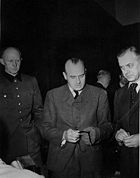 Frank was captured by American troops on 3 May 1945, at Tegernsee
in southern Bavaria
. Upon his capture, he tried to cut his own throat; two days later, he lacerated his left arm while attempting to slit his wrists in a second unsuccessful suicide attempt. He was indicted for war crimes and tried before the International Military Tribunal
in Nuremberg
from 20 November 1945 to 1 October 1946. During the trial he renewed the faith of his childhood, Roman Catholicism
, and claimed to have a series of religious experiences.
Frank voluntarily surrendered 43 volumes of his personal diaries to the Allies, which were then used against him as evidence of his guilt. Frank confessed to some of the charges put against him and viewed his own execution as a form of atonement
for his sin
s. Although on the witness stand he expressed remorse, during the trial, he vacillated between penitence for his crimes and blaming the Allies, especially the Soviet
s, for an equal share of wartime atrocities.
The former Governor-General of Poland was found guilty of war crimes and crimes against humanity on 1 October 1946, and was sentenced to death by hanging
. While awaiting execution, he wrote his memoirs. The sentence was carried out on 16 October by Master Sergeant John C. Woods. Journalist Howard K. Smith wrote of the execution:
He and Albert Speer
were allegedly the only defendants to show remorse for their war crimes. "My conscience
does not allow me simply to throw the responsibility simply on minor people... A thousand years will pass and still Germany's guilt will not have been erased." But four months later he insisted in his final statement, that the guilt of the Germans had been wiped out by the crimes inflicted upon them: "There is still one statement of mine which I must rectify. On the witness stand I said that a thousand years would not suffice to erase the guilt brought upon our people because of Hitler's conduct in this war. Every possible guilt incurred by our nation has already been, completely wiped out today, not only by the conduct of our war-time enemies towards our nation and its soldiers, which has been carefully kept out of this Trial, but also by the tremendous mass crimes of the most frightful sort which-as I have now learned-have been and still are being committed against Germans by Russians, Poles, and Czechs, especially in East Prussia, Silesia, Pomerania, and Sudetenland. Who shall ever judge these crimes against the German people?" He answered to his name quietly and when asked for any last statement, he replied "I am thankful for the kind treatment during my captivity and I ask God
to accept me with mercy."
and the couple honeymooned in Venetia. Hans and Brigitte Frank had five children:
Brigitte Frank had a reputation for having a more dominant personality than her husband, and from 1939 she called herself "a queen of Poland" ("Königin von Polen"). The marriage was unhappy and became colder from year to year. When Frank sought a divorce in 1942, Brigitte gave everything to save their marriage in order to remain the "First Lady in the General Government". One of her most famous comments was "I'd rather be widowed than divorced from a Reichsminister!" Frank answered: "So you are my deadly enemy!"
In 1987, Niklas Frank wrote a book about his father, Der Vater: Eine Abrechnung ("The Father: A Settling of Accounts"), which was published in English
in 1991 as In the Shadow of the Reich. The book, which was serialized in the magazine Stern
, resulted in controversy in Germany because of the scathing way in which the younger Frank depicted his father, referring to him as "a slime-hole of a Hitler fanatic" and questioning his remorse before his execution.
:
About Polish partisans
in Warsaw
in 1943, he spoke from Kraków
, stating:
Germany
Germany , officially the Federal Republic of Germany , is a federal parliamentary republic in Europe. The country consists of 16 states while the capital and largest city is Berlin. Germany covers an area of 357,021 km2 and has a largely temperate seasonal climate...
lawyer
Lawyer
A lawyer, according to Black's Law Dictionary, is "a person learned in the law; as an attorney, counsel or solicitor; a person who is practicing law." Law is the system of rules of conduct established by the sovereign government of a society to correct wrongs, maintain the stability of political...
who worked for the Nazi party during the 1920s and 1930s and later became a high-ranking official in Nazi Germany
Nazi Germany
Nazi Germany , also known as the Third Reich , but officially called German Reich from 1933 to 1943 and Greater German Reich from 26 June 1943 onward, is the name commonly used to refer to the state of Germany from 1933 to 1945, when it was a totalitarian dictatorship ruled by...
. He was prosecuted during the Nuremberg trials
Nuremberg Trials
The Nuremberg Trials were a series of military tribunals, held by the victorious Allied forces of World War II, most notable for the prosecution of prominent members of the political, military, and economic leadership of the defeated Nazi Germany....
for his role in perpetrating the Holocaust during his tenure as the Governor-General of that portion of occupied Poland that was not directly incorporated into the German Reich, although administered by the Nazis, and known as the General Government
General Government
The General Government was an area of Second Republic of Poland under Nazi German rule during World War II; designated as a separate region of the Third Reich between 1939–1945...
. He was found guilty of war crime
War crime
War crimes are serious violations of the laws applicable in armed conflict giving rise to individual criminal responsibility...
s and crimes against humanity
Crime against humanity
Crimes against humanity, as defined by the Rome Statute of the International Criminal Court Explanatory Memorandum, "are particularly odious offenses in that they constitute a serious attack on human dignity or grave humiliation or a degradation of one or more human beings...
and executed
Capital punishment
Capital punishment, the death penalty, or execution is the sentence of death upon a person by the state as a punishment for an offence. Crimes that can result in a death penalty are known as capital crimes or capital offences. The term capital originates from the Latin capitalis, literally...
in Nuremberg.
Pre-war career
Frank was born in KarlsruheKarlsruhe
The City of Karlsruhe is a city in the southwest of Germany, in the state of Baden-Württemberg, located near the French-German border.Karlsruhe was founded in 1715 as Karlsruhe Palace, when Germany was a series of principalities and city states...
, and his parents were Karl Frank, a lawyer, and his wife Magdalena (née Buchmaier). He had an older brother, Karl Jr., and a younger sister, Elisabeth. He joined the German army in 1917, during World War I
World War I
World War I , which was predominantly called the World War or the Great War from its occurrence until 1939, and the First World War or World War I thereafter, was a major war centred in Europe that began on 28 July 1914 and lasted until 11 November 1918...
. After the war he served in the Freikorps
Freikorps
Freikorps are German volunteer military or paramilitary units. The term was originally applied to voluntary armies formed in German lands from the middle of the 18th century onwards. Between World War I and World War II the term was also used for the paramilitary organizations that arose during...
under the command of Franz Ritter von Epp, and then joined the German Worker's Party (which soon evolved into NSDAP), in 1919, and was one of the party's earliest members.
He studied law, passing the final state examination in 1926, and rose to become Adolf Hitler
Adolf Hitler
Adolf Hitler was an Austrian-born German politician and the leader of the National Socialist German Workers Party , commonly referred to as the Nazi Party). He was Chancellor of Germany from 1933 to 1945, and head of state from 1934 to 1945...
's personal legal adviser. In this capacity, Frank was privy to personal details of Hitler's life. In his memoirs, written shortly before his execution, Frank made the sensational claim that he had been commissioned by Hitler to investigate Hitler's family in 1930 after a "blackmail
Blackmail
In common usage, blackmail is a crime involving threats to reveal substantially true or false information about a person to the public, a family member, or associates unless a demand is met. It may be defined as coercion involving threats of physical harm, threat of criminal prosecution, or threats...
letter" had been received from Hitler's nephew, William Patrick Hitler
William Patrick Hitler
William Patrick "Willy" Stuart-Houston was the nephew of Adolf Hitler. Born to Adolf's half-brother Alois Hitler, Jr., and his first wife Bridget Dowling, William later moved to Germany and subsequently escaped, eventually going to the United States where he enlisted to fight in World War...
, who allegedly threatened to reveal embarrassing facts about his uncle's ancestry. Frank said that the investigation uncovered evidence that Maria Schicklgruber
Maria Schicklgruber
Maria Anna Schicklgruber was Adolf Hitler's paternal grandmother.- Family :Maria was born in the village of Strones in the Waldviertel area. She was the daughter of Theresia Pfeisinger , and farmer Johannes Schicklgruber...
, Hitler's paternal grandmother, had been working as a cook in the household of a Jewish man named Leopold Frankenberger before she gave birth to Hitler's father, Alois
Alois Hitler
Alois Hitler was an Austrian civil servant who was the father of Adolf Hitler.-Early life:...
, out of wedlock. Frank claimed that he had obtained from a relative of Hitler's by marriage a collection of letters between Maria Schicklgruber and a member of the Frankenberger family that discussed a stipend for her after she left the employ of the family. According to Frank, Hitler told him that the letters did not prove that the Frankenberger son was his grandfather but rather his grandmother had merely extorted
Extortion
Extortion is a criminal offence which occurs when a person unlawfully obtains either money, property or services from a person, entity, or institution, through coercion. Refraining from doing harm is sometimes euphemistically called protection. Extortion is commonly practiced by organized crime...
money from Frankenberger by threatening to claim his paternity of her illegitimate child. Frank accepted this explanation, but added that it was still just possible that Hitler had some Jewish ancestry. Nevertheless, he thought it unlikely because, "...from his entire demeanor, the fact that Adolf Hitler had no Jewish blood coursing through his veins seems so clearly evident that nothing more need be said on this."
Given that all Jews had been expelled from the province of Styria (which includes Graz) in the 15th century and were not allowed to return until the 1860s, scholars such as Ian Kershaw
Ian Kershaw
Sir Ian Kershaw is a British historian of 20th-century Germany whose work has chiefly focused on the period of the Third Reich...
and Brigitte Hamann
Brigitte Hamann
Brigitte Hamann Ph.D., is a German-Austrian author and historian based in Vienna.Born Brigitte Deitert in Essen, Germany, she studied history in Münster and Vienna and for a time worked as a journalist in her native Essen...
dismiss the Frankenberger hypothesis, which before had only Frank's speculation to support it as baseless. There is no evidence outside of Frank's statements for the existence of a "Leopold Frankenberger" living in Graz in the 1830s, and Frank's story is notably inaccurate on several points such as the claim that Maria Schicklgruber came from "Leonding near Linz", when in fact she came from the hamlet of Strones near the village of Döllersheim. It has been suggested that Frank, who turned against National Socialism after 1945, remained an anti-Semitic fanatic, made the claim that Hitler had Jewish ancestry as way of proving that Hitler was thus really a "Jew" and not an "Aryan"; and in this way, "proved" that the crimes of the Third Reich were the work of the "Jewish" Hitler. The full anti-Semitic implications of Frank's story were borne out in a letter to the editor of a Saudi newspaper in 1982 by a German man living in Saudi Arabia entitled "Was Hitler a Jew?". The letter-writer accepted Frank's story as the truth, and added since Hitler was a Jew, "the Jews should pay Germans reparations for the War, since one of theirs caused the destruction of Germany". The American author Ron Rosenbaum
Ron Rosenbaum
-Life and career:Rosenbaum was born into a Jewish family in New York City, New York and grew up in Bay Shore, New York. He graduated from Yale University in 1968 and won a Carnegie Fellowship to attend Yale's graduate program in English Literature, though he dropped out after taking one course...
wrote about Frank:
"On the other hand, a different version of Frank emerges in the brilliantly vicious, utterly unforgiving portrait of him by his son, Niklas Frank, who (in a memoir called In the Shadow of the Reich) depicts his father as a craven coward and weakling, but one not without a kind of animal cunning, an instinct for lying, insinuation, self-aggrandizement. For this Hans Frank, disgraced and facing death on the gallows for following Hitler, fabricating such a story might be a cunning way of ensuring his place in history as the one man who gave the world the hidden key to the mystery of Hitler's psyche. While at the same time, revenging himself on his former master for having led him to this end by foisting a sordid and humiliating explanation of Hitler on him for all posterity. In any case, it was one Frank knew the victors would find seductive".
As the Nazis rose to power, Frank served as the party's lawyer, representing it in over 2,400 cases, and spending over $10,000. This sometimes brought him into conflict with other lawyers, and one, a former teacher of Frank's appealed to him: "I beg you to leave these people alone! No good will come of it! Political movements that begin in the criminal courts will end in the criminal courts!" In September-October 1930, Frank served as the defence lawyer at the court-martial in Leipzig of Lieutenants Richard Scheringer, Hans Friedrich Wendt and Hanns Ludin
Hanns Ludin
Hanns Elard Ludin was a German diplomat.Born in Freiburg to Friedrich and Johanna Ludin, Ludin began his Nazi affiliation in 1930 by joining the party, and was arrested for his political activities the same year...
, three Reichswehr
Reichswehr
The Reichswehr formed the military organisation of Germany from 1919 until 1935, when it was renamed the Wehrmacht ....
officers charged with membership in the NSDAP. The trial was a media sensation with Hitler himself testifying, and the defence successfully putting the Weimar Republic on trial, and many Army officers won over to a sympathetic view of the National Socialist movement..
Frank was elected to the Reichstag
Reichstag (Weimar Republic)
The Reichstag was the parliament of Weimar Republic .German constitution commentators consider only the Reichstag and now the Bundestag the German parliament. Another organ deals with legislation too: in 1867-1918 the Bundesrat, in 1919–1933 the Reichsrat and from 1949 on the Bundesrat...
in 1930, and in 1933 he was made Minister of Justice for Bavaria
Bavaria
Bavaria, formally the Free State of Bavaria is a state of Germany, located in the southeast of Germany. With an area of , it is the largest state by area, forming almost 20% of the total land area of Germany...
. From 1933, he was also the head of the National Socialist Jurists Association and President of the Academy of German Law. Frank objected to extrajudicial killings, both at the Dachau concentration camp and during the Night of the Long Knives
Night of the Long Knives
The Night of the Long Knives , sometimes called "Operation Hummingbird " or in Germany the "Röhm-Putsch," was a purge that took place in Nazi Germany between June 30 and July 2, 1934, when the Nazi regime carried out a series of political murders...
.
Frank's view of what the judicial process required should not be exaggerated:
From 1934, Frank was Reich Minister Without Portfolio
Minister without Portfolio
A minister without portfolio is either a government minister with no specific responsibilities or a minister that does not head a particular ministry...
.
Wartime career
In September 1939 Frank was assigned as Chief of Administration to Gerd von RundstedtGerd von Rundstedt
Karl Rudolf Gerd von Rundstedt was a Generalfeldmarschall of the German Army during World War II. He held some of the highest field commands in all phases of the war....
in the German military administration in occupied Poland
German military administration in occupied Poland
German military administration in occupied Poland refers to the brief period during and in the immediate aftermath of the German invasion of Poland , in which the occupied Polish territories were administered by the German military, instead of civilian, administration.-Military administration:On 8...
. From 26 October 1939, following the end of the invasion of Poland
Invasion of Poland (1939)
The Invasion of Poland, also known as the September Campaign or 1939 Defensive War in Poland and the Poland Campaign in Germany, was an invasion of Poland by Germany, the Soviet Union, and a small Slovak contingent that marked the start of World War II in Europe...
, Frank was assigned Governor-General of the occupied Polish territories (Generalgouverneur für die besetzten polnischen Gebiete), controlling the General Government
General Government
The General Government was an area of Second Republic of Poland under Nazi German rule during World War II; designated as a separate region of the Third Reich between 1939–1945...
, the area of Poland not directly incorporated into Germany (roughly 90,000 km² out of the 187,000 km² Germany had gained). He was also granted the SS rank of Obergruppenführer
Obergruppenführer
Obergruppenführer was a Nazi Party paramilitary rank that was first created in 1932 as a rank of the SA and until 1942 it was the highest SS rank inferior only to Reichsführer-SS...
.
One of his first operations was the AB Action, aimed at destroying Polish culture, and in which more than 30,000 Poles (intellectuals and the upper classes) were arrested and 7,000 were subsequently massacred. Frank oversaw the segregation of the Jews into ghetto
Ghetto
A ghetto is a section of a city predominantly occupied by a group who live there, especially because of social, economic, or legal issues.The term was originally used in Venice to describe the area where Jews were compelled to live. The term now refers to an overcrowded urban area often associated...
s and the use of Polish civilians as "forced and compulsory" labour. In 1942 he lost his positions of authority outside the GG after annoying Hitler with a series of speeches in Berlin
Berlin
Berlin is the capital city of Germany and is one of the 16 states of Germany. With a population of 3.45 million people, Berlin is Germany's largest city. It is the second most populous city proper and the seventh most populous urban area in the European Union...
, Vienna
Vienna
Vienna is the capital and largest city of the Republic of Austria and one of the nine states of Austria. Vienna is Austria's primary city, with a population of about 1.723 million , and is by far the largest city in Austria, as well as its cultural, economic, and political centre...
, Heidelberg
Heidelberg
-Early history:Between 600,000 and 200,000 years ago, "Heidelberg Man" died at nearby Mauer. His jaw bone was discovered in 1907; with scientific dating, his remains were determined to be the earliest evidence of human life in Europe. In the 5th century BC, a Celtic fortress of refuge and place of...
, and Munich
Munich
Munich The city's motto is "" . Before 2006, it was "Weltstadt mit Herz" . Its native name, , is derived from the Old High German Munichen, meaning "by the monks' place". The city's name derives from the monks of the Benedictine order who founded the city; hence the monk depicted on the city's coat...
and also as part of a power struggle with Friedrich Wilhelm Krüger
Friedrich Wilhelm Krüger
Friedrich-Wilhelm Krüger was a Nazi official and high-ranking member of the SA and SS. Between 1939 and 1943 he was SS and Police Leader in the General Government in German-occupied Poland and in that capacity he organized and supervised numerous acts of war crimes.- Early life :Krüger was born...
, the State Secretary for Security — head of the SS and the police in the GG. Krüger himself was ultimately replaced with Wilhelm Koppe
Wilhelm Koppe
Wilhelm Koppe was a German Nazi commander who was responsible for numerous atrocities against Poles and Jews in Reichsgau Wartheland and the General Government during the German occupation of Poland in World War II.-Biography:Born in Hildesheim, he fought in the First World War...
.
An assassination attempt by Polish Secret State
Polish Secret State
The Polish Underground State is a collective term for the World War II underground resistance organizations in Poland, both military and civilian, that remained loyal to the Polish Government in Exile in London. The first elements of the Underground State were put in place in the final days of the...
on 29/30 January 1944 (the night preceding the 11th anniversary of the appointment of Adolf Hitler as Chancellor of Germany
Chancellor of Germany
The Chancellor of Germany is, under the German 1949 constitution, the head of government of Germany...
) in Szarów
Szarów, Lesser Poland Voivodeship
Szarów is a village in the administrative district of Gmina Kłaj, within Wieliczka County, Lesser Poland Voivodeship, in southern Poland. It lies approximately east of Wieliczka and east of the regional capital Kraków....
near Krakow
Kraków
Kraków also Krakow, or Cracow , is the second largest and one of the oldest cities in Poland. Situated on the Vistula River in the Lesser Poland region, the city dates back to the 7th century. Kraków has traditionally been one of the leading centres of Polish academic, cultural, and artistic life...
failed. A special train with Frank traveling to Lviv
Lviv
Lviv is a city in western Ukraine. The city is regarded as one of the main cultural centres of today's Ukraine and historically has also been a major Polish and Jewish cultural center, as Poles and Jews were the two main ethnicities of the city until the outbreak of World War II and the following...
was derailed after an explosive device went off but no one was killed.
As governor general, Frank "stripped away" his appearance of culture stating to his cabinet, The General Government was the location of four of the six extermination camps. Frank later claimed that the extermination of Jews was entirely controlled by Heinrich Himmler
Heinrich Himmler
Heinrich Luitpold Himmler was Reichsführer of the SS, a military commander, and a leading member of the Nazi Party. As Chief of the German Police and the Minister of the Interior from 1943, Himmler oversaw all internal and external police and security forces, including the Gestapo...
and the SS and that he, Frank, was unaware of the extermination camps in the GG until early in 1944. During his testimony at Nuremberg, Frank claimed he submitted resignation requests to Hitler on 14 occasions, but Hitler would not allow him to resign. Frank fled GG in January 1945, in advance of the Soviet Army
Soviet Army
The Soviet Army is the name given to the main part of the Armed Forces of the Soviet Union between 1946 and 1992. Previously, it had been known as the Red Army. Informally, Армия referred to all the MOD armed forces, except, in some cases, the Soviet Navy.This article covers the Soviet Ground...
.
Chess
Hans Frank was extremely interested in chessChess
Chess is a two-player board game played on a chessboard, a square-checkered board with 64 squares arranged in an eight-by-eight grid. It is one of the world's most popular games, played by millions of people worldwide at home, in clubs, online, by correspondence, and in tournaments.Each player...
. He not only possessed an extensive library of chess literature but was also a good player, and he even received the Ukrainian chess grandmaster Efim Bogoljubow
Efim Bogoljubow
Efim Dmitriyevich Bogolyubov was a Russo-German chess grandmaster who won numerous events and played two matches with Alexander Alekhine for the world championship.-Early career:...
at the Wawel
Wawel
Wawel is an architectural complex erected over many centuries atop a limestone outcrop on the left bank of the Vistula River in Kraków, Poland, at an altitude of 228 metres above the sea level. It is a place of great significance to the Polish people. The Royal Castle with an armoury and the...
castle. He was a patron of General Government chess tournament
General Government chess tournament
General Government chess championships were held during World War II:- Participants :*Alexander Alekhine /*Efim Bogoljubow /*Paul Felix Schmidt /*Klaus Junge /*Karl Gilg /*Josef Lokvenc /*Hans Müller /...
s (1940–1944). On 3 November 1940 he organized a chess congress in Krakow
Kraków
Kraków also Krakow, or Cracow , is the second largest and one of the oldest cities in Poland. Situated on the Vistula River in the Lesser Poland region, the city dates back to the 7th century. Kraków has traditionally been one of the leading centres of Polish academic, cultural, and artistic life...
. Six months later he announced the establishment of a chess school under Bogoljubow and the World Chess Champion, Dr. Alexander Alekhine
Alexander Alekhine
Alexander Alexandrovich Alekhine was the fourth World Chess Champion. He is often considered one of the greatest chess players ever.By the age of twenty-two, he was already among the strongest chess players in the world. During the 1920s, he won most of the tournaments in which he played...
, and he visited a chess tournament in October 1942 at the "Literary Café" in Krakow.
Capture and trial
Tegernsee
Tegernsee is a town in the Miesbach district of Bavaria, Germany. It is located on the shore of Tegernsee lake, at an elevation of 747 m above sea level....
in southern Bavaria
Bavaria
Bavaria, formally the Free State of Bavaria is a state of Germany, located in the southeast of Germany. With an area of , it is the largest state by area, forming almost 20% of the total land area of Germany...
. Upon his capture, he tried to cut his own throat; two days later, he lacerated his left arm while attempting to slit his wrists in a second unsuccessful suicide attempt. He was indicted for war crimes and tried before the International Military Tribunal
Nuremberg Trials
The Nuremberg Trials were a series of military tribunals, held by the victorious Allied forces of World War II, most notable for the prosecution of prominent members of the political, military, and economic leadership of the defeated Nazi Germany....
in Nuremberg
Nuremberg
Nuremberg[p] is a city in the German state of Bavaria, in the administrative region of Middle Franconia. Situated on the Pegnitz river and the Rhine–Main–Danube Canal, it is located about north of Munich and is Franconia's largest city. The population is 505,664...
from 20 November 1945 to 1 October 1946. During the trial he renewed the faith of his childhood, Roman Catholicism
Roman Catholic Church
The Catholic Church, also known as the Roman Catholic Church, is the world's largest Christian church, with over a billion members. Led by the Pope, it defines its mission as spreading the gospel of Jesus Christ, administering the sacraments and exercising charity...
, and claimed to have a series of religious experiences.
Frank voluntarily surrendered 43 volumes of his personal diaries to the Allies, which were then used against him as evidence of his guilt. Frank confessed to some of the charges put against him and viewed his own execution as a form of atonement
Atonement
Atonement is a doctrine that describes how human beings can be reconciled to God. In Christian theology the atonement refers to the forgiving or pardoning of sin through the death of Jesus Christ by crucifixion, which made possible the reconciliation between God and creation...
for his sin
Sin
In religion, sin is the violation or deviation of an eternal divine law or standard. The term sin may also refer to the state of having committed such a violation. Christians believe the moral code of conduct is decreed by God In religion, sin (also called peccancy) is the violation or deviation...
s. Although on the witness stand he expressed remorse, during the trial, he vacillated between penitence for his crimes and blaming the Allies, especially the Soviet
Soviet Union
The Soviet Union , officially the Union of Soviet Socialist Republics , was a constitutionally socialist state that existed in Eurasia between 1922 and 1991....
s, for an equal share of wartime atrocities.
The former Governor-General of Poland was found guilty of war crimes and crimes against humanity on 1 October 1946, and was sentenced to death by hanging
Capital punishment
Capital punishment, the death penalty, or execution is the sentence of death upon a person by the state as a punishment for an offence. Crimes that can result in a death penalty are known as capital crimes or capital offences. The term capital originates from the Latin capitalis, literally...
. While awaiting execution, he wrote his memoirs. The sentence was carried out on 16 October by Master Sergeant John C. Woods. Journalist Howard K. Smith wrote of the execution:
He and Albert Speer
Albert Speer
Albert Speer, born Berthold Konrad Hermann Albert Speer, was a German architect who was, for a part of World War II, Minister of Armaments and War Production for the Third Reich. Speer was Adolf Hitler's chief architect before assuming ministerial office...
were allegedly the only defendants to show remorse for their war crimes. "My conscience
Conscience
Conscience is an aptitude, faculty, intuition or judgment of the intellect that distinguishes right from wrong. Moral judgement may derive from values or norms...
does not allow me simply to throw the responsibility simply on minor people... A thousand years will pass and still Germany's guilt will not have been erased." But four months later he insisted in his final statement, that the guilt of the Germans had been wiped out by the crimes inflicted upon them: "There is still one statement of mine which I must rectify. On the witness stand I said that a thousand years would not suffice to erase the guilt brought upon our people because of Hitler's conduct in this war. Every possible guilt incurred by our nation has already been, completely wiped out today, not only by the conduct of our war-time enemies towards our nation and its soldiers, which has been carefully kept out of this Trial, but also by the tremendous mass crimes of the most frightful sort which-as I have now learned-have been and still are being committed against Germans by Russians, Poles, and Czechs, especially in East Prussia, Silesia, Pomerania, and Sudetenland. Who shall ever judge these crimes against the German people?" He answered to his name quietly and when asked for any last statement, he replied "I am thankful for the kind treatment during my captivity and I ask God
God
God is the English name given to a singular being in theistic and deistic religions who is either the sole deity in monotheism, or a single deity in polytheism....
to accept me with mercy."
Family
On 2 April 1925 Frank married 29-year-old secretary Brigitte Herbst (1895–1959) from Forst (Lausitz). The wedding took place in MunichMunich
Munich The city's motto is "" . Before 2006, it was "Weltstadt mit Herz" . Its native name, , is derived from the Old High German Munichen, meaning "by the monks' place". The city's name derives from the monks of the Benedictine order who founded the city; hence the monk depicted on the city's coat...
and the couple honeymooned in Venetia. Hans and Brigitte Frank had five children:
- Sigrid Frank (born 13 March 1927, Munich)
- Norman Frank (born 3 June 1928, Munich)
- Brigitte Frank (born 13 January 1935, Munich)
- Michael Frank (born 15 February 1937, Munich)
- Niklas Frank (born 9 March 1939, Munich)
Brigitte Frank had a reputation for having a more dominant personality than her husband, and from 1939 she called herself "a queen of Poland" ("Königin von Polen"). The marriage was unhappy and became colder from year to year. When Frank sought a divorce in 1942, Brigitte gave everything to save their marriage in order to remain the "First Lady in the General Government". One of her most famous comments was "I'd rather be widowed than divorced from a Reichsminister!" Frank answered: "So you are my deadly enemy!"
In 1987, Niklas Frank wrote a book about his father, Der Vater: Eine Abrechnung ("The Father: A Settling of Accounts"), which was published in English
English language
English is a West Germanic language that arose in the Anglo-Saxon kingdoms of England and spread into what was to become south-east Scotland under the influence of the Anglian medieval kingdom of Northumbria...
in 1991 as In the Shadow of the Reich. The book, which was serialized in the magazine Stern
Stern (magazine)
Stern is a weekly news magazine published in Germany. It was founded in 1948 by Henri Nannen, and is currently published by Gruner + Jahr, a subsidiary of Bertelsmann. In the first quarter of 2006, its print run was 1.019 million copies and it reached 7.84 million readers according to...
, resulted in controversy in Germany because of the scathing way in which the younger Frank depicted his father, referring to him as "a slime-hole of a Hitler fanatic" and questioning his remorse before his execution.
Quotations
In a 1940 interview in the Völkischer BeobachterVölkischer Beobachter
The Völkischer Beobachter was the newspaper of the National Socialist German Workers' Party from 1920. It first appeared weekly, then daily from February 8, 1923...
:
About Polish partisans
Polish Secret State
The Polish Underground State is a collective term for the World War II underground resistance organizations in Poland, both military and civilian, that remained loyal to the Polish Government in Exile in London. The first elements of the Underground State were put in place in the final days of the...
in Warsaw
Warsaw
Warsaw is the capital and largest city of Poland. It is located on the Vistula River, roughly from the Baltic Sea and from the Carpathian Mountains. Its population in 2010 was estimated at 1,716,855 residents with a greater metropolitan area of 2,631,902 residents, making Warsaw the 10th most...
in 1943, he spoke from Kraków
Kraków
Kraków also Krakow, or Cracow , is the second largest and one of the oldest cities in Poland. Situated on the Vistula River in the Lesser Poland region, the city dates back to the 7th century. Kraków has traditionally been one of the leading centres of Polish academic, cultural, and artistic life...
, stating:
Portrayal in the media
Hans Frank has been portrayed by the following actors in film, television and theater productions.- Hans Schwarz Jr. in the 19541954 in filmThe year 1954 in film involved some significant events and memorable ones.-Events:*May 12 - The Marx Brothers' Zeppo Marx divorces wife Marion Benda...
West GermanWest GermanyWest Germany is the common English, but not official, name for the Federal Republic of Germany or FRG in the period between its creation in May 1949 to German reunification on 3 October 1990....
film Geld aus der Luft - Lothar Bellag in the 1968 East German television miniseries Wege übers LandWays across the CountryWays across the Country is a 1968 East German television miniseries, directed by Martin Ackermann.-Episode I:...
. - Voja MiricVoja MiricVoja Mirić is a Serbian television and film actor most noted for his role as Ahmed Nurudin in the 1974 Yugoslav movie Dervis i smrt ....
in the 1971 YugoslaviaYugoslaviaYugoslavia refers to three political entities that existed successively on the western part of the Balkans during most of the 20th century....
n television production Nirnberski epilog - Jerzy DuszyńskiJerzy DuszyńskiJerzy Duszyński was one of the most popular actors in a post-war Poland. He starred in a number of film productions as well as theatrical plays.-Biography:...
in the 1976 PolishPolandPoland , officially the Republic of Poland , is a country in Central Europe bordered by Germany to the west; the Czech Republic and Slovakia to the south; Ukraine, Belarus and Lithuania to the east; and the Baltic Sea and Kaliningrad Oblast, a Russian exclave, to the north...
film Ocalić miasto - John BaileyJohn BaileyJohn Bailey or Jack Bailey may refer to:*John Bailey *John Bailey *John Bailey , British actor*Jack Bailey , American actor and daytime game show host...
in the 1978 United StatesUnited StatesThe United States of America is a federal constitutional republic comprising fifty states and a federal district...
television production HolocaustHolocaust (miniseries)Holocaust was a television miniseries broadcast in four parts in 1978 on the NBC television network. The series tells the story of the Holocaust from the perspective of the Weiss family of German Jews and that of a rising member of the SS, who gradually becomes a merciless war criminal... - Robert Austin in the 1984 United States television production Pope John Paul II
- Frank MooreFrank MooreFrank C. Moore II was a New York-based painter, winner of the Logan Medal of the arts, and a member of the Visual AIDS Artist Caucus—the organization responsible for the Ribbon Project, A Day Without Art, and A Night Without Light.Born in Manhattan in 1953, Moore moved with his family to Long...
in the 2000 CanadianCanadaCanada is a North American country consisting of ten provinces and three territories. Located in the northern part of the continent, it extends from the Atlantic Ocean in the east to the Pacific Ocean in the west, and northward into the Arctic Ocean...
/U.S. T.V. production NurembergNuremberg (2000 film)Nuremberg is a 2000 Canadian/United States television docudrama, based on the book Nuremberg: Infamy on Trial by Joseph E. Persico, that tells the story of the Nuremberg Trials.-Part one:... - Matt CravenMatt Craven-Life and career:Craven was born Matthew John Crnkovich in Port Colborne, Ontario, the son of Joanne Leslie, a hairdresser, and Nick Crnkovich. He has an older sister, Deborah...
in the 2005 PolishPolandPoland , officially the Republic of Poland , is a country in Central Europe bordered by Germany to the west; the Czech Republic and Slovakia to the south; Ukraine, Belarus and Lithuania to the east; and the Baltic Sea and Kaliningrad Oblast, a Russian exclave, to the north...
television production Karol, un uomo diventato Papa - Andreas Conrad in the 2005 German T.V. miniseries Speer und ErSpeer und ErSpeer und Er is a three-part German docudrama starring Sebastian Koch as Albert Speer and Tobias Moretti as Adolf Hitler...
. - Harald Posch in the 2005 ItalianItalyItaly , officially the Italian Republic languages]] under the European Charter for Regional or Minority Languages. In each of these, Italy's official name is as follows:;;;;;;;;), is a unitary parliamentary republic in South-Central Europe. To the north it borders France, Switzerland, Austria and...
/U.S./Polish television production Pope John Paul IIPope John Paul IIBlessed Pope John Paul II , born Karol Józef Wojtyła , reigned as Pope of the Catholic Church and Sovereign of Vatican City from 16 October 1978 until his death on 2 April 2005, at of age. His was the second-longest documented pontificate, which lasted ; only Pope Pius IX ... - Will KeenWill KeenWill Keen is an English actor. He is also a trustee of the James Menzies Kitchen Award, an award set up for young theatre directors in memory of the director with whom Keen collaborated early in his career...
in the 2011 BBCBBCThe British Broadcasting Corporation is a British public service broadcaster. Its headquarters is at Broadcasting House in the City of Westminster, London. It is the largest broadcaster in the world, with about 23,000 staff...
production The Man Who Crossed HitlerThe Man Who Crossed HitlerThe Man Who Crossed Hitler is a 2011 BBC film set in Berlin in the summer of 1931, dramatising the true story where lawyer Hans Litten subpoenas Adolf Hitler as a witness in the trial of some Nazi thugs...
See also
- Glossary of Nazi Germany
- List of Nazi Party leaders and officials
- The Holocaust in Poland
- Command responsibilityCommand responsibilityCommand responsibility, sometimes referred to as the Yamashita standard or the Medina standard, and also known as superior responsibility, is the doctrine of hierarchical accountability in cases of war crimes....