

Spanish State

Encyclopedia
Francoist Spain refers to a period of Spanish history
between 1936 and 1975 when Spain
was under the authoritarian
dictatorship
of Francisco Franco
.
The regime was formed on 1 October 1936 by Francisco Franco and the National Defense Committee (a faction of the Spanish army rebelling against the Republic). The regime was entrenched upon the victory in the Spanish Civil War
of the rebel Nacionales coalition. Besides the internal support, Franco's rebellion had been backed from abroad by Fascist Italy
and Nazi Germany
, while the Second Spanish Republic
was increasingly backed by the communist Soviet Union
.
After winning the Spanish Civil War, the Nacionales had established a single party
authoritarian state under the undisputed leadership of Franco. World War II started shortly afterwards, and though Spain was officially neutral, it did send a special Division of troops to Russia to aid the Germans, and its pro-Axis stance led to it being isolated after the collapse of the Axis powers. This changed with the new Cold War
scenario, on the face of which Franco's strong anti-communism
naturally tilted its régime to ally with the United States
.
Spain was declared a kingdom
in 1947, but no monarch was designated. Franco reserved for himself the right to name the person to be king, and deliberately delayed the selection due to political considerations. The selection finally came in 1969, with the designation of Juan Carlos de Borbón
as Franco's official successor.
With the death of Franco on 20 November 1975, Juan Carlos became the King of Spain. He immediately began the process of a transition to democracy
, ending with Spain becoming a constitutional monarchy
articulated by a parliamentary democracy.
When the Spanish Civil War broke out, the Nationalist forces immediately began using the form the Spanish State rather than the Spanish Republic
or the Kingdom of Spain, out of deference to the differing political sensibilities of the members of the Nationalist coalition, which included, amongst others, the anti-monarchic fascist Falangists, and the rival conservative-monarchist Carlist
s and Legitimist parties.
Following the Second World War, both the Falangist and Carlist movements declined, while Franco's rule was consolidated. This allowed Franco to nominally restore the Spanish monarchy without any significant opposition.
as leader of the Nationalists, with the rank of Generalísimo
(sometimes written in English as Generalissimo, after the Fascist Italian fashion). He was originally supposed to be only commander-in-chief, but after the death of General Emilio Mola
(the initial leader of the movement) became head of state as well with nearly unlimited and absolute powers.
This provisional government ruled over the territories controlled by the Nationalists during the Civil War
. Its main political action during the war was the consolidation of the heterogeneous political forces that joined the rebellion into a single party, the authoritarian Falange
.
During the war, the Nationalist government repressed Republican militants and sympathizers, as retaliation for the repression of clergy and Nationalist militants on the opposite side. Extrajudicial killings were widespread on both sides during the whole war. The retaliation continued right after the war, in part to punish war crimes committed under the Republican government, under a trial called Causa General. Franco's government executed, jailed, or subjected to forced labor thousands of Republicans, but many of them were entirely innocent of anything other than the flimsiest support for the Republican cause, or merely being related to known Republicans. As a result thousands chose to go into exile, mostly in France and Mexico. Of those who fled to metropolitan France, many joined the French resistance
against the Nazis. One such exile in metropolitan France was Lluís Companys, President of the Catalan Government
; he was subsequently arrested and extradited to Spain in September 1940 by the Pétain regime
, then executed after a military trial.
Many of those who had supported the Republic fled into exile. Spain lost thousands of doctors, nurses, teachers, lawyers, judges, professors, businessmen, artists, etc. Many of those who had to stay lost their jobs or lost their rank. Sometimes those jobs were given to unskilled and even untrained personnel. This deprived the country of many of its brightest minds, and also of a very capable workforce. . However, this was done to keep Spain's citizens consistent with the ideals sought by the FET y de las JONS and Franco.
broke out in Europe. After the collapse of France in June 1940, Spain adopted a pro-Axis non-belligerency stance (for example, it offered Spanish naval facilities to German ships), and returned escaping Allied servicemen and fleeing resistance fighters to the Nazis, returning the favour paid by the Nazis when they had contributed forces including the Stuka dive bombers to support Franco and the Nationalists during the Civil War.
Adolf Hitler
met Franco in Hendaye
, France (23 October 1940), to discuss the Spanish entry in the war joining the Axis
. Franco's demands (food, military equipment, Gibraltar
, French North Africa, etc.) proved too much and no agreement was reached.
Contributing to the disagreement was an ongoing dispute over German mining rights in Spain. Some historians argue that Franco made demands that he knew Hitler would not accede to in order to stay out of the war. Other historians argue that he simply had nothing to offer the Germans. Franco did send volunteer troops to fight communism joining the Axis armies on the Eastern Front against the Soviet Union
. The unit name was the División Azul, or Blue Division, after the Falange
's party color, whose members were known as 'blueshirts'. Franco returned to complete neutrality in 1943, when the tide of the war had turned decisively against Germany. However, Fulgencio Batista
of Cuba
, despite the Cuban armed forces not being greatly involved in World War II, had suggested a joint U.S.
-Latin America
n assault on Spain in order to overthrow the Franco regime.
. Franco's government was seen, especially by Soviet countries but also by the Western allies, to be a remnant of the central European fascist regimes. Under these circumstances, a UN resolution condemning Franco's government followed. The resolution encouraged countries to remove their ambassadors in Spain, and established the basis for measures against Spain if the government remained authoritarian. Only neighbouring Portugal, Ireland and a few Latin American, Arabian and Asian countries, refused to comply with this advice.
The consequence of all of this was the establishment of an embargo
against the Francoist regime in 1946 — including the closure of the French border — with very little success, as it boosted support for the regime. The isolation was represented by Franco's regime as a modern version of the Black Legend
, with the most fanatical partisans claiming it was a machination of Jews
and Freemasons
against Catholic Spain. (Historian Vicente Carcel Orti asserts that anticlerical Freemasons
had in fact played a large part in the anti-Catholic acts of the prior Republican government since they held key government positions, including at least 183 deputies in the Cortes (the Spanish parliament), and thus were instrumental in the making of anti-Catholic laws.) This impression of machination helped to rally significant popular support for the regime such as the large scale 1946 demonstration held in Madrid. In 1947, the president of Argentina, Juan Perón, ignored the UN embargo and sent his wife Eva Perón
(Evita) with much needed food supplies. The Spaniards, and Franco himself, heartily welcomed Evita.
After World War II, the Spanish economy was still in disarray. Rationing
cards were still used as late as 1952. War and economic isolation prompted the regime to move towards autarky
, a movement warmly welcomed by Falangists. The tenets of the economy were: reduction of imports, self-sufficiency, state-controlled production and commercialization of first order goods, state-funded industry and construction of infrastructure — heavily damaged during the Civil War — through the use of improvised means.
In other aspects the regime continued showing its heavy-handedness when it withdrew the press credentials of six U.S. reporters in 1951.
 The increased tensions between the U.S. and the USSR in the 1950s led the American government to search for new allies in Europe. Franco's strong anti-Communist stance as well as the strategic location of Spain made the Spanish State a potential ally in the Cold War
.
Spain's international ostracism was finally broken in 1953 when Spain and the United States signed the Pact of Madrid
in a series of agreements under which Spain received some financial benefits in the form of grants and loans in return for hosting American military bases (such as Naval Station Rota
, opened in 1955). The same year, the Spanish government signed the Concordat
with the Vatican
.
In 1955, Spanish wealth approached the pre-Civil War levels of 1935, leaving behind the disasters of the war and the struggle of isolation. Spain was admitted to the UN in 1955 and to the World Bank
in 1958. Other Western European countries, including Italy, were from that point eager to restore good contacts with Francoist Spain.
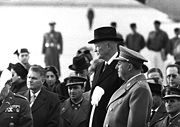
Spain's gradual readmission to the international fold was given visible form with the visit of U.S. President Dwight D. Eisenhower
in December 1959.
 The Spanish Miracle (Desarrollo) was the name given to the Spanish economic boom between 1959 and 1973. It is seen by some as the most remarkable positive legacy of the regime. During this period, Spain largely surpassed the per capita income that differentiates developed
from underdeveloped countries and induced the development of a dominant middle class
.
The boom was bolstered by economic reforms promoted by the so-called "technocrat
s", appointed by Franco, who pushed for public investment in infrastructure development, as recommended by the International Monetary Fund
. The technocrats were a new breed of economists who replaced the old, prone to isolationism, Falangist guard.
The implementation of these policies took the form of development plans (planes de Desarrollo) and it was largely a success: Spain enjoyed the second highest growth rate in the world, just after Japan, and became the ninth largest economy in the world, just after Canada. Spain joined the industrialized world, leaving behind the poverty and endemic underdevelopment it had experienced since the loss of the Spanish Empire
in the 19th century.
Although the economic growth produced noticeable improvements in Spanish living standards and the development of a middle class, Spain remained less economically advanced relative to the rest of Western Europe (with the exception of Portugal, Greece and Ireland). At the heyday of the Miracle, 1974, Spanish income per capita peaked at 79 percent of the Western European average, only to be reached again 25 years later, in 1999.
The 14 years of recovery led to an increase in (often unplanned) building on the periphery of the main Spanish cities to accommodate the new class of industrial workers brought by rural exodus
.
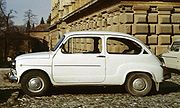
The icon of the Desarrollo was the SEAT 600
(a license-built Italian Fiat
600
) the first car for many Spanish working class families, produced by the Spanish factory SEAT
or Sociedad Española de Automóviles de Turismo.
1969 also saw the Spanish government close the border with Gibraltar. Aircraft from Gibraltar were stopped from travelling to Spain or banned from using Spanish airspace. The border remained closed until the 1980s and air restrictions were only lifted in 2006.
severely affected Spain, and brought the economic growth to a halt. This caused a new wave of strikes (nominally illegal at the time).
Franco's declining health during the early 1970s gave more power to Admiral Luis Carrero Blanco
, allegedly his caretaker and guardian of young Juan Carlos, the future king. Nevertheless, ETA
was planning to assassinate Blanco, and finally, the commando led by Argala, after two years of work, exploded a bomb which was located in a tunnel dig under the road he used to drive every morning. The operation was named Operación Ogro
and it was highly celebrated especially in the Basque Country
and in the dissident areas of Spain.
Carlos Arias Navarro
took over as President of the Spanish Government, and tried to introduce some reforms to the decaying regime, but he struggled between the two factions of the regime, the conservative búnker
and the aperturistas, who promoted transition towards democracy.
But there was no way back to the old regime: Spain was not the same as in post-Civil War times and the model for the now wealthy Spaniards was the prosperous Western Europe, not the impoverished post-war Falangist Spain. Additionally, a considerable number of Spanish men had worked in Western Europe
in the previous years as cheap labour forces, thereby encountering the economic growth and wealth of other western Europeans.
Meanwhile, in Western Sahara
the situation became increasingly difficult, with the Polisario Front
fighting for the independence against colonial troops in one hand, and the Moroccan regime wishing to annex the territory to Morocco
.
Led by Cardinal
Tarancón and hand in hand with the reforms of the Vatican Council II
, the Spanish Roman Catholic church had changed deeply by the last years of the Franco regime and could not be counted as supporting it anymore.
In July 1974 Franco fell ill, and Juan Carlos took over as Head of State. Franco soon recovered, but one year later he fell ill once again, and by late October 1975, he fell into a coma and was put on life support. After a long illness, Franco died on November 20, 1975, at the age of 82—the same date as the death of José Antonio Primo de Rivera
, founder of the Falange
. It is suspected that his doctors were ordered to keep him barely alive by artificial means until this symbolic date of the far-right. The historian Ricardo de la Cierva says that on the 19th around 6 p.m. he was told that Franco had already died. After Franco's death, the interim government decided to bury him at Valle de los Caídos, a colossal memorial to all the casualties of the Spanish Civil War
, although it was conceived by Franco and has a distinctly nationalist tone.
Upon Franco's death, Juan Carlos became the King of Spain and immediately used his absolute power to transition to a democratic and constitutional monarchy. The Spanish State ceased to exist in 1975 de facto during the Spanish transition to democracy
, and was officially over de jure after the Spanish Constitution of 1978
.
. Through a state of emergency
-like status, the 100 member national council
(central committee) of the FET worked as makeshift legislature of Spain until the passing of the Organic law of 1942
(Ley Organica) and the Constituting of the Cortes Act (Ley Constitutiva de las Cortes) the same year, which saw the grand reopening of the Cortes Generales
on July 18, 1942.
The Organic law stipulated the government to be ultimately responsible for all legislation of the country, while defining the Cortes of Spain as a purely advisory body not elected by either direct or universal suffrage. As head of government, Franco was constitutionally in charge of appointing his own ministers, thus being the one source of legislation. The law of national referendums (Ley del Referendum Nacional), passed in 1945 approved for all "fundamental law" to be approved by a popular referendum, in which only the family heads could vote. Local municipal council
s were appointed similarly by family heads and local corporations
through elections, while the government exercised the exclusive right to appoint mayors.
The law of referendums was exercised twice; in 1947, when a law approved through a referendum
revived the Spanish monarchy
with Franco as interim regent for life
with sole right to appoint his successor, secondly in 1966, to approve of a new "organic law"
, or constitution
, supposedly limiting and clearly defining Franco's powers as well as formally creating the modern office of Prime Minister of Spain
.
. Despite this, Franco was forced to make some concessions. Henceforth, when French Morocco
became independent in 1956, he surrendered Spanish Morocco
to Mohammed V
, retaining only a few enclaves (the Plazas de soberanía
). The year after, Mohammed V invaded Spanish Sahara
during the Ifni War
(known as the "Forgotten War" in Spain). Only in 1975, with the Green March
and the military occupation, did Morocco take control of all of the former Spanish territories in the Sahara.
In 1968, under United Nations pressure, Franco granted Spain's colony of Equatorial Guinea
its independence, and the next year, ceded the exclave of Ifni
to Morocco
. Under Franco, Spain also pursued a campaign to gain sovereignty of the British overseas territory of Gibraltar
, and closed its border with Gibraltar
in 1969. The border would not be fully reopened until 1985.
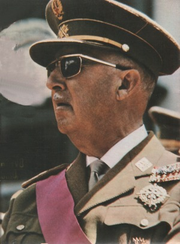
The consistent points in Francoism included above all authoritarianism
, nationalism
and anti-Freemasonry
; some authors also quote integralism
. All in all, Francoism showed a frontal rejection of Communism
, Socialism
and Anarchism
. Although Franco and Spain under his rule adopted some trappings of fascism, he, and Spain under his rule, are not generally considered to be fascist by scholars of fascism;among the distinctions, fascism entails a revolutionary aim to transform society, where Franco and Franco's Spain did not seek to do so, and, to the contrary, although authoritarian, were conservative and traditional.
Stanley Payne, the preeminent scholar on fascism and Spain notes: "scarcely any of the serious historians and analysts of Franco consider the generalissimo to be a core fascist." According to historian Walter Laqueur
"during the civil war, Spanish fascists were forced to subordinate their activities to the nationalist cause. At the helm were military leaders such as General Francisco Franco, who were conservatives in all essential respects. When the civil war ended, Franco was so deeply entrenched that the Falange stood no chance; in this strongly authoritarian regime, there was no room for political opposition. The fascists became junior partners in the government and, as such, they had to accept responsibility for the regime's policy without being able to shape it substantially"
(founder of the Falange and executed by the Republicans during the course of the war) Franco lacked any consistent political ideology other than fierce anti-communism.
Franco initially sought support from various groups, such as National syndicalism
(nacionalsindicalismo) and the Roman Catholic Church
(nacionalcatolicismo). The Falange
, a fringe fascist inspired party during the Republic, soon transformed itself into the frame of reference in the Movimiento Nacional. In April 1937, the Falange Española Tradicionalista y de las Juntas de Ofensiva Nacional-Sindicalista ("Spanish Traditionalist Phalanx of the Assemblies of National-Syndicalist Offensive", FET y de las JONS) was created from a merger of the Carlist traditionalists
with the Falange Española de las Juntas de Ofensiva Nacional-Sindicalista, which itself was issued of a merger of José Antonio Primo de Rivera
's Falange Española with the national-syndicalist Juntas de Ofensiva Nacional-Sindicalista
(JONS).
and the German Nazi Party, the FET-JONS were relatively heterogeneous instead of being an ideological monolith. Because of this, the Spanish State is generally considered to be authoritarian rather than fascist; among the distinctions, fascism entails a revolutionary aim to transform society, where Franco did not seek to do so, and, to the contrary, although authoritarian, were conservative and traditional.
After World War II, the Falange opposed freer capital markets, but the ultimately prevailing technocrats
, many of whom were linked with Opus Dei
, eschewed syndicalist economics and favored increased competition as a means of achieving rapid economic growth and integration with wider Europe which meant greater democracy.
While it included fascist trappings, the Spanish State was very authoritarian: non-government trade union
s and all political opponents across the political spectrum
were either suppressed or tightly controlled by all means, including violent police repression. Most country towns and rural areas were patrolled by pairs of Guardia Civil, a military police for civilians, which functioned as his chief means of social control. Larger cities, and capitals, were mostly under the heavily-armed Policía Armada, commonly called grises.
Members of the oppressed ranged from trade unions to communist
and anarchist
organizations to liberal democrats
and Catalan
or Basque
separatists. The Confederación Nacional del Trabajo
(CNT) and the Unión General de Trabajadores
(UGT) trade-unions were outlawed, and replaced in 1940 by the corporatist Sindicato Vertical. The Spanish Socialist Workers' Party
(PSOE) party and the Esquerra Republicana de Catalunya
(ERC) were banned in 1939, while the Communist Party of Spain (PCE) went underground. University students seeking democracy revolted in the late 1960s and early 1970s, which was repressed by the grises. The Basque Nationalist Party
(PNV) went into exile, and in 1959, the ETA
armed group was created to wage a low-intensity war against Franco. Franco, like others at the time, evinced a concern about a possible Masonic
conspiracy against his regime. Some non-Spanish authors have described it as being an "obsession".
Franco continued to personally sign all death warrants until just months before he died despite international campaigns requesting him to desist.
and flamenco
were promoted as national traditions while those traditions not considered "Spanish" were suppressed. Franco's view of Spanish tradition was somewhat artificial and arbitrary: while some regional traditions were suppressed, Flamenco, an Andalusia
n tradition, was considered part of a larger, national identity. All cultural activities were subject to censorship
, and many were plainly forbidden (often in an erratic manner). This cultural policy relaxed with time, most notably in the late 1960s and early 1970s.
Franco was reluctant to enact any form of administrative and legislative decentralization and kept a fully centralized form of government with a similar administrative structure to that established by the House of Bourbon
and General Miguel Primo de Rivera y Orbaneja. Such structures were both based in the model of the French centralised State. The main drawback of this kind of management is that government attention and initiatives were irregular, and often depended on the goodwill of regional Government representatives than on regional needs. Thus, inequalities in schooling, health care or transport facilities among regions were patent: classically affluent regions like Madrid, Catalonia, or the Basque Country fared much better than Extremadura, Galicia or Andalusia. Some regions, like Extremadura or La Mancha didn't have a university.
Franco dissolved the autonomy granted by the Second Spanish Republic
to these two regions and to Galicia. Franco abolished the centuries-old fiscal privileges and autonomy (the fueros) in two of the three Basque provinces: Guipuzcoa and Biscay
, but kept them for Alava
. Among Franco's greatest area of support during the civil war was Navarre
, also a Basque speaking region in its north half. Navarre remained a separated region from the Basque Country and Franco decided to preserve its also centuries' old fiscal privileges and autonomy, the so-called Fueros of Navarre
.
Franco also used language politics
in an attempt to establish national homogeneity. Despite Franco being Galician, in accordance with his nationalist principles, he abolished the official statute and recognition for the Basque
, Galician
, and Catalan
languages that the Second Spanish Republic
had granted for the first time in the history of Spain. He returned to Spanish
as the only official language of the State and education, although millions of the country's citizens spoke other languages. The legal usage of languages other than Spanish was forbidden. All government, notarial, legal and commercial documents were to be drawn up exclusively in Spanish and any written in other languages were deemed null and void. The usage of any other language was forbidden in schools, in advertising, and on road and shop signs. Publications in other languages were generally forbidden, though citizens continued to speak other languages in private.
This was the situation throughout the 1940s
and, to a lesser extent, during the 1950s
, but after 1960 the non-Castilian Spanish languages were freely spoken and written and reached books, plays, and films. Even so, non-Castilian languages continued to be discouraged and never received official status: all government, notarial, legal and commercial documents were still drawn up exclusively in Spanish and any written in other languages were deemed null and void.
Additionally, the popularization of the compulsory national educational system and the development of modern mass media, both controlled by the State and in Spanish language, and heavily reduced the number of speakers of Basque, Catalan and Galician, as happened during the second half of the twentieth century with other European minority languages which were not officially protected like Scottish Gaelic or French Breton
. By the 1970s
the majority of the population in the urban areas could not speak in the minority language
or, as in some Catalan towns, their use had been abandoned. The most endangered case was the Basque language. By the 1970s Basque had reached the point where any further reduction in the number of Basque speakers would have not guaranteed the necessary generational renewal and it is now recognized that the language would have disappeared in only a few more decades. This was the main reason that drove the Francoist provincial government of Alava
to create a network of Basque medium schools (Ikastola
) in 1973 which were State financed.
was made the official religion of the Spanish State, which enforced Catholic social mores
. The Catholic Church was established as the one religion of the Spanish State. The remaining nomads of Spain (Gitanos and Mercheros like El Lute
) were especially affected. The Spanish State enforced Catholic behavior mainly by using a law (the Ley de Vagos y Maleantes, Vagrancy Act) enacted by Azaña
. Civil servants had to be Catholic, and some official jobs even required a "good behavior" statement by a priest. Civil marriages which had taken place under Republican Spain were declared null and void and had to be convalidated by the Catholic Church of Spain. Civil marriages were only possible after the couple made a public renunciation to the Catholic Church. Divorce, contraceptives and abortion were forbidden. From 1954 onwards, homosexuality
, pedophilia
, and prostitution
were criminal offenses, although the enforcement of this was seldom consistent.
Francoism professed a devotion to the traditional role of women in society, that is: loving child to her parents and brothers, faithful to her husband, residing with her family. Official propaganda confined her role to family care and motherhood. Most progressive laws passed by the Republic were made void, correspondingly. Women could not become judges, or testify in trial. They could not become university professors. In the 1960s and 1970s the situation became increasingly liberalized, finally reaching full liberalization after Franco's death.
Although a self-proclaimed monarchist, Franco had no particular desire for a king, due to his strained relations with the legitimate heir of the Crown, Don Juan de Borbón. Therefore, he left the throne vacant, with himself as de facto regent
. In 1947 Franco proclaimed Spain a monarchy
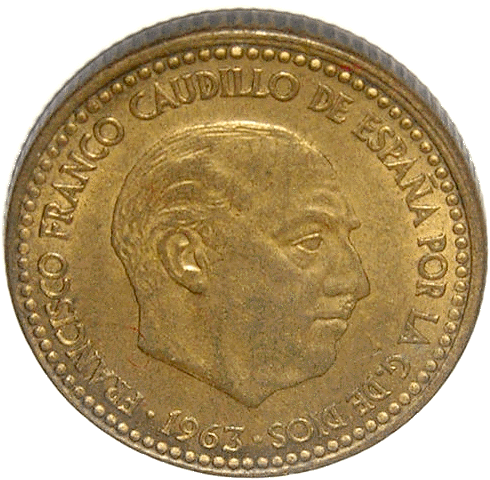
, through the Ley de Sucesión en la Jefatura del Estado act, but did not designate a monarch. Instead, he set the basis for his succession. This gesture was largely done to appease monarchist factions within the Movimiento. He wore the uniform of a captain general (a rank traditionally reserved for the King), resided in the royal Pardo Palace, appropriated the kingly privilege of walking beneath a canopy
, and his portrait appeared on most Spanish coins. Indeed, although his formal titles were Jefe del Estado (Head of State) and Generalísimo de los Ejércitos Españoles (Generalissimo
of the Spanish Armed Forces), he was referred to as Caudillo de España por la gracia de Dios, (by the Grace of God
, the Leader of Spain). Por la Gracia de Dios is a technical, legal formulation which states sovereign dignity in absolute monarchies
, and had only been used by monarchs before Franco used it himself. The long-delayed selection of Juan Carlos de Borbón as Franco's official successor in 1969 was an unpleasant surprise for many interested parties, as Juan Carlos was the rightful heir for neither the Carlists nor the Legitimists.
 The Civil War had ravaged the Spanish economy. Infrastructure had been damaged, workers killed, and daily business severely hampered. For more than a decade after Franco's victory, the economy improved little. Franco initially pursued a policy of autarky
, cutting off almost all international trade. The policy had devastating effects, and the economy stagnated. Only black marketeers could enjoy an evident affluence.
In 1940, the "Vertical Trade Union" was created; it was inspired by the ideas of José Antonio Primo de Rivera
, who thought that class struggle
would be ended by grouping together workers and owners according to corporative principles. It was the only legal trade union, and was under government control. Other trade unions were forbidden and strongly repressed along with political parties outside the FET-JONS.
On one occasion, a Czech engineer and con-man managed to convince the general that with the waters of the River Jarama and certain herbs and secret powders, Spain could get all the petroleum it needed. On another, he was convinced of a plan to solve the country’s terrible hunger of the 1940s by feeding the population of 30 million with dolphin sandwiches. (La Memoria Insumisa, Nicolás Sartorius y Javier Alfaya, 1999). Indeed in the background of these economic policies some 200,000 people died of hunger in the early years of Francoism, a period known as Los Años de Hambre (the Years of Hunger).
On the brink of bankruptcy, a combination of pressure from the USA, the IMF and technocrats from Opus Dei managed to “convince” the regime to adopt a free market economy in 1959 in what amounted to a mini coup d’etat which removed the old guard in charge of the economy, despite the opposition of Franco. This economic liberalisation was not, however, accompanied by political reforms and repression continued unabated, though these very reforms would lead to socio-economic changes in Spanish society which would make the regime’s continuation 16 years later untenable.
Economic growth picked up after 1959 after Franco took authority away from these ideologues and gave more power to the liberal
technocrats. The country implemented several development policies and growth took off creating the "Spanish Miracle
". Concurrent with the absence of social reforms, and the economic power shift, a tide of mass emigration commenced: to European countries, and to lesser extent, to South America. Emigration helped the Régime in two ways: the country got rid of surplus population, and the emigrants supplied the country with much needed monetary remittances.
During the 1960s, the population, mainly the wealthier segments, experienced further increases in wealth, particularly those who remained politically faithful. International firms established their factories in Spain: salaries were low, taxes nearly non existent, strikes were forbidden, labour health or real state regulations were unheard of, and Spain was virtually a virgin market. Spain became the second-fastest growing economy in the world, just behind Japan
). The rapid development of this period became known as the Spanish Miracle. At the time of Franco's death, Spain still lagged behind most of Western Europe, but the gap between its GDP per capita and that of the major Western European economies had greatly narrowed; in world terms, Spain was already enjoying a fairly high material standard of living with basic but comprehensive services. However, the period between the mid 1970s and mid 1980s was to prove difficult as, in addition to the oil shocks to which Spain was highly exposed, the settling of the new political order took priority over the modernising of the economy.
 In Spain and abroad, the legacy of Franco remains controversial. In Germany a squadron named after Werner Mölders
has been renamed, because as a pilot he led the escorting units in the bombing of Guernica
. As recently as 2006, the BBC reported that Maciej Giertych
, an MEP
of the right-wing League of Polish Families
, had expressed admiration for Franco's stature who allegedly "guaranteed the maintenance of traditional values in Europe."
But this is not the most shared opinion. Several statues of Franco and other public Francoist symbols have been removed, with the last statue in Madrid coming down in 2005. Additionally, the Permanent Commission of the European Parliament
"firmly" condemned in a resolution unanimously adopted in March 2006 the "multiple and serious violations" of human rights
committed in Spain under the Francoist regime from 1939 to 1975. The resolution was at the initiative of the MEP Leo Brincat and of the historian Luis María de Puig, and is the first international official condemnation of the repression enacted by Franco's regime. The resolution also urged to provide public access to historians (professional and amateurs) to the various archive
s of the Francoist regime, including those of the Fundación Francisco Franco which, as well as other Francoist archives, remain as of 2006 inaccessible to the public. Furthermore, it urged the Spanish authorities to set up an underground exhibition
in the Valle de los Caídos monument, in order to explain the "terrible" conditions in which it was built. Finally, it proposes the construction of monuments to commemorate Franco's victims in Madrid and other important cities.
In Spain, a commission to repair the dignity and restitute the memory of the victims of Francoism (Comisión para reparar la dignidad y restituir la memoria de las víctimas del franquismo) was approved in the summer of 2004, and is directed by the vice-president María Teresa Fernández de la Vega
.
The late Franco was a prominent and frequent subject of jokes on early episodes of Saturday Night Live
, see "Generalissimo Francisco Franco is still dead
".
Because of his language policies, Franco's legacy is still particularly poorly perceived in Catalonia
and the Basque Country
. The Basque Country and Catalonia were among the regions that offered the strongest resistance to Franco in the Civil War, as well as during his regime.
Recently the Association for the Recovery of Historical Memory
(ARHM) initiated a systematic search for mass graves of people executed during Franco's regime, which has been supported since the Spanish Socialist Workers' Party
's victory during the 2004 elections by José Luis Rodríguez Zapatero
's government. A Ley de la memoria histórica de España (Law on the Historical Memory of Spain) was passed in 2007. The law is supposed to enforce an official recognition of the crimes committed against civilians during the Francoist rule and organize under state supervision the search for mass graves.
of John the Evangelist
to the shield. The new arms were allegedly inspired in the coat of arms the Catholic Monarchs
adopted after the taking of Granada
from the Moors
, but replacing the arms of Sicily
with those of Navarre
and adding the Pillars of Hercules
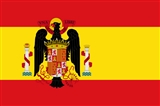
on either side of the coat of arms. In 1938 the columns were placed outside the wings. On July 26, 1945 the commander's ensigns were suppressed by decree, and on October 11, a detailed regulation of flags was published that fixed the model of the bi-color flag in use, but better defined its details, emphasizing a greater style of the Saint John's eagle. The models established by this decree remained in force until 1977.
During this period two more flags were usually displayed along with the national flag: the flag of Spanish Falange
(three vertical strips, red, black and red, with the black stripe wider than the red, and the yoke
and arrows emblem in red in the center of the black stripe) and the Carlist flag (the Saint Andrew saltire
or Cross of Burgundy
red on white), representing the National Movement
which had unified Falange and the Requetés
under the name Falange Española Tradicionalista y de las JONS.
From the death of Franco in 1975 until 1977, the national flag followed the 1945 regulations. On 21 January 1977 a new regulation was approved that stipulated an eagle with more open wings, ("pasmada" eagle), with the restored Pillars of Hercules placed within the wings, and the tape with the motto UNA, GRANDE Y LIBRE (ONE, GREAT and FREE) moved over the eagle's head from its previous position around the neck.
: The Bend between the Pillars of Hercules, crowned with an imperial crown and open (old) royal crown.
Juan Carlos I, as Prince of Spain from 1969 to 1975, used a royal standard which was virtually identical to the one later adopted when he was became King in 1975. The earlier standard differed only that it featured the royal crown of a Crown Prince, the King's royal crown has 8 arches of which 5 are visible, while the Prince's one has only 4 arches of which 3 are visible. The Royal Standard of Spain consists of a dark blue square with the Coat of arms of the King in the center. The King's Guidon is identical to the standard, differing it in that it incorporates a fringe.
Video
History of Spain
The history of Spain involves all the other peoples and nations within the Iberian peninsula formerly known as Hispania, and includes still today the nations of Andorra, Gibraltar, Portugal and Spain...
between 1936 and 1975 when Spain
Spain
Spain , officially the Kingdom of Spain languages]] under the European Charter for Regional or Minority Languages. In each of these, Spain's official name is as follows:;;;;;;), is a country and member state of the European Union located in southwestern Europe on the Iberian Peninsula...
was under the authoritarian
Authoritarianism
Authoritarianism is a form of social organization characterized by submission to authority. It is usually opposed to individualism and democracy...
dictatorship
Dictatorship
A dictatorship is defined as an autocratic form of government in which the government is ruled by an individual, the dictator. It has three possible meanings:...
of Francisco Franco
Francisco Franco
Francisco Franco y Bahamonde was a Spanish general, dictator and head of state of Spain from October 1936 , and de facto regent of the nominally restored Kingdom of Spain from 1947 until his death in November, 1975...
.
The regime was formed on 1 October 1936 by Francisco Franco and the National Defense Committee (a faction of the Spanish army rebelling against the Republic). The regime was entrenched upon the victory in the Spanish Civil War
Spanish Civil War
The Spanish Civil WarAlso known as The Crusade among Nationalists, the Fourth Carlist War among Carlists, and The Rebellion or Uprising among Republicans. was a major conflict fought in Spain from 17 July 1936 to 1 April 1939...
of the rebel Nacionales coalition. Besides the internal support, Franco's rebellion had been backed from abroad by Fascist Italy
Kingdom of Italy (1861–1946)
The Kingdom of Italy was a state forged in 1861 by the unification of Italy under the influence of the Kingdom of Sardinia, which was its legal predecessor state...
and Nazi Germany
Nazi Germany
Nazi Germany , also known as the Third Reich , but officially called German Reich from 1933 to 1943 and Greater German Reich from 26 June 1943 onward, is the name commonly used to refer to the state of Germany from 1933 to 1945, when it was a totalitarian dictatorship ruled by...
, while the Second Spanish Republic
Second Spanish Republic
The Second Spanish Republic was the government of Spain between April 14 1931, and its destruction by a military rebellion, led by General Francisco Franco....
was increasingly backed by the communist Soviet Union
Soviet Union
The Soviet Union , officially the Union of Soviet Socialist Republics , was a constitutionally socialist state that existed in Eurasia between 1922 and 1991....
.
After winning the Spanish Civil War, the Nacionales had established a single party
Single-party state
A single-party state, one-party system or single-party system is a type of party system government in which a single political party forms the government and no other parties are permitted to run candidates for election...
authoritarian state under the undisputed leadership of Franco. World War II started shortly afterwards, and though Spain was officially neutral, it did send a special Division of troops to Russia to aid the Germans, and its pro-Axis stance led to it being isolated after the collapse of the Axis powers. This changed with the new Cold War
Cold War
The Cold War was the continuing state from roughly 1946 to 1991 of political conflict, military tension, proxy wars, and economic competition between the Communist World—primarily the Soviet Union and its satellite states and allies—and the powers of the Western world, primarily the United States...
scenario, on the face of which Franco's strong anti-communism
Anti-communism
Anti-communism is opposition to communism. Organized anti-communism developed in reaction to the rise of communism, especially after the 1917 October Revolution in Russia and the beginning of the Cold War in 1947.-Objections to communist theory:...
naturally tilted its régime to ally with the United States
United States
The United States of America is a federal constitutional republic comprising fifty states and a federal district...
.
Spain was declared a kingdom
Monarchy
A monarchy is a form of government in which the office of head of state is usually held until death or abdication and is often hereditary and includes a royal house. In some cases, the monarch is elected...
in 1947, but no monarch was designated. Franco reserved for himself the right to name the person to be king, and deliberately delayed the selection due to political considerations. The selection finally came in 1969, with the designation of Juan Carlos de Borbón
Juan Carlos I of Spain
Juan Carlos I |Italy]]) is the reigning King of Spain.On 22 November 1975, two days after the death of General Francisco Franco, Juan Carlos was designated king according to the law of succession promulgated by Franco. Spain had no monarch for 38 years in 1969 when Franco named Juan Carlos as the...
as Franco's official successor.
With the death of Franco on 20 November 1975, Juan Carlos became the King of Spain. He immediately began the process of a transition to democracy
Spanish transition to democracy
The Spanish transition to democracy was the era when Spain moved from the dictatorship of Francisco Franco to a liberal democratic state. The transition is usually said to have begun with Franco’s death on 20 November 1975, while its completion has been variously said to be marked by the Spanish...
, ending with Spain becoming a constitutional monarchy
Constitutional monarchy
Constitutional monarchy is a form of government in which a monarch acts as head of state within the parameters of a constitution, whether it be a written, uncodified or blended constitution...
articulated by a parliamentary democracy.
Etymology and usage
The formal name of Spain during the Franco era was the Spanish State . In 1947, the state was formally proclaimed to be a monarchy, but international treaties continued after that date to refer to it as the Spanish State rather than as the Kingdom of Spain.When the Spanish Civil War broke out, the Nationalist forces immediately began using the form the Spanish State rather than the Spanish Republic
Second Spanish Republic
The Second Spanish Republic was the government of Spain between April 14 1931, and its destruction by a military rebellion, led by General Francisco Franco....
or the Kingdom of Spain, out of deference to the differing political sensibilities of the members of the Nationalist coalition, which included, amongst others, the anti-monarchic fascist Falangists, and the rival conservative-monarchist Carlist
Carlism
Carlism is a traditionalist and legitimist political movement in Spain seeking the establishment of a separate line of the Bourbon family on the Spanish throne. This line descended from Infante Carlos, Count of Molina , and was founded due to dispute over the succession laws and widespread...
s and Legitimist parties.
Following the Second World War, both the Falangist and Carlist movements declined, while Franco's rule was consolidated. This allowed Franco to nominally restore the Spanish monarchy without any significant opposition.
Establishment
The Nationalist senior generals held an informal meeting in September 1936, where they elected Francisco FrancoFrancisco Franco
Francisco Franco y Bahamonde was a Spanish general, dictator and head of state of Spain from October 1936 , and de facto regent of the nominally restored Kingdom of Spain from 1947 until his death in November, 1975...
as leader of the Nationalists, with the rank of Generalísimo
Generalissimo
Generalissimo and Generalissimus are military ranks of the highest degree, superior to Field Marshal and other five-star ranks.-Usage:...
(sometimes written in English as Generalissimo, after the Fascist Italian fashion). He was originally supposed to be only commander-in-chief, but after the death of General Emilio Mola
Emilio Mola
Emilio Mola y Vidal, 1st Duke of Mola, Grandee of Spain was a Spanish Nationalist commander during the Spanish Civil War. He is best-known for having coined the term "fifth column".-Early life:...
(the initial leader of the movement) became head of state as well with nearly unlimited and absolute powers.
This provisional government ruled over the territories controlled by the Nationalists during the Civil War
Spanish Civil War
The Spanish Civil WarAlso known as The Crusade among Nationalists, the Fourth Carlist War among Carlists, and The Rebellion or Uprising among Republicans. was a major conflict fought in Spain from 17 July 1936 to 1 April 1939...
. Its main political action during the war was the consolidation of the heterogeneous political forces that joined the rebellion into a single party, the authoritarian Falange
Falange
The Spanish Phalanx of the Assemblies of the National Syndicalist Offensive , known simply as the Falange, is the name assigned to several political movements and parties dating from the 1930s, most particularly the original fascist movement in Spain. The word means phalanx formation in Spanish....
.
During the war, the Nationalist government repressed Republican militants and sympathizers, as retaliation for the repression of clergy and Nationalist militants on the opposite side. Extrajudicial killings were widespread on both sides during the whole war. The retaliation continued right after the war, in part to punish war crimes committed under the Republican government, under a trial called Causa General. Franco's government executed, jailed, or subjected to forced labor thousands of Republicans, but many of them were entirely innocent of anything other than the flimsiest support for the Republican cause, or merely being related to known Republicans. As a result thousands chose to go into exile, mostly in France and Mexico. Of those who fled to metropolitan France, many joined the French resistance
French Resistance
The French Resistance is the name used to denote the collection of French resistance movements that fought against the Nazi German occupation of France and against the collaborationist Vichy régime during World War II...
against the Nazis. One such exile in metropolitan France was Lluís Companys, President of the Catalan Government
Generalitat de Catalunya
The Generalitat of Catalonia is the institution under which the autonomous community of Catalonia is politically organised. It consists of the Parliament, the President of the Generalitat of Catalonia and the Government of Catalonia....
; he was subsequently arrested and extradited to Spain in September 1940 by the Pétain regime
Vichy France
Vichy France, Vichy Regime, or Vichy Government, are common terms used to describe the government of France that collaborated with the Axis powers from July 1940 to August 1944. This government succeeded the Third Republic and preceded the Provisional Government of the French Republic...
, then executed after a military trial.
Many of those who had supported the Republic fled into exile. Spain lost thousands of doctors, nurses, teachers, lawyers, judges, professors, businessmen, artists, etc. Many of those who had to stay lost their jobs or lost their rank. Sometimes those jobs were given to unskilled and even untrained personnel. This deprived the country of many of its brightest minds, and also of a very capable workforce. . However, this was done to keep Spain's citizens consistent with the ideals sought by the FET y de las JONS and Franco.
World War II years (1939–1945)
In September 1939, World War IIWorld War II
World War II, or the Second World War , was a global conflict lasting from 1939 to 1945, involving most of the world's nations—including all of the great powers—eventually forming two opposing military alliances: the Allies and the Axis...
broke out in Europe. After the collapse of France in June 1940, Spain adopted a pro-Axis non-belligerency stance (for example, it offered Spanish naval facilities to German ships), and returned escaping Allied servicemen and fleeing resistance fighters to the Nazis, returning the favour paid by the Nazis when they had contributed forces including the Stuka dive bombers to support Franco and the Nationalists during the Civil War.
Adolf Hitler
Adolf Hitler
Adolf Hitler was an Austrian-born German politician and the leader of the National Socialist German Workers Party , commonly referred to as the Nazi Party). He was Chancellor of Germany from 1933 to 1945, and head of state from 1934 to 1945...
met Franco in Hendaye
Hendaye
Hendaye is the most south-westerly town and commune in France, lying in the Pyrénées-Atlantiques department and located in the traditional province Lapurdi of the French Basque Country...
, France (23 October 1940), to discuss the Spanish entry in the war joining the Axis
Axis Powers
The Axis powers , also known as the Axis alliance, Axis nations, Axis countries, or just the Axis, was an alignment of great powers during the mid-20th century that fought World War II against the Allies. It began in 1936 with treaties of friendship between Germany and Italy and between Germany and...
. Franco's demands (food, military equipment, Gibraltar
Gibraltar
Gibraltar is a British overseas territory located on the southern end of the Iberian Peninsula at the entrance of the Mediterranean. A peninsula with an area of , it has a northern border with Andalusia, Spain. The Rock of Gibraltar is the major landmark of the region...
, French North Africa, etc.) proved too much and no agreement was reached.
Contributing to the disagreement was an ongoing dispute over German mining rights in Spain. Some historians argue that Franco made demands that he knew Hitler would not accede to in order to stay out of the war. Other historians argue that he simply had nothing to offer the Germans. Franco did send volunteer troops to fight communism joining the Axis armies on the Eastern Front against the Soviet Union
Soviet Union
The Soviet Union , officially the Union of Soviet Socialist Republics , was a constitutionally socialist state that existed in Eurasia between 1922 and 1991....
. The unit name was the División Azul, or Blue Division, after the Falange
Falange
The Spanish Phalanx of the Assemblies of the National Syndicalist Offensive , known simply as the Falange, is the name assigned to several political movements and parties dating from the 1930s, most particularly the original fascist movement in Spain. The word means phalanx formation in Spanish....
's party color, whose members were known as 'blueshirts'. Franco returned to complete neutrality in 1943, when the tide of the war had turned decisively against Germany. However, Fulgencio Batista
Fulgencio Batista
Fulgencio Batista y Zaldívar was the United States-aligned Cuban President, dictator and military leader who served as the leader of Cuba from 1933 to 1944 and from 1952 to 1959, before being overthrown as a result of the Cuban Revolution....
of Cuba
Cuba
The Republic of Cuba is an island nation in the Caribbean. The nation of Cuba consists of the main island of Cuba, the Isla de la Juventud, and several archipelagos. Havana is the largest city in Cuba and the country's capital. Santiago de Cuba is the second largest city...
, despite the Cuban armed forces not being greatly involved in World War II, had suggested a joint U.S.
United States
The United States of America is a federal constitutional republic comprising fifty states and a federal district...
-Latin America
Latin America
Latin America is a region of the Americas where Romance languages – particularly Spanish and Portuguese, and variably French – are primarily spoken. Latin America has an area of approximately 21,069,500 km² , almost 3.9% of the Earth's surface or 14.1% of its land surface area...
n assault on Spain in order to overthrow the Franco regime.
Isolation (1945–1953)
After the war, the Allies used Spain's ties to the Axis powers to keep it from joining the United NationsUnited Nations
The United Nations is an international organization whose stated aims are facilitating cooperation in international law, international security, economic development, social progress, human rights, and achievement of world peace...
. Franco's government was seen, especially by Soviet countries but also by the Western allies, to be a remnant of the central European fascist regimes. Under these circumstances, a UN resolution condemning Franco's government followed. The resolution encouraged countries to remove their ambassadors in Spain, and established the basis for measures against Spain if the government remained authoritarian. Only neighbouring Portugal, Ireland and a few Latin American, Arabian and Asian countries, refused to comply with this advice.
The consequence of all of this was the establishment of an embargo
Embargo
An embargo is the partial or complete prohibition of commerce and trade with a particular country, in order to isolate it. Embargoes are considered strong diplomatic measures imposed in an effort, by the imposing country, to elicit a given national-interest result from the country on which it is...
against the Francoist regime in 1946 — including the closure of the French border — with very little success, as it boosted support for the regime. The isolation was represented by Franco's regime as a modern version of the Black Legend
Black Legend
The Black Legend refers to a style of historical writing that demonizes Spain and in particular the Spanish Empire in a politically motivated attempt to morally disqualify Spain and its people, and to incite animosity against Spanish rule...
, with the most fanatical partisans claiming it was a machination of Jews
Jews
The Jews , also known as the Jewish people, are a nation and ethnoreligious group originating in the Israelites or Hebrews of the Ancient Near East. The Jewish ethnicity, nationality, and religion are strongly interrelated, as Judaism is the traditional faith of the Jewish nation...
and Freemasons
Freemasonry
Freemasonry is a fraternal organisation that arose from obscure origins in the late 16th to early 17th century. Freemasonry now exists in various forms all over the world, with a membership estimated at around six million, including approximately 150,000 under the jurisdictions of the Grand Lodge...
against Catholic Spain. (Historian Vicente Carcel Orti asserts that anticlerical Freemasons
Anticlericalism and Freemasonry
The question of whether Freemasonry is Anticlerical is the subject of debate. The Catholic Church has long been an outspoken critic of Freemasonry, and Catholic scholars have often accused the fraternity of anticlericalism. The Catholic Church forbids its members to join any masonic society under...
had in fact played a large part in the anti-Catholic acts of the prior Republican government since they held key government positions, including at least 183 deputies in the Cortes (the Spanish parliament), and thus were instrumental in the making of anti-Catholic laws.) This impression of machination helped to rally significant popular support for the regime such as the large scale 1946 demonstration held in Madrid. In 1947, the president of Argentina, Juan Perón, ignored the UN embargo and sent his wife Eva Perón
Eva Perón
María Eva Duarte de Perón was the second wife of President Juan Perón and served as the First Lady of Argentina from 1946 until her death in 1952. She is often referred to as simply Eva Perón, or by the affectionate Spanish language diminutive Evita.She was born in the village of Los Toldos in...
(Evita) with much needed food supplies. The Spaniards, and Franco himself, heartily welcomed Evita.
After World War II, the Spanish economy was still in disarray. Rationing
Rationing
Rationing is the controlled distribution of scarce resources, goods, or services. Rationing controls the size of the ration, one's allotted portion of the resources being distributed on a particular day or at a particular time.- In economics :...
cards were still used as late as 1952. War and economic isolation prompted the regime to move towards autarky
Autarky
Autarky is the quality of being self-sufficient. Usually the term is applied to political states or their economic policies. Autarky exists whenever an entity can survive or continue its activities without external assistance. Autarky is not necessarily economic. For example, a military autarky...
, a movement warmly welcomed by Falangists. The tenets of the economy were: reduction of imports, self-sufficiency, state-controlled production and commercialization of first order goods, state-funded industry and construction of infrastructure — heavily damaged during the Civil War — through the use of improvised means.
In other aspects the regime continued showing its heavy-handedness when it withdrew the press credentials of six U.S. reporters in 1951.
The end of isolation (1953–1959)
Cold War
The Cold War was the continuing state from roughly 1946 to 1991 of political conflict, military tension, proxy wars, and economic competition between the Communist World—primarily the Soviet Union and its satellite states and allies—and the powers of the Western world, primarily the United States...
.
Spain's international ostracism was finally broken in 1953 when Spain and the United States signed the Pact of Madrid
Pact of Madrid
The Pact of Madrid, signed in 1953 by Spain and the United States, ended a period of virtual isolation for Spain, although the other victorious allies of World War II and much of the rest of the world remained hostile to what they regarded as a fascist regime sympathetic to the Nazi cause and...
in a series of agreements under which Spain received some financial benefits in the form of grants and loans in return for hosting American military bases (such as Naval Station Rota
Naval Station Rota, Spain
Naval Station Rota is a Spanish naval base commanded by a Spanish Vice Admiral and fully funded by the United States of America. Located in Rota, Spain, and near the Spanish town of El Puerto de Santa María, NavSta Rota is the largest American military community in Spain and houses US Navy...
, opened in 1955). The same year, the Spanish government signed the Concordat
Concordat of 1953
The Concordat of 1953 was the last classic concordat of the Roman Catholic Church. Concluded by Spain with the Vatican, and together with the Pact of Madrid, signed the same year, it was a significant effort to break Spain's international isolation after World War II .In return for the granting...
with the Vatican
Holy See
The Holy See is the episcopal jurisdiction of the Catholic Church in Rome, in which its Bishop is commonly known as the Pope. It is the preeminent episcopal see of the Catholic Church, forming the central government of the Church. As such, diplomatically, and in other spheres the Holy See acts and...
.
In 1955, Spanish wealth approached the pre-Civil War levels of 1935, leaving behind the disasters of the war and the struggle of isolation. Spain was admitted to the UN in 1955 and to the World Bank
World Bank
The World Bank is an international financial institution that provides loans to developing countries for capital programmes.The World Bank's official goal is the reduction of poverty...
in 1958. Other Western European countries, including Italy, were from that point eager to restore good contacts with Francoist Spain.
Spain's gradual readmission to the international fold was given visible form with the visit of U.S. President Dwight D. Eisenhower
Dwight D. Eisenhower
Dwight David "Ike" Eisenhower was the 34th President of the United States, from 1953 until 1961. He was a five-star general in the United States Army...
in December 1959.
The Desarrollo, the Spanish Miracle (1959–1973)
Developed country
A developed country is a country that has a high level of development according to some criteria. Which criteria, and which countries are classified as being developed, is a contentious issue...
from underdeveloped countries and induced the development of a dominant middle class
Middle class
The middle class is any class of people in the middle of a societal hierarchy. In Weberian socio-economic terms, the middle class is the broad group of people in contemporary society who fall socio-economically between the working class and upper class....
.
The boom was bolstered by economic reforms promoted by the so-called "technocrat
Technocracy (bureaucratic)
Technocracy is a form of government where technical experts are in control of decision making in their respective fields. Economists, engineers, scientists, health professionals, and those who have knowledge, expertise or skills would compose the governing body...
s", appointed by Franco, who pushed for public investment in infrastructure development, as recommended by the International Monetary Fund
International Monetary Fund
The International Monetary Fund is an organization of 187 countries, working to foster global monetary cooperation, secure financial stability, facilitate international trade, promote high employment and sustainable economic growth, and reduce poverty around the world...
. The technocrats were a new breed of economists who replaced the old, prone to isolationism, Falangist guard.
The implementation of these policies took the form of development plans (planes de Desarrollo) and it was largely a success: Spain enjoyed the second highest growth rate in the world, just after Japan, and became the ninth largest economy in the world, just after Canada. Spain joined the industrialized world, leaving behind the poverty and endemic underdevelopment it had experienced since the loss of the Spanish Empire
Spanish Empire
The Spanish Empire comprised territories and colonies administered directly by Spain in Europe, in America, Africa, Asia and Oceania. It originated during the Age of Exploration and was therefore one of the first global empires. At the time of Habsburgs, Spain reached the peak of its world power....
in the 19th century.
Although the economic growth produced noticeable improvements in Spanish living standards and the development of a middle class, Spain remained less economically advanced relative to the rest of Western Europe (with the exception of Portugal, Greece and Ireland). At the heyday of the Miracle, 1974, Spanish income per capita peaked at 79 percent of the Western European average, only to be reached again 25 years later, in 1999.
The 14 years of recovery led to an increase in (often unplanned) building on the periphery of the main Spanish cities to accommodate the new class of industrial workers brought by rural exodus
Rural exodus
Rural flight is a term used to describe the migratory patterns of peoples from rural areas into urban areas.In modern times, it often occurs in a region following the industrialization of agriculture when fewer people are needed to bring the same amount of agricultural output to market and related...
.
The icon of the Desarrollo was the SEAT 600
SEAT 600
The SEAT 600 was a Spanish car made by SEAT from May 1957 to August 1973. It helped to start the economic boom, the Spanish Miracle , that came at the end of the slow recovery from the Spanish Civil War...
(a license-built Italian Fiat
Fiat
FIAT, an acronym for Fabbrica Italiana Automobili Torino , is an Italian automobile manufacturer, engine manufacturer, financial, and industrial group based in Turin in the Italian region of Piedmont. Fiat was founded in 1899 by a group of investors including Giovanni Agnelli...
600
Fiat 600
The Fiat 600 is a city car produced by the Italian automaker Fiat from 1955 to 1969. Measuring only 3.22 m long, it was the first rear-engined Fiat and cost the equivalent of about € 6,700 or US$ 7300 in today's money . The total number produced from 1955 to 1969 at the Mirafiori...
) the first car for many Spanish working class families, produced by the Spanish factory SEAT
SEAT
SEAT, S.A. is a Spanish automobile manufacturer founded on May 9, 1950 by the Instituto Nacional de Industria , a state-owned industrial holding company....
or Sociedad Española de Automóviles de Turismo.
1969 also saw the Spanish government close the border with Gibraltar. Aircraft from Gibraltar were stopped from travelling to Spain or banned from using Spanish airspace. The border remained closed until the 1980s and air restrictions were only lifted in 2006.
Franco's last years (1973–1975)
The 1973 oil crisis1973 oil crisis
The 1973 oil crisis started in October 1973, when the members of Organization of Arab Petroleum Exporting Countries or the OAPEC proclaimed an oil embargo. This was "in response to the U.S. decision to re-supply the Israeli military" during the Yom Kippur war. It lasted until March 1974. With the...
severely affected Spain, and brought the economic growth to a halt. This caused a new wave of strikes (nominally illegal at the time).
Franco's declining health during the early 1970s gave more power to Admiral Luis Carrero Blanco
Luis Carrero Blanco
Don Luis Carrero Blanco, 1st Duke of Carrero Blanco, Grandee of Spain was a Spanish admiral and long-time confidant of dictator Francisco Franco.- Biography :...
, allegedly his caretaker and guardian of young Juan Carlos, the future king. Nevertheless, ETA
ETA
ETA , an acronym for Euskadi Ta Askatasuna is an armed Basque nationalist and separatist organization. The group was founded in 1959 and has since evolved from a group promoting traditional Basque culture to a paramilitary group with the goal of gaining independence for the Greater Basque Country...
was planning to assassinate Blanco, and finally, the commando led by Argala, after two years of work, exploded a bomb which was located in a tunnel dig under the road he used to drive every morning. The operation was named Operación Ogro
Operación Ogro
Operación Ogro was the name given by ETA to the assassination of Luis Carrero Blanco the Prime Minister of Spain in 1973...
and it was highly celebrated especially in the Basque Country
Basque Country (autonomous community)
The Basque Country is an autonomous community of northern Spain. It includes the Basque provinces of Álava, Biscay and Gipuzkoa, also called Historical Territories....
and in the dissident areas of Spain.
Carlos Arias Navarro
Carlos Arias Navarro
Don Carlos Arias-Navarro, 1st Marquis of Arias-Navarro, Grandee of Spain, born Carlos Arias y Navarro was one of the best known Spanish politicians during the dictatorship of General Francisco Franco....
took over as President of the Spanish Government, and tried to introduce some reforms to the decaying regime, but he struggled between the two factions of the regime, the conservative búnker
Búnker
The term búnker refers to a far-right faction during the Spanish transition to democracy. The group of hardline francoists opposed political and social reform; the group's steadfast refusal to compromise led to the name of "bunker." Under the presidency of Carlos Arias Navarro, búnker and its...
and the aperturistas, who promoted transition towards democracy.
But there was no way back to the old regime: Spain was not the same as in post-Civil War times and the model for the now wealthy Spaniards was the prosperous Western Europe, not the impoverished post-war Falangist Spain. Additionally, a considerable number of Spanish men had worked in Western Europe
Western Europe
Western Europe is a loose term for the collection of countries in the western most region of the European continents, though this definition is context-dependent and carries cultural and political connotations. One definition describes Western Europe as a geographic entity—the region lying in the...
in the previous years as cheap labour forces, thereby encountering the economic growth and wealth of other western Europeans.
Meanwhile, in Western Sahara
Western Sahara
Western Sahara is a disputed territory in North Africa, bordered by Morocco to the north, Algeria to the northeast, Mauritania to the east and south, and the Atlantic Ocean to the west. Its surface area amounts to . It is one of the most sparsely populated territories in the world, mainly...
the situation became increasingly difficult, with the Polisario Front
Polisario Front
The POLISARIO, Polisario Front, or Frente Polisario, from the Spanish abbreviation of Frente Popular de Liberación de Saguía el Hamra y Río de Oro is a Sahrawi rebel national liberation movement working for the independence of Western Sahara from Morocco...
fighting for the independence against colonial troops in one hand, and the Moroccan regime wishing to annex the territory to Morocco
Morocco
Morocco , officially the Kingdom of Morocco , is a country located in North Africa. It has a population of more than 32 million and an area of 710,850 km², and also primarily administers the disputed region of the Western Sahara...
.
Led by Cardinal
Cardinal (Catholicism)
A cardinal is a senior ecclesiastical official, usually an ordained bishop, and ecclesiastical prince of the Catholic Church. They are collectively known as the College of Cardinals, which as a body elects a new pope. The duties of the cardinals include attending the meetings of the College and...
Tarancón and hand in hand with the reforms of the Vatican Council II
Second Vatican Council
The Second Vatican Council addressed relations between the Roman Catholic Church and the modern world. It was the twenty-first Ecumenical Council of the Catholic Church and the second to be held at St. Peter's Basilica in the Vatican. It opened under Pope John XXIII on 11 October 1962 and closed...
, the Spanish Roman Catholic church had changed deeply by the last years of the Franco regime and could not be counted as supporting it anymore.
In July 1974 Franco fell ill, and Juan Carlos took over as Head of State. Franco soon recovered, but one year later he fell ill once again, and by late October 1975, he fell into a coma and was put on life support. After a long illness, Franco died on November 20, 1975, at the age of 82—the same date as the death of José Antonio Primo de Rivera
José Antonio Primo de Rivera
José Antonio Primo de Rivera y Sáenz de Heredia, 1st Duke of Primo de Rivera, 3rd Marquis of Estella , was a Spanish lawyer, nobleman, politician, and founder of the Falange Española...
, founder of the Falange
Falange
The Spanish Phalanx of the Assemblies of the National Syndicalist Offensive , known simply as the Falange, is the name assigned to several political movements and parties dating from the 1930s, most particularly the original fascist movement in Spain. The word means phalanx formation in Spanish....
. It is suspected that his doctors were ordered to keep him barely alive by artificial means until this symbolic date of the far-right. The historian Ricardo de la Cierva says that on the 19th around 6 p.m. he was told that Franco had already died. After Franco's death, the interim government decided to bury him at Valle de los Caídos, a colossal memorial to all the casualties of the Spanish Civil War
Spanish Civil War
The Spanish Civil WarAlso known as The Crusade among Nationalists, the Fourth Carlist War among Carlists, and The Rebellion or Uprising among Republicans. was a major conflict fought in Spain from 17 July 1936 to 1 April 1939...
, although it was conceived by Franco and has a distinctly nationalist tone.
Upon Franco's death, Juan Carlos became the King of Spain and immediately used his absolute power to transition to a democratic and constitutional monarchy. The Spanish State ceased to exist in 1975 de facto during the Spanish transition to democracy
Spanish transition to democracy
The Spanish transition to democracy was the era when Spain moved from the dictatorship of Francisco Franco to a liberal democratic state. The transition is usually said to have begun with Franco’s death on 20 November 1975, while its completion has been variously said to be marked by the Spanish...
, and was officially over de jure after the Spanish Constitution of 1978
Spanish Constitution of 1978
-Structure of the State:The Constitution recognizes the existence of nationalities and regions . Preliminary Title As a result, Spain is now composed entirely of 17 Autonomous Communities and two autonomous cities with varying degrees of autonomy, to the extent that, even though the Constitution...
.
Government
After Franco's victory in 1939, the FET y de las JONS (formed in 1937) became the sole legal party in Spain, and then, in 1949, asserted itself as the main component of the Movimiento NacionalMovimiento Nacional
The Movimiento Nacional was the name given to the nationalist inspired mechanism during Francoist rule in Spain, which purported to be the only channel of participation to Spanish public life...
. Through a state of emergency
State of emergency
A state of emergency is a governmental declaration that may suspend some normal functions of the executive, legislative and judicial powers, alert citizens to change their normal behaviours, or order government agencies to implement emergency preparedness plans. It can also be used as a rationale...
-like status, the 100 member national council
Central Committee
Central Committee was the common designation of a standing administrative body of communist parties, analogous to a board of directors, whether ruling or non-ruling in the twentieth century and of the surviving, mostly Trotskyist, states in the early twenty first. In such party organizations the...
(central committee) of the FET worked as makeshift legislature of Spain until the passing of the Organic law of 1942
Organic law
An organic or fundamental law is a law or system of laws which forms the foundation of a government, corporation or other organization's body of rules. A constitution is a particular form of organic law for a sovereign state....
(Ley Organica) and the Constituting of the Cortes Act (Ley Constitutiva de las Cortes) the same year, which saw the grand reopening of the Cortes Generales
Cortes Generales
The Cortes Generales is the legislature of Spain. It is a bicameral parliament, composed of the Congress of Deputies and the Senate . The Cortes has power to enact any law and to amend the constitution...
on July 18, 1942.
The Organic law stipulated the government to be ultimately responsible for all legislation of the country, while defining the Cortes of Spain as a purely advisory body not elected by either direct or universal suffrage. As head of government, Franco was constitutionally in charge of appointing his own ministers, thus being the one source of legislation. The law of national referendums (Ley del Referendum Nacional), passed in 1945 approved for all "fundamental law" to be approved by a popular referendum, in which only the family heads could vote. Local municipal council
Municipal council
A municipal council is the local government of a municipality. Specifically the term can refer to the institutions of various countries that can be translated by this term...
s were appointed similarly by family heads and local corporations
Corporatism
Corporatism, also known as corporativism, is a system of economic, political, or social organization that involves association of the people of society into corporate groups, such as agricultural, business, ethnic, labor, military, patronage, or scientific affiliations, on the basis of common...
through elections, while the government exercised the exclusive right to appoint mayors.
The law of referendums was exercised twice; in 1947, when a law approved through a referendum
Law of succession referendum, 1947
A law of succession referendum was held in Francoist Spain in 1947, under the "organic law" established in 1942, which stipulated for all "major" legislation to be approved by referendum...
revived the Spanish monarchy
Monarchy
A monarchy is a form of government in which the office of head of state is usually held until death or abdication and is often hereditary and includes a royal house. In some cases, the monarch is elected...
with Franco as interim regent for life
President for Life
President for Life is a title assumed by some dictators to remove their term limit, in the hope that their authority, legitimacy, and term will never be disputed....
with sole right to appoint his successor, secondly in 1966, to approve of a new "organic law"
Spanish organic law referendum, 1966
A referendum on the new Spanish constitution or "organic law" was held in 1966, with all Spaniards over age 21 being allowed to participate. The new constitution stipulated a slight restraint on General Francisco Franco's autocratic powers, designated an office of "Chief of Government" independent...
, or constitution
Constitution
A constitution is a set of fundamental principles or established precedents according to which a state or other organization is governed. These rules together make up, i.e. constitute, what the entity is...
, supposedly limiting and clearly defining Franco's powers as well as formally creating the modern office of Prime Minister of Spain
Prime Minister of Spain
The President of the Government of Spain , sometimes known in English as the Prime Minister of Spain, is the head of Government of Spain. The current office is established under the Constitution of 1978...
.
Colonial empire and decolonization
Spain attempted to retain control the last remnants of its colonial empire throughout Franco's rule. During the Algerian War (1954–62), Madrid became the base of the Organisation de l'armée secrète (OAS) right-wing French Army group which sought to preserve French AlgeriaFrench rule in Algeria
French Algeria lasted from 1830 to 1962, under a variety of governmental systems. From 1848 until independence, the whole Mediterranean region of Algeria was administered as an integral part of France, much like Corsica and Réunion are to this day. The vast arid interior of Algeria, like the rest...
. Despite this, Franco was forced to make some concessions. Henceforth, when French Morocco
French Morocco
French Protectorate of Morocco was a French protectorate in Morocco, established by the Treaty of Fez. French Morocco did not include the north of the country, which was a Spanish protectorate...
became independent in 1956, he surrendered Spanish Morocco
Spanish Morocco
The Spanish protectorate of Morocco was the area of Morocco under colonial rule by the Spanish Empire, established by the Treaty of Fez in 1912 and ending in 1956, when both France and Spain recognized Moroccan independence.-Territorial borders:...
to Mohammed V
Mohammed V of Morocco
Mohammed V was Sultan of Morocco from 1927–53, exiled from 1953–55, where he was again recognized as Sultan upon his return, and King from 1957 to 1961. His full name was Sidi Mohammed ben Yusef, or Son of Yusef, upon whose death he succeeded to the throne...
, retaining only a few enclaves (the Plazas de soberanía
Plazas de soberanía
The plazas de soberanía or sovereign territories, referred to in English as Spanish North Africa or simply Spanish Africa, are the current Spanish territories in continental North Africa bordering Morocco, except the autonomous cities of Ceuta and Melilla.After the Reconquista, forces of the...
). The year after, Mohammed V invaded Spanish Sahara
Spanish Sahara
Spanish Sahara was the name used for the modern territory of Western Sahara when it was ruled as a territory by Spain between 1884 and 1975...
during the Ifni War
Ifni War
The Ifni War, sometimes called the Forgotten War in Spain , was a series of armed incursions into Spanish West Africa by Moroccan insurgents and Sahrawi rebels that began in October 1957 and culminated with the abortive siege of Sidi Ifni.The war, which may be seen as part of the general movement...
(known as the "Forgotten War" in Spain). Only in 1975, with the Green March
Green March
The Green March was a strategic mass demonstration in November 1975, coordinated by the Moroccan government, to force Spain to hand over the disputed, autonomous semi-metropolitan Spanish Province of Sahara to Morocco.-Background:...
and the military occupation, did Morocco take control of all of the former Spanish territories in the Sahara.
In 1968, under United Nations pressure, Franco granted Spain's colony of Equatorial Guinea
Equatorial Guinea
Equatorial Guinea, officially the Republic of Equatorial Guinea where the capital Malabo is situated.Annobón is the southernmost island of Equatorial Guinea and is situated just south of the equator. Bioko island is the northernmost point of Equatorial Guinea. Between the two islands and to the...
its independence, and the next year, ceded the exclave of Ifni
Ifni
Ifni was a Spanish province on the Atlantic coast of Morocco, south of Agadir and across from the Canary Islands.It had a total area of 1,502 km² , and a population of 51,517 in 1964. The main industry was fishing....
to Morocco
Morocco
Morocco , officially the Kingdom of Morocco , is a country located in North Africa. It has a population of more than 32 million and an area of 710,850 km², and also primarily administers the disputed region of the Western Sahara...
. Under Franco, Spain also pursued a campaign to gain sovereignty of the British overseas territory of Gibraltar
Gibraltar
Gibraltar is a British overseas territory located on the southern end of the Iberian Peninsula at the entrance of the Mediterranean. A peninsula with an area of , it has a northern border with Andalusia, Spain. The Rock of Gibraltar is the major landmark of the region...
, and closed its border with Gibraltar
Disputed status of Gibraltar
Gibraltar is a British overseas territory, near the southernmost tip of the Iberian peninsula, which is the subject of a disputed irredentist claim by Spain....
in 1969. The border would not be fully reopened until 1985.
Francoism
The consistent points in Francoism included above all authoritarianism
Authoritarianism
Authoritarianism is a form of social organization characterized by submission to authority. It is usually opposed to individualism and democracy...
, nationalism
Nationalism
Nationalism is a political ideology that involves a strong identification of a group of individuals with a political entity defined in national terms, i.e. a nation. In the 'modernist' image of the nation, it is nationalism that creates national identity. There are various definitions for what...
and anti-Freemasonry
Anticlericalism and Freemasonry
The question of whether Freemasonry is Anticlerical is the subject of debate. The Catholic Church has long been an outspoken critic of Freemasonry, and Catholic scholars have often accused the fraternity of anticlericalism. The Catholic Church forbids its members to join any masonic society under...
; some authors also quote integralism
Integralism
Integralism, or Integral nationalism, is an ideology according to which a nation is an organic unity. Integralism defends social differentiation and hierarchy with co-operation between social classes, transcending conflict between social and economic groups...
. All in all, Francoism showed a frontal rejection of Communism
Communism
Communism is a social, political and economic ideology that aims at the establishment of a classless, moneyless, revolutionary and stateless socialist society structured upon common ownership of the means of production...
, Socialism
Socialism
Socialism is an economic system characterized by social ownership of the means of production and cooperative management of the economy; or a political philosophy advocating such a system. "Social ownership" may refer to any one of, or a combination of, the following: cooperative enterprises,...
and Anarchism
Anarchism
Anarchism is generally defined as the political philosophy which holds the state to be undesirable, unnecessary, and harmful, or alternatively as opposing authority in the conduct of human relations...
. Although Franco and Spain under his rule adopted some trappings of fascism, he, and Spain under his rule, are not generally considered to be fascist by scholars of fascism;among the distinctions, fascism entails a revolutionary aim to transform society, where Franco and Franco's Spain did not seek to do so, and, to the contrary, although authoritarian, were conservative and traditional.
Stanley Payne, the preeminent scholar on fascism and Spain notes: "scarcely any of the serious historians and analysts of Franco consider the generalissimo to be a core fascist." According to historian Walter Laqueur
Walter Laqueur
Walter Zeev Laqueur is an American historian and political commentator. He was born in Breslau, Germany , to a Jewish family. In 1938, Laqueur left Germany for the British Mandate of Palestine. His parents, who were unable to leave, became victims of the Holocaust...
"during the civil war, Spanish fascists were forced to subordinate their activities to the nationalist cause. At the helm were military leaders such as General Francisco Franco, who were conservatives in all essential respects. When the civil war ended, Franco was so deeply entrenched that the Falange stood no chance; in this strongly authoritarian regime, there was no room for political opposition. The fascists became junior partners in the government and, as such, they had to accept responsibility for the regime's policy without being able to shape it substantially"
Development
Unlike José Antonio Primo de RiveraJosé Antonio Primo de Rivera
José Antonio Primo de Rivera y Sáenz de Heredia, 1st Duke of Primo de Rivera, 3rd Marquis of Estella , was a Spanish lawyer, nobleman, politician, and founder of the Falange Española...
(founder of the Falange and executed by the Republicans during the course of the war) Franco lacked any consistent political ideology other than fierce anti-communism.
Franco initially sought support from various groups, such as National syndicalism
National syndicalism
National syndicalism is a nationalist variant of syndicalism.- Founding of national syndicalism in France :National syndicalism was founded in France by the fusion of Maurrassian integral nationalism with Sorelian syndicalism. Interest in Sorelian thought arose in the French political right,...
(nacionalsindicalismo) and the Roman Catholic Church
Roman Catholic Church
The Catholic Church, also known as the Roman Catholic Church, is the world's largest Christian church, with over a billion members. Led by the Pope, it defines its mission as spreading the gospel of Jesus Christ, administering the sacraments and exercising charity...
(nacionalcatolicismo). The Falange
Falange
The Spanish Phalanx of the Assemblies of the National Syndicalist Offensive , known simply as the Falange, is the name assigned to several political movements and parties dating from the 1930s, most particularly the original fascist movement in Spain. The word means phalanx formation in Spanish....
, a fringe fascist inspired party during the Republic, soon transformed itself into the frame of reference in the Movimiento Nacional. In April 1937, the Falange Española Tradicionalista y de las Juntas de Ofensiva Nacional-Sindicalista ("Spanish Traditionalist Phalanx of the Assemblies of National-Syndicalist Offensive", FET y de las JONS) was created from a merger of the Carlist traditionalists
Carlism
Carlism is a traditionalist and legitimist political movement in Spain seeking the establishment of a separate line of the Bourbon family on the Spanish throne. This line descended from Infante Carlos, Count of Molina , and was founded due to dispute over the succession laws and widespread...
with the Falange Española de las Juntas de Ofensiva Nacional-Sindicalista, which itself was issued of a merger of José Antonio Primo de Rivera
José Antonio Primo de Rivera
José Antonio Primo de Rivera y Sáenz de Heredia, 1st Duke of Primo de Rivera, 3rd Marquis of Estella , was a Spanish lawyer, nobleman, politician, and founder of the Falange Española...
's Falange Española with the national-syndicalist Juntas de Ofensiva Nacional-Sindicalista
Juntas de Ofensiva Nacional-Sindicalista
Juntas de Ofensiva Nacional-Sindicalista was a national syndicalist movement in 1930s Spain, eventually incorporated into the dictatorship of Francisco Franco.-History:...
(JONS).
Authoritarianism
Unlike other ideological-based regimes' parties, such as the Italian National Fascist PartyNational Fascist Party
The National Fascist Party was an Italian political party, created by Benito Mussolini as the political expression of fascism...
and the German Nazi Party, the FET-JONS were relatively heterogeneous instead of being an ideological monolith. Because of this, the Spanish State is generally considered to be authoritarian rather than fascist; among the distinctions, fascism entails a revolutionary aim to transform society, where Franco did not seek to do so, and, to the contrary, although authoritarian, were conservative and traditional.
After World War II, the Falange opposed freer capital markets, but the ultimately prevailing technocrats
Technocracy (bureaucratic)
Technocracy is a form of government where technical experts are in control of decision making in their respective fields. Economists, engineers, scientists, health professionals, and those who have knowledge, expertise or skills would compose the governing body...
, many of whom were linked with Opus Dei
Opus Dei
Opus Dei, formally known as The Prelature of the Holy Cross and Opus Dei , is an organization of the Catholic Church that teaches that everyone is called to holiness and that ordinary life is a path to sanctity. The majority of its membership are lay people, with secular priests under the...
, eschewed syndicalist economics and favored increased competition as a means of achieving rapid economic growth and integration with wider Europe which meant greater democracy.
While it included fascist trappings, the Spanish State was very authoritarian: non-government trade union
Trade union
A trade union, trades union or labor union is an organization of workers that have banded together to achieve common goals such as better working conditions. The trade union, through its leadership, bargains with the employer on behalf of union members and negotiates labour contracts with...
s and all political opponents across the political spectrum
Political spectrum
A political spectrum is a way of modeling different political positions by placing them upon one or more geometric axes symbolizing independent political dimensions....
were either suppressed or tightly controlled by all means, including violent police repression. Most country towns and rural areas were patrolled by pairs of Guardia Civil, a military police for civilians, which functioned as his chief means of social control. Larger cities, and capitals, were mostly under the heavily-armed Policía Armada, commonly called grises.
Members of the oppressed ranged from trade unions to communist
Communism
Communism is a social, political and economic ideology that aims at the establishment of a classless, moneyless, revolutionary and stateless socialist society structured upon common ownership of the means of production...
and anarchist
Anarchism
Anarchism is generally defined as the political philosophy which holds the state to be undesirable, unnecessary, and harmful, or alternatively as opposing authority in the conduct of human relations...
organizations to liberal democrats
Liberal democracy
Liberal democracy, also known as constitutional democracy, is a common form of representative democracy. According to the principles of liberal democracy, elections should be free and fair, and the political process should be competitive...
and Catalan
Catalan nationalism
Catalan nationalism or Catalanism , is a political movement advocating for either further political autonomy or full independence of Catalonia....
or Basque
Basque nationalism
Basque nationalism is a political movement advocating for either further political autonomy or, chiefly, full independence of the Basque Country in the wider sense...
separatists. The Confederación Nacional del Trabajo
Confederación Nacional del Trabajo
The Confederación Nacional del Trabajo is a Spanish confederation of anarcho-syndicalist labor unions affiliated with the International Workers Association . When working with the latter group it is also known as CNT-AIT...
(CNT) and the Unión General de Trabajadores
Unión General de Trabajadores
The Unión General de Trabajadores is a major Spanish trade union, historically affiliated with the Spanish Socialist Workers' Party .-History:...
(UGT) trade-unions were outlawed, and replaced in 1940 by the corporatist Sindicato Vertical. The Spanish Socialist Workers' Party
Spanish Socialist Workers' Party
The Spanish Socialist Workers' Party is a social-democratic political party in Spain. Its political position is Centre-left. The PSOE is the former ruling party of Spain, until beaten in the elections of November 2011 and the second oldest, exceeded only by the Partido Carlista, founded in...
(PSOE) party and the Esquerra Republicana de Catalunya
Esquerra Republicana de Catalunya
The Republican Left of Catalonia is a left wing Catalan independentist political party in Spain. It is also the main sponsor of the independence movement from France and Spain in the territories known among Catalan nationalists as Països Catalans...
(ERC) were banned in 1939, while the Communist Party of Spain (PCE) went underground. University students seeking democracy revolted in the late 1960s and early 1970s, which was repressed by the grises. The Basque Nationalist Party
Basque Nationalist Party
The Basque National Party is the largest and oldest Basque nationalist party. It is currently the largest political party in the Basque Autonomous Community also with a minor presence in Navarre and a marginal one in the French Basque Country...
(PNV) went into exile, and in 1959, the ETA
ETA
ETA , an acronym for Euskadi Ta Askatasuna is an armed Basque nationalist and separatist organization. The group was founded in 1959 and has since evolved from a group promoting traditional Basque culture to a paramilitary group with the goal of gaining independence for the Greater Basque Country...
armed group was created to wage a low-intensity war against Franco. Franco, like others at the time, evinced a concern about a possible Masonic
Freemasonry
Freemasonry is a fraternal organisation that arose from obscure origins in the late 16th to early 17th century. Freemasonry now exists in various forms all over the world, with a membership estimated at around six million, including approximately 150,000 under the jurisdictions of the Grand Lodge...
conspiracy against his regime. Some non-Spanish authors have described it as being an "obsession".
Franco continued to personally sign all death warrants until just months before he died despite international campaigns requesting him to desist.
Nationalism
Franco's Spanish nationalism promoted a unitary national identity by repressing Spain's cultural diversity. BullfightingBullfighting
Bullfighting is a traditional spectacle of Spain, Portugal, southern France and some Latin American countries , in which one or more bulls are baited in a bullring for sport and entertainment...
and flamenco
Flamenco
Flamenco is a genre of music and dance which has its foundation in Andalusian music and dance and in whose evolution Andalusian Gypsies played an important part....
were promoted as national traditions while those traditions not considered "Spanish" were suppressed. Franco's view of Spanish tradition was somewhat artificial and arbitrary: while some regional traditions were suppressed, Flamenco, an Andalusia
Andalusia
Andalusia is the most populous and the second largest in area of the autonomous communities of Spain. The Andalusian autonomous community is officially recognised as a nationality of Spain. The territory is divided into eight provinces: Huelva, Seville, Cádiz, Córdoba, Málaga, Jaén, Granada and...
n tradition, was considered part of a larger, national identity. All cultural activities were subject to censorship
Censorship
thumb|[[Book burning]] following the [[1973 Chilean coup d'état|1973 coup]] that installed the [[Military government of Chile |Pinochet regime]] in Chile...
, and many were plainly forbidden (often in an erratic manner). This cultural policy relaxed with time, most notably in the late 1960s and early 1970s.
Franco was reluctant to enact any form of administrative and legislative decentralization and kept a fully centralized form of government with a similar administrative structure to that established by the House of Bourbon
House of Bourbon
The House of Bourbon is a European royal house, a branch of the Capetian dynasty . Bourbon kings first ruled Navarre and France in the 16th century. By the 18th century, members of the Bourbon dynasty also held thrones in Spain, Naples, Sicily, and Parma...
and General Miguel Primo de Rivera y Orbaneja. Such structures were both based in the model of the French centralised State. The main drawback of this kind of management is that government attention and initiatives were irregular, and often depended on the goodwill of regional Government representatives than on regional needs. Thus, inequalities in schooling, health care or transport facilities among regions were patent: classically affluent regions like Madrid, Catalonia, or the Basque Country fared much better than Extremadura, Galicia or Andalusia. Some regions, like Extremadura or La Mancha didn't have a university.
Franco dissolved the autonomy granted by the Second Spanish Republic
Second Spanish Republic
The Second Spanish Republic was the government of Spain between April 14 1931, and its destruction by a military rebellion, led by General Francisco Franco....
to these two regions and to Galicia. Franco abolished the centuries-old fiscal privileges and autonomy (the fueros) in two of the three Basque provinces: Guipuzcoa and Biscay
Biscay
Biscay is a province of Spain and a historical territory of the Basque Country, heir of the ancient Lord of Biscay. Its capital city is Bilbao...
, but kept them for Alava
Álava
Álava is a province of Spain and a historical territory of the Basque Country, heir of the ancient Lord of Álava. Its capital city is Vitoria-Gasteiz which is also the capital of the autonomous community...
. Among Franco's greatest area of support during the civil war was Navarre
Navarre
Navarre , officially the Chartered Community of Navarre is an autonomous community in northern Spain, bordering the Basque Country, La Rioja, and Aragon in Spain and Aquitaine in France...
, also a Basque speaking region in its north half. Navarre remained a separated region from the Basque Country and Franco decided to preserve its also centuries' old fiscal privileges and autonomy, the so-called Fueros of Navarre
Fueros of Navarre
The Fueros of Navarre were the medieval laws of the Kingdom of Navarre. They were a sort of constitution which defined the position of the king, the nobility, and the judicial procedures...
.
Franco also used language politics
Language politics in Spain under Franco
Language politics in Francoist Spain centered on attempts in Spain under Franco to increase the dominance of the Spanish language over the other languages of Spain.The regime of Francisco Franco had Spanish nationalism as one of its bases....
in an attempt to establish national homogeneity. Despite Franco being Galician, in accordance with his nationalist principles, he abolished the official statute and recognition for the Basque
Basque language
Basque is the ancestral language of the Basque people, who inhabit the Basque Country, a region spanning an area in northeastern Spain and southwestern France. It is spoken by 25.7% of Basques in all territories...
, Galician
Galician language
Galician is a language of the Western Ibero-Romance branch, spoken in Galicia, an autonomous community located in northwestern Spain, where it is co-official with Castilian Spanish, as well as in border zones of the neighbouring territories of Asturias and Castile and León.Modern Galician and...
, and Catalan
Catalan language
Catalan is a Romance language, the national and only official language of Andorra and a co-official language in the Spanish autonomous communities of Catalonia, the Balearic Islands and Valencian Community, where it is known as Valencian , as well as in the city of Alghero, on the Italian island...
languages that the Second Spanish Republic
Second Spanish Republic
The Second Spanish Republic was the government of Spain between April 14 1931, and its destruction by a military rebellion, led by General Francisco Franco....
had granted for the first time in the history of Spain. He returned to Spanish
Spanish language
Spanish , also known as Castilian , is a Romance language in the Ibero-Romance group that evolved from several languages and dialects in central-northern Iberia around the 9th century and gradually spread with the expansion of the Kingdom of Castile into central and southern Iberia during the...
as the only official language of the State and education, although millions of the country's citizens spoke other languages. The legal usage of languages other than Spanish was forbidden. All government, notarial, legal and commercial documents were to be drawn up exclusively in Spanish and any written in other languages were deemed null and void. The usage of any other language was forbidden in schools, in advertising, and on road and shop signs. Publications in other languages were generally forbidden, though citizens continued to speak other languages in private.
This was the situation throughout the 1940s
1940s
File:1940s decade montage.png|Above title bar: events which happened during World War II : From left to right: Troops in an LCVP landing craft approaching "Omaha" Beach on "D-Day"; Adolf Hitler visits Paris, soon after the Battle of France; The Holocaust occurred during the war as Nazi Germany...
and, to a lesser extent, during the 1950s
1950s
The 1950s or The Fifties was the decade that began on January 1, 1950 and ended on December 31, 1959. The decade was the sixth decade of the 20th century...
, but after 1960 the non-Castilian Spanish languages were freely spoken and written and reached books, plays, and films. Even so, non-Castilian languages continued to be discouraged and never received official status: all government, notarial, legal and commercial documents were still drawn up exclusively in Spanish and any written in other languages were deemed null and void.
Additionally, the popularization of the compulsory national educational system and the development of modern mass media, both controlled by the State and in Spanish language, and heavily reduced the number of speakers of Basque, Catalan and Galician, as happened during the second half of the twentieth century with other European minority languages which were not officially protected like Scottish Gaelic or French Breton
Breton language
Breton is a Celtic language spoken in Brittany , France. Breton is a Brythonic language, descended from the Celtic British language brought from Great Britain to Armorica by migrating Britons during the Early Middle Ages. Like the other Brythonic languages, Welsh and Cornish, it is classified as...
. By the 1970s
1970s
File:1970s decade montage.png|From left, clockwise: US President Richard Nixon doing the V for Victory sign after his resignation from office after the Watergate scandal in 1974; Refugees aboard a US naval boat after the Fall of Saigon, leading to the end of the Vietnam War in 1975; The 1973 oil...
the majority of the population in the urban areas could not speak in the minority language
Minority language
A minority language is a language spoken by a minority of the population of a territory. Such people are termed linguistic minorities or language minorities.-International politics:...
or, as in some Catalan towns, their use had been abandoned. The most endangered case was the Basque language. By the 1970s Basque had reached the point where any further reduction in the number of Basque speakers would have not guaranteed the necessary generational renewal and it is now recognized that the language would have disappeared in only a few more decades. This was the main reason that drove the Francoist provincial government of Alava
Álava
Álava is a province of Spain and a historical territory of the Basque Country, heir of the ancient Lord of Álava. Its capital city is Vitoria-Gasteiz which is also the capital of the autonomous community...
to create a network of Basque medium schools (Ikastola
Ikastola
An Ikastola is a type of primary and secondary school in the Basque Autonomous Community, Navarre and the French Basque Country in which pupils are taught either entirely or predominantly in the Basque language...
) in 1973 which were State financed.
Conservatism
CatholicismCatholicism
Catholicism is a broad term for the body of the Catholic faith, its theologies and doctrines, its liturgical, ethical, spiritual, and behavioral characteristics, as well as a religious people as a whole....
was made the official religion of the Spanish State, which enforced Catholic social mores
Mores
Mores, in sociology, are any given society's particular norms, virtues, or values. The word mores is a plurale tantum term borrowed from Latin, which has been used in the English language since the 1890s....
. The Catholic Church was established as the one religion of the Spanish State. The remaining nomads of Spain (Gitanos and Mercheros like El Lute
Eleuterio Sánchez
Eleuterio Sánchez Rodríguez , known as El Lute, was at one time listed as Spain's "Most Wanted" criminal. He was a legendary Spanish outlaw who escaped several times from prison after being convicted and sentenced at age 23 to 30 years for murder...
) were especially affected. The Spanish State enforced Catholic behavior mainly by using a law (the Ley de Vagos y Maleantes, Vagrancy Act) enacted by Azaña
Manuel Azaña
Manuel Azaña Díaz was a Spanish politician. He was the first Prime Minister of the Second Spanish Republic , and later served again as Prime Minister , and then as the second and last President of the Republic . The Spanish Civil War broke out while he was President...
. Civil servants had to be Catholic, and some official jobs even required a "good behavior" statement by a priest. Civil marriages which had taken place under Republican Spain were declared null and void and had to be convalidated by the Catholic Church of Spain. Civil marriages were only possible after the couple made a public renunciation to the Catholic Church. Divorce, contraceptives and abortion were forbidden. From 1954 onwards, homosexuality
Homosexuality
Homosexuality is romantic or sexual attraction or behavior between members of the same sex or gender. As a sexual orientation, homosexuality refers to "an enduring pattern of or disposition to experience sexual, affectional, or romantic attractions" primarily or exclusively to people of the same...
, pedophilia
Pedophilia
As a medical diagnosis, pedophilia is defined as a psychiatric disorder in adults or late adolescents typically characterized by a primary or exclusive sexual interest in prepubescent children...
, and prostitution
Prostitution
Prostitution is the act or practice of providing sexual services to another person in return for payment. The person who receives payment for sexual services is called a prostitute and the person who receives such services is known by a multitude of terms, including a "john". Prostitution is one of...
were criminal offenses, although the enforcement of this was seldom consistent.
Francoism professed a devotion to the traditional role of women in society, that is: loving child to her parents and brothers, faithful to her husband, residing with her family. Official propaganda confined her role to family care and motherhood. Most progressive laws passed by the Republic were made void, correspondingly. Women could not become judges, or testify in trial. They could not become university professors. In the 1960s and 1970s the situation became increasingly liberalized, finally reaching full liberalization after Franco's death.
Although a self-proclaimed monarchist, Franco had no particular desire for a king, due to his strained relations with the legitimate heir of the Crown, Don Juan de Borbón. Therefore, he left the throne vacant, with himself as de facto regent
Regent
A regent, from the Latin regens "one who reigns", is a person selected to act as head of state because the ruler is a minor, not present, or debilitated. Currently there are only two ruling Regencies in the world, sovereign Liechtenstein and the Malaysian constitutive state of Terengganu...
. In 1947 Franco proclaimed Spain a monarchy
Monarchy
A monarchy is a form of government in which the office of head of state is usually held until death or abdication and is often hereditary and includes a royal house. In some cases, the monarch is elected...
, through the Ley de Sucesión en la Jefatura del Estado act, but did not designate a monarch. Instead, he set the basis for his succession. This gesture was largely done to appease monarchist factions within the Movimiento. He wore the uniform of a captain general (a rank traditionally reserved for the King), resided in the royal Pardo Palace, appropriated the kingly privilege of walking beneath a canopy
Baldachin
A baldachin, or baldaquin , is a canopy of state over an altar or throne. It had its beginnings as a cloth canopy, but in other cases it is a sturdy, permanent architectural feature, particularly over high altars in cathedrals, where such a structure is more correctly called a ciborium when it is...
, and his portrait appeared on most Spanish coins. Indeed, although his formal titles were Jefe del Estado (Head of State) and Generalísimo de los Ejércitos Españoles (Generalissimo
Generalissimo
Generalissimo and Generalissimus are military ranks of the highest degree, superior to Field Marshal and other five-star ranks.-Usage:...
of the Spanish Armed Forces), he was referred to as Caudillo de España por la gracia de Dios, (by the Grace of God
By the Grace of God
By the Grace of God is an introductory part of the full styles of a monarch taken to be ruling by divine right, not a title in its own right....
, the Leader of Spain). Por la Gracia de Dios is a technical, legal formulation which states sovereign dignity in absolute monarchies
Absolute monarchy
Absolute monarchy is a monarchical form of government in which the monarch exercises ultimate governing authority as head of state and head of government, his or her power not being limited by a constitution or by the law. An absolute monarch thus wields unrestricted political power over the...
, and had only been used by monarchs before Franco used it himself. The long-delayed selection of Juan Carlos de Borbón as Franco's official successor in 1969 was an unpleasant surprise for many interested parties, as Juan Carlos was the rightful heir for neither the Carlists nor the Legitimists.
Economic policy
Autarky
Autarky is the quality of being self-sufficient. Usually the term is applied to political states or their economic policies. Autarky exists whenever an entity can survive or continue its activities without external assistance. Autarky is not necessarily economic. For example, a military autarky...
, cutting off almost all international trade. The policy had devastating effects, and the economy stagnated. Only black marketeers could enjoy an evident affluence.
In 1940, the "Vertical Trade Union" was created; it was inspired by the ideas of José Antonio Primo de Rivera
José Antonio Primo de Rivera
José Antonio Primo de Rivera y Sáenz de Heredia, 1st Duke of Primo de Rivera, 3rd Marquis of Estella , was a Spanish lawyer, nobleman, politician, and founder of the Falange Española...
, who thought that class struggle
Class struggle
Class struggle is the active expression of a class conflict looked at from any kind of socialist perspective. Karl Marx and Friedrich Engels wrote "The [written] history of all hitherto existing society is the history of class struggle"....
would be ended by grouping together workers and owners according to corporative principles. It was the only legal trade union, and was under government control. Other trade unions were forbidden and strongly repressed along with political parties outside the FET-JONS.
On one occasion, a Czech engineer and con-man managed to convince the general that with the waters of the River Jarama and certain herbs and secret powders, Spain could get all the petroleum it needed. On another, he was convinced of a plan to solve the country’s terrible hunger of the 1940s by feeding the population of 30 million with dolphin sandwiches. (La Memoria Insumisa, Nicolás Sartorius y Javier Alfaya, 1999). Indeed in the background of these economic policies some 200,000 people died of hunger in the early years of Francoism, a period known as Los Años de Hambre (the Years of Hunger).
On the brink of bankruptcy, a combination of pressure from the USA, the IMF and technocrats from Opus Dei managed to “convince” the regime to adopt a free market economy in 1959 in what amounted to a mini coup d’etat which removed the old guard in charge of the economy, despite the opposition of Franco. This economic liberalisation was not, however, accompanied by political reforms and repression continued unabated, though these very reforms would lead to socio-economic changes in Spanish society which would make the regime’s continuation 16 years later untenable.
Economic growth picked up after 1959 after Franco took authority away from these ideologues and gave more power to the liberal
Economic liberalism
Economic liberalism is the ideological belief in giving all people economic freedom, and as such granting people with more basis to control their own lives and make their own mistakes. It is an economic philosophy that supports and promotes individual liberty and choice in economic matters and...
technocrats. The country implemented several development policies and growth took off creating the "Spanish Miracle
Spanish miracle
The Spanish miracle was the name given to a broadly based economic boom in Spain from 1959 to 1974. The international oil and stagflation crises of the 1970s ended the boom.- The pre-boom situation :...
". Concurrent with the absence of social reforms, and the economic power shift, a tide of mass emigration commenced: to European countries, and to lesser extent, to South America. Emigration helped the Régime in two ways: the country got rid of surplus population, and the emigrants supplied the country with much needed monetary remittances.
During the 1960s, the population, mainly the wealthier segments, experienced further increases in wealth, particularly those who remained politically faithful. International firms established their factories in Spain: salaries were low, taxes nearly non existent, strikes were forbidden, labour health or real state regulations were unheard of, and Spain was virtually a virgin market. Spain became the second-fastest growing economy in the world, just behind Japan
Japan
Japan is an island nation in East Asia. Located in the Pacific Ocean, it lies to the east of the Sea of Japan, China, North Korea, South Korea and Russia, stretching from the Sea of Okhotsk in the north to the East China Sea and Taiwan in the south...
). The rapid development of this period became known as the Spanish Miracle. At the time of Franco's death, Spain still lagged behind most of Western Europe, but the gap between its GDP per capita and that of the major Western European economies had greatly narrowed; in world terms, Spain was already enjoying a fairly high material standard of living with basic but comprehensive services. However, the period between the mid 1970s and mid 1980s was to prove difficult as, in addition to the oil shocks to which Spain was highly exposed, the settling of the new political order took priority over the modernising of the economy.
Legacy
Werner Mölders
Werner Mölders was a World War II German Luftwaffe pilot and the leading German fighter ace in the Spanish Civil War. Mölders became the first pilot in aviation history to claim 100 aerial victories—that is, 100 aerial combat encounters resulting in the destruction of the enemy aircraft, and was...
has been renamed, because as a pilot he led the escorting units in the bombing of Guernica
Bombing of Guernica
The bombing of Guernica was an aerial attack on the Basque town of Guernica, Spain, causing widespread destruction and civilian deaths, during the Spanish Civil War...
. As recently as 2006, the BBC reported that Maciej Giertych
Maciej Giertych
Maciej Marian Giertych is a Polish dendrologist and social conservative politician of the League of Polish Families . He favours state intervention in the economy. He was a member of the Sejm and a Polish member of the European Parliament...
, an MEP
Member of the European Parliament
A Member of the European Parliament is a person who has been elected to the European Parliament. The name of MEPs differ in different languages, with terms such as europarliamentarian or eurodeputy being common in Romance language-speaking areas.When the European Parliament was first established,...
of the right-wing League of Polish Families
League of Polish Families
The League of Polish Families is a right-wing political party in Poland. It was represented in the Polish parliament, forming part of the cabinet of Jarosław Kaczyński, until the latter dissolved in September 2007....
, had expressed admiration for Franco's stature who allegedly "guaranteed the maintenance of traditional values in Europe."
But this is not the most shared opinion. Several statues of Franco and other public Francoist symbols have been removed, with the last statue in Madrid coming down in 2005. Additionally, the Permanent Commission of the European Parliament
European Parliament
The European Parliament is the directly elected parliamentary institution of the European Union . Together with the Council of the European Union and the Commission, it exercises the legislative function of the EU and it has been described as one of the most powerful legislatures in the world...
"firmly" condemned in a resolution unanimously adopted in March 2006 the "multiple and serious violations" of human rights
Human rights
Human rights are "commonly understood as inalienable fundamental rights to which a person is inherently entitled simply because she or he is a human being." Human rights are thus conceived as universal and egalitarian . These rights may exist as natural rights or as legal rights, in both national...
committed in Spain under the Francoist regime from 1939 to 1975. The resolution was at the initiative of the MEP Leo Brincat and of the historian Luis María de Puig, and is the first international official condemnation of the repression enacted by Franco's regime. The resolution also urged to provide public access to historians (professional and amateurs) to the various archive
Archive
An archive is a collection of historical records, or the physical place they are located. Archives contain primary source documents that have accumulated over the course of an individual or organization's lifetime, and are kept to show the function of an organization...
s of the Francoist regime, including those of the Fundación Francisco Franco which, as well as other Francoist archives, remain as of 2006 inaccessible to the public. Furthermore, it urged the Spanish authorities to set up an underground exhibition
Art exhibition
Art exhibitions are traditionally the space in which art objects meet an audience. The exhibit is universally understood to be for some temporary period unless, as is rarely true, it is stated to be a "permanent exhibition". In American English, they may be called "exhibit", "exposition" or...
in the Valle de los Caídos monument, in order to explain the "terrible" conditions in which it was built. Finally, it proposes the construction of monuments to commemorate Franco's victims in Madrid and other important cities.
In Spain, a commission to repair the dignity and restitute the memory of the victims of Francoism (Comisión para reparar la dignidad y restituir la memoria de las víctimas del franquismo) was approved in the summer of 2004, and is directed by the vice-president María Teresa Fernández de la Vega
María Teresa Fernández de la Vega
María Teresa Fernández de la Vega Sanz, LLD is a Spanish Valencian Socialist politician. From 18 April 2004 to 20 October 2010, she was the First Deputy Prime Minister, Minister of the Presidency and Cabinet Spokesperson in the government of Spanish Prime Minister José Luis Rodríguez Zapatero...
.
The late Franco was a prominent and frequent subject of jokes on early episodes of Saturday Night Live
Saturday Night Live
Saturday Night Live is a live American late-night television sketch comedy and variety show developed by Lorne Michaels and Dick Ebersol. The show premiered on NBC on October 11, 1975, under the original title of NBC's Saturday Night.The show's sketches often parody contemporary American culture...
, see "Generalissimo Francisco Franco is still dead
Generalissimo Francisco Franco is still dead
"Generalissimo Francisco Franco is still dead" is a catchphrase mocking the weeks-long media reports of the Spanish dictator's impending death that originated in 1975 during the first season of NBC's Saturday Night...
".
Because of his language policies, Franco's legacy is still particularly poorly perceived in Catalonia
Catalonia
Catalonia is an autonomous community in northeastern Spain, with the official status of a "nationality" of Spain. Catalonia comprises four provinces: Barcelona, Girona, Lleida, and Tarragona. Its capital and largest city is Barcelona. Catalonia covers an area of 32,114 km² and has an...
and the Basque Country
Basque Country (autonomous community)
The Basque Country is an autonomous community of northern Spain. It includes the Basque provinces of Álava, Biscay and Gipuzkoa, also called Historical Territories....
. The Basque Country and Catalonia were among the regions that offered the strongest resistance to Franco in the Civil War, as well as during his regime.
Recently the Association for the Recovery of Historical Memory
Association for the Recovery of Historical Memory
The Association for the Recovery of Historical Memory is a Spanish organization that collects the oral and written testimonies about the victims of the regime of Francisco Franco and excavates and identifies their bodies that were often dumped in mass graves.Emilio Silva and Santiago Macias...
(ARHM) initiated a systematic search for mass graves of people executed during Franco's regime, which has been supported since the Spanish Socialist Workers' Party
Spanish Socialist Workers' Party
The Spanish Socialist Workers' Party is a social-democratic political party in Spain. Its political position is Centre-left. The PSOE is the former ruling party of Spain, until beaten in the elections of November 2011 and the second oldest, exceeded only by the Partido Carlista, founded in...
's victory during the 2004 elections by José Luis Rodríguez Zapatero
José Luis Rodríguez Zapatero
José Luis Rodríguez Zapatero is a member of the Spanish Socialist Workers' Party . He was elected for two terms as Prime Minister of Spain, in the 2004 and 2008 general elections. On 2 April 2011 he announced he will not stand for re-election in 2012...
's government. A Ley de la memoria histórica de España (Law on the Historical Memory of Spain) was passed in 2007. The law is supposed to enforce an official recognition of the crimes committed against civilians during the Francoist rule and organize under state supervision the search for mass graves.
Flags
At the conclusion of the Spanish Civil War, and in spite of the army's reorganization, several sections of the army continued with their bi-color flags improvised in 1936, but since 1940 new ensigns began to be distributed, whose main innovation was the addition of the eagleEagle (heraldry)
The eagle is used in heraldry as a charge, as a supporter, and as a crest. Parts of the eagle's body such as its head, wings or leg are also used as a charge or crest....
of John the Evangelist
John the Evangelist
Saint John the Evangelist is the conventional name for the author of the Gospel of John...
to the shield. The new arms were allegedly inspired in the coat of arms the Catholic Monarchs
Catholic Monarchs
The Catholic Monarchs is the collective title used in history for Queen Isabella I of Castile and King Ferdinand II of Aragon. They were both from the House of Trastámara and were second cousins, being both descended from John I of Castile; they were given a papal dispensation to deal with...
adopted after the taking of Granada
Granada
Granada is a city and the capital of the province of Granada, in the autonomous community of Andalusia, Spain. Granada is located at the foot of the Sierra Nevada mountains, at the confluence of three rivers, the Beiro, the Darro and the Genil. It sits at an elevation of 738 metres above sea...
from the Moors
Moors
The description Moors has referred to several historic and modern populations of the Maghreb region who are predominately of Berber and Arab descent. They came to conquer and rule the Iberian Peninsula for nearly 800 years. At that time they were Muslim, although earlier the people had followed...
, but replacing the arms of Sicily
Sicily
Sicily is a region of Italy, and is the largest island in the Mediterranean Sea. Along with the surrounding minor islands, it constitutes an autonomous region of Italy, the Regione Autonoma Siciliana Sicily has a rich and unique culture, especially with regard to the arts, music, literature,...
with those of Navarre
Navarre
Navarre , officially the Chartered Community of Navarre is an autonomous community in northern Spain, bordering the Basque Country, La Rioja, and Aragon in Spain and Aquitaine in France...
and adding the Pillars of Hercules
Pillars of Hercules
The Pillars of Hercules was the phrase that was applied in Antiquity to the promontories that flank the entrance to the Strait of Gibraltar. The northern Pillar is the Rock of Gibraltar in the British overseas territory of Gibraltar...
on either side of the coat of arms. In 1938 the columns were placed outside the wings. On July 26, 1945 the commander's ensigns were suppressed by decree, and on October 11, a detailed regulation of flags was published that fixed the model of the bi-color flag in use, but better defined its details, emphasizing a greater style of the Saint John's eagle. The models established by this decree remained in force until 1977.
During this period two more flags were usually displayed along with the national flag: the flag of Spanish Falange
Falange
The Spanish Phalanx of the Assemblies of the National Syndicalist Offensive , known simply as the Falange, is the name assigned to several political movements and parties dating from the 1930s, most particularly the original fascist movement in Spain. The word means phalanx formation in Spanish....
(three vertical strips, red, black and red, with the black stripe wider than the red, and the yoke
Yoke
A yoke is a wooden beam, normally used between a pair of oxen or other animals to enable them to pull together on a load when working in pairs, as oxen usually do; some yokes are fitted to individual animals. There are several types of yoke, used in different cultures, and for different types of oxen...
and arrows emblem in red in the center of the black stripe) and the Carlist flag (the Saint Andrew saltire
Saltire
A saltire, or Saint Andrew's Cross, is a heraldic symbol in the form of a diagonal cross or letter ex . Saint Andrew is said to have been martyred on such a cross....
or Cross of Burgundy
Cross of Burgundy Flag
The Cross of Burgundy flag was used by Spain 1506-1701 as a naval ensign, and up to 1843 as the land battle flag, and still appears on regimental colours, badges, shoulder patches and company guidons...
red on white), representing the National Movement
Movimiento Nacional
The Movimiento Nacional was the name given to the nationalist inspired mechanism during Francoist rule in Spain, which purported to be the only channel of participation to Spanish public life...
which had unified Falange and the Requetés
Requetés
The Requetés were the Carlist militia during the Spanish Civil War. Wearing red berets, they mostly came from Navarre and were highly religious with many regarding the war as a Crusade...
under the name Falange Española Tradicionalista y de las JONS.
From the death of Franco in 1975 until 1977, the national flag followed the 1945 regulations. On 21 January 1977 a new regulation was approved that stipulated an eagle with more open wings, ("pasmada" eagle), with the restored Pillars of Hercules placed within the wings, and the tape with the motto UNA, GRANDE Y LIBRE (ONE, GREAT and FREE) moved over the eagle's head from its previous position around the neck.
Standards
From 1940 to 1975, Franco used the Castilian Bend (like the version of Charles I) as Head of State’s Standard and GuidonColours, standards and guidons
In military organizations, the practice of carrying colours, standards or Guidons, both to act as a rallying point for troops and to mark the location of the commander, is thought to have originated in Ancient Egypt some 5,000 years ago...
: The Bend between the Pillars of Hercules, crowned with an imperial crown and open (old) royal crown.
Juan Carlos I, as Prince of Spain from 1969 to 1975, used a royal standard which was virtually identical to the one later adopted when he was became King in 1975. The earlier standard differed only that it featured the royal crown of a Crown Prince, the King's royal crown has 8 arches of which 5 are visible, while the Prince's one has only 4 arches of which 3 are visible. The Royal Standard of Spain consists of a dark blue square with the Coat of arms of the King in the center. The King's Guidon is identical to the standard, differing it in that it incorporates a fringe.
Coat of arms
In 1938, Franco adopted a variant of the Coat of Arms reinstating some elements originally used by the House of Trastámara such as Saint John's eagle and the yoke and bundle, as follows: Quarterly, 1 and 4. quarterly Castile and León, 2 and 3. per pale Aragon and Navarra, enté en point of Granada. The arms are crowned with an open royal crown, placed on eagle displayed sable, surrounded with the pillars of Hercules, the yoke and the bundle of arrows of the Catholic Monarchs.See also
- Catalan StateEstat CatalàEstat Català is a historical pro-independence political party in Catalonia, Spain.Despite its role in the 20th and 21st centuries both in Catalan and Spanish politics, ever since Spain returned to democracy in the 1970s, the party has not managed to get any of its candidates elected, having...
- Instituto Nacional de ColonizaciónInstituto Nacional de ColonizaciónThe Instituto Nacional de Colonización y Desarrollo Rural, , was the administrative entity that was established by the Spanish Dictatorship in October 1939, shortly after the end of the Spanish Civil War, in order to repopulate certain areas of Spain...
- Politics of SpainPolitics of SpainThe politics of Spain take place in the framework of a parliamentary representative democratic constitutional monarchy, whereby the Monarch is the Head of State and the President of the Government is the head of government in a multi-party system. Executive power is vested in the government...
- Nationalist Foreign Volunteers
- Red Terror (Spain)Red Terror (Spain)The Red Terror in Spain is the name given by historians to various acts committed "by sections of nearly all the leftist groups" such as the killing of tens of thousands of people , as well as attacks on landowners, industrialists, and politicians, and the...
- White Terror (Spain)White Terror (Spain)In Spain, White Terror refers to acts of politically motivated violence committed by the Nationalist movement during the Spanish Civil War and during Francisco Franco's dictatorship...
- Pact of forgettingPact of forgettingPact of Forgetting is the Spanish political decision of avoiding having Spain deal with the legacy of Francoism after the 1975 death of Gen...
- List of people executed by Francoist Spain
Further reading
- Payne, S. (1987). The Franco regime. 1st ed. Madison, WI: University of Wisconsin PressUniversity of Wisconsin PressThe University of Wisconsin Press is a non-profit university press publishing peer-reviewed books and journals. It primarily publishes work by scholars from the global academic community but also serves the citizens of Wisconsin by publishing important books about Wisconsin, the Upper Midwest, and...
. - Luis FernandezLuis FernándezLuis Fernández is a Spanish-French footballer who played as a defender / midfielder. He retired as a player in 1993 to become a manager....
. Franco. Editorial
External links
- Text of Franco's Fundamental Laws, the Spanish Constitution under Franco.
Video
- Relations of Members of the United Nations with Spain
- Condecoraciones otorgadas por Francisco Franco a Benito Mussolini y a Adolf Hitler