

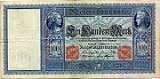
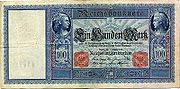
Reichsbank

Encyclopedia
Central bank
A central bank, reserve bank, or monetary authority is a public institution that usually issues the currency, regulates the money supply, and controls the interest rates in a country. Central banks often also oversee the commercial banking system of their respective countries...
of Germany
Germany
Germany , officially the Federal Republic of Germany , is a federal parliamentary republic in Europe. The country consists of 16 states while the capital and largest city is Berlin. Germany covers an area of 357,021 km2 and has a largely temperate seasonal climate...
from 1876 until 1945. It was founded on 1 January 1876 (shortly after the establishment of the German Empire
German Empire
The German Empire refers to Germany during the "Second Reich" period from the unification of Germany and proclamation of Wilhelm I as German Emperor on 18 January 1871, to 1918, when it became a federal republic after defeat in World War I and the abdication of the Emperor, Wilhelm II.The German...
in 1871). The Reichsbank was a privately owned central bank
Central bank
A central bank, reserve bank, or monetary authority is a public institution that usually issues the currency, regulates the money supply, and controls the interest rates in a country. Central banks often also oversee the commercial banking system of their respective countries...
of Prussia
Prussia
Prussia was a German kingdom and historic state originating out of the Duchy of Prussia and the Margraviate of Brandenburg. For centuries, the House of Hohenzollern ruled Prussia, successfully expanding its size by way of an unusually well-organized and effective army. Prussia shaped the history...
, under close control by the Reich government. Its first president was Hermann von Dechend
Hermann von Dechend
Hermann Dechend, since 1865 ennobled von Dechend, was a Prussian public official and first President of the Reichsbank.- Biography :...
. Before unification in 1871, Germany had 31 central banks – the Notenbanken (note banks). Each of the independent states issued their own money. In 1870, a law was passed that forbade the formation of further central banks. In 1874, a draft banking law was introduced in the Reichstag
Reichstag (German Empire)
The Reichstag was the parliament of the North German Confederation , and of the German Reich ....
(the German parliament
Parliament
A parliament is a legislature, especially in those countries whose system of government is based on the Westminster system modeled after that of the United Kingdom. The name is derived from the French , the action of parler : a parlement is a discussion. The term came to mean a meeting at which...
). After several changes and compromises, the law was passed in 1875. Despite the creation of the Reichsbank, however, four of the Notenbanken – Baden
Baden
Baden is a historical state on the east bank of the Rhine in the southwest of Germany, now the western part of the Baden-Württemberg of Germany....
, Bavaria
Bavaria
Bavaria, formally the Free State of Bavaria is a state of Germany, located in the southeast of Germany. With an area of , it is the largest state by area, forming almost 20% of the total land area of Germany...
, Saxony
Saxony
The Free State of Saxony is a landlocked state of Germany, contingent with Brandenburg, Saxony Anhalt, Thuringia, Bavaria, the Czech Republic and Poland. It is the tenth-largest German state in area, with of Germany's sixteen states....
and Württemberg
Württemberg
Württemberg , formerly known as Wirtemberg or Wurtemberg, is an area and a former state in southwestern Germany, including parts of the regions Swabia and Franconia....
– continued to exist until 1914.
The history of the Reichsbank was volatile. Until World War I
World War I
World War I , which was predominantly called the World War or the Great War from its occurrence until 1939, and the First World War or World War I thereafter, was a major war centred in Europe that began on 28 July 1914 and lasted until 11 November 1918...
it produced a very stable currency called the Goldmark
German gold mark
The Goldmark was the currency used in the German Empire from 1873 to 1914.-History:Before unification, the different German states issued a variety of different currencies, though most were linked to the Vereinsthaler, a silver coin containing 16⅔ grams of pure silver...
. The expenses of the war caused inflation
Inflation
In economics, inflation is a rise in the general level of prices of goods and services in an economy over a period of time.When the general price level rises, each unit of currency buys fewer goods and services. Consequently, inflation also reflects an erosion in the purchasing power of money – a...
ary pressure and the mark started to decrease in value. The defeat of imperial Germany in 1918, the economic burden caused by the payment of war reparations
War reparations
War reparations are payments intended to cover damage or injury during a war. Generally, the term war reparations refers to money or goods changing hands, rather than such property transfers as the annexation of land.- History :...
to the Allies
Allies
In everyday English usage, allies are people, groups, or nations that have joined together in an association for mutual benefit or to achieve some common purpose, whether or not explicit agreement has been worked out between them...
, and the social unrest in the early years culminated in the German hyperinflation of 1922–23. The mark, formerly backed by gold, evolved into the Papiermark
German papiermark
The name Papiermark is applied to the German currency from the 4th August 1914 when the link between the Mark and gold was abandoned, due to the outbreak of World War I...
(paper mark), backed by nothing.
Economic reforms, such as the issue of a new provisional currency – the Rentenmark
German rentenmark
The Rentenmark was a currency issued on 15 November 1923 to stop the hyperinflation of 1922 and 1923 in Germany. It was subdivided into 100 Rentenpfennig.-History:...
– and the 1924 Dawes Plan
Dawes Plan
The Dawes Plan was an attempt in 1924, following World War I for the Triple Entente to collect war reparations debt from Germany...
, stabilised German monetary development and thus the economic outlook of the Weimar Republic
Weimar Republic
The Weimar Republic is the name given by historians to the parliamentary republic established in 1919 in Germany to replace the imperial form of government...
. One of the key reforms caused by the Dawes Plan was the establishment of the Reichsbank as an institution independent of the Reich government. On 30 August 1924, the Reichsbank began issuing the Reichsmark
German reichsmark
The Reichsmark was the currency in Germany from 1924 until June 20, 1948. The Reichsmark was subdivided into 100 Reichspfennig.-History:...
, which served as the German currency until 1948.
The seizure and consolidation of power by the Nazis during the years of the Third Reich also greatly affected the Reichsbank. A 1937 law reestablished the Reich government's control of the Reichsbank, and in 1939, the Reichsbank was renamed as the Deutsche Reichsbank and placed under the direct control of Adolf Hitler
Adolf Hitler
Adolf Hitler was an Austrian-born German politician and the leader of the National Socialist German Workers Party , commonly referred to as the Nazi Party). He was Chancellor of Germany from 1933 to 1945, and head of state from 1934 to 1945...
, with Walther Funk
Walther Funk
Walther Funk was a prominent Nazi official. He served as Reich Minister for Economic Affairs in Nazi Germany from 1937 to 1945, tried as a major war criminal by the International Military Tribunal at Nuremberg.-Early life:...
as the last president of the Reichsbank, from 1939 to 1945. The defeat of Nazi Germany in May 1945 also resulted in the dissolution of the Reichsbank, along with other Reich ministries and institutions. The explanation of the disappearance of the Reichsbank reserves in 1945 was uncovered by Bill Stanley Moss
W. Stanley Moss
Ivan William "Billy" Stanley Moss MC , was a British army officer in World War II, and later a successful writer, broadcaster, journalist and traveller. He served with the Coldstream Guards and the Special Operations Executive . He was a best-selling author in the 1950s, based both on his novels...
and Andrew Kennedy
Andrzej Kowerski
Andrzej Kowerski was a Polish Army officer and SOE agent in World War II. From 1941 he used the nom de guerre "Andrew Kennedy."-Life:During the German invasion of Poland in September 1939, Lieutenant Kowerski fought gallantly as a member of Poland's 10th Motorized Cavalry Brigade, commanded by Col...
, in post War Germany.
The Allied occupation authorities (in the West – Great Britain
Great Britain
Great Britain or Britain is an island situated to the northwest of Continental Europe. It is the ninth largest island in the world, and the largest European island, as well as the largest of the British Isles...
, France
France
The French Republic , The French Republic , The French Republic , (commonly known as France , is a unitary semi-presidential republic in Western Europe with several overseas territories and islands located on other continents and in the Indian, Pacific, and Atlantic oceans. Metropolitan France...
and the United States
United States
The United States of America is a federal constitutional republic comprising fifty states and a federal district...
; in the East – the Soviet Union
Soviet Union
The Soviet Union , officially the Union of Soviet Socialist Republics , was a constitutionally socialist state that existed in Eurasia between 1922 and 1991....
) became responsible for German monetary policy in the immediate postwar years. In this role, the Allies continued to issue Reichsmarks (and Allied military marks) as the German banking system was gradually restored. In 1948, the Reichsmark ceased to exist owing to the introduction of the Deutsche Mark in the West and the East German mark
East German mark
The East German mark commonly called the eastern mark , in East Germany only Mark, was the currency of the German Democratic Republic . Its ISO 4217 currency code was DDM...
in the East. In West Germany
West Germany
West Germany is the common English, but not official, name for the Federal Republic of Germany or FRG in the period between its creation in May 1949 to German reunification on 3 October 1990....
, monetary policy
Monetary policy
Monetary policy is the process by which the monetary authority of a country controls the supply of money, often targeting a rate of interest for the purpose of promoting economic growth and stability. The official goals usually include relatively stable prices and low unemployment...
was taken over by the Bank deutscher Länder
Bank deutscher Länder
The Bank deutscher Länder , abbreviation BdL, was the forerunner of the Deutsche Bundesbank. It was founded on 1 March 1948....
(Bank of the German States) and later by the Deutsche Bundesbank
Deutsche Bundesbank
The Deutsche Bundesbank is the central bank of the Federal Republic of Germany and as such part of the European System of Central Banks . Due to its strength and former size, the Bundesbank is the most influential member of the ESCB. Both the Deutsche Bundesbank and the European Central Bank are...
. In East Germany, this role was assumed by the Deutsche Notenbank (later renamed as the Staatsbank der DDR
Staatsbank
right|thumb|250px|Headquarters of the East German Central BankThe State Bank of the GDR was the central bank of East Germany. It was established on 1 January 1968 from the Deutsche Notenbank and took over the majority of the same tasks.The State Bank of the G.D.R...
(State Bank of the German Democratic Republic
German Democratic Republic
The German Democratic Republic , informally called East Germany by West Germany and other countries, was a socialist state established in 1949 in the Soviet zone of occupied Germany, including East Berlin of the Allied-occupied capital city...
)).
Reichsbank presidents
- 1876–1890 Hermann von DechendHermann von DechendHermann Dechend, since 1865 ennobled von Dechend, was a Prussian public official and first President of the Reichsbank.- Biography :...
- 1890–1908 Richard KochRichard KochRichard Koch is a former management consultant, entrepreneur, and writer of several books on how to apply the Pareto principle in all walks of life. Koch has also used his concepts to make a fortune from several private equity investments made personally. Koch’s investments have included...
- 1908–1923 Rudolf E. A. HavensteinRudolf E. A. HavensteinRudolf E. A. Havenstein was a German lawyer and president of the Reichsbank during the hyperinflation of 1921-1923....
- 1923–1930 Hjalmar SchachtHjalmar SchachtDr. Hjalmar Horace Greeley Schacht was a German economist, banker, liberal politician, and co-founder of the German Democratic Party. He served as the Currency Commissioner and President of the Reichsbank under the Weimar Republic...
- 1930–1933 Hans LutherHans LutherHans Luther was a German politician and Chancellor of Germany.-Biography:Born in Berlin, Luther started in politics in 1907 by becoming the town councillor in Magdeburg. He continued on becoming secretary of the German Städtetag in 1913 and then mayor of Essen in 1918...
- 1933–1939 Hjalmar SchachtHjalmar SchachtDr. Hjalmar Horace Greeley Schacht was a German economist, banker, liberal politician, and co-founder of the German Democratic Party. He served as the Currency Commissioner and President of the Reichsbank under the Weimar Republic...
- 1939–1945 Walther FunkWalther FunkWalther Funk was a prominent Nazi official. He served as Reich Minister for Economic Affairs in Nazi Germany from 1937 to 1945, tried as a major war criminal by the International Military Tribunal at Nuremberg.-Early life:...
For history of German central banks after 1945 see: Deutsche Bundesbank
Deutsche Bundesbank
The Deutsche Bundesbank is the central bank of the Federal Republic of Germany and as such part of the European System of Central Banks . Due to its strength and former size, the Bundesbank is the most influential member of the ESCB. Both the Deutsche Bundesbank and the European Central Bank are...