
All Topics  
Scaffolding

 
Scaffolding

   Email Print
   Bookmark   Link


Scaffolding


Scaffolding is a temporary framework
Framework

A framework is a basic conceptual structure used to solve or address complex issues. This very broad definition has allowed the term to be used as a buzzword, especially in a software context....
 used to support people and material in the construction
Construction

In the fields of architecture and civil engineering, construction is a process that consists of the building or assembling of infrastructure. Far from being a single activity, large scale construction is a feat of multitasking....
 or repair of buildings and other large structures. It is usually a modular system of metal
Metal

In chemistry, a metal is a chemical element whose atoms readily lose electrons to form positive ions , and form metallic bonds between other metal atoms and ionic bonds between nonmetal atoms....
 pipes
Pipe (material)

A pipe is a tube or hollow Cylinder used to convey materials or as a structural component. The terms pipe and tubing are almost interchangeable....
 (termed tubes in Britain
United Kingdom

The United Kingdom of Great Britain and Northern Ireland, commonly known as the United Kingdom , the UK or Britain,is a sovereign state located off the northwestern coast of continental Europe....
), although it can be made out of other materials.


Discussion
Ask a question about 'Scaffolding'
Start a new discussion about 'Scaffolding'
Answer questions from other users
Full Discussion Forum


Recent Posts


Encyclopedia


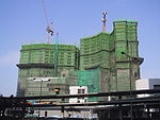
Bambooconstructionhongkong
Scaffolding is a temporary framework
Framework

A framework is a basic conceptual structure used to solve or address complex issues. This very broad definition has allowed the term to be used as a buzzword, especially in a software context....
 used to support people and material in the construction
Construction

In the fields of architecture and civil engineering, construction is a process that consists of the building or assembling of infrastructure. Far from being a single activity, large scale construction is a feat of multitasking....
 or repair of buildings and other large structures. It is usually a modular system of metal
Metal

In chemistry, a metal is a chemical element whose atoms readily lose electrons to form positive ions , and form metallic bonds between other metal atoms and ionic bonds between nonmetal atoms....
 pipes
Pipe (material)

A pipe is a tube or hollow Cylinder used to convey materials or as a structural component. The terms pipe and tubing are almost interchangeable....
 (termed tubes in Britain
United Kingdom

The United Kingdom of Great Britain and Northern Ireland, commonly known as the United Kingdom , the UK or Britain,is a sovereign state located off the northwestern coast of continental Europe....
), although it can be made out of other materials. Bamboo
Bamboo

The bamboos are a group of woody perennial plant evergreen plants in the true grass family Poaceae, subfamily Bambusoideae, tribe Bambuseae....
 is still used frequently in Asia
Asia

Asia is the world's largest and most populous continent. It covers 8.6% of the Earth's total surface area and, with over 4 billion people, it contains more than 60% of the world's current human population....
.

Scaffolding in the Ancient World

The Berlin Foundry Cup
Berlin Foundry Cup

The Berlin Foundry Cup is a Red-figure pottery kylix from the early 5th_century_BC. It is the name vase of the Attica vase painter known conventionally as the Foundry Painter....
 depicts scaffolding in ancient Greece
Ancient Greece

The term Ancient Greece refers to the period of History of Greece lasting from the Greek Dark Ages ca. 1100 BC and the Dorian invasion, to 146 BC and the Roman Republic conquest of Greece after the Battle of Corinth ....
 (early fifth century BC).

  • [All scaffolds are subject to certain minimum requirements set out in British Standard (BS) 5973 (Withdrawn by the BSI in 2004)- the Code of Practice for Access and Working Scaffolds and Special Scaffold Structures in Steel. The Provision and Use of Work Equipment Regulations (1993) also applies. BS 5973 was the recommended code of practice for around 25 years, however since its withdrawal, and the introduction of BS EN 12811-1:2003, the UK industry has been in limbo. The reason for this being that the new BS EN 12811-1 does not lend itself to the use of tube and fitting scaffolding (the majority of scaffolding in the UK is tube and fitting) and also uses the limit state design method (BS 5973 uses permissible stress design method). Therefore the NASC (National Access and Scaffolding Confederation) released a technical guidance called TG20 which aimed to provide a good practice guide for the use of tube and fitting scaffolding whilst conforming to the requirements of BS EN 12811-1. TG20 is largely based on BS 5973 with extracts taken directly from the old code, it also uses permissible stress design method. However, TG20 received a mixed response from the UK industry and as a result TG20 is being re-written and the new version is due for release sometime in 2008. This is the reason for the 'limbo' situation. Until the release of the revised TG20 the HSE continue to allow scaffold to be built in accordance with BS 5973. For more information on this you should contact your local HSE office or 2H Scaffold Designs Ltd.


This European Standard specifies performance requirements and methods of structural and general design for access and working scaffolds. Requirements given are for scaffold structures that rely on the adjacent structures for stability. In general these requirements also apply to other types of working scaffolds.

The purpose of a working scaffold is to provide a safe place of work with safe access suitable for the work being done. This document sets out performance requirements for working scaffolds. These are substantially independent of the materials of which the scaffold is made. The standard is intended to be used as the basis for enquiry and design.

This European Standard includes rules for structural design, which are of particular relevance to scaffolds made of certain materials. It is to be used in conjunction with the Eurocodes for structural design.

Materials

The basic materials are tubes, couplers and boards.

Tubes are either steel
Steel

Steel is an alloy consisting mostly of iron, with a carbon content between 0.2% and 2.14% by weight , depending on grade. Carbon is the most cost-effective alloying material for iron, but various other alloying elements are used such as manganese, chromium, vanadium, and tungsten....
 or aluminium
Aluminium

Aluminium or aluminum is a silvery white and ductile member of the boron group of chemical elements. It has the symbol Al; its atomic number is 13....
. If steel they are either 'black' or galvanised. The tubes come in a variety of lengths and a standard diameter
Diameter

In geometry, a diameter of a circle is any straight line segment that passes through the center of the circle and whose endpoints are on the circle....
 of 48.3 mm. (1.5 NPS
Nominal Pipe Size

Nominal Pipe Size is a North American set of standard sizes for pipes used for high or low pressures and temperatures. Pipe size is specified with two non-dimensional numbers: a nominal pipe size based on inches, and a schedule ....
 pipe
Pipe (material)

A pipe is a tube or hollow Cylinder used to convey materials or as a structural component. The terms pipe and tubing are almost interchangeable....
). The chief difference between the two types of tubes is the lower weight of aluminium tubes (1.7 kg/m as opposed to 4.4 kg/m) and also a greater flexibility and so less resistance to force. Tubes are generally bought in 6.3 m lengths and can then be cut down to certain typical sizes.

Cincinnati Scaffolding
Boards provide a working surface for users of the scaffold. They are seasoned wood
Wood

Wood is an organic material; in the strict sense wood is produced as secondary xylem in the stems of woody plants, notably trees but also shrubs, etc....
 and come in three thicknesses (38 mm (usual), 50 mm and 63 mm) are a standard width (225 mm) and are a maximum of 3.9 m long. The board ends are protected by metal plates called hoop irons or sometimes nail plates. Timber Scaffold boards in the UK should comply with the requirements of BS 2482. As well as timber, steel or aluminium decking is used or laminate
Laminate

A laminate is a material constructed by uniting two or more layers of material together. The process of creating a laminate is lamination, which in common parlance refers to the placing of something between layers of plastic and sealing them with heat and/or pressure, usually with an adhesive....
 boards. As well as boards for the working platform there are sole boards which are placed beneath the scaffolding if the surface is soft or otherwise suspect, although ordinary boards can be used, and meet the minimum requirements, they can be too long and tougher boards can be necessary.

Couplers are the fittings which hold the tubes together. The most common are called scaffold couplers, there are three basic types: right-angle couplers, putlog couplers and swivel couplers. To join tubes end-to-end joint pins (also called spigots) or sleeve couplers are used, or both together. Only right angle couplers and swivel couplers can be used to fix tube in a 'load bearing connection'. Single couplers are not load bearing couplers and have no design capacity.

Other common materials lnclude base plates, ladder
Ladder

A ladder is a vertical or inclined set of rungs or Step . There are two types: rigid ladders that can be leaned against a vertical surface such as a wall, and rope ladders that are hung from the top....
s, rope
Rope

A rope is a length of fibers, twisted or braided together to improve strength for pulling and connecting. It has tensile strength but is too flexible to provide compressive strength ....
s, anchor ties, reveal ties, gin wheels, sheeting, etc.

Despite the metric measurements given many scaffolders measure tubes and boards in imperial units. With tubes from 21 feet down and boards from 13 ft down.

Basic scaffolding


The key elements of a scaffold are standards, ledgers and transoms. The standards, also called uprights, are the vertical tubes that transfer the entire mass of the structure to the ground where they rest on a square base plate to spread the load. The base plate has a shank in its centre to hold the tube and is sometimes pinned to a sole board. Ledgers are horizontal tubes which connect between the standards. Transoms rest upon the ledgers at right angles. Main transoms are placed next to the standards, they hold the standards in place and provide support for boards; intermediate transoms are those placed between the main transoms to provide extra support for boards. In Canada this style is referred to as "English". "American" has the transoms attached to the standards and is used less but has certain advantages in some situations. Since scaffolding is a physical structure, it is possible to go in and come out of scaffolding.
Scaffolding
As well as the tubes at right angles there are cross braces to increase rigidity, these are placed diagonally from ledger to ledger, next to the standards to which they are fitted. If the braces are fitted to the ledgers they are called ledger braces. To limit sway a facade brace is fitted to the face of the scaffold every 30 metres or so at an angle of 35°-55° running right from the base to the top of the scaffold and fixed at every level.

Of the couplers previously mentioned, right-angle couplers join ledgers or transoms to standards, putlog or single couplers join board bearing transoms to ledgers - Non-board bearing transoms should be fixed using a right-angle coupler. Swivel couplers are to connect tubes at any other angle. The actual joints are staggered to avoid occurring at the same level in neighbouring standards.

Scaff T 02
The spacing of the basic elements in the scaffold are fairly standard. For a general purpose scaffold the maximum bay length is 2.1 m, for heavier work the bay size is reduced to 2 or even 1.8 m while for inspection a bay width of up to 2.7 m is allowed.

The scaffolding width is determined by the width of the boards, the minimum width allowed is 600 mm but a more typical four-board scaffold would be 870 mm wide from standard to standard. More heavy duty scaffolding can require 5, 6 or even up to 8 boards width. Often an inside board is added to reduce the gap between the inner standard and the structure.

The lift height, the spacing between ledgers, is 2 m, although the base lift can be up to 2.7 m. The diagram above also shows a kicker lift, which is just 150 mm or so above the ground.

Transom spacing is determined by the thickness of the boards supported, 38 mm boards require a transom spacing of no more than 1.2 m while a 50 mm board can stand a transom spacing of 2.6 m and 63 mm boards can have a maximum span of 3.25 m. The minimum overhang for all boards is 50 mm and the maximum overhang is no more than 4x the thickness of the board.

Foundations

Good foundations are essential. Often scaffold frameworks will require more than simple base plates to safely carry and spread the load. Scaffolding can be used without base plates on concrete or similar hard surfaces, although base plates are always recommended. For surfaces like pavements or tarmac base plates are necessary. For softer or more doubtful surfaces sole boards must be used, beneath a single standard a sole board should be at least 1,000 cm² with no dimension less than 220 mm, the thickness must be at least 35 mm. For heavier duty scaffold much more substantial baulks set in concrete can be required. On uneven ground steps must be cut for the base plates, a minimum step size of around 450 mm is recommended.

A working platform requires certain other elements to be safe. They must be close-boarded, have double guard rails and toe and stop boards. Safe and secure access must also be provided.

Scaff Wp 01

Ties


Scaffolds are only rarely independent structures. To provide stability for a scaffolding (at left) framework ties are generally fixed to the adjacent building / fabric / steelwork.

General practice is to attach a tie every 4m on alternate lifts (traditional scaffolding) prefabricated System scaffolds require structural connections at all frames - ie.2-3m centres (tie patterns must be provided by the System manufacturer / supplier). The ties are coupled to the scaffold as close to the junction of standard and ledger (node point) as possible. Due to recent regulation changes, scaffolding ties must support +/- loads (tie/butt loads) and lateral (shear) loads.

Due to the different nature of structures there are a variety of different ties to take advantage of the opportunities.

Through ties are put through structure openings such as windows. A vertical inside tube crossing the opening is attached to the scaffold by a transom and a crossing horizontal tube on the outside called a bridle tube. The gaps between the tubes and the structure surfaces are packed or wedged with timber sections to ensure a solid fit.

Box ties are used to attach the scaffold to suitable pillars or comparable features. Two additional transoms are put across from the lift on each side of the feature and are joined on both sides with shorter tubes called tie tubes. When a complete box tie is impossible a l-shaped lip tie can be used to hook the scaffold to the structure, to limit inward movement an additional transom, a butt transom, is place hard against the outside face of the structure.

Sometimes it is possible to use anchor ties (also called bolt ties), these are ties fitted into holes drilled in the structure. A common type is a ring bolt with an expanding wedge which is then tied to a node point.

The least 'invasive' tie is a reveal tie. These use an opening in the structure but use a tube wedged horizontally in the opening. The reveal tube is usually held in place by a reveal screw pin (an adjustable threaded bar) and protective packing at either end. A transom tie tube links the reveal tube to the scaffold. Reveal ties are not well regarded, they rely solely on friction and need regular checking so it is not recommended that more than half of all ties be reveal ties.

If it is not possible to use a safe number of ties rakers can be used. These are single tubes attached to a ledger extending out from the scaffold at an angle of less than 75° and securely founded. A transom at the base then completes a triangle back to the base of the main scaffold.

Putlog scaffold


As well as putlog couplers there are also putlog tubes, these have a flattened end or have been fitted with a blade. This feature allows the end of the tube to be within or rest upon the brickwork of the structure. They can be called a bricklayer's scaffold and as such consist only of a single row of standards with a single ledger, the putlogs are transoms - attached to the ledger at one end but integrated into the bricks at the other. Spacing is as general purpose scaffold and ties are still required.