


Ibn Saud of Saudi Arabia

Encyclopedia
King Abdul-Aziz of Saudi Arabia (1876 – 9 November 1953) was the first monarch of the Third Saudi State known as Saudi Arabia
. He was commonly referred to as Ibn Saud.
Beginning with the reconquest of his family's ancestral home city of Riyadh
in 1902, he consolidated his control over the Najd
in 1922, then conquered the Hijaz in 1925. The nation was founded and unified as Saudi Arabia
in 1932. As King, he presided over the discovery of petroleum in Saudi Arabia
in 1938 and the beginning of large-scale oil exploitation after World War II. He was the father of many children, including all of the subsequent kings of Saudi Arabia.
, in the region of Najd
in central Arabia.
In 1890, the Al Rashid conquered Riyadh. Abdul-Aziz was 14 at the time. He and his family initially took refuge with the Al-Murrah, a Bedouin tribe in the southern desert of Saudi Arabia. Later, the Al Sauds moved to Kuwait.
Abdul-Aziz lived with his family in a simple dwelling. His primary occupation, and the family's sole source of income, was undertaking raids in the Najd. He also attended the daily majlis
of the emir of Kuwait, Mubarak Al-Sabah
, from whom he learned the art of statecraft.
In the spring of 1901, he and some relatives – including a half-brother, Mohammed, and several cousins – set out on a raiding expedition into the Najd, targeting for the most part tribes associated with the Rashidis. As the raid proved profitable, it attracted more participants. The raiders' numbers peaked at over 200, though these numbers dwindled over the ensuing months.
In the fall, the group made camp in the Yabrin oasis. While observing Ramadan
, he decided to attack Riyadh
and retake it from the Al Rashidi. On the night of 15 January 1902, he set out with a raiding party of some twenty men (forty or more, mostly slaves, had remained at the oasis to guard the camels and baggage). Their raid was successful. The Rashidi
governor of the city, Ajlan, was killed in front of the gate to his own fortress.
rallied to Ibn Saud's call to arms. He was a charismatic leader and kept his men supplied with arms. Over the next two years, he and his forces recaptured almost half of the Najd from the Rashidis.
In 1904, Ibn Rashid appealed to the Ottoman Empire
for military protection and assistance. The Ottomans responded by sending troops into Arabia. On 15 June 1904, Ibn Saud's forces suffered a major defeat at the hands of the combined Ottoman and Rashidi forces. His forces regrouped and began to wage guerrilla warfare
against the Ottomans. Over the next two years he was able to disrupt their supply routes, forcing them to retreat.
He completed his conquest of the Najd and the eastern coast of Arabia in 1912. He then founded the Ikhwan
, a military-religious brotherhood which was to assist in his later conquests, with the approval of local Salafi
ulema
. In the same year, he instituted an agrarian policy to settle the nomadic pastoralist
bedouins into colonies, and to dismantle their tribal organizations in favor of allegiance to the Ikhwan.
During World War I the British government established diplomatic relations with Ibn Saud. The British agent, Captain William Shakespear, was well received by the Bedouin. Similar diplomatic missions were established with any Arabian power who might have been able to unify and stabilize the region. The British entered into a treaty in December 1915 (the "Treaty of Darin") which made the lands of the House of Saud a British protectorate and attempted to define the boundaries of the developing Saudi state. In exchange, Ibn Saud pledged to again make war against Ibn Rashid, who was an ally of the Ottomans.
Shakespear died at the Battle of Jarrab
. He was followed by St John Philby in 1917 seconded by the British India Office. The British Foreign Office had previously begun to support Sharif Hussein bin Ali
, Emir of the Hejaz
by seconding Lawrence of Arabia
in 1915. The Saudi Ikhwan began conflict with Emir Feisal also in 1917 just as his sons Abdullah and Feisal entered Damascus. The Treaty of Darin remained in effect until superseded by the Jeddah conference of 1927 and the Dammam conference of 1952 during both of which Abdul Aziz Ibn Saud extended his boundaries past the Anglo-Ottoman Blue Line. After Darin, he stockpiled the weapons and supplies with which the British provided him, including a 'tribute' of (£5,000 Sterling
per month). After World War One he received further support from the British, including a glut of surplus munitions. He launched his campaign against the Al Rashidi in 1920; by 1922 they had been all but destroyed.
The defeat of the Al Rashidi increased the size of Saudi territory twofold. This allowed Ibn Saud the leverage to negotiate a new and more favorable treaty with the British. Their treaty, signed at Uqair in 1922, saw Britain recognize many of his territorial gains. In exchange, Ibn Saud agreed to recognize British territories in the area, particularly along the Persian Gulf coast and in Iraq. The former of these were vital to the British, as merchant traffic between British India and England depended upon coaling stations on the approach to the Suez Canal
.
In 1925 the forces of Ibn Saud captured the holy city of Mecca
from Sharif Hussein bin Ali
, ending 700 years of Hashemite
rule. On 10 January 1926, Ibn Saud proclaimed himself King of the Hejaz
in the Great Mosque at Mecca
. On 20 May 1927, the British government signed the Treaty of Jeddah, which abolished the Darin protection agreement and recognized the independence of the Hejaz and Najd with Ibn Saud as its ruler.
With international recognition and support, Ibn Saud continued to consolidate power throughout the Arabian Peninsula
. After the alliance between the Ikhwan and the Al Saud collapsed, he suppressed the Ikhwan Revolt
in the Battle of Sabilla
in March 1929. In 1932, after conquering most of the Peninsula, he renamed his dominions "Saudi Arabia
" and proclaimed himself "King of Saudi Arabia".
was discovered in Saudi Arabia in 1938 by American geologists working for Standard Oil of California in partnership with Saudi officials. Through his advisers St. John Philby and Ameen Rihani, he granted substantial authority over Saudi oil fields to American oil companies in 1944, much to the dismay of the British who had invested heavily in the House of Saud's rise to power in hopes of open access to any oil reserves that were to be surveyed. Beginning in 1915, Ibn Saud signed the "friendship and cooperation" pact with Britain to keep his militia in line and cease any further attacks against their protectorates for whom they were responsible. Not only did the British pay a generous monthly allowance for his cooperation, in 1935 he was knighted into the Order of the Bath
.
His new found oil wealth brought with it a great deal of power and influence that, naturally, Ibn Saud would use to advantage in the Hijaz. He forced many nomadic tribes to settle down and abandon "petty wars" and vendettas. He also began widespread enforcement of new kingdom's ideology, based on the teachings of Muhammad Ibn Abd al-Wahhab. This included an end to traditionally sanctioned rites of pilgrimage, recognized by the orthodox schools of jurisprudence, but odds with those sanctioned by Abd al Wahhab. In 1926, after a caravan of Egyptians on the way to Mecca were beaten for playing bugles by his forces after which he was impelled to issue conciliatory statement to the Egyptian government. In fact, several such statements would have to be issued to Muslim government around the world as a result of beating suffered by the pilgrim
s visiting the holy cities of Mecca
and Medina
. With the uprising of and subsequent decimation thereafter of the Ikhwan
in 1929, via British air power, however, the 1930s onward marked a turning point. With his rivals eliminated, Ibn Saud's ideology was in full force, ending nearly 1400 years of accepted religious practices surrounding the Hajj
, the majority of which were sanctioned by a millennia of scholarship.
. Ibn Saud supported Prince Rashed Al-Khuzai and his followers in rebellion against the Hussein.
Prince Rashed supported Izz ad-Din al-Qassam
's Palestinian revolution in 1935 which led him and his followers in rebellion against King Abdullah
of Jordan
. And later at 1937, when they were forced to leave Jordan, Prince Rashed Al Khuzai, his family, and a group of his followers chose to move to Saudi Arabia, where Prince Al Khuzai was living for several years in the hospitality of King Abdul-Aziz Al Saud.
He positioned Saudi Arabia as neutral in World War II, but was generally considered to favor the Allies
. However, in 1938, when an attack on a main British pipeline in the Kingdom of Iraq
was found to be connected to the German
Ambassador, Dr. Fritz Grobba
, Ibn Saud provided Grobba with refuge. It was reported that he had been "on the outs" with the British since 1937.
In 1948, he participated in the Arab-Israeli War
. Saudi Arabia's contribution was generally considered token.
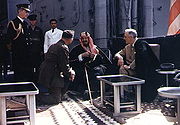 The number of children that Ibn Saud fathered is unknown. One source indicates that he had 37 sons. His number of wives is put at 22.
Saudi Arabia
The Kingdom of Saudi Arabia , commonly known in British English as Saudi Arabia and in Arabic as as-Sa‘ūdiyyah , is the largest state in Western Asia by land area, constituting the bulk of the Arabian Peninsula, and the second-largest in the Arab World...
. He was commonly referred to as Ibn Saud.
Beginning with the reconquest of his family's ancestral home city of Riyadh
Riyadh
Riyadh is the capital and largest city of Saudi Arabia. It is also the capital of Riyadh Province, and belongs to the historical regions of Najd and Al-Yamama. It is situated in the center of the Arabian Peninsula on a large plateau, and is home to 5,254,560 people, and the urban center of a...
in 1902, he consolidated his control over the Najd
Najd
Najd or Nejd , literally Highland, is the central region of the Arabian Peninsula.-Boundaries :The Arabic word nejd literally means "upland" and was once applied to a variety of regions within the Arabian Peninsula...
in 1922, then conquered the Hijaz in 1925. The nation was founded and unified as Saudi Arabia
Saudi Arabia
The Kingdom of Saudi Arabia , commonly known in British English as Saudi Arabia and in Arabic as as-Sa‘ūdiyyah , is the largest state in Western Asia by land area, constituting the bulk of the Arabian Peninsula, and the second-largest in the Arab World...
in 1932. As King, he presided over the discovery of petroleum in Saudi Arabia
Economy of Saudi Arabia
Saudi Arabia has an oil-based economy with strong government control over major economic activities. Saudi Arabia possesses 18% of the world's proven petroleum reserves, ranks as the largest exporter of petroleum, and plays a leading role in OPEC, although its influence has waned in recent...
in 1938 and the beginning of large-scale oil exploitation after World War II. He was the father of many children, including all of the subsequent kings of Saudi Arabia.
Early life
Abdul-Aziz was born in 1876 in RiyadhRiyadh
Riyadh is the capital and largest city of Saudi Arabia. It is also the capital of Riyadh Province, and belongs to the historical regions of Najd and Al-Yamama. It is situated in the center of the Arabian Peninsula on a large plateau, and is home to 5,254,560 people, and the urban center of a...
, in the region of Najd
Najd
Najd or Nejd , literally Highland, is the central region of the Arabian Peninsula.-Boundaries :The Arabic word nejd literally means "upland" and was once applied to a variety of regions within the Arabian Peninsula...
in central Arabia.
In 1890, the Al Rashid conquered Riyadh. Abdul-Aziz was 14 at the time. He and his family initially took refuge with the Al-Murrah, a Bedouin tribe in the southern desert of Saudi Arabia. Later, the Al Sauds moved to Kuwait.
Abdul-Aziz lived with his family in a simple dwelling. His primary occupation, and the family's sole source of income, was undertaking raids in the Najd. He also attended the daily majlis
Majlis
' , is an Arabic term meaning "a place of sitting", used in the context of "council", to describe various types of special gatherings among common interest groups be it administrative, social or religious in countries with linguistic or cultural connections to Islamic countries...
of the emir of Kuwait, Mubarak Al-Sabah
Mubarak Al-Sabah
Mubarak bin Sabah Al-Sabah, KCSI, KCIE "the Great" was the ruler of Kuwait from May 18, 1896 until his death on November 28, 1915. Mubarak ascended the throne upon the controversial death of his half-brother, Muhammad Al-Sabah. Mubarak was the seventh ruler of the Al-Sabah dynasty...
, from whom he learned the art of statecraft.
In the spring of 1901, he and some relatives – including a half-brother, Mohammed, and several cousins – set out on a raiding expedition into the Najd, targeting for the most part tribes associated with the Rashidis. As the raid proved profitable, it attracted more participants. The raiders' numbers peaked at over 200, though these numbers dwindled over the ensuing months.
In the fall, the group made camp in the Yabrin oasis. While observing Ramadan
Ramadan
Ramadan is the ninth month of the Islamic calendar, which lasts 29 or 30 days. It is the Islamic month of fasting, in which participating Muslims refrain from eating, drinking, smoking and sex during daylight hours and is intended to teach Muslims about patience, spirituality, humility and...
, he decided to attack Riyadh
Riyadh
Riyadh is the capital and largest city of Saudi Arabia. It is also the capital of Riyadh Province, and belongs to the historical regions of Najd and Al-Yamama. It is situated in the center of the Arabian Peninsula on a large plateau, and is home to 5,254,560 people, and the urban center of a...
and retake it from the Al Rashidi. On the night of 15 January 1902, he set out with a raiding party of some twenty men (forty or more, mostly slaves, had remained at the oasis to guard the camels and baggage). Their raid was successful. The Rashidi
Rashidi
Al Rasheed, the House of Rashid, or the House of Rasheed were a historic dynasty of the Arabian Peninsula, and the most formidable enemies of the House of Saud in Nejd...
governor of the city, Ajlan, was killed in front of the gate to his own fortress.
Rise to power
Following the capture of Riyadh, many former supporters of the House of SaudHouse of Saud
The House of Saud , also called the Al Saud, is the ruling royal family of Saudi Arabia and one of the wealthiest and most powerful dynasties in the world. The family holds thousands of members...
rallied to Ibn Saud's call to arms. He was a charismatic leader and kept his men supplied with arms. Over the next two years, he and his forces recaptured almost half of the Najd from the Rashidis.
In 1904, Ibn Rashid appealed to the Ottoman Empire
Ottoman Empire
The Ottoman EmpireIt was usually referred to as the "Ottoman Empire", the "Turkish Empire", the "Ottoman Caliphate" or more commonly "Turkey" by its contemporaries...
for military protection and assistance. The Ottomans responded by sending troops into Arabia. On 15 June 1904, Ibn Saud's forces suffered a major defeat at the hands of the combined Ottoman and Rashidi forces. His forces regrouped and began to wage guerrilla warfare
Guerrilla warfare
Guerrilla warfare is a form of irregular warfare and refers to conflicts in which a small group of combatants including, but not limited to, armed civilians use military tactics, such as ambushes, sabotage, raids, the element of surprise, and extraordinary mobility to harass a larger and...
against the Ottomans. Over the next two years he was able to disrupt their supply routes, forcing them to retreat.
He completed his conquest of the Najd and the eastern coast of Arabia in 1912. He then founded the Ikhwan
Ikhwan
The Ikhwan was the Islamic religious militia which formed the main military force of the Arabian ruler Ibn Saud and played a key role in establishing him as ruler of most of the Arabian Peninsula, in his new state of Saudi Arabia. The Ikhwan were made up of Bedouin tribes...
, a military-religious brotherhood which was to assist in his later conquests, with the approval of local Salafi
Salafi
A Salafi come from Sunni Islam is a follower of an Islamic movement, Salafiyyah, that is supposed to take the Salaf who lived during the patristic period of early Islam as model examples...
ulema
Ulema
Ulama , also spelt ulema, refers to the educated class of Muslim legal scholars engaged in the several fields of Islamic studies. They are best known as the arbiters of shari‘a law...
. In the same year, he instituted an agrarian policy to settle the nomadic pastoralist
Nomadic pastoralism
Nomadic pastoralism is a form of agriculture where livestock are herded in order to find fresh pastures on which to graze following an irregular pattern of movement - in contrast with transhumance where seasonal pastures are fix. The herded livestock may include cattle, yaks, sheep, goats,...
bedouins into colonies, and to dismantle their tribal organizations in favor of allegiance to the Ikhwan.
During World War I the British government established diplomatic relations with Ibn Saud. The British agent, Captain William Shakespear, was well received by the Bedouin. Similar diplomatic missions were established with any Arabian power who might have been able to unify and stabilize the region. The British entered into a treaty in December 1915 (the "Treaty of Darin") which made the lands of the House of Saud a British protectorate and attempted to define the boundaries of the developing Saudi state. In exchange, Ibn Saud pledged to again make war against Ibn Rashid, who was an ally of the Ottomans.
Shakespear died at the Battle of Jarrab
Battle of Jarrab
The Battle of Jarrab was a territorial battle between the Al Sa'ud and their traditional enemies the Al Rashid in January 1915. It was a proxy battle of World War I between the British-supportedSa'udis and the Ottoman-supported Rashidis....
. He was followed by St John Philby in 1917 seconded by the British India Office. The British Foreign Office had previously begun to support Sharif Hussein bin Ali
Hussein bin Ali, Sharif of Mecca
Sayyid Hussein bin Ali, GCB was the Sharif of Mecca, and Emir of Mecca from 1908 until 1917, when he proclaimed himself King of Hejaz, which received international recognition. He initiated the Arab Revolt in 1916 against the increasingly nationalistic Ottoman Empire during the course of the...
, Emir of the Hejaz
Hejaz
al-Hejaz, also Hijaz is a region in the west of present-day Saudi Arabia. Defined primarily by its western border on the Red Sea, it extends from Haql on the Gulf of Aqaba to Jizan. Its main city is Jeddah, but it is probably better known for the Islamic holy cities of Mecca and Medina...
by seconding Lawrence of Arabia
T. E. Lawrence
Lieutenant Colonel Thomas Edward Lawrence, CB, DSO , known professionally as T. E. Lawrence, was a British Army officer renowned especially for his liaison role during the Arab Revolt against Ottoman Turkish rule of 1916–18...
in 1915. The Saudi Ikhwan began conflict with Emir Feisal also in 1917 just as his sons Abdullah and Feisal entered Damascus. The Treaty of Darin remained in effect until superseded by the Jeddah conference of 1927 and the Dammam conference of 1952 during both of which Abdul Aziz Ibn Saud extended his boundaries past the Anglo-Ottoman Blue Line. After Darin, he stockpiled the weapons and supplies with which the British provided him, including a 'tribute' of (£5,000 Sterling
Pound sterling
The pound sterling , commonly called the pound, is the official currency of the United Kingdom, its Crown Dependencies and the British Overseas Territories of South Georgia and the South Sandwich Islands, British Antarctic Territory and Tristan da Cunha. It is subdivided into 100 pence...
per month). After World War One he received further support from the British, including a glut of surplus munitions. He launched his campaign against the Al Rashidi in 1920; by 1922 they had been all but destroyed.
The defeat of the Al Rashidi increased the size of Saudi territory twofold. This allowed Ibn Saud the leverage to negotiate a new and more favorable treaty with the British. Their treaty, signed at Uqair in 1922, saw Britain recognize many of his territorial gains. In exchange, Ibn Saud agreed to recognize British territories in the area, particularly along the Persian Gulf coast and in Iraq. The former of these were vital to the British, as merchant traffic between British India and England depended upon coaling stations on the approach to the Suez Canal
Suez Canal
The Suez Canal , also known by the nickname "The Highway to India", is an artificial sea-level waterway in Egypt, connecting the Mediterranean Sea and the Red Sea. Opened in November 1869 after 10 years of construction work, it allows water transportation between Europe and Asia without navigation...
.
In 1925 the forces of Ibn Saud captured the holy city of Mecca
Mecca
Mecca is a city in the Hijaz and the capital of Makkah province in Saudi Arabia. The city is located inland from Jeddah in a narrow valley at a height of above sea level...
from Sharif Hussein bin Ali
Hussein bin Ali, Sharif of Mecca
Sayyid Hussein bin Ali, GCB was the Sharif of Mecca, and Emir of Mecca from 1908 until 1917, when he proclaimed himself King of Hejaz, which received international recognition. He initiated the Arab Revolt in 1916 against the increasingly nationalistic Ottoman Empire during the course of the...
, ending 700 years of Hashemite
Hashemite
Hashemite is the Latinate version of the , transliteration: Hāšimī, and traditionally refers to those belonging to the Banu Hashim, or "clan of Hashim", a clan within the larger Quraish tribe...
rule. On 10 January 1926, Ibn Saud proclaimed himself King of the Hejaz
Hejaz
al-Hejaz, also Hijaz is a region in the west of present-day Saudi Arabia. Defined primarily by its western border on the Red Sea, it extends from Haql on the Gulf of Aqaba to Jizan. Its main city is Jeddah, but it is probably better known for the Islamic holy cities of Mecca and Medina...
in the Great Mosque at Mecca
Mecca
Mecca is a city in the Hijaz and the capital of Makkah province in Saudi Arabia. The city is located inland from Jeddah in a narrow valley at a height of above sea level...
. On 20 May 1927, the British government signed the Treaty of Jeddah, which abolished the Darin protection agreement and recognized the independence of the Hejaz and Najd with Ibn Saud as its ruler.
With international recognition and support, Ibn Saud continued to consolidate power throughout the Arabian Peninsula
Arabian Peninsula
The Arabian Peninsula is a land mass situated north-east of Africa. Also known as Arabia or the Arabian subcontinent, it is the world's largest peninsula and covers 3,237,500 km2...
. After the alliance between the Ikhwan and the Al Saud collapsed, he suppressed the Ikhwan Revolt
Ikhwan Revolt
The Ikhwan Revolt had begun in 1927, when elements of the Ikhwan, the radical irregular tribesmen of Arabia, undermined the authority of Ibn Saud and begun raiding neighbouring Iraq and Kuwait. The relations between the House of Saud and the Ikhwans deteriorated into an open bloody feud in December...
in the Battle of Sabilla
Battle of Sabilla
The Battle of Sabilla was the main battle of the Ikhwan Revolt in northern Arabia between the rebellious Ikhwan forces and the army of Ibn Saud. It was the last major battle, where one side rode camels, as the Ikhwan emphasized radical conservatism, shunned technological modernization...
in March 1929. In 1932, after conquering most of the Peninsula, he renamed his dominions "Saudi Arabia
Saudi Arabia
The Kingdom of Saudi Arabia , commonly known in British English as Saudi Arabia and in Arabic as as-Sa‘ūdiyyah , is the largest state in Western Asia by land area, constituting the bulk of the Arabian Peninsula, and the second-largest in the Arab World...
" and proclaimed himself "King of Saudi Arabia".
Oil and the rule of Ibn Saud
OilPetroleum
Petroleum or crude oil is a naturally occurring, flammable liquid consisting of a complex mixture of hydrocarbons of various molecular weights and other liquid organic compounds, that are found in geologic formations beneath the Earth's surface. Petroleum is recovered mostly through oil drilling...
was discovered in Saudi Arabia in 1938 by American geologists working for Standard Oil of California in partnership with Saudi officials. Through his advisers St. John Philby and Ameen Rihani, he granted substantial authority over Saudi oil fields to American oil companies in 1944, much to the dismay of the British who had invested heavily in the House of Saud's rise to power in hopes of open access to any oil reserves that were to be surveyed. Beginning in 1915, Ibn Saud signed the "friendship and cooperation" pact with Britain to keep his militia in line and cease any further attacks against their protectorates for whom they were responsible. Not only did the British pay a generous monthly allowance for his cooperation, in 1935 he was knighted into the Order of the Bath
Order of the Bath
The Most Honourable Order of the Bath is a British order of chivalry founded by George I on 18 May 1725. The name derives from the elaborate mediæval ceremony for creating a knight, which involved bathing as one of its elements. The knights so created were known as Knights of the Bath...
.
His new found oil wealth brought with it a great deal of power and influence that, naturally, Ibn Saud would use to advantage in the Hijaz. He forced many nomadic tribes to settle down and abandon "petty wars" and vendettas. He also began widespread enforcement of new kingdom's ideology, based on the teachings of Muhammad Ibn Abd al-Wahhab. This included an end to traditionally sanctioned rites of pilgrimage, recognized by the orthodox schools of jurisprudence, but odds with those sanctioned by Abd al Wahhab. In 1926, after a caravan of Egyptians on the way to Mecca were beaten for playing bugles by his forces after which he was impelled to issue conciliatory statement to the Egyptian government. In fact, several such statements would have to be issued to Muslim government around the world as a result of beating suffered by the pilgrim
Pilgrim
A pilgrim is a traveler who is on a journey to a holy place. Typically, this is a physical journeying to some place of special significance to the adherent of a particular religious belief system...
s visiting the holy cities of Mecca
Mecca
Mecca is a city in the Hijaz and the capital of Makkah province in Saudi Arabia. The city is located inland from Jeddah in a narrow valley at a height of above sea level...
and Medina
Medina
Medina , or ; also transliterated as Madinah, or madinat al-nabi "the city of the prophet") is a city in the Hejaz region of western Saudi Arabia, and serves as the capital of the Al Madinah Province. It is the second holiest city in Islam, and the burial place of the Islamic Prophet Muhammad, and...
. With the uprising of and subsequent decimation thereafter of the Ikhwan
Ikhwan
The Ikhwan was the Islamic religious militia which formed the main military force of the Arabian ruler Ibn Saud and played a key role in establishing him as ruler of most of the Arabian Peninsula, in his new state of Saudi Arabia. The Ikhwan were made up of Bedouin tribes...
in 1929, via British air power, however, the 1930s onward marked a turning point. With his rivals eliminated, Ibn Saud's ideology was in full force, ending nearly 1400 years of accepted religious practices surrounding the Hajj
Hajj
The Hajj is the pilgrimage to Mecca, Saudi Arabia. It is one of the largest pilgrimages in the world, and is the fifth pillar of Islam, a religious duty that must be carried out at least once in their lifetime by every able-bodied Muslim who can afford to do so...
, the majority of which were sanctioned by a millennia of scholarship.
Foreign wars
He was able to gain loyalty from tribes even nearby Saudi Arabia, tribes such as those in Jordan. For example, he built very strong ties with Prince Sheikh Rashed Al- Khuzai from Al Fraihat tribe, one of the most influential and royal roots family during the Ottomans Empire. Prince Rashed Al-Khuzai and his tribe had dominated eastern Jordan before the arrival of Sharif HusseinHussein of Jordan
Hussein bin Talal was the third King of Jordan from the abdication of his father, King Talal, in 1952, until his death. Hussein's rule extended through the Cold War and four decades of Arab-Israeli conflict...
. Ibn Saud supported Prince Rashed Al-Khuzai and his followers in rebellion against the Hussein.
Prince Rashed supported Izz ad-Din al-Qassam
Izz ad-Din al-Qassam
Sheikh Muhammad Izz ad-Din al-Qassam was a Tijani Sufi who led militant activities against British, French, and Zionist organizations in the Levant in the 1920's and 1930's.-Early life:...
's Palestinian revolution in 1935 which led him and his followers in rebellion against King Abdullah
Abdullah I of Jordan
Abdullah I bin al-Hussein, King of Jordan [‘Abd Allāh ibn al-Husayn] عبد الله الأول بن الحسين born in Mecca, Second Saudi State, was the second of three sons of Sherif Hussein bin Ali, Sharif and Emir of Mecca and his first wife Abdiyya bint Abdullah...
of Jordan
Jordan
Jordan , officially the Hashemite Kingdom of Jordan , Al-Mamlaka al-Urduniyya al-Hashemiyya) is a kingdom on the East Bank of the River Jordan. The country borders Saudi Arabia to the east and south-east, Iraq to the north-east, Syria to the north and the West Bank and Israel to the west, sharing...
. And later at 1937, when they were forced to leave Jordan, Prince Rashed Al Khuzai, his family, and a group of his followers chose to move to Saudi Arabia, where Prince Al Khuzai was living for several years in the hospitality of King Abdul-Aziz Al Saud.
He positioned Saudi Arabia as neutral in World War II, but was generally considered to favor the Allies
Allies
In everyday English usage, allies are people, groups, or nations that have joined together in an association for mutual benefit or to achieve some common purpose, whether or not explicit agreement has been worked out between them...
. However, in 1938, when an attack on a main British pipeline in the Kingdom of Iraq
Kingdom of Iraq
The Kingdom of Iraq was the sovereign state of Iraq during and after the British Mandate of Mesopotamia. The League of Nations mandate started in 1920. The kingdom began in August 1921 with the coronation of Faisal bin al-Hussein bin Ali al-Hashemi as King Faisal I...
was found to be connected to the German
Nazi Germany
Nazi Germany , also known as the Third Reich , but officially called German Reich from 1933 to 1943 and Greater German Reich from 26 June 1943 onward, is the name commonly used to refer to the state of Germany from 1933 to 1945, when it was a totalitarian dictatorship ruled by...
Ambassador, Dr. Fritz Grobba
Fritz Grobba
Fritz Konrad Ferdinand Grobba is best remembered for being a German diplomat during the interwar period and World War II.-Biography:...
, Ibn Saud provided Grobba with refuge. It was reported that he had been "on the outs" with the British since 1937.
In 1948, he participated in the Arab-Israeli War
1948 Arab-Israeli War
The 1948 Arab–Israeli War, known to Israelis as the War of Independence or War of Liberation The war commenced after the termination of the British Mandate for Palestine and the creation of an independent Israel at midnight on 14 May 1948 when, following a period of civil war, Arab armies invaded...
. Saudi Arabia's contribution was generally considered token.
Family
- Princess Wadha bint Muhammad Al-Hazzam
- Turki (I) (1900–1919)
- SaudSaud of Saudi ArabiaSaud bin Abdul-Aziz Al Saud was King of Saudi Arabia from 1953 to 1964. He was removed from power by Faisal because of Saud's mismanagement and waste. He was the eldest surviving son of Ibn Saud and became Crown Prince in 1933. He died in exile in Greece.-Early life:Saud was born in 1902 in Kuwait...
(12 January 1902 – 23 February 1969); reigned 1953–1964 - Nura
- Munira
- Princess Tarfah bint Abdullah Al-AlSheikh
- Khaled (I) (born 1903, died in infancy)
- FaisalFaisal of Saudi ArabiaFaisal bin Abdul-Aziz Al Saud was King of Saudi Arabia from 1964 to 1975. As king, he is credited with rescuing the country's finances and implementing a policy of modernization and reform, while his main foreign policy themes were pan-Islamic Nationalism, anti-Communism, and pro-Palestinian...
(April 1906 – 25 March 1975); reigned 1964–1975 - Saad (I) (1914–1919)
- Anud (born 1917)
- Princess Lulua bint Salih Al-Dakhil
- Fahd (I) (1905–1919)
- Princess Jauhara bint Musaid Al Saud
- Muhammad (1910–1988)
- KhalidKhalid of Saudi ArabiaKhalid bin Abdul-Aziz Al Saud was King of Saudi Arabia from 1975 to 1982. He ruled during Saudi Arabia's oil boom years. In 1979, he had to deal with the Grand Mosque Seizure...
(II) (1913 – 13 June 1982); reigned 1975–1982
- Princess Lajah bint Khalid bin Hithlayn
- Sara (1916 – June 2000)
- Princess Bazza I
- Nasser (1919–1984)
- Princess Jawhara bint Saad bin Abdul-Muhsin al-Sudairi
- Saad (II) (1920–1993)
- Musa'id (born 1923)
- Abdul-Mohsin (1925–1985)
- Al-BandariAl-Bandari bint AbdulazizAl-Bandari bint Abdul-Aziz was a royal princess Saudi royal family and the sister of King Abdullah. Princess Al-Bandari was the daughter of the late King Abdul-Aziz and his wife, Jawhara bint Sa'ad bin Abdul-Muhsin al-Sudairi...
(1928–2008)
- Princess Hassa bint Ahmad al-Sudairi
(The sons are known as the "Sudairi SevenSudairi SevenThe Sudairi Seven, also spelled Sudairy or Sudayri, is the commonly used name for a powerful alliance of seven full brothers and their descendants within the royal family of Saudi Arabia. They are also known as the Al Fahd . They are sometimes referred to as the Sudairi Clan or the Sudairi faction...
")- FahdFahd of Saudi ArabiaFahd bin Abdul Aziz Al Saud, Custodian of the Two Holy Mosques, was King of Saudi Arabia from 1982 to 2005...
(II) (1920 – 1 August 2005); reigned 1982–2005 - Sultan (1928–2011)
- Luluwah (ca 1928–2008)
- Abdul-RahmanAbd al-Rahman bin Abdul AzizAbdul-Rahman bin Abdul-Aziz is a senior member of the Saudi royal family and , was Saudi Arabia's Deputy Minister of Defense & Aviation 1978 - 2011. He is a part of the Sudairi Seven....
(born 1931) - NaifNayef bin Abdul AzizBorn = Ta'if, Saudi ArabiaNayef bin Abdul Aziz Al Saud, also spelled Naif, is the Crown Prince , First Deputy Prime Minister and long time Minister of Interior of Saudi Arabia. He is a half-brother of King Abdullah. He is one of the five surviving members of the Sudairi Seven.-Early life and...
(born 1933); current crown prince - Turki (II) (born 1934)
- SalmanSalman bin Abdul AzizSalman bin Abdul-Aziz Al Saud is the Minister of Defense of Saudi Arabia since November 5th, 2011. He was the Governor of the Riyadh Province from 1962 - 2011, and is a prince of House of Saud. He is the fifth of the Sudairi Seven. He has a reputation for arbitrating disputes within the royal...
(born 1936) - AhmedAhmed bin Abdul AzizAhmed bin Abdul-Aziz Al Saud is the youngest of the Sudairi Seven of Saudi Arabia's royal family. He has been the Deputy Minister of Interior of Saudi Arabia since 1975...
(born 1942) - Jawaher
- Lateefa
- Al-Jawhara
- Moudhi (died young)
- Felwa (died young)
- Fahd
- Princess Shahida
- Mansur (1922 – 2 May 1951)
- Mishaal (born 1926)
- Qumasha (born 1927)
- MutaibMutaib bin Abdul AzizMutaib bin Abdul-Aziz is a senior member of the Saudi royal family. He served as Deputy Minister of Defense from 1951-56. He was Minister of Public Works and Housing from 1975-2003. He served as Minister of Municipal and Rural Affairs from 2003-09...
(born 1931)
- Princess Fahda
- AbdullahAbdullah of Saudi ArabiaAbdullah bin Abdul-Aziz Al Saud, Custodian of the Two Holy Mosques, is the King of Saudi Arabia. He succeeded to the throne on 1 August 2005 upon the death of his half-brother, King Fahd. When Crown Prince, he governed Saudi Arabia as regent from 1998 to 2005...
(born August 1922); current king, since 2005 - Nuf
- Seeta (c. 1930 – 13 April 2011)
- Abdullah
- Princess Bazza (the second wife named Bazza)
- Bandar (born 1923)
- FawwazFawwaz bin Abdul AzizPrince Fawwaz bin Abdul-Aziz was a senior member of the Saudi royal family. He was Governor of Riyadh from 1960-1961 and was part of the Free Princes Movement from 1962-1964. He served as Governor of Makkah from 1971-80 for which he was removed from office after the 1979 Grand Mosque Seizure...
(1934–2008) - Mishari (1932 – 23 May 2000)
- Princess Haya bint Sa'ad al-Sudairy (1913 – 18 April 2003)
- Badr (I) (1931–1932)
- BadrBadr bin Abdul AzizPrince Badr bin Abdul-Aziz is a senior member of the Saudi royal family. He is a former Deputy Commander of the Saudi Arabian National Guard . He participated in the Free Princes movement in 1962-1964 during which time he lived in exile, mostly in Beirut and Cairo...
(II) (born 1933) - Huzza (1951 – July 2000)
- Abdul-IlahAbdul-Ilah bin Abdul-Aziz Al SaudAbdul-Ilah bin Abdul-Aziz Al Saud , also spelled Abdulillah, is a prince of the Saudi royal family. He is an adviser to King Abdullah. He is a member of the Allegiance Council which helps determine the Saudi line of succession.-Biography:...
(born 1935) - Abdul-MajeedAbdul Majeed bin Abdul AzizPrince Abdul-Majeed bin Abdul-Aziz was a prominent Saudi prince. He was seen as a close ally of his half-brother, King Abdullah. . He served as Governor of Tabuk Province from 1980-1986. He served as Governor of Madinah Province from 1986-2000...
(1943–2007) - Nura (born 1930)
- Mishail
- Princess Munaiyir (died December 1991, funeral prayer led by King Fahd)
- Talal (I) (1930–1931)
- Talal (II) (born 1932)
- NawwafNawwaf bin Abdul AzizNawwaf bin Abdul-Aziz is a senior member of the Saudi royal family and a close ally of King Abdullah. He is a former Minister of Finance. He also served as King Faisal's Special Adviser for Gulf Affairs from 1968-1975. He is a former Director General of Saudi Arabia's intelligence agency Al...
(born 1933) - Madawi
- Princess Mudhi
- SultanaSultana bint Abdulaziz Al-SaudPrincess Sultana bint Abdul-Aziz Al-Saud was a member of the House of Saud royal family and the sister of the current King of Saudi Arabia, Abdullah. She was the daughter of the first monarch of Saudi Arabia, Ibn Saud, and his twelfth wife, Mudhi.Sultana bint Abdulaziz died on July 7, 2008, aged...
(ca. 1928 – 7 July 2008) - Haya (ca. 1929 – 2 November 2009)
- Majid (II) (9 October 1938 – 12 April 2003)
- SattamSattam bin Abdul AzizSattam bin Abdul-Aziz Al Saud , former Deputy Governor of Riyadh 1968 - 2011. On November 5, 2011, he was appointed Governor of Riyadh Region. He is a senior member of the Saudi royal family.-Lineage:...
(born 21 January 1941)
- Sultana
- Princess Nouf bint al-Shalan
- Thamir (1937 – 27 June 1959)
- Mamduh (born 1941)
- Mashhur (born 1942)
- Princess Saida al-Yamaniyah
- Hidhlul (born 1941)
- Princess Khadra
- Princess Baraka al-Yamaniyah
- Muqrin (born 15 September 1945)
- Princess Futayma
- Hamoud (1947–1994)
- By Unknown
- Shaikha (born 1922)
- Majed (I) (1934–1940)
- Abdul-Saleem (1941–1942)
- Jiluwi (I) (1942–1944)
- Jiluwi (II) (1952–1952) Was the youngest son of Ibn Saud but died as an infant.