
Encyclopedia
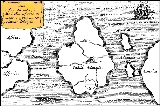
Atlantis is the name of an island first mentioned and described by the
classical Greek philosopher Plato. According to him this island, lying "beyond the
pillars of Hercules", was a naval power, having conquered many parts of
western Europe and
Africa. Soon after a failed invasion of
Athens, Atlantis sank in the waves "in a single day and night of misfortune" due to a natural catastrophe which happened 9,000 years before Plato's time.
As a story embedded in Plato's dialogues, Atlantis is mostly seen as a myth created by Plato to back up a previously invented theory with real facts. Some scholars express the opinion that Plato intended to tell real history. Although the function of the story of Atlantis seems to be clear to most scholars, they dispute whether and how much Plato's account was inspired by older traditions. Some scholars argue Plato drew upon memories of past events such as the
Thera eruption or the
Trojan War, while others insist that he took inspiration of contemporary events like the destruction of Helike in 373 BC or the failed
Athenian invasion of Sicily in 415–413 BC.
The possible existence of Atlantis was actively discussed throughout the
classical antiquity, but it was usually rejected and occasionally parodied. While basically unknown during the
Middle Ages, the story of Atlantis was rediscovered by
Humanists at the very beginning of modern times. Plato's description inspired the utopian works of several Renaissance writers, like
Francis Bacon's "
New Atlantis". More than ever, Atlantis inspires today's literature, from
science fiction to
comic books and movies.
Plato's account
Plato's account of Atlantis is written in the dialogues
Timaeus and
Critias, dated circa 360 BC. These works contain the earliest known references to Atlantis. The dialogue
Critias was never completed by Plato for an unknown reason, however scholar
B. Jowett among others, argues that Plato originally planned a third dialogue titled
Hermocrates. John V. Luce assumes that Plato — after describing the origin of the world and mankind in
Timaeus as well as the allegorical perfect society of ancient
Athens and its successful defense against an antagonistic Atlantis in
Critias — would have made the strategy of the
Hellenic civilisation during their conflict with the barbarians a subject of discussion in the phantom dialog.
The four persons appearing in those two dialogues are the politicians Critias and Hermocrates as well as the philosophers
Socrates and Timaeus, although only Critias speaks of Atlantis. While most likely all of these people actually lived, these dialogues as recorded may have been the invention of Plato. In his written works, Plato makes extensive use of the Socratic dialogues in order to discuss contrary positions within the context of a supposition.
The
Timaeus begins with an introduction, followed by an account of the creations and structure of the universe and ancient civilizations. In the introduction,
Socrates muses about the perfect society, described in Plato's
Republic, and wonders if he and his guests might recollect a story which exemplifies such a society. Critias mentions an allegedly historical tale that would make the perfect example, and follows by describing Atlantis as is recorded in the
Critias. In his account, ancient Athens seems to represent the "perfect society" and Atlantis its opponent, representing the very antithesis of the "perfect" traits described in the
Republic. Critias claims that his accounts of ancient Athens and Atlantis stem from a visit to
Egypt by the Athenian lawgiver
Solon in the 6th century BC. In
Egypt, Solon met a priest of Sais, who translated the history of ancient Athens and Atlantis, recorded on papyri in Egyptian hieroglyphs, into Greek. According to
Plutarch the priest was named Sonchis, but because of the temporal distance between Plutarch and the alleged event, this identification is unverified.
According to Critias, the
Hellenic gods of old divided the land so that each god might own a lot;
Poseidon was appropriately, and to his liking, bequeathed the island of Atlantis. The island was larger than
Libya and
Asia Minor combined, but has since been sunk by an earthquake and became an impassable mud shoal, inhibiting travel between the
Atlantic Ocean and the
Mediterranean Sea. The Egyptians described Atlantis as an island approximately 700 kilometres across, comprising mostly mountains in the northern portions and along the shore, and encompassing a great plain of an oblong shape in the south "extending in one direction three thousand
stadia [about 600 km; 375 mi], but across the center inland it was two thousand stadia [about 400 km; 250 mi]."
Fifty stadia inland from the middle of the southern coast was a "mountain not very high on any side." Here lived a native woman with whom Poseidon fell in love and who bore him five pairs of male
twins. The eldest of these,
Atlas, was made rightful king of the entire island and the ocean , and was given the mountain of his birth and the surrounding area as his fiefdom. Atlas's twin Gadeirus or Eumelus in Greek, was given the easternmost portion of the island. The other four pairs of twins — Ampheres and Evaemon, Mneseus and Autochthon, Elasippus and Mestor, and Azaes and Diaprepes — "were the inhabitants and rulers of divers islands in the open sea."
Poseidon carved the inland mountain where his love dwelt into a palace and enclosed it with three circular
moats of increasing width, varying from one to three stadia and separated by rings of land proportional in size. The Atlanteans then built bridges northward from the mountain, making a route to the rest of the island. They dug a great canal to the sea, and alongside the bridges carved tunnels into the rings of rock so that ships could pass into the city around the mountain; they carved docks from the rock walls of the moats. Every passage to the city was guarded by gates and towers, and a wall surrounded each of the city's rings. The walls were constructed of red, white and black rock quarried from the moats, and were covered with
brass,
tin and orichalcum, respectively.
According to Critias, 9,000 years before his lifetime a war took place between those outside the
Pillars of Hercules- commonly considered to be the
Strait of Gibraltar- and those who dwelt within them. The Atlanteans had conquered the Mediterranean as far east as Egypt and the continent into
Tyrrhenia, and subjected its people to slavery. The Athenians led an alliance of resistors against the Atlantean empire and as the alliance disintegrated, prevailed alone against the empire, liberating the occupied lands. "But afterwards there occurred violent earthquakes and floods; and in a single day and night of misfortune all your warlike men in a body sank into the earth, and the island of Atlantis in like manner disappeared in the depths of the sea."
Receptions
Ancient
Other than Plato's
Timaeus and
Critias there is no primary ancient account on Atlantis, which means every other account on Atlantis relies on Plato in one way or another. There has not been found any proof for a non-Platonic tradition of Atlantis to this day. However, there is a lost work of the Greek logographer Hellanicus of Lesbos named
Atlantis , which is about the daughters of the titan
Atlas . Anyway, it is unlikely that this work was an inspiration to Plato, since he named Atlantis after the
Atlantic Ocean , which is verified to be named such since Herodotus.
Many ancient philosophers viewed Atlantis as fiction. The most popular might be
Aristotle, who is allegedly quoted by
Strabo with the above mentioned commentary on Atlantis.
However, in antiquity, there were also philosophers, geographers, and historians who believed that Atlantis was real. For instance, the philosopher Crantor, a student of Plato's student Xenocrates, tried to find proof of Atlantis' existence. His work, a comment on Plato's
Timaeus, is lost, but another ancient historian, Proclus, reports that Crantor traveled to Egypt and actually found columns with the history of Atlantis written in
hieroglyphic characters. However, Plato did not write that Solon saw the Atlantis story on a column but on a source that can be "taken to hand". Proclus' proof appears implausible.
Another passage from Proclus' 5th century AD commentary on the
Timaeus gives a description of the geography of Atlantis: "That an island of such nature and size once existed is evident from what is said by certain authors who investigated the things around the outer sea. For according to them, there were seven islands in that sea in their time, sacred to Persephone, and also three others of enormous size, one of which was sacred to Pluto, another to Ammon, and another one between them to Poseidon, the extent of which was a thousand stadia; and the inhabitants of it—they add—preserved the remembrance from their ancestors of the immeasurably large island of Atlantis which had really existed there and which for many ages had reigned over all islands in the Atlantic sea and which itself had like-wise been sacred to Poseidon. Now these things Marcellus has written in his
Aethiopica". However, Heinz-Günther Nesselrath argues that this Marcellus — who is otherwise unknown — is probably not a historian but a novelist.
Other ancient historians and philosophers believing in the existence of Atlantis were
Strabo and
Posidonius .
Plato's account of Atlantis may have also inspired
parodic imitation: writing only a few decades after the
Timaeus and
Critias, the historian Theopompus of
Chios wrote of a land beyond the ocean known as Meropis. This description was included in Book 8 of his voluminous
Philippica, which contains a dialogue between King Midas and
Silenus, a companion of
Dionysus. Silenus describes the Meropids, a race of men who grow to twice normal size, and inhabit two cities on the island of Meropis:
Eusebes and
Machimos . He also reports that an army of ten million soldiers crossed the ocean to conquer Hyperborea, but abandoned this proposal when they realized that the Hyperboreans were the luckiest people on earth. Heinz-Günther Nesselrath has argued that these and other details of Silenus' story are meant as imitation and exaggeration of the Atlantis story, for the purpose of exposing Plato's ideas to ridicule.
Somewhat similar is the story of Panchaea, written by philosopher Euhemerus. It mentions a perfect society on an island in the
Indian Ocean. Zoticus, a Neoplatonist philosopher of the 3rd century AD, wrote an epic poem based on Plato's account of Atlantis.
The 4th century AD historian Ammianus Marcellinus, relying on a lost work by Timagenes, a historian writing in the 1st century BC, writes that the
Druids of
Gaul said that part of the inhabitants of
Gaul had migrated there from distant islands. Ammianus' testimony has been understood by some as a claim that when Atlantis sunk into the sea, its inhabitants fled to western Europe; but Ammianus in fact says that “the Drasidae recall that a part of the population is indigenous but others also migrated in from islands and lands beyond the
Rhine" , an indication that the immigrants came to Gaul from the north and east, not from the Atlantic Ocean.
Modern
Francis Bacon's 1627 novel
The New Atlantis was a utopia [i]n novel written by Francis Bacon [i] in 1626. ...
describes a utopian society, called Bensalem, located off the western coast of America. A character in the novel gives a history of Atlantis that is similar to Plato's, and places Atlantis in America. It is not clear whether Bacon means North or South America.
In middle and late
19th century, several renowned
Mesoamerican scholars, starting with
Charles Etienne Brasseur de Bourbourg, and including Edward Herbert Thompson and Augustus Le Plongeon proposed that Atlantis was somehow related to Mayan and
Aztec culture.
The 1882 publication of
by
Ignatius Donnelly stimulated much popular interest in Atlantis. Donnelly took Plato's account of Atlantis seriously and attempted to establish that all known
ancient civilizations were descended from its high
neolithic culture.
During the late 19
th century, ideas about the legendary nature of Atlantis were combined with stories of other lost continents such as Mu and Lemuria by popular figures in the occult and the growing
new age phenomenon.
Helena Blavatsky, the "Grandmother of the New Age movement," writes in
The Secret Doctrine that the Atlanteans were cultural heroes , and are the fourth "
Root Race", succeeded by the "
Aryan race".
Rudolf Steiner wrote of the cultural evolution of Mu or Atlantis. Famed psychic
Edgar Cayce first mentioned Atlantis in a life reading given in 1923, and later gave its geographical location as the
Caribbean, and proposed that
Atlantis was an ancient, now-submerged, highly-evolved civilization which had ships and aircraft powered by a mysterious form of energy crystal. He also predicted that parts of Atlantis would rise in 1968 or 1969. The
Bimini Road, a submarine geological formation just off
North Bimini Island, discovered in 1968, has been claimed by some to be evidence of the lost civilization and is still being explored .
Before the time of
Eratosthenes about 250 BC, Greek writers located the
Pillars of Hercules on the Strait of Sicily. This changed with
Alexander the Great’s eastward expansion and the Pillars were moved by Eratosthenes to Gibraltar. This evidence has been cited in some Atlantis
theories, notably in Sergio Frau's work. His theory, supported by scholars and archaeologists, is still studied by the UNESCO
Nationalist and Socialist ideas of Atlantis
Plato's Atlantis has been considered by some
socialists as an early socialist
utopia. British nationalists identified the British isles with Atlantis.
The concept of Atlantis also entered
National Socialist theory through
Theosophy and
Anthroposophy. In 1938,
Heinrich Himmler organized a search in
Tibet to find a remnant of the white Atlanteans. According to Julius Evola , the Atlanteans were Hyperboreans -- Nordic
supermen who originated on the
North pole . Similarly,
Alfred Rosenberg spoke of a "Nordic-Atlantean" or "Aryan-Nordic" master race.
Aleister Crowley has also written an esoteric history of Atlantis, although this may be intended more as metaphor than as fact.
Recent times
As continental drift became better understood and accepted during the
1950s, most "Lost Continent" theories of Atlantis were shown to be impossible. In response, some recent theories propose that elements of Plato's story were derived from earlier myths.
Plato scholar Dr Julia Annas has had this to say on the matter:
"The continuing industry of discovering Atlantis illustrates the dangers of reading Plato. For he is clearly using what has become a standard device of fiction - stressing the historicity of an event as an indication that what follows is fiction.
The idea is that we should use the story to examine our ideas of government and power. We have missed the point if instead of thinking about these issues we go off exploring the sea bed. The continuing misunderstanding of Plato as historian here enables us to see why his distrust of imaginative writing is sometimes justified."
Location hypotheses
- Main article: Location hypotheses of Atlantis
Inside the Mediterranean
Since Donnelly's day, there have been dozens—perhaps hundreds—of locations proposed for Atlantis. Some are scholarly or archaeological works whilst others have been made by psychic or other
pseudoscientific means. Many of the proposed sites share some of the characteristics of the Atlantis story , but none have been proven conclusively to be the historical Atlantis. Most of the historically proposed locations are in or near the
Mediterranean Sea, either islands such as
Sardinia,
Crete and
Santorini,
Cyprus,
Malta, and
Ponza or as land based cities or states such as
Troy, Tartessos or Tantalus ,
Turkey, and the new theory of
Israel-
Sinai or
Canaan as possible locations. The massive
Thera eruption, dated either to the 17th or the 15th century BC, caused a massive
tsunami that experts hypothesize devastated the
Minoan civilization on the nearby island of
Crete, further leading some to believe that this may have been the catastrophe which inspired the story.
Outside the Mediterranean
Locations as wide-ranging as
Andalusia,
Antarctica,
Indonesia and the
Caribbean have been proposed as the true site of Atlantis. In the area of the
Black Sea at least three locations have been proposed:
Bosporus, Sinop and Ancomah . The nearby
Sea of Azov was proposed as another site in 2003. In Northern
Europe,
Sweden ,
Ireland, and the
North Sea have been proposed . Areas in the
Pacific and
Indian Ocean have also been proposed including
Indonesia,
Malaysia or both and stories of a lost continent off
India named "Kumari Kandam" have drawn parallels to Atlantis. Even
Cuba and the
Bahamas have been suggested. Some believe that Atlantis stretched from the tip of Spain to
Central America. Intriguingly, the rulers of the Mayas and Aztecs claimed they came from a sunken land called
Aztlan, and pointed east to the Caribbean as its former location.
The
Canary Islands have also been identified as a possible location, West of the Straits of Gibraltar but in close proximity to the Mediterranean Sea. Various islands or island groups in the Atlantic were also identified as possible locations, notably the
Azores , and even several
Caribbean islands. The submerged island of Spartel near the Strait of Gibraltar would coincide with some elements of Plato's account, matching both the location and the date of submersion given in the
Critias. Even the coastal Spanish city of
Cadiz near Gibraltar was formerly know as
Gades, which is a modern contraction of the Gadeirus named in Plato's Critias. Popular culture unceasingly places Atlantis in the Atlantic Ocean and perpetuates the original Platonic ideal.
The natural history of the mouth of the Mediterranean Sea carries a great deal of potential for the kind of
geological violence that destroyed Atlantis. Nearby island groups such as the
Canary Islands and
Madeira lend credence to the idea that there may once have been a great collapsed
caldera in the region, from which might have arisen a
Submarine volcano much like Mauna Lea in
Hawaii. Such a landform could easily have been destroyed in a cataclysmic manner if seawater had come into contact with the magma extrusion beneath the volcano's shield. The instantaneous superheating and vaporization of large quantities of seawater that results from such mixing creates an immense buildup of
pressure which may cause an
Phreatic explosion in an effort to release itself, and could easily have destroyed the island of Atlantis in a terrible volcanic eruption, just as it did the island of
Krakatoa.
Moreover, the surprising proximity of a transverse faultline separating the Eurasian Continental
tectonic plate from the African Continental
tectonic plate makes possible the catastrophic
earthquake that supposedly followed the explosion of Atlantis. As a phreatic explosion releases pressure, previously supported geological structures are allowed to collapse. In this case, such collapses may have relieved pressure along the fault line, and caused the two tectonic plates to slip. If the resulting slip were significant enough, the associated earthquake could have been sufficient to cause the remaining portions of th Atlantean landform to collapse into the sea.
Atlantis in fiction
- Main article: Atlantis in fiction
The legend of Atlantis is frequently featured in many books, movies, television series, games, and other creative works. A current example is
Stargate Atlantis, in which Atlantis is depicted as a high-tech mobile cityship currently located in the Pegasus Galaxy.
Atlantis in music
- The songs Atlantis and Abyss by Stratovarius.
- The song Atlantis Falling featured in the album Iron Savior by Iron Savior.
- The album by David Arkenstone.
- The album Crowning of Atlantis by Therion.
- The album Atlantis by K-OS.
See also
In J. R. R. Tolkien [i]'s legendarium [i],
Nmenor is a fictional place [i] in Middle-earth [i], and is ...
The song Atlantis by Donovan
References
Ancient sources
Modern sources
- Berlitz, C . The Mystery of Atlantis: The Eighth Continent?, London: Souvenir Press.
- Bichler, R . 'Athen besiegt Atlantis. Eine Studie über den Ursprung der Staatsutopie', Canopus, vol. 20, no. 51, pp. 71-88.
- De Camp, LS . , New York: Gnome Press.
- Donnelly, I . , New York: Harper & Bros. Retrieved November 6, 2001, from .
- Ellis, R . Imaging Atlantis, New York: Knopf. ISBN 0-679-44602-8
- Erlingsson, U . Atlantis from a Geographer's Perspective: Mapping the Fairy Land, Miami: Lindorm. ISBN 0-9755946-0-5
- Flem-Ath, R & Wilson, C . The Atlantis Blueprint, London: Little, Brown and Company. ISBN 0-316-85313-5
- Frau, S . Le Colonne d'Ercole: Un'inchiesta, Rome: Nur neon. ISBN 88-900740-0-0
- Gill, C . 'The origin of the Atlantis myth', Trivium, vol. 11, pp. 8-9.
- Görgemanns, H . 'Wahrheit und Fiktion in Platons Atlantis-Erzählung', Hermes, vol. 128, pp. 405-420.
- Griffiths, JP . 'Atlantis and Egypt', Historia, vol. 34, pp. 35f.
- Heidel, WA . 'A suggestion concerning Platon's Atlantis', Daedalus, vol. 68, pp. 189-228.
- Jordan, P . The Atlantis Syndrom, Stroud: Sutton Publishing. ISBN 0-7509-3518-9
- Martin, TH [1841] . 'Dissertation sur l'Atlantide', in TH Martin, Études sur le Timée de Platon, Paris: Librairie philosophique J. Vrin, pp. 257-332.
- Morgan, KA . 'Designer history: Plato's Atlantis story and fourth-century ideology', Journal of Hellenic Studies, vol. 118, pp. 101-118.
- Nesselrath, HG . 'Theopomps Meropis und Platon: Nachahmung und Parodie', Göttinger Forum für Altertumswissenschaft, vol. 1, pp. 1-8.
- Nesselrath, HG . 'Atlantes und Atlantioi: Von Platon zu Dionysios Skytobrachion', Philologus, vol. 145, pp. 34-38.
- Nesselrath, HG . 'Atlantis auf ägyptischen Stelen? Der Philosoph Krantor als Epigraphiker', Zeitschrift für Papyrologie und Epigraphik, vol. 135, pp. 33-35.
- Nesselrath, HG . Platon und die Erfindung von Atlantis, München/Leipzig: KG Saur Verlag. ISBN 3-598-77560-1
- Nesselrath, HG . 'Where the Lord of the Sea Grants Passge to Sailors through the Deep-blue Mere no More: The Greeks and the Western Seas', Greece & Rome, vol. 52, pp. 153-171.
- Phillips, ED . 'Historical Elements in the Myth of Atlantis', Euphrosyne, vol. 2, pp. 3-38.
- Ramage, ES . Atlantis: Fact or Fiction?, Bloomington: Indiana University Press. ISBN 0-253-10482-3
- Spence, L [1926] . The History of Atlantis, Mineola, NY: Dover Publications. ISBN 0-486-42710-2
- Szlezák, TA . 'Atlantis und Troia, Platon und Homer: Bemerkungen zum Wahrheitsanspruch des Atlantis-Mythos', Studia Troica, vol. 3, pp. 233-237.
- Vidal-Naquet, P . 'Athens and Atlantis: Structure and Meaning of a Platonic Myth', in P Vidal-Naquet, The Black Hunter, Baltimore: Johns Hopkins University Press, pp. 263-284. ISBN 0-8018-3251-9
- Wilson, C . From Atlantis to the Sphinx, London: Virgin Books. ISBN 0-88064-176-2
- Zangger, E . The Flood from Heaven: Deciphering the Atlantis legend, New York: William Morrow and Company. ISBN 0-688-11350-8
Footnotes
External links
-
- from Encyclopedia Mythica
-
- A lawyer's letter indicating publisher interest in William James Sidis's
-
-
-
-
- by Genry Joil
- by Michael Tsarion